
Life, 1906-12-27 · page 8 of 33
Life — December 27, 1906 — page 8: what you’re looking at
What you’re looking at
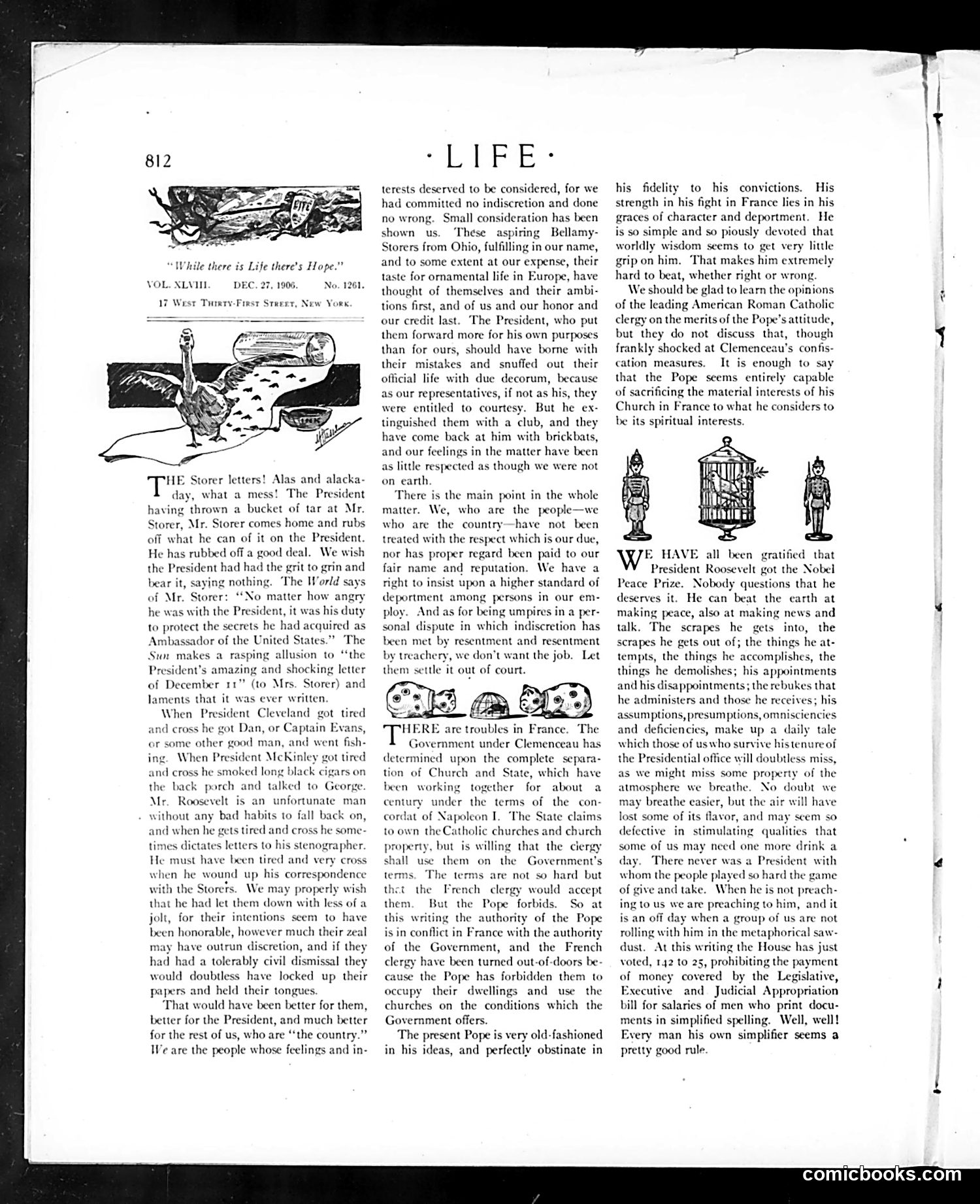
The main cartoon depicts **President Theodore Roosevelt** as a figure being struck or attacked, illustrating criticism over the **Storer letters scandal**. The text discusses how Roosevelt dismissed Ambassador Bellamy Storer and his wife after they publicly criticized the President's handling of Church-State relations in France. The cartoon criticizes Roosevelt's response—using a "club" against those who questioned him—as disrespectful to American citizens' right to voice opinions. The article argues that while Roosevelt deserves credit for his Nobel Peace Prize, he's shown poor judgment in how he treated the Storers, who were prominent Republicans. The satire suggests the President's famous aggressive personality ("grit") becomes counterproductive when directed at fellow citizens exercising free speech.
📄 Transcribed text from this page (OCR, searchable)
Machine-transcribed from the original scan — historical spelling and the odd misread are preserved.
“While there is Life there’s Hope.” VOL. XLVI DEC. 27, 1906. No.1 17 West Turry-First Street, New Yori. HE Storer letters! Alas and alacka- day, what a mess! The President having thrown a bucket of tar at Mr. Storer, Mr. Storer comes home and rubs off what he can of it on the President. He has rubbed off a good deal. We wish the President had had the grit to grin and bear it, saying nothing. The World says Mr. Storer: “No matter how angry he was with the President, it was his duty to protect the secrets he had acquired as Ambassador of the United States.” The ‘Sun makes a rasping allusion to “the President’s amazing and shocking letter of December 11” (to Mrs. Storer) and laments that it was ever written. When President Cleveland got tired nd cross he got Dan, or Captain or some other good man, and went fish- ing. When President McKinley got tired and cross he smoked long black cigars on the back porch and talked to George. Mr. Roosevelt is an unfortunate man without any bad habits to fall back on, and when he gets tired and cross he some- times dictates letters to his stenographer. He must have been tired and very cross when he wound up his correspondence with the Storers. We may properly wish that he had let them down with less of a jolt, for their intentions seem to have n honorable, however much their zeal ay have outrun discretion, and if they had had a tolerably civil dismissal they would doubtless have locked up their papers and held their tongues. ‘That would have been better for them, better for the President, and much better for the rest of us, who are “the country.” IWe are the people whose feelings and in- bee ‘LUPE: terests deserved to be considered, for we had committed no indiscretion and done no wrong. Small consideration has been shown us. ‘These aspiring Bellamy- Storers from Ohio, fulfilling in our name, and to some extent at our expense, their taste for ornamental life in Europe, have thought of themselves and their ambi- tions first, and of us and our honor and our credit last. The President, who put them forward more for his own purposes than for ours, should have borne with their mistakes and snuffed out their official life with due decorum, because as our representatives, if not as his, they were entitled to courtesy. But he ex- tinguished them with a club, and they have come back at him with brickbats, and our feelings in the matter have been. as little respected as though we were not on earth There is the main point in the whole matter. We, who are the people—we who are the country—have not been treated with the respect which is our due, nor has proper regard been paid to our fair name and reputation. We have a right to insist upon a higher standard of deportment among persons in our em- ploy. And as for being umpires in a per- sonal dispute in which indiscretion has been met by resentment and resentment by treachery, we don’t want the job. Let them settle it out of court. fiaees yovernment under Clemenceau has determined upon the complete separa- tion of Church and State, which have been working together for about a century under the terms of the con- cordat of Napoleon I. The State claims to own theCatholic churches and church property, but is willing that the clergy shall use them on the Government's terms. The terms are not so hard but thet the French clergy would accept them. But the Pope forbids. So at this writing the authority of the Pope is in conflict in France with the authority of the Government, and the French clergy have been turned out-of-doors be- cause the Pope has forbidden them to occupy their dwellings and use the churches on the conditions which the Government offers. ‘The present Pope is very old-fashioned in his ideas, and perfectly obstinate in his fidelity to his convictions. His strength in his fight in France lies in his graces of character and deportment. He is so simple and so piously devoted that worldly wisdom seems to get very little grip on him. That makes him extremely hard to beat, whether right or wrong. We should be glad to learn the opinion of the leading American Roman Catholic clergy on the merits of the Pope’s attitude, but they do not discuss that, though frankly shocked at Clemenceau’s confi cation measures. It is enough to say that the Pope seems entirely capable of sacrificing the material interests of his Church in France to what he considers to be its spiritual interests. E HAV ds that President Roosevelt got the Nobel Peace Prize. Nobody questions that he deserves it. He can beat the earth at making peace, also at making news and talk. The scrapes he gets into, the scrapes he gets out of; the things he at- tempts, the things he accomplishes, the things he demolishes; his appointments and his disappointments; the rebukes that he administers and those he receives; his assumptions, presumptions, omniscienci and deficiencies, make up a daily tale which those of us who survive his tenure of the Presidential office will doubtless miss, as we might miss some property of the atmosphere we breathe. No doubt we may breathe easier, but the air will have lost some of its flavor, and may scem so. defective in stimulating qualities that some of us may need one more drink a day. ‘There never was a President with whom the people played so hard the game of give and take. When he is not preach- ing to us we are preaching to him, and it is an off day when a group of us are not rolling with him in the metaphorical saw- dust. At this writing the House has just voted, 142 to 25, prohibiting the payment of money covered by the Legislative, Executive and Judicial Appropriation bill for salaries of men who print docu- ments in simplified spelling. Well, well! Every man his own simplifier seems a pretty good rule. comicbooks.com