
Life, 1906-12-27 · page 25 of 33
Life — December 27, 1906 — page 25: what you’re looking at
What you’re looking at
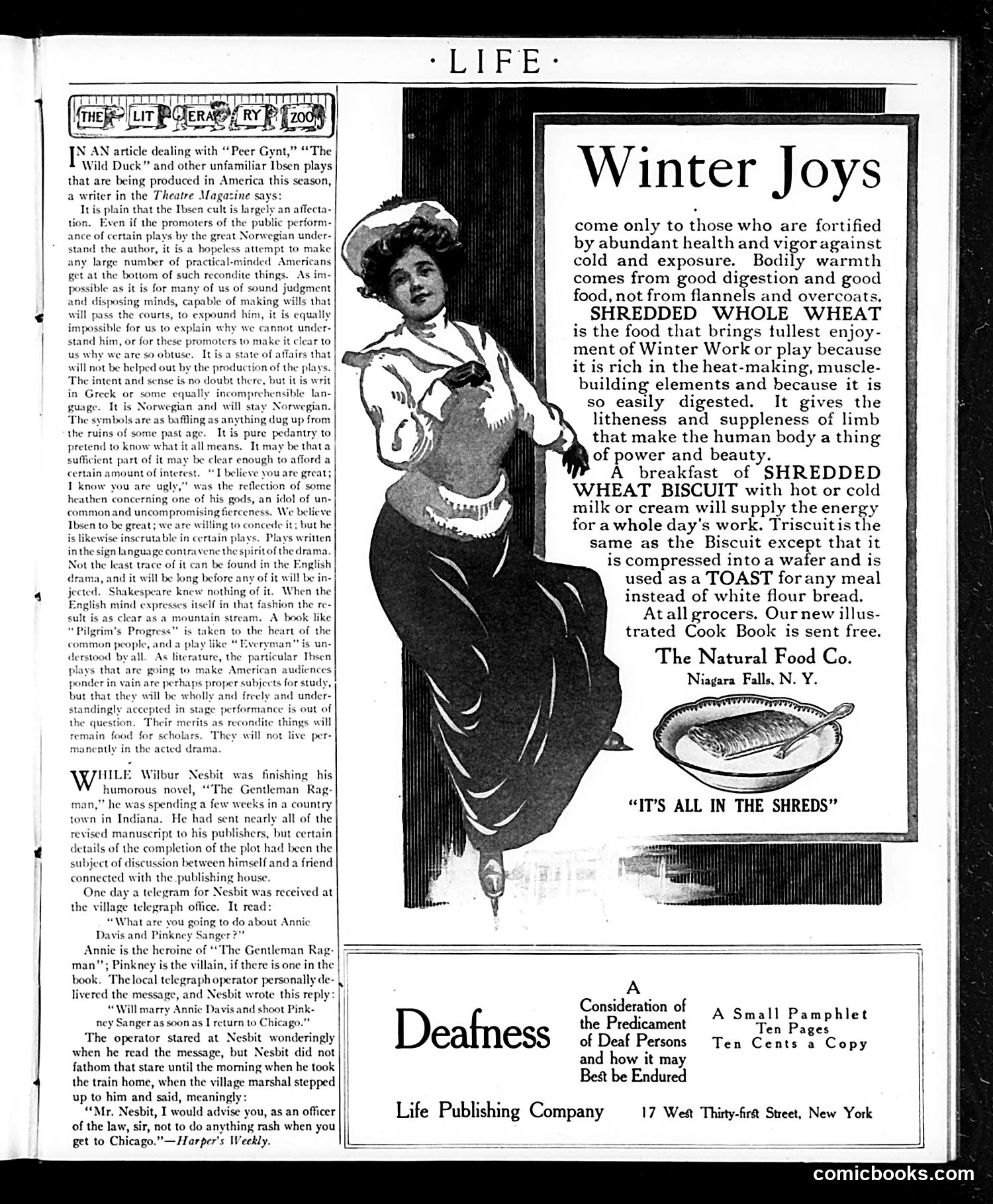
This page contains **two distinct pieces of content**: literary criticism and advertising, with no political cartoon. **Left column**: A critique of Henrik Ibsen's plays being produced in America. The writer dismisses them as incomprehensibly obscure—written in "sign language" and "Norwegian" symbolism that practical Americans cannot understand. The tone is dismissive yet admiring; Ibsen is "great" but deliberately obscure, unlike accessible works like *Pilgrim's Progress* or *Everyman*. **Embedded anecdote**: A humorous story about novelist Wilbur Nesbit. A telegraph operator takes literally Nesbit's joking reply about marrying his novel's heroine and shooting the villain, alerting the local marshal—a joke about the operator's inability to recognize hyperbole. **Right side**: A full-page advertisement for Shredded Wheat cereal, featuring an illustrated woman and promoting the product as body-warming winter food rich in digestible nutrients. The slogan reads "It's All in the Shreds." The page reflects early 1900s attitudes toward modernist drama as elitist and impenetrable to average readers.
📄 Transcribed text from this page (OCR, searchable)
Machine-transcribed from the original scan — historical spelling and the odd misread are preserved.
RE I AN article dealing with “Peer Gynt,” “The Wild Duck” and other unfamiliar Ibsen plays that are being produced in America this season, It is plain that the Ibsen cult is largely an affecta- en if the promoters of the public perform- ance of certain plays by the great Norwegian under- stand the author, it is a hopeless attempt to make any large number of practical-minded Ameri get at the bottom of such recondite things. As im- possible as it is for many of us of sound judgment and disposing minds, capable of » will pass the courts, to expound hin’ impossible for us to explain why we cannot under- t clear to affairs that n of the plays. | tion moters to mak us why we are so obtuse. It isa will not be helped out by the produ The intent and sense is no doubt there, in Greck or some equally incomprehensible lan- guage. It is Norwegian and will stay Norwegian. ‘The symbols are as baffling as anything dug up from the ruins of some past age. It is pure pedantry to pretend to know what it all means. It may be thata nt part of it may be clear enough to afford a namount of interest. “I believe you are great; I know you are ugly,” was the reflection of some heathen concerning one of his gods, an idol of un- commonand uncompromising fierceness. We believe Ibsen to be great; we are willing to concede it; but he se inscrutable in certain plays. Plays written c sign language contravene the spirit of the drama Not the least trace of it can be found in the English g before any of it will be in- knew nothing of it. When the sh mind expresses itself in that fashion the re~ ‘A book like heart of the stand him, or for these p itis writ| sult is as clear as a mountain stream “Pilgrim's Progress” is taken to th common people, and a play like “Ew nis un- jerstood by all. As literature, the particular Thsen plays that are going to make American audiences ponder in vain are perhaps proper subjects for study, but that they will be wholly and and under- gly accepted in stage performance is out of E recondite things will hey will not live per- remain food manently in the acted ‘drama HILE Wilbur Nesbit was finishing his. humorous novel, “The Gentleman Rag- man,” he was spending a few weeks in a country town in Indiana. He had sent nearly all of the ed manuscript to his publishers, but certain of the completion of the plot had been the subject of discussion between himself and a friend cted with the publishing house. One day a telegram for Nesbit was received at the village telegraph office. It read: “What are you going to do about Annic Da i Pin! anger?” Annie is the heroine of “The Gentleman Ra man”; Pinkney is the villain, if there is one in th book. The local telegraph operator personally de livered the message, and Nesbit wrote this reply “Will marry Annic Davis and shoot Pink- Sanger as soon as I return to Chicago.” The operator stared at Nesbit wonderingly when he read the message, but bit did not fathom that stare until the morning when he took ney the train home, when the village marshal stepped | || up to him and said, meaningly: “Mr. Nesbit, I would advise you, as an officer of the law, sir, not to do anything rash when you get to Chicago.” —Harper's Weekly. Winter Joys come only to those who are fortified by abundant health and vigor against cold and exposure. Bodily warmth comes from good digestion and good food, not from flannels and overcoats. SHREDDED WHOLE WHEAT is the food that brings tullest enjoy- ment of Winter Work or play because it is rich in the heat-making, muscle- building elements and because it is so easily digested. It gives the litheness and suppleness of limb that make the human body a thing of power and beauty. A breakfast of SHREDDED WHEAT BISCUIT with hot or cold milk or cream will supply the energy for a whole day’s work. Triscuitis the same as the Biscuit except that it is compressed into a wafer and is used as a TOAST forany meal instead of white flour bread. Atall grocers. Our new illus- trated Cook Book is sent free. The Natural Food Co. Niagara Falls, N. Y. and how it may Best be Endured Consideration of | D 3 fn the Predicament Small pompbles {| e€ ess of Deaf Persons Ten Cents a Copy | | Life Publishing Company —17 Wes Thirty-firt Street, New York comicbooks.com