
Life, 1906-12-27 · page 20 of 33
Life — December 27, 1906 — page 20: what you’re looking at
What you’re looking at
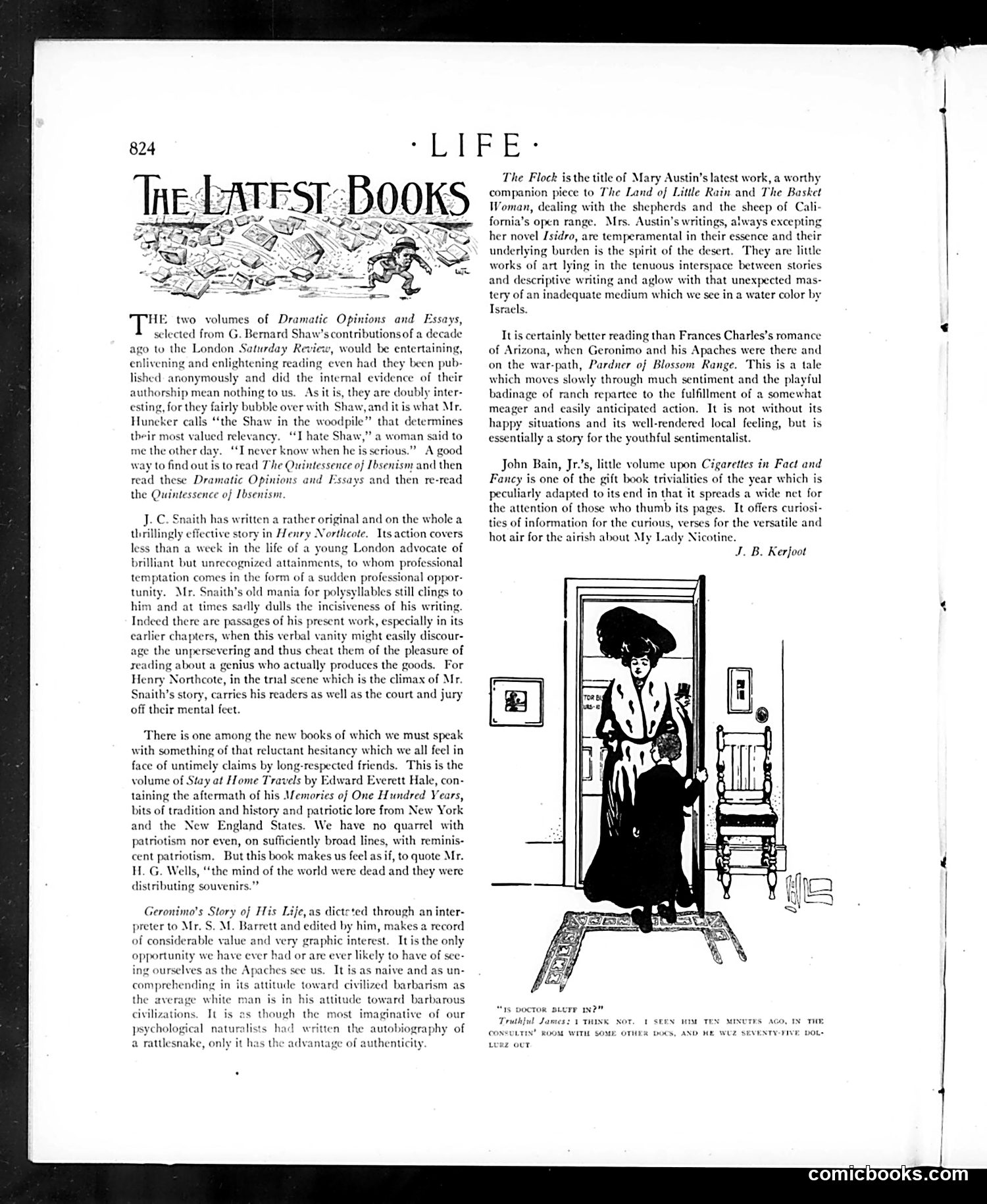
This is a literary review section from *Life* magazine featuring illustrations and commentary on new publications. The main cartoon shows a woman in her home interior with furniture and a baby carriage, accompanying a review of John Bain Jr.'s *Cigarettes in Fact and Fancy*. The caption beneath reads: "Dr. BLEET IN?" with dialogue about "Doctor James" visiting "ten minutes ago" — a mild domestic scene playing on the book's subject matter about smoking. The page primarily reviews recent works by George Bernard Shaw, J.C. Snaith, Edward Everett Hale, and notably **Geronimo's autobiography**, which the critic praises as offering rare authentic perspective on Apache views of white civilization. The reviewer uses this as satire: comparing it favorably to psychological naturalism, while ironically noting Geronimo's "naive and uncomprehending" attitude toward "civilized barbarism" — mirroring white condescension toward indigenous peoples. The reviews mix literary criticism with social commentary typical of *Life*'s satirical approach to contemporary culture and letters.
📄 Transcribed text from this page (OCR, searchable)
Machine-transcribed from the original scan — historical spelling and the odd misread are preserved.
HE two volumes of Dramatic Opinions and Essays, selected from G. Benard Shaw’scontributionsof a decade ago to the London Saturday Review, would be entertaining, enlivening and enlightening reading even had they been pub- lished anonymously and did the internal evidence of their authorship mean nothing to us. As itis, they are doubly inter- esting, for they fairly bubble over with Shaw,and itis what Mr. Huncker calls “the Shaw in the woodpile” that determine their most valued relevancy. “I hate Shaw,” a woman said to me the other day. ‘I never know when he is serious.” A good way to find out is to read The Quintessence of Ibsenism and then read these Dramatic Opinions and Essays and then re-read the Quintessence of Ibsenism J. C. Snaith has written a rather original and on the whole a thrillingly effective story in Henry Northcote. Itsaction cov less than a week in the life of a young London advocate of brilliant but unrecognized attainments, to whom professional temptation comes in the form of a sudden professional oppor tunity. Mr. Snaith’s old mania for polysyllables still clings to him and at times sadly dulls the incisiveness of his writing. Indeed there are passages of his present work, especially in its earlier chapters, when this verbal vanity might easily discour- age the unpersevering and thus cheat them of the pleasure of seading about a genius who actually produces the goods. For Henry Northcote, in the trial scene which is the climax of Mr. Snaith’s story, carries his readers as well as the court and jury off their mental feet. There is one among the new books of which we must speak with something of that reluctant hesitancy which we all feel in ace of untimely claims by long-respected friends. This is the volume of Stay at Home Travels by Edward Everett Hale, con- taining the aftermath of his Memories of One Hundred Years, bits of tradition and history and patriotic lore from New York and the New England States. We have no quarrel with patriotism nor even, on sufficiently broad lines, with reminis- cent patriotism, But this book makes us feel as if, to quote Mr. H. G. Wells, ‘‘the mind of the world were dead and they were distributing souvenirs. Geronimo’s Story of His Lije,as dictcted through an inter- preter to Mr. S. M. Barrett and edited by him, makes a record of considerable value and very graphic interest. It is the only opportunity we have ever had or are ever likely to have of see- ing ourselves as the Apaches see us. It is as naive and as un- comprehending in its attitude toward civilized barbarism as the average white man is in his attitude toward barbarous ative of our civilizations. It is as though the most written the autobiography of of authenticity. psychological naturalists hac a rattlesnake, only it has advantay LIFE The Flock isthe title of Mary Austin’s latest work, a worthy companion piece to The Land of Little Rain and The Basket Woman, dealing with the shepherds and the sheep of Cali fornia’s open range. Mrs. Austin’s writings, always exceptin her novel Isidro, are temperamental in their essence and their underlying burden is the spirit of the desert. They are little works of art lying in the tenuous interspace between stories and descriptive writing and aglow with that unexpected mas- tery of an inadequate medium which we see in a water color by Israels. It is certainly better reading than Frances Charles’s romance of Arizona, when Geronimo and his Apaches were there and on the war-path, Pardner oj Blossom Range. This is a tale which moves slowly through much sentiment and the playful badinage of ranch repartee to the fulfillment of a somewhat meager and easily anticipated action. It is not without its happy situations and its well-rendered local feeling, but is essentially a story for the youthful sentimentalist. John Bain, Jrs, little volume upon Cigarettes in Fact and Fancy is one of the gift book trivialities of the year which is peculiarly adapted to its end in that it spreads a wide net for the attention of those who thumb its pa It offers curiosi- ties of information for the curious, verses for the versatile and hot air for the airish about My Lady Nicotine. J.B. Kerjoot “13 pocToR BLUTF IN?” Truthjul James: 1 THINK NOT. 1 SEEN IDM TEN MINUTYS AGO, IN THO: CONSULTIN’ ROOM WITH SOME OTHER DOCS, AND ME WUZ SEVENTYIIVE DOL 2 OT « comicbooks.com