
A complete issue · 46 pages · 1906
Life — December 20, 1906
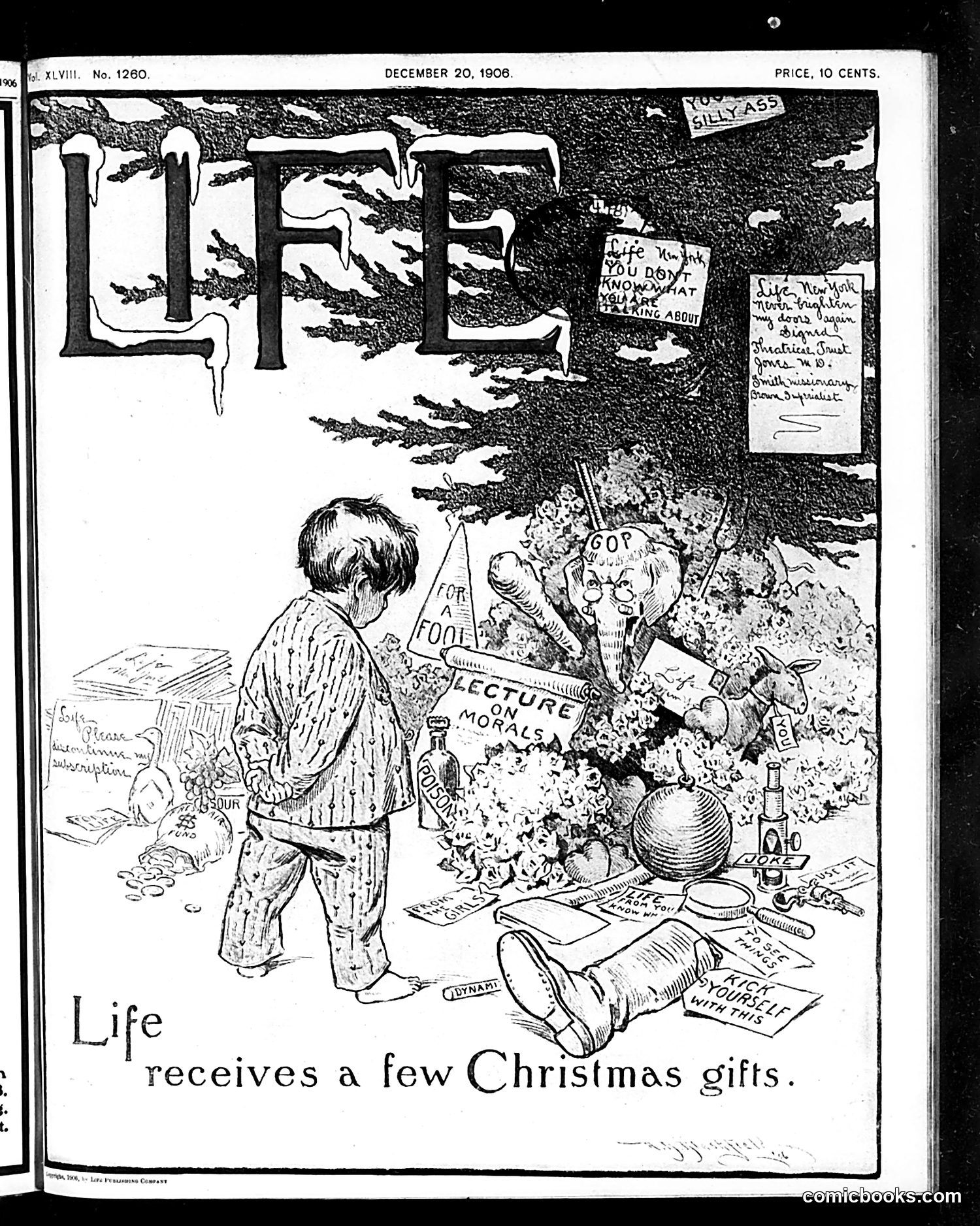
This editorial cartoon satirizes the Republican Party (GOP) and political corruption during Theodore Roosevelt's presidency. A figure representing "Life" (the magazine itself) examines Christmas gifts—actually political scandals and criticisms—strewn about like garbage. The gifts include labeled items referencing contemporary controversies: "Lecture on Morals" (apparent hypocrisy), "Dynamite" (likely referring to violent labor disputes or anarchist concerns), and various other items suggesting political failures and broken promises. The skull marked "GOP" and other dark imagery indicate Life's view of Republican governance as destructive and morally bankrupt. The satire mocks the party's self-presentation of virtue while pointing to actual harmful policies and scandals. This reflects progressive-era criticism of Republican leadership.
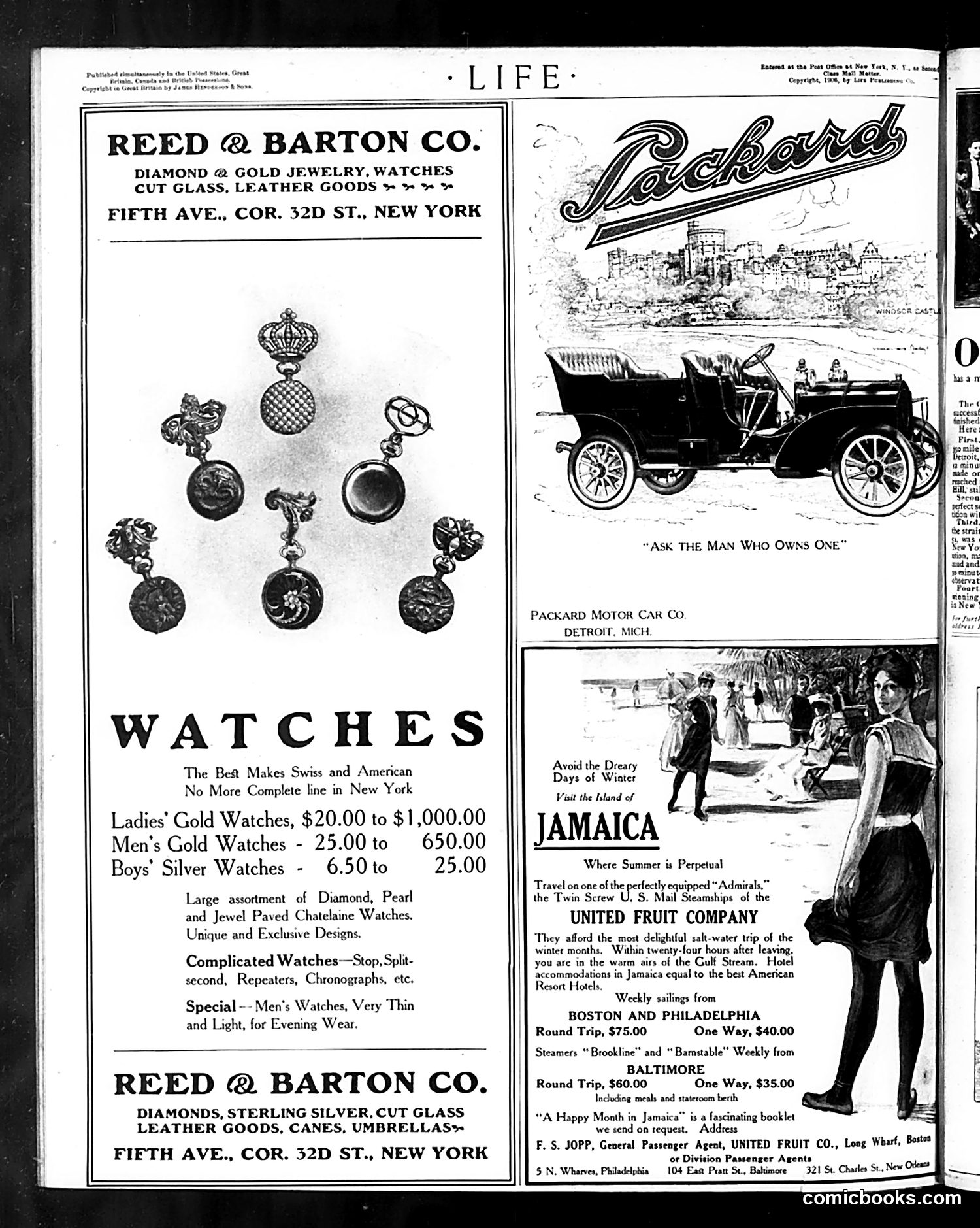
This page consists almost entirely of **advertisements**, not editorial cartoons or satirical content. The left side features Reed & Barton Co. advertising watches and jewelry, with product images and pricing for ladies', men's, and boys' watches ranging from $6.50 to $1,000. The right side advertises a Packard automobile ("Ask the Man Who Owns One") and United Fruit Company's Jamaica vacation cruises, promoting winter travel to escape "dreary days" with steamship options from Boston, Philadelphia, and Baltimore. There is **no political cartoon or satirical commentary** on this page. It represents early 20th-century luxury consumer advertising typical of *Life* magazine's revenue model during this era.
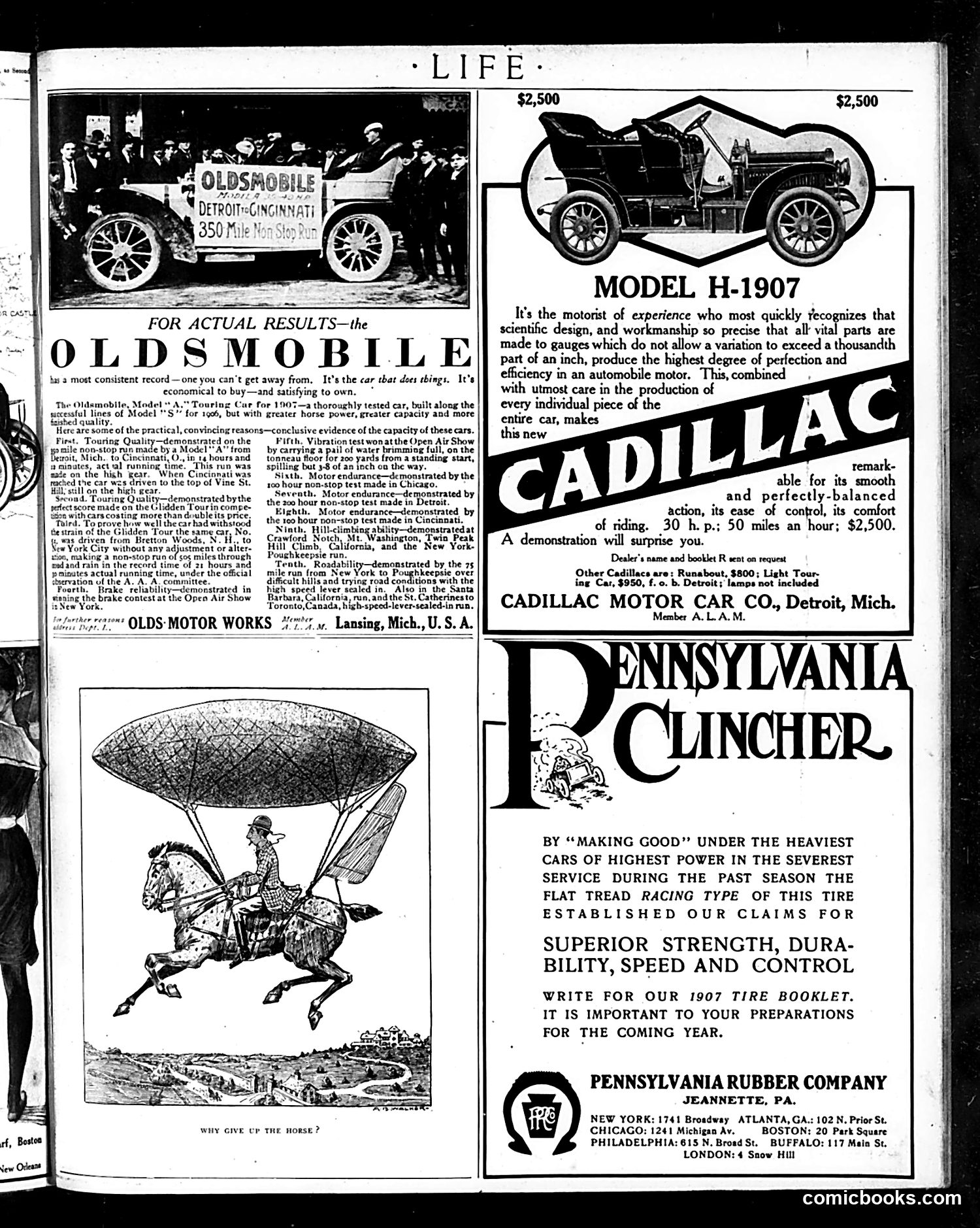
This page is primarily **advertising rather than political satire**. It contains three automobile and tire advertisements from 1907: 1. **Oldsmobile** (top left): Advertises the Model "A" and Model "B," emphasizing their reliability through performance records and endurance tests. 2. **Cadillac** (top right): Promotes the Model H-1907 ($2,500), highlighting precision manufacturing and smooth operation at 30 h.p., 50 miles per hour. 3. **Pennsylvania Clincher Tire** (bottom right): Features a humorous illustration of a man on horseback with a parachute-like umbrella, asking "WHY GIVE UP THE HORSE?" The visual joke compares tire reliability to switching from horses to automobiles—suggesting tires are now dependable enough to make that transition practical. The page reflects early 1900s automotive marketing, with no apparent political commentary.
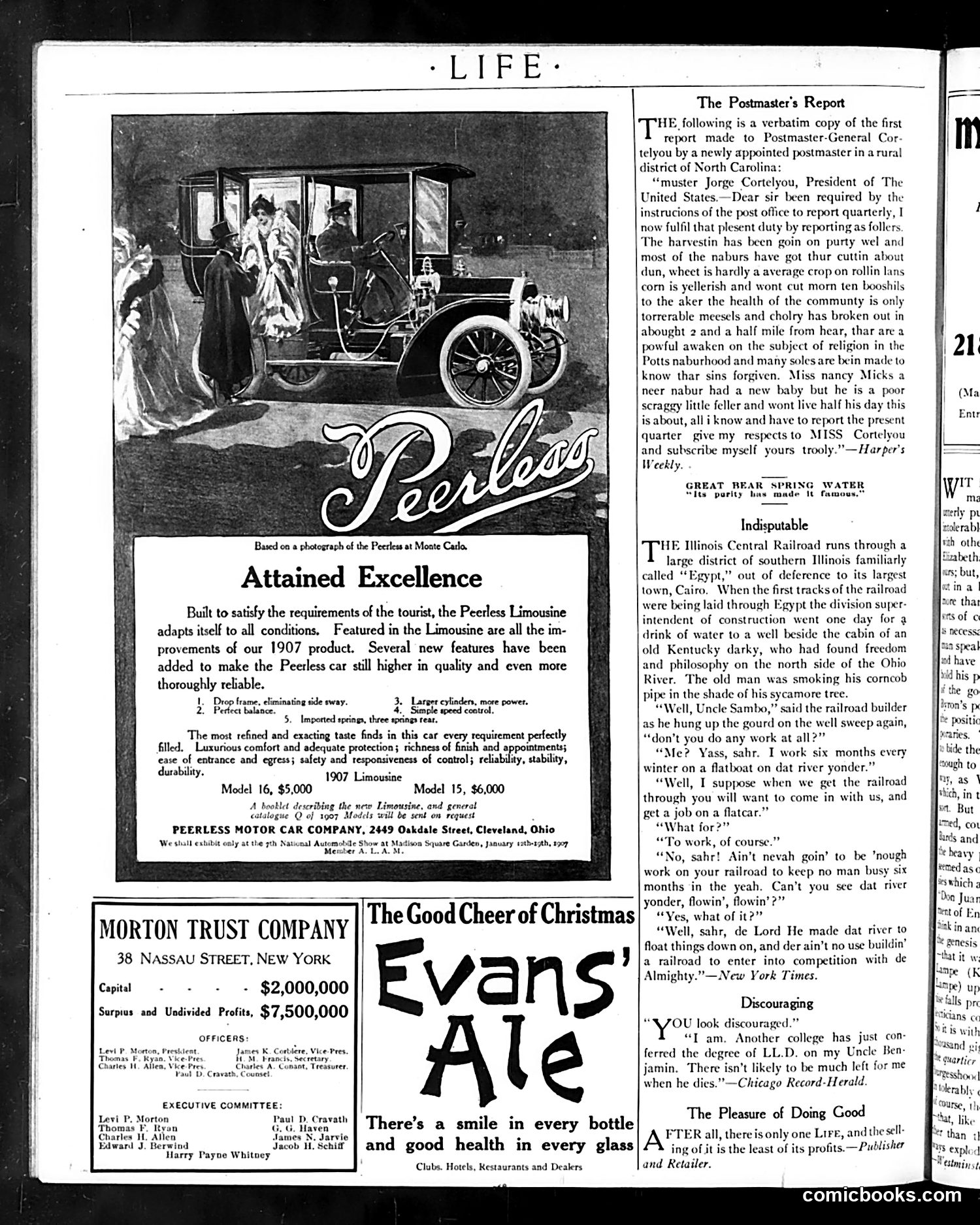
This page is **primarily advertisements** rather than political satire. The main image shows a Peerless Limousine automobile, marketed as having "attained excellence" with various mechanical improvements for 1907-1908. Below that is a Morton Trust Company financial advertisement and Evans' Ale promotion. The only editorial content is "The Postmaster's Report" — a humorous letter supposedly from a newly appointed rural North Carolina postmaster to the Postmaster General, detailing local hardships: poor harvests, disease, and a woman (Miss Nancy Micks) seeking forgiveness for past sins. The joke appears gentle: rural incompetence and naive piety. There's also "Indisputable," a brief anecdote about an old man and a railroad builder along the Ohio River, seemingly illustrating folk wisdom.
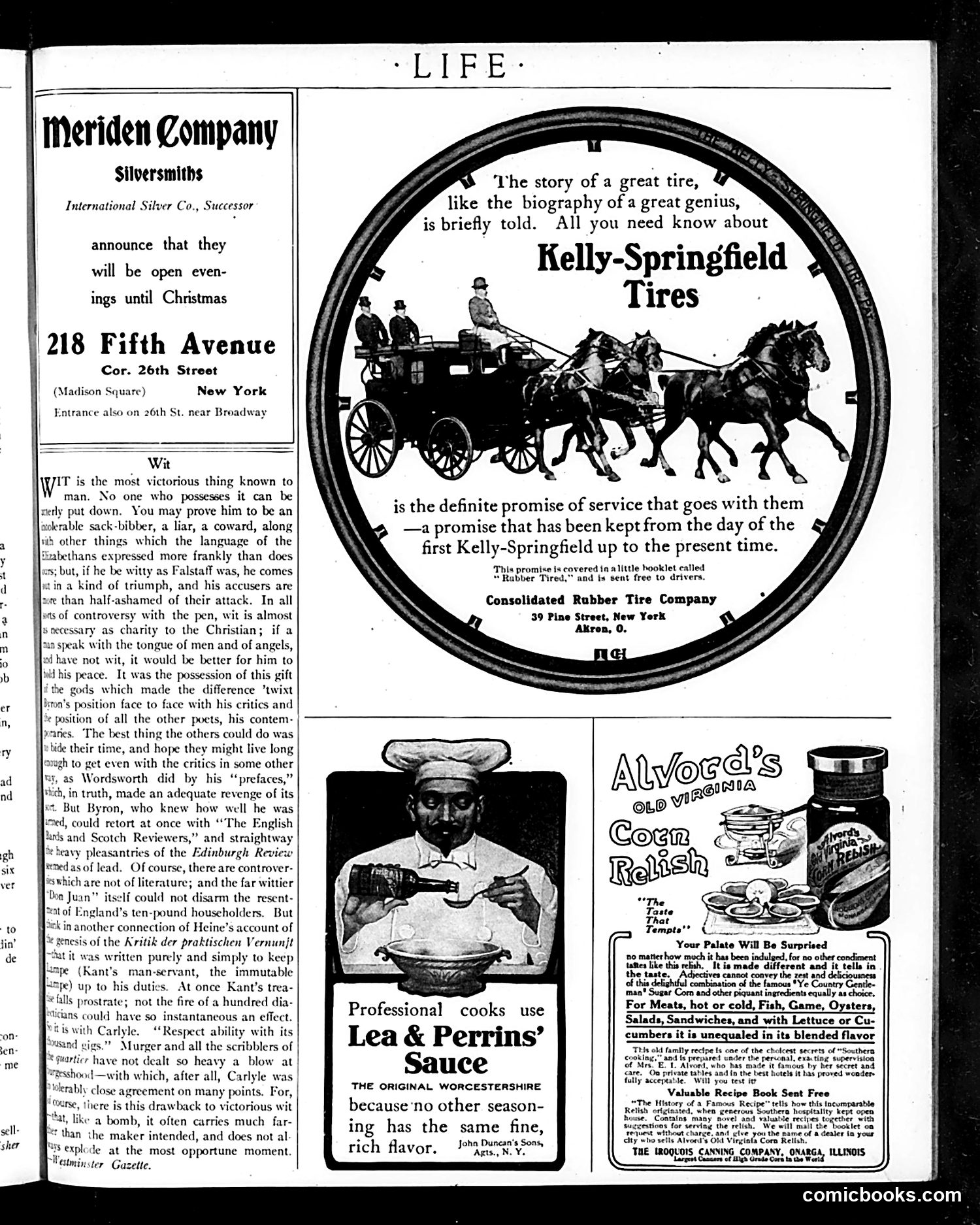
This page is primarily **advertising**, not satire or political commentary. It contains three commercial advertisements: 1. **Meriden Company Silversmiths** (top left) — announcing holiday hours in New York 2. **Kelly-Springfield Tires** (center) — featuring a horse-drawn carriage to emphasize the tire's reliability and longevity ("from the day of the first Kelly-Springfield up to the present time") 3. **Lea & Perrins' Sauce** and **Alvord's Old Virginia Corn Relish** (bottom) — food product ads The only non-advertising content is a brief essay on "Wit" (left column), discussing how wit differs from other forms of cleverness. There is no political cartoon or satirical content visible on this page. It represents typical early 20th-century *Life* magazine advertising and editorial material.
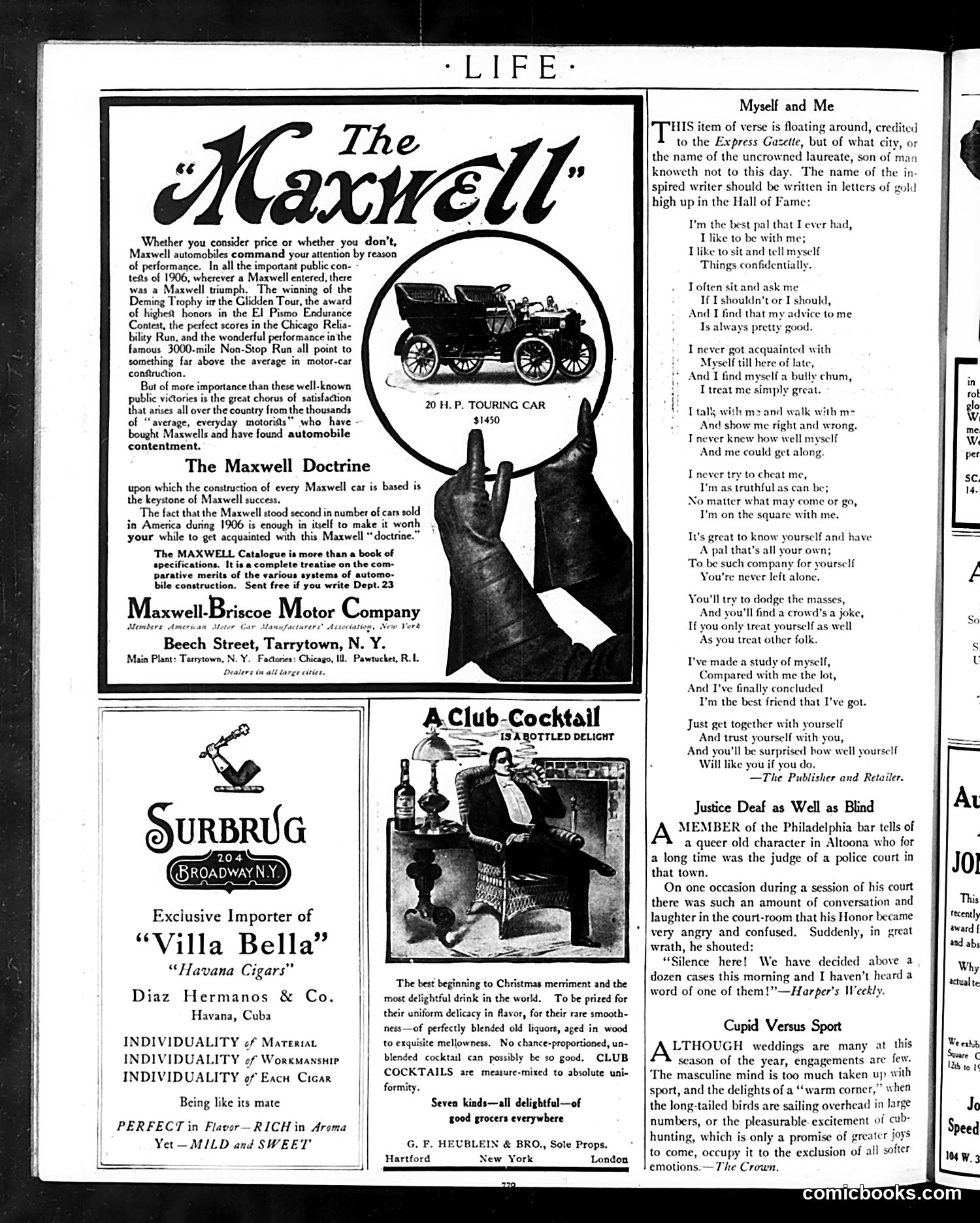
This page is primarily **advertising**, not satire or political commentary. The dominant feature is a **Maxwell automobile advertisement** featuring a 20 HP touring car ($1,450). The ad emphasizes the car's reliability and performance through racing victories and testimonials from everyday drivers. Below that is a **Subrrig cigar advertisement** for "Villa Bella" Havana cigars, emphasizing individual quality and rich aroma. There's also a **Club Cocktail advertisement** showing a man enjoying drinks, promoting bottled cocktails as convenient. The right column contains **"Myself and Me,"** a lighthearted verse about self-companionship, and short humor pieces like **"Justice Deaf as Well as Blind"** (an anecdote about a confused judge) and **"Cupid Versus Sport"** (commentary on weddings versus hunting season). This is a typical Life magazine page mixing advertisements with light satirical content.
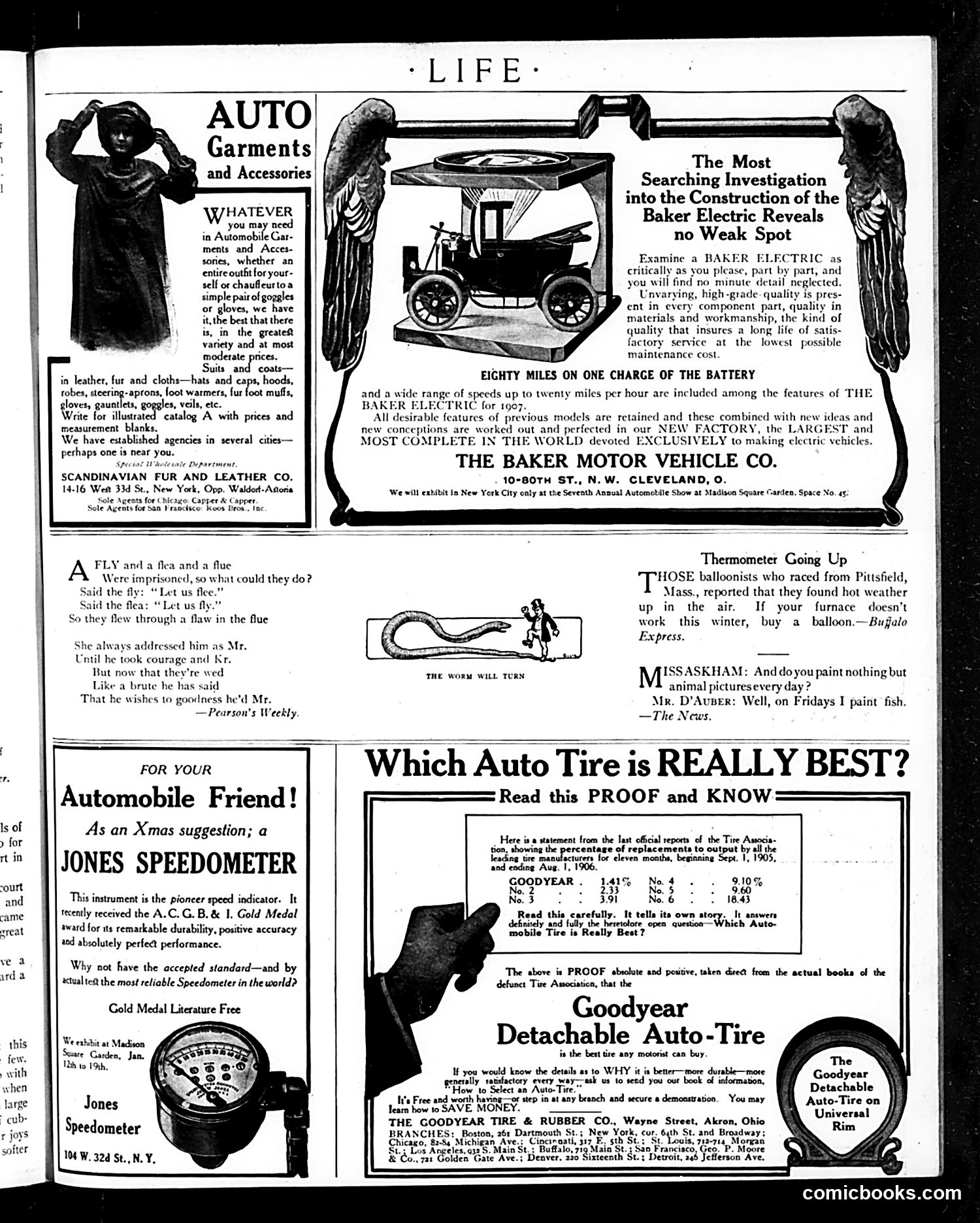
This page is primarily **advertising**, not satirical content. The main advertisements are: 1. **AUTO Garments and Accessories** - selling driving clothes and gear 2. **Baker Motor Vehicle Co.** - promoting their electric car (claiming 80 miles on one battery charge) 3. **Jones Speedometer** - Christmas gift suggestion for automobile enthusiasts 4. **Goodyear Detachable Auto-Tire** - comparative tire analysis claiming superiority The page includes minor **humorous verse** about a fly, flea, and flue (a homophone pun), and brief jokes ("Thermometer Going Up," "Missaskham" dialogue). The **historical context**: This appears early 1900s, when electric vehicles competed with gasoline cars, speedometers were novel technology, and detachable tires were a significant innovation. The advertisements reflect nascent automotive culture and consumer goods marketing to automobile owners.
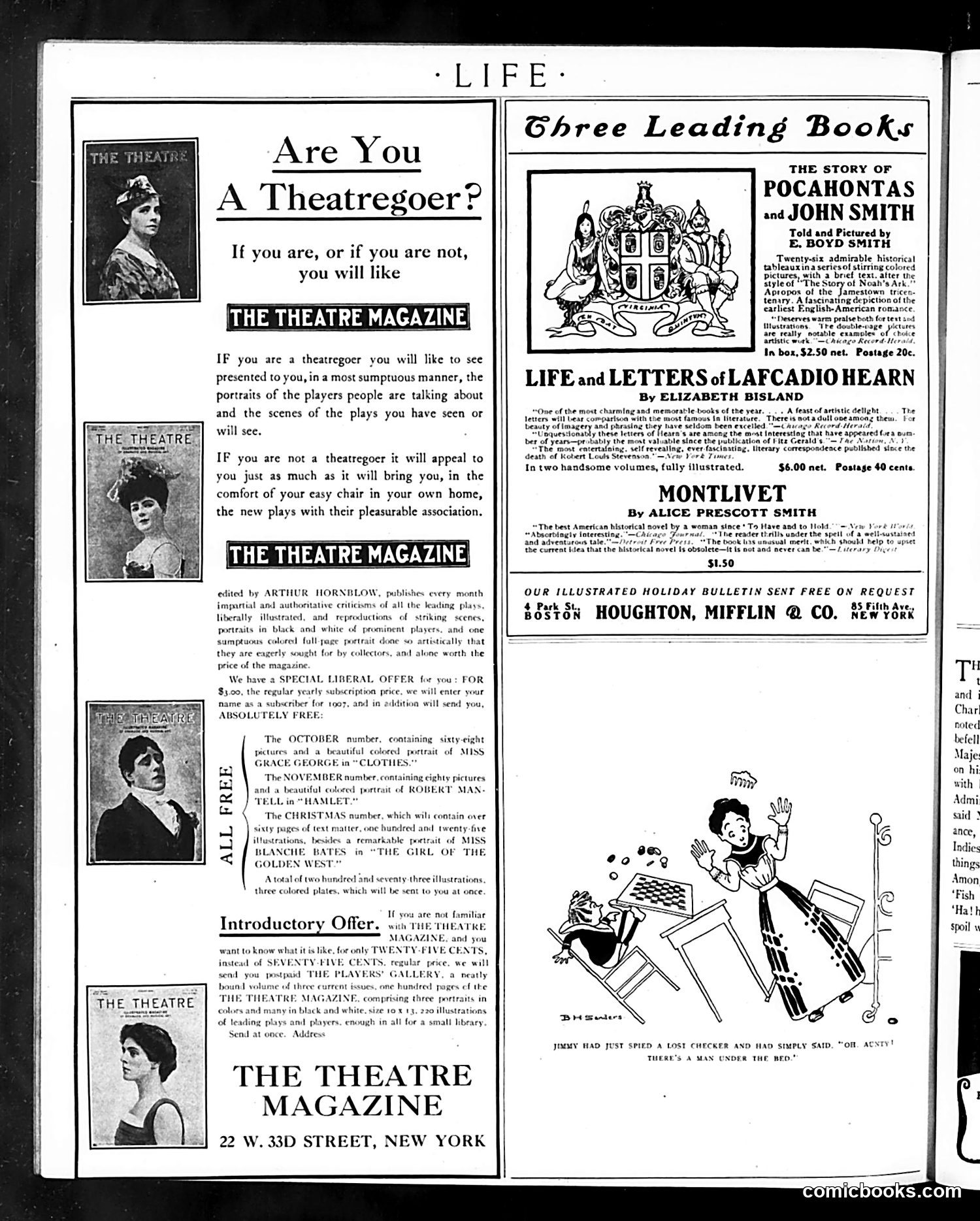
This page is primarily **advertising and editorial content**, not political satire. The left column promotes *The Theatre Magazine* with subscription offers, featuring theatrical portraits. The right side advertises three books from "Obree Leading Books": *The Story of Pocahontas and John Smith*, *Life and Letters of Lafcadio Hearn*, and *Montlivedt*. The only cartoon appears at bottom-right: a humorous domestic scene captioned "Jimmy had just spied a lost checker and had simply said: 'Oh Acey!' There's a man under the bed.'" This is **not political satire** but rather a light domestic joke playing on misheard words—a child's innocent comment about finding a checker game piece creates alarm for adults who misunderstand his statement. The page reflects early 1900s entertainment and literary advertising.
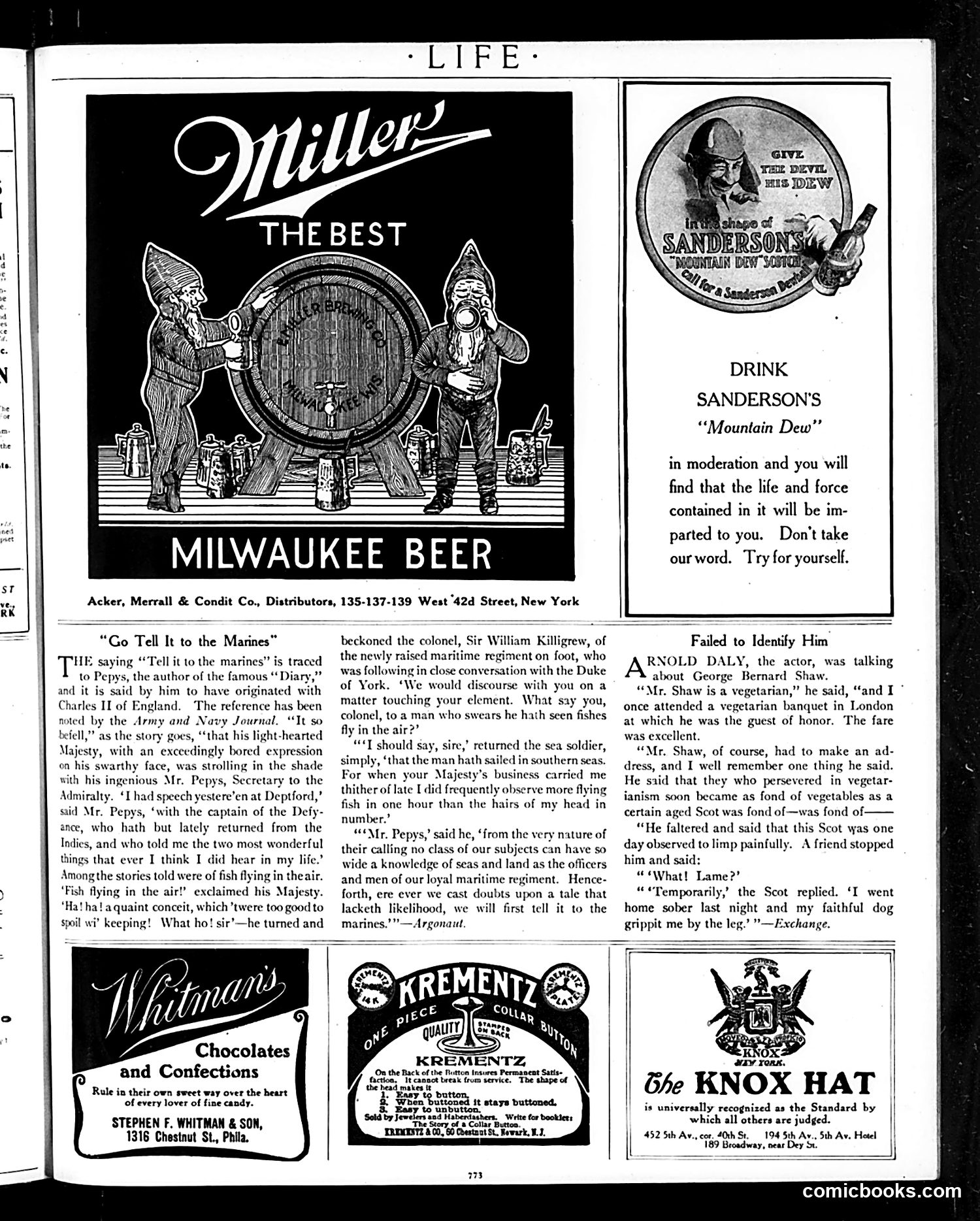
This page is primarily **advertisements** rather than satirical content. The main image shows Miller Beer's "The Best Milwaukee Beer" ad, featuring two gnome-like figures flanking a barrel—a common advertising motif of the era. The text articles ("Go Tell It to the Marines" and "Failed to Identify Him") are anecdotal humor pieces unrelated to the ads, recounting military and social stories. Below are additional advertisements: Whitman's Chocolates, Krementz collar buttons, and Knox Hats. These represent typical early 20th-century consumer goods marketing. The Sanderson's Mountain Dew ad (top right) advertises a patent medicine, promoting health benefits "in moderation"—reflecting the era before strict FDA regulations on health claims. This appears to be a **standard magazine page mixing editorial content with paid advertisements**, not a political cartoon.
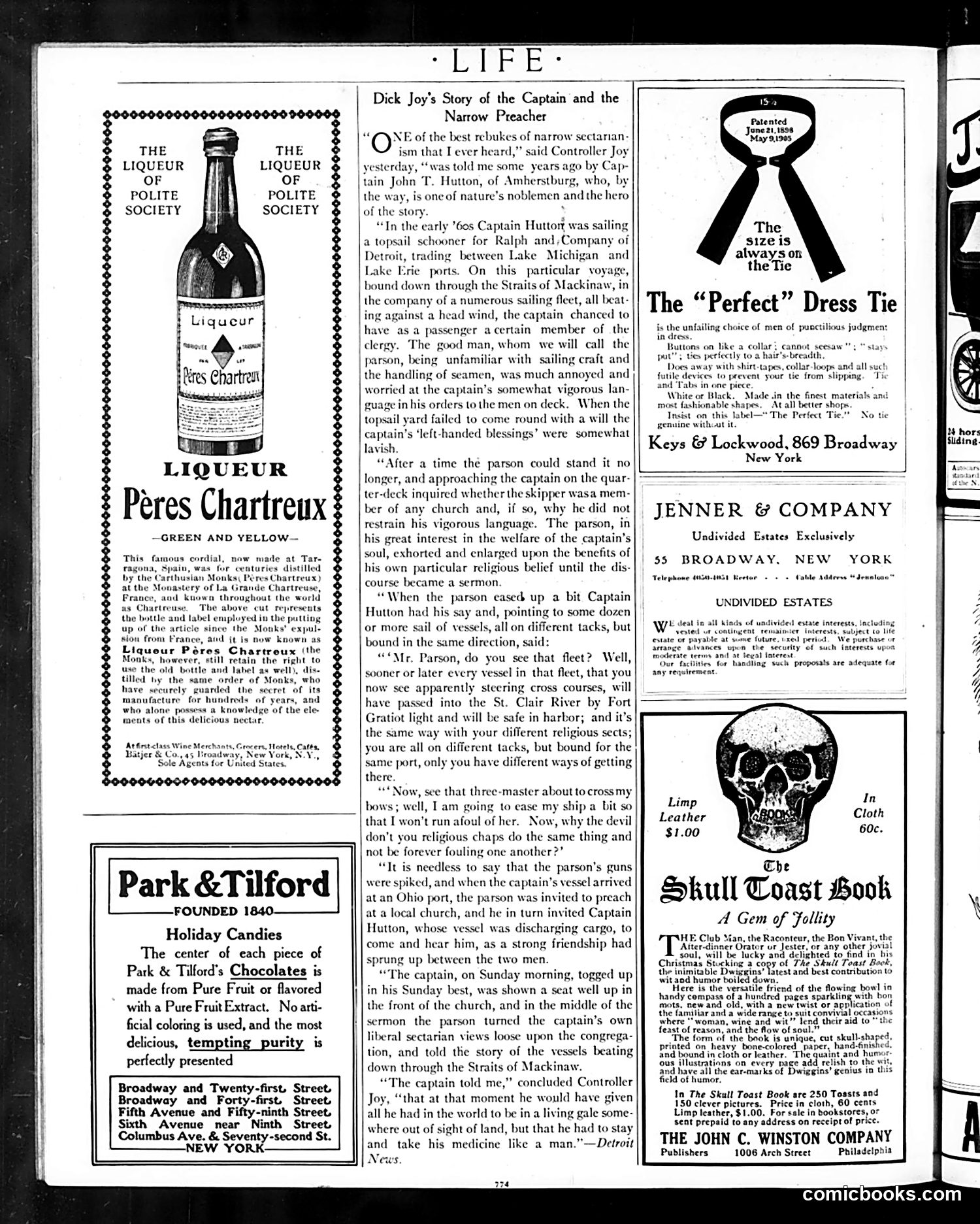
This page is **primarily advertising** with one literary article. The ads include: - **Liqueur Pères Chartreaux**: A French digestif liqueur, marketed as refined and historic - **Park & Tilford Holiday Candies**: Premium chocolates made with pure fruit extracts - **Keys & Lockwood**: A dress tie product - **Jenner & Company**: Estate management services - **The Skull Coast Book**: A novelty item (skull-shaped container with cloth/leather options) The editorial content is **"Dick Joy's Story of the Captain and the Narrow Preacher,"** a sea yarn about Captain Hutton whose vessel encounters a religious clergyman. The story emphasizes tolerance and mutual respect between men of different beliefs sharing close quarters. There is **no political cartoon** on this page—it's a standard early 20th-century magazine layout mixing fiction, lifestyle advertising, and luxury goods targeting affluent readers.
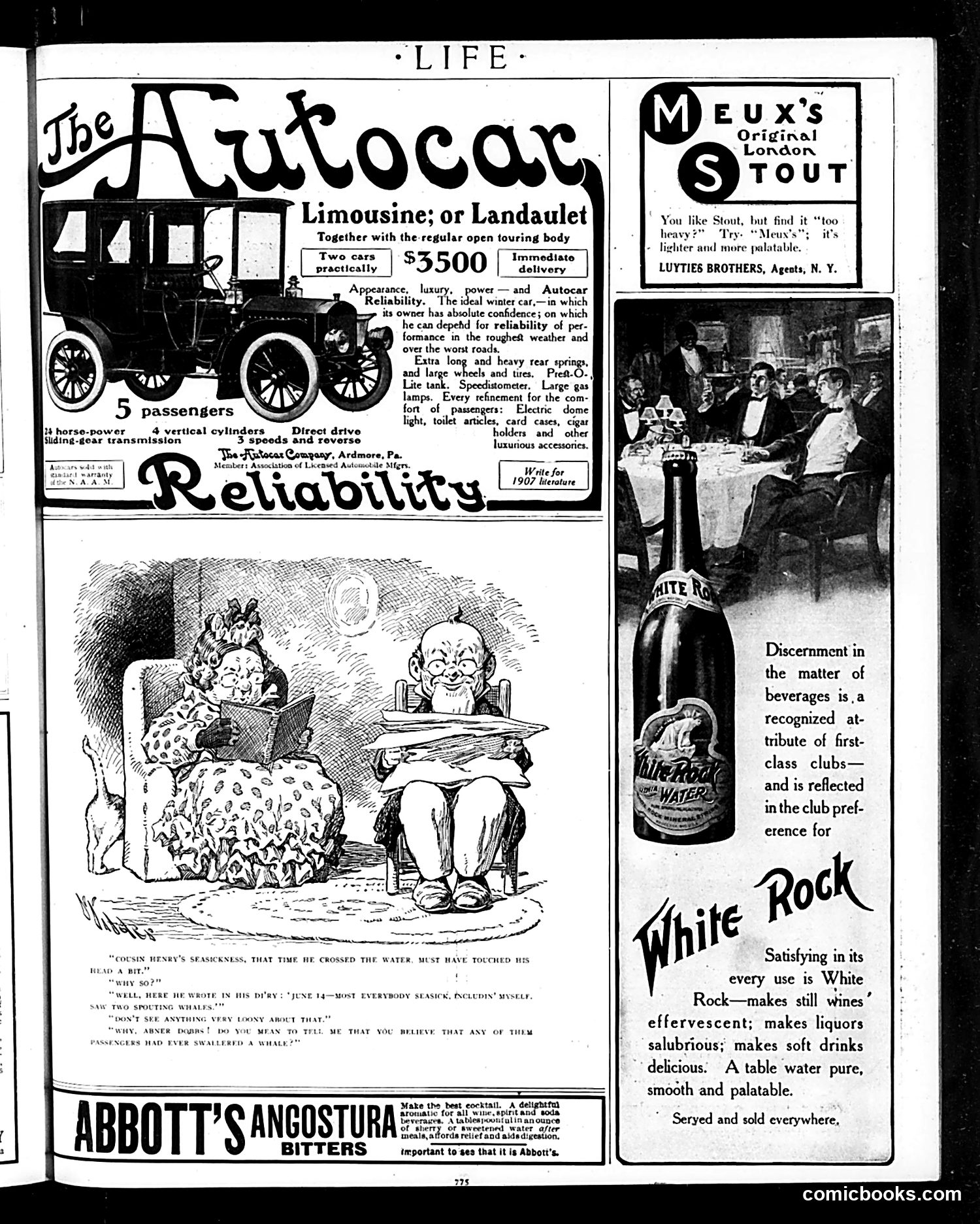
This page is primarily **advertising** rather than editorial content. The main features are: 1. **The Autocar advertisement** (left): Promotes a luxury automobile priced at $3,500, emphasizing reliability and comfort for five passengers. 2. **Political/social cartoon** (center): Depicts exaggerated caricatured figures (appears to show racist stereotyping typical of early 1900s satire) discussing a newspaper. The caption references "Cousin Henry's seasickness" and crossing water, suggesting maritime humor or commentary. 3. **Beverage advertisements** (right): Meux's London Stout and White Rock mineral water ads, targeting affluent consumers. The cartoon's specific satirical meaning is **unclear without additional historical context**, though the exaggerated facial features reflect the problematic caricature conventions of that era.
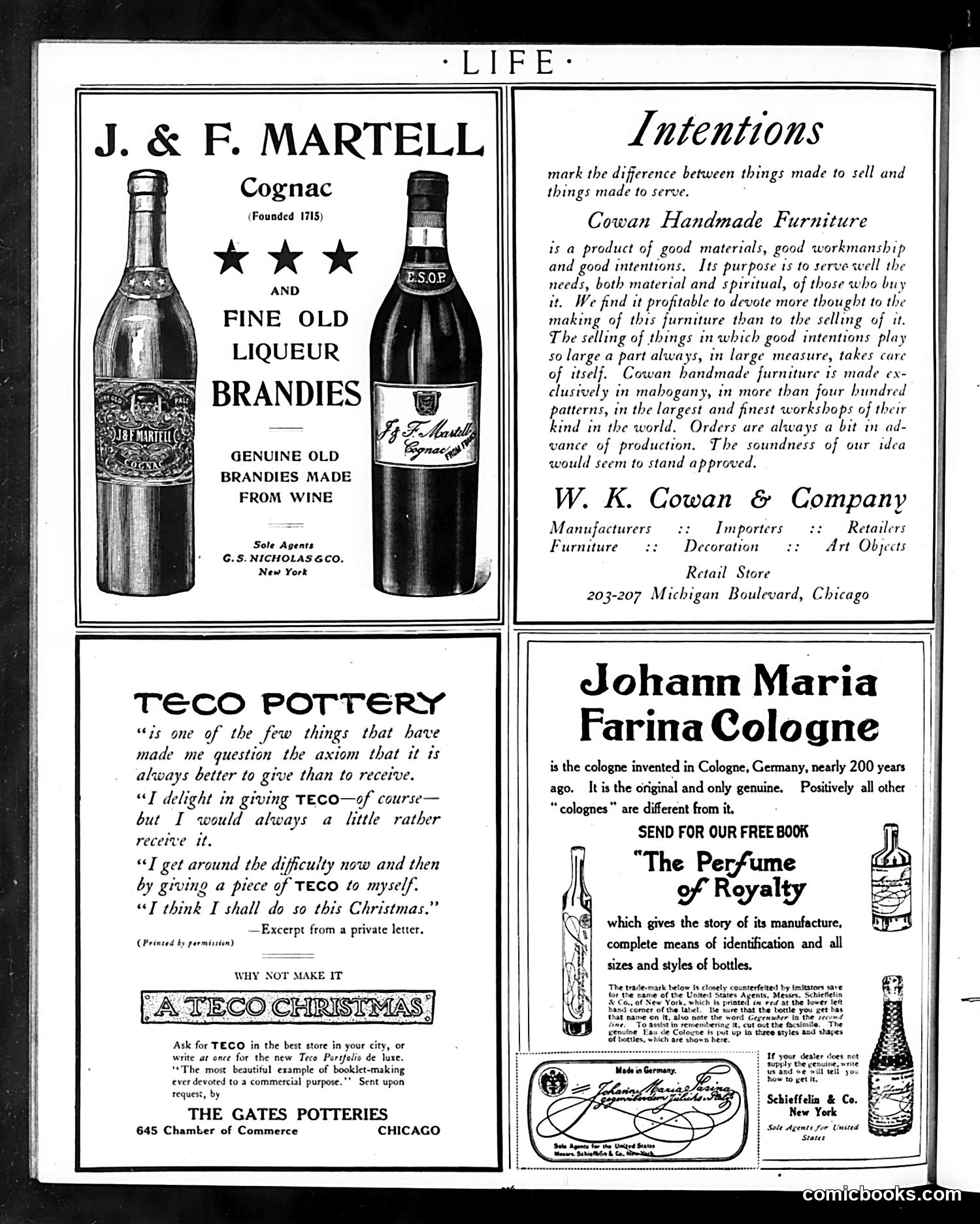
This is an **advertising page**, not a cartoon or satirical content. It contains four separate advertisements: 1. **J. & F. Martell Cognac** — promoting French brandy with two bottle images 2. **W. K. Cowan & Company** — furniture manufacturer in Chicago, emphasizing handmade quality and good intentions in craftsmanship 3. **Teco Pottery** — featuring a testimonial quote (unclear if satirical or genuine) about giving Teco pottery as gifts, encouraging Christmas purchases 4. **Johann Maria Farina Cologne** — advertising German cologne with a free promotional booklet offer The Cowan furniture ad is the only piece addressing consumer values, contrasting items "made to sell" versus "made to serve," but this is straightforward marketing rhetoric rather than satire.
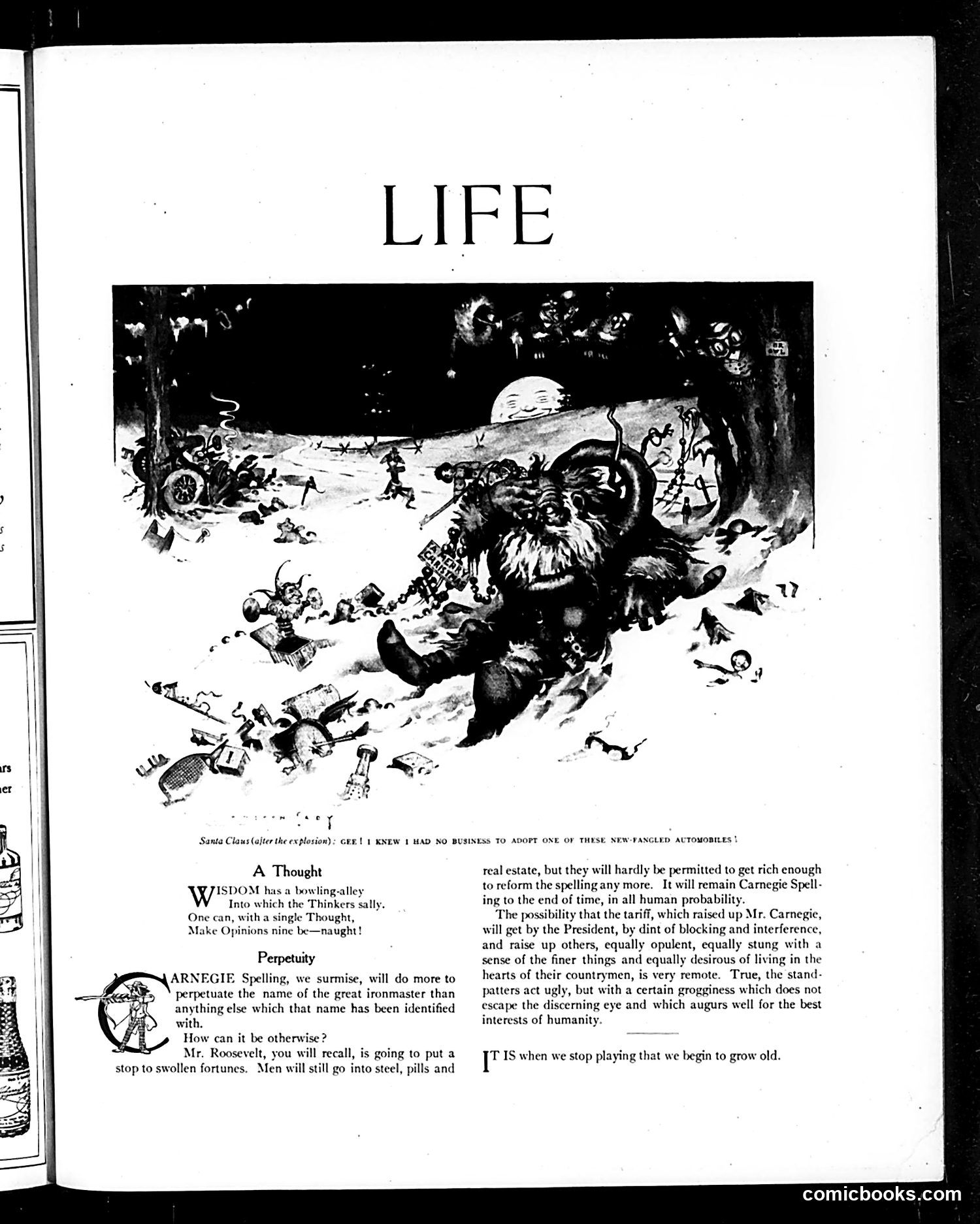
This is a satirical page from *Life* magazine featuring a fantastical illustration and accompanying commentary on wealth and social reform. The main cartoon depicts Santa Claus surrounded by various industrial/commercial items (automobiles, machinery) scattered across a landscape, with a full moon in the background. The caption references Santa adopting "new-tangled automobiles," suggesting criticism of modern commercialism corrupting traditional values. Below, the text sections titled "A Thought" and "Perpetuity" critique wealth inequality and industrial fortunes. "Perpetuity" specifically references "Carnegie Spelling" and discusses Mr. Roosevelt's policies regarding steel, pills, and swollen fortunes—likely referring to President Theodore Roosevelt's trust-busting efforts against industrialists like Andrew Carnegie. The satire targets the contradiction between charitable philanthropy and the perpetuation of massive industrial wealth, arguing that Roosevelt's reforms cannot truly redistribute such fortunes.
This editorial page praises President Theodore Roosevelt's recent message to Congress on various policy matters. The text addresses Roosevelt's recommendations on: **Japanese Immigration**: The page supports Roosevelt's balanced approach—protecting Japanese treaty rights while acknowledging California's concerns about labor competition, noting a diplomatic arrangement with Japan will restrict laborers. **Tax Reform**: Roosevelt proposed graduated income and inheritance taxes. The editor supports these as theoretically just, though acknowledging they'll face resistance. **National Divorce Law**: Endorsed as promoting uniformity across states, though the writer skeptically notes it won't improve bad marriages. **Other Issues**: Trade subsidies for shipping, Philippine trade justice, and Puerto Rican citizenship are presented as reasonable demands. **Military Authority**: Roosevelt seeks power to discharge officers without court-martial. The tone is generally supportive of Roosevelt's ethical leadership and progressive reforms, presenting him as thoughtfully addressing contemporary social and economic problems.
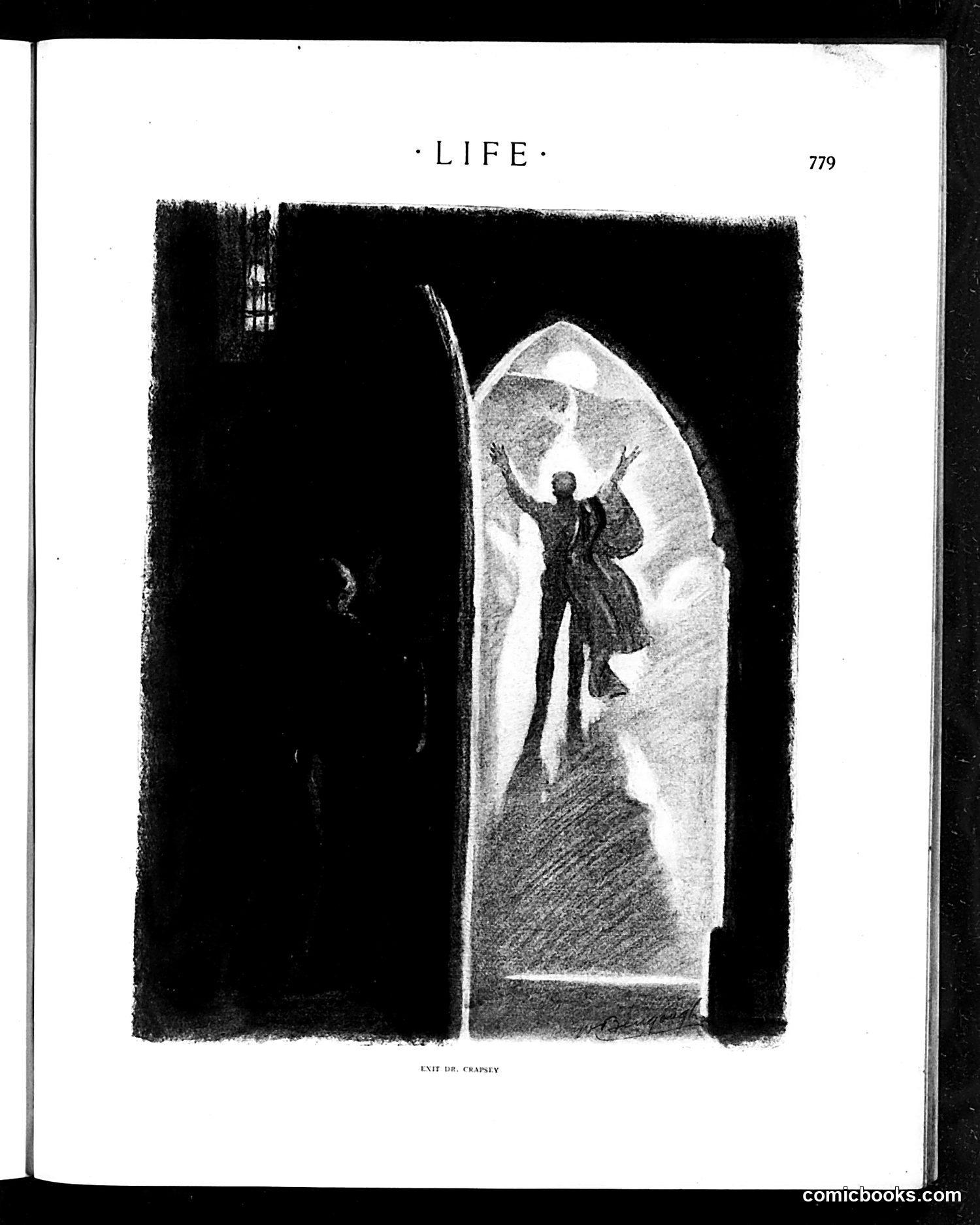
This cartoon depicts a figure escaping through a narrow archway or passage, arms raised in apparent relief or triumph, while darkness surrounds the scene. The caption "EXIT DR. CRAPSEY" suggests this illustrates someone's departure or removal from a position. Without additional context about Dr. Crapsey's identity or the specific historical moment, the exact satirical target remains unclear. However, the visual composition—showing an exit from confinement—implies criticism of this person's tenure in some role, with the cartoon celebrating their departure as liberation. The dramatic lighting and composition suggest this was likely commentary on a notable public figure whose removal was viewed positively by Life magazine's editors and readership, though the specific reference escapes modern context without additional publication date information.
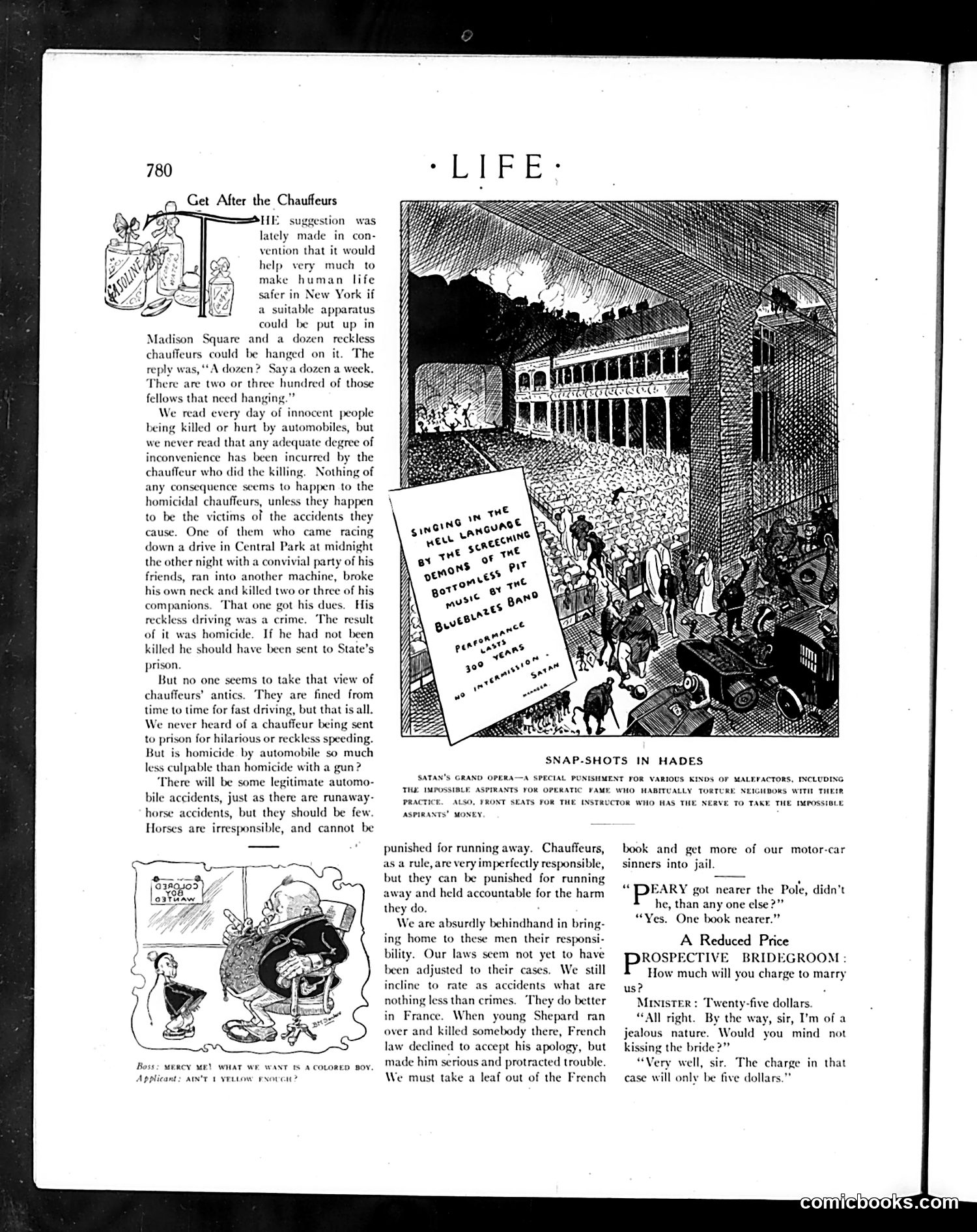
**Main Article: "Get After the Chauffeurs"** This is a serious editorial critiquing early automobile drivers ("chauffeurs") for reckless driving that kills pedestrians. The piece argues that when drivers cause fatal accidents, they face minimal legal consequences—merely fines for speeding—unlike murderers. The author demands stricter accountability, noting France treats such deaths as serious crimes rather than accidents. The underlying point: new technology (automobiles) has outpaced legal frameworks, and wealthy drivers escape justice for killing innocents. **Cartoon Jokes:** 1. **"Boss" cartoon**: A racist joke about hiring preferences; transcends this page's main topic. 2. **"Snap-Shots in Hades"**: Depicts Hell's "grand opera" as punishment for various wrongdoers, including bad opera singers who torture neighbors with practice. This reflects early-1900s cultural anxieties about amateur musicians. **"Reduced Price" Joke**: A clergyman agrees to lower marriage fees if the groom refrains from kissing the bride—playing on jealousy stereotypes.
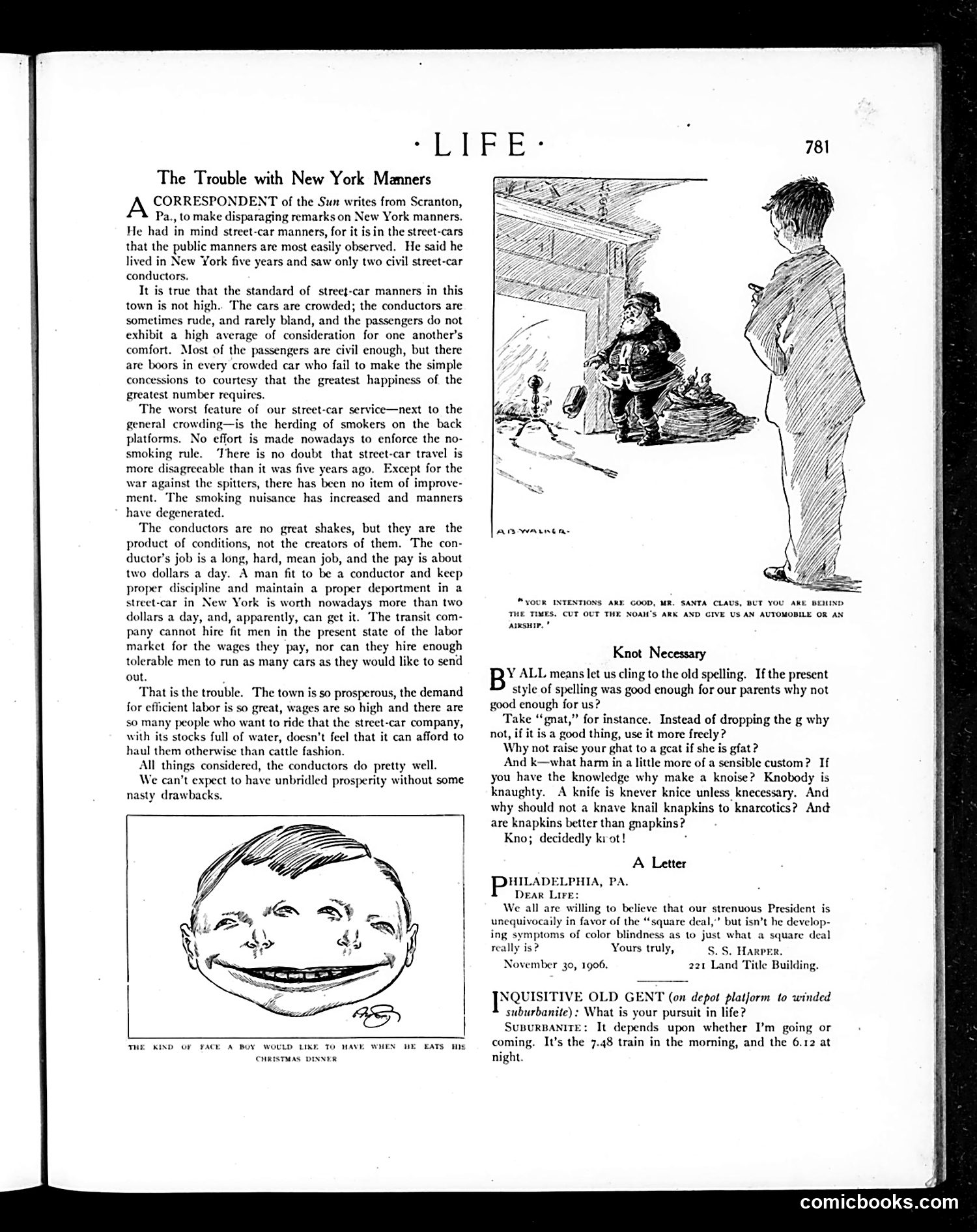
This page contains social commentary typical of early 1900s *Life* magazine. The main article critiques New York City street-car conduct, arguing that poor manners stem not from moral failings but from economic conditions—conductors earn only two dollars daily and cannot afford to maintain discipline. The piece defends working-class employees while blaming the transit company's refusal to pay adequate wages. The cartoons offer lighter humor: one depicts a boy's gleeful Christmas dinner expression (captioned about his exaggerated face); another shows a child rejecting Santa's traditional toy ark in favor of an automobile—satirizing how rapidly American consumer desires shifted toward modern technology. A brief humor section mocks proposed spelling reforms (suggesting absurdities like "knoise" instead of "noise"), while letters address President Theodore Roosevelt's color blindness and suburban commuting anxiety. The overall tone reflects *Life*'s blend of progressive social criticism with genteel satire.
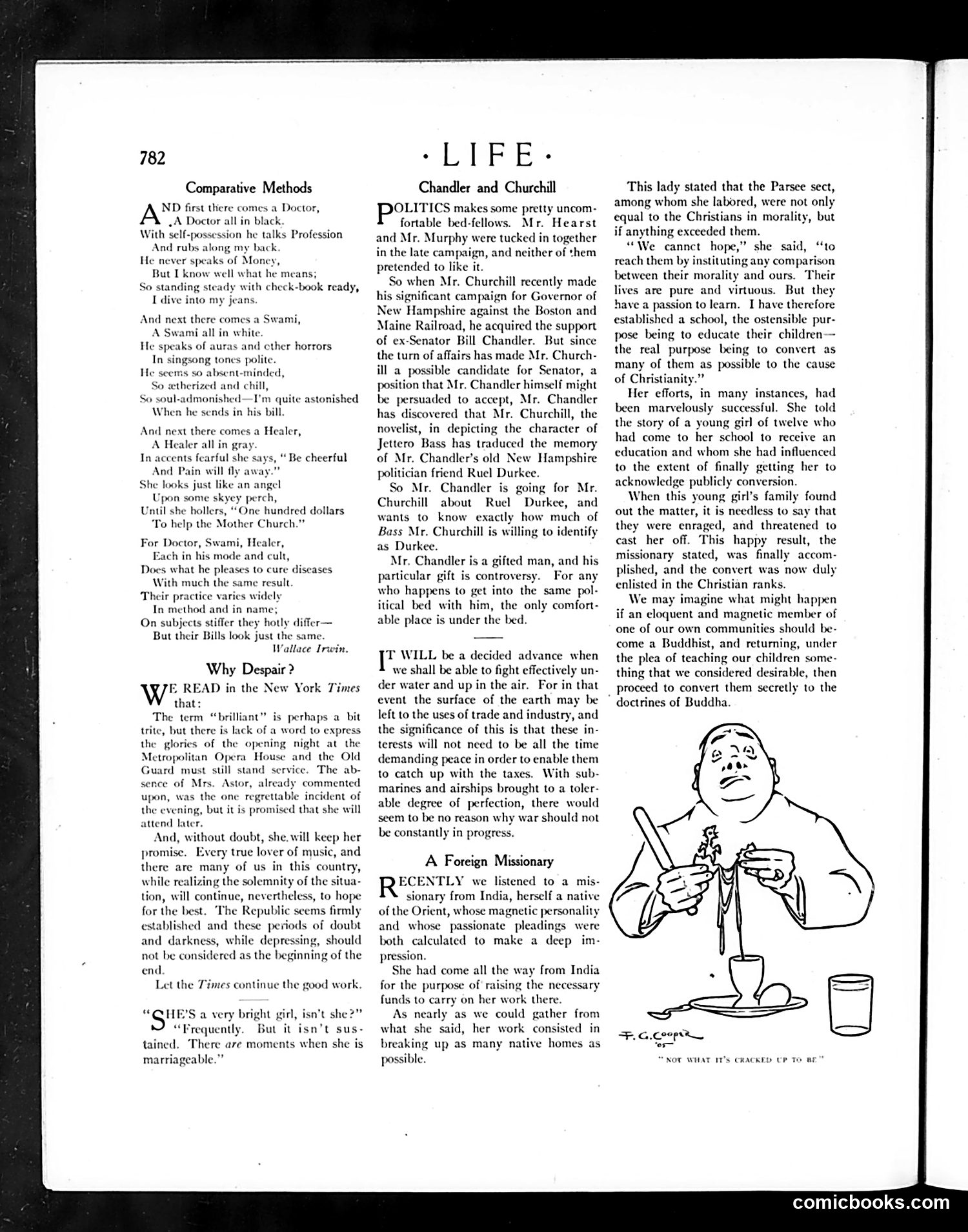
This page contains three distinct pieces satirizing American society circa early 1900s. **"Comparative Methods"** (poem by Wallace Irwin): Mocks three alternative healers—a doctor, swami, and faith healer—all dressed distinctively (black, white, gray). The joke: despite their different philosophies and demeanor, they all demand payment identically. It's social commentary on quackery and commercialism masquerading as medicine or spirituality. **"Why Despair?"**: A brief society-page joke about a "bright girl" whose intelligence is inconsistent with marriageability—satirizing upper-class attitudes that intelligence in women made them poor marriage prospects. **"Chandler and Churchill"**: Political commentary on New Hampshire politicians. Ex-Senator Chandler and novelist Churchill were allied against the Boston & Maine Railroad, but when Churchill became a Senate candidate, Chandler attacked him, claiming his novel character "Jettero Bass" libeled Chandler's old friend Ruel Durkee. The satirist notes Chandler weaponizes controversy—his "comfortable place is under the bed" with political allies. The accompanying crude cartoon illustrates the Foreign Missionary section (incomplete on this page).
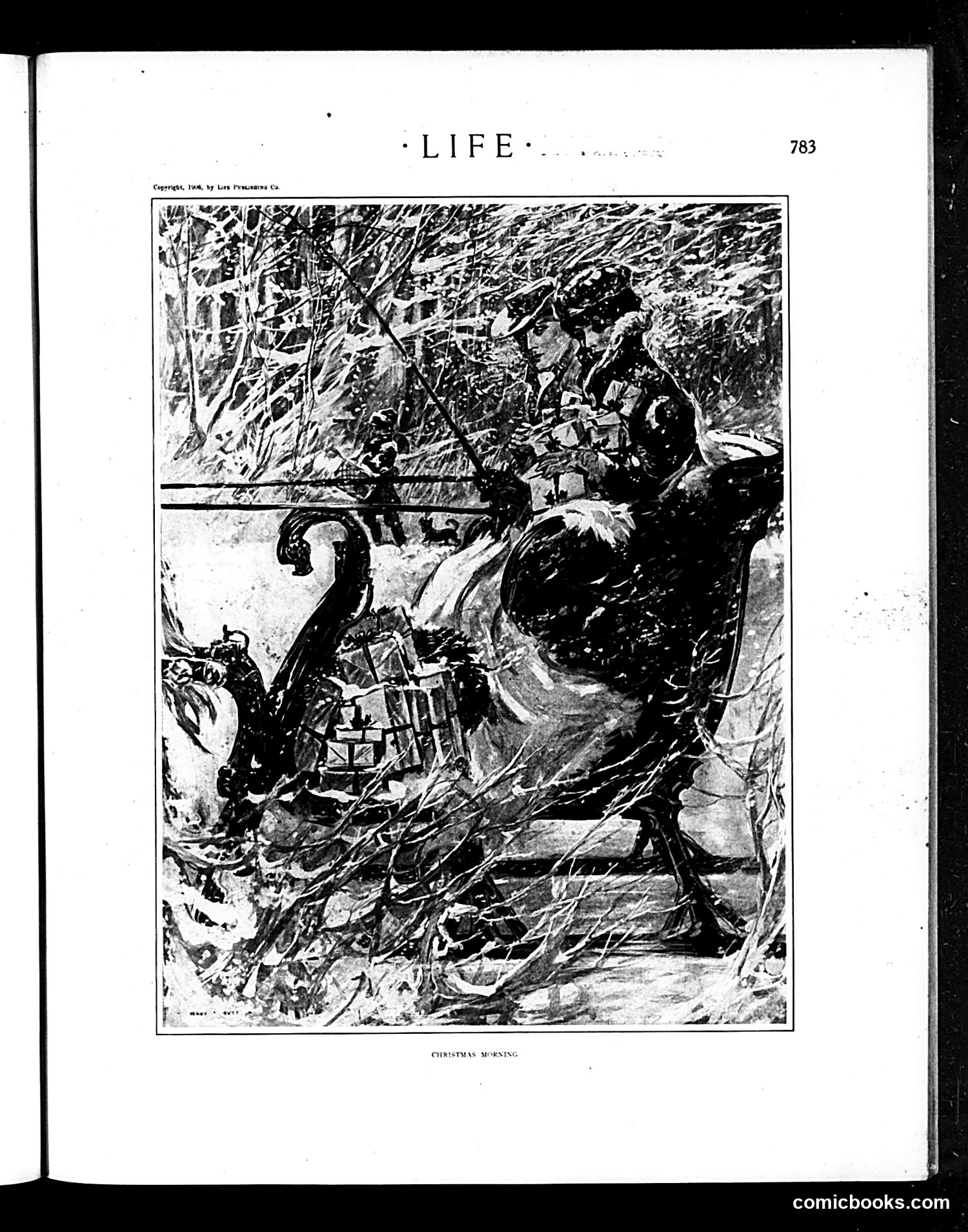
This illustration depicts a domestic Christmas scene from early 20th-century America. The image shows what appears to be a wealthy family in an ornate interior, with figures examining presents or gifts arranged around them. The detailed line work and composition are characteristic of Life magazine's illustrative style during this era. The caption "CHRISTMAS MORNING" indicates this is a straightforward genre scene rather than political satire—depicting the domestic celebration of Christmas among the upper classes. The elaborate furnishings, clothing, and gift-giving suggest themes of holiday abundance and family togetherness that would have resonated with Life's educated, middle-to-upper-class readership. Without additional context or captions, the image appears to be celebratory rather than satirical.
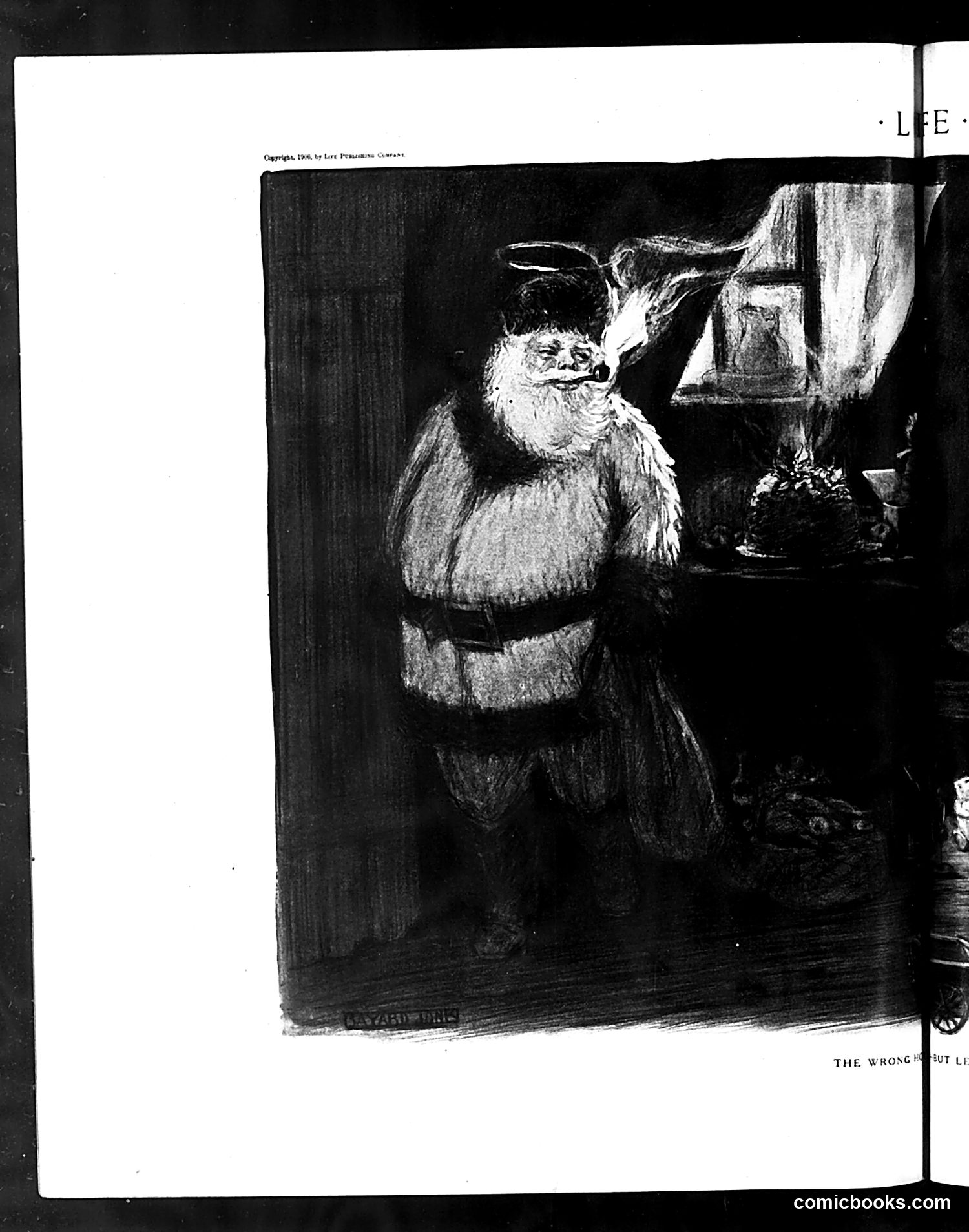
This appears to be a satirical cartoon from *Life* magazine (copyright 1908). The image shows Santa Claus in what seems to be a domestic interior scene. Based on the visible caption fragment "THE WRONG [SOMETHING] LI[...]" at the bottom, this is likely a commentary on Santa Claus or Christmas gift-giving practices. The cartoon's satire probably critiques either: mistaken identity (the "wrong" Santa), inappropriate gifts, or commercialized Christmas traditions. Santa's exaggerated facial features and the dark, sketchy art style are typical of *Life*'s sharp social commentary from this era. Without the complete caption text, I cannot definitively identify the specific target of the satire, though it appears to mock some aspect of turn-of-the-century American holiday customs or consumer culture.
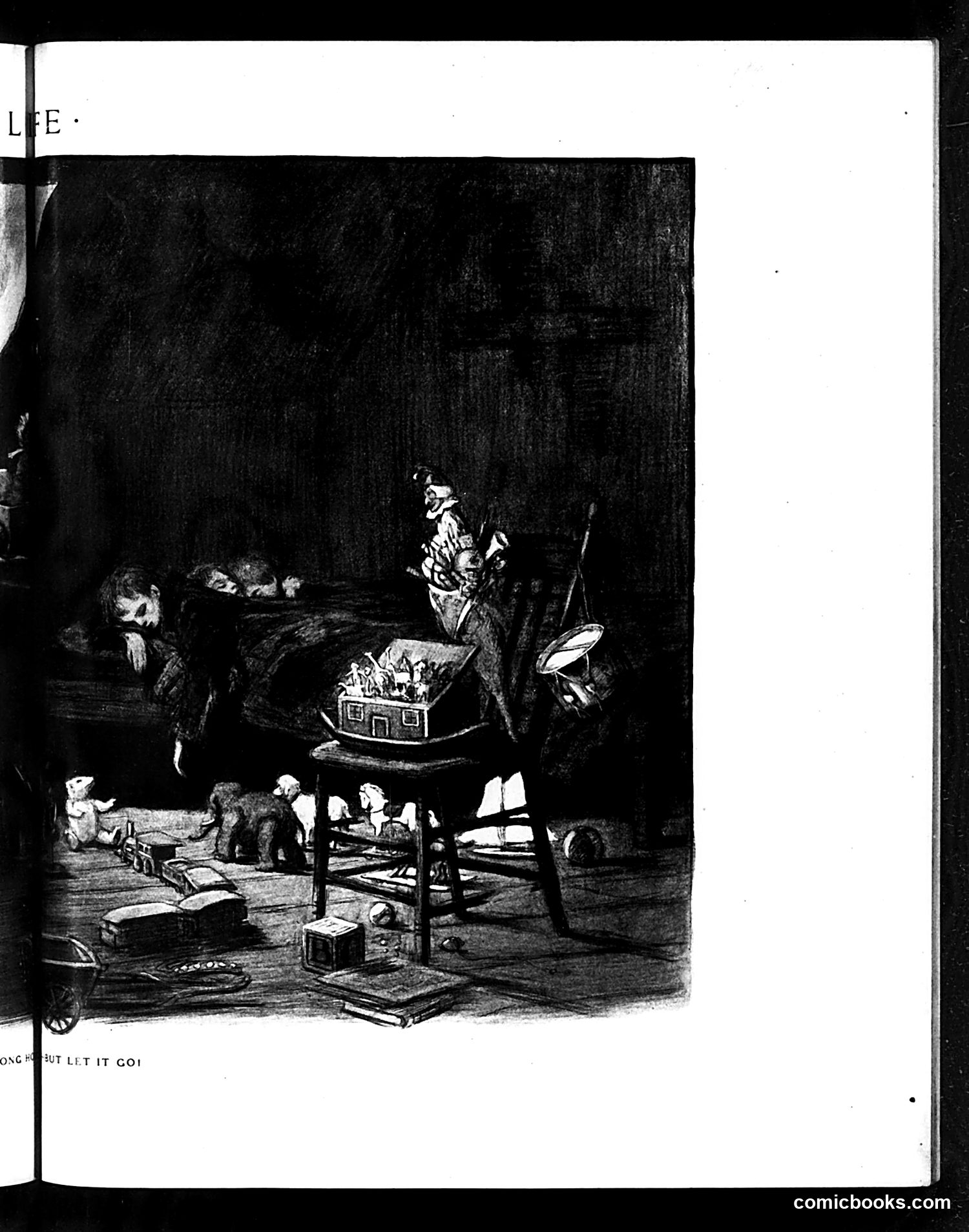
This appears to be a satirical illustration from *Life* magazine showing a scene inside what looks like a toy maker's workshop or dollhouse. The visible text at the bottom reads "HUT LET IT GO!" (possibly "BUT LET IT GO!"), suggesting commentary on the creation or release of something. The image depicts figures around a miniature house structure with various toys and dolls scattered about. The dark, dramatic etching style emphasizes the scene's theatrical or cautionary nature. Without clearer context or complete caption text, I cannot definitively identify the specific political figures or events being referenced. The composition suggests satire about toy-making, manufacturing, or possibly the commercialization of childhood—but the exact target of the satire remains unclear from this page alone.
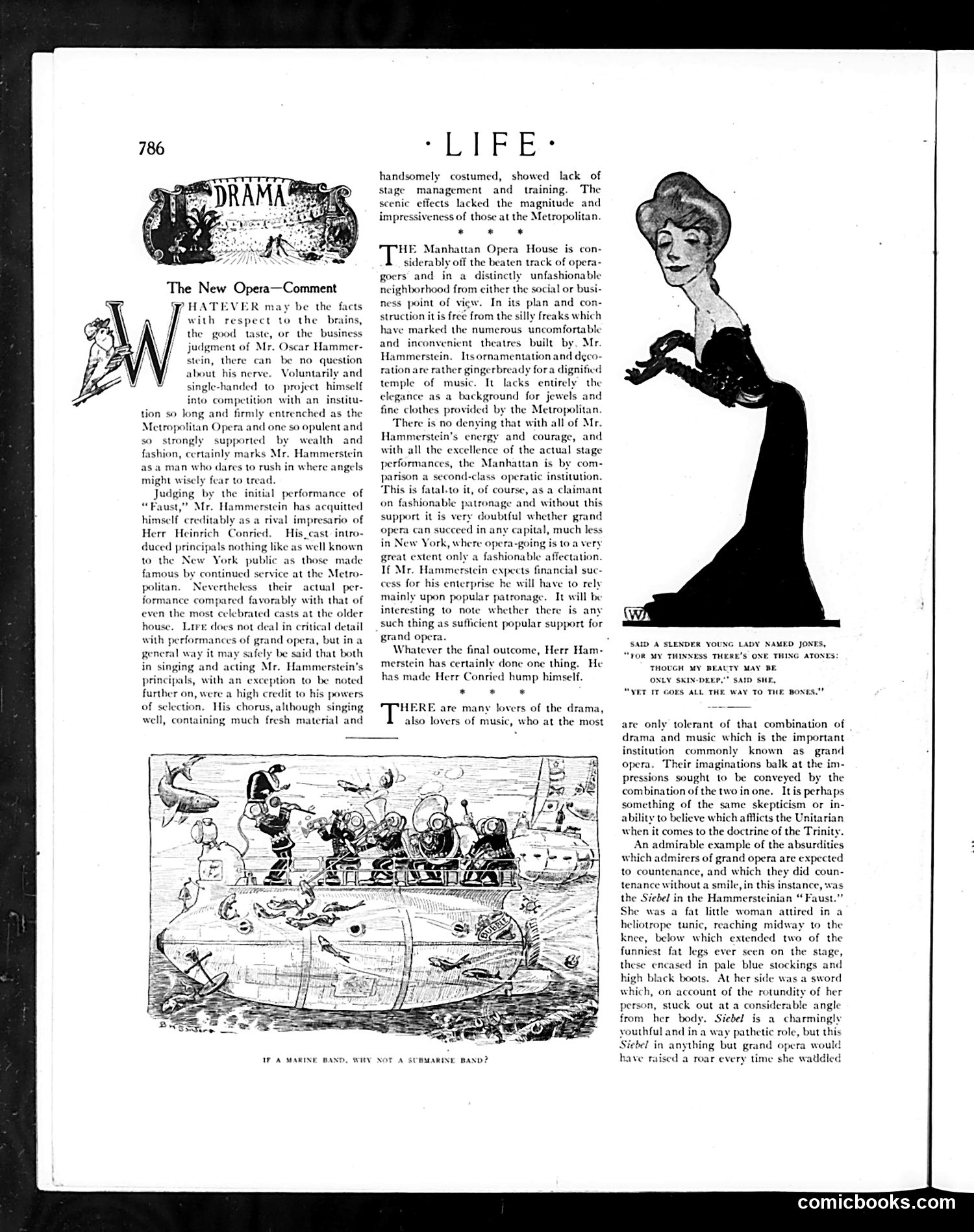
This page critiques Oscar Hammerstein's newly opened Manhattan Opera House, which challenged the established Metropolitan Opera's monopoly on New York's opera scene. **The Main Cartoon ("If a Marine Band, Why Not a Submarine Band?"):** A visual pun mocking a woman's extreme thinness—her beauty allegedly extends "all the way to the bones," suggesting she's skeletal. This has no connection to the opera commentary. **The Opera Critique:** The text praises Hammerstein's nerve in competing against the well-entrenched, wealthy Metropolitan Opera. However, it attacks his venue as inferior: located in an unfashionable neighborhood, architecturally gaudy ("gingerbready"), and lacking the Metropolitan's elegance. Crucially, the article questions whether grand opera can survive on "popular patronage" alone, implying it depends on wealthy fashionable society's support—which the Manhattan's inferior setting cannot attract. The review concedes Hammerstein made the Metropolitan's director "hump himself" (work harder), but doubts his financial viability.
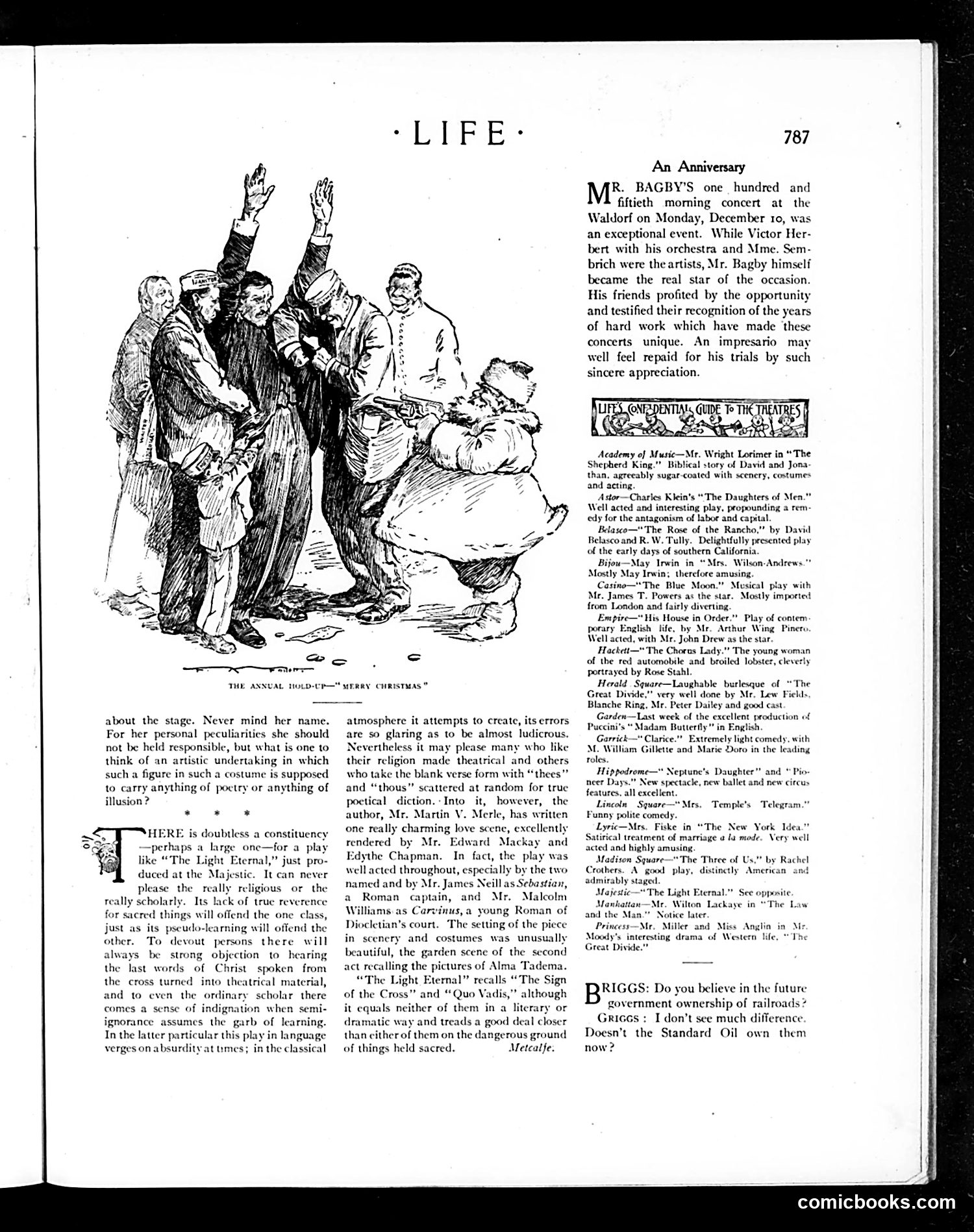
The cartoon depicts a satirical Christmas scene labeled "The Annual Hold-Up." A rotund figure (likely representing a theatrical producer or impresario) is surrounded by several people with their hands raised in celebratory or demanding gestures, while money appears scattered on the ground. The satire targets the commercialization of Christmas theater productions. The "hold-up" metaphor suggests that theatrical producers exploit the holiday season—extracting money from audiences through Christmas-themed shows. The raised hands and money scattered about indicate financial transaction or extraction during what should be a sacred or genuine cultural moment. This aligns with the page's theater reviews, which critique productions mixing religious and commercial elements. The accompanying text criticizes plays that treat sacred subjects like Christ theatrically for profit, suggesting hypocrisy in holiday entertainment marketed as artistic or spiritual when primarily financial. The cartoon thus mocks how the theater industry uses Christmas sentiment and religious themes to maximize profits during the season.
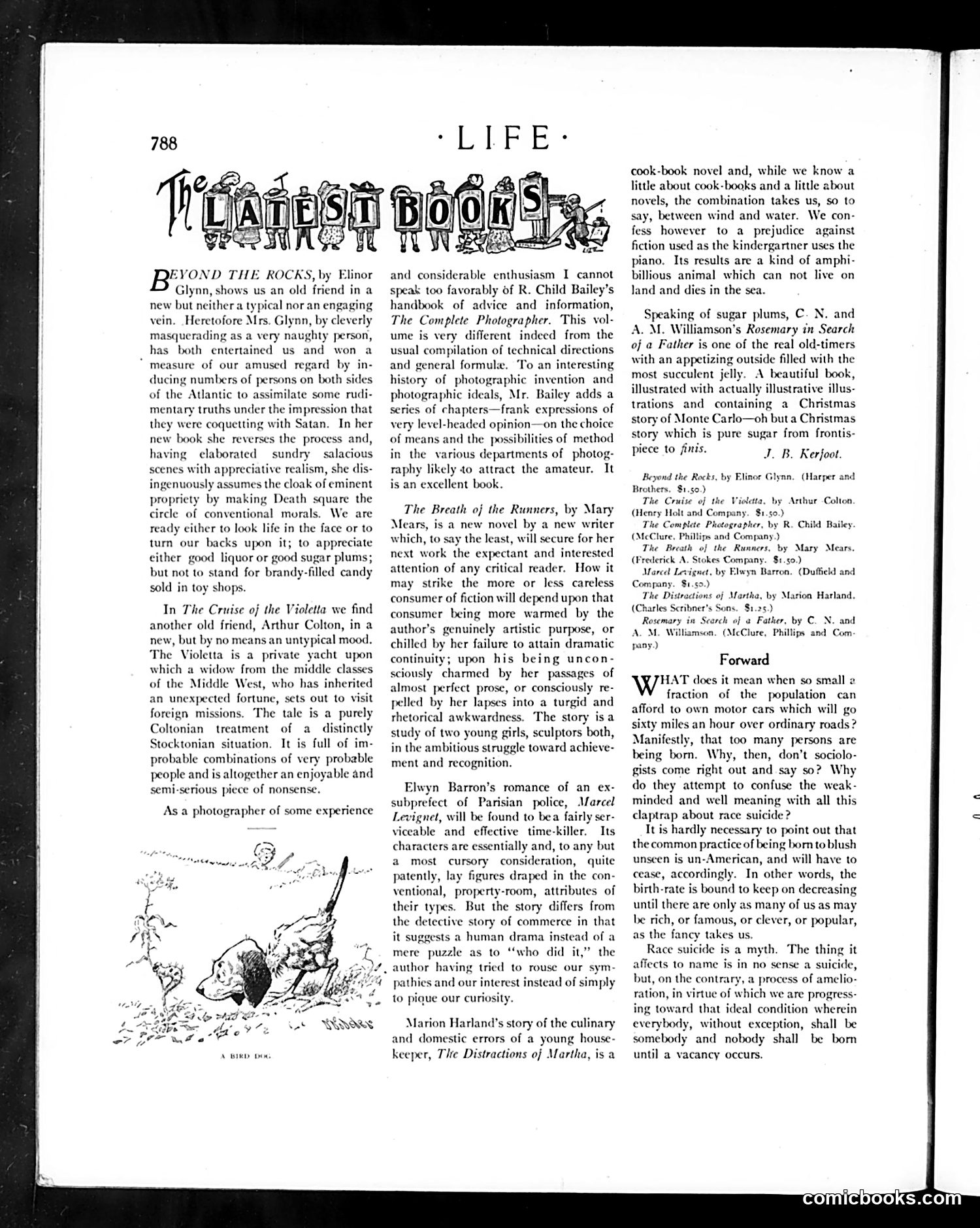
This page is primarily a **book review section** titled "The Largest Books," not a political cartoon. It contains literary criticism of several contemporary novels, including works by Elinor Glyn, Mary Mears, and others. The only illustration is a small sketch labeled "A Bird Dog"—a hunting dog pointing, likely serving as decorative filler rather than satirical commentary. The reviews themselves offer mild social satire through critique rather than cartooning. For example, the reviewer mocks Elinor Glyn's "Beyond the Rocks" for presenting salacious scenes while claiming moral propriety—a commentary on hypocrisy in popular literature. Another critique dismisses a novel's characters as mere "lay figures" (mannequins) without depth. The "Forward" section addresses **race suicide**—a period concern about birth rates among educated classes—but presents this as demographic anxiety rather than satire. This is essentially a **literary criticism page**, not a political cartoon page.
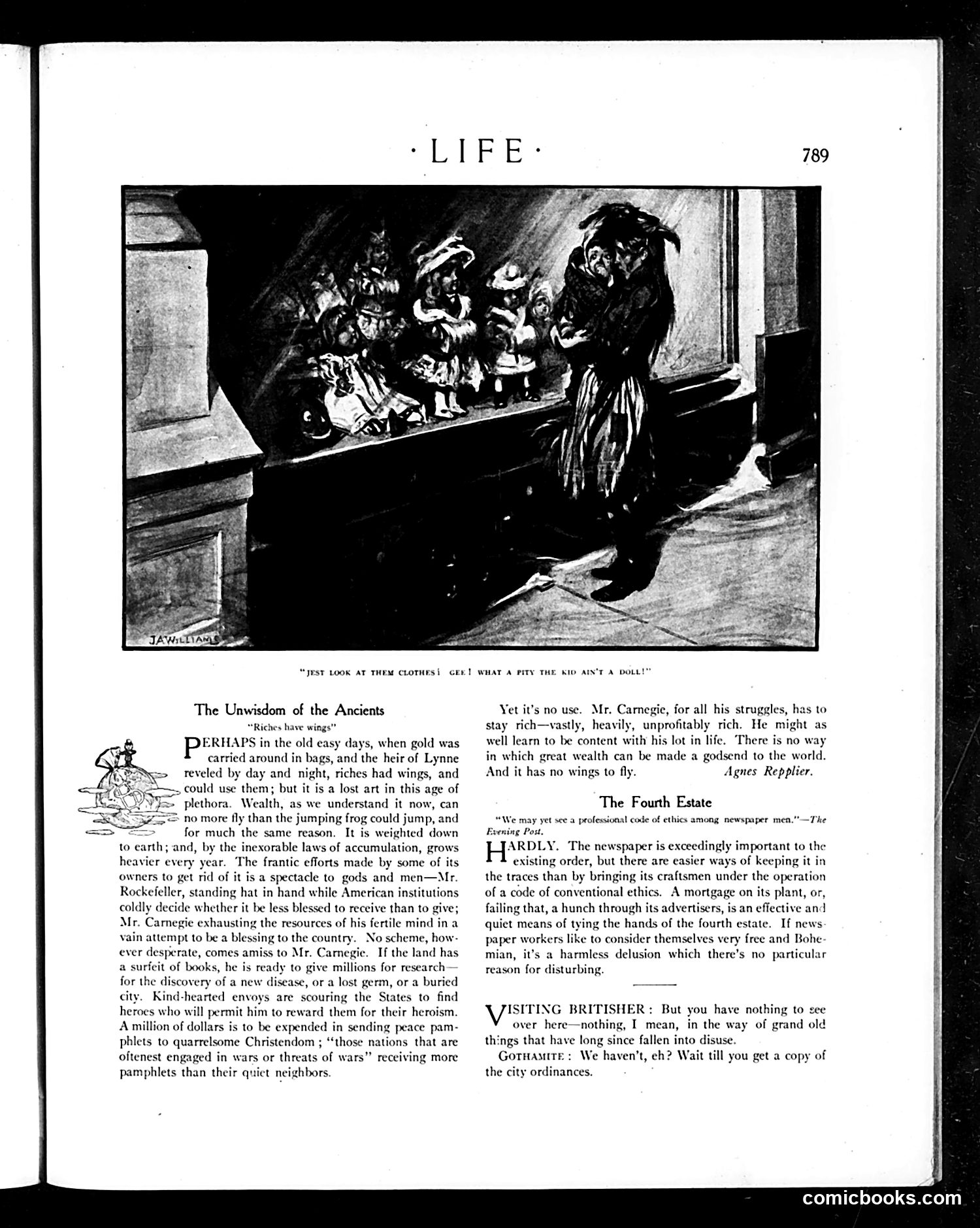
The page contains two satirical pieces: **"The Unwisdom of the Ancients"** attacks the philanthropic efforts of wealthy industrialists, particularly Andrew Carnegie. The article mocks Carnegie's desperate attempts to give away his fortune—funding libraries, disease research, peace pamphlets—arguing that massive wealth cannot be "made a godsend to the world" and has become immobilized by its own accumulation. The satire suggests that despite his charitable schemes, Carnegie remains "vastly, heavily, unprofitably rich." **"The Fourth Estate"** cynically dismisses hopes for ethical standards among newspaper workers, arguing that wealth controls the press more effectively than any code of ethics—through mortgages on property, control of advertisers, and other financial leverage. It suggests newspapermen's self-image as "free and Bohemian" is merely a "harmless delusion." The cartoon caption about clothing appears unrelated to the text below it—likely a separate joke or illustration about fashion rather than wealth.
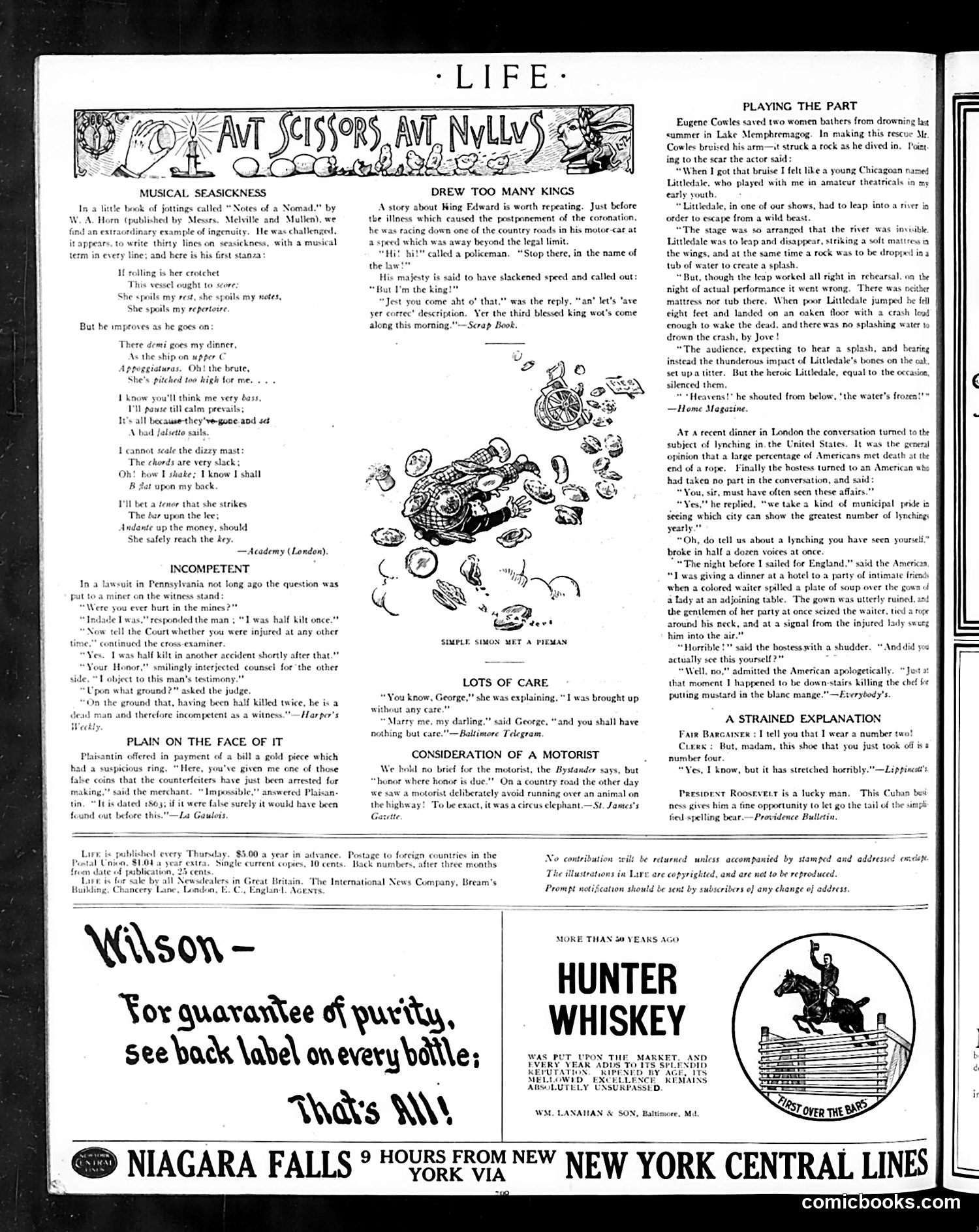
This page from *Life* magazine contains several brief humorous pieces: **"Musical Seasickness"** is a poem where every line contains a musical term, creating double meanings about seasickness—a clever wordplay exercise. **"Incompetent"** is a courtroom joke: a miner testifies he was "half killed" twice, so opposing counsel argues he's legally dead and incompetent to testify—absurdist humor. **"Drew Too Many Kings"** satirizes King Edward (likely Edward VII), who was speeding in his motorcar. A policeman stops him, and when Edward claims "I'm the king," the officer replies he's the *third* king to pass that morning—mocking either the king's audacity or suggesting multiple imposters, with working-class humor. **"Plain on the Face of It"** is a brief joke about counterfeit coins. The remaining pieces are light anecdotes about motorists and actors. These are typically *Life*'s sophisticated but accessible humor—wordplay, irony, and social commentary aimed at educated readers.
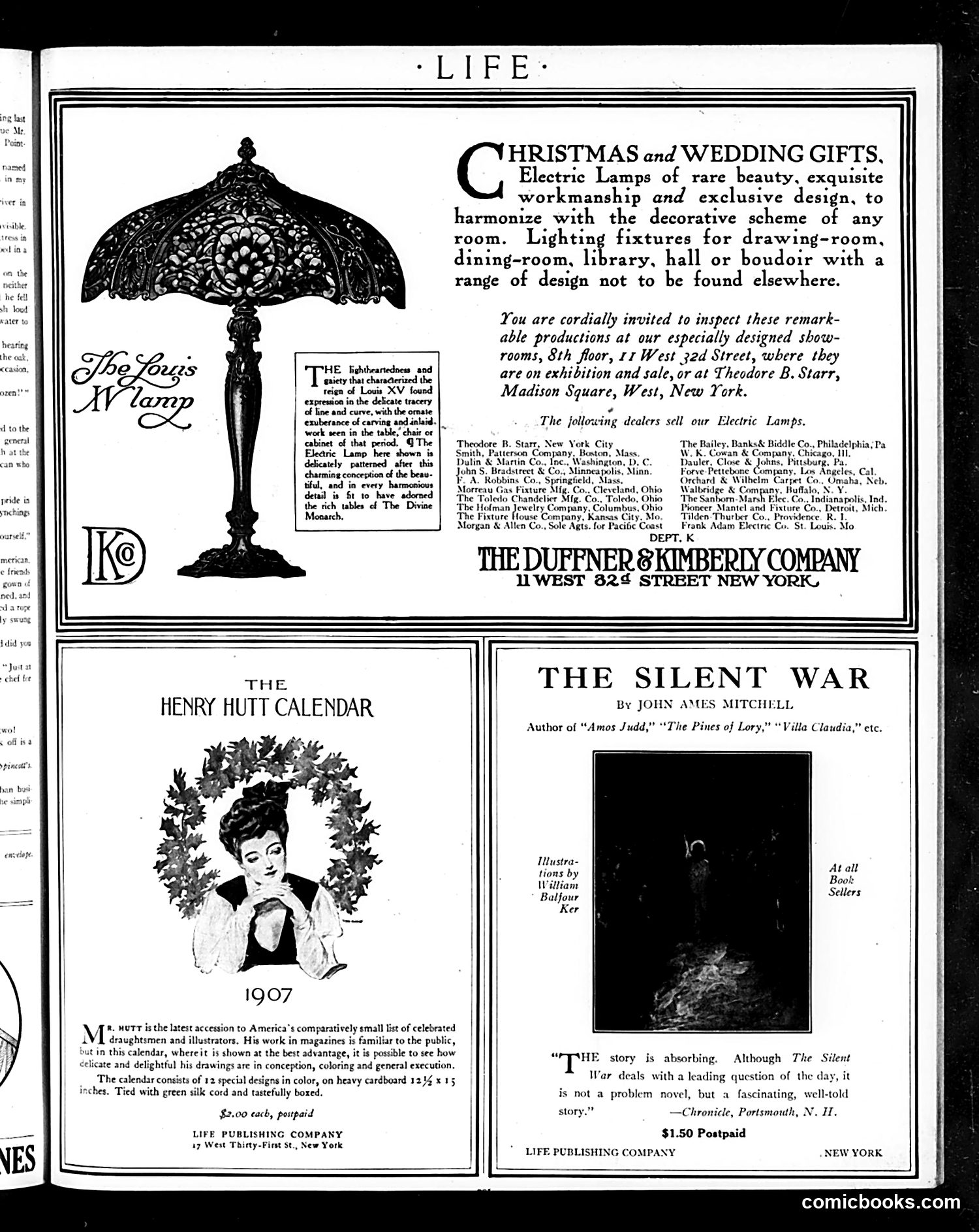
This page contains **no political cartoons or satire**—it is primarily **advertising and book promotion**. The top section advertises **"The Louis Lamp"** by Duffner & Kimberly Company, a luxury electric lamp marketed as Christmas and wedding gifts. The ornate lamp design references Louis XV style, positioning it as high-end home décor. Below are two book advertisements: 1. **Henry Hutt Calendar (1907)**: Promotes an illustrated calendar by artist Henry Hutt, emphasizing his delicate draftsmanship and commercial magazine work. Priced at $2.00. 2. **"The Silent War" by John Ames Mitchell**: Advertises a novel dealing with "a leading question of the day"—likely referencing contemporary political/social concerns (the exact topic is unclear from this excerpt). Priced at $1.50. The page reflects early 20th-century *Life* magazine's mixed content of luxury goods advertising and literary promotion aimed at affluent readers.
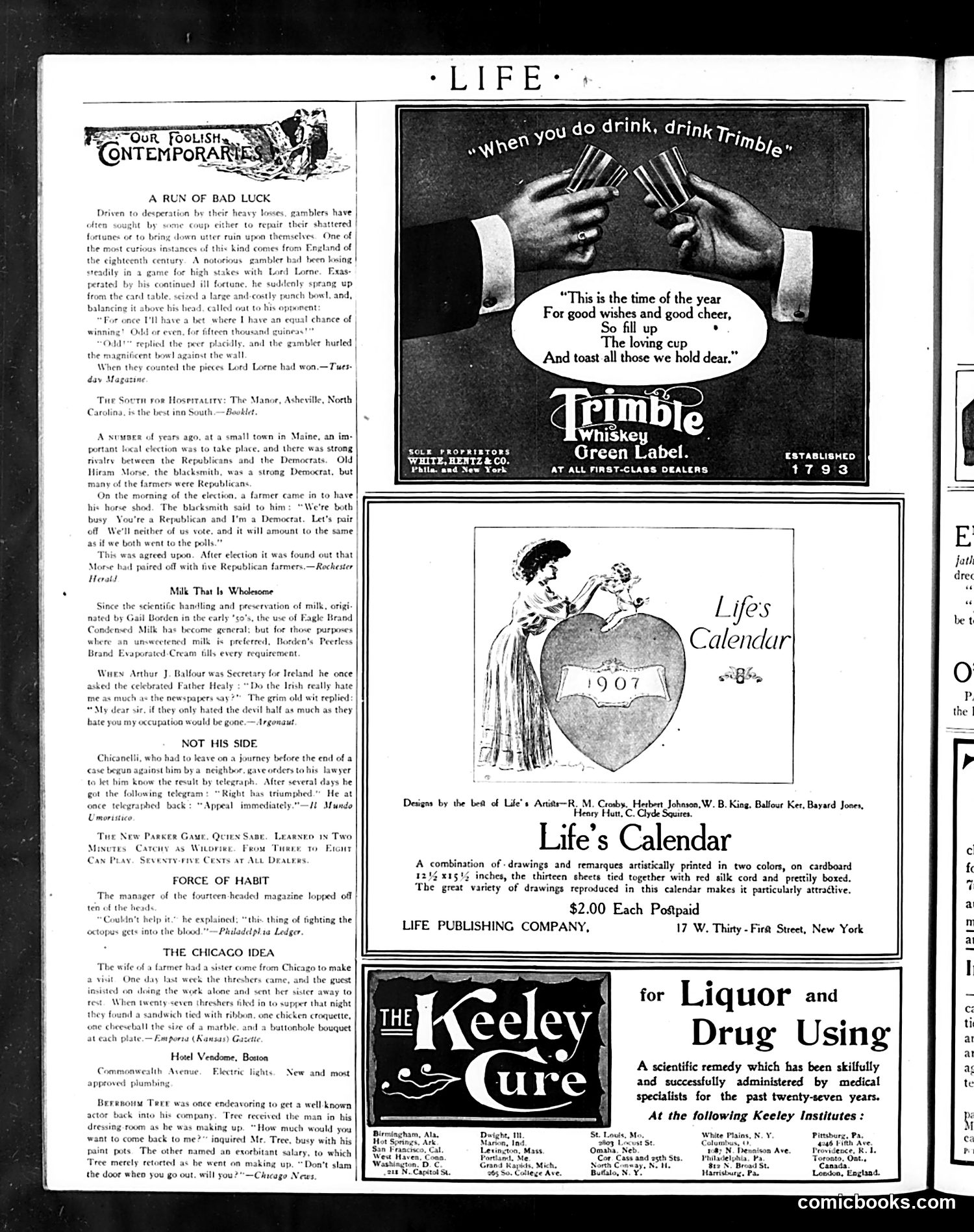
This page from *Life* magazine combines satirical humor columns with advertisements. The left column features "Our Foolish Contemporaries"—anecdotes mocking human folly across different social classes. **Key satirical pieces include:** - A gambler who, losing heavily, smashes his bowl against a wall in desperation—satirizing compulsive gambling behavior - An Irish blacksmith who tricks a Republican farmer into "pairing off" votes, then votes with five other Republicans anyway—mocking electoral dishonesty and political naivety - A lawyer who telegraphs "Justice triumphed!" when actually defeated—satirizing legal pretension The page also advertises **Trimble Whiskey** (with a period drinking toast), **Life's Calendar** (a 1907 product), and notably **"The Keeley Cure"**—a commercial treatment facility claiming to cure "Liquor and Drug Using" through medical specialists, reflecting turn-of-century anxieties about addiction. The advertisements reveal contemporary social concerns: alcoholism was treated as a medical condition requiring institutional "cures," while the satirical content mocks corruption, gullibility, and moral weakness in everyday American life.
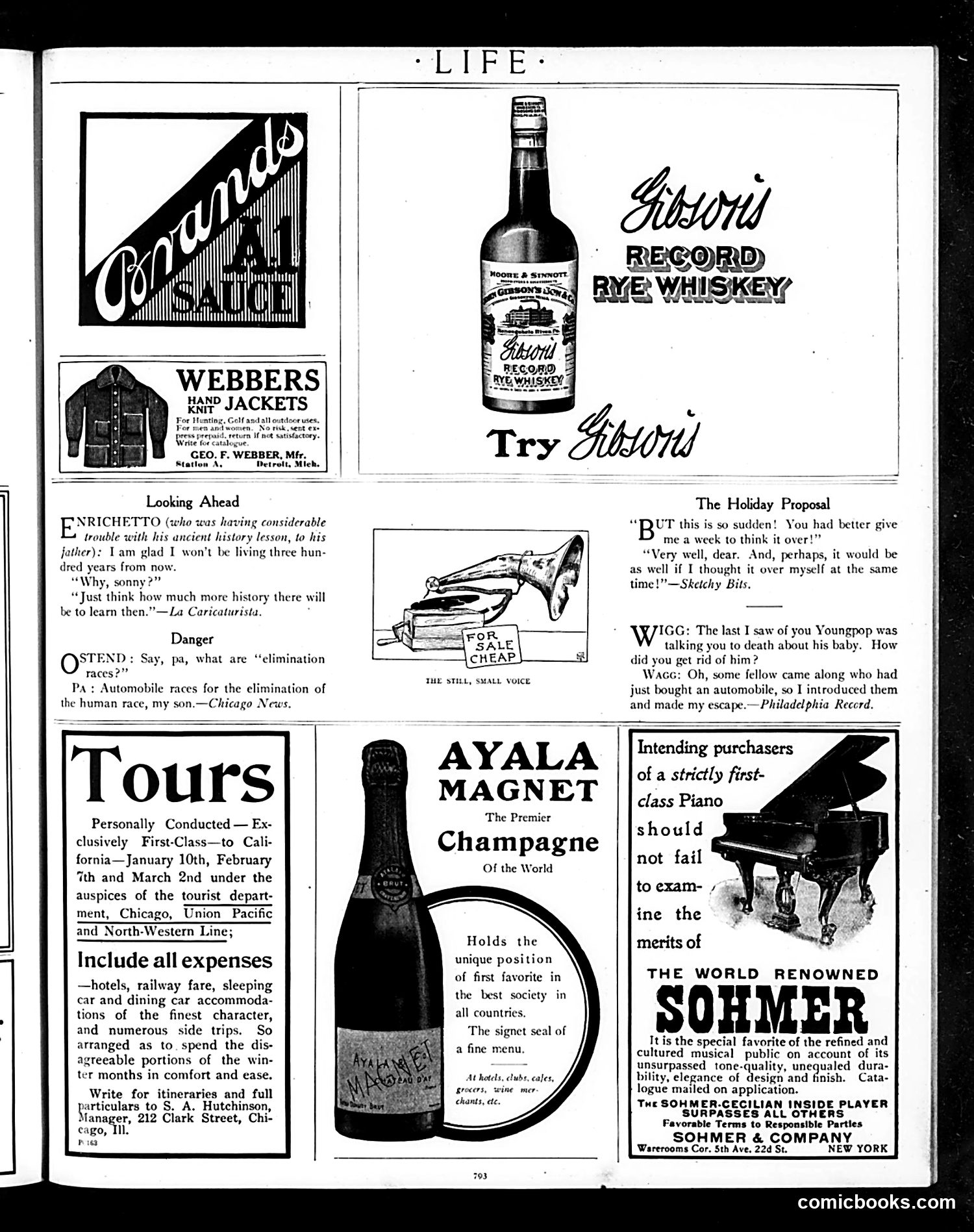
This page combines satirical humor with period advertisements (typical for Life magazine circa early 1900s). **The Cartoons:** Two brief jokes appear: One depicts a student (Enrichetto) dreading future schooling because there will be more history to memorize. The second shows a father explaining "elimination races" as automobile races that eliminate humans—a dark joke about early automobiles' notorious danger and fatality rates. A third item, "The Holiday Proposal," presents a domestic humor exchange where a woman accepts a sudden proposal, then admits she needs time to think—implying even she questions the decision. **The Advertisements:** The page is dominated by luxury product ads: Gibson's Rye Whiskey, Webber hand-knit jackets, Ayala Magnet Champagne, Sohmer pianos, and California tourist packages. These reflect Life's affluent readership. **Historical Context:** The automobile jokes and references suggest this is from the early 1900s, when cars were novel, expensive, and genuinely dangerous. The ads target wealthy consumers comfortable with premium imported spirits and European champagne.
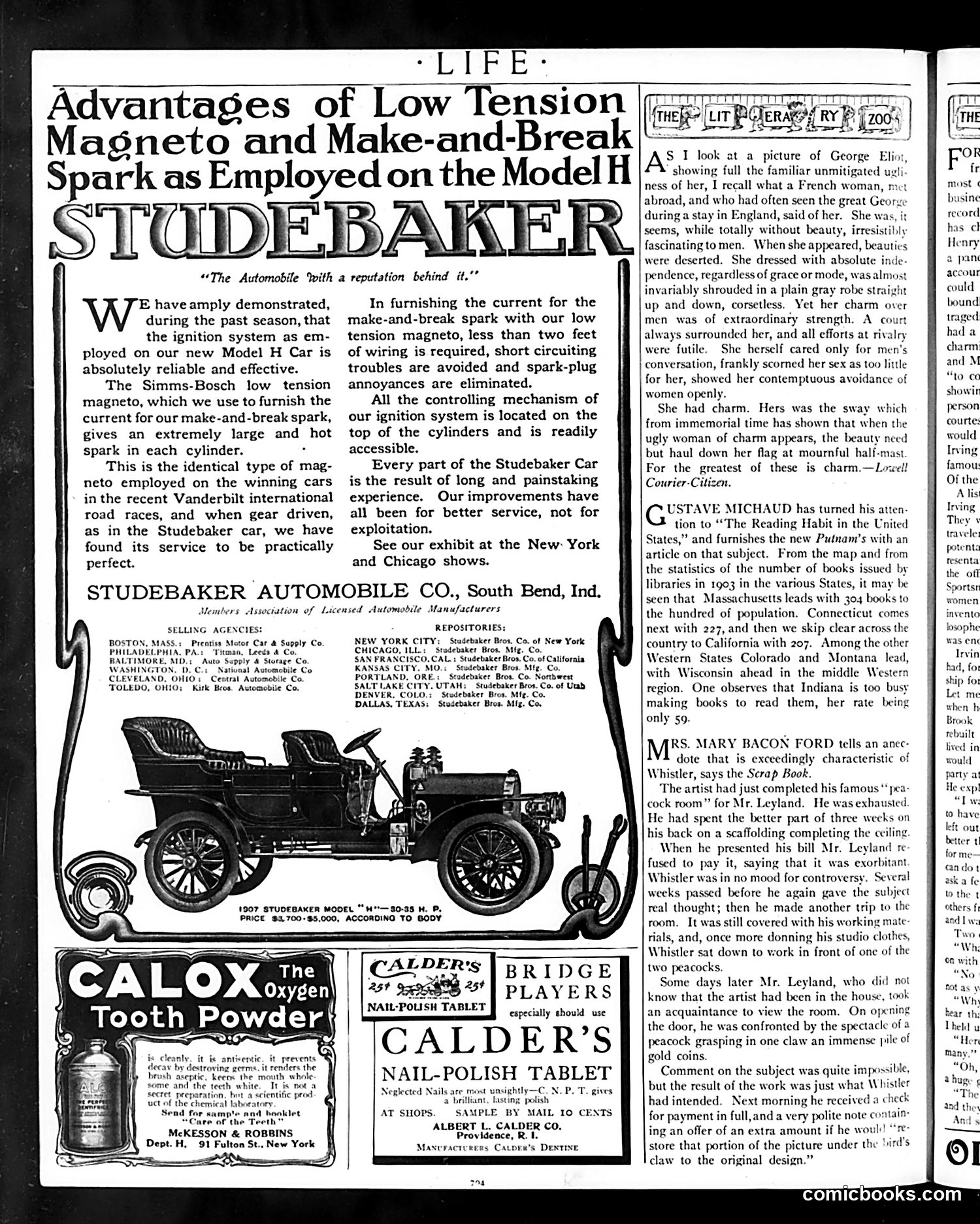
This page is primarily advertising, not political satire. The main content is a Studebaker Model H automobile advertisement, claiming advantages of its "low tension magneto" ignition system—specifically that it uses short wiring, avoids spark-plug problems, and proved reliable in racing competitions. The ad includes technical specifications, price ($3,700-$5,000), and sales agency locations. The page also contains minor product advertisements for Calox Tooth Powder and Calder's Nail-Polish Tablet. On the right side, editorial content discusses George Eliot's famously plain appearance but personal magnetism, and mentions Gustave Michaud's article on American reading habits—standard magazine filler content unrelated to the automotive advertising. There is no political cartoon or satire present on this page.
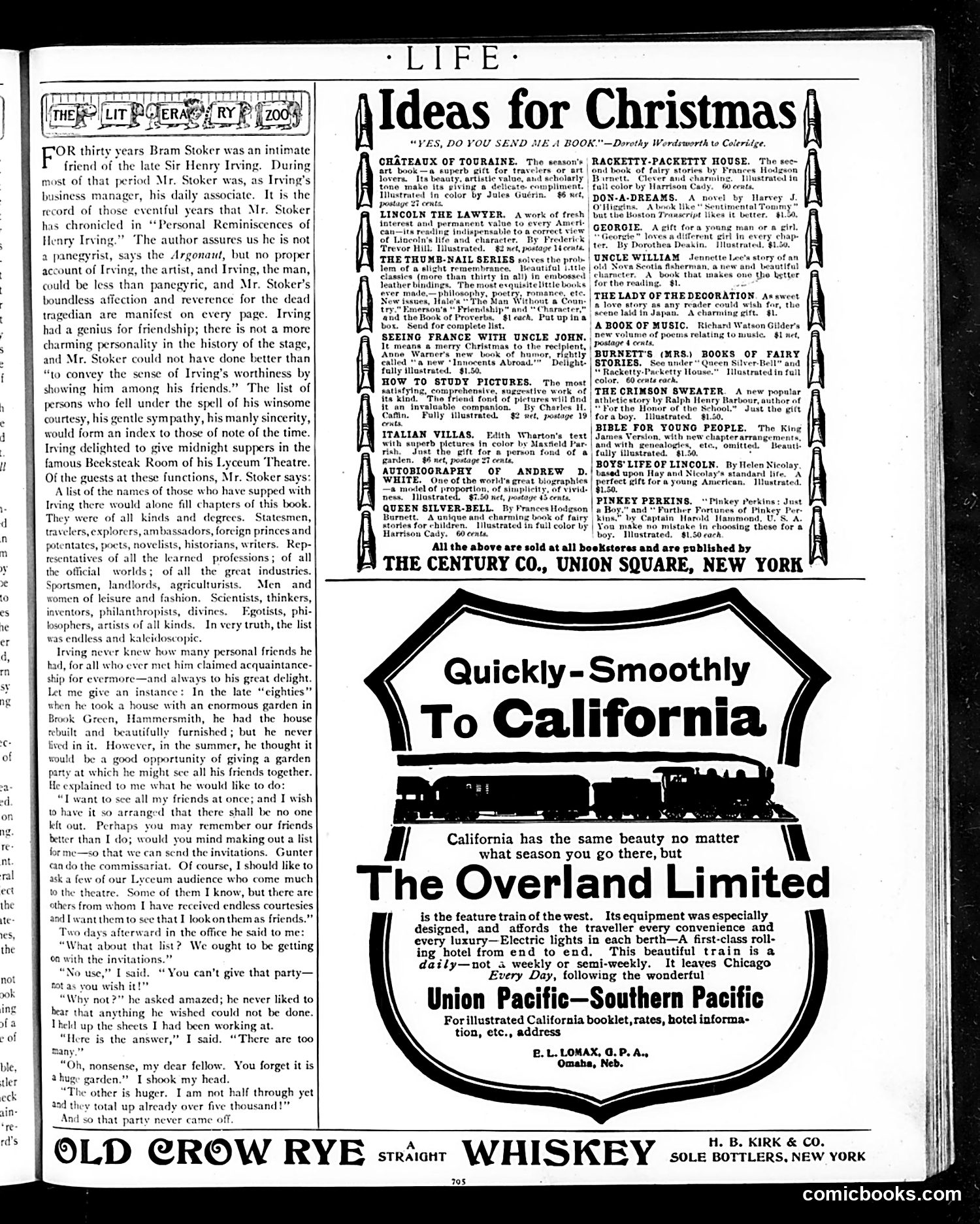
This page is primarily **advertising and book promotion**, not political satire. The left column contains a biographical article about author Bram Stoker's friendship with actor Henry Irving, including an anecdote about Irving's failed attempt to host a garden party—he wanted to invite all his friends but the list exceeded 5,000 people, making the event impossible. The right side features "Ideas for Christmas," a gift guide listing books published by The Century Company. These include titles like "Don-A-Dreams," "Georgie," and "Uncle William"—children's and young adult literature typical of the era. Below is a railroad advertisement for the Overland Limited train to California, and at the bottom is an advertisement for Old Crow Rye whiskey. There is **no political cartoon or satire** on this page—it's a standard magazine layout mixing editorial content with commercial advertisements, typical of early 20th-century American magazines.
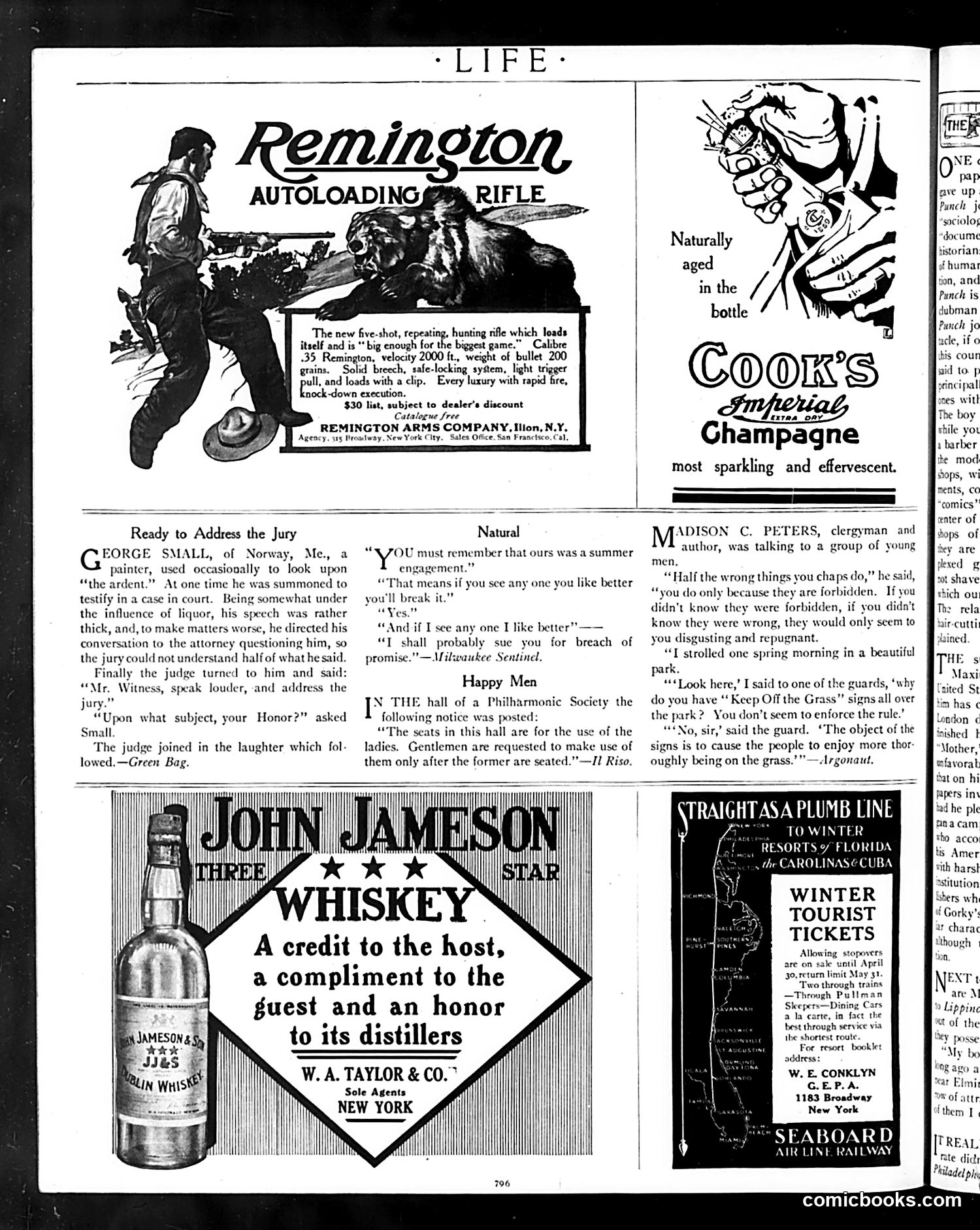
This page contains **humorous anecdotes and advertisements** rather than political cartoons. The main content includes three brief jokes: 1. **"Ready to Address the Jury"**: A drunk painter testifying in court speaks incoherently; when told to address the jury, he asks what subject to discuss—humor based on his intoxication making him miss the obvious meaning. 2. **"Natural"**: A couple's engagement dialog joking about threatening lawsuits over infidelity—typical period humor about courtship and marriage. 3. **"Happy Men"**: A clergyman observes that "Keep Off the Grass" signs actually *encourage* people to trespass by making the forbidden appealing—satirizing psychology and human nature. The advertisements promote a Remington rifle, Cook's champagne, John Jameson whiskey, and Florida winter tourism. These reflect early 20th-century consumer culture and leisure travel. **No clear political satire or caricature is present**—this is a miscellaneous humor and advertising page typical of Life magazine's lighter content.
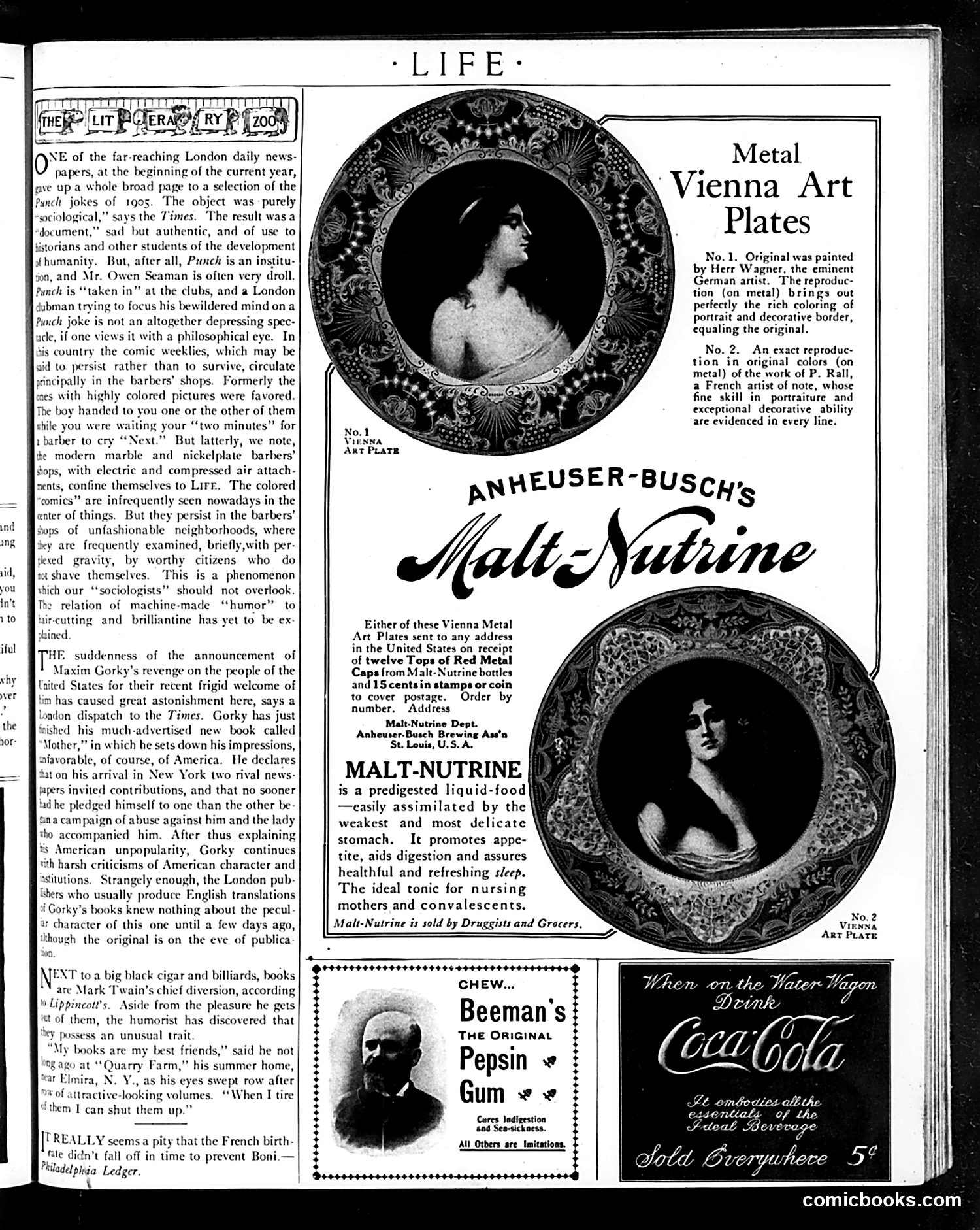
This page is primarily **advertisements and product promotions** rather than political satire. However, it includes brief literary commentary: **Editorial Content:** - Discussion of *Punch* (British satirical magazine) and American comic weeklies, noting they've migrated from barber shops to more "modern" establishments - Commentary on Maxim Gorky's new book "Mother," where he criticized America after receiving a cold reception—Life's editors note London publishers were unaware of his harsh views of American character - Anecdote about Mark Twain viewing books as "best friends" - A brief joke about French birth rates (unclear reference) **Primary Content: Advertisements** - "Metal Vienna Art Plates" (decorative enamelware featuring portraits) - Malt-Nutrine (a liquid food supplement by Anheuser-Busch, marketed for nursing mothers and convalescents) - Beeman's Pepsin Gum - Coca-Cola advertisement The page reflects early 1900s consumer culture and literary gossip rather than sharp political satire.
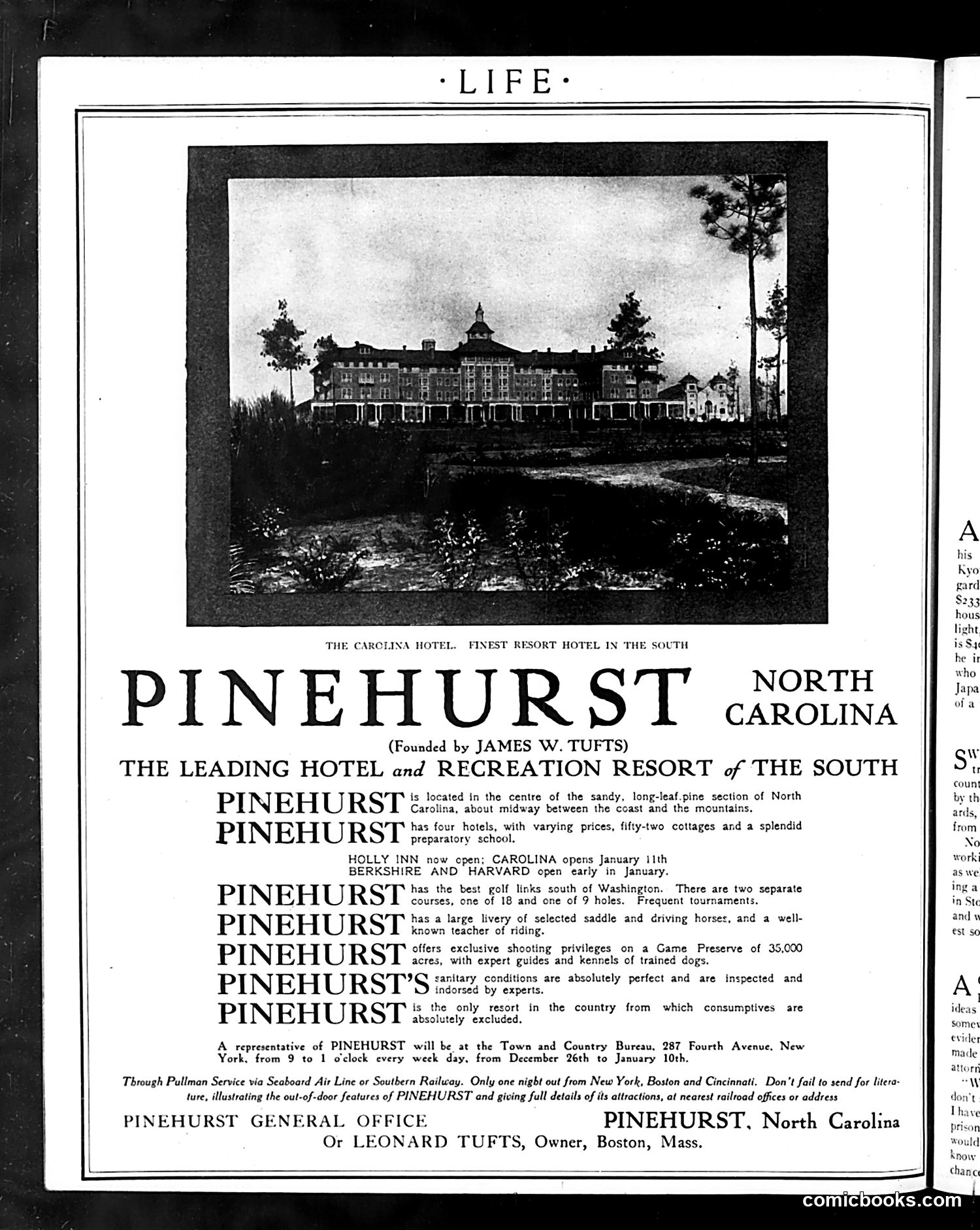
This page is **not a cartoon or satire** — it's a full-page advertisement for Pinehurst, North Carolina, a luxury resort founded by James W. Tufts. The ad promotes Pinehurst as "the leading hotel and recreation resort of the South," featuring multiple hotels, golf courses, horseback riding, hunting on a 35,000-acre game preserve, and a preparatory school. A notable detail: the resort explicitly excludes consumptives (tuberculosis patients), which reflects early 20th-century health anxieties and segregation practices. The photograph shows the Carolina Hotel, the resort's flagship building. The copy emphasizes accessibility via Pullman rail service from New York, Boston, and Cincinnati — marketing luxury leisure travel to wealthy northeastern audiences during the winter season (opening dates specified as January). This represents typical *Life* magazine content of its era: high-end advertising aimed at affluent readers.
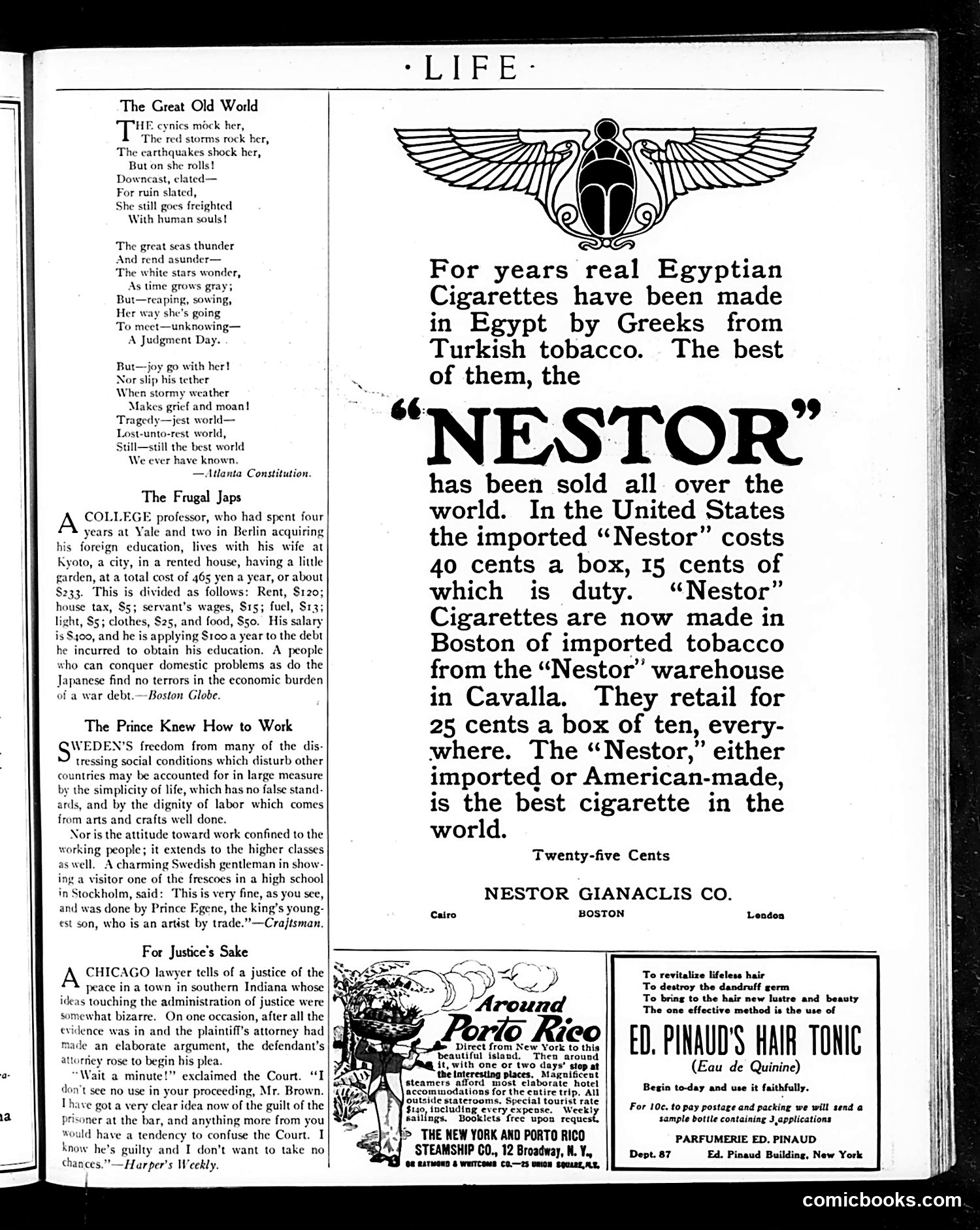
This page is primarily **advertisements and filler content** rather than political satire or cartooning. The left column contains three brief **humorous anecdotes**: 1. "The Great Old World" — a poem about Earth's resilience despite hardships 2. "The Frugal Japs" — celebrates Japanese economic efficiency, noting a professor lives on $233/year 3. "The Prince Knew How to Work" — praises Swedish work ethic, including Prince Eugen doing artistic labor 4. "For Justice's Sake" — a joke about an impatient judge The **dominant feature** is a large advertisement for **Nestor Cigarettes**, emphasizing their Egyptian origin and quality. Additional ads promote hair tonic and a steamship line. The content reflects early 20th-century attitudes: admiration for non-Western peoples' frugality and work ethic, and normalization of tobacco advertising. The anecdotes are gentle, nostalgic humor rather than biting satire.
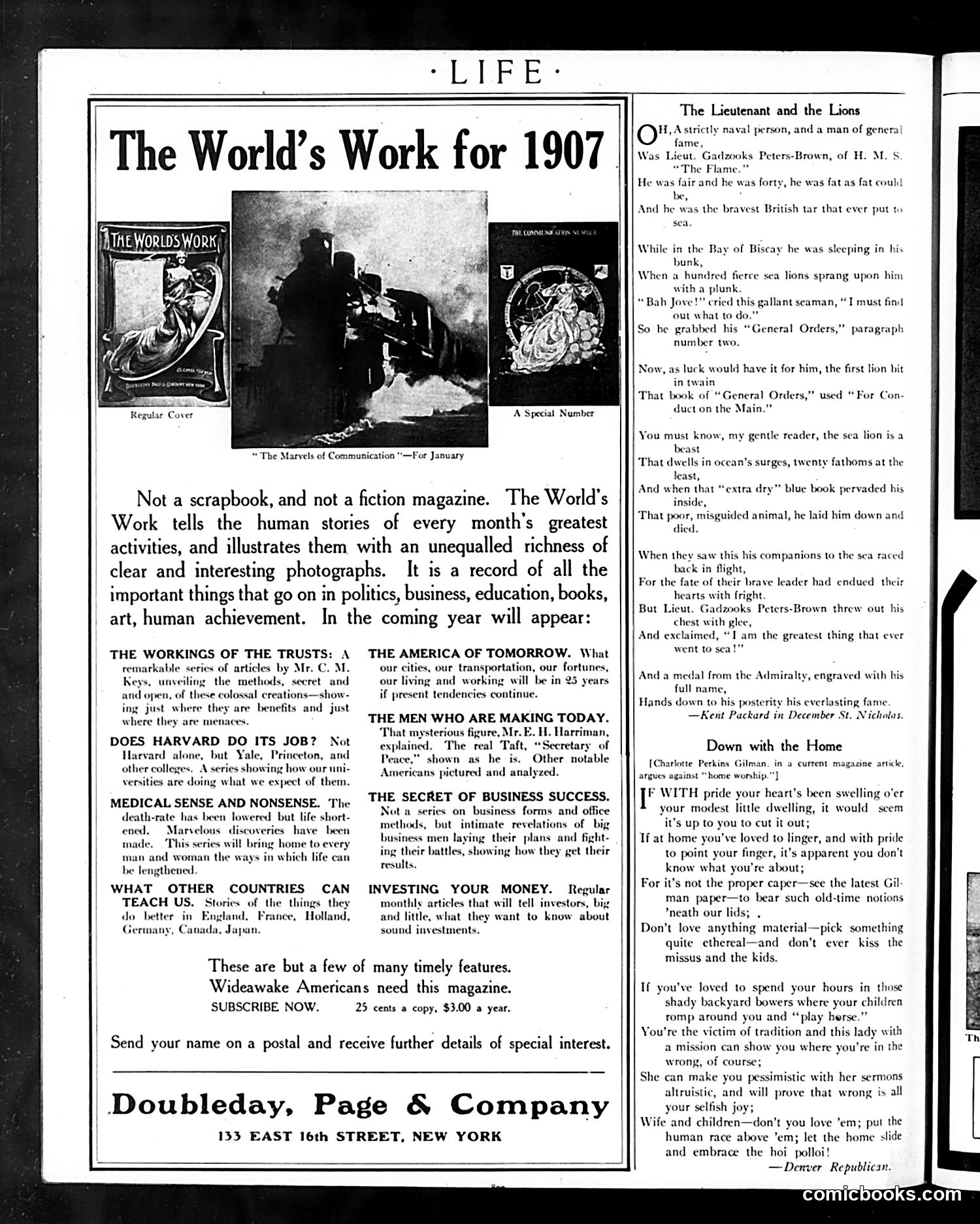
This page primarily advertises *The World's Work* magazine, a serious journalistic publication (not fiction or satire). The advertisement promises investigative journalism on contemporary issues: trusts, universities, medical advances, international comparisons, and business practices. Notable figures mentioned include E.H. Harriman (railroad magnate) and President Taft. The right column contains "The Lieutenant and the Lions," a humorous light verse by Kent Packard (published in *St. Nicholas* magazine). It's a mock-heroic poem about a British naval officer, Lieutenant Peters-Brown, who defeats sea lions by force-feeding one a Navy regulations handbook ("General Orders"). The satire gently mocks British naval formality and pomposity—the idea that rigid adherence to regulations conquers all obstacles, even wild animals. The page reflects 1907 progressive-era concerns with exposés of corporate power and institutional accountability.
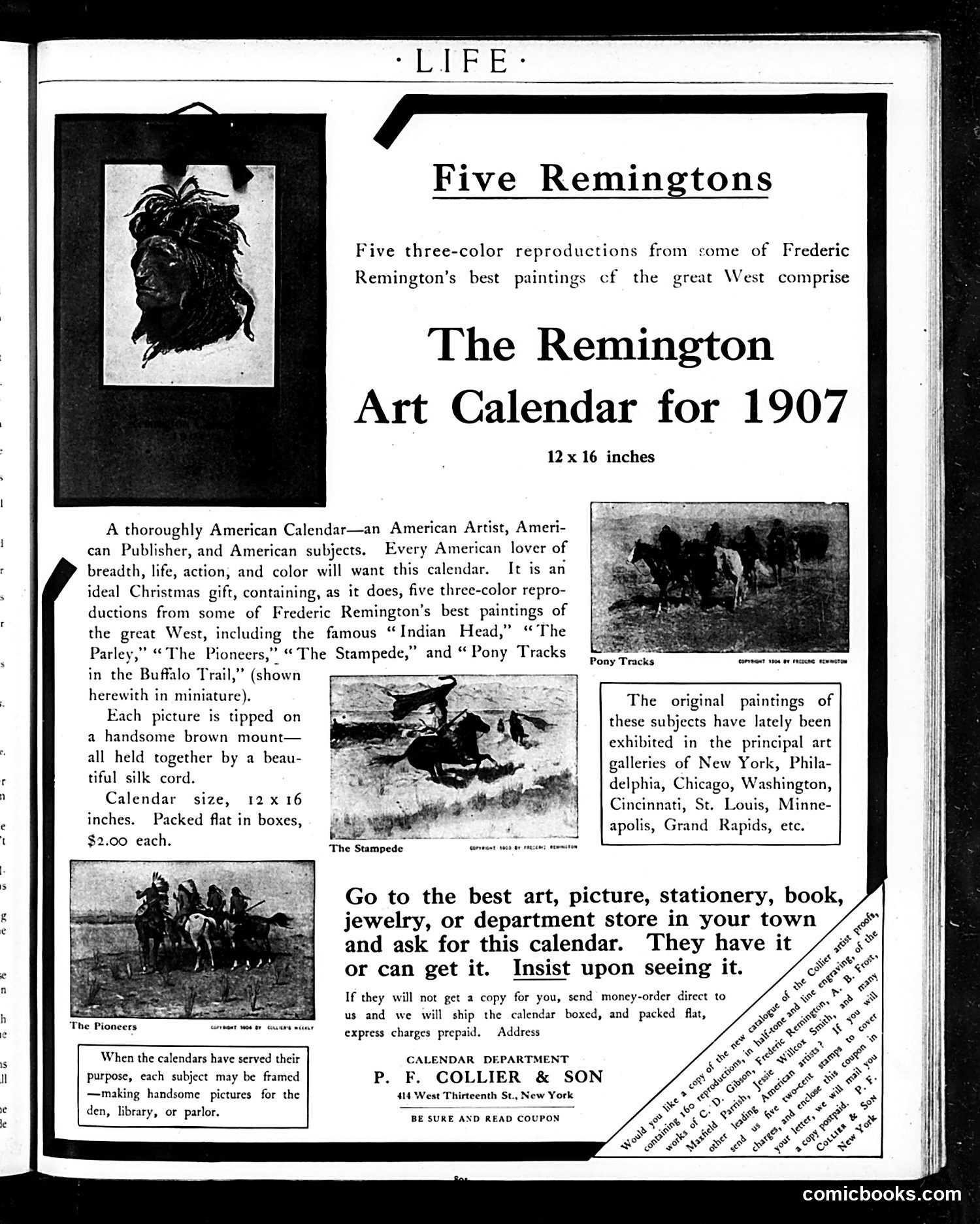
This is not a political cartoon but rather a **product advertisement** for a 1907 calendar featuring paintings by Frederic Remington, the famous American artist known for Western frontier imagery. The page promotes five reproductions of Remington's paintings—"Indian Head," "The Parley," "The Pioneers," "The Stampede," and "Pony Tracks in the Buffalo Trail"—presented as three-color prints. The advertisement emphasizes patriotic appeal ("thoroughly American Calendar—an American Artist, American Publisher, and American subjects"), marketing the calendar as an ideal Christmas gift at $2.00. The small reproductions visible show frontier scenes with Native Americans, cowboys, and horses—typical Remington subject matter romanticizing the American West. The ad directs readers to purchase through local retailers or directly from P.F. Collier & Son publishing house in New York, emphasizing the calendars' quality and suitability for framing after use. This represents turn-of-the-century American cultural values celebrating Western expansion and frontier mythology.
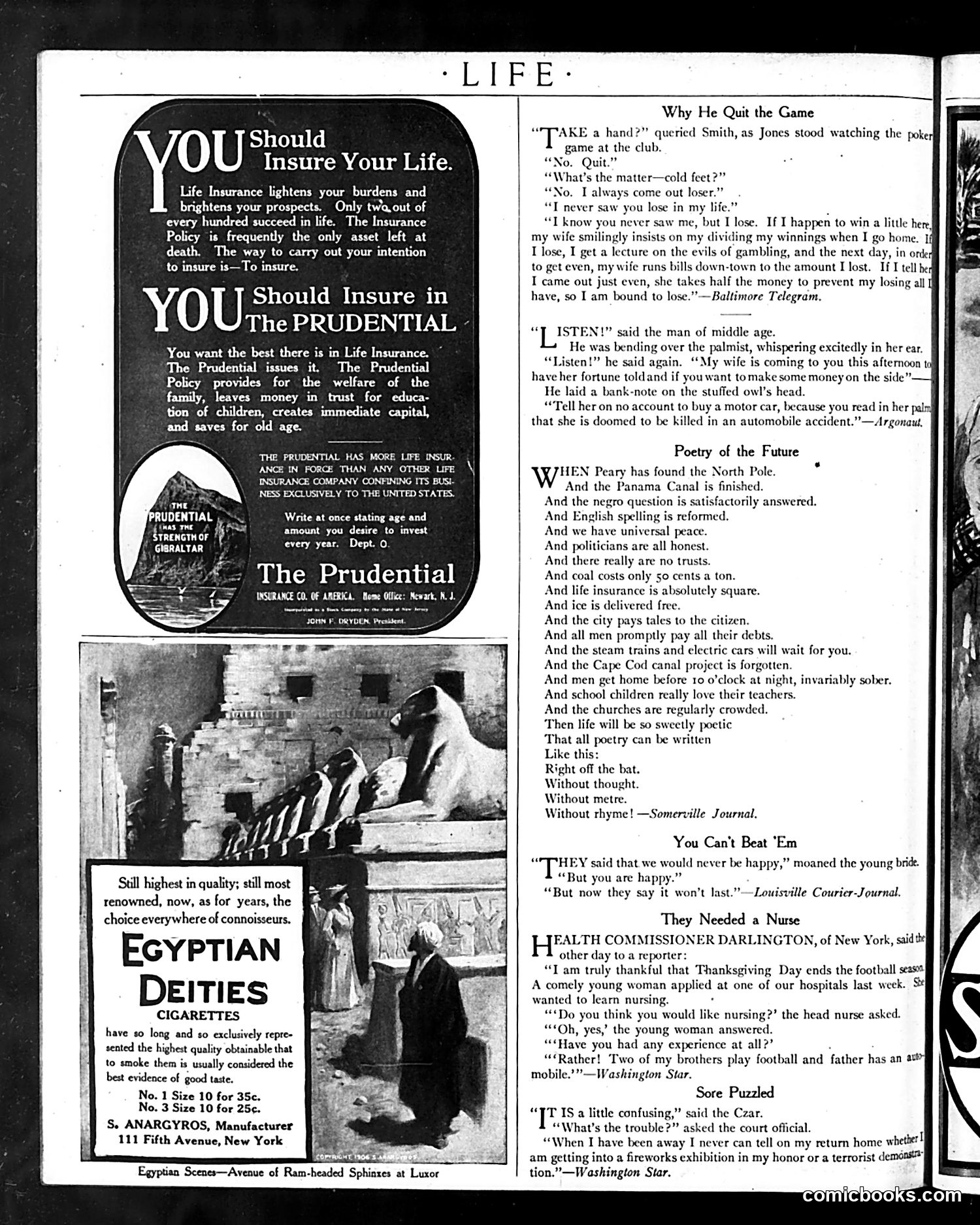
This page combines advertisements with humorous satirical pieces typical of *Life* magazine's editorial voice. **Ads**: The Prudential Insurance and Egyptian Deities Cigarettes advertisements occupy significant space. These are standard period marketing—the cigarette ad emphasizes "quality" and taste, while the insurance ad appeals to family security and financial planning. **Satirical Content**: The right-hand column features short comedic pieces. "Why He Quit the Game" satirizes wives' financial double-bind logic: if a husband wins at cards, she demands the winnings; if he loses, she lectures him and runs up household bills—making gambling futile. "Listen!" mocks fortune-tellers' opportunism. The extended poem "Poetry of the Future" is biting satire: it lists impossible utopian conditions (honest politicians, fair insurance, trusts eliminated, free ice delivery, children loving school) before poetry could be written "without thought" or "metre." The final item suggests reform to women's expectations in marriage is equally unrealistic. The page reflects era-specific anxieties about male vice, women's domestic authority, and reform optimism, while targeting credulous consumers and unfulfilled promises.
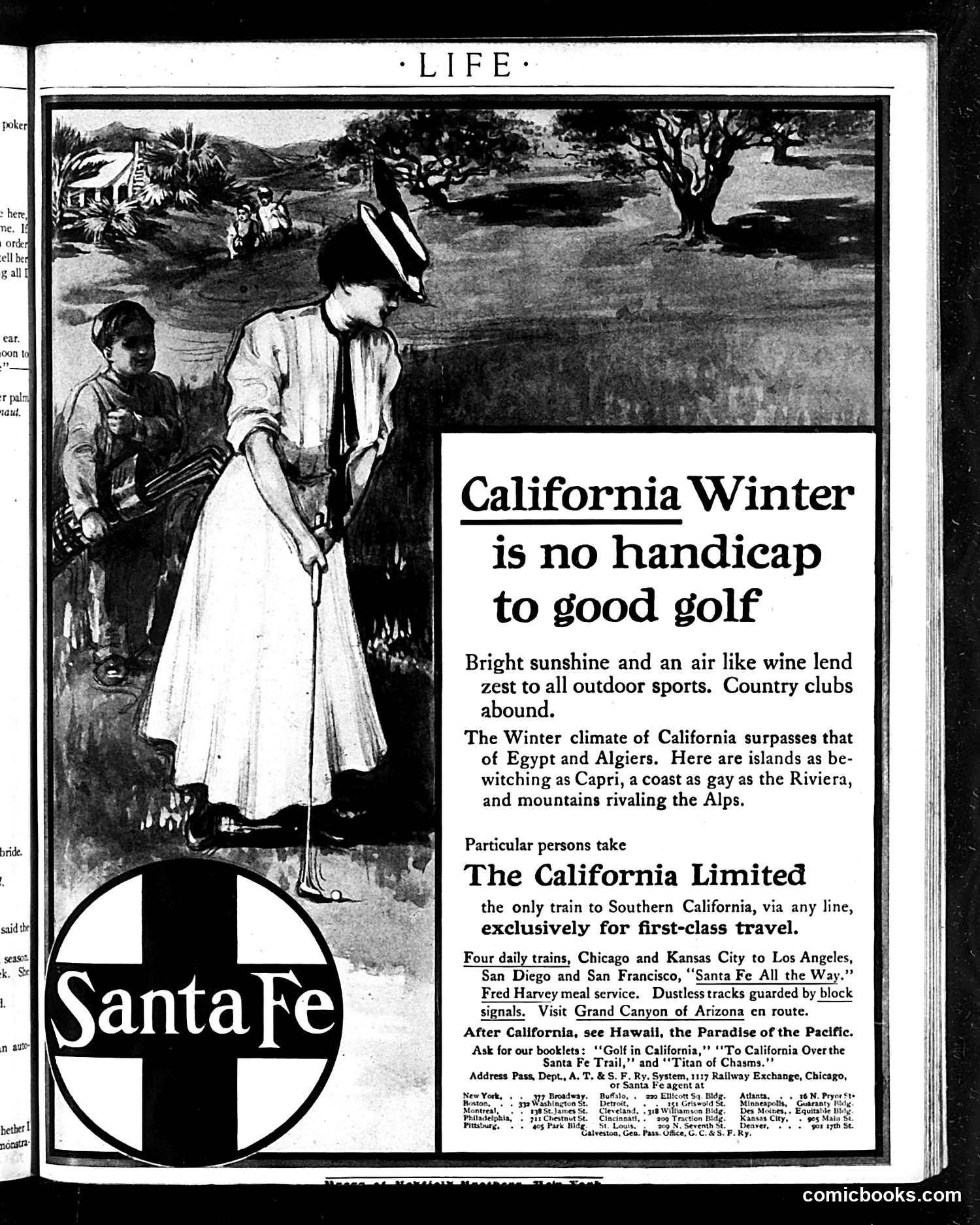
This is primarily a **Santa Fe Railroad advertisement**, not a political cartoon. The image shows a woman in Edwardian-era dress playing golf, with a young caddy, set against a California landscape. The "satire" here is gentle commercial messaging: the ad argues that California's mild winter climate is ideal for golf and outdoor leisure—a luxury pitch targeting affluent travelers. It compares California favorably to famous Mediterranean destinations (Capri, the Riviera) and Egyptian resorts, positioning it as an exclusive vacation destination. The "California Limited" train is promoted as the first-class conveyance for such particular persons. The ad emphasizes amenities (Fred Harvey dining service, guarded tracks) and suggests tourists can visit California, then continue to Hawaii and the Grand Canyon. For modern readers: this reflects early 20th-century American marketing of the West as a playground for the wealthy, using aspirational European comparisons to sell leisure travel via rail.
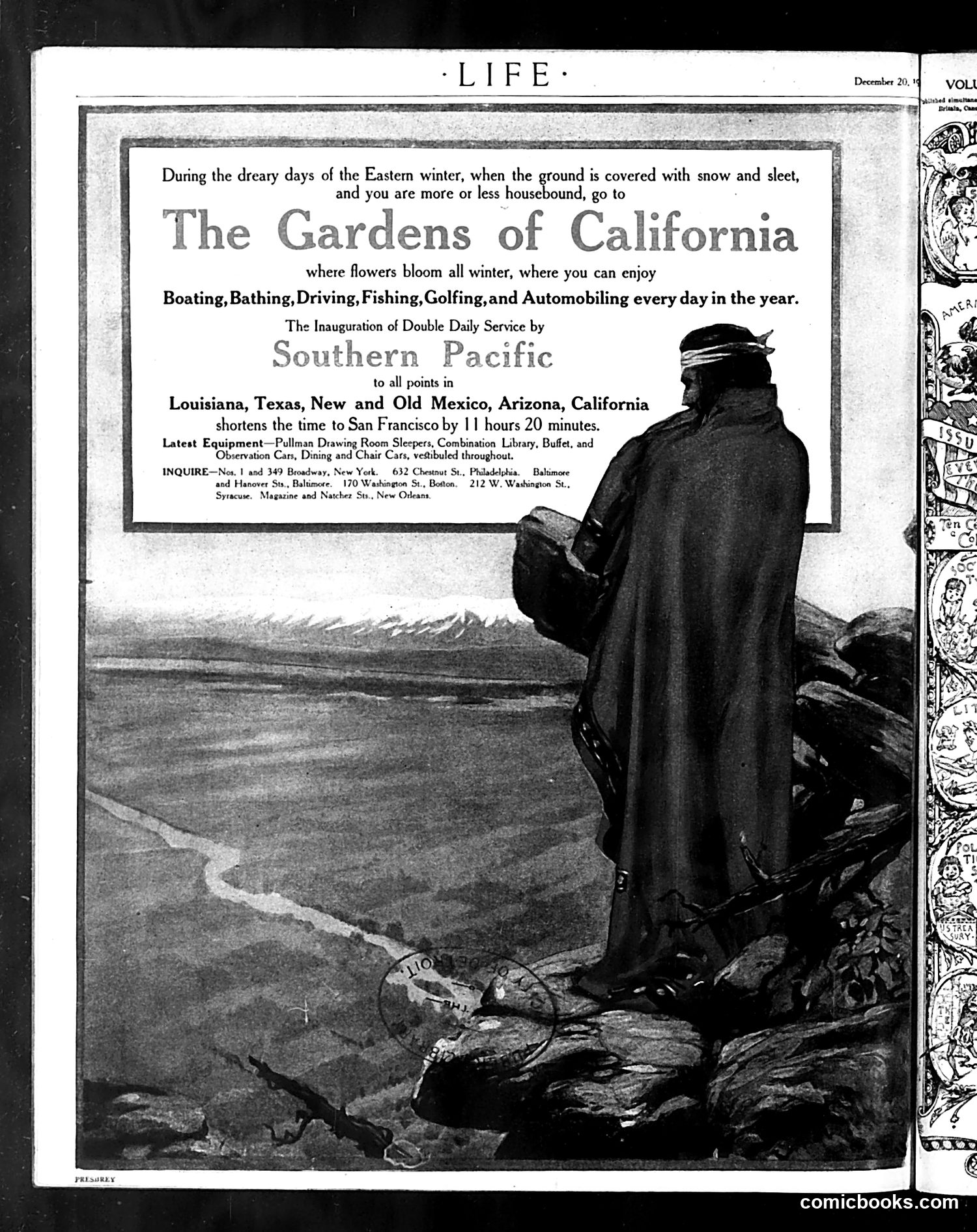
This is primarily a **railroad advertisement**, not a political cartoon. It promotes Southern Pacific's new double-daily train service to California destinations. The image shows a figure in heavy winter clothing gazing southward toward a warm, fertile California landscape with snow-capped mountains in the distance. This visual contrast—between the "dreary days of the Eastern winter" with "snow and sleet" mentioned in the text and California's perpetual sunshine and blooming gardens—is the advertisement's central appeal. The satire is gentle and implicit: it mocks Eastern winter weather by presenting California as an irresistible escape for the "housebound," where one can enjoy outdoor activities year-round. The figure's yearning posture emphasizes the desirability of this contrast. Rather than political commentary, this reflects early 20th-century American advertising's use of aspirational messaging—selling not just transportation but a lifestyle and climate escape that became central to California's brand identity.
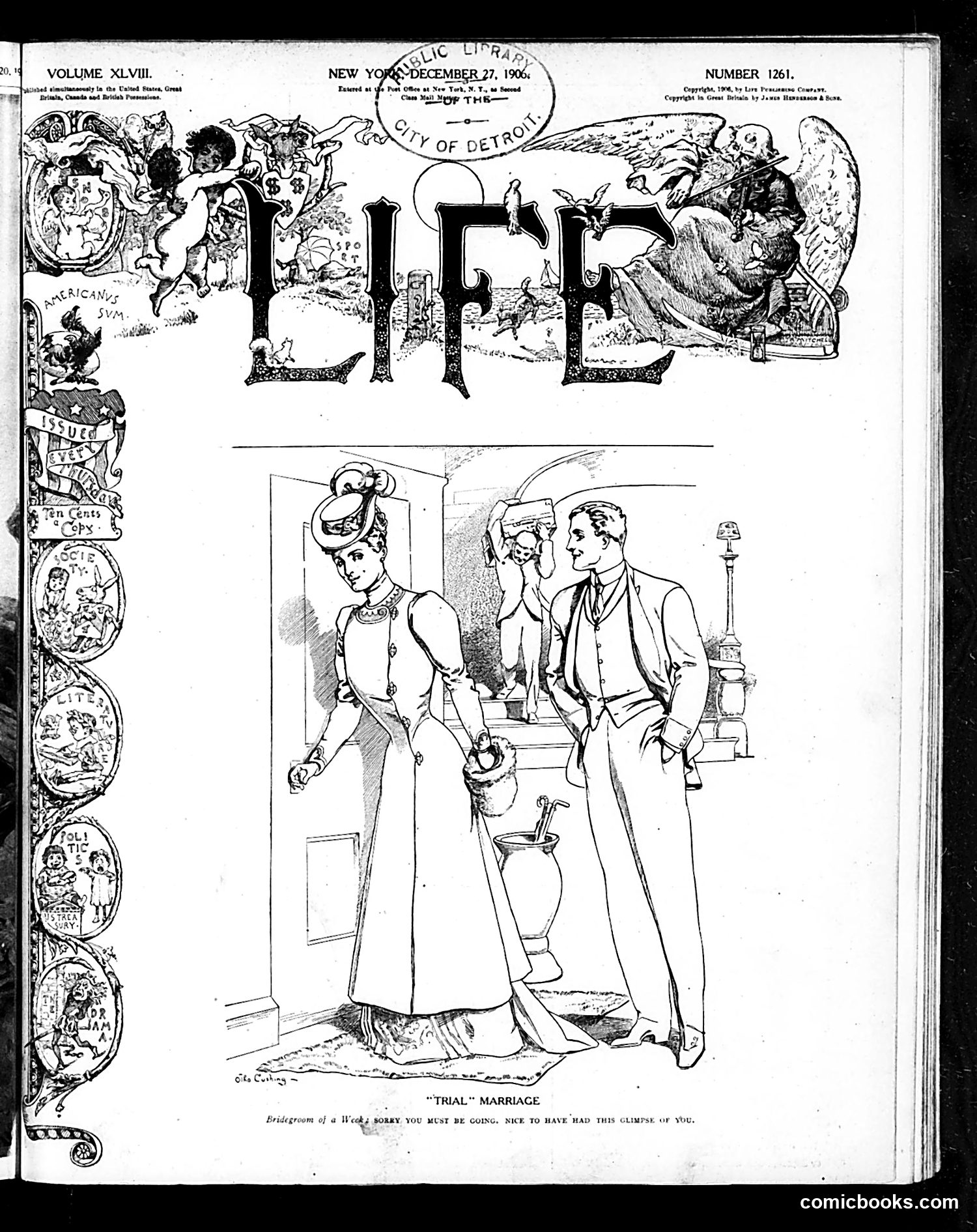
This Life magazine cartoon satirizes the early-1900s social practice of "trial marriage"—a controversial concept where couples would live together before or instead of formal marriage. The cartoon depicts a woman in fashionable dress and elaborate hat greeting a man at her home's entrance. The caption's dismissive tone ("Sorry, you must be going") suggests she's ending a temporary domestic arrangement casually, as though he were a brief houseguest rather than a spouse. The satire targets the perceived immorality and instability of trial marriage, which shocked conventional society at the time. By showing the woman as fashionable but apparently fickle, the cartoon mocks both the practice and the "new woman" of the era who might adopt such unconventional living arrangements. The joke hinges on portraying trial marriage as temporary and disposable—reinforcing conservative disapproval of alternatives to traditional matrimony.
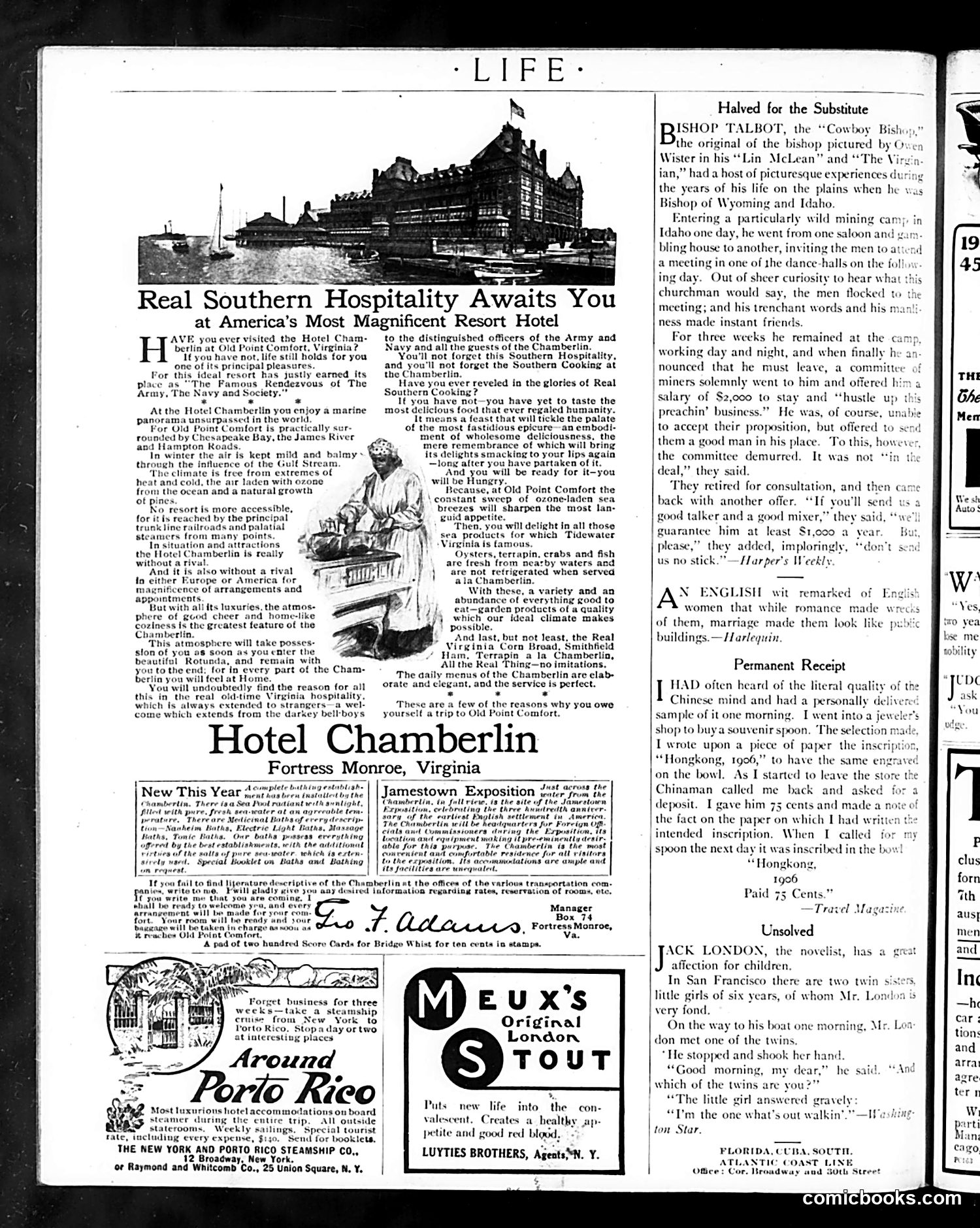
This page is primarily **advertising**, not satire or political commentary. It's a full-page promotional piece for the Hotel Chamberlin at Fortress Monroe, Virginia. The advertisement emphasizes "Real Southern Hospitality" and celebrates the hotel's luxuries, location, cuisine (particularly Southern cooking), and accessibility to military and society figures. The text repeatedly highlights Southern hospitality extended "from the darkey bell-boys" onwards—language reflecting period racial attitudes without irony. There is **no political cartoon or satirical content** visible. The only illustration shows a chef or cook figure, reinforcing the culinary marketing angle. The page also includes an announcement that the Hotel Chamberlin will serve as headquarters during the Jamestown Exposition (celebrating the 300th anniversary of English settlement in America). Minor advertisements for Porto Rico travel and Meux's Stout appear alongside the main hotel promotion.
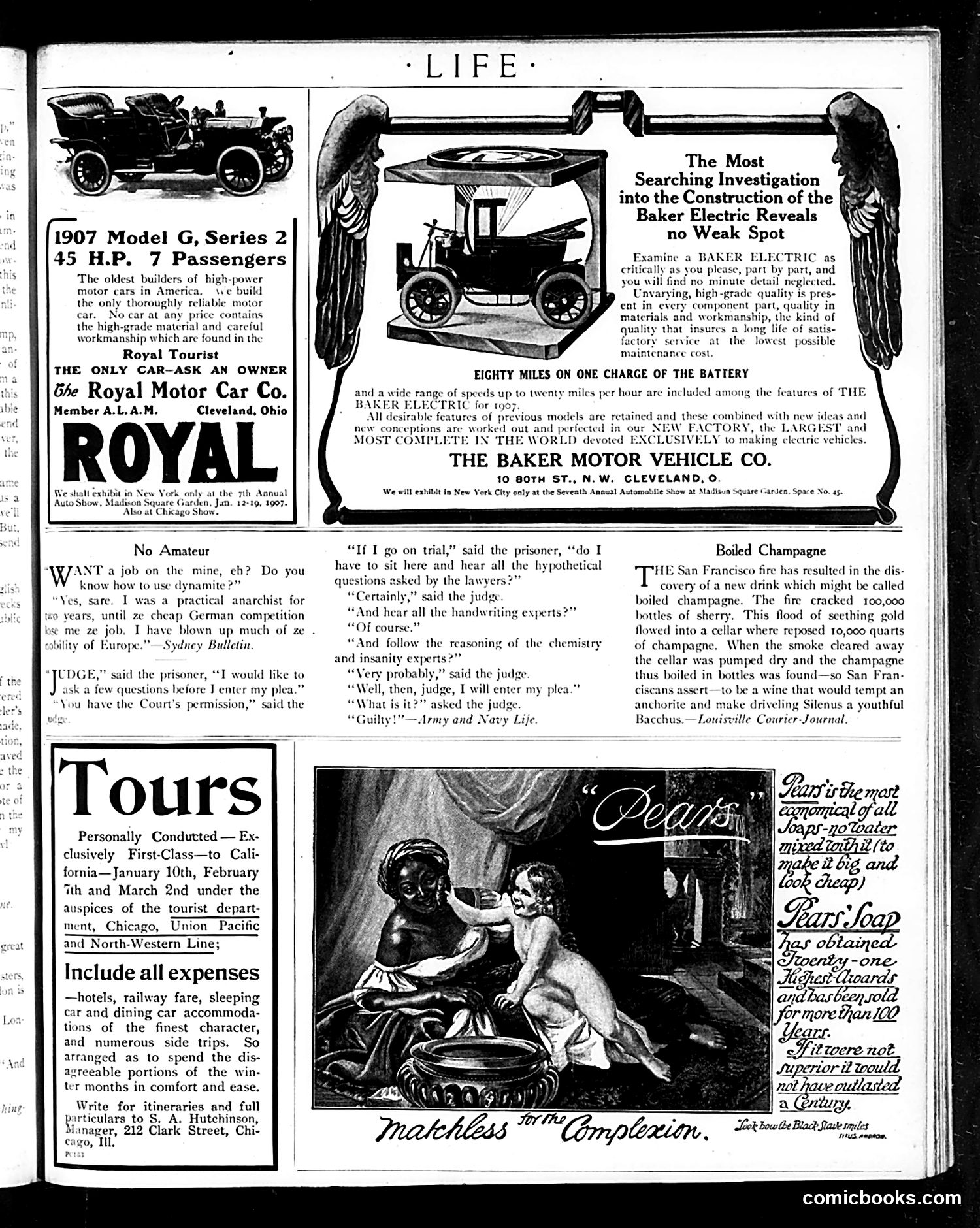
This page is primarily **automotive advertising** with sidebar humor pieces—typical of early 1900s Life magazine format. The main content advertises three competing early electric and gasoline automobiles: the Royal Motor Car (gasoline), and two electric vehicles (Baker Electric). The ads emphasize reliability, power, and range—key selling points as automobiles were still novel luxury items. The humor pieces are unrelated satirical vignettes: 1. **"No Amateur"**: A joke about a mine worker claiming anarchist dynamiting experience, playing on contemporary fears of anarchist immigrants. 2. **"Judge's Questions"**: A prisoner jokes he'd rather plead guilty than endure expert testimony—satirizing the growing complexity of trial procedures. 3. **"Boiled Champagne"**: A tongue-in-cheek account of San Francisco fire's aftermath, where heat supposedly improved stored champagne into an exceptional wine. None contain political cartoons or caricatures. The page reflects 1907's preoccupations: automobile technology, immigration anxieties, legal procedures, and the recent San Francisco earthquake (1906).
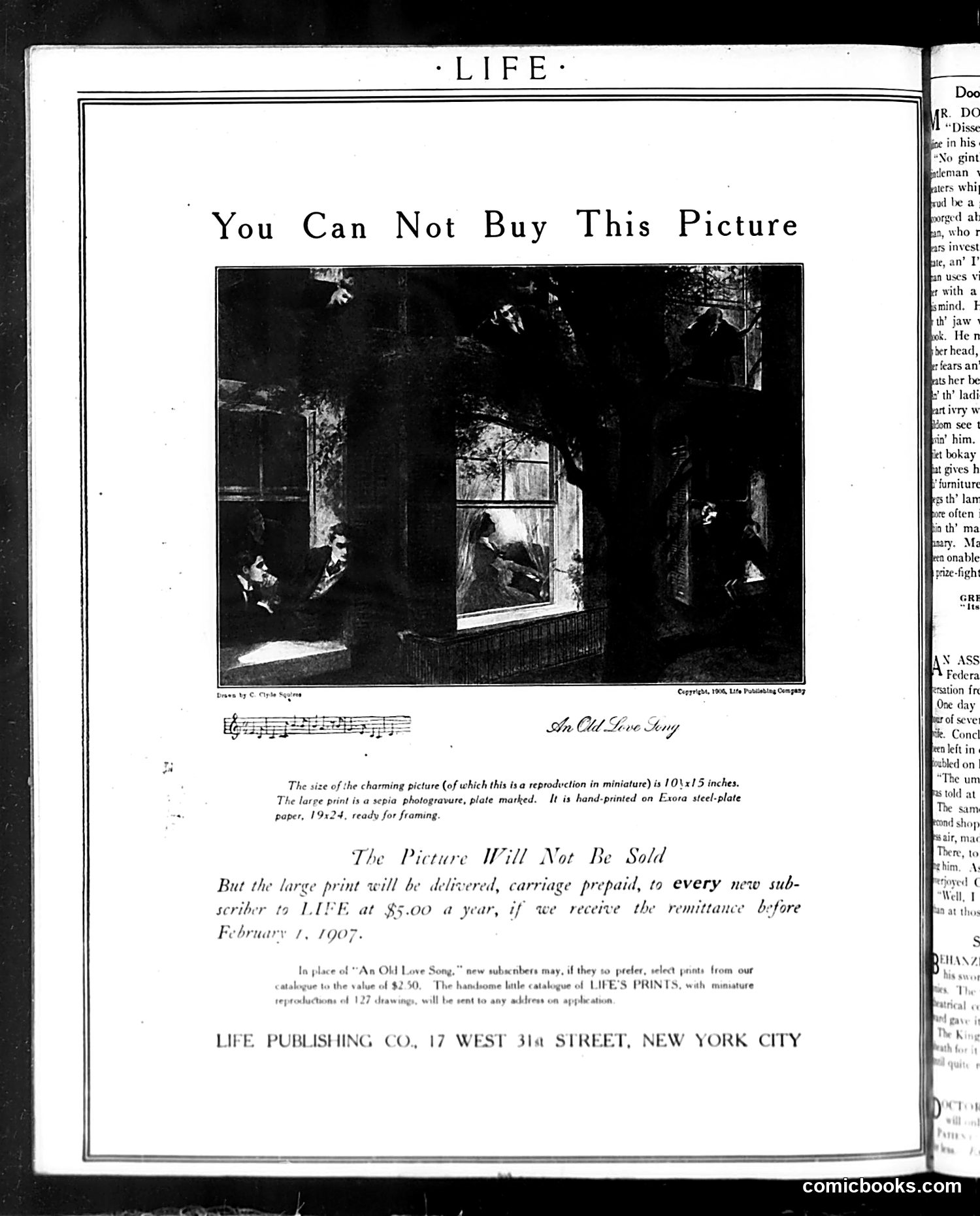
This is primarily **advertising content**, not editorial satire. Life Publishing Company is promoting a subscription offer (dated 1907) featuring a hand-printed photogravure titled "An Old Love Song." The image shows a sentimental domestic scene: figures visible through a lit window at night, with onlookers outside observing the intimate moment. This romantic, voyeuristic imagery was typical of early 20th-century sentimental art. The page's ironic headline—"You Can Not Buy This Picture"—is a marketing hook: the actual artwork won't be sold separately, but Life promises to deliver the large print free to new subscribers paying $5 annually (if they remit by February 1, 1907). The accompanying sheet music reinforces the nostalgic, emotional appeal. This represents Life's business model: using attractive art reproductions as subscription incentives rather than as independent commodities.
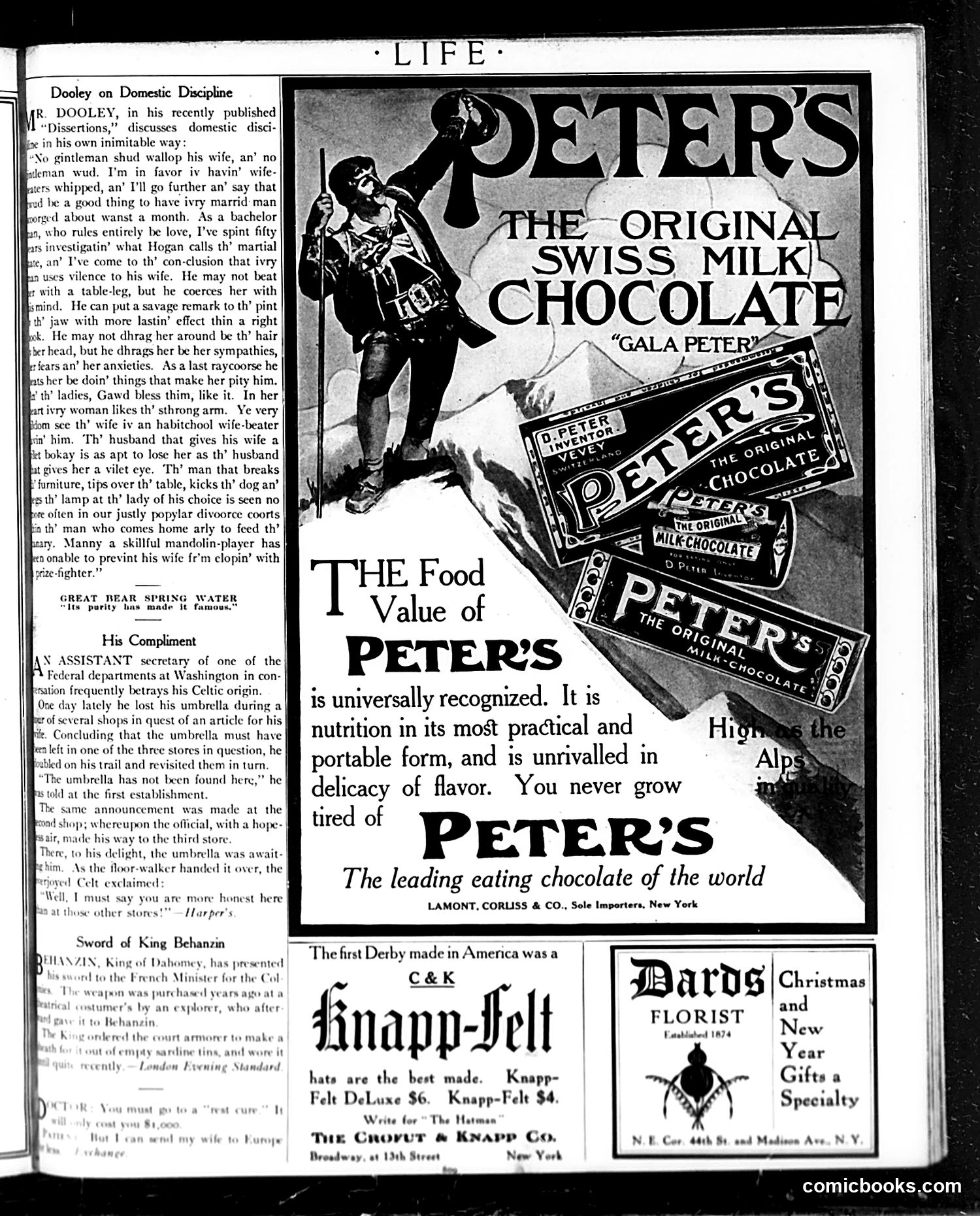
This page is primarily **advertising** for Peter's Swiss Milk Chocolate, with supporting editorial content. The main feature is "Dooley on Domestic Discipline," a satirical column by Mr. Dooley (a fictional Irish-American character created by humorist Finley Peter Dunne). Dooley discusses marital relations in his characteristic brogue, arguing paradoxically that while gentlemen shouldn't "wallop" their wives, some form of domestic dominance—through sarcasm, manipulation, or intimidation—is inevitable and even necessary in marriage. The satire mocks both Victorian attitudes about masculine authority and the contradictions in contemporary marriage discourse. The page also includes brief anecdotes about a bureaucrat's lost umbrella and King Behanzin of Dahomey's sword gift, but these are minor filler pieces. The bulk of the space advertises Peter's Chocolate as "the leading eating chocolate of the world," emphasizing its nutritional and portable qualities. Supporting ads promote Knapp-Felt hats and Dard's Florist.
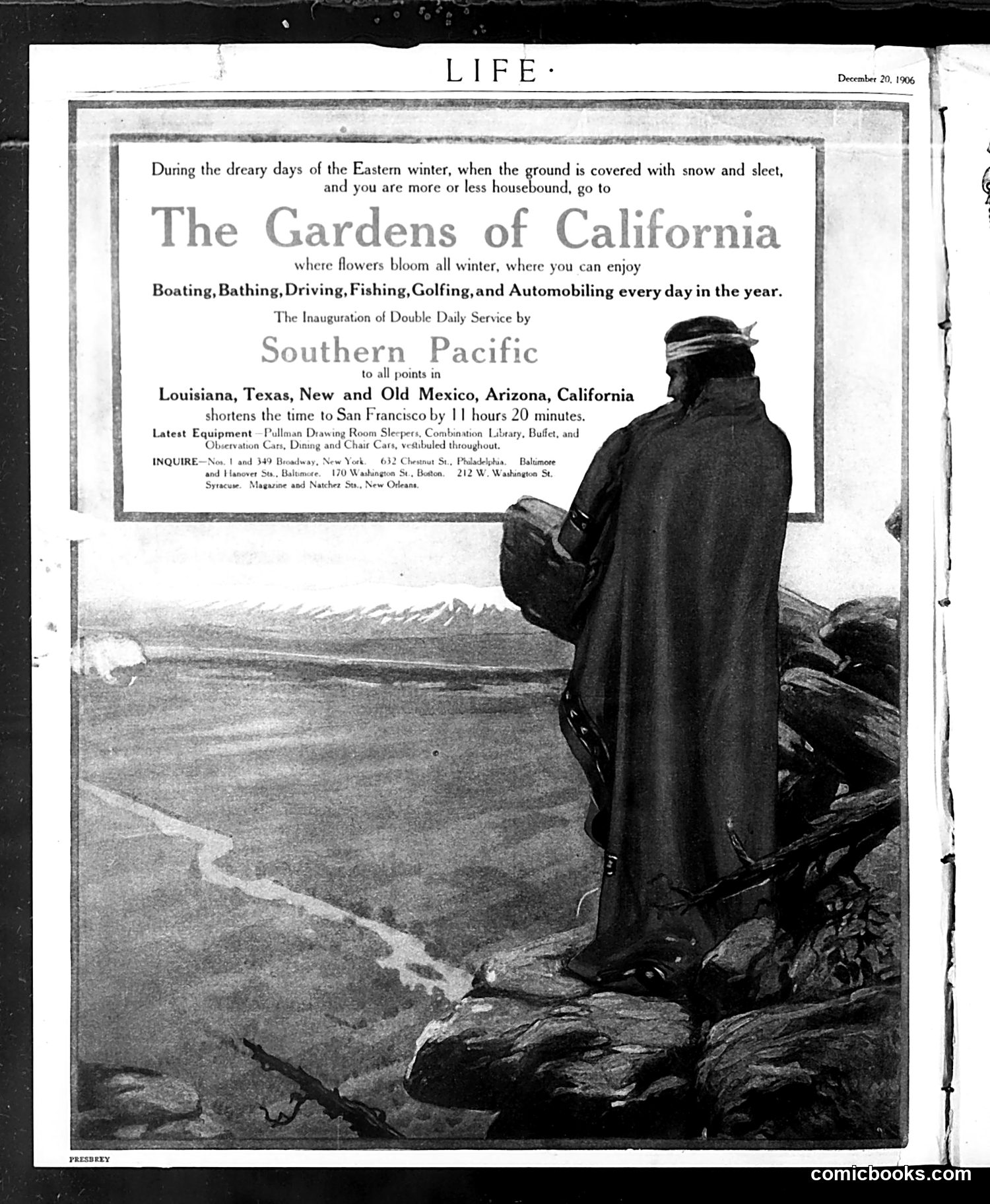
This is primarily a **railroad advertisement**, not political satire. The Southern Pacific Railway promotes its new "Double Daily Service" to California destinations, emphasizing year-round warm weather and outdoor recreation (boating, golfing, automobiling). The imagery shows a figure in winter clothing gazing from a snowy landscape toward California's warmer valleys and mountains—a visual contrast between the "dreary days of the Eastern winter" and California's perpetual sunshine. This is **aspirational advertising** exploiting common American desires: escape from harsh winters, leisure activities, and modern rail travel. The 1906 date marks early automobile culture enthusiasm and the railway industry's peak marketing era before automobiles made such trains less essential. The advertisement targets wealthy Easterners seeking winter refuge—a appeal that became a foundational California tourism trope.