
Life, 1906-12-20 · page 18 of 46
Life — December 20, 1906 — page 18: what you’re looking at
What you’re looking at
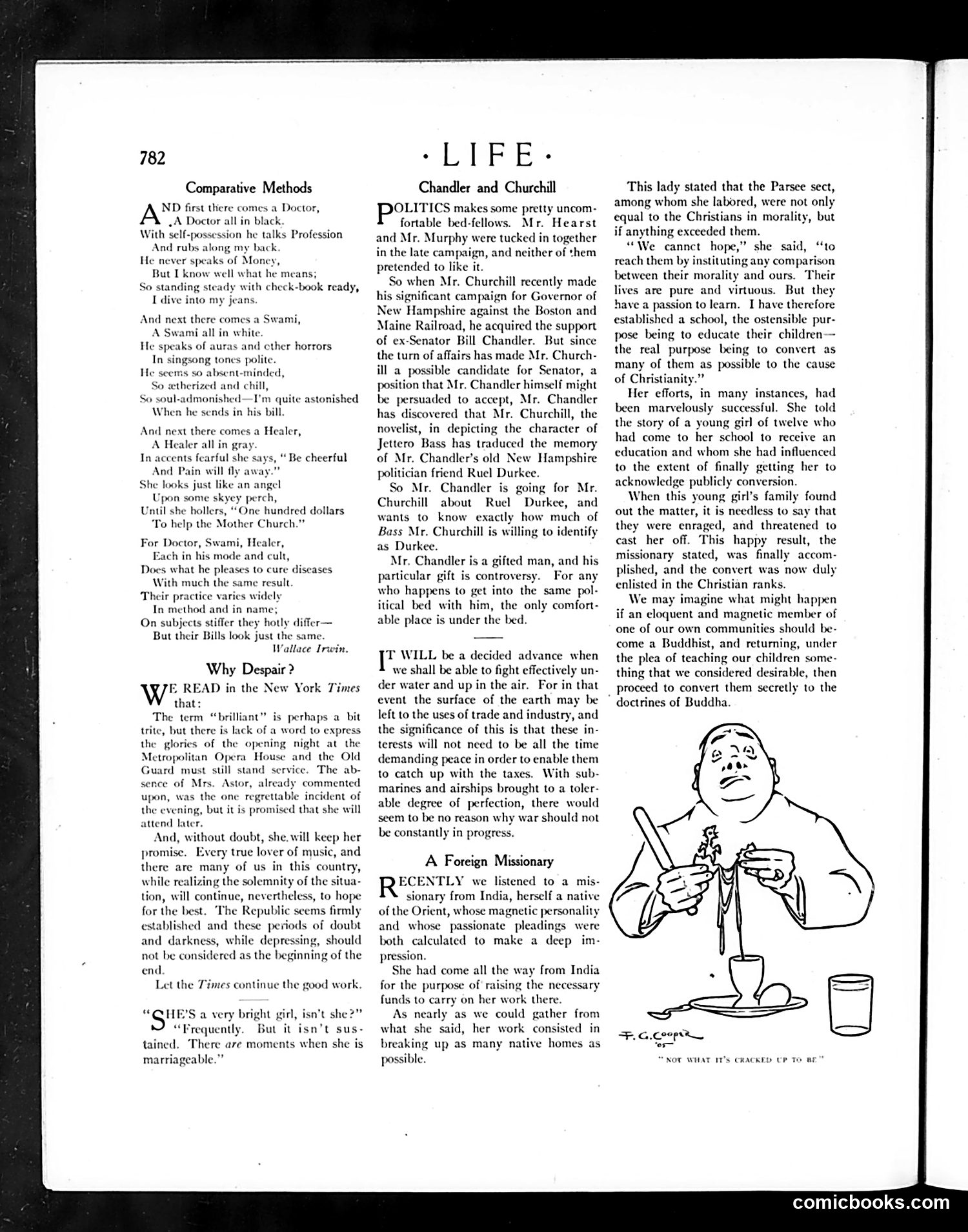
This page contains three distinct pieces satirizing American society circa early 1900s. **"Comparative Methods"** (poem by Wallace Irwin): Mocks three alternative healers—a doctor, swami, and faith healer—all dressed distinctively (black, white, gray). The joke: despite their different philosophies and demeanor, they all demand payment identically. It's social commentary on quackery and commercialism masquerading as medicine or spirituality. **"Why Despair?"**: A brief society-page joke about a "bright girl" whose intelligence is inconsistent with marriageability—satirizing upper-class attitudes that intelligence in women made them poor marriage prospects. **"Chandler and Churchill"**: Political commentary on New Hampshire politicians. Ex-Senator Chandler and novelist Churchill were allied against the Boston & Maine Railroad, but when Churchill became a Senate candidate, Chandler attacked him, claiming his novel character "Jettero Bass" libeled Chandler's old friend Ruel Durkee. The satirist notes Chandler weaponizes controversy—his "comfortable place is under the bed" with political allies. The accompanying crude cartoon illustrates the Foreign Missionary section (incomplete on this page).
📄 Transcribed text from this page (OCR, searchable)
Machine-transcribed from the original scan — historical spelling and the odd misread are preserved.
782 Comparative Methods ND first there comes a Doctor, «A Doctor all in black With self-possession he talks Profession And rubs along my back He never speaks of Money, But I know well what he means; So standing steady with check-book ready, I dive into my jeans. And next there comes a Swami, A Swami all in white He speaks of auras and ether horrors In singsong tones polite. He seems so absent-minded, So wtherized and chill, So soul-admonished—I'm quite astonished When he sends in his bill. And next there comes a Healer, A Healer all in gray In accents fearful she And Pain will fly away. She looks just like an angel Upon some skyey perch, Until she hollers, “One hundred dollars To help the Mother Church.” “Be cheerful For Doctor, Swami, Healer, Each in his mode and cult, Does what he pleases to cure diseases With much the same result. Their practice varies widely In method and in name; On subjects stiffer they hotly differ— But their Bills look just the same. Wallace Irwin. Why Despair ? D in the New York Times that The term “brilliant” is perhaps a bit trite, but there is lack of a word to express the glories of the opening night at the Metropolitan Opera House and the Old Guard must still stand service. The ab- sence of Mrs. Astor, already commented upon, was the one regrettable incident « the evening, but it is promised that she will attend later. And, without doubt, she. will keep her promise. Every true lover of music, and there are many of us in this country, while realizing the solemnity of the situa- tion, will continue, nevertheless, to hope for the best. ‘The Republic seems firmly established and these periods of doubt and darkness, while depressing, should not be considered as the beginning of the end Let the Times continue the good work, “QUHE’S a very bright girl, isn’t she?” “Frequently, But it isn’t su tained. There ave moments when she is marriageable.” ‘LTP E « Chandler and Churchill OLITICS makes some pretty uncom- fortable bed-fellows. Mr. Hearst and Mr. Murphy were tucked in together in the late campaign, and neither of them pretended to like it. So when Mr. Churchill recently made his significant campaign for Governor of New Hampshire against the Boston and Maine Railroad, he acquired the support of ex-Senator Bill Chandler. But since the turn of affairs has made Mr. Church- ill a possible candidate for Senator, a position that Mr. Chandler himself might be persuaded to accept, Mr. Chandler has discovered that Mr. Churchill, the novelist, in depicting the character of Jettero Bass has traduced the memory of Mr. Chandler’s old New Hampshire politician friend Ruel Durkee. So Mr. Chandler is going for Mr. Churchill about Ruel Durkee, and wants to know exactly how much of Bass Mr. Churchill is willing to identify as Durk Mr, Chandler is a gifted man, and his particular gift is controversy. For any who happens to get into the same pol- itical bed with him, the only comfort- able place is under the bed. T WILL be a decided advance when we shall be able to fight effectively un- der water and up in the air. For in that event the surface of the earth may be left to the uses of trade and industry, and the significance of this is that these in- terests will not need to be all the time demanding peace in order to enable them to catch up with the taxes. With sub- marines and airships brought to a toler- able degree of perfection, there would seem to be no reason why war should not be constantly in progress. A Foreign Missionary CENTLY we listened to a mis- sionary from India, herself a native of the Orient, whose magnetic personality and whose passionate pleadings were both calculated to make a deep im- pression. She had come all the way from India for the purpose of raising the necessary funds to carry on her work there As nearly as we could gather from what she said, her work consisted in breaking up as many native homes as possible. This lady stated that the Parsee sect, among whom she labored, were not only equal to the Christians in morality, but if anything exceeded them. “We cannct hope,” she said, “to reach them by instituting any comparison between their morality and ours. Their lives are pure and virtuous. But they have a passion to learn. I have therefore established a school, the ostensible pur- pose ig to educate their children— the real purpose being to convert as many of them as possible to the cause of Christianity.” Her efforts, in many instances, had been marvelously successful. She told the story of a young girl of twelve who had come to her school to receive an education and whom she had influenced to the extent of finally getting her to acknowledge publicly conversion. When this young girl’s family found out the matter, it is needless to say that they were enraged, and threatened to cast her off. This happy result, the missionary stated, was finally accom- plished, and the convert was now duly enlisted in the Christian ranks. We may imagine what might happen if an eloquent and magnetic member of one of our own communities should be- come a Buddhist, and returning, under the plea of teaching our children some- thing that we considered desirable, then proceed to convert them secretly to the doctrines of Buddha. FF. G.Coeph “or “Noe WHAT IT's CRACKED comicbooks.com