
Life, 1906-12-20 · page 22 of 46
Life — December 20, 1906 — page 22: what you’re looking at
What you’re looking at
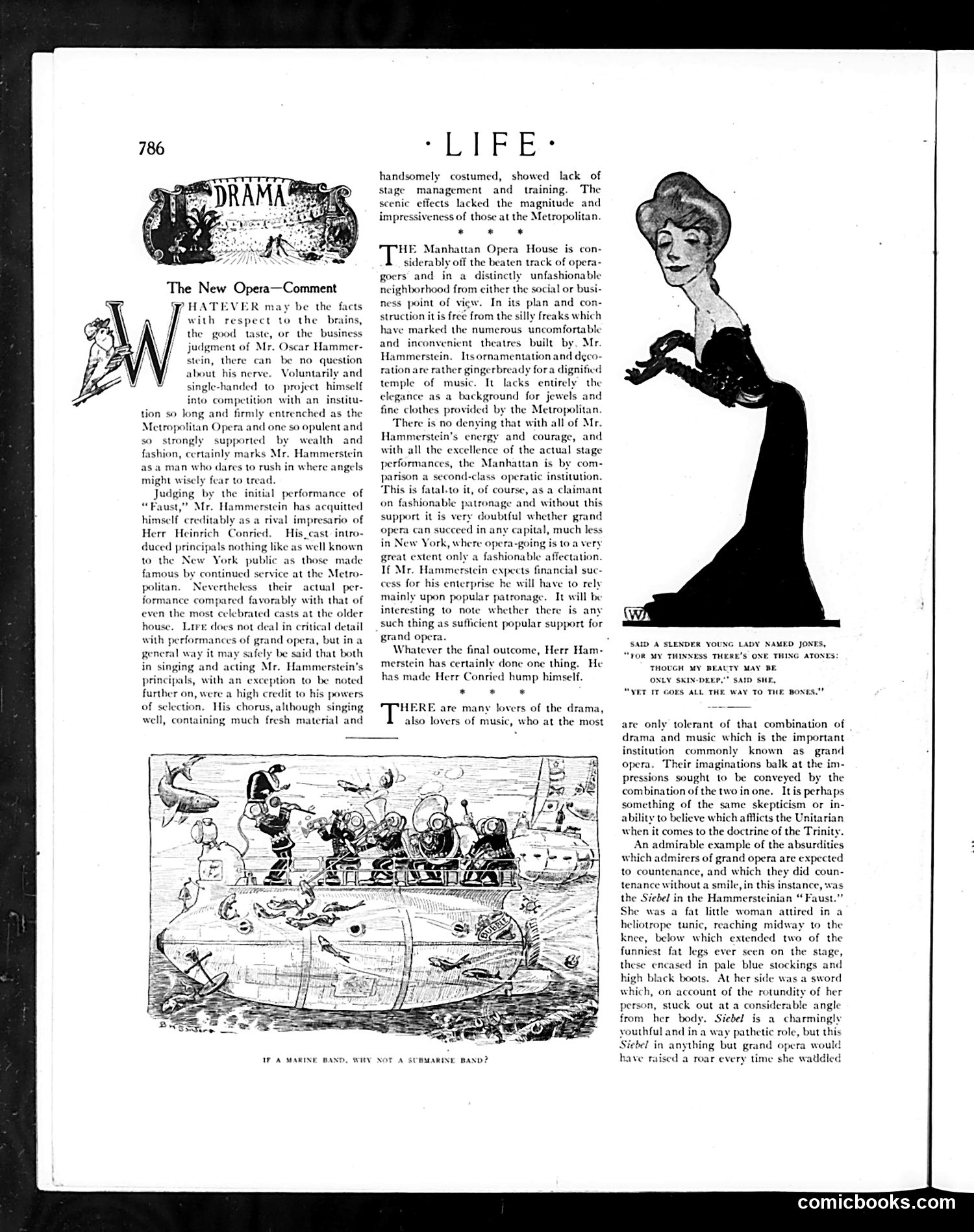
This page critiques Oscar Hammerstein's newly opened Manhattan Opera House, which challenged the established Metropolitan Opera's monopoly on New York's opera scene. **The Main Cartoon ("If a Marine Band, Why Not a Submarine Band?"):** A visual pun mocking a woman's extreme thinness—her beauty allegedly extends "all the way to the bones," suggesting she's skeletal. This has no connection to the opera commentary. **The Opera Critique:** The text praises Hammerstein's nerve in competing against the well-entrenched, wealthy Metropolitan Opera. However, it attacks his venue as inferior: located in an unfashionable neighborhood, architecturally gaudy ("gingerbready"), and lacking the Metropolitan's elegance. Crucially, the article questions whether grand opera can survive on "popular patronage" alone, implying it depends on wealthy fashionable society's support—which the Manhattan's inferior setting cannot attract. The review concedes Hammerstein made the Metropolitan's director "hump himself" (work harder), but doubts his financial viability.
📄 Transcribed text from this page (OCR, searchable)
Machine-transcribed from the original scan — historical spelling and the odd misread are preserved.
with the brains, the good taste, or the business judgment of Mr. Oscar Hammer- stein, there can be no question about his nerve. Voluntarily and single-handed to. project himself into competition with an_institu- tion so Jong and firmly entrenched as the Metropolitan Opera and one so opulent and so strongly supported by wealth and fashion, certainly marks Mr. Hammerstein as a man who dares to rush in where angels might wisely fear to tread. Judging by the initial performance of “Faust,” Mr. Hammerstein has acquitted himself creditably as a rival impresario of Herr Heinrich Conried. His_castintro- duced principals nothing like as well known to the New York public as those made famous by continued service at the Metro- politan. Nevertheless their actual per- formance compared favorably with that of even the most celebrated casts at the older house. Lire docs not deal in critical detail with performances of grand opera, but in a general way it may safely be said that both gg and acting Mr. Hammerstein's principals, with an exception to be noted further on, were of selection. His chorus, although singing well, containing much fresh material and respect to in sing high credit to his powers “LIFE: handsomely costumed, showed lack of stage management and taining. The scenic effects lacked the magnitude and npressiveness of those at the Metropolitan, * * * HE Manhattan Opera House is con- siderably off the beaten track of opers goers and in a distinctly unfashionable neighborhood from cither the social or busi- ness point of vigw. In its plan and con- struction itis free from the silly freaks which have marked the numerous uncomfortable and atres built by, Mr. Hammerstein. Itsornamentation and dgco- ration are rather gingerbready fora dignified temple of music. It lacks entirely the clegance as a background for jewels and fine clothes provided by the Metropolitan. There is no denying that with all of Mr. Hammerstein’s energy and courage, and with all the excellence of the actual stage performances, the Manhattan is by com- parison a second-class operatic institution. This is fatal-to it, of course, asa claimant on fashionable patronage and without this support it is very doubtful whether grand opera can succeed in any capital, much less in New York, where opera-going is to a very great extent only ation. If Mr. Hammerstein expects financial suc- cess for his enterprise he will have to rely mainly upon popular patronage, It will be interesting to note whether there is any such thing as sufficient popular support for grand opera. Whatever the final outcome, Herr Ham- merstein has certainly done one thing. He has made Herr Conried hump himself. * 8 6 inconvenient th fashionable aff HERE are many lovers of the drama, also lovers of music, who at the most IF A MARINE: BAND WHY NOT A SUBMARINE BAND? SAID A SLENDER YOUNG LADY NAMED JON “YOR MY THINNESS THERE'S ONE THING ATONES: THOUGH MY BEAUTY MAY BE ONLY SKIN-DEEP,"" SAID SIE, “YET IT GOFS ALL THE WAY TO THE BONES." are only tolerant of that combination of drama and music which is the important institution commonly known as grand opera. ‘Their imaginations balk at the im- pressions sought to be conveyed by the combination of the two inone. Itis perhaps something of the same skepticism or in- ability to believe which afflicts the Unitarian when it comes to the doctrine of the Trinit An admirable example of the absurdities which admirers of grand opera are expected to countenance, and which they did coun- tenance without a smile, in this instance, was the Siebel in the Hammersteinian “Faust.” She was a fat litle woman attired in a heliotrope tunic, reaching midway to the knee, below which extended two of the funniest fat legs ever scen on the stage, these encased in pale blue stockings and high black boots. At her side was a sword which, on account of the rotundity of her person, stuck out ata considerable angle from her body. Siebel is a charmingly youthful and ina way pathetic role, but this Siebel in anything but grand opera would have raised a roar every time she watldled comicbooks.com