
Life, 1906-12-20 · page 23 of 46
Life — December 20, 1906 — page 23: what you’re looking at
What you’re looking at
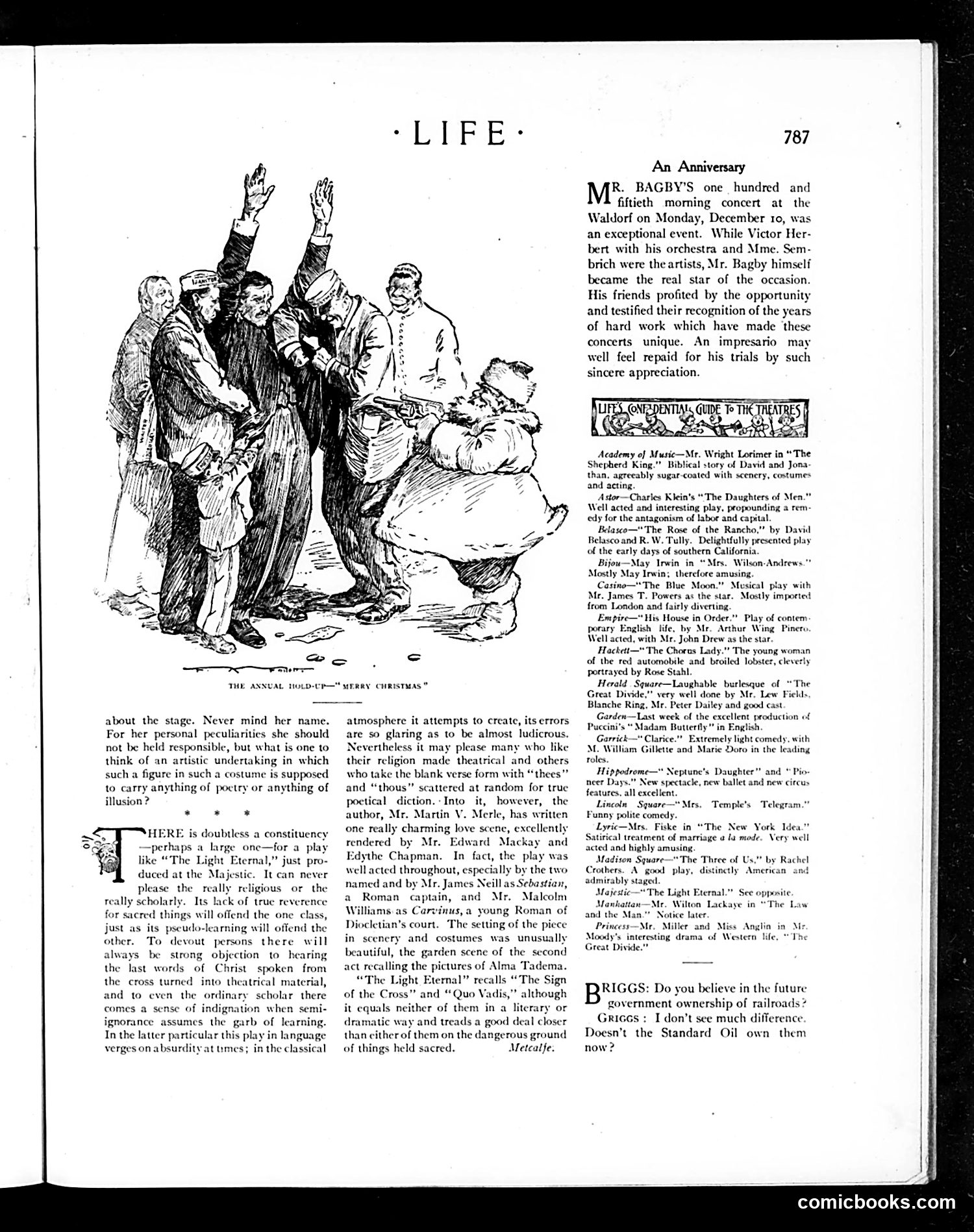
The cartoon depicts a satirical Christmas scene labeled "The Annual Hold-Up." A rotund figure (likely representing a theatrical producer or impresario) is surrounded by several people with their hands raised in celebratory or demanding gestures, while money appears scattered on the ground. The satire targets the commercialization of Christmas theater productions. The "hold-up" metaphor suggests that theatrical producers exploit the holiday season—extracting money from audiences through Christmas-themed shows. The raised hands and money scattered about indicate financial transaction or extraction during what should be a sacred or genuine cultural moment. This aligns with the page's theater reviews, which critique productions mixing religious and commercial elements. The accompanying text criticizes plays that treat sacred subjects like Christ theatrically for profit, suggesting hypocrisy in holiday entertainment marketed as artistic or spiritual when primarily financial. The cartoon thus mocks how the theater industry uses Christmas sentiment and religious themes to maximize profits during the season.
📄 Transcribed text from this page (OCR, searchable)
Machine-transcribed from the original scan — historical spelling and the odd misread are preserved.
TUE ANNUAL HOLD-UP—" MERRY CHRISTAEAS” about the stage. Never mind her name. For her personal peculiarities she should not be held responsible, but what is one to think of an artistic undertaking in which such a figure in such a costume is supposed to carry anything of poctry or anything of illusion ? dat the Majestic. It can never se the really religious or the Its lack of true reverence for sacred things will offend the one class, just as its pscudo-learning will offend the other. To devout pe: there will always be strong objection to hearing the of Christ spoken from the cross turned into theatrical material, and to even the ordinary scholar there comes a sense of indignation when semi- ignorance assumes the garb of learning. In the latter particular this play in language verges on absurdity at umes; in the classical last. words atmosphere it attempts to create, its errors are so glaring as to be almost ludicrous. rtheless it may please many who like their religion made theatrical and others who take the blank verse form with “thees”” and “thous” scattered at random for truc poctical diction. -Into it, however, the author, Mr. Martin V. Merle, has written one really charming love scene, excellently rendered by Mr. Edward Mackay and dythe Chapman. In fact, the play was well acted throughout, especially by the two named and by Mr. James Neill as Sebastian, a Roman captain, and Mr. Malcolm Williams. as Carvinus,a young Roman of Diocletian’s court. ‘The setting of the piece in scenery and costumes was unusually beautiful, the garden scene of the second act recalling the pictures of Alma Tadema. “The Light Eternal” recalls “The Sign of the Cross” and “Quo Vadis,” although it equals neither of them in a literary or dramatic way and treads a good deal closer than cither of them on the dangerous ground of things held sacred. Metcalfe. dis,’ 787 An Anniversary R. BAGBY’S one hundred and fiftieth moming concert at the Waldorf on Monday, December 10, was an exceptional event. While Victor Her- bert with orchestra and Mme. Sem- brich were theartists, Mr. Bagby himself became the real star of the occasion. His friends profited by the opportunity and testified their recognition of the years of hard work which have made ‘these concerts unique. An impresario may well feel repaid for his trials by such sincere appreciation. Academy of Music—Mr. Wright Lorimer in “The Shepherd King." Biblical story of David and Jona than, agreeably sugar-coated with scenery, costumes and acting. Astor—Charies Kicin's “The Daughters of Men.” Well acted and interesting play, propounding a rem- edy for the antagonism of labor and capital. Belasco—"The Rose of the Rancho,” by David Belasco and R. W. Tully. Delightfully presented play of the early days of southern California Bijou—May Irwin in “Mrs. Wilson-Andrews.” Mostly May Irwin; therefore amusing. Casino—"The Blue Moon.” Mesical play with Mr. James T. Powers as the star. Mostly imported from London and fairly diverting Empire—" His House in Order.” Play of contem porary English life, by Mr. Arthur Wing Pinero, Well acted, with Mr. John Drew as the star. Hackett—" The Chorus Lady." The young wom: of the red automobile and broiled lobster, cleverly portrayed by Rose Stahl. Herald Square—Laughable burlesque of “The Great Divide," very well done by Mr, Lew Field Blanche Ring, Mr. Peter Dailey and good cast Garden—Last week of the excellent production of Puccini's “Madam Butterfly " in English Garrich—" Clarice.” Extremely light comedy. with M. William Gillette and Marie Doro in the leading roles. Hippodrome— Neptune's Daughter” and Pin- neer Days."” New spectacle, new ballet and new circus features, all excellent. Lincoln Square—" Mes. Funny polite comedy. Lyric—Mrs. Fiske in “The New York Satirical treatment of marriage a la mode. Very well acted and highly amusing Madison Square—"The Three of Us,"" by Rachel Crothers. A good play, distinctly American admirably staged. Majestic" The Light Eternal.”* —Mr. Wilton Lackaye in * Notice later Princess—Mr. Miller and Miss Anglin in. Mr, Moody's interesting drama of Westet “The Great Divide.” Temple's Telegram.” Ice opposite “The Law RIGGS: Do you believe in the future government ownership of railroads? Gries : I don’t see much difference. Doesn’t the Standard Oil own them now? comicbooks.com