
Life, 1906-12-20 · page 24 of 46
Life — December 20, 1906 — page 24: what you’re looking at
What you’re looking at
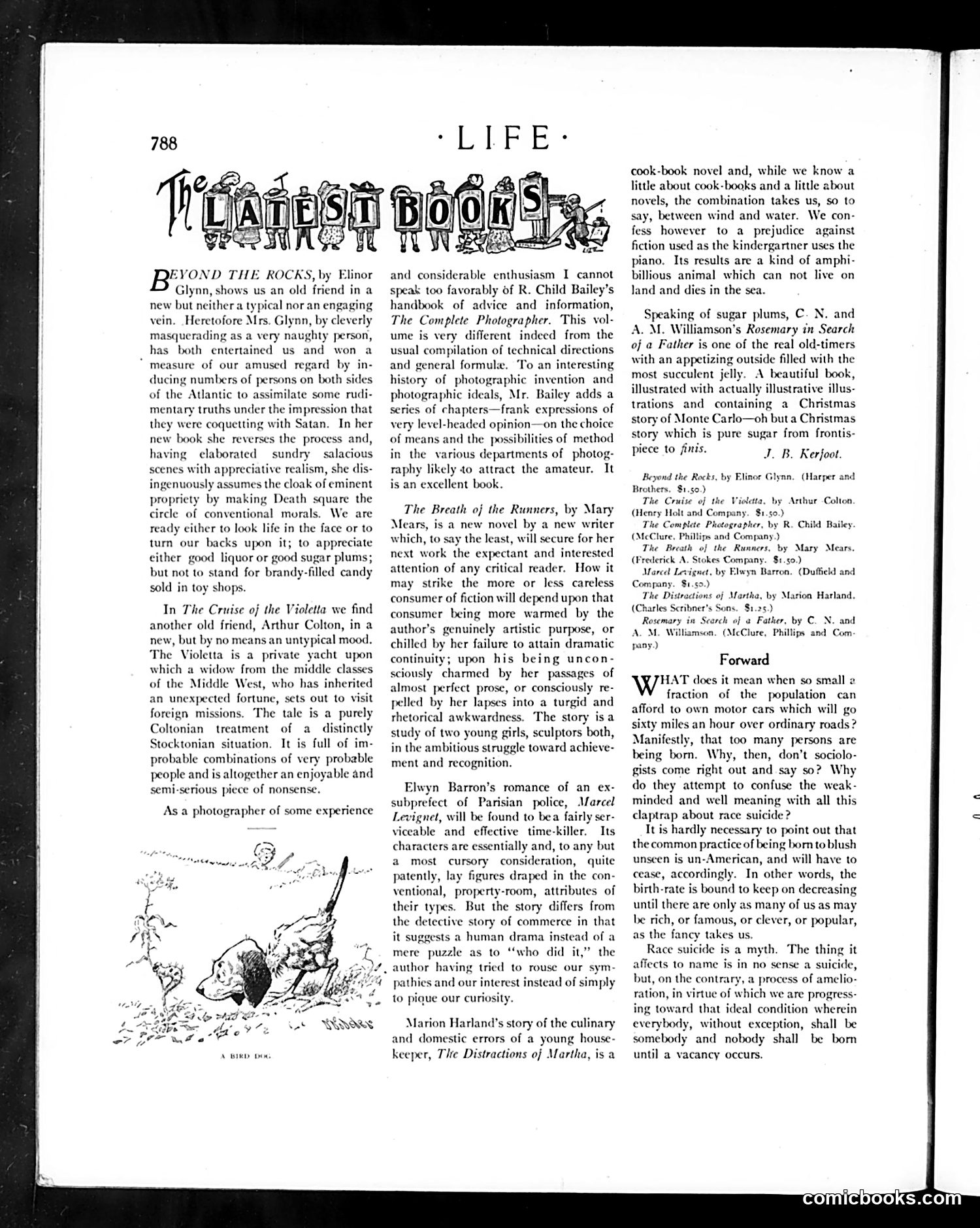
This page is primarily a **book review section** titled "The Largest Books," not a political cartoon. It contains literary criticism of several contemporary novels, including works by Elinor Glyn, Mary Mears, and others. The only illustration is a small sketch labeled "A Bird Dog"—a hunting dog pointing, likely serving as decorative filler rather than satirical commentary. The reviews themselves offer mild social satire through critique rather than cartooning. For example, the reviewer mocks Elinor Glyn's "Beyond the Rocks" for presenting salacious scenes while claiming moral propriety—a commentary on hypocrisy in popular literature. Another critique dismisses a novel's characters as mere "lay figures" (mannequins) without depth. The "Forward" section addresses **race suicide**—a period concern about birth rates among educated classes—but presents this as demographic anxiety rather than satire. This is essentially a **literary criticism page**, not a political cartoon page.
📄 Transcribed text from this page (OCR, searchable)
Machine-transcribed from the original scan — historical spelling and the odd misread are preserved.
EYOND THE ROCKS, by Glynn, shows us an old friend in a new but neither a typical nor an engaging vein. Heretofore Mrs. Glynn, by cleverly masquerading as a very naughty person, has both entertained us and won a * measure of our amused regard by in- ducing numbers of persons on both sides of the Atlantic to assimilate some rudi- mentary truths under the impression that they were coquetting with Satan. In her new book she reverses the process and, having elaborated sundry _ salacious scenes with appreciative realism, she dis- ingenuously assumes the cloak of eminent propriety by making Death square the circle of conventional morals. We are ready either to look life in the face or to turn our backs upon it; to appreciate either good liquor or good sugar plums; but not to stand for brandy-filled candy sold in toy shops. In The Cruise oj the Violetta we find another old friend, Arthur Colton, in a new, but by no means an untypical mood. The Violeta is a private yacht upon which a widow from the middle classes of the Middle West, who has inherited an unexpected fortune, sets out to visit foreign missions. The tale is a purely Coltonian treatment of a distinctly Stocktonian situation. It is full of im- probable combinations of very probable people and is altogether an enjoyable and semi-serious piece of nonsense. As a photographer of some experience 50 ead Mo? A BIRD DOG and considerable enthus I cannot speak too favorably of R. Child Bailey’s handbook of advice and information, The Complete Photographer. This vol- ume is very different indeed from the usual compilation of technical dire and general formule. To an interesting history of photographic invention and photographic ideals, Mr. Bailey adds a series of chapters—frank expressions of very level-headed opinion—on the choice of means and the possibilities of method in the various departments of photog- raphy likely to attract the amateur. It is an excellent book. The Breath oj the Runners, by Mary Mears, is a new novel by a new writer which, to say the least, will secure for her next work the expectant and interested attention of any critical reader, How it may strike the more or less careless consumer of fiction will depend upon that consumer being more warmed by the author’s genuinely artistic purpose, or chilled by her failure to attain dramatic continuity; upon his being uncon- sciously charmed by her passages of almost perfect prose, or consciously re- pelled by her lapses into a turgid and rhetorical awkwardness. The story is a study of two young girls, sculptors both, in the ambitious struggle toward achieve- ment and recognition. Elwyn Barron’s romance of an ex- subprefect of Parisian police, Marcel Levignet, will be found to bea fairly ser- viceable and effective time-killer. Its characters are essentially and, to any but a most cursory consideration, quite patently, lay figures draped in the con- ventional, property-room, attributes of their types. But the story differs from the detective story of commerce in that it suggests a human drama instead of a mere puzzle as to “who did it,” the author having tried to rouse our sym- pathies and our interest instead of simply to pique our curiosity. Marion Harland’s story of the culinary and domestic errors of a young house- keeper, Tite Distractions oj Martha, is a cook-book novel and, while we know a little about cook-books and a little about novels, the combination takes us, so to say, between wind and water. We con- fess however to a prejudice against fiction used as the kindergartner uses the piano. Its results are a kind of amphi- billious animal which can not live on d and dies in the se: Speaking of sugar plums, C. N. and A. M. Williamson’s Rosemary in Search oj a Father is one of the real old-timers with an appetizing outside filled with the most succulent jelly. A beautiful book, illustrated with actually illustrative illus- trations and containing a Christmas story of Monte Carlo—oh but a Christmas story which is pure sugar from frontis- piece to finis. TB. Kerfoot. the Rocks, by Elinor Glynn. $1.50.) The Cruise Violata, by (Henry Holt and Company. $1.50.) The Complete Photographer, by R. Child Baitey (McClure, Phillips and Company.) The Breath of the Runners, by Mary Mears, (Frederick akes Company. $1.50.) Marcel Levignet, by Elwyn Barron. (Duffield and pany. $1.59.) The Distractions of Martha, by Marion Harland. (Charles Scribner's Sons. $1.25.) Rosemary in Scarch of a Father, by C. N. and A. M. Williamson. (McClure, Phillips and Com, pany.) (Harper and Arthur Colton. Forward HAT does it mean when so small 2 fraction of the population can afford to own motor cars which will go sixty miles an hour over ordinary roads? Manifestly, that too many persons are being bom. Why, then, don’t sociolo- gists come right out and say so? Why do they attempt to confuse the weak- minded and well meaning with all this claptrap about race suicide? It is hardly necessary to point out that the common practice of being bom to blush unseen is un-American, and will have to cease, accordingly. In other words, the birth-rate is bound to keep on decreasing until there are only as many of us as may be rich, or famous, or clever, or popular, as the fancy takes us Race suicide is a myth. The thing it affects to name is in no sense a suicide, but, on the contrary, a process of amclio- ration, in virtue of which we are progre: ing toward that ideal condition wherein everybody, without exception, shall be somebody and nobody shall be born until a vacancy occurs.