
Life, 1906-12-20 · page 14 of 46
Life — December 20, 1906 — page 14: what you’re looking at
What you’re looking at
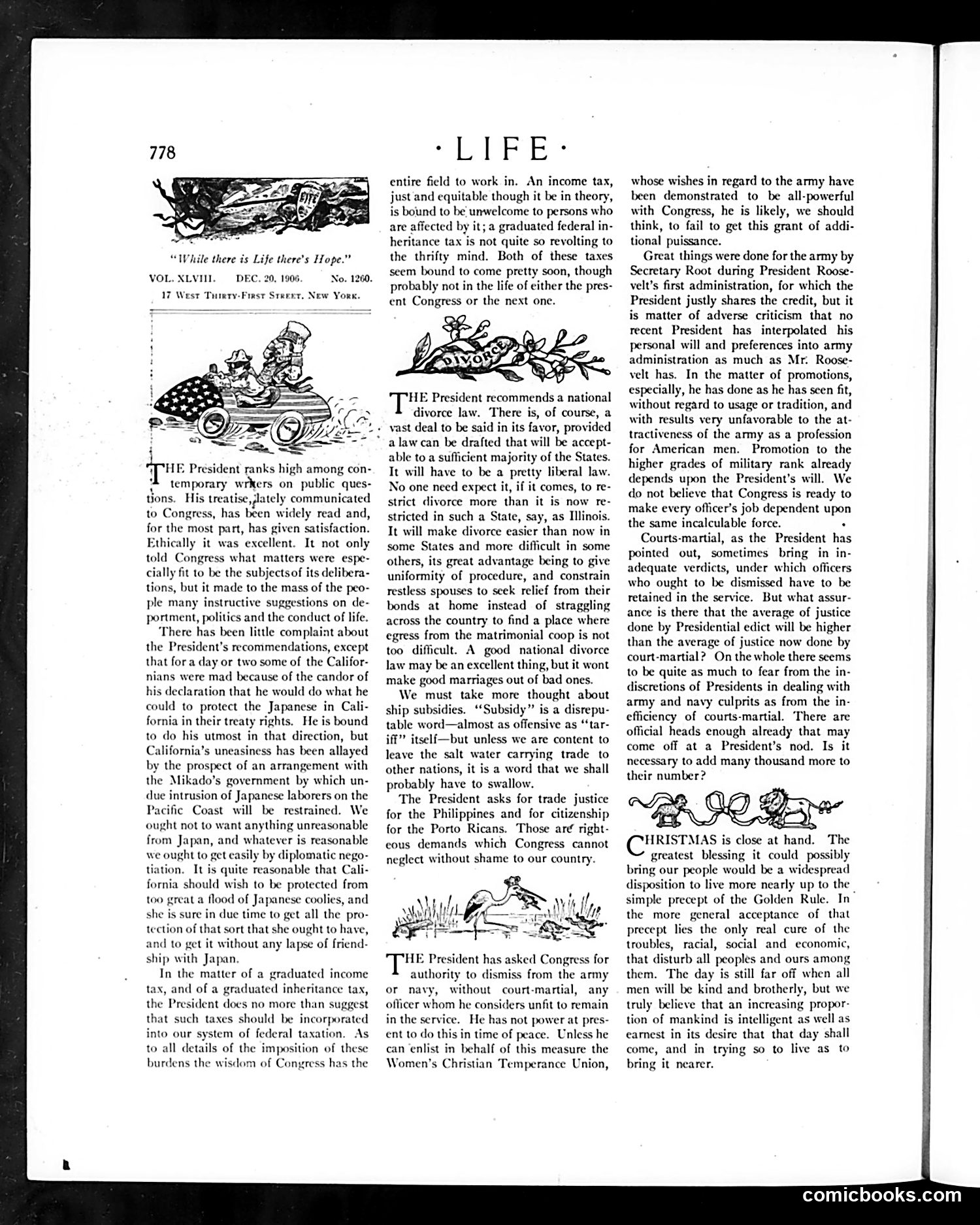
This editorial page praises President Theodore Roosevelt's recent message to Congress on various policy matters. The text addresses Roosevelt's recommendations on: **Japanese Immigration**: The page supports Roosevelt's balanced approach—protecting Japanese treaty rights while acknowledging California's concerns about labor competition, noting a diplomatic arrangement with Japan will restrict laborers. **Tax Reform**: Roosevelt proposed graduated income and inheritance taxes. The editor supports these as theoretically just, though acknowledging they'll face resistance. **National Divorce Law**: Endorsed as promoting uniformity across states, though the writer skeptically notes it won't improve bad marriages. **Other Issues**: Trade subsidies for shipping, Philippine trade justice, and Puerto Rican citizenship are presented as reasonable demands. **Military Authority**: Roosevelt seeks power to discharge officers without court-martial. The tone is generally supportive of Roosevelt's ethical leadership and progressive reforms, presenting him as thoughtfully addressing contemporary social and economic problems.
📄 Transcribed text from this page (OCR, searchable)
Machine-transcribed from the original scan — historical spelling and the odd misread are preserved.
“While there is Life there's Hope.” VOL. XLVIII. No. 1260. 17 West Tuety-First Steeet, New York. |. 19065. 'HE President ranks high among con- 2 temporary wrkers on public ques- tons. His treatise, lately communicated to Congress, has been widely read and, for the most part, has given satisfaction. Ethically it was excellent. It not only told Congress what matters were espe- cially fit to be the subjectsof its delibera- tions, but it made to the mass of the peo- ple many instructive suggestions on de- portment, politics and the conduct of life. ‘There has been little complaint about the President’s recommendations, except that fora day or two some of the Califor- nians were mad because of the candor of his declaration that he would do what he could to protect the Japanese in Cali- fornia in their treaty rights. He is bound to do his utmost in that direction, but California’s uneasiness has been allayed by the prospect of an arrangement with the Mikado’s government by which un- due intrusion of Japanese laborers on the ific Coast will be restrained. We ‘ht not to want anything unreasonable from Japan, and whatever is reasonable we ought to get by diplomatic nego- tiation. It is quite reasonable that Cali- fornia should wish to be protected from too great a flood of Japanese coolies, and she is sure in due time to get all the pro- tection of that sort that she ought to have, and to get it without any lapse of friend- ship with Japan, In the matter of a graduated income tax, and of a graduated inheritance tax, the President does no more than suggest that such taxes should be incorporated into our system of federal taxation. As to all details of the imposition of these burdens the wisdom of Congress has the “LIFE * entire field to work in. An income tax, just and equitable though it be in theory, is bound to be unwelcome to persons who are affected by it; a graduated federal in- heritance tax is not quite so revolting to the thrifty mind. Both of these taxes seem bound to come pretty soon, though probably not in the life of either the pres- ent Congress or the next one. 'HE President recommends a national divorce law. There is, of course, a vast deal to be said in its favor, provided a law can be drafted that will be accept- able to a sufficient majority of the States. It will have to be a pretty liberal law. No one need expect it, if it comes, to re- strict divorce more than it is now re- stricted in such a State, say, as Illinois. It will make divorce easier than now in some States and more difficult in some others, its great advantage being to give uniformity of procedure, and constrain restless spouses to seek relief from their bonds at home instead of straggling across the country to find a place where egress from the matrimonial coop is not too difficult. A good national divorce law may be an excellent thing, but it wont make good marriages out of bad ones. We must take more thought about s. “Subsidy” is a disrepu- almost as offensive as “‘tar- iff” itself—but unless we are content to leave the salt water carrying trade to other nations, it is a word that we shall probably have to swallow. The President asks for trade justice for the Philippines and for citizenship for the Porto Ricans. Those ar¢ right- cous demands which Congress cannot neglect without shame to our country. eG Inn HE President has asked Congress for authority to dismiss from the army or navy, without court-martial, any oflicer whom he considers unfit to remain in the service. He has not power at pre: ent to do this in time of peace. Unless he can enlist in behalf of this measure th Women’s Christian Temperance Union, whose wishes in regard to the army have been demonstrated to be all-powerful with Congress, he is likely, we should think, to fail to get this grant of addi- tional puissance. Great things were done for the army by Secretary Root during President Roose- yelt’s first administration, for which the President justly shares the credit, but it is matter of adverse criticism that no recent President has interpolated his personal will and preferences into army administration as much as Mr. Roose- velt has. In the matter of promotions, especially, he has done as he has scen fit, without regard to usage or tradition, and with results very unfavorable to the at- tractiveness of the army as a profession for American men. Promotion to the higher grades of military rank already depends upon the President's will. We do not believe that Congress is ready to make every officer’s job dependent upon the same incalculable force. . Courts-martial, as the President ha: pointed out, sometimes bring in in- adequate verdicts, under which officers who ought to be dismissed have to be retained in the service. But what assur- ance is there that the average of justice done by Presidential edict will be higher than the average of justice now done by court-martial? On the whole there seems to be quite as much to fear from the in- discretions of Presidents in dealing with army and navy culprits as from the in- efficiency of courts-martial. There are official heads enough already that may come off at a President’s nod. Is it necessary to add many thousand more to their number? id. greatest blessing it could possibly bring our people would be a widespread disposition to live more nearly up to the _ simple precept of the Golden Rule. In the more general acceptance of that precept lies the only real cure of the troubles, racial, social and economic, that disturb all peoples and ours among them. The day is still far off when all men will be kind and brotherly, but we truly believe that an increasing propor- tion of mankind is intelligent as well as earnest in its desire that that day shall come, and in trying so to live as to bring it nearer. comicbooks.com