
A complete issue · 36 pages · 1906
Life — November 15, 1906
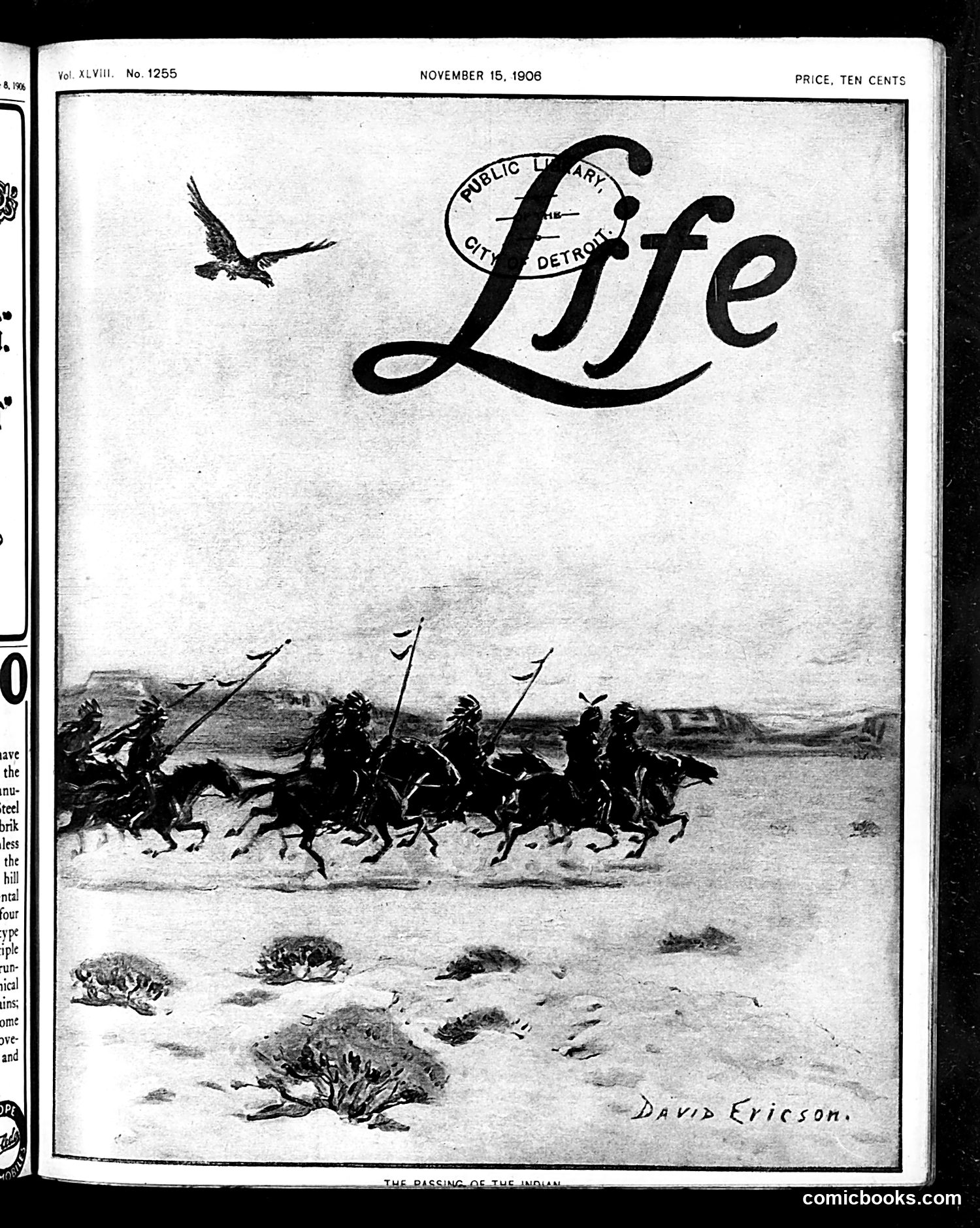
This cover illustration by David Ericson depicts Native American warriors on horseback charging across desert terrain, carrying spears and flags. The title "Life" dominates in decorative lettering above, with a bird in flight. The caption reads "THE PASSING OF THE INDIAN," suggesting this artwork references the historical displacement and decline of Native American populations—a major theme in early 20th-century American discourse. The dramatic composition romanticizes indigenous peoples as vanishing figures, reflecting period attitudes that viewed Native Americans as relics of the past rather than living communities. This represents how mainstream publications framed indigenous peoples during this era of continued westward expansion and reservation policies.
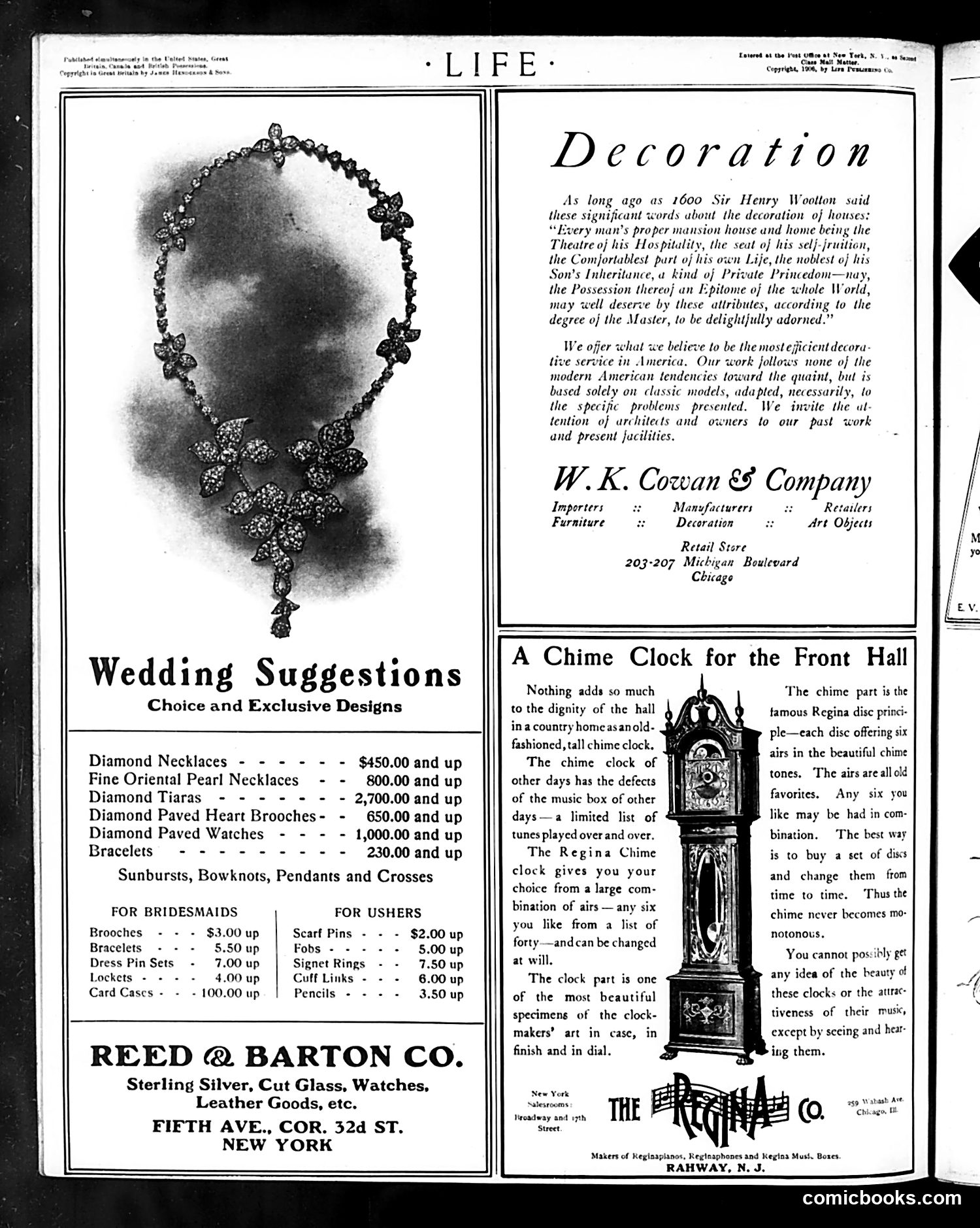
This page contains **no political cartoons or satire**. It is primarily **advertising content** from the early 20th century (Life magazine often mixed editorial and commercial material). The left side advertises wedding jewelry and gifts from **Reed & Barton Co.** (sterling silver, watches, etc.) and includes a decorative necklace image labeled "Wedding Suggestions." The right side features **two separate advertisements**: W.K. Cowan & Company promoting decorative home furnishings, and **The Regina Co.** advertising a "Chime Clock for the Front Hall" — a music box-style clock with interchangeable discs. There is no satirical commentary, political messaging, or caricature present on this page. It represents straightforward commercial advertising aimed at affluent readers interested in luxury goods and home decoration.
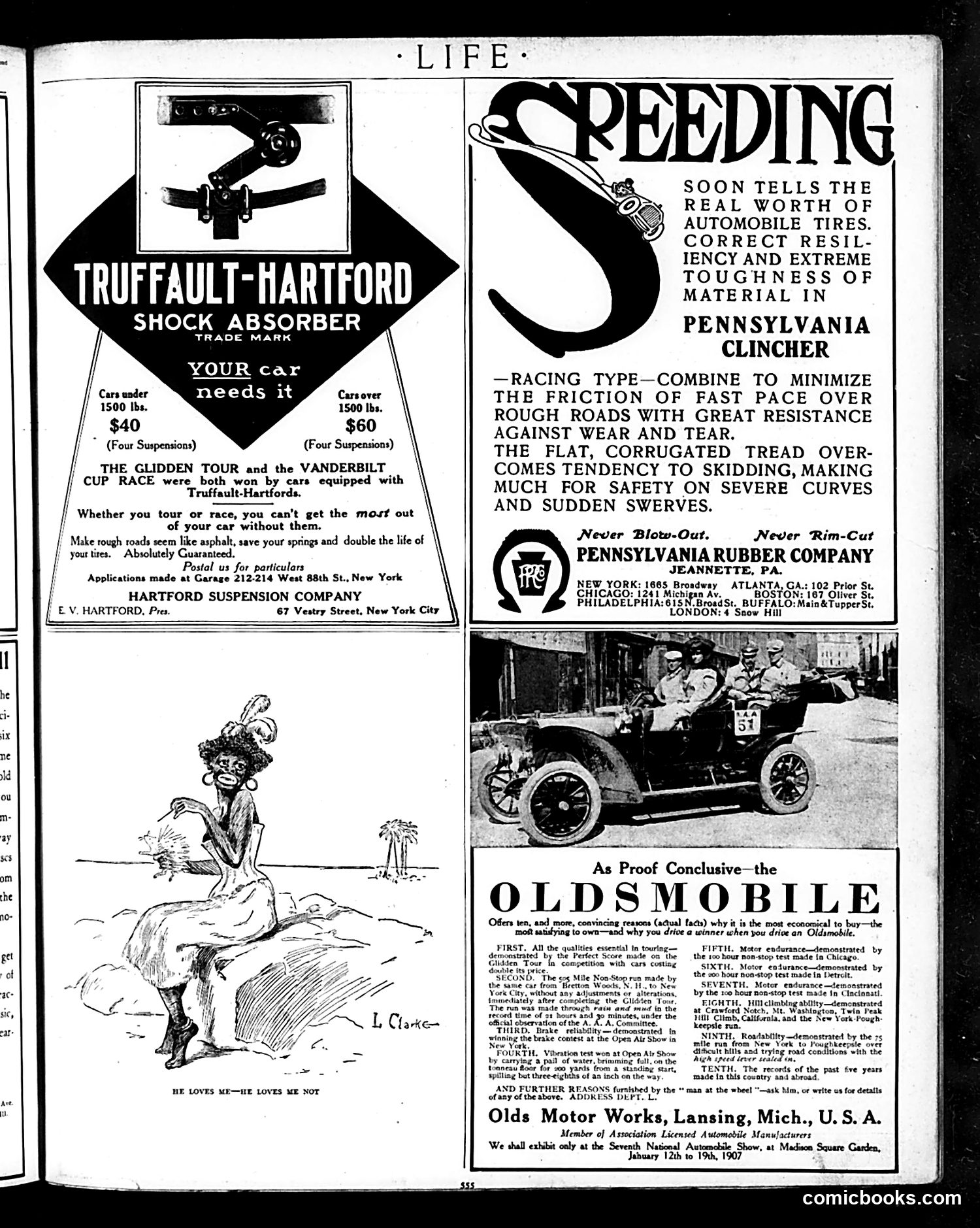
This page is primarily **advertising rather than political satire**. It contains three automobile-related advertisements from the early 1900s: 1. **Truffault-Hartford Shock Absorber** - pitches suspension improvements for cars under and over 1500 lbs. 2. **Pennsylvania Clincher Tire** - emphasizes durability and safety features for racing and rough roads. 3. **Oldsmobile** - the main ad, touting ten different performance tests and achievements, prominently featuring a vintage racing car photograph. The only cartoon element is a small humorous illustration (signed L. Clarke) showing a desert figure with text "HE LOVES ME—HE LOVES ME NOT," but this appears unrelated to the automotive content—likely filler or a separate feature. This is a **commercial publication page**, not political commentary.
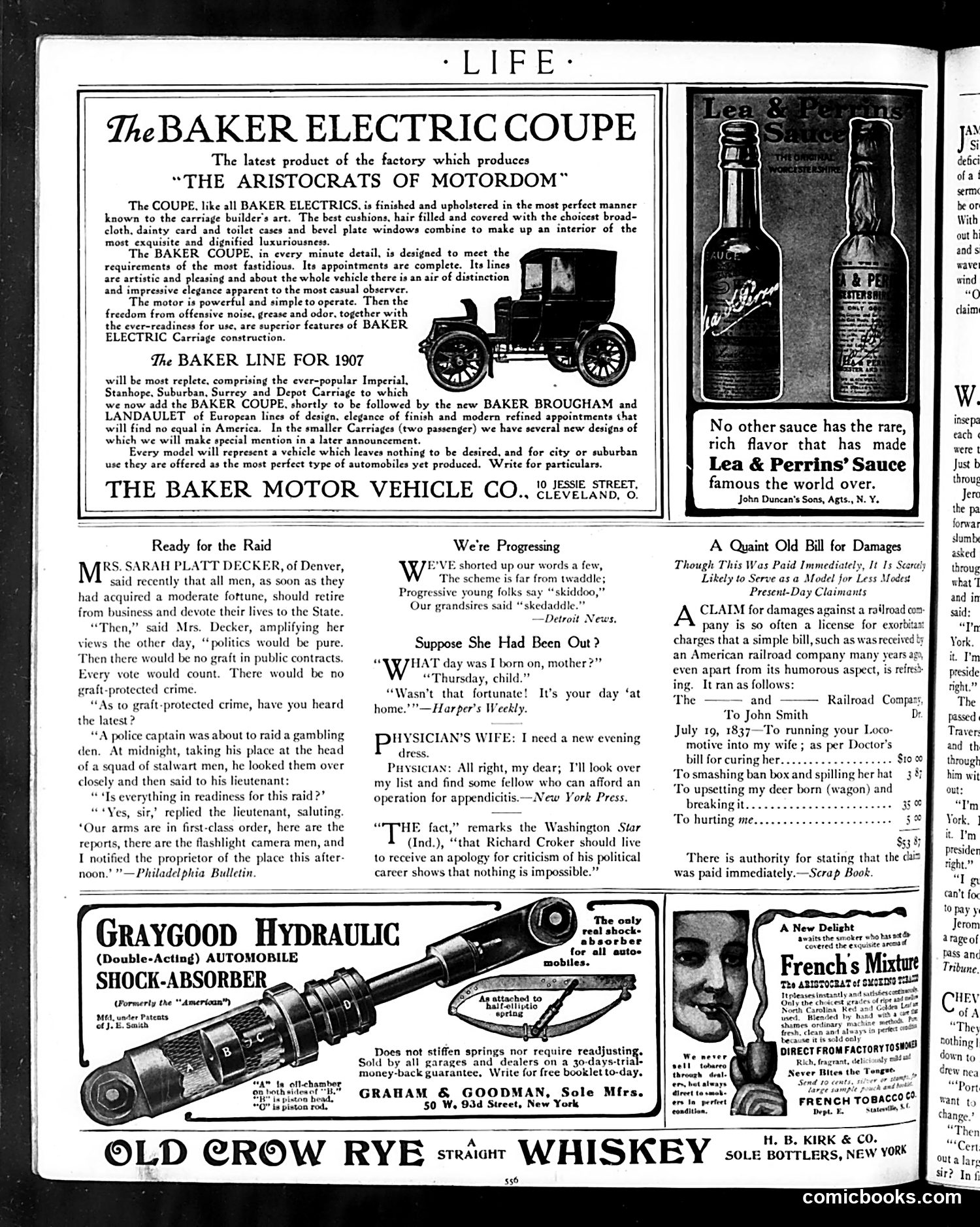
This page is **primarily advertising**, not political satire. The bulk of the content consists of commercial advertisements for: - **Baker Electric Coupe** (automobiles) - **Graygood Hydraulic Shock-Absorber** - **Lea & Perrins Sauce** - **French's Mixture tobacco** - **Old Crow Rye whiskey** The small text sections titled "Ready for the Raid," "We're Progressing," and similar headings appear to be **humorous anecdotes or jokes** rather than political cartoons—they contain light social commentary about domestic life and bureaucracy, typical of Life magazine's satirical humor of the era. No specific political figures or events are identifiable from the material shown.
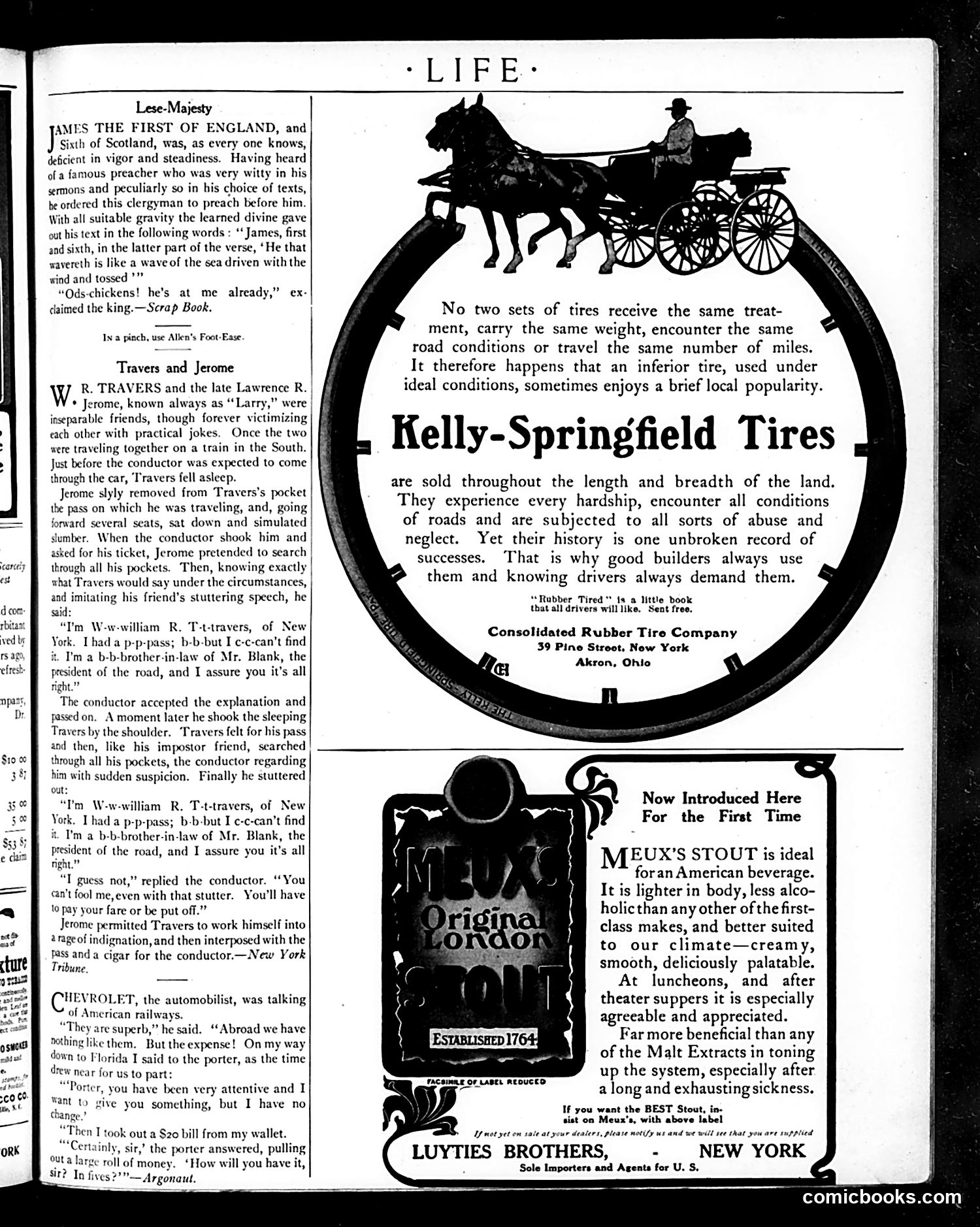
This page is primarily **advertising**, not satire. The dominant content features two product advertisements: 1. **Kelly-Springfield Tires** (center): A large circular tire design frames a horse-drawn carriage, emphasizing the tire's durability across varied road conditions and travel distances. 2. **Meux's Stout** (bottom): Advertises a beer brand newly introduced to America, claiming superiority in body, alcohol content, and palatability compared to other first-class makes. The left column contains unrelated **humorous anecdotes** about James I, travelers named Travers and Jerome, and a railroad porter—these are entertainment filler typical of *Life* magazine's format, not political commentary. The page reflects early 20th-century American consumer culture and advertising practices.
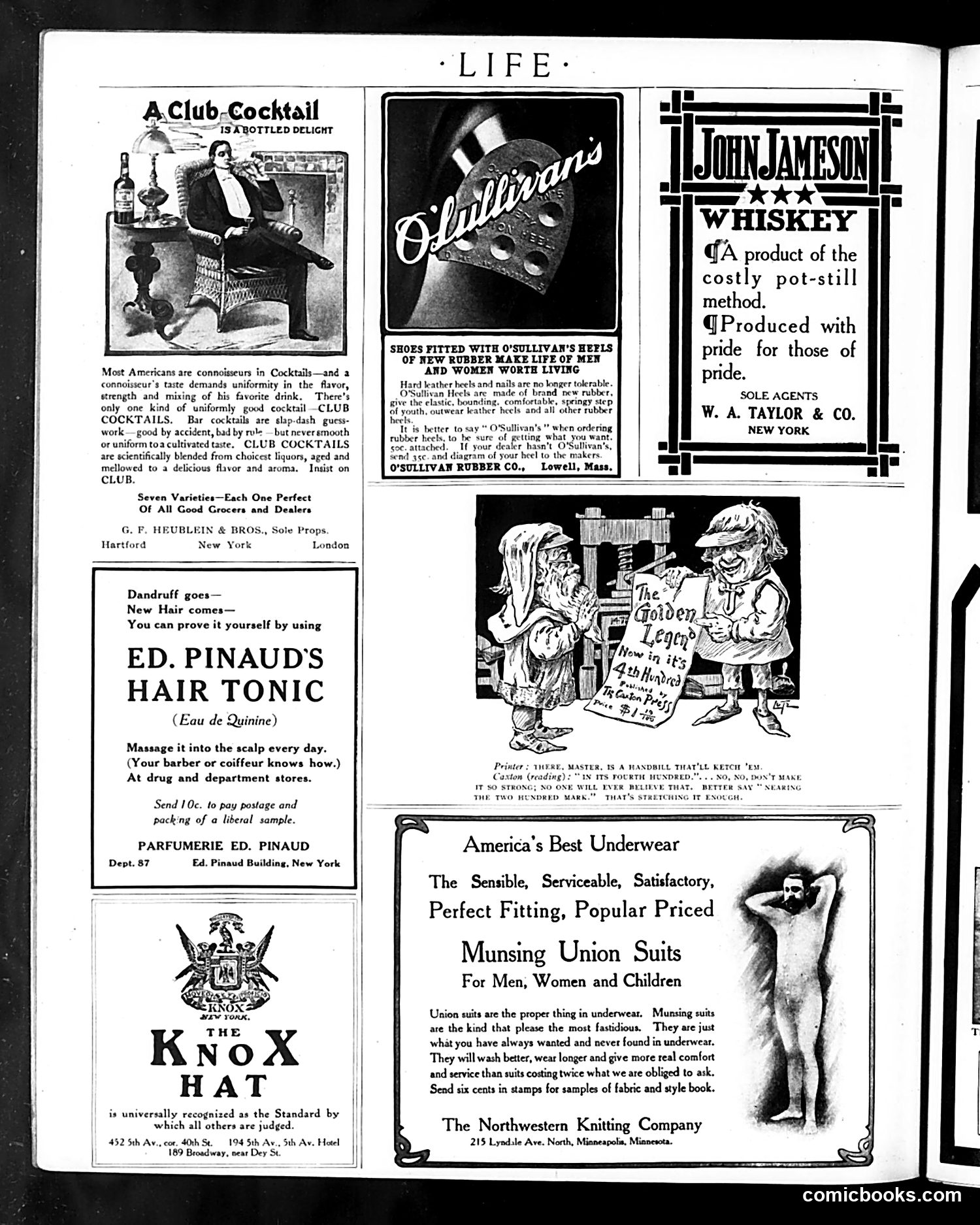
This page is primarily **advertising content** with one cartoon. The main satirical cartoon, titled "The Golden Legend," depicts two figures examining what appears to be a ledger or account book marked "How is it's 4th hundred." The caption suggests this is satirizing wealth accumulation or financial success—likely poking fun at the obsession with reaching monetary milestones. The rest of the page contains period product advertisements: Club Cocktails, O'Sullivan's rubber heels, John Jameson whiskey, Ed. Pinaud hair tonic, Knox hats, and Munsing Union underwear. These ads are typical of early 20th-century Life magazine content, targeting upper-middle-class readers with luxury goods and grooming products.
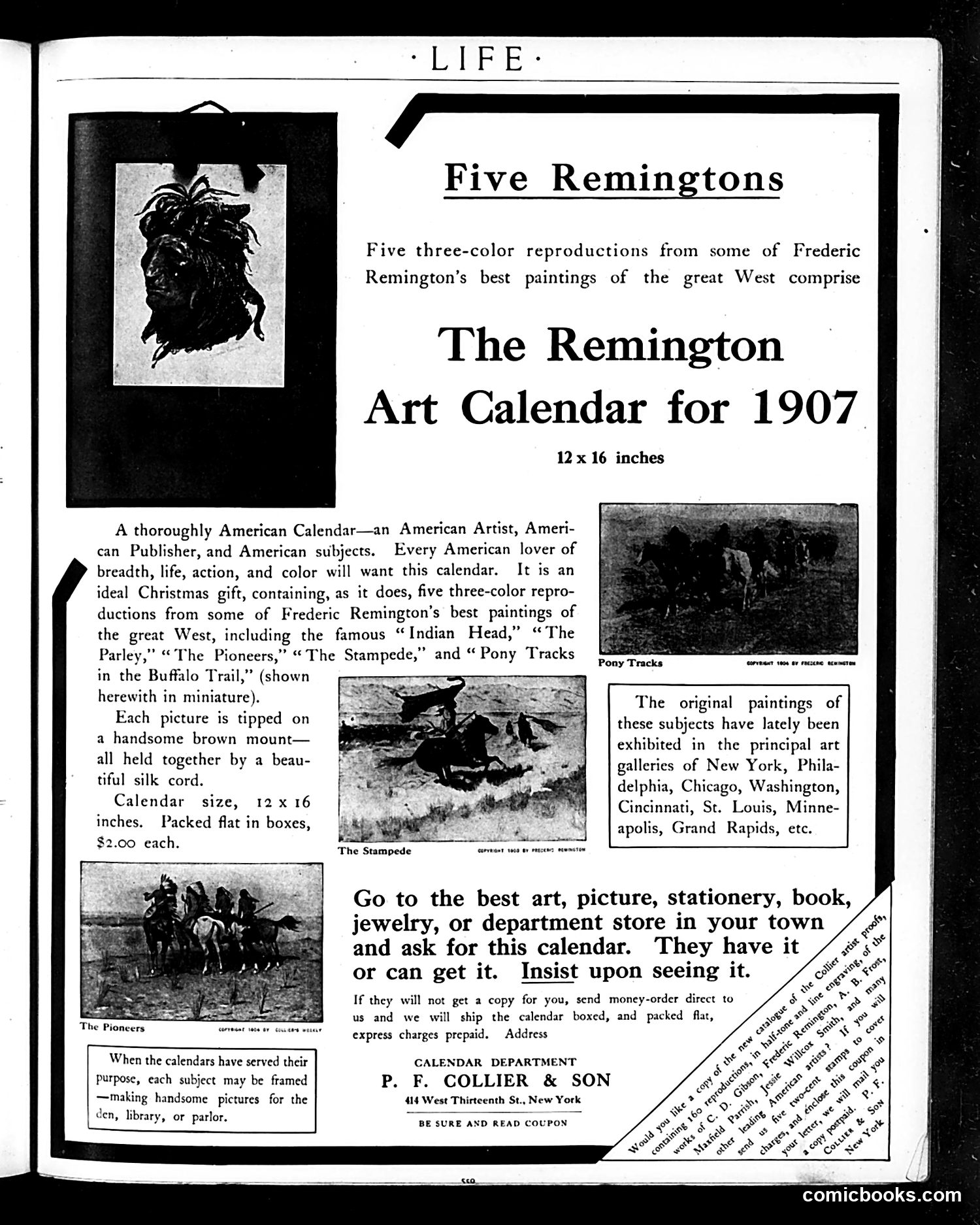
This is primarily an **advertisement page**, not a satirical cartoon. It promotes "The Remington Art Calendar for 1907," featuring five three-color reproductions of paintings by Frederic Remington, the famous American artist known for depicting the American West. The page includes reproductions of works titled "Indian Head," "The Parley," "The Pioneers," "The Stampede," and "Pony Tracks in the Buffalo Trail." These images celebrate Remington's romanticized depictions of frontier life—Native Americans, cowboys, and horses—which were enormously popular in early 20th-century America. The advertisement emphasizes that this is "thoroughly American"—featuring an American artist, publisher, and subjects. It was marketed as an ideal Christmas gift. The calendar cost $2.00 and could be purchased at local retailers or ordered directly from P. F. Collier & Son in New York.
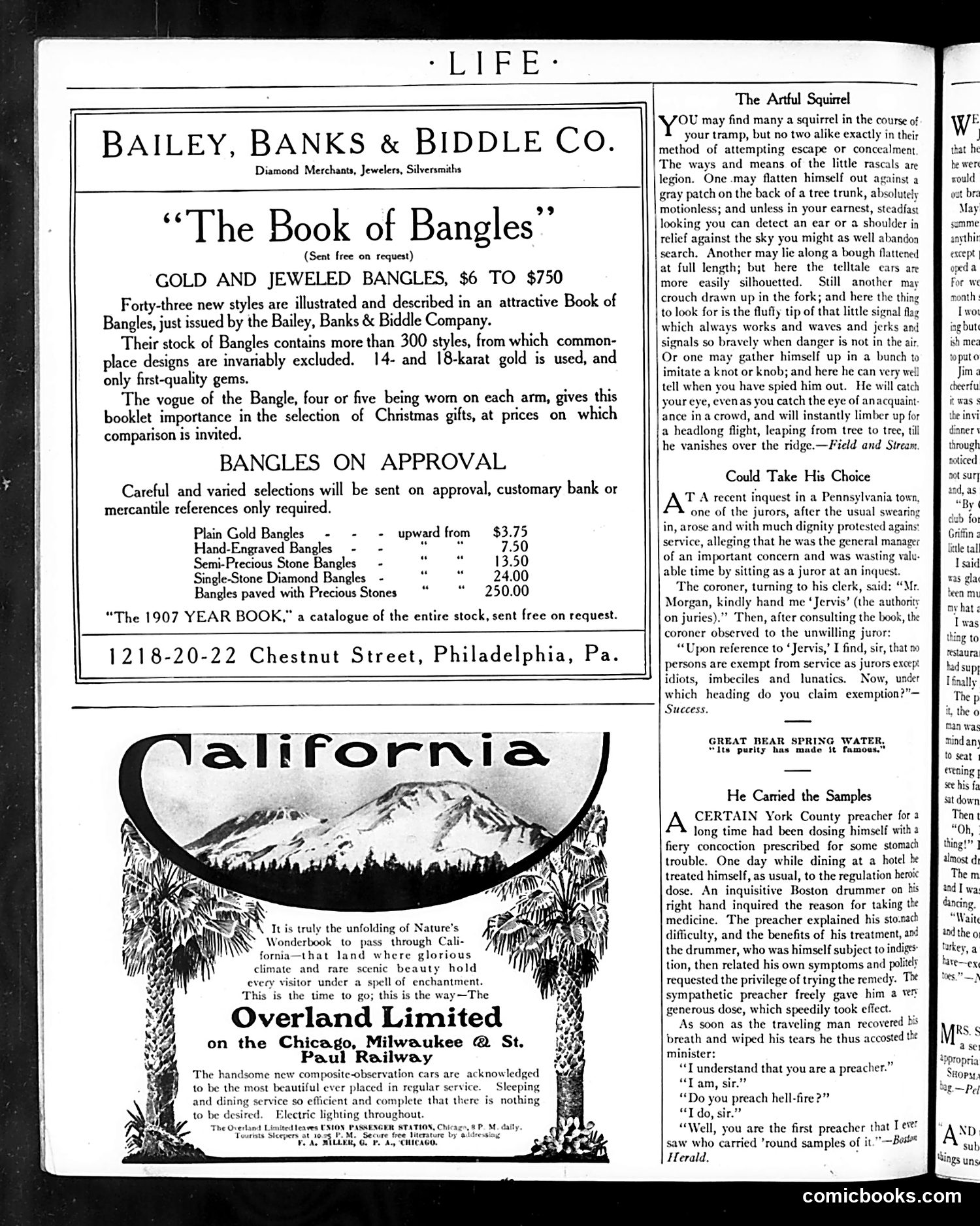
This page is primarily **advertising content** interspersed with brief humorous articles—not political cartoons. The main advertisements are for Bailey, Banks & Biddle Co. (jewelry/bangles), and the Overland Limited train service. The illustrated content consists of three short satirical pieces: "The Artful Squirrel" (about a squirrel's escape tactics), "Could Take His Choice" (a jury duty anecdote about someone claiming exemption as an "idiot"), and "He Carried the Samples" (a story about a preacher distributing medicine samples to a drummer). These are light, non-political humor pieces typical of *Life* magazine's satirical style—social observation and wordplay rather than political commentary. The page reflects early 1900s advertising and entertainment conventions.
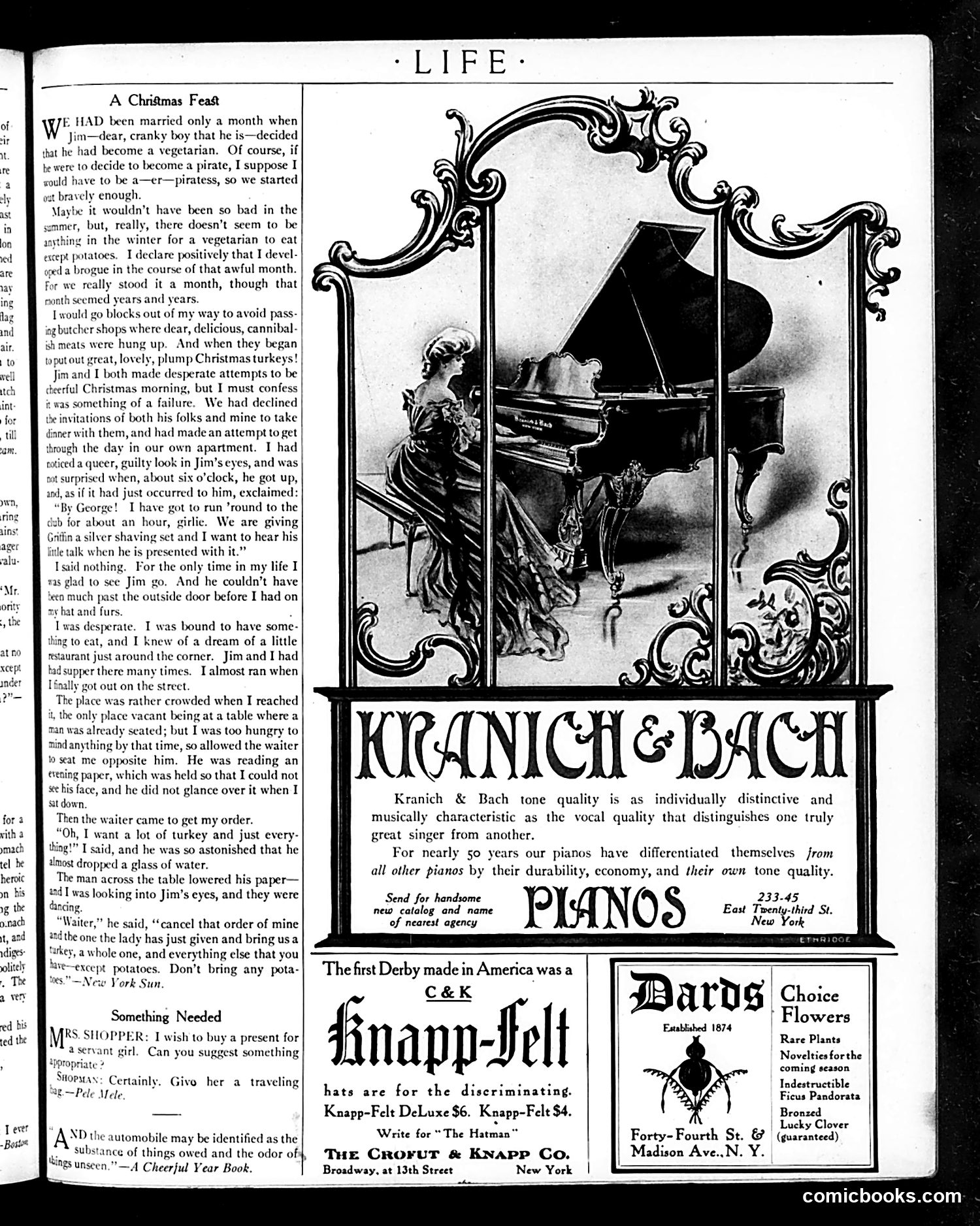
This page is primarily **advertising with a sidebar article**. The main visual content shows a **Kranich & Bach piano advertisement** featuring an elegant woman at a grand piano in an ornate Art Deco frame—typical luxury goods marketing from the early 20th century. The left column contains "A Christmas Feast," a humorous personal essay about a newlywed couple's vegetarianism and failed attempts at cheerful domesticity during the holidays. The narrator describes avoiding butcher shops and their husband's disappointing Christmas dinner efforts—satirizing both vegetarian dietary trends and domestic discord. Below are smaller ads for Knapp-Felt hats and Dard's flowers. This is **not a political cartoon page** but rather a lifestyle/humor column with period advertisements typical of *Life* magazine's mixed format.
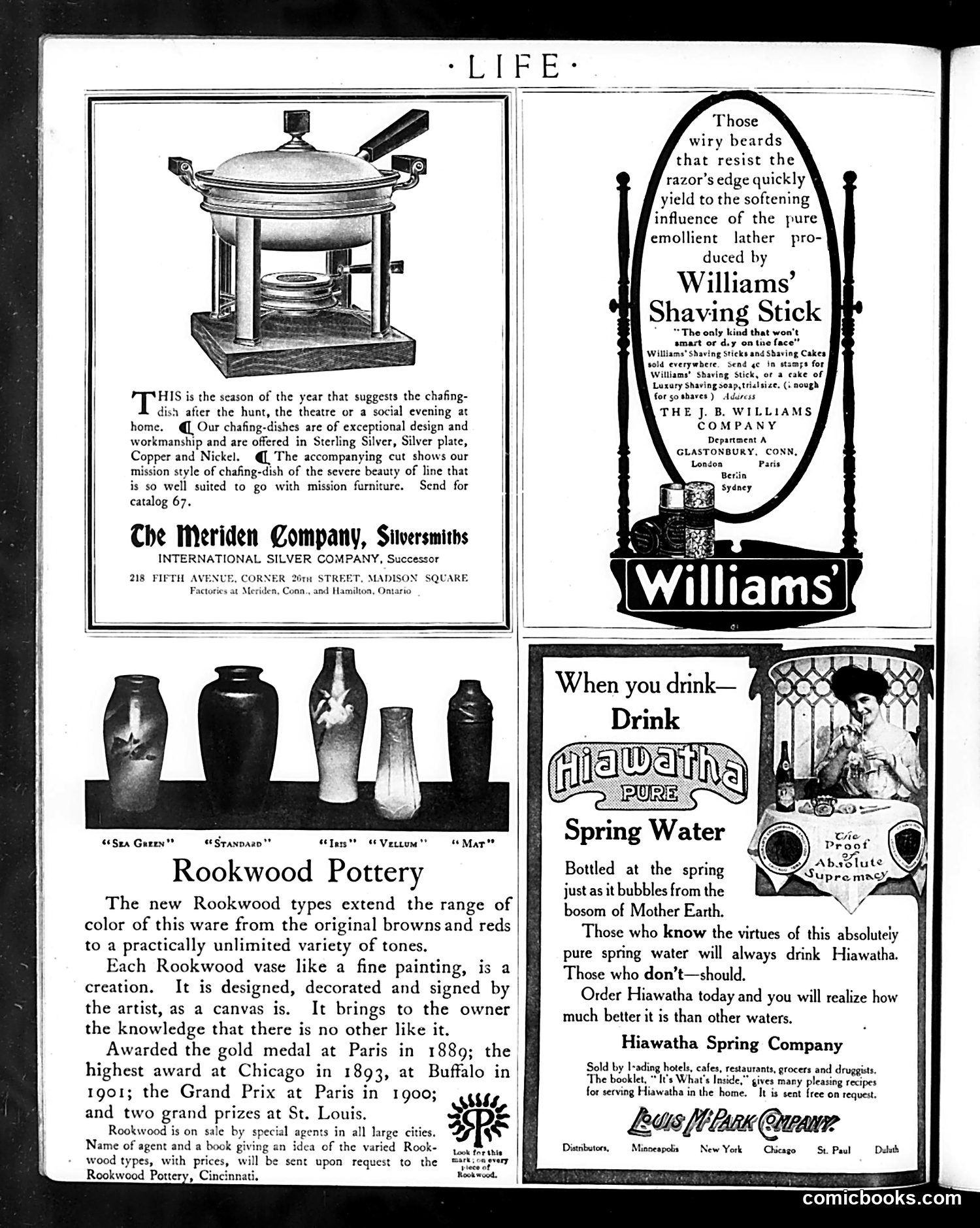
This page contains **no political cartoons or satire**. Instead, it is a **product advertisement page** from Life magazine featuring four separate ads: 1. **The Meriden Company** (top left): Chafing dishes for "changing-dishes" at home dinner parties—positioning them as fashionable entertaining equipment. 2. **Rookwood Pottery** (bottom left): Decorative vases highlighted as fine art, noting international awards (Paris 1889, Chicago 1893, etc.). 3. **Williams' Shaving Stick** (top right): Cosmetic product emphasizing how its lather softens facial hair. 4. **Hiawatha Spring Water** (bottom right): Bottled water marketed as pure and healthful. The page represents typical early 20th-century magazine advertising with no satirical intent or political content visible.
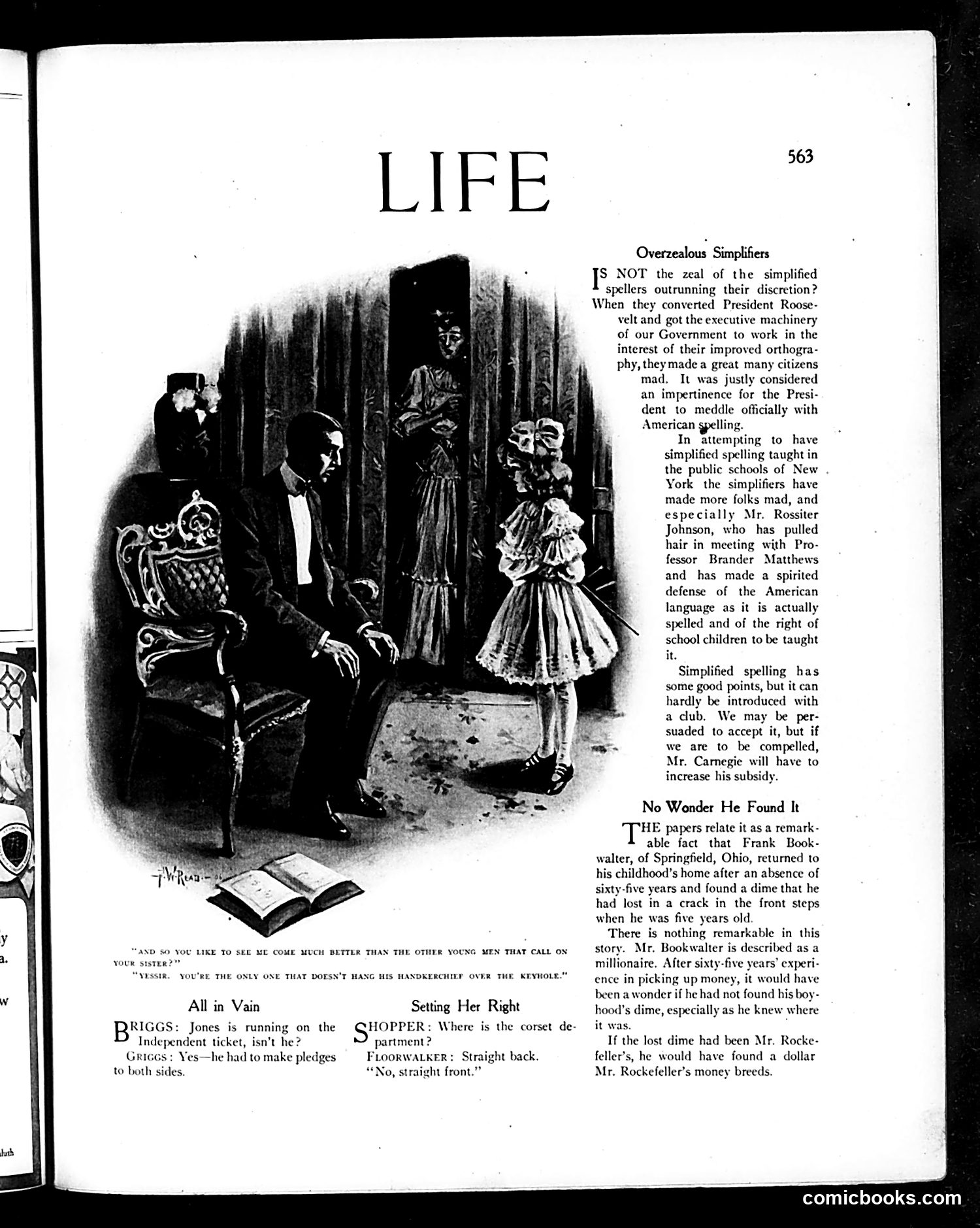
This page contains two satirical pieces from *Life* magazine: **"Overzealous Simplifiers"** critiques spelling reform advocates who pressured President Roosevelt's administration to adopt simplified spellings. The article mocks Rossiter Johnson and others who made "a great many citizens mad" by attempting to reform American orthography through government policy. The satire suggests these reformers overstepped by trying to impose changes on schools and the public. **"No Wonder He Found It"** is a brief humorous anecdote about Frank Bookwalter, who returned home to Springfield, Ohio after 65 years and discovered a lost dime from childhood. The joke's punch line suggests that if the dime had belonged to a wealthy person like Rockefeller, he would have found a dollar instead—satirizing wealth disparities and implying the poor remain poor. The illustration shows a domestic scene but relates primarily to the first article's discussion of language authority.
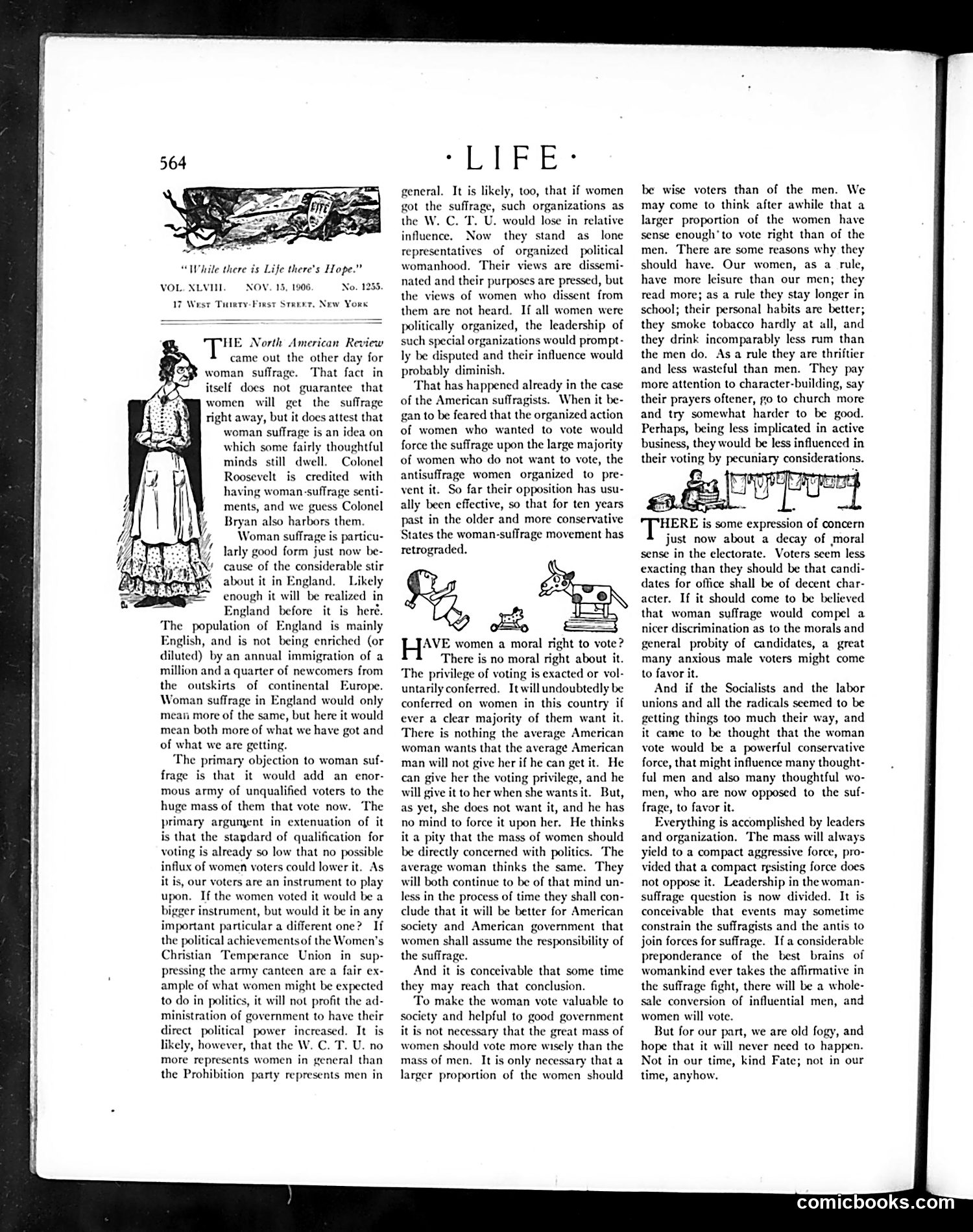
This page from *Life* magazine discusses women's suffrage through text and illustration. The main cartoon depicts a woman in Edwardian dress labeled "While there is Life there's Hope," suggesting optimism about voting rights. The article argues that women deserve the vote and counters anti-suffrage arguments. It addresses concerns that women voters would be an "enormous army of unqualified voters," claiming instead that women are likely more conscientious voters than men. The piece also references the Women's Christian Temperance Union and Socialist movements, suggesting suffrage had broad political support. The satire appears aimed at opponents who feared women's voting power would "diminish" their own political influence, portraying this opposition as self-interested rather than principled.
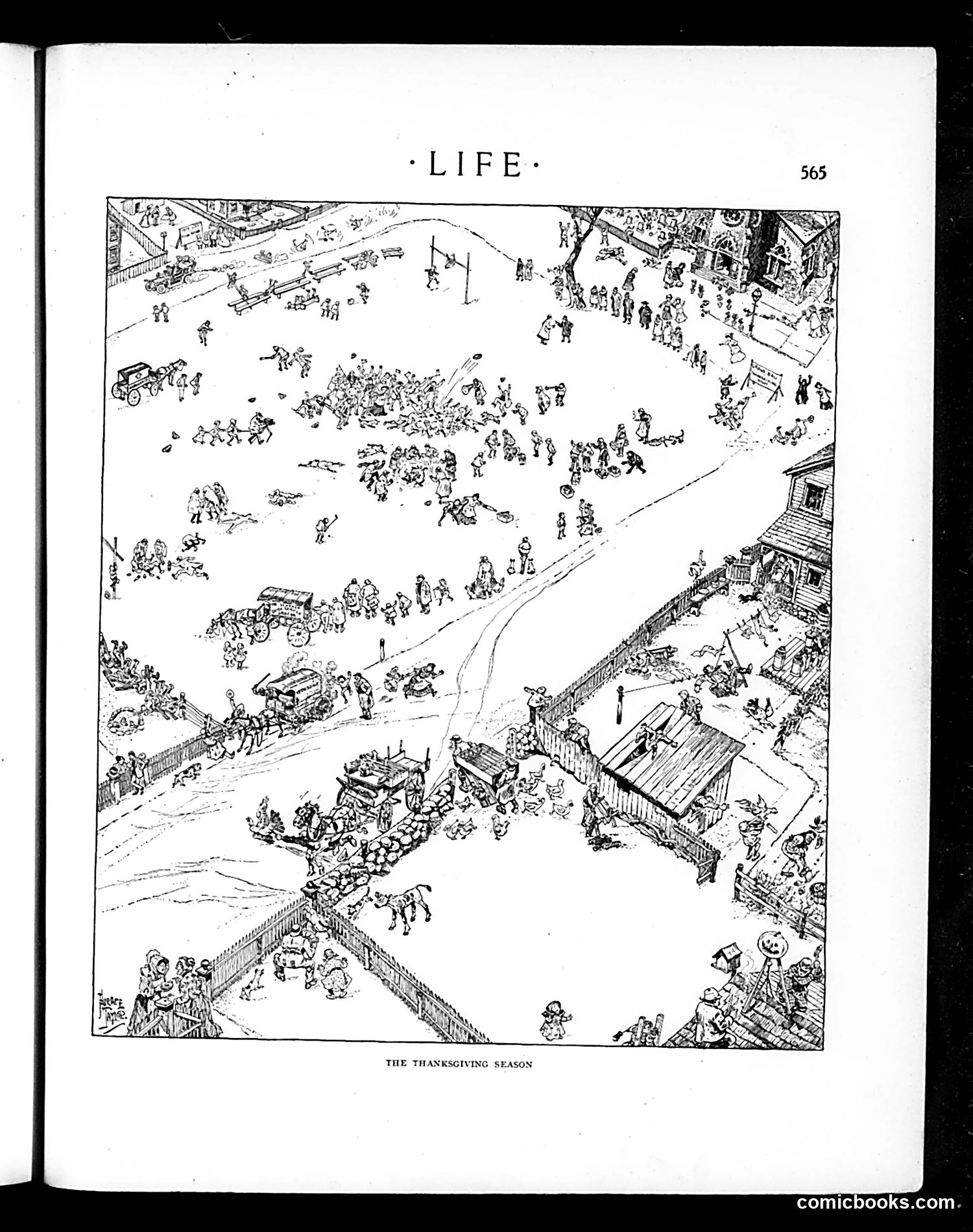
This is a bird's-eye view illustration titled "The Thanksgiving Season" showing a bustling public space—likely a park or town square—filled with numerous small figures engaged in various recreational activities. The scene depicts crowds of people gathered in groups, some near fenced areas and buildings on the periphery, others spread across the open ground. There are horse-drawn carriages, what appear to be market stalls or vendor areas, and people participating in different leisure activities. The satire appears to target the commercialization and crowding of American holiday celebrations during the Thanksgiving period. Rather than depicting family gatherings or traditional holiday customs, the illustration emphasizes chaotic public leisure, consumption, and mass entertainment—suggesting social commentary on how modern urban life has transformed traditional holidays into crowded, commercialized public spectacles.
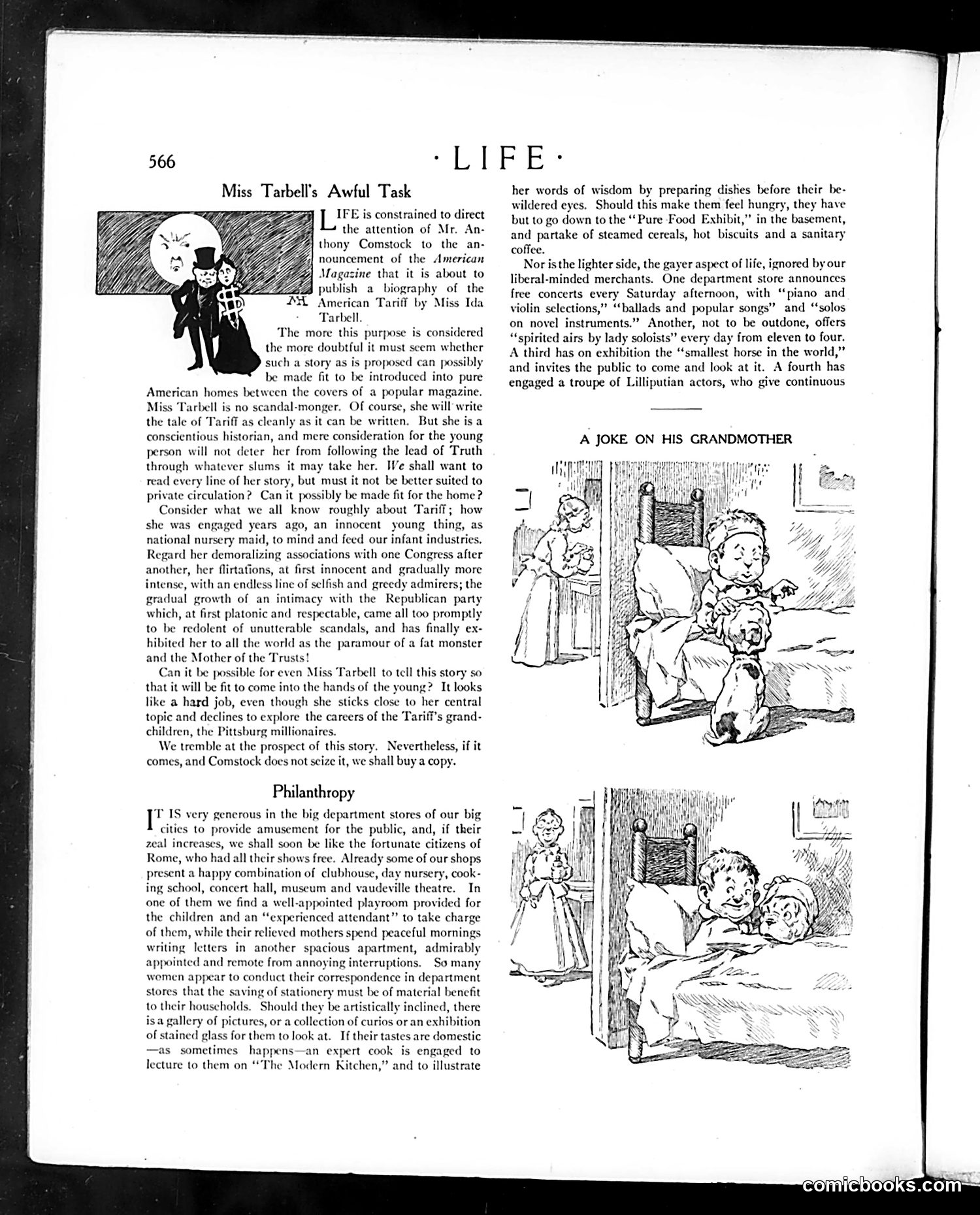
This satirical piece mocks Anthony Comstock, a famous censorship crusader, by suggesting he should oppose Ida Tarbell's upcoming biography of the American Tariff. The joke treats the Tariff as a scandalous woman: a former "nursery maid" for infant industries who became entangled in immoral "associations" with Congress and an illicit relationship with the Republican party, ultimately becoming "the paramour of a fat monster and the Mother of the Trusts." The satire ridicules both Comstock's prudish censorship and the actual corruption surrounding tariff policy and industrial monopolies. By framing complex economic exploitation as sexual scandal, Life mocks how Comstock might view legitimate historical criticism as indecent—while the real corruption of trusts and Republican Party complicity goes unexamined. The secondary piece "Philanthropy" gently satirizes department stores' patronizing "free" amenities (concerts, childcare, cooking classes) that subtly encourage women to spend more time—and money—shopping.
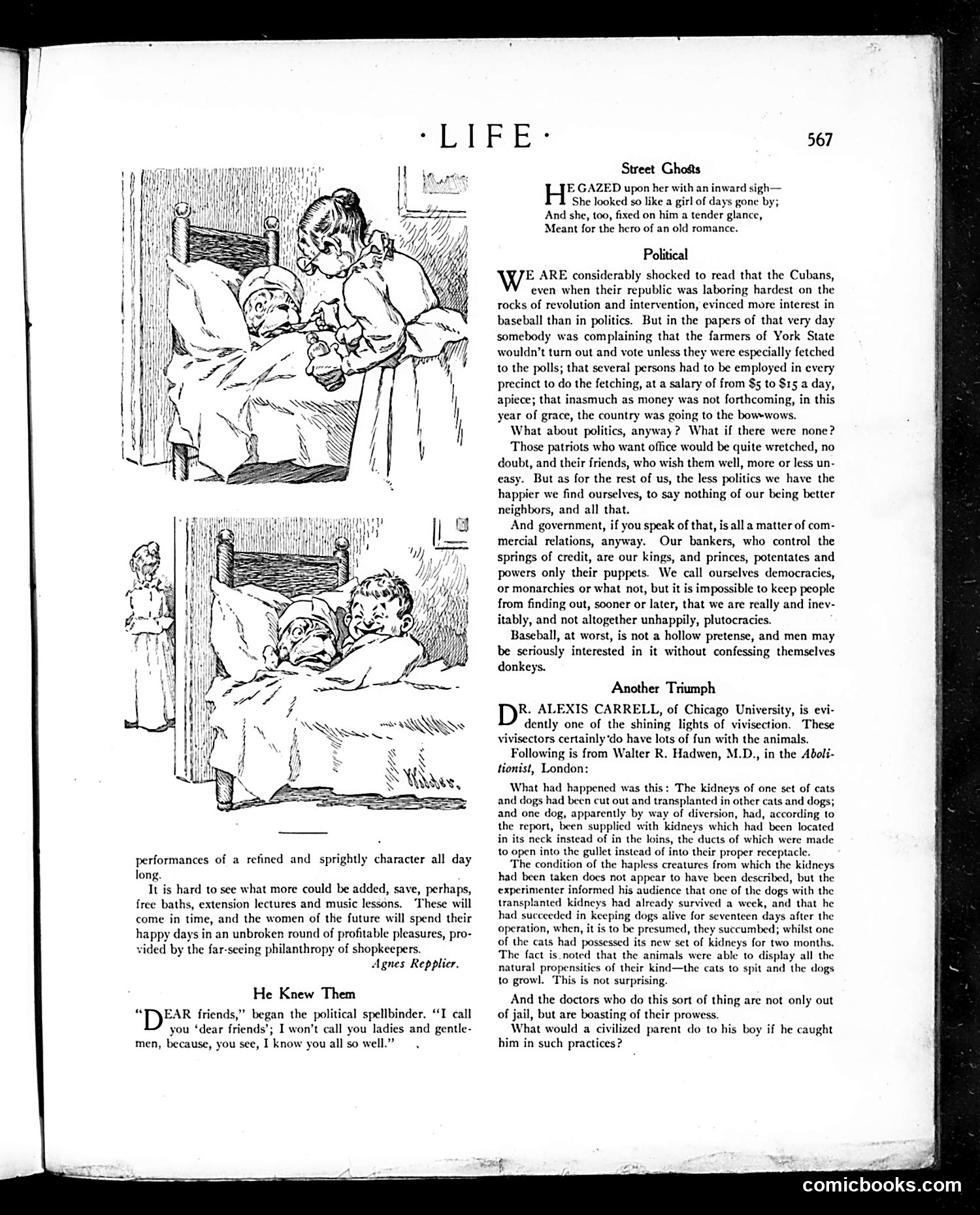
This page contains three distinct pieces of satirical content: **"He Knew Them"** mocks a politician's false familiarity with voters—calling them "dear friends" while condescendingly claiming intimate knowledge of them. **"Political"** section criticizes American civic apathy by contrasting Cubans' interest in baseball during political crisis with Americans' disinterest in voting unless paid or coerced. The author argues this indifference is preferable, since government is ultimately controlled by bankers (plutocracy) regardless of democratic pretense. **"Another Triumph"** attacks vivisection—animal experimentation—by describing Dr. Alexis Carrel's kidney transplant experiments on cats and dogs in grotesque detail (kidneys placed in necks, ducts redirected to throats). The satire highlights the cruelty and absurdity of such "scientific" work, sarcastically noting the animals could still perform natural behaviors despite mutilation. The illustrations show domestic bedroom scenes accompanying the romantic "Street Ghosts" poem about nostalgic longing.
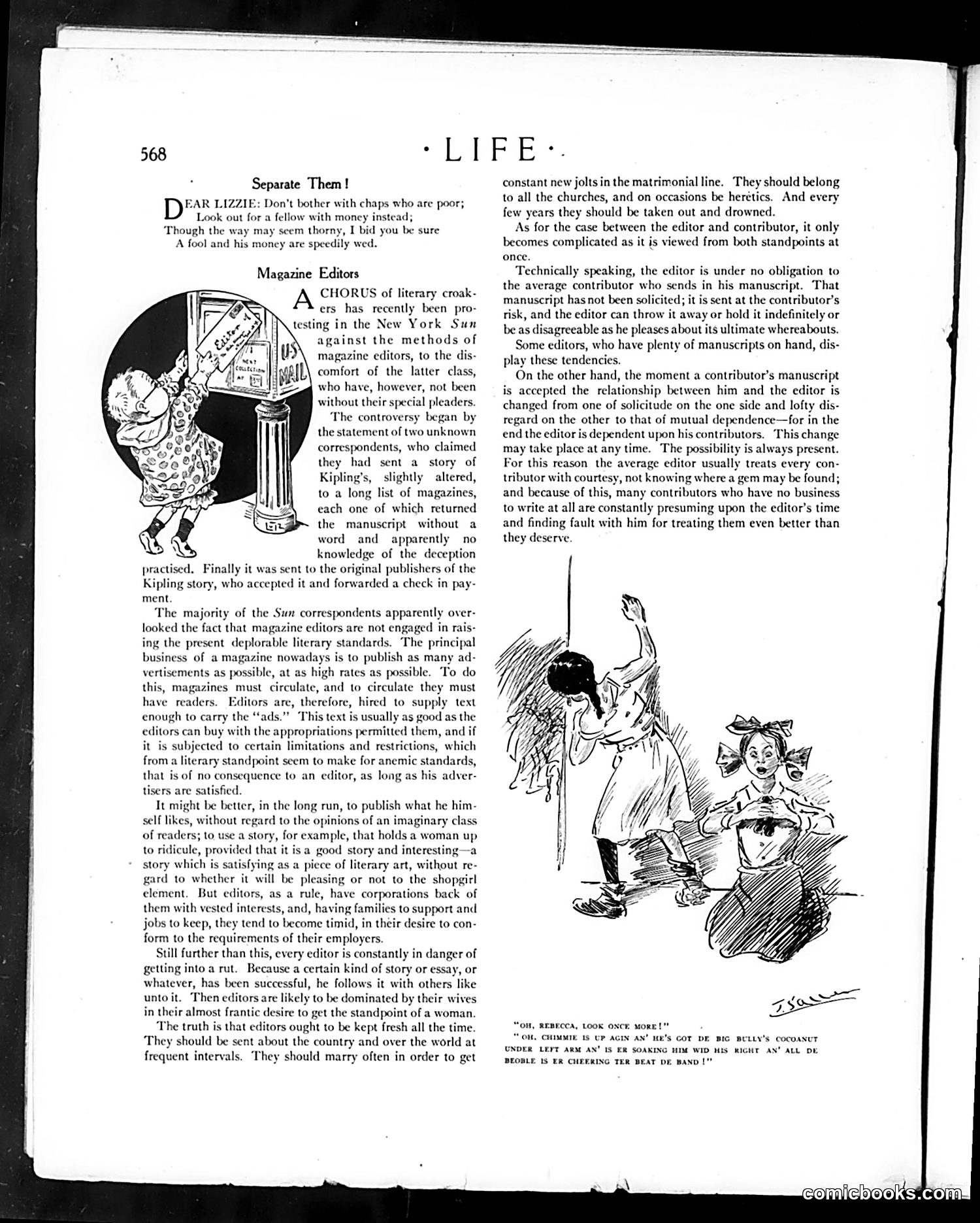
This page contains two satirical pieces about literary gatekeepers in early 20th-century America. **"Separate Them!"** is a brief cautionary verse warning women against marrying poor men, ending with the maxim "A fool and his money are speedily wed"—satirizing both the mercenary attitudes of the era and naive assumptions about wealth. **"Magazine Editors"** is the main article, illustrated with a cartoon of an editor overwhelmed by manuscripts. It discusses a contemporary scandal: two unknown writers submitted a slightly altered Rudyard Kipling story to multiple magazines; all rejected it without comment. When sent to Kipling's actual publisher, it was accepted. The article's satire cuts both ways: it mocks literary critics complaining about declining magazine standards while exposing editors' actual priorities—publishers cared primarily about carrying advertisements profitably, not literary merit. Editors hired to fill space between ads faced pressure from corporate employers and timid sensibilities. The piece concludes provocatively that editors should travel constantly, change churches, and "every few years...be taken out and drowned" to stay fresh-minded.
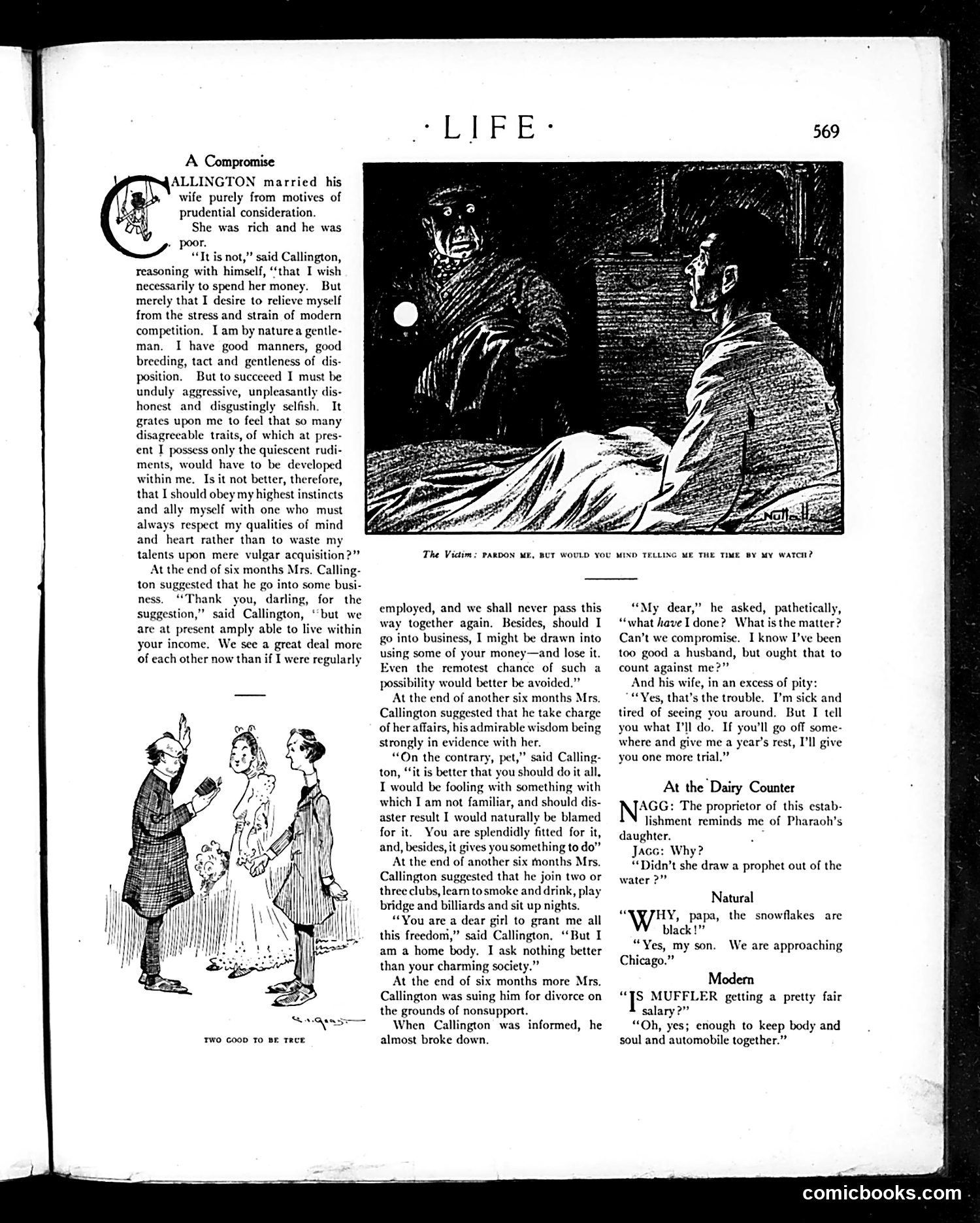
This story satirizes a parasitic husband who marries a wealthy woman, then uses elaborate rationalizations to avoid work or contributing to the household. Callington justifies idleness by appealing to his "gentlemanly nature" and refined sensibilities—claims that mask pure indolence. The satire works through escalating absurdity: each time his wife suggests he do *something* (enter business, manage her affairs, join clubs), he offers increasingly ridiculous excuses about why her proposals are actually *better* for both of them. His reasoned-sounding arguments grow progressively transparent as manipulation. The punchline exposes the con: after months of this, his wife sues for divorce on grounds of nonsupport. Callington—genuinely bewildered—protests he's been "too good a husband," missing entirely that doing nothing *is* the problem. The joke reflects early 20th-century anxieties about masculine idleness and financial dependence in marriage, likely targeting wealthy men of leisure who avoided productive work through philosophical pretense.
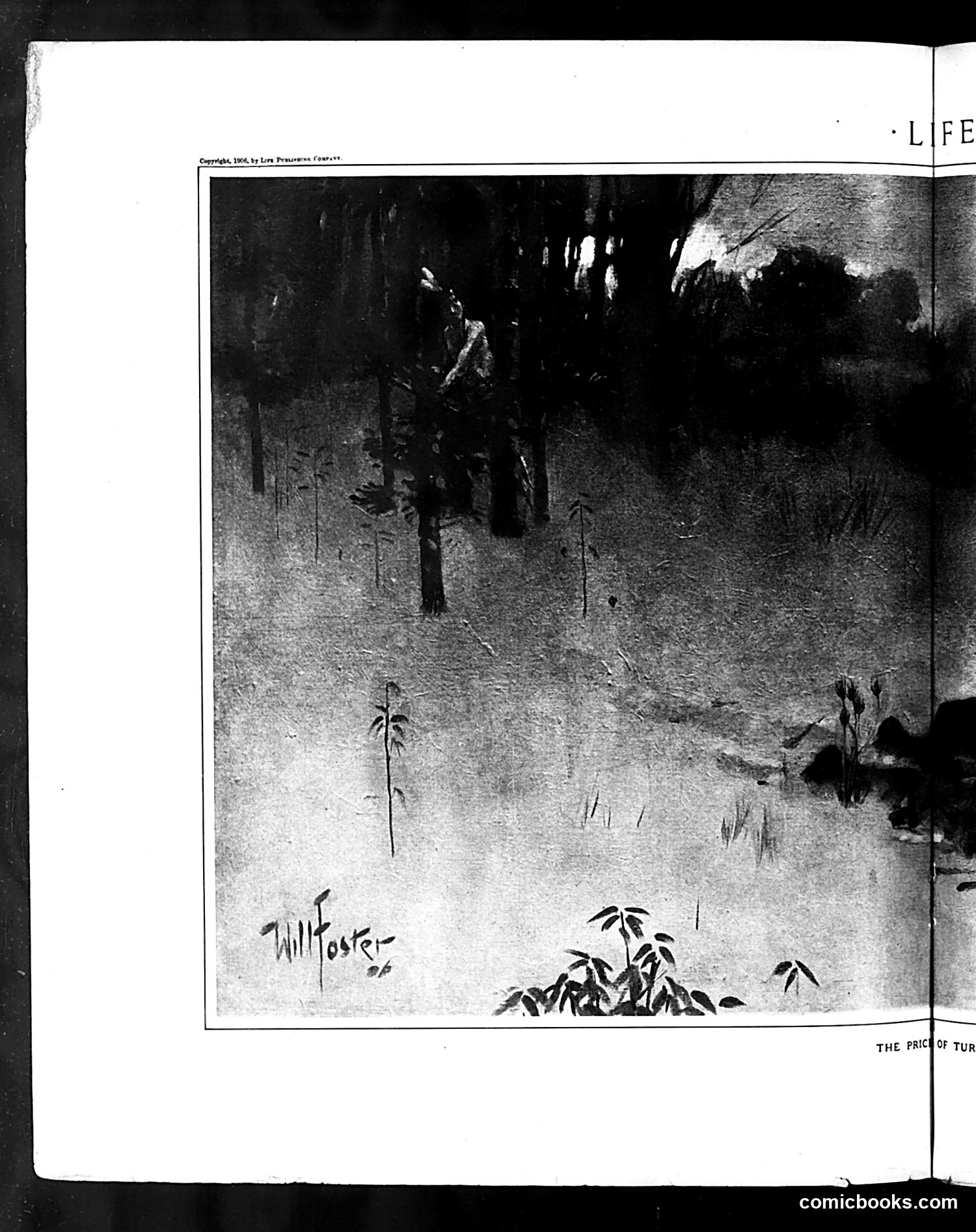
This appears to be a black and white photograph or illustration from Life magazine (copyrighted 1906) showing a natural landscape scene. The image depicts what looks like a forest or wooded area with trees in the background and various plants or saplings in the foreground on sandy/light-colored ground. There's a signature that appears to read "Will Foster" in the lower left. The partial caption visible at the bottom reads "THE PRICE OF TUR[...]" (likely "TURF" or similar, cut off in this reproduction). Without the complete caption and full context, I cannot definitively explain what specific satire or social commentary this image conveys. It may relate to forestry, land development, or environmental concerns of the early 1900s, but I cannot assert this with certainty based solely on what's visible here.
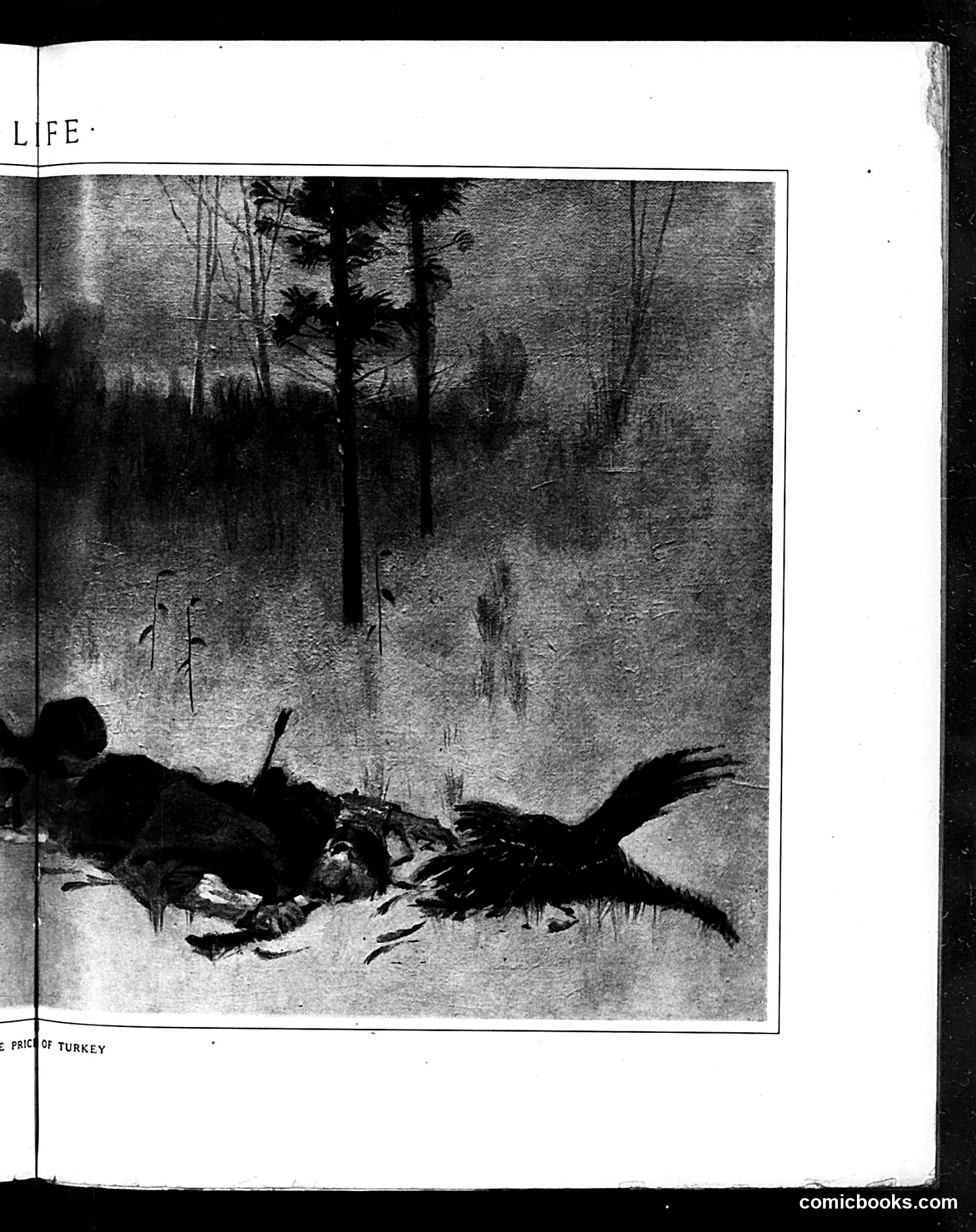
This page from *Life* magazine shows a black and white photograph titled "The Price of Turkey" (visible at bottom left). The image depicts a dead wild turkey lying on the ground in a forest setting, with bare trees and undergrowth visible in the background. This appears to be a hunting photograph rather than a political cartoon. The caption's reference to "price" likely contains satirical commentary—possibly critiquing the cost or consequences of hunting, or making a wordplay joke about turkeys and expense. Without additional context or visible captions, the exact satirical intent remains unclear, though the juxtaposition of a dead animal with the word "price" suggests commentary on the value or cost of game hunting as a sport or food source.
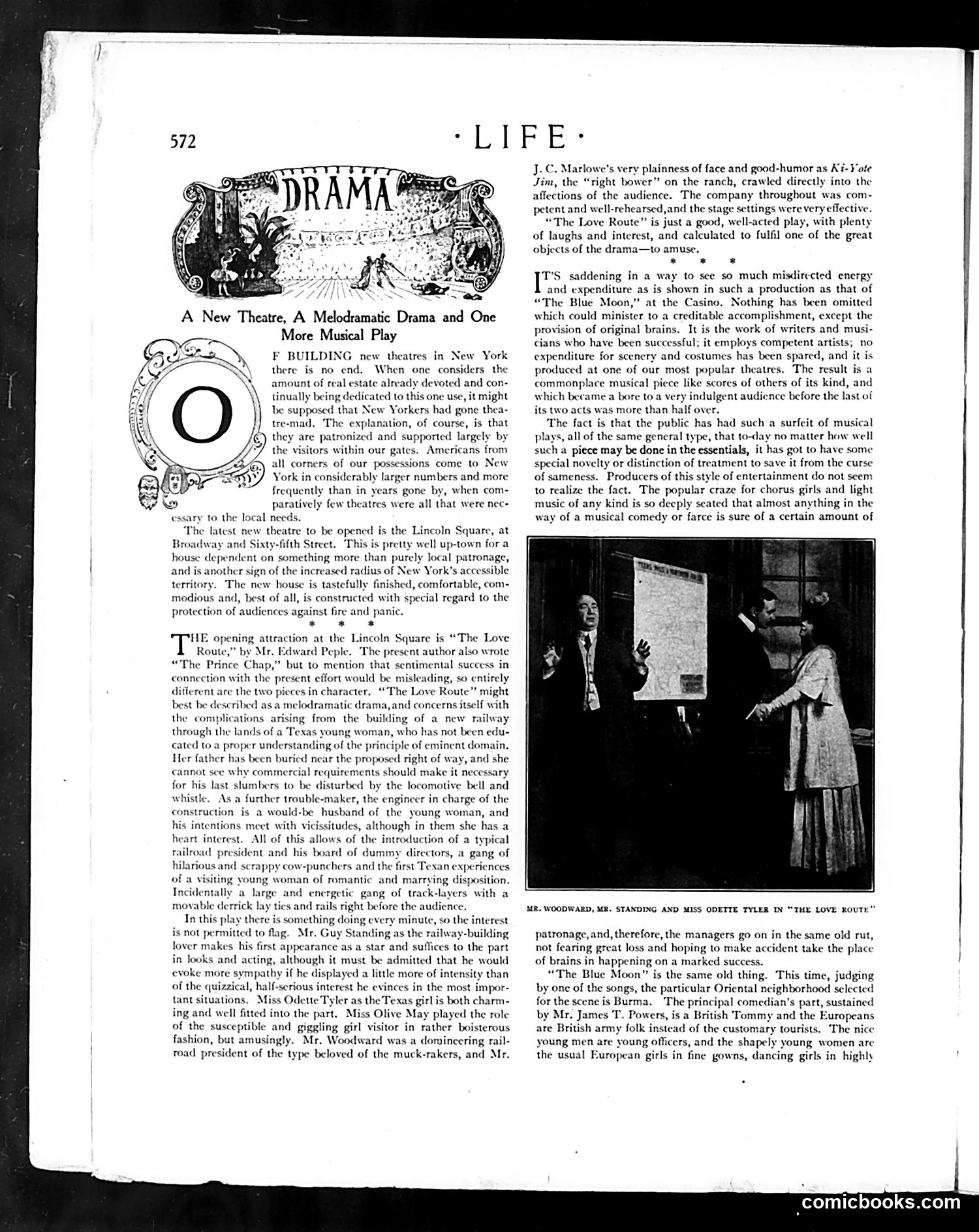
This is a theater review page, not a political cartoon. The single photograph shows actors from the Lincoln Square Theatre's opening production, "The Love Route," by Edward Peple—a melodramatic play about a Texas woman resisting railroad construction through her father's burial ground. The review discusses New York's theater-building boom, attributing it to tourism rather than local demand. "The Love Route" features a railroad engineer (played by Guy Standing) courting the resistant heroine, plus stock characters: a corrupt railroad president (Mr. Woodward), comic cowboys, and a visiting Eastern woman. The critic praises the competent cast and stage effects, particularly noting Ki-Yote Jim (J.C. Marlowe) as an audience favorite. The performance included actual track-laying equipment on stage—a notable technical feature for the era.
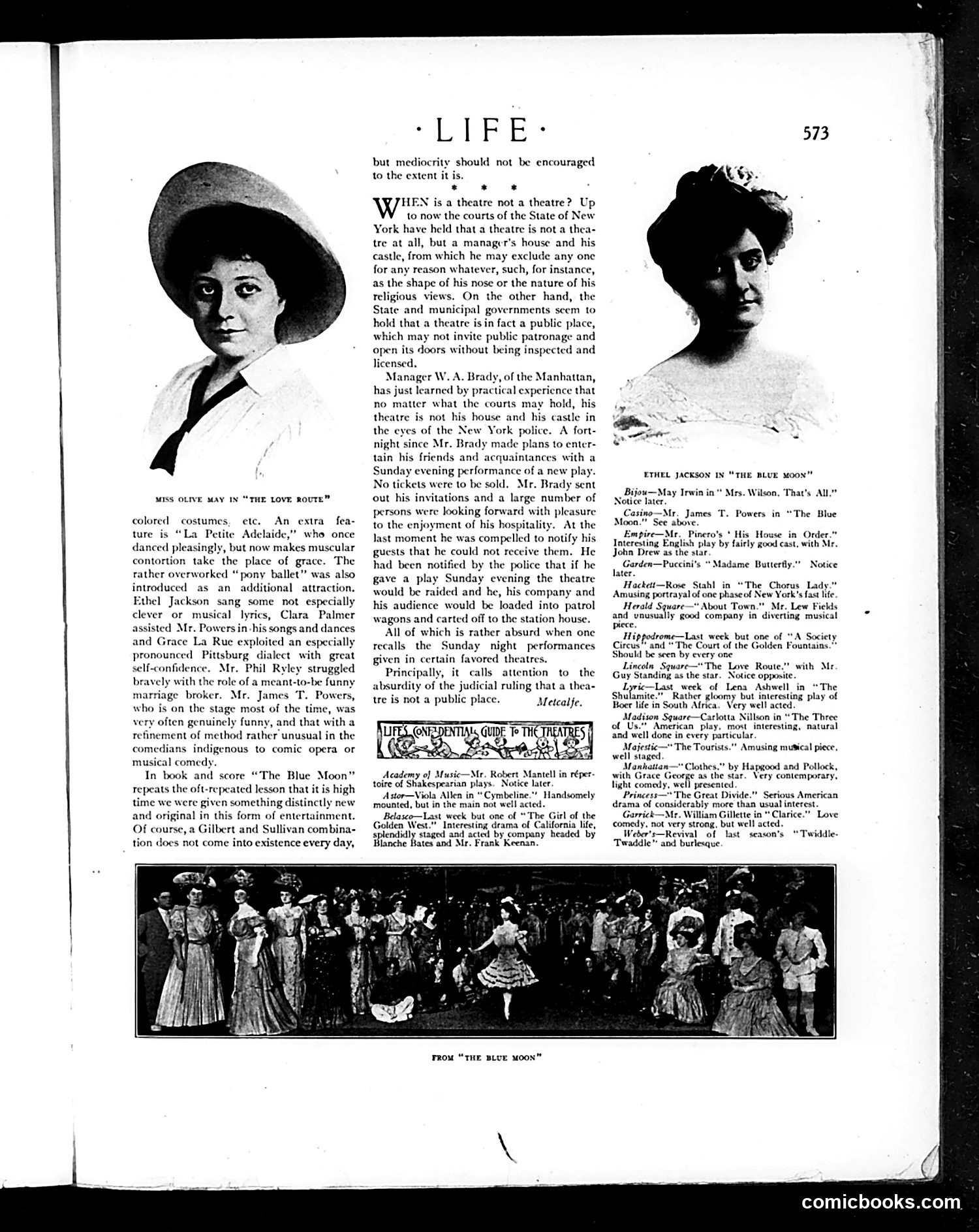
This page from *Life* magazine contains theater reviews and a legal satire. The main editorial piece (signed "Metcalfe") criticizes the absurdity of New York legal doctrine regarding theaters. **The Legal Paradox Being Mocked:** Theater manager W.A. Brady planned a private Sunday evening performance for friends—no tickets sold, just an invitation-only event. Police threatened to raid the theater and arrest everyone if he proceeded. Metcalfe highlights the hypocrisy: courts legally classify theaters as private property ("a manager's house and castle"), yet government treats them as public places requiring inspection and licensing. Some theaters apparently held Sunday performances without interference, suggesting selective enforcement. **The Satire's Point:** The piece ridicules this contradiction—if theaters are truly private, why police interference? If public, why the legal fiction otherwise? It exposes arbitrary power and inconsistent application of rules favoring certain establishments. The page also includes theater reviews of productions like "The Blue Moon" and photographs of actresses Olive May and Ethel Jackson from current productions.
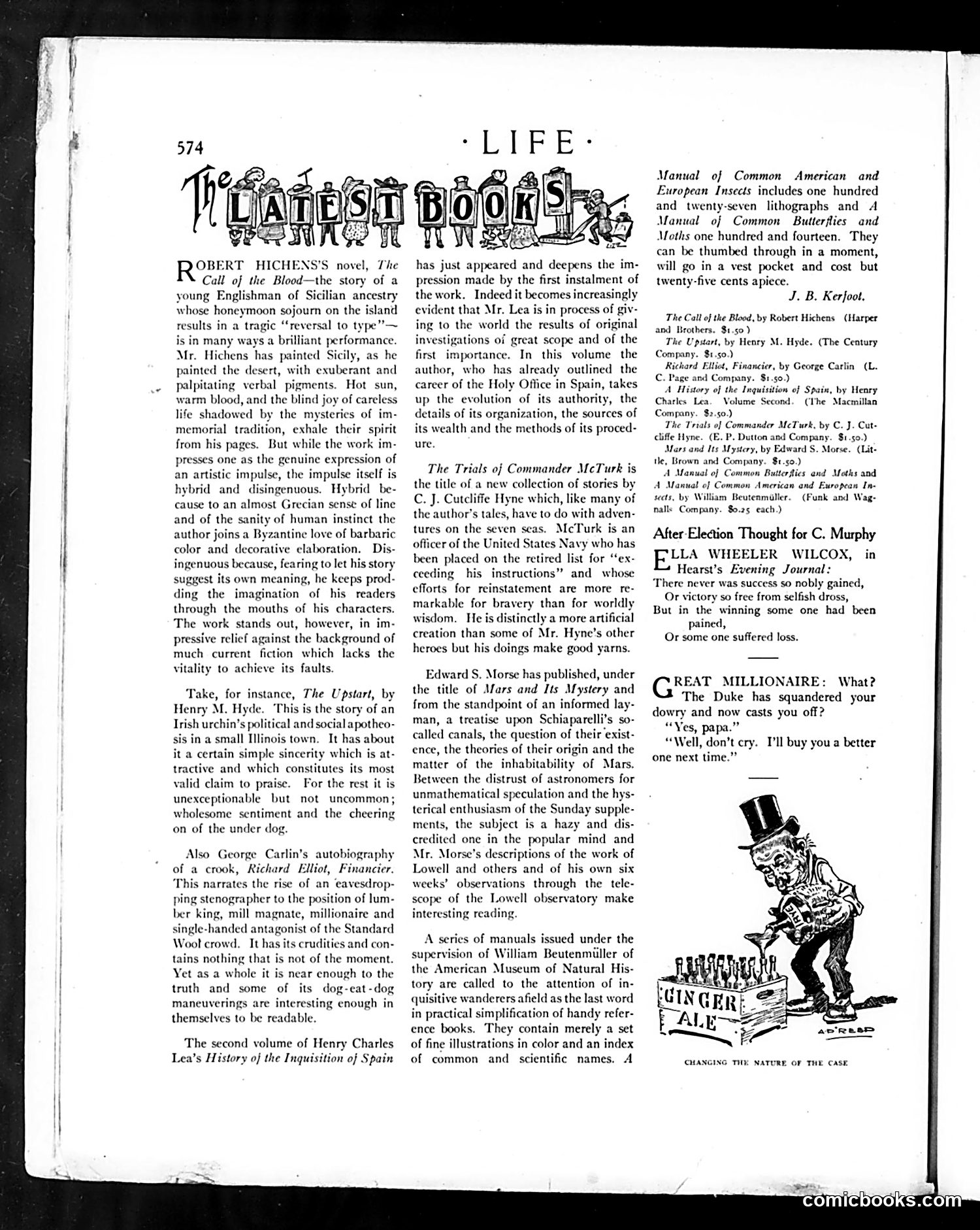
This page is primarily a **book review section** from Life magazine, not a political cartoon page. The main content critiques several contemporary novels and works of non-fiction. The only illustration present is a small cartoon in the lower right corner captioned "CHANGING THE NATURE OF THE CASE." It depicts a caricatured figure (appears to be a wealthy man in a top hat) standing over a chessboard labeled "GINGER ALE," suggesting a joke about business or commerce, though the specific reference is unclear from the image alone. The book reviews discuss works by Robert Hichens, Henry M. Hyde, George Carlin, and others—standard literary criticism of the era. There is **no significant political satire or social commentary** on this particular page; it functions as a cultural review section typical of Life magazine's content during this period.
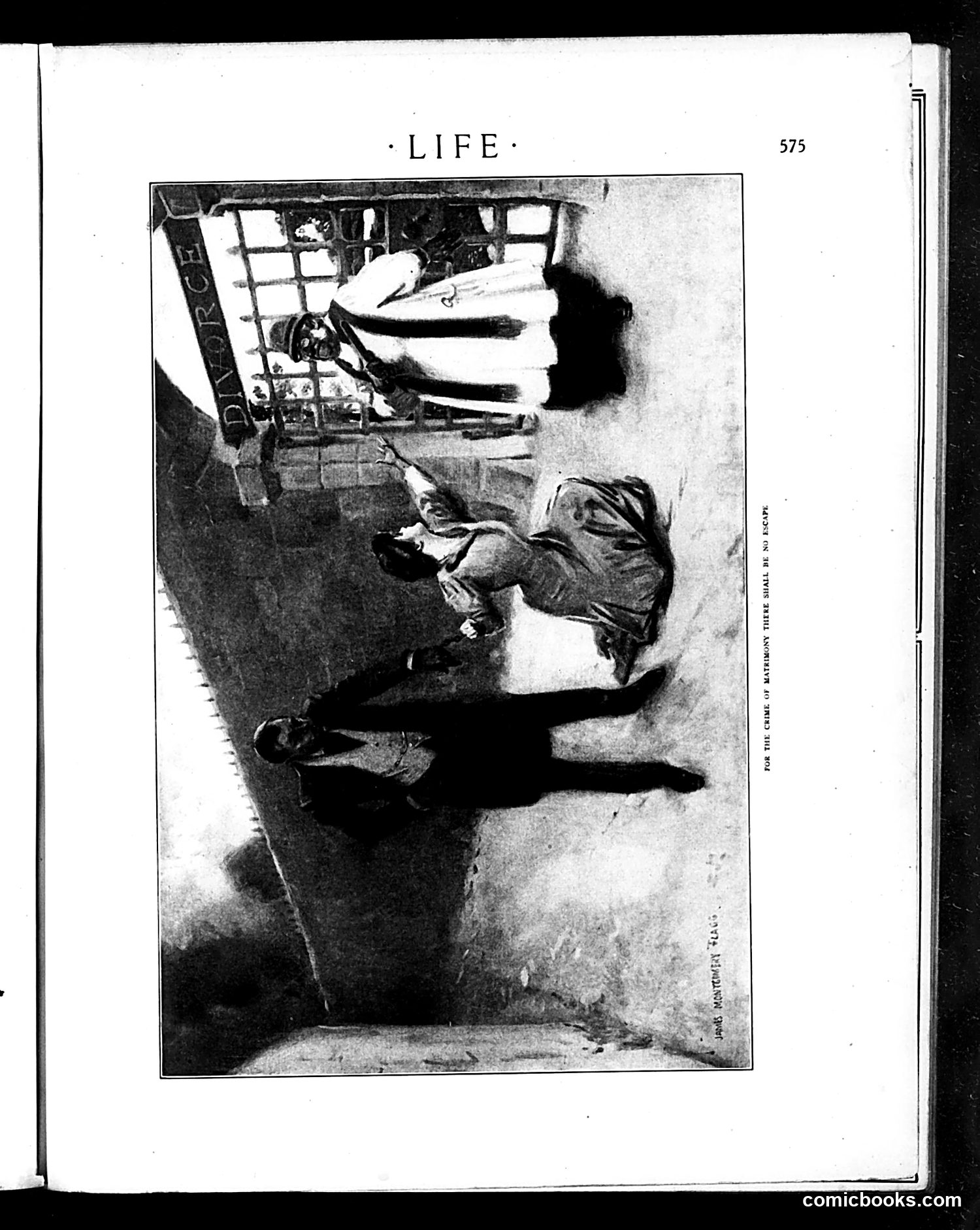
This page from Life magazine (page 575) contains a black-and-white photograph oriented sideways. The image shows what appears to be an interior domestic scene with two figures - one seated and one standing. The OCR text is largely corrupted and unreadable, making it difficult to determine the specific satirical point or identify the subjects with certainty. Without legible caption text or clear identifying markers, I cannot reliably explain what political or social commentary this image intended to convey. The photograph's quality and sideways orientation suggest it may be documenting a humorous domestic moment, but the specific context, identities of the figures, and the satirical intent remain unclear from the visible evidence alone.
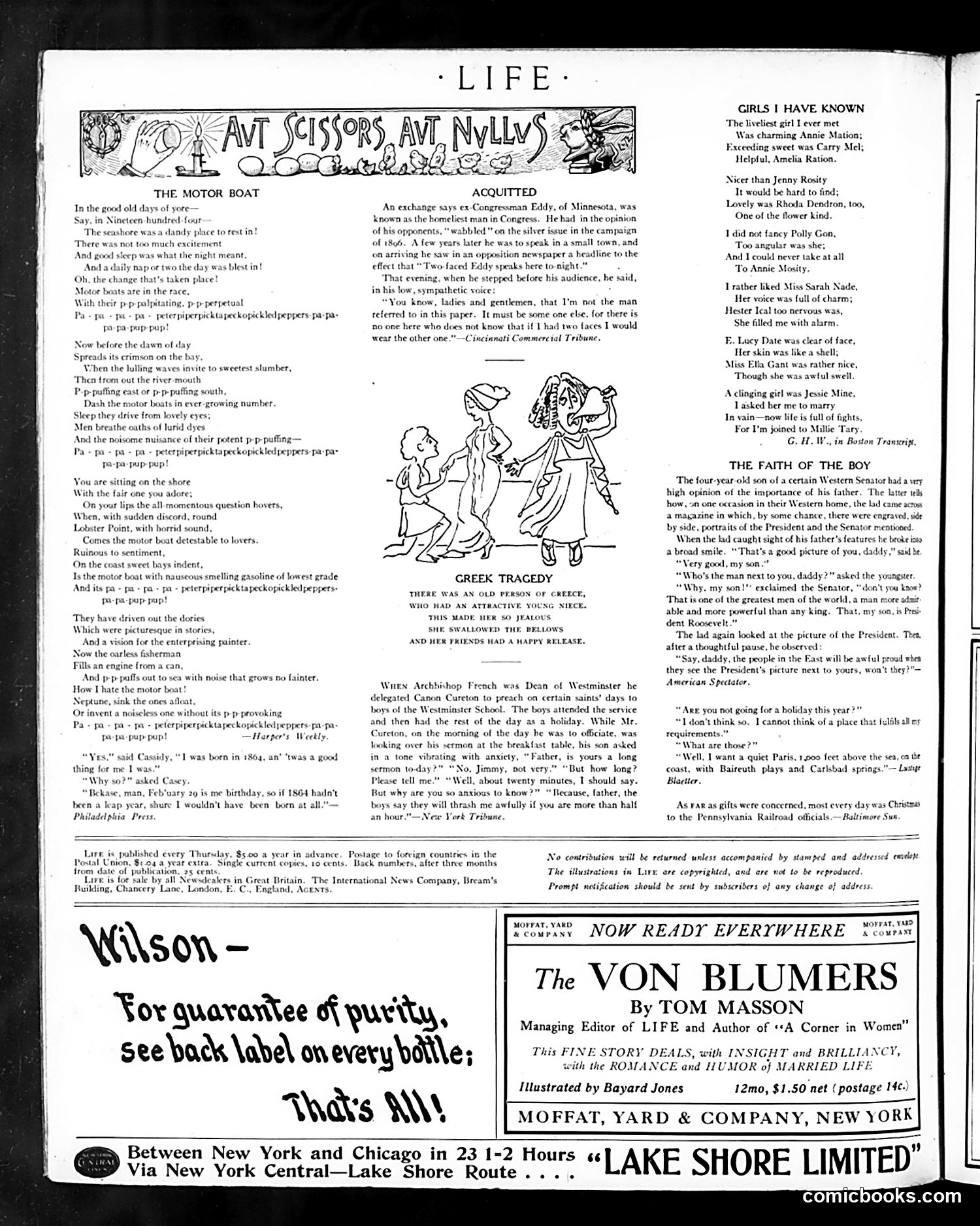
This page's main cartoon satirizes the recent introduction of gasoline-powered motorboats, which disrupted early 1900s seaside life. The poem mockingly catalogs how these noisy vessels—with their repetitive "pa-pa-pa" puffing sounds—have ruined the quiet beaches that once offered peaceful rest and romance. The satire targets several changes: motorboats replaced picturesque rowing boats, their foul-smelling exhaust polluted the air, and their constant racket prevented intimate moments ("ruinous to sentiment"). The narrator laments how couples can no longer propose without diesel interruption, and fishermen now carry fuel cans instead of oars. This reflects genuine Progressive Era anxieties about industrial "progress" destroying nature and traditional ways. The other brief humor items on the page (about a congressman's "two faces," a leap-year birthday paradox, a schoolmaster's sermon length) are unrelated filler typical of Life magazine's miscellaneous format.
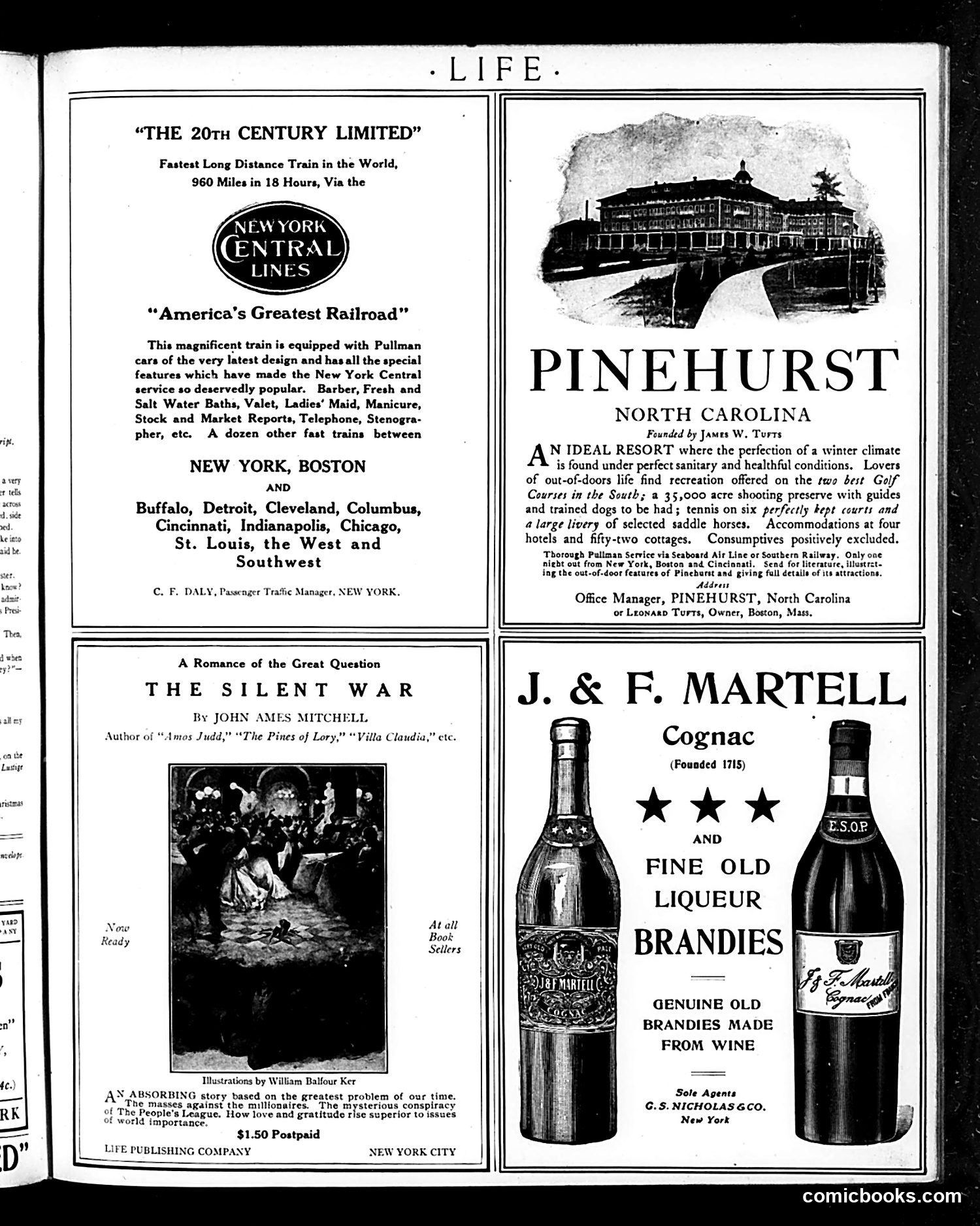
This page contains **no political cartoons or satire**—it's primarily advertisements from an early 20th-century American magazine. The ads showcase luxury products for wealthy consumers: the "20th Century Limited" train (emphasizing speed and Pullman comfort), Pinehurst resort in North Carolina (a winter destination explicitly excluding tuberculosis patients—reflecting period attitudes toward consumptives), and J. & F. Martell cognac brandy. The only editorial content is a book advertisement for *The Silent War* by John Ames Mitchell, described as addressing "the greatest problem of our time"—apparently class conflict between "the masses against the millionaires" involving a "People's League." This suggests Progressive-era anxieties about wealth inequality, though the plot emphasizes how "love and gratitude rise superior to issues of world importance," undercutting any radical message. The page reflects Gilded Age commercialism and upper-class leisure culture rather than satirical commentary.
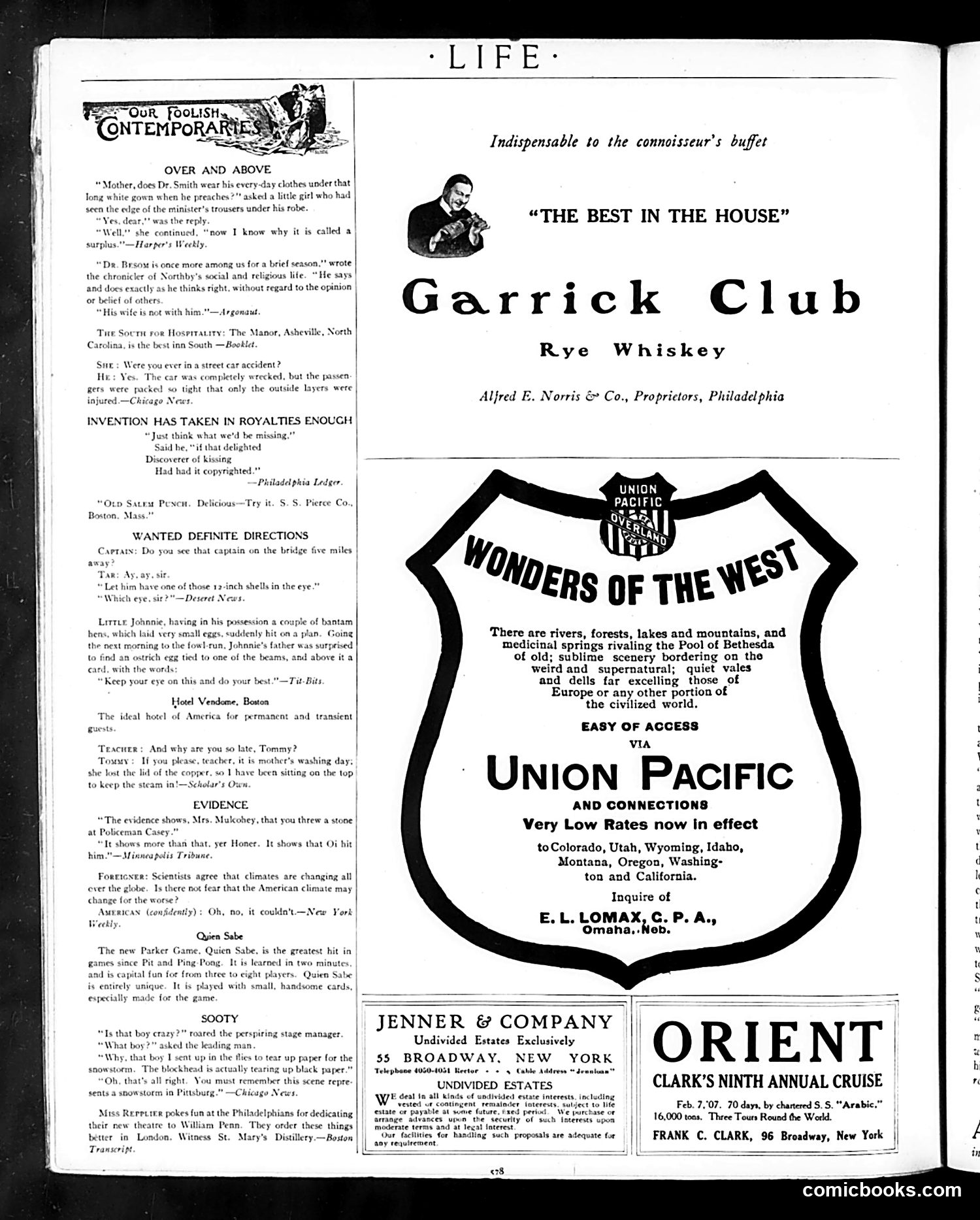
This page features Life's regular humor column mocking contemporary absurdities. The cartoons and brief anecdotes ridicule everyday foolishness: **Key jokes include:** - A minister's child asking why his "surplus" (vestment) is called that when regular clothes show underneath - A streetcar accident where passengers survive only because they're packed so tightly - A captain ordered to shoot at an object five miles away with 12-inch shells - A boy's mother blaming tardiness on laundry day - A woman claiming she threw a stone but hit something else **The satire targets:** common illogic, absurd excuses, miscommunication, and the pretensions of authority figures. The humor relies on literal interpretations of figurative language and obvious contradictions in reasoning—typical early-20th-century American comedy emphasizing wordplay and situational irony rather than social commentary. The page also contains period advertisements for whiskey, travel, and real estate—standard Life magazine filler.
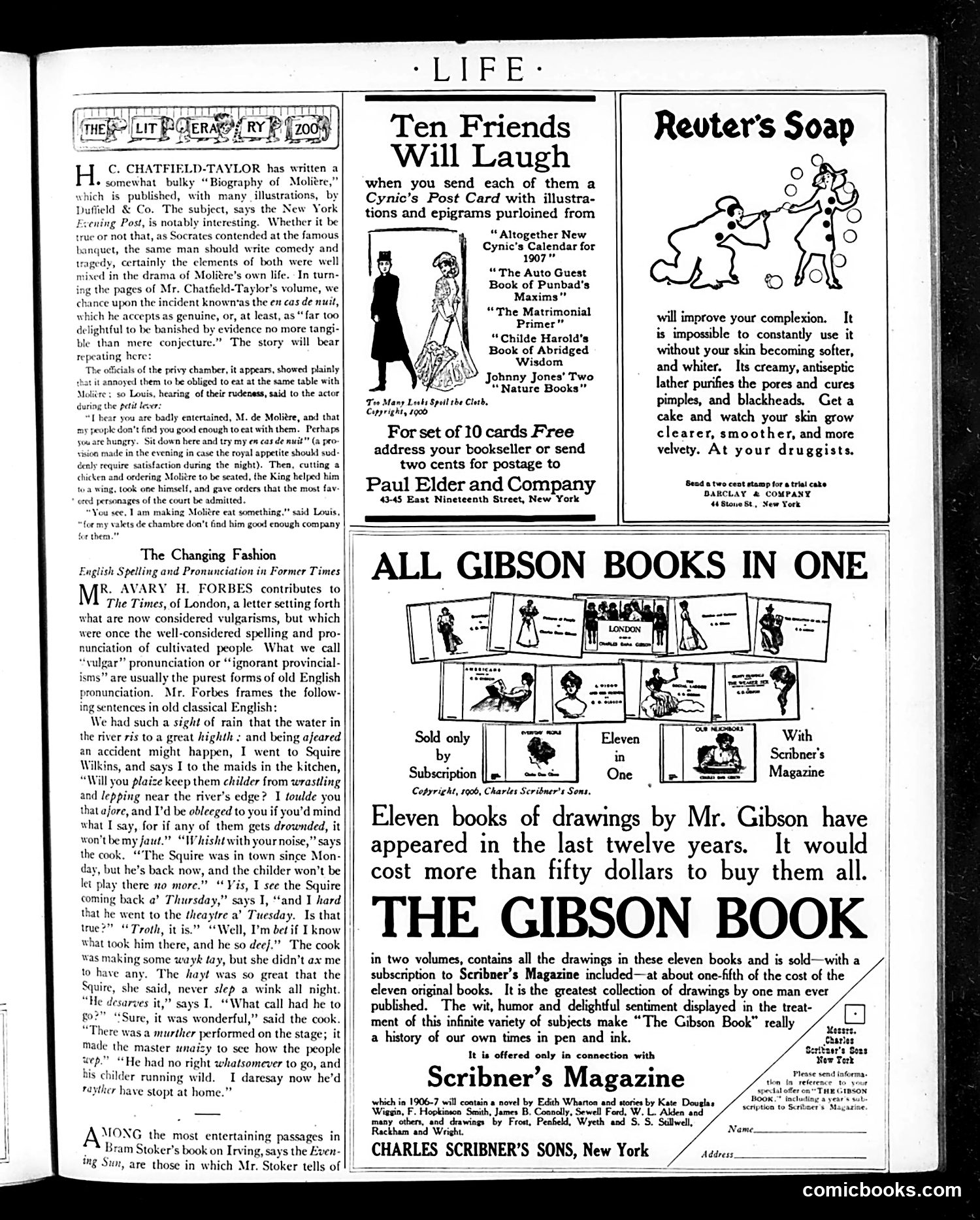
This page is primarily **advertising and literary announcements** rather than political satire. The main content includes: **Left column**: Book reviews discussing H.C. Chatfield-Taylor's biography of Molière and a linguistic piece by Avary H. Forbes on archaic English pronunciation—treating how words like "ris" (rose), "highth" (height), and "childer" (children) were once standard but became marked as vulgar. **Center**: An advertisement for Cynic's Post Cards offering humorous illustrated cards to send friends. **Right**: A Reuter's Soap advertisement with a simple cartoon showing figures and soap bubbles—typical product advertising. **Bottom half**: A major advertisement for "The Gibson Book"—a collection of Charles Dana Gibson's famous illustrations, sold via subscription to Scribner's Magazine. The page reflects early 1900s magazine advertising conventions. There's no significant political satire visible—it's a standard Life magazine layout mixing literary content with commercial advertisements typical of this era.
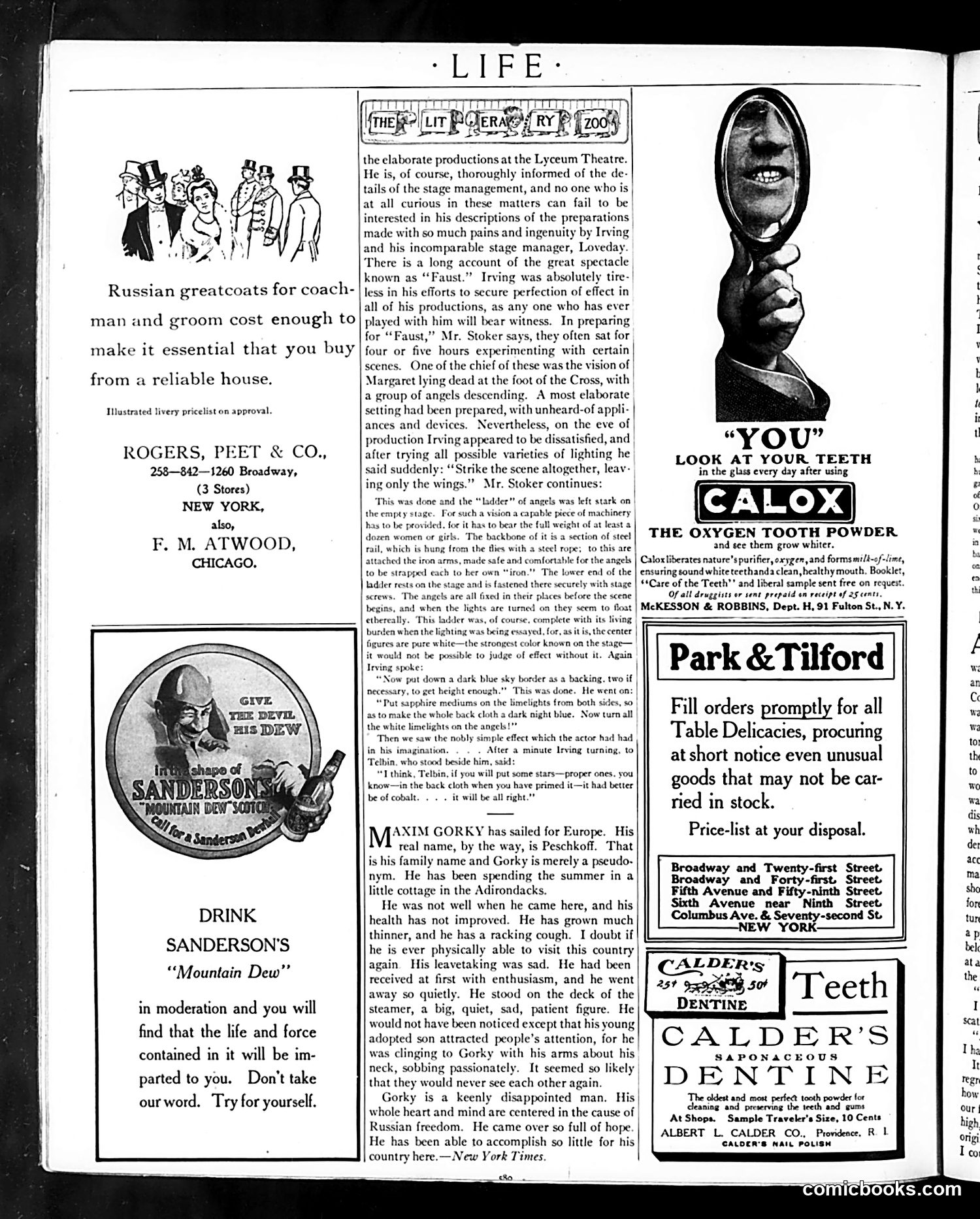
This page is primarily **advertising**, with a secondary article about theater production. The main content discusses **Henry Irving's elaborate staging** of "Faust" at the Lyceum Theatre, recounting how Irving obsessively perfected a complex scene of the dead Margaret with descending angels. The anecdote illustrates Irving's perfectionism—he rejected an entire elaborate setup, then methodically specified lighting (sapphire mediums, white limelights) and backdrop details (dark blue sky, cobalt stars) to achieve his vision. The cartoons/illustrations are purely decorative—a sketch of well-dressed men for a Russian greatcoat advertisement and a circular ad for Sanderson's "Mountain Dew" whiskey. The advertisements fill most space: clothing retailers (Rogers, Peet & Co.), tooth powder (Calox), whiskey, dental products (Calder's Dentine), and a gourmet food purveyor (Park & Tilford). A brief item notes **Maxim Gorky** has sailed for Europe, revealing his real name is Peschkoff—a biographical footnote with no apparent satirical intent.
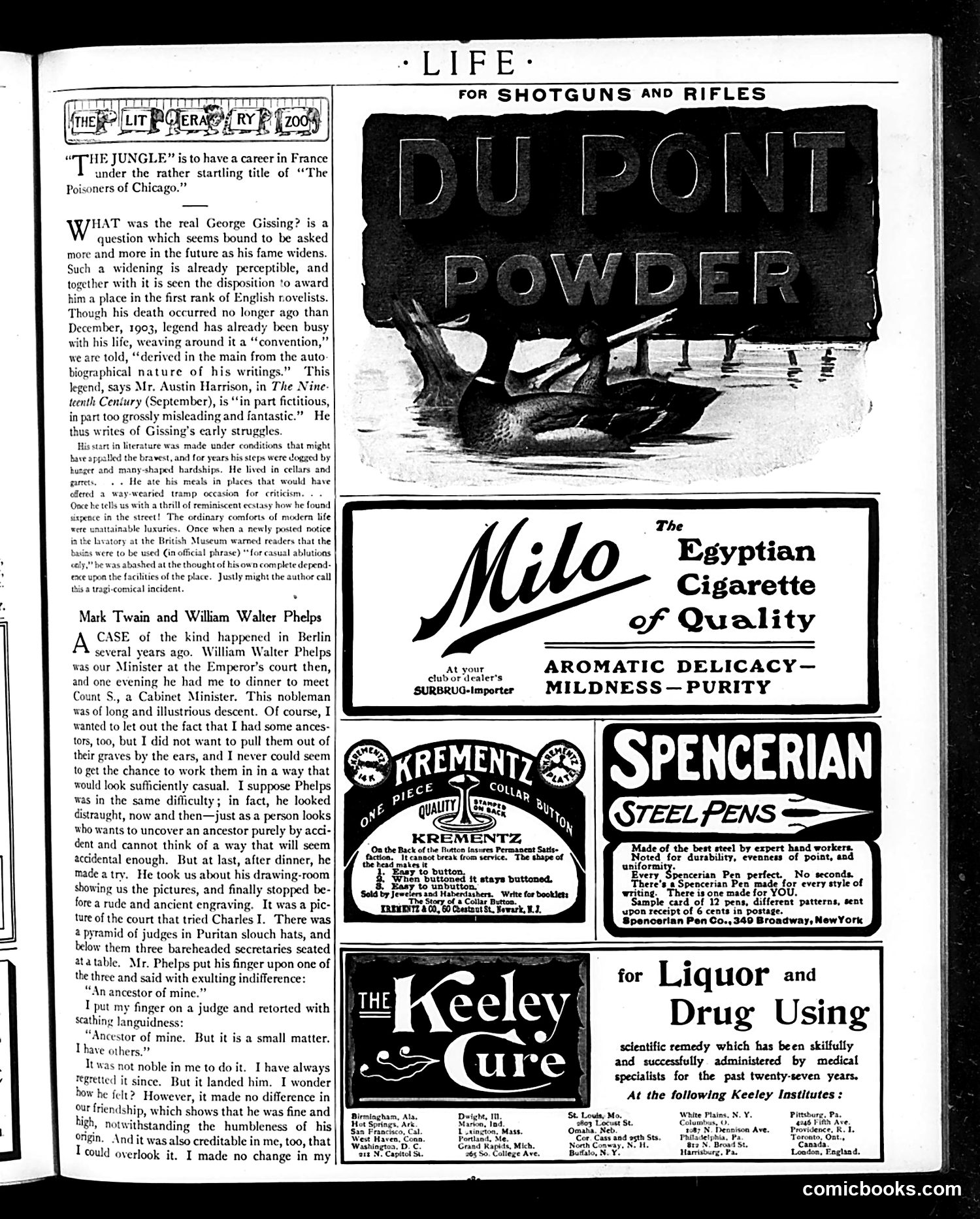
This Life magazine page contains mostly **literary content and advertisements** rather than political cartoons. The main text discusses **George Gissing**, a deceased English novelist (d. 1903), debating the accuracy of biographical legends surrounding his life and struggles. The second piece is a **Mark Twain anecdote** about a dinner in Berlin with U.S. Minister William Walter Phelps and a German Cabinet Minister, where Twain and Phelps engage in witty one-upmanship about their ancestors—Twain claiming descent from someone at the trial of Charles I. It's a humorous tale about social pretension and competitive ancestor-claiming. The page is dominated by **period product advertisements**: DuPont Powder (ammunition), Milo cigarettes, Krementz jewelry, Spencerian steel pens, and a "Keeley Cure" (a notorious 19th-century addiction treatment center). The Keeley Cure advertised treatment for "Liquor and Drug Using"—indicating widespread concern about addiction at this time. The content reflects early 20th-century literary criticism, memoir humor, and commercial advertising typical of Life magazine's format.
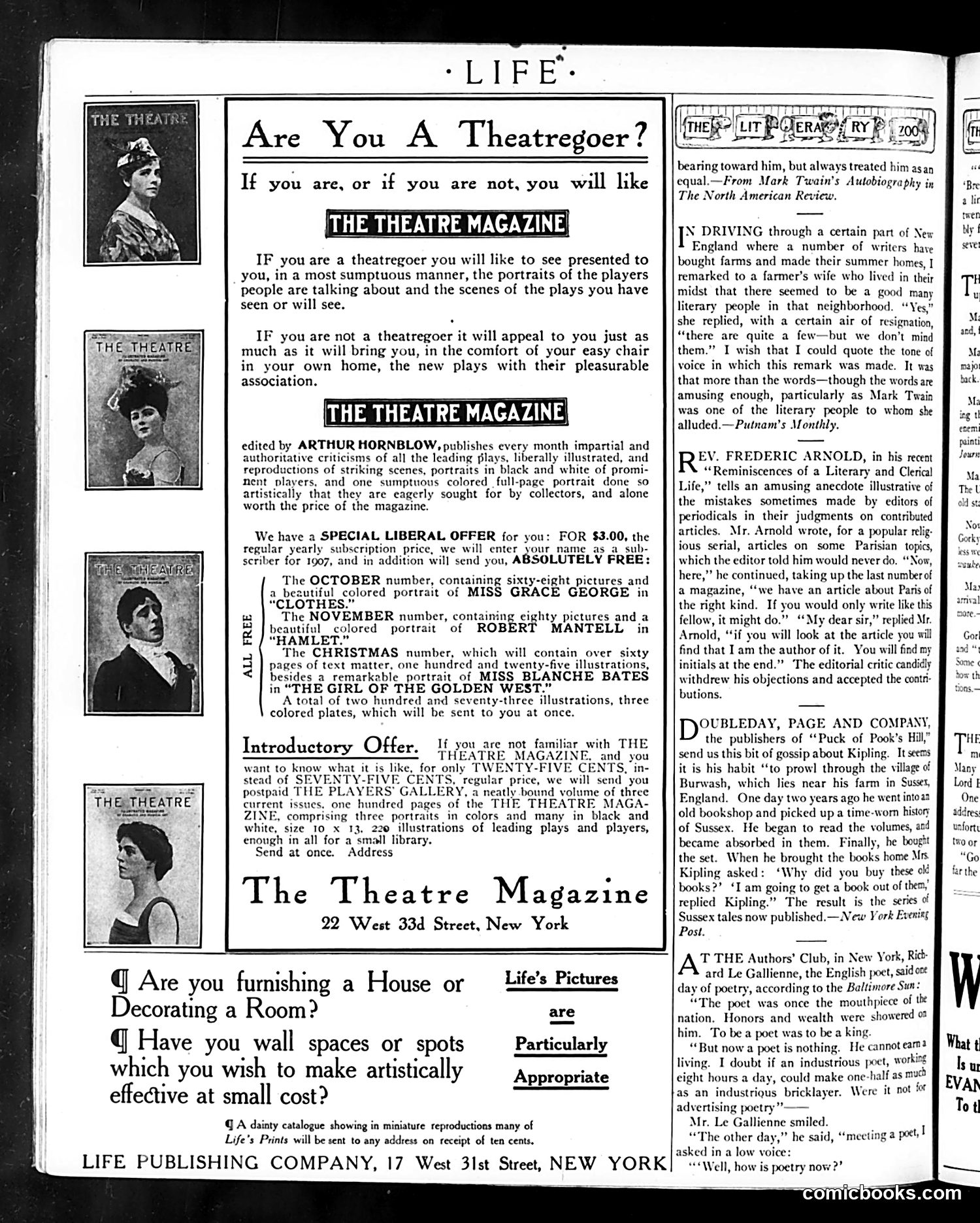
This page is primarily **advertising and editorial content**, not political satire. It consists of: 1. **The Theatre Magazine advertisement** (main feature): A promotional campaign edited by Arthur Hornblow soliciting subscriptions by offering free issues featuring portraits of popular stage actors including Grace George, Robert Mantell, and Blanche Bates. The pitch emphasizes theatrical photography and play criticism for both theater enthusiasts and casual readers seeking home entertainment. 2. **Life's Pictures advertisement**: A secondary ad for decorative prints suitable for home furnishing. 3. **Right column**: Anecdotal literary commentary, including a Mark Twain reference about rural New England writers and a story about Reverend Frederic Arnold's publishing experiences. The content reflects early 1900s American leisure culture—theater attendance as popular entertainment, home decoration aspirations, and literary celebrity. There is **no political cartoon or satire** present; this is straightforward period advertising and social commentary.
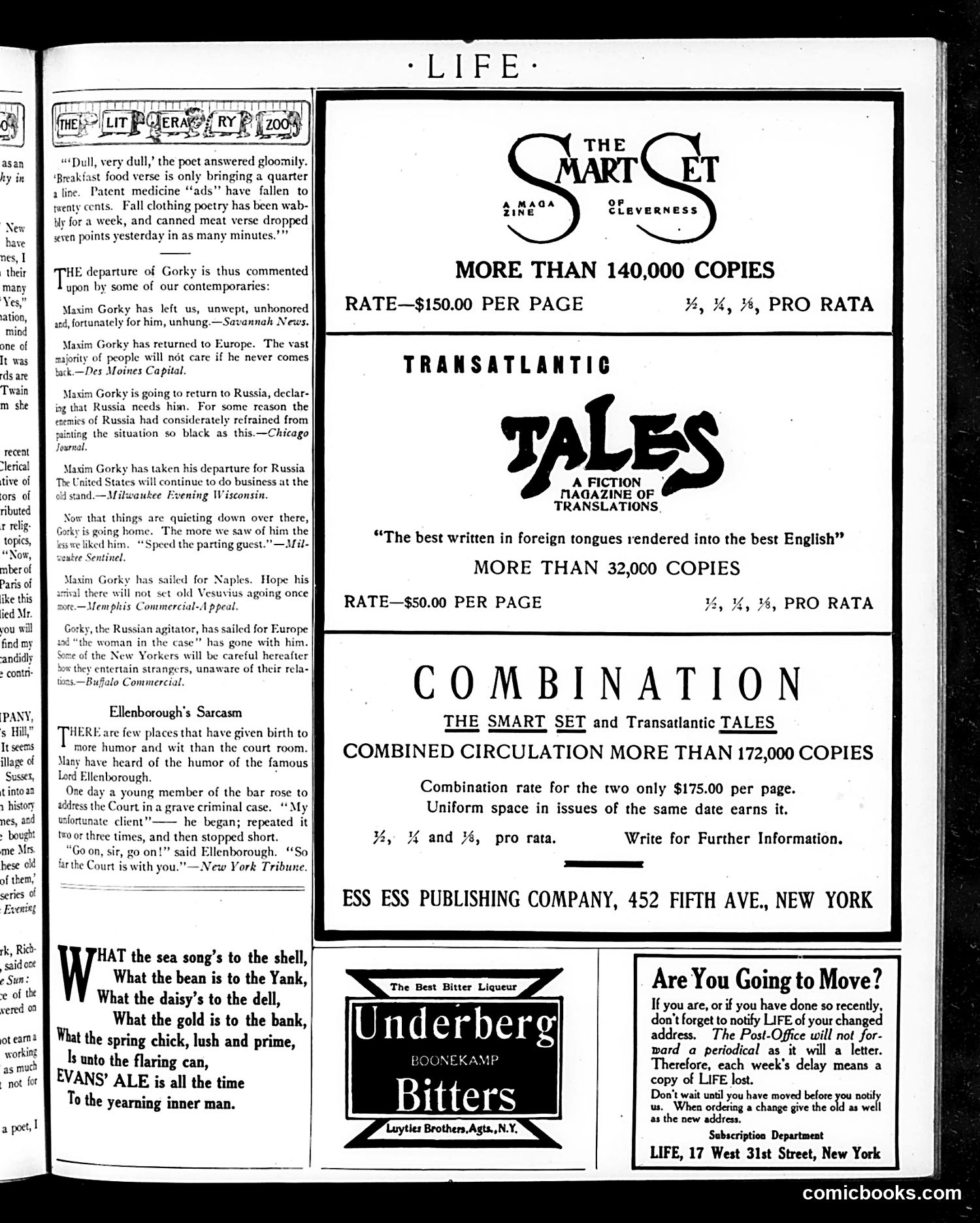
This page is primarily **advertising and administrative notices** rather than editorial cartoons. The main content includes: **Literary Advertisements:** Three magazine/publication ads promote *The Smart Set* (satirical magazine with 140,000+ circulation at $150/page), *Transatlantic Tales* (32,000+ copies at $50/page), and a combination rate for both publications. These target literary advertisers. **Editorial snippets** mock the departure of **Maxim Gorky**, the Russian writer/activist who had visited America. Various newspapers sarcastically comment on his leaving—some relieved, others mocking. This references Gorky's controversial 1906 American tour (he faced scandal and was asked to leave). **Brief humorous anecdotes** include a Lord Ellenborough courtroom joke and advertising copy for Evans' Ale. **Practical notice:** A subscription department reminder to notify *Life* of address changes before moving. The page reflects *Life's* dual nature: a satirical magazine dependent on advertising revenue, mixing cultural commentary with commercial appeals to readers and advertisers.
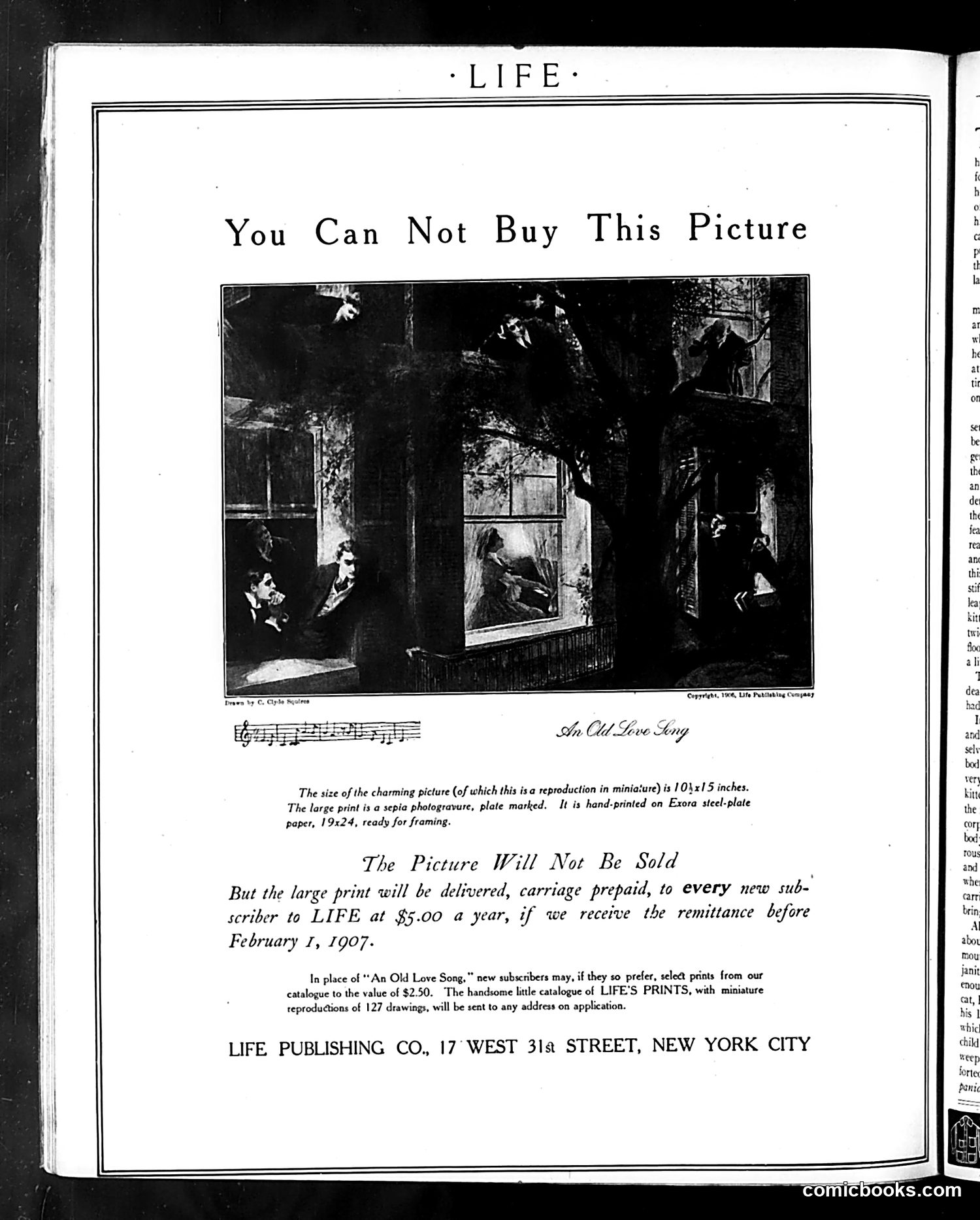
This is primarily a **subscription advertisement**, not a political cartoon. The page promotes Life magazine's subscription offer circa 1907. The central image titled "An Old Love Song" depicts a romantic, atmospheric scene: figures in period dress arranged around a street or courtyard, with dramatic lighting and what appears to be a serenade or romantic encounter—possibly referencing a classical love song or literary scene. The real point is the **marketing strategy**: Life promises this large, hand-printed sepia artwork (10.5×15 inches) as a free premium to new annual subscribers paying $5.00 before February 1, 1907. The headline "You Can Not Buy This Picture" creates urgency—it's *exclusively* for subscribers, not for individual purchase. This reflects early 1900s magazine marketing tactics, using fine art reproductions as subscription incentives to compete for readers. The offer also mentions a catalog of 127 other prints subscribers could choose from instead.
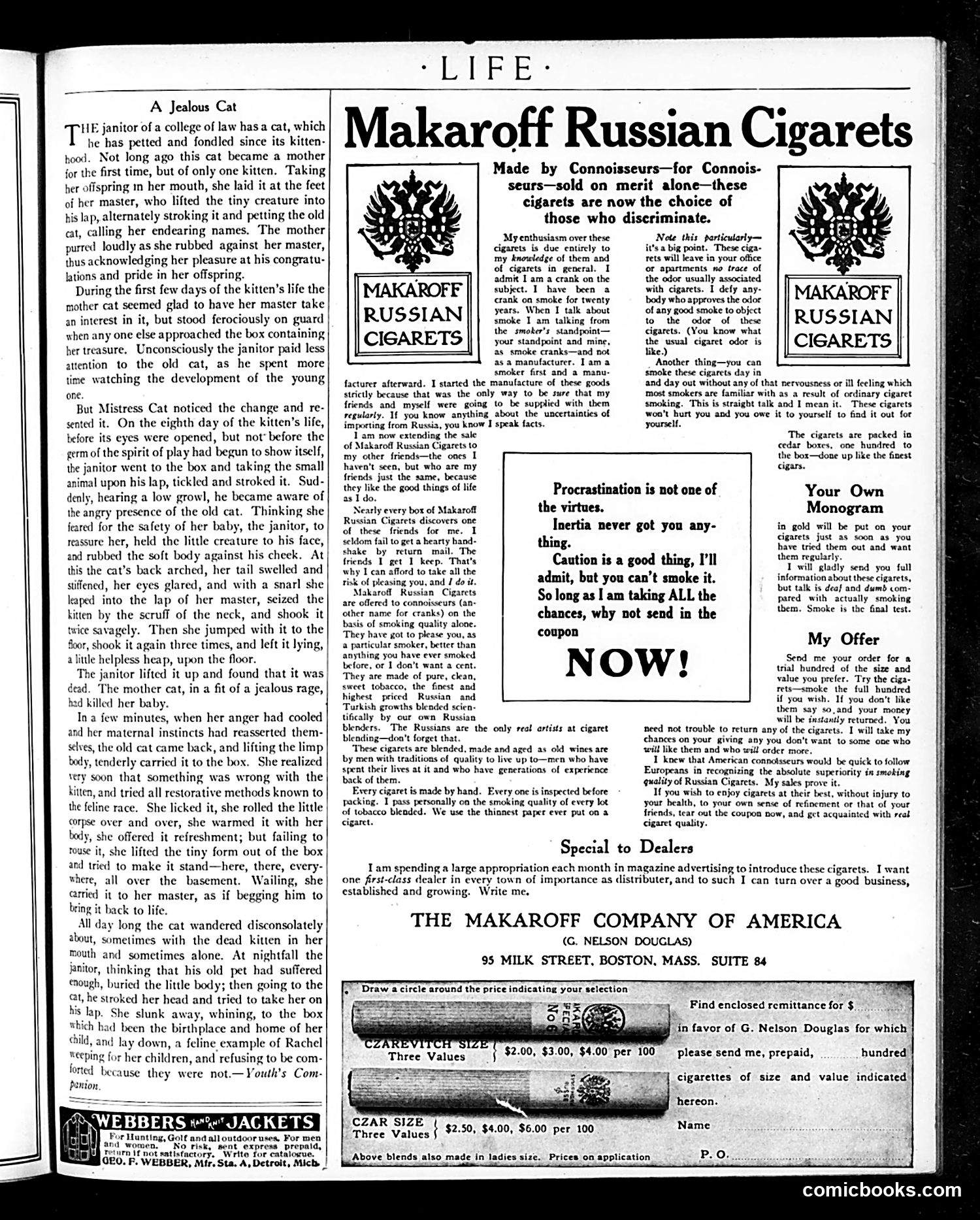
This is a sentimental moral tale, not political satire. The story describes a college janitor's cat who kills her own kitten out of jealousy when the master pays attention to the newborn instead of her. The narrative emphasizes the tragedy: the mother, realizing what she's done, frantically tries to revive the dead kitten, then grieves inconsolably. The piece satirizes human-like emotional complexity in animals—depicting maternal pride, jealous rage, and maternal remorse with the language typically reserved for people. The final reference to "Rachel weeping for her children" (a Biblical image of inconsolable grief) elevates the cat's suffering to tragic, almost biblical proportions, which is the joke: we're asked to treat a cat's jealous infanticide with profound seriousness. The rest of the page is cigarette advertising (Makaroff Russian Cigarets).
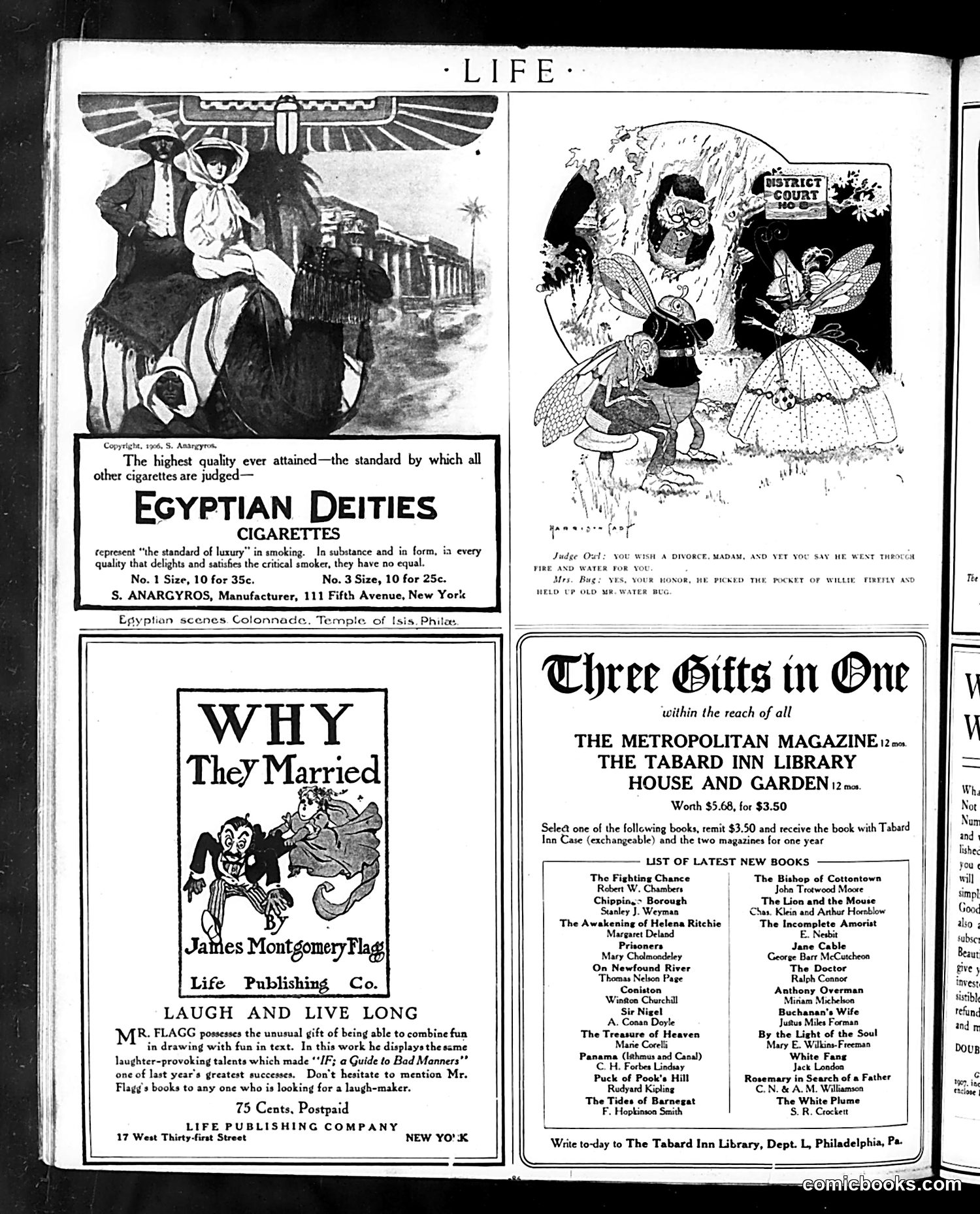
This page is primarily **advertising and book promotion**, with minimal satirical content. The main advertisements include: 1. **Egyptian Deities Cigarettes** – Appeals to luxury consumers by evoking exotic Egyptian imagery (temple, winged deity figure) and claiming superior quality. 2. **"Why They Married"** by James Montgomery Flagg – A humorous book advertised through a cartoon showing a couple in comedic domestic chaos, promoting Flagg as a humorist. 3. **"Laugh and Live Long"** – Another Flagg book emphasizing his reputation for combining visual and textual humor. 4. **The Tabard Inn Library Bundle** – A subscription offer combining *The Metropolitan Magazine* and *House and Garden* with a selected book. The small cartoon captioned "Judge Oxt" (upper right) shows insects in a court scene—likely a brief satirical joke about nature or marital discord, though context is unclear. The page reflects early 1900s consumer culture targeting educated, affluent readers through literary and luxury goods advertising.
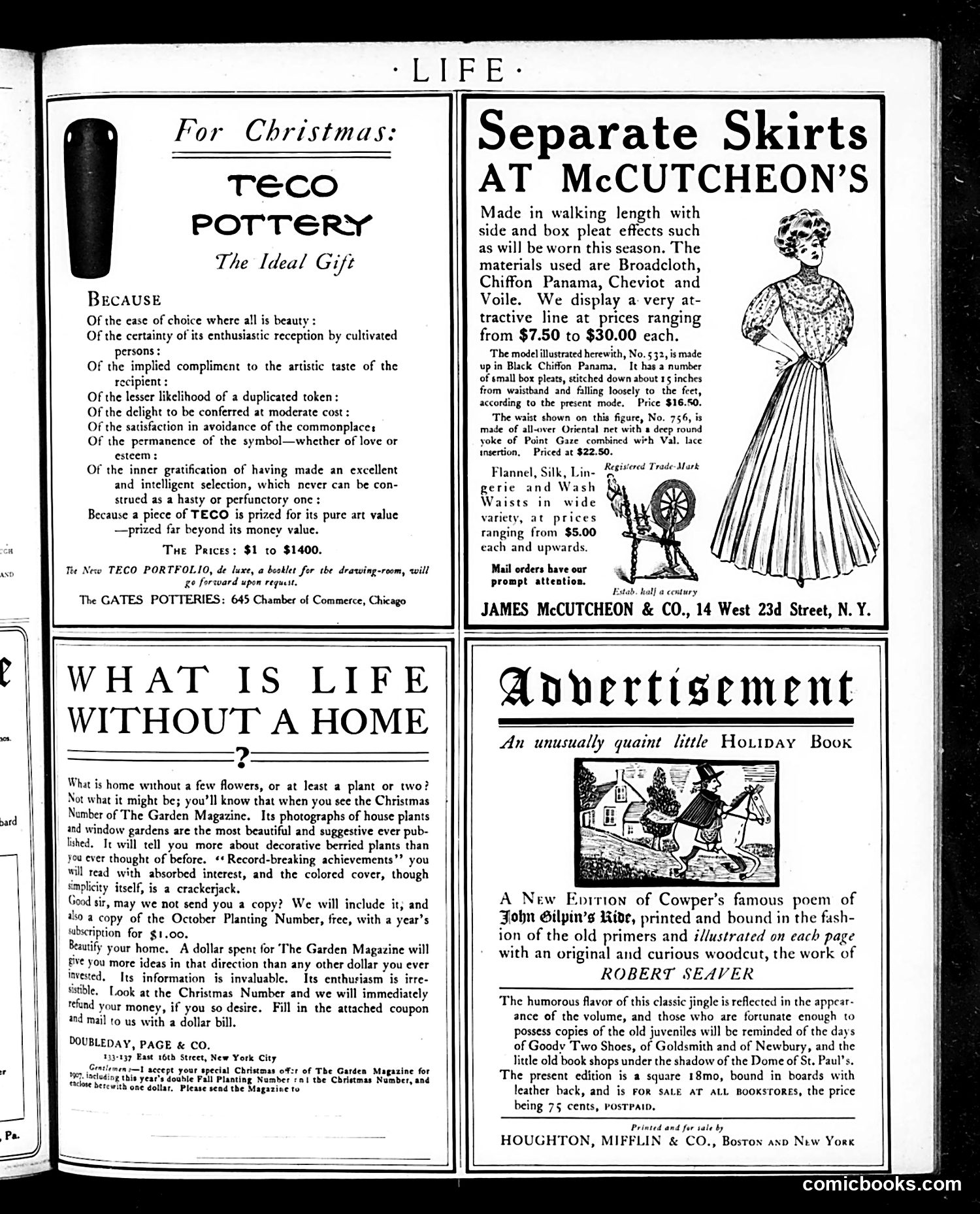
This is primarily an **advertising page** from an early 20th-century issue of Life magazine, containing no political cartoons or satirical content. The page features four advertisements: 1. **Teco Pottery** - promoting art pottery as Christmas gifts, emphasizing artistic value and refinement for "cultivated persons" 2. **McCutcheon's Separate Skirts** - advertising women's fashionable skirts in various fabrics (Chiffon Panama, Broadcloth) priced $7.50-$30, with an illustration of period-appropriate women's fashion 3. **The Garden Magazine** - promoting a subscription emphasizing home beautification with house plants and window gardens 4. **Cowper's John Gilpin's Ride** - advertising a reissued classic poem illustrated with woodcuts The page reflects **early 1900s consumer culture**: emphasis on refined taste, home decoration, and fashionable women's clothing. No satire or political commentary is present—it's straightforward commercial advertising aimed at middle/upper-class readers.
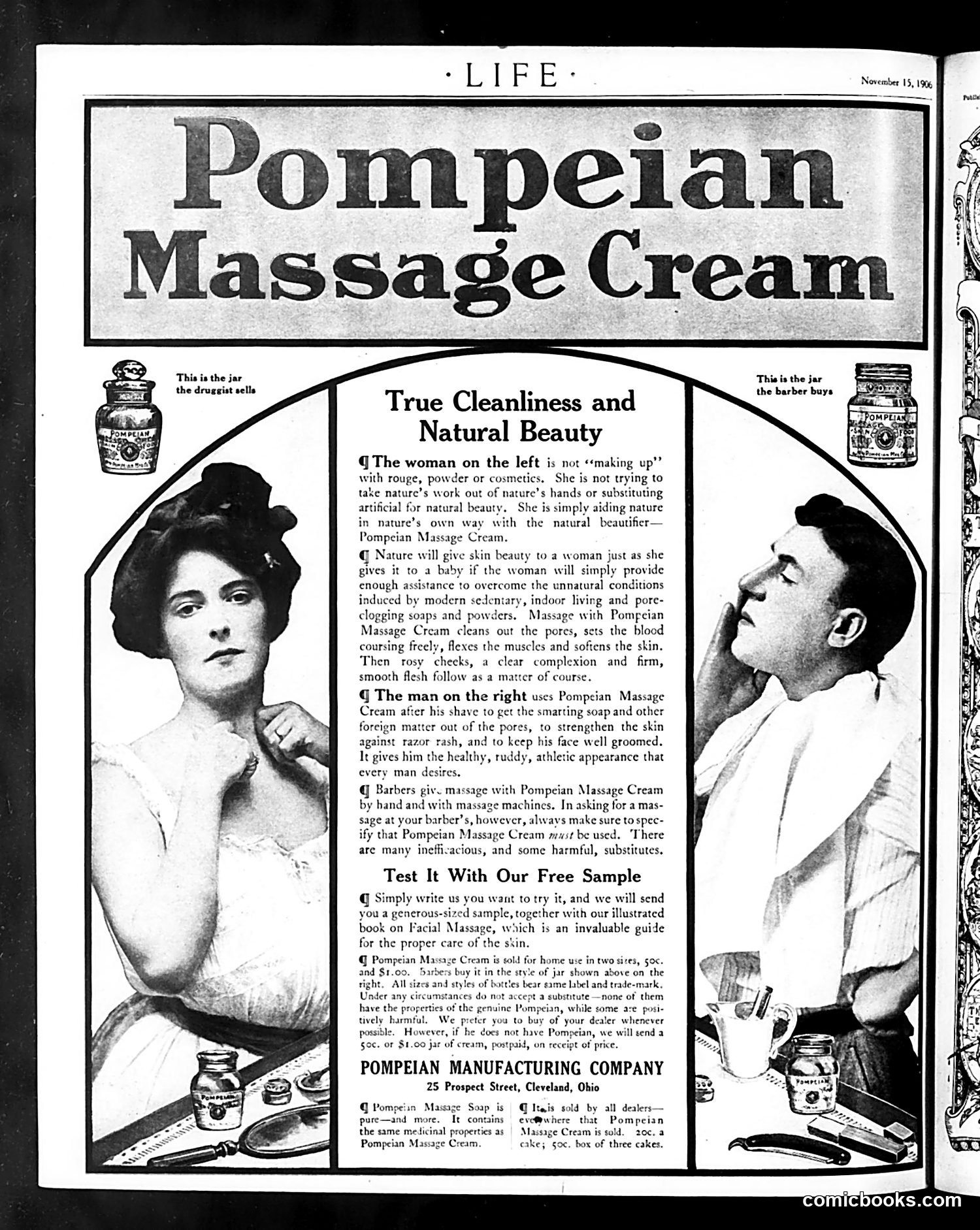
This is a **product advertisement**, not political satire. It promotes Pompeian Massage Cream to both women and men as a natural beauty aid. The page contrasts two users: a woman (left) who uses the cream to enhance natural beauty without cosmetics, and a man (right) who uses it after shaving for skin health and grooming. The ad emphasizes that the product aids nature rather than replacing it—a selling point reflecting early-1900s attitudes skeptical of heavy makeup. The small jars shown indicate the product was sold through both drugstores and barbershops, suggesting different marketing channels for men and women. The ad includes a free-sample offer and warns consumers to ensure barbers use the genuine product, not "inefficacious" substitutes. This reflects period concerns about product authenticity and the emerging consumer culture of mail-order sampling.