
Life, 1906-11-15 · page 30 of 36
Life — November 15, 1906 — page 30: what you’re looking at
What you’re looking at
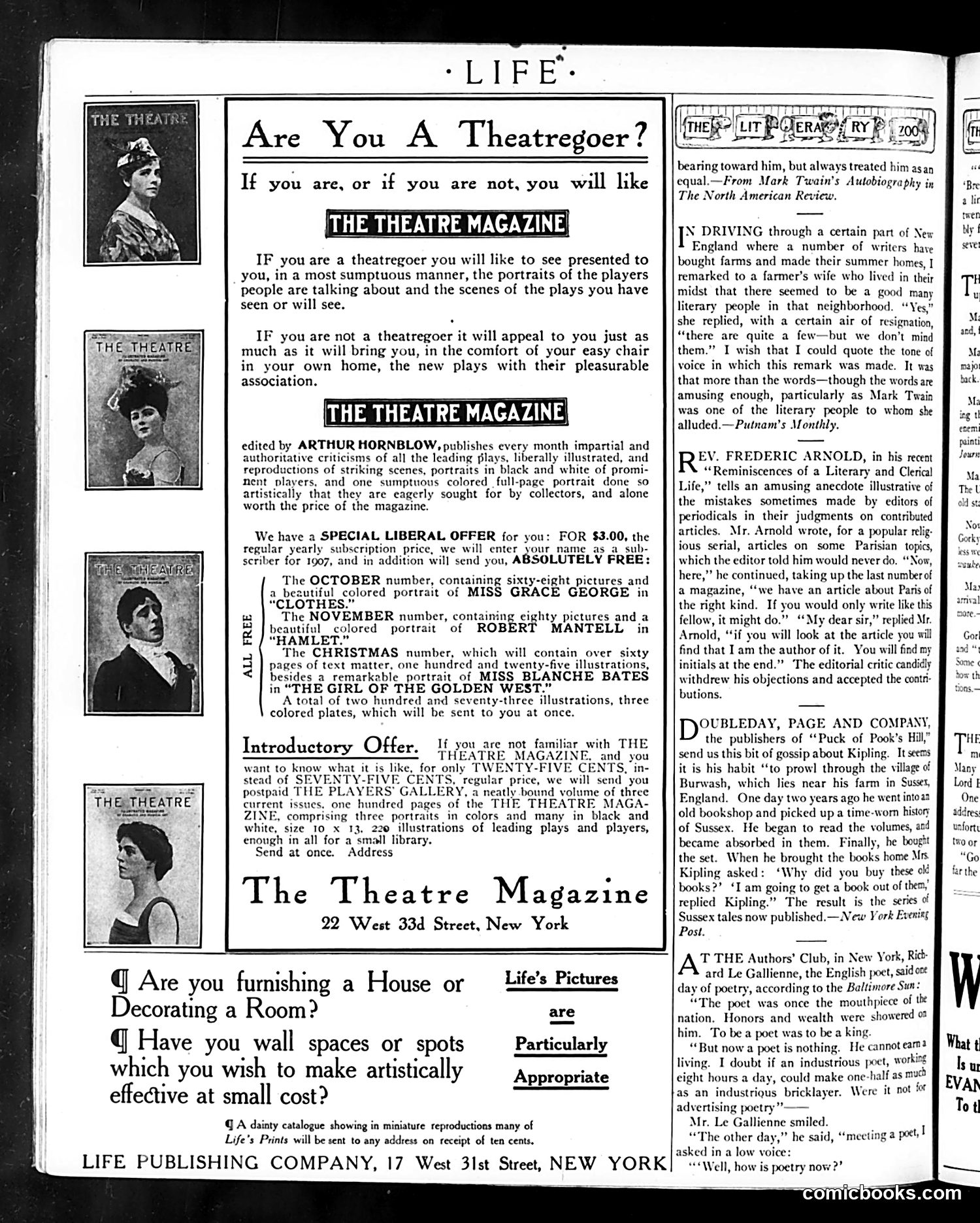
This page is primarily **advertising and editorial content**, not political satire. It consists of: 1. **The Theatre Magazine advertisement** (main feature): A promotional campaign edited by Arthur Hornblow soliciting subscriptions by offering free issues featuring portraits of popular stage actors including Grace George, Robert Mantell, and Blanche Bates. The pitch emphasizes theatrical photography and play criticism for both theater enthusiasts and casual readers seeking home entertainment. 2. **Life's Pictures advertisement**: A secondary ad for decorative prints suitable for home furnishing. 3. **Right column**: Anecdotal literary commentary, including a Mark Twain reference about rural New England writers and a story about Reverend Frederic Arnold's publishing experiences. The content reflects early 1900s American leisure culture—theater attendance as popular entertainment, home decoration aspirations, and literary celebrity. There is **no political cartoon or satire** present; this is straightforward period advertising and social commentary.
📄 Transcribed text from this page (OCR, searchable)
Machine-transcribed from the original scan — historical spelling and the odd misread are preserved.
Are You A Theatregoer ? If you are, or if you are not, you will like THE THEATRE MAGAZINE! IF you are a theatregoer you will like to see presented to you, in a most sumptuous manner, the portraits of the players people are talking about and the scenes of the plays you have seen or will see. IF you are not a theatregoer it will appeal to you just as much as it will bring you, in the comfort of your easy chair in your own home, the new plays with their pleasurable association. THE THEATRE MAGAZINE edited by ARTHUR HORNBLOW, publishes every month impartial and authoritative criticisms of all the leading plays, liberally illustrated, and reproductions of striking scenes, portraits in black and white of promi- nent players, and one sumptuous colored full-page portrait done so artistically that they are eagerly sought for by collectors, and alone worth the price of the magazine. We have a SPECIAL LIBERAL OFFER for you: FOR $3.00, the regular yearly subscription price, we will enter your name asa sub- scriber for 1907, and in addition will send you, ABSOLUTELY FREE: The OCTOBER number, containing sixty-eight pictures and a beautiful colored portrait of MISS GRACE GEORGE in “CLOTHES.” The NOVEMBER number, containing eighty pictures and a beautiful colored portrait of ROBERT MANTELL in “HAMLET.” The CHRISTMAS number, which will contain over sixty pages of text matter, one hundred and twenty-five illustrations, besides a remarkable portrait of MISS BLANCHE BATES in “THE GIRL OF THE GOLDEN WEST.” A total of two hundred and seventy-three illustrations, three colored plates, which will be sent to you at once. If you are not familiar with THE THEATRE AGAZIN only TWENTY-FIVE CENTS, in- TS, regular price, we will send you postpaid THE P: RY, a neatly bound volume of three issues, one hundred s of the THE THEATRE MAGA- comprising three portraits in colors and many in black and white, size 10 x 13, 220 illustrations of leading plays and players, enough in all for a'small library. Send at once. Address The Theatre Magazine 22 West 33d Street, New York want to know stead of S @ Are you furnishing a House or __ kife’s Pictures Decorating a Room? @ Have you wall spaces or spots which you wish to make artistically effective at small cost? are Particularly Appropriate GA dainty catalogue showing in miniature reproductions many of Life's Prints will be sent to any address on receipt of ten cents. LIFE PUBLISHING COMPANY, 17 West 3lst Stree, NEW YORK bearing toward him, but always treated him asan equal.—From Mark Twain's Autobiography ix The North American Review. N DRIVING through a certain part of New England where a number of writers have bought farms and made their summer homes, I remarked to a farmer’s wife who lived in their midst that there seemed to be a good many literary people in that neighborhood. “Yes,” she replied, with a certain air of resignation, “there are quite a few—but we don’t mind them.” I wish that I could quote the tone of voice in which this remark was made. It was that more than the words—though the words are amusing enough, particularly as Mark Twain was one of the literary people to whom she alluded.—Putnam’s Monthly, EV. FREDERIC ARNOLD, in his recent “Reminiscences of a Literary and Clerical Life,” tells an amusing anecdote illustrative of the mistakes sometimes made by editors of periodicals in their judgments on contributed articles. Mr. Arnold wrote, for a popular relig: ious serial, articles on some Parisian topics, which the editor told him would never do. “Now, here,” he continued, taking up the last number of a magazine, “we have an article about Paris of the right kind. If you would only write like this fellow, it might do.” ‘My dear sir,” replied Mr. Amold, “if you will look at the article you will find that I am the author of it. You will find my initials at the end.” The editorial critic candidly withdrew his objections and accepted the contri butions. OUBLEDAY, PAGE AND COMPANY, the publishers of ‘Puck of Pook’s Hill,” send us this bit of gossip about Kipling. It seems it is his habit “to prowl through the village of Burwash, which lies near his farm in Susser, England. One day two years ago he went intozt old bookshop and picked up a time-worm history of Sussex. He began to read the volumes, and became absorbed in them. Finally, he bougit the set. When he brought the books home Mrs Kipling asked: ‘Why did you buy these olf books?’ ‘Iam going to get a book out of thea’ replied Kipling.” The result is the series Sussex tales now published.—New York Evenitg Post. At THE Authors’ Club, in New York, Ric ard Le Gallienne, the English poet, said ore day of poetry, according to the Baltimore Sun: “The poet was once the mouthpiece of the nation, Honors and wealth were showered 0 him. To be a poet was to be a king. “But now a poet is nothing. He cannot em? living. I doubt if an industrious poet, Wo eight hours a day, could make one-half as ™¥¢ as an industrious bricklayer. Were it not advertising poetry ””—— Mr. Le Gallienne smiled. “The other day,” he said, ‘meeting a poet ! asked in a low voice: “Well, how is poetry now ?”