
Life, 1906-11-15 · page 27 of 36
Life — November 15, 1906 — page 27: what you’re looking at
What you’re looking at
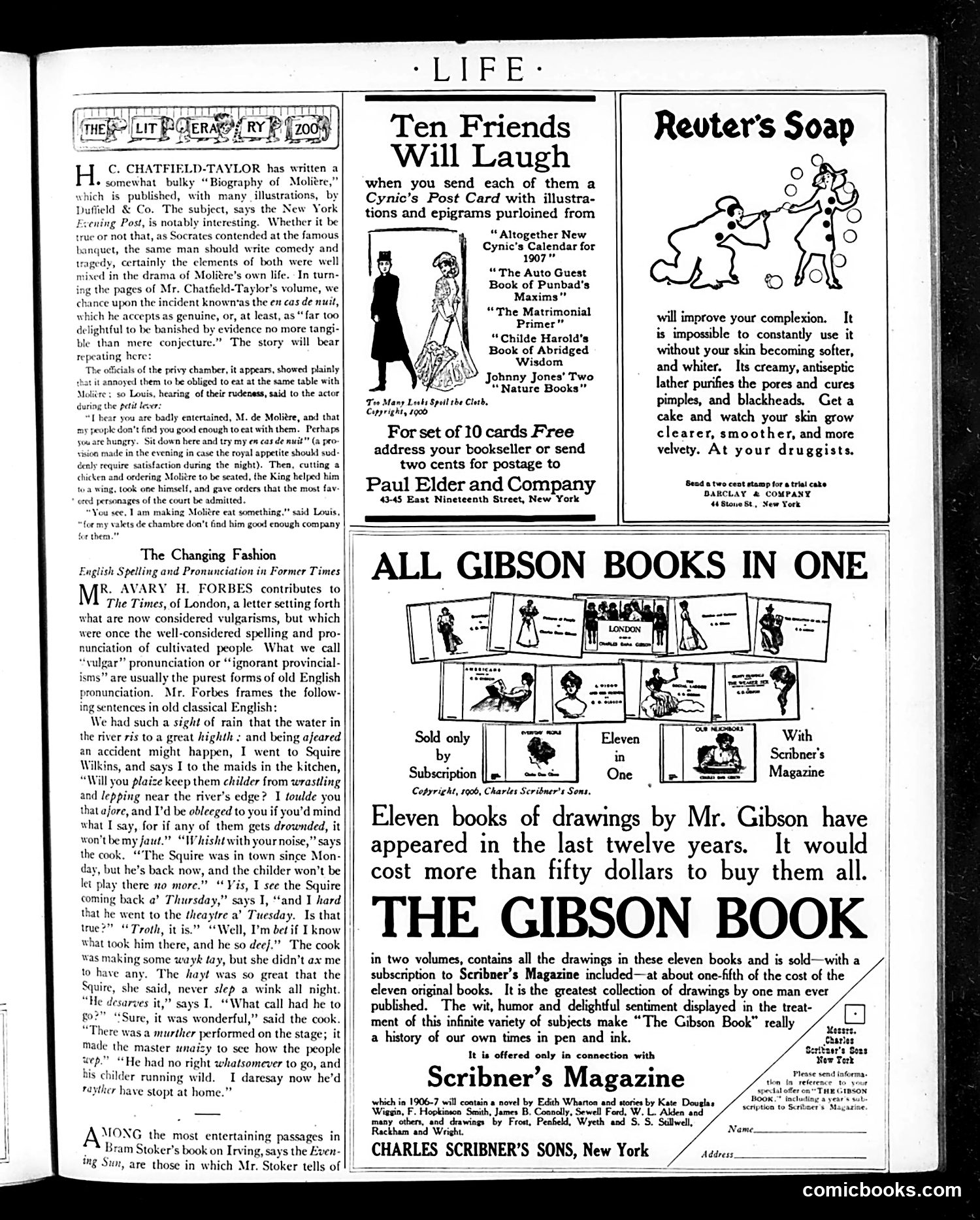
This page is primarily **advertising and literary announcements** rather than political satire. The main content includes: **Left column**: Book reviews discussing H.C. Chatfield-Taylor's biography of Molière and a linguistic piece by Avary H. Forbes on archaic English pronunciation—treating how words like "ris" (rose), "highth" (height), and "childer" (children) were once standard but became marked as vulgar. **Center**: An advertisement for Cynic's Post Cards offering humorous illustrated cards to send friends. **Right**: A Reuter's Soap advertisement with a simple cartoon showing figures and soap bubbles—typical product advertising. **Bottom half**: A major advertisement for "The Gibson Book"—a collection of Charles Dana Gibson's famous illustrations, sold via subscription to Scribner's Magazine. The page reflects early 1900s magazine advertising conventions. There's no significant political satire visible—it's a standard Life magazine layout mixing literary content with commercial advertisements typical of this era.
📄 Transcribed text from this page (OCR, searchable)
Machine-transcribed from the original scan — historical spelling and the odd misread are preserved.
RE Ten Friends | (cme eh [Lir P.leRAY RY F fod 700) a C. CHATFIELD-TAYLOR has written a somewhat bulky “Biography of Molitre,” which is published, with many illustrations, by Duffield & Co. The subject, says the New York Evening Post, is notably interesting. Whether it be truc of not that, as Socrates contended at the famous banquet, the same man should write comedy and tragedy, certainly the clements of both were well mixed in the drama of Molitre’s own life. In turn ing the pages of Mr. Chatficld-Taylor’s volume, we ce upon the incident known‘as the en cas de nuit, h he accepts as genuine, or, at least, as“ far too delightful to be banished by evidence no more tangi- ble than mere conjecture.” The story will bear repeating here: ials of the privy chamber, it appears, showed plainly J them to be obliged to eat at the same table with ‘Louis, hearing of their rudeness, said to the actor using ve petit lever: you are badly entertained, M. de Molitre, and that jon't find you good enough toeat with them. Perhaps you are hungry. Sit down here and try my en cas de m1 (a pro- sision made in the evening in case the royal appetite shoukd sud- denly require satisfaction during the night). Then, cutting a chicken and ordering Molitre to be seated, the King helped him a wing, took one himself, and gave orders that the most fav- personages of the court be admitted. ou see, I am making Molitre eat something.” said Louis, of my valets de chambre don’t find him good enough company for them."” The Changing Fashion English Spelling and Pronunciation in Former Times R. AVARY H. FORBES contributes to The Times, of London, a letter setting forth what are now considered vulgarisms, but which were once the well-considered spelling and pro- nunciation of cultivated people What we call “vulgar” pronunciation or ‘ignorant provincial- isms” are usually the purest forms of old English pronunciation. Mr. Forbes frames the follow- ing sentences in old classical English: We had such a sight of rain that the water in the river ris to a great highth ; and being ajeared an accident might happen, I went to Squire Wilkins, and says I to the maids in the kitchen, “Will you plaize keep them childer from wrastling and lepping near the river’s edge? I foulde you that afore, and I’d be obleeged to you if you'd mind what I say, for if any of them gets drownded, it || won't be my jaw.” “IWhishtwith your noise,” says || the cook. “The Squire was in town since Mon- day, but he’s back now, and the childer won't be let play there no more.” “Vis, I see the Squire coming back a’ Thursday,” says I, ‘and I hard that he went to the theaytre a’ Tuesday. Is that || true?” “ Tyoth, it is.” “Well, I'm bet if I know | | what took him there, and he so dee.” The cook was making some wayk fay, but she didn’t ax me . The hayt was so great that the id, never slep a wink all night. I, ‘What call had he to wonderful,” said the cook. a murther performed on the stage; it made the master unaizy to sce how the people uep.” “He had no right whatsomever to go, and his childer running wild. I daresay now he'd rayther have stopt at home.” MONG the most entertaining passages in Bram Stoker's book on Irving, says the Even- ing Sun, are those in which Mr. Stoker tells of ie Reuter’s Soap Will Laugh when you send each of them a Cynic’s Post Card with illustra- tions and epigrams purloined from “ Altogether New Cynic’s Calendar for “The Auto Guest Book of Punbad's “The Matrimonial Primer” “Childe Harold's Book of Abridged 4) >\ ‘Wisdom cy ; 4\ Johnny Jones’ Two Ree “Nature Books” Tor Many Lets Spoil the Clot, Copyright, 1900 For set of 10 cards Free address your bookseller or send two cents for postage to Paul Elder and Company 43-45 East Nineteenth Street, New York will improve your complexion. It is impossible to constantly use it without your skin becoming softer, and whiter. Its creamy, antiseptic lather purifies the pores and cures pimples, and blackheads. Get a cake and watch your skin grow clearer, smoother, and more velvety. At your druggists. Sead a two cent stamp for atrial cake DARCLAY & COMPANY 44 Stone St, New York CHARLES SCRIBNER’S SONS, New York Scribner's Magazine Cofyright, 1906, Charles Scribner's Sons, Eleven books of drawings by Mr. Gibson have appeared in the last twelve years. It would cost more than fifty dollars to buy them all. THE GIBSON BOOK in two volumes, contains all the drawings in these eleven books and is sold—with a subscription to Scribner’s Magazine included—at about one-fifth of the cost of the eleven original books. It is the greatest collection of drawings by one man ever published. The wit, humor and delightful sentiment displayed in the treat- ment of this infinite variety of subjects make “The Gibson Book” really a history of our own times in pen and ink. It is offered only in connection with Scribner’s Magazine which in 1906-7 will contain a novel by Edith Wharton and stories by Kate Douglas Wiggin, F. Hopkinson Smith, James B. Coonolly, Sewell Ferd, W. L. Alden and many others, and drawings by Frost, Penfield, Wyeth and S. S. Sullwell, Rackham and Wright. comicbooks.com