
Life, 1906-11-15 · page 21 of 36
Life — November 15, 1906 — page 21: what you’re looking at
What you’re looking at
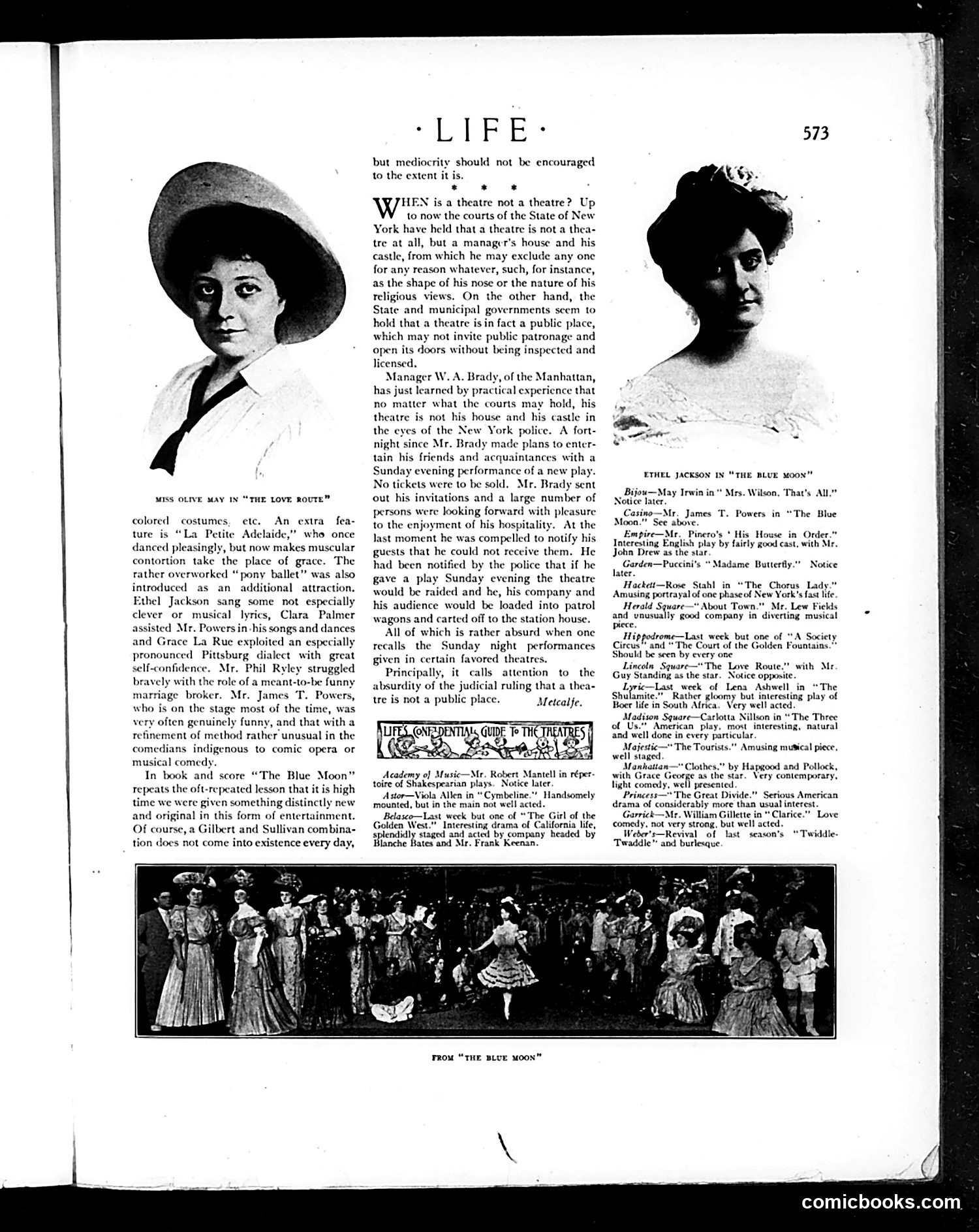
This page from *Life* magazine contains theater reviews and a legal satire. The main editorial piece (signed "Metcalfe") criticizes the absurdity of New York legal doctrine regarding theaters. **The Legal Paradox Being Mocked:** Theater manager W.A. Brady planned a private Sunday evening performance for friends—no tickets sold, just an invitation-only event. Police threatened to raid the theater and arrest everyone if he proceeded. Metcalfe highlights the hypocrisy: courts legally classify theaters as private property ("a manager's house and castle"), yet government treats them as public places requiring inspection and licensing. Some theaters apparently held Sunday performances without interference, suggesting selective enforcement. **The Satire's Point:** The piece ridicules this contradiction—if theaters are truly private, why police interference? If public, why the legal fiction otherwise? It exposes arbitrary power and inconsistent application of rules favoring certain establishments. The page also includes theater reviews of productions like "The Blue Moon" and photographs of actresses Olive May and Ethel Jackson from current productions.
📄 Transcribed text from this page (OCR, searchable)
Machine-transcribed from the original scan — historical spelling and the odd misread are preserved.
MISS OLIVE MAY IN “THE Love RouTE” colored costumes, ete. An extra fea- ture is “La Petite Adelaide,” who once danced pleasingly, but now makes muscular contortion take the place of grace. The rather overworked “pony ballet” was also introduced as an additional attraction. Ethel Jackson sang some not especially clever or musical lyrics, Clara Palmer assisted Mr. Powers in-his songs and dances and Grace La Rue exploited an especially pronounced Pittsburg dialect with great self-confidence. Mr. Phil Ryley struggled bravely with the role of a meant-to-be funny marriage broker. Mr. James T. Powers, who is on the stage most of the time, was very often genuinely funny, and that with a refinement of method rather unusual in the comedians indigenous to comic opera or musical comedy. In book and score “The Blue Moon” repeats the oft-repeated lesson that it is high time we were given something distinctly new and original in this form of entertainment. Of course, a Gilbert and Sullivan combina- tion does not come into existence every day, *LIPE: but mediocrity should not be encouraged to the extent it is. s 8 «& HEN is a theatre not a theatre? Up to now the courts of the State of New York have held that a theatre is not a the: tre at all, but a manager’s house and his castle, from which he may exclude any one for any reason whatever, such, for instance, as the shape of his nose or the nature of his religious views. On the other hand, the State and municipal governments seem to hold that a theatre isin fact a public place, which may not invite public patronage and open its doors without being inspected and licensed, Manager W. A. Brad: has just learned by practical experience that no matter what the courts may hold, his theatre is not his house and his castle in the eyes of the New York police. A fort- night since Mr. Brady made plans to enter- tain his friends and acquaintances with a Sunday evening performance of a new pl No tickets were to be sold, Mr. Brady sent out his invitations and a large number of persons were looking forward with pleasure to the enjoyment of his hospitality. At the last moment he was compelled to notify his guests that he could not receive them. He had been notified by the police that if he gave a play Sunday evening the theatre would be raided and he, his company and his audience would be loaded into patrol wagons and carted off to the station house. All of which is rather absurd when one recalls. the Sunday night performances given in certain favored theatres. Principally, it calls attention to the absurdity of the judicial ruling that a thea- tre is not a public place. Metcalfe. of the Manhattan, Academy of Music—Mr. Robert Mantell in réper- toire of Shakespearian plays. Notice later Asor—Viola Allen in “Cymbeline.” Handsomely mounted, but in the main not well acted. Belasco—Last week but one of “The Girl of the Golden West.” Interesting drama of California life, splendidly staged and acted by company headed by Blanche Bates and Mr. Frank Keenan. ETHEL JACKSON IN “THE BLUE MooN”* _ Bijou—May Irwin in Mrs. Wilson, That's All.” Notice later. Casino—Mr. James T. Powers in “The Blue Moon."" See above. Empire—Mr. Pinero's * His House in Order.” Interesting English play by fairly good cast, with Mr. Joba Drew as the sta Garden—Puccini’s later. Hackett—Rose Stahl in “The Chorus Lady." Amusing portrayal of one phaseof New York's fast life Herald Square—" About Town.” Mr. Lew Fields and unusually good company in diverting musical piece, Hippodrome—Last week but one of "A Society Circus" and “The Court of the Golden Fountains.”” Should be scen by every one Lincoln Square—""The Love Route.” with Mr Guy Standing as the star. Notice opposite. Loric—Last, week of Lena Ashwell, in The Shulamite.” Rather gloomy but interesting play of Boer life in South Africa. Very well acted Madison Square—Carlotta Nillson in “The Three of Us."" American play, most interesting, natural and well done in every particular Mojestic—" The Tourists."" Amusing mutical piece, well staged. Manhattan—" Clothes.” by Hapgood and Pollock, with Grace George as the star. Very contemporary, light comedy, well presented Princess—" The Great Divide.” Serious American drama of considerably more than usual interest. Madame Butterfly.” Notice Garrick —Mr. William Gillette in ** Clarice." Love comedy, not very strong, but well acted. Weber’s—Revival of last season's “Twiddle- and burlesque FROM “THE BLUE MOON” comicbooks.com,