
Life, 1906-11-15 · page 12 of 36
Life — November 15, 1906 — page 12: what you’re looking at
What you’re looking at
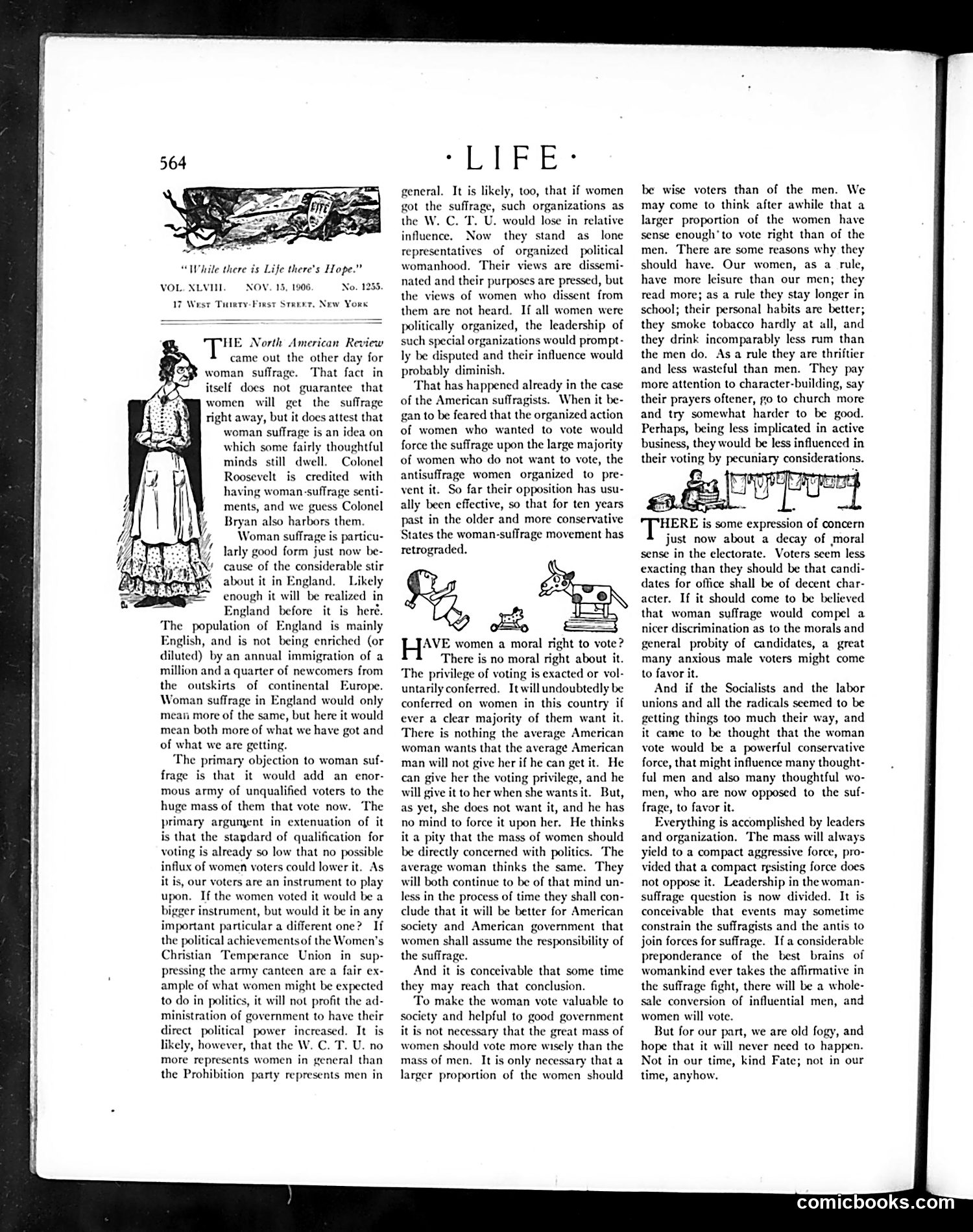
This page from *Life* magazine discusses women's suffrage through text and illustration. The main cartoon depicts a woman in Edwardian dress labeled "While there is Life there's Hope," suggesting optimism about voting rights. The article argues that women deserve the vote and counters anti-suffrage arguments. It addresses concerns that women voters would be an "enormous army of unqualified voters," claiming instead that women are likely more conscientious voters than men. The piece also references the Women's Christian Temperance Union and Socialist movements, suggesting suffrage had broad political support. The satire appears aimed at opponents who feared women's voting power would "diminish" their own political influence, portraying this opposition as self-interested rather than principled.
📄 Transcribed text from this page (OCR, searchable)
Machine-transcribed from the original scan — historical spelling and the odd misread are preserved.
“While there is Life there's Hope.” VOL. XLVHI No. 12: 17 West Tinety-Finst Staeer, New Yor NOV. 15, 1906. HE North American Review came out the other day for woman suffrage. That fact in itself does not guarantee that women will get the suffrage right away, but it does attest that woman suffrage is an idea on which some fairly thoughtful minds still dwell. Colonel Roosevelt is credited with having woman-suffrage senti- ments, and we guess Colonel Bryan also harbors them. Woman suffrage is particu- larly good form just now be- cause of the considerable stir about it in England. Likely enough it will be realized in England before it is heré. The population of England is mainly English, and is not being enriched (or diluted) by an annual immigration of a million and a quarter of newcomers from the outskirts of continental Europe. Woman suffrage in England would only mean more of the same, but here it would mean both more of what we have got and of what we are getting. ‘The primary objection to woman suf frage is that it would add an enor- mous army of unqualified voters to the huge mass of them that vote now. The primary argument in extenuation of it is that the stapdard of qualification for voting is already so low that no possible influx of women voters could lower it. As it is, our voters are an instrument to play upon. If the women voted it would be a bigger instrument, but would it be in any important particular a different one? If the political achievementsof the Women’s Christian Temperance Union in sup- pressing the army canteen are a fair ex- ample of what women might be expected to do in politics, it will not profit the ad- ministration of government to have their direct political power increased. It is likely, however, that the W. C. T. U. no more represents women in general than the Prohibition party represents men in ‘LIFE general. It is likely, too, that if women got the suffrage, such organizations as the W. C. T. U. would lose in relative influence. Now they stand as lone esentatives of organized political anhood. Their views are dissemi- nated and their purposes are pressed, but the views of women who dissent from them are not heard. If all women were politically organized, the leadership of such special organizations would prompt: ly be disputed and their influence would probably diminish. ‘That has happened already in the case of the American suffragists. When it be- gan to be feared that the organized action of women who wanted to vote would force the suffrage upon the large majority of women who do not want to vote, the antisuffrage women organized to pre- vent it. So far their opposition has usu- ally been effective, so that for ten years past in the older and more conservative States the woman-suffrage movement has retrograded. HE women a moral right to vote? There is no moral right about it. The privilege of voting is exacted or vol- untarily conferred. It will undoubtedly be conferred on women in this country if ever a clear majority of them want it. There is nothing the average American woman wants that the average American man will not give her if he can get it. He can give her the voting privilege, and he will give it to her when she wants it. But, as yet, she does not want it, and he has no mind to force it upon her. He thinks it a pity that the mass of women should be directly concerned with politics. The average woman thinks the same. They will both continue to be of that mind un- less in the process of time they shall con- clude that it will be better for American society and American government that women shall assume the responsibility of the suffrage. And it is conceivable that some time they may reach that conclusion. To make the woman vote valuable to society and helpful to good government it is not necessary that the great mass of women should vote more wisely than the mass of men. It is only necessary that a larger proportion of the women should be wise voters than of the men. We may come to think after awhile that a larger proportion of the women have sense enough’ to vote right than of the men. There are some reasons why they should have. Our women, as a rule, have more Icisure than our men; they read more; as a rule they stay longer in school; their personal habits are better; they smoke tobacco hardly at all, and they drink incomparably less ram than the men do. Asa rule they are thriftier and less wasteful than men. They pay more attention to character-building, say their prayers oftener, go to church more and try somewhat harder to be good. Perhaps, being less implicated in active business, they would be less influenced in their voting by pecuniary considerations. just now about a decay of moral sense in the electorate. Voters seem less exacting than they should be that candi- dates for office shall be of decent char- acter. If it should come to be believed that woman suffrage would compel a nicer discrimination as to the morals and general probity of candidates, a great many anxious male voters might come to favor it. And if the Socialists and the labor unions and all the radicals seemed to be getting things too much their way, and it came to be thought that the woman vote would be a powerful conservative force, that might influence many thought- ful men and also many thoughtful wo- men, who are now opposed to the suf- frage, to favor it. Everything is accomplished by leaders and organization. The mass will always yield to a compact aggressive force, pro- vided that a compact resisting force does not oppose it. Leadership in the woman- suffrage question is now divided. It is conceivable that events may sometime constrain the suffragists and the antis to join forces for suffrage. If a considerable preponderance of the best brains of womankind ever takes the affirmative in the suffrage fight, there will be a whole- sale conversion of influential men, and women will vote. But for our part, we are old fogy, and hope that it will never need to happen. Not in our time, kind Fate; not in our time, anyhow. comicbooks.com