
Life, 1906-11-15 · page 16 of 36
Life — November 15, 1906 — page 16: what you’re looking at
What you’re looking at
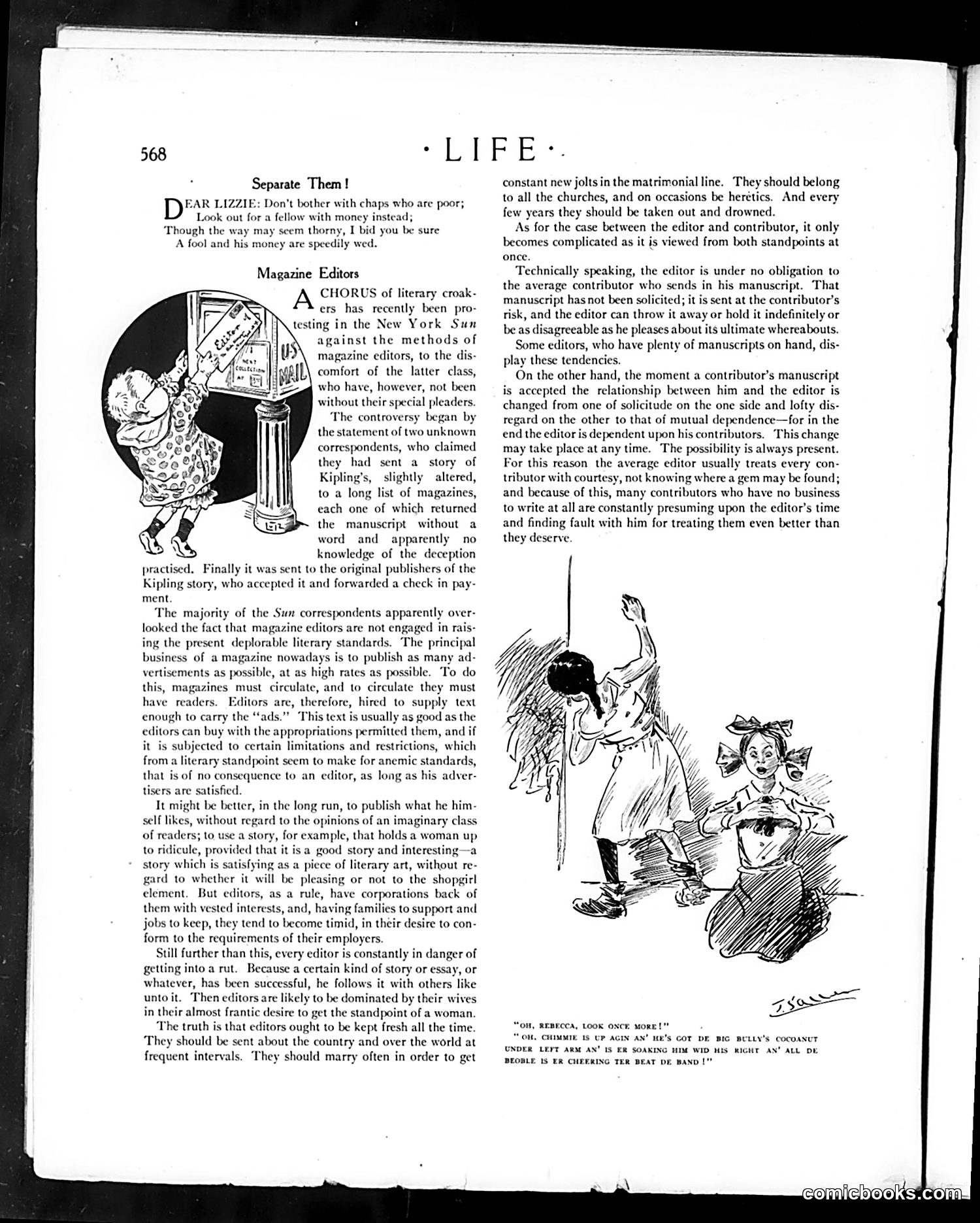
This page contains two satirical pieces about literary gatekeepers in early 20th-century America. **"Separate Them!"** is a brief cautionary verse warning women against marrying poor men, ending with the maxim "A fool and his money are speedily wed"—satirizing both the mercenary attitudes of the era and naive assumptions about wealth. **"Magazine Editors"** is the main article, illustrated with a cartoon of an editor overwhelmed by manuscripts. It discusses a contemporary scandal: two unknown writers submitted a slightly altered Rudyard Kipling story to multiple magazines; all rejected it without comment. When sent to Kipling's actual publisher, it was accepted. The article's satire cuts both ways: it mocks literary critics complaining about declining magazine standards while exposing editors' actual priorities—publishers cared primarily about carrying advertisements profitably, not literary merit. Editors hired to fill space between ads faced pressure from corporate employers and timid sensibilities. The piece concludes provocatively that editors should travel constantly, change churches, and "every few years...be taken out and drowned" to stay fresh-minded.
📄 Transcribed text from this page (OCR, searchable)
Machine-transcribed from the original scan — historical spelling and the odd misread are preserved.
Separate Them ! D : Don't bother with chaps who are poor; Look out for a fellow with money instead; ‘Though the way may seem thorny, I bid you be sure A fool and his money are speedily wed. 568 AR LI Magazine Editors CHORUS of literary croak- ers has recently been pro- testing in the New York Sun against the methods of magazine editors, to the di comfort of the latter class, who have, however, not been without their special pleaders. The controversy began by the statement of two unknown correspondents, who claimed they had sent a story of Kipling’s, slightly altered, to a long list of magazines, each one of which returned the manuscript without a word and apparently no knowledge of the deception pra : ally it was sent to the original publishers of the Kipling story, who accepted it and forwarded a check in pay- ment The majority of the Sun correspondents apparently over- looked the fact that magazine editors are not engaged in rais- ing the present deplorable literary standards. The principal business of a magazine nowadays is to publish as many ad- vertisements as possible, at as high rates as possible. ‘To do this, magazines must circulate, and to circulate they must have readers. Editors are, therefore, hired to supply text enough to carry the “ads.”” This text is usually as good as the editors can buy with the appropriations permitted them, and if it is subjected to certain limitations and restrictions, which from a literary standpoint seem to make for anemic standards, that is of no consequence to an editor, as long as his adver- tisers are satisfied. It might be better, in the long run, to publish what he him- self likes, without regard to the opinions of an imaginary class of readers; to use a story, for example, that holds a woman up to ridicule, provided that it isa good story and interesting—a story which is satisfying as a piece of literary art, without re gard to whether it will be pleasing or not to the shopgirl clement. But editors, as a rule, have corporations back of them with vested interests, and, having families to support and jobs to keep, they tend to become timid, in their desire to con- form to the requirements of their employers. till further than this, every editor is constantly in danger of getting into a rut. Because a certain kind of story or essay, or whatever, has been successful, he follow: with others like unto it. Then editors are likely to be dominated by their wives in their almost frantic desire to get the standpoint of a woman. ¢ truth is that editors ought to be kept fresh all the time. should be sent about the country and over the world at frequent intervals. They should marry often in order to get « LPF'E *- constant new jolts in the matrimonial line. They should belong to all the churches, and on occasions be heretics. And every few years they should be taken out and drowned. As for the case between the editor and contributor, it only becomes complicated as it is viewed from both standpoints at once. Technically speaking, the editor is under no obligation to the average contributor who sends in his manuscript. That manuscript has not been solicited; it is sent at the contributor’s risk, and the editor can throw it away or hold it indefinitely or be as disagreeable as he pleases about its ultimate whereabouts. Some editors, who have plenty of manuscripts on hand, dis- play these tendencies. On the other hand, the moment a contributor’s manuscript is accepted the relationship between him and the editor is changed from one of solicitude on the one side and lofty dis- regard on the other to that of mutual dependence—for in the end the editor is dependent upon his contributors. This change may take place at any time. The possibility is always present. For this reason the average editor usually treats every con- tributor with courtesy, not knowing where a gem may be found; and because of this, many contributors who have no business to write at all are constantly presuming upon the editor’s time and finding fault with him for treating them even better than they deserve. “oll, REBECCA, LOOK ONCE MORE!" “OM, CHIMMIE 15 UP AGIN AN! Itk'S COT DE BIG BULLY'S COcOANUT UNDER LEFT ARM AN’ 1S ER SOAKING HIM WID MIS RIGHT AN’ ALL DE BEOBLE 1S ER CHEERING TER BEAT DE BAND!”