
Life, 1906-11-15 · page 20 of 36
Life — November 15, 1906 — page 20: what you’re looking at
What you’re looking at
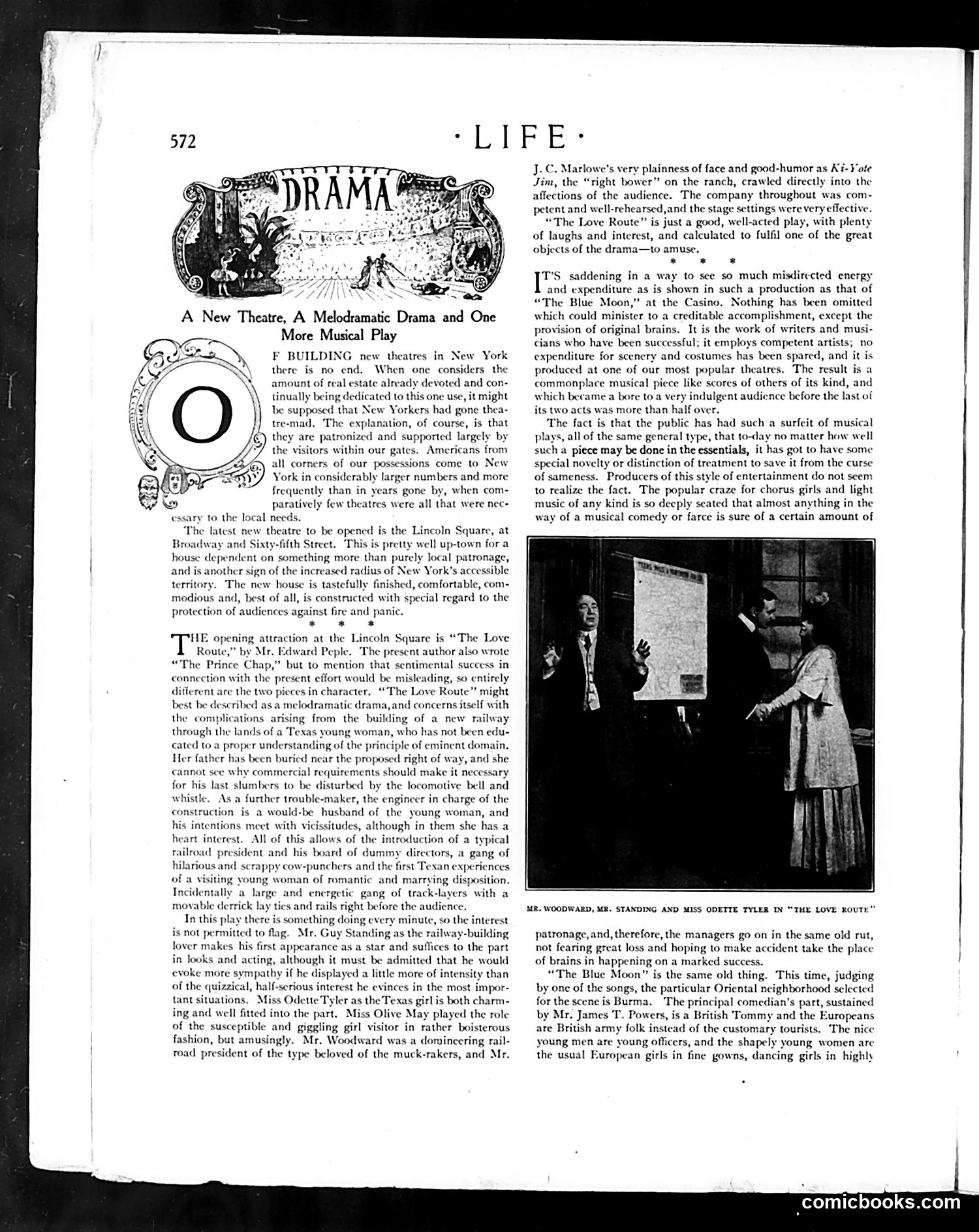
This is a theater review page, not a political cartoon. The single photograph shows actors from the Lincoln Square Theatre's opening production, "The Love Route," by Edward Peple—a melodramatic play about a Texas woman resisting railroad construction through her father's burial ground. The review discusses New York's theater-building boom, attributing it to tourism rather than local demand. "The Love Route" features a railroad engineer (played by Guy Standing) courting the resistant heroine, plus stock characters: a corrupt railroad president (Mr. Woodward), comic cowboys, and a visiting Eastern woman. The critic praises the competent cast and stage effects, particularly noting Ki-Yote Jim (J.C. Marlowe) as an audience favorite. The performance included actual track-laying equipment on stage—a notable technical feature for the era.
📄 Transcribed text from this page (OCR, searchable)
Machine-transcribed from the original scan — historical spelling and the odd misread are preserved.
* LIP E@ A New Theatre, A Melodramatic Drama and One More Musical Play F BUILDING new theatres in New York there is no end, When one considers the amount of real estate already devoted and con- inually being dedicated to this one use, it might be supposed that New Yorkers had gone thi tre-mad, ‘The explanation, of course, is t they are patronized and supported largely by the visitors within our gates. Americans from all corners of our possessions come to New ger numbers and more frequently than in years gone by, when com- paratively few theatres were all that were nec= essary to the local needs. The latest new theatre to be opened is the Lincoln Square, at Broadway and Sixty-fifth Street. This is pretty well up-town for a house dependent on something more than purely local patronage, and is another sign of the increased radius of New York’s accessible territory, The new house is tastefully finished, comfortable, com- modious and, best of all, is constructed with special regard to the protection of audiences against fire and panic. + * 8 HE opening attraction at the Lincoln Square is “The Love Route,” by Mr. Edward Peple. The present author also wrote “The Prince Chap,” but to mention that sentimental success in connection with the present effort would be misleading, so entirely different are the two pieces in character, “The Love Route” might best be described as a melodramatic drama, and concerns itself with the complications arising from the building of a new railway through the lands of a Texas young woman, who has not been edu- cated to a proper understanding of the principle of eminent domain, Her father has been buried near the proposed right of way, and she not sce why commercial requirements should make it necessary for his last slumbers to be disturbed by the locomotive bell and whistle. Asa further trouble-maker, the engineer in charge of the construction is a would-be husband of the young woman, and his intentions mect with vicissitudes, although in them she has a heart interest. All of this allows of the introduction of a typi railroad president and his board of dummy directors, a gang of hilarious and scrappy cow-punchers and the first Texan experiences of a visiting young woman of romantic and marrying dispos Incidentally a large and energetic gang of track-layers with a movable derrick lay tics and rails right before the audience. In this play there is something doing every minute, so the interest is not permitted to flag. Mr. Guy Standing as the railway-building lover makes his first appearance as a star and suffices to the part in looks and acting, although it must be admitted that he would evoke more sympathy if he displayed a little more of intensity than of the quizzical, half-serious interest he evinces in the most impor- tant situations, Miss OdetteTyler as the Texas girl is both charm- ing and well fitted into the part. Miss Olive May played the role of the susceptible and giggling girl visitor in rather boisterous fashion, but amusingly. Mr. Woodward was a dorgincering rai road president of the type beloved of the muck-rakers, and Mr. J.C. Marlowe's very plainness of face and good-humor as Ki-Yote Jim, the “right bower” on the ranch, crawled directly into the affections of the audience. The company throughout was com- petent and well-rehearsed,and the stage settings were very effective. “The Love Route” is just a good, well-acted play, with plenty of laughs and interest, and calculated to fulfil one of the great objects of the drama—to amuse. * 8 # T'S saddening in a way to see so much misdirected energy and expenditure as is shown in such a production as that of “The Blue Moon,” at the Casino. Nothing has been omitted which could minister to a creditable accomplishment, except the provision of original brains. It is the work of writers and musi- cians who have been successful; it employs competent artists; no expenditure for scenery and costumes has been spared, and it is produced at one of our most popular theatres. The result is a commonplace musical piece like scores of others of its kind, and which became a bore toa very indulgent audience before the last of its two acts was more than half over. ‘The fact is that the public has had such a surfeit of musical plays, all of the same general type, that to-day no matter how well such a piece may be done in the essentials, it has got to have some special novelty or distinction of treatment to save it from the curse of sameness. Producers of this style of entertainment do not seem to realize the fact. The popular craze for chorus girls and light music of any kind is so deeply seated that almost anything in the way of a musical comedy or farce is sure of a certain amount of MR. WOODWARD, MR. STANDING AND MISS ODETTE TYLER IN “THE LOVE ROUTE” patronage, and, therefore, the managers go on in the same old rut, not fearing great loss and hoping to make accident take the place of brains in happening on a marked success. “The Bluc Moon" is the same old thing. ‘This time, judging by one of the songs, the particular Oriental neighborhood selected for the scene is Burma. ‘The principal comedian’s part, sustained by Mr. James T. Powers, is a British Tommy and the Europeans are British army folk instead of the customary tourists. ‘The nice young men are young officers, and the shapely young women are the usual European girls in fine gowns, dancing girls in highly comicbooks.com