
Life, 1906-11-15 · page 22 of 36
Life — November 15, 1906 — page 22: what you’re looking at
What you’re looking at
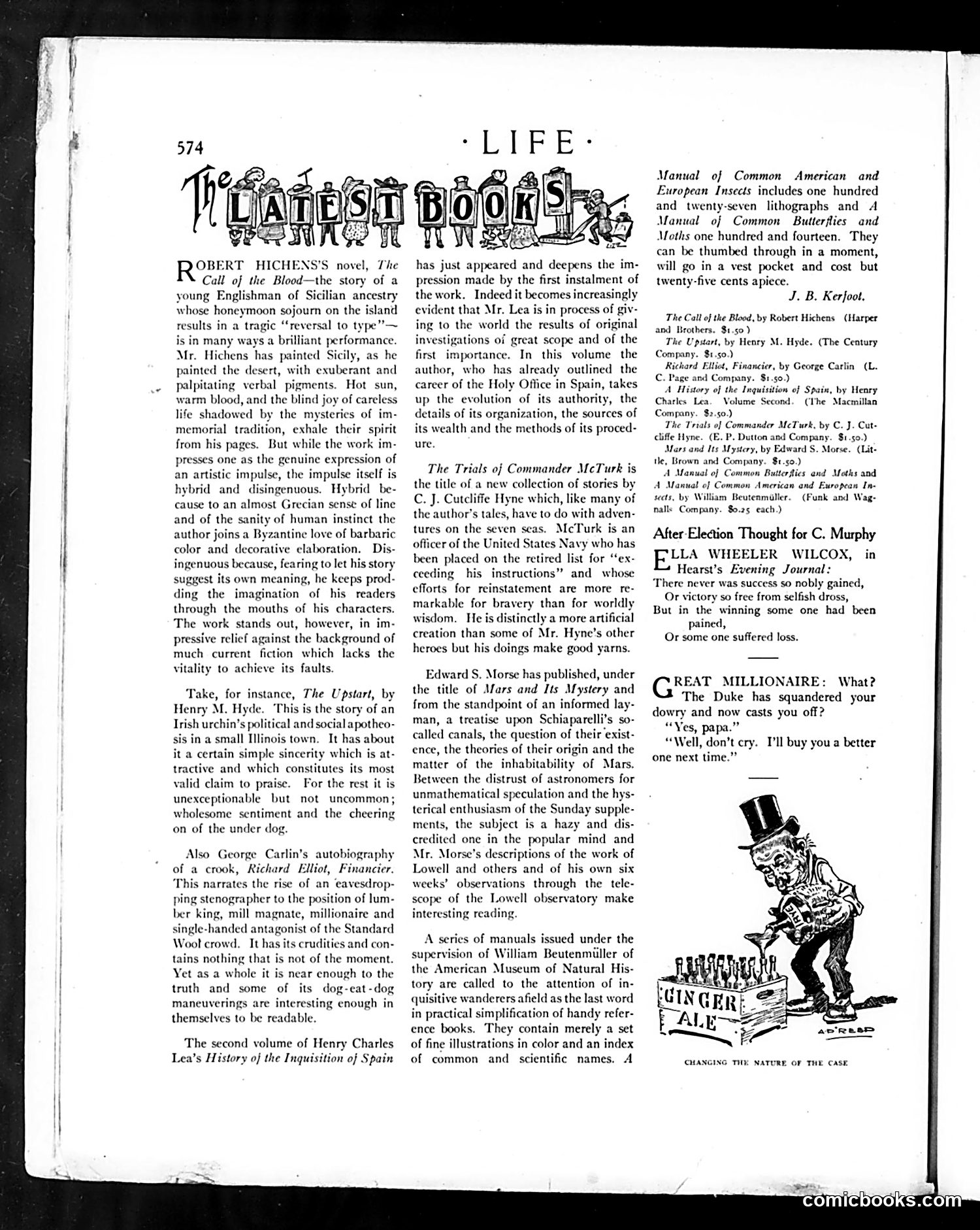
This page is primarily a **book review section** from Life magazine, not a political cartoon page. The main content critiques several contemporary novels and works of non-fiction. The only illustration present is a small cartoon in the lower right corner captioned "CHANGING THE NATURE OF THE CASE." It depicts a caricatured figure (appears to be a wealthy man in a top hat) standing over a chessboard labeled "GINGER ALE," suggesting a joke about business or commerce, though the specific reference is unclear from the image alone. The book reviews discuss works by Robert Hichens, Henry M. Hyde, George Carlin, and others—standard literary criticism of the era. There is **no significant political satire or social commentary** on this particular page; it functions as a cultural review section typical of Life magazine's content during this period.
📄 Transcribed text from this page (OCR, searchable)
Machine-transcribed from the original scan — historical spelling and the odd misread are preserved.
OBERT HICH S novel, The Call of the Blood—the story of a young Englishman of Sicilian ancestry whose honeymoon sojourn on the island results in a tragic ‘“revers: s in many ways a brilliant performance. Mr. Hichens has painted Sicily, as he painted the desert, with exuberant and palpitating verbal pigments. Hot sun, warm blood, and the blind joy of careless life shadowed by the mysteries of im- memorial tradition, exhale their spirit from his pages. But while the work im- presses one as the genuine expression of an artistic impulse, the impulse itself is hybrid and disingenuous. Hybrid be- cause to an almost Grecian of line and of the sanity of human instinct the author joins a Byzantine love of barbaric color and decorative elaboration. Di ingenuous because, fearing to let his story suggest its own meaning, he keeps prod- ding the imagination of his readers through the mouths of his characters. The work stands out, however, in im- pressive relief against the background of much current fiction which lacks the vitality to achieve its faults. Take, for instance, The Upstart, by Henry M. Hyde. ‘This is the story of an Irish urchin’s political and social apotheo- sis in a small Illinois town. It has about it a certain simple sincerity which is at- tractive and which constitutes its mo: alid claim to praise. For the rest it is unexceptionable but not uncommon; wholesome sentiment and the cheeri on of the under dog. Also George Carlin’ of a crool ‘This narrates the rise of an ‘cavesdrop- ping stenographer to the position of lum- ber king, mill magnate, millionaire and single-handed antagonist of the Standard Woot crowd. It has its crudities and con- tains nothing that is not of the moment. Yet as a whole it is near enough to the truth and some of its dog-eat-dog maneuverings are interesting enough in themselves to be readable. The second volume of Henry Charles Lea’s History oj the Inquisition of Spain has just appeared and deepens the im- pression made by the first instalment of the work. Indeed it becomes increasingly evident that Mr. Lea is in process of giv- ing to the world the results of original investigations of great scope and of the first importance. In this volume the author, who has already outlined the career of the Holy Office in Spain, takes up the evolution of its authority, the details of its organization, the sources of its wealth and the methods of its proced- ure. The Trials of Commander McTurk is the title of a new collection of stories by C. J. Cutcliffe Hyne which, like many of the author’s tales, have to do with adven- tures on the seven seas. McTurk is an officer of the United States Navy who has been placed on the retired ceeding his instructions” and whose efforts for reinstatement are more re- markable for bravery than for worldly Jom. He is distinctly a more artificial creation than some of Mr. Hyne’s other heroes but his doings make good yarns. Edward S. Morse has published, under the title of Mars and Its Mystery and from the standpoint of an informed lay- man, a treatise upon Schiaparelli’s so- called canals, the question of their exist- ence, the theories of their origin and the matter of the inhabitability of Mars. Between the distrust of astronomers for unmathematical speculation and the hys- terical enthusiasm of the Sunday supple- ments, the subject is a hazy and dis- credited one in the popular mind and Mr. Morse’s descriptions of the work of Lowell and others and of his own six weeks’ observations through the tele- scope of the Lowell observatory make interesting reading. A series of manuals issued under the supervision of William Beutenmiiller of the American Museum of Natural His- tory are called to the attention of in- quisitive wanderers afield as the last word in practical simplification of handy refer- ence books. They contain merely a set of fine illustrations in color and an index of common and_ scientific names. A Manual of Common American and European Insects includes one hundred and twenty-seven lithographs and A Manual of Common Butterflies and Moths one hundred and fourteen. They can be thumbed through in a moment, will go in a vest pocket and cost but twenty-five cents apiece. J. B. Kerfoot. The Call of the Blood, by Robert Hichens (Harper and Brothers. $1.50) The Upstart, by Henry M. Hyde. (The Century Company. $1.50.) Richard Elliot, Financier, by George Catlin (L. C. Page and Company. $1.50.) A History of the Inquisition of Spain, by Henry Charles Lea. Volume Second. (The Macmillan Company. $2.50.) The Trials of Commander MeTurk, by C. J. Cute cliffe Hyne. (E. P. Dutton and Company. $1.50.) Mars and Its Mystery, by Edward S. Morse. (Lit- tle, Brown and Company. $1.50.) A Manuel of Common Butterflies and Moths and 4 Manual of Common American and European In- sects, by William Beutenmiller. (Funk and Wag- nalls Company. $0.25 each.) After Election Thought for C. Murphy LLA WHEELER WILCOX, in Hearst’s Evening Journal: There never was success so nobly gained, Or victory so free from selfish dross, But in the winning some one had been pained, Or some one suffered loss. REAT MILLIONAIRE: What? The Duke has squandered your dowry and now casts you off? “Yes, papa.” “Well, don’t cry. I’ll buy you a better one next time.” QUANGING THN: NATURE OF THE CASE