
Life, 1906-11-15 · page 17 of 36
Life — November 15, 1906 — page 17: what you’re looking at
What you’re looking at
This story satirizes a parasitic husband who marries a wealthy woman, then uses elaborate rationalizations to avoid work or contributing to the household. Callington justifies idleness by appealing to his "gentlemanly nature" and refined sensibilities—claims that mask pure indolence. The satire works through escalating absurdity: each time his wife suggests he do *something* (enter business, manage her affairs, join clubs), he offers increasingly ridiculous excuses about why her proposals are actually *better* for both of them. His reasoned-sounding arguments grow progressively transparent as manipulation. The punchline exposes the con: after months of this, his wife sues for divorce on grounds of nonsupport. Callington—genuinely bewildered—protests he's been "too good a husband," missing entirely that doing nothing *is* the problem. The joke reflects early 20th-century anxieties about masculine idleness and financial dependence in marriage, likely targeting wealthy men of leisure who avoided productive work through philosophical pretense.
📄 Transcribed text from this page (OCR, searchable)
Machine-transcribed from the original scan — historical spelling and the odd misread are preserved.
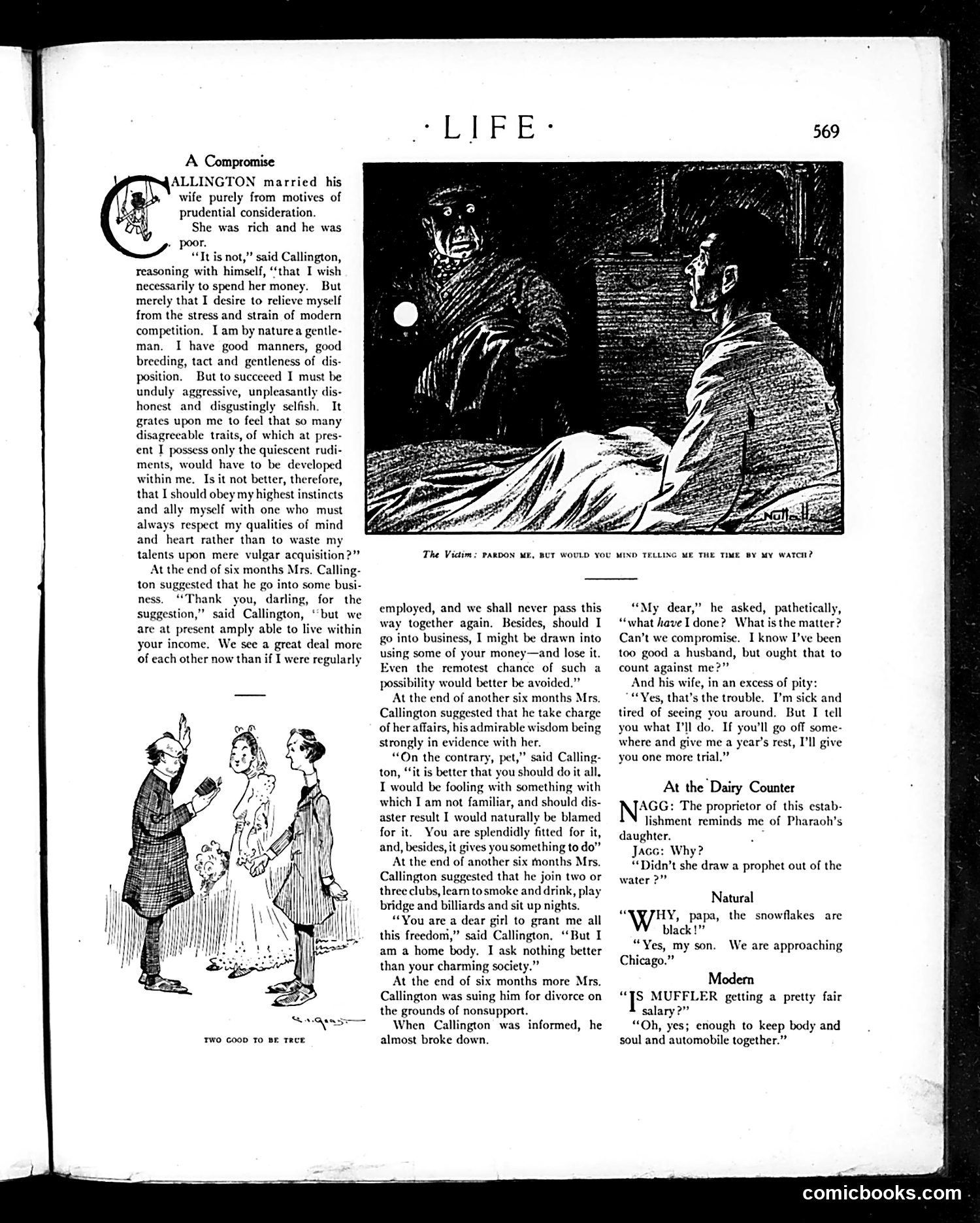
A Compromise ALLINGTON married his wife purely from motives of prudential consideration. She was rich and he was poor. “It is not,” said Callington, reasoning with himself, ‘that I wish necessarily to spend her money. But merely that I desire to relieve myself from the stress and strain of modern competition. I am by nature a gentle- man. I have good manners, good breeding, tact and gentleness of dis- position, But to succeeed I must be unduly aggressive, unpleasantly dis- honest and disgustingly selfish. It grates upon me to feel that so many disagreeable traits, of which at pres- ent I possess only the quiescent rudi- ments, would have to be developed within me. Is it not better, therefore, that I should obey my highest instincts and ally myself with one who must always respect my qualities of mind and heart rather than to waste my talents upon mere vulgar acquisition?” At the end of six months Mrs. Calling- ton suggested that he go into some busi- ness. “Thank you, darling, for the suggestion,” said Callington, “but we are at present amply able to live within your income. We see a great deal more of each other now than if I were regularly Two GooD To BE TREE The Victim: PARDON ME, BUT WOULD YOU MIND TELLING ME THE TIME BY MY WATCH? employed, and we shall never pass this way together again. Besides, should I go into business, I might be drawn into using some of your money—and lose it. Even the remotest chance of such a possibility would better be avoided.” At the end of another six months Mrs. Callington suggested that he take charge of her affairs, his admirable wisdom being strongly in evidence with her. “On the contrary, pet,” said Calling- ton, “‘it is better that you should do it all, I would be fooling with something with which I am not familiar, and should dis- aster result I would naturally be blamed for it. You are splendidly fitted for it, and, besides, it gives yousomething to do” At the end of another six months Mrs. Callington suggested that he join two or three clubs, learn tosmoke and drink, play bridge and billiards and sit up nights. “You are a dear girl to grant me all this freedom,” said Callington, “But I am a home body. I ask nothing better than your charming society.” At the end of six months more Mrs. Callington was suing him for divorce on the grounds of nonsupport. When Callington was informed, he almost broke down. “My dear,” he asked, pathetically, “what have I done? What is the matter? Can’t we compromise. I know I’ve been too good a husband, but ought that to count against me?” And his wife, in an excess of pity “Yes, that’s the trouble. I’m sick and tired of seeing you around. But I tell you what I'll do. If you'll go off some- where and give me a year’s rest, I'll give you one more trial.” At the Dairy Counter NAGE: The proprietor of this estab- lishment reminds me of Pharaoh’s daughter. Jace: Why? “Didn't she draw a prophet out of the water ?”” Natural “VYVHY, paps, the snowflakes are black!” “Yes, my son. Chicago.” We are approaching Modem i MUFFLER getting a pretty fair salary?” “Oh, yes; enough to keep body and soul and automobile together.” comicbooks.com