
A complete issue · 48 pages · 1906
Life — February 1, 1906
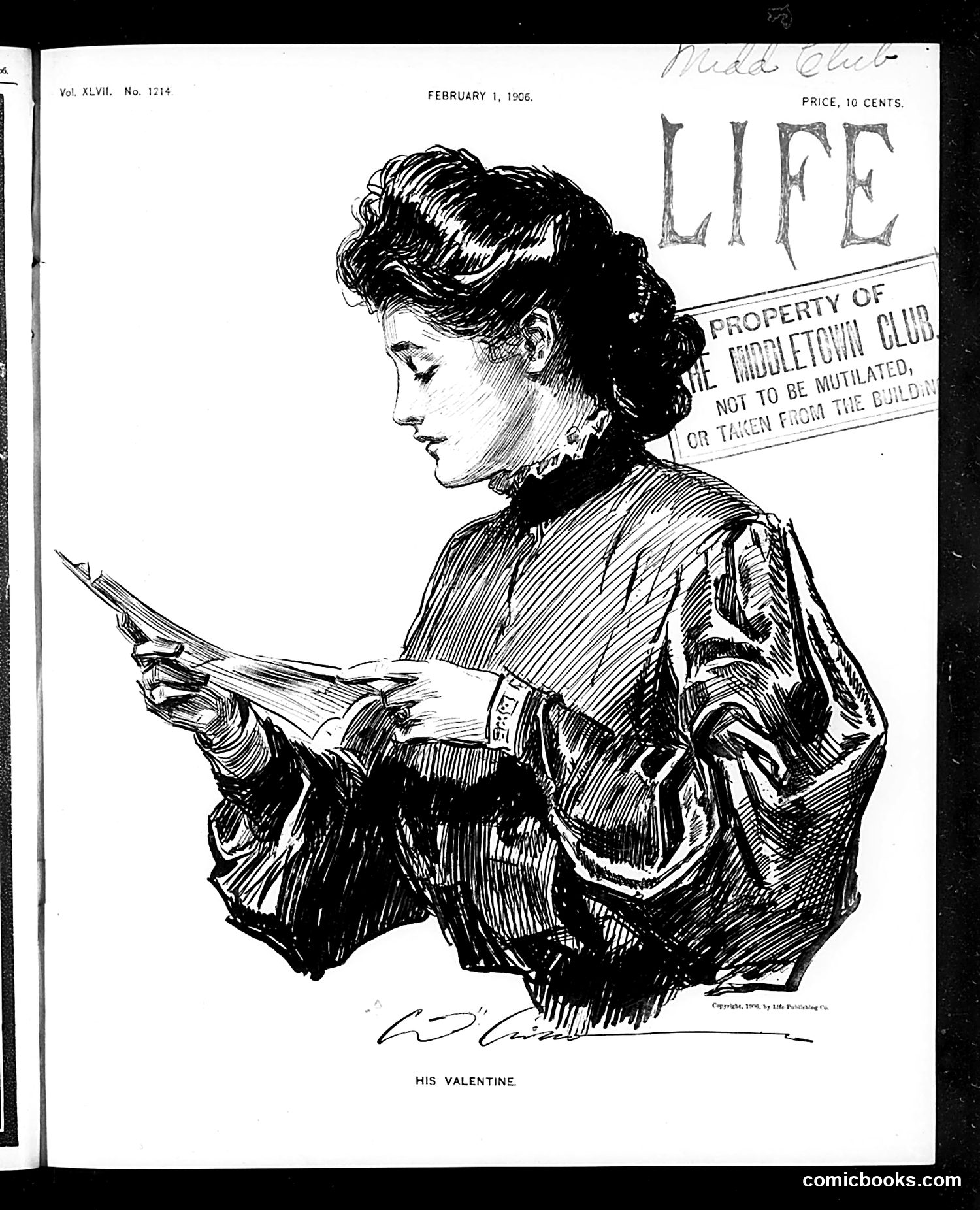
This is a cover illustration showing an elegantly dressed woman in profile, reading what appears to be a letter or valentine. The drawing style is characteristic of early-1900s magazine illustration, executed in pen and ink with careful cross-hatching. The title "His Valentine" suggests a romantic theme appropriate for the February publication date. The woman's refined clothing, elaborate hairstyle, and composed demeanor suggest she represents an idealized feminine figure of the Edwardian era. Without additional context about contemporary events or personalities from 1906, the specific satirical intent remains unclear. The image may be satirizing romantic conventions, feminine propriety, or a particular social figure of the period, but the particular target is not evident from the image alone.
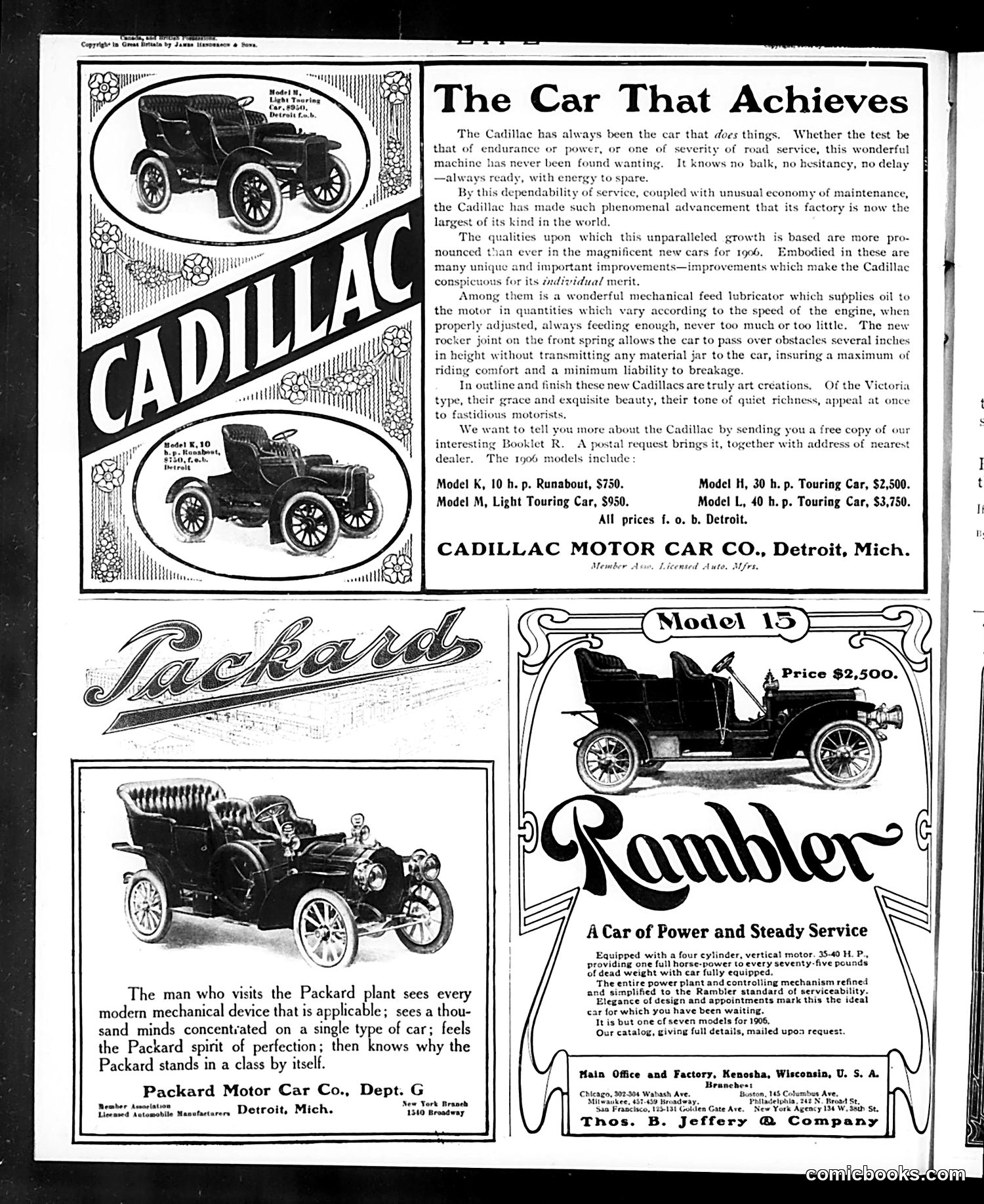
This page contains **automobile advertisements, not political cartoons or satire**. It features four separate ads for early 1900s motor cars: 1. **Cadillac** — emphasizes reliability, economy of maintenance, and mechanical innovations 2. **Packard** — highlights precision manufacturing and engineering excellence 3. **Rambler** — advertises a four-cylinder vehicle as practical and dependable The ads use period-typical marketing language comparing cars favorably to competitors, but they're straightforward commercial promotions rather than satirical content. The page reflects the competitive early automotive industry, with manufacturers stressing quality, power, and service to appeal to wealthy buyers. No political references or social commentary appears present.
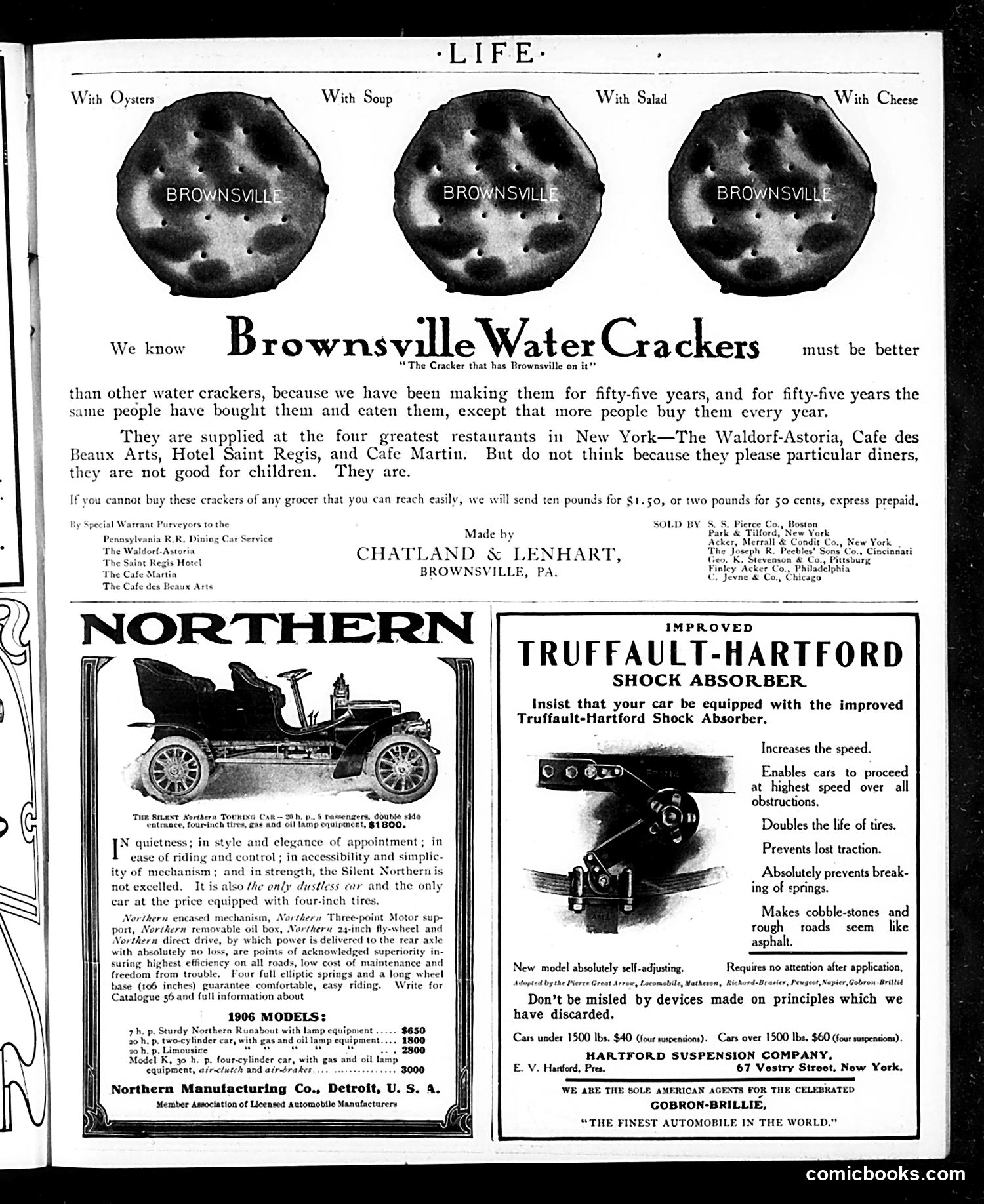
This page is **primarily advertising**, not satire or political commentary. It contains three distinct product advertisements: 1. **Brownsville Water Crackers** — A food product advertisement emphasizing 55 years of production and availability at New York's finest restaurants. The four circular images show the cracker with different accompaniments (oysters, soup, salad, cheese). 2. **Northern Silent Touring Car** — An automobile advertisement for a 1906 model vehicle, emphasizing quiet operation, mechanical reliability, and affordability ($650-$3000 depending on configuration). 3. **Truffault-Hartford Shock Absorber** — An automobile accessory advertisement claiming improvements to speed, tire life, and road comfort. There is no political satire or social commentary present. This represents typical early-20th-century Life magazine content mixing advertisements with editorial matter.
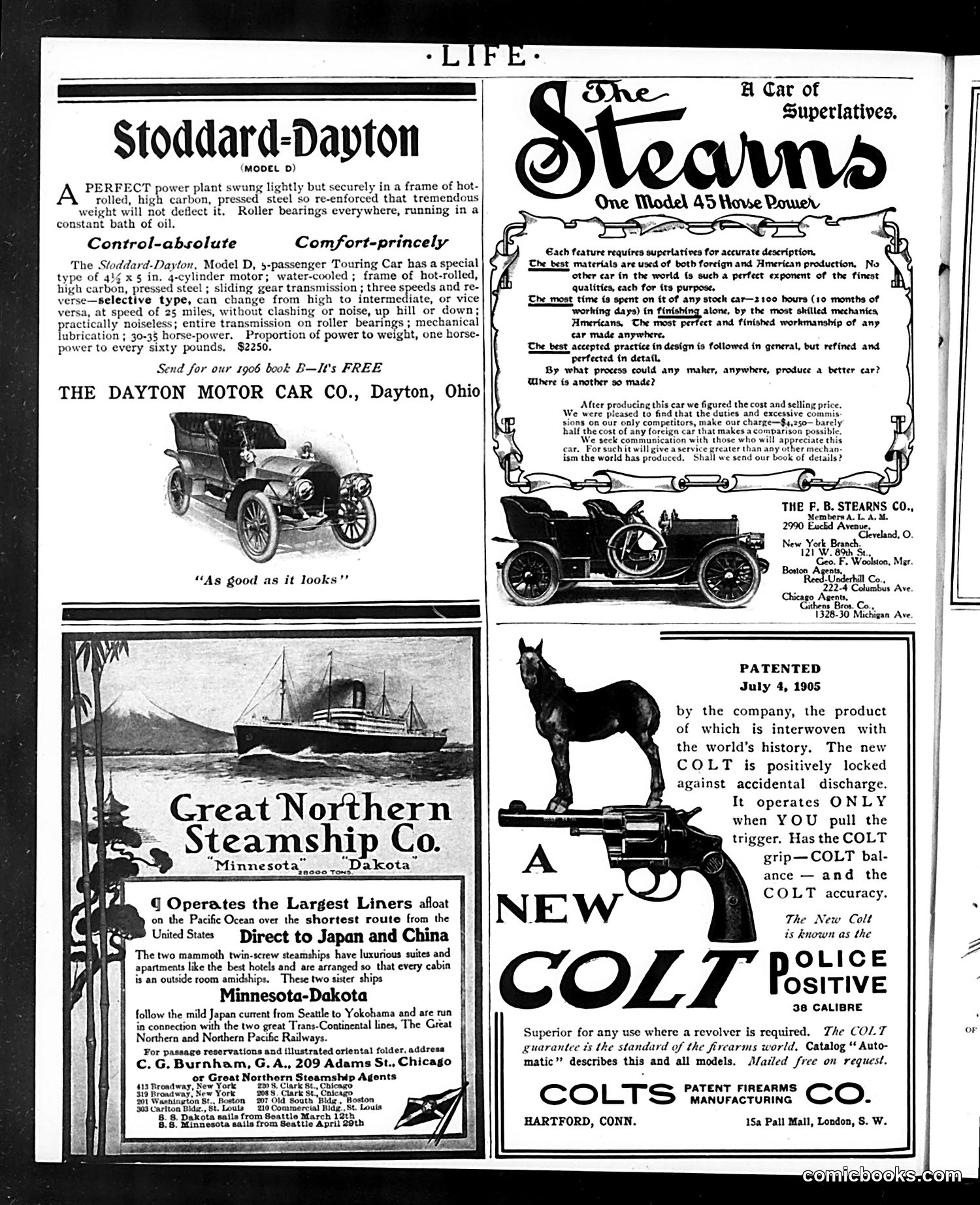
This page is **primarily advertising**, not political satire. It contains four product advertisements from circa 1906: 1. **Stoddard-Dayton automobile** - promoting a Model D touring car with technical specifications 2. **The Stearns automobile** - a 45-horsepower car emphasizing superior engineering and manufacturing quality 3. **Great Northern Steamship Company** - advertising luxury liner service between Minnesota/Dakota and Japan/China 4. **Colt Police Positive revolver** - promoting a new .38 caliber handgun patented July 4, 1905, emphasizing safety features There are **no political cartoons or satirical commentary** on this particular page. The content reflects early 20th-century consumer goods marketing, showing the era's focus on industrial innovation and expanding transportation options.
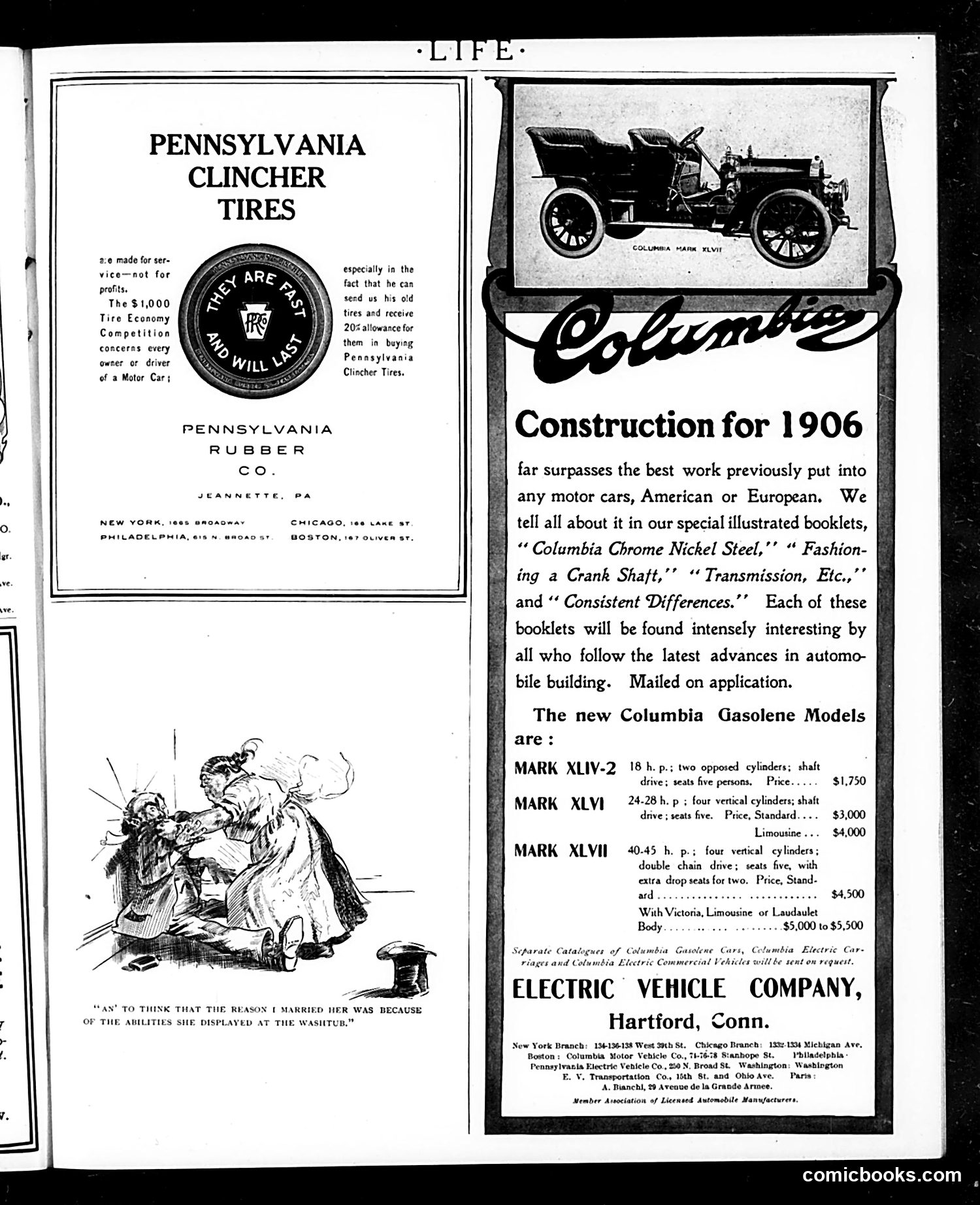
This page is primarily **advertising**, not political satire. The left side advertises Pennsylvania Clincher Tires and Pennsylvania Rubber Company (Jeannette, PA), emphasizing tire durability and economy for motorists. The right side features a Columbia automobile advertisement for 1906 models, highlighting advanced construction. The accompanying illustration shows a vintage motorcar. Below the tire ad is a **cartoon** depicting a woman in period dress with a man, captioned: "An' to think that the reason I married her was because of the abilities she displayed at the wash tub." This is straightforward domestic humor—a husband sardonically reflecting that his wife's laundry skills have apparently not translated to other household competencies. It's typical early-1900s gender-role satire with no broader political significance.
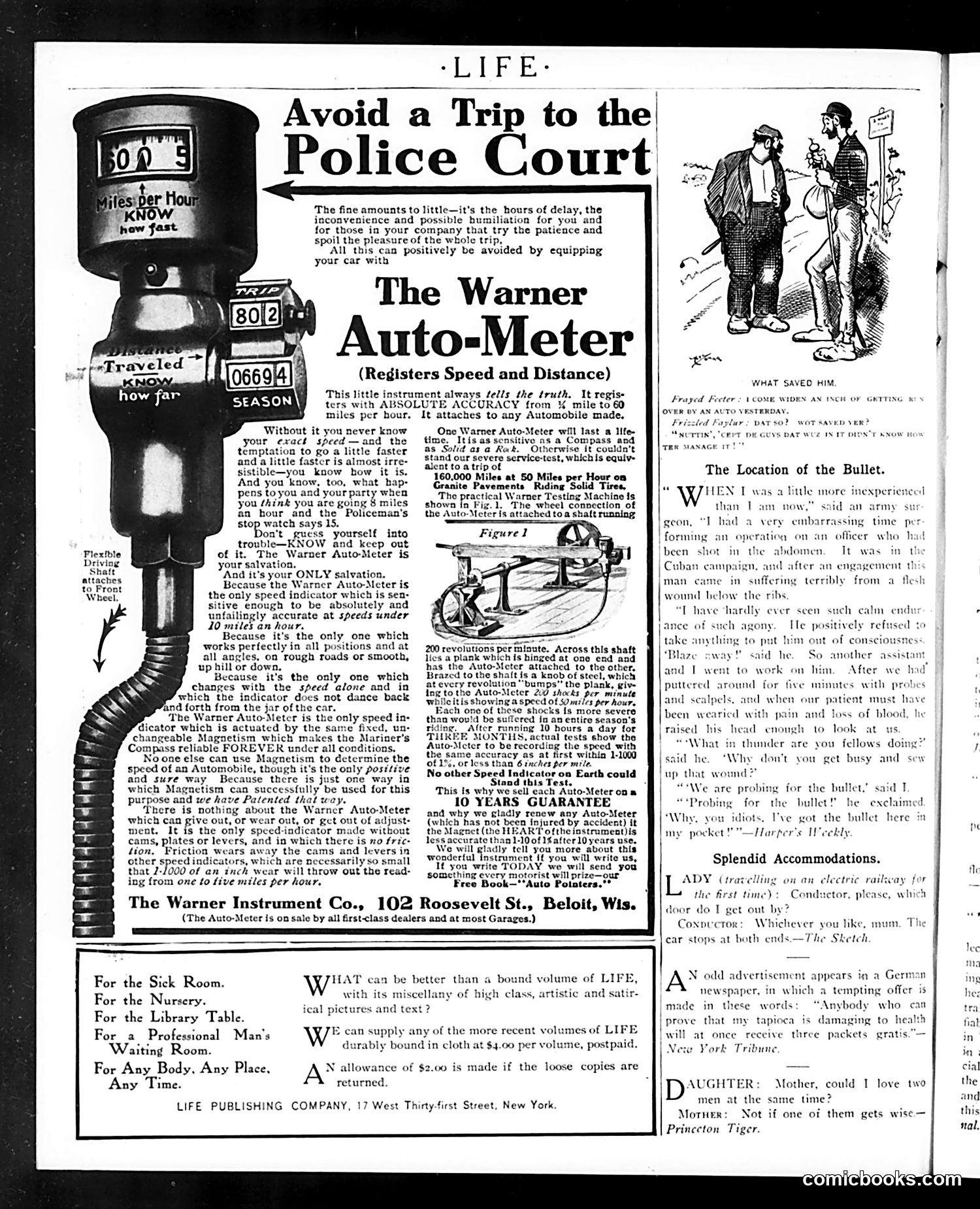
This page is primarily **advertising**, not satire. The dominant feature is a large advertisement for the "Warner Auto-Meter," a speedometer device designed to help drivers avoid traffic violations and police court appearances. The cartoon in the upper right shows two men—one appearing to be a police officer—with the caption "What Saved Him," illustrating the product's purpose: preventing speeding tickets. The text emphasizes that the device "always tells the truth" about speed and distance traveled. The remaining content includes unrelated humor pieces and advertisements for Life magazine volumes. The page reflects early automotive-era concerns about traffic enforcement and the appeal of technology to help drivers stay within legal speed limits—a relevant issue as automobile use expanded in America.
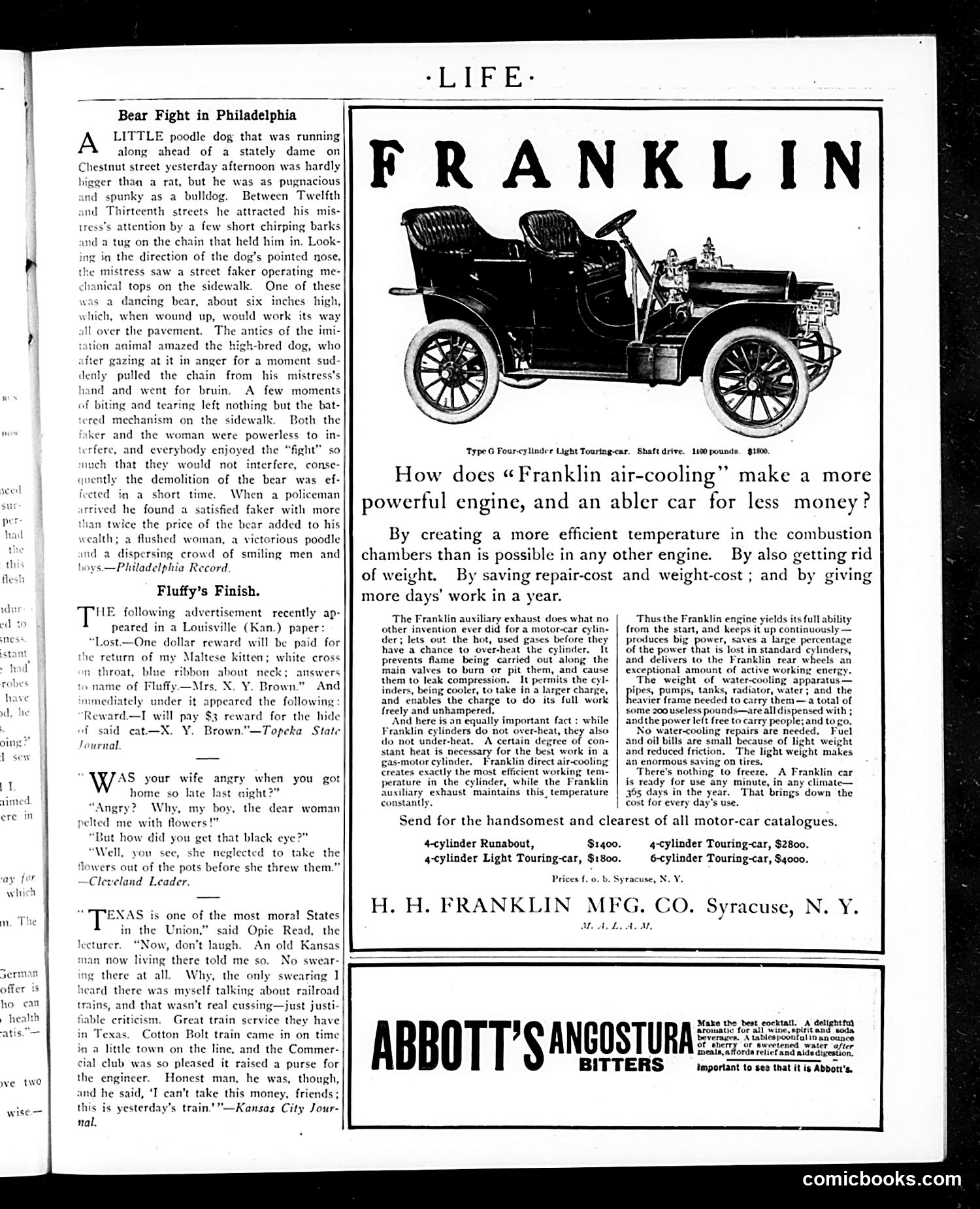
This page is primarily **advertising content** rather than satirical cartoons. The dominant feature is a large Franklin automobile advertisement showcasing a Type 0 Four-cylinder Light Touring-car. The ad emphasizes the car's "air-cooling" technology as superior to water-cooling, claiming it produces a more powerful engine at lower cost. The left column contains three brief humorous anecdotes—"Bear Fight in Philadelphia," "Fluffy's Finish," and a Texas morality tale—typical of Life's light humor section. The bottom features an Abbott's Angostura Bitters advertisement. This appears to be a standard early 20th-century magazine page mixing editorial humor with automotive and beverage advertising, with no significant political satire evident.
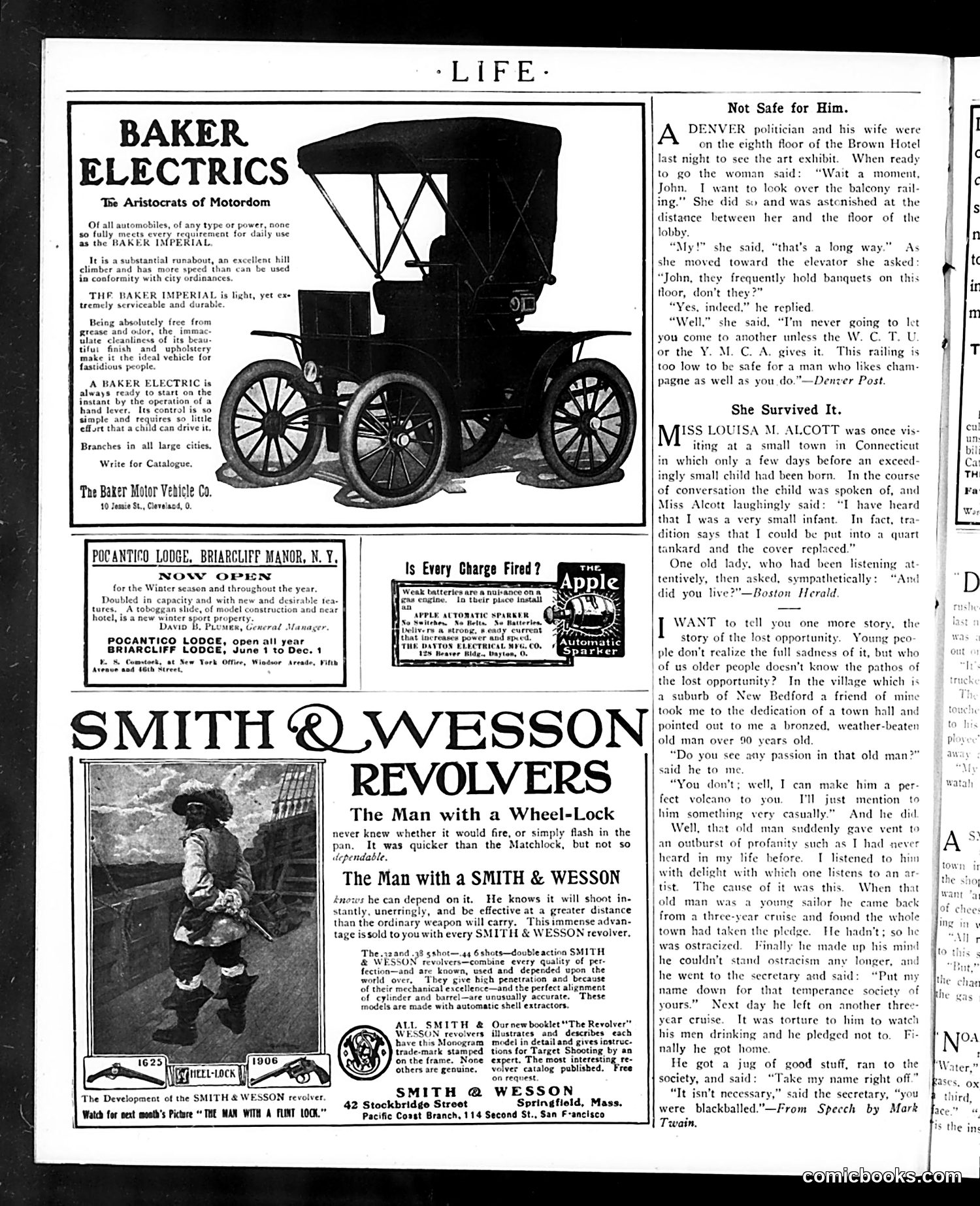
This page is primarily **advertisements and short stories**, not political satire. The ads feature: - **Baker Electrics**: Early automobiles marketed as reliable, easy-to-operate vehicles for wealthy buyers - **Smith & Wesson Revolvers**: Firearms advertising emphasizing reliability and accuracy - **Focantico Lodge**: A vacation resort The text sections include three brief anecdotes: - "Not Safe for Him": A hotel lobby story about social climbing and etiquette - "She Survived It": A humorous tale about a woman's exaggerated concern over a child's small size - "I Want to Tell You One More Story": An elderly man's account of meeting a reformed sailor These are light, moralistic humor pieces typical of *Life* magazine's satirical format—poking gentle fun at social pretension and human nature rather than specific political figures or events. The page reflects early 20th-century advertising and publishing conventions.
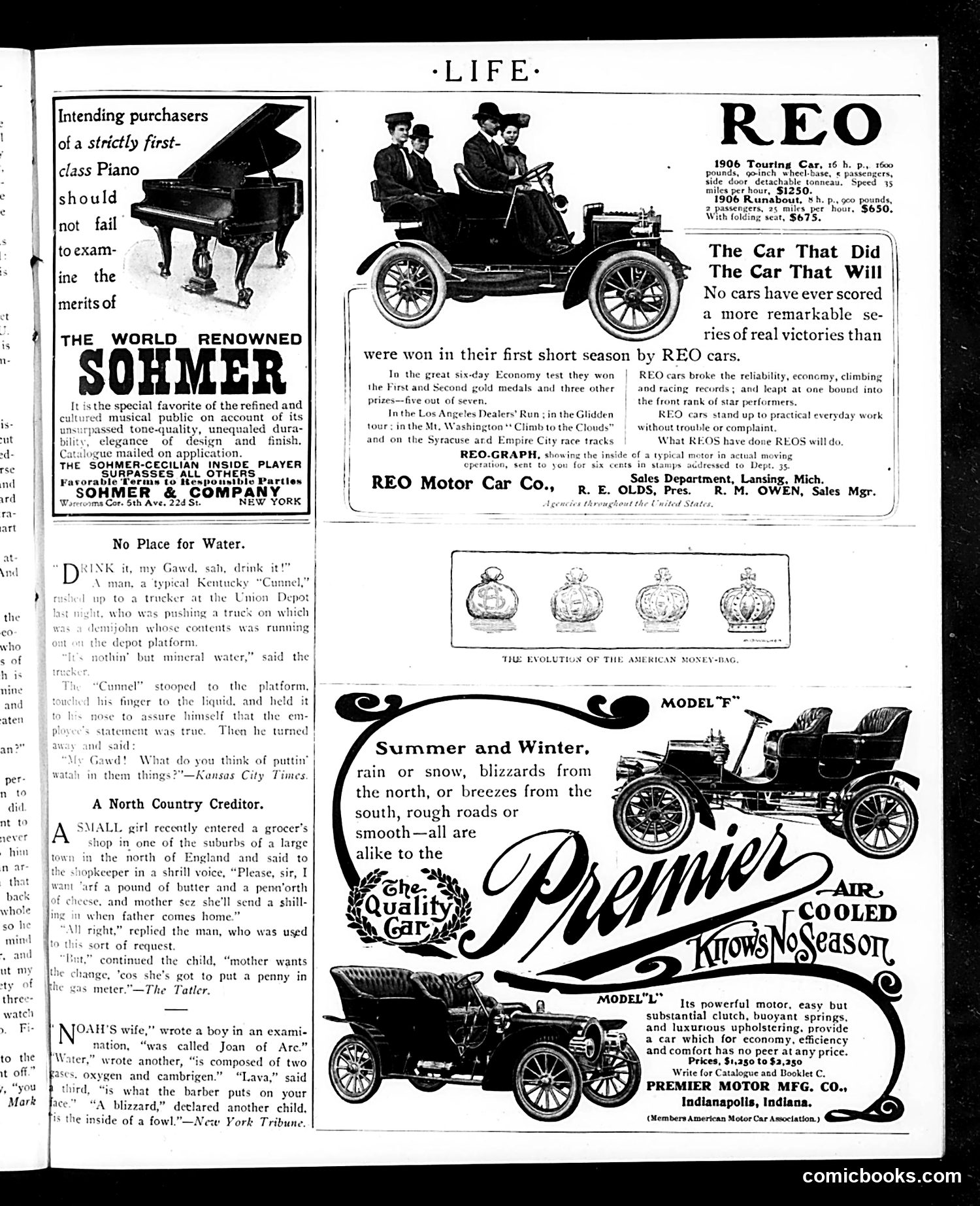
This page is primarily **advertisements and short humorous anecdotes**, not political cartoons. The ads showcase early 1900s automobiles (REO and Premier cars) and a Sohmer piano—typical luxury goods marketed to wealthy readers. The car ads emphasize reliability and racing victories, reflecting the era's nascent auto industry. The three brief stories are genteel humor pieces: "No Place for Water" depicts a Kentucky colonel rejecting mineral water at a train station; "A North Country Creditor" shows a shopkeeper's blunt response to a child's request for credit; and the final anecdote plays on the name "Joan of Arc" as a biblical reference. These pieces represent *Life* magazine's characteristic mix of consumer advertising and lighthearted social observation rather than sharp satire or political commentary.
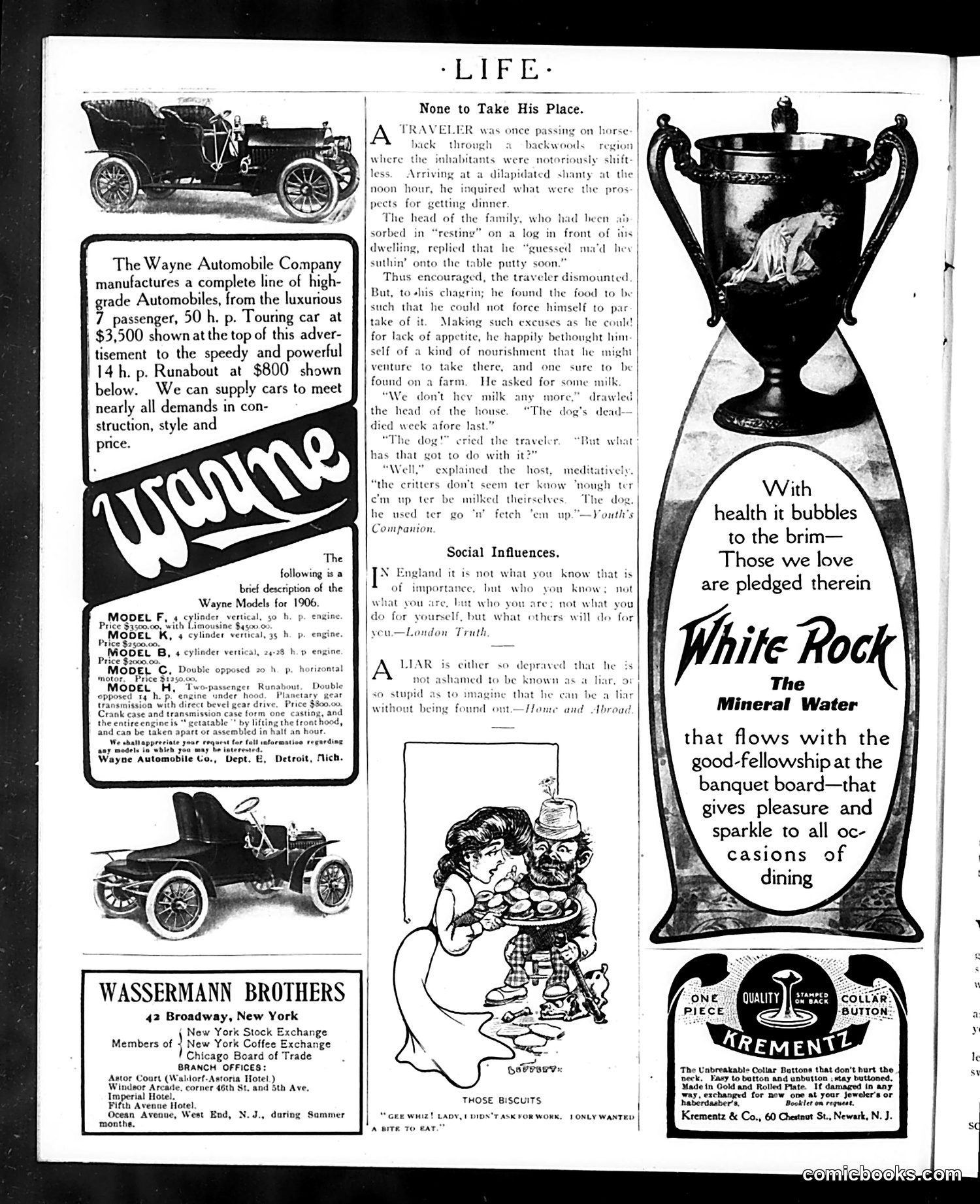
This page is primarily **advertising** mixed with short humorous articles and an illustration. The main content includes: - **Wayne Automobile Company advertisement** featuring early 1900s cars - **Wassermann Brothers** (New York) coffee exchange ad - **White Rock Mineral Water** advertisement with classical imagery - **Krementz collar buttons** ad The illustrated story **"None to Take His Place"** depicts a traveler who stops at a farmhouse seeking dinner. The farmer's family has no milk (their cow died) and limited food. The joke plays on social awkwardness: the traveler, initially discouraged, is assured by the host that such excuses for poor hospitality are common—implying that rural poverty and hospitality failures were frequent enough to warrant casual explanation. The tone is gently satirical about rural life's hardships. The other brief text items ("Social Influences" and "Those Biscuits") contain aphorisms and mild social commentary typical of early 1900s Life magazine humor.
This LIFE magazine page is primarily **advertising and miscellaneous content** rather than political satire or comics. The page contains: 1. **Two brief anecdotes** ("A Scared Lion" and "Dawn Refused to Appear") - humorous short stories with no apparent political meaning. 2. **Three advertisements**: one for the novel *The House of a Thousand Candles*, one for the New York Telephone Company, and one for Boss Medium Hard Water Cracker. 3. **A large financial statement** from the Manhattan Life Insurance Company, detailing assets and liabilities as of January 1, 1906. There is no visible political cartoon or satirical commentary on this particular page. The content appears typical of early-1900s magazine filler material.
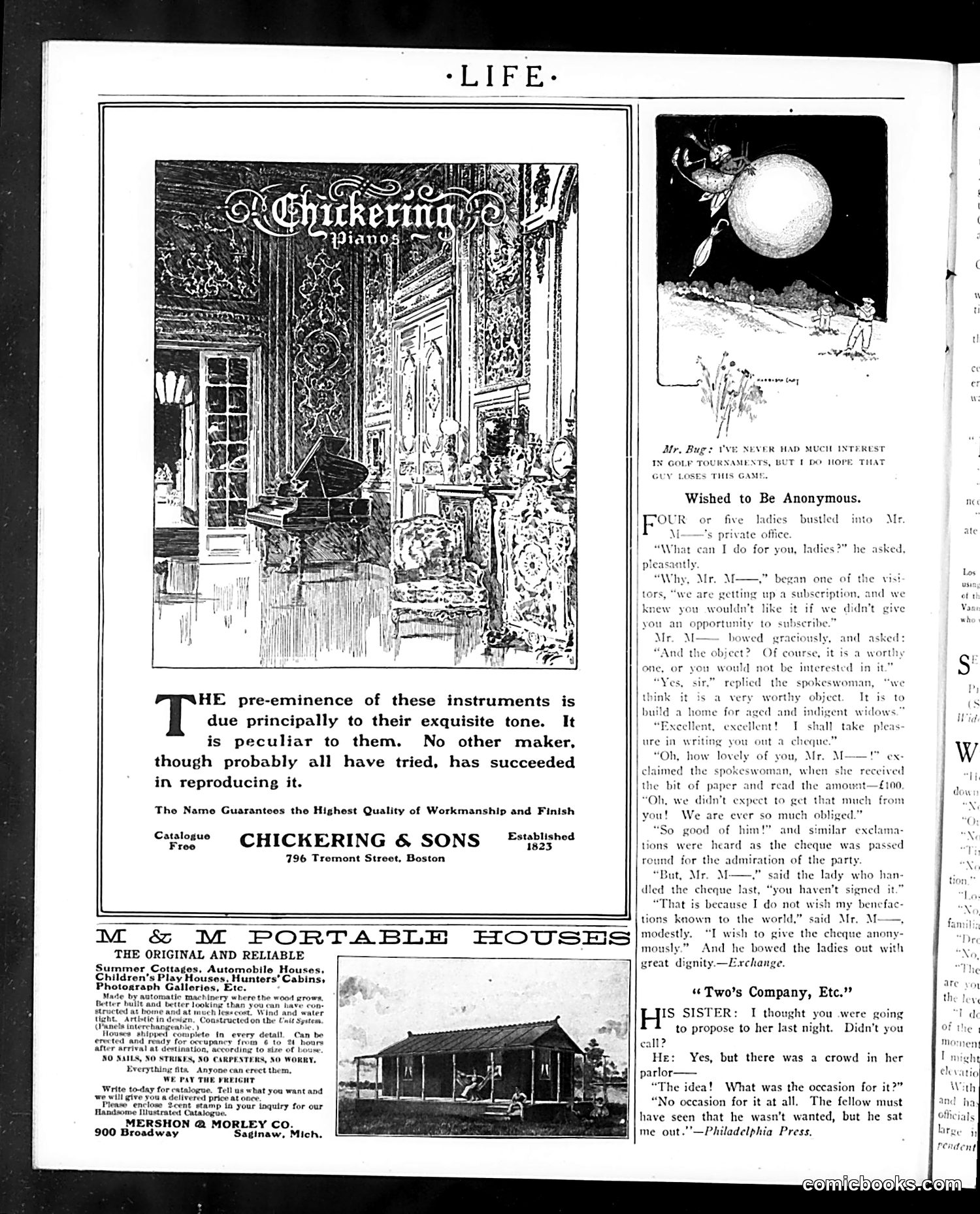
This page is primarily **advertising and commercial content** rather than political satire. The main illustrated advertisement promotes **Chickering & Sons pianos**, established 1823, emphasizing their superior craftsmanship and finish. The ornate interior illustration showcases a grand piano in an elegant Victorian drawing room. Below are ads for **M & M Portable Houses** (prefabricated structures) and **Mershon & Morley Co.** (machinery). On the right side is a brief humorous story titled **"Wished to Be Anonymous"** about ladies seeking a subscription, and **"Two's Company, Etc."** — light domestic humor rather than political commentary. The page represents **early 20th-century Life magazine's mixed editorial-advertisement format**, focused on consumer goods and gentle social humor rather than political satire.
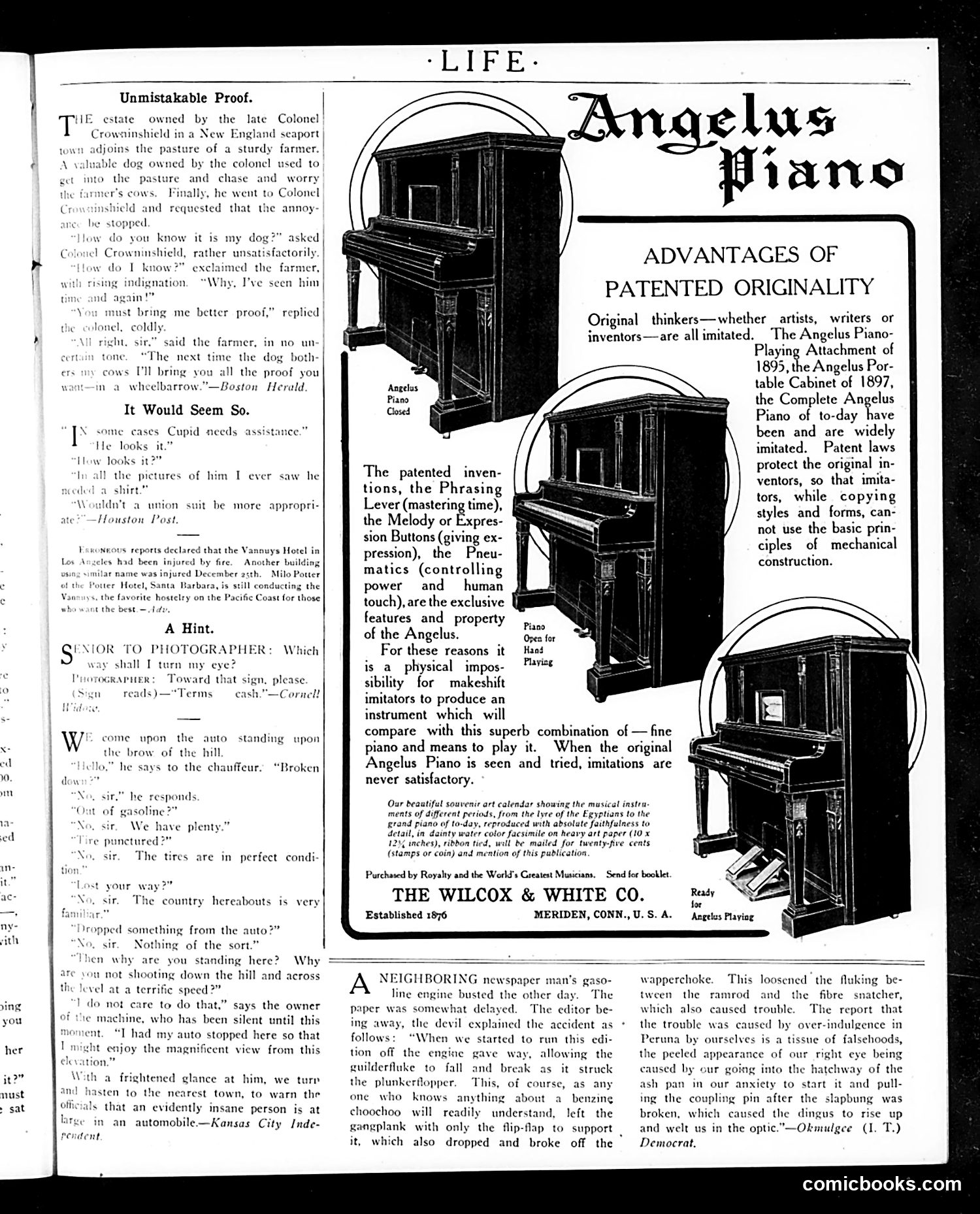
This page is **primarily advertising** for the Angelus Piano, manufactured by Wilcox & White Co. of Meriden, Connecticut. The advertisement emphasizes the piano's patented mechanical features—the "Phrasing Lever," "Melody of Expression Buttons," and "Pneumatics"—as exclusive innovations that competitors cannot legally copy. This was a selling point in an era when player pianos were popular luxury items. The left column contains unrelated humorous anecdotes typical of *Life* magazine's satirical content, including jokes about automobiles and photography. The advertisement's core message: the Angelus Piano's patented design makes it superior to imitators, and buyers should choose the original over cheaper knockoffs. This reflects early 20th-century consumer culture and patent law marketing.
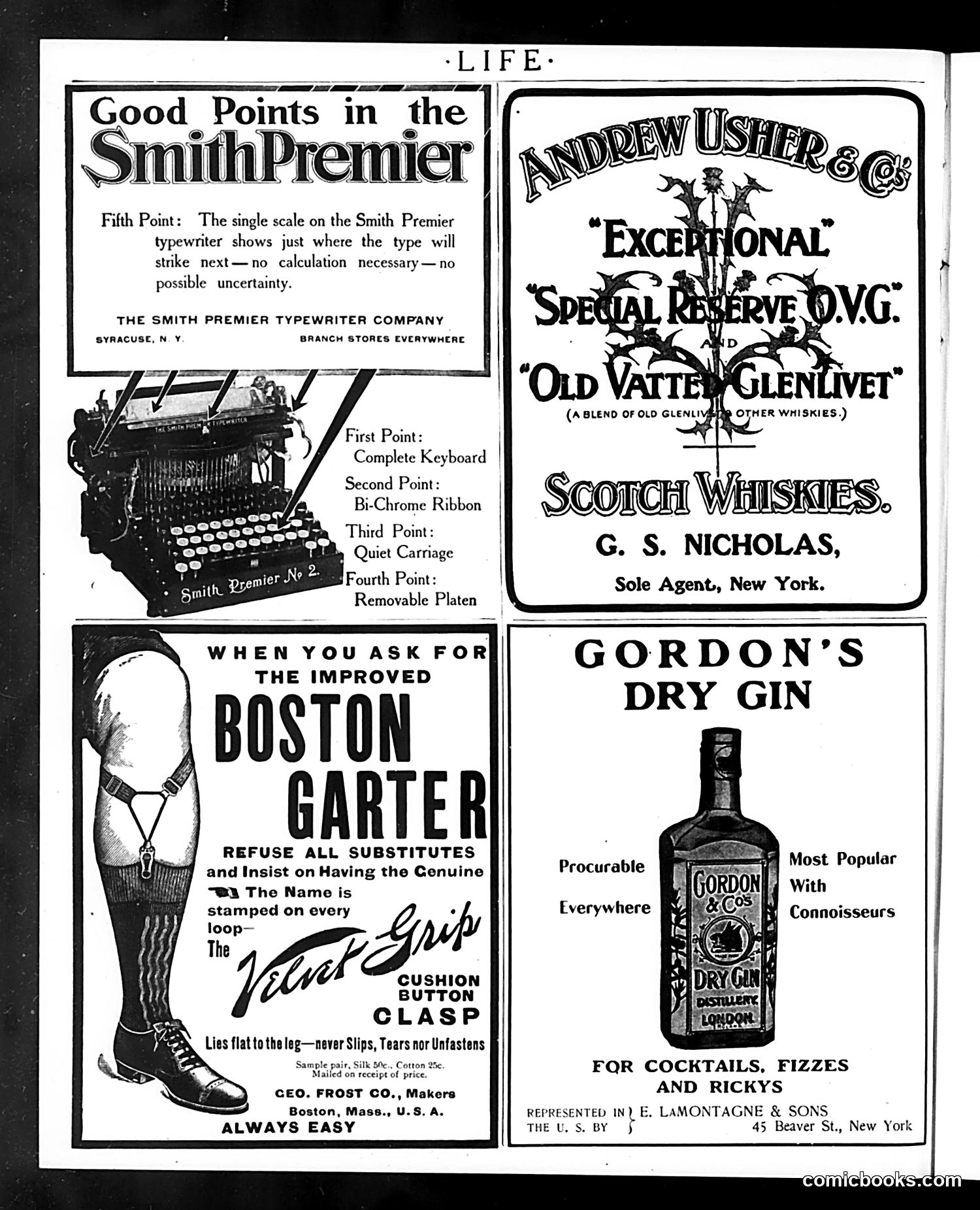
This page consists entirely of **advertisements**, not satirical cartoons. It features four product promotions typical of early 20th-century American marketing: 1. **Smith Premier Typewriter** — highlights five mechanical features (complete keyboard, ribbon, quiet carriage, removable platen, single scale) 2. **Andrew Usher Scotch Whiskies** — promotes "Old Vatte Glenlivet" brand through ornate decorative typography 3. **Boston Garter** — advertises elastic leg garters with an illustrated leg, emphasizing the product stays secure ("never slips, tears nor unfastens") 4. **Gordon's Dry Gin** — presents a bottle image, marketed for cocktails and mixed drinks There is **no political satire or commentary** on this page. The content reflects consumer goods marketed during Prohibition's era or immediately before/after. These are straightforward commercial pitches emphasizing product reliability and brand authenticity—"refuse all substitutes" appears repeatedly, suggesting counterfeit products were a genuine concern.
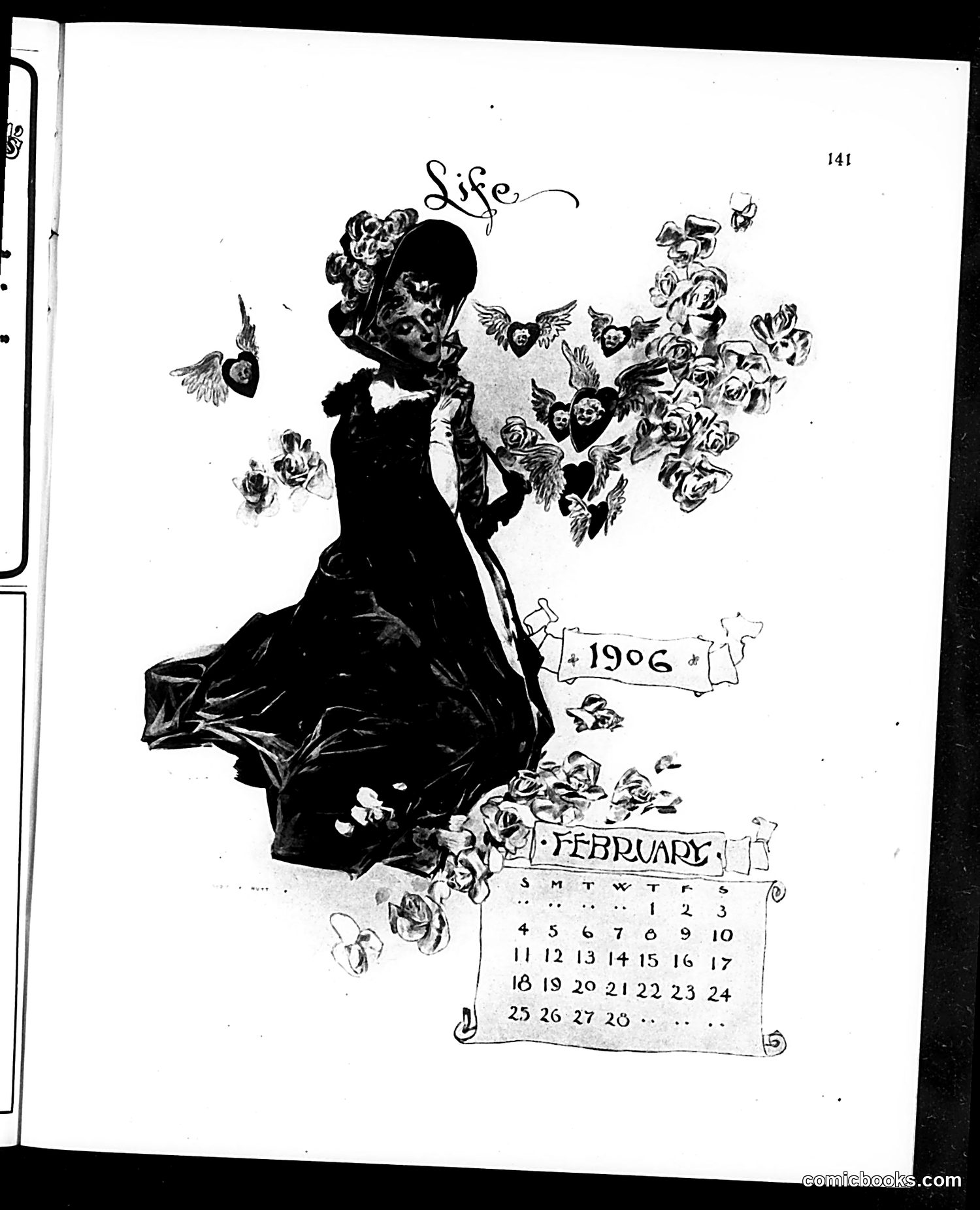
This is a calendar page for February 1906 featuring an allegorical figure labeled "Life" at the top. The illustration shows a silhouetted woman in elegant Edwardian dress surrounded by cherubs or cupids bearing hearts with wings—a common symbol of love and romance. The design exemplifies Art Nouveau styling popular in the early 1900s, with flowing lines and decorative elements. The cherubs scattered around suggest themes of love, beauty, or romantic aspiration—fitting for a February calendar tied to Valentine's Day traditions. This appears to be a decorative calendar page from Life magazine's 1906 publication, likely meant to be collectible or displayable. The artistic execution and romantic imagery were typical of how magazines marketed themselves as objects of aesthetic value to middle and upper-class readers of the era.
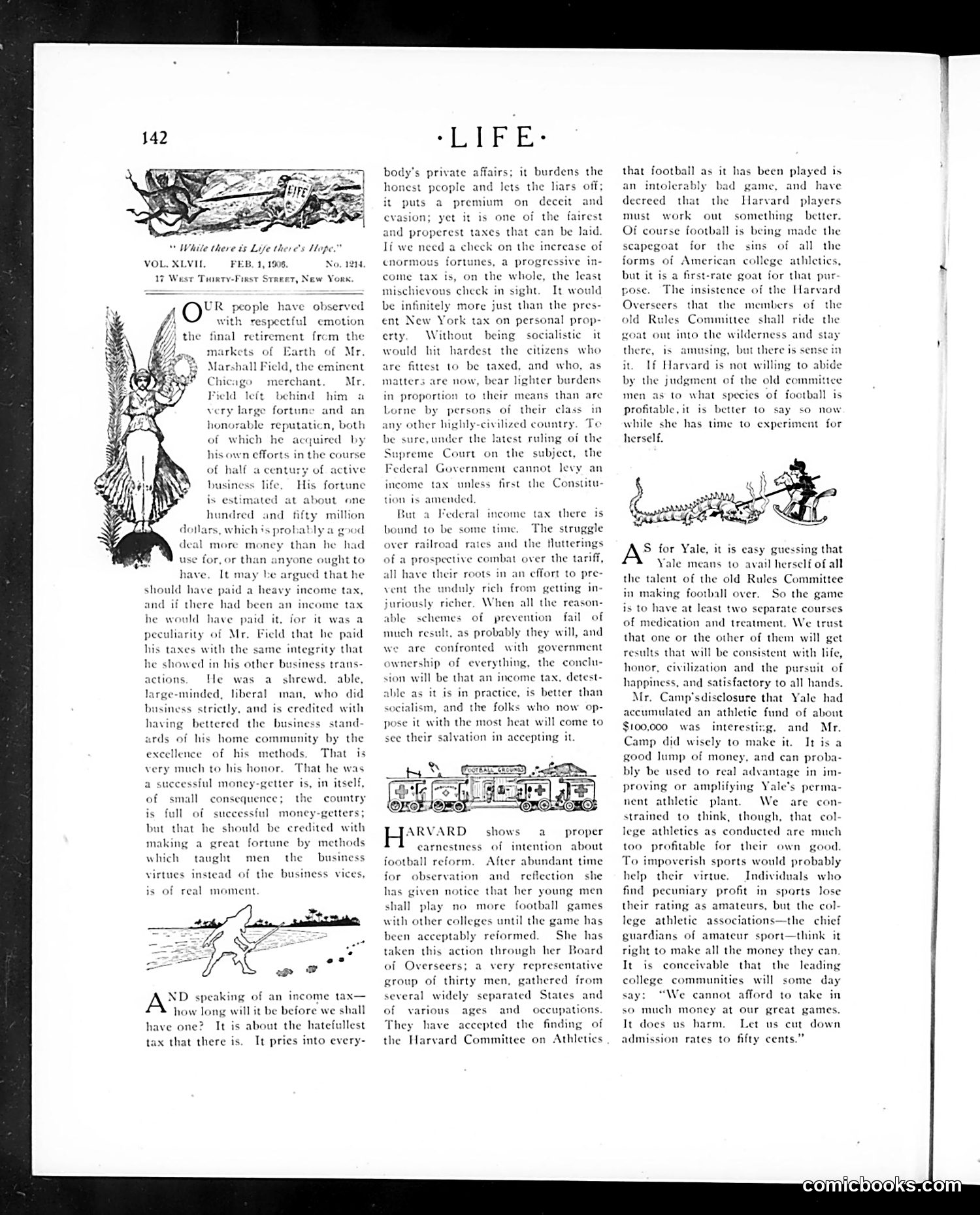
This page discusses three topics: Marshall Field's retirement, income taxation, and Harvard's football reform. The **Marshall Field section** praises the Chicago merchant's ethical business practices and vast fortune (~$150 million), arguing that wealthy self-made men who accumulated fortunes through integrity deserve respect, though the author questions whether such enormous wealth should exist. The **income tax discussion** advocates for a progressive federal income tax as a check on excessive fortunes, arguing it's fairer than current property taxes. The author acknowledges socialist concerns but frames income taxation as preferable to government ownership of everything. The **Harvard section** applauds the university's commitment to football reform, noting its Board of Overseers (representing "thirty men, gathered from several widely separated States") has determined football "as it has been played is…probably bad" and will prohibit games until the sport is acceptably reformed. The cartoon illustrations (appearing to show animals and figures) complement these satirical critiques of wealth inequality and institutional reform.
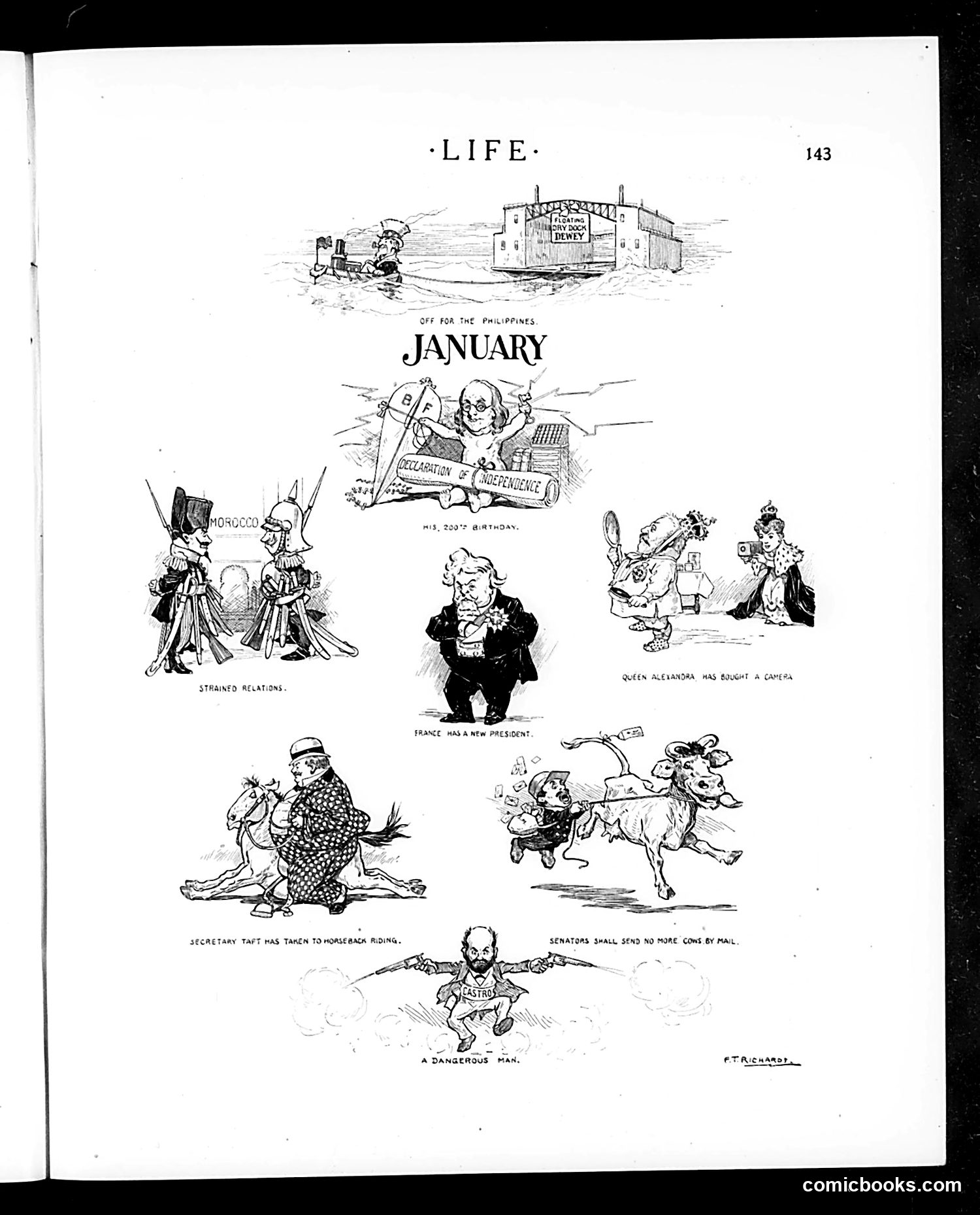
This page presents political cartoons satirizing January events and figures. The top cartoon references "Off for the Philippines," depicting maritime/naval activity—likely commentary on American military involvement in the Philippines. The remaining cartoons mock various political figures and situations: "Strained Relations" appears to reference diplomatic tensions; "France Had a New President" comments on French leadership; "Queen Alexandra Has Bought a Camera" satirizes the British queen; "Secretary Taft Has Taken to Horseback Riding" mocks the Secretary of War; and "Senators Shall Send No More Cones by Mail" references Congressional behavior. The central figure labeled "A Dangerous Man" is unclear without additional context, though the caricatured style suggests a prominent political or social figure of the period. The overall page represents Life's characteristic satirical commentary on early 20th-century American and international politics.
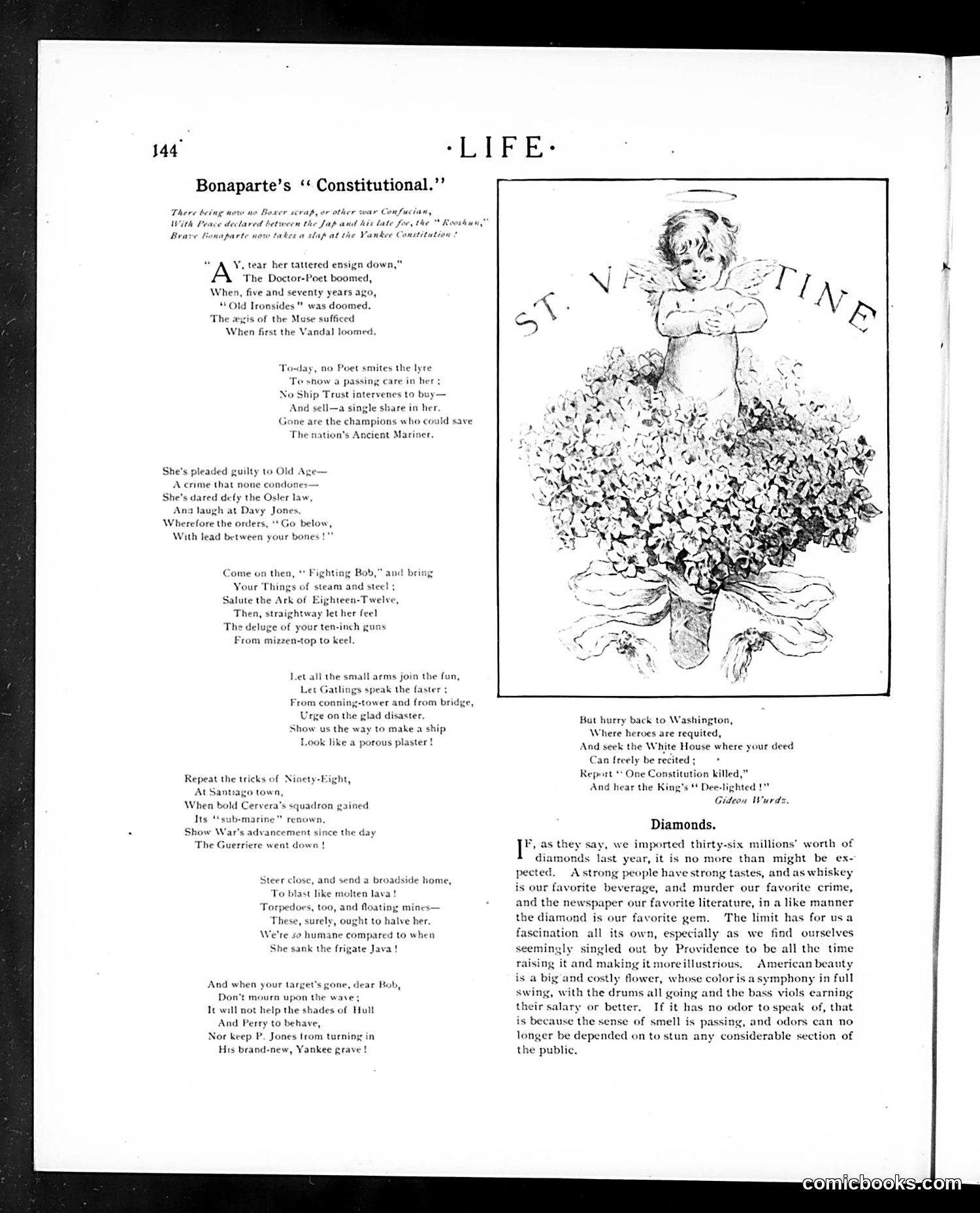
This poem satirizes calls to destroy the USS *Constitution*, America's oldest warship, through military target practice. The poem mocks this proposal by adopting an ironic, mock-heroic tone addressing "Fighting Bob" (likely Admiral Robert Peary or similar naval figure). The satire works through contrast: the poem invokes the ship's glorious history—its defense in the War of 1812 against the *Guerriere* and *Java*—then absurdly urges modern weaponry (ten-inch guns, torpedoes, mines) be used against it. The cartoon's cherub surrounded by flowers labeled "St. Valentine" illustrates the incongruity: America would destroy its own heritage for military experimentation. The title "Bonaparte's Constitutional" suggests this destructive impulse mirrors Napoleon's authoritarian disregard for law and tradition. The poem's final ironic plea—to report the achievement to Washington's White House—underscores the satire: destroying an American icon contradicts American values.
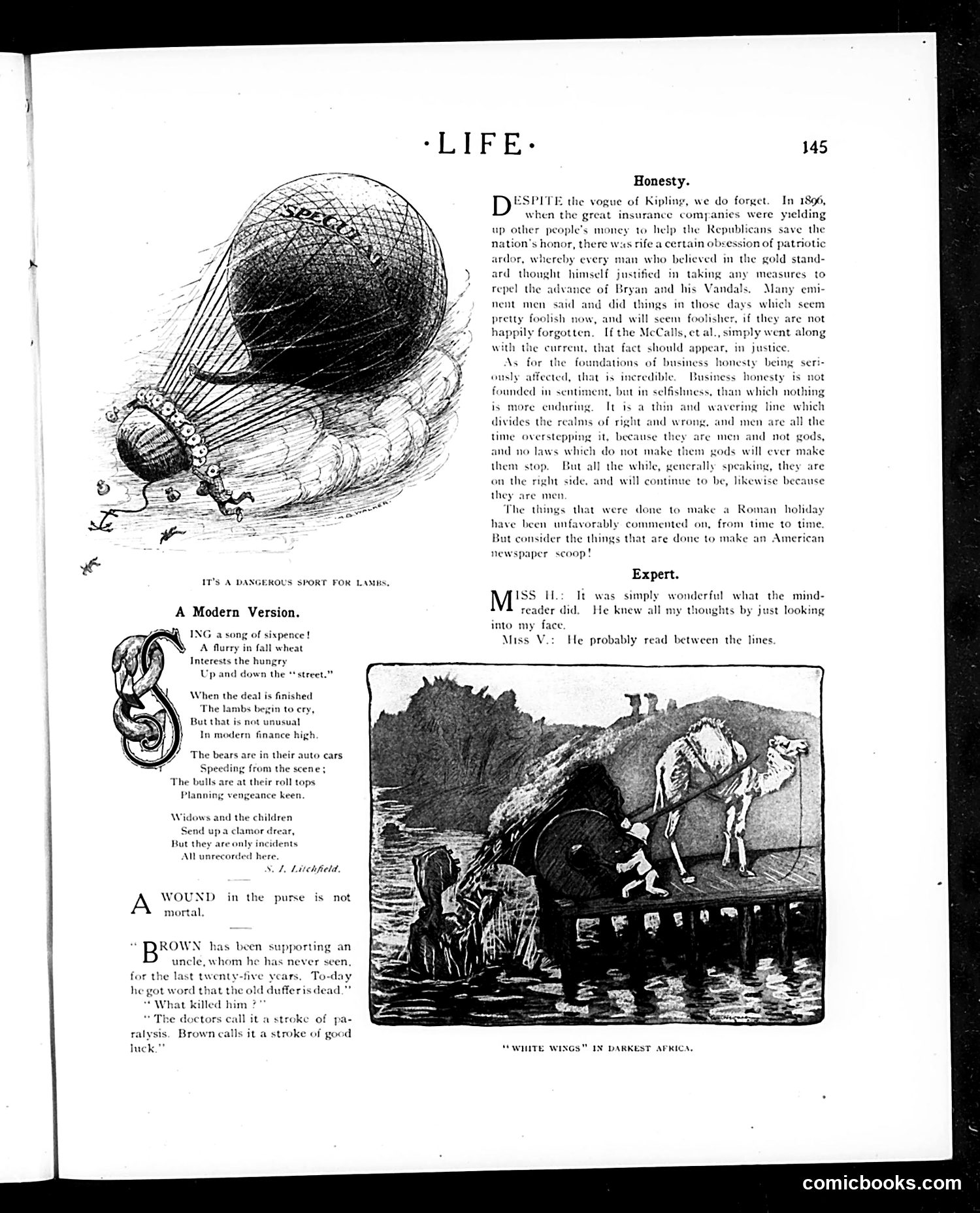
This page contains several satirical pieces about American business ethics and colonial adventures circa 1896. The main essay "Honesty" references the 1896 election when insurance companies donated Republican funds, claiming patriotic duty against William Jennings Bryan's "free silver" campaign. The author argues that business honesty stems from self-interest rather than morality, and that men regularly cross ethical lines—but generally stay on the "right side" because they remain fundamentally human. "A Modern Version" parodies the nursery rhyme "Sing a Song of Sixpence," replacing pie-baking with stock market manipulation: wheat speculation, financial deals causing suffering ("lambs begin to cry"), and bears/bulls (market speculators) profiting while widows and children suffer unrecorded losses. The "Expert" dialogue mockingly portrays mind-reading as newspaper journalism—suggesting reporters fabricate stories rather than reporting facts. "White Wings in Darkest Africa" likely satirizes colonial missionary or commercial ventures in Africa, though the specific reference remains unclear from this excerpt.
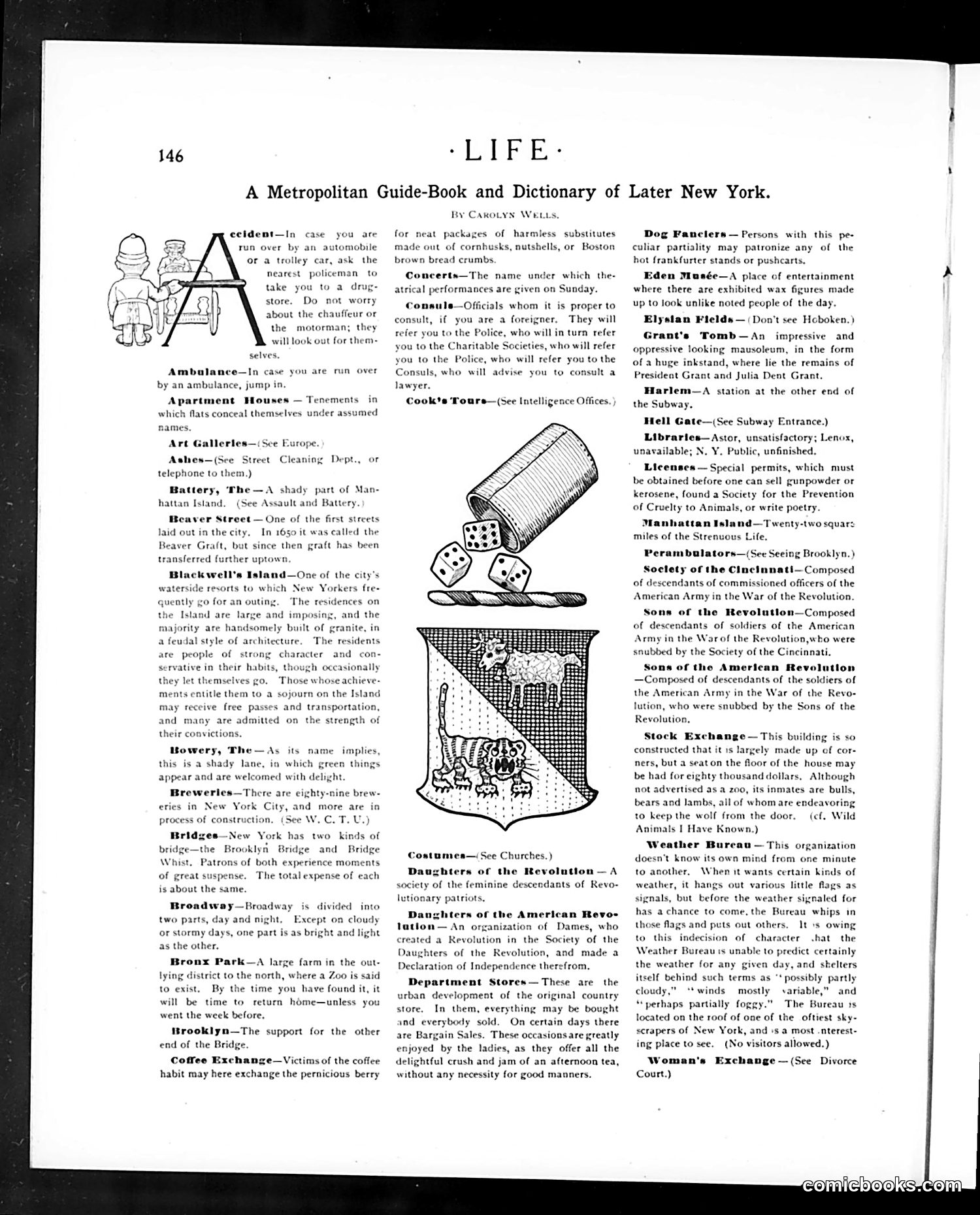
This is a satirical "dictionary" of New York City institutions, written by Carolyn Wells for *Life* magazine. It's essentially a comedic guidebook that mocks contemporary urban life through mock-serious definitions. The humor targets: - **Urban hazards**: Getting hit by automobiles/trolleys is treated as routine ("Do not worry about the chauffeur") - **Class and corruption**: Blackwell's Island residents are described as people admitted "on the strength of their convictions" (implying criminals) - **Bureaucratic runaround**: Foreigners needing help get shuffled between police, charities, and consuls endlessly - **Women's organizations**: The "Daughters of the American Revolution" spawned the "Daughters of the American Revolution" (sic)—satirizing splinter groups and social pretension - **Department stores**: Portrayed as places where "everybody [gets] sold," with bargain sales compared unfavorably to afternoon tea The tone is gently mocking of New York's modern inconveniences, social hierarchies, and the absurdities of rapid urbanization.
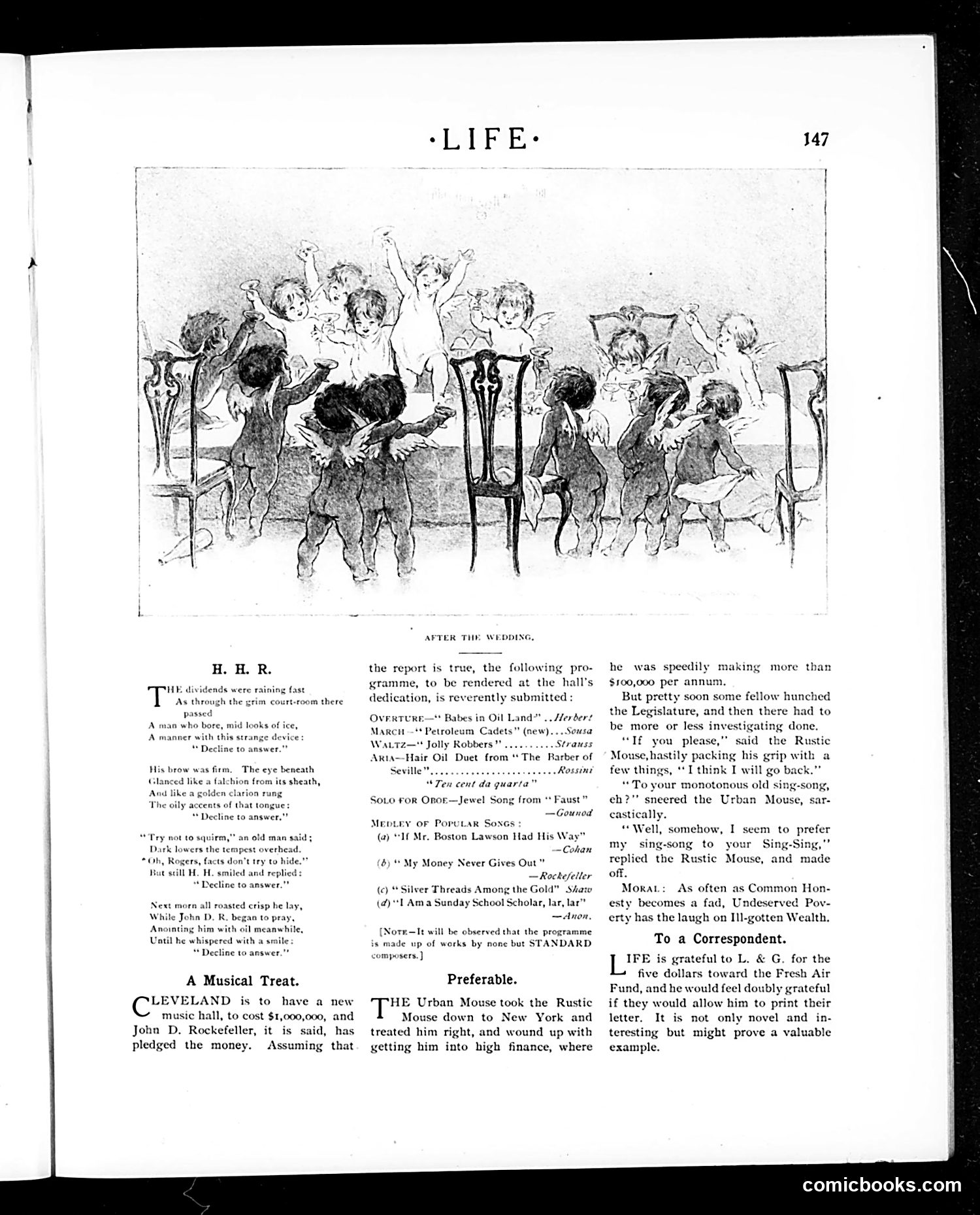
This page contains two distinct satirical pieces attacking wealthy industrialists, particularly John D. Rockefeller. **"H.H.R." (top):** A poem mocking someone (likely Rockefeller, given the initials and context) repeatedly "declining to answer" during what appears to be legislative testimony or investigation. The repeated refusal becomes absurdly theatrical—the figure is "roasted crisp" yet still stonewalling. This satirizes wealthy tycoons evading accountability through legal obstruction. **"A Musical Treat" and "Preferable":** These mock Rockefeller's pledged $1 million music hall. The proposed concert program satirizes his oil wealth with titles like "Babes in Oil Land" and "Petroleum Cadets." The fable contrasts a country mouse rejecting city wealth gained through "high finance" requiring legislative investigation, with the moral that "Ill-gotten Wealth" triumphs when "Common Honesty becomes a fad"—suggesting such wealth is inherently corrupt. The illustration shows children in chairs, likely depicting the music hall's future use for wholesome entertainment, contrasting with the morally compromised source of funds.
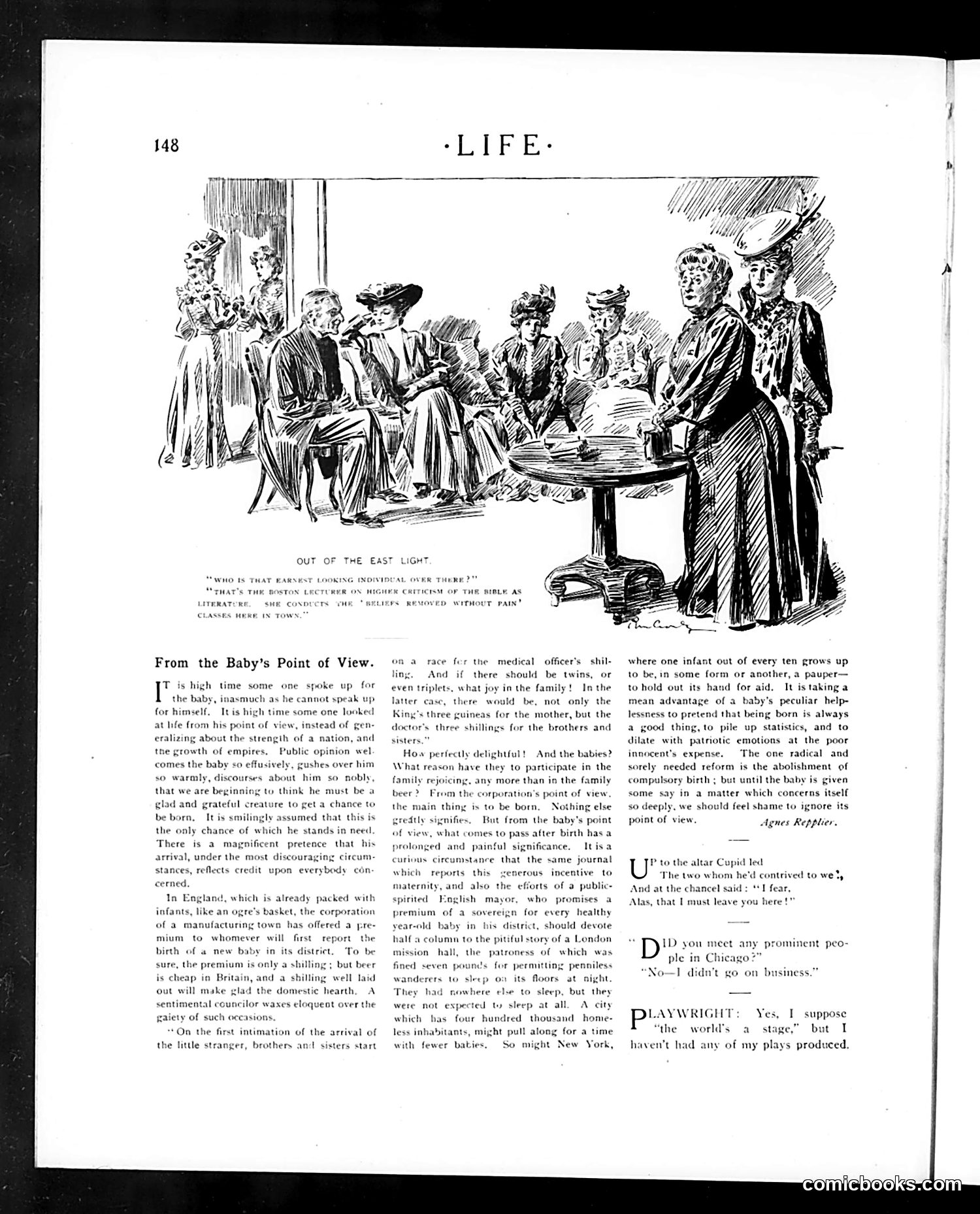
The top cartoon satirizes Boston's intellectual pretensions. A well-dressed woman lecturer on literature is identified as "the barest looking Indian"—a crude visual joke mocking her appearance while suggesting that Boston's celebrated cultural authorities may be less refined than they claim. The main article, "From the Baby's Point of View" by Agnes Repplier, is social satire attacking the hypocrisy of celebrating childbirth in societies that fail to support poor children. Repplier critiques British towns offering monetary premiums to encourage births while simultaneously allowing hundreds of thousands of infants to grow into paupers. She argues this treats babies as statistical achievements rather than recognizing their actual welfare needs. The piece advocates for abolishing "compulsory birth" until society genuinely cares for children's wellbeing—a progressive argument for the era. The bottom section contains unrelated comedic dialogue about theater and marriage, typical of Life's miscellaneous humor content.
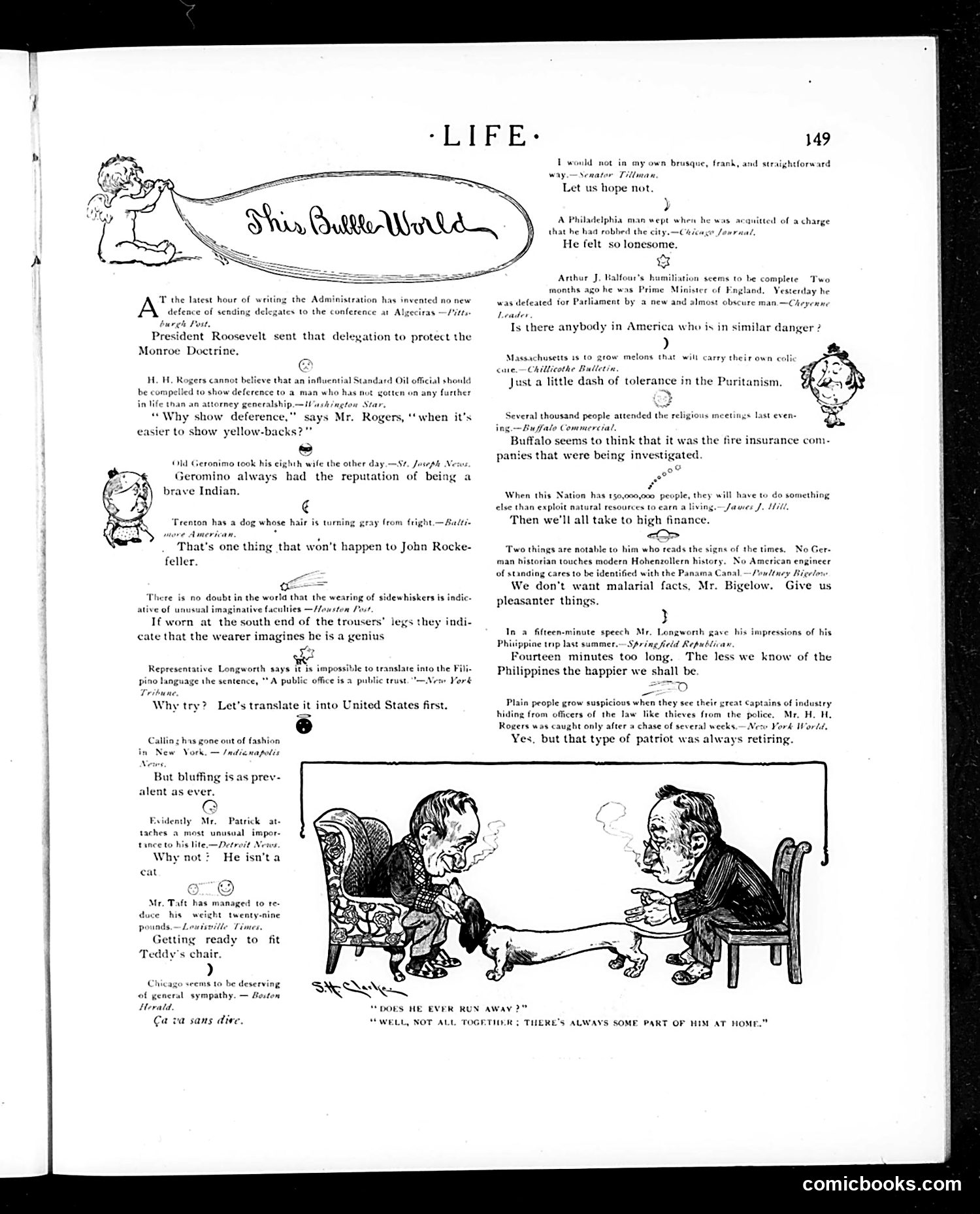
This page collects brief satirical comments on contemporary political and social figures, typical of Life's format. The main cartoon depicts two men in conversation, with the caption addressing whether someone "runs away"—the response being "not all together; there's always some part of him at home," likely a jab at a politician's divided loyalties or physical presence. The text snippets mock various targets: Standard Oil's H.H. Rogers (for expecting deference despite his origins), Representative Longworth (for claiming certain American concepts can't be translated into Filipino), and President Taft (humorously noted as preparing to occupy Theodore Roosevelt's chair after losing weight). Other quips target turn-of-century concerns: sideburns as markers of pretension, the reliability of fire insurance companies during investigations, and the suspicious behavior of wealthy industrialists evading law enforcement. The humor assumes readers' familiarity with contemporary scandals and political figures now largely forgotten.
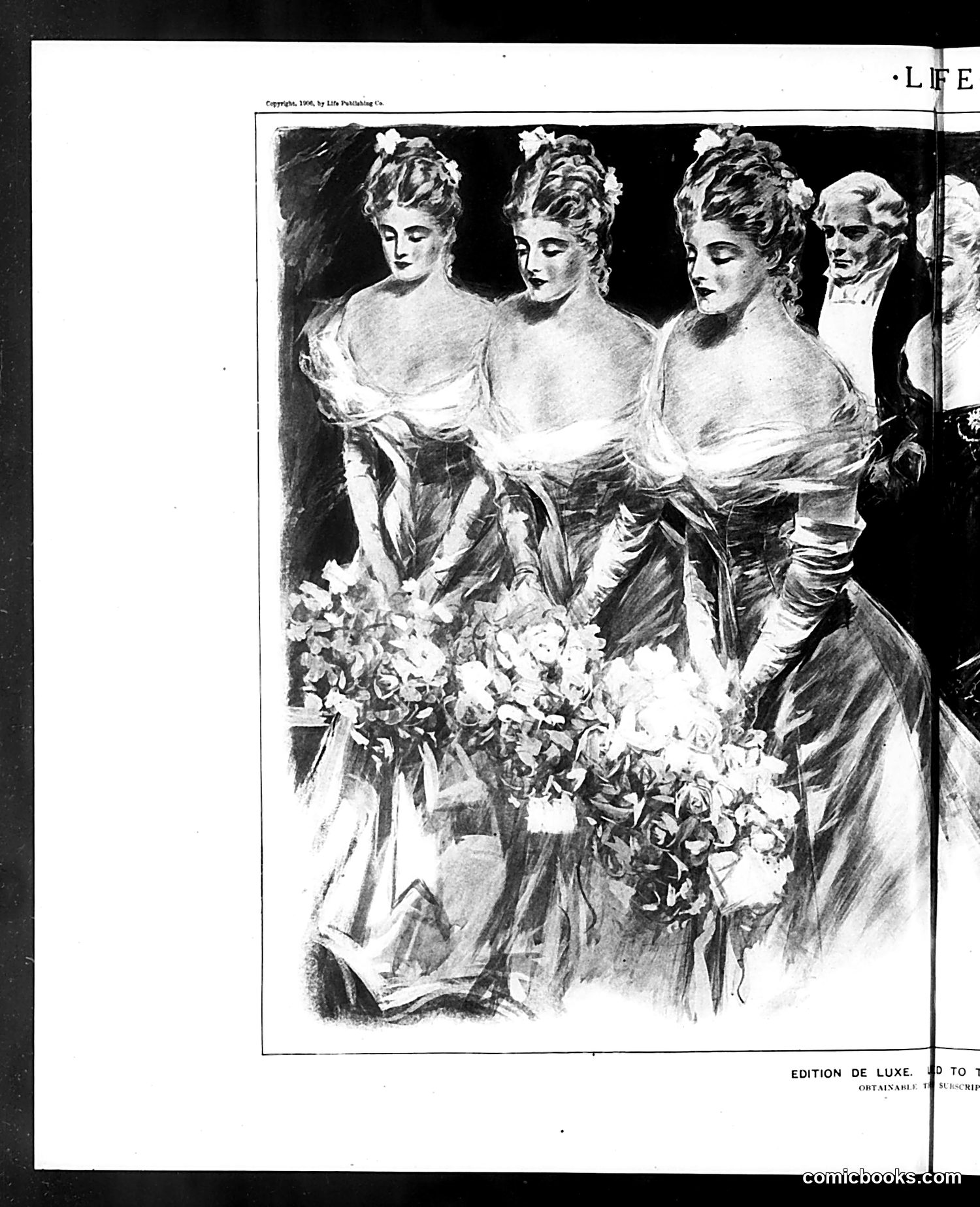
This page appears to be from a *Life* magazine edition and shows an illustration of three elegantly dressed women in Edwardian-era formal gowns with elaborate upswept hairstyles, holding large bouquets of flowers. Male figures are partially visible in the background. The text is largely illegible in the OCR, but the caption mentions "EDITION DE LUXE" (Deluxe Edition), suggesting this may be promotional or aspirational content about high society or fashion. The artistic style and subject matter—fashionable women at what appears to be a formal social event—suggests this depicts contemporary upper-class society life, likely satirizing or commenting on the vanity and formality of Gilded Age social conventions. Without clearer text, the specific satirical point remains unclear.
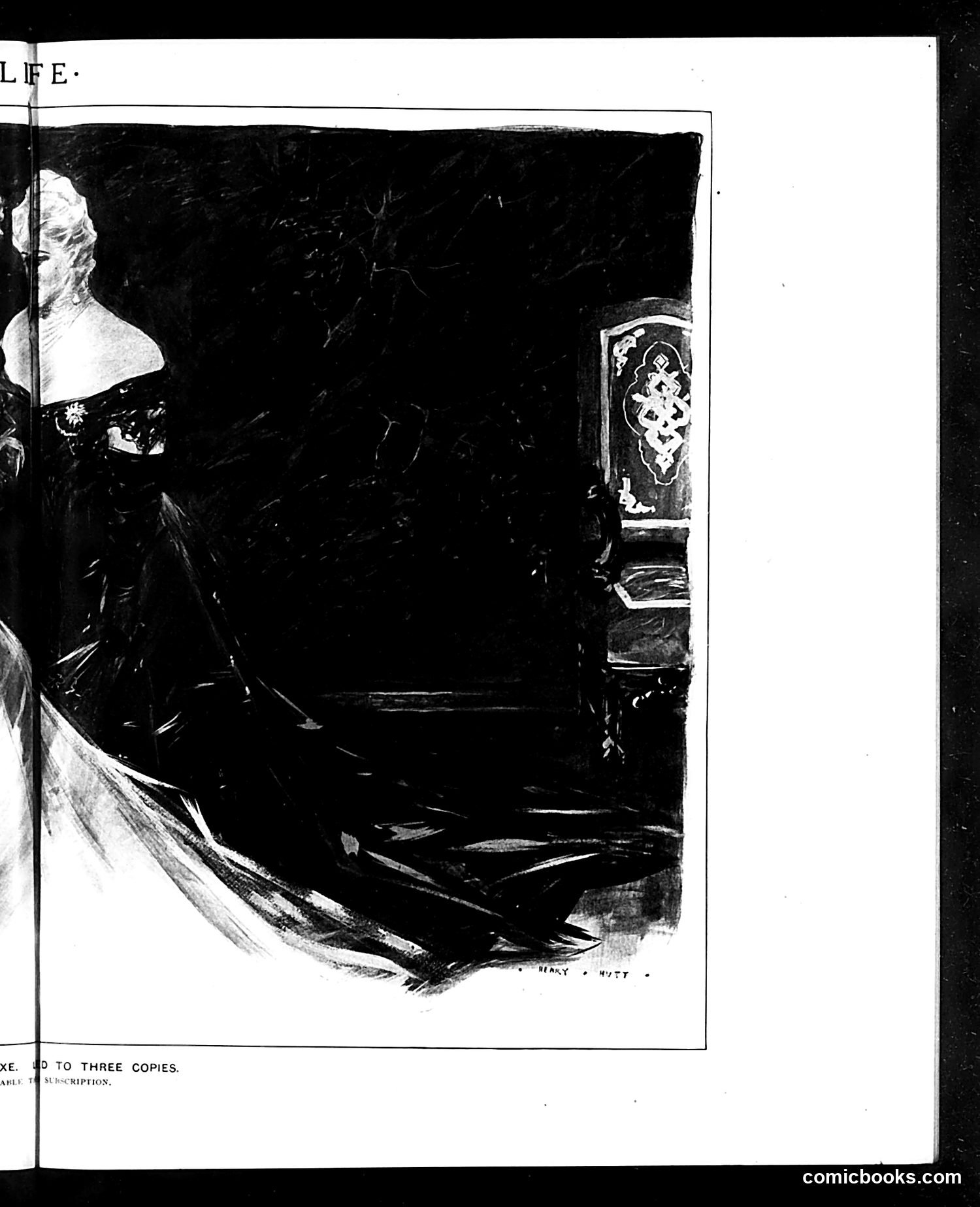
This appears to be an illustration by Henry Hutt (signature visible at bottom) showing a dramatic interior scene. On the left, a woman in an elegant white décolletage neckline and dark dress is partially visible. The composition is dominated by deep black shadows suggesting an interior space, with what appears to be a decorative panel or artwork visible on the right side of the frame. The artistic style is characteristic of early 20th-century satirical illustration. However, the OCR text is fragmentary and unclear, providing only subscription information. Without clearer text or additional context identifying specific figures or political references, the cartoon's satirical subject matter remains ambiguous. The dramatic lighting and composition suggest commentary on high society or domestic themes common to Life magazine's social satire.
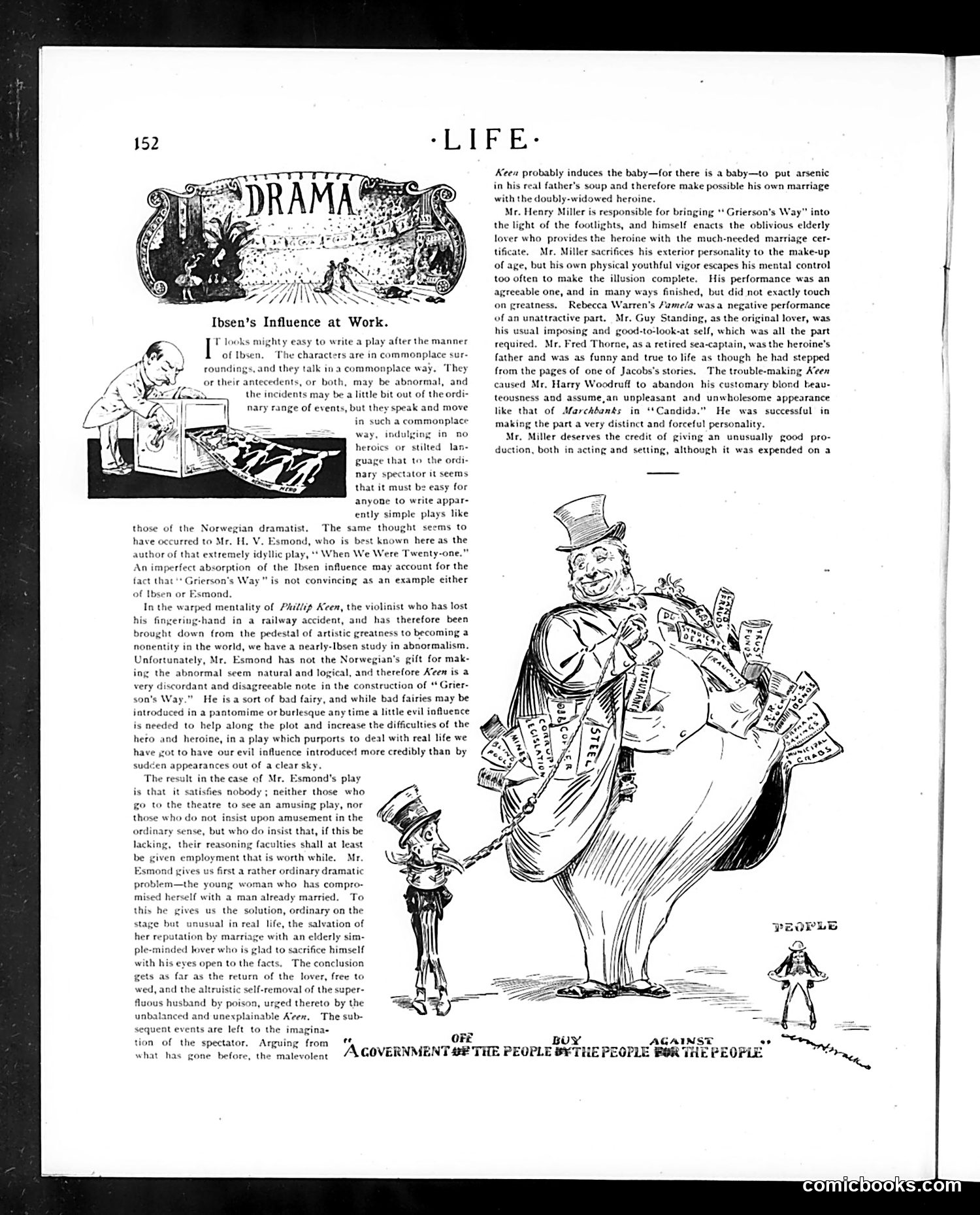
This political cartoon depicts a grotesquely caricatured fat man in formal dress holding money, with a tiny figure labeled "BOY" being crushed or dominated beneath him. The caption references Lincoln's Gettysburg Address phrase, inverting it sarcastically. The satire criticizes **plutocracy and economic inequality**: the bloated capitalist figure represents wealthy elites who have corrupted democratic ideals. Rather than government serving the people equally, the cartoon argues that the wealthy elite now control the system, leaving ordinary citizens (represented by the diminished "boy") powerless and exploited. The cartoon appears on a page discussing Henrik Ibsen's theatrical influence on American drama, which often explored social inequality and hypocrisy. This juxtaposition suggests Life magazine used both dramatic criticism and political satire to critique social problems in early 20th-century America.
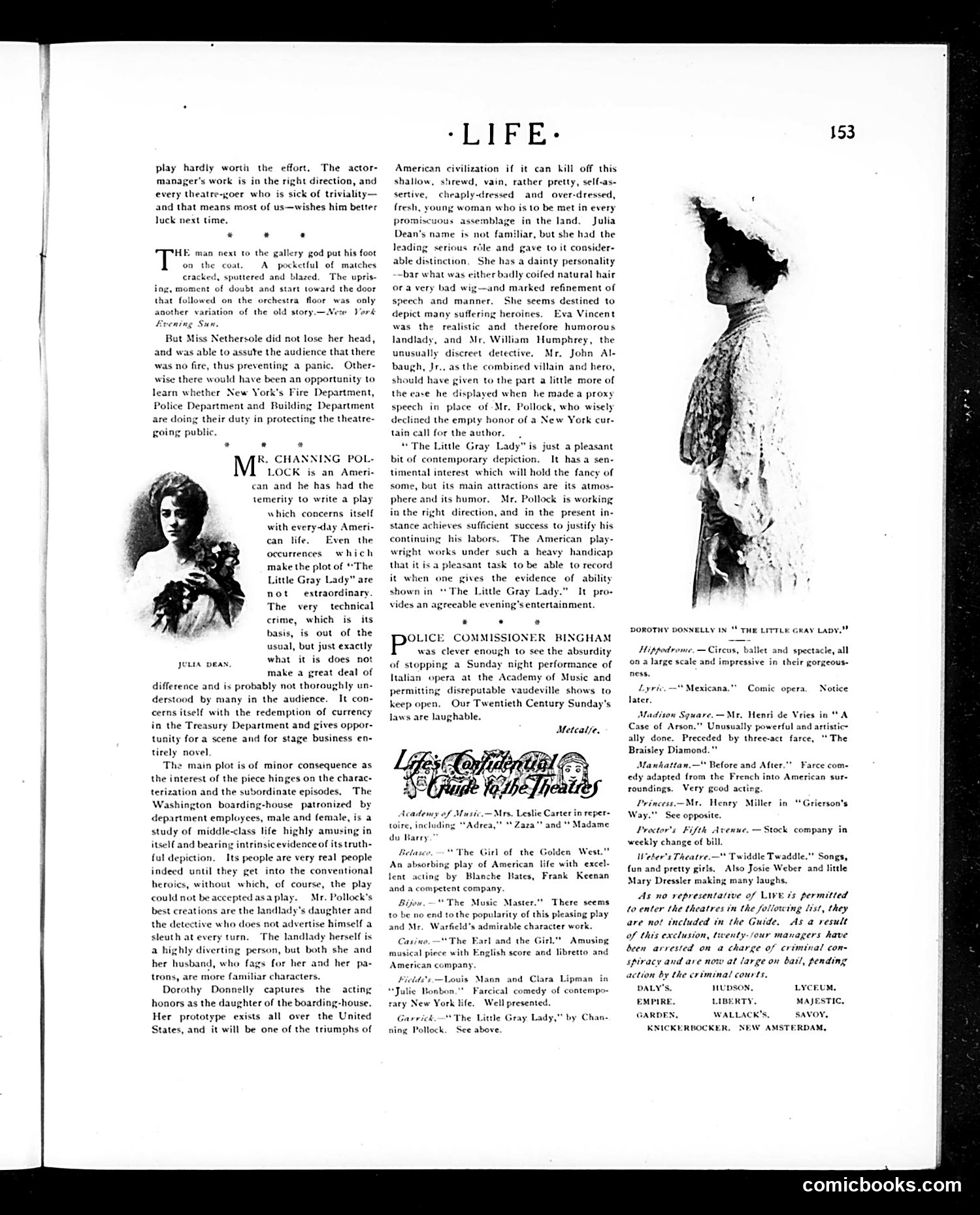
This page contains theater reviews from Life magazine, focusing on plays opening in New York. The main subjects are: **"The Little Gray Lady"** by Channing Pollock - A contemporary American play set in a Washington boarding house populated by Treasury Department employees. The reviewer praises its realistic depiction of middle-class life and characters, particularly actress Dorothy Donnelly's portrayal of a typical shallow, vain young woman "to be met in every pretentious assemblage in the land." The plot involves currency redemption—apparently unconventional for stage drama at the time. **Supporting commentary** addresses theater safety (referencing an incident where matches ignited during a performance) and applauds Pollock for writing about everyday American life rather than artificial theatrical heroics. The photograph shows Julia Dean, who played the leading serious role. The review is generally positive, calling the play "a pleasant bit of contemporary depiction" with good atmosphere and humor, though criticizing conventional dramatic elements the playwright felt forced to include.
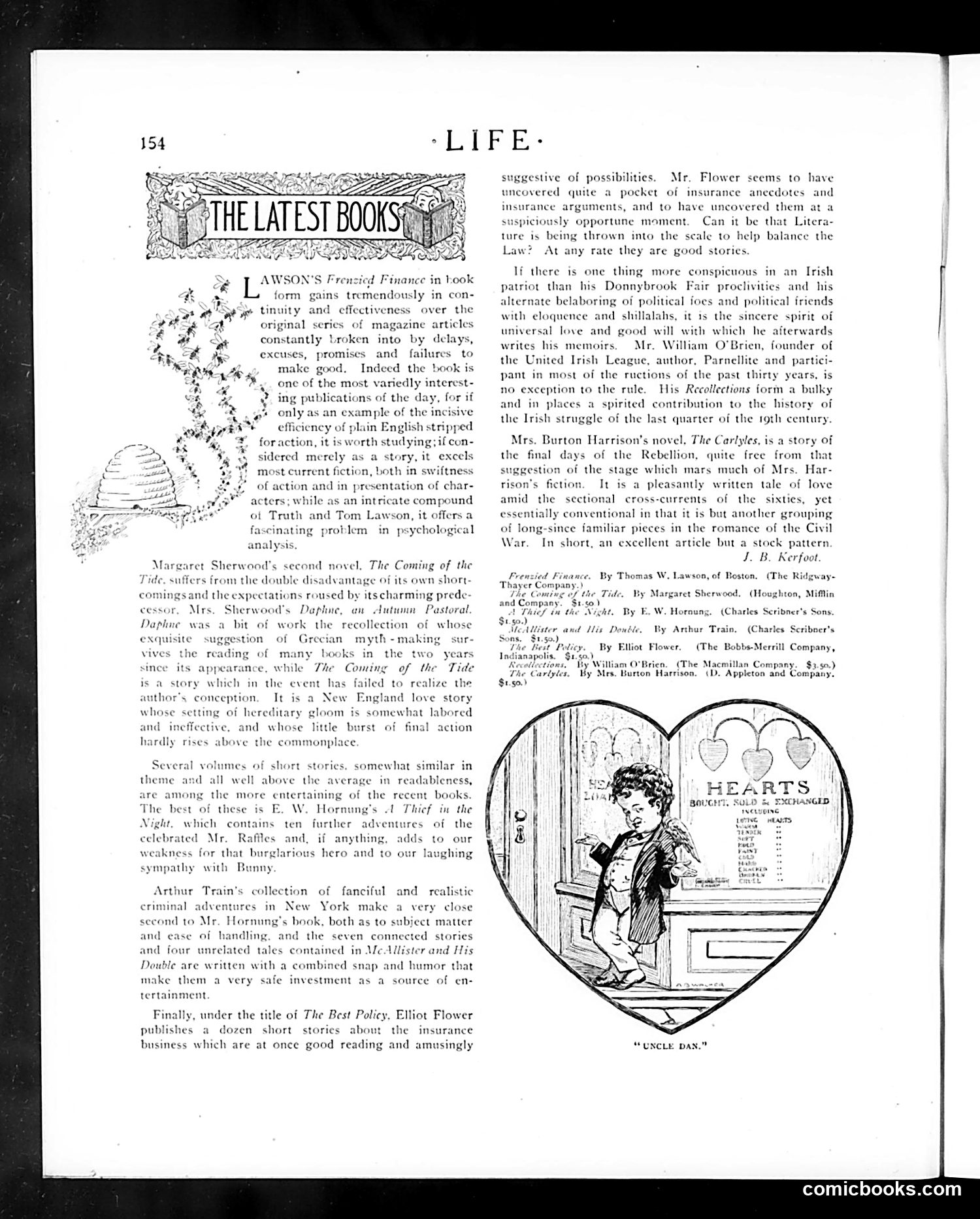
This is a book review page ("The Latest Books") from Life magazine, featuring literary criticism rather than political cartoons. The main illustration—a heart-shaped frame labeled "Uncle Dan's" showing a figure looking at a chart of "hearts bought, sold & exchanged"—appears to be a satirical advertisement or story illustration related to romantic commerce or matchmaking. The reviews discuss contemporary novels and short story collections, including works by Margaret Sherwood, E.W. Hornung (featuring the criminal character Raffles), and Arthur Train. One notable reference mentions **William O'Brien**, an Irish nationalist politician and founder of the United Irish League, whose memoir is reviewed here. The text humorously notes the Irish trait of combining political violence ("shillalahs") with sincere professions of goodwill when writing memoirs. The page represents typical early 20th-century American literary journalism, not political satire.
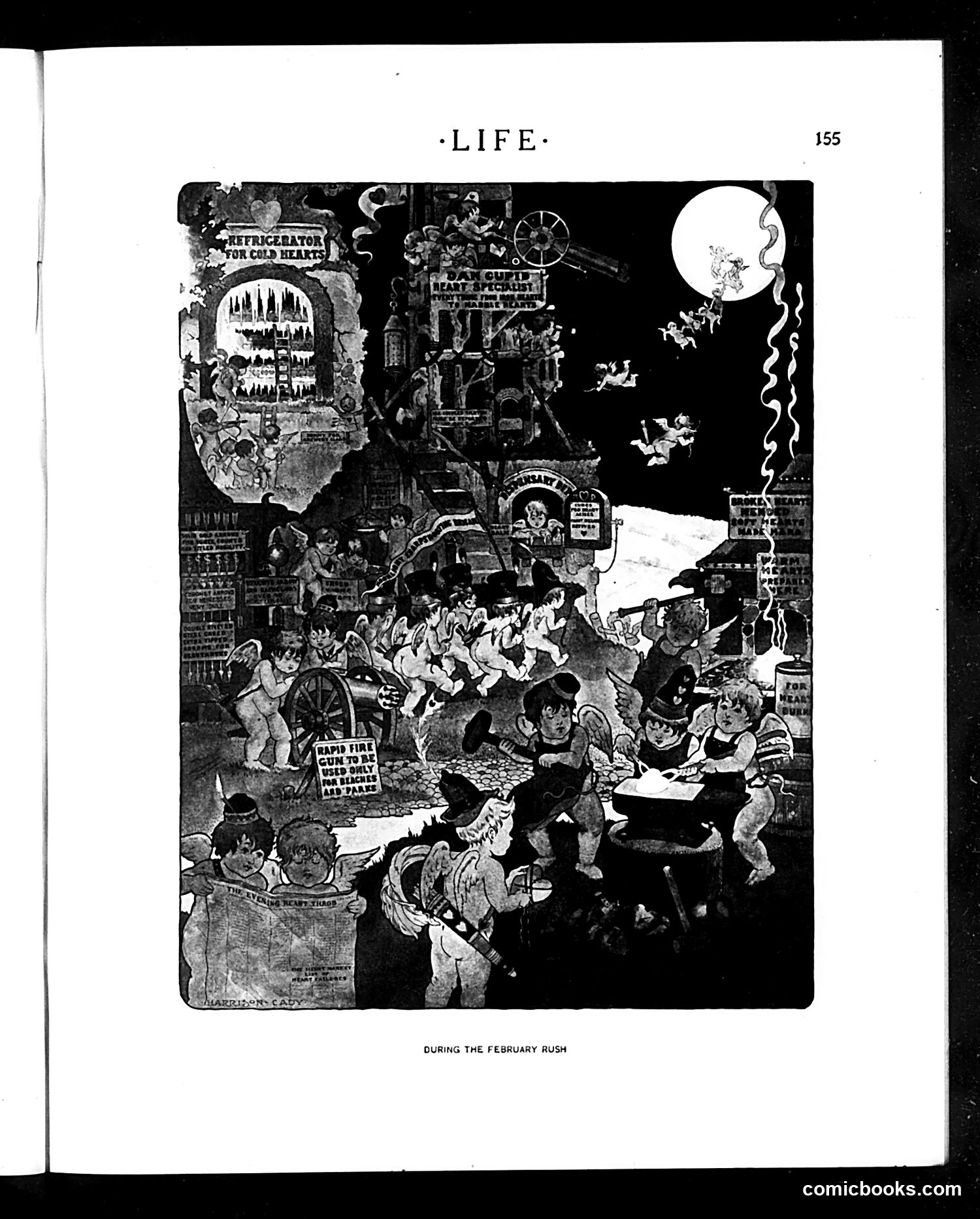
This Life magazine illustration satirizes Valentine's Day commercialism and chaos. The crowded, frenetic scene depicts cherubs and figures in a hectic shopping environment, with various store signs advertising heart-themed merchandise and Valentine's goods visible throughout. The cartoon mocks the "February Rush"—the commercial madness surrounding Valentine's Day as consumers scramble to purchase romantic gifts. Multiple advertisements for chocolates, flowers, and other sentimental items crowd the composition, highlighting how retailers exploit the holiday. The chaotic arrangement of cupids and shoppers emphasizes the frenzied, undignified nature of commercial gift-buying, contrasting sharply with Valentine's Day's supposed romantic ideals. The satire suggests that commercialism has transformed an intimate holiday into a hectic consumer spectacle.
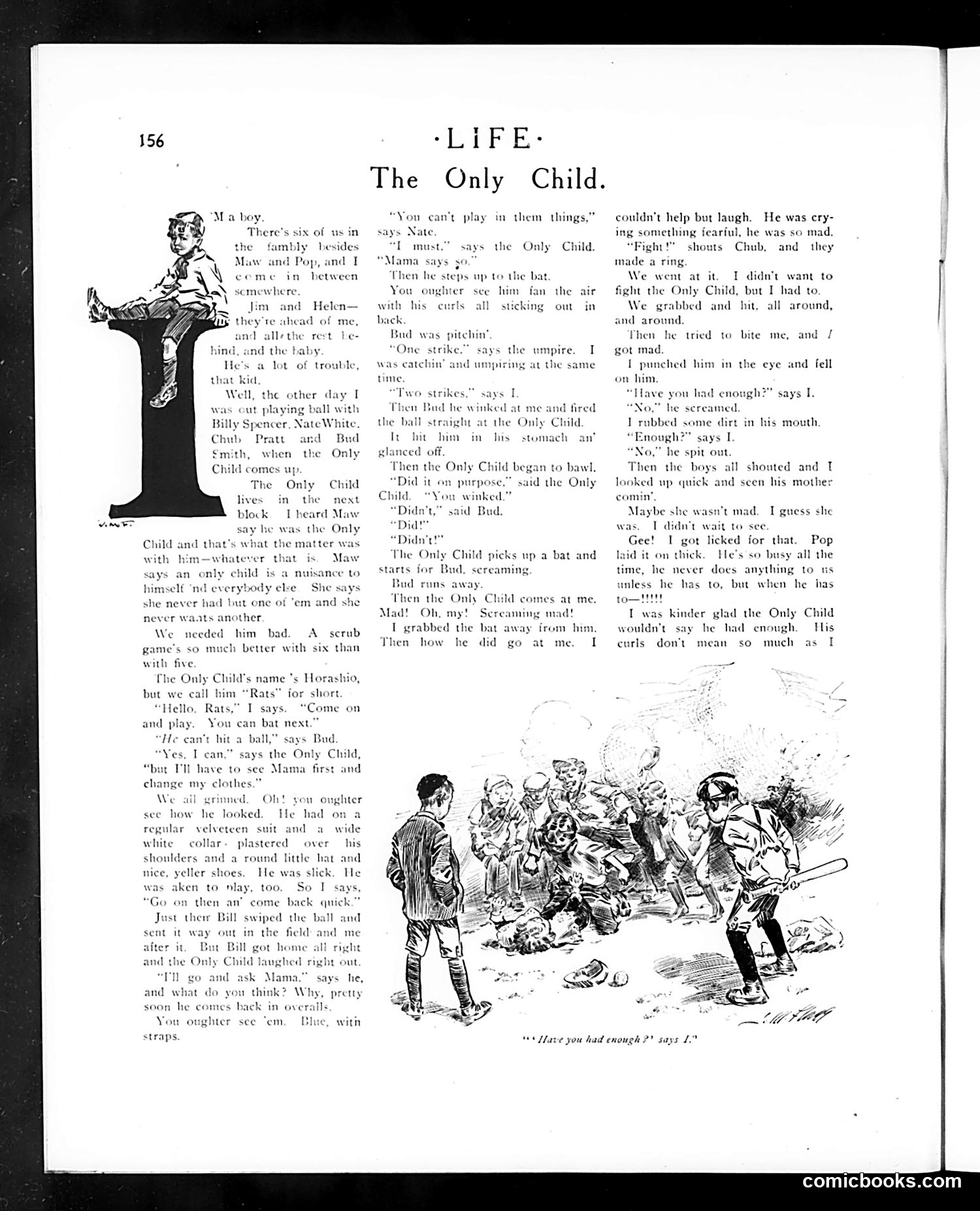
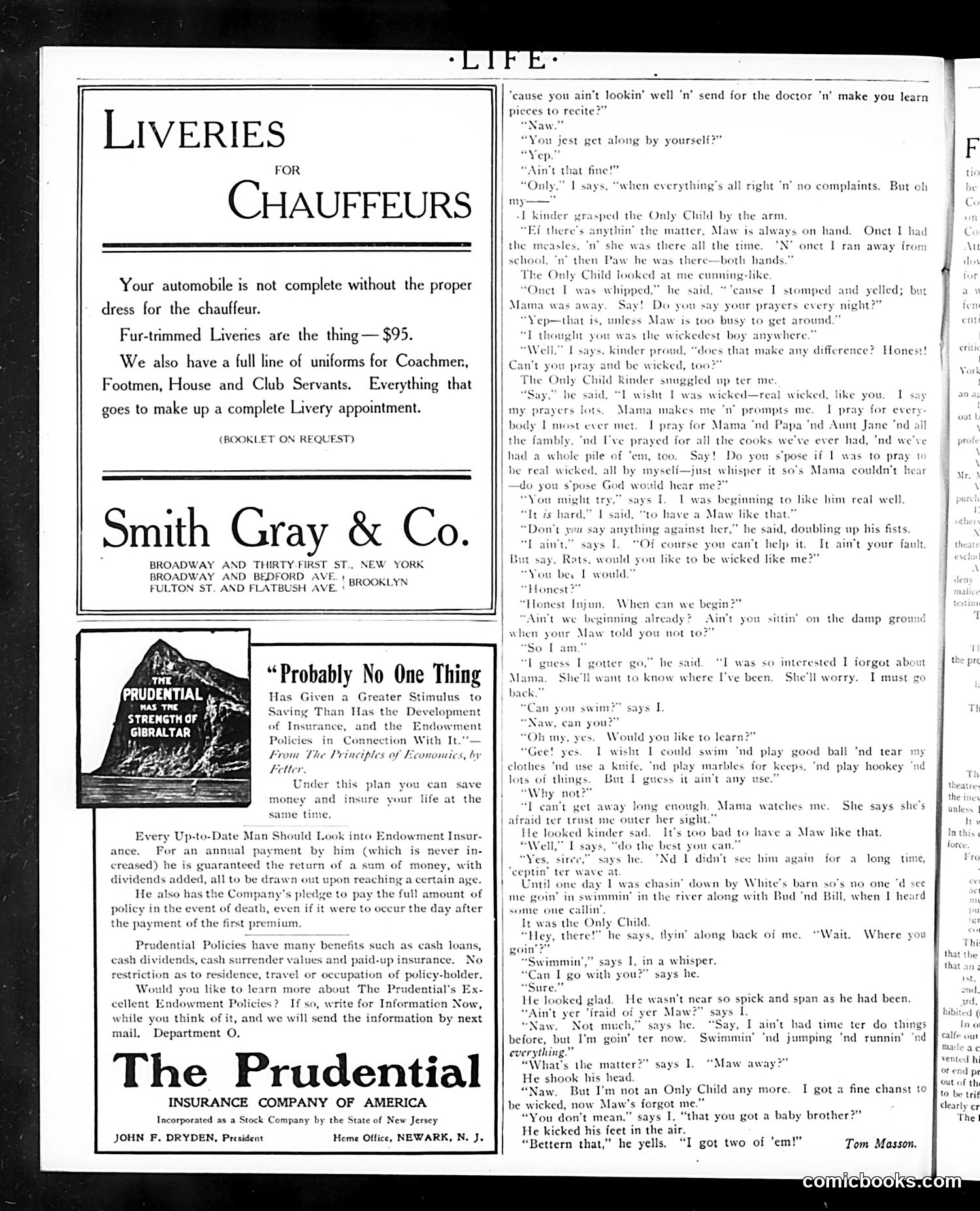
This story satirizes the social phenomenon of the "only child" — a relatively new concern in early 20th-century America as families grew smaller. The narrator, one of six children, contrasts his rough-and-tumble working-class upbringing with a wealthy neighbor boy named Horatio ("Rats"), the pampered only child. The satire targets upper-class parenting: Rats wears velvet suits and a fancy collar, is coddled by his mother, and lacks toughness. When the neighborhood boys invite him to play baseball, he's physically weak and emotionally fragile — he cries when hit by a pitch, attempts violence with a bat, and bites during a fight. The joke is that despite his advantages, Rats is actually *worse off* — undisciplined, weak, and insufferable. The working-class narrator's tough childhood has made him more capable. The final irony: the narrator gets punished by his father for fighting, yet feels *glad* Rats wouldn't surrender — validating his own harder upbringing as superior character-building.
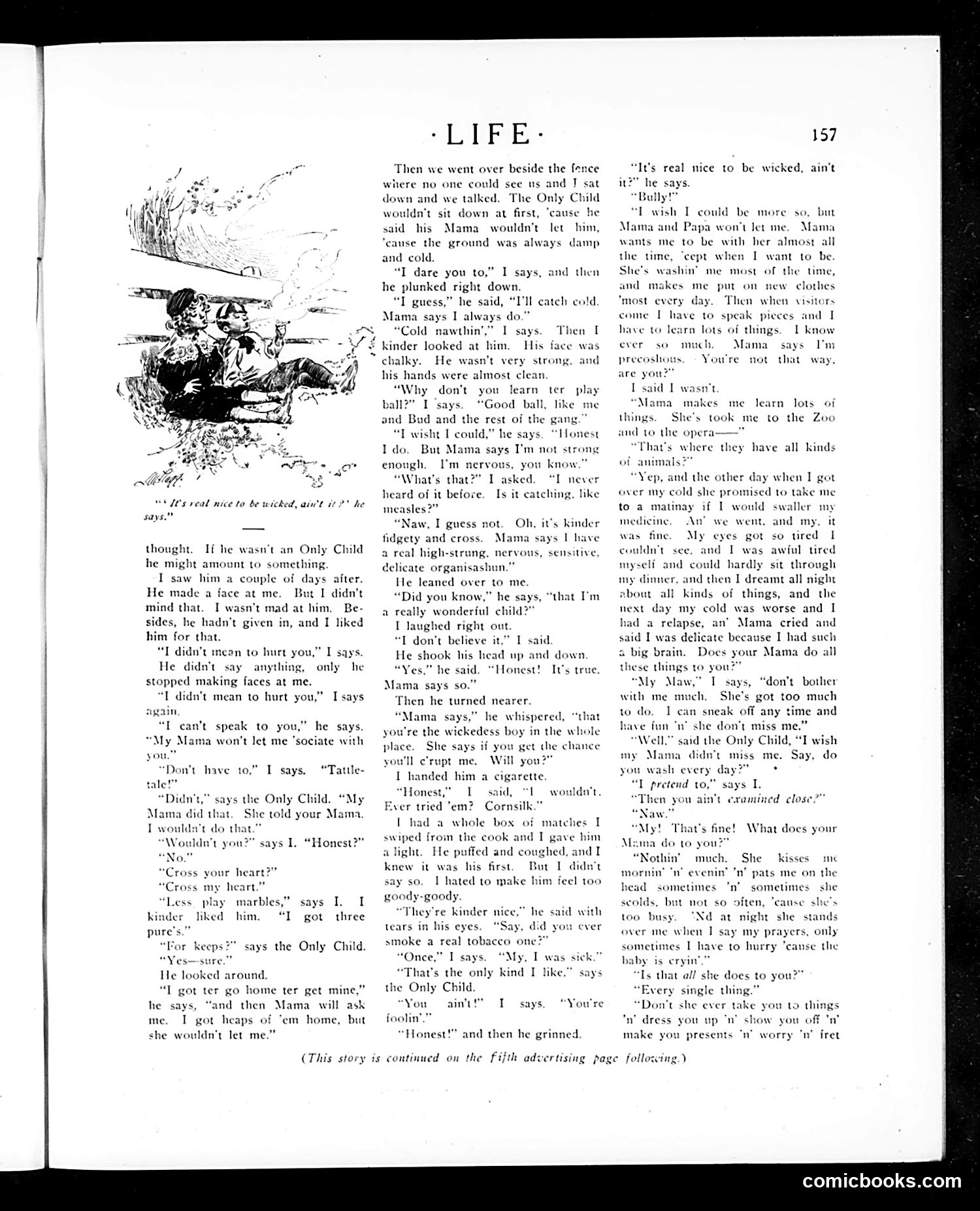
This page presents a narrative story about two boys—a narrator and an "Only Child"—establishing friendship despite class/social differences. The illustration shows them together by a fence. The satire targets **overprotective parenting and maternal coddling** of wealthy or privileged children. The "Only Child" is portrayed as physically weak, nervously controlled, and emotionally stunted by his mother's constant supervision, washing, dressing, and educational demands. He cannot play ball, must sit on clean surfaces, and cannot associate with the narrator without maternal permission. The irony is pointed: the "wickedest boy" (the working-class narrator) represents actual vitality and freedom, while the sheltered, "precious" only child—despite his advantages—is portrayed as pathetically constrained and corrupted by overindulgence rather than genuine mischief. The humor satirizes early-20th-century middle-class anxieties about child-rearing, suggesting that excessive protection produces nervous, delicate, dependent offspring rather than healthy children.
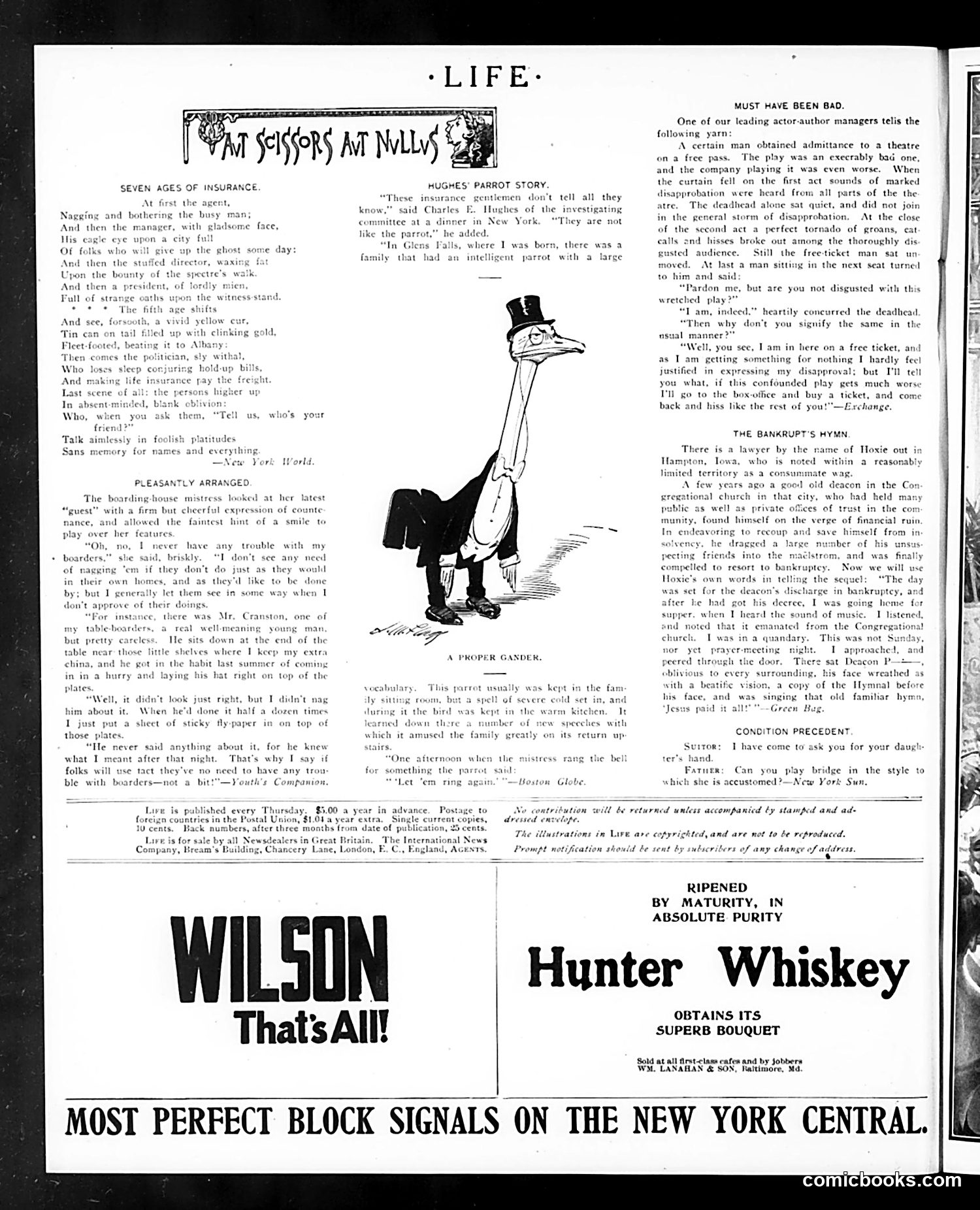
This page contains several satirical pieces typical of Life magazine's humor: **"A Proper Gander"** (main cartoon): A tall, thin man in formal dress stands awkwardly with what appears to be a large parrot. The accompanying text discusses a parrot kept in a family's kitchen that amused them upon its return upstairs—a simple domestic anecdote played for absurdist humor. **"Must Have Been Bad"**: A story about a man attending theater on a free pass who remains unmoved while others boo a terrible production. When questioned about his lack of protest, he explains he feels unjustified complaining about something obtained for nothing—only paying admission would justify his disapproval. This satirizes both theatrical quality and audience entitlement. **"The Bankrupt's Hymn"**: An anecdote about a deacon in Iowa who, facing financial ruin, drags friends into bankruptcy with him. The joke involves ironic timing—hearing hymn music upon his discharge. The page also includes advertisements for Wilson whiskey and New York Central railroad services. The satire targets theater culture, social hypocrisy, and financial mismanagement common to the era.
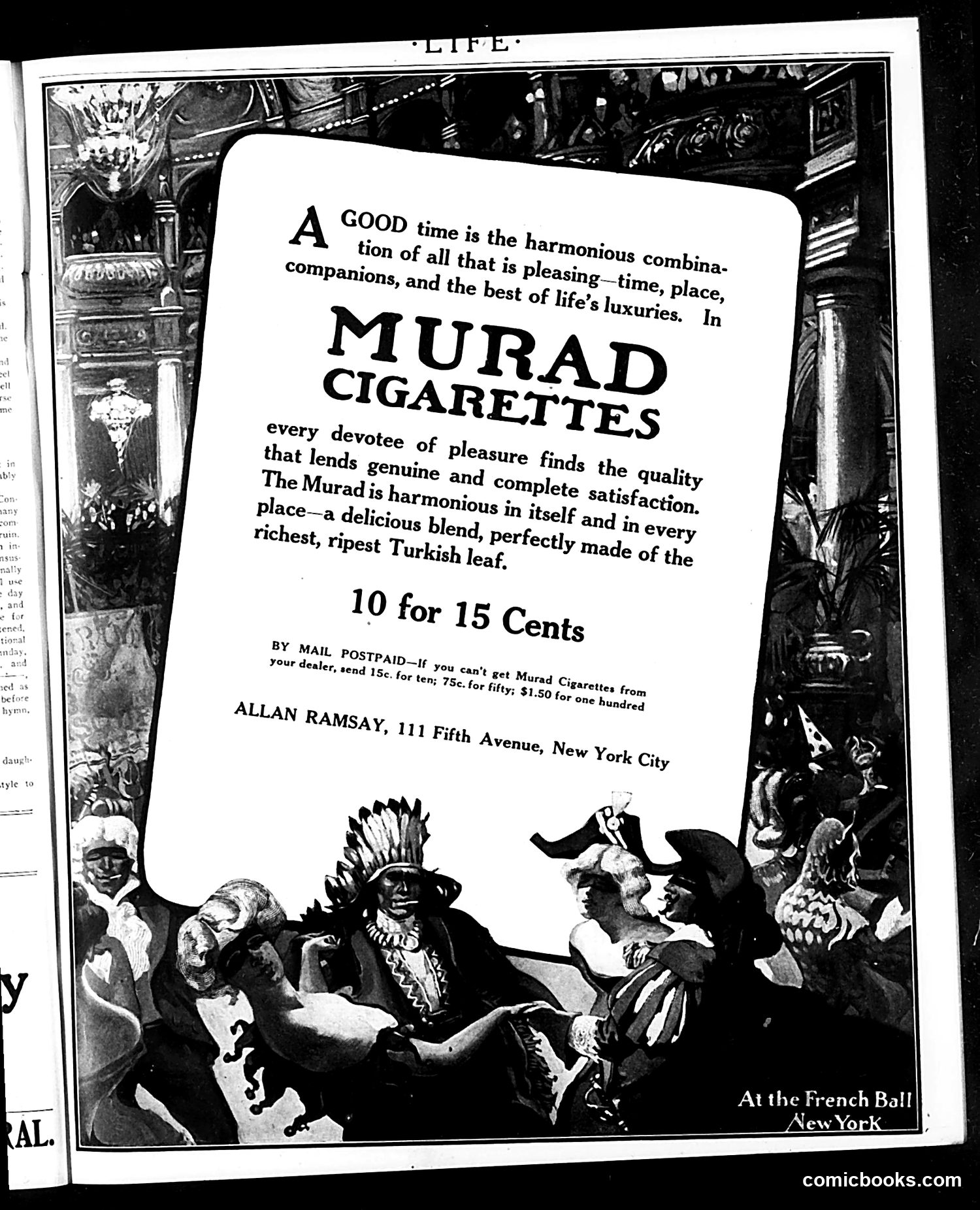
This is a **Murad Cigarettes advertisement**, not political satire. The ad uses an elaborate illustration labeled "At the French Ball, New York" showing figures in costume at what appears to be a masquerade or fancy dress ball. The text promotes Murad cigarettes as enhancing pleasure and good times, claiming they offer "genuine and complete satisfaction" made from "the richest, ripest Turkish leaf." The pricing is "10 for 15 Cents," with mail-order information from Allan Ramsay at 111 Fifth Avenue, New York City. The ornate ball scene is decorative rather than satirical—designed to associate the product with luxury, sophistication, and social enjoyment. This reflects early 20th-century advertising that linked cigarettes to aspirational lifestyles.
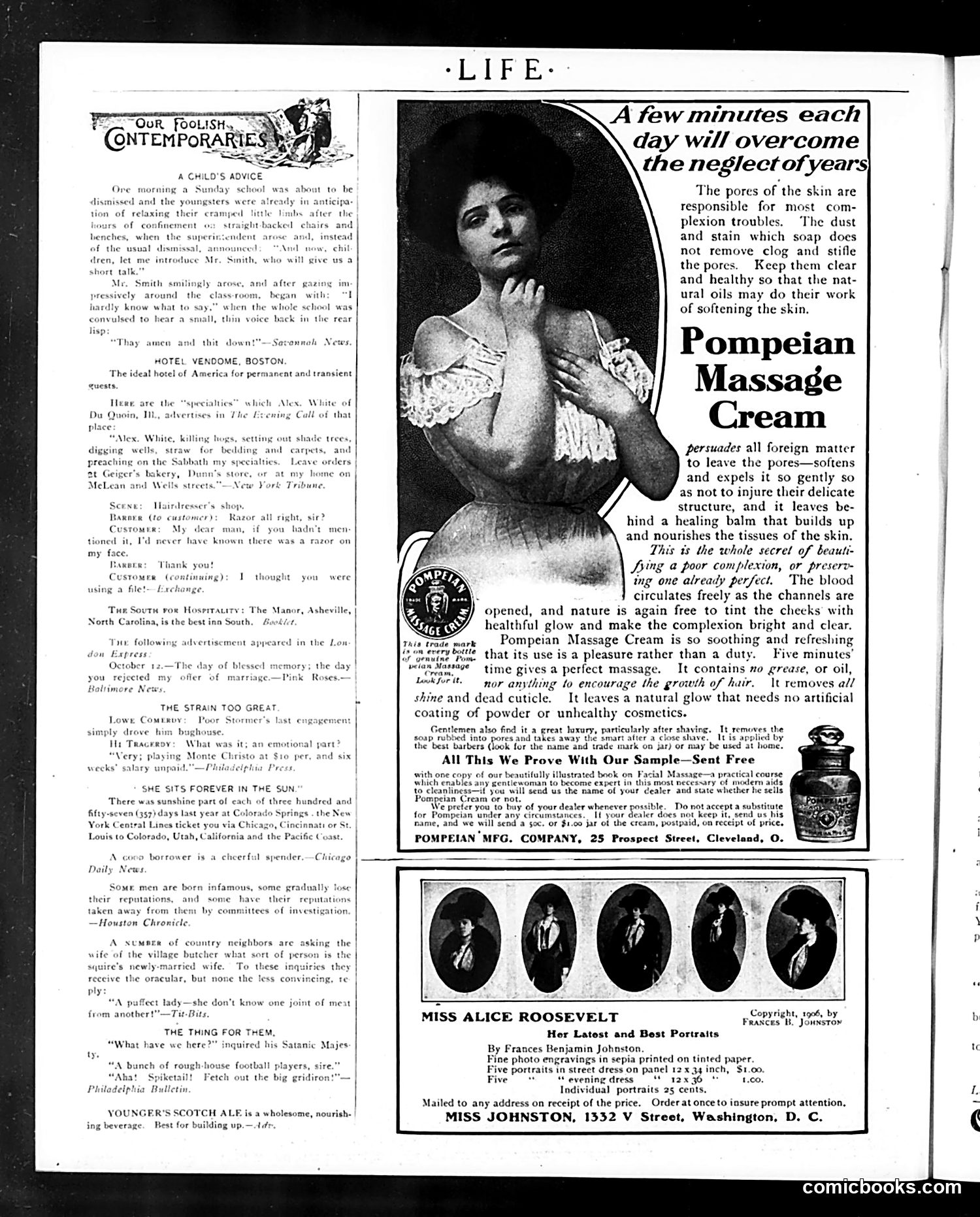
This page contains mostly **short humorous anecdotes and advertisements** rather than political cartoons. The left column features satirical "Foolish Contemporaries"—brief jokes mocking various people and situations. One anecdote depicts a Sunday school superintendent introducing a speaker, only to be interrupted by a child saying "Thay amen and that down!"—mocking the child's impatience with religious services. Other jokes target: a barber's poor technique, a hotel's mediocre amenities, and an actor's financial stress from unpaid wages. The **right side is dominated by a Pompeian Massage Cream advertisement** featuring a woman's portrait. The ad promises to unclog pores and improve complexion through massage, appealing to vanity and beauty anxieties of the era. Below is an advertisement for portrait photography services by Miss Johnston, featuring five oval photographs. The page reflects early 20th-century American concerns: religious propriety, working-class economic struggles, and emerging consumer beauty products marketed to women.
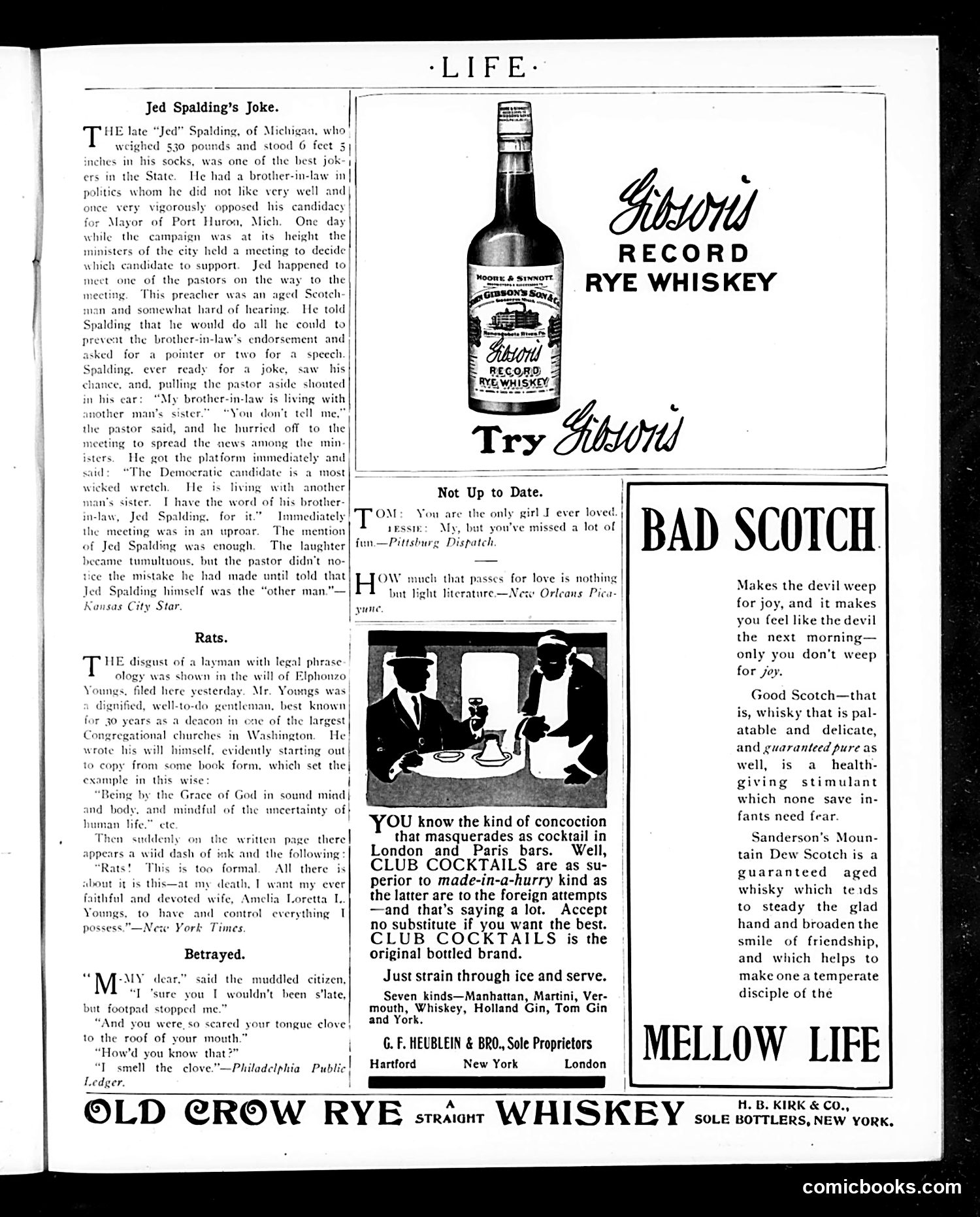
This Life magazine page contains humorous anecdotes and period advertisements. The main joke—"Jed Spalding's Joke"—concerns a prankster who deliberately misleads a hard-of-hearing pastor by claiming his brother-in-law is "living with another man's sister" (implying scandal). The pastor, misunderstanding, spreads this as a political attack during a mayoral campaign, only to discover he's accused Jed himself—the intended target of the original insult. The humor relies on miscommunication and the pastor's gullibility. The other brief items mock pretension: a man's overly formal will, romantic clichés ("you've missed a lot of fun"), and a muddled citizen caught in an obvious lie about being late. The page is primarily **advertising**—featuring whiskey brands (Gibbons Record Rye, Old Crow Rye, Club Cocktails, Sanderson's Mountain Dew Scotch). A "Bad Scotch" advertisement humorously warns that poor whisky makes "the devil weep for joy," contrasting with good Scotch as a "health-giving stimulant" and aid to friendship—typical early 20th-century liquor marketing before Prohibition.
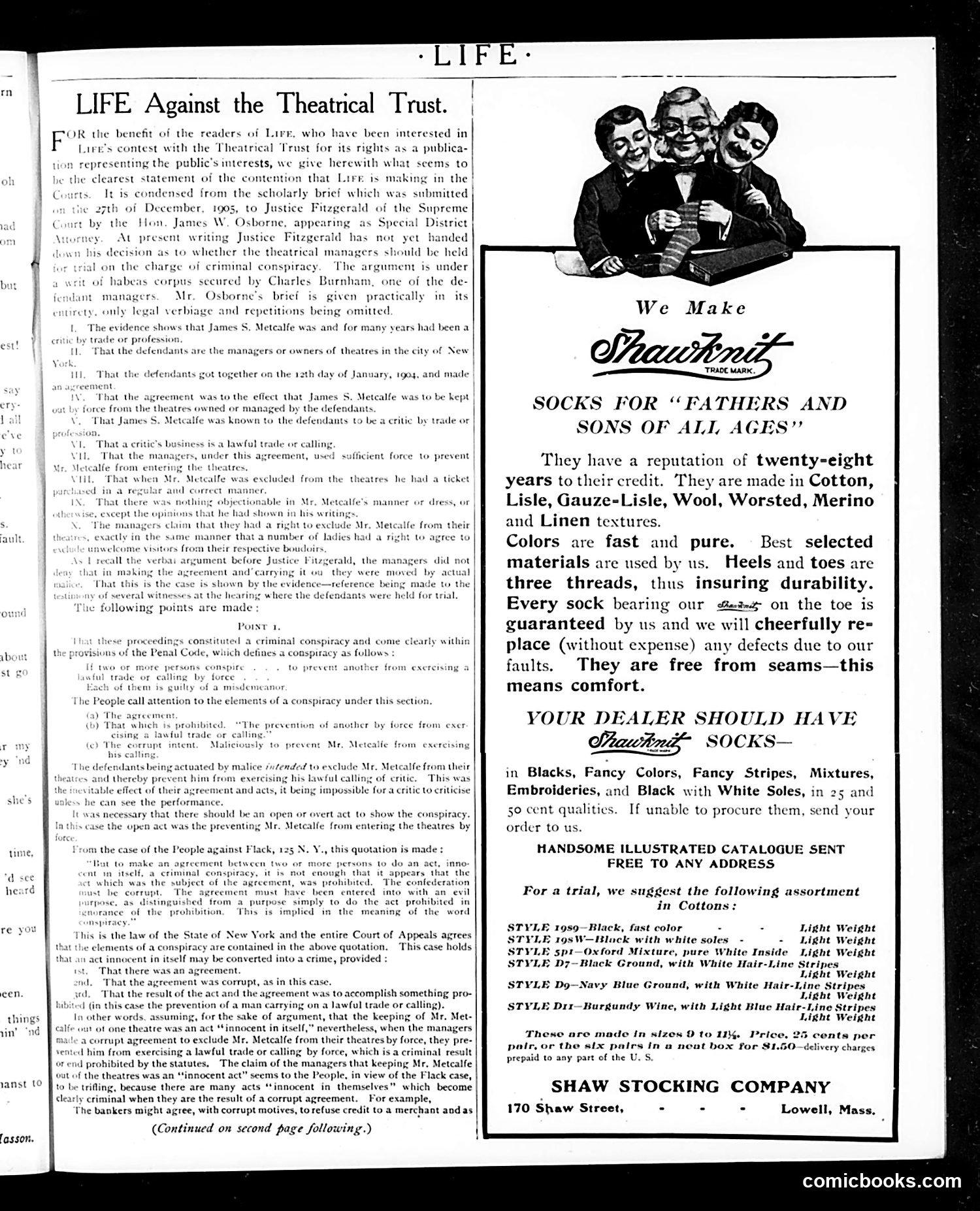
This page documents Life magazine's legal battle against the **Theatrical Trust**—a powerful cartel of New York theater owners and managers accused of conspiring to exclude drama critic **James S. Metcalfe** from their venues. The case centers on Metcalfe's exclusion beginning January 12, 1903. Life argues this constitutes criminal conspiracy: the theater managers collectively agreed to use force to prevent a critic from exercising his lawful profession, thereby preventing him from seeing performances necessary for his work. Life's argument emphasizes that while excluding someone from a private business might normally be legal, a *coordinated conspiracy* to eliminate someone's ability to earn their livelihood crosses into criminality. The page presents evidence and legal reasoning supporting this position before the courts. The right side is an unrelated advertisement for Shaw brand socks—typical magazine filler of the era.
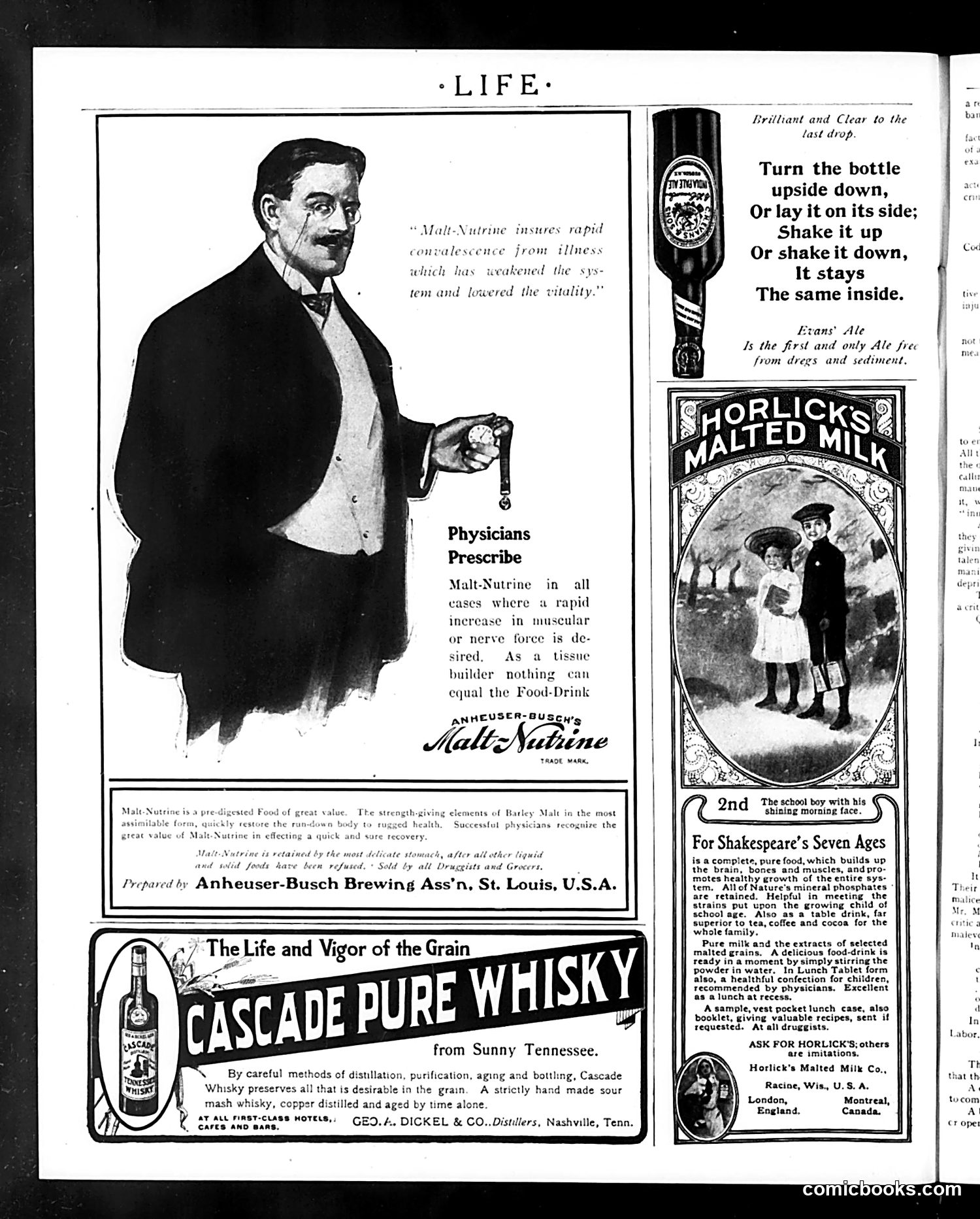
This page consists entirely of **patent medicine and alcohol advertisements** — common in early 20th-century American magazines. There is no political cartoon or satire here. The ads promote: 1. **Malt-Nutrine** (Anheuser-Busch) — marketed to physicians as a medicinal "food-drink" for convalescence and building strength, with a doctor endorsing it 2. **Evans' Ale** — claimed to be sediment-free 3. **Horlick's Malted Milk** — positioned as nutritious food for children and families 4. **Cascade Pure Whisky** — presented as a quality grain spirit These reflect the era when alcohol and patent medicines were legally sold with health claims (before FDA regulation). The doctor imagery and scientific language ("tissue builder," "mineral phosphates") gave these products medical credibility they likely didn't possess. Modern readers would recognize this as misleading health advertising that would be illegal today.
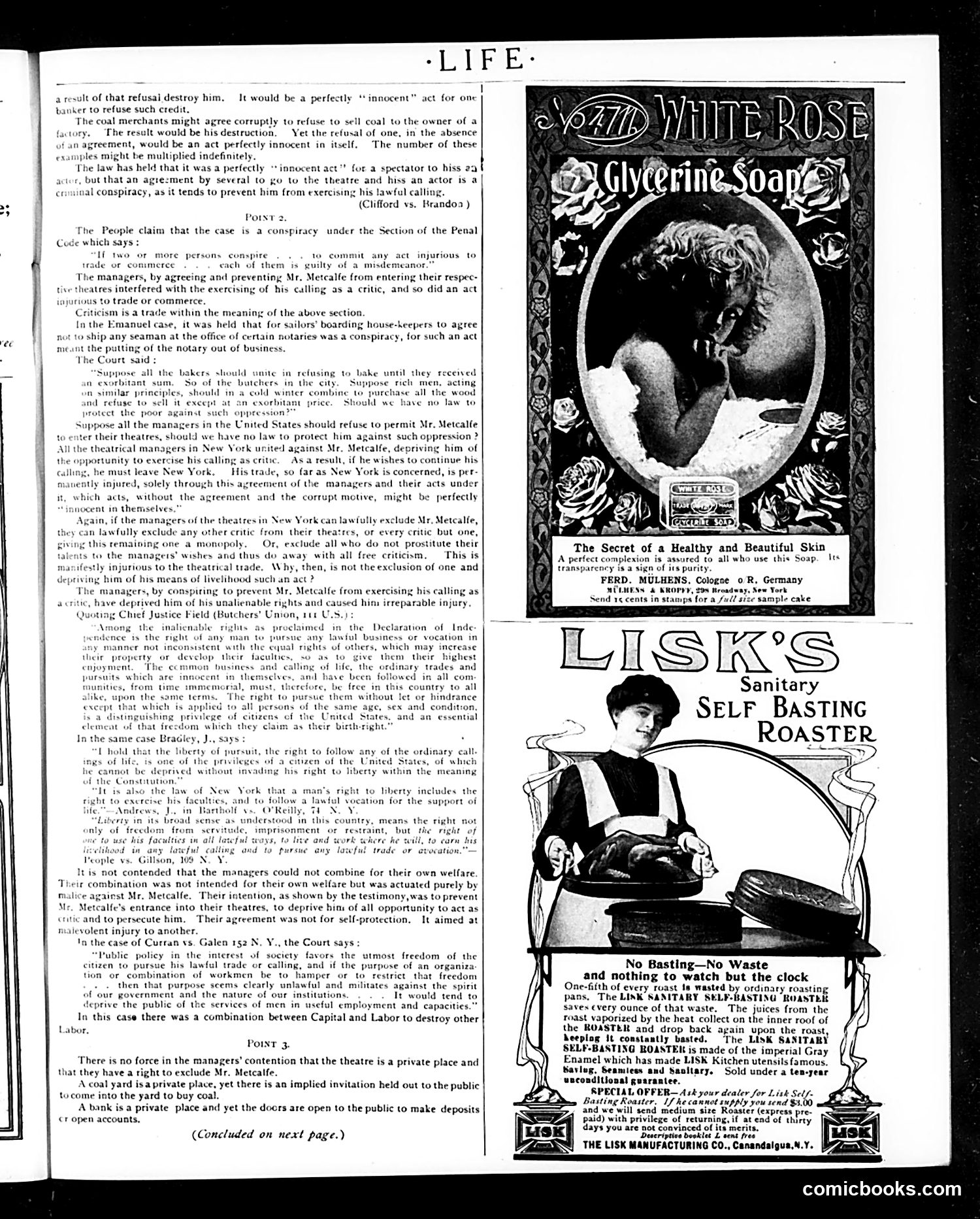
This page presents a legal argument about the "Metcalfe case"—a dispute over theatrical managers' right to exclude a drama critic from New York theaters. The text debates whether a coordinated boycott constitutes illegal conspiracy. The argument uses hypothetical scenarios (bakers refusing to bake, coal merchants withholding fuel) to illustrate that individual refusals are "innocent acts," but collective agreements to harm someone's livelihood constitute actionable conspiracy. The author argues that if managers can exclude one critic, they could exclude all critics or only those who praise them—destroying free criticism and fair trade. The two advertisements on the right (White Rose Glycerine Soap and Lisk's Self-Basting Roaster) are unrelated commercial content typical of Life's revenue model. The satire concerns monopolistic power: should business owners have absolute discretion, or does society need legal protection against coordinated exclusion that destroys someone's ability to work?
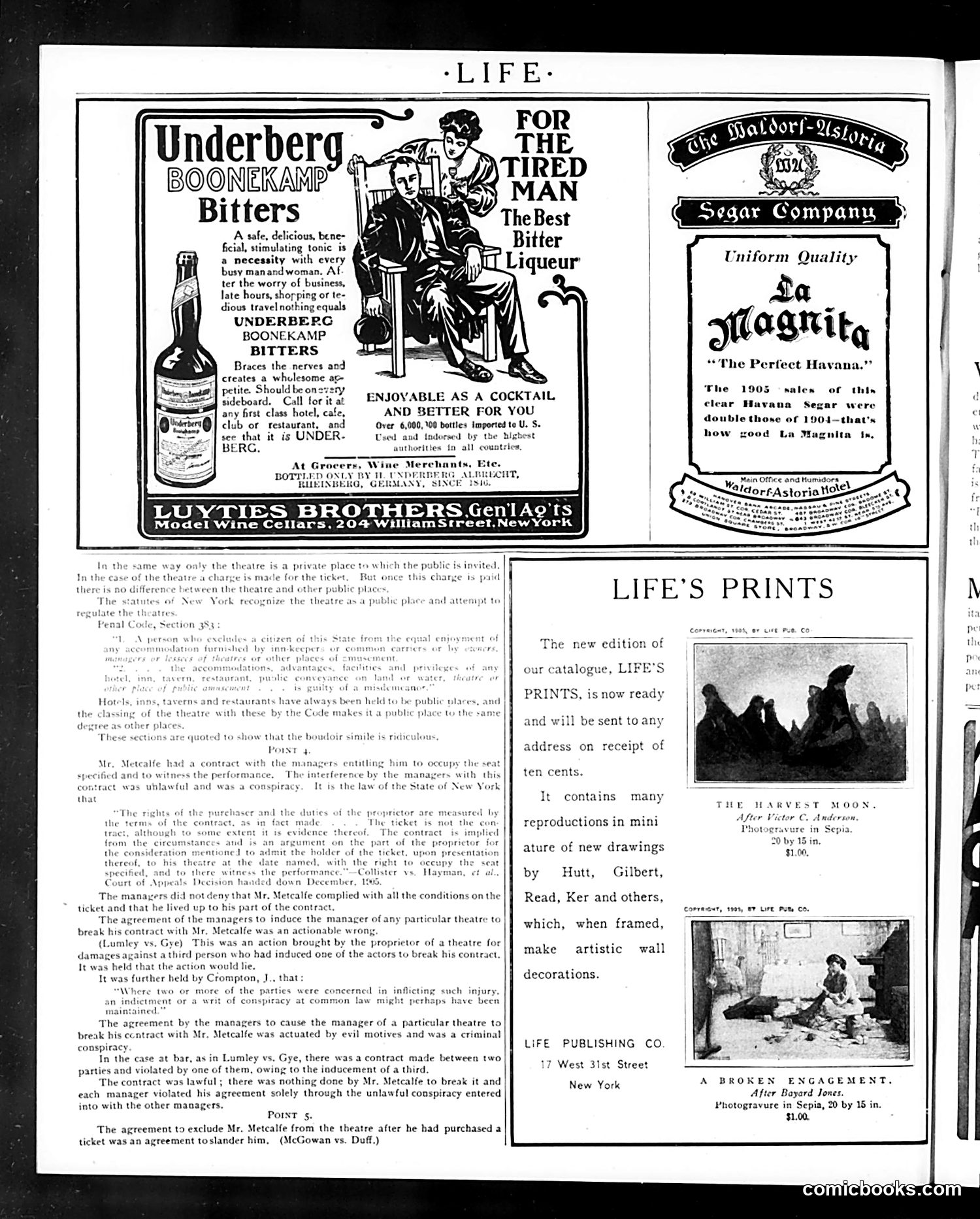
This page is primarily **advertising and promotional content**, not political satire. The top contains three product advertisements: Underberg Boonekamp Bitters (a digestive liqueur), La Magnita cigars, and Luyties Brothers wine merchants. These use typical early 1900s marketing—the bitters ad features a well-dressed man being attended to, positioning the product as a tonic for busy professionals. The majority of the page consists of **legal commentary** discussing theater contract disputes, specifically referencing cases like *Lumley vs. Gye* and *McGowan vs. Duff*. This appears to be educational content about contract law and conspiracy, not satire. The bottom advertises **Life's Prints catalog**—reproductions of drawings by artists including Hutt and Gilbert, available for wall decoration at ten cents. Overall, this is a commercial/informational page rather than a satirical one, typical of Life's mixed-content format during this period.
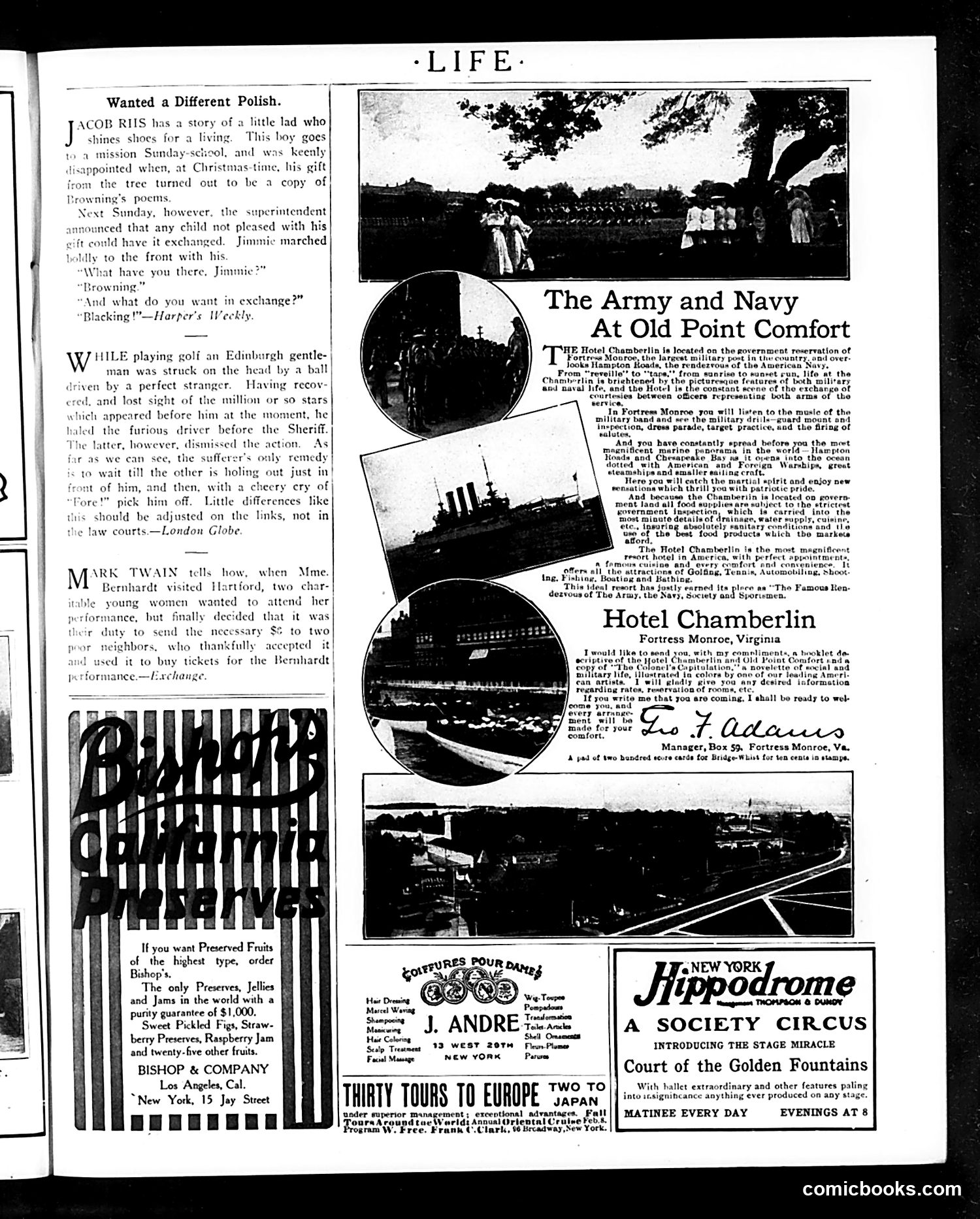
This page contains three brief satirical anecdotes ("Wanted a Different Polish," the golf incident, and the Mark Twain story) alongside advertisements and hotel promotions. **The Cartoons/Satire:** The anecdotes mock human expectations and entitlement. In "Wanted a Different Polish," a boy exchanges a gift of Browning's poems for shoe polish—suggesting the superintendent's well-intentioned but misjudged gift-exchange policy backfires. The golf story ridicules the absurdity of a gentleman seeking legal recourse for an accident, when the real remedy is simple revenge on the golf course. The Twain anecdote mocks false charity: wealthy women self-righteously avoid attending Bernhardt's performance themselves but donate money, congratulating themselves for supporting neighbors' attendance. **Social Context:** These reflect early 20th-century sensibilities about class pretension, gift-giving, and conspicuous benevolence. The humor depends on readers recognizing hypocrisy and unrealistic expectations in polite society. The page is primarily **advertisements** (Hotel Chamberlin, Bishop's Preserves, J. André salon) interspersed with these short humor pieces—typical of Life's format.
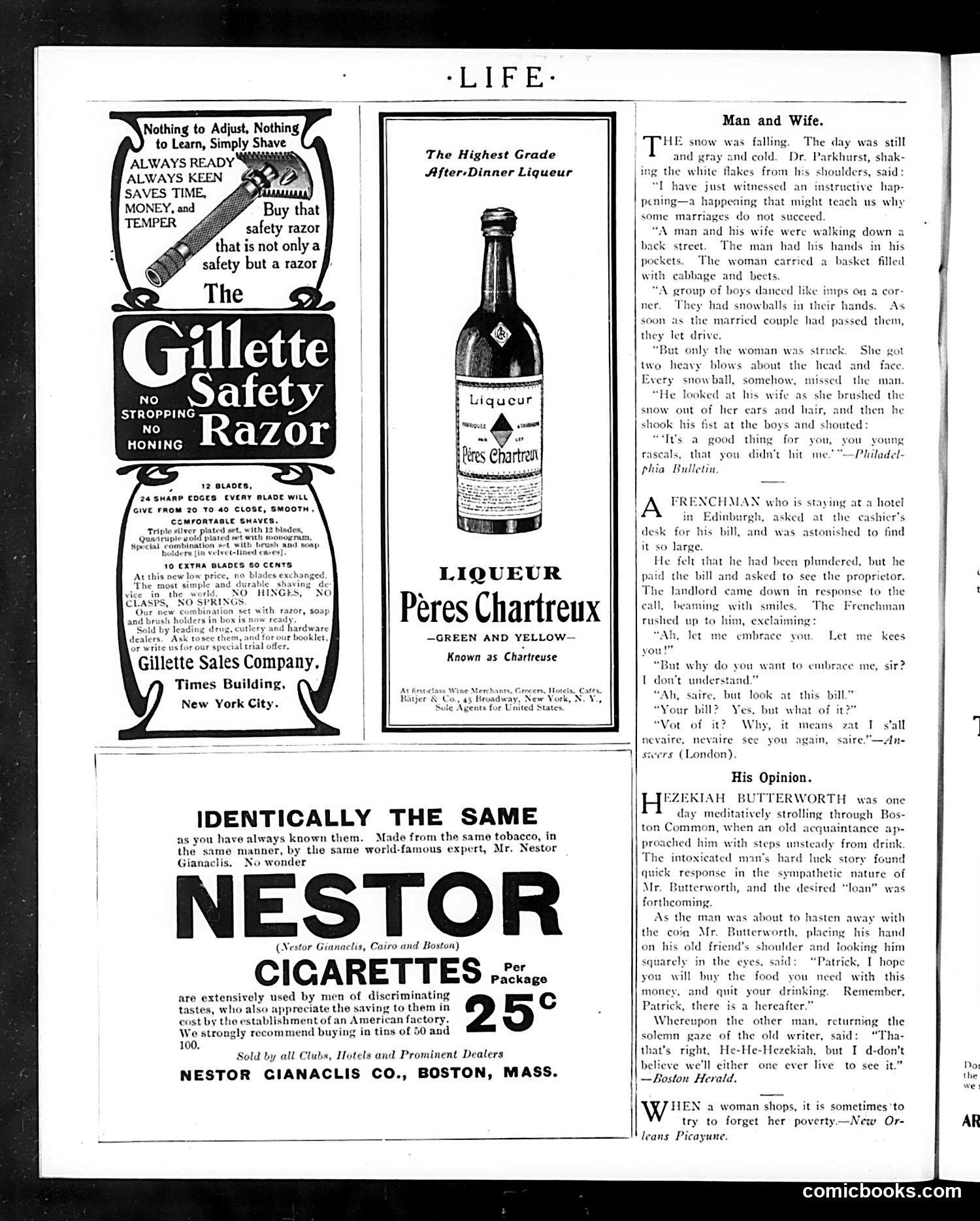
This page combines **advertisements with humorous anecdotes** rather than political cartoons. **The advertisements** promote: - Gillette Safety Razors (emphasizing convenience and quality) - Pères Chartreux liqueur (a French after-dinner drink) - Nestor Cigarettes (25¢ per package) **The humorous stories** include social commentary: 1. **"Man and Wife"**: A husband ignores his wife being hit by snowballs while protecting himself—satirizing marital indifference and male selfishness. 2. **"The Frenchman's Bill"**: A French hotel guest is shocked by an inflated Edinburgh bill, confusing the high cost with theft—poking fun at both French naiveté and Scottish hospitality pricing. 3. **"His Opinion"**: A drunk man asks Hezekiah Butterworth for money, expecting moral counsel. When offered salvation, the drunk cynically replies they'll "never live to see it"—darkly satirizing how charity often masks hopelessness rather than solving problems. These vignettes reflect early-20th-century American attitudes toward marriage, class, and social responsibility.
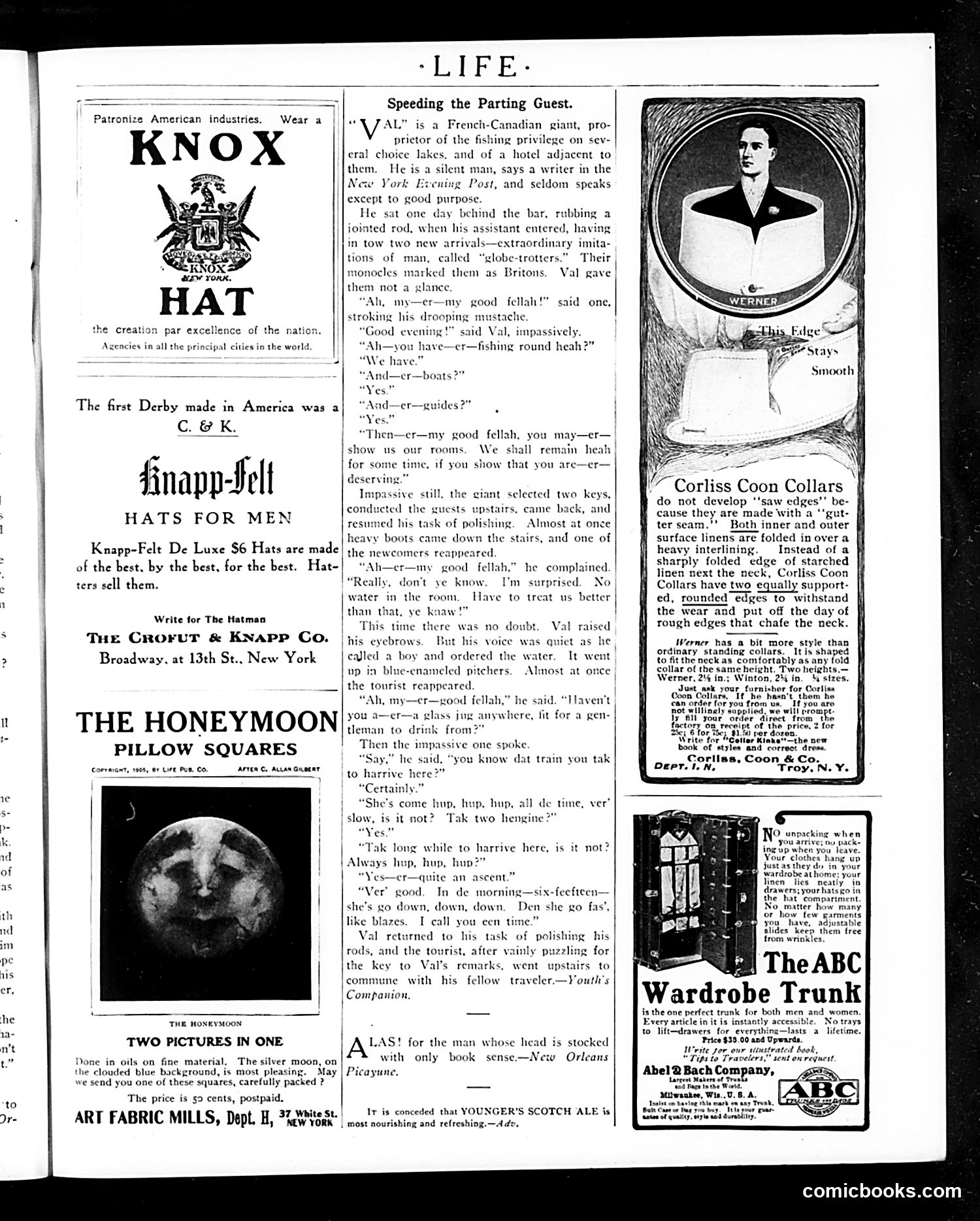
This satirical story mocks pretentious British tourists ("globe-trotters," identifiable by their monocles). Two pompous Englishmen arrive at a French-Canadian hotel owner Val's establishment, speaking in exaggerated affected manner ("my good fella," "er—er"). They make increasingly ridiculous demands: first fishing, then boats, then guides, then complain about water quality and demand a fancy drinking glass. Val, taciturn and patient, finally responds to their complaints with a deadpan speech about trains—comparing their complaints to a train's climb and descent, implying their behavior mirrors the locomotive's up-and-down rhythm. The joke: Val's oblique insult goes entirely over the tourists' heads; they puzzle over his remarks, unable to grasp they've been subtly mocked for their whining. The humor targets British affectation and American frontier practicality—Val's silent competence versus the tourists' verbal fussiness and entitlement.
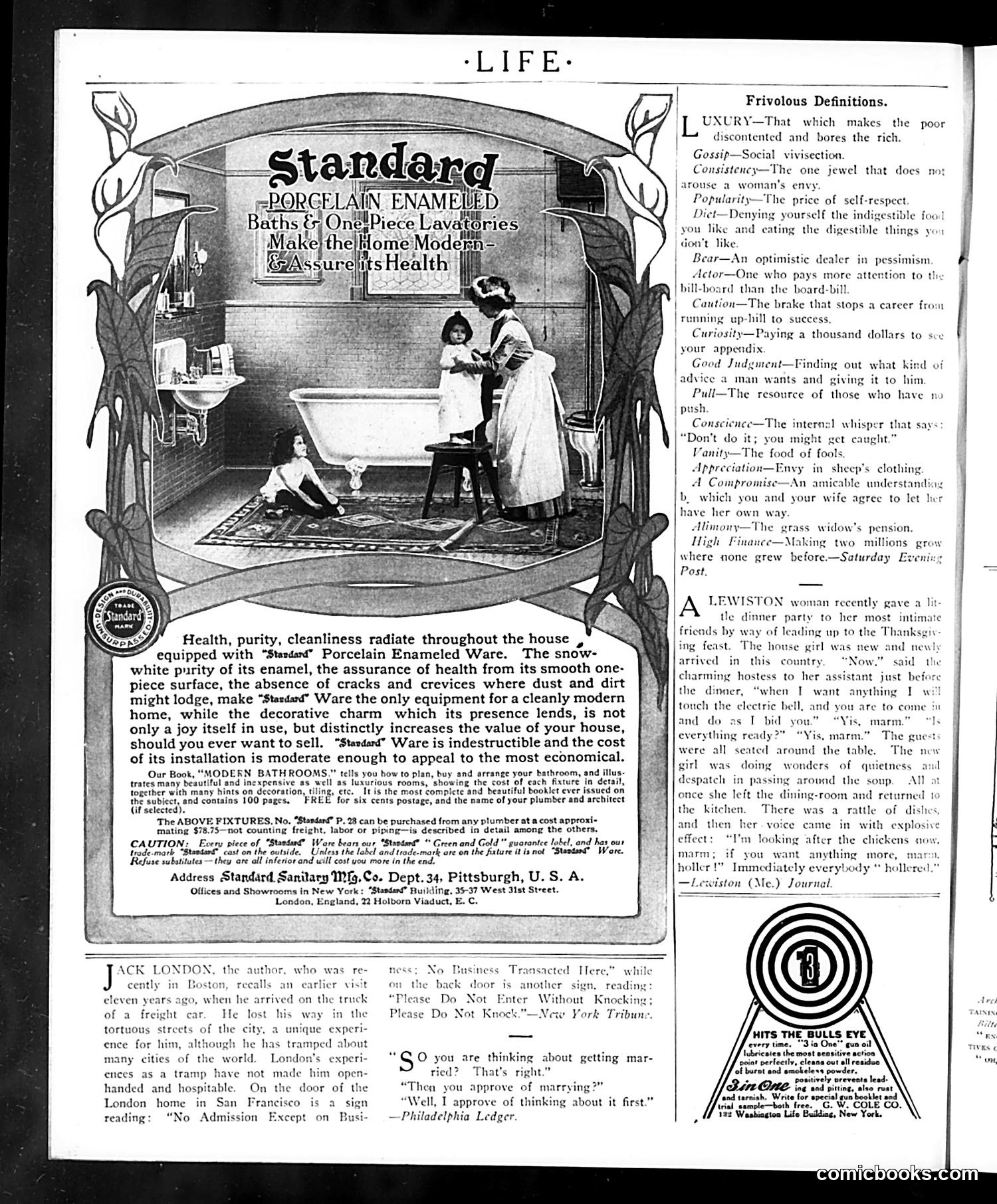
This page is primarily **advertising**, not political satire. The dominant content is a full-page advertisement for Standard Sanitary Manufacturing Company's porcelain enameled bathroom fixtures and bathtubs. The ad uses an idealized domestic scene showing a woman and child admiring modern plumbing as a sales pitch, emphasizing health, cleanliness, and home value—marketing tactics typical of early 20th-century consumer advertising. The right column contains "Frivolous Definitions"—humorous one-liners defining abstract concepts (luxury, gossip, consistency, etc.) in satirical ways. These are standalone jokes mocking social pretensions and human nature, not tied to current events. Below that appears a brief anecdote about a dinner party with a newly-hired immigrant servant girl, offering gentle domestic humor. **Bottom section** features unrelated items: a Jack London reminiscence about his travels, and a marriage joke from the Philadelphia Ledger. This is a typical Life magazine layout mixing advertising with miscellaneous humor and commentary—not a focused political or social satire piece.
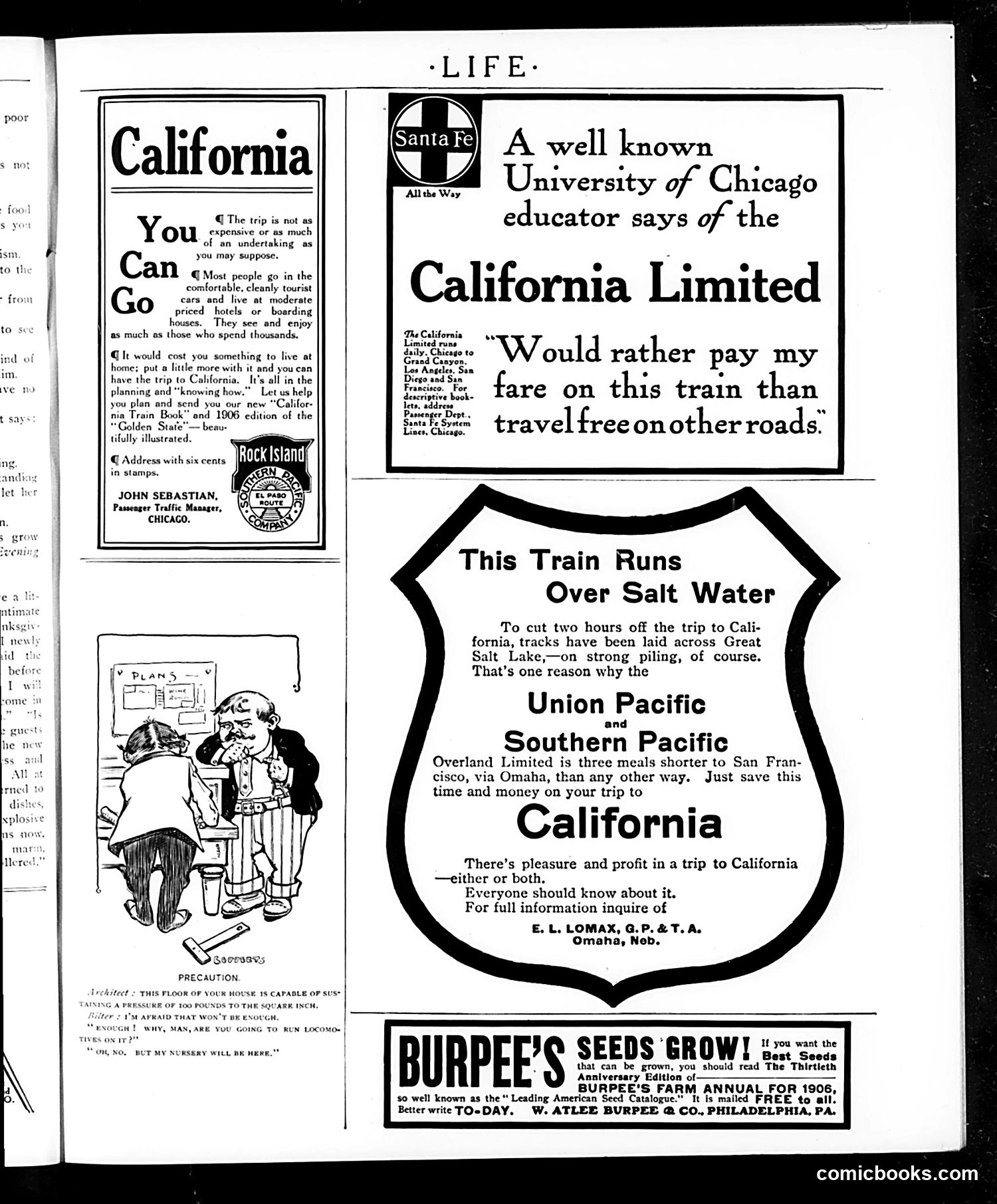
This page is primarily **advertising** for California travel and related products, with one small cartoon joke. The main cartoon (bottom left, labeled "Precaution") shows a conversation between two figures discussing floor structural capacity. One says the floor can handle 100 pounds per square inch; the other worries it won't be enough because "my nursery will be here"—implying a baby will add significant weight. The joke plays on anxiety about structural safety, likely reflecting early-1900s concerns about building construction standards. The page otherwise contains railroad advertisements promoting California travel via the California Limited (Rock Island line) and the Overland Limited (Union Pacific/Southern Pacific), emphasizing affordability and speed. A University of Chicago educator is quoted endorsing the California Limited. Additional ads promote Burpee's Seeds (1906 catalog) and railroad information from E.L. Lomax in Omaha. The page reflects turn-of-the-century American interest in western travel and commerce.
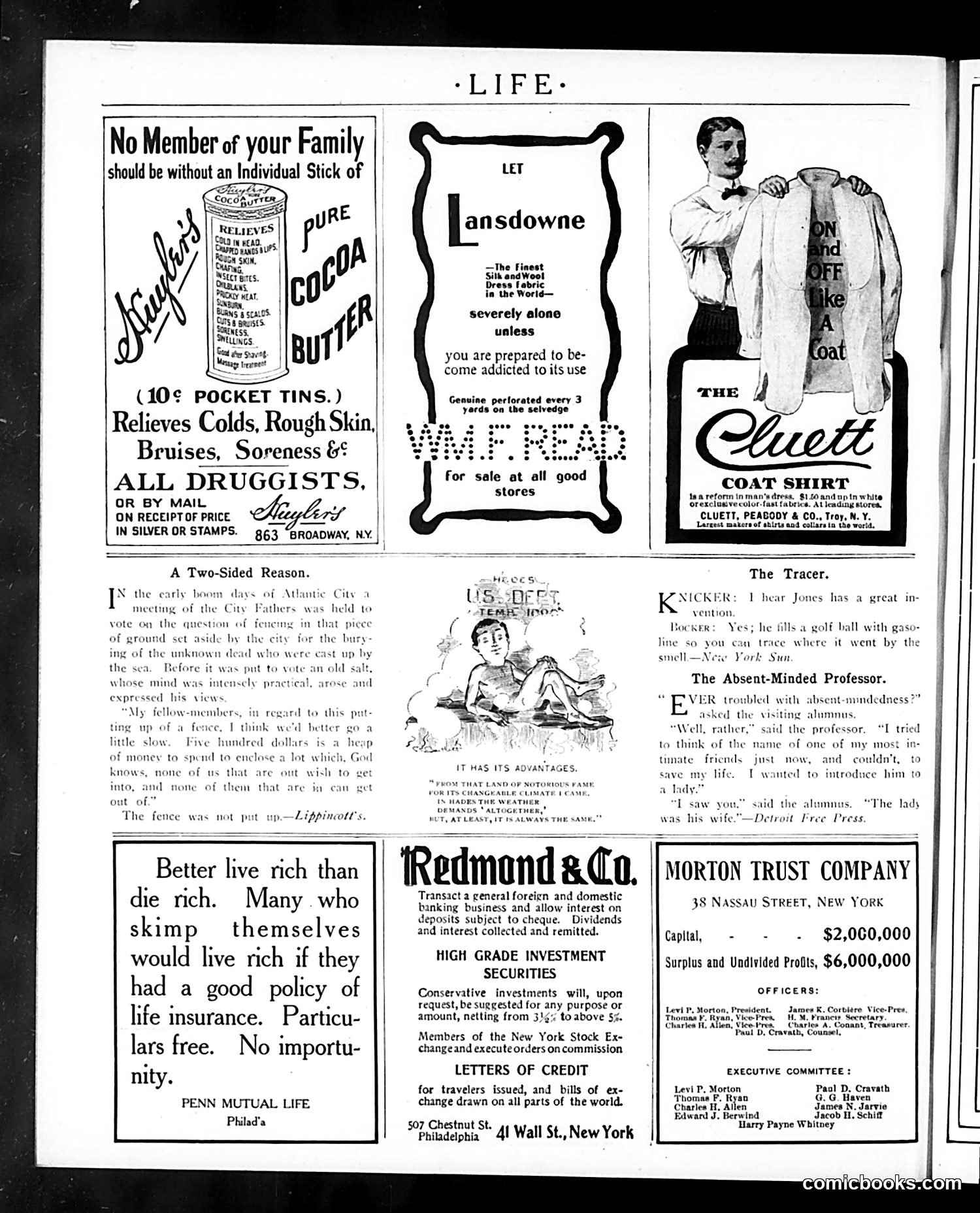
This page from *Life* magazine is primarily **advertisements and short humor pieces** rather than political cartoons. The advertisements promote period goods (Kemp's cocoa butter, Lansdowne fabric, Cluett dress shirts) and financial services (banking, insurance, investment firms). The humor pieces are brief comedic vignettes: "A Two-Sided Reason" recounts an Atlantic City city council debate about fencing a pauper's graveyard—a councilman argues it's pointless because the living don't want to visit and the dead can't escape. "The Tracer" jokes about a man tracing a golf ball by smell. "The Absent-Minded Professor" depicts a professor who forgets his own friend's name while introducing him to visitors, only to learn it was the man's wife. These are gentle, absurdist humor with no political content—typical of *Life*'s satirical but apolitical comedic style from this era.
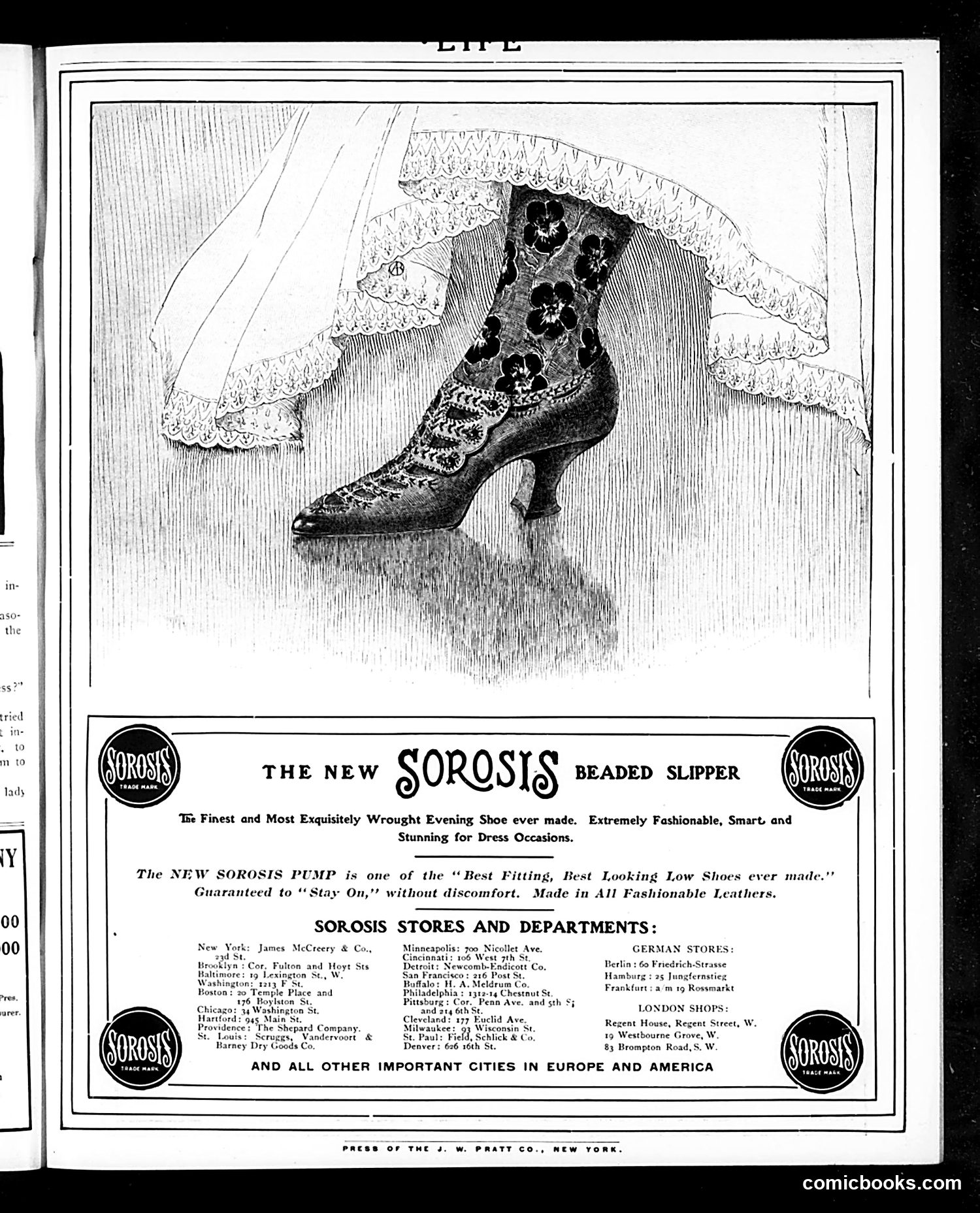
This is a **fashion advertisement**, not a cartoon or satire. It promotes Sorosis brand women's shoes—specifically a "beaded slipper" and "pump"—described as fashionable evening wear for dress occasions. The image shows an elegant women's shoe with beaded decoration and lace trim, positioned against a delicate lace background. The ad emphasizes the shoe's quality ("finest," "exquisitely wrought") and fit ("best fitting," "stays on"). The text lists Sorosis retail locations across major American cities (New York, Chicago, Boston, etc.) plus German and London shops, indicating this was a upscale, internationally-distributed brand aimed at affluent women concerned with fashionable footwear. There is no political satire or social commentary present—this is straightforward period advertising from Life magazine's commercial pages.
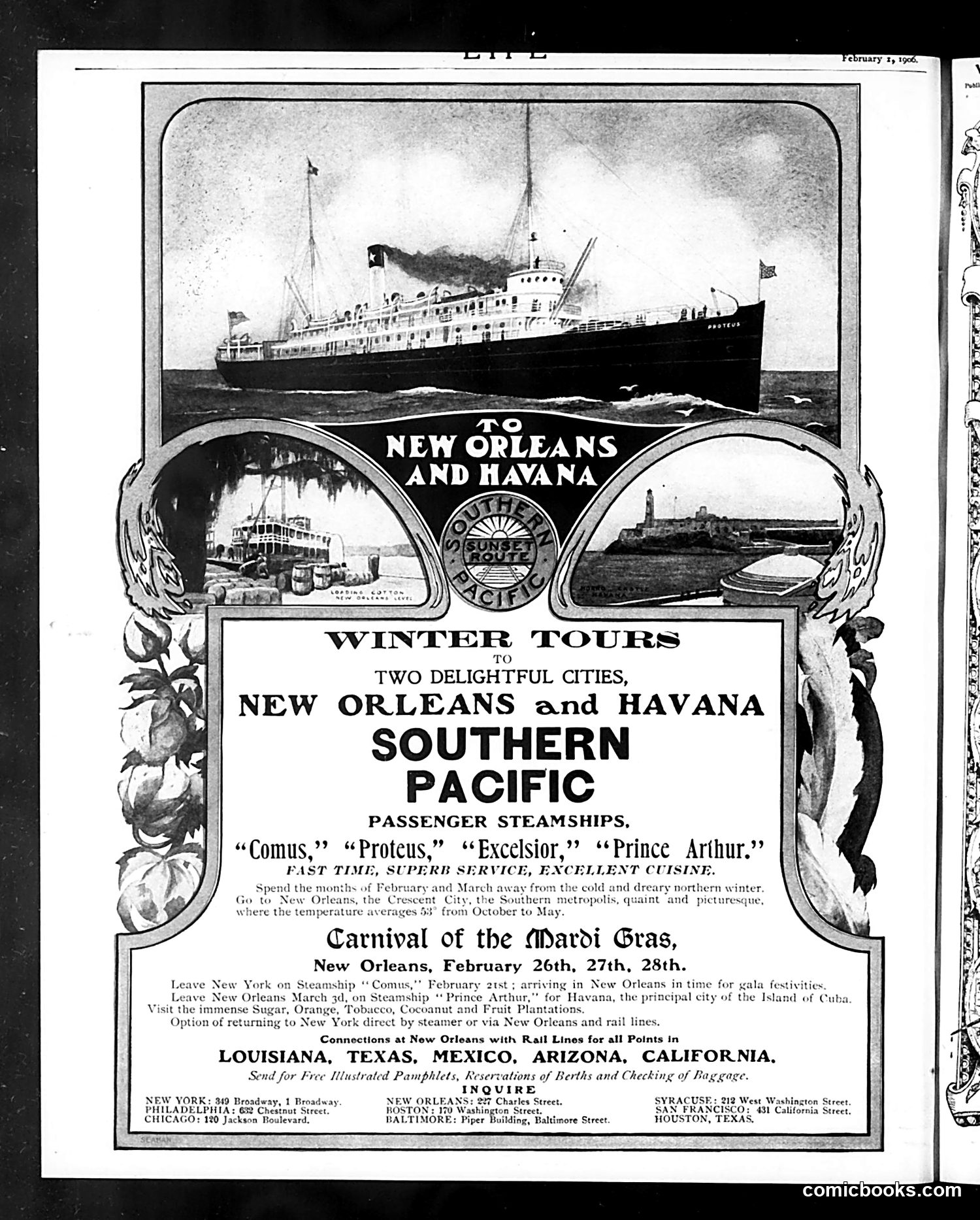
This is primarily a **travel advertisement**, not a political cartoon. It's a Southern Pacific steamship line promotion from Life magazine (February 1, 1906) advertising winter cruises to New Orleans and Havana. # What It Shows The ad features: - A large passenger steamship at top - Decorative vignettes showing dock scenes and coastal views - Ship names: *Comus*, *Proteus*, *Excelsior*, *Prince Arthur* - Promotional text emphasizing "fast time, superb service, excellent cuisine" - Details about catching Mardi Gras (February 26-28) - Multiple office addresses for booking # The Appeal to Readers This targets wealthy northerners seeking winter escape from cold weather to "two delightful cities." The emphasis on the Carnival of the Mardi Gras and exotic Cuban sugar/tobacco plantations suggests leisure tourism to glamorous, warm destinations—luxury travel marketing typical of the Gilded Age era.