
Life, 1906-02-01 · page 16 of 48
Life — February 1, 1906 — page 16: what you’re looking at
What you’re looking at
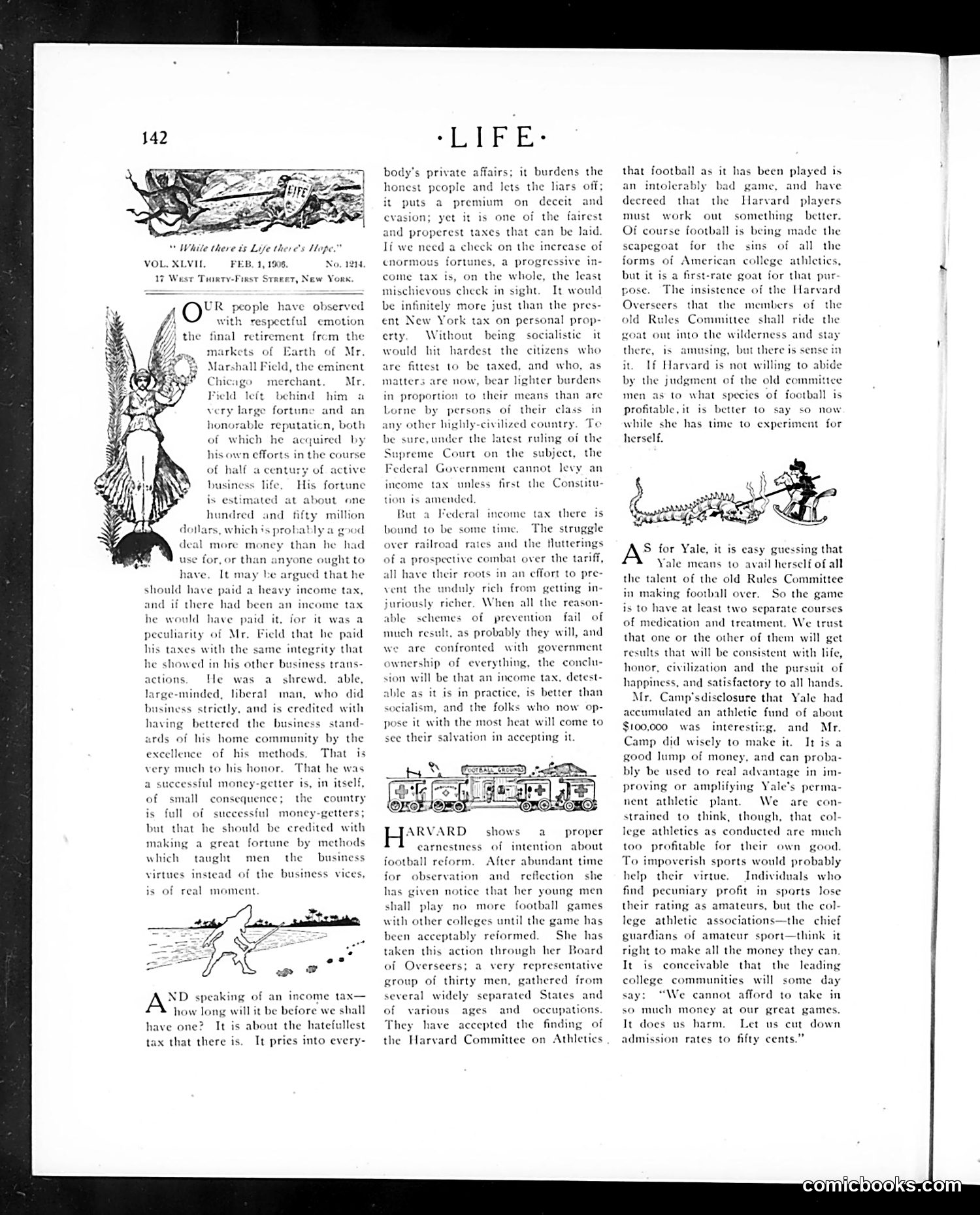
This page discusses three topics: Marshall Field's retirement, income taxation, and Harvard's football reform. The **Marshall Field section** praises the Chicago merchant's ethical business practices and vast fortune (~$150 million), arguing that wealthy self-made men who accumulated fortunes through integrity deserve respect, though the author questions whether such enormous wealth should exist. The **income tax discussion** advocates for a progressive federal income tax as a check on excessive fortunes, arguing it's fairer than current property taxes. The author acknowledges socialist concerns but frames income taxation as preferable to government ownership of everything. The **Harvard section** applauds the university's commitment to football reform, noting its Board of Overseers (representing "thirty men, gathered from several widely separated States") has determined football "as it has been played is…probably bad" and will prohibit games until the sport is acceptably reformed. The cartoon illustrations (appearing to show animals and figures) complement these satirical critiques of wealth inequality and institutional reform.
📄 Transcribed text from this page (OCR, searchable)
Machine-transcribed from the original scan — historical spelling and the odd misread are preserved.
VOL. XLVIL. White there is Life there's Hope.” FEB. 1, 1908. No. 1214 17 West Trarty-Fiest Street, New York. xople have observed th respectful emotion nal retirement from the of Mr. Marshall Field, the eminent merchant Mr. behind him a > fortune and an honorable reputaticn, both 4 OCR w markets of Eart Chicago Field left very larg of which he acquired by his own efforts in the course of active His fortune is estimated at about one hundred and fifty million of half a centu; lusiness life. dollars, which és probably a good deal more money than he had use for, or than anyone ought to have. It may be argued that he should have paid a heavy income and if there had been an income t he would have paid it, ior it was a field that he his taxes with the same integrity that peculiarity of Mr. he showed in his other business trans- shrewd, able, who did actions. He was a urge-minded, liberal man, business strictly, and is credited with having ards of his home community by the methods, That is That he w a successful money-getter is, in itsel| consequence; the country money-getters; credited with bettered the business stand- excellence of his his honor. very much of small is full of successful but that he should be making a great fortune by methods men the business which taught virtues instead of the business vices, real moment ND speaking of an income t how long will it be before we shall It is about the hatefullest It pries into every- have one? that there is. “LEE body's private affairs; it burdens the honest people and lets the liars off; on deceit and it puts a ; yet it is one of the fairest premium cvasio 1 properest taxes that can be laid ar lf we need a check on the increase of enormous fortunes, a progressive in- come tax is, on the whole, the least mischievous cheek in sight. It would be infinitely more just than the pres- ent New York tax on personal prop- erty. Without being socialistic it would hit hardest the who are fittest to be taxed, and who, as matters are now, bear lighter burdens citizens in proportion to their means than are Lorne by their ¢ i any other highly-civilized country. Te be sure, under the latest ruling of the he subject, the at levy an Constitu- persons of ass in urt on Supreme C Government first. the Federal ae income tax unless tion is amended. Federal income tax there is bound to be The struggle over railroad rates and the Hutterings ‘combat over the tariff, But a some time of a prospective all have their roots in an effort to pre- duly rich from getting in When all the reason- ail of vent the juriously richer schemes of prevention as probably they will, and with government able much res we are confronted ownership of everything, the conclu- sion will be that an income tax, detest- able as it is in practice, is better than socialism, and the folks who now op- pose it with the most heat will come to see their salvation in accepting it wile Poly, argh hia Gh aaars sear S ARVARD shows a proper earnestness of intention about After abundant time and reflection she football reform. for observation iven notice that her young men football has shall play no with other colleges until the game has ptably reformed. She has n through her Board very. representative more games been ace taken this act of Overseers; a group of thirty men, gathered from arated States several widely sey ages and occupations. epted the finding of of various They have ac the Harvard Committee on Athletics that football as it has been played is bly bad game, and have decreed that the Harvard must work out something Of course football is being made the scapegoat for the sins of all the forms of American college athletics, but it is a first-rate goat for that pur The insistence of the Harvard Overseers that the members of the old Rules Committee shall ride the goat out into the wilderness and stay an intole players better. pose. there, is amusing, but there is sense i it. If Harvard is not willing to abide by the judgment of the old comny men as to what species of footba profitable, it is better to say so while she has time to experiment for herself. now le, it is casy guessing that Yale means to avail herself of all the talent of the old Rules Committee in making football over. So the game is to have at least two separate courses of medication and treatment. We trust that one or the other of them will get results that will be consistent with life, honor, civilization and the pursuit of happiness, and satisfactory to all hands. Mr. Camp'sdisclosure that Yale had accumulated an athletic fund of about $100,000 interestizg, and Mr. Camp did wisely to make it. It is a good lump of money, and can proba was bly be used to real advantage in im- proving or amplifying Yale's pert nent athletic plant. We are con- strained to think, though, that col lege athletics as conducted are much too profitable for their own good. To impoverish sports would probably help their virtue. Individuals who find pecuniary profit in sparts lose their rating amateurs, but the col- lege athletic associations—the guardians of amateur sport—think it right to make all the money they can It is ble that the leading college communities will some day say: “We cannot afford to take in so much money at our great ga harm. Let us cut chief cone mes, It does us down admission rates to fifty cents.”