
Life, 1906-02-01 · page 39 of 48
Life — February 1, 1906 — page 39: what you’re looking at
What you’re looking at
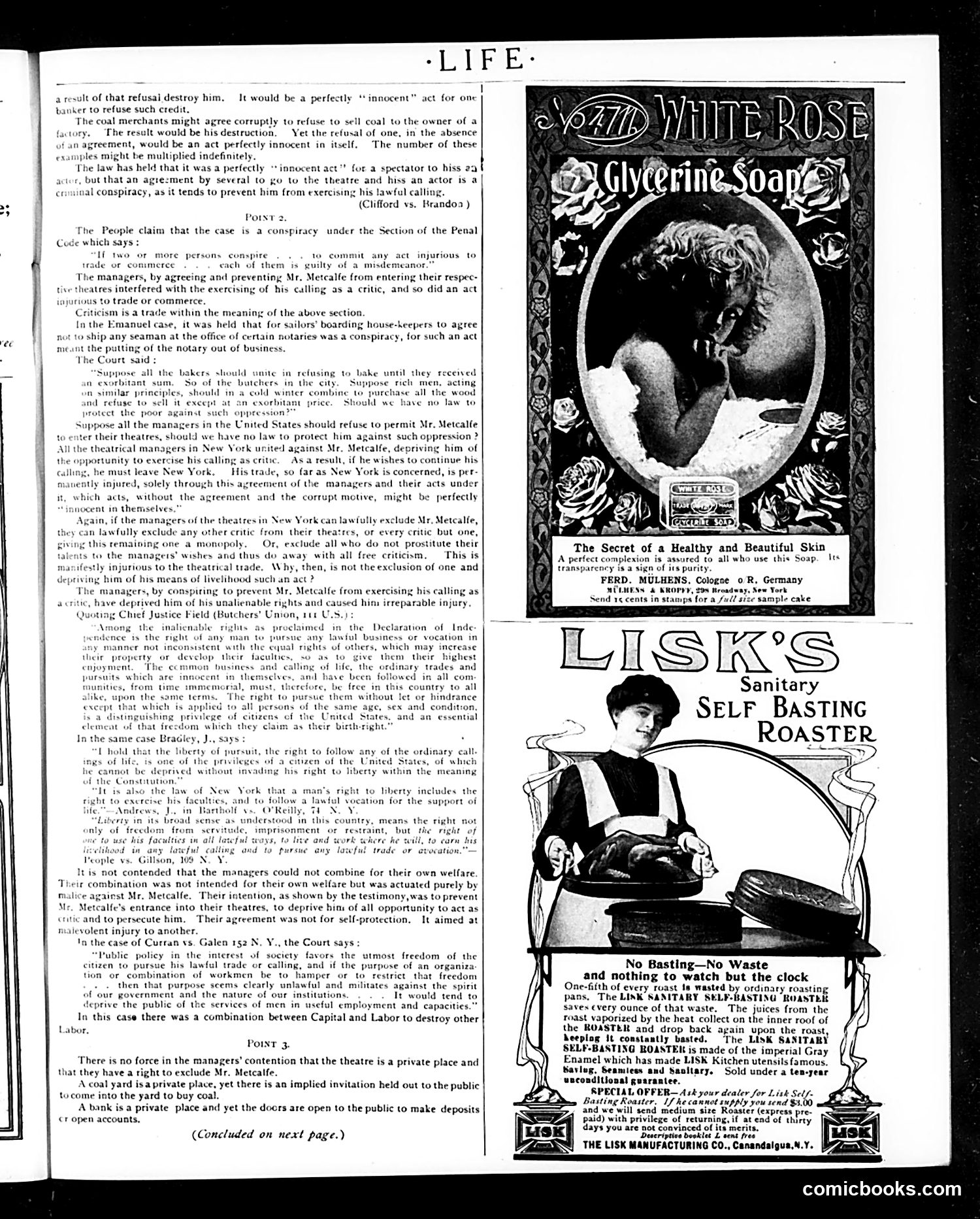
This page presents a legal argument about the "Metcalfe case"—a dispute over theatrical managers' right to exclude a drama critic from New York theaters. The text debates whether a coordinated boycott constitutes illegal conspiracy. The argument uses hypothetical scenarios (bakers refusing to bake, coal merchants withholding fuel) to illustrate that individual refusals are "innocent acts," but collective agreements to harm someone's livelihood constitute actionable conspiracy. The author argues that if managers can exclude one critic, they could exclude all critics or only those who praise them—destroying free criticism and fair trade. The two advertisements on the right (White Rose Glycerine Soap and Lisk's Self-Basting Roaster) are unrelated commercial content typical of Life's revenue model. The satire concerns monopolistic power: should business owners have absolute discretion, or does society need legal protection against coordinated exclusion that destroys someone's ability to work?
📄 Transcribed text from this page (OCR, searchable)
Machine-transcribed from the original scan — historical spelling and the odd misread are preserved.
a result of that refusal destroy him, It would be a perfectly “innocent” act for one panker to refuse such credit, The coal merchants might agree corruptly to refuse to sell coal to the owner of a The result would be his destruction, Yet the refusal of one, in the absence {an agreement, would be an act perfectly innocent in itself, The number of these csamples might be multiplied indefinitely. law has held that it was a perfectly “innocent act’ for a spectator to hiss 2a but that an agrezment by several to go to the theatre and hiss an actor is a al conspiracy, as it tends to prevent him from exercising his lawful calling. (Clifford vs, Brandoa ) Pott 2. ne People claim that the case is a conspiracy under the Section of the Penal Code which says : If 1wo or more persons conspire . . 5 10 commit any act injurious to le of conimerce cach of is guilty of a misdemeanor.” managers, by agreeing and preventing Mr. Metcalfe from entering their respec- tres interfered with the exercising of his calling as a critic, and so did an act injurious to trade or commerce. Criticism is a trade within the meaning of the above section. In the Emanuel case, it was held that for sailors’ boarding house-heepers to agree not to ship any seaman at the office of certain notaries was a conspiracy, for such an act meant the putting of the notary out of business. The Court said : Suppose all the bakers should unite in refw to bake until they + an exorbitant n. So of the butchers in the city, 5 lose rich me n similar principles, should in a cold win por all the wood nd refuse to sell it except 1 price. Should we have no law to protect the poor against such oppression Suppose all the managers in the United States should refuse to permit Mr, Metcalle to enter their theatres, should we have no law to protect him against such oppression > | the theatrical managers in New York united against Mr. Metcalfe, depriving him of pportunity to exercise his calling as critic. Asa result, if he wishes to continue his he must leave New York, His trade, so far as New York is concerned, is per- ntly injured, solely through this agreement of the managers and theie acts under which acts, without the agreement and the corrupt motive, might be perfectly yocent in themselves.” Again, if the managers of the theatres in New York can lawfully exclude Mr, Metealfe, y can lawfully exclude any other critic from their theatres, of every critic but one, ng this remaining a monopoly, Or, exclude all who do not prostitute their ats to the managers’ wishes and thus do away with all free criticism. — This is y injurious to the theatrical trade, Why, then, is not the exclusion of one and depriving him of his means of livelihood such an act > e managers, by conspiring to prevent Mr, Metcalfe from exercising his calling as tic, have deprived him of his unalienable rights and caused hin irreparable injury, | Quoting Chief Justice Field (Butchers' Union, rt U.S.) : \ the the Declaration of Inde en shits as. proclaimed cndence is the right of any man to purste any L ness of vocation in y manner not inconsistent he equal rights of others, which may increase their property or develop faculties, as to give them their highest enjo: The cemmon business and cal life, the ordinary trades and porsu which are innoc in themselves, and have been followed in all con tnunities, from time immemorial, must, therefore, be free in this country to a put le or hindrance nd condition, an essential alike, upon the same terms. The right to pursue thent w except that whieh is applied persons of the same sa distinguishing privilege of citizens of clement of that freedom which they claim In the same case Bracley, J., s I hold that the liberty of 1, the rig of life, is one of the a citizen of the Uni 1 be depe his right to liberty meaning f the Constituti “It is also the law of New "s right to liberty includes the right to exercise his facult a lawty n for the support ife.""—Andrews, J. in Ba aN Liberty in its bi sense und tood in this country, jn right y of freedom from serv iin a Veople vs It is not contended that the managers could not combine for their own welfare ‘Their combination was not intended for their own welfare but was actuated purely by malice against Mr. Metcalfe, Their intention, as shown by the testimony, was to prevent Mr. Metcalfe’s entrance into their theatres, to deprive hin: of all opportunity to act as d to persecute him, Their agreement was not for self-protection. It aimed at olent injury to another. 1a the case of Curran vs. Galen 152 N, Y., the Court says : ent or restraint, but the right of rk where he will, lawful trade oro ful ¢ Ison, 109 N Public policy in the interest of society favors the utmost freedom of the citizen to pursue his lawful trade or calling, and if the purpose of an organiza. tion or combinat: of workmen be to hamper or to restrict that freedom . . then purpose seems clearly unlawful and militates against the spirit of our government and the nature of our institutions. It would tend to deprive the public of the services of men in useful employment and capacities.” In this case there was a combination between Capital and Labor to destroy other Labor. Poixt 3. There is no force in the managers’ contention that the theatre is a private place and that they have a right to exclude Mr. Metcalfe. A coal yard isa private place, yet there is an implied invitation held out to the public tocome into the yard to buy coal. A bank isa private place and yet the doors are open to the public to make deposits Cr open accounts. (Concluded on next page.) The Secret of a Healthy and Beautiful Skin A perfect complexion is assured to all who use this Soap. transparency is a sign of its purity. FERD. MULHENS., Cologne oR, Germany ATLUEN 4 KROPPY, 208 troadway, Sew York Send r¢ cents in stamps for a full size sample cake Sanitary SELF_ BASTING ROASTER No Basting—No Waste and nothing to watch but the clock One-fifth of every roast 18 wasted by ordinary roasting pans, The LINK SANITARY SELF-BASTING ROASTEE saves Cvery ounce of that waste. The juices from the roast vaporized by the heat collect on the inner roof of the RUASTER and drop back again upon the roast Aeepiog it constantly tasted. The LINK SANITARY SELF-BASTING ROASTEK is made of the imperial Gray Enamel which has made LISK Kitchen utensils famous. Savlog, Seamiess and Sanitary. Sold under a ten-year unconditional guarantee. SPECIAL OFFER— Ask your dealer for Lisk Self- Basting Roaster. If he cannot supply you send $3.00 and we will send medium size Roaster (express pre- paid) with privilege of returning, if at end of thirty days you are not convinced of its merits. Descriptive booklet L sent free THE LISK MANUFACTURING CO., Canandalgua.N.Y. comicbooks.com