
Life, 1906-02-01 · page 28 of 48
Life — February 1, 1906 — page 28: what you’re looking at
What you’re looking at
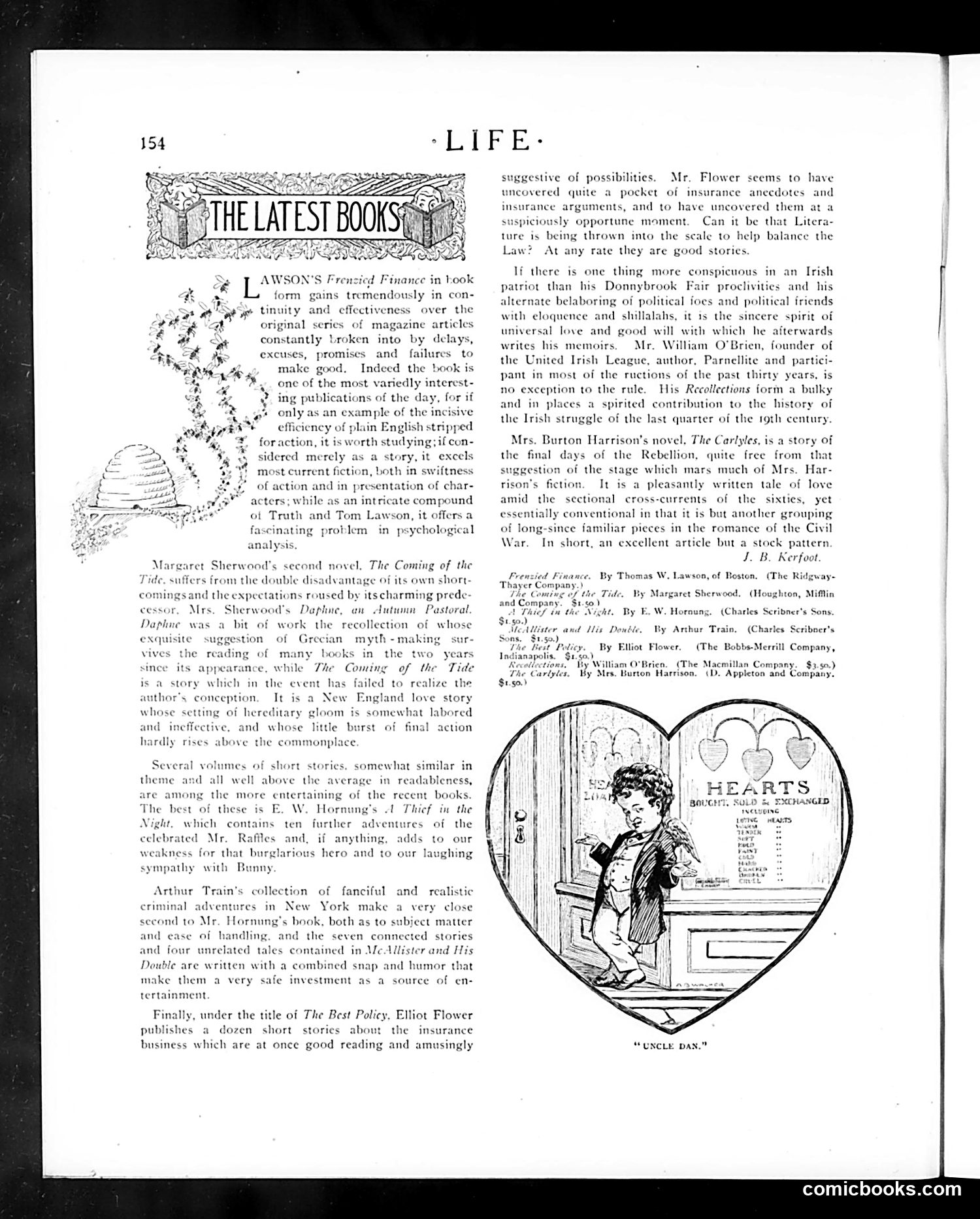
This is a book review page ("The Latest Books") from Life magazine, featuring literary criticism rather than political cartoons. The main illustration—a heart-shaped frame labeled "Uncle Dan's" showing a figure looking at a chart of "hearts bought, sold & exchanged"—appears to be a satirical advertisement or story illustration related to romantic commerce or matchmaking. The reviews discuss contemporary novels and short story collections, including works by Margaret Sherwood, E.W. Hornung (featuring the criminal character Raffles), and Arthur Train. One notable reference mentions **William O'Brien**, an Irish nationalist politician and founder of the United Irish League, whose memoir is reviewed here. The text humorously notes the Irish trait of combining political violence ("shillalahs") with sincere professions of goodwill when writing memoirs. The page represents typical early 20th-century American literary journalism, not political satire.
📄 Transcribed text from this page (OCR, searchable)
Machine-transcribed from the original scan — historical spelling and the odd misread are preserved.
ied Financ ins tremendously in con- > a ye tinuity and effectiveness over the a original series of magazine articles constantly broken into by delays, uses, promises and failures to make good. Indeed the book is one of the most variedly interest- ing publications of the day, for if only as an example of the incisive efficiency of plain English stripped for action, it is worth studying; if con- sidered merely as a story, it excels most current fiction, both in swiftness form g of action and in presentation of char- acters; while as an intricate compound ot Truth and Tom Lawson, it offers a fascinating problem in psyche gical analysis, ret Sherwood’s second novel, The Coming of the isadvantage of its own short- Tide. suffers from the doubl ingsand the expectations roused by its charming prede- cessor, Mrs. Sherwood's Dap Auton P storal. k the recollection of whose exquisite suggestion of Grecian) myth-making sur- Daphne was a dit of we vives the reading of many books in the two years since its appearance, while The Coming of the Tide is a story which in the event has failed to realize the author's conception. It is a New England love story whose s ng of hereditary gloom is somewhat labored le t hardly rises above the commonplace trst of final action and ineffective, and whose 1 Several volumes of short stories, somewhat similar in theme d all well above the average in readable ss, are among the more entertaining of the recent books. The best of these is E. W. Hornung’s <1 Thief in the Night, which contains ten further adventures of the celebrated Mr. Rafiles and, if anyth ng, adds to our weakness for that burglarious hero and to our laughing sympathy with Bunny Arthur Train’s collection of fanciful and realistic al adventures in New York make a very close second to Mr. Hornung’s hook, both as to subject matter 1 the seven connected stories and four unrelated tales contained in Me-lllister and His Double are written with a combined snap and humor that make them a very safe investment as a source of en- cr and ease of handling. tertainment Finally, under the title of The Best Policy, Elliot Flower publishes a dozen short stories about the insurance business which are at once good reading and amusingly LIFE suggestive of possibilities. Mr. Flower seems to have uncovered quite a pocket of insy dotes and insurance arguments, and to have uncovered them at a piciously opportune moment. Can it be that Lite ture is being thrown into the scale to help balance the Law? At any rate they are good stories. ance an If there is one thing more patriot than his Donnybrook alternate belaboring nspicuous in an Irish air proclivities and his i political foes and political friends with eloquence and shillalahs, it is the sincere spirit of universal love and good will with which he afterwards writes his memoirs. Mr. William O'Brien, founder of the United Irish League, author, Parnellite and partic pant in most of the ructions of the past thirty years, is no exception to the rule. His Recollections form a bulky and in places a spirited contribution to the history of the 19th century. the Irish struggle of the last quarter « Mrs. Burton Harrison's novel, The Carlyles, is a story of the final days of the Rebellion, quite free from that suggestion of the stage which mars much of Mrs. Har- rison’s fiction. It is a pleasantly written tale of love amid the sectional cross-currents of the sixties, yet essentially conventional in that it is but another grouping of long-since familiar pieces in the romance of the Civil War. In short, an excellent article but a stoc hayer Company.) and Company. $1.50) 1 Thief in the Night, By EW. Hornung. (Charles Scribner's Sons. $t.go.) WeAdtister and His D Sons. $1.50) Tie Best Policy. By Elliot Flower, (The Bobbs-Merrill Company, Indianapolis. $1.30.) diections. ty William O'Brien. (The Macmillan Company. $3.50.) Carlyles, By Mes. Burton Harrison. (D. Appleton and Company. as W, Lawson, of Boston, (The Ridgway- By Margaret Sherwood, (Houghton, MifMin Ry Arthur Train, (Charles Scriboer's ‘ay HEARTS BOUGHT, SOLD & EXCHANGED “UNCLE DAN.” comicbooks.com