
Life, 1906-02-01 · page 26 of 48
Life — February 1, 1906 — page 26: what you’re looking at
What you’re looking at
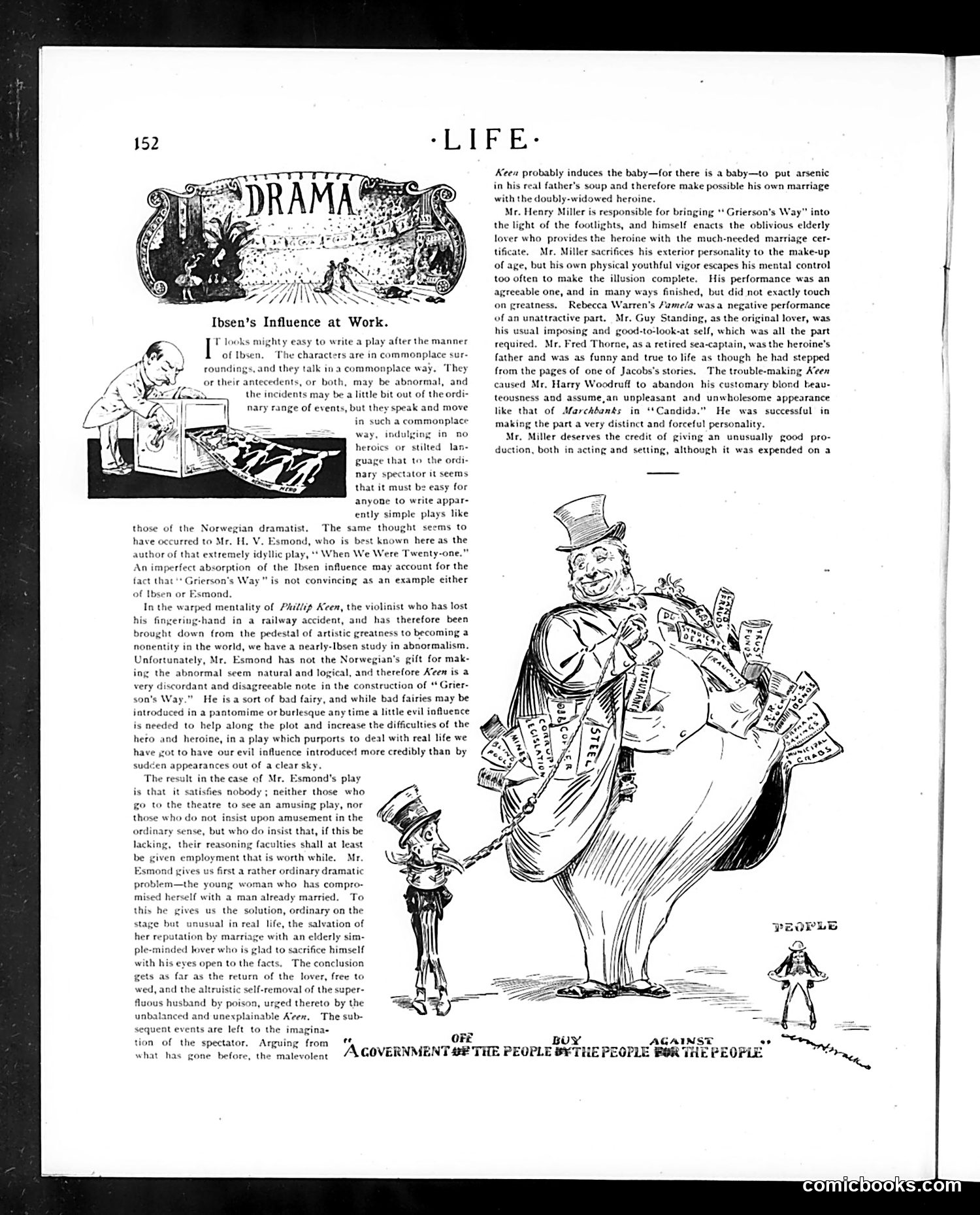
This political cartoon depicts a grotesquely caricatured fat man in formal dress holding money, with a tiny figure labeled "BOY" being crushed or dominated beneath him. The caption references Lincoln's Gettysburg Address phrase, inverting it sarcastically. The satire criticizes **plutocracy and economic inequality**: the bloated capitalist figure represents wealthy elites who have corrupted democratic ideals. Rather than government serving the people equally, the cartoon argues that the wealthy elite now control the system, leaving ordinary citizens (represented by the diminished "boy") powerless and exploited. The cartoon appears on a page discussing Henrik Ibsen's theatrical influence on American drama, which often explored social inequality and hypocrisy. This juxtaposition suggests Life magazine used both dramatic criticism and political satire to critique social problems in early 20th-century America.
📄 Transcribed text from this page (OCR, searchable)
Machine-transcribed from the original scan — historical spelling and the odd misread are preserved.
“LIF E- Keen probably induces the baby—for there is a baby—to put arsenic in his real father's soup and therefore make possible his own marriage with the doubly-widowed heroine. Mr. Henry Miller is responsible for bringing * Grierson’s Way" into the light of the footlights, and himself enacts the oblivious elderly lover who provides the heroine with the much-needed marriage cer- tificate, Mr. Miller sacrifices his exterior personality to the make-up of age, but his own physical youthful vigor escapes his mental control too often to make the illusion complete. His performance was an 7771 \ RES < agreeable one, and in many ways finished, but did not exactly touch on greatness. Rebecca Warren’s Same/a wasa negative performance Ibsen’s Influence at Work. of an unattractive part, Mr. Guy Standing, as the original lover, was his usual imposing and good-to-look-at self, which was all the part T looks mighty easy to write a play afterthe manner required. Mr. Fred Thorne, as a retired sea-captain, was the heroine's of Ibsen. ‘The characters are in commonplace sur- father and was as funny and true to life as though he had stepped roundings, and they talk ina commonplace way. They from the pages of one of Jacobs's stories. The trouble-making A’een or their antecedents, or both, may be abnormal, and sed Mr, Harry Woodruff to abandon his customary blond beau- the incidents may be a little bit out of theordi- ——_teousness and assume,an unpleasant and unwholesome appearance nary range of events, but they speak and move jike that of Marchbanks in “Candida.” He was successful in in such acommonplace making the part a very distinct and forceful personality. way, indulging in no Mr. Miller deserves the credit of giving an unusually good pro- heroics or stilted lan- duction, both in acting and setting, although it was expended on a guage that to the ordi- nary spectator it seems that it must bs easy for anyone to write appar- ently simple plays like those of the Norwegian dramatist. The same thought seems to have occurred to Mr, H. V. Esmond, who is best known here as the author of that extremely idyllic play, * When We Were Twenty-one." An imperfect absorption of the Ibsen influence may account for the fact that‘ Grierson’s Way "is not convincing as an example either of Ibsen or Esmond. In the warped mentality of Pillip Keen, the violinist who has lost his fingering-hand in a railway accident, and has therefore been brought down from the pedestal of artistic greatness to becoming a nonentity in the world, we have a nearly-Ibsen study in abnormalism, Unfortunately, Mr, Esmond has not the Norwegian’s gift for mak- ing the abnormal seem natural and logical, and therefore A’een is a very discordant and disagreeable note in the construction of * Grier- son's Way.” He isa sort of bad fairy, and while bad fairies may be introduced in a pantomime or burlesque any time a little evil influence is needed to help along the plot and increase the difficulties of the hero and heroine, ina play which purports to deal with real life we have ot to have our evil influence introduced more credibly than by sudéen appearances out of a clear sky, The result in the case of Mr. Esmond’s play is that it satisfies nobody ; neither those who go to the the, those who do not insist upon amusement in the ordinary sense, but who do insist that, if this be lackin, re to see an amusing pla nor their reasoning faculties shall at least be given employment that is worth while, Mr. inary dramatic an who has compro- Esmond gives us first a rather on i wom problem—the you elf with a man already married, To s the solution, ordinary on the e, the salvation of with an elderly sim- mise this he gives stage but unusual in real her reputation by marria jad to sacrifice himself ded hover who is ¢! h his eyes open to the facts, The conclusion gets as far as the return of the lover, free to altruistic self-removal of the super- fluous husband by poison, urged thereto by the unbalanced and unexplainable A’een. ‘The sub- sequent events are left to the imaginae tion of the spectator. Arguing « ore BUY AGAIN chat nae on batons ene from A GOVERNMENT ## THE PEOPLE 8¥ THE PEOPLE " e i Et sas m g Fi has gone before, the malevolent