
Life, 1906-02-01 · page 22 of 48
Life — February 1, 1906 — page 22: what you’re looking at
What you’re looking at
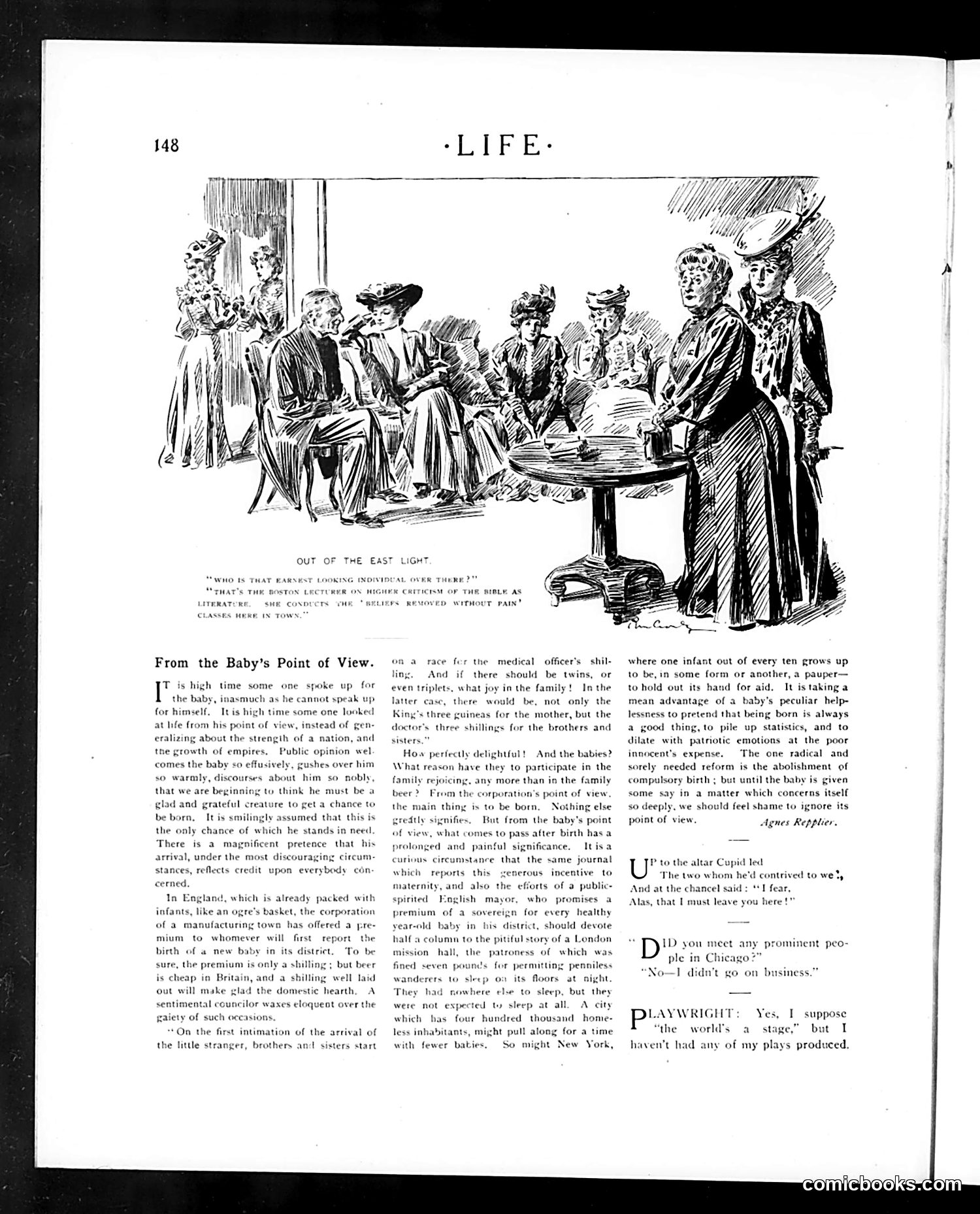
The top cartoon satirizes Boston's intellectual pretensions. A well-dressed woman lecturer on literature is identified as "the barest looking Indian"—a crude visual joke mocking her appearance while suggesting that Boston's celebrated cultural authorities may be less refined than they claim. The main article, "From the Baby's Point of View" by Agnes Repplier, is social satire attacking the hypocrisy of celebrating childbirth in societies that fail to support poor children. Repplier critiques British towns offering monetary premiums to encourage births while simultaneously allowing hundreds of thousands of infants to grow into paupers. She argues this treats babies as statistical achievements rather than recognizing their actual welfare needs. The piece advocates for abolishing "compulsory birth" until society genuinely cares for children's wellbeing—a progressive argument for the era. The bottom section contains unrelated comedic dialogue about theater and marriage, typical of Life's miscellaneous humor content.
📄 Transcribed text from this page (OCR, searchable)
Machine-transcribed from the original scan — historical spelling and the odd misread are preserved.
“WHO IS THAT BARSEST LOOKING INOI T'S THK BOSTON LECTURER ON LITRRATERE, SHE CONDUCTS Vi From the Baby’s Point of View. for much a: Irish I is high time some one spoke up the baby, cannot speak up for himself, at life from his poin me some one looked . instead of gen- eralizing about the strength of a nation, and the growth of empires, Public opinion wel comes the baby so effusively, gushes over so warmly, discourses about him so nobl. that we are beginning to think he must be a lad and grateful creature to get a chance to Iti y chance of which bi be born, the on There ly assumed that this is stands in need nificent that his is a ma, pretence arrival, under the most discouraging circum stances, reflects credit upon everybody con cerned. In England, which is already packed with infants, like an ogre’s basket, the corporatic of a manufacturing town has offered a pre- mium to whomever will first’ report To be illing ; but beer well laid hearth, A ent over the birth of a new baby in its district sure, the premium is only a is cheap in Britain, and a shillin, out will make glad the domest councilor waxes eloq ety of such occasions. On the first intimati the little st n of the arrival of ger, brothers anil sisters start MOF THR BIBLE. AS D WITHOUT PAIN race fer officer's shil- And if even triplets, what joy in the family ! the medical there should be twins, or In the only the ling, latter case, Kin, doct there would be, not + three guineas for the mother, but the “s three shillings for the brothers and sisters.” How perfectly delightful! And the babies? What reason have they to participate in the family rejoicing, any more than io the family beer? From the corporation's point of view the main thing is to be born, Nothing else gredtly sign But from the baby’s point of view, what comes to pass after birth has a prolonged and painful significance. tis a curious circumstance that the same journal which reports crous incentive to maternity, and also the efforts of a public- ed English mayor, who promises a um of a sovereign for every healthy Md baby in bis district, should devote alfa column to the pitiful story of a Lond mission hall, the patroness of which wa fined seven 5 F permitting: penniless erers 10 sleep on its floors at night had nowhere else to sleep, but they were not expected ty sleep at all. A city which has four hundred thousand home- less inhabitants, might pull along for a time with fewer babi So might New York, where one infant out of every ten grows up to be, in some form or another, a pauper— to hold out its hand for aid, It is taking a mean advantage of a baby’s peculiar help- lessness to pretend that being born is always a good thing, to pile up statistics, and to dilate with patriotic emotions at the poor innocent’s expense. The one radical and sorely needed reform is the abolishment of compulsory birth ; but until the baby is given some say in a matter which concerns itself so deeply, we should feel shame to ignore its point of view, Agnes Repplier. Prot The two whom he'd contrived to we ty tar Cupid led And at the chancel said Alas, that I must leave ye 0 on business.” AYWRIGHT ‘the Yes, I suppose but 1 world’s a stage, haven't had any of my plays produced,