
A complete issue · 62 pages · 1905
Life — April 6, 1905
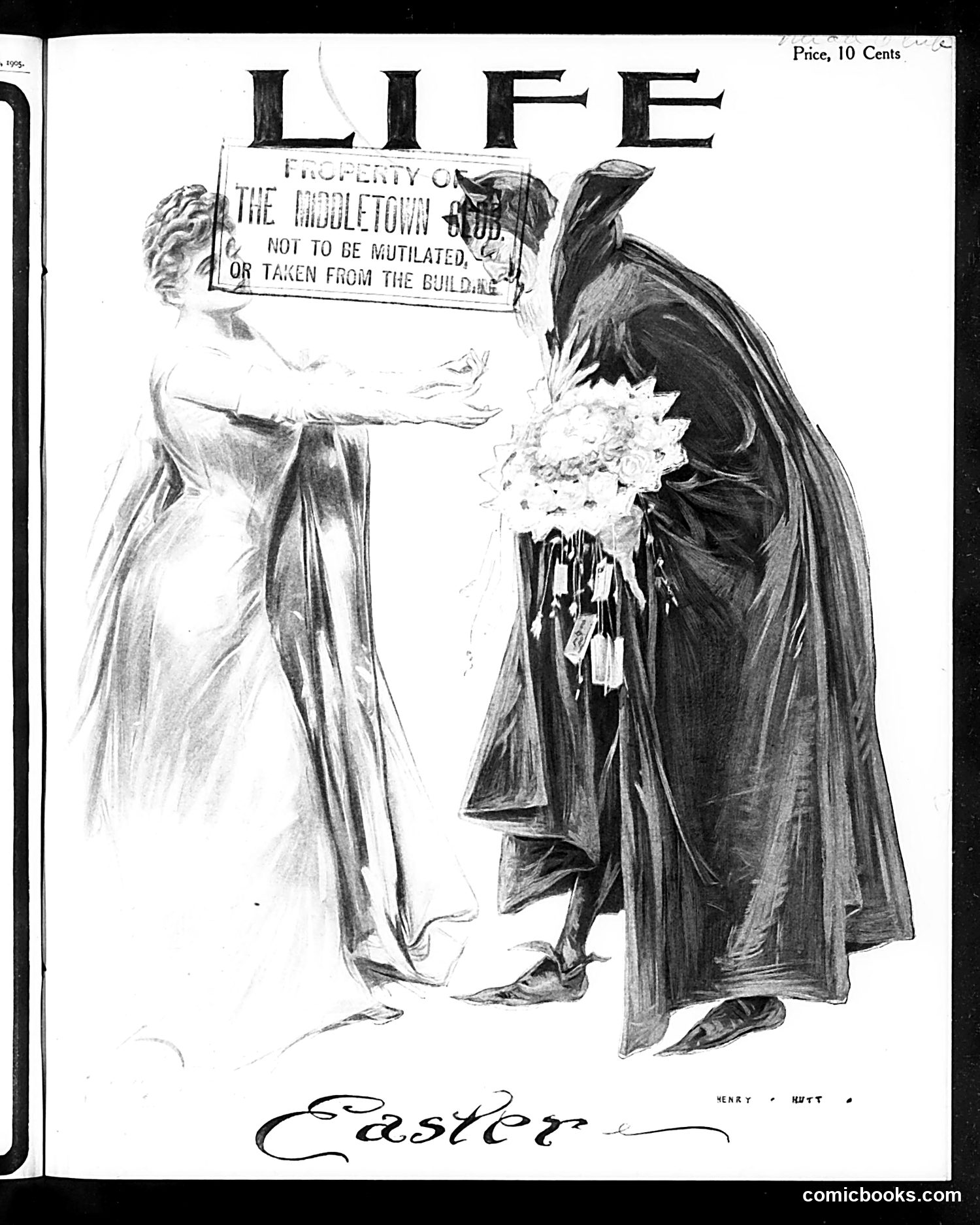
This Life magazine cover depicts an Easter-themed satire. A woman in elegant dress presents a sign reading "Property of The Middletown School—Not to be mutilated or taken from the building" to a figure in dark robes carrying flowers—likely representing Death or a grim reaper figure. The cartoon's humor plays on the contrast between Easter's associations with renewal and life against Death's traditional imagery. The "property of school" sign suggests institutional ownership or control, possibly satirizing how institutions or society attempt to regulate or contain mortality itself. The artwork is credited to Henry Hutt. Without additional context about Middletown or contemporary 1910s-1920s events, the specific institutional reference remains unclear, though the satire targets attitudes toward death and institutional control.
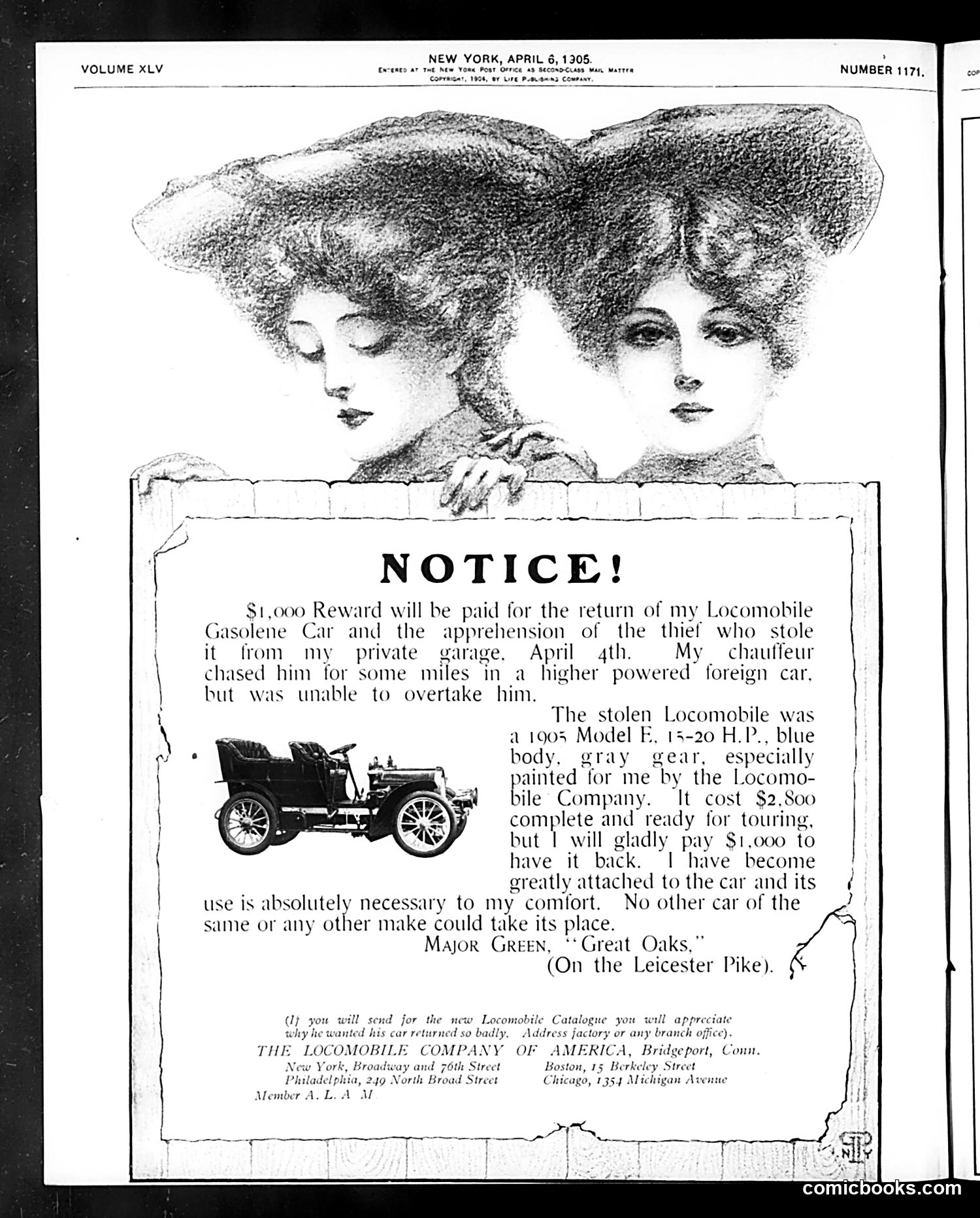
This page is primarily an **advertisement**, not satire or political commentary. It's a 1905 reward notice from the Locomobile Company of America for a stolen car. The decorative illustration shows two fashionably dressed women with elaborate Gibson Girl-style hair and hats—typical of early 1900s beauty standards—framing the notice above. The advertisement itself is straightforward: Major Green of "Great Oaks" (Leicester Pike) offers $1,000 for return of his stolen 1905 Locomobile Model E automobile. The notice includes car details, addresses for the Locomobile Company's factories and branch offices, and an appeal to readers to help recover the vehicle or apprehend the thief. The Gibson Girl imagery was likely chosen to appeal to the magazine's affluent readership—the demographic who could afford $2,800 automobiles.
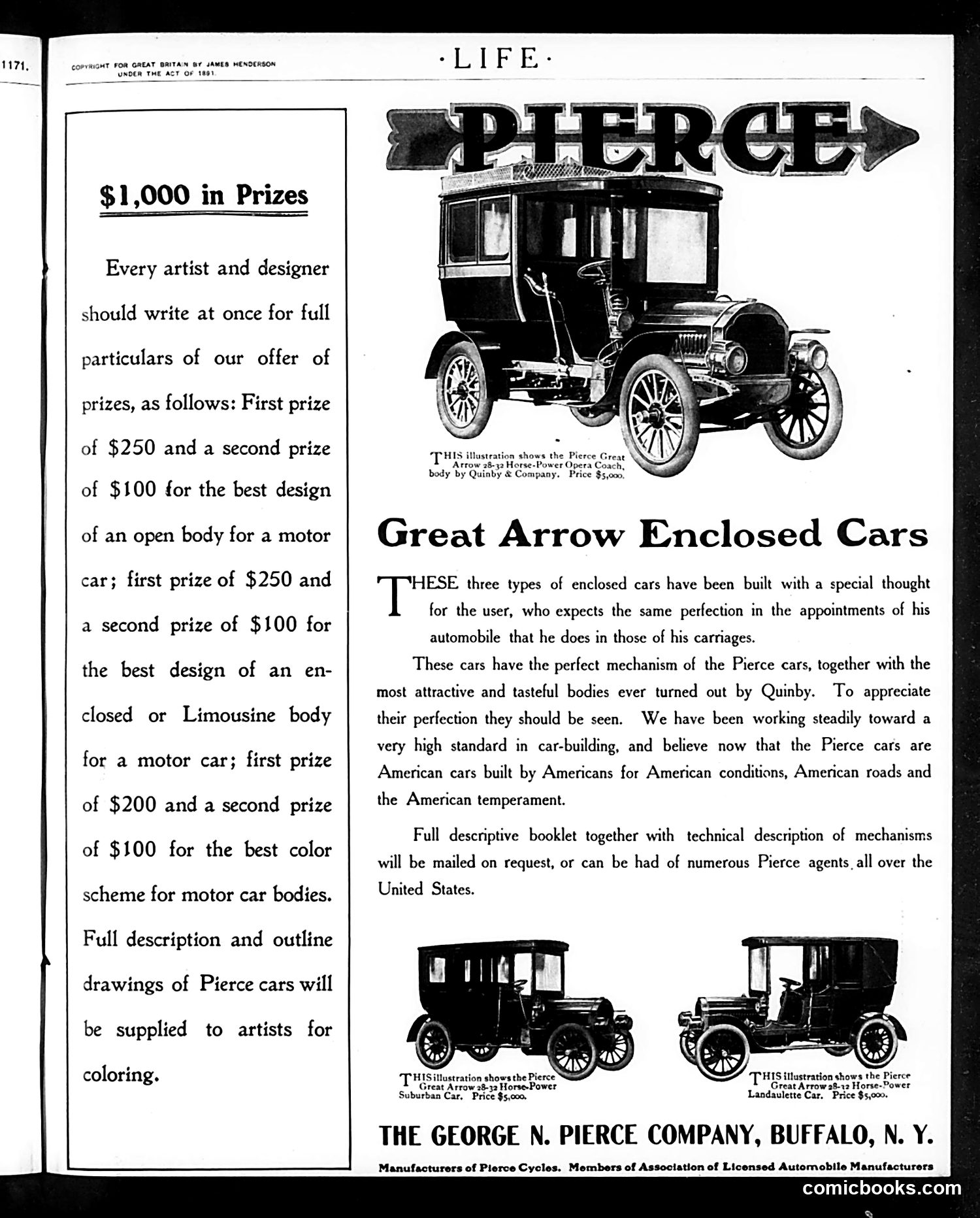
This page is **primarily an advertisement**, not satire or political commentary. The George N. Pierce Company, an automobile manufacturer in Buffalo, New York, is advertising their "Great Arrow Enclosed Cars" — early automobiles with enclosed cabins (a relatively new luxury feature). Three car models are shown with prices around $9,000-$15,000. The left column announces a **design competition** offering $1,000 in total prizes ($250 first prize) for artists and designers to submit the best designs for open and enclosed motor car bodies and color schemes. There is **no cartoon or satire present**. This is a straightforward commercial pitch combining product advertisement with a call for design submissions from the artistic community. The emphasis on "American cars built by Americans for American conditions" reflects early-1900s manufacturing pride.
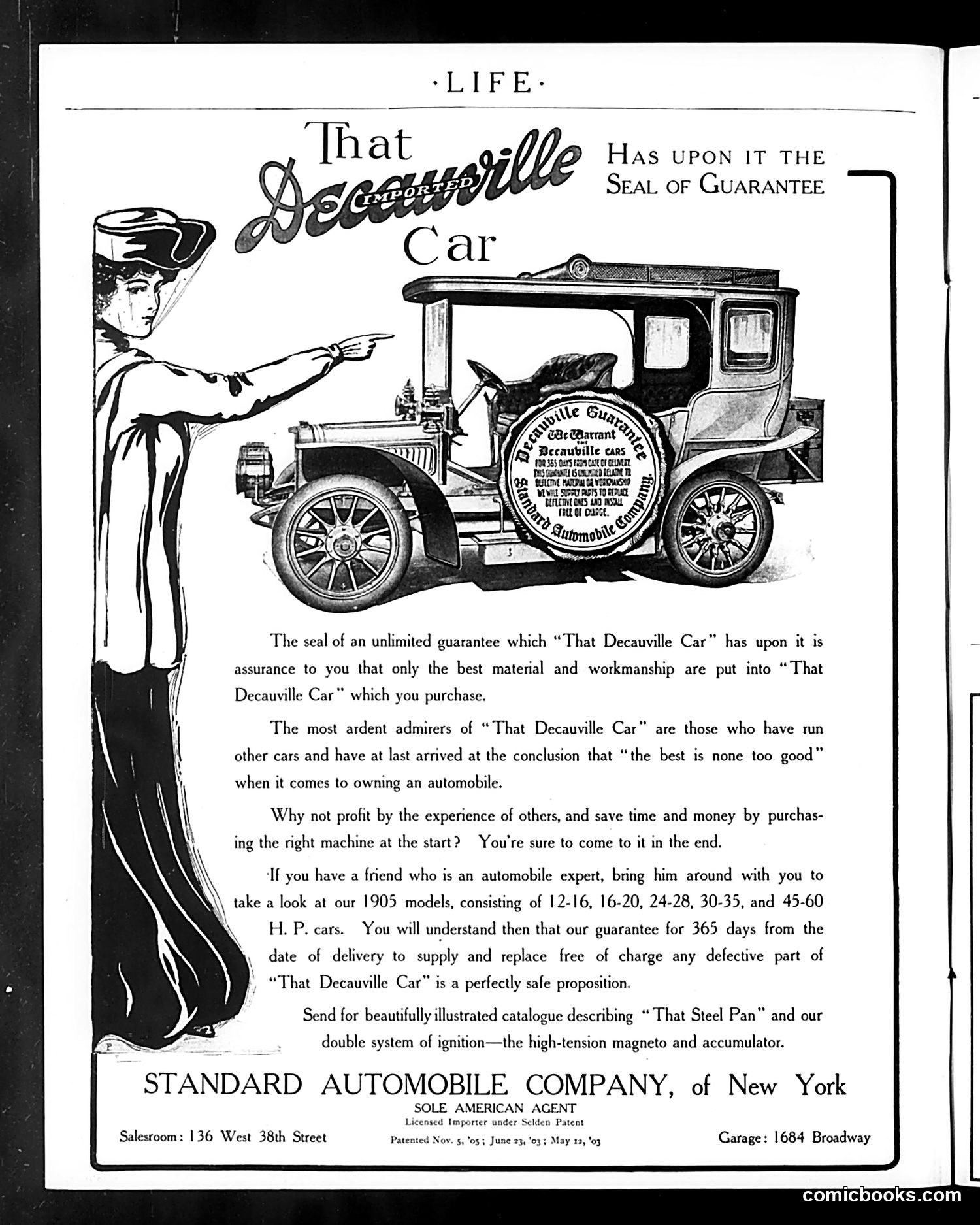
This is primarily a **product advertisement**, not satirical content. The page advertises "That Decauville Car" manufactured by the Standard Automobile Company of New York (circa 1905, based on patent dates shown). The illustration features a stylized female figure in Edwardian dress pointing toward the automobile, a common advertising convention of the era. The "Seal of Guarantee" circular emblem on the car's side emphasizes the manufacturer's warranty claim—365 days of free replacement for defective parts. The text appeals to potential buyers by suggesting that experienced automobile owners ultimately prefer Decauville vehicles, and encourages customers to inspect 1905 models (12-60 H.P. variants). This represents straightforward early automotive marketing rather than satire or social commentary.
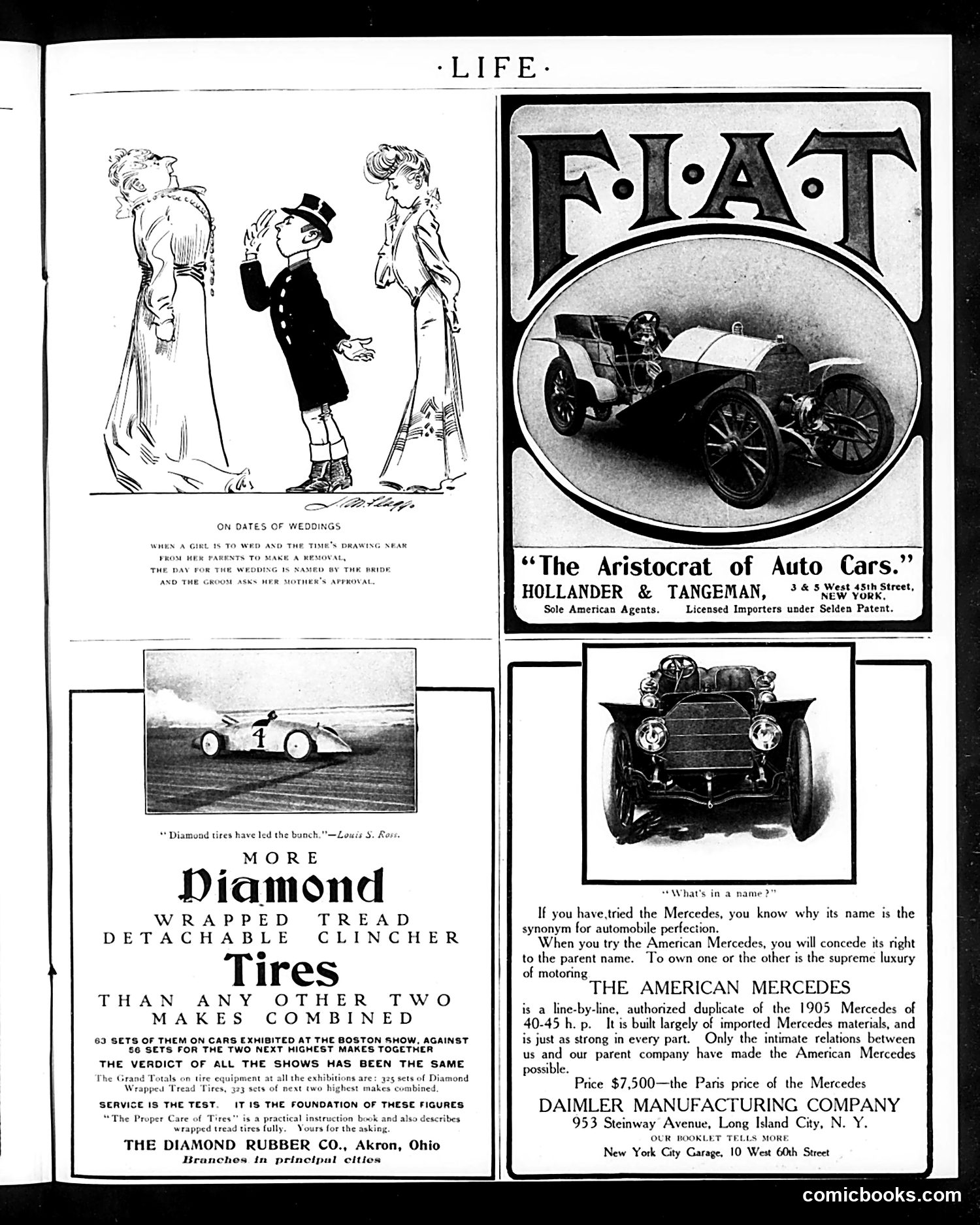
The top cartoon satirizes wedding etiquette among the upper classes. It depicts a young boy (likely a ring bearer or page boy) positioned awkwardly between two adult women in wedding attire, with the caption explaining that when a girl is to be wed, the groom's family draws near to observe proceedings—and the mother's approval becomes crucial to setting the wedding date. The humor targets the formality and social maneuvering surrounding upper-class weddings, particularly the power dynamics between families and the boy's uncomfortable central position in this ritual. The rest of the page consists primarily of **advertisements** for automobiles (Fiat, Diamond tires, American Mercedes) and automotive products—not editorial content. These ads reflect the early 1900s automobile industry's emergence as a luxury consumer good.
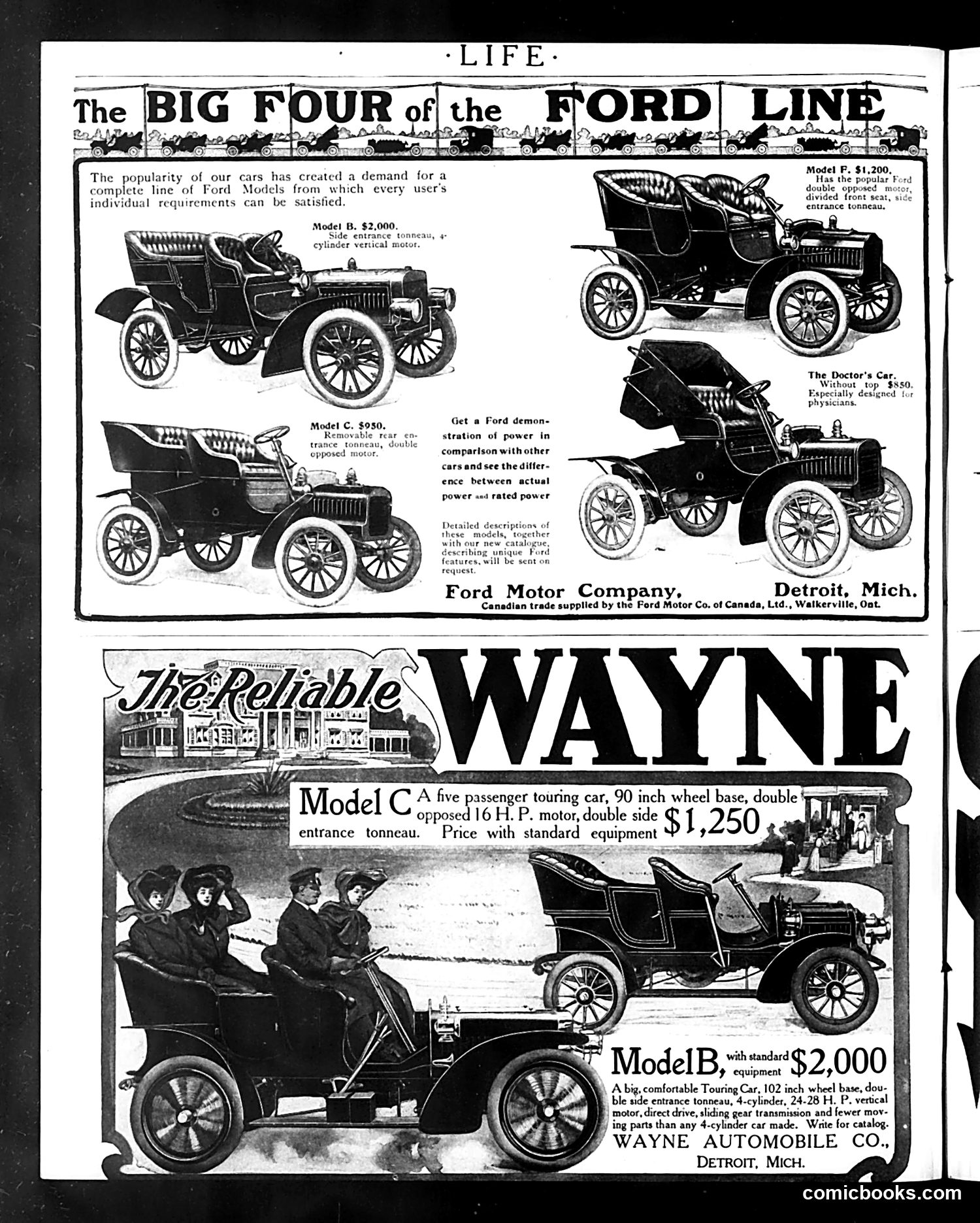
This page contains **no political cartoons or satire**—it is primarily **automobile advertising** from the early 1900s. The top half advertises Ford's "Big Four" model line (Models B, C, and a Doctor's Car variant), emphasizing their affordability and practical design for different needs. The bottom half advertises the Wayne automobile, priced at $1,250-$2,000, featuring five-passenger touring cars with technical specifications highlighted. Both ads target middle-class consumers by stressing reliability, power comparison, and value. The imagery shows elegant vehicles with passengers in period dress, reflecting early automotive aspirations. This represents the competitive early auto industry before Ford's Model T dominance, when multiple manufacturers competed on features and price points rather than standardization.
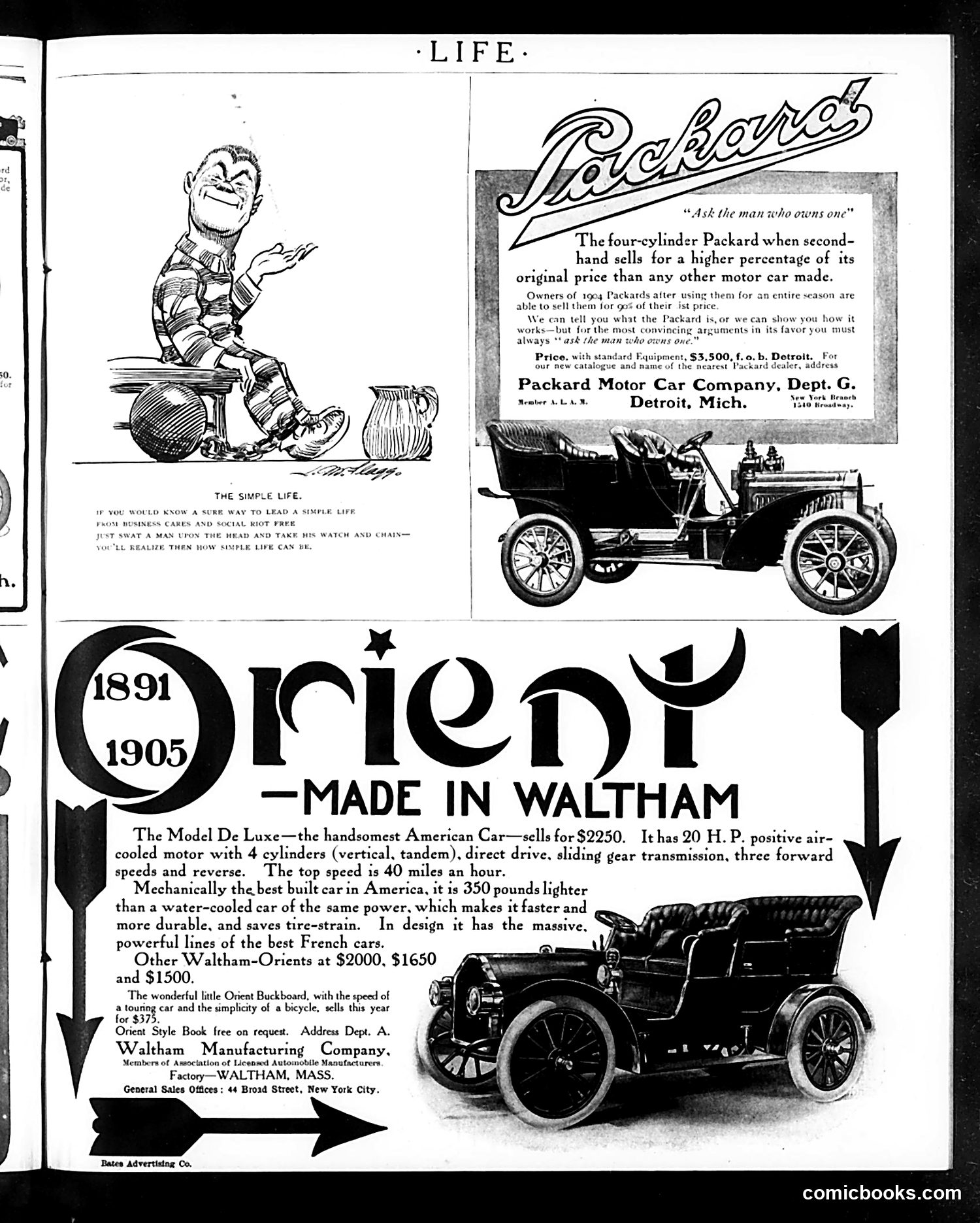
This page is primarily **advertising** rather than political satire. It contains two automobile advertisements from the early 1900s: 1. **Packard Motor Car** (top right): Promotes a four-cylinder model, emphasizing its superior resale value with the phrase "Ask the man who owns one." 2. **Orient automobile** (bottom): Advertises the Model De Luxe priced at $2250, highlighting its air-cooled engine, 20 H.P., and light weight compared to water-cooled competitors. The left side features "The Simple Life"—a cartoon showing a caricatured man in a humorous pose, suggesting ironic commentary on escaping urban complexity, though the specific satirical target remains unclear from the visible text alone. The page reflects early automotive industry marketing and consumer culture of approximately 1905.
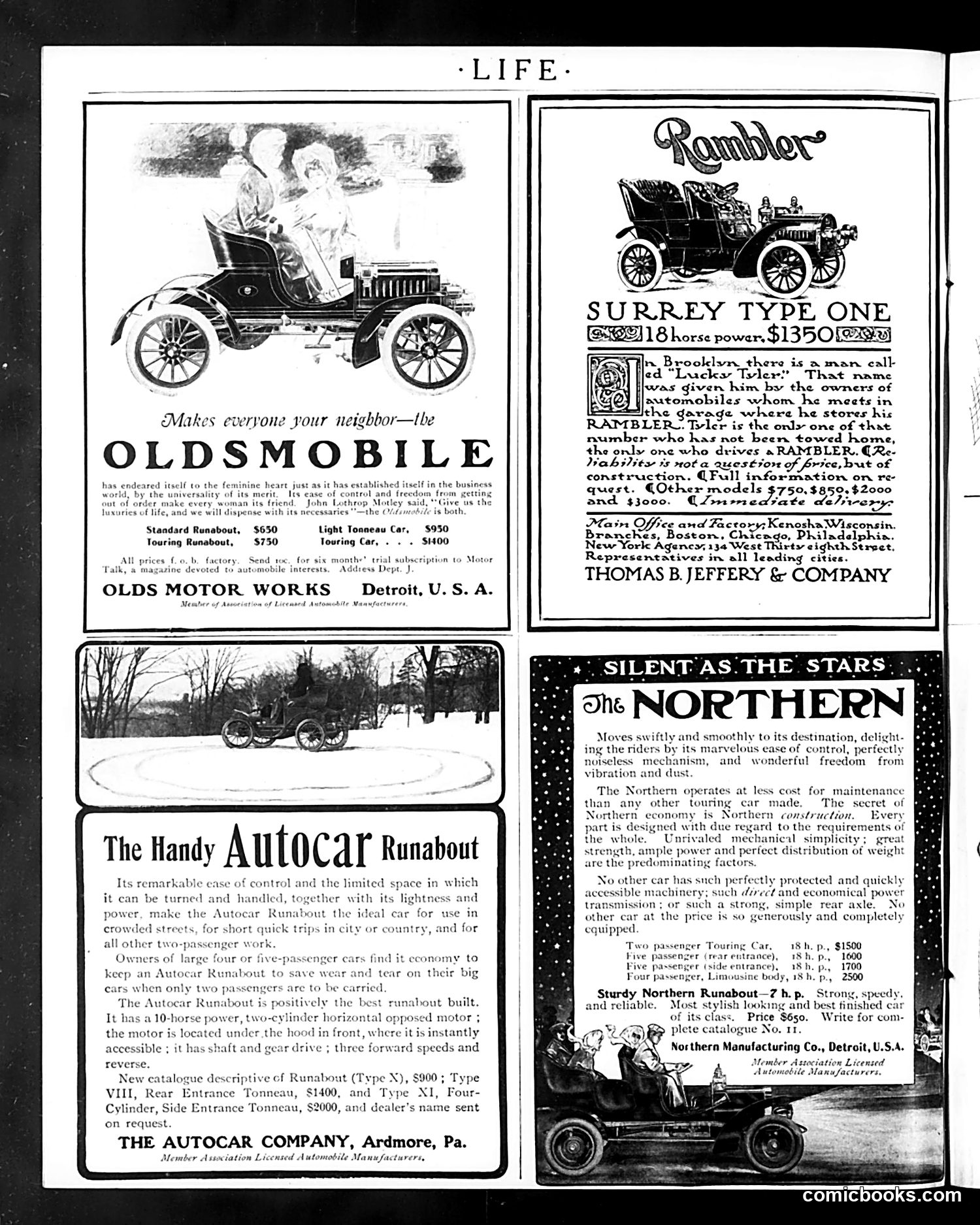
This page is **primarily automobile advertisements**, not satirical content. It contains four separate car ads from the early 1900s: 1. **Oldsmobile** - emphasizes it "makes everyone your neighbor" through accessibility 2. **Rambler Surrey Type One** - a 18-horsepower model priced at $1,350 3. **Autocar Runabout** - highlights ease of control and lightness for urban/rural use 4. **Northern** - marketed as "silent as the stars," emphasizing smooth, quiet operation and low maintenance costs The advertisements reflect the era's automobile industry messaging: affordability, reliability, and the social democratization that cars promised. There is no political satire or caricature present—this is a commercial publication page showcasing competing vehicle manufacturers competing for consumers during the automotive industry's early expansion period.
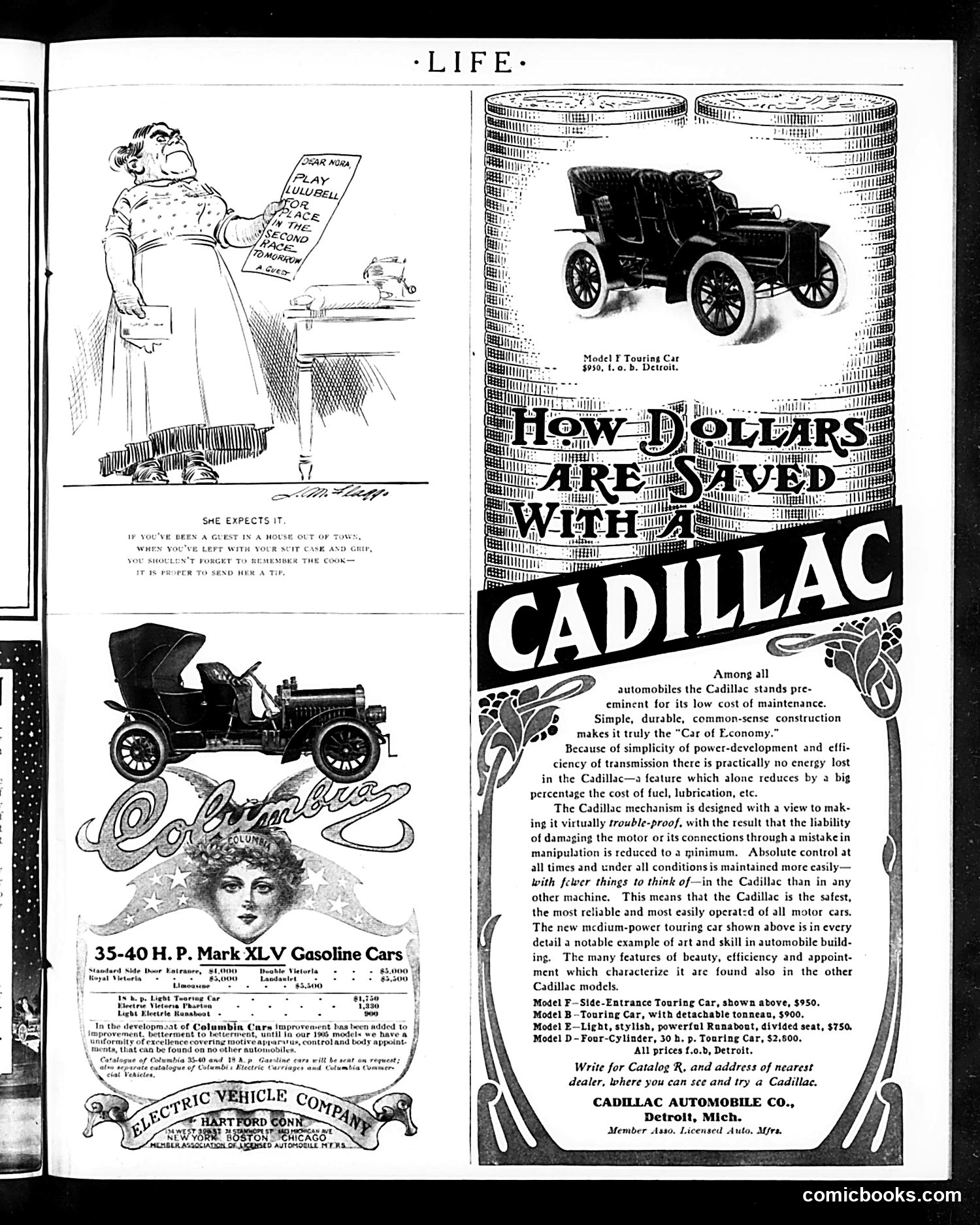
This page contains two distinct advertisements rather than political satire. **Left side**: A humorous etiquette cartoon about tipping. A woman holds a placard reading "OSCAR ASMA / PLAY DUMBBELL / FOR / A WEEK BEGINNING / TOMORROW," with text below explaining that guests shouldn't forget to tip the cook. Below this is a **Columbia Electric automobile advertisement** featuring an elegant woman's head with a car image, promoting 35-40 H.P. Mark XLV gasoline cars. **Right side**: A **Cadillac automobile advertisement** emphasizing economy and reliability. The text claims Cadillac saves money through efficient transmission, durability, and ease of operation, positioning it as "the safest, most reliable and most easily operated of all motor cars." Both ads target affluent readers who could afford automobiles during the early automotive era. The page is primarily commercial rather than satirical.
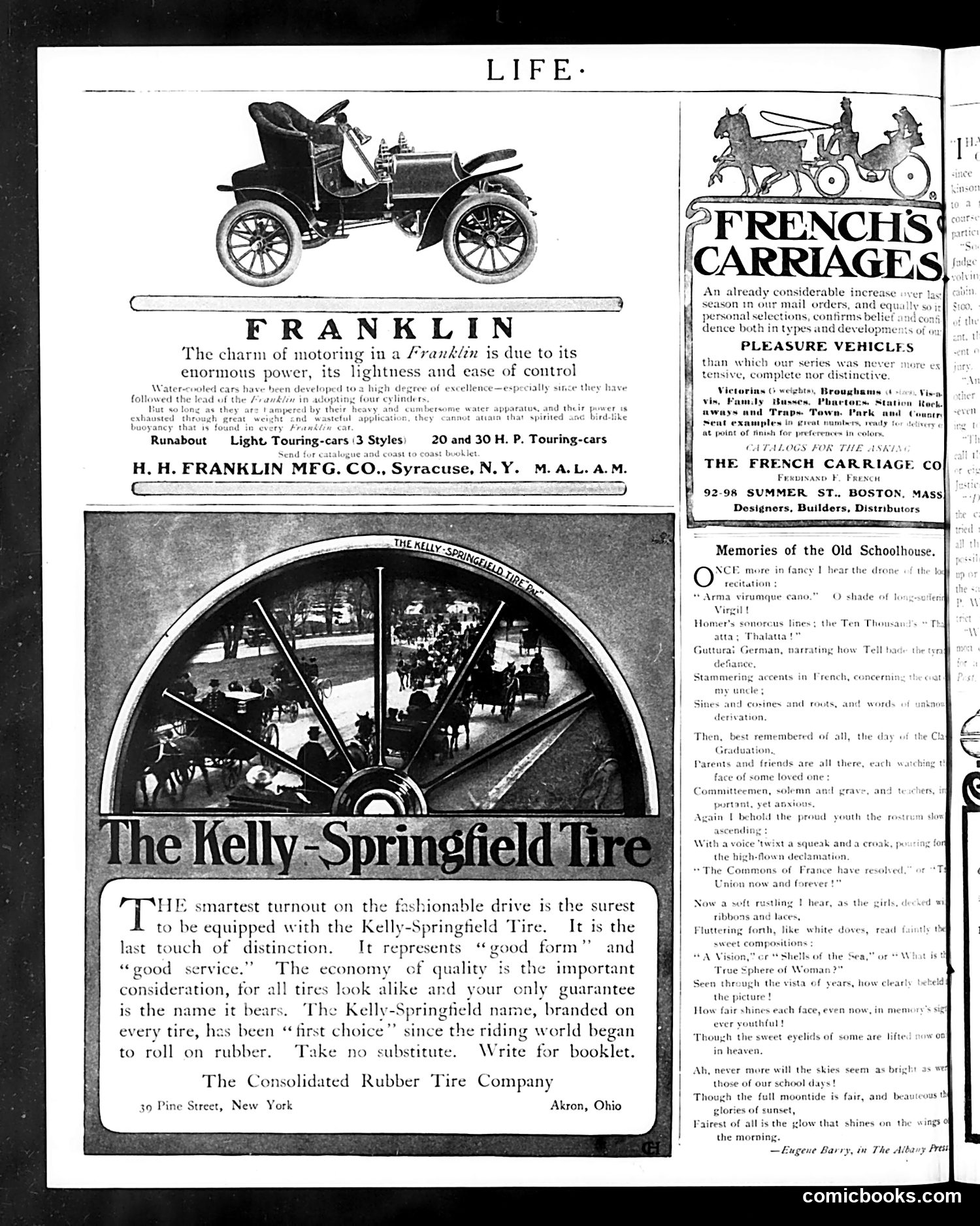
This page is primarily **advertising content**, not satire or political commentary. The top features a **Franklin automobile** advertisement emphasizing its power, lightness, and ease of control—characteristics that made it competitive with other early cars. Below is a large **Kelly-Springfield Tire advertisement** showing a cross-section of their tire with multiple internal layers visible. The ad argues that tire quality matters since "all tires look alike," making the brand name the only guarantee of quality. It positions Kelly-Springfield as the "first choice" and "last touch of distinction" for fashionable drivers. The right column contains **French's Carriages** advertisement (horse-drawn vehicles) and a literary piece titled "Memories of the Old Schoolhouse." There is **no political cartoon or satire** on this page—it's a standard magazine advertising layout from the early automotive era.
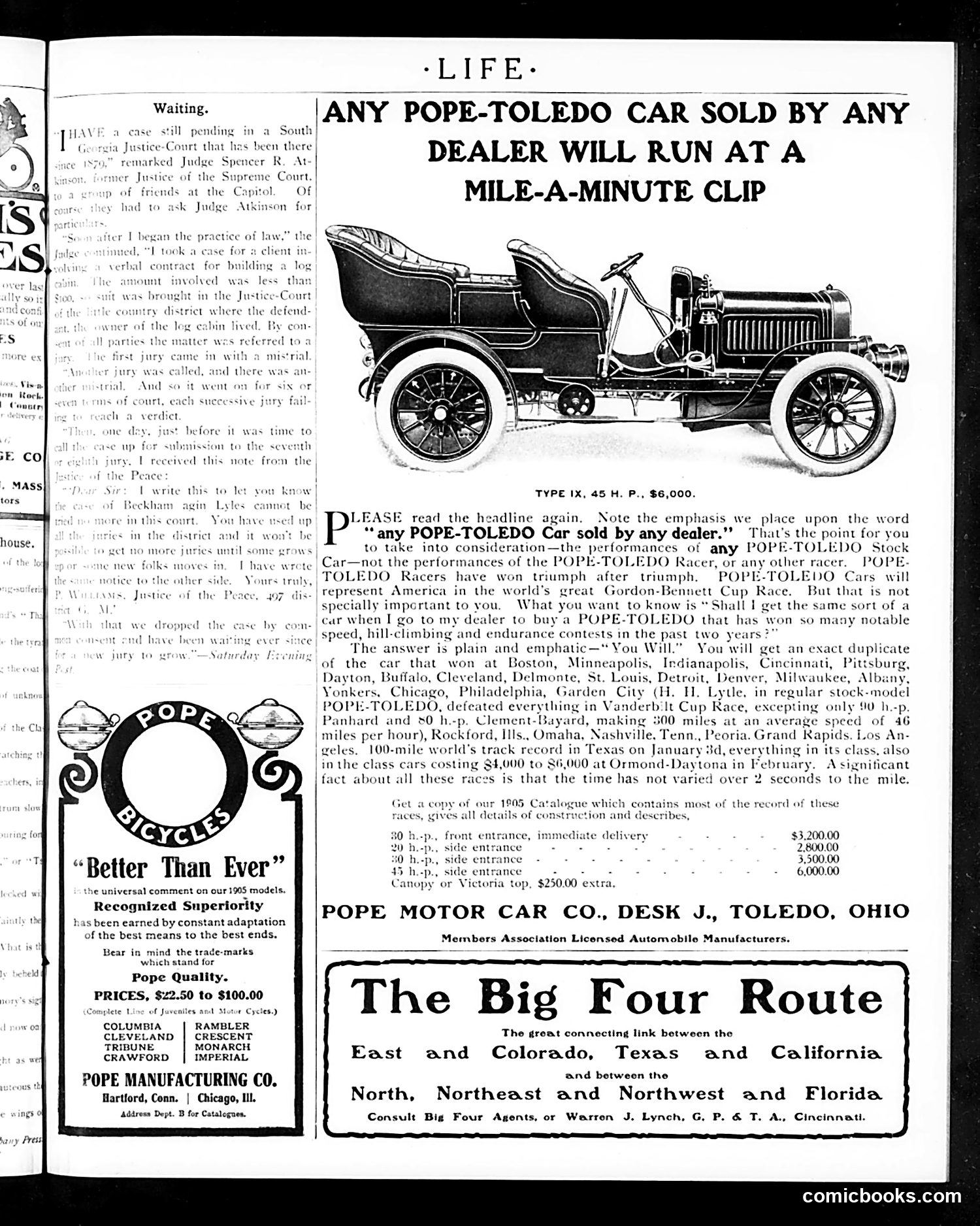
This page is primarily **advertising**, not satire or political commentary. It contains: 1. **A testimonial article titled "Waiting"** (top left) — a judge's anecdote about court cases, seemingly unrelated to the advertisements. 2. **Pope-Toledo automobile advertisement** (center/top) — promoting the Type IX model at $6,000, emphasizing its racing victories and availability across American cities. The ad stresses "any Pope-Toledo car sold by any dealer" will match the performance of racing models. 3. **Pope Manufacturing Company bicycle advertisement** (bottom left) — promoting their bicycles as "Better Than Ever" with quality claims. 4. **"The Big Four Route" travel advertisement** (bottom right) — promoting a transportation route connecting multiple American regions. The page reflects early 1900s commercial marketing, with no discernible political cartoons or satire present.
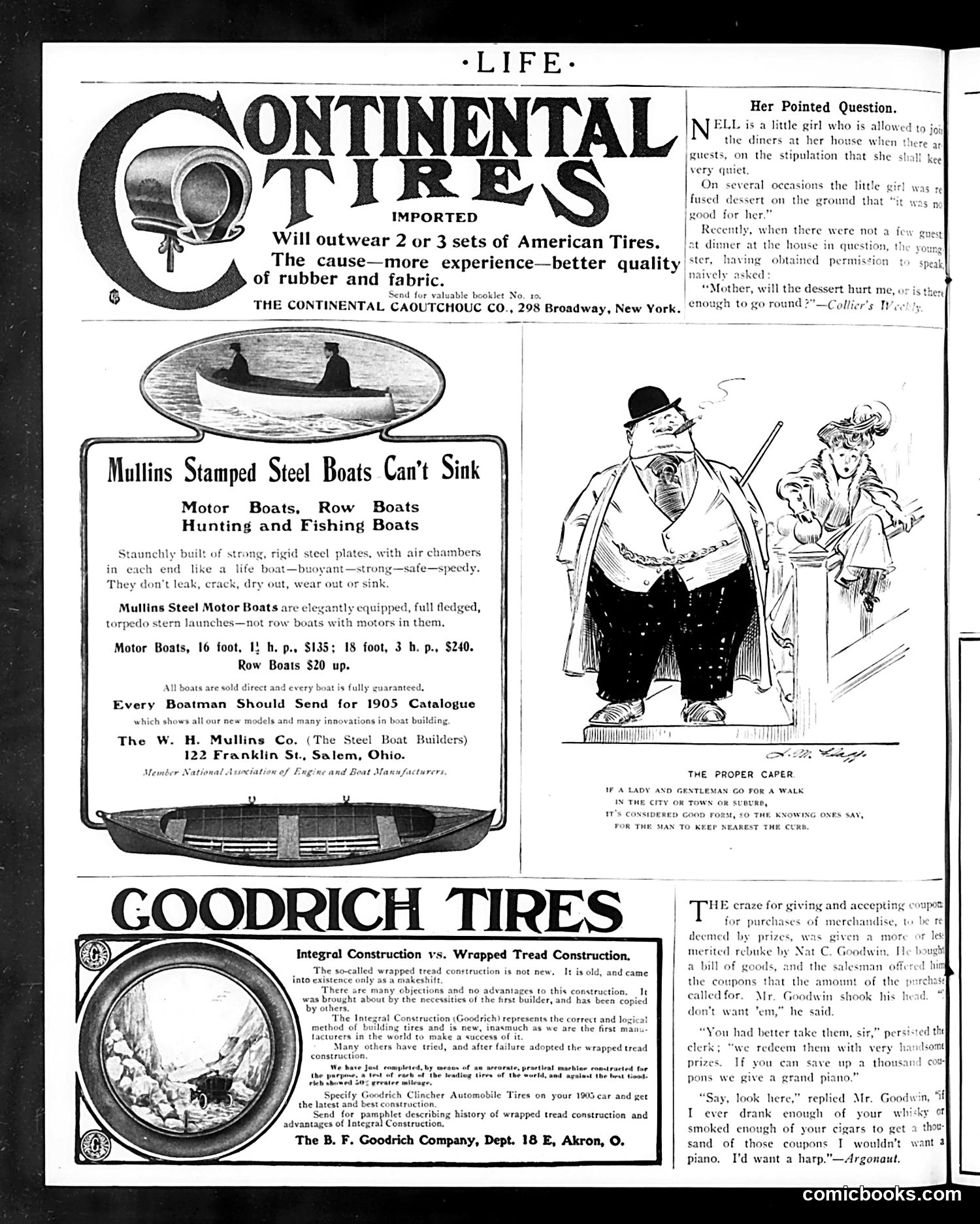
This page is primarily **advertising**, with one small satirical cartoon titled "The Proper Caper." The main advertisements are for Continental Tires, Mullins Stamped Steel Boats, and Goodrich Tires—typical early 1900s product pitches emphasizing durability and safety. The cartoon depicts a well-dressed gentleman and woman on a city street. The caption explains the joke: it's considered proper etiquette for a man to walk on the outside (curb side) of the sidewalk when accompanying a lady, keeping her away from street traffic and splash. The cartoon satirizes this genteel social convention—the man's exaggerated posture suggests the sometimes-ridiculous formality of Edwardian-era propriety and gender roles.
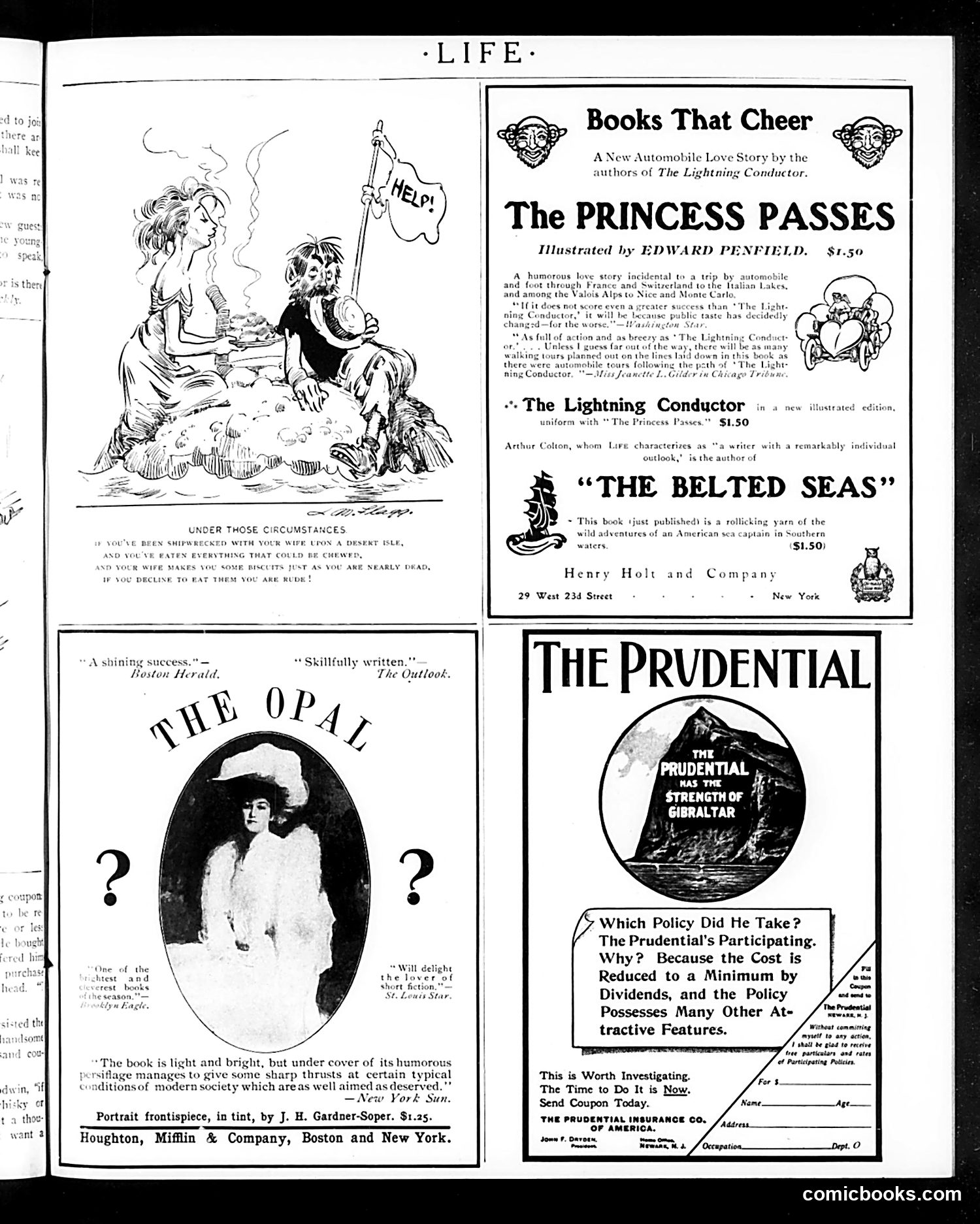
This page is primarily **advertising**, not satire or political commentary. It features book advertisements from early 1900s publishers (Houghton Mifflin, Henry Holt) promoting popular fiction titles: *The Princess Passes* and *The Lightning Conductor* (automobile romance novels), *The Belted Seas* (sea adventure yarn), and *The Opal* (satirical social commentary). The only cartoon—a small sketch at top-left—depicts a shipwrecked couple in a humorous domestic situation, illustrating a book plot point about marital survival in desperate circumstances. The caption uses exaggeration for comedic effect. The page also includes a Prudential Insurance advertisement with a Gibraltar rock image, promoting insurance policies. This is a typical Life magazine advertising section blending literary promotion with insurance marketing, reflecting Edwardian-era consumer culture rather than political satire.
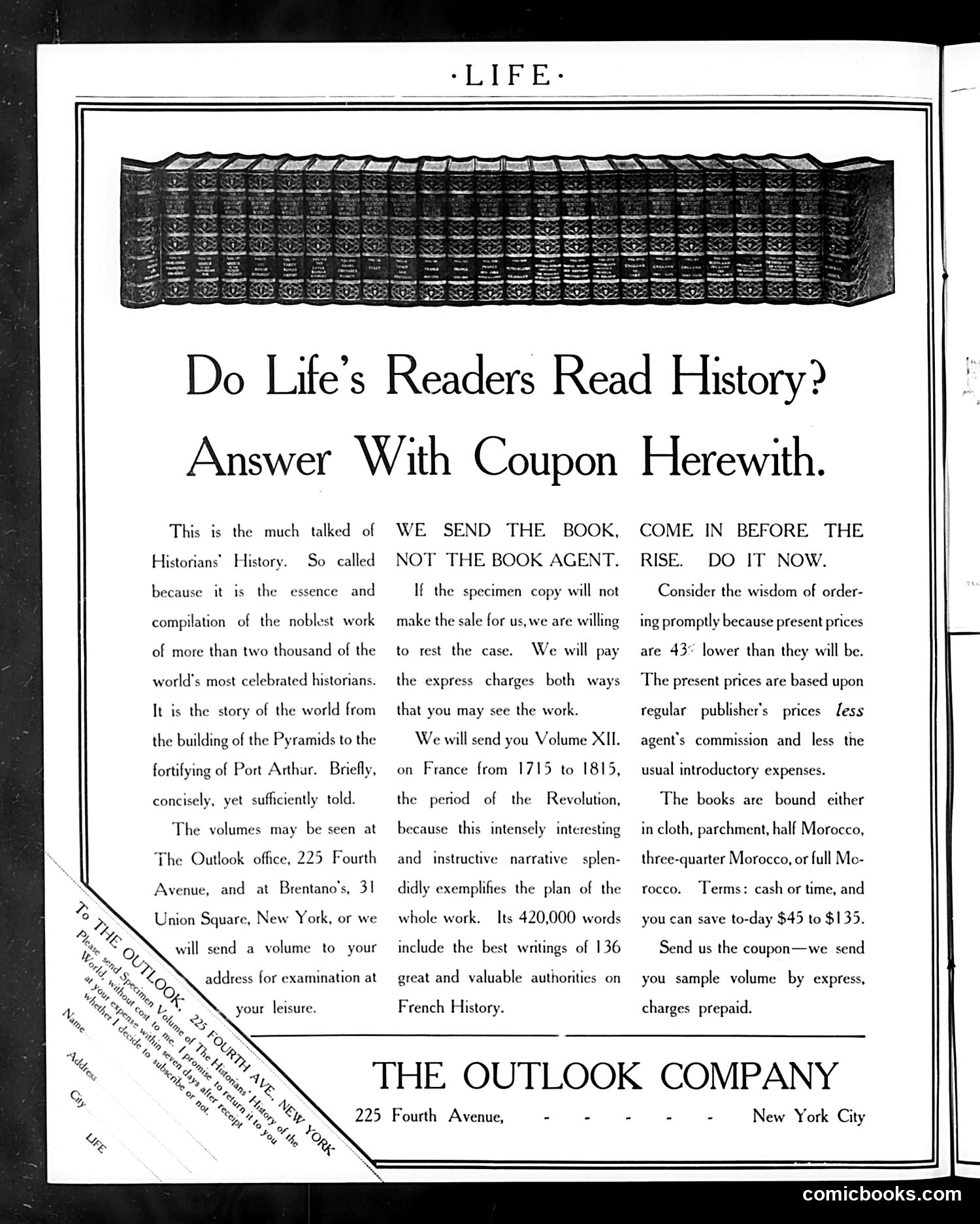
This is primarily a **full-page advertisement**, not a cartoon or satirical content. It promotes "The Historians' History," a multi-volume encyclopedia compiled from over 2,000 historical sources. The ad uses a sales pitch common to early 20th-century direct marketing: urgency ("DO IT NOW"), price incentives (claiming 43% savings), and sample-volume offers. It appeals to Life magazine's educated readers by positioning historical knowledge as valuable and accessible. The only potentially satirical element is the headline question "Do Life's Readers Read History?" — a tongue-in-cheek jab suggesting the magazine's audience should be intellectually serious enough to own such works. The copy emphasizes the French Revolution volume (1715-1815) as an example of the work's scope and authority. There is no visible political cartoon or caricature on this page. It's a straightforward period advertisement using marketing techniques typical of the era.
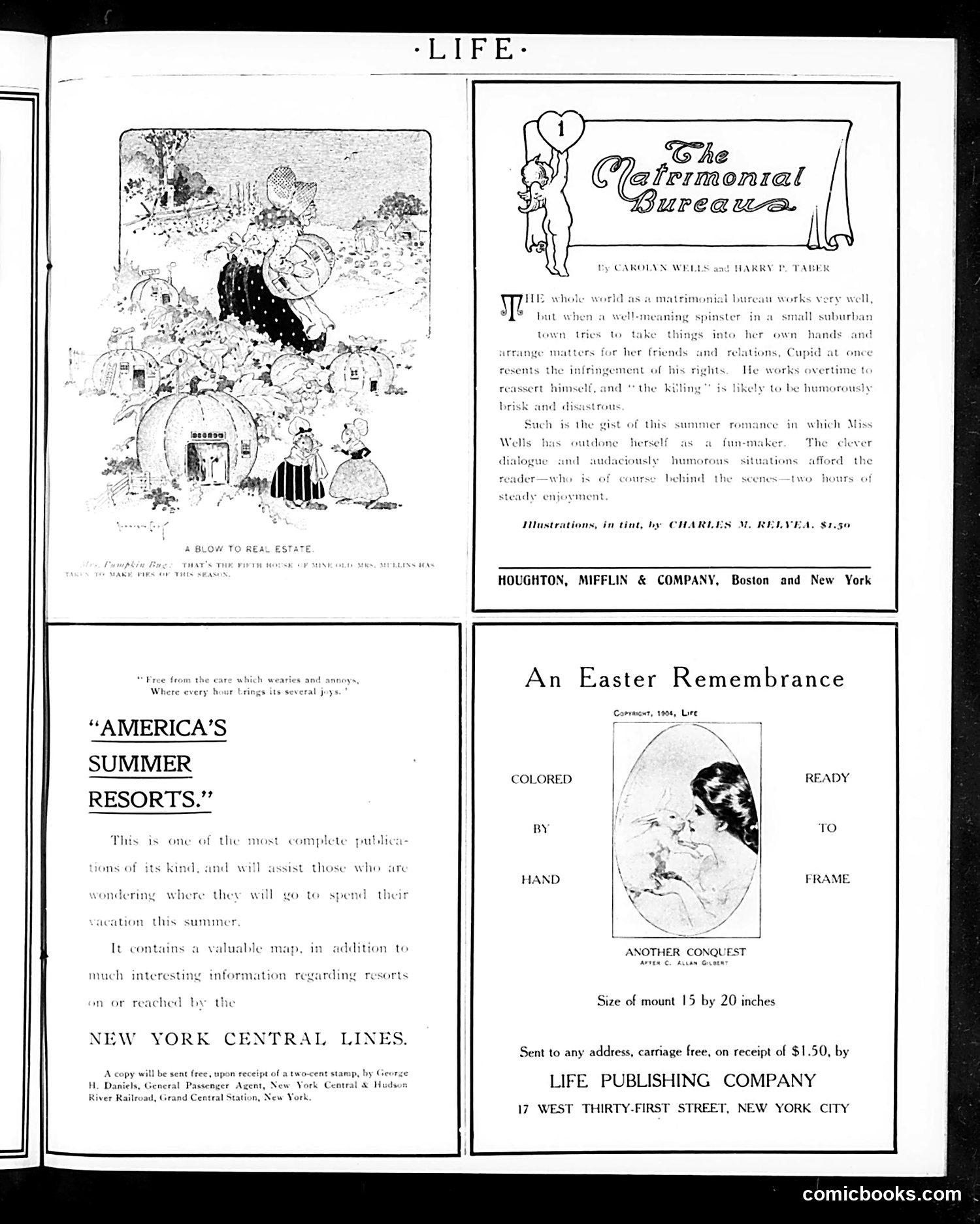
This page is primarily **advertising and book promotion** rather than political satire. It contains: 1. **"The Matrimonial Bureau"** (top right): A book advertisement by Carolyn Wells and Harry Taber, illustrated by Charles M. Relvea ($1.50). The description indicates a humorous summer romance about a spinster in a small suburban town who meddles in matchmaking, creating comedic situations. 2. **"A Blow to Real Estate"** (top left): An illustration accompanying the book, showing whimsical housing designs—likely satirizing real estate ventures or suburban development trends of the era. 3. **"America's Summer Resorts"** (bottom left): A travel guide advertisement for New York Central Lines, helping readers plan vacations. 4. **"An Easter Remembrance"** (bottom right): An advertisement for hand-colored religious artwork ($1.50). The page reflects early 20th-century consumer culture, with book and travel promotion aimed at middle-class readers. No significant political commentary is evident.
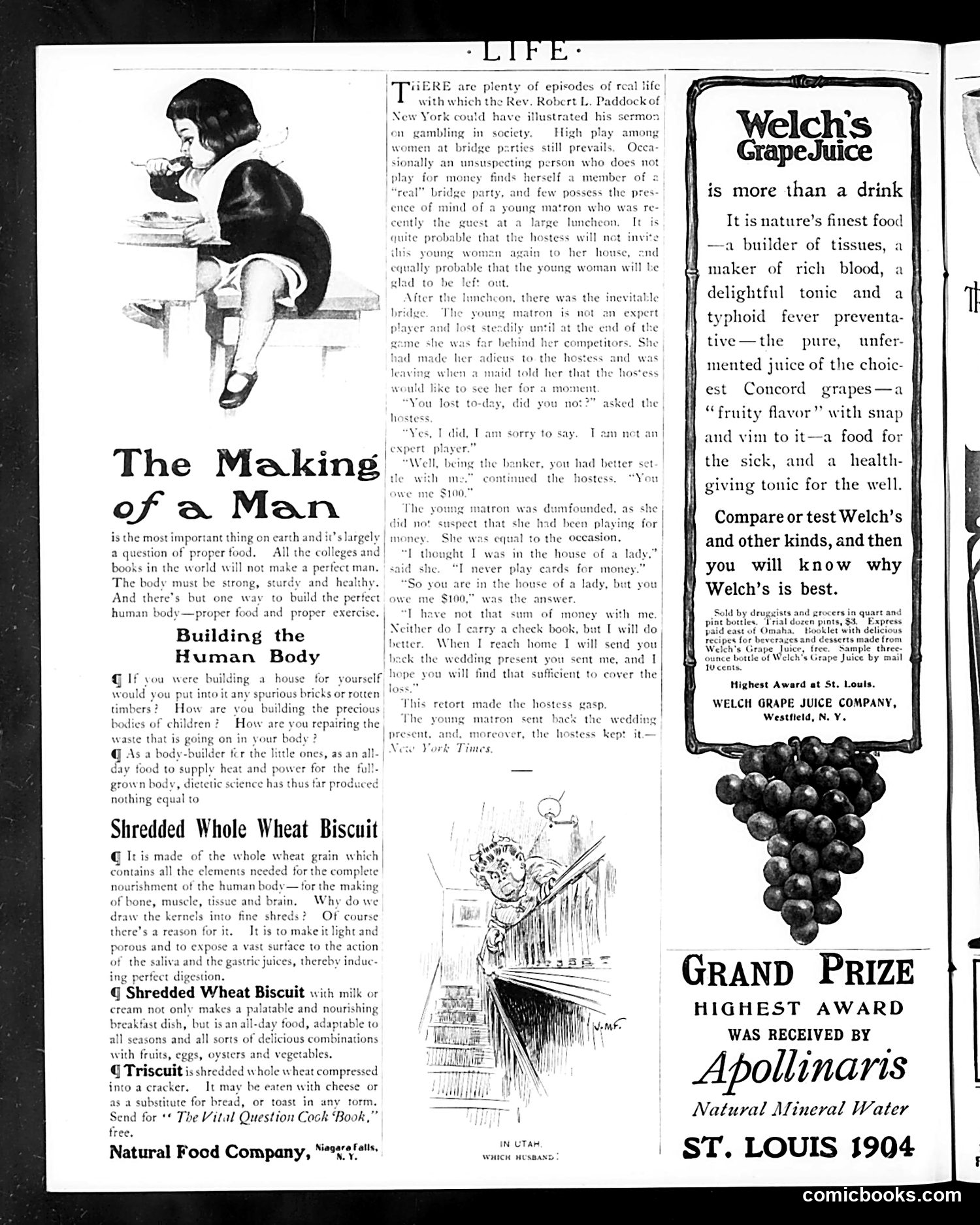
The central cartoon satirizes social hypocrisy among wealthy women. It depicts a young matron at a bridge party who loses money playing cards, then claims to the hostess that she "never plays cards for money." When pressed, she offers to repay her debt with the wedding gift the hostess had sent her—implying she'll simply return the present rather than admit she gambled. The satire targets the contradiction between genteel society's public morality (respectable women don't gamble) and private behavior (they do, regularly). The hostess's smug expression suggests she's caught the younger woman in obvious dishonesty. The joke relies on readers understanding that among the leisure class, bridge parties were notorious venues for gambling, despite polite society's official disapproval of women wagering money. The surrounding ads for wholesome foods (Shredded Wheat, Welch's Grape Juice) provide ironic contrast to this tale of moral compromise.
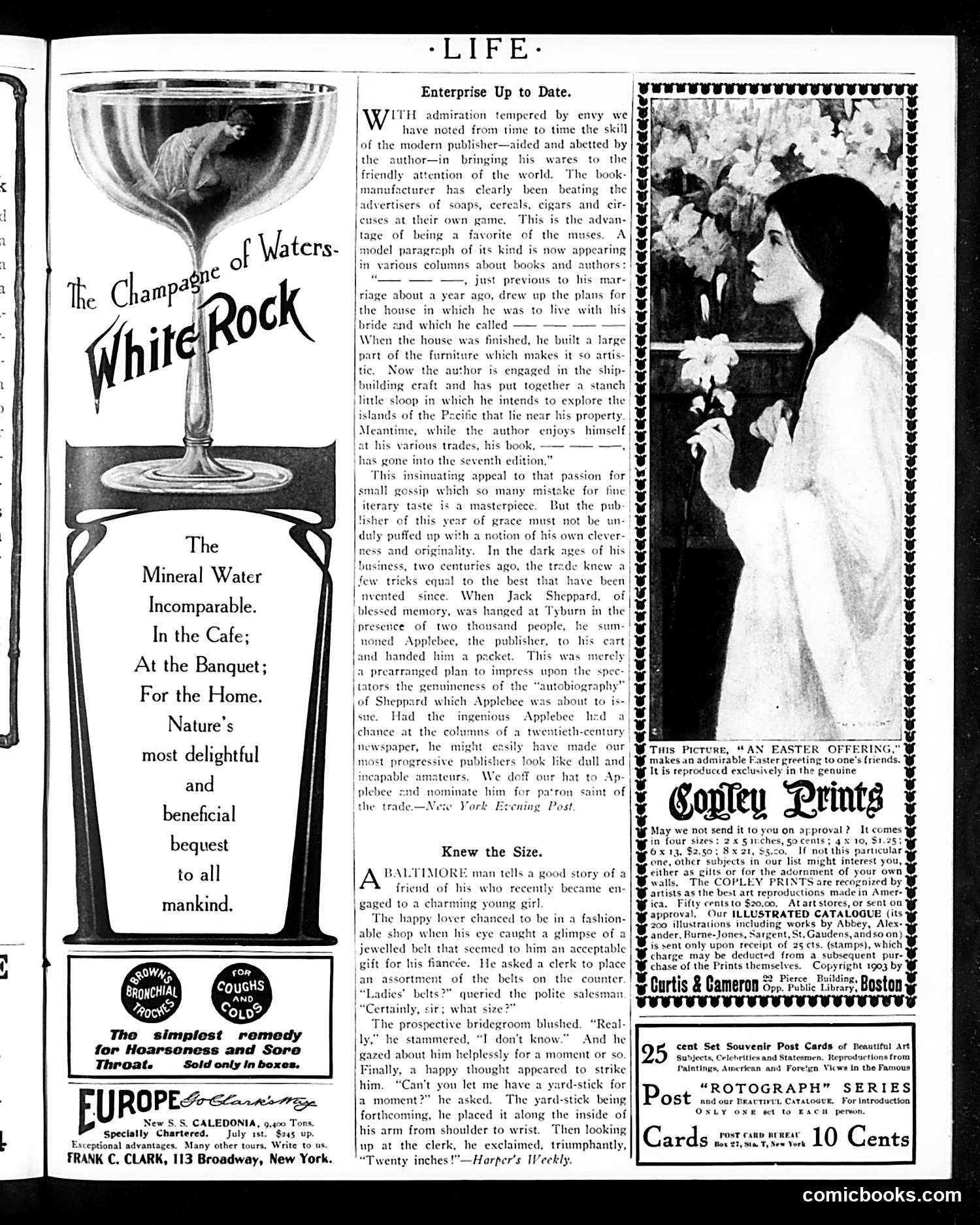
This page is primarily **advertising** with two brief humorous anecdotes. The left side features ads for **White Rock mineral water** and European travel (S.S. Caledonia cruise), plus a throat remedy. The main text content includes two satirical pieces: 1. **"Enterprise Up to Date"** mocks modern publishers' shameless self-promotion. It describes how publishers craftily market books by planting glowing paragraphs about authors in newspapers—praising their talents while the authors pursue other trades (building houses, ships). The reference to Jack Sheppard's execution and publisher Applebee receiving a memoir in Sheppard's pocket illustrates how this promotional trickery dates back centuries. The satire suggests publishers exploit authors' vanity and readers' gossip appetite for commercial gain. 2. **"Knew the Size"** is a mild joke: a Baltimore suitor, asked a belt clerk for his fiancée's size, doesn't know it and must measure his own arm with a yard-stick to estimate, implying humorous ignorance of his betrothed's dimensions. The page is typical early-20th-century *Life* content: advertising mixed with light social commentary.
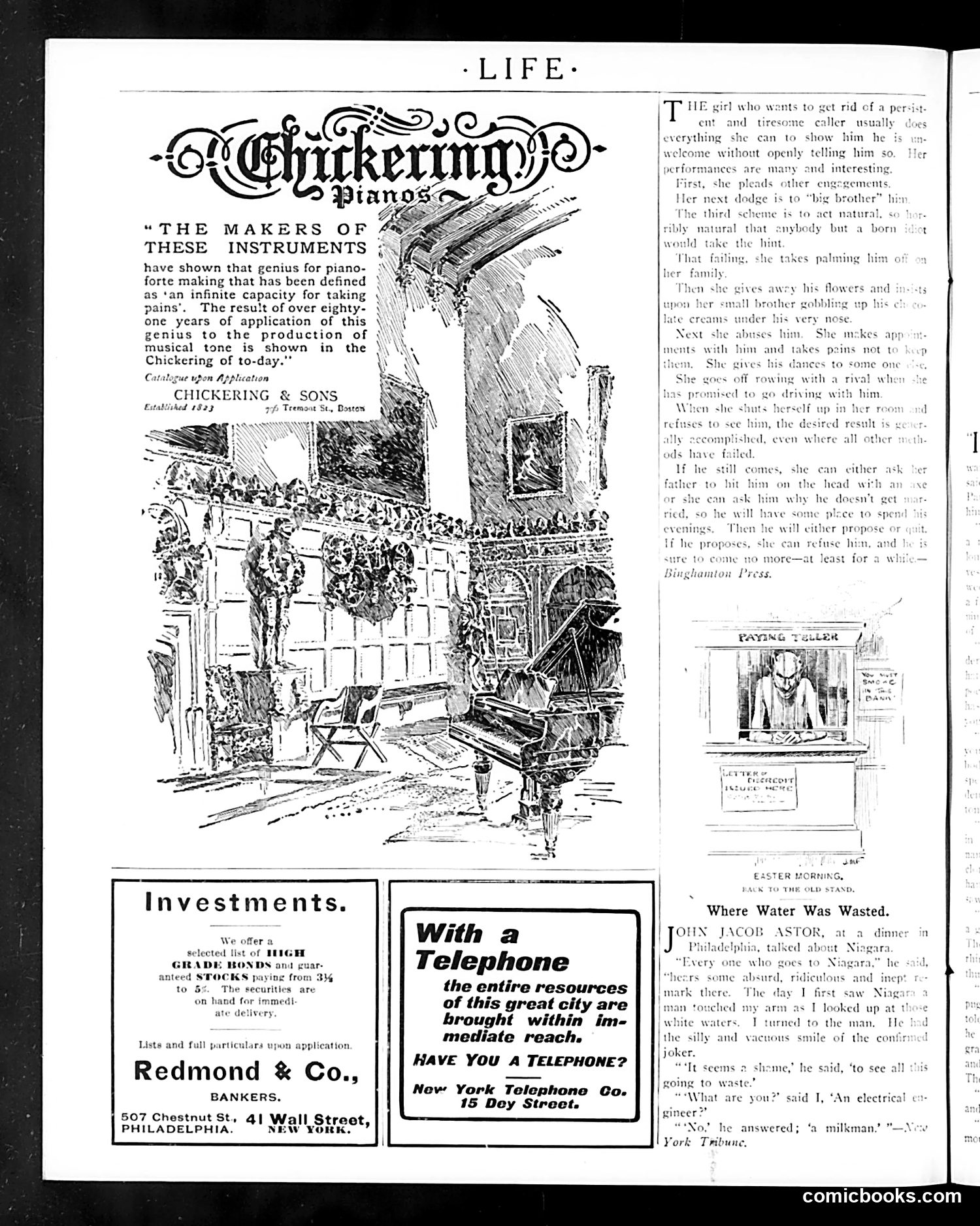
This page is primarily **advertising**, not political satire. It contains four distinct ads: 1. **Chickering Pianos** (top left): A decorative engraving showing a Victorian parlor with a piano, advertising the company's 81+ years of piano manufacturing expertise. 2. **Redmond & Co. Bankers** (bottom left): A financial services advertisement offering high-grade securities. 3. **New York Telephone Co.** (bottom center): Promoting telephone service by claiming it provides access to "the entire resources of this great city" with immediate reach. 4. **"Where Water Was Wasted"** (right side): A brief anecdote featuring John Jacob Astor (the wealthy industrialist) discussing Niagara Falls with a milkman. The joke appears to be that the milkman, observing water "wasted" at Niagara, ironically turns out to be a "milkman"—someone accustomed to working with water—making his concern about waste somewhat humorous. The page reflects early 20th-century advertising and light humor typical of *Life* magazine's format.
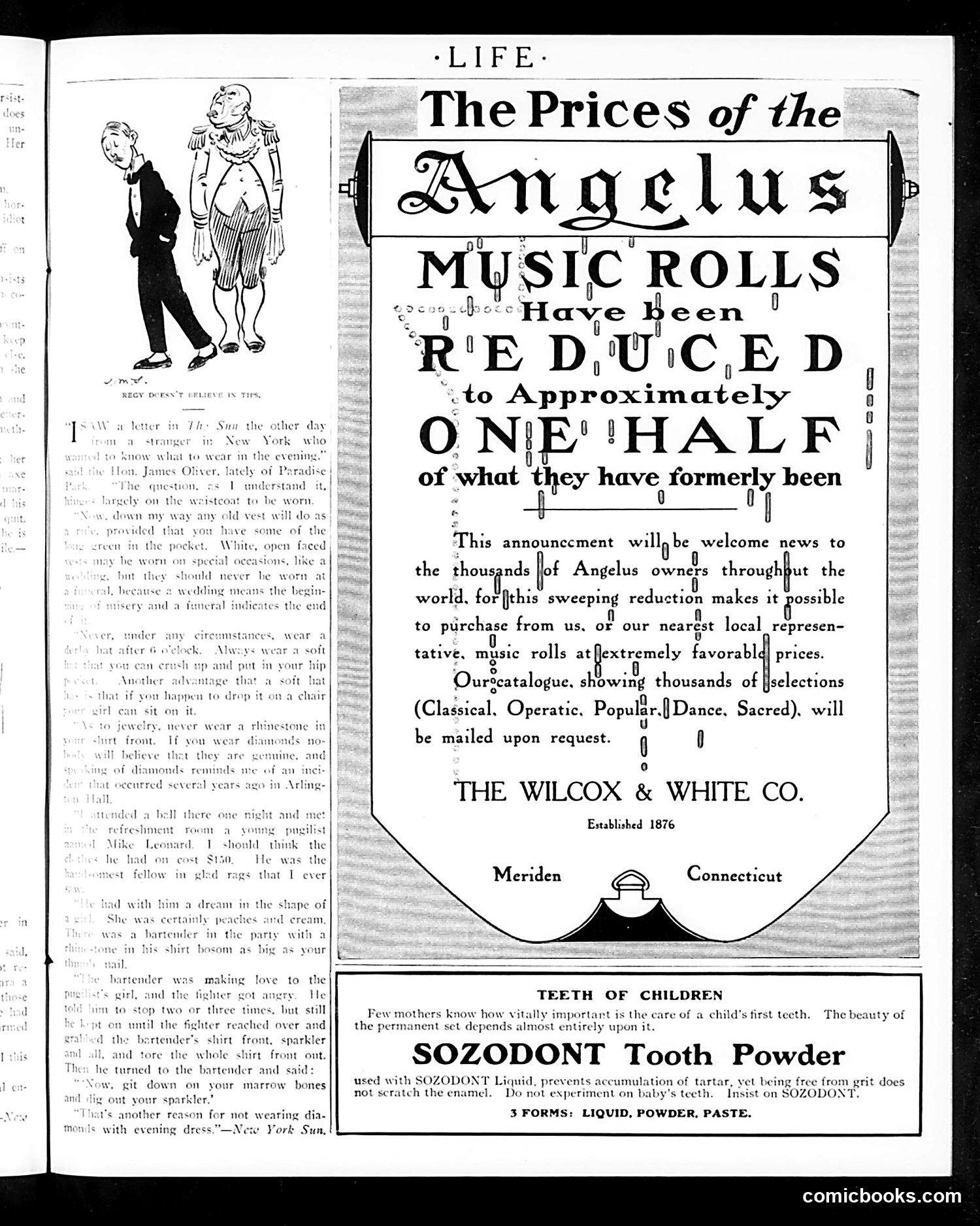
This page contains **no political cartoon**—it is primarily advertising material from an early 20th-century issue. The left side shows a brief illustrated anecdote (likely humorous commentary on social etiquette), but the bulk of the page features two commercial advertisements: 1. **Angelus Music Rolls**: announces a price reduction to "approximately one-half" of former prices. This advertises player piano rolls—pre-recorded music for automatic pianos, a popular entertainment technology before radio and phonographs became dominant. 2. **Sozodont Tooth Powder**: markets dental hygiene products for children's teeth. The cartoon fragment on the left appears to relate to evening dress codes and social behavior, but the OCR text is too fragmented to determine its precise satirical point. **For modern readers**: This page illustrates how early Life magazine mixed editorial content with paid advertising, and shows consumer products (player pianos, tooth powder) that have largely disappeared from use.
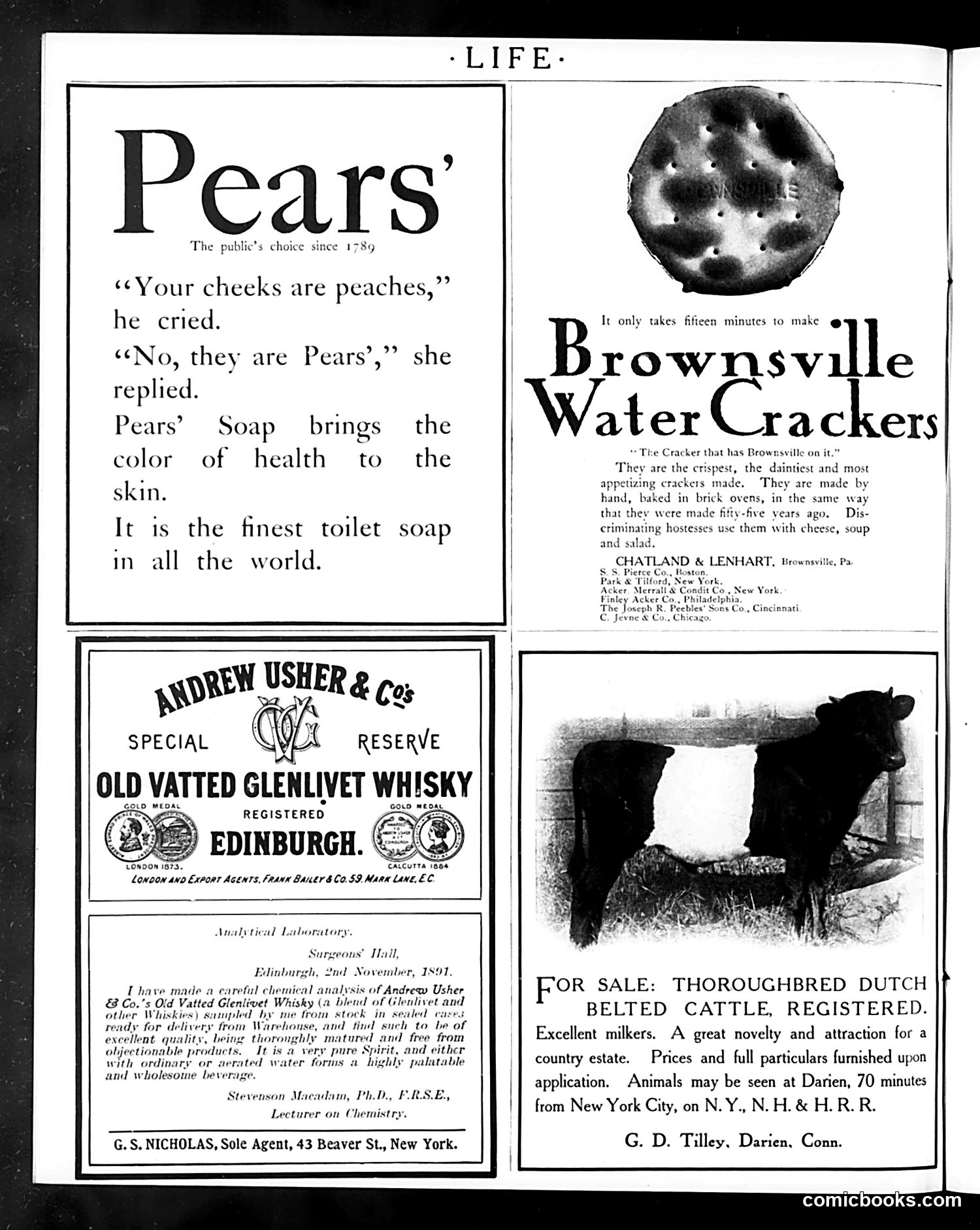
This is primarily an **advertisement page** rather than political satire. The content consists of four commercial ads from the 1890s: 1. **Pears' Soap**: A brief comedic ad playing on the brand name—a man compliments a woman's complexion as "peaches," she corrects him saying they're "Pears" (the soap product). It's a pun, not satire. 2. **Brownsville Water Crackers**: Markets a regional snack product with a photograph of the cracker. 3. **Andrew Usher's Old Vatted Glenlivet Whisky**: Includes a scientific analysis from an Edinburgh chemist (dated 1891) certifying the whisky's quality—a credibility-building tactic common in Victorian advertising. 4. **Thoroughbred Dutch Belted Cattle**: Offers livestock for sale near Darien, Connecticut, marketed as a "great novelty" for country estates. The page reflects late-19th-century consumer culture and advertising techniques rather than political commentary.
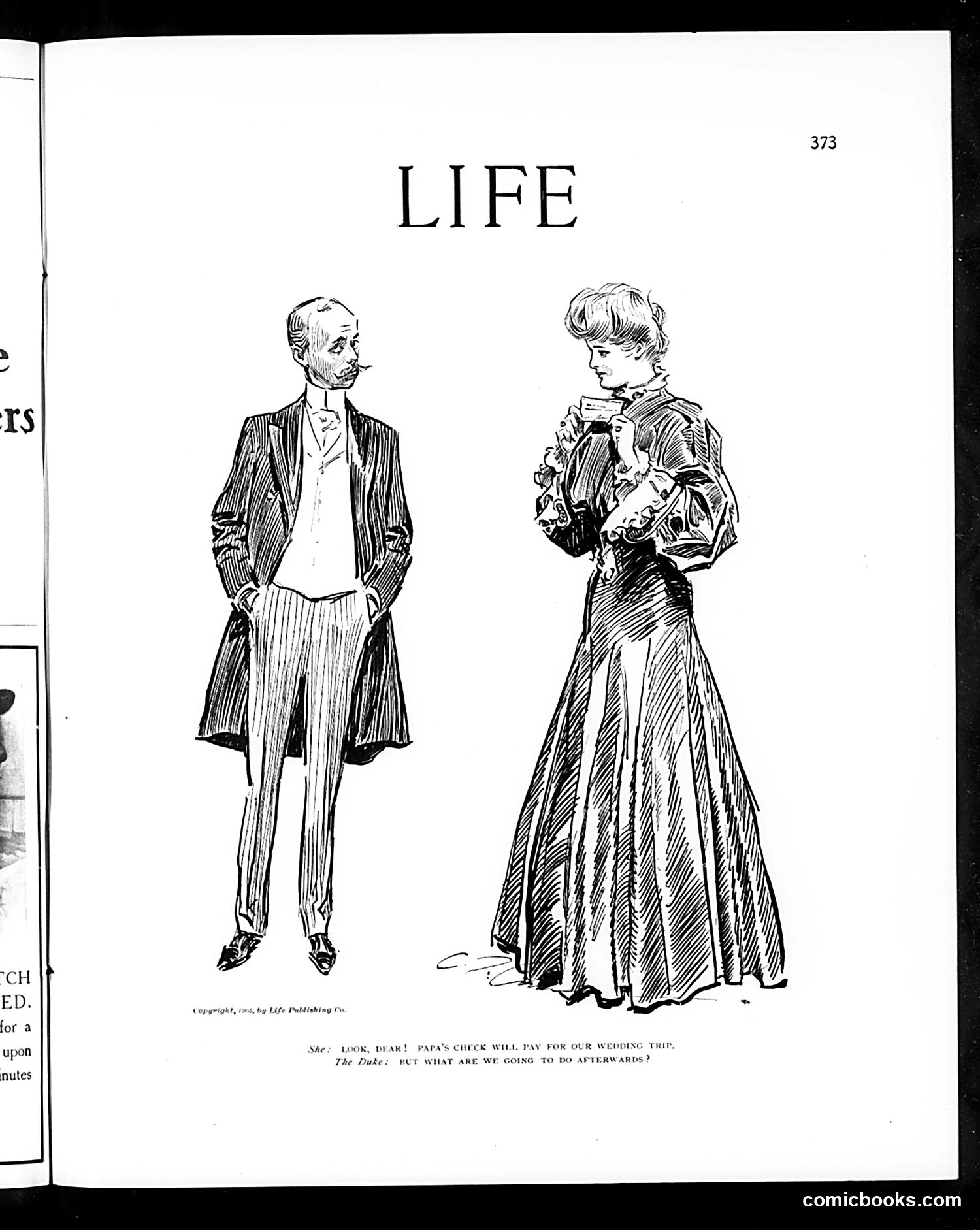
This is a single-panel satirical cartoon showing a couple in formal attire. The woman says: "Look, dear! Papa's check will pay for our wedding trip." The man responds: "But what are we going to do afterwards?" The humor targets early-1900s middle-class anxieties about marriage and financial dependence. The joke suggests that the bride's father is funding their honeymoon, but the couple has no plan for supporting themselves afterward—implying the groom lacks independent means or income. This satirizes both the groom's apparent lack of ambition and the financial precariousness of newlyweds relying on parental support rather than establishing their own economic security. The sophisticated line-drawing style is typical of Life's editorial cartoons from this era.
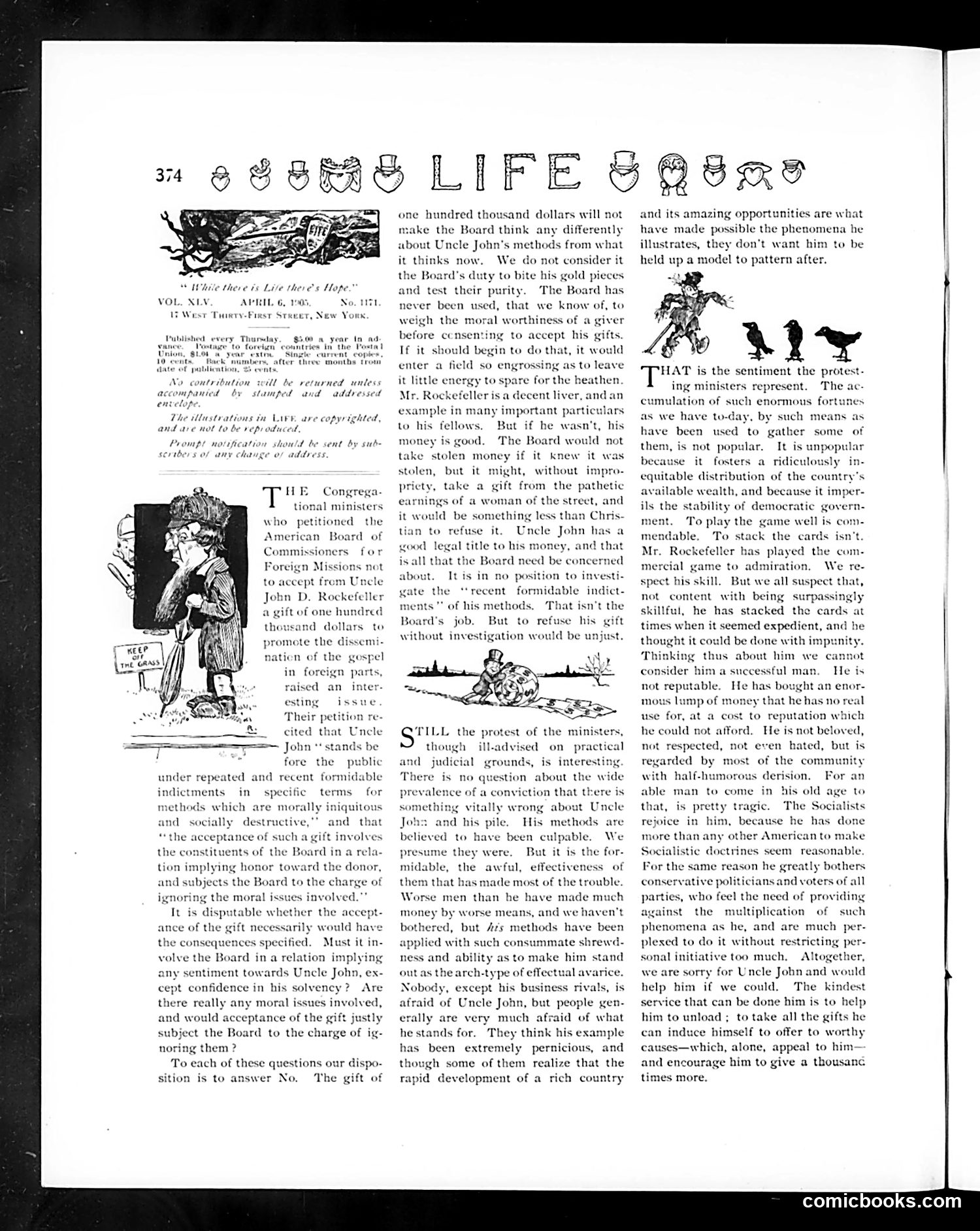
This page debates whether the American Board of Commissioners for Foreign Missions should accept a $100,000 gift from **John D. Rockefeller**, the oil magnate and industrialist. **The controversy:** Congregational ministers petitioned the Board to refuse the donation, arguing that accepting tainted money from someone engaged in morally questionable business practices would compromise the Board's integrity. **Life's position:** The editorial argues the Board should accept the gift. It distinguishes between Rockefeller's personal decency and his business methods, contending the Board needn't judge his conduct. The magazine notes that while Rockefeller's ruthless efficiency in accumulating wealth frightens people, it resulted partly from America's opportunities—not pure villainy. **The satire:** The accompanying cartoons (left) mock the ministers' scruples. Life suggests their moral grandstanding ignores that Rockefeller's methods, however questionable, made him useful as a donor to missionary work. This reflects the Progressive Era debate over whether wealthy industrialists' money could be morally "laundered" through charitable giving.
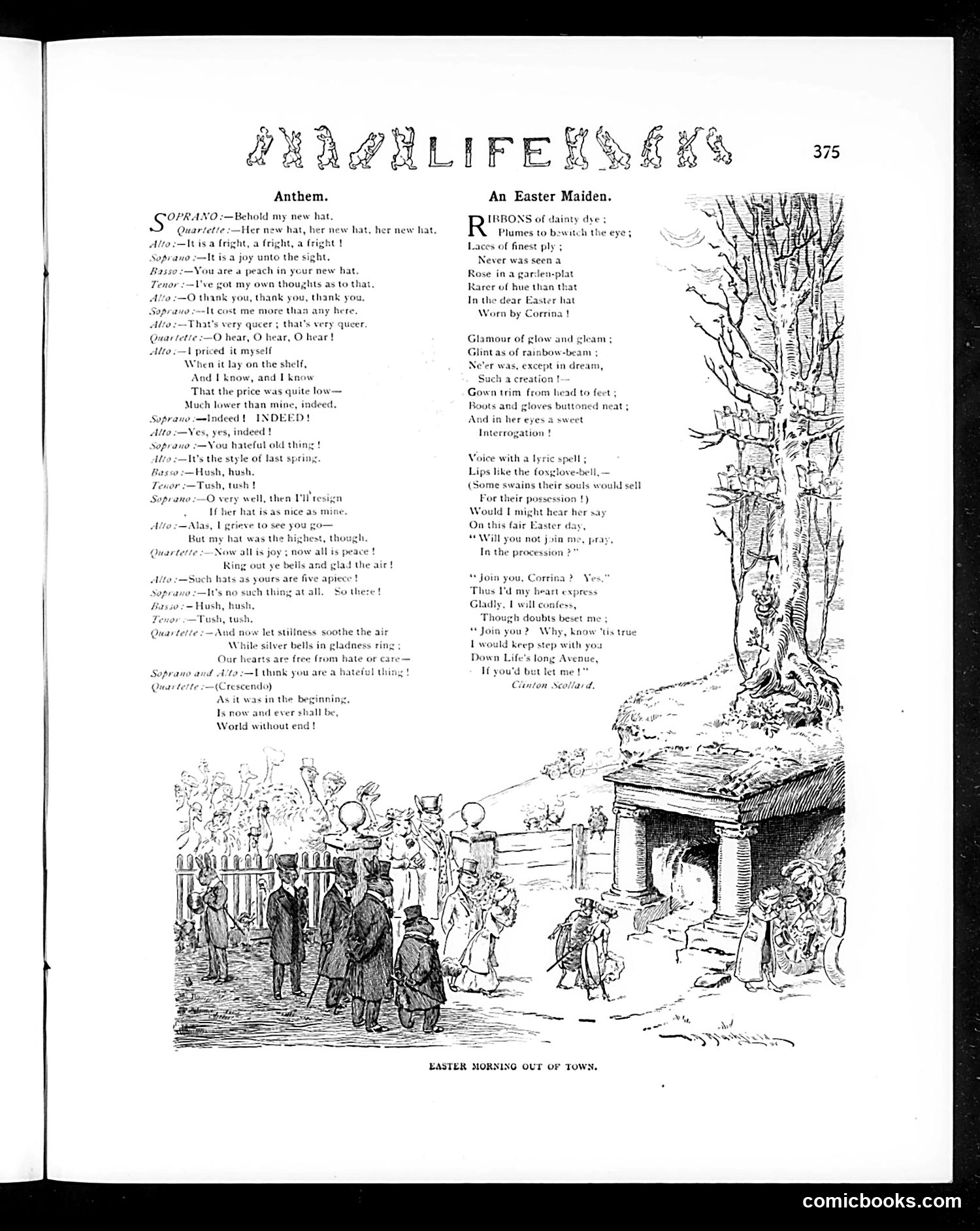
This page contains two separate pieces satirizing Easter fashions and courtship rituals in late 19th-century America. **"Anthem" (left):** A humorous musical quartet where women obsess over their new Easter hats. The satire mocks feminine vanity and competitiveness—women bicker about hat prices and styles, with one admitting her expensive hat cost more than others'. The irony is framed as a religious "anthem," treating hat-purchasing with mock-solemnity, suggesting the secular materialism of Easter celebrations has replaced spiritual meaning. **"An Easter Maiden" (right):** Romantic poetry celebrating a woman's Easter outfit, accompanied by an illustration showing townspeople departing for Easter morning—people in formal dress near a church or gathering spot. The sentimental verse about "Corrina" and her ribbons, plumes, and gloves parodies the era's romanticization of fashionable women during holiday celebrations. Together, these pieces satirize how Easter had become primarily a fashion spectacle rather than religious observance, and how women's worth was judged by their appearance and material possessions.
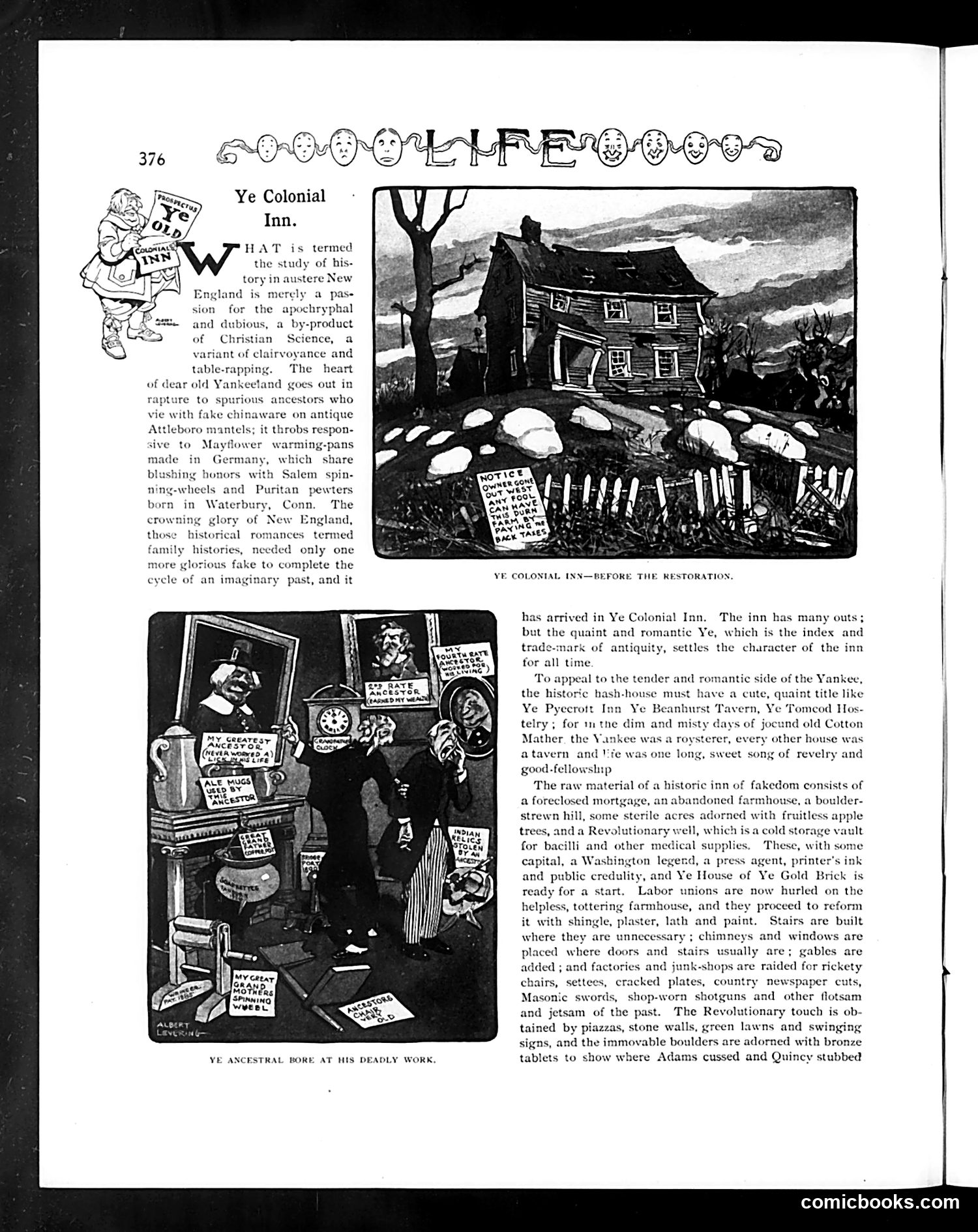
This Life magazine article mocks Americans' obsession with fake colonial authenticity. The satire targets wealthy Yankees who fabricate "historic" inns and taverns to satisfy romantic nostalgia for New England's past. **The Scheme:** Entrepreneurs buy foreclosed farmhouses on worthless land, then use press agents, labor unions, and creative marketing to transform them into pseudo-colonial attractions. They add unnecessary architectural features, scatter Revolutionary-era props (fake pistols, spurious ancestor portraits), and slap names like "Ye Pyecroft Inn" on the buildings. **The Target:** The article ridicules both the con artists profiting from this fakery and the gullible wealthy tourists/residents who pay for it. The phrase "hash-house" suggests these aren't genuine historic sites but rather commercialized restaurants. **The Joke:** Americans desperately want connection to their colonial heritage but will happily accept obvious fabrications—bronze plaques claiming Adams "cussed" there—if presented with enough "quaint" theatrical decoration. It's historical fraud dressed as nostalgia.
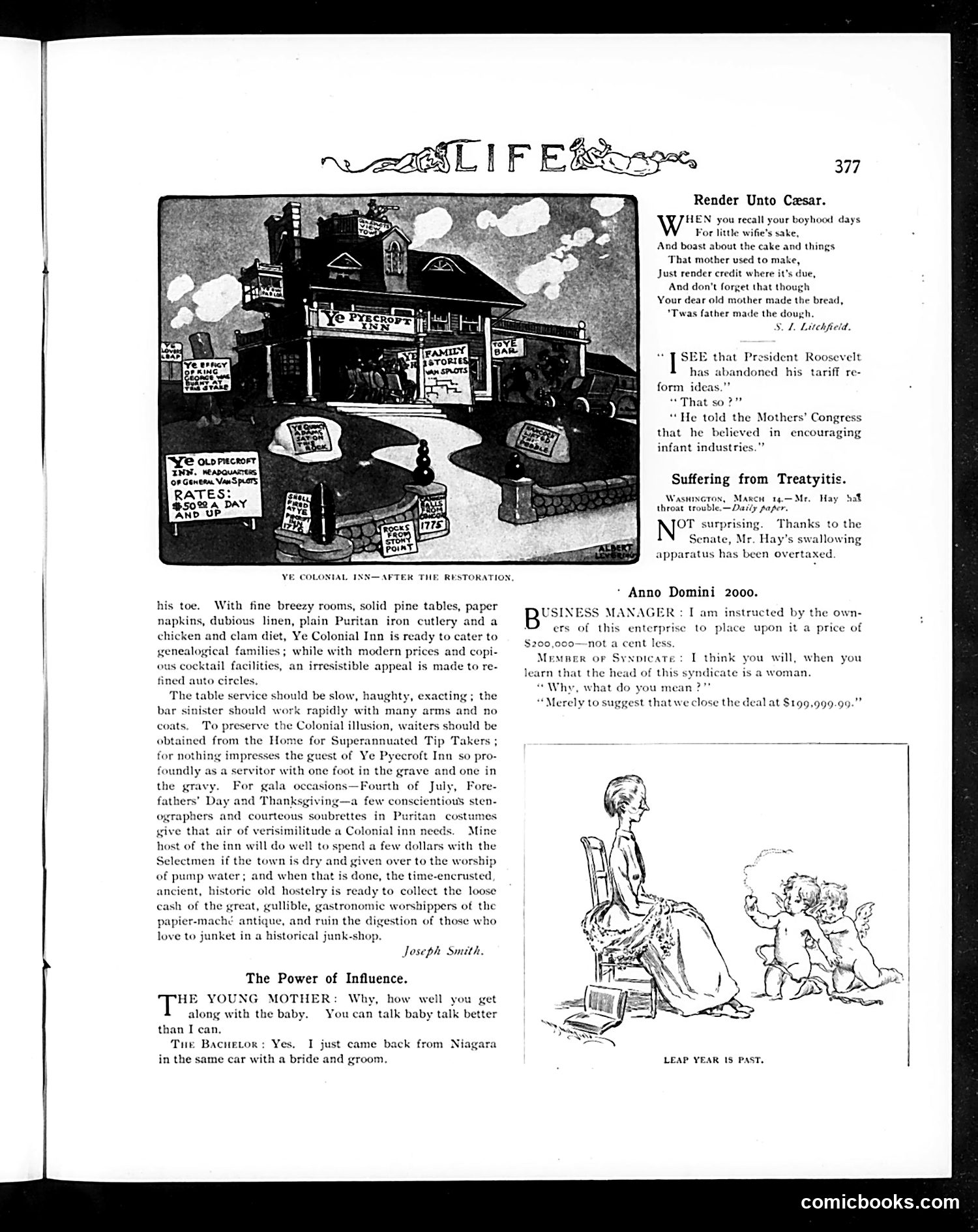
This page contains several satirical pieces targeting early-1900s American politics and social customs: **"Render Unto Caesar"** is a poem mocking men who take credit for household contributions—the joke being that while mothers bake bread, fathers merely "make the dough" (money), yet expect recognition. **The Roosevelt tariff joke** satirizes President Theodore Roosevelt's apparent contradiction: he claimed to oppose protective tariffs while telling the Mothers' Congress he supported "infant industries"—a pun equating business protectionism with literal child-rearing. **"Suffering from Treatyitis"** is a political jab at Secretary of State John Hay, suggesting the Senate's obstruction of his treaty negotiations has overworked him so severely he's "suffering" from throat trouble. **"Anno Domini 2000"** imagines a Colonial-themed inn in the distant future, satirizing both the commercialization of Americana and early anxieties about women in business leadership. The page also includes lighter social humor about bachelor behavior and "leap year" courtship customs, reflecting period gender dynamics.
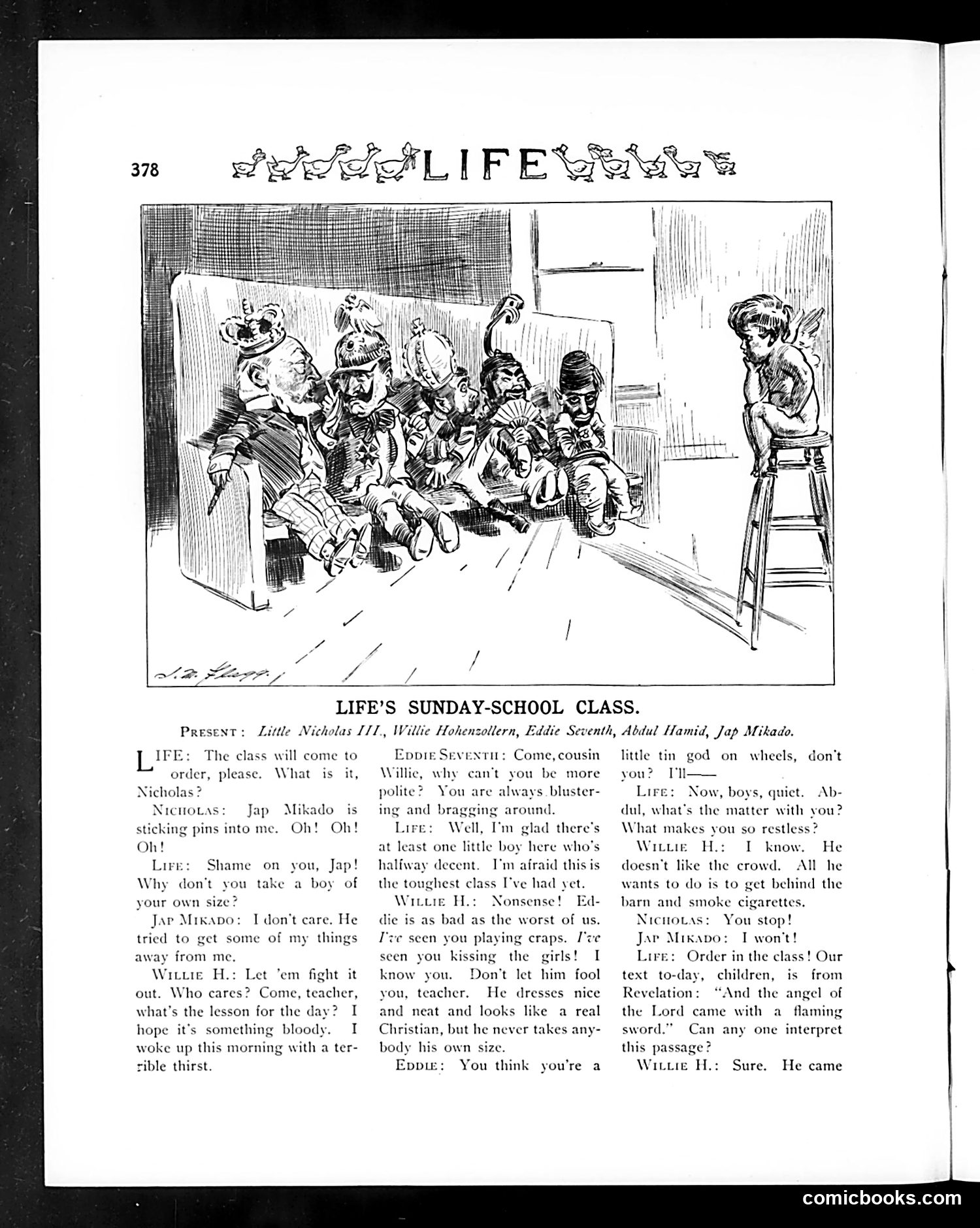
This satirical cartoon uses a classroom scenario to mock contemporary world leaders as misbehaving children. The "students" represent major powers: Little Nicholas III (Russia), Willie Hohensollern (Germany's Kaiser Wilhelm II), Eddie Seventh (Britain's King Edward VII), Abdul Hamid (Ottoman Empire), and the Jap Mikado (Japan). The humor comes from depicting imperial rivalries and aggression as schoolyard bullying. Japan "sticks pins" into Russia (referencing the Russo-Japanese War); Wilhelm II is portrayed as a blustering troublemaker; Abdul Hamid appears restless and secretive. The lesson on divine judgment with "a flaming sword" suggests these leaders deserve punishment for their militaristic behavior. This reflects early-20th-century American anxiety about European imperialism and rising international tensions before World War I.
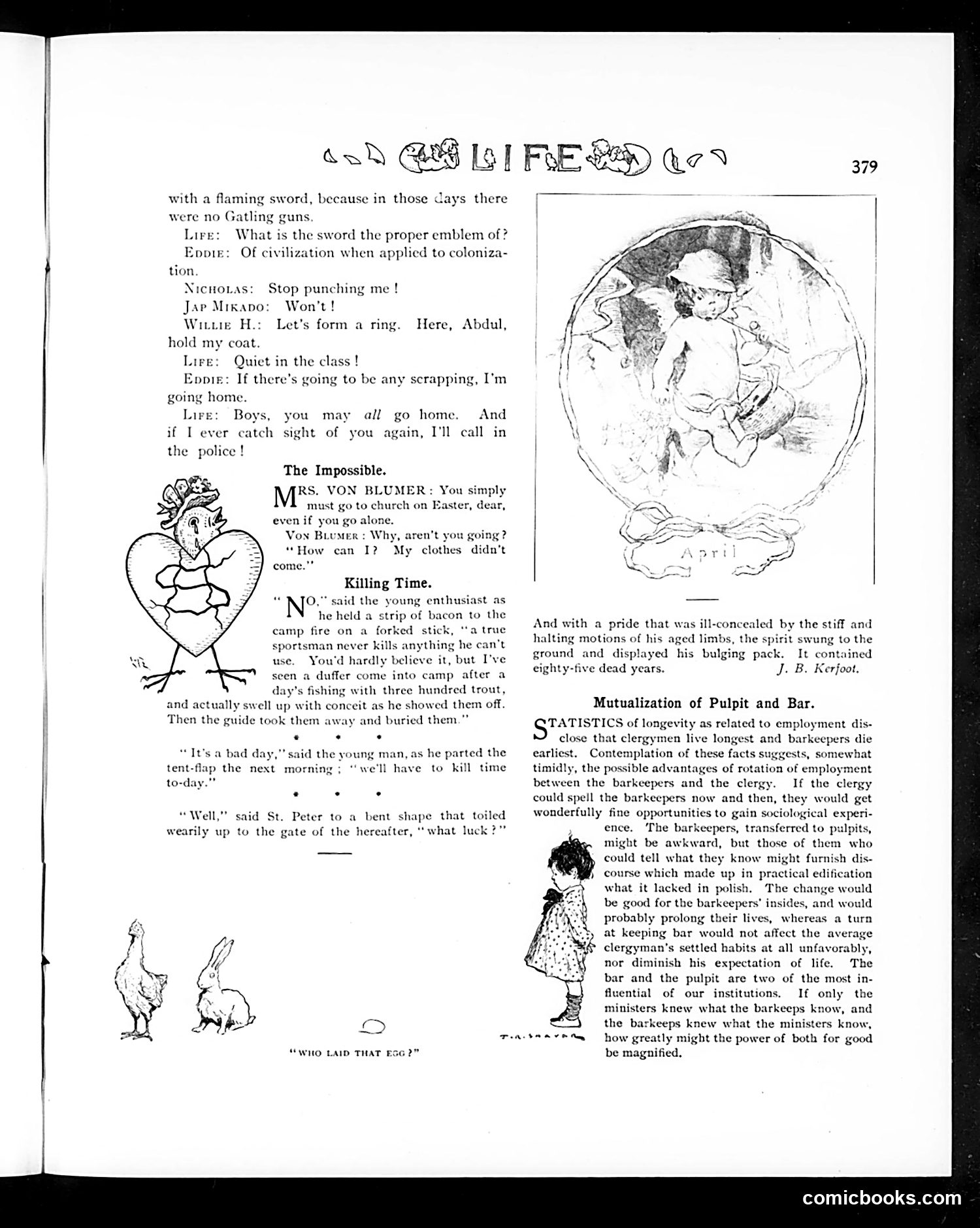
This page contains several satirical pieces mocking social pretensions and institutional absurdities: **"The Impossible"** ridicules marital class anxiety: Mrs. von Blumer insists on attending Easter services despite her husband's claim that his formal clothes haven't arrived—suggesting wealthy people prioritize social appearances over practical concerns. **"Killing Time"** depicts a fishing-camp anecdote where a "sportsman" boasts about ethical hunting while a guide quietly buries hundreds of trout the man caught and discarded—satirizing hypocrisy in outdoor recreation ethics. **"Mutualization of Pulpit and Bar"** proposes swapping clergy and barkeepers' professions, arguing both groups would benefit: barkeepers might offer practical moral instruction, while clergymen wouldn't suffer from tavern work. This mocks rigid institutional hierarchies and suggests unexpected wisdom exists across social classes—a critique of early-20th-century class assumptions about respectability. The cartoons throughout reinforce themes of pretension, contradiction, and social folly typical of *Life*'s satirical approach.
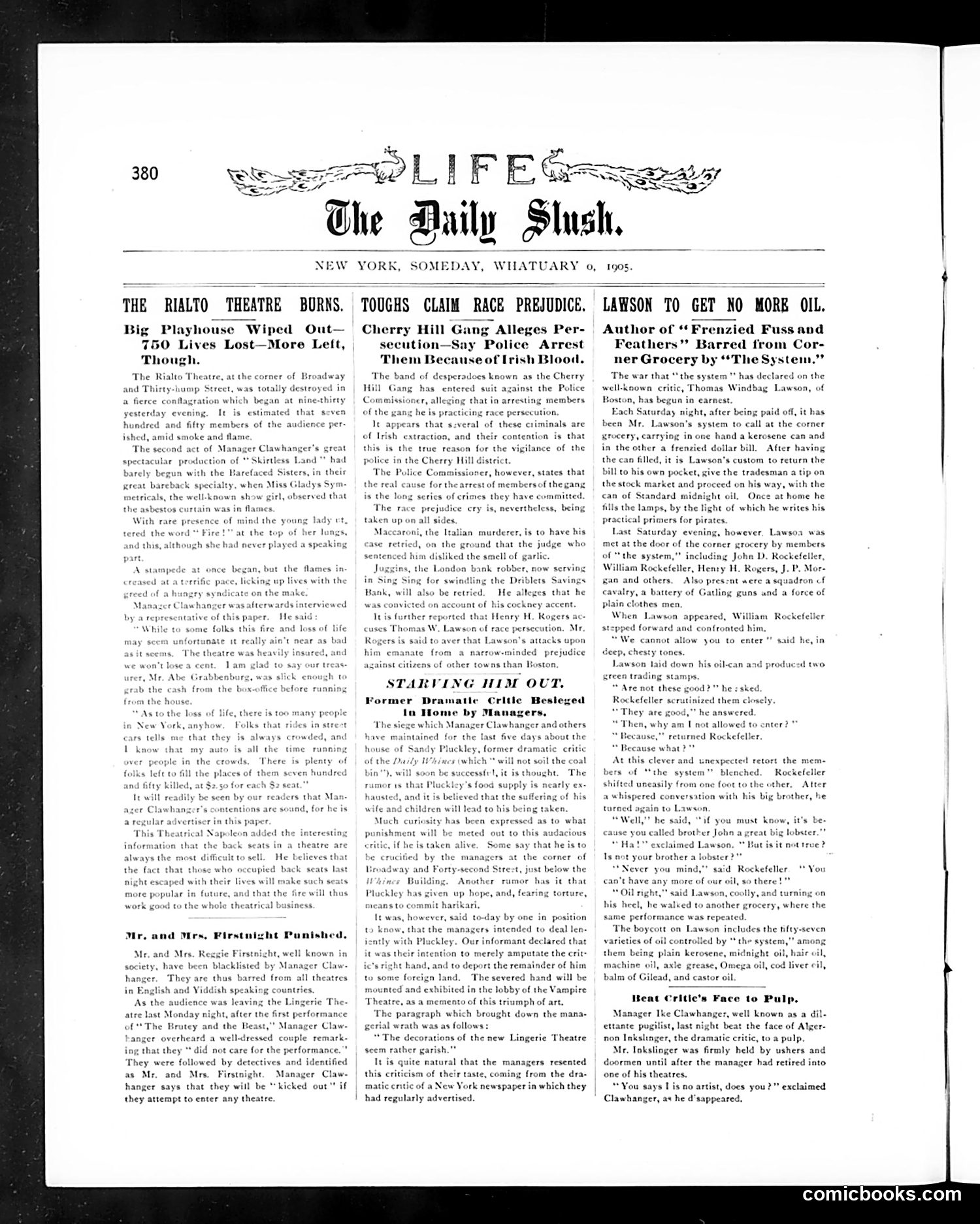
This page is entirely satirical news commentary, not a cartoon. The satire targets theater management corruption and hypocrisy. The main pieces mock: 1. **Manager Clawhanger** of the Rialto Theatre, who dismisses a fire killing 750 people as actually good for business—it will make rear seats more popular since survivors escaped safely. The satire highlights callous profiteering: Clawhanger is praised as "a regular advertiser in this paper," implying Life accepts his ads despite his moral bankruptcy. 2. **Clawhanger's blacklisting** of theater-goers Mr. and Mrs. Firstnight for criticizing a performance, banning them from all English and Yiddish theaters—absurdly petty authoritarian control. 3. **The "Cherry Hill Gang"** claiming race prejudice when arrested, while the Police Commissioner insists the real cause is their crimes—satirizing how prejudice claims distract from actual criminality. The page satirizes corrupt theater management, censorious control over audiences, and false victimhood claims by criminals.
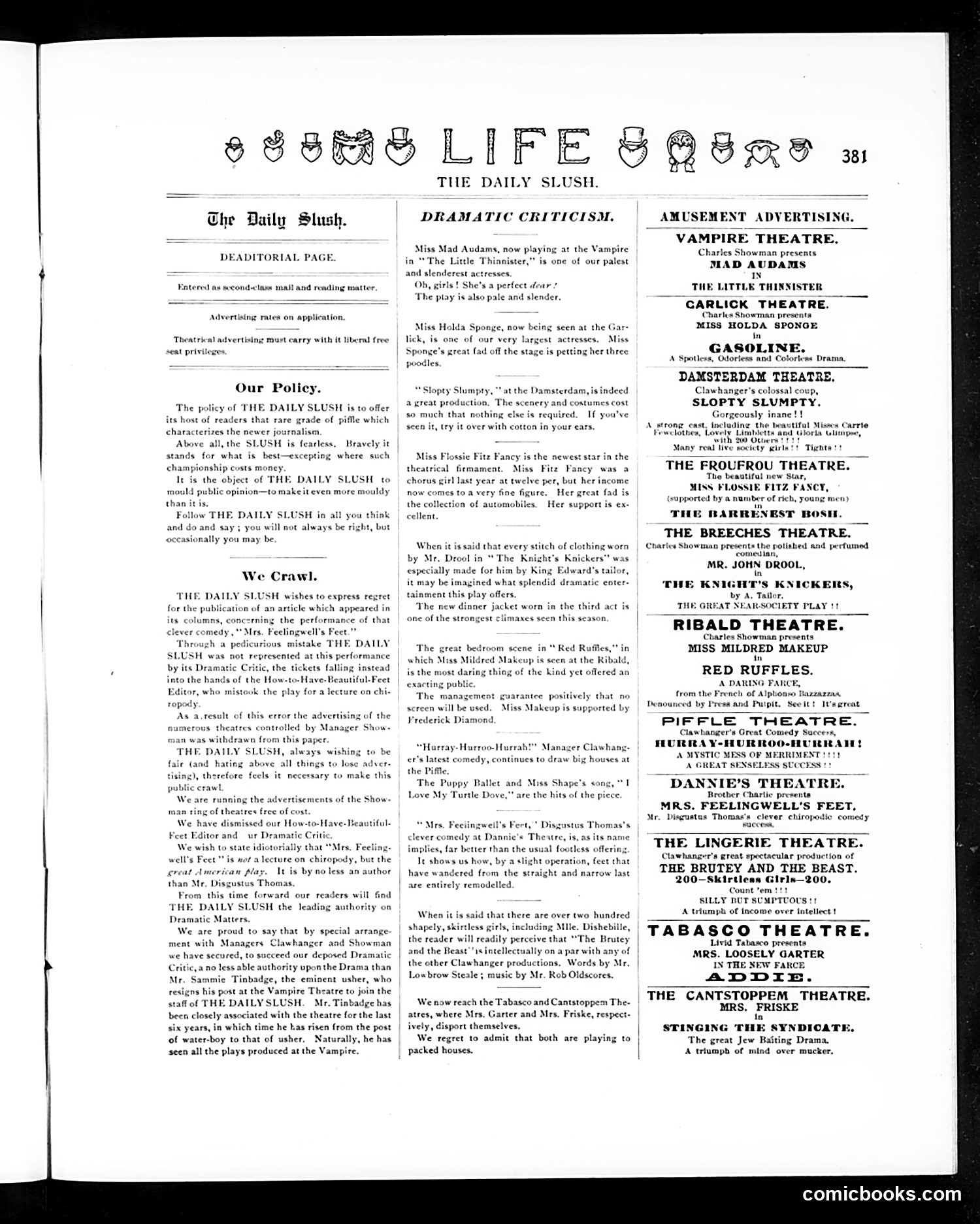
This page satirizes theatrical criticism and advertising through a fake publication called "The Daily Slush." The satire mocks both sensationalist journalism and inflated theater promotion of the era. The "Dramatic Criticism" section ridicules shallow theater reviews by offering absurd praise: actresses are described by physical appearance ("palest," "largest") rather than talent. The jokes target specific plays and performers with silly descriptions—"Slopty Slumpty" is praised as "gorgeously inane," and a chorus girl's success is attributed to her automobile collection rather than acting ability. "We Crawl" confesses THE DAILY SLUSH mistakenly published a pedicure review instead of a play review, blaming "the How-to-Have-Beautiful-Feet Editor" for the mix-up. This mocks careless editorial standards and sensationalist content priorities. The right column's theater advertisements parody exaggerated promotional language, using empty superlatives ("great," "triumph," "senseless success") and vague descriptions—typical of the era's hyperbolic theater marketing. Overall, the page satirizes low-quality journalism that prioritizes gossip and spectacle over substance.
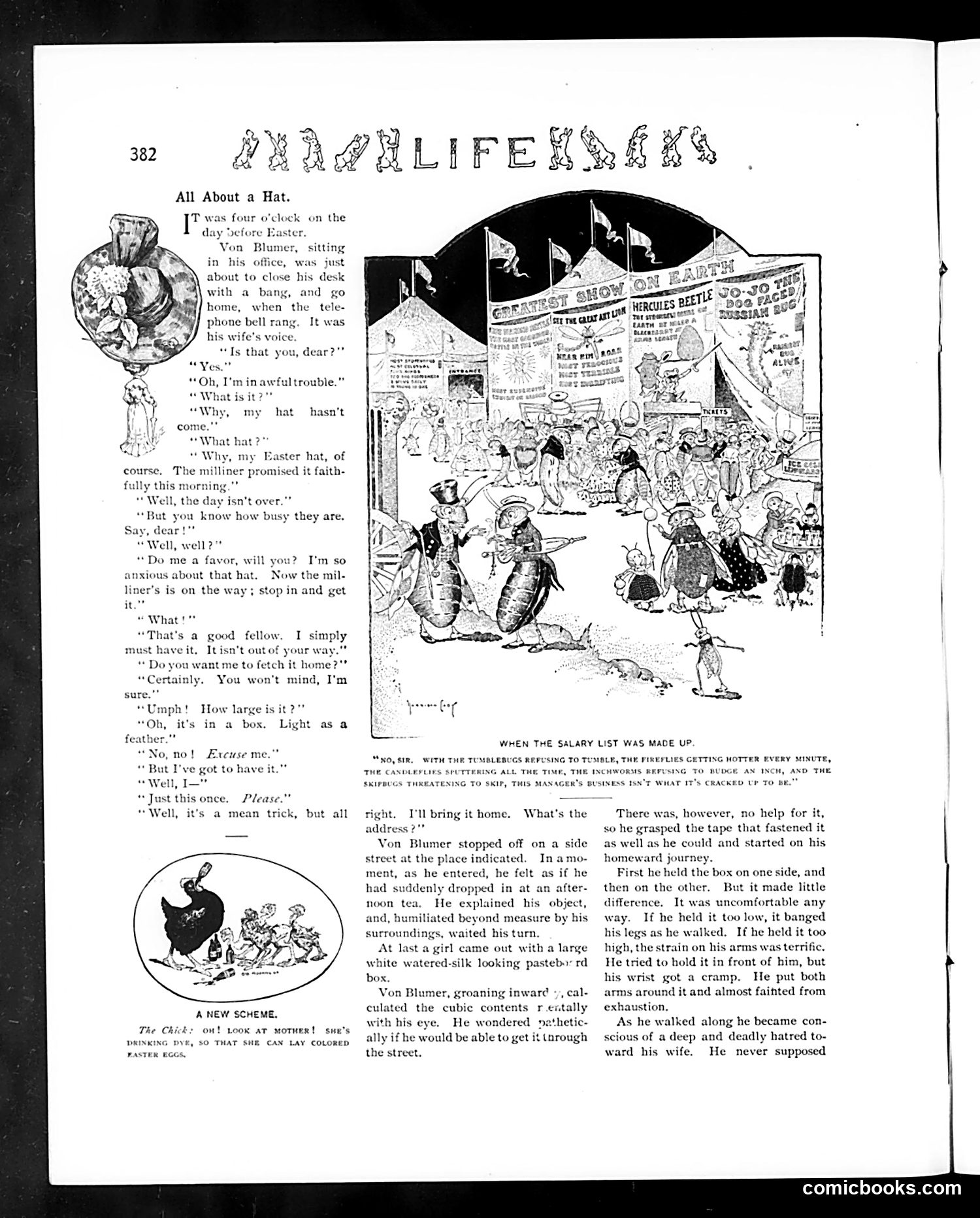
This page satirizes the frustrations of early 20th-century domestic life and gender dynamics. The main story follows Von Blumer, a businessman whose wife calls demanding he fetch her Easter hat from the milliner before closing time. Though reluctant, he complies—a commentary on marital obligation and henpecked husbands. The satire's point: Von Blumer's suffering while transporting the enormous, awkwardly-shaped hat box through the street represents the absurd burdens wives impose on husbands. His growing "deadly hatred" toward his wife is presented comedically, reflecting the era's sardonic take on marriage as an institution where women's vanity and demands torment accommodating men. The secondary cartoons mock workplace inefficiency and animal behavior—typical satirical filler for Life magazine's humor sections.
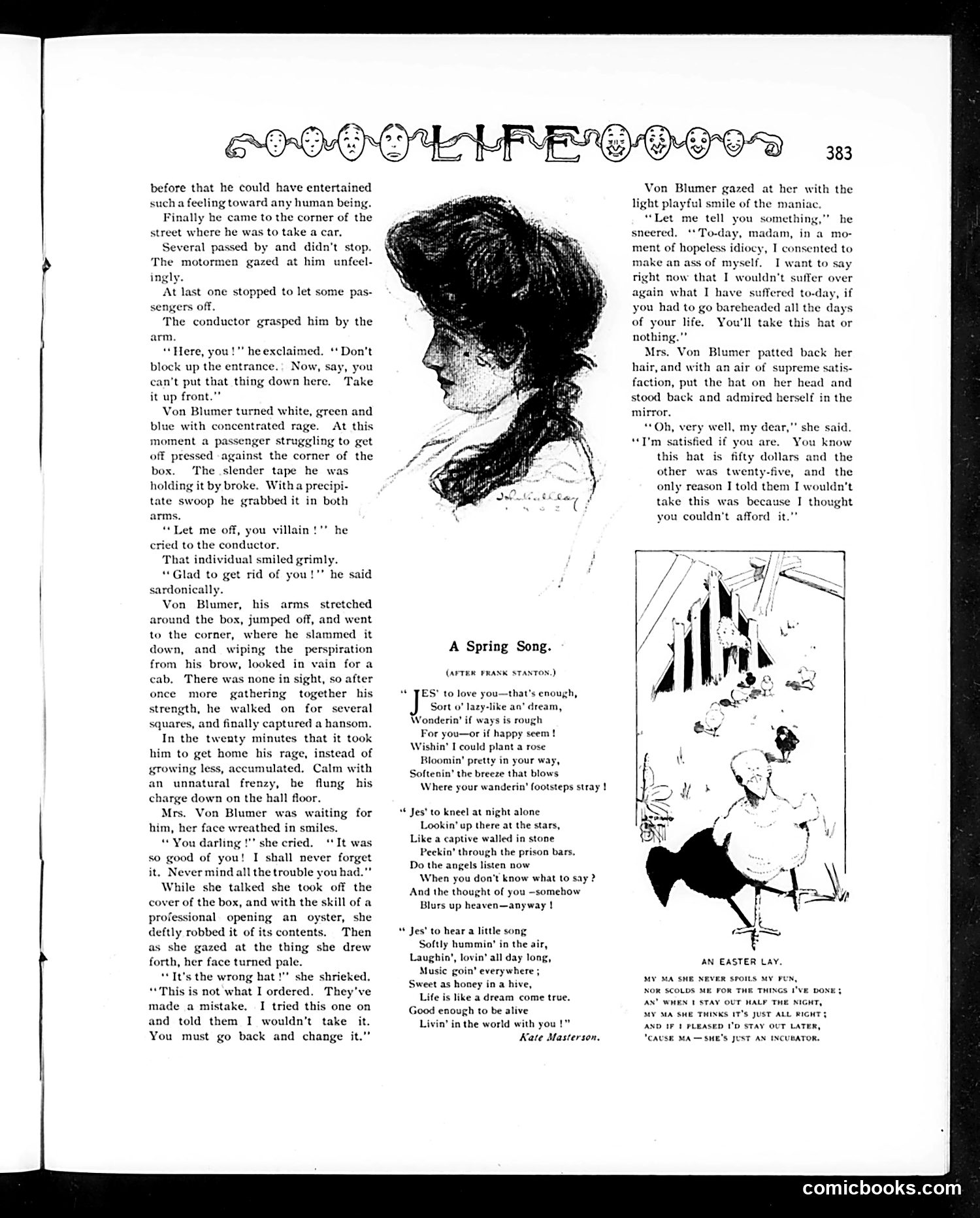
This page contains a satirical short story about marital discord. Von Blumer, a working-class man, goes to considerable trouble retrieving a hat his wife ordered—carrying it through the city, enduring rudeness from a streetcar conductor, arriving home exhausted and furious. His wife thanks him effusively, but then reveals the hat is wrong and demands he return it. She then reveals the cruel irony: she deliberately refused the correct hat (which cost more) because she assumed her husband couldn't afford it. When he angrily insists she keep this cheaper hat, she triumphantly puts it on, having essentially tricked him into buying her a hat he never intended to purchase. The satire targets both marital manipulation and class anxieties—the wife's assumptions about her husband's finances, his wounded pride, and the performative gratitude masking selfish calculation. The humor lies in the wife's transparent scheming and Von Blumer's impotent rage. The page also includes poetry and an illustration unrelated to the main story.
This page appears to be from a historical archive or collection hosted on comicbooks.com rather than an original Life magazine page. The image shows what appears to be a classical or renaissance-style artwork depicting multiple figures in a dramatic scene—possibly a religious or mythological composition with elaborate details and numerous human figures. However, the image quality is poor, the text is minimal (just a URL watermark), and there are no visible captions, titles, or OCR text provided that would allow me to identify specific political figures, social references, or satirical intent. Without clearer labeling or readable accompanying text, I cannot reliably explain what this cartoon means or what it's satirizing. The page does not appear to be a typical Life magazine satirical cartoon based on its composition.
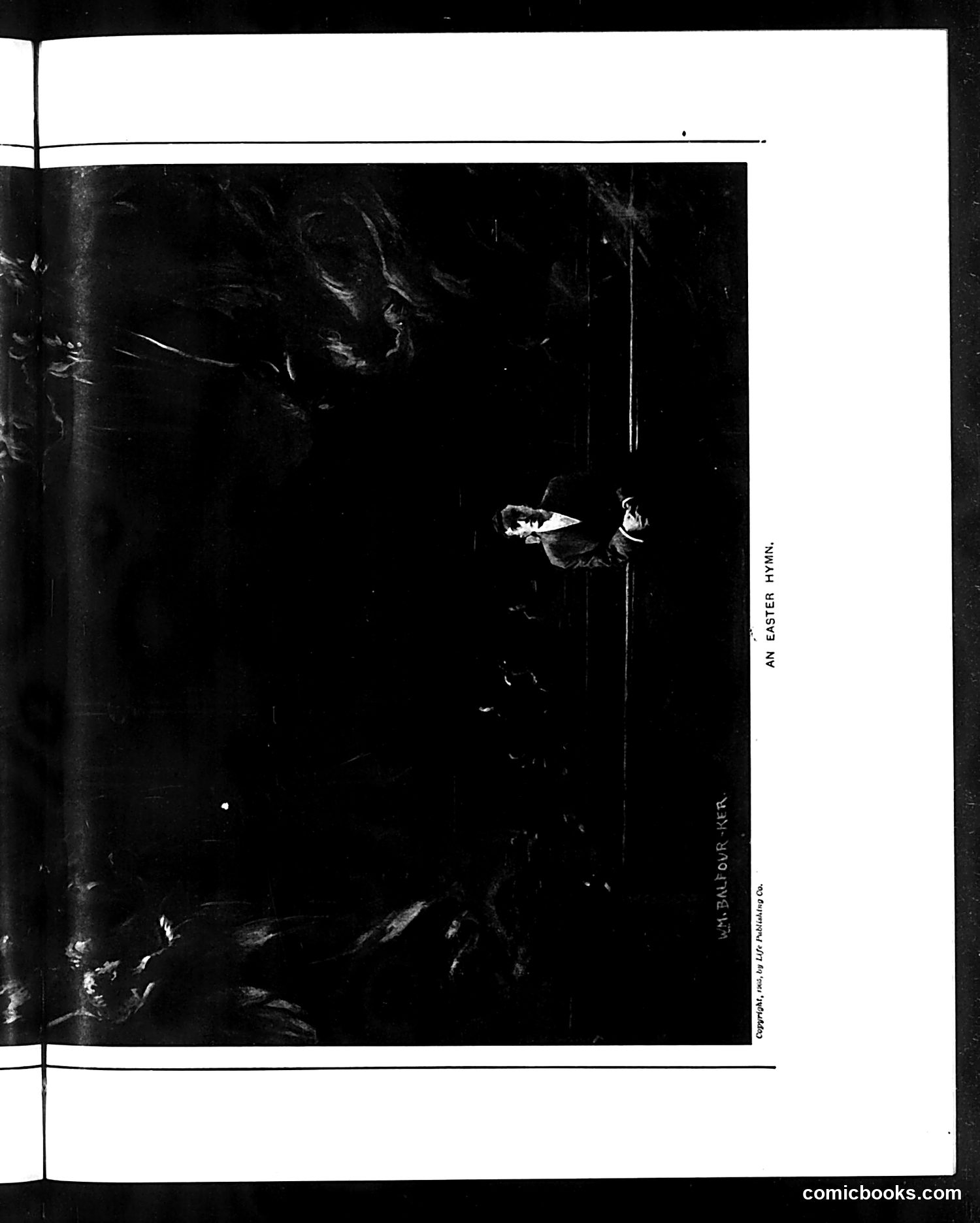
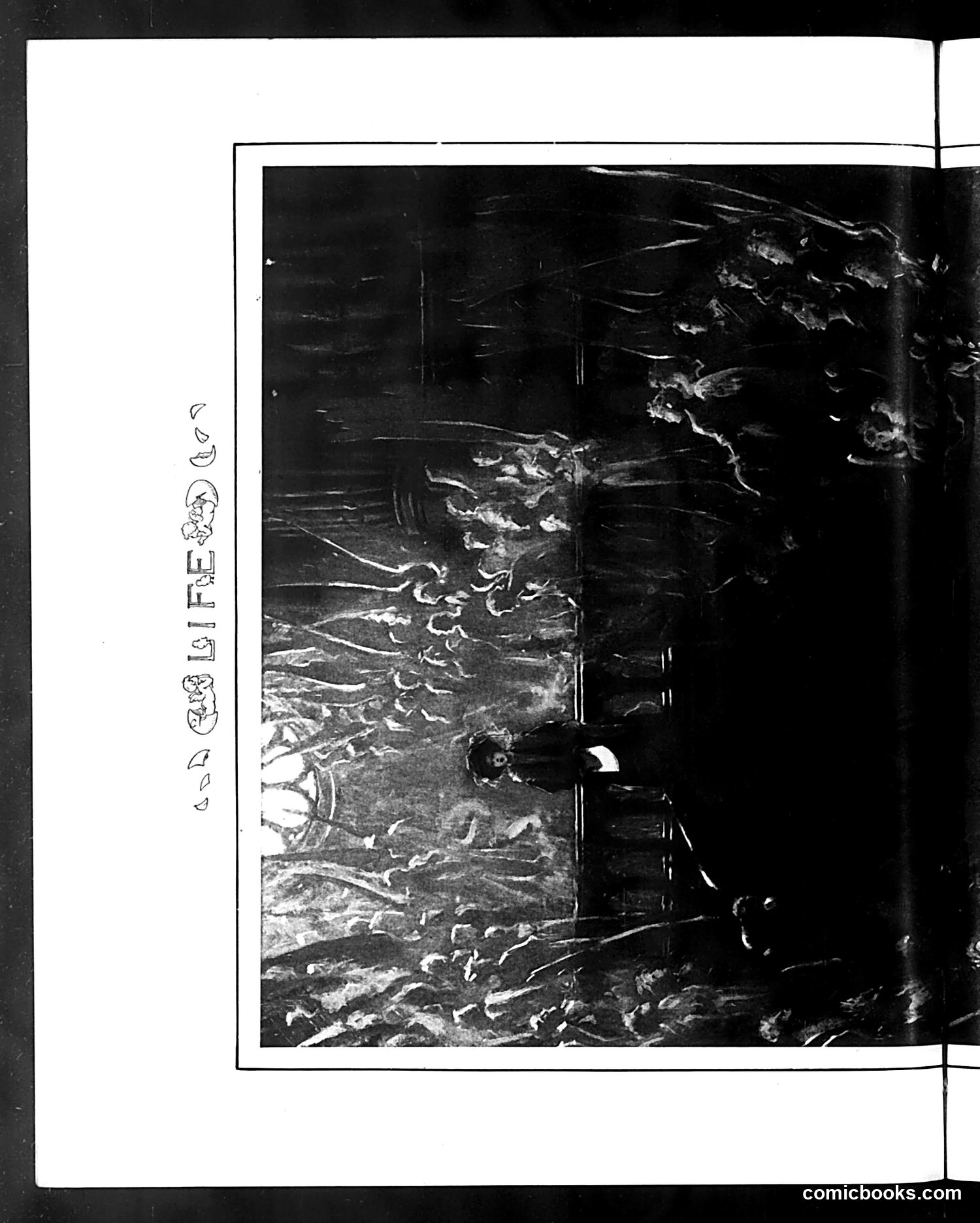
This page appears to be a dark, atmospheric illustration titled "An Easter Hymn," though the image quality makes specific details difficult to discern. The heavily shadowed composition suggests a religious or solemn subject matter appropriate to the Easter theme indicated by the title. The OCR text is largely garbled and unintelligible, providing no clear context for interpretation. Without readable accompanying text or clearer visual details, I cannot confidently identify specific figures, caricatures, or the intended satirical message. The artistic style and dramatic lighting suggest this may be serious commentary rather than humorous satire, but the exact subject and point remain unclear from this reproduction.
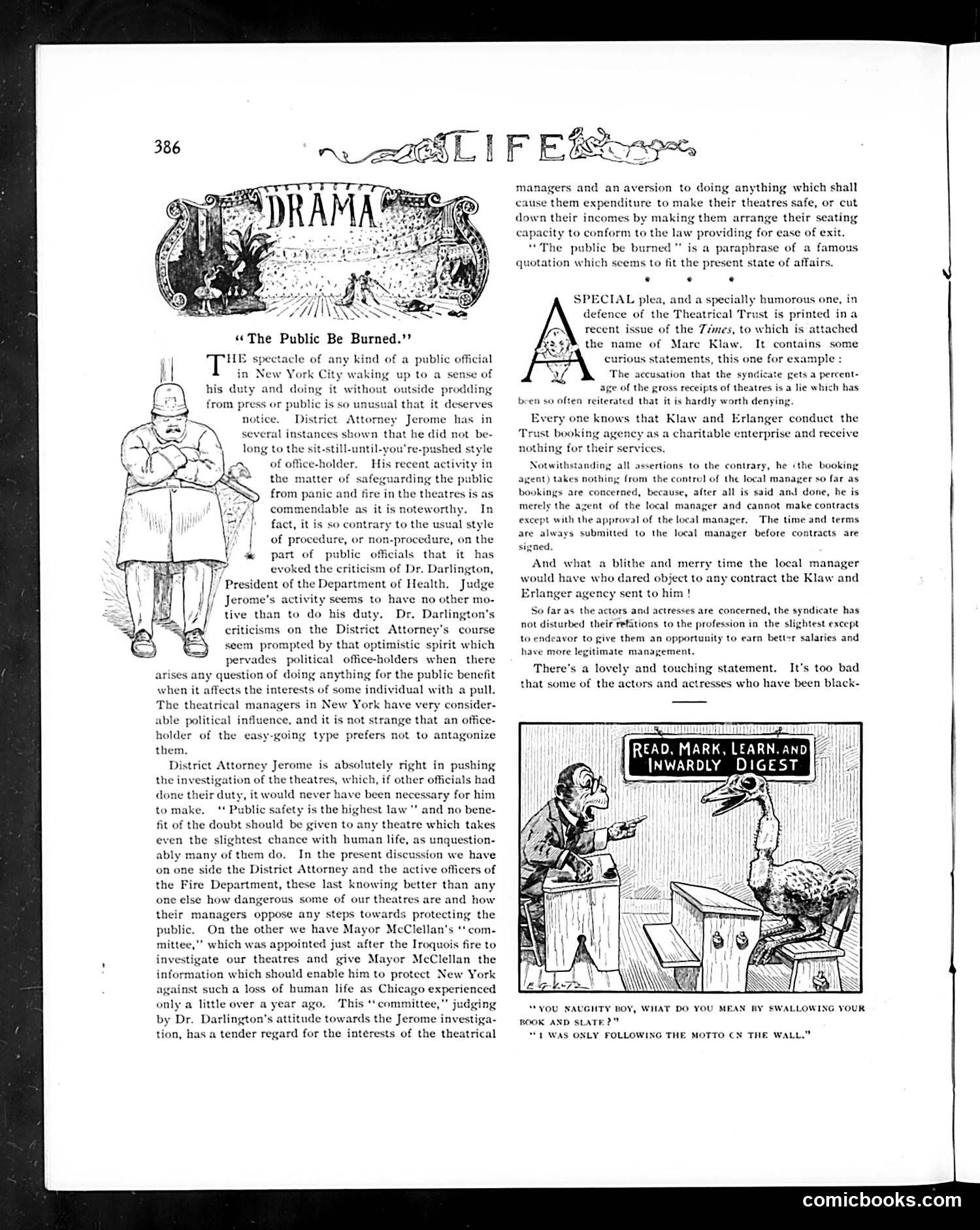
This article satirizes the conflict between New York District Attorney Jerome's efforts to enforce theater safety regulations and resistance from theatrical managers with political power. The title parodies the famous phrase "the public be damned," suggesting that theater owners prioritize profits over public safety. The piece praises Jerome's investigation into dangerous theater conditions—likely prompted by the catastrophic Iroquois Theatre fire in Chicago (referenced as occurring "a little over a year ago"). However, it criticizes Mayor McClellan's appointed committee for protecting managers' financial interests rather than public welfare. The article also mocks Marc Klaw's public defense of the "Theatrical Trust" (Klaw and Erlanger's booking monopoly), particularly his absurd claim that the syndicate operates as "charitable enterprise" while denying they profit from theater operations. The satirist highlights how theatrical managers use political connections to obstruct safety improvements that would reduce their income.
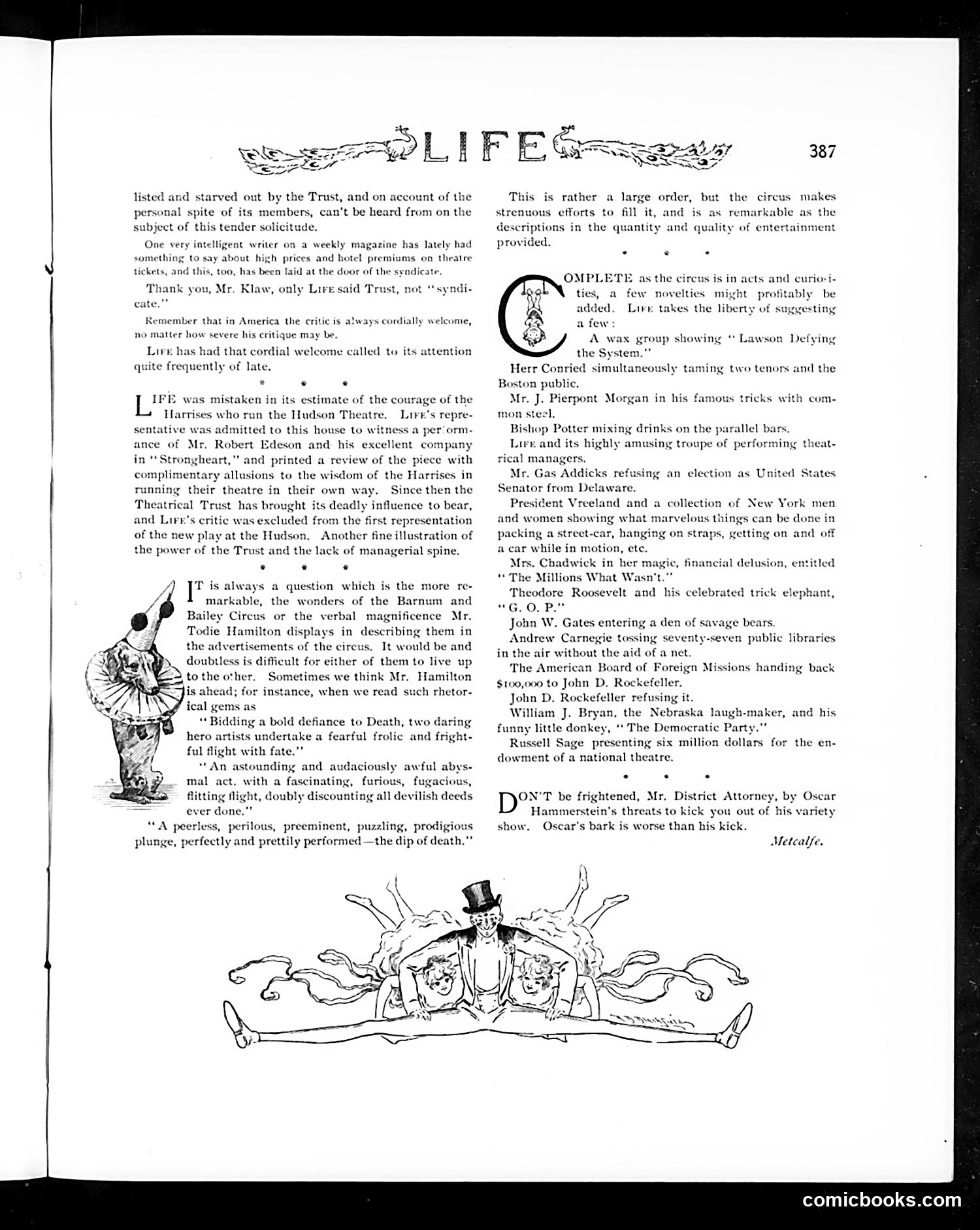
This page satirizes the theatrical "Trust"—a monopolistic cartel controlling theater bookings and venues that excluded critics who gave unfavorable reviews. Life criticizes the Trust's retaliation against its own reviewer for praising a production at the Hudson Theatre, demonstrating the Trust's anti-competitive power. The page also mocks circus advertisements, particularly those by impresario Todie Hamilton, for using absurdly elaborate vocabulary ("peerless, perilous, preeminent, puzzling, prodigious plunge") to describe simple acts. A secondary satirical section lists impossible scenarios—Theodore Roosevelt with a trick elephant, John D. Rockefeller refusing his own donation, William Jennings Bryan as a donkey representing the Democratic Party—mocking various public figures. The final jab at Oscar Hammerstein suggests his threats to the District Attorney are mere bluster. The cartoons illustrate the acrobatic acts being hyperbolically promoted.
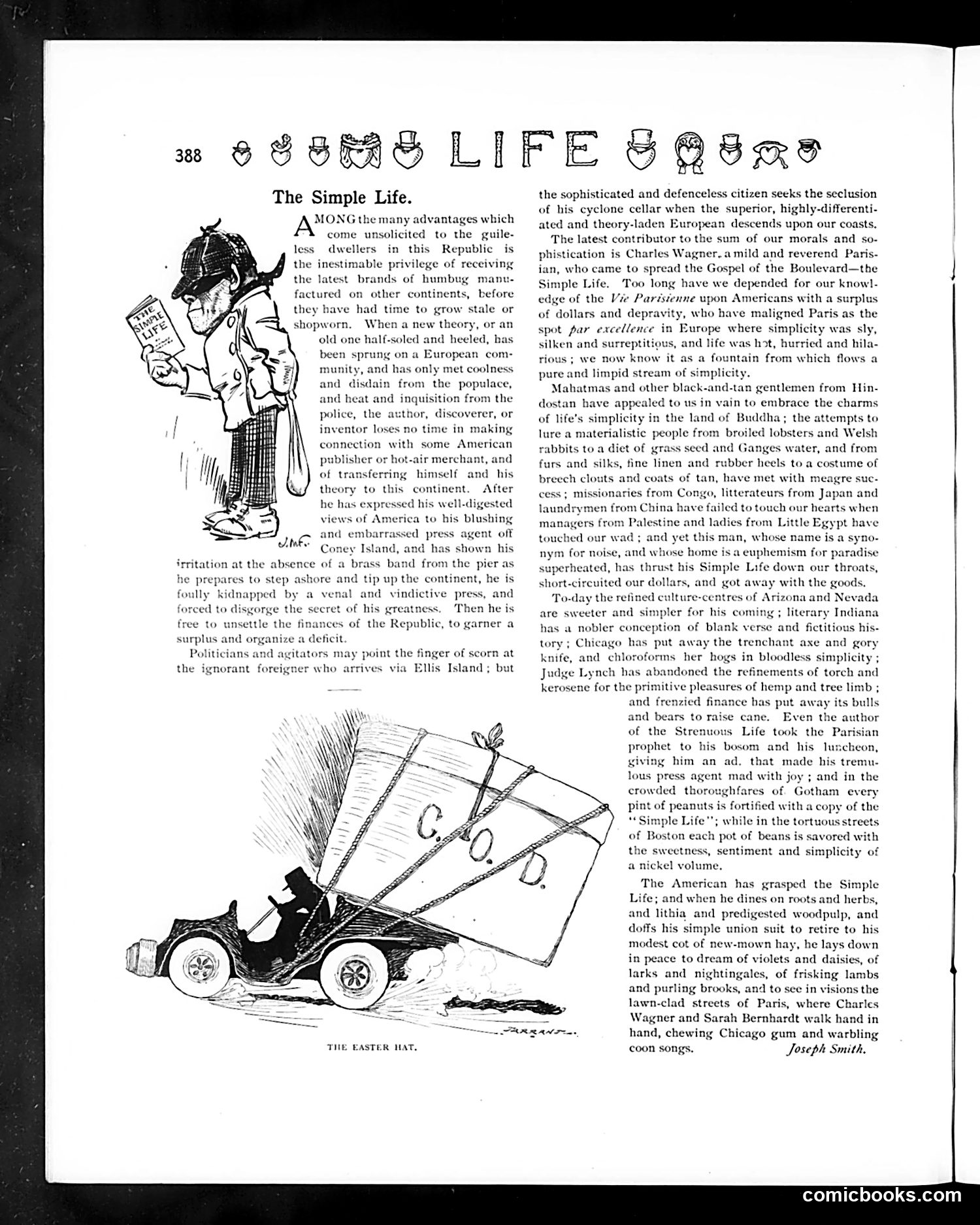
This satirical essay mocks the American fascination with European intellectual trends, specifically Charles Wagner's "Simple Life" philosophy imported from Paris. The author ridicules how Americans eagerly adopt failed European theories that "only met coolness and disdain" at home, then export them back as profound wisdom. The cartoon's two illustrations—a pompous European intellectual at Ellis Island and "The Easter Hat" (a massive, impractical contraption)—embody this critique. The essay sarcastically argues that Wagner's "Simple Life" gospel has somehow persuaded refined American cities to abandon materialism, despite evidence suggesting Americans remain fundamentally unchanged (Judge Lynch still lynches; finance remains frenzied). The reference to Roosevelt's "Strenuous Life" suggests even he fell prey to this fashion. The core joke: Americans mistake European pretension for sophistication, adopting it uncritically while secretly remaining their materialistic selves—missing genuine simplicity entirely.
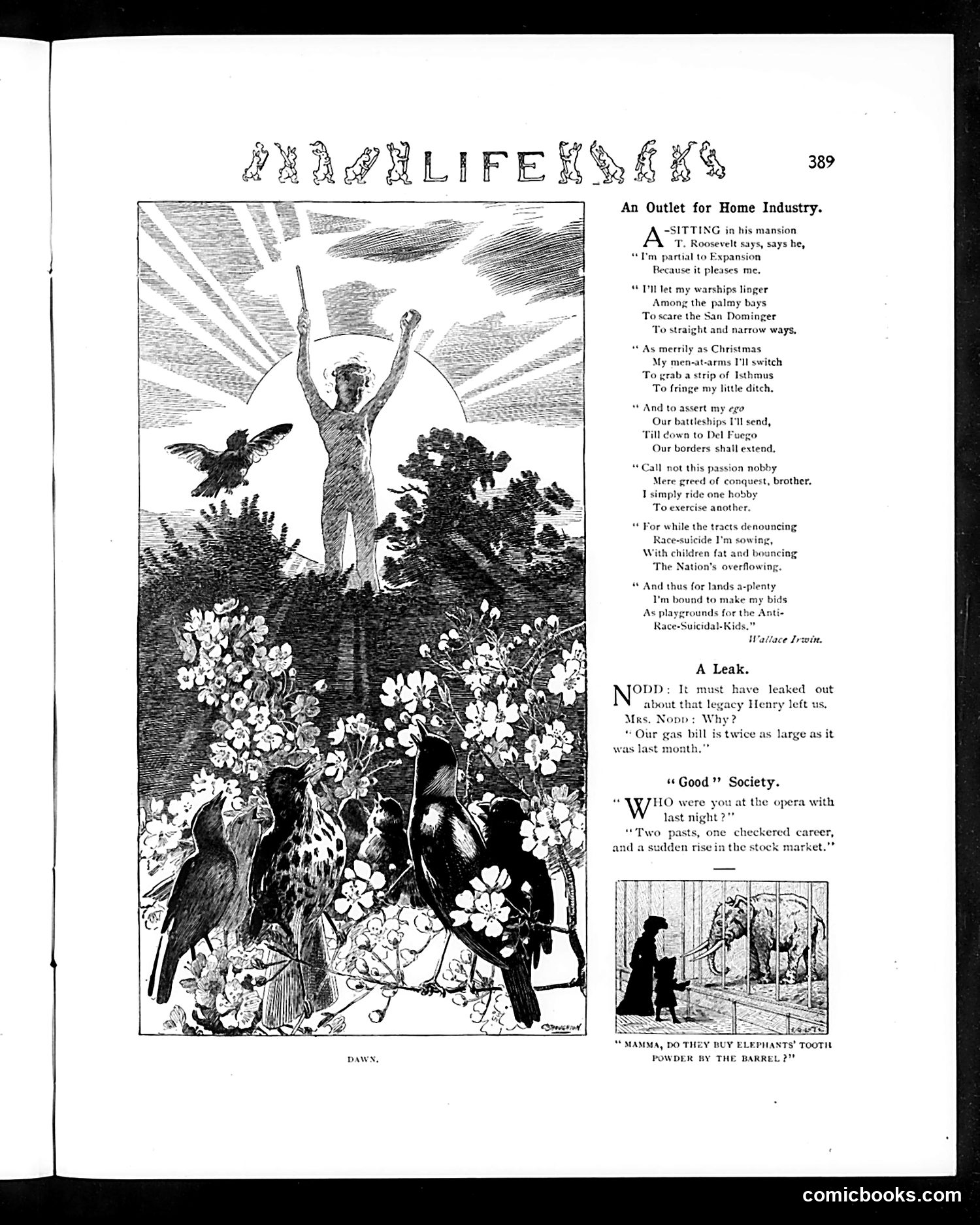
The main cartoon titled "Dawn" satirizes President Theodore Roosevelt's imperialist expansion policies. Roosevelt (speaking from his mansion) justifies aggressive military expansion—stationing warships in Caribbean waters ("palmy bays"), seizing territory like the Panama Canal ("strip of Isthmus"), and extending borders southward to "Del Fuego"—as merely "exercising" his expansionist hobby rather than naked conquest. The satire's bite lies in the contradiction: Roosevelt simultaneously promotes "race-suicide" prevention (encouraging American births) while grabbing foreign lands as "playgrounds" for these children. The poem mocks his rhetoric of benevolence masking imperial ambition, and the symbolic illustration shows this expansion sprouting like flowers from the earth. The page also includes two brief joke items: "A Leak" (about rising gas bills) and "'Good' Society" (mocking wealthy pretense). The bottom cartoon shows someone buying "elephant's tooth powder by the barrel"—apparently satirizing either exotic consumption or dubious patent medicines.
This page satirizes Harvard University's failed experiment in creating social cohesion among students through the Harvard Union. The article argues the Union languishes because it fails to provide what actually attracts students: **beer**. The satire is straightforward: the author suggests Harvard administrators naively expect students to bond through "improving things" like lectures and talks, when what would genuinely draw them is alcohol. The piece notes that Cambridge is a "no-license city" (prohibiting alcohol sales), so the Union can't compete with the restricted student organizations that "faithfully make experiments" with beer. The joke critiques both the pretentiousness of institutional attempts at improving student life and the obvious gap between what administrators think students want versus student reality. The page also includes "Ballade of Love," a poem about romantic entanglement, and a brief "Success" dialogue about avoiding fathers—unrelated satirical content typical of Life magazine's miscellaneous humor format.
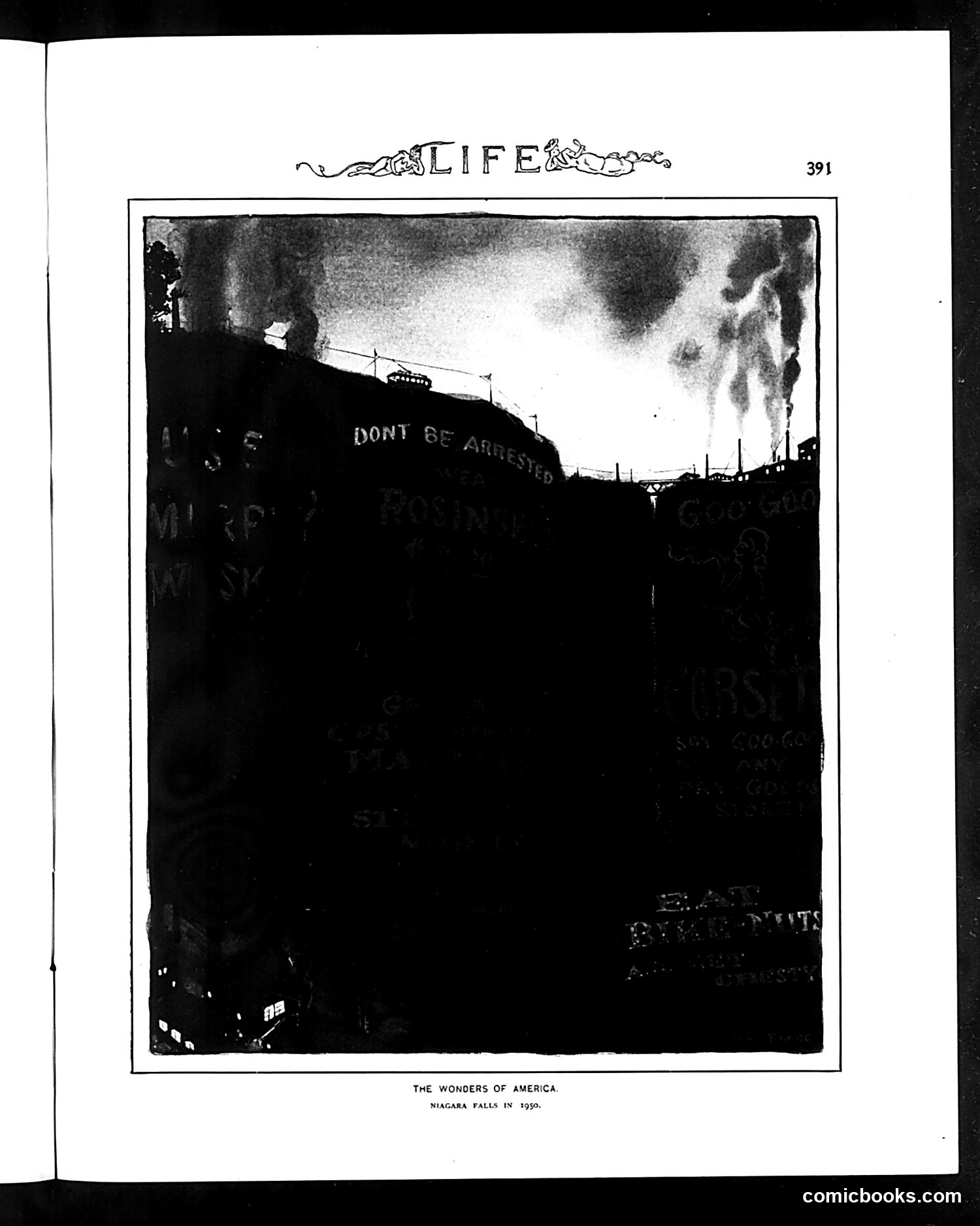
This is a darkly satirical prediction about America's future. The image shows Niagara Falls in 1950—depicted as an industrial wasteland of smokestacks and pollution rather than the natural wonder. A sign reading "DON'T BE ARRESTED" is visible on what appears to be a dam or industrial structure, suggesting both environmental degradation and authoritarian control. The satire critiques unchecked industrialization and pollution. By presenting this dystopian vision as a "wonder," Life magazine mocks American progress and warns readers about environmental destruction. The 1950 date indicates this was published before that year as a prophecy—suggesting concerns about where industrial expansion could lead if left unregulated. It's a prescient environmental warning from early-to-mid 20th century America.
This page is primarily a **book review section** titled "The Latest Books," with no political cartoons visible. It reviews contemporary early-1900s literature, including: - *The Silence of Mrs. Harrold* by Samuel M. Gardenhire—praised as a complex New York drama with substantial characters - New Sherlock Holmes stories by Conan Doyle, noted as supposedly "final" but likely to return - *Rachel Marr* by Morley Roberts—described as serious social commentary - Ghost stories by M.R. James, criticized as old-fashioned in treating the supernatural The page includes a separate **advice column** responding to a reader's question about correcting a husband's mistake (kissing the wrong sister). The advice emphasizes honest conversation over confrontation. **Context for modern readers:** This reflects the era's literary culture and domestic advice-giving conventions—serious realism versus escapist fiction were competing genres, and etiquette advice was a standard magazine feature.
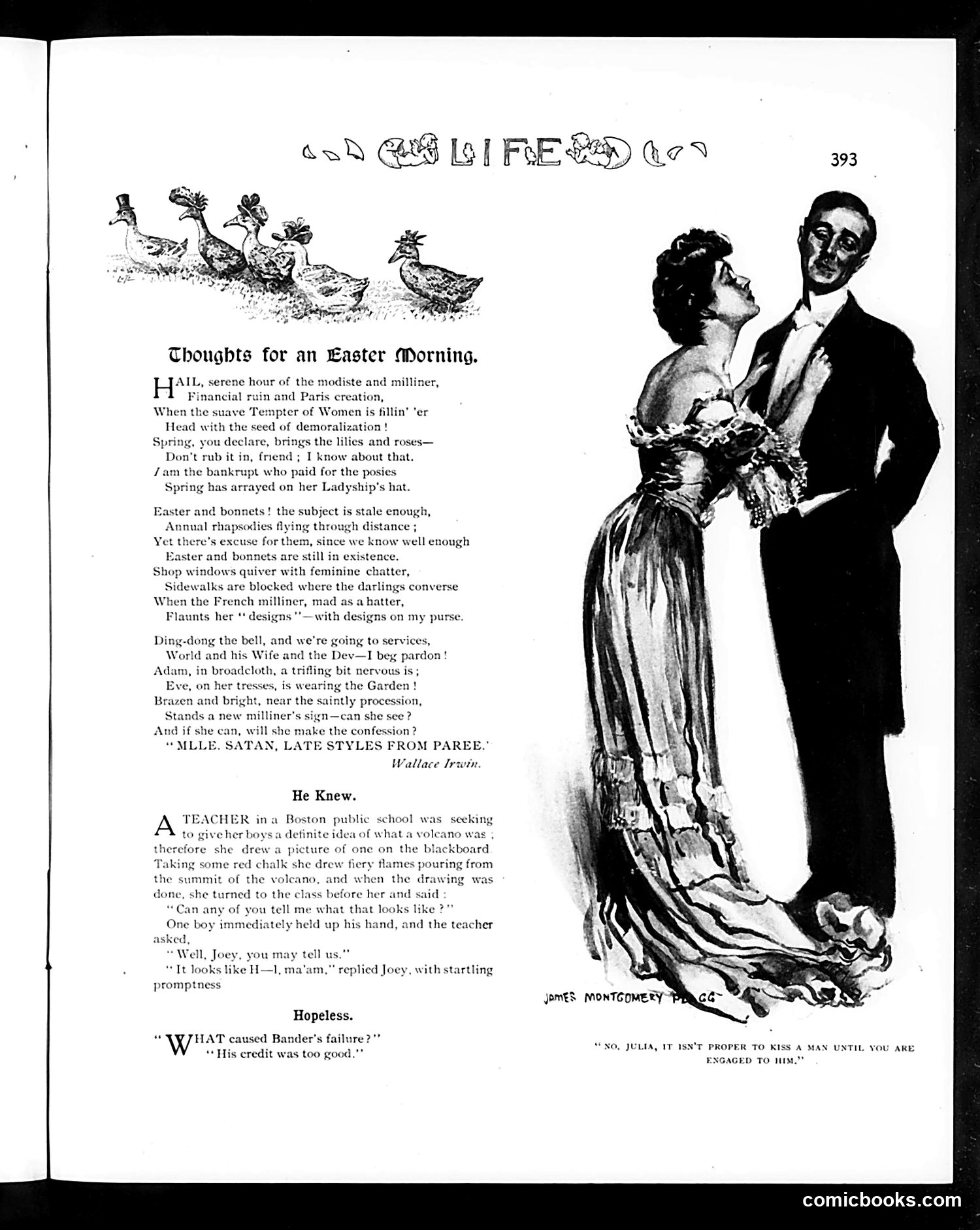
This page contains three separate satirical pieces: **"Thoughts for an Easter Morning"** (poem by Wallace Irwin): A sharp critique of Easter fashion excess, particularly women's expensive bonnets. The speaker—apparently a husband or father—complains that Easter's religious significance is overshadowed by commercialism. Women parade in elaborate hats designed by milliners (hat-makers) who deliberately exploit male wallets. The satire targets the shallow materialism of spring fashion and the financial burden it places on men. **"He Knew"**: A humorous anecdote about a Boston schoolboy who, when shown a volcano drawing and asked what it resembles, replies "H—I, ma'am" (Hell). The joke trades on the child's literal interpretation and resulting impropriety. **"Hopeless"** and the illustration: A brief joke about failed credit, paired with James Montgomery Flagg's drawing showing a couple embracing with text about proper engagement etiquette—a light commentary on courtship propriety. The page reflects early 1900s concerns: consumerism, gender relations, and social conventions around courtship and spending.
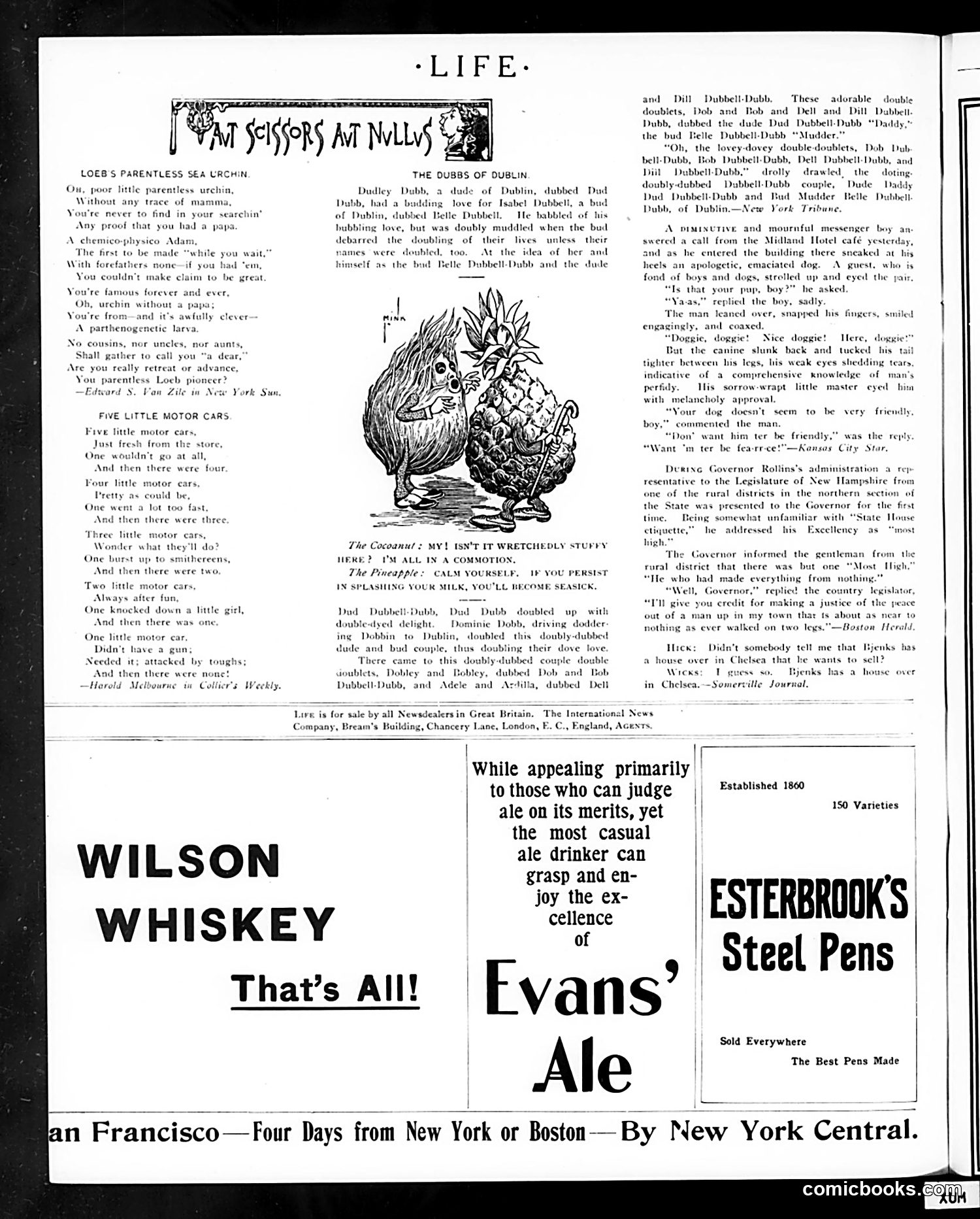
This page contains three distinct humor pieces typical of Life magazine's satirical content: **"Loeb's Parentless Sea Urchin"** (top left): A poem mocking a parentless orphan child, using sardonic wordplay about social status and inheritance. **"The Dubbs of Dublin"** (center): A nonsensical story playing on alliteration and name repetition—characters named Dud Dubbell-Dubb, Isabel Dubbell, and various "Dubbs" engaged in absurd situations. The humor derives from tongue-twisting names and deliberate narrative confusion. **"Five Little Motor Cars"** (left): A darkly humorous poem in the style of "Five Little Monkeys," where motor cars are progressively destroyed through accidents, ending with none remaining. This satirizes early automobile dangers and fatalities. The page also contains period advertisements for Wilson Whiskey, Evans' Ale, and Esterbrook's Steel Pens, typical of the magazine's revenue model. The content reflects turn-of-the-century American humor: whimsical wordplay, social satire, and dark comedy about contemporary hazards like automobile accidents.
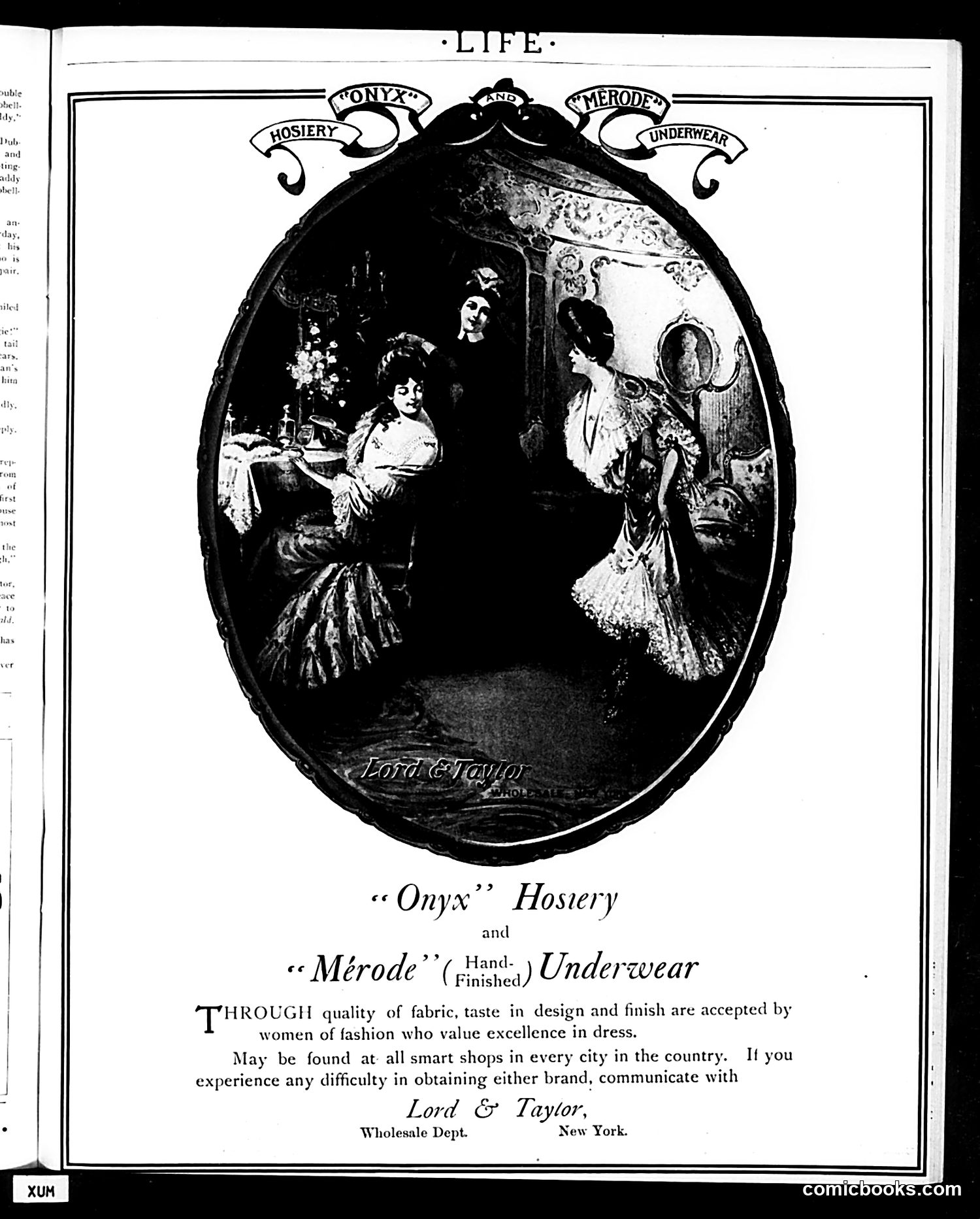
This is a **full-page advertisement**, not political satire. It promotes two women's undergarment brands—"Onyx" hosiery and "Mérode" hand-finished underwear—distributed by Lord & Taylor's wholesale department in New York. The oval illustration depicts an **elegant interior scene** with fashionably dressed women in early 20th-century attire, establishing luxury and sophistication. The imagery appeals to women concerned with fashion and quality craftsmanship. The text emphasizes that these brands are found "at all smart shops in every city in the country," positioning them as premium, nationally available products for discerning consumers. The advertisement assumes readers value "excellence in dress" and understand that quality fabric and finishing matter. This reflects early 1900s consumer culture, where undergarments were marketed as status symbols requiring careful attention to quality and design.
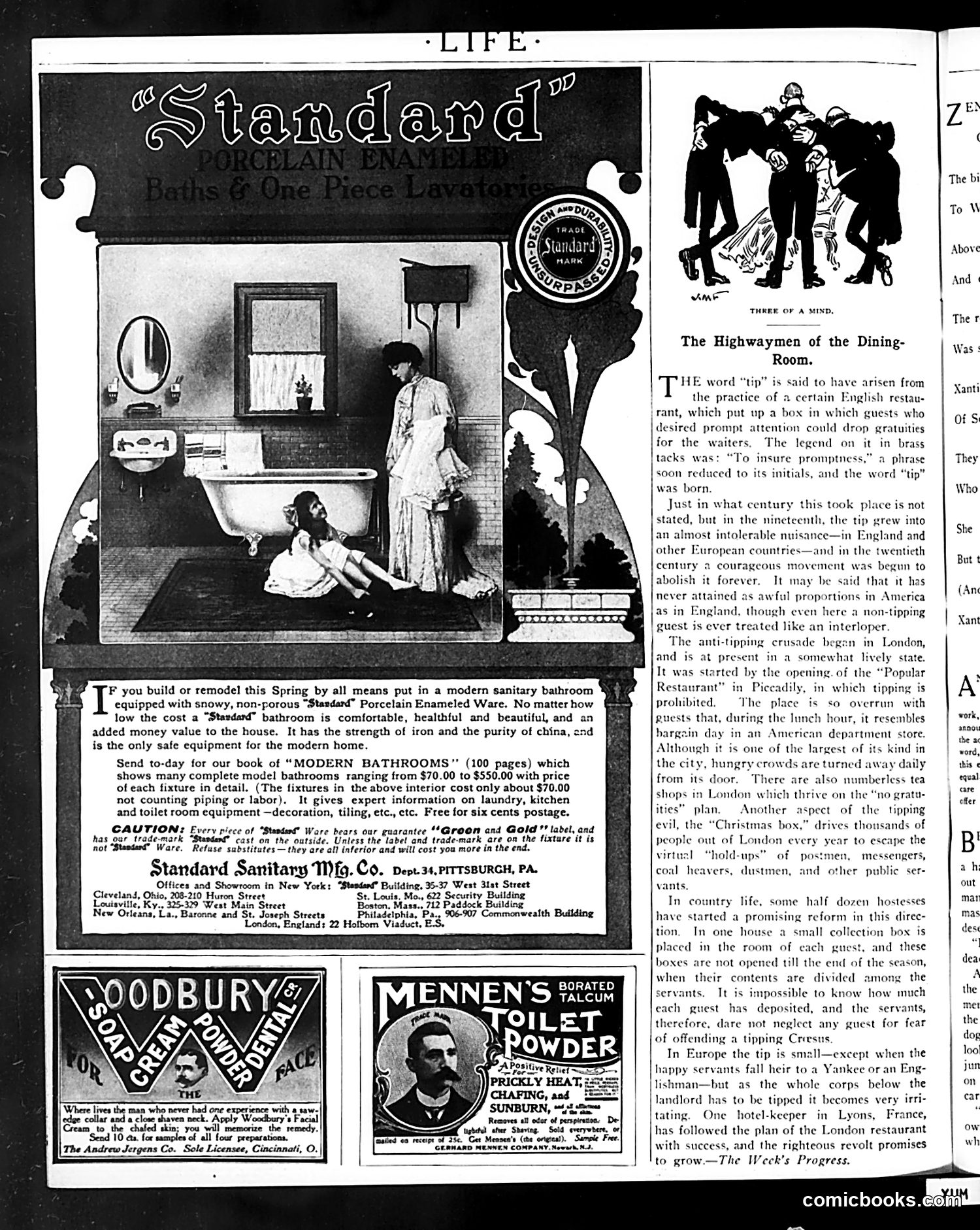
This page combines advertisements with a satirical article about tipping culture. The main cartoon, "Three of a Mind" (top right), depicts three well-dressed men depicted as "highwaymen of the dining-room"—a visual metaphor comparing waiters extracting tips to highway robbers. The article traces the word "tip" (allegedly from "To Insure Promptness") and critiques the practice as an "intolerable nuisance" that had grown worse by the early 20th century. It notes England experienced an anti-tipping movement, including a no-tip restaurant in Piccadilly that became so popular it couldn't accommodate demand. The piece also mocks the "Christmas box" custom where British servants would essentially shake down departing guests before the holidays. The satire targets both the obligation to tip and servants' aggressive expectations—presenting tipping not as voluntary gratuity but as coercive "hold-ups" of customers. The advertisement section occupies the lower half of the page.
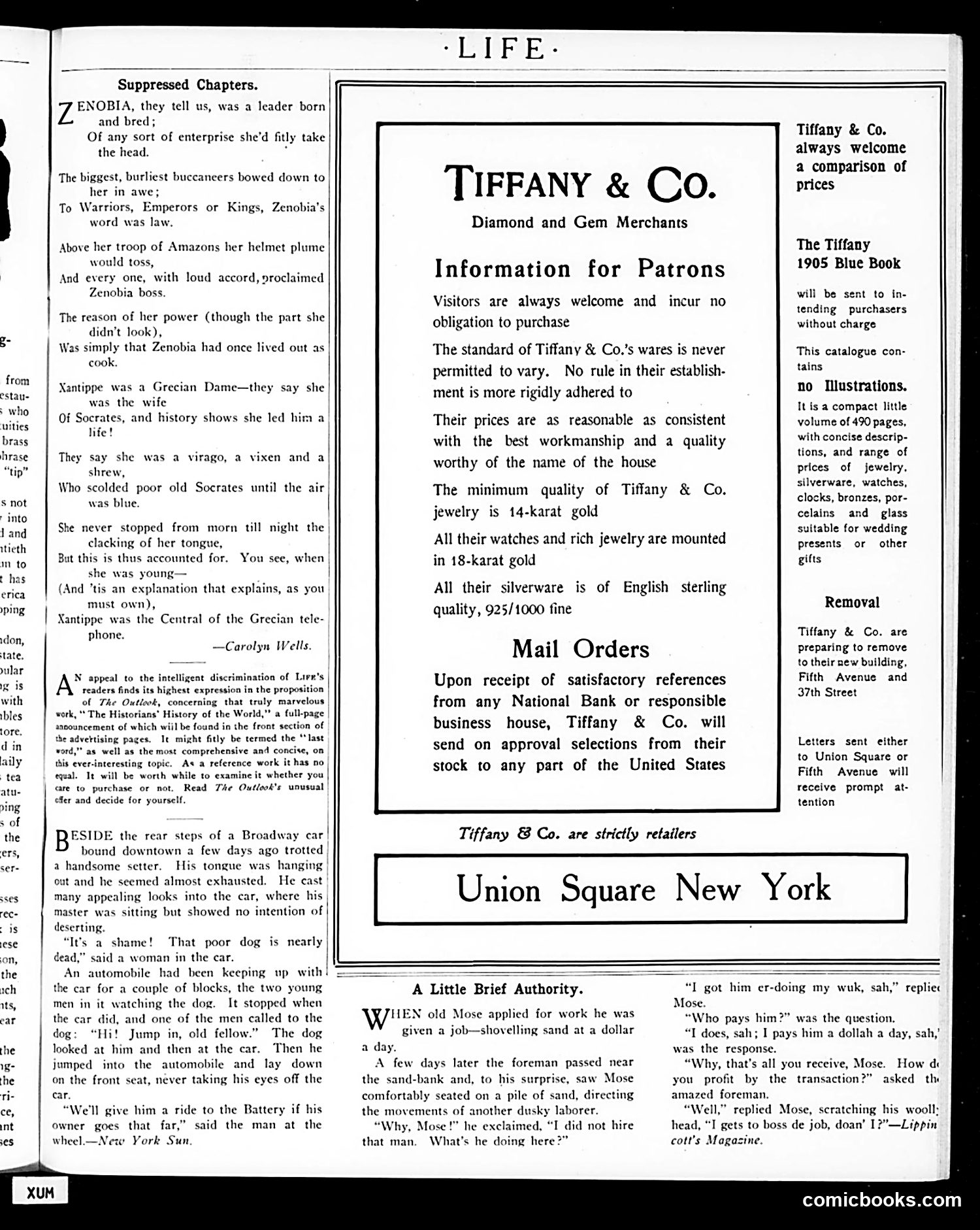
This page contains three distinct elements: a humorous poem, a short anecdote, and a Tiffany & Co. advertisement. **"Suppressed Chapters"** presents two historical "explanations" in verse. The first claims ancient Queen Zenobia's leadership stemmed from her experience as a cook—implying women's domestic work somehow qualified her for power. The second suggests Xantippe (Socrates' wife) developed her legendary shrewishness because she once worked as a telephone switchboard operator, her constant talking a job habit. The satire mocks contemporary assumptions about women's roles: it presents absurdist "origins" for female authority that reduce women to domestic or service work, while sardonically suggesting such experience paradoxically produced powerful women—poking fun at male anxieties about female leadership. **Below** is a brief anecdote about a loyal dog choosing to follow his owner's streetcar rather than accept a ride from strangers—a sentimental story with no particular satirical intent. **The advertisement** is straightforward luxury marketing for Tiffany & Co., emphasizing quality standards and mail-order availability.
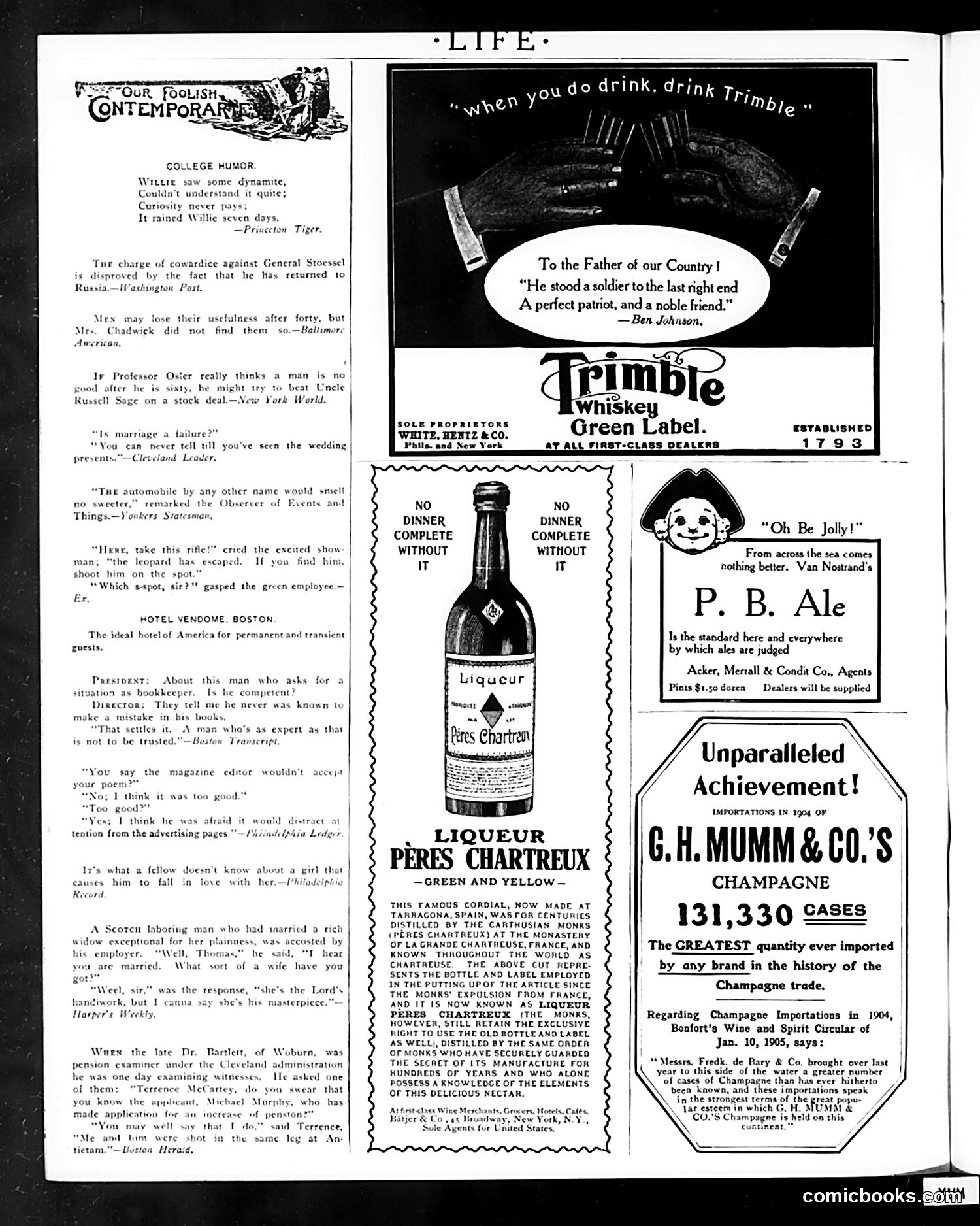
This page mixes college humor columns with liquor advertisements—typical of *Life* magazine's format. **The Humor Section** ("Our Foolish Contemporaries") collects brief satirical jokes from other publications, mocking contemporary figures and situations: a General Stoessel (likely the Russian general from the Russo-Japanese War), discussions of marriage failures, and workplace incompetence. The jokes are lighthearted, targeting public figures and social pretensions of the era. **The Advertisements** are the page's substance. Three liquor brands dominate: **Trimble Whiskey** (with a patriotic Washington/Ben Jonson quote), **Pères Chartreux liqueur** (emphasizing its centuries-old monastic origins, now made in Spain after monks' expulsion from France), and **P.B. Ale** and **Mumm Champagne** (boasting record importation numbers). The ads reflect early 1900s marketing: appeals to tradition, patriotism, and prestige. The Chartreux ad's historical detail about the monks' expulsion suggests French anticlerical politics of the period resonated with American advertisers.
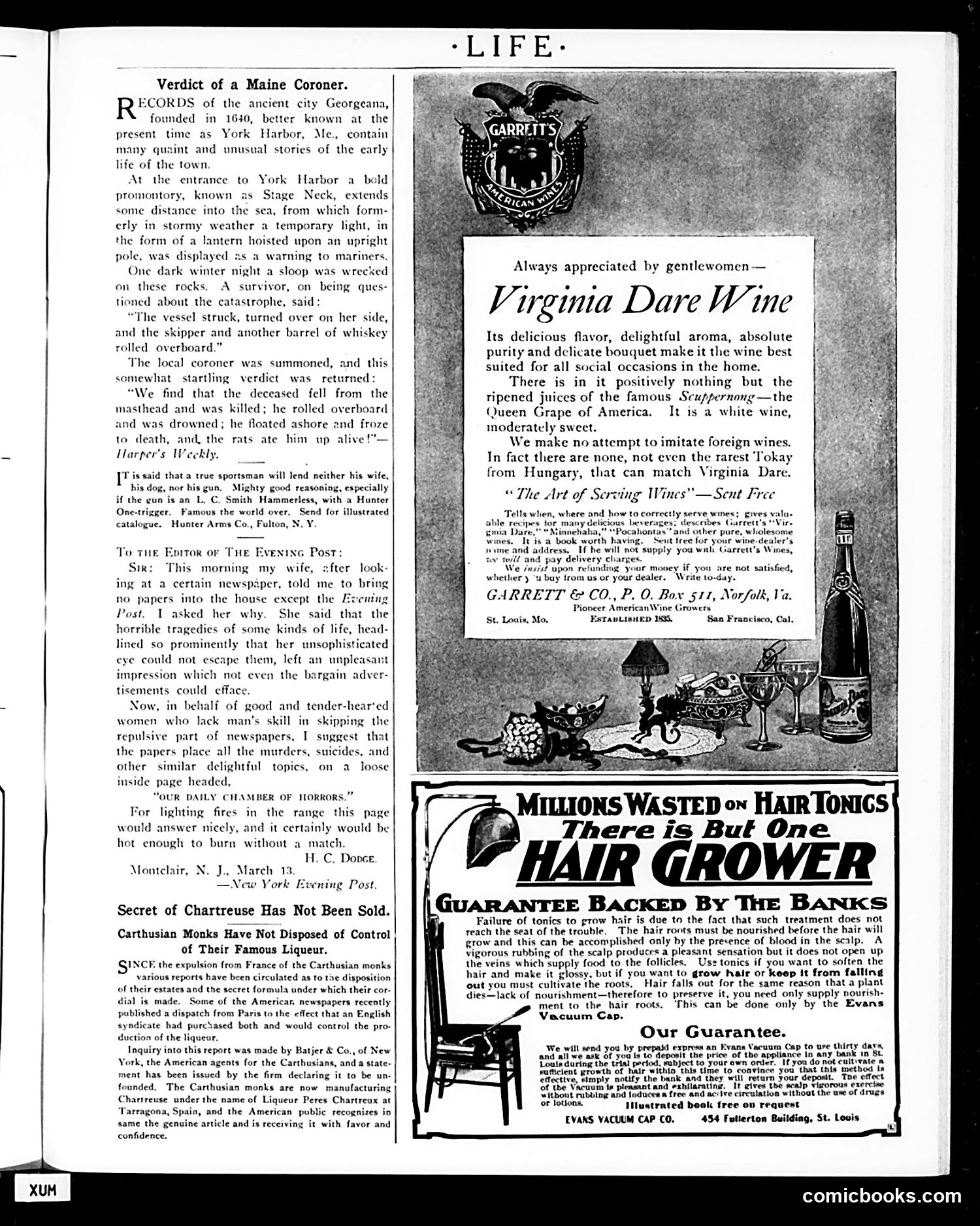
This page from *Life* magazine (circa early 1900s) contains primarily **satirical news items and advertisements** rather than political cartoons. The main satirical content includes: 1. **"Verdict of a Maine Coroner"** — A humorous anecdote from *Harper's Weekly* about a shipwreck where the coroner's verdict absurdly lists multiple causes of death for a drowned sailor, including that "the rats ate him up alive." The joke relies on the incongruity of an impossibly thorough (and contradictory) official verdict. 2. **Letter to Editor** — A reader complains that newspaper headlines about murders and suicides distress sensitive women, sarcastically suggesting papers segregate such content onto a removable page labeled "Our Daily Chamber of Horrors" suitable only for kindling. 3. **Chartreuse Liqueur Note** — A brief correction clarifying that French Carthusian monks retained control of their famous liqueur formula, countering rumors of English syndicate purchase. The remainder consists of period advertisements for Virginia Dare Wine and hair-growth products — typical commercial content of the era.
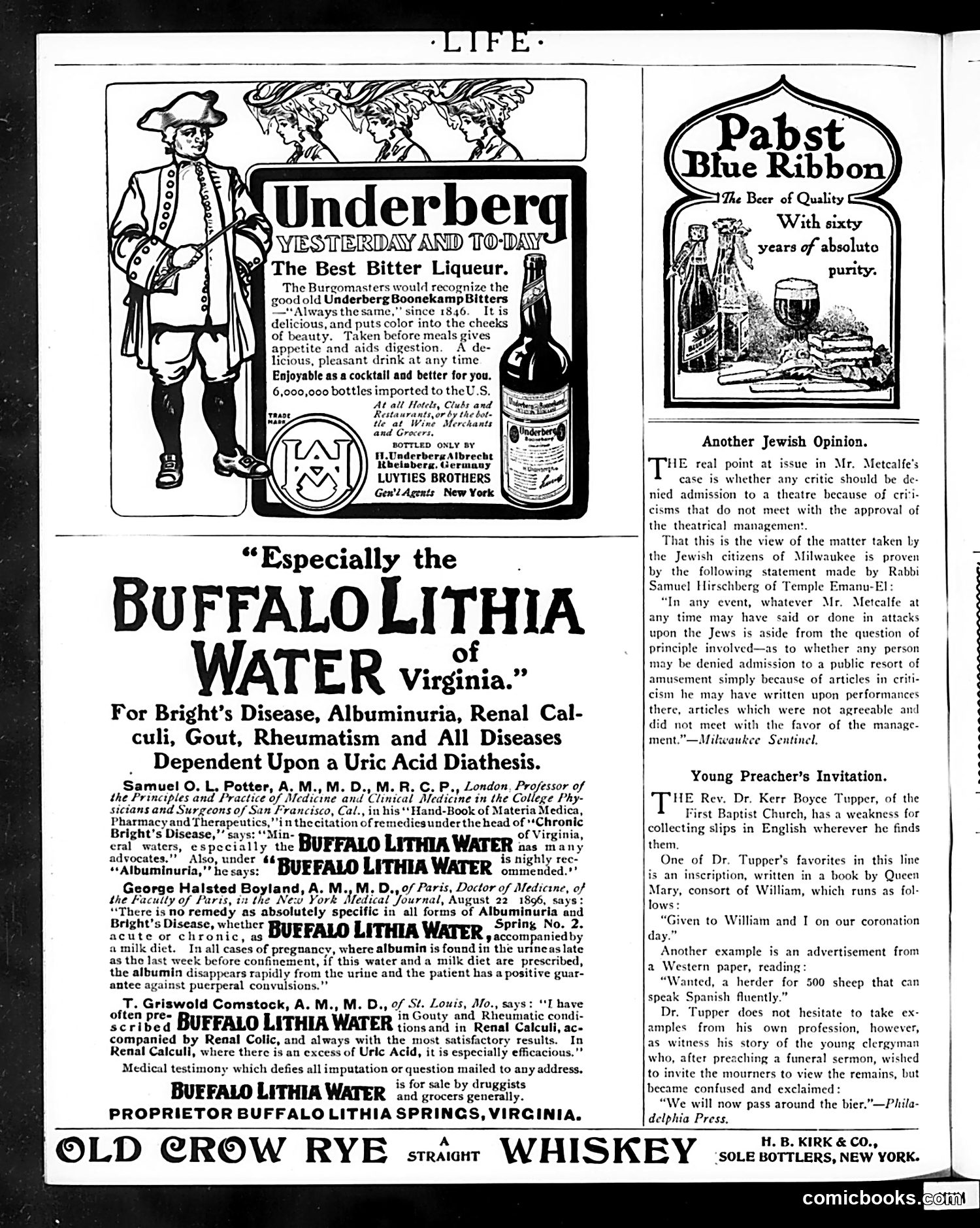
This page is primarily **advertising**, featuring patent medicine and alcohol promotions typical of early 1900s publications. The main advertisements include: 1. **Underberg Bitters** - A German liqueur marketed as a digestive aid, featuring a colonial-era figure (likely a "Burgomaster" or German merchant) to evoke Old World authenticity and tradition since 1846. 2. **Buffalo Lithia Water** - A "miracle cure" spring water claiming to treat kidney disease, gout, and rheumatism. The credibility rests on fabricated medical testimonials from named doctors, a common deceptive practice before FDA regulation. 3. **Pabst Blue Ribbon** - Beer advertised as having "sixty years of absolute purity." The page also includes brief editorial content about theater critic admission and a preacher's humorous anecdotes—filler material common in Life magazine. **The satire is implicit**: these advertisements represent the era's unregulated medical fraud and exaggerated health claims that Life's readers would have recognized as dubious, yet were legally permissible at the time.
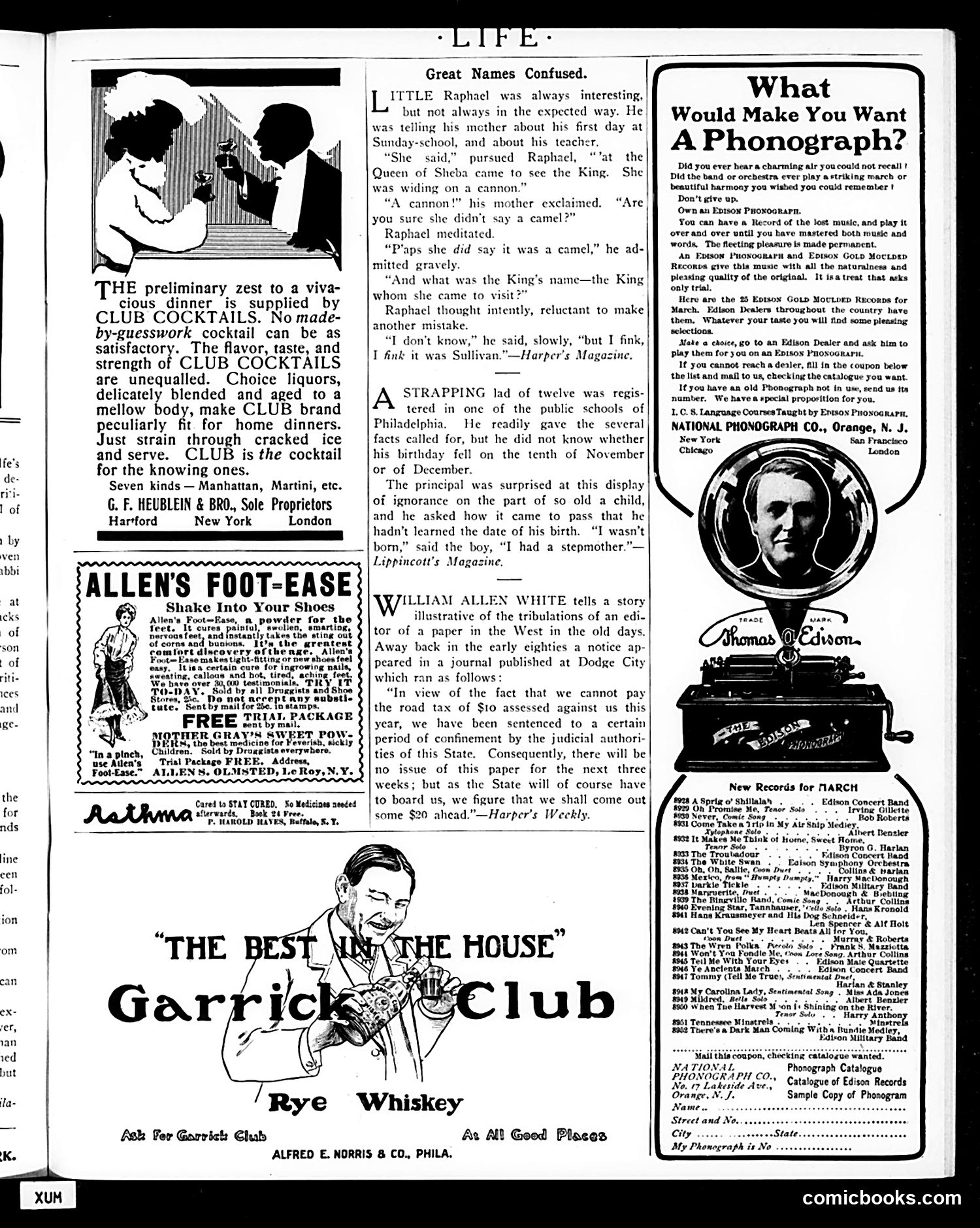
This page contains three humorous anecdotes mocking children's misunderstandings of Bible stories and historical facts. **"Great Names Confused"** satirizes a child named Raphael who confuses the Queen of Sheba's arrival at Solomon's court—she rode a *camel*, not a *cannon*. The joke plays on his innocent mishearing of similar-sounding words. A second story mocks a Philadelphia schoolboy who doesn't know his own birthday because he has a stepmother, implying family dysfunction. **William Allen White's anecdote** describes a struggling frontier newspaper editor in 1880s Dodge City announcing the paper won't print for three weeks because the editor is jailed for unpaid taxes—but calculates the state feeding him will cost more than the $10 owed, so he'll profit $20. The page is mostly **period advertisements** (cocktails, foot powder, phonographs, whiskey) typical of early 20th-century magazines. The humor reflects contemporary attitudes toward education, family, and frontier hardship.
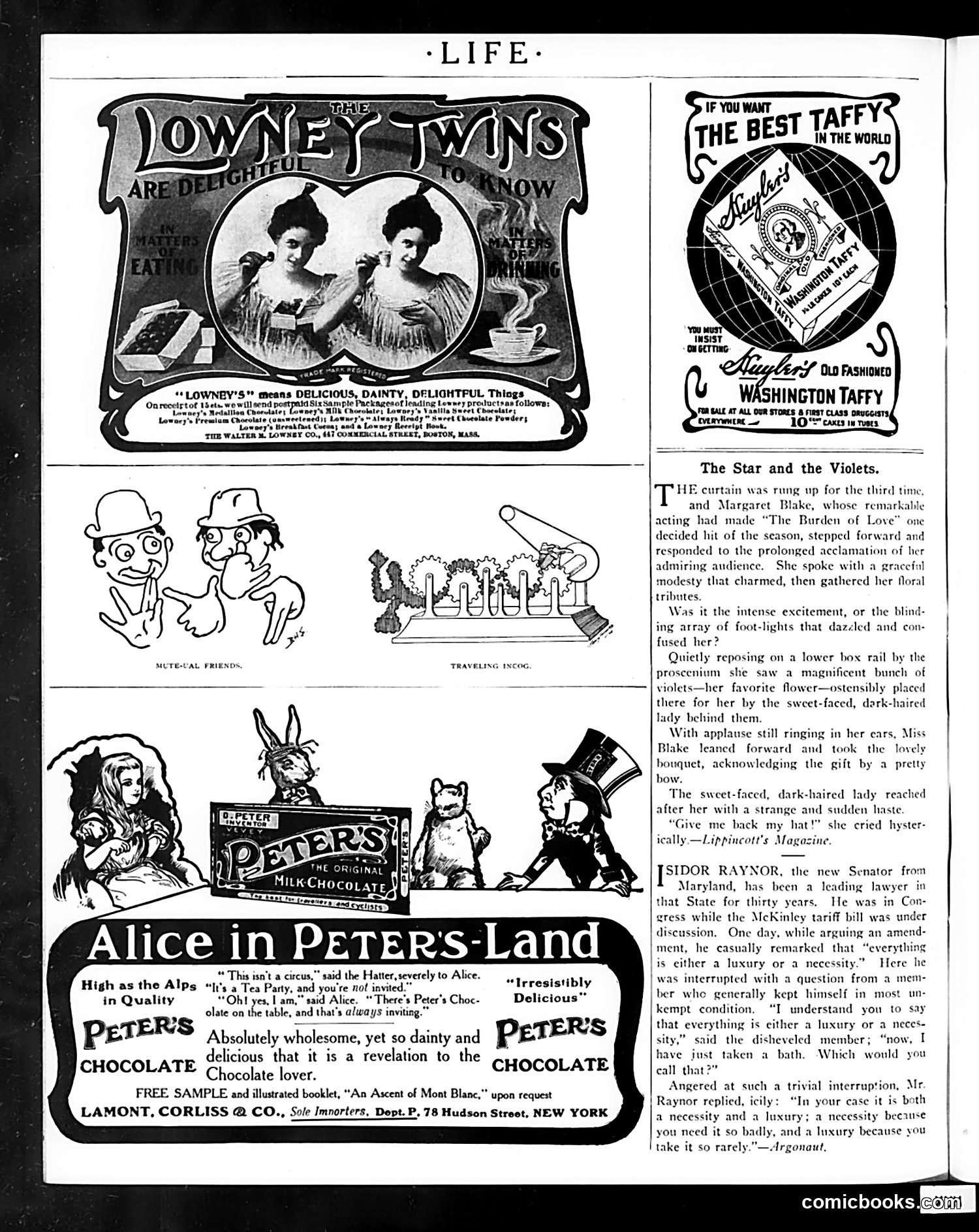
This page contains primarily **advertisements and humorous short stories** rather than political cartoons. The main visual content includes: - **"Alice in Peter's-Land"**: A playful advertisement referencing Lewis Carroll's *Alice in Wonderland*, showing Alice at a tea party. The joke is that Peter's Chocolate is "always inviting"—a commercial pun rather than satire. - **Small comic sketches** ("Mutual Friends," "Traveling Incog") with generic humor about gentlemen in hats. The text pieces are **satirical anecdotes**: - **"The Star and the Violets"** is a theatrical mishap story: an actress receives flowers at the theater, only for the "dark-haired lady" to frantically demand them back—revealing the bouquet concealed her hat, not a romantic tribute. - **The Raynor anecdote** mocks a newly-elected Senator's pompous remark that "everything is either a luxury or necessity." A deliberately unkempt colleague asks if taking a bath falls into either category, embarrassing Raynor into a cutting retort about the man's poor hygiene. The page reflects *Life*'s satirical focus: social embarrassment, theatrical pretension, and political pomposity—not hard-hitting commentary.
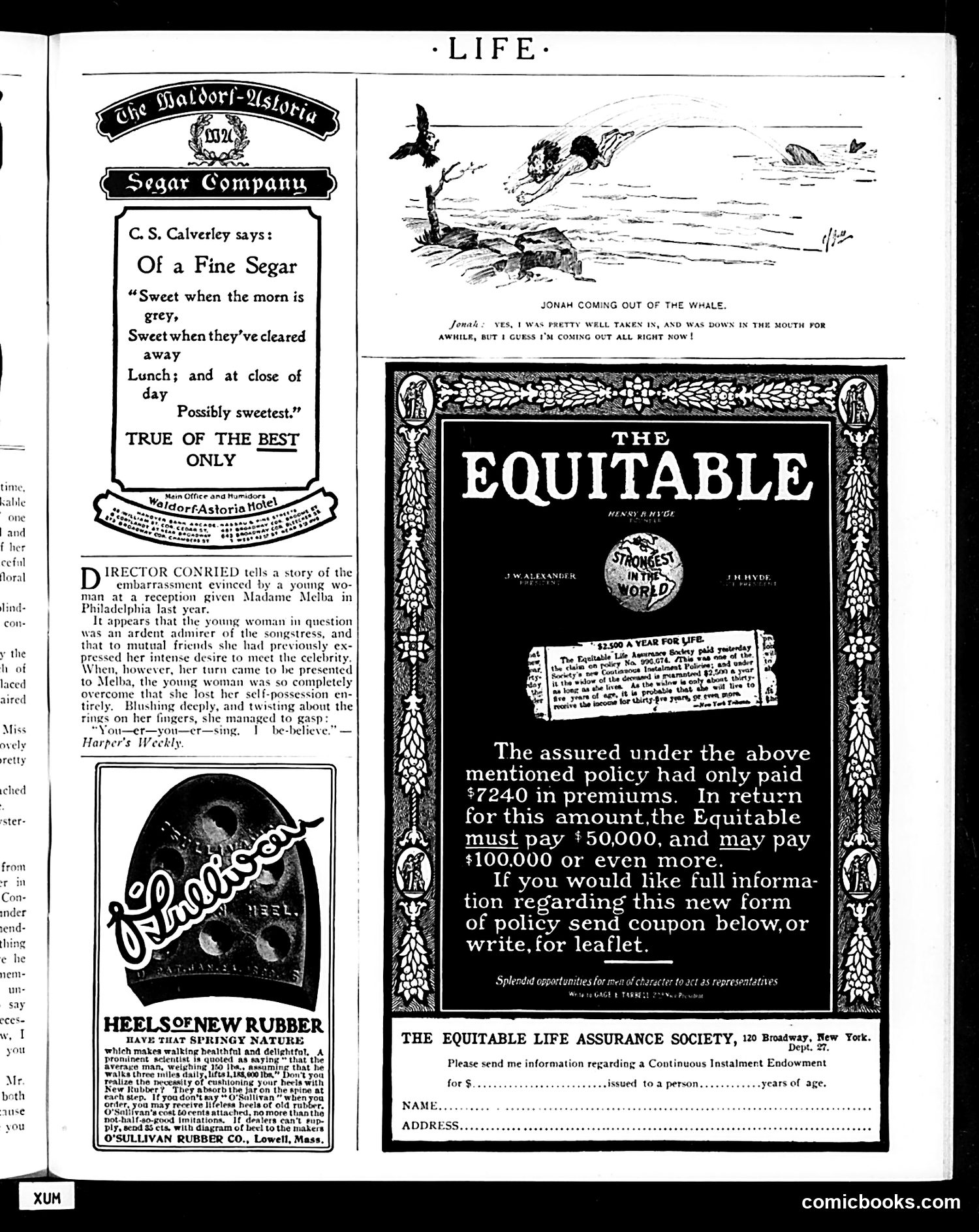
This page contains **mostly advertisements** rather than satirical content, though it includes one small cartoon. The main cartoon shows **Jonah emerging from the whale's mouth**, with the caption playing on the phrase "down in the mouth"—a pun meaning both literally inside the whale and figuratively despondent. Jonah quips he was "taken in" but is "coming out all right now," a mild joke about his ordeal. The page also includes a **anecdote about Director Conried** describing a young woman's embarrassed encounter with opera singer Madame Melba at a Philadelphia reception. Overcome with nerves, she stammers "You—er—you—er—sing. I be-believe," poking fun at fan awkwardness meeting celebrities. The bulk of the page features **period advertisements**: a Waldorf-Astoria cigar endorsement, an Equitable Life Assurance insurance policy ad, and O'Sullivan Rubber Company heels. These ads reflect early-1900s consumer products and investment opportunities typical of Life's advertising model.
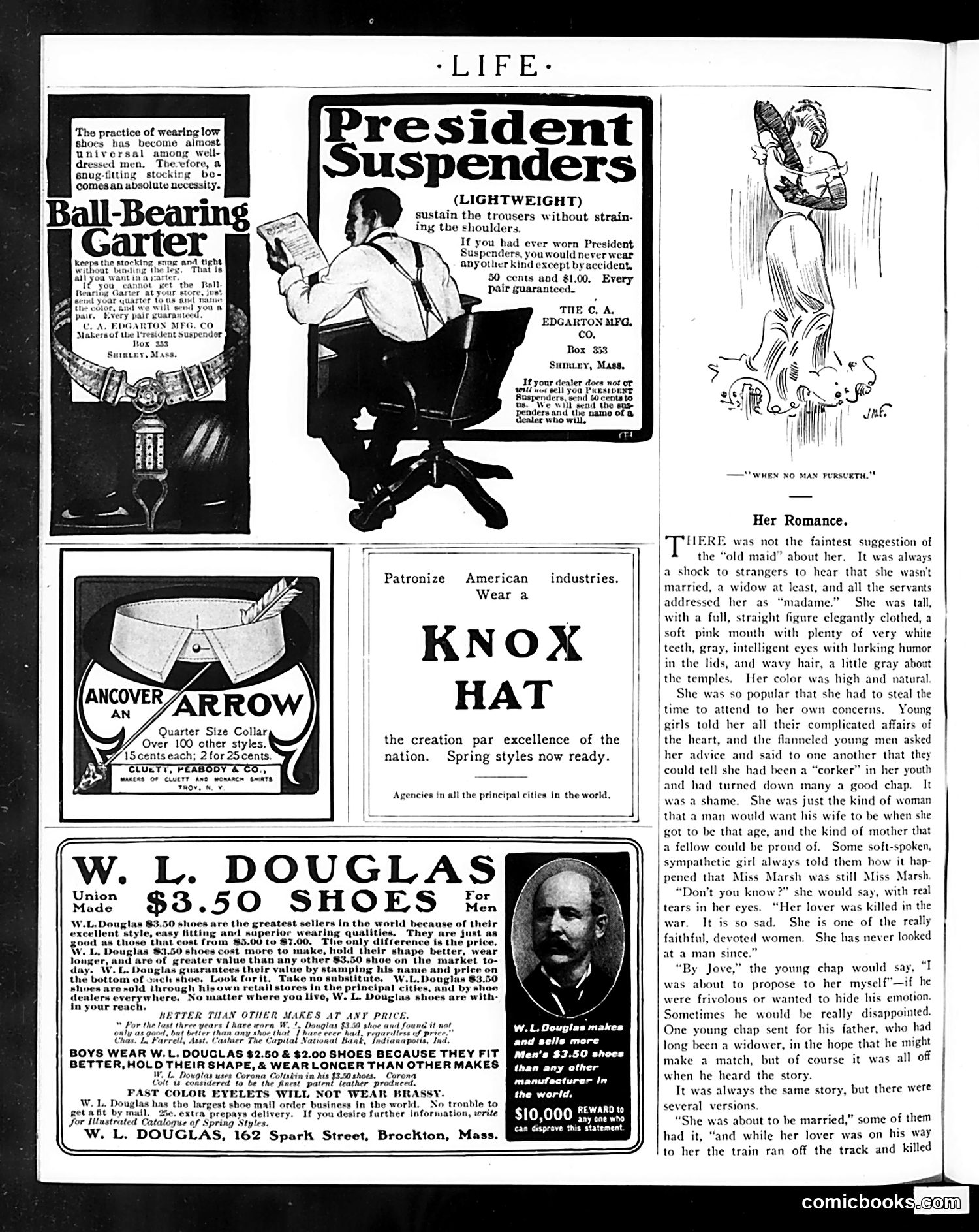
This page mixes **period advertisements** (garters, hats, collars, shoes) with a sentimental **short story titled "Her Romance."** The story depicts an unmarried older woman—Miss Marsh—described as attractive, gracious, and popular. The narrative reveals she remains single because her lover was killed in World War I. Young men, upon learning this, are moved by her faithfulness and either propose to her or consider her an ideal wife-figure for their future. The satire is gentle: the story trades in romantic Victorian sentimentality about devoted widowhood and wartime loss. The repeated anecdote of suitors being shocked she's unwed, then learning the "tragic" explanation, plays on period stereotypes about women's roles (devoted wife or devoted widow—but never independent). The page reflects early 20th-century attitudes where a woman's value hinged on romantic/marital status, and where wartime sacrifice provided acceptable narrative justification for spinsterhood.
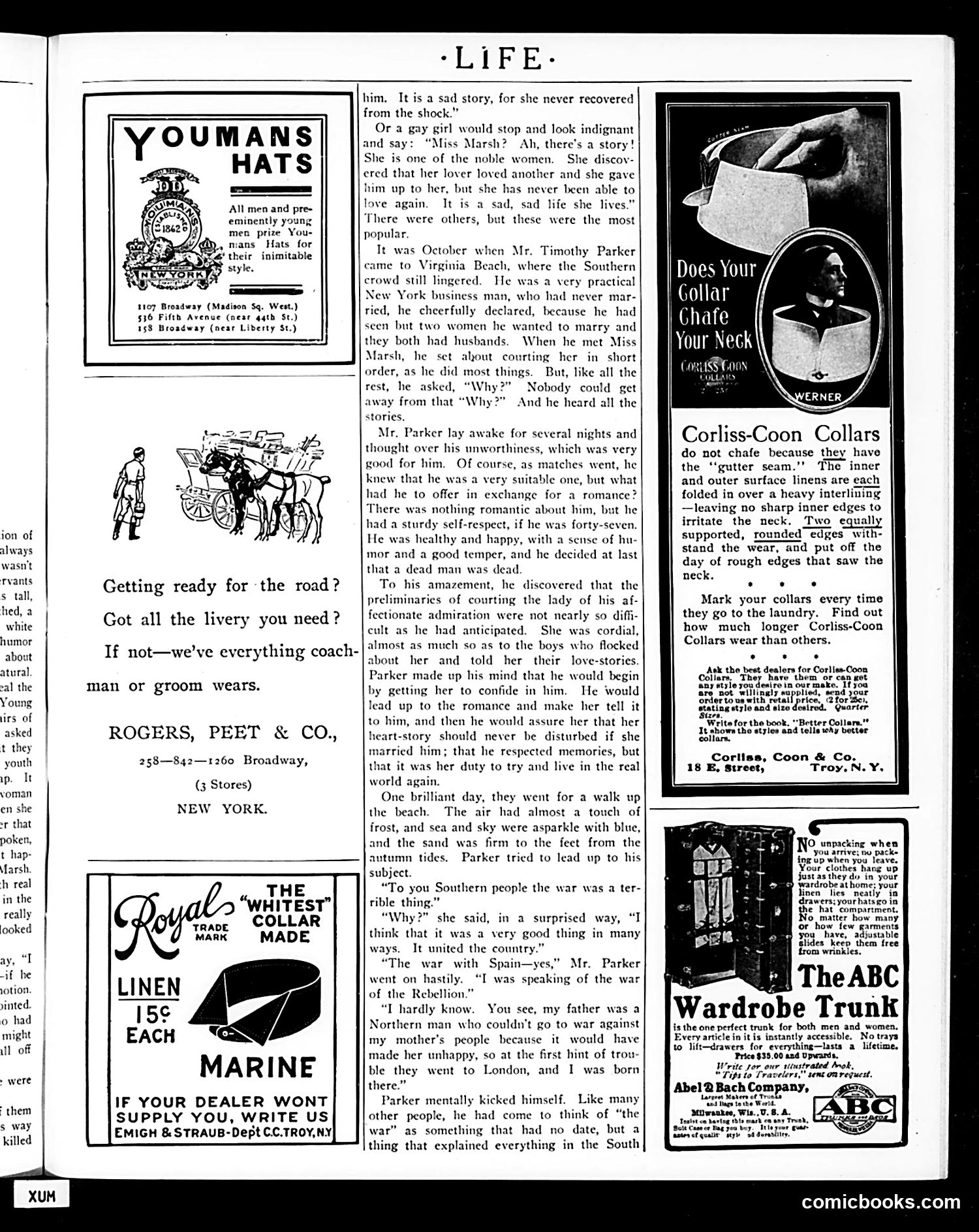
This page mixes advertising with serialized fiction. The main narrative concerns Mr. Timothy Parker, a practical New York businessman courting a mysterious Southern woman, Miss Marsh, at Virginia Beach. The text reveals Parker's strategy: he plans to extract her tragic romantic history, then convince her to move past it and marry him instead. The story employs a common early-20th-century trope—the romantically wounded woman with a secret past—which the narrative gently satirizes through Parker's blunt, unsentimental approach. His courtship is characterized as merely another business transaction he's executing methodically. The advertisements (Youmans Hats, Rogers Peet clothing, Royal collars, ABC Wardrobe Trunk, Corliss-Coon Collars) target well-dressed male readers. There's mild satire in the juxtaposition: while the fiction explores emotional complexity, the ads peddle conventional masculine respectability through haberdashery.
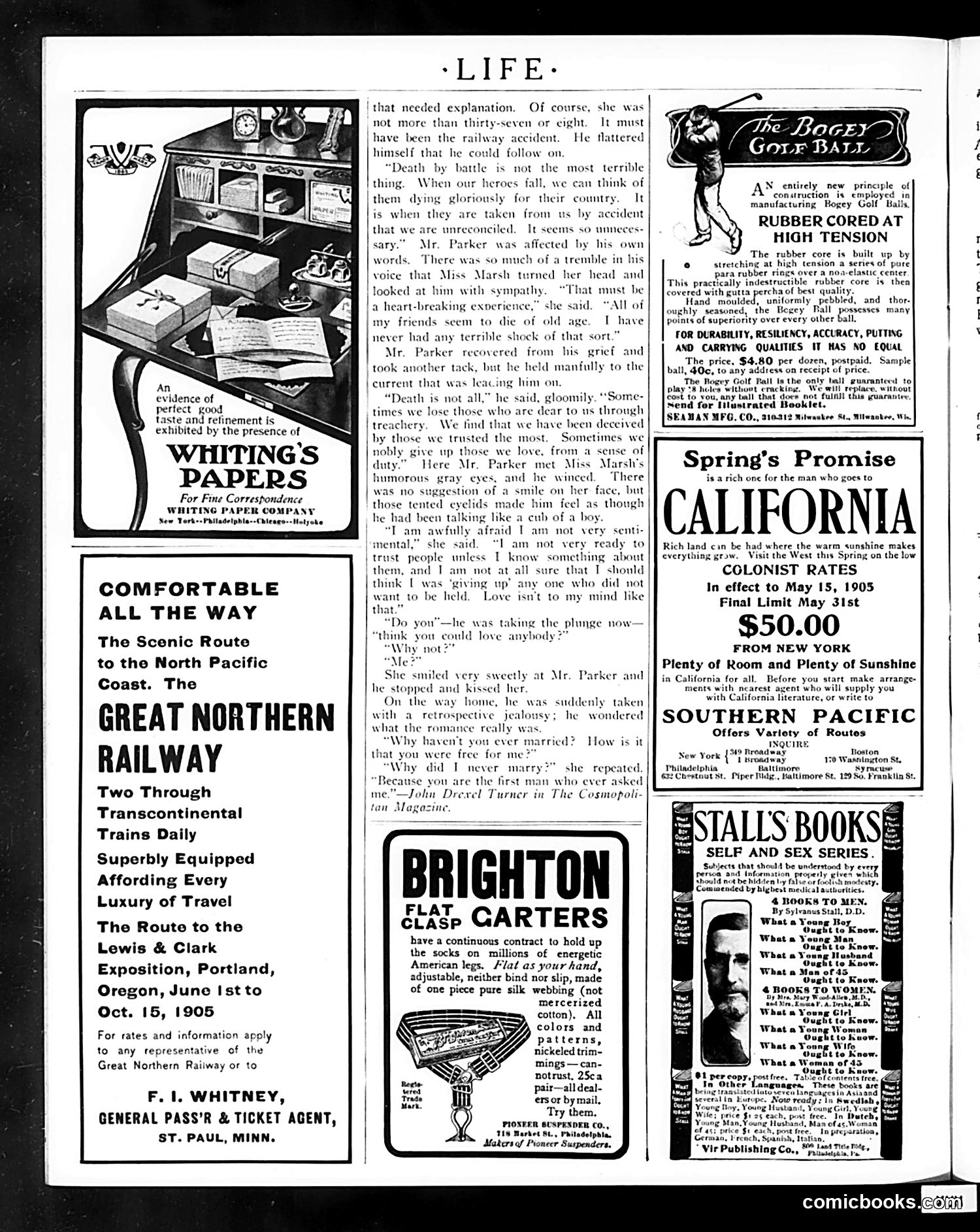
This page is primarily **advertising**, with a serialized story excerpt ("John Drevel Turner in The Cosmopolitan") running through the center. The narrative excerpt appears to depict a romantic scene where Mr. Parker attempts to win over Miss Marsh by discussing death, sacrifice, and love—performing sentimental idealization. Miss Marsh, however, responds with pragmatic skepticism, rejecting his romantic rhetoric. The joke seems to be that his elaborate, flowery emotional appeals backfire; she's unmoved by his performance and asks direct questions instead. The surrounding ads (Whiting's Papers, Great Northern Railway, Brighton garters, Bogey Golf Balls, Stalls Books) represent typical early 1900s consumer products marketed to middle-class readers. **No political cartoon is present on this page.** The content is entertainment and commercial advertising typical of *Life* magazine's format during this period (1905, based on the dated railway advertisement).
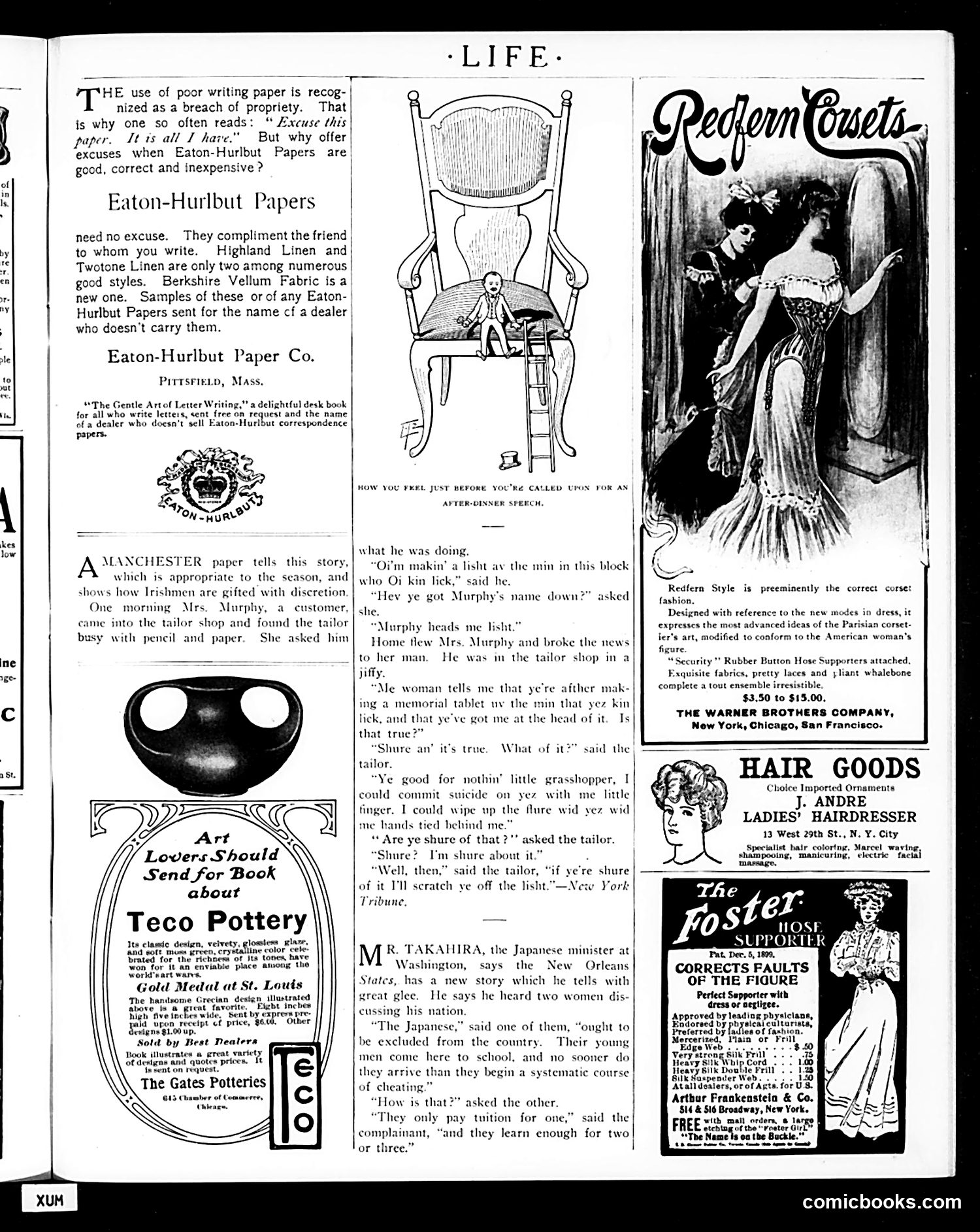
This page is **primarily advertising**, with three short comedic anecdotes interspersed. The main cartoon shows a man sitting in a chair clutching armrests, captioned "HOW YOU FEEL JUST BEFORE YOU'RE CALLED UPON FOR AN AFTER-DINNER SPEECH." It depicts universal stage fright—a relatable social anxiety joke about public speaking. Below are three brief humorous stories: 1. **The Irish Tailor**: A custom-appropriate joke about an Irish construction worker who, when told the tailor has listed him as the strongest man in the neighborhood and included him in a fight list, requests removal from the list—demonstrating Irish wit and pride. 2. **Japanese Tuition Anecdote**: A stereotypical joke playing on prejudice against Japanese immigrants, suggesting they cheat by having one person pay tuition while multiple students learn. The rest comprises advertisements for paper stock, pottery, corsets, hair goods, and hairdressing services—typical *Life* magazine commercial content from this era.
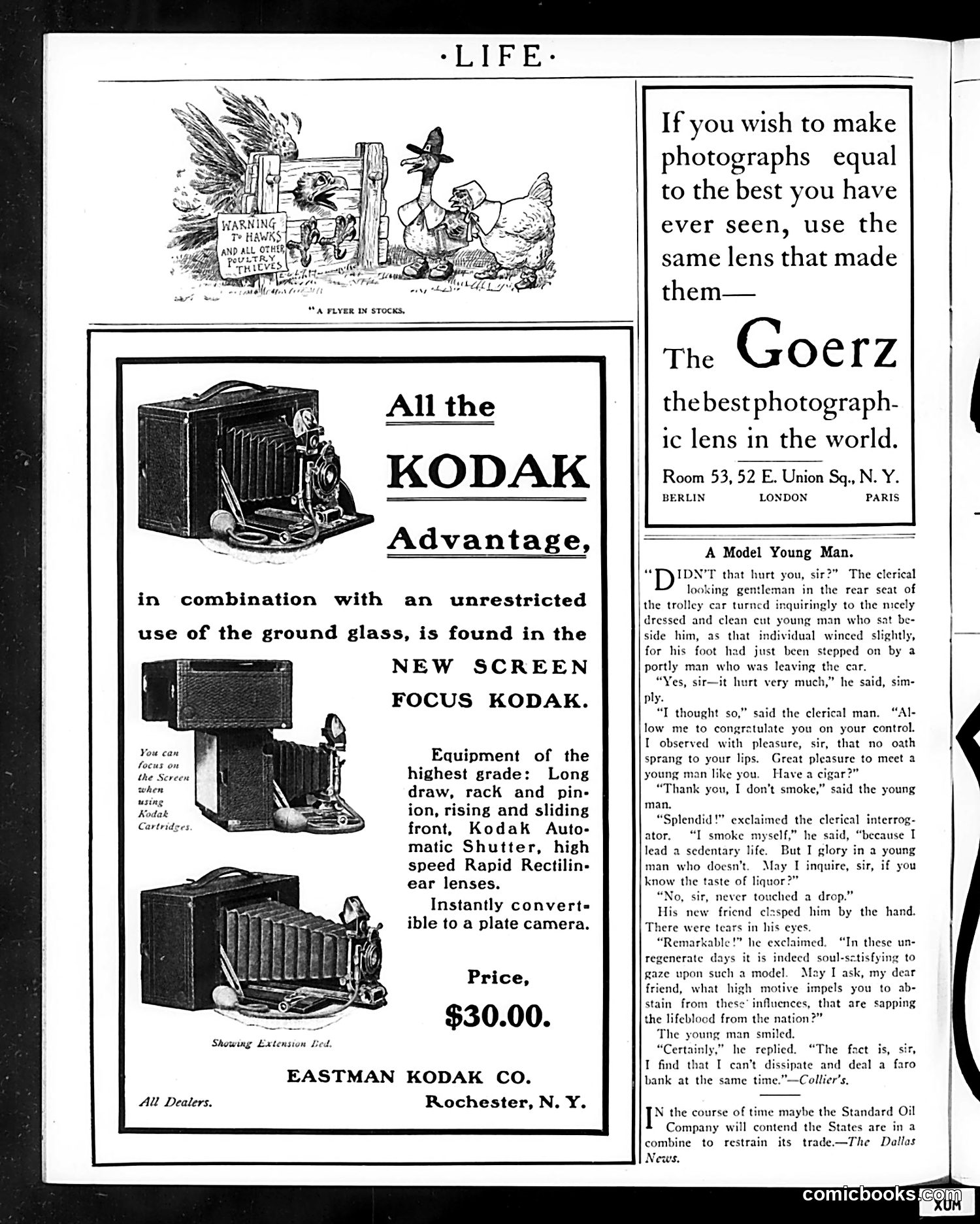
This satirical story mocks Victorian moralism and hypocrisy. A well-dressed young man on a trolley impresses a clerical gentleman by stoically enduring pain without cursing. The clergyman congratulates him and learns the youth neither smokes nor drinks—behaviors the clergyman praises as virtuous restraint. The punchline reveals the real reason: the young man avoids dissipation because he runs a faro bank (illegal gambling operation) and needs to stay sharp for that work. He's not morally upright—he's simply prioritizing criminal enterprise over vice. The joke satirizes how easily respectable society misjudges character based on surface virtue, and how the "model young man" can be fundamentally dishonest while appearing exemplary. It critiques both naive moral judgment and the corruption beneath genteel appearances.
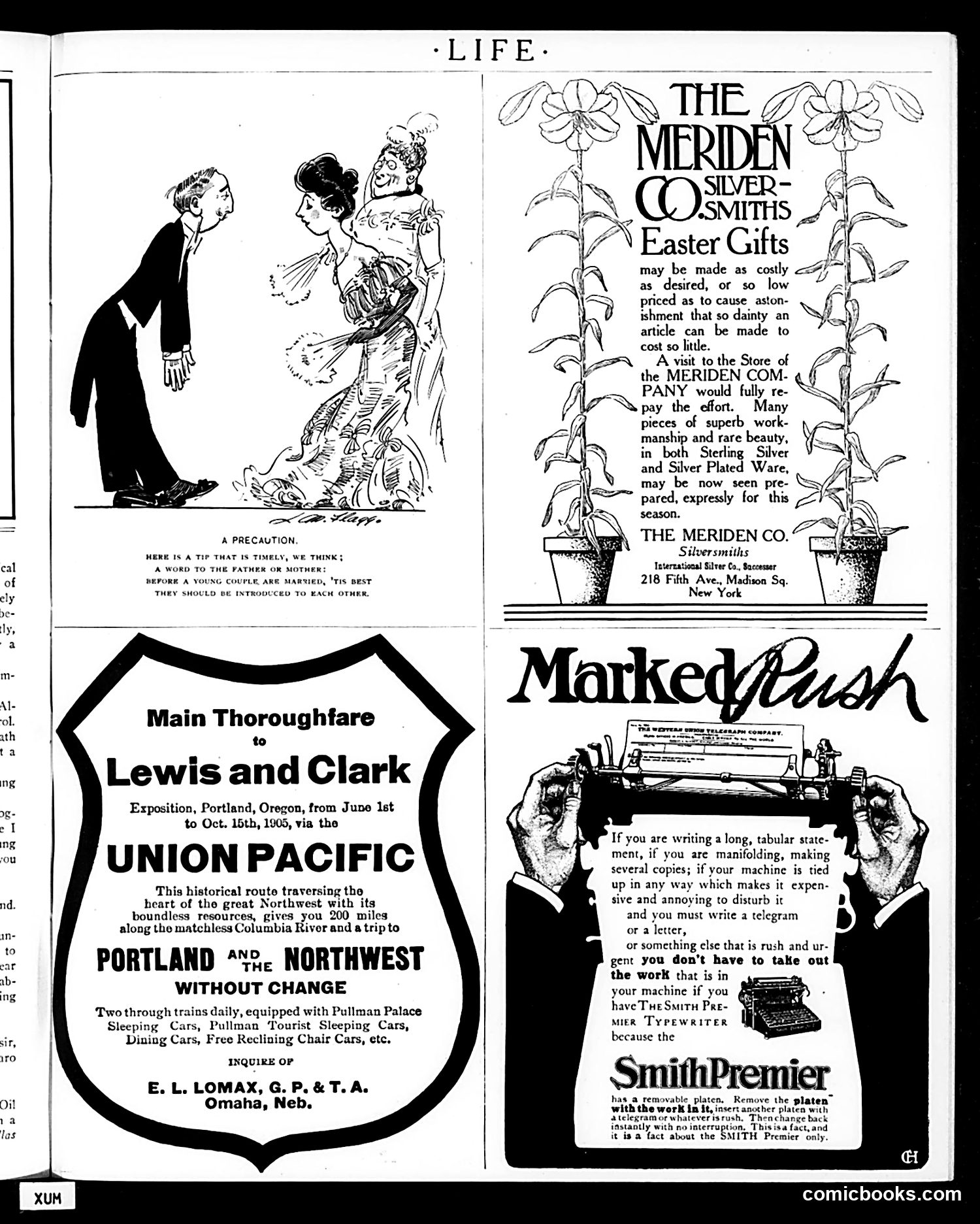
The cartoon satirizes social etiquette regarding courtship and marriage. It depicts three figures: a man in formal dress (left) appearing startled or disapproving, while a woman in an elaborate dress and a soldier or military officer embrace or flirt (center-right). The caption's advice—that a young couple should be "introduced to each other" before marriage—suggests the cartoon mocks either: 1. Arranged marriages where couples hadn't met beforehand, or 2. The formal social conventions that kept unmarried couples separated The joke appears to be that proper introduction is "a precaution" against unsuitable matches. The soldier's presence implies a romantic rival or unexpected suitor, adding comedic tension to the domestic scene. The page is primarily advertisements (Meriden silverware, Union Pacific railroad, Smith Premier typewriter), typical of Life magazine's format.
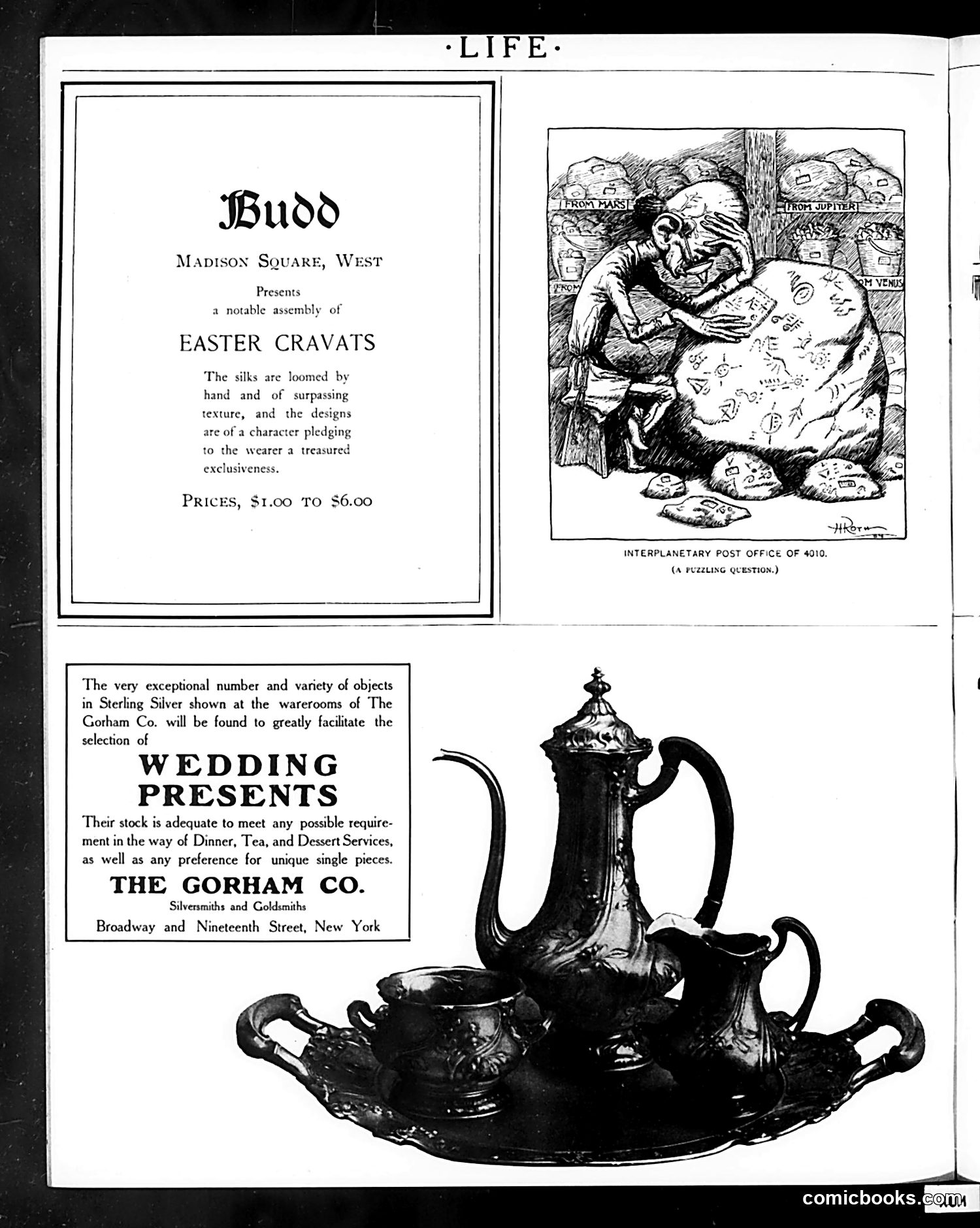
This page is primarily **advertising**, not political satire. It contains three advertisements: 1. **Budd neckwear** (top left): promoting Easter cravats at $1–$6 2. **Cartoon** (top right): A whimsical illustration titled "Interplanetary Post Office of 4010"—a science-fiction joke imagining a future mail system. A gnome-like figure appears to be sorting mail among alien or fantasy creatures. The "puzzling question" likely refers to postal logistics in an impossible scenario. This is humorous fantasy, not political commentary. 3. **The Gorham Co.** (bottom): Sterling silver and jewelry for weddings and formal dining The page reflects early-20th-century consumer culture and advertising style. The sci-fi cartoon reflects contemporary interest in futurism and technological speculation popular in that era's popular magazines.
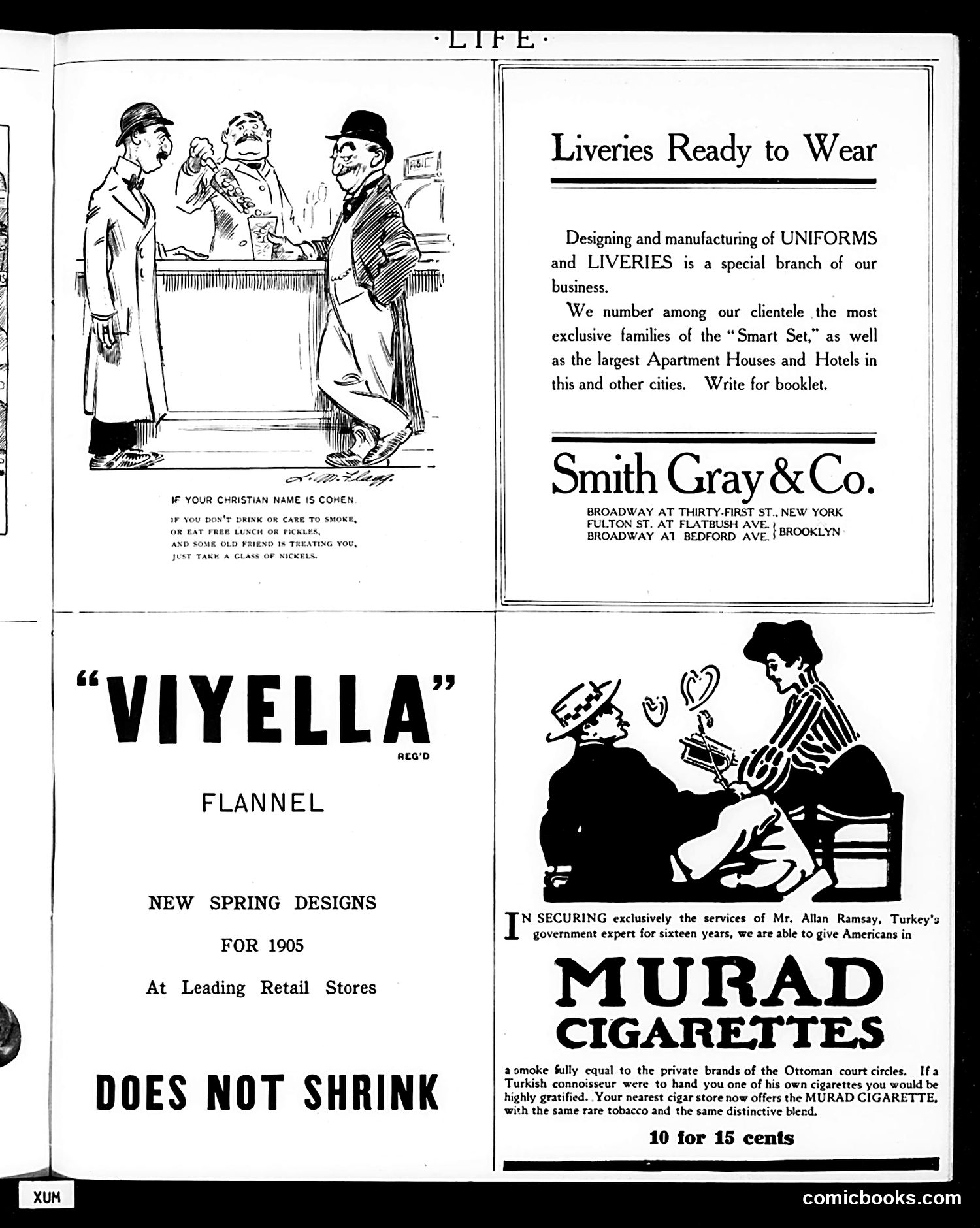
This page is primarily **advertising**, not satire or political commentary. The top cartoon shows three men at what appears to be a bar or counter, with text reading "IF YOUR CHRISTIAN NAME IS COHEN" and a caption about not minding smoke or an old friend treating you—likely a mild ethnic or social joke about Jewish names, typical of early 1900s casual humor. The page advertises: 1. **Smith Gray & Co.** — a uniform and livery manufacturer serving wealthy families and hotels 2. **Viyella Flannel** — a fabric that "does not shrink" (new spring designs for 1905) 3. **Murad Cigarettes** — marketed as equivalent to Ottoman court tobacco, employing Turkey's government tobacco expert; sold at 10 for 15 cents The Murad ad notably appeals to aspirational American consumers by emphasizing exclusivity and foreign sophistication. The imagery shows a woman and man in what appears to be a romantic or social context, common sales tactics for luxury goods of the era.
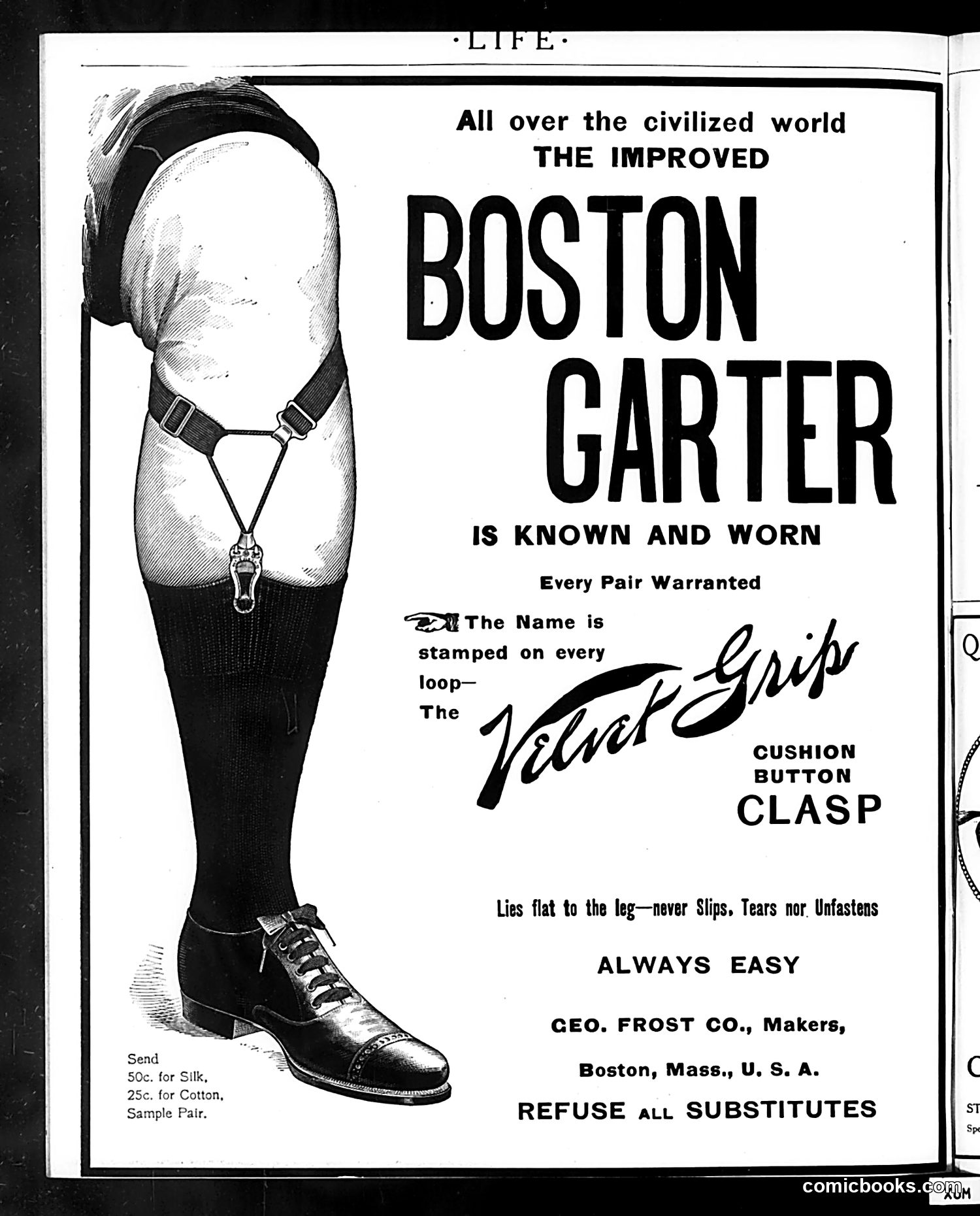
This is a straightforward product advertisement, not satire. It promotes the "Boston Garter," a men's garter—a device worn below the knee to hold up socks or stockings, common before elastic became standard. The illustration shows the garter's mechanism: a cushioned button clasp that "lies flat to the leg" without slipping. The advertisement emphasizes quality and American manufacture (Boston, Mass.), promising durability ("Every Pair Warranted") and offering samples at modest cost (50¢ for silk, 25¢ for cotton). The phrase "REFUSE all SUBSTITUTES" was typical advertising language asserting the superiority of the branded product over competitors. There is no political or satirical content—this is simply a vintage commercial page from *Life* magazine promoting a now-obsolete men's accessory.
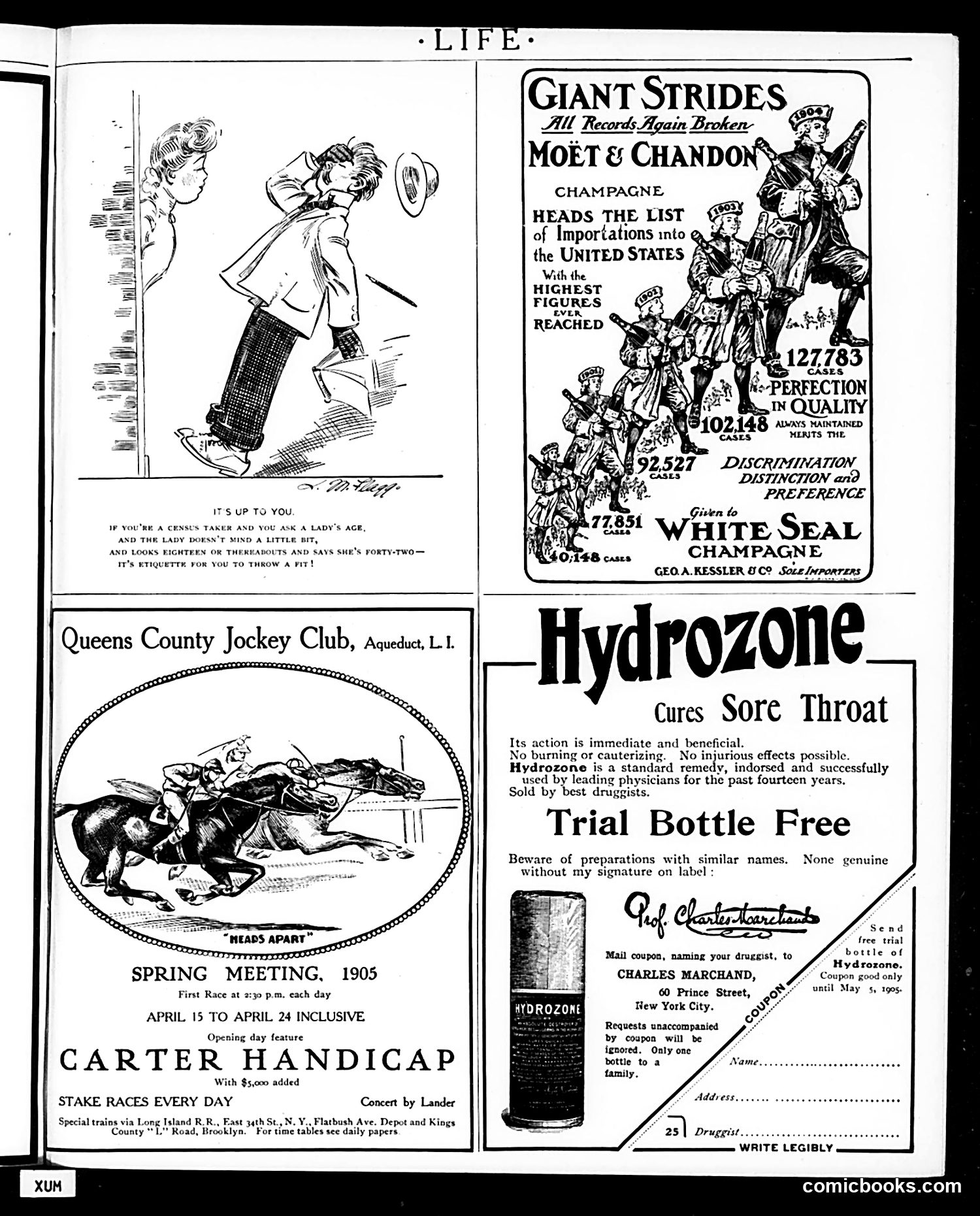
This page mixes satire with period advertising. The top cartoon—credited to artist signature—humorously addresses census-taking etiquette: a man reacts with exaggerated distress upon learning his wife claimed to be forty-two years old. The joke assumes readers recognize the social convention that women often lied about their age, and that honest husbands would publicly feign offense at such claims to maintain propriety. It's satirizing both gender dynamics and the awkwardness of the 1900 census itself. The page otherwise contains advertisements typical of *Life* magazine: champagne import statistics, a horse-racing event at Queens County Jockey Club (spring 1905), and patent medicine ads (Hydrozone for sore throats). These ads reflect early-1900s consumer culture and the widespread marketing of dubious medical remedies before FDA regulation.
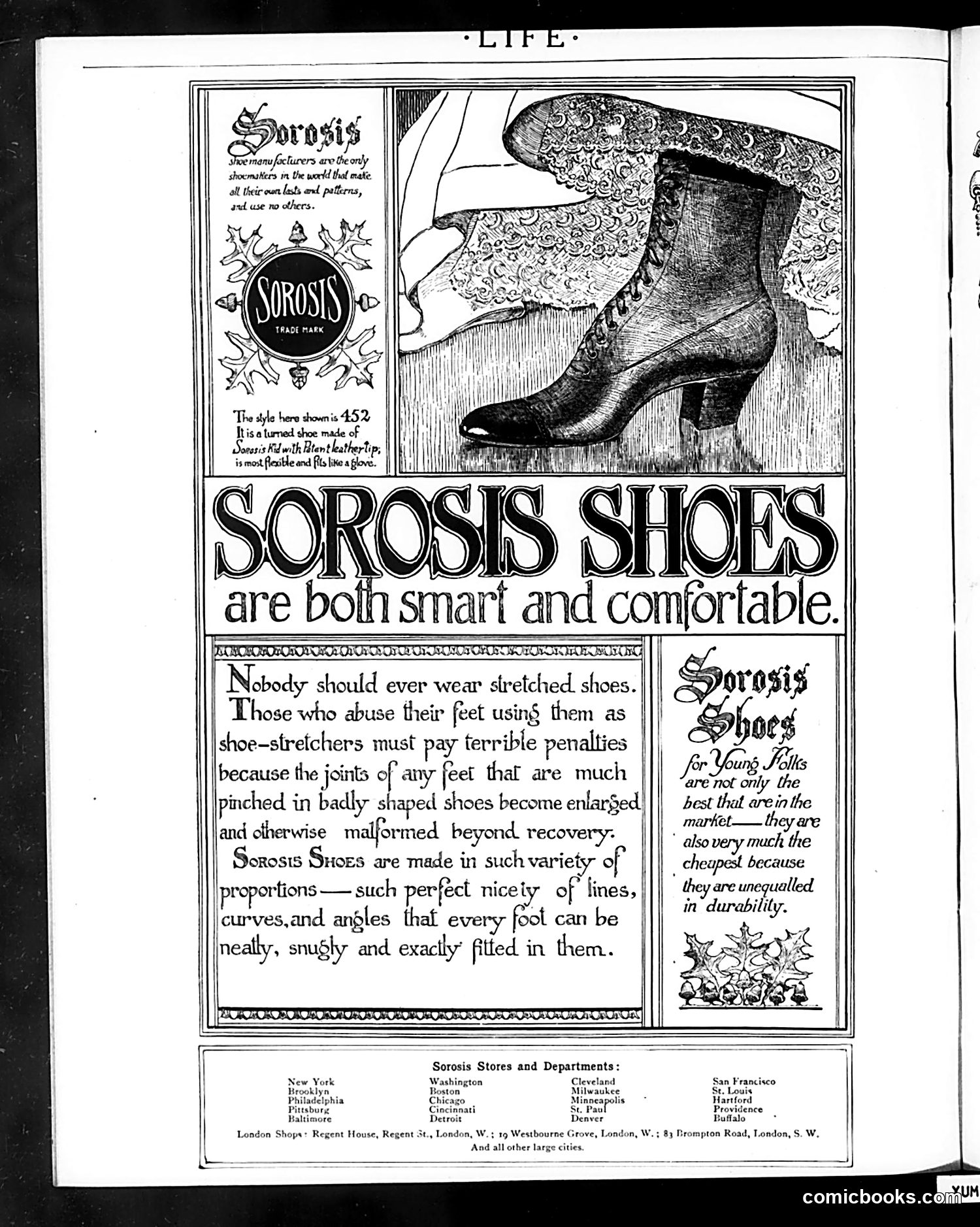
This is **primarily an advertisement**, not satire or political commentary. It promotes Sorosis brand women's shoes circa early 1900s. The page features: - **Main image**: An ornate ladies' boot with decorative lace trim, shown in detail to emphasize craftsmanship - **Marketing claims**: The ad argues against wearing "stretched shoes" (shoes warped from misuse as shoe-stretchers), warning this causes permanent foot damage - **Selling point**: Sorosis shoes are manufactured in precise proportions to fit various foot shapes perfectly—eliminating the need for stretching - **Target audience**: "Young folks" seeking durability and affordability The text contrasts properly-fitted shoes (Sorosis) against the contemporary practice of shoe-stretching, positioning the product as both stylish and health-conscious. The ornamental design elements and tone reflect early 20th-century advertising aesthetics. This appears to be a straightforward commercial advertisement rather than satirical content.