
Life, 1905-04-06 · page 27 of 62
Life — April 6, 1905 — page 27: what you’re looking at
What you’re looking at
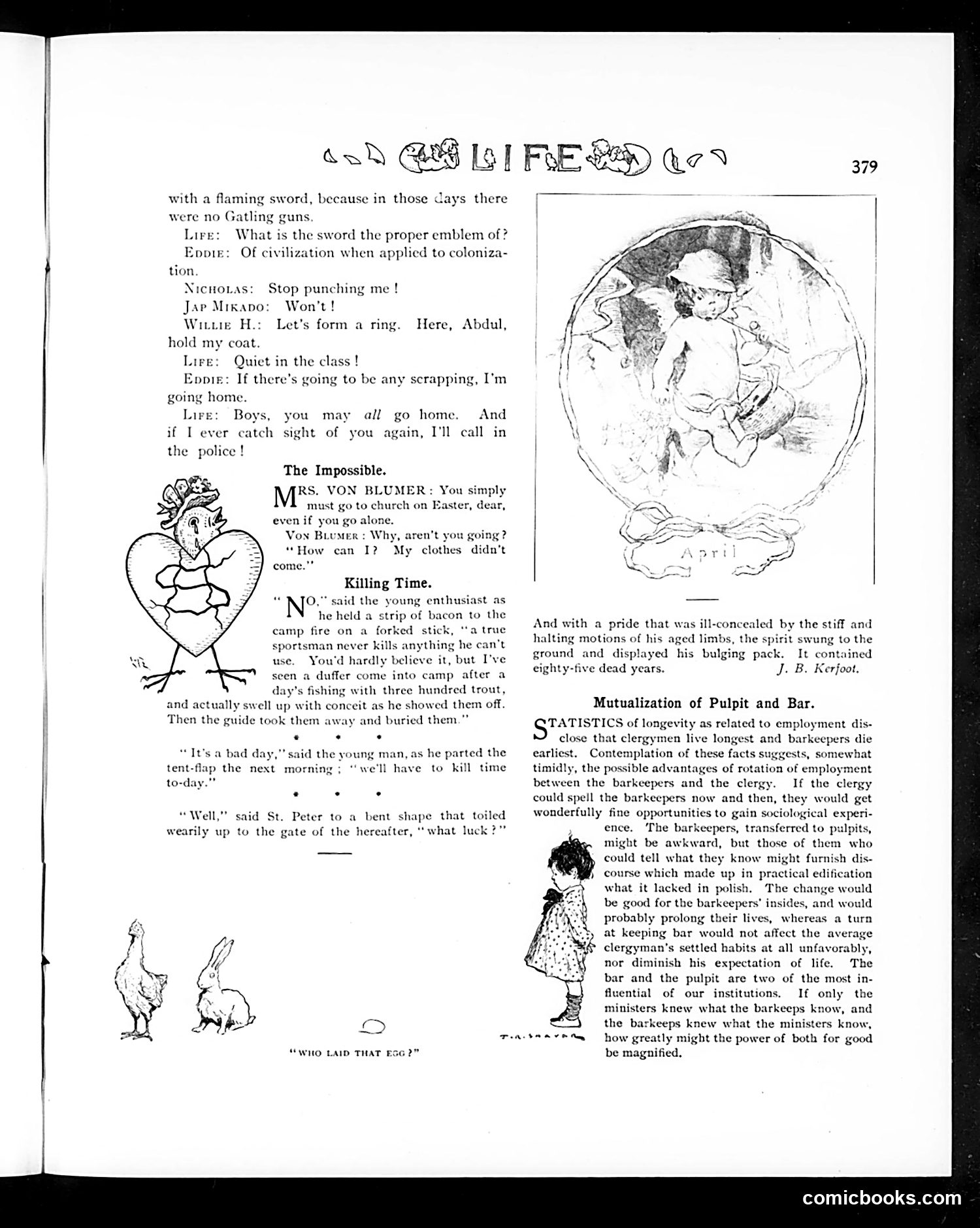
This page contains several satirical pieces mocking social pretensions and institutional absurdities: **"The Impossible"** ridicules marital class anxiety: Mrs. von Blumer insists on attending Easter services despite her husband's claim that his formal clothes haven't arrived—suggesting wealthy people prioritize social appearances over practical concerns. **"Killing Time"** depicts a fishing-camp anecdote where a "sportsman" boasts about ethical hunting while a guide quietly buries hundreds of trout the man caught and discarded—satirizing hypocrisy in outdoor recreation ethics. **"Mutualization of Pulpit and Bar"** proposes swapping clergy and barkeepers' professions, arguing both groups would benefit: barkeepers might offer practical moral instruction, while clergymen wouldn't suffer from tavern work. This mocks rigid institutional hierarchies and suggests unexpected wisdom exists across social classes—a critique of early-20th-century class assumptions about respectability. The cartoons throughout reinforce themes of pretension, contradiction, and social folly typical of *Life*'s satirical approach.
📄 Transcribed text from this page (OCR, searchable)
Machine-transcribed from the original scan — historical spelling and the odd misread are preserved.
aah G8 Io] FRE SD acy a with a flaming sword, because in those days there were no Gatling guns Lire: What is the sword the proper emblem of ? Eppie: Of civilization when applied to coloniza- , tion. NicHotas: Stop punching me ! Jar Mikapo: Won't! Witte H.: Let’s form a ring. Here, Abdul, hold my coat. Lire: Quiet in the class! Eppie: If there's going to be any scrapping, I'm going home. Li Bo: you may all go home. And if I ever catch sight of you again, I'll call in the police! The Impossible. M! . VON BLUMER: You simply must go to church on Easter, dear, even if you go alone. Vow Buumer : Why, aren't you going? “How can I? My clothes didn’t come. Killing Time. “ N°: said the young enthusiast as — he held a strip of bacon to the camp fire on a forked stick, ‘a true sportsman never kills anything he can’t use. You'd hardly believe it, but I’ve And with a pride that was ill-concealed by the stiff and halting motions of his aged limbs, the spirit swung to the ground and displayed his bulging pack. It contained seen a duffer come into camp after a eighty-five dead years. J. B. Kerjoot. day’s fishing with three hundred trout, a and actually swell up with conceit as he showed them off. Mutualization of Pulpit and Bar. Then the guide took them away and buried them.” TATISTICS of longevity as related to employment d . . : close that clergymen live longest and barkeepers die ang man, as he parted the earliest. Contemplation of these facts suggests, somewhat ‘we'll have to kill time _ timidly, the possible advantages of rotation of employment between the barkeepers and the clergy. If the clergy could spell the barkeepers now and then, they would get Peter to a bent shape that toiled Wonderfully fine opportunities to gain sociological experi- “Well,” said S$ 1. wearily up to the gate of the hereafter, “what luck?” 2 ence. The barkeepers, transferred to pulp might be awkward, but those of them who could tell what they know might furnish dis- course which made up in practical edification what it lacked in polish. The change would be good for the barkeepers’ insides, and would probably prolong their lives, whereas a turn at keeping bar would not affect the average clergyman's settled habits at all unfavorably, nor diminish his expectation of life. The bar and the pulpit are two of the most in- fluential of our institutions. If only the ministers knew what the barkeeps know, and cy the barkeeps knew what the ministers know, ~~ Teastaareany how greatly might the power of both for good be magnified. comicbooks.com