
Life, 1905-04-06 · page 22 of 62
Life — April 6, 1905 — page 22: what you’re looking at
What you’re looking at
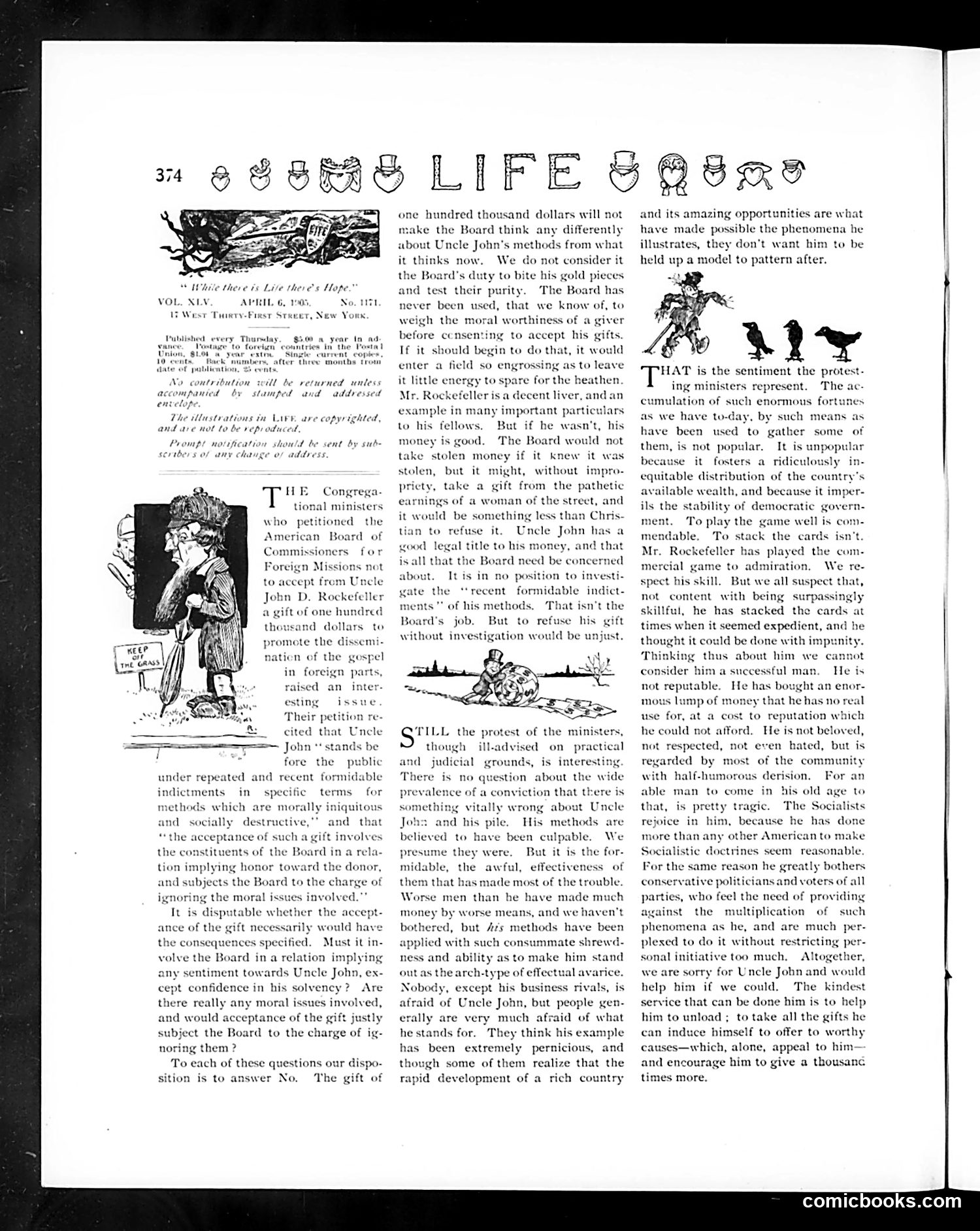
This page debates whether the American Board of Commissioners for Foreign Missions should accept a $100,000 gift from **John D. Rockefeller**, the oil magnate and industrialist. **The controversy:** Congregational ministers petitioned the Board to refuse the donation, arguing that accepting tainted money from someone engaged in morally questionable business practices would compromise the Board's integrity. **Life's position:** The editorial argues the Board should accept the gift. It distinguishes between Rockefeller's personal decency and his business methods, contending the Board needn't judge his conduct. The magazine notes that while Rockefeller's ruthless efficiency in accumulating wealth frightens people, it resulted partly from America's opportunities—not pure villainy. **The satire:** The accompanying cartoons (left) mock the ministers' scruples. Life suggests their moral grandstanding ignores that Rockefeller's methods, however questionable, made him useful as a donor to missionary work. This reflects the Progressive Era debate over whether wealthy industrialists' money could be morally "laundered" through charitable giving.
📄 Transcribed text from this page (OCR, searchable)
Machine-transcribed from the original scan — historical spelling and the odd misread are preserved.
« ¢@86RG LIFE S@8x8 “White there fs Lite there's Ho; VOL. NEV APRIL 6, 1905, 1y West Tingry-Fiest Stxeer, New Yous ' van We to Union, $100 a ye 10 cents, Rack num date ef pabliention, 3 No contribution will be returned untess accompanied by stamped and addressed envelop The illustrations in LAPK. are copyrighted, 1 should be sent by sub- ompt notificati scribes § of at HE Congre tional ministers who petitioned the American Board of Commissioners for Foreign Missions not to accept from L John D, Rockefeller a gift of one hundred the promote the dissemi- sand dollars to naticn of the gospel in f n parts, raised an_ inter- esting issue Their pe cited that Uncle = John “stands be ] J 4 fore the lic under repeated and recent formidable indictments in specific terms for methods which are moral y iniquitous nd that he acceptance of such a gift involves Board in a rela- tion implying honor toward the donor, and socially destructive,”* the constituents of and subjects the Board to the charge of i ring the moral issues involved." It is disputable whether the accept- ance of the gift necessarily would have the consequences specified. Must it in- volve the Board ina relation implying any sentiment towards Uncle John, ex- confidence in his solvency? Are moral issues involved, and would acceptance of the gift justly subject the Board to the charge of ig- noring them ? To each of these questions our dispo- sition is to answer No. The gift of ne hundred thousand dollars will not ke the Board think any differently about Uncle John’s methods from what it thinks now. We do not consider it the Board's duty to bite his gold pieces it The Board has never been used, that we know of, to ‘igh th T before ccnsenting to accept his gifts. If it should begin to do that, it would enter a field so engrossing as to leave and test their 7 w moral worthiness of a giv it little energy to spare for the heathen Mr. Rocke: example in many important particu! to his fellows. But if b money is good. The Board would not take stolen money i eller is a decent liver, anc rs sn't, his w f it knew it w: stolen, but it might, without impro- cty, take a gift from the pathetic he street, and pr earnings of a woman 1 be something less than Chris- use it, Uncle John has a tle to hi and that ¢ Board need be concerned it we tian to r mone good legal is all that about. It is in no position to investi- gate the ‘recent formidable indict- nts" of his methods. That isn’t the Board's job, But to refuse h without investigation would be ur TILL the protest of the mini though ill-advised on practical and judie’ | prevalence of a conviction that t about Uncle nd his pile. His methods are ers, jal grounds, is interesting. re is no question about the wide ere is something vitally wron: believed to have been culpable. We presume they were, But it is the for- midable, the awful, effectiveness of them that has made most of the trouble. Worse men than be have made much money by worse means, and we haven't bothered, but 7s methods have been applied with such consummate shrewd- ness and ability as to make him stand outas the arch-type of effectual avarice. Nobody, except his business rivals, is afraid of Uncle John, but people gen- erally are very much afraid of what he stands for. ‘They think his example has been extremely pernicious, and though some of them realize that the rapid development of a rich country and its amazing opportunities are what have made possible the phenomena he illustrates, they don’t want him to be held up a model to pattern after. Tet is the sentiment the protest- ing ministers represent. ‘The ac- cumulation of such enormous for! nes as we have to-day, by such means as have been them, because it fosters ridicule equitable distribution of the co 3 able wealth, and because it imper- ils the stability of democratic ment. To play the game well is c mendable. To stack the Mr. Rockefeller has played the com- mercial game to admiration, We re- spect his skill, But we all suspect that, not content with being surpassingly skillful, he has stacked the cards at times when it seemed expedient, and he thought it could be done with impunity. Thinking thus about him we cannot consider him a successful man. He is not reputable. He has bought an enor- mous lump of money that he has no real used to gather some of is not popular. It is unpopular sly in- avail ards isn't. use for, at a cost to reputation which he could not afford, He is not beloved, not respected, not even hated, but is regarded by most of the community h half-humorous derision, For an wil able man to come in his old age to that, is pretty tragic. The Socialists m, because he has done rejoice in bh more thar Sociali For the same reason he greatly bothers conservative politicians and voters of all parti wainst’ the multiplication of such ny other American to make ¢ doctrines seem reasonable. s, who feel the need of providing phenomena as he, and are much per- plexed to do it without restricting per. Tr, we are sorry for Uncle John and would help him if we could. The kindest service that can be done him is to help him to unload ; to take all the gifts he can induce himself to offer to worthy causes—which, alone, appeal to him and encourage him to give a thousanc times more, sonal initiative too much, Altogeth — comicbooks.com