
Life, 1905-04-06 · page 34 of 62
Life — April 6, 1905 — page 34: what you’re looking at
What you’re looking at
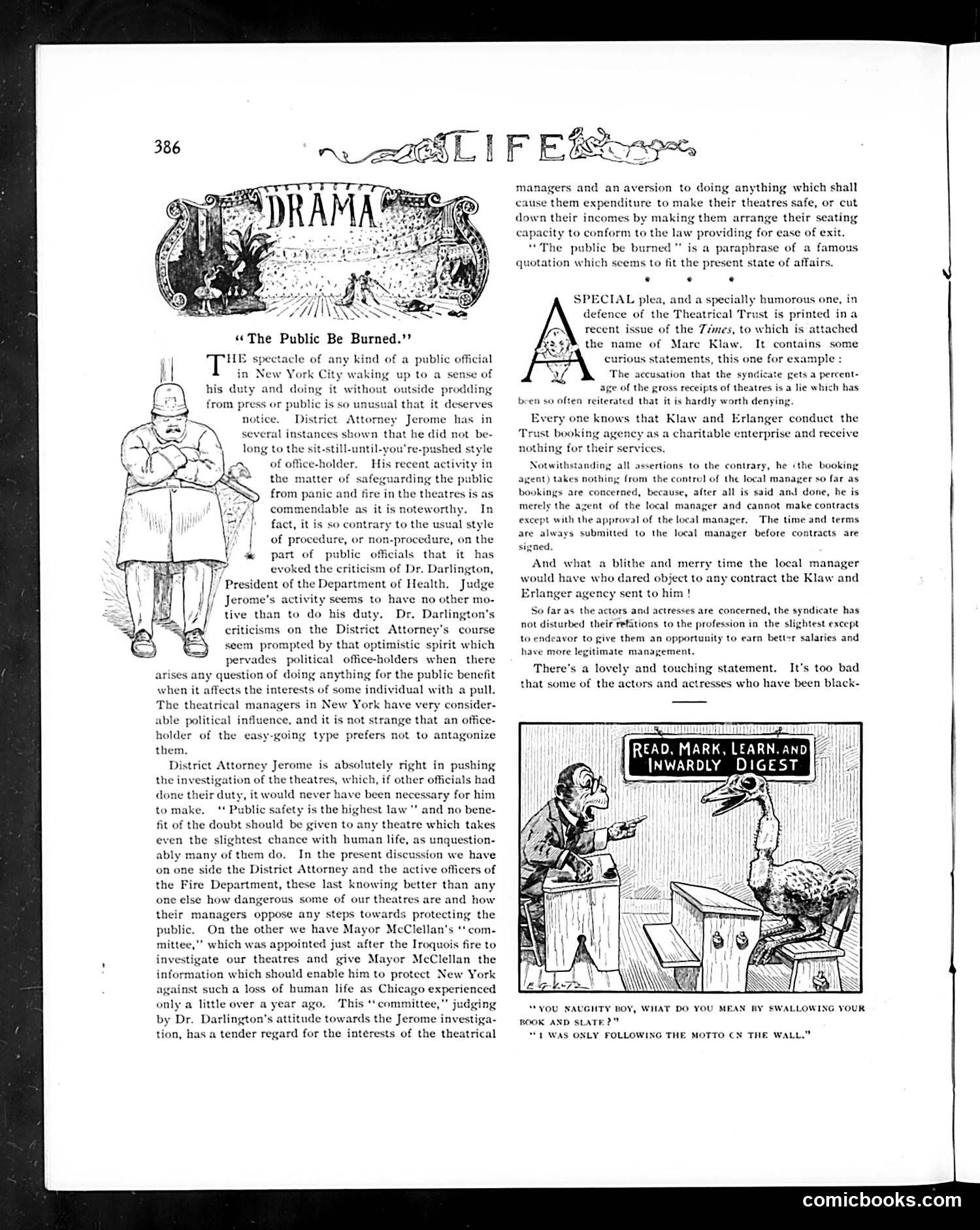
This article satirizes the conflict between New York District Attorney Jerome's efforts to enforce theater safety regulations and resistance from theatrical managers with political power. The title parodies the famous phrase "the public be damned," suggesting that theater owners prioritize profits over public safety. The piece praises Jerome's investigation into dangerous theater conditions—likely prompted by the catastrophic Iroquois Theatre fire in Chicago (referenced as occurring "a little over a year ago"). However, it criticizes Mayor McClellan's appointed committee for protecting managers' financial interests rather than public welfare. The article also mocks Marc Klaw's public defense of the "Theatrical Trust" (Klaw and Erlanger's booking monopoly), particularly his absurd claim that the syndicate operates as "charitable enterprise" while denying they profit from theater operations. The satirist highlights how theatrical managers use political connections to obstruct safety improvements that would reduce their income.
📄 Transcribed text from this page (OCR, searchable)
Machine-transcribed from the original scan — historical spelling and the odd misread are preserved.
CHIN “The Public Be Burned.’’ : HE spectacle of any kind of a public offic f | in New York City waking up to a sense of his duty and doing it without outside prodding from press or public is so unusual ths noti District Attorney Jerome has in several instances shown that he did not be- long to the si it deserves -still-until-you're-pushed style of office-holder, His recent activity in the matter safeguarding the public from panic and fire in the theatres is commendable as it is noteworthy. fact, it is so contrary to the usual style of procedure, or non-procedure, on the part of public officials that it has evoked the criticism of Dr. Darlington, ‘ President of the Department of Health. Judge | [/ Jerome's activity seems to have no other mo- A] tive than to do his duty, Dr. Darlington's criticisms on the District Attorney's course seem prompted by that optimistic spirit which pervades political office-holders when there ises any question of doing anything for the public benefit when it affects the interests of some individual with a pull. The theatrical managers in New York have very consider- able political influence, and it is not strange that an office- holder of the going type prefers not to antagonize them. District Attorn eas Jerome is absolutely right in pushing which, if other officials had done their duty, it would never have been necessary for him tomake. ‘ Public safety is the highest law ” and no bene- fit of the doubt should be given to any theatre which takes even the slightest chance with human life, as unqu ably many of them do. the investigation of the theatres, tion- In the present discussion we have on one side the District Attorney and the active officers of the Fire Department, these last knowing better than any one else how dangerous some of our the: nd how tres are a their managers oppose any steps towards protecting the public, On the other we have Mayor McClellan's ‘tcom- which was appointed just after the Iroquois fire to ate our theatres and give Mayor McClellan the information which should enable him to protect New York against such a loss of human life as Chicago experienced only a little over a year ago. This ‘‘ committee,” judging by Dr. Darlington’s attitude towards the Jerome investiga- tion, has a tender regard for the interests of the theatrical managers and an aversion to doing anything which shall cause them expenditure to make their theatres safe, or cut down their incomes by making them arrange their seating capacity to conform to the law providing for ease of exit. The public be burned” is a paraphrase of a famous quotation which seems to fit the present state of affairs. SPECIAL plea, and a specially humorous one, in defence of the Theatrical Trust is printed ina recent issue of the 7/mes, to which is attached the name of Mare Klaw. It contains some curious statements, this one for example : ‘The accusation that the syndicate gets a percent- ge of the gross receipts of theatres is a lie which has been so often reiterated that it is hardly worth denying. Every one knows that Klaw and Erlanger conduct the Trust booking agency as a charitable enterprise and receive nothing for their services. Notwithstanding all assertions to the contrary, he ithe booking agent) takes nothing: from the contrel of the local manager so far as bookings are concerned, because, after all is said and done, he is merely the agent of the local manager and cannot make contracts except with the approval of the local manager, The time and terms are always submitted to the local manager before contracts are signed. And what a blithe and merry time the local manager would have who dared object to any contract the Klaw and Erlanger agency sent to him ! So far as the actors and actresses are concerned, the syndicate has not disturbed their refitions to the profession in the slightest except to endeavor to give them an opportunity to earn better salaries and have more legitimate management, There's a lovely and touching statement. that some of the actors It’s too bad and actresses who have been black- READ, MARK, LEARN. AND INWARDLY DIGEST “YOU NAUGHTY BOY, WHAT DO YOU MEAN BY SWALLOWING YOUR BOOK AND SLATE?” 1 WAS ONLY FOLLOWING THE MOTTO CN THE WALL.” comicbooks.com