
A complete issue · 41 pages · 1904
Life — April 7, 1904
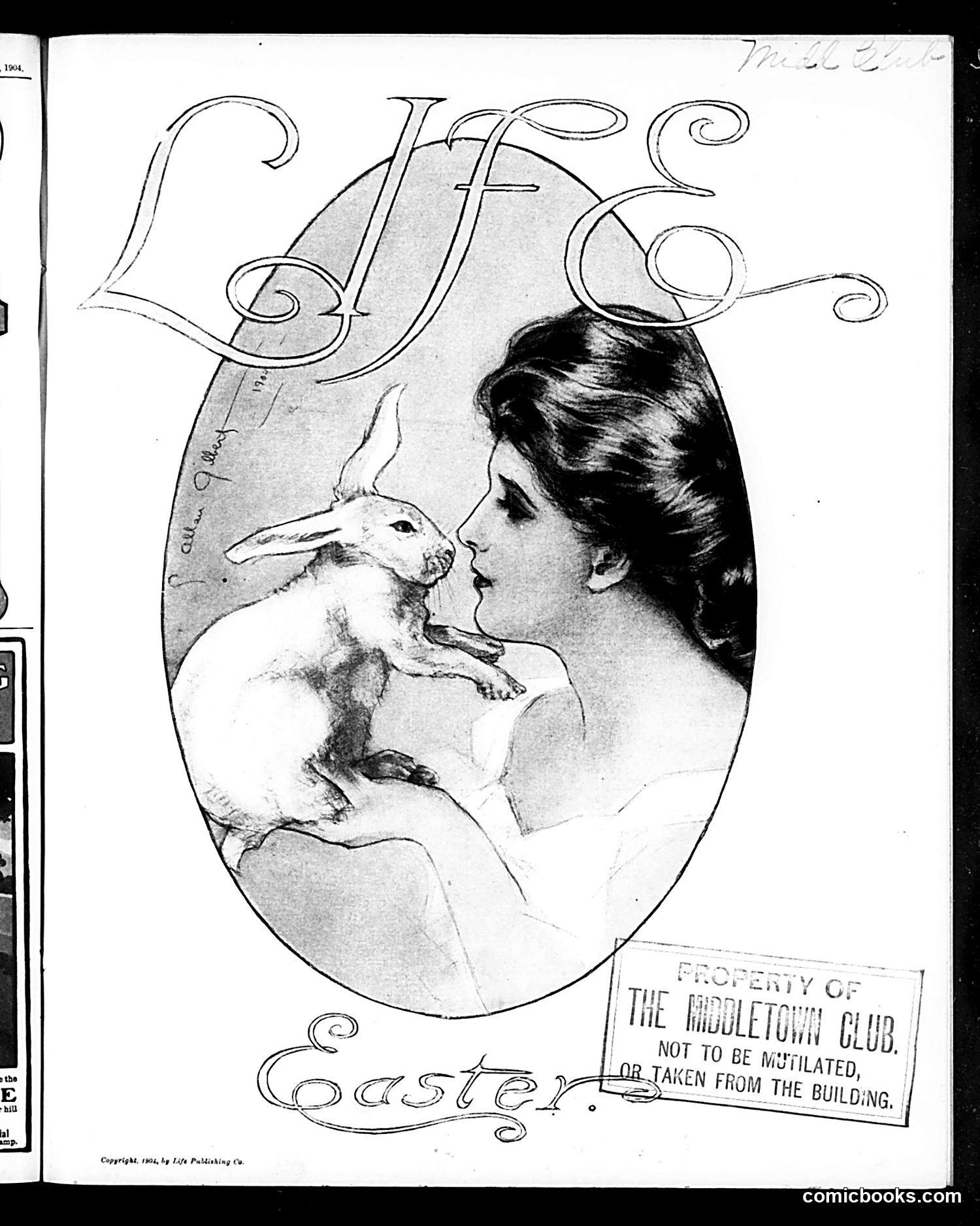
This appears to be a Life Magazine cover from around 1904 (based on the copyright mark visible). The illustration shows a woman in profile holding a young rabbit, with decorative text reading "Life" at top and "Easter" at bottom. The image plays on the Easter holiday theme, depicting a woman with a rabbit—the traditional symbol of Easter and spring fertility. The soft, romantic illustration style was typical of early-1900s magazine covers. The stamp reading "Property of the Middletown Club" indicates this particular copy belonged to a club library and wasn't meant to be removed from the building—a common library marking practice of the era. This is a straightforward holiday illustration rather than political satire.
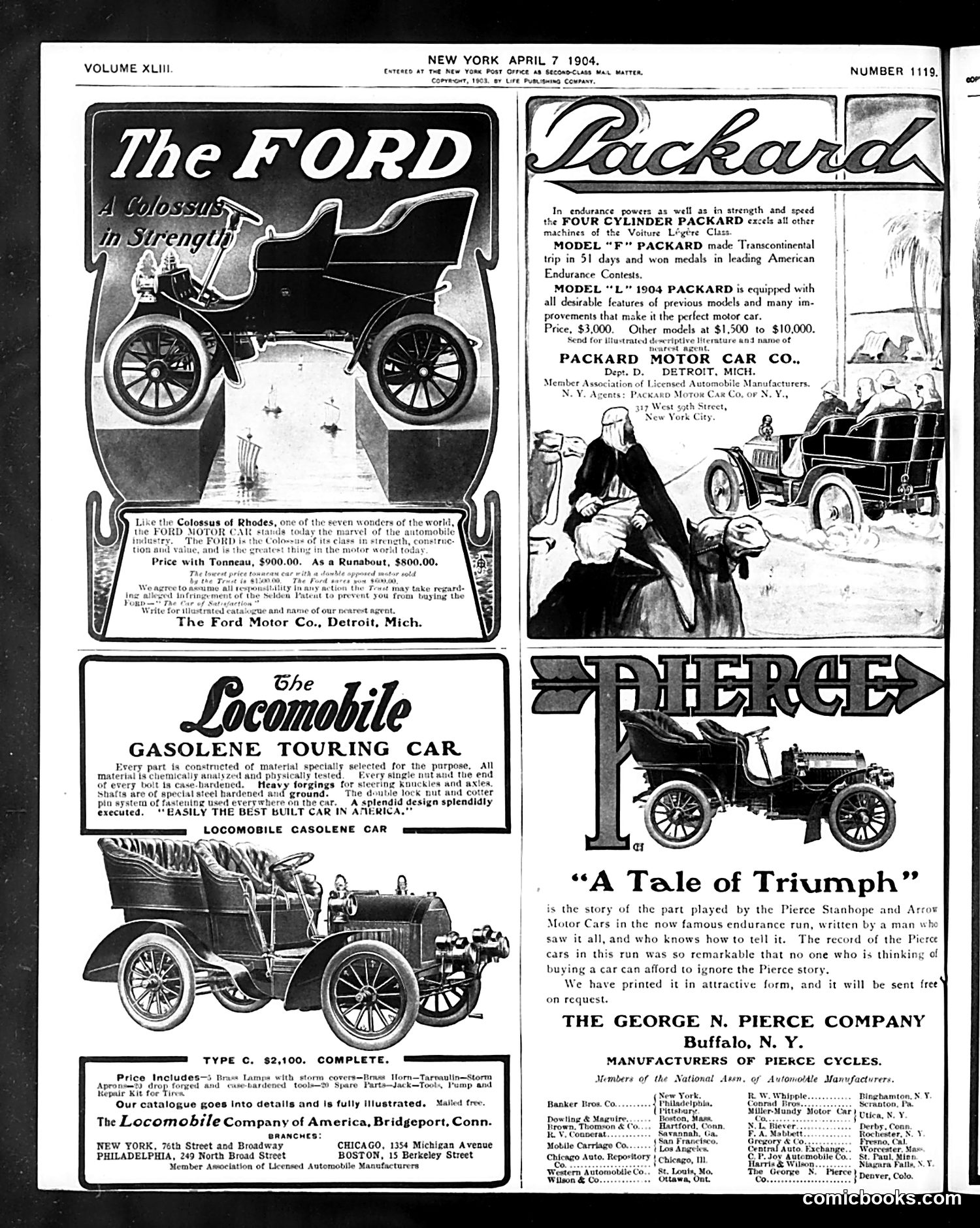
This page consists primarily of **automobile advertisements** rather than satirical cartoons. The ads promote early automotive brands: Ford ("A Colossus in Strength"), Packard, Locomotile, and Pierce-Arrow. The only narrative content is Pierce-Arrow's "A Tale of Triumph," describing an endurance run featuring Pierce Stanhope and Arrow Motor Cars. This appears to be marketing copy rather than satire, highlighting the cars' reliability by referencing a real endurance competition. The page reflects the **early automobile era** when such vehicles were expensive luxury items. The advertisements' prominence and detailed specifications indicate cars were novel enough to require explanation to Life's readers. There is no evident political satire on this particular page.
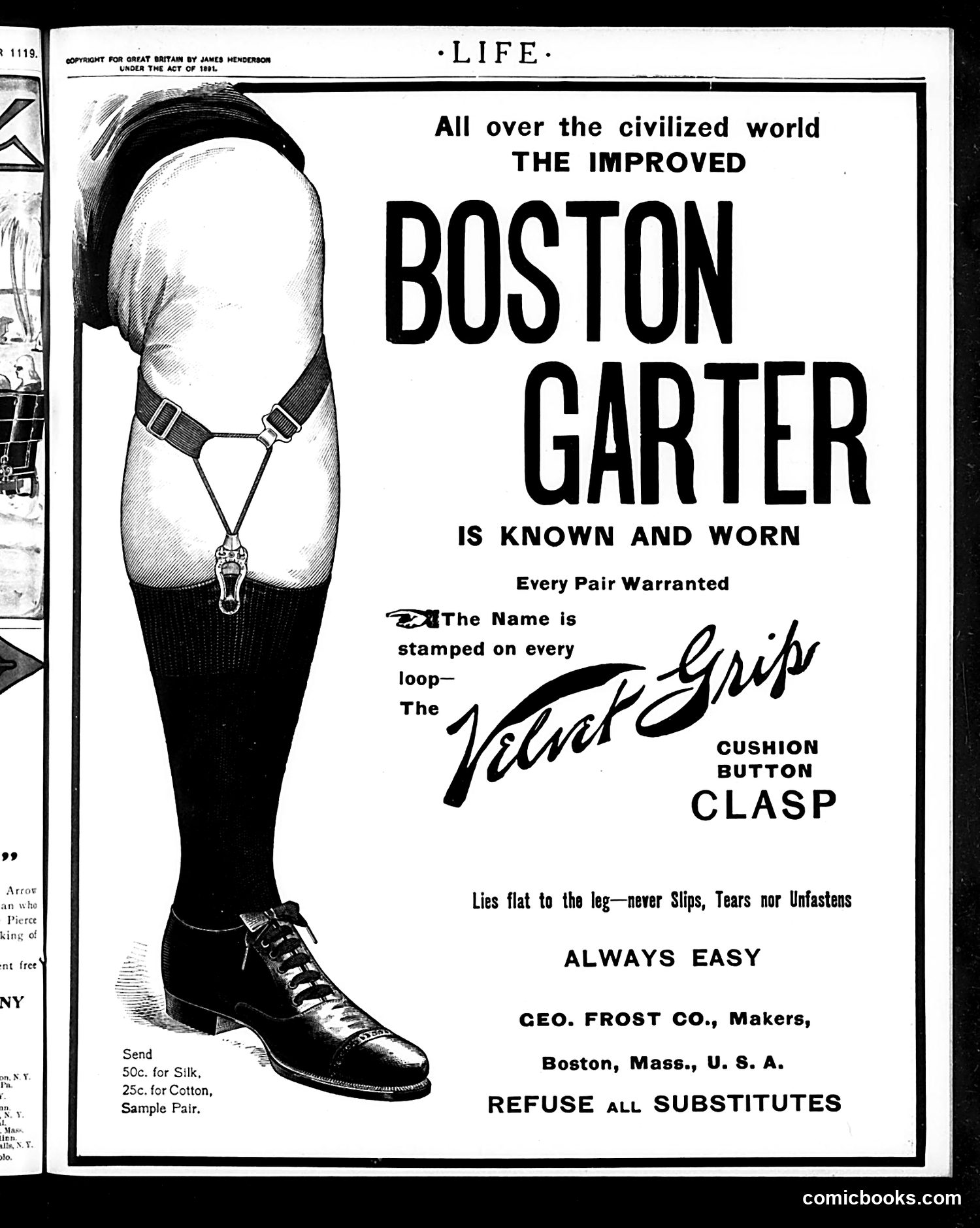
This page is **primarily an advertisement**, not satirical content. It promotes "The Improved Boston Garter" — a men's garter (sock supporter) made by Geo. Frost Co. of Boston. The ad features an illustration of a leg wearing the garter with its "Velvet Grip" cushion button clasp, paired with a formal shoe. The marketing emphasizes reliability ("Every Pair Warranted," "REFUSE all SUBSTITUTES") and practical benefits ("Lies flat to the leg—never Slips, Tears nor Unfastens," "ALWAYS EASY"). The phrase "All over the civilized world" suggests this was a nationally or internationally distributed product seeking to establish brand prestige. The garter itself was standard menswear of the era, holding up socks before elastic became common. This reflects early 20th-century consumer advertising practices in *Life* magazine.
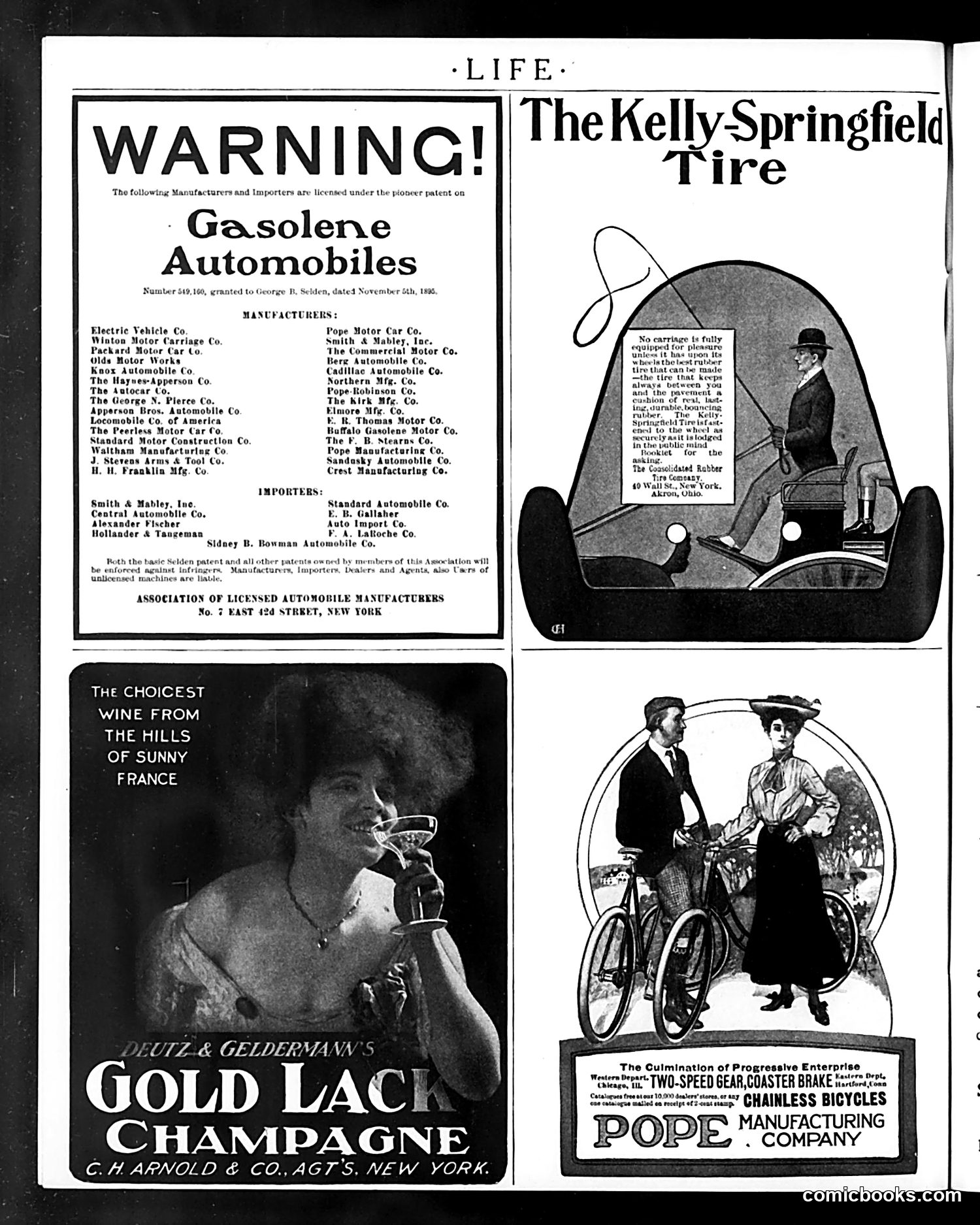
This page is primarily **advertising**, not satirical content. It contains: 1. **Warning notice** (top left): Lists gasoline automobile manufacturers licensed under a pioneer patent (#549,160, granted to George B. Selden in 1895). This appears to reference patent litigation over early automobile technology—a significant legal battle of the era. 2. **Product advertisements**: - Kelly-Springfield Tire (top right) - Gold Lack Champagne by Deutz & Geldermann (bottom left) - Pope Manufacturing Company chainless bicycles (bottom right) The page reflects early 1900s consumer goods marketing. The patent warning suggests industrial legal disputes were common enough to warrant prominent advertisement. No political satire is evident; this is straightforward commercial content from Life magazine's advertising section.
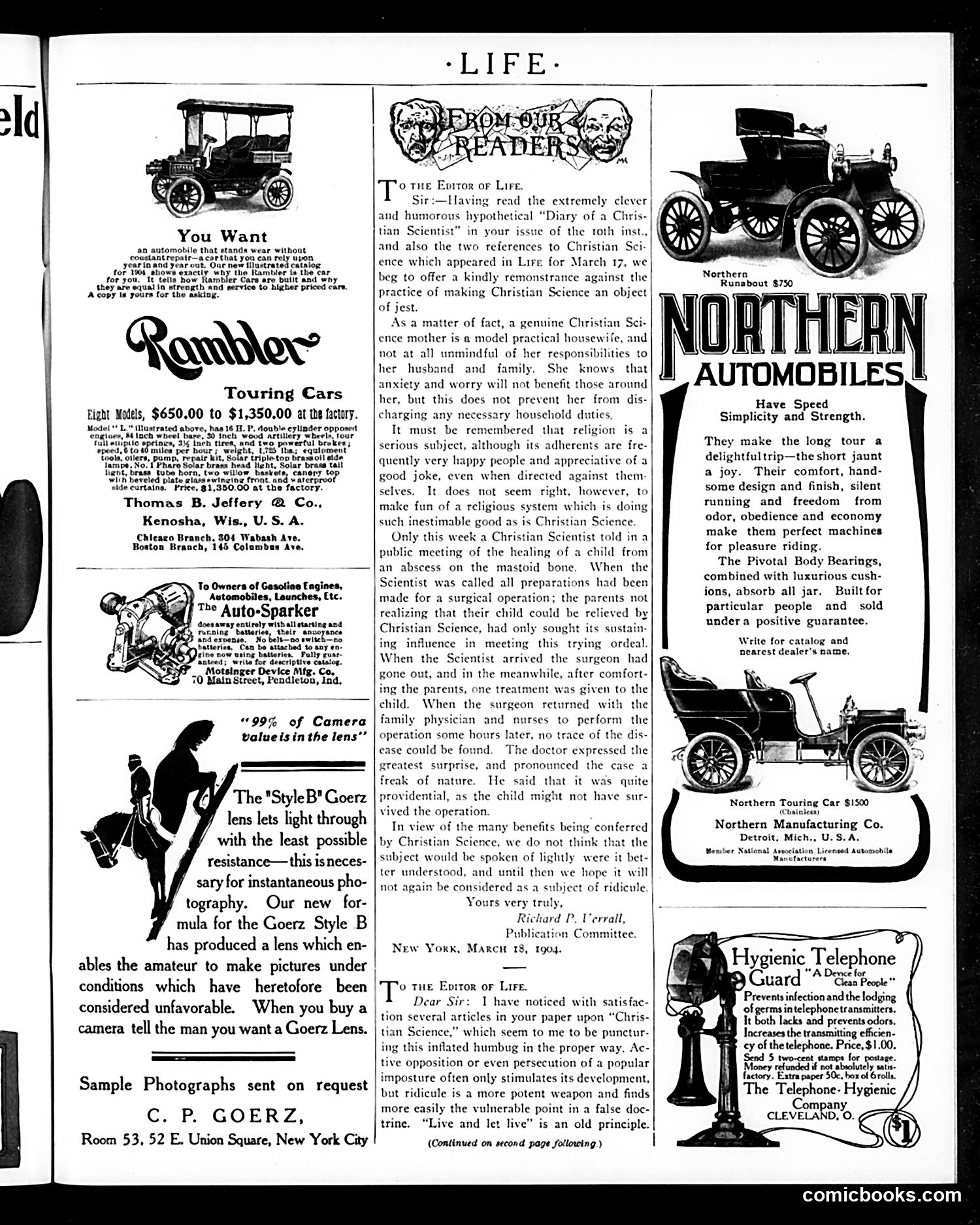
This page is primarily **advertising and reader correspondence**, not political satire. The "From Our Readers" section contains two letters debating Christian Science—one criticizing a previous Life article mocking "Christian Scientists" as hypocritical, another defending Christian Science's efficacy based on a medical case. The advertisements feature early automobiles (Rambler touring cars, Northern automobiles) and photography equipment (Goerz camera lenses), typical of Life magazine's 1904 commercial content. There is **no political cartoon** on this page. The satirical element appears limited to Life's earlier editorial content that prompted reader responses about Christian Science—a contemporary social controversy—but that content isn't shown here.
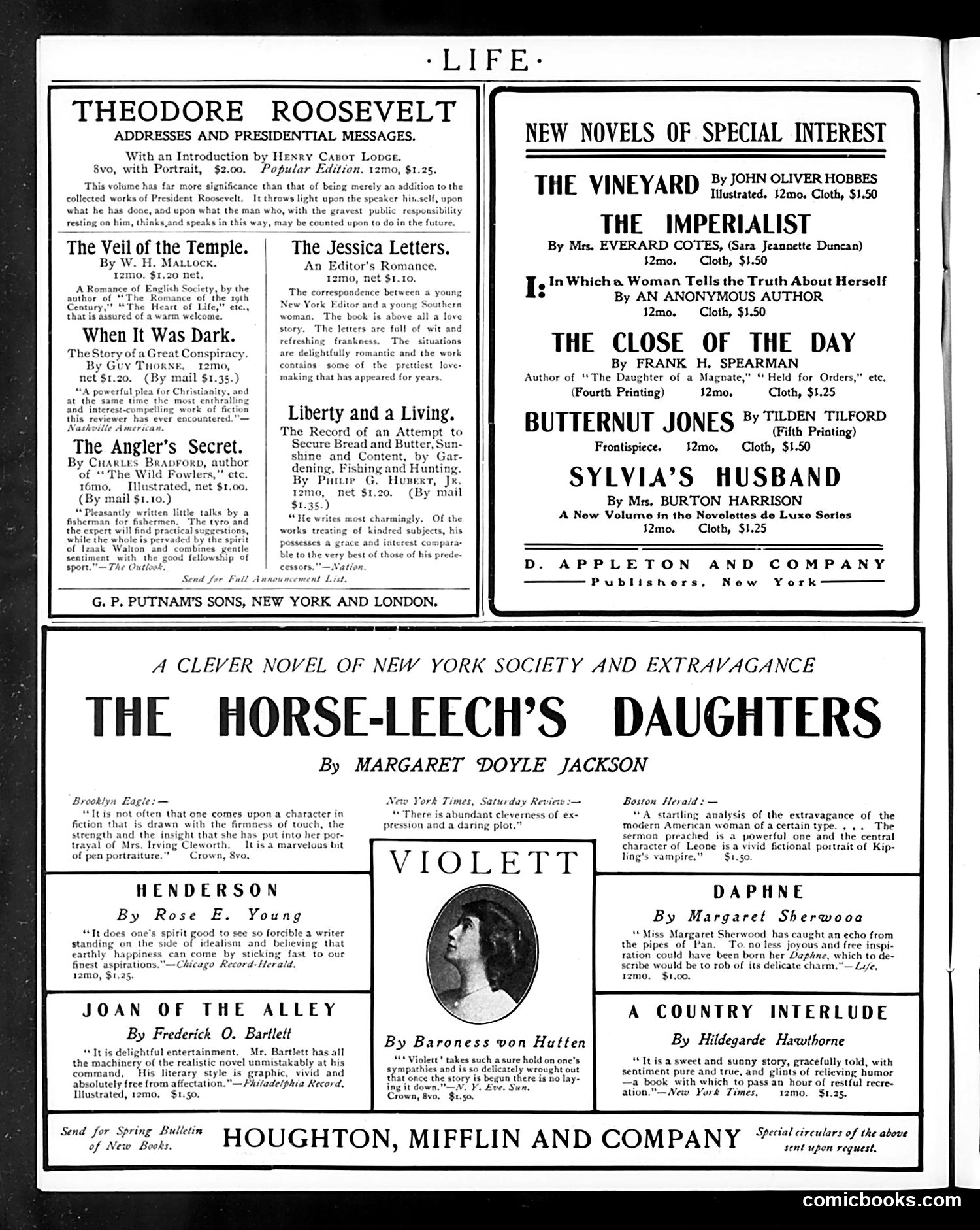
This page is primarily **book advertisements** rather than political satire or editorial cartoons. The upper section advertises Theodore Roosevelt's collected addresses and presidential messages, alongside various novels. The lower half features a large advertisement for novels published by Houghton, Mifflin and Company, with a central portrait labeled "VIOLETT" by Baroness von Hutten. The only visual element is a **portrait photograph** (not a cartoon), appearing to be of a woman, presumably related to the advertised novel "Violett." There is **no discernible political satire, caricature, or social commentary** on this page. It functions as a straightforward book advertisement section typical of *Life* magazine's commercial content from this era.
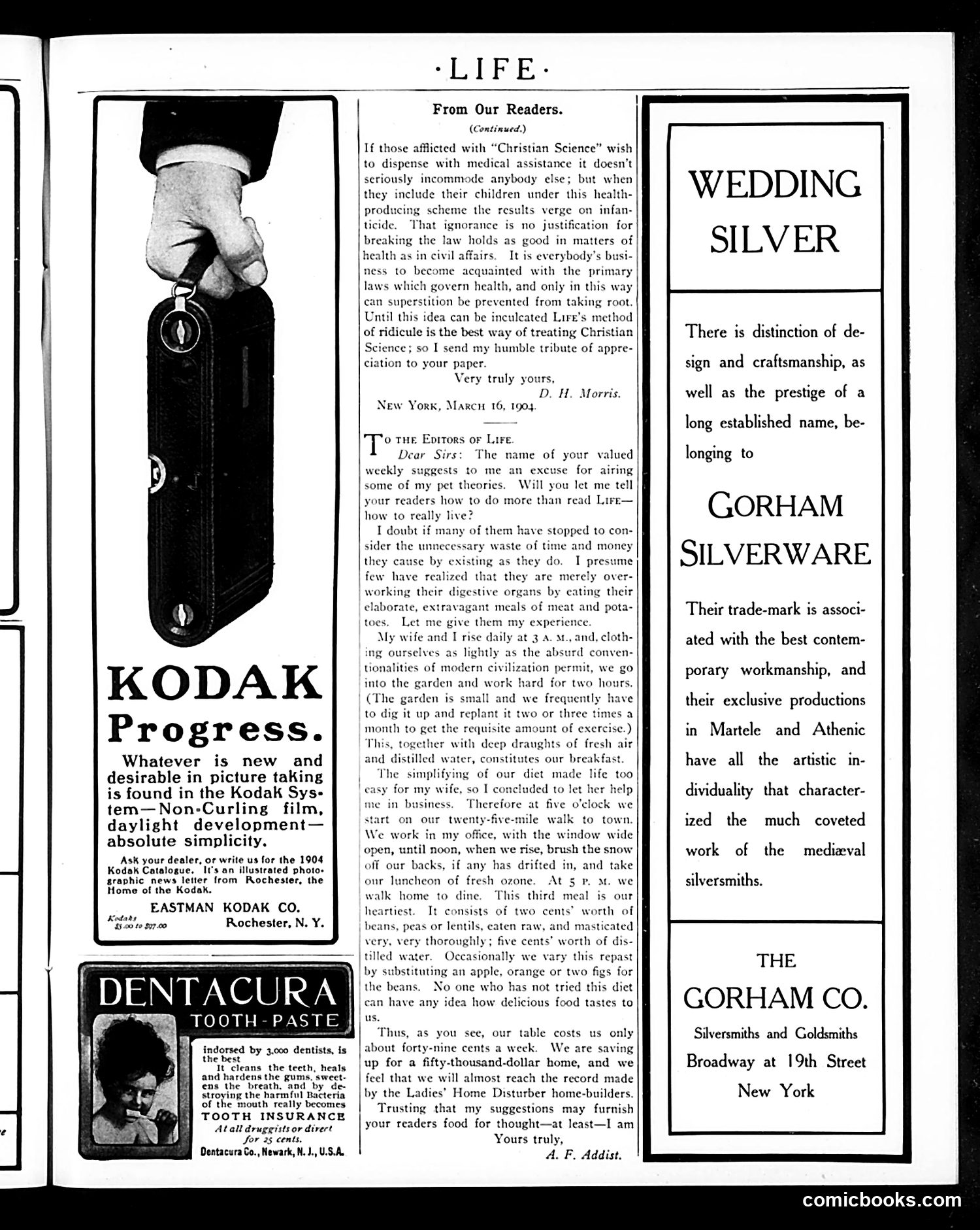
This page contains reader letters and advertisements rather than political cartoons. The "From Our Readers" section includes two letters debating health topics—one defending medical science against Christian Science practices, another describing an unconventional diet regimen involving early rising, garden work, and eating beans and lentils. The advertisements promote Kodak cameras, Dentacura toothpaste, and Gorham silverware. The Kodak ad emphasizes the camera's simplicity; the toothpaste ad claims endorsement by 3,000 dentists; Gorham highlights craftsmanship of medieval-style silverware. The page reflects early 1904 concerns: skepticism toward Christian Science healing, interest in physical fitness and dietary reform, and consumer product marketing to middle-class readers.
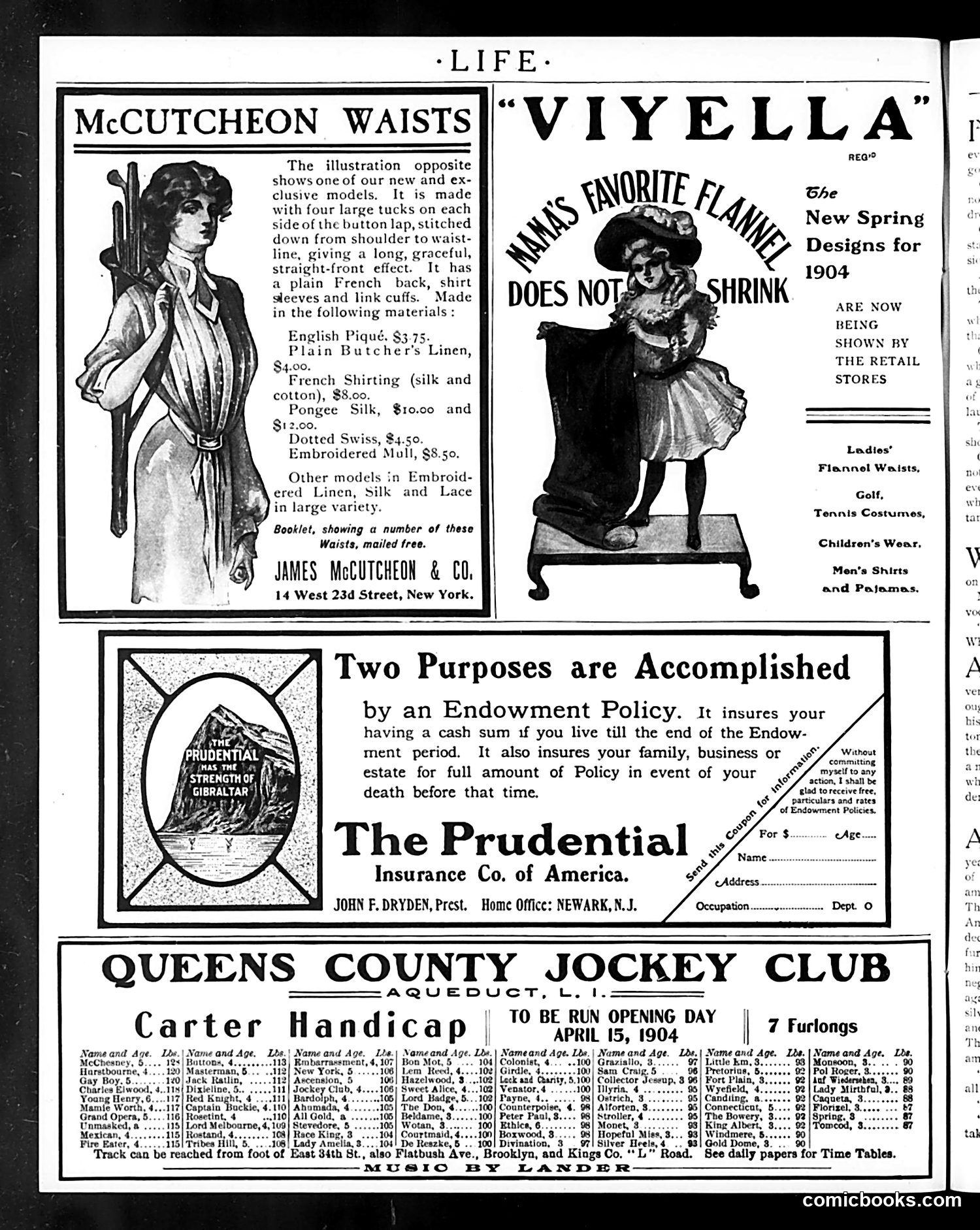
This page is **primarily advertising** with no political cartoons. The content includes: 1. **McCutcheon Waists** (top left): An advertisement for women's clothing by James McCutcheon & Co., featuring an illustration of a fashionable woman in early-1900s dress with detailed fabric options and pricing. 2. **Viyella Flannel** (top right): Spring 1904 fabric advertisement claiming the material "does not shrink," with an illustration of a child in flannel clothing. 3. **Prudential Insurance** (center): An endowment policy advertisement explaining financial protection benefits. 4. **Queens County Jockey Club** (bottom): Announcement for a horse-racing event (Carter Handicap) on April 15, 1904, with horse names and odds listed. The page reflects 1904 consumer culture and leisure activities rather than political commentary.
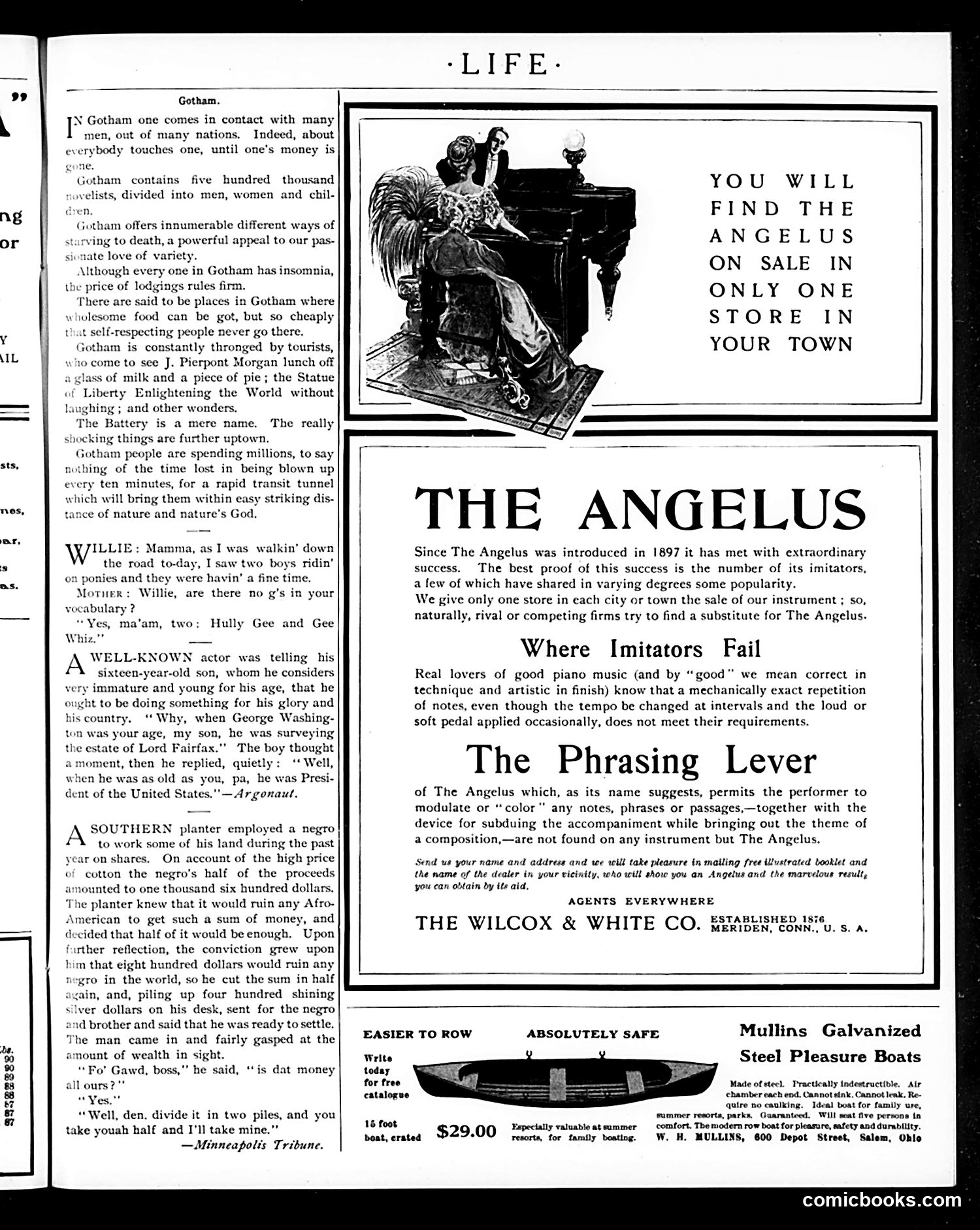
This page is primarily **advertising and product promotion** rather than political satire. The main visual—an illustrated angel at a piano—advertises "The Angelus," a mechanical piano device introduced in 1897. The text acknowledges that imitators have copied The Angelus's success, then explains the device's key innovation: "The Phrasing Lever," which allows performers to control musical expression (tempo, dynamics, phrasing) in ways other mechanical pianos cannot. The left column contains unrelated humorous anecdotes about Gotham (New York City) and dialect humor featuring working-class characters named Willie. These are typical Life magazine filler content—social observation and comedy sketches common to the era's satirical publications. The page also advertises steel boats ($29.00) at bottom.
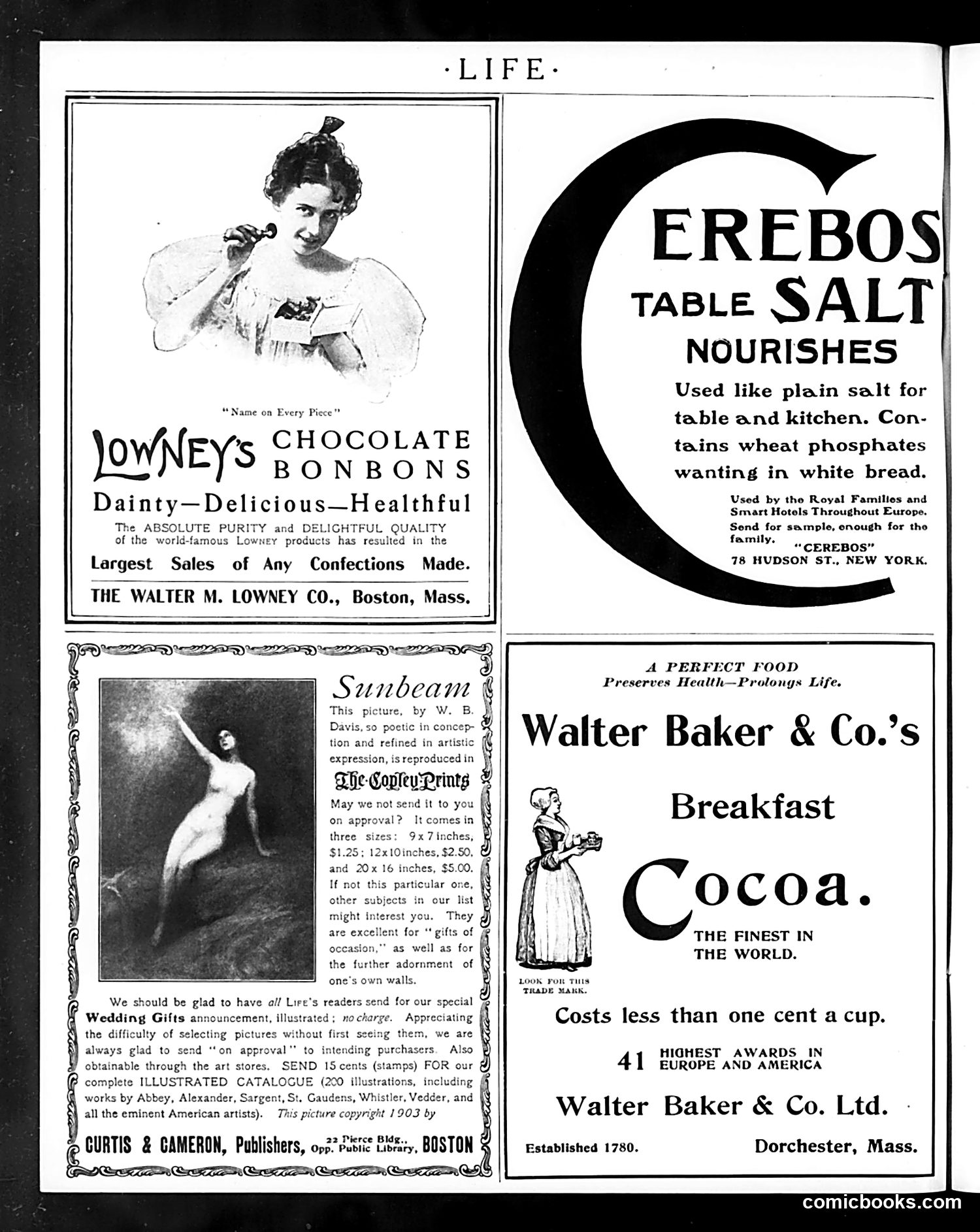
This page is **primarily advertising**, not satirical content. It contains four product advertisements from the early 1900s: 1. **Lowney's Chocolate Bonbons** — emphasizes "absolute purity and delightful quality," appealing to health-conscious consumers 2. **Cerebos Table Salt** — markets wheat phosphates as nutritional, targeting bread consumption 3. **Sunbeam art print** — offers reproductions by W.B. Davis through Curtis & Cameron Publishers 4. **Walter Baker & Co.'s Cocoa** — highlights affordability (under one cent per cup) and 41 international awards The page reflects early-20th-century consumer culture emphasizing **health benefits and purity** — marketing tactics responding to growing food-safety concerns of the Progressive Era. The feminine imagery (woman with chocolate, woman in classical dress) was typical period advertising, though appears dated to modern viewers.
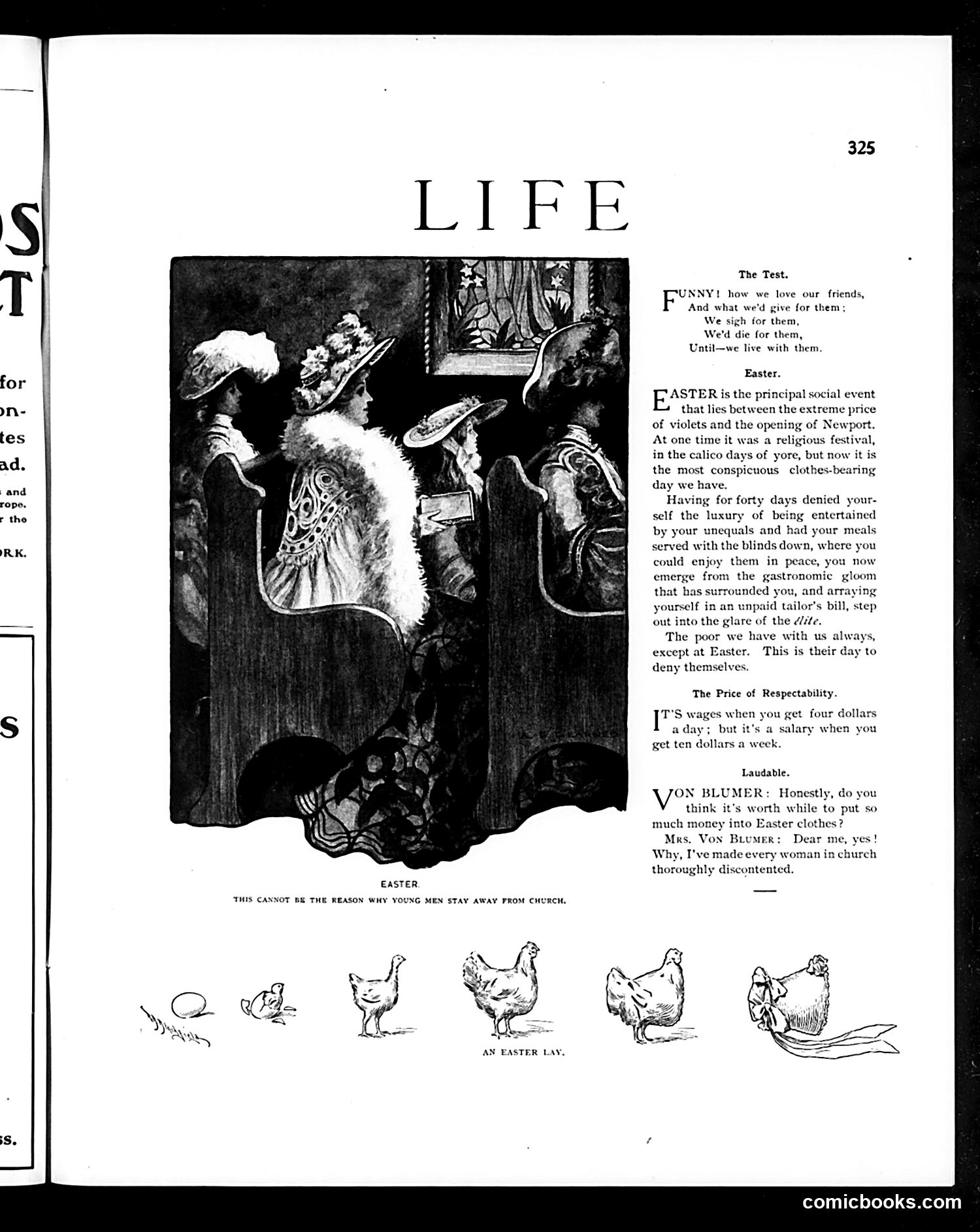
This page satirizes Easter as a social event for the wealthy. The main illustration depicts elaborately dressed upper-class people at an Easter gathering, with the caption "THIS CANNOT BE THE REASON WHY YOUNG MEN STAY AWAY FROM CHURCH"—sarcastically suggesting that ostentatious displays of wealth and fashion are what actually keep young men from attending religious services. The accompanying text sections mock Easter's transformation from a religious observance into a conspicuous consumption spectacle. "The Test" notes the irony of charitable sentiments, while "The Price of Respectability" jokes that higher salaries enable status-seeking behavior. The satirical dialogue between Mrs. Von Blumer and her husband ridicules the wasteful spending on Easter clothes. The bottom row shows chickens in humorous poses—an "Easter lay," pun intended—as additional commentary on Easter commerce.
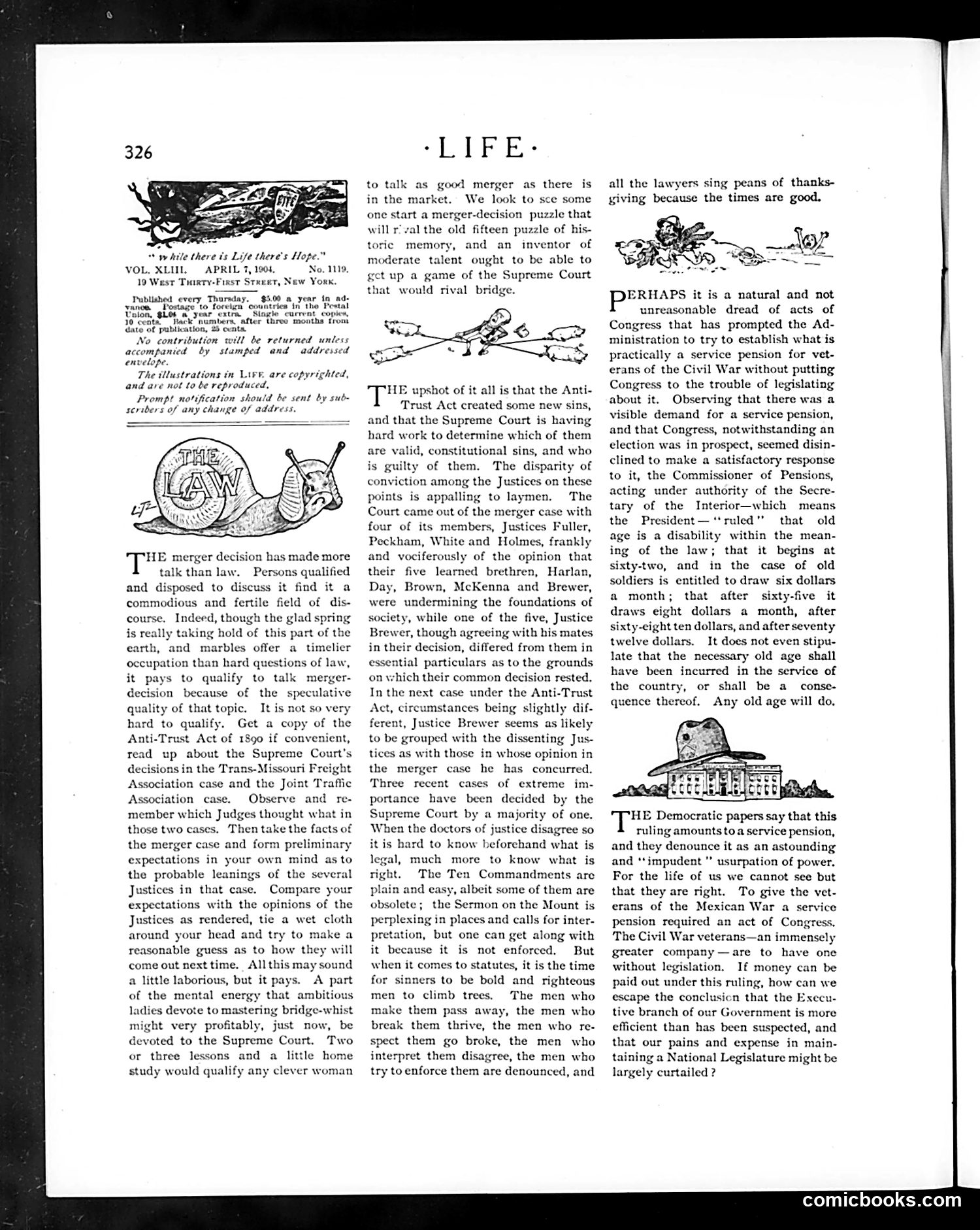
This page discusses the Supreme Court's recent merger decision and its implications for civil service pensions for Civil War veterans. The main satirical focus appears to be criticism of Congressional reluctance to establish a service pension for disabled Civil War veterans without legislative action. The cartoon at top-left shows a snail, likely symbolizing the slow pace of government action on veterans' benefits. The bottom illustration depicts a classical government building, reinforcing the theme of governmental responsibility. The text argues that Democratic opposition to the pension bill is hypocritical given their claims to support veterans, and suggests the Executive branch could act more efficiently than Congress on this matter. The satire targets political obstruction preventing aid to aging Civil War soldiers who served their country.
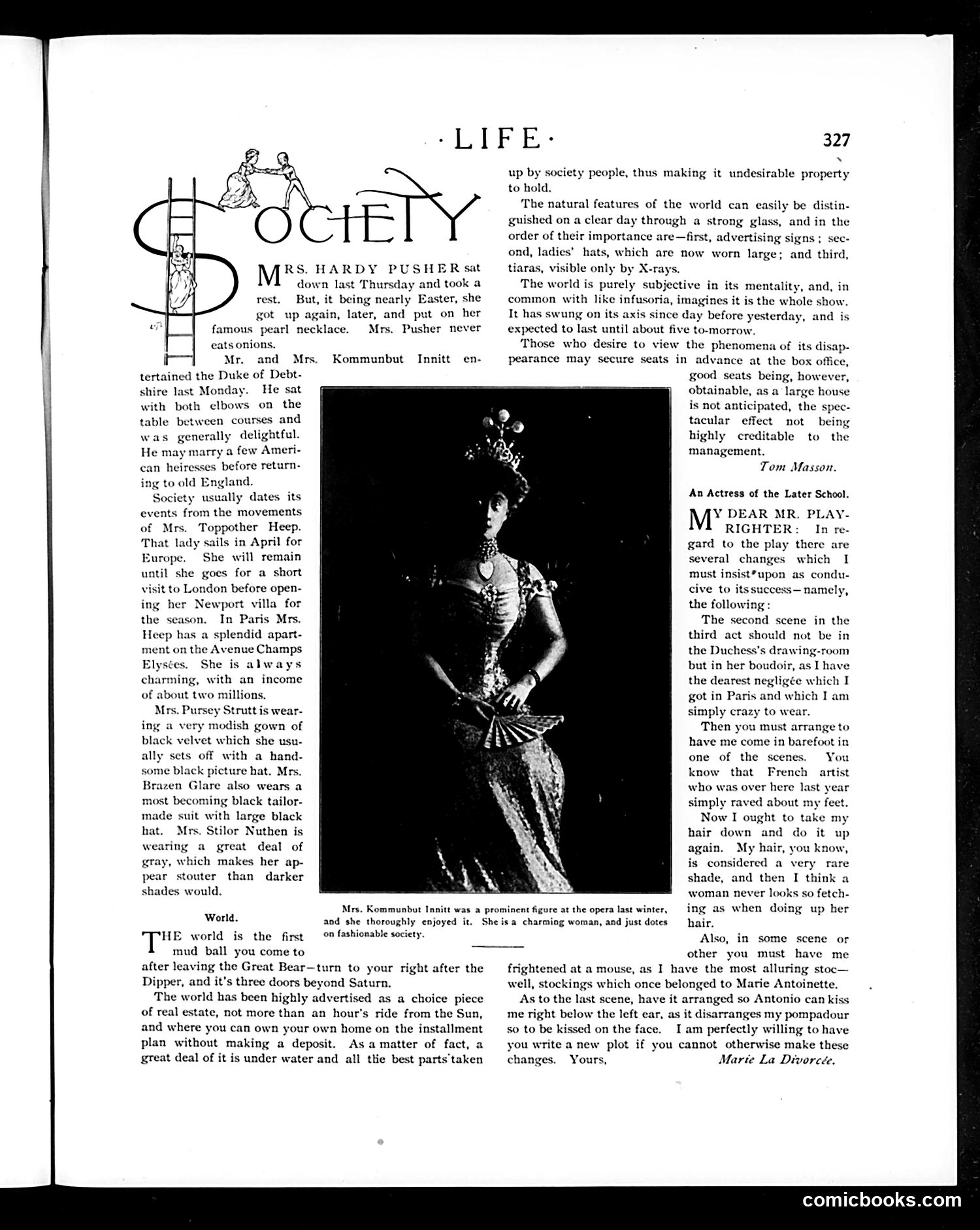
This page contains two satirical pieces mocking American high society and theatrical vanity. The **"Society" section** parodies wealthy socialites through exaggerated descriptions of trivial social events—Mrs. Hardy's pearl necklace, a Duke visiting for dinner with poor table manners, and Mrs. Toppother Heep's elaborate European travels. The humor lies in treating these mundane activities as newsworthy, satirizing society magazines' breathless coverage of the idle rich. The **"An Actress of the Later School"** piece mocks a vain stage actress demanding script changes to showcase her appearance rather than serve the play. Her insistence on wearing a negligée, displaying her feet, arranging hair-styling scenes, and positioning a kiss to avoid mussing her hair satirizes theatrical ego and the commodification of female performers' bodies. The letter parodies how actresses prioritized self-promotion over artistic merit. Both pieces use exaggeration and absurdist humor to critique superficiality in Gilded Age America.
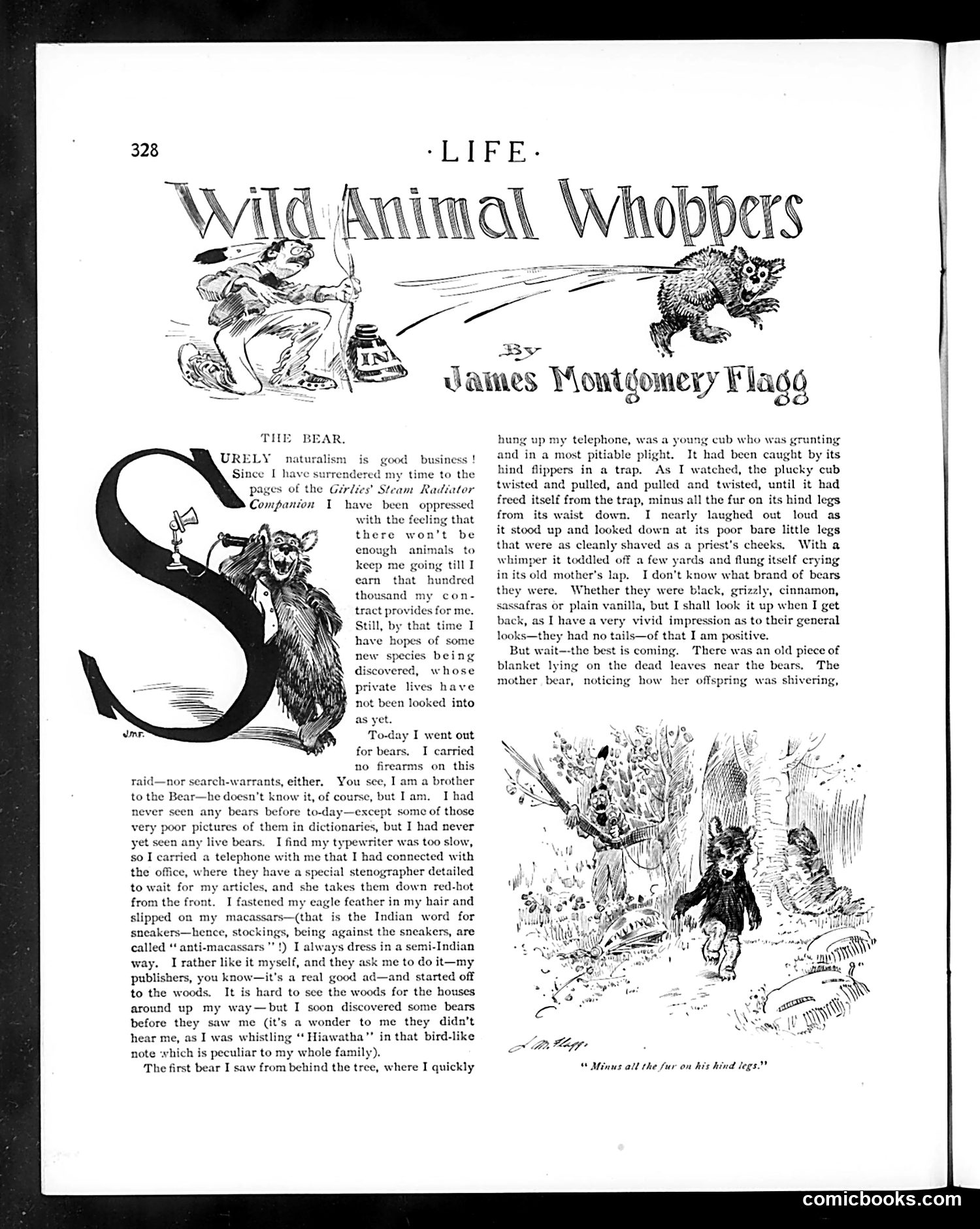
This is a humorous essay by James Montgomery Flagg titled "The Bear," presented as an exaggerated personal anecdote. The author claims to have gone bear-hunting in the woods near his home, equipped with a telephone connected to his office stenographer to transcribe his "articles" in real-time. The satire targets several things: the author's self-aggrandizing pretense (calling himself "a brother to the Bear"), his pseudo-intellectual affectations (wearing "macassars"—Indian sneakers—and claiming to whistle "Hiawatha"), and the absurdity of modern conveniences intruding on nature (a telephone in the woods). The accompanying illustrations show comical scenes with bears. The story's centerpiece is a fabricated "whopper"—an obviously tall tale about a bear cub trapped, struggling free with its hind legs completely hairless, then being warmed by its mother with a blanket. The humor lies in the obvious exaggeration presented as sincere reporting.
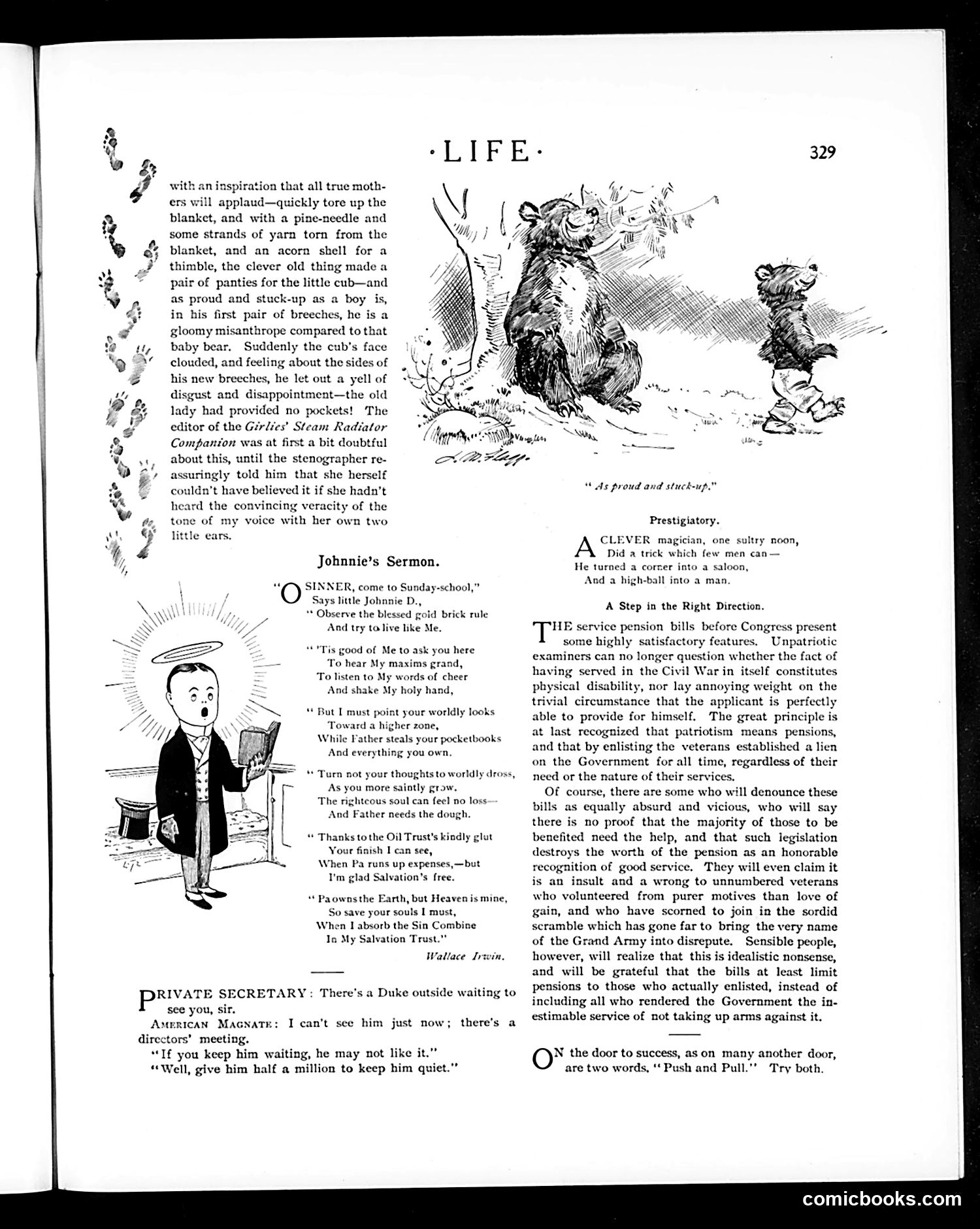
This satirical page contains multiple pieces mocking American hypocrisy and greed: **"Johnnie's Sermon"**: A child preacher instructs others to be virtuous while his father steals from them and runs corrupt trusts ("Oil Trust," "Sin Combine"). The satire targets religious hypocrisy and robber baron capitalism—preachers and wealthy industrialists exploiting faith while enriching themselves. **American Magnate cartoon**: A businessman bribes a Duke with "half a million" to wait, satirizing how American wealth buys social status and respect from European aristocracy. **"A Step in the Right Direction"**: Bitterly satirizes pension legislation for Civil War veterans, arguing sarcastically that the bills reward undeserving applicants. The satire attacks politicians for passing laws benefiting those who didn't actually need help, corrupting honorable military service into a "sordid scramble" for government money. The page broadly criticizes corruption, religious fraud, and exploitation across American institutions.
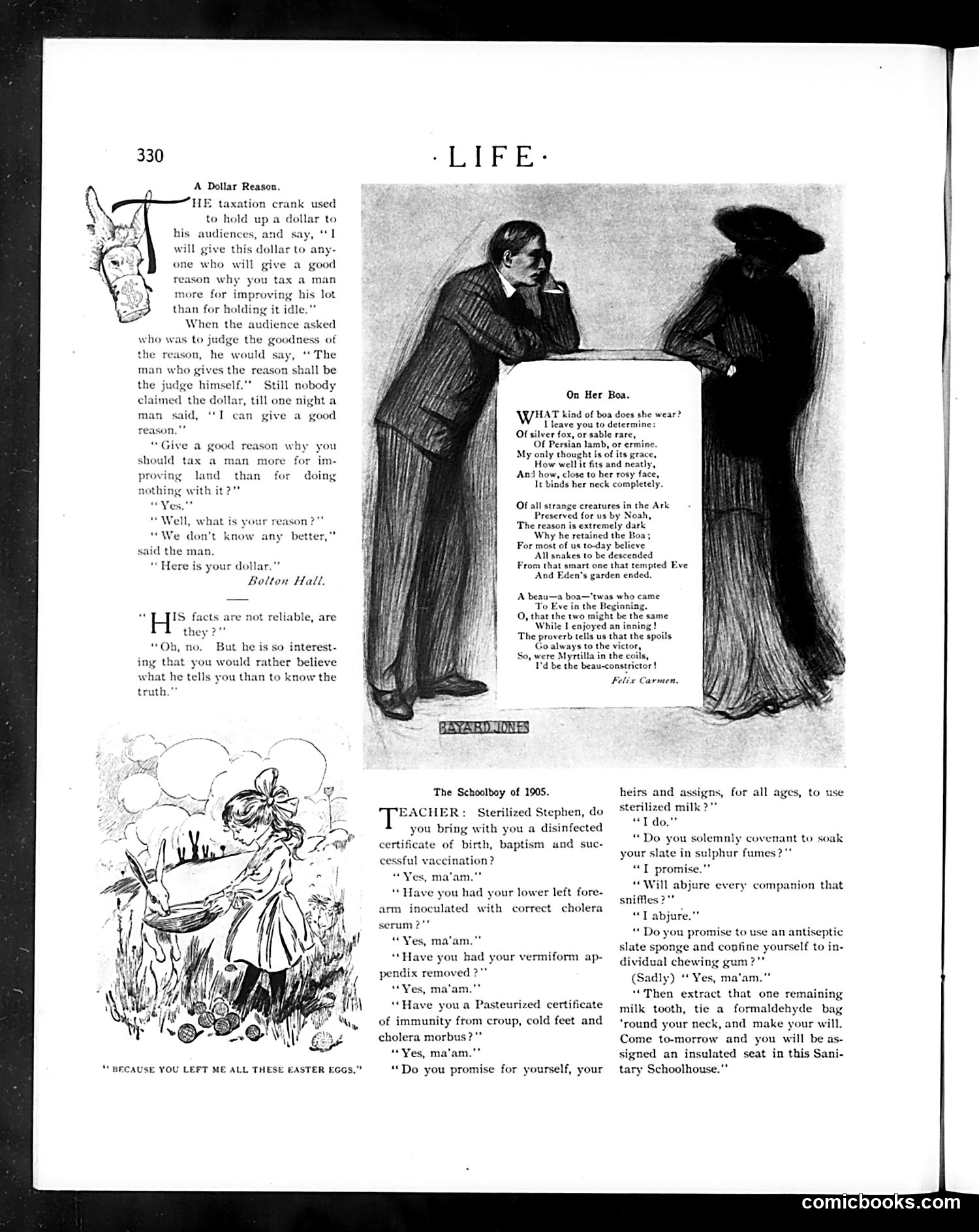
This page contains three separate satirical pieces mocking early 1900s social trends: **"A Dollar Reason"** (Bolton Hall): Satirizes taxation debates by showing a "taxation crank" offering a dollar for good reasons to tax productive citizens. The joke: when a man finally claims it with the honest answer "We don't know any better," the crank admits defeat—suggesting taxation lacks rational justification. **"On Her Boa"** (Felix Carmen): A poem satirizing fashion and courtship. It plays on the double meaning of "boa" (the fashion accessory AND the snake), with sexual innuendo about a man wanting to be the "beau-constrictor" around his romantic interest. **"The Schoolboy of 1905"**: The harshest satire. It mocks contemporary health obsession and germ theory hysteria by depicting a school entrance exam requiring children to prove they've been sterilized, inoculated, pasteurized, and disinfected to absurd extremes. The final requirement—making a will and sitting in an "insulated seat"—suggests this overcautious medicalization is actually deadly.
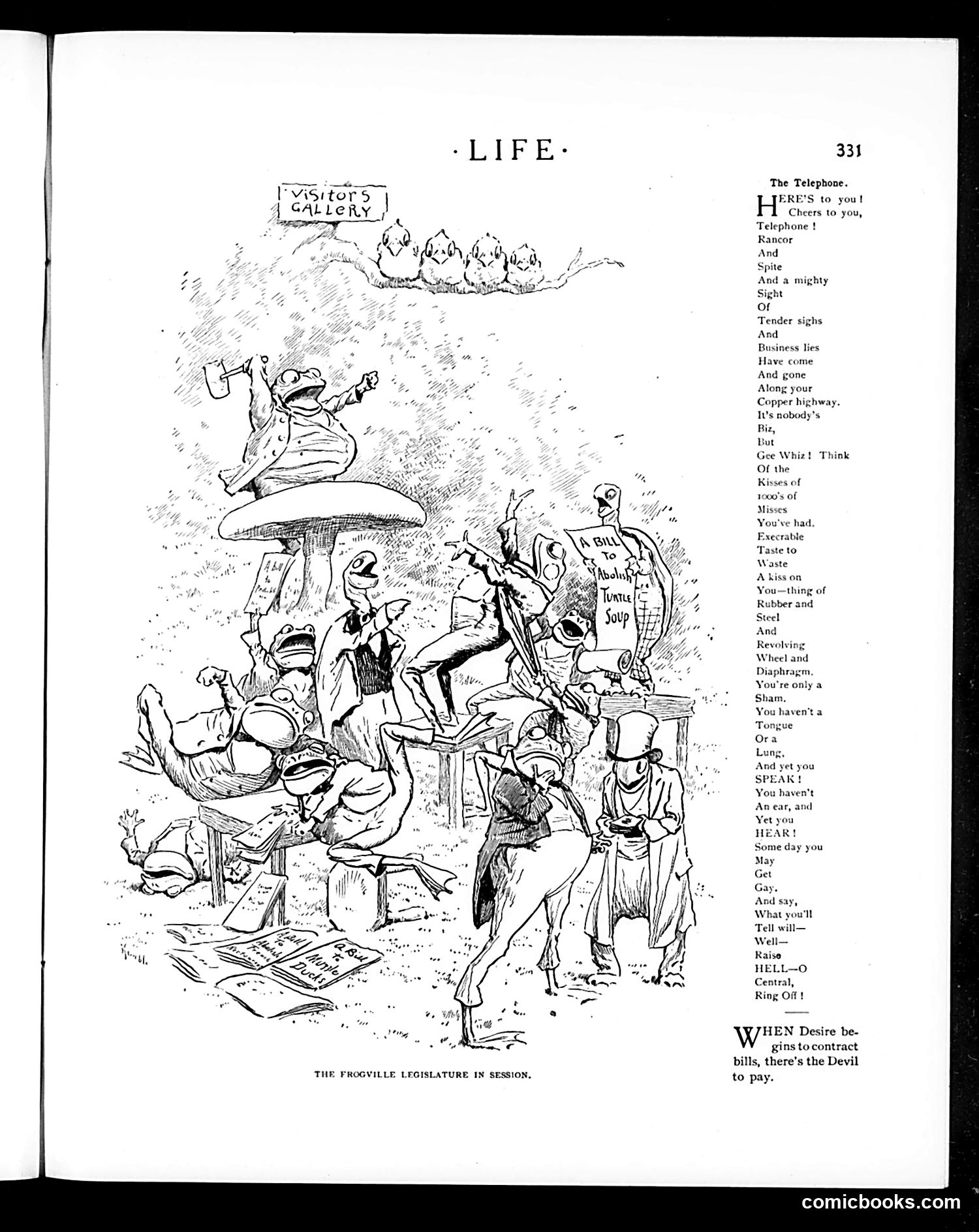
This page contains two satirical pieces from Life magazine: **"The Telephone"** (right): A playful poem personifying the telephone as a conduit for human emotion and deception—carrying "kisses," "business lies," and gossip along its copper wires. The joke plays on the telephone's paradox: it "speaks" and lets us "hear" despite having no tongue or lungs. The final punchline suggests telephone bills arrive with devastating consequences ("Raise HELL"). **"The Frogville Legislature in Session"** (center/left): A cartoon depicting frogs conducting legislative business, shown as absurdly chaotic—some arguing, drinking, examining documents. "Frogville" is a satirical stand-in for human government. The caption suggests this ridicules actual legislators as little better than amphibians—foolish, self-interested, and disorganized. The bottom caption warns that when political desires lead to contracted bills, "there's the Devil to pay"—mocking government spending and corruption. Both pieces mock modern technology and democratic governance with gentle, anthropomorphic humor typical of early-20th-century satire.
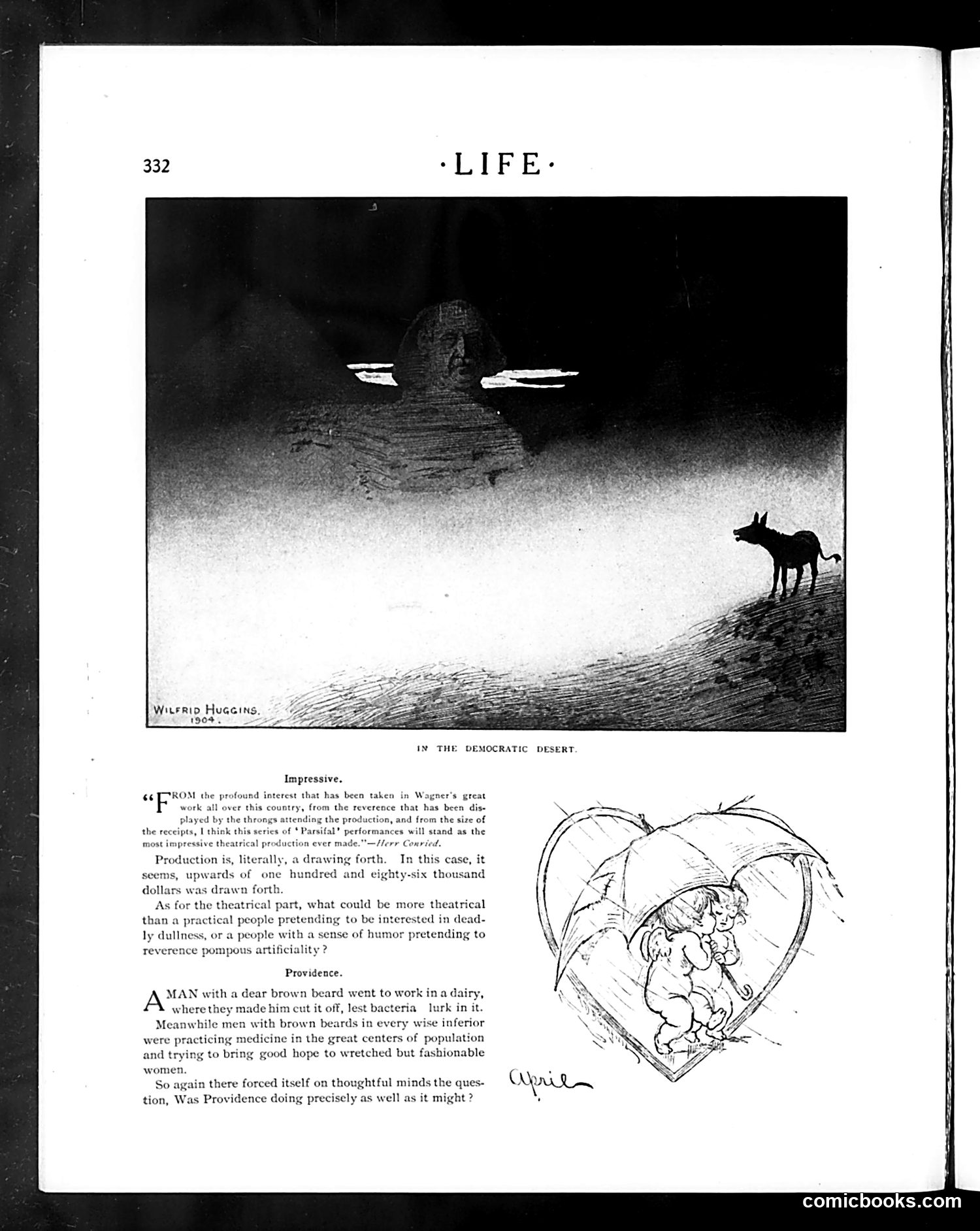
**The Main Cartoon** ("In the Democratic Desert," by Wilfred Hugging, 1904): This depicts a small, silhouetted figure (likely representing the American public or "common man") standing in a barren desert landscape, dwarfed by an enormous, sphinx-like head emerging from the sand. The image satirizes the American fascination with Wagner's operatic works—expensive European cultural imports that the text notes drew enormous crowds and revenue ($186,000). **The Satire's Point:** The cartoon mocks Americans for pretending to appreciate Wagner's "dead dullness" and "pompous artificiality" when they're fundamentally a "practical people." The desert setting emphasizes cultural emptiness; the tiny figure suggests ordinary Americans overwhelmed by grandiose pretension. **Secondary Text** ("Providence"): A brief anecdote contrasts a workingman forced to shave his beard for dairy hygiene while inferior physicians with beards practice among wealthy women—questioning whether Providence (divine justice) operates fairly. The page criticizes both cultural snobbery and class hypocrisy in early-20th-century America.
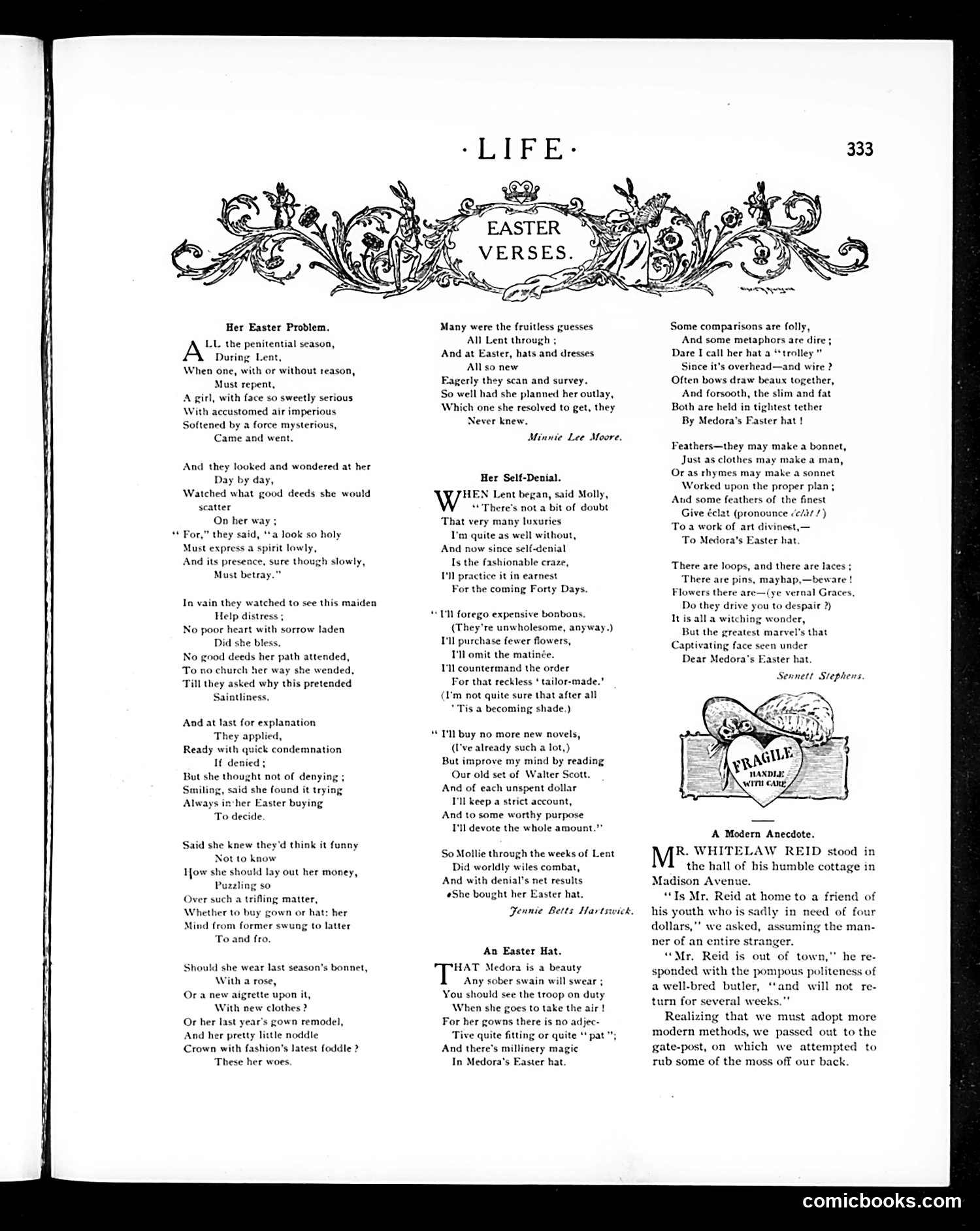
This page contains three humorous poems mocking women's Easter preparations and vanity during the Lenten season. **"Her Easter Problem"** satirizes a young woman whose "self-denial" during Lent consists entirely of agonizing over which new Easter hat and dress to purchase—not actual charitable or spiritual acts. Observers mistake her serious demeanor for piety, when she's actually just indecisive about fashion. **"Her Self-Denial"** features Molly, who grandly announces Lenten sacrifices (forgoing bonbons, flowers, new novels) only to ultimately spend her savings on a new Easter hat anyway—defeating the entire purpose of self-denial. **"An Easter Hat"** celebrates Medora's extraordinary Easter bonnet as so magnificent it captivates all observers and secures romantic attention. The satire targets the hypocrisy and materialism of upper-class women who perform religious devotion while obsessing over fashionable Easter millinery—a cultural marker of wealth and status. The point: Easter observance had become primarily about displaying new clothing rather than genuine spiritual reflection.
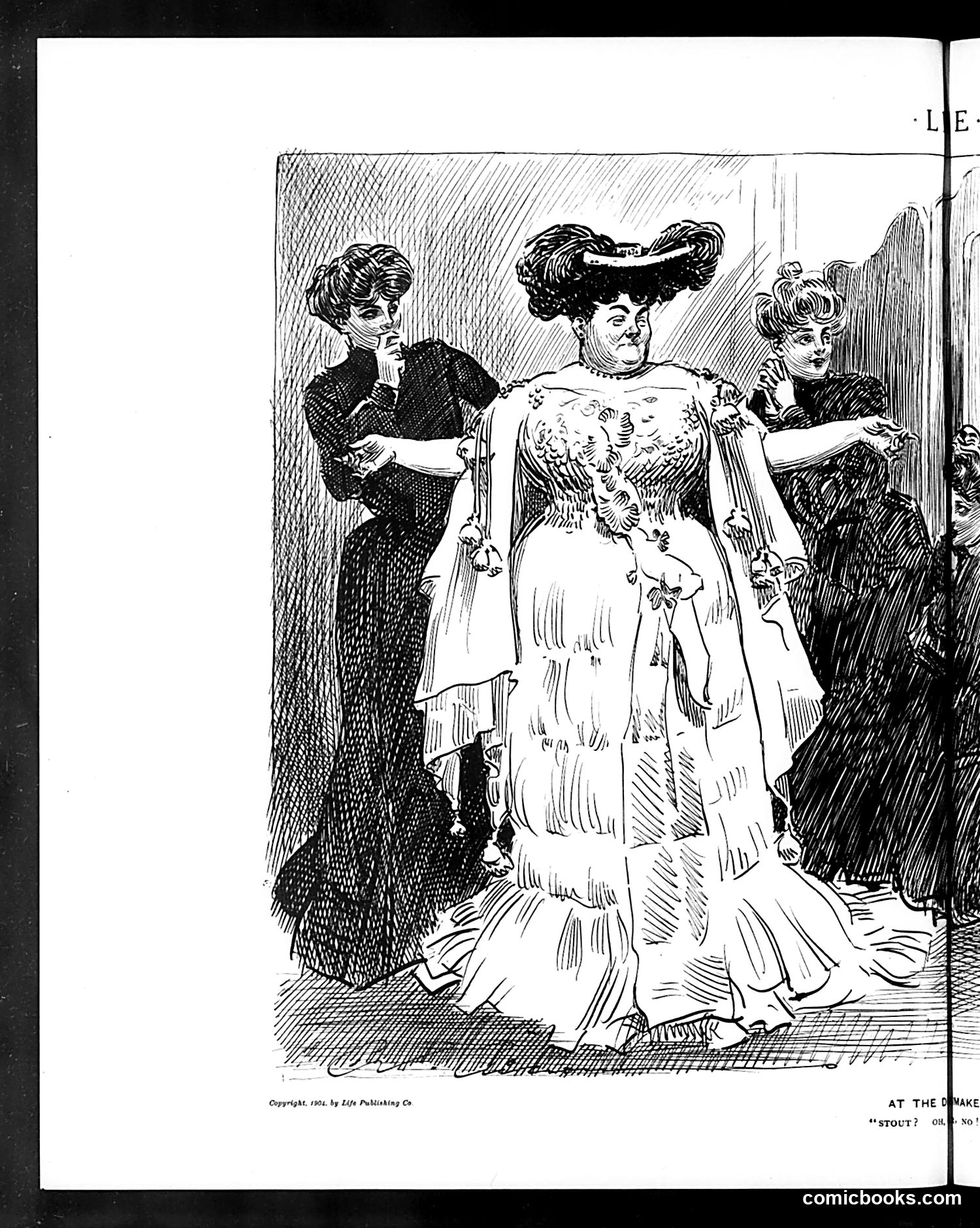
This 1904 Life magazine cartoon satirizes women's fashion and body image concerns of the Edwardian era. The central figure is a woman in a white dress being fitted by attendants in black. The caption "Stout? Oh—no!" suggests ironic commentary: the woman appears quite substantial, yet she or her attendants insist she isn't overweight. The joke likely mocks either the woman's self-denial about her size, the dressmaker's flattery to secure business, or the era's corsetry industry—which promised to reshape bodies through tight-lacing. The elaborate hairstyles and fashions reflect early 1900s upper-class aesthetics. The cartoon pokes fun at vanity, the fashion industry's deceptions, and the gap between appearance and reality in Gilded Age society.
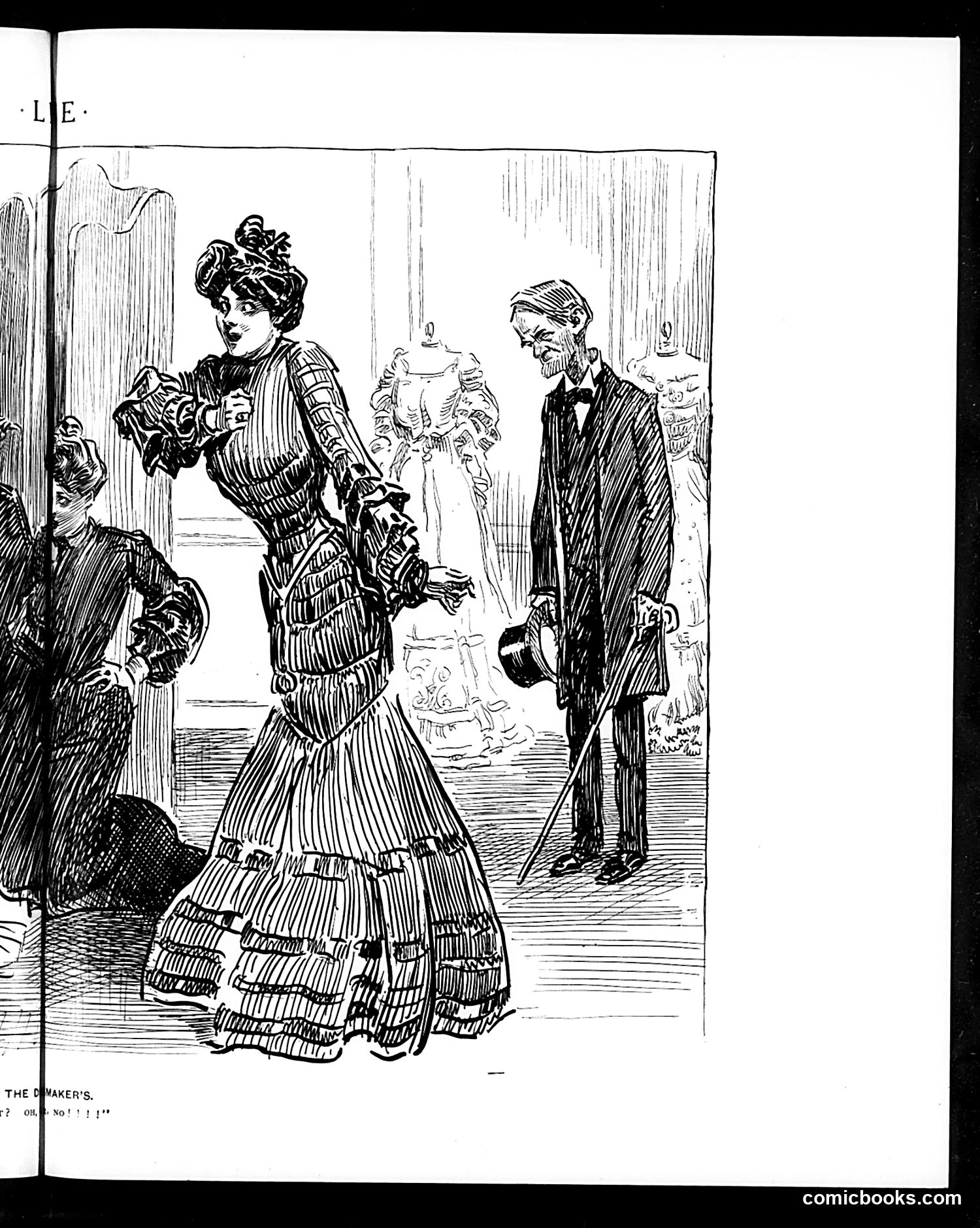
This is a satirical illustration from *Life* magazine titled "The Quaker's" (visible at bottom left). The cartoon depicts a social scene with a well-dressed woman in an elaborate Gibson Girl-style gown greeting a shabby, poorly-dressed man holding a top hat. The contrast is stark and intentional. The satire appears to target class pretension and social hypocrisy. The impeccably dressed woman represents wealthy society, while the ragged man likely represents either poverty or the absurdity of mixing social classes. The title's reference to "Quakers"—known for religious simplicity and rejecting ostentation—suggests the cartoon mocks the contradiction between claimed values (simplicity, equality) and actual behavior (class-consciousness, materialism). The exact political reference remains unclear without additional context.
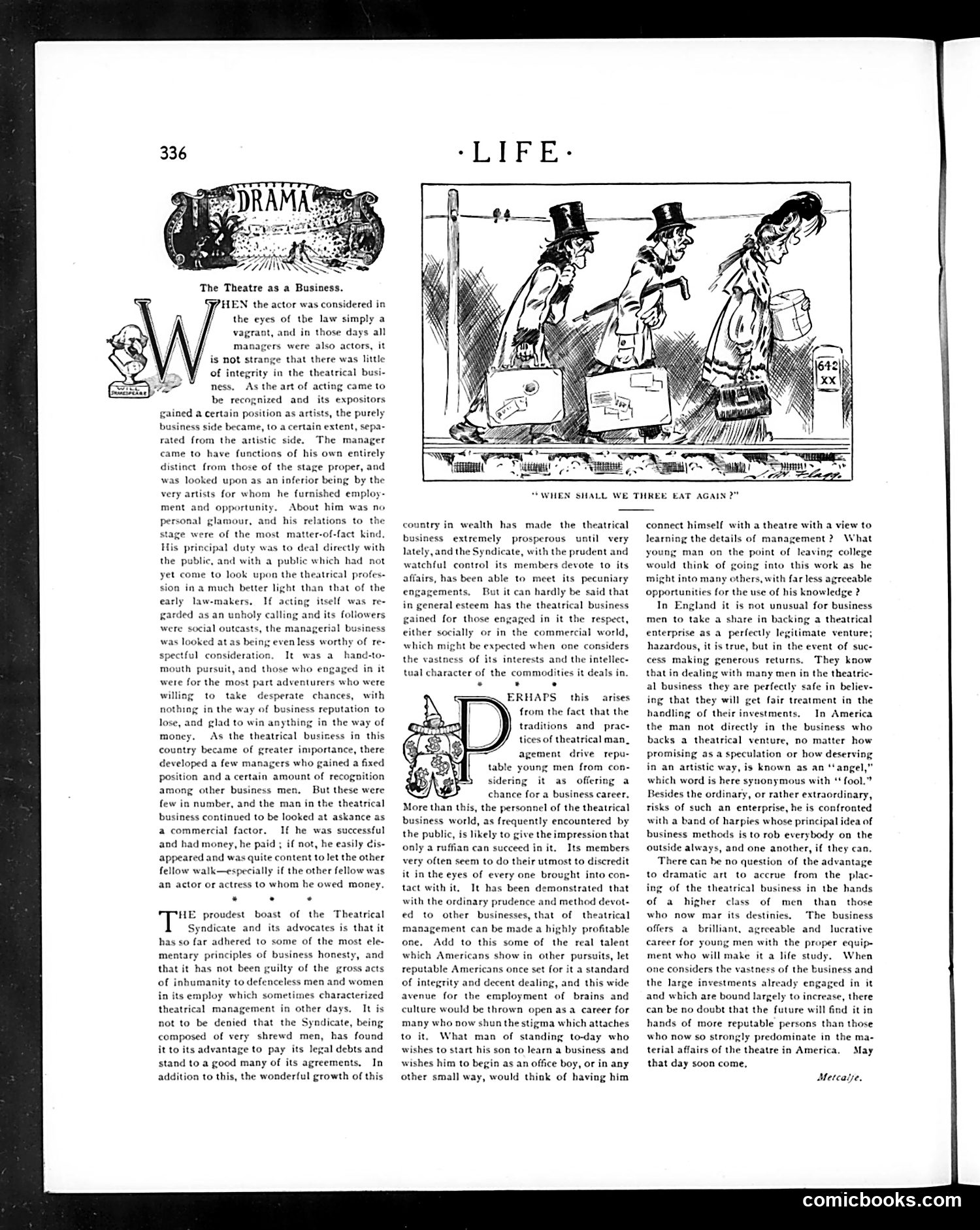
This page from *Life* magazine addresses the theatrical industry's poor reputation and business practices. The cartoon (top right, captioned "When Shall We Thrice Eat Again?") depicts three shabby theatrical figures huddled over empty boxes, satirizing the financial precarity and disreputable conduct common in theater management. The accompanying article argues that while actors were historically viewed as vagrants, theater *managers* earned even less respect—treated as inferior commercial operators rather than artists. The text credits the Theatrical Syndicate with introducing basic business honesty (paying debts, honoring agreements), yet notes the industry still struggles socially because its personnel seem like "ruffians." The satire targets the theatrical world's reputation for financial irresponsibility and disreputable dealings, contrasting the Syndicate's relative propriety against the industry's persistent stigma. For modern readers: this reflects early 20th-century anxieties about unregulated entertainment industries and concerns that theatrical people were fundamentally unreliable.
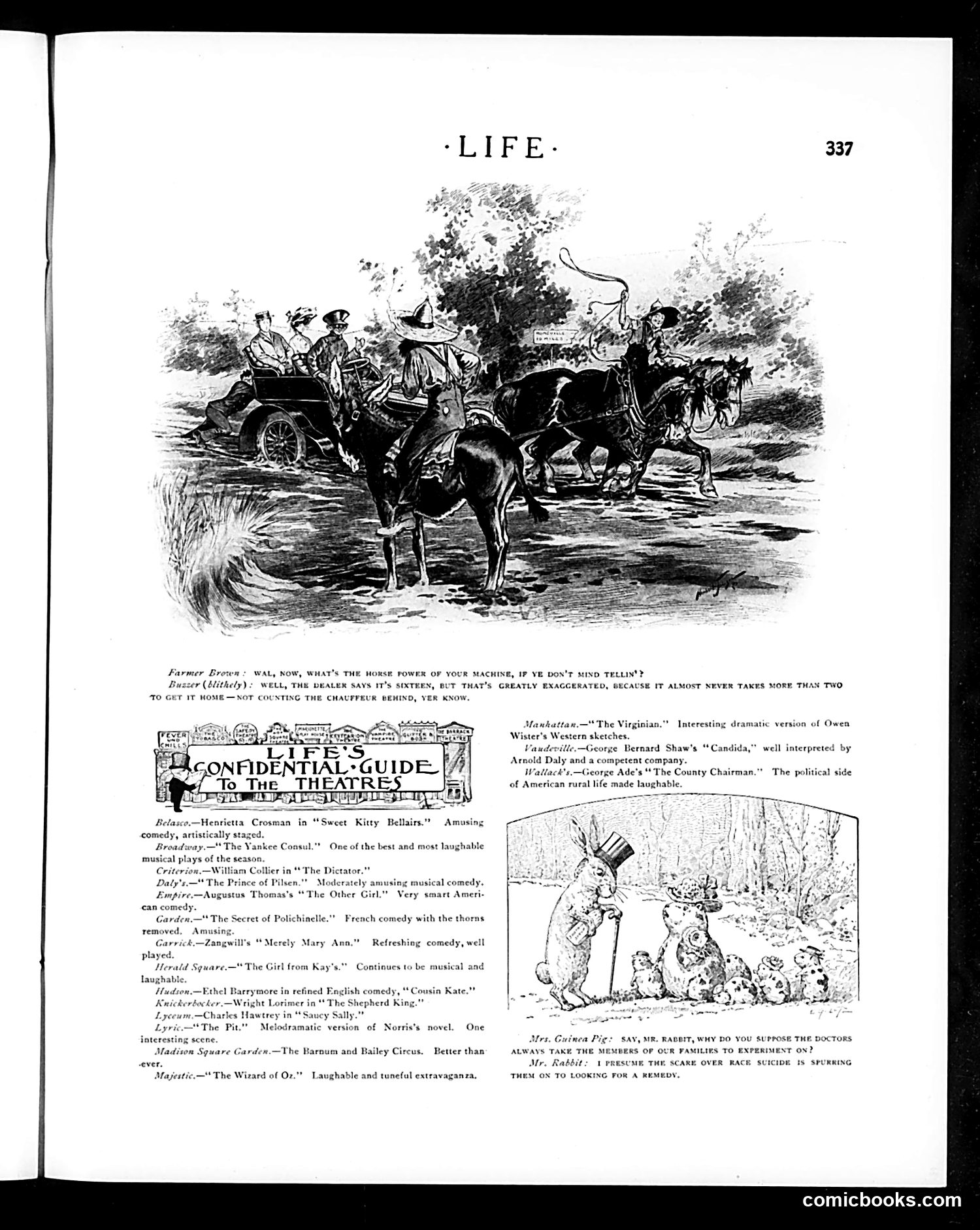
**Top cartoon** depicts a farmer and car dealer. The farmer asks about "horse power," misunderstanding automotive terminology literally—he thinks the dealer means actual horses pulling the vehicle. The joke mocks rural ignorance of new automobile technology and the absurdity of marketing jargon to unsophisticated buyers. The dealer's boast that the car "almost never takes more than two" horses to get home suggests unreliable machinery. **Bottom cartoon** features Mrs. Guinea Pig asking Mr. Rabbit why doctors experiment on their families. The rabbit blames "race suicide"—a contemporary panic (early 1900s) about declining birth rates among certain populations. The satire targets both medical ethics and the era's obsession with this pseudo-scientific concern, suggesting doctors use race-suicide hysteria as an excuse for human experimentation. Both cartoons mock contemporary anxieties: rural-urban technological divide and period anxieties about population and medical science.
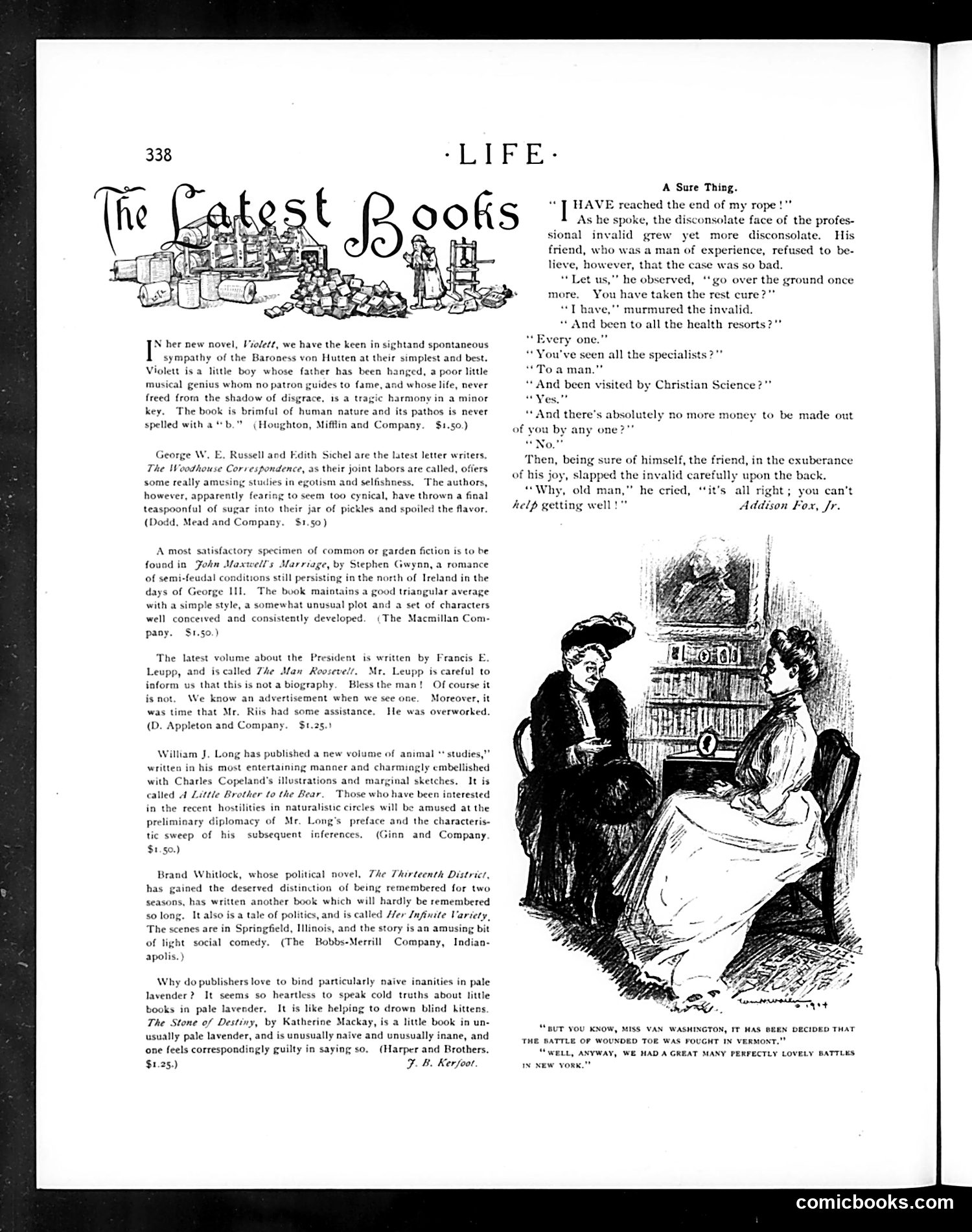
This two-part page combines book reviews with a cartoon joke about hypochondriacs and the medical industry. **The Cartoon/Text Story**: A "professional invalid" (chronic patient) tells his friend he's reached his rope's end, having exhausted all treatments: rest cure, health resorts, every specialist, and Christian Science. His friend systematically checks off each failed remedy—each more expensive and exploitative than the last. When the invalid admits "there's absolutely no more money to be made out of you by any one," the friend slaps him on the back: "Why, old man, it's all right—you can't help getting well!" **The Satire**: The joke exposes how the medical establishment (doctors, specialists, faith healers) profits from the wealthy worried-well. The punchline—that the invalid will recover once he's financially useless to practitioners—suggests recovery was always possible but economically inconvenient. It satirizes both patient hypochondria and practitioner greed. The accompanying book reviews discuss recent fiction, including criticism of overly sentimental bindings on trivial books.
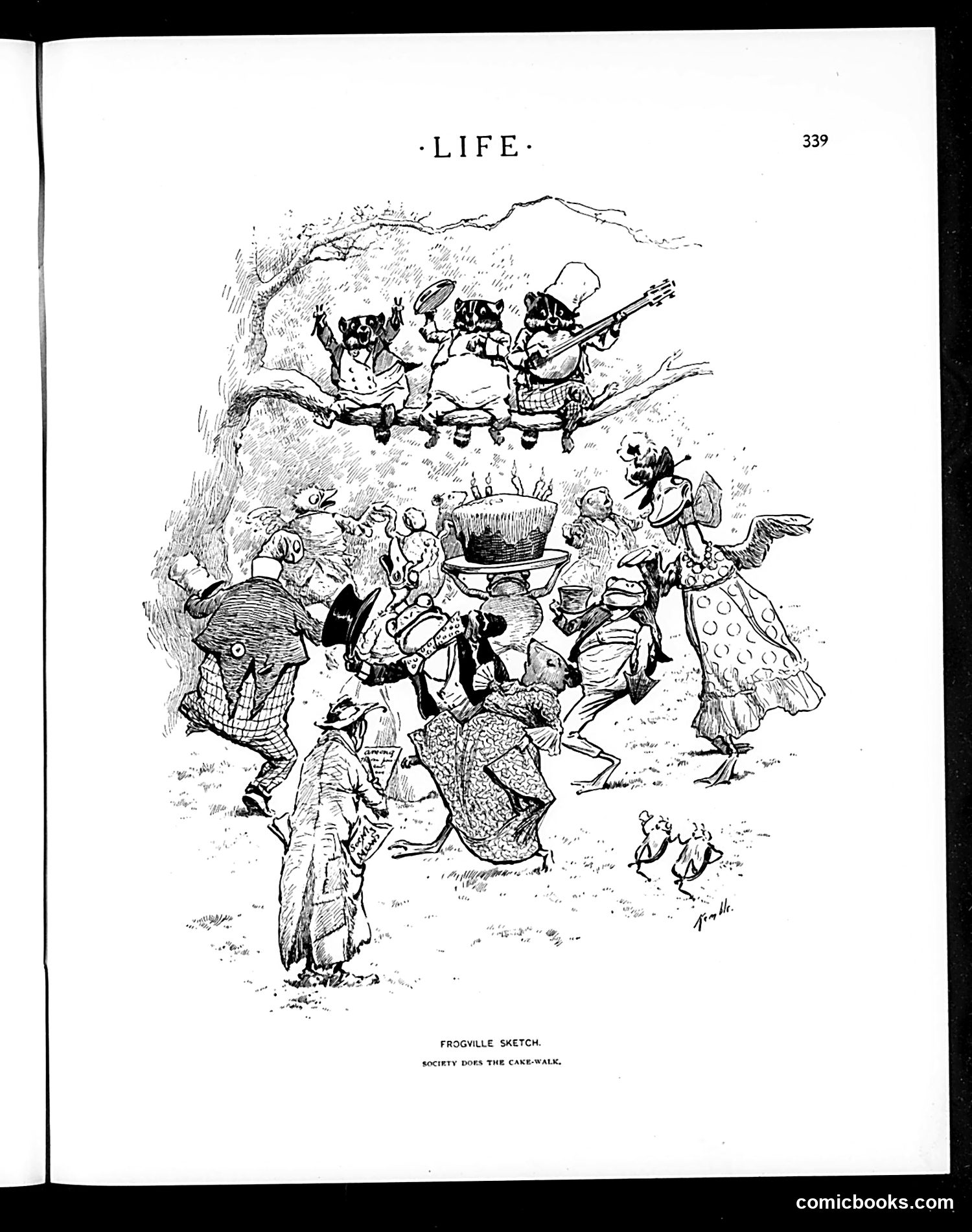
This is a satirical illustration depicting anthropomorphic frogs performing a "cake-walk"—a high-stepping dance that originated in African American culture. The sketch mocks high society by portraying well-dressed frogs engaged in this popular entertainment, complete with formal attire (hats, coats) and musical accompaniment. The satire likely targets the pretensions of upper-class Americans who adopted and performed the cake-walk as fashionable entertainment, often without acknowledging or respecting its cultural origins. By replacing human "society" with frogs, the artist ridicules the absurdity of refined social circles mimicking popular dance forms while maintaining their airs of superiority. The humor relies on the incongruity between frog nature and human social performance.
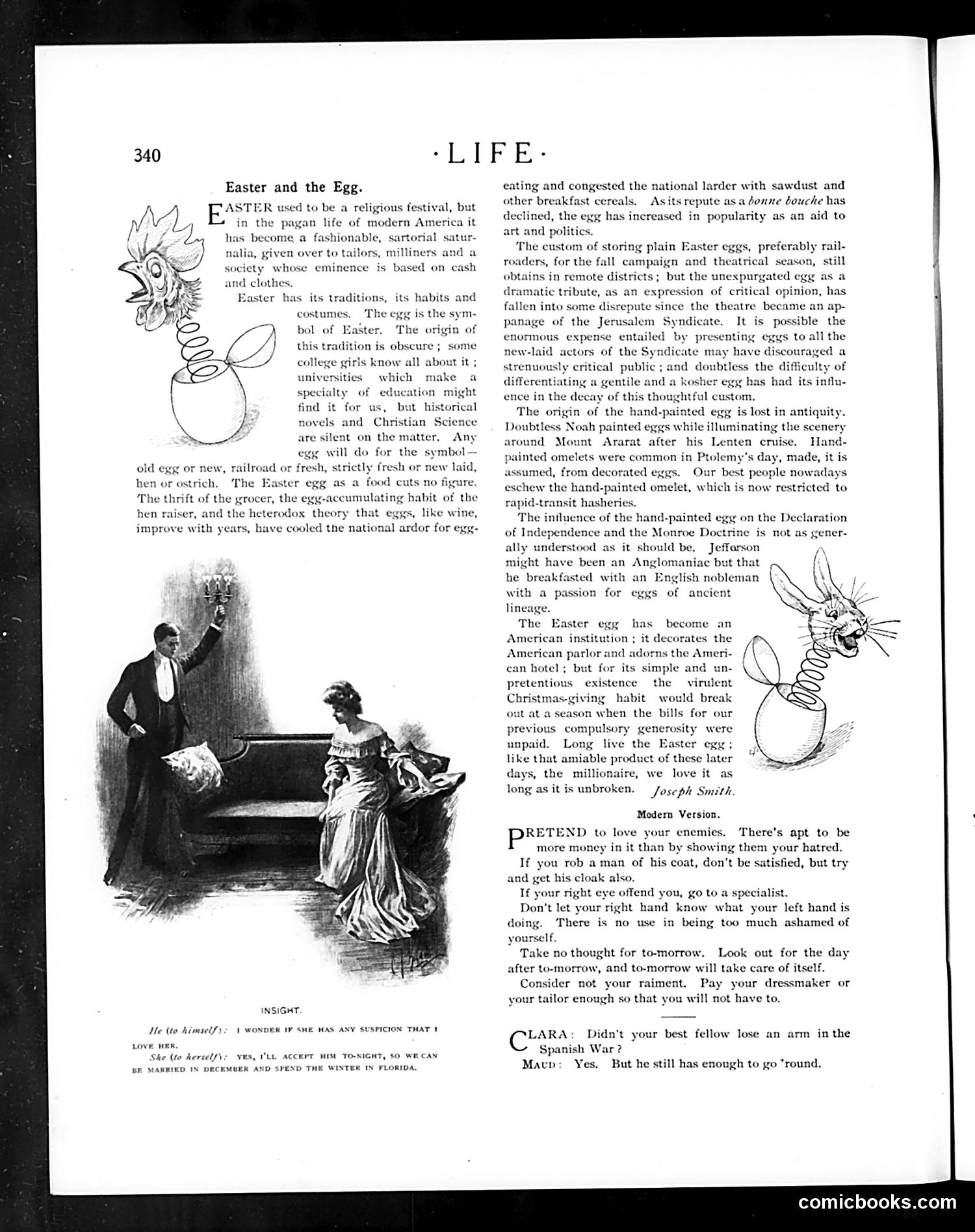
This page from *Life* satirizes Easter's transformation from religious observance into a secular, commercialized fashion spectacle. The article mocks how Easter has become about displaying wealth through new clothes rather than spiritual meaning. The cartoon "Insight" depicts a couple's mercenary marriage plans: he thinks she loves him; she mentally calculates marrying him in December to spend winter in Florida—satirizing transactional relationships among the wealthy classes. The "Modern Version" section parodies Biblical teachings reinterpreted through a cynical, materialistic lens: "rob a man of his coat, don't be satisfied, but try and get his cloak also" perverts Jesus's teaching into greedy excess; "If your right eye offend you, go to a specialist" replaces spiritual discipline with consumerism. The overall message: turn-of-the-century American society has corrupted traditional values into shallow displays of money and status.
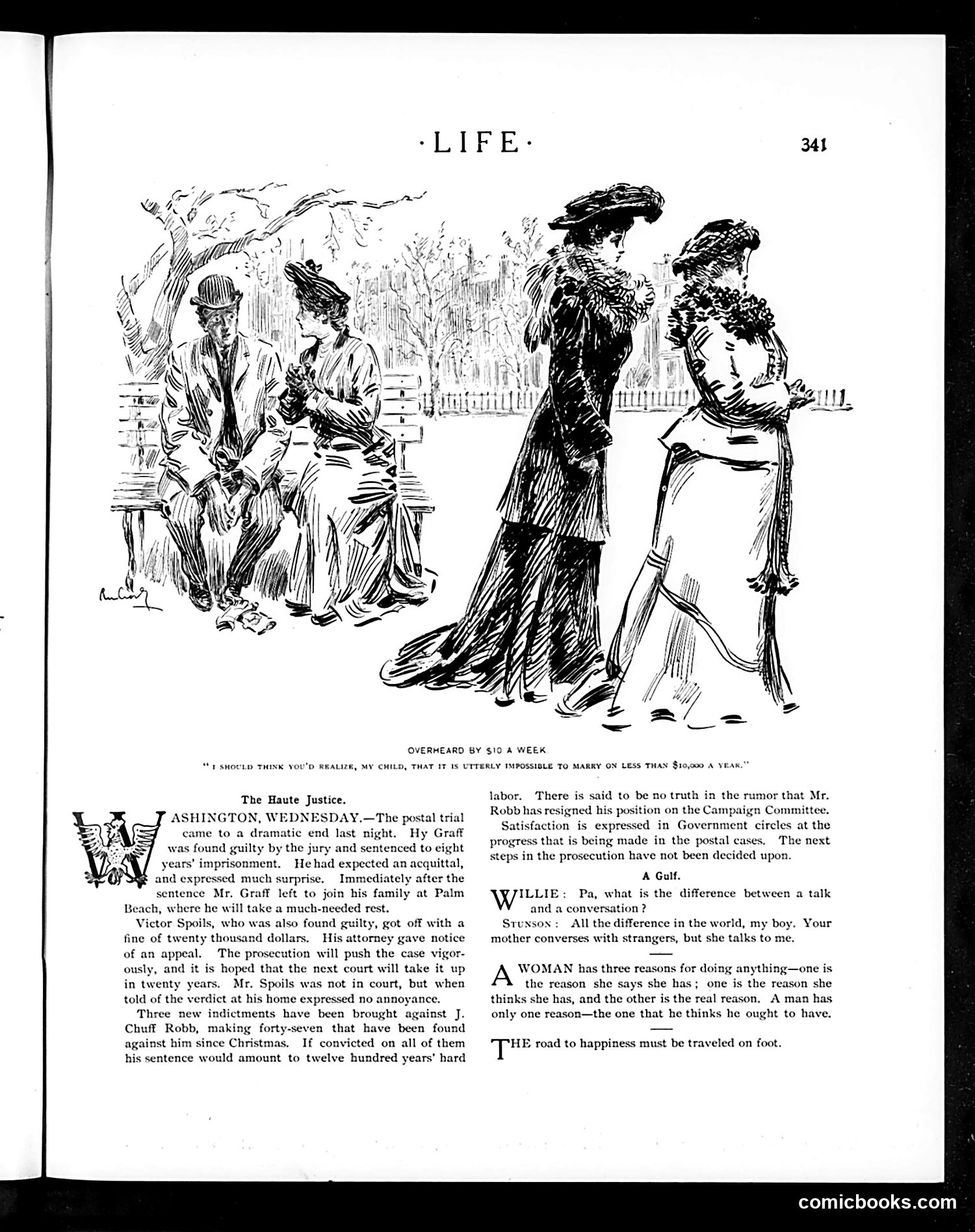
This *Life* magazine page contains satirical commentary on early 1900s American justice and wealth inequality. **"The Haute Justice"** section mocks corruption in postal fraud trials. It describes absurdly lenient sentences: one defendant gets 8 years while another (Victor Spoils) receives only a fine and plans appeal; prosecution delays cases 20 years. The satire suggests wealthy defendants escape justice through legal manipulation and delays—a commentary on class-based inequity. **The cartoon above** depicts a wealthy man telling a woman it's "impossible to marry on less than $10,000 a year"—mocking the extravagant financial expectations of the wealthy elite during an era of vast income inequality. The remaining jokes about conversations, women's reasoning, and happiness are lighter filler content typical of the magazine's format. The page overall critiques 1900s judicial corruption, wealth-based privilege, and the absurd financial standards of the upper class.
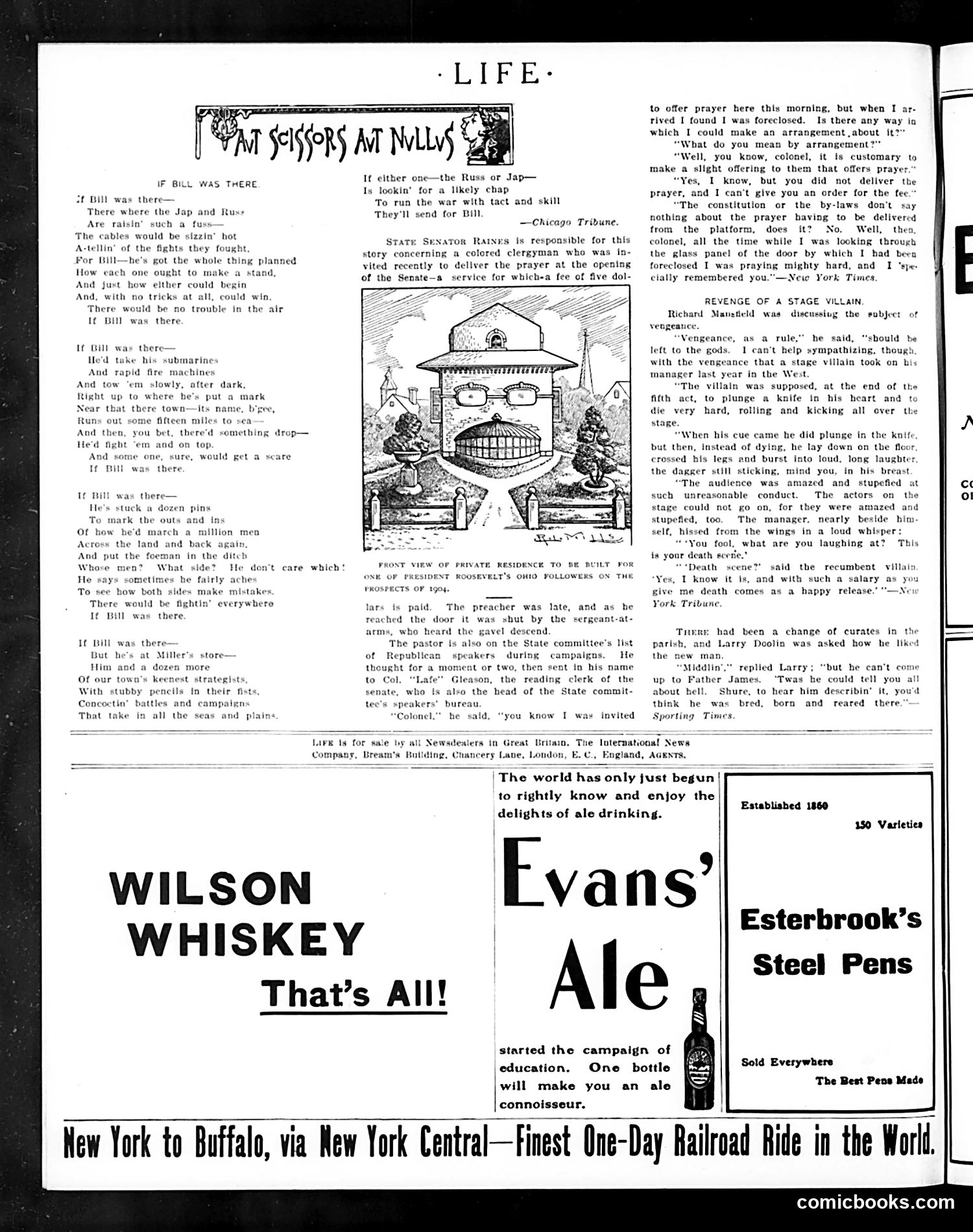
This page contains two main elements: **"If Bill Was There" Poem**: A satirical poem imagining how a character named Bill—apparently a military strategist or interventionist—would solve various problems (political conflicts, military campaigns). The satire mocks armchair warriors who casually propose violent solutions to complex issues, suggesting Bill would recklessly deploy submarines, position troops, and cause widespread destruction while remaining indifferent to consequences. The repeated refrain "If Bill was there" emphasizes how such people overestimate their own importance. **Anecdotes**: Brief humorous stories about: (1) a Black clergyman denied prayer fees due to a technicality about delivering from the platform, satirizing bureaucratic absurdity; (2) a stage villain actor's revenge on his manager by refusing to "die" convincingly during a performance, mocking theatrical melodrama. The page is primarily **satirical social commentary** targeting overconfident military thinking, racial discrimination, and theatrical pretension, wrapped in humorous narratives typical of *Life* magazine's style.
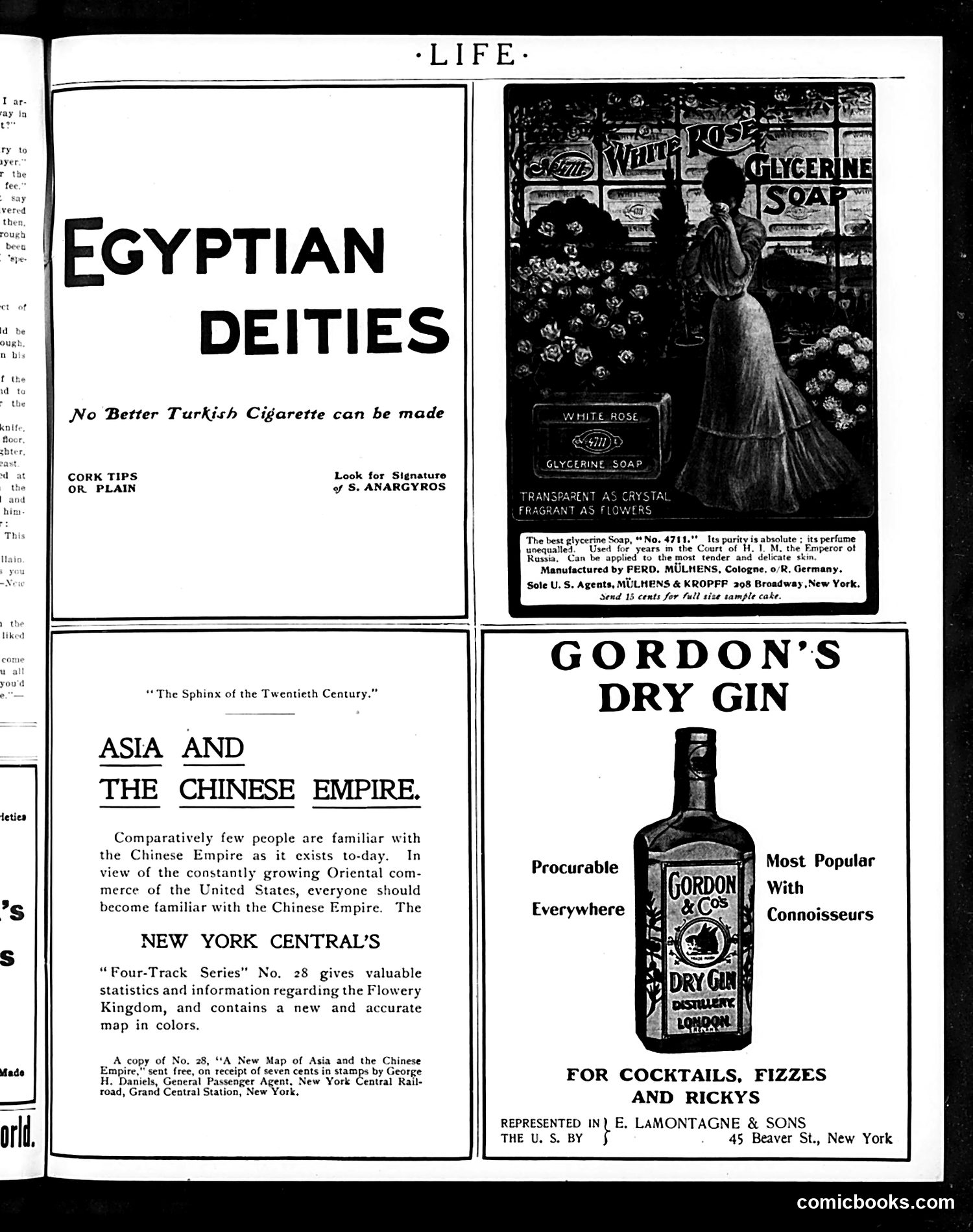
This page is primarily **advertising**, not satire or editorial content. It contains four unrelated ads typical of early 20th-century magazines: 1. **Egyptian Deities Cigarettes** - Uses "Egyptian" branding (fashionable exotica of the era) to market Turkish cigarettes by S. Anargyros, available with cork or plain tips. 2. **No. 4711 Glycerine Soap** - Claims imperial prestige by noting use in the Russian Emperor's court, manufactured in Cologne, Germany. 3. **New York Central Railroad** - Promotes educational materials about the Chinese Empire and commerce, reflecting contemporary American commercial interest in Asia. 4. **Gordon's Dry Gin** - Markets liquor as sophisticated ("Most Popular With Connoisseurs"), suitable for cocktails and mixed drinks. The page reflects early 1900s advertising strategies: exotic branding, appeals to aristocratic authority, and nationalism. No political cartoons or satire are present—this is a commercial page showcasing consumer products and services of the period.
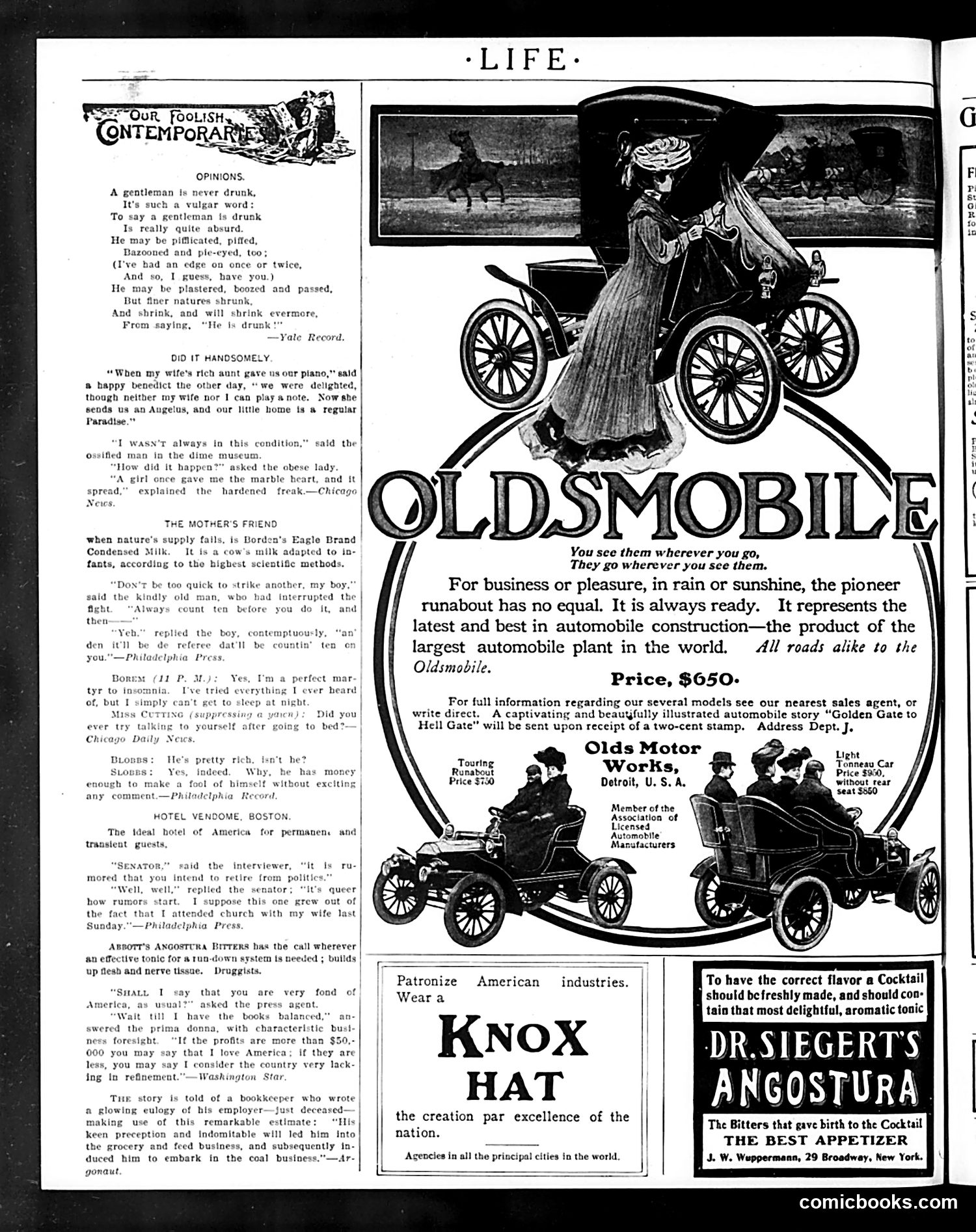
This page mixes satirical commentary with period advertising. **The satire section** ("Our Foolish Contemporaries") mocks euphemistic language around drunkenness. The opening poem ridicules genteel society's avoidance of the word "drunk," listing absurd alternatives like "pifflicated" and "bazooned." Modern readers would recognize this as skewering how polite society uses coded language to avoid uncomfortable truths—a timeless social critique. Other brief humorous anecdotes mock pretension (a man proud to own a piano he can't play) and hypocrisy (a man claiming virtue after attending church once). **The advertisements** dominate the page, featuring an Oldsmobile automobile ($650) and Knox hats as products of "creation par excellence." Dr. Siegert's Angostura bitters are also promoted. The page essentially showcases Life's formula: lightweight social satire targeting middle-class pretension alongside full-page advertisements. The humor assumes readers familiar with genteel conventions worth mocking.
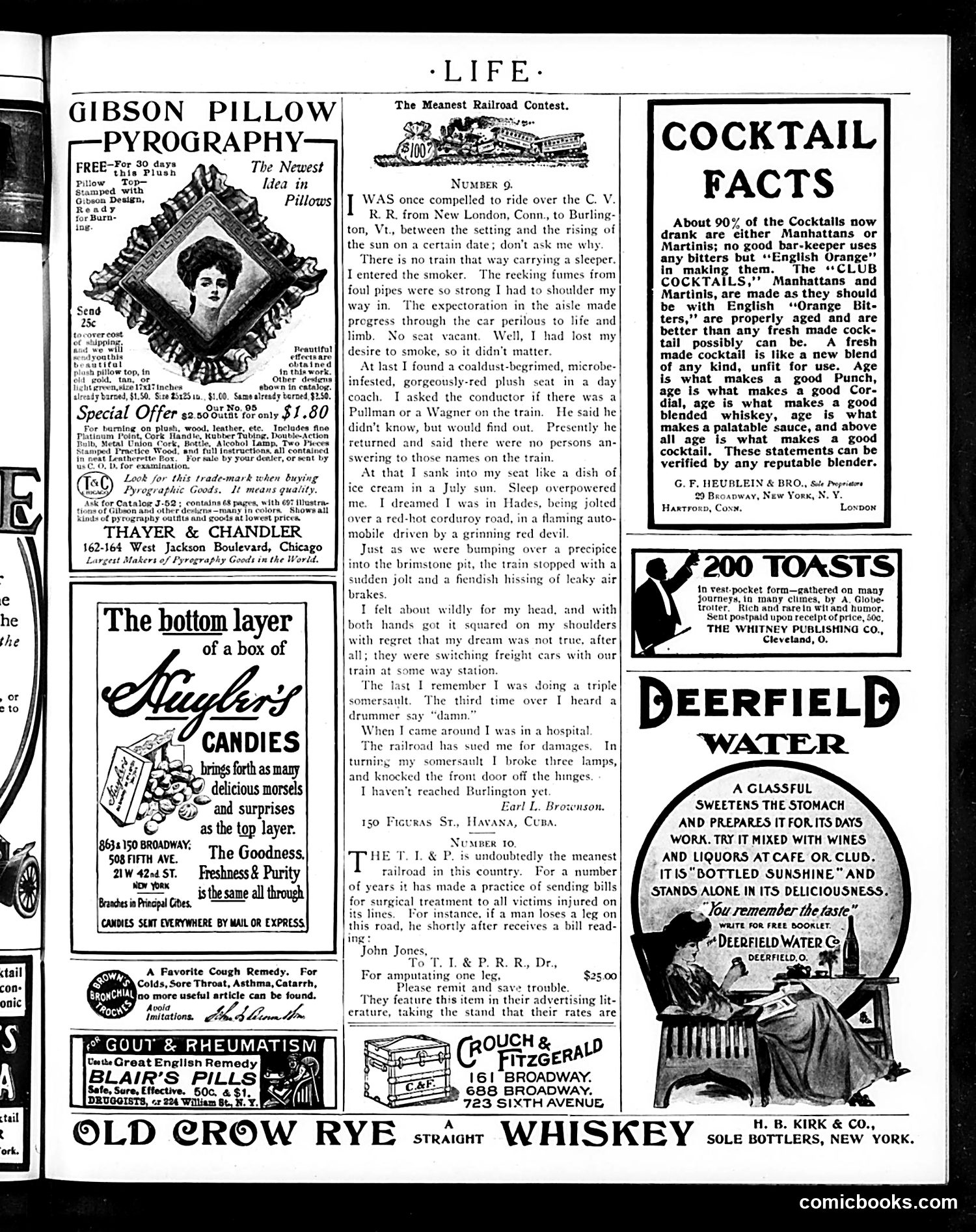
This page is primarily **advertisements and paid content**, not editorial satire or political cartooning. The main feature is "The Meanest Railroad Contest"—reader submissions describing terrible experiences on American railroads. Entry #9 describes a filthy, uncomfortable train journey with no sleepers; Entry #10 sardonically notes the T.I. & P.R.R. railroad's practice of billing injury victims for surgical treatment (e.g., "For amputating one leg"). The satire here targets **railroad companies' poor service and predatory billing practices**—contemporary grievances about how railroads treated passengers. The humor relies on exaggeration and absurdity (billing for amputation) to criticize real abuses. The surrounding advertisements promote vintage products: Gibson Pyrography (decorative woodburning), Suyler's Candies, Old Crow Whiskey, Deerfield Water, and patent medicines—typical early-20th-century advertising fare.
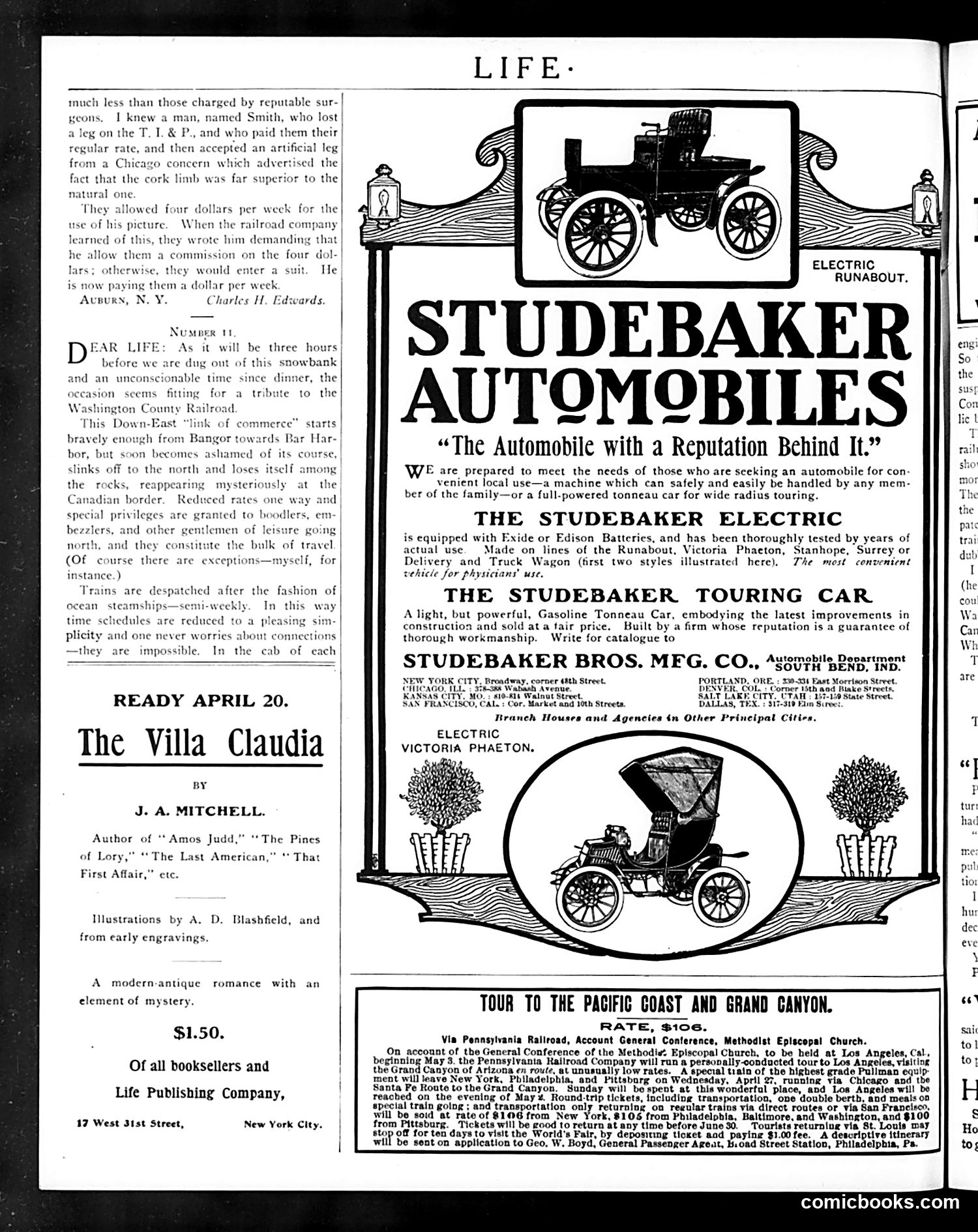
This page is primarily **advertising** rather than political satire. The dominant content is a large Studebaker Automobiles advertisement showcasing their electric and gasoline-powered vehicles—the runabout, touring car, victoria phaeton, and delivery wagon. The text above the advertisement discusses a humorous anecdote about a man named Smith who lost his leg on a railroad and was fitted with an artificial cork limb superior to his natural one. The railroad company then demanded a commission when Smith was paid to advertise the prosthetic device. This illustrates absurd corporate overreach rather than formal satire. The page also advertises J.A. Mitchell's novel *The Villa Claudia* and a Methodist Church tour to the Pacific Coast and Grand Canyon via Pennsylvania Railroad. The satire here is mild social commentary on corporate greed and railroad monopoly practices, embedded within what is fundamentally a commercial publication designed to generate advertising revenue.
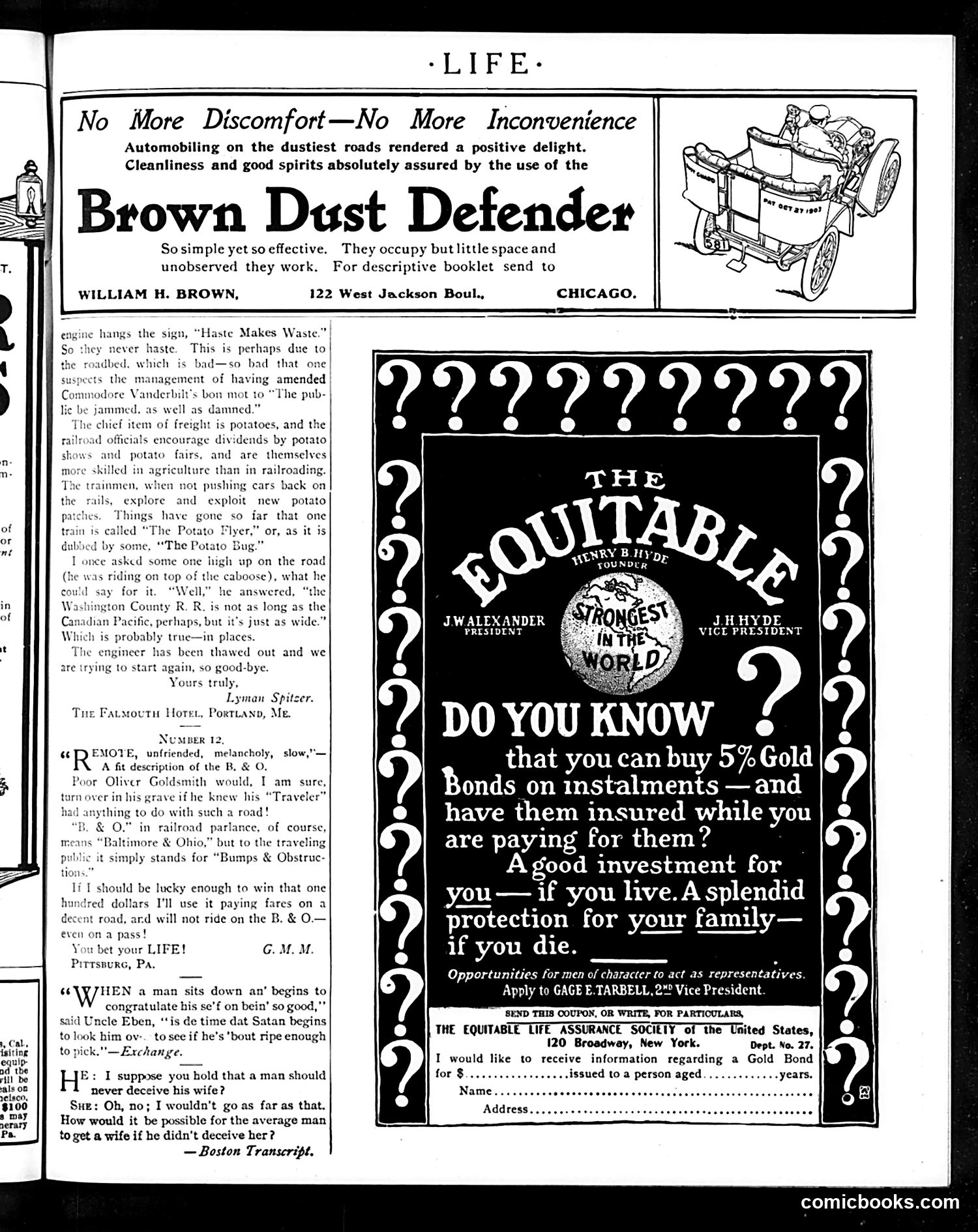
This page blends **advertising with satirical reader letters**—typical of Life's format. **Top Advertisement:** The "Brown Dust Defender" is a humorous auto accessory promising to shield motorists from road dust during the early automobile era when unpaved roads were common. The ad's breathless tone mocks the genuine discomfort of early motoring. **Main Content:** Reader letters satirize American life: 1. **Lyman Spitzer's railroad letter** mocks the B&O Railroad's terrible condition, comparing it unfavorably to Canadian rail while joking that potato shipments have earned the line nicknames like "The Potato Flyer." 2. **The debate about deception** (bottom) presents contrasting views on marital honesty—one correspondent argues men must deceive women to win them, a *Boston Transcript* quip that satirizes both male dishonesty and the presumed gullibility of courtship. **Sidebar:** The Equitable Life Assurance advertisement uses dramatic question marks and promises life insurance and gold bonds—typical of period financial product marketing. The satire targets American transportation inefficiency, male-female relations, and early consumer culture.
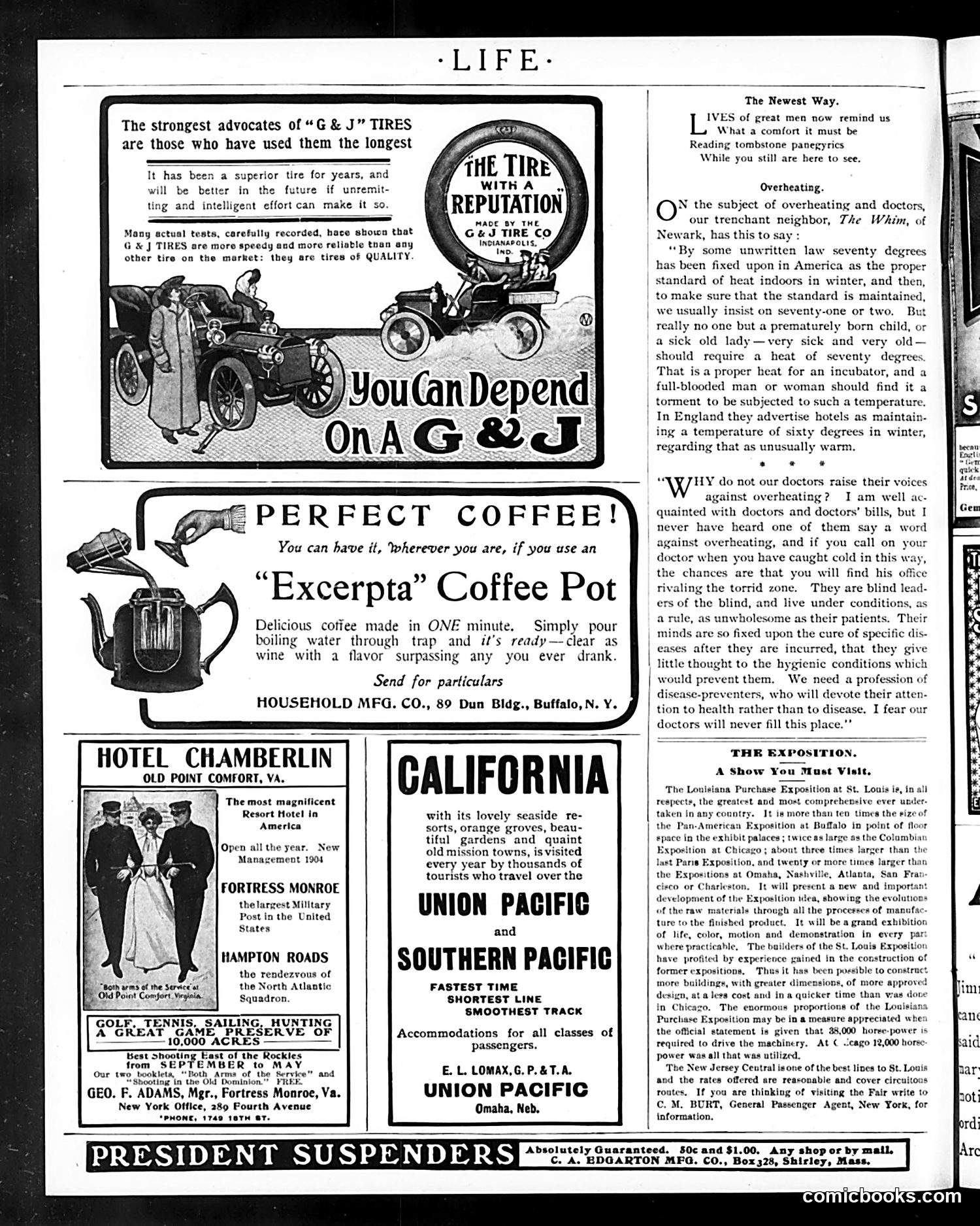
This page mixes advertising with social commentary typical of early 1900s *Life* magazine. The main editorial content critiques American indoor heating practices and doctors' silence on the matter. An unnamed "trenchant neighbor, The Whim, of Newark" argues that Americans obsessively maintain 70+ degree indoor temperatures—appropriate only for incubators and the severely ill. The piece sarcastically notes doctors won't speak against overheating despite living in overheated offices themselves, suggesting we need "disease-preventers" rather than disease-curers. The advertisements include G&J Tires, an Excerpta Coffee Pot, Hotel Chamberlin resort, and Union Pacific railroad promotions. A notable ad for the Louisiana Purchase Exposition at St. Louis boasts it's vastly larger than previous American expositions. The tone is muckraking—exposing what the writer sees as collective foolishness (overheating) and professional cowardice (doctors' silence)—balanced against commercial pitches for consumer goods and leisure travel.
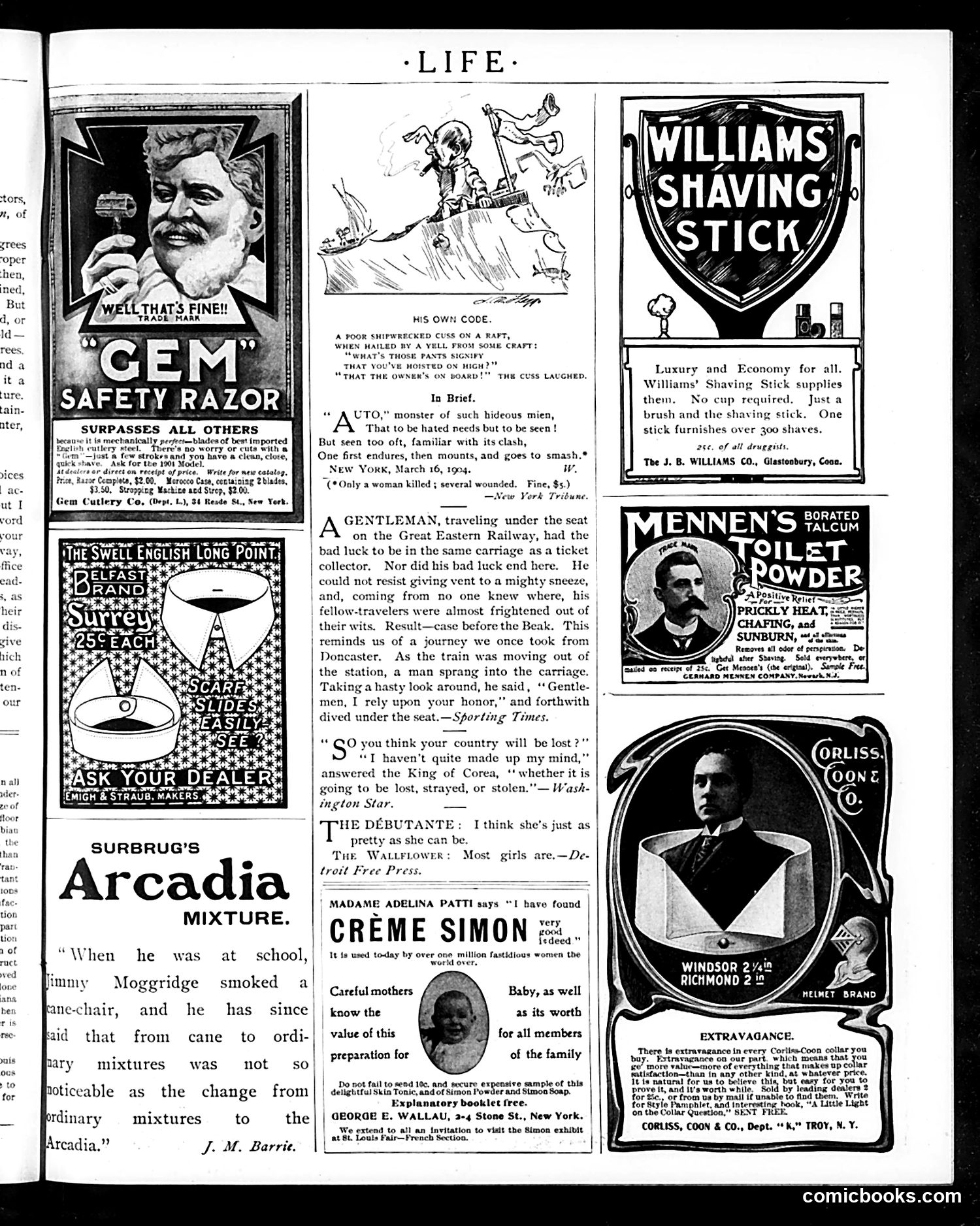
This is primarily an **advertising page** from Life magazine (dated March 16, 1904), with brief satirical content interspersed. The main editorial content includes short humor pieces: - **"His Own Code"**: A joke about a shipwrecked man signaling distress with his pants, implying he's relieved rather than desperate. - **"In Brief"**: A quoted poem about an "AUTO" (automobile) as a monster causing destruction—referencing the then-novel danger of early motor vehicles. The note "(Only a woman killed; several wounded)" darkly satirizes public indifference to automobile deaths. - Anecdotes about railway travel absurdities and a quip about Korea's King potentially losing his country to war, occupation, or theft—likely referencing Russo-Japanese War tensions (1904-1905). The **advertisements** dominate: Gem Safety Razors, shaving products, talcum powder, and collars. These represent typical early-20th-century masculine grooming products. The humor reflects Life's satirical style—mocking modern technology dangers, social pretension, and current events through brief, sardonic observations rather than visual cartoons.
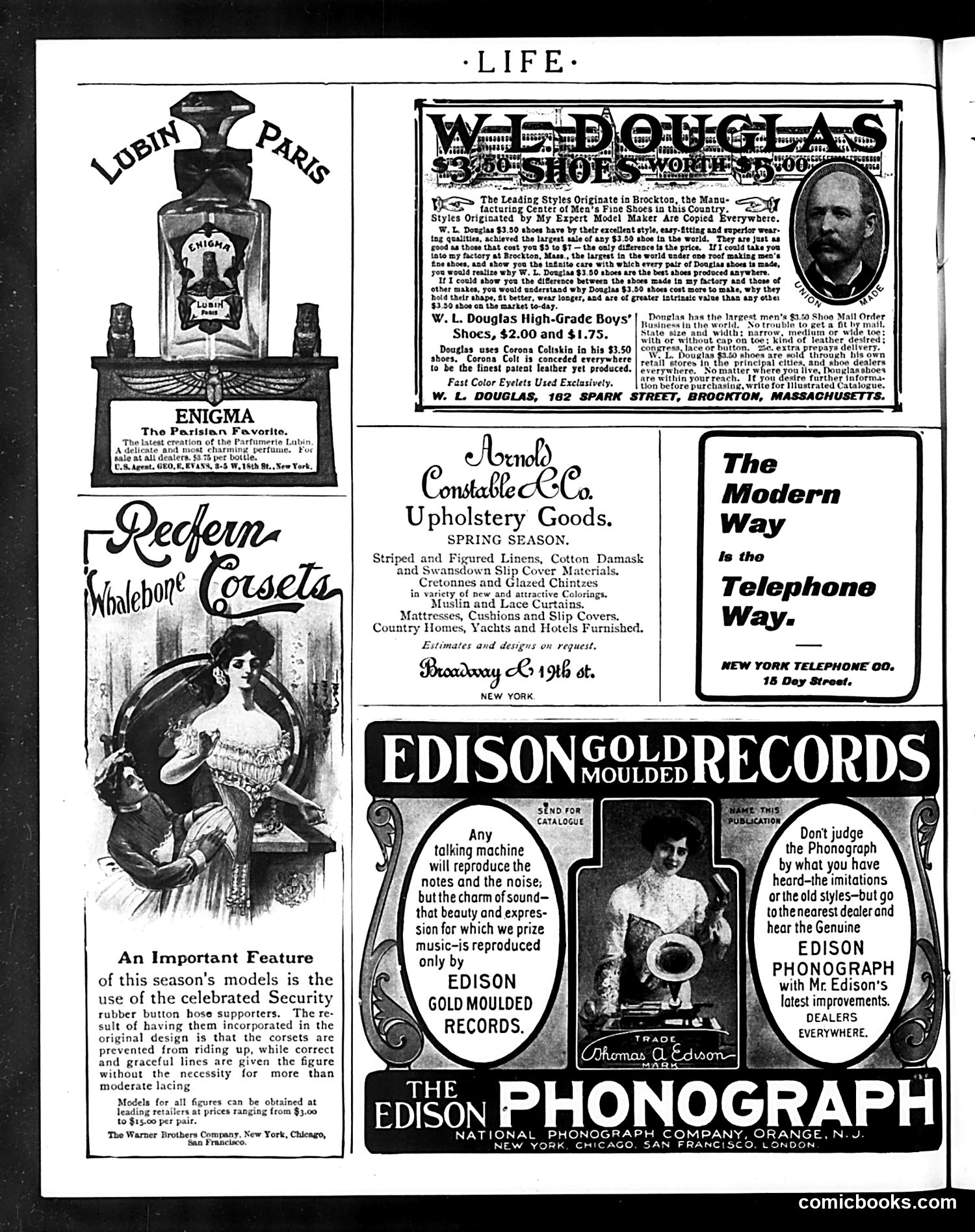
This is primarily an **advertising page** rather than satirical content. The page features five major product advertisements from the early 1900s: 1. **Lubin Paris Perfume** ("Enigma") - promoting French luxury fragrance 2. **Recfern Whalebone Corsets** - emphasizing new "Security" rubber button supporters that prevent corsets from riding up 3. **W.L. Douglas Shoes** - advertising men's and boys' footwear manufactured in Brockton, Massachusetts, emphasizing quality at $3.50 4. **Arnold Constable & Co.** - upholstery and home furnishings 5. **Edison Gold Moulded Records and Phonograph** - promoting Edison's recording technology The ads reflect early 20th-century consumer culture: women's corsetry, American manufacturing pride (Brockton shoes), and new entertainment technology (phonographs). There is **no political satire or cartoon content** visible—this appears to be a standard revenue-generating advertising section of Life magazine.
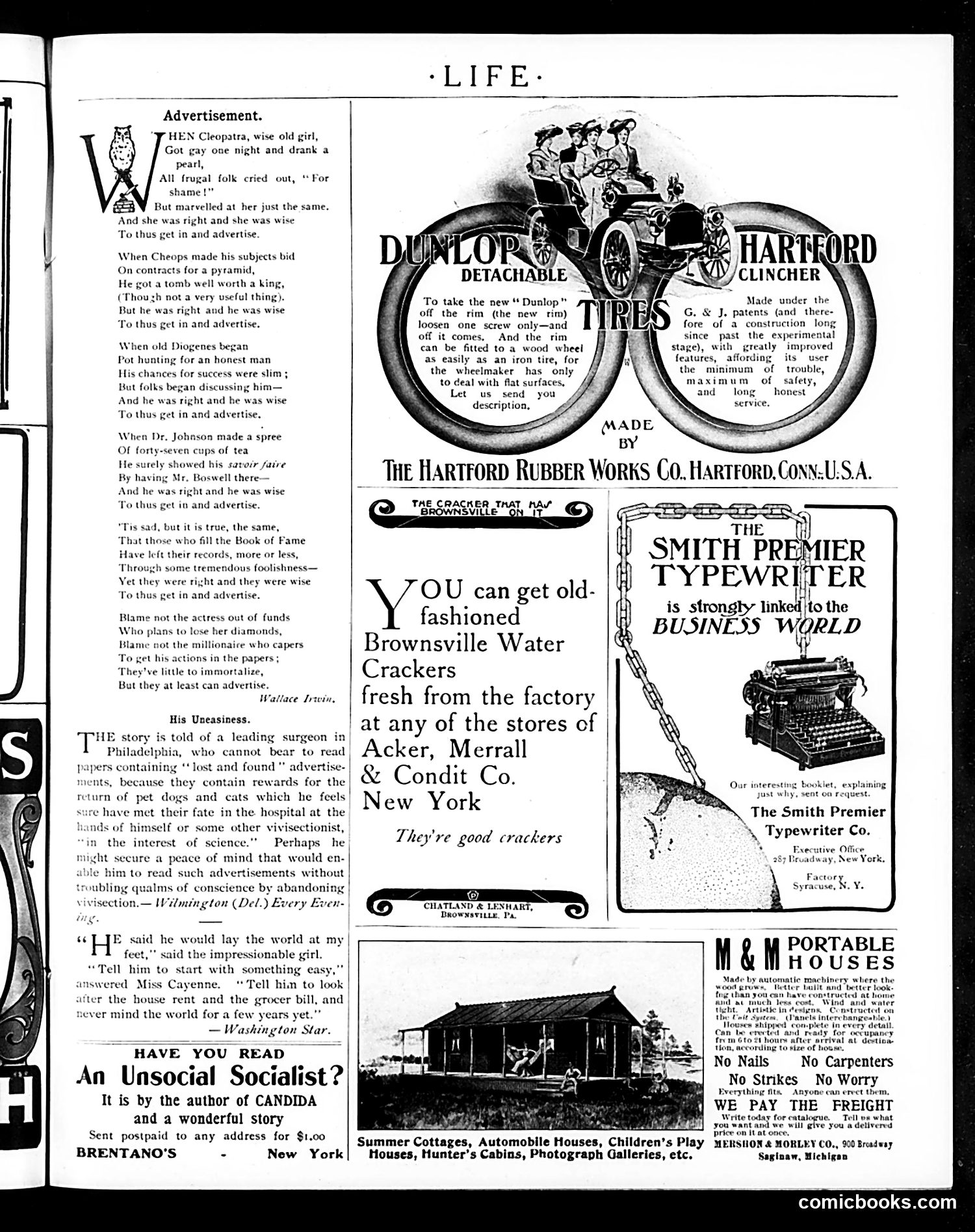
This is primarily an **advertising page** with a framing poem by Wallace Irwin at top-left titled "Advertisement." **The Irwin poem's satire:** It humorously argues that historical figures—Cleopatra, Cheops, Diogenes, Dr. Johnson—were actually *clever advertisers* who staged memorable acts to gain fame and attention. The poem's point: advertising oneself isn't shameful; even the great did it. The final stanzas extend this to modern times, suggesting that actresses losing diamonds or wealthy people seeking press coverage are merely following an ancient, respectable tradition. **The advertisements below** include: - Dunlop Tires (detachable clincher design) - Hartford Rubber Works Tires - Brownsville Water Crackers - Smith Premier Typewriter - M&M Portable Houses (pre-fabricated structures) - An Unsocial Socialist book promotion **Context for moderns:** The poem gently mocks the era's anxiety about self-promotion and publicity-seeking, normalizing advertising as inherently human behavior. This reflects early 20th-century concerns about emerging mass media and commercialism.
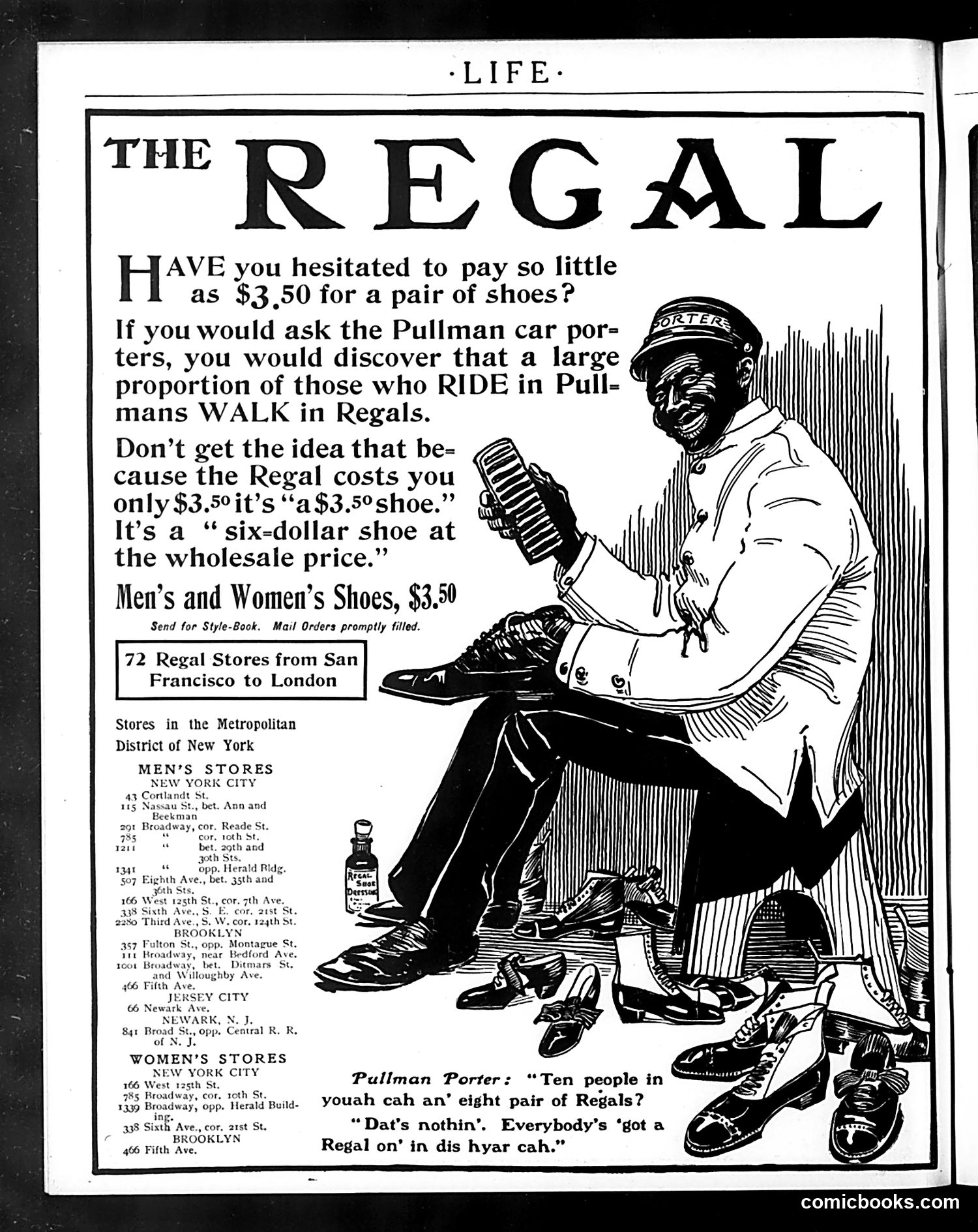
This is a **shoe advertisement**, not political satire. It promotes Regal brand shoes at $3.50—positioned as an affordable yet quality product ("a six-dollar shoe at wholesale price"). The advertisement features a **Pullman porter** (a Black railroad worker) as the central figure, shown examining shoes. The accompanying dialogue uses dialect: "Ten people in youah cah an' eight pair of Regals? Dat's nothin'. Everybody's 'got a Regal on' in dis hyar cah." The ad leverages the porter's credibility—claiming that wealthy Pullman car passengers (who "RIDE in Pullmans") actually "WALK in Regals," suggesting the shoes appeal across class lines. The porter's testimonial was meant to build consumer trust. **Modern context**: The dialect and caricature reflect period racism in advertising. While the ad positions affordability as democratic, it simultaneously uses a stereotyped Black worker to sell to white audiences, reflecting early 20th-century marketing conventions.
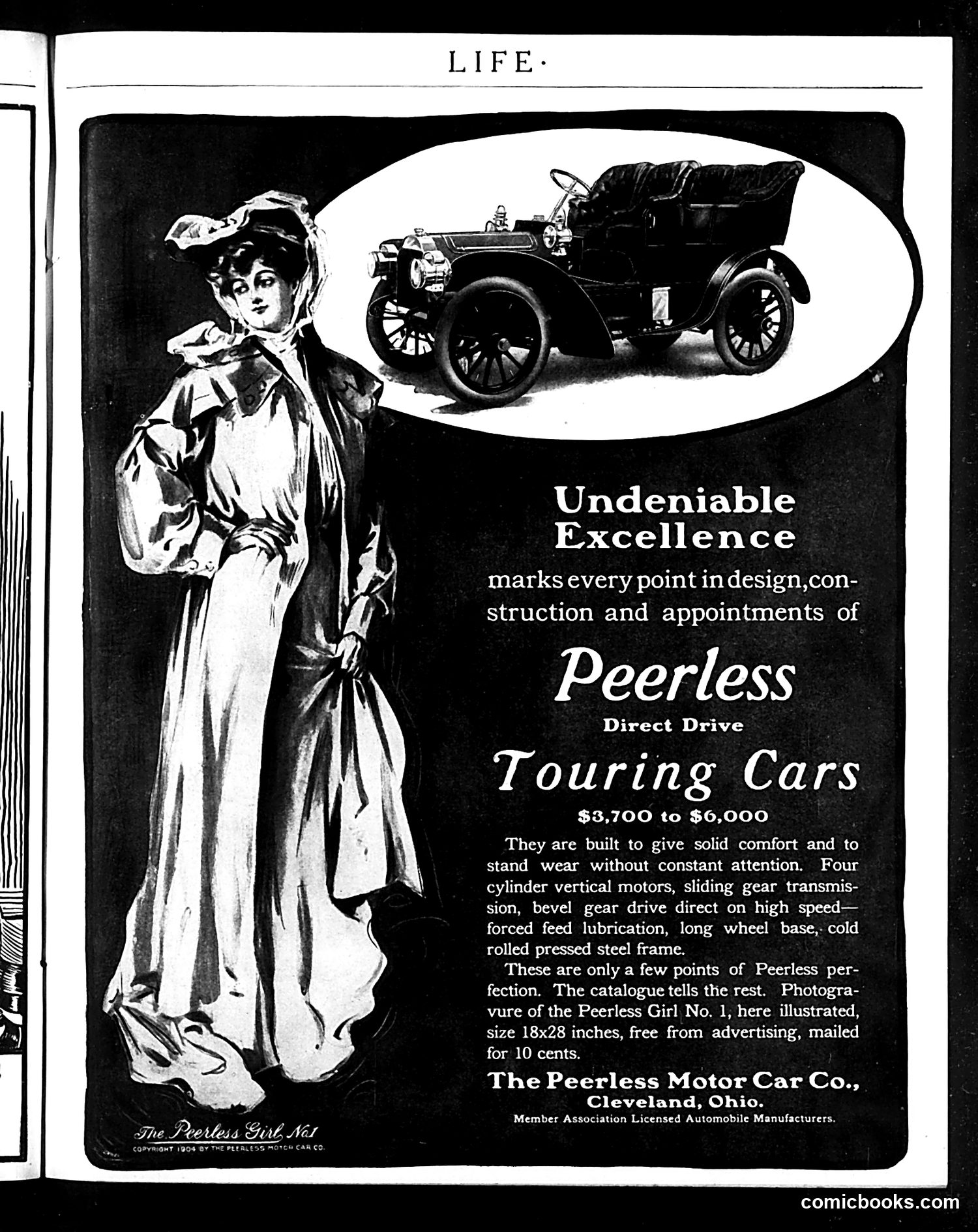
This is primarily a **product advertisement**, not political satire. The Peerless Motor Car Company promotes their "Direct Drive Touring Cars" (priced $3,700-$6,000) by featuring an elegant illustration of "The Peerless Girl No. 1"—a fashionably dressed woman in early 1900s attire serving as the brand's mascot/spokeswoman. The ad emphasizes technical specifications (four-cylinder motors, bevel gear drive, steel frame) alongside the figure's refined appearance, appealing to affluent buyers by associating the automobile with elegance and sophistication. The offer of a free photogravure suggests premium marketing targeting upscale consumers. This represents typical early automotive advertising strategy: linking luxury cars to aspirational imagery of genteel femininity rather than emphasizing practical transportation. The "Girl No. 1" designation suggests a marketing series.
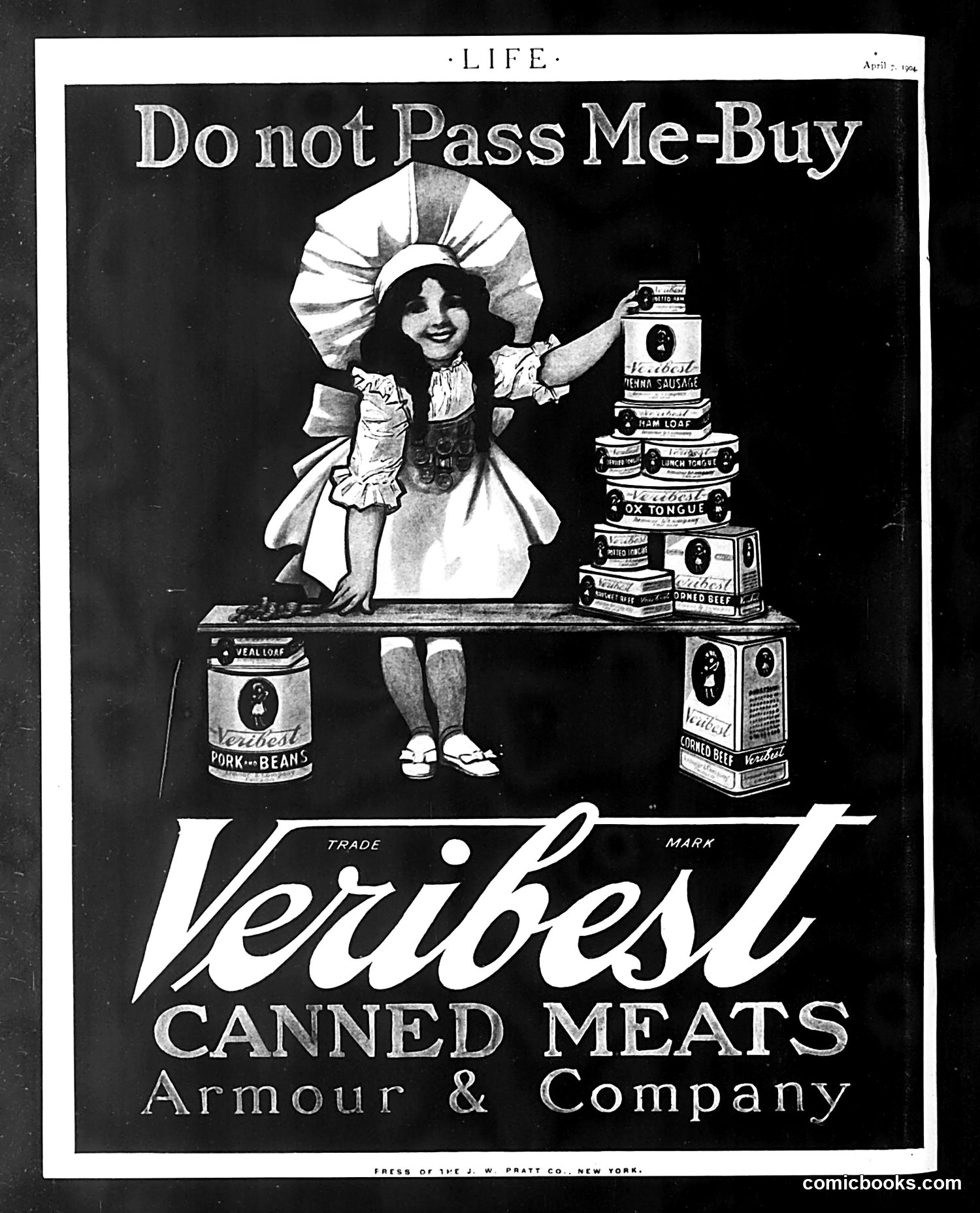
This is an **advertisement for Veribest Canned Meats** by Armour & Company, not political satire. The headline "Do not Pass Me-Buy" is a pun on the Monopoly game phrase "Do not pass Go." The image depicts a cheerful woman in period costume with an enormous bonnet, displaying stacked canned goods (ham loaf, pork and beans, ox tongue, corned beef, etc.). The visual joke relies on the woman's exaggerated features and clothing to make the products memorable and appealing. This is straightforward **commercial advertising** from the 1920s, using humor and an eye-catching illustration to promote convenient, shelf-stable meat products—a major selling point in the pre-refrigeration era. There is no political commentary present.

I can see this is a nearly entirely black page with only "comicbooks.com" visible in the bottom right corner. There is a white vertical stripe on the left edge, possibly a binding margin or scanning artifact. The image appears to be either a blank page, a heavily damaged/degraded historical document, or a technical scanning error. Without visible cartoon content, text, or imagery to analyze, I cannot identify any figures, political references, or satirical commentary. To provide the historical analysis you're requesting, I would need a page with legible content visible.