
Life, 1904-04-07 · page 24 of 41
Life — April 7, 1904 — page 24: what you’re looking at
What you’re looking at
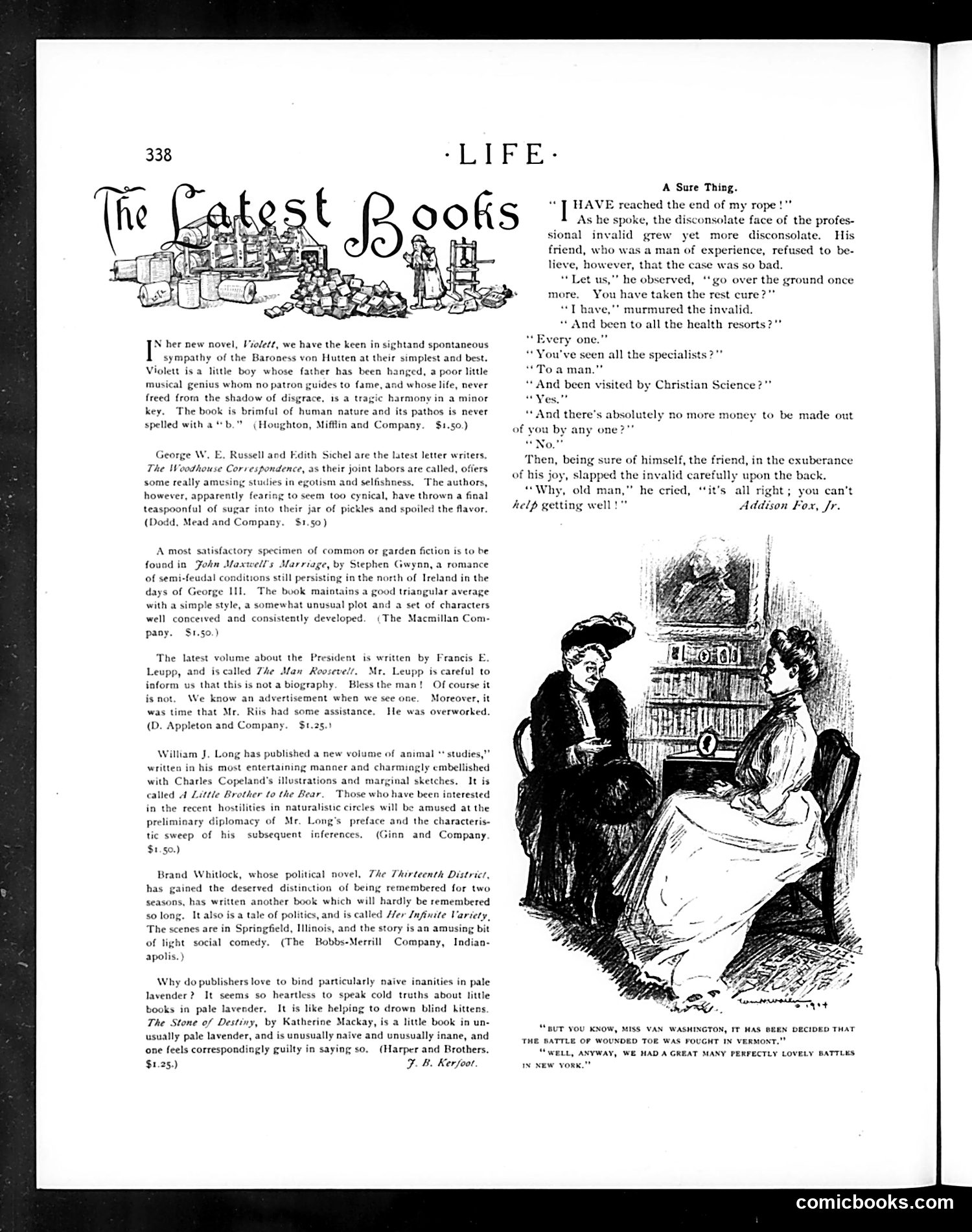
This two-part page combines book reviews with a cartoon joke about hypochondriacs and the medical industry. **The Cartoon/Text Story**: A "professional invalid" (chronic patient) tells his friend he's reached his rope's end, having exhausted all treatments: rest cure, health resorts, every specialist, and Christian Science. His friend systematically checks off each failed remedy—each more expensive and exploitative than the last. When the invalid admits "there's absolutely no more money to be made out of you by any one," the friend slaps him on the back: "Why, old man, it's all right—you can't help getting well!" **The Satire**: The joke exposes how the medical establishment (doctors, specialists, faith healers) profits from the wealthy worried-well. The punchline—that the invalid will recover once he's financially useless to practitioners—suggests recovery was always possible but economically inconvenient. It satirizes both patient hypochondria and practitioner greed. The accompanying book reviews discuss recent fiction, including criticism of overly sentimental bindings on trivial books.
📄 Transcribed text from this page (OCR, searchable)
Machine-transcribed from the original scan — historical spelling and the odd misread are preserved.
her new novel, Miolett, we have the keen in sightand spontaneous sympathy of the Baroness von Hutten at their simplest and best. t isa little boy whose father has been hanged, a poor little musical genius whom no patron guides to fame, freed from the shadow of disgrace, 1s a tragic harmony in a minor key. The book is brimful of human nature and its pathos is never spelled with ab.” (Houghton, Mifflin and Company. $1.50.) nd whose life, never George W. E. Russell and Edith Sichel are the latest letter writers, The Woodhouse Correspondence, as their joint labors are called, offers some really amusing studies in egotism and selfishness, The authors, however, apparently fearing to seem too cynical, have thrown a final teaspoonful of sugar into their jar of pickles and spoiled the flavor. (Dodd, Mead and Company. $1.50) A most satisfactory specimen of common or garden fiction is to be found in John Maxwell's Marriage, by Stephen Gwynn, a romance of semi-feudal conditions still persisting in the north of Ireland in the days of George III]. The book maiotains a good triangular average unusual plot and a set of characters well conceived and consistently developed. (The Macmillan Com- pany. $1.50.) with a simple style, a somew The latest volume about the President is written by Francis E. Leupp, and is called 7he Man Roosevelt, Mr. Leupp is careful to inform us that this is not a biography. Bless the man ! We know an advertisement when we see one was time that Mr, Riis had some assistance. He was overworked. (D. Appleton and Company. $1.25.) Of course it is not Moreover, it William J, Long has published a new volume of animal “studies,” written in his most entertaining manner and charmingly embellished with Charles Copeland’s illustrations and marginal sketches. It is called A Little Brother to the Bear, Those who have been interested in the recent hostilities in naturalistic circles will be amused at the 's preface and the characteris- subsequent inferences. (Ginn and Company. preliminary diplomacy of Mr. Loi tic sweep of his $1.50.) Brand Whitlock, whose political novel, The Thirteenth District, has gained the deserved distinction of being remembered for two seasons, has written another book which will hardly be remembered so long. It also isa tale of politics, and is called Her Infinite Variety, The scenes are in Springfield, Ilinois, and the story is an amusing bit of light social comedy, (The Bobbs-Merrill Company, Indian- apolis. ) Why do publishers love to bind particularly naive inanities in pale lavender? It seems so heartless to speak cold truths about little books in pale lavender, It is like helping to drown blind kittens The Stone of Destiny, by Katherine Mackay, is a little book in un- usually pale lavender, and is unusually naive and unusually inane, and one feels correspondingly guilty in saying so. (Harper and Brothers. $1.25.) J. B. Kerfoot A Sure Thing. “| HAVE reached the end of my rope !”" As he spoke, the disconsolate face of the profes- sional invalid grew yet more disconsolate. His friend, who was a man of experience, refused to be- lieve, however, that the case was so bad. ** Let us,"’ he observed, ‘* go over the ground once more. You have taken the rest cure?" “T have,’’ murmured the invalid. nd been to all the health resorts?" “Every one.” “ You've seen all the specialists ?"" “To a man. “And been visited by Christian Science? And there’s absolutely no more money to be made out of you by any one?"’ “No, Then, being sure of himself, friend, in the exuberance of his joy, slapped the invalid carefully upon the bac! “Why, old man, help getting well!" he cried, ‘it’s all right; you can’t Addison Fox, Jr. “BUT YOU KNOW, MISS VAN WASHINGTON, IT HAS BEEN DECIDED THE BATTLE OF WOUNDED TOE WAS FOUGHT IX VERMONT.” “WELL, ANYWAY, WE HAD A GREAT MANY PERFECTLY LOVELY BATTLES IN NEW YORK. comicbooks.com