
Life, 1904-04-07 · page 22 of 41
Life — April 7, 1904 — page 22: what you’re looking at
What you’re looking at
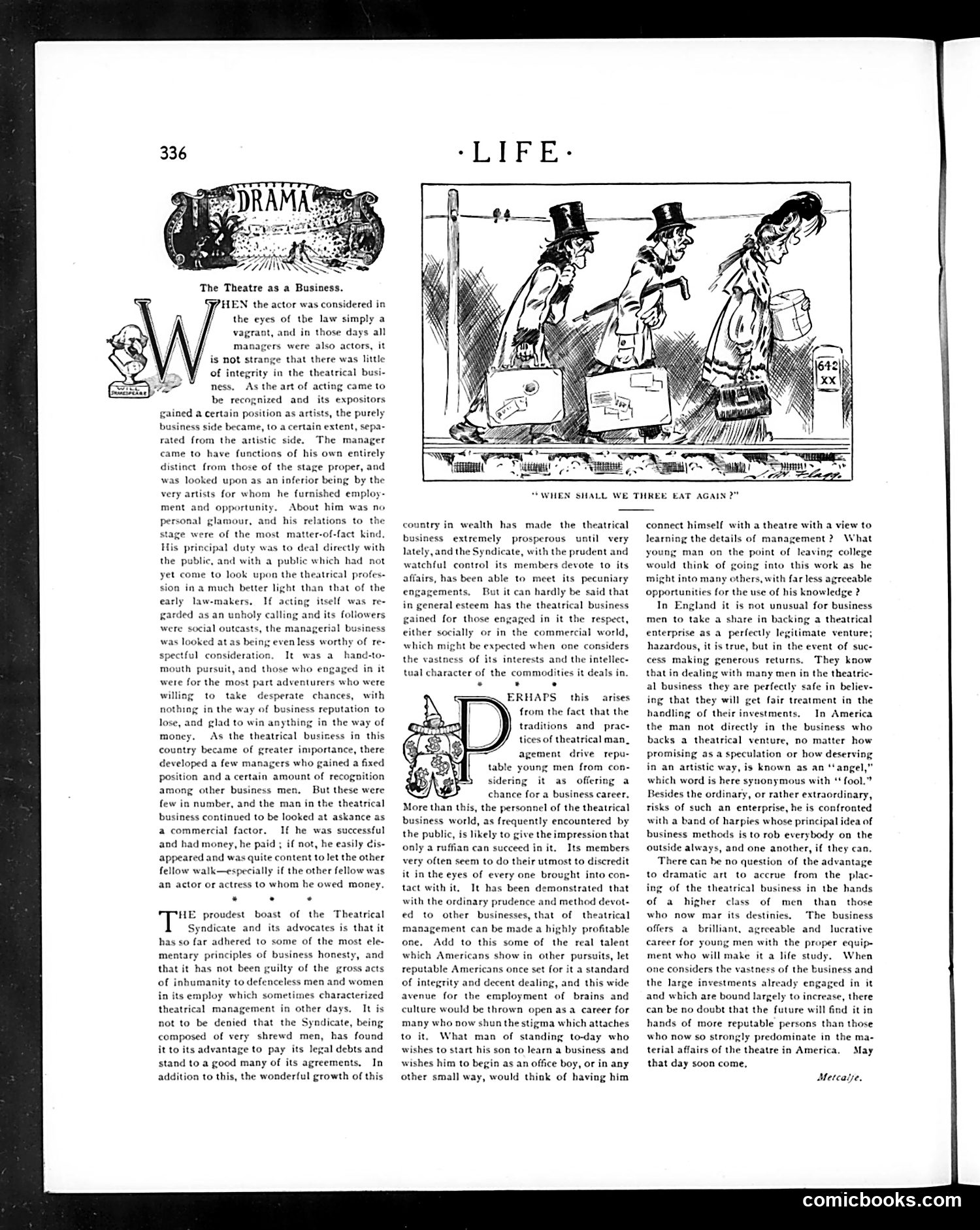
This page from *Life* magazine addresses the theatrical industry's poor reputation and business practices. The cartoon (top right, captioned "When Shall We Thrice Eat Again?") depicts three shabby theatrical figures huddled over empty boxes, satirizing the financial precarity and disreputable conduct common in theater management. The accompanying article argues that while actors were historically viewed as vagrants, theater *managers* earned even less respect—treated as inferior commercial operators rather than artists. The text credits the Theatrical Syndicate with introducing basic business honesty (paying debts, honoring agreements), yet notes the industry still struggles socially because its personnel seem like "ruffians." The satire targets the theatrical world's reputation for financial irresponsibility and disreputable dealings, contrasting the Syndicate's relative propriety against the industry's persistent stigma. For modern readers: this reflects early 20th-century anxieties about unregulated entertainment industries and concerns that theatrical people were fundamentally unreliable.
📄 Transcribed text from this page (OCR, searchable)
Machine-transcribed from the original scan — historical spelling and the odd misread are preserved.
HEN the actor was considered in the eyes of the law simply a vagrant, and in those days all | managers were also actors, it ff is not strange that there was little of integrity in the theatrical busi- ness, As the art of acting came to be recognized and its expositors gained a certain position as artists, the purely business side became, to a certain extent, sepa- rated from the artistic side, The manager came to have functions of his own entirely distinct from those of the stage proper, and was looked upon as an inferior being by the very artists for whom he furnished employ- ment and opportunity. About him was no personal glamour, and his relations to th stage were of the most matter-of-fact kind, His principal duty was to deal directly with the public, and wi yet come to look upon the theatrical profe sion ina much better light than that of the early If acting garded as an unholy calling and its followers ha public which had not law-makers, itself was re were social outcasts, the managerial business was looked at as being even less worthy of re- was mouth pursuit, and those who engaged in it spectful consideration, It hand-to- were for the most part adventurers who were willing to with nothing in the way of business reputation to lose, and glad to win anything in the way of money, As the theatrical business in this country became of greater importance, there developed a few managers who gained a fixed position and a certain amount of recognition among other business men, But these were few in number, and the man in the theatrical business continued to be looked at askance as a commercial factor. If he was successful and had money, he paid ; if not, he easily dis- appeared and was quite content to let the other fellow walk—especially if the other fellow was an actor or actress to whom he owed money, take desperate chances, HE proudest boast of the Theatrical Syndicate and its advocates is that it has so far adhered to some of the most ele- mentary principles of business honesty, and that it has not been guilty of the gross acts of inhumanity to defenceless men and women in its employ which sometimes characterized theatrical management in other days. It is not to be denied that the Syndicate, being composed of very shrewd men, has found it to its advantage to pay its legal debts and stand to a good many of its agreements, In addition to this, the wonderful growth of this i 4 country in wealth has made the theatrical business extremely prosperous until very lately, and the Syndicate, with the prudent and watchful control its members devote to its affairs, has been able to meet its pecuniary engagements, But it can hardly be said that in general esteem has the theatrical business gained for those engaged in it the respect, either socially or in the commercial world, which might be expected when one considers the vastness of its interests and the intellec- tual character of the commodities it deals in. . . ERHAPS this from the fact that the traditions and prac tices of theatrical man, repu- table young men from con- sidering it as chance for a business career, More than this, the personnel of the theatrical business world, as frequently encountered by the public, is likely to give the impression that only a ruffian can succeed in it, Its members very often seem to do their utmost to discredit it in the eyes of every one brought into con- tact with it. It has been demonstrated that with the ordinary prudence and method devot- ed to other businesses, that of theatrical management can be made a highly profitable one, Add to this some of the real talent which Americans show in other pursuits, let reputable Americans once set for it a standard of integrity and decent dealing, and this wide avenue for the employment of brains and culture would be thrown open as a career for many who now shun the stigma which attaches to it, What man of standing to-day who wishes to start his son to learn a business and wishes him to begin as an office boy, or in any other small way, would think of having him arises agement drive offering a lS race connect himself with a theatre with a view to learning the details of management ?) What young man on the point of leaving college would think of going into this work as he might into many others, with far less agreeable opportunities for the use of his knowledge ? In England it is not unusual for business men to take a share in backing a theatrical enterprise as a perfectly legitimate venture; hazardous, it is true, but in the event of suc- cess making generous returns. They know that in dealing with many men in the theati al business they are perfectly safe in beliew- ing that they will get fair treatment in the handling of their investments, In America the man not directly in the business who backs a theatrical venture, no matter how promising as a speculation or how deserving in an artistic way, is known as an “angel,” which word is here synonymous with ‘ fool,” Besides the ordinary, or rather extraordinary, risks of such an enterprise, he is confronted with a band of harpies whose principal idea of business methods is to rob everybody on the outside always, and one another, if they can. There can be no question of the advantage to dramatic art to accrue from the plac- ing of the theatrical business in the hands of a higher than who now mar its destinies, ‘The business offers a brilliant, agreeable and lucrative career for young men with the proper equip- ment who will make it a life study. When one considers the vastness of the business and the large investments already engaged in it and which are bound largely to increase, there can be no doubt that the future will Gind it in hands of more reputable persons than those who now so strongly predominate in the ma- terial affairs of the theatre in America. May that day soon come, class of men those Metcayye. comicbooks.com