
Life, 1904-04-07 · page 12 of 41
Life — April 7, 1904 — page 12: what you’re looking at
What you’re looking at
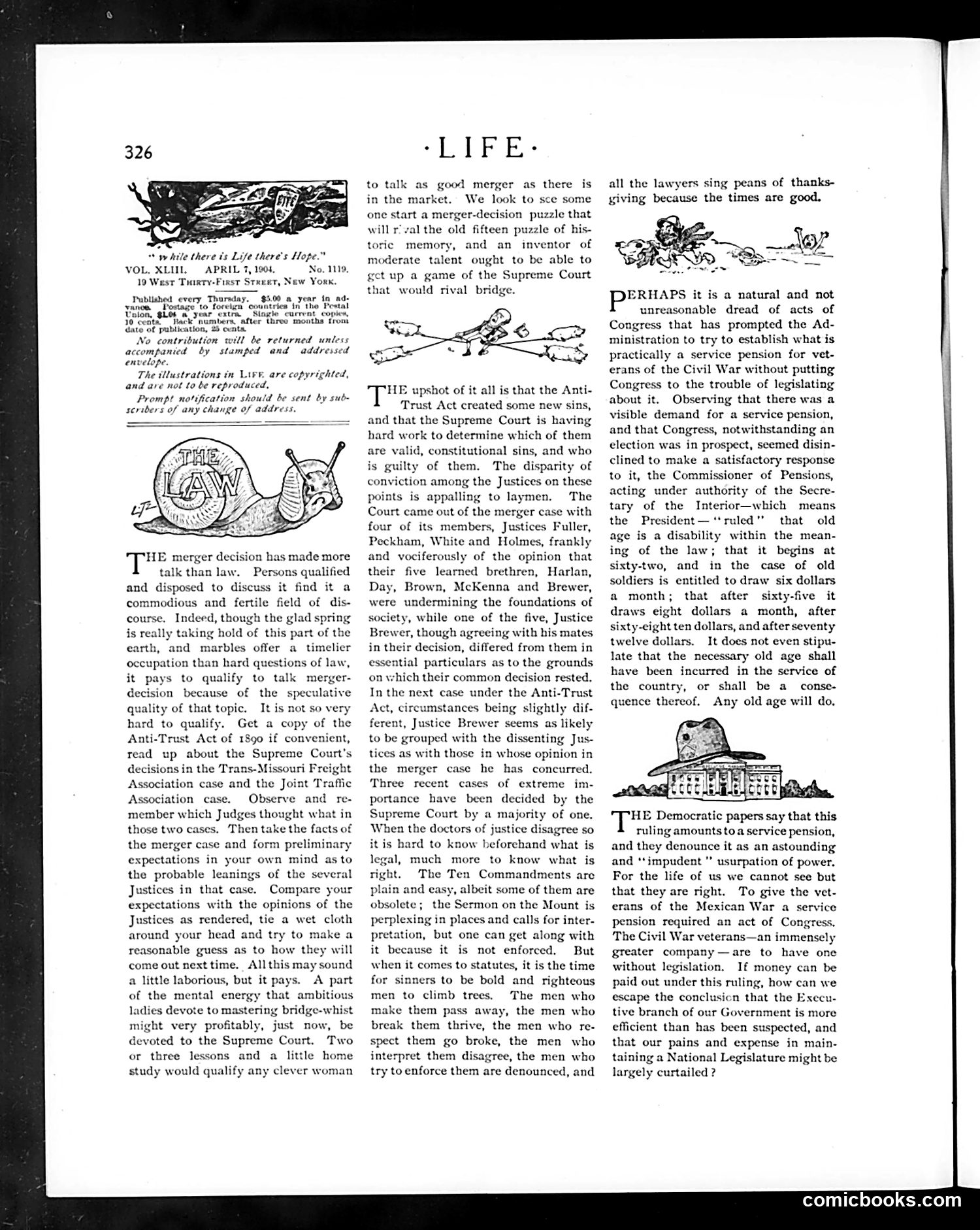
This page discusses the Supreme Court's recent merger decision and its implications for civil service pensions for Civil War veterans. The main satirical focus appears to be criticism of Congressional reluctance to establish a service pension for disabled Civil War veterans without legislative action. The cartoon at top-left shows a snail, likely symbolizing the slow pace of government action on veterans' benefits. The bottom illustration depicts a classical government building, reinforcing the theme of governmental responsibility. The text argues that Democratic opposition to the pension bill is hypocritical given their claims to support veterans, and suggests the Executive branch could act more efficiently than Congress on this matter. The satire targets political obstruction preventing aid to aging Civil War soldiers who served their country.
📄 Transcribed text from this page (OCR, searchable)
Machine-transcribed from the original scan — historical spelling and the odd misread are preserved.
VOL. XLII. APRIL 7, 1904, No. 1119, 19 West Tiagty-Fixst Street, New Yorn. Publiuhed every Thursday. | $500 a, year in. ad: 10 centa, Pa date of publication, No contribution will be returned untess accompanied by stamped and addressed envelope. The illustrations in LAF®. are copyrighted, and are not to be reproduced. Prompt notification should be sent by sub= scribers of any change of address. HE merger de $ made more talk than law. Persons qualified and disposed to discuss it find it a commodious and fertile field of dis- course, Indeed, though the glad spring is really taking hold of this part of the earth, and marbles offer a timelier occupation than hard questions of law, it pays to qualify to talk merger- decision because of the speculative quality of that topic. It is not so very hard to qualify, Get a copy of the Anti-Trust Act of 1890 if convenient, read up about the Supreme Court's decisions in the Trans-Missouri Freight Association case and the Joint Traffic Association case. Observe and re- member which Judges thought what in those two cases, Then take the facts the merger case and form preliminary expectations in your own mind as to the probable leanings of the several Justices in that case. Compare your expectations with the opinions of the Justices as rendered, tie a wet cloth around your head and try to make a reasonable guess as to how they will come out next time. All this may sound a little laborious, but it pays. A part of the mental energy that ambitious ladies devote to mastering bridge-whist might very profitably, just now, be devoted to the Supreme Court. Two or three lessons and a little home study would qualify any clever woman LIFE to talk as good merger as there is in the market. We look to sce some one start a merger-decision puzzle that will r'val the old fifteen puzzle of his- toric memory, and an inventor of moderate talent ought to be able to get up a game of the Supreme Court that would rival bridge. TT? upshot of it all is that the Anti- Trust Act created some new sins, and that the Supreme Court is having hard work to determine which of them are valid, constitutional sins, and who is guilty of them. The disparity of conviction among the Justices on these points is appalling to laymen. ‘The Court came out of the merger case with four of its members, Justices Fuller, Peckham, White and Holmes, frankly and vociferou of the opinion that their five learned brethren, Harlan, Day, Brown, McKenna and Brewer, were undermining the foundations of society, while one of the five, Justice Brewer, though agreeing with his mates in their decision, differed from them in essential particulars as to the grounds on which their common decision rested, In the next case under the Anti-Trust Act, circumstances being slightly dif- ferent, Justice Brewer seems as likely to be grouped with the dissenting Jus- tices as with those in whose opinion in the merger case he concurred. Three recent cases of extreme im- portance have been decided by the Supreme Court by a majority of one. When the doctors of justice di it is hard to know beforehand what is legal, much more to know what is right. The Ten Commandments are albeit some of them are ermon on the Mount is ing in places and calls for inter- pretation, but one can get along with it because it is not enforced. But when it comes to statutes, it is the time for sinners to be bold and righteous men to climb trees. The men who make them pass away, the men who break them thrive, the men who re- t them go broke, the men who interpret them disagree, the men who try to enforce them are denounced, and all the lawyers sing peans of thanks- giving because the times are good. ERHAPS it is a natural and not unreasonable dread of acts of Congress that has prompted the Ad- ministration to try to establish what is practically a service pension for vet- erans of the Civil War without putting Congress to the trouble of legislating about it. Observing that there was a visible demand for a service pension, and that Congress, notwithstanding an election was in prospect, seemed disin- clined to make a satisfactory response it, the Commissioner of Pension: acting under authority of the Sec: tary of the Interior—which means the President—‘‘ruled’’ that old age is a disability within the mean- ing of the law; that it begins at sixty-two, and in the case of old soldiers is entitled to draw six dollars a month; that after sixty-five it draws eight dollars a month, after sixty-eight ten dollars, and afterseventy twelve dol It does not even stipu- late that the necessary old age shall have been incurred in the service of the country, or shall be a conse- quence thereof. Any old age will do. Te Democratic papers say that this ruling amounts toa service pension, and they denounce it as an astounding and ‘‘impudent " usurpation of power. For the life of us we cannot see but that they are right. To give the vet- erans of the Mexican War a service pension required an act of Congress, The Civil War veterans—an immensely greater company —are to have one without legislation. If money can be paid out under this ruling, how can we ape the conclusion that the Execu- tive branch of our Government is more efficient than has been suspected, and that our pains and expense in main- taining a National Legislature might be largely curtailed ? comicbooks.com