
A complete issue · 32 pages · 1902
Life — May 8, 1902
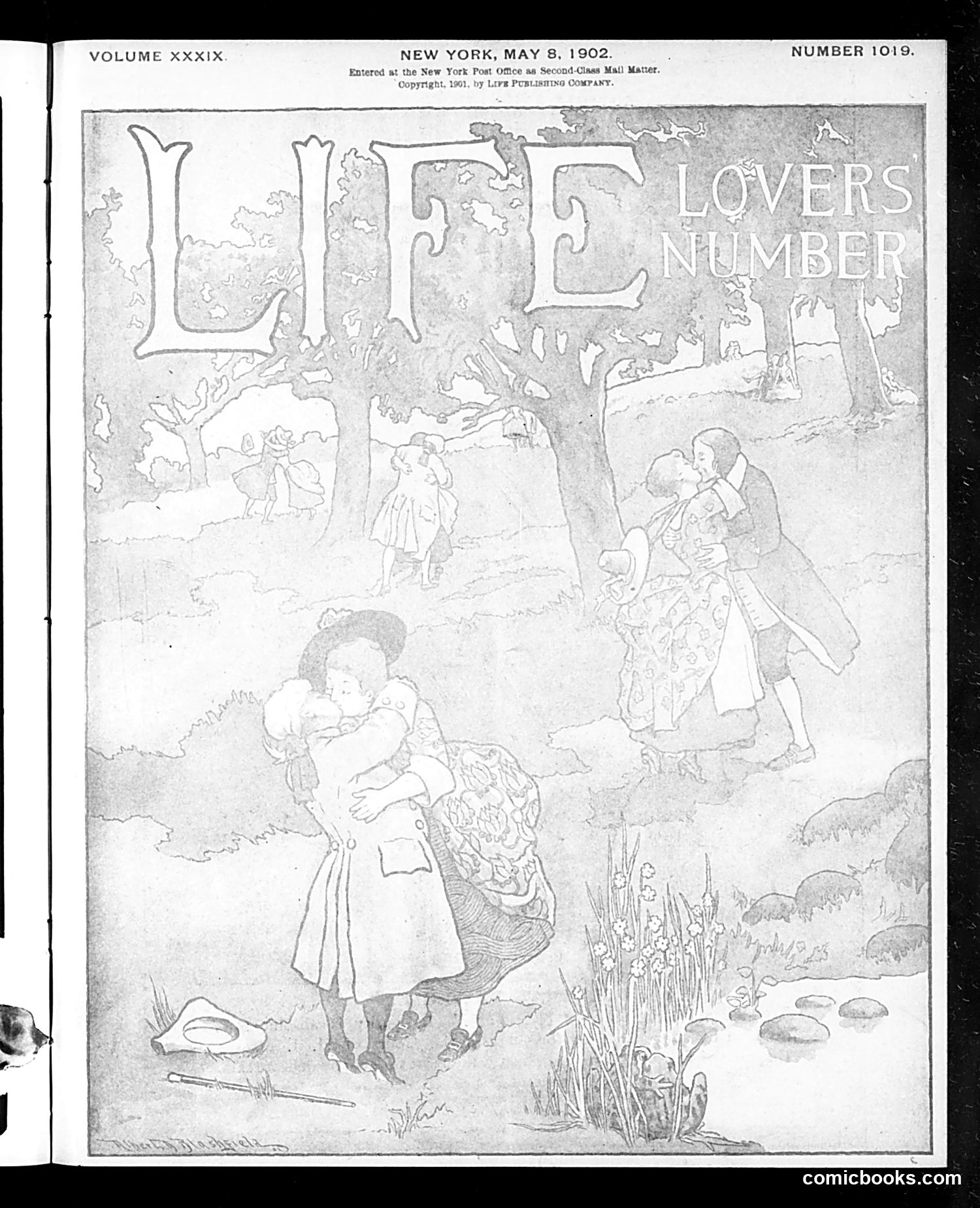
This is the cover of *Life* magazine's "Lovers Number" issue. The illustration depicts a romantic woodland scene with couples in Victorian-era dress engaged in courtship and flirtation. A woman in the foreground embraces a young man, while other couples stroll or interact in the background among trees and flowers. The cover is purely illustrative rather than political satire. It's a thematic issue celebrating romance and love, common subject matter for *Life's* lighter entertainment content. The refined, pastoral setting and elegant clothing reflect upper-class courtship conventions of the Edwardian era. This represents the magazine's broader satirical coverage beyond politics—addressing social customs, manners, and domestic life of early 20th-century America.
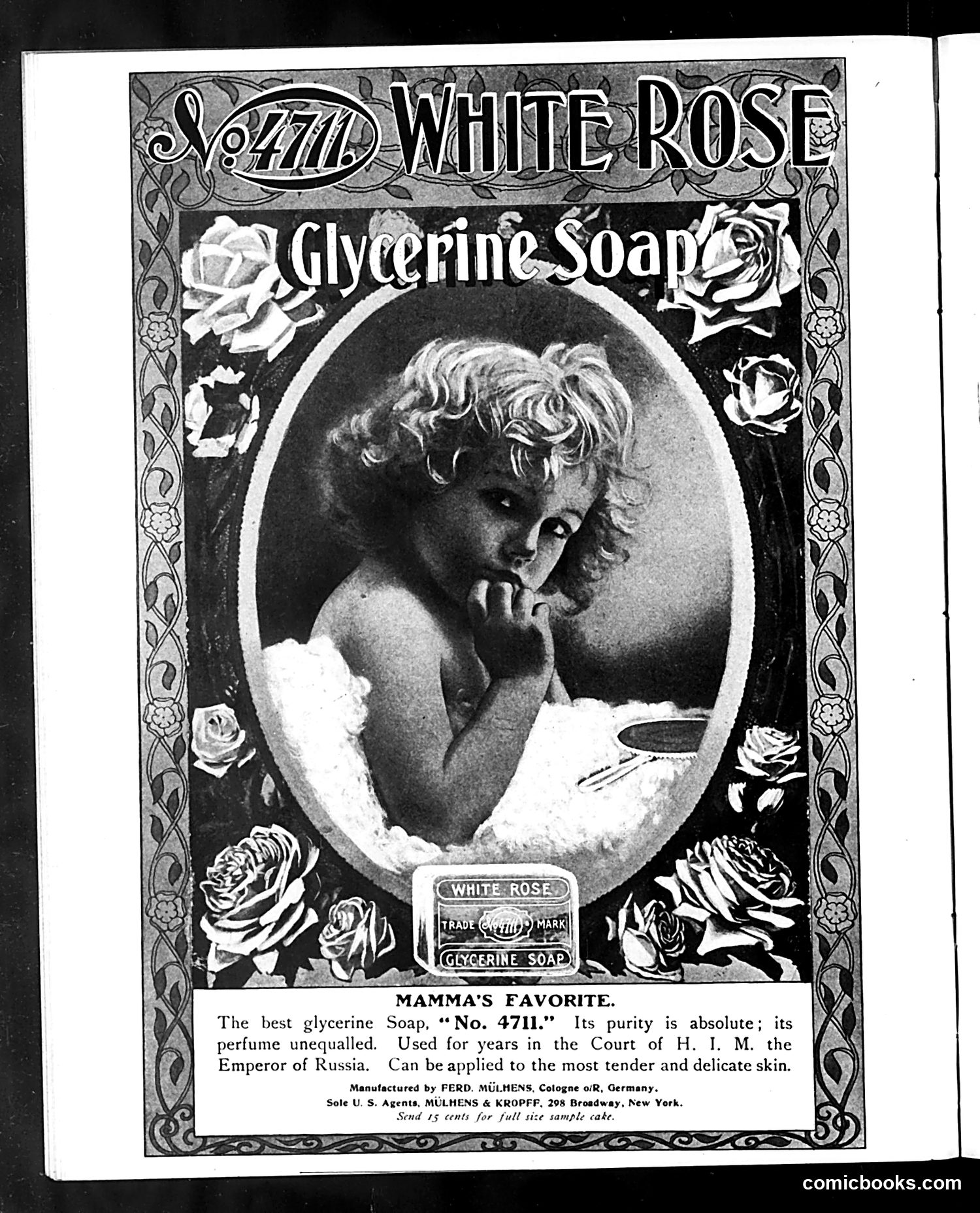
This is a **product advertisement, not satire or political commentary**. It advertises "White Rose" glycerine soap, marketed as "No. 471L" and branded "Mamma's Favorite." The ad's appeal relies on several period conventions: it features a cherubic child (a common advertising motif), surrounded by decorative roses, and claims the product was "used for years in the Court of H.I.M. the Emperor of Russia"—a status claim meant to suggest luxury and imperial approval. The text promises absolute purity, unequaled perfume, and suitability for delicate skin. The manufacturer was Ferd. Mülhens of Cologne, Germany, with U.S. distribution through Mülhens & Kropff in New York. This represents typical early 20th-century advertising strategy: associating products with nobility and children to imply safety and prestige.
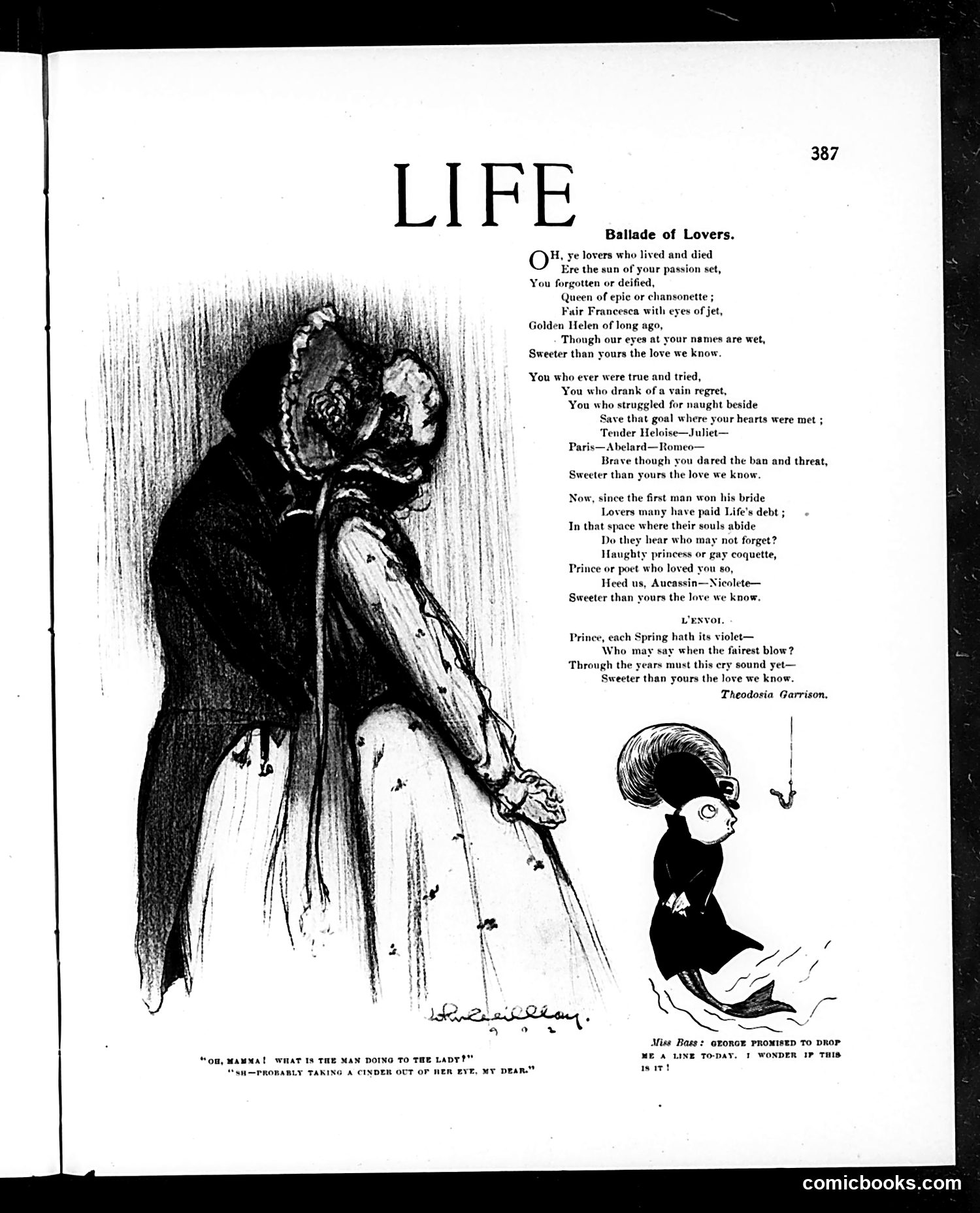
This page presents a "Ballade of Lovers"—a poem by Theodosia Garrison commemorating famous literary and historical lovers (Francesca, Helen of Troy, Héloïse, Juliet, etc.). The verse celebrates romantic devotion across centuries, with a refrain: "Sweeter than yours the love we know." The two cartoons are unrelated social humor: **Left cartoon**: Shows a couple embracing intimately, captioned with a wife's complaint about her husband's behavior with another woman—likely satirizing infidelity or indiscreet public displays. **Right cartoon**: "Miss Bias" (a recurring character) references George promising to drop her a line, expressing doubt he'll follow through—poking fun at romantic unreliability and broken promises in modern courtship. Both mock contemporary romantic behavior versus idealized literary love.
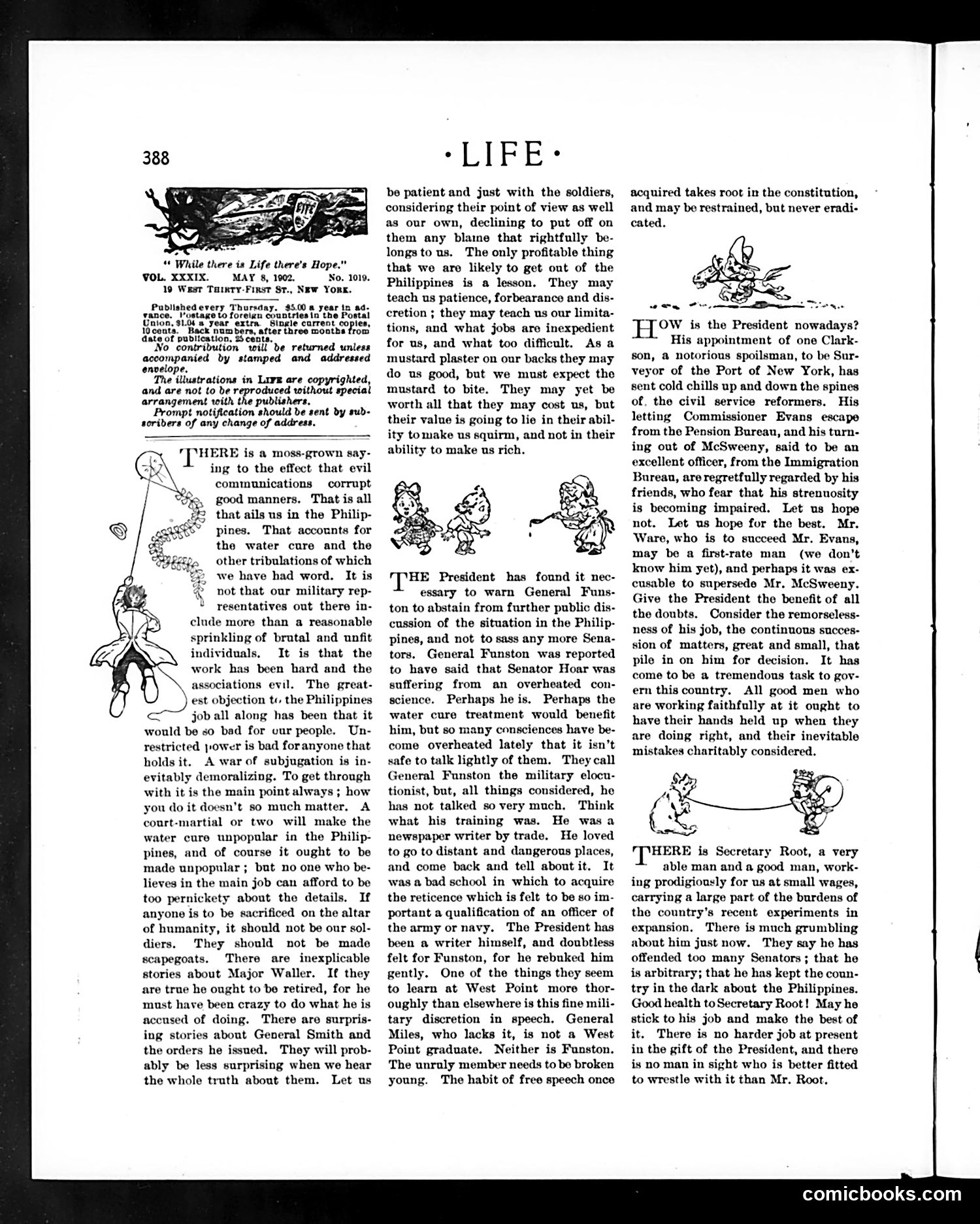
This page contains political commentary on U.S. military involvement in the Philippines. The text discusses General Funston, a military officer criticized for his approach to the conflict, and Secretary Root (the Secretary of War), portrayed as competent but burdened by the administration's Philippine policies. The satirical illustrations show figures in compromising positions—likely representing politicians or military leaders struggling with the Philippine situation's complexities. The cartoons suggest these officials are overwhelmed by the consequences of American imperial expansion. The overall message critiques how U.S. leadership handled the Philippine-American War: military decisions lack strategic coherence, public discourse about the conflict is constrained, and officials blame each other rather than addressing fundamental policy failures. The tone is mocking toward both military decisions and political accountability.
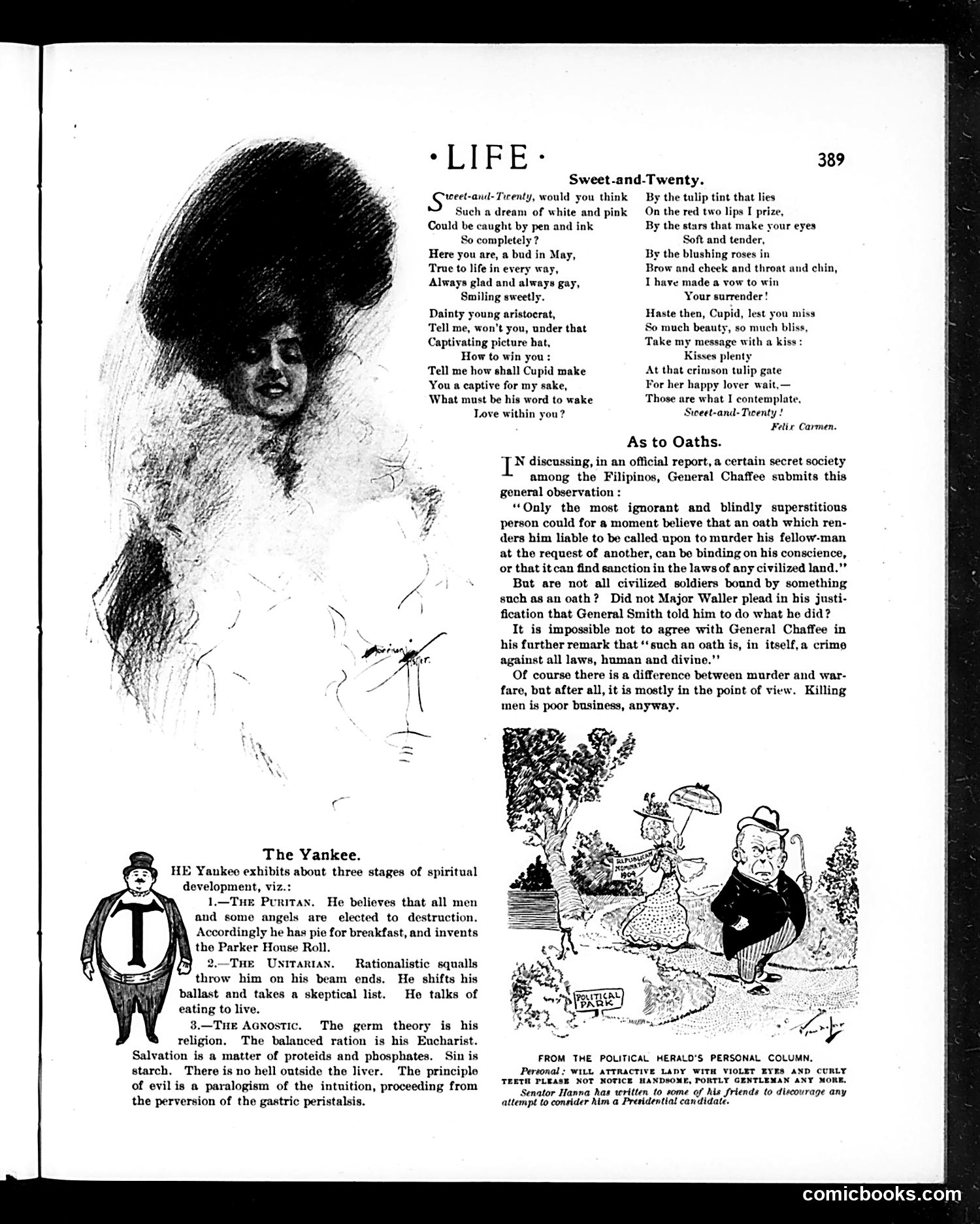
**"Sweet-and-Twenty"** is a romantic poem by Felix Carmen, addressed to a young woman, emphasizing her beauty and desirability. **"As to Oaths"** discusses whether soldiers can be bound by oaths to commit murder. It references General Chaffee's observation that "an oath is, in itself, a crime" if it compels someone to harm others. The text debates whether military obedience justifies killing, distinguishing between warfare and murder. **"The Yankee"** satirizes three stages of American spiritual/intellectual development: the Puritan (believing in predetermined salvation), the Utilitarian (rationalist), and the Agnostic (focused on material sustenance). It's social commentary on American philosophical evolution. The page mixes literary content with political/philosophical satire typical of Life's format during this period.
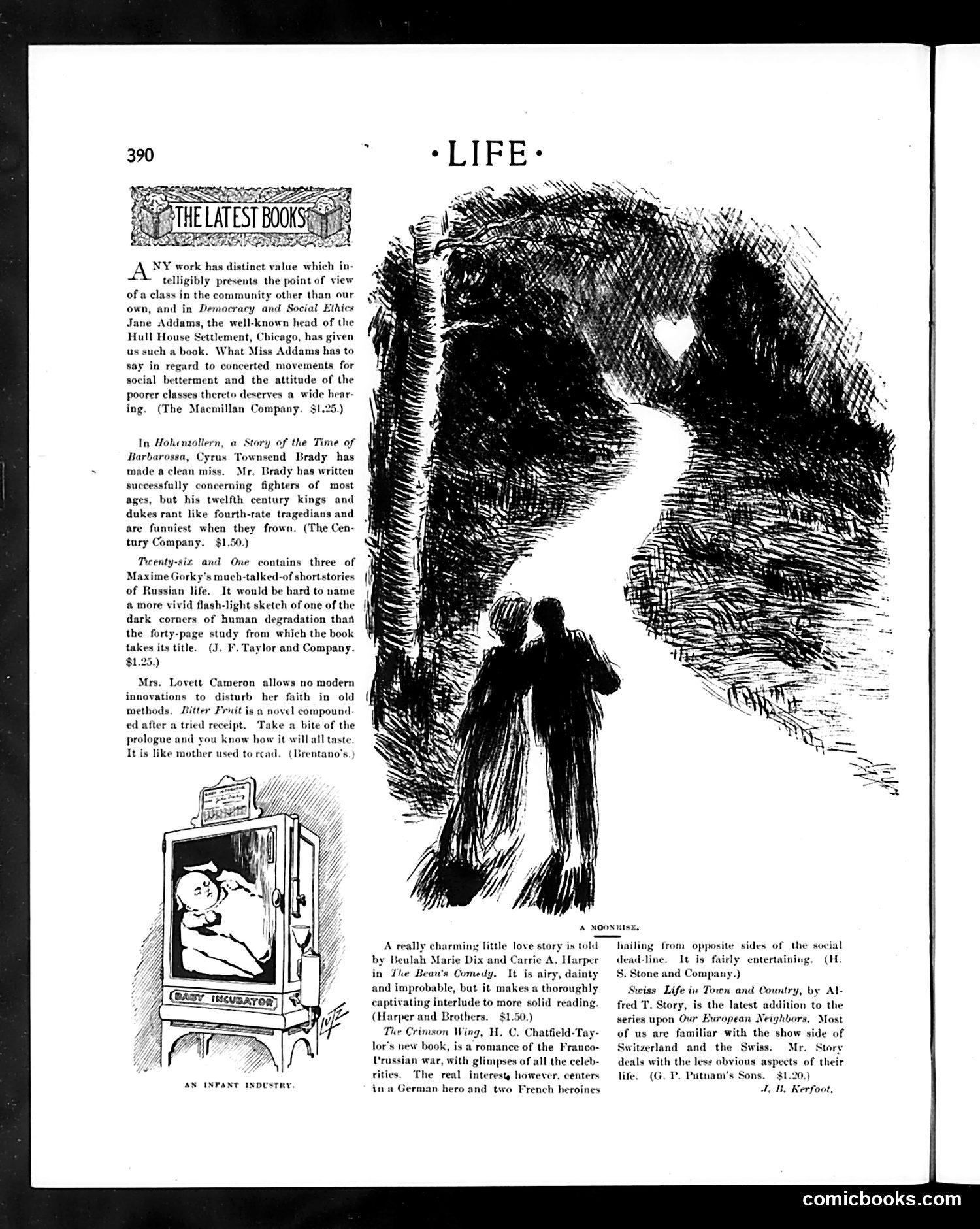
This page primarily features **book reviews** rather than political cartoons. The main illustration shows two figures standing before a dramatic cliff or chasm, accompanying a review of what appears to be a romance novel set during the Franco-Prussian War. A smaller cartoon at bottom left labeled "AN INFANT INDUSTRY" depicts a baby in an incubator, likely satirizing some contemporary commercial enterprise—though without additional context, the specific target is unclear. The page reviews several books including works by Jane Addams, Cyrus Townsend Brady, and Maxim Gorky, representing diverse literary interests of the early 20th century. The reviews emphasize literary merit and social significance rather than partisan politics.
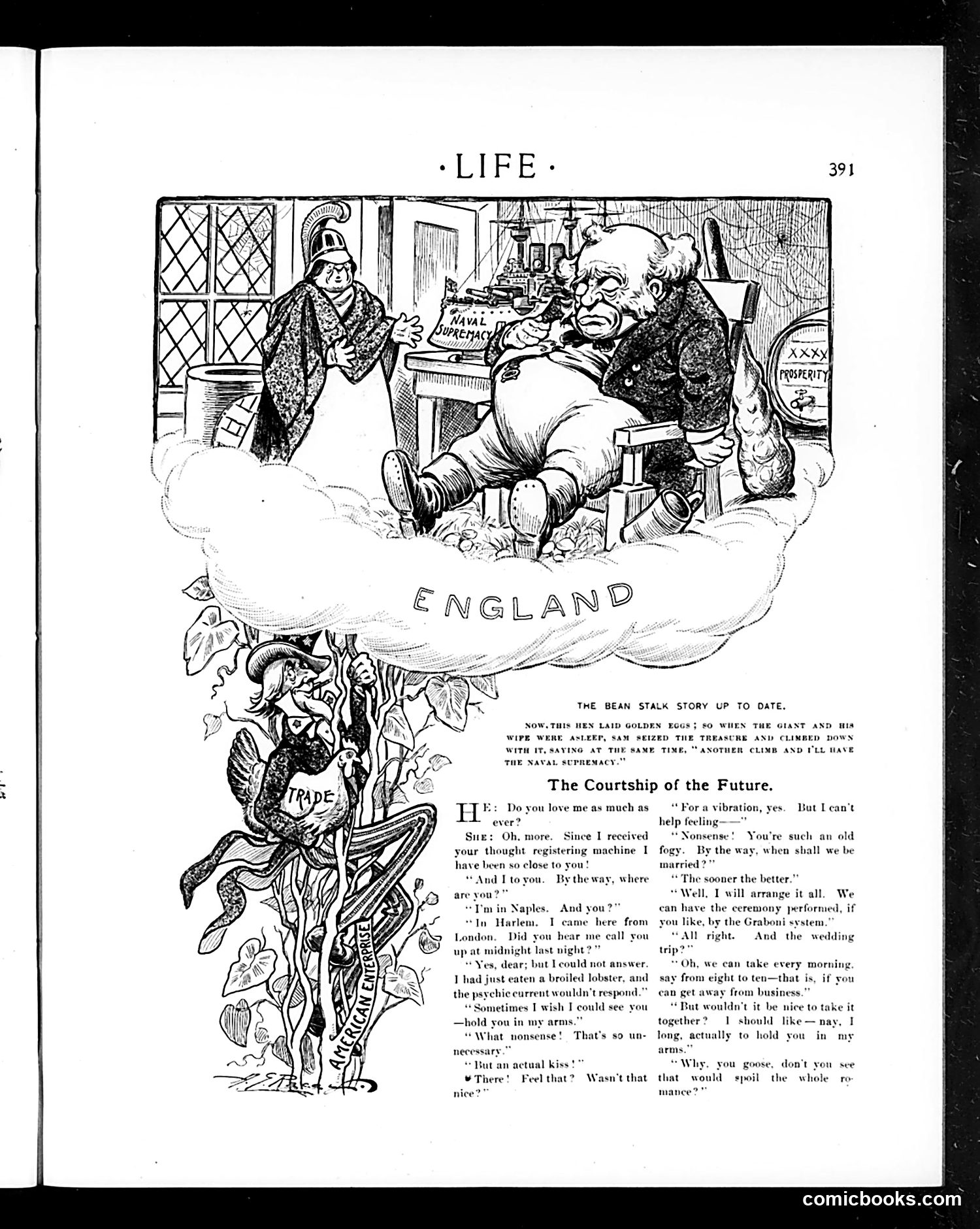
This satirical cartoon depicts **England as a giant beanstalk rooted in "Trade,"** with the upper pod containing figures in what appears to be a naval or governmental setting. The caption references Jack and the Beanstalk, with a character seizing "treasure" while another claims naval supremacy—suggesting commentary on **British imperial and naval dominance** and its economic foundations. Below, "The Courtship of the Future" presents a flirtatious dialogue between two figures discussing marriage arrangements via "thought registering machine" and the "Grabeni system"—likely satirizing emerging **technological mediation of relationships and modern courtship customs**. The overall page mocks both Britain's imperial pretensions and contemporary social anxieties about mechanization affecting human connection.
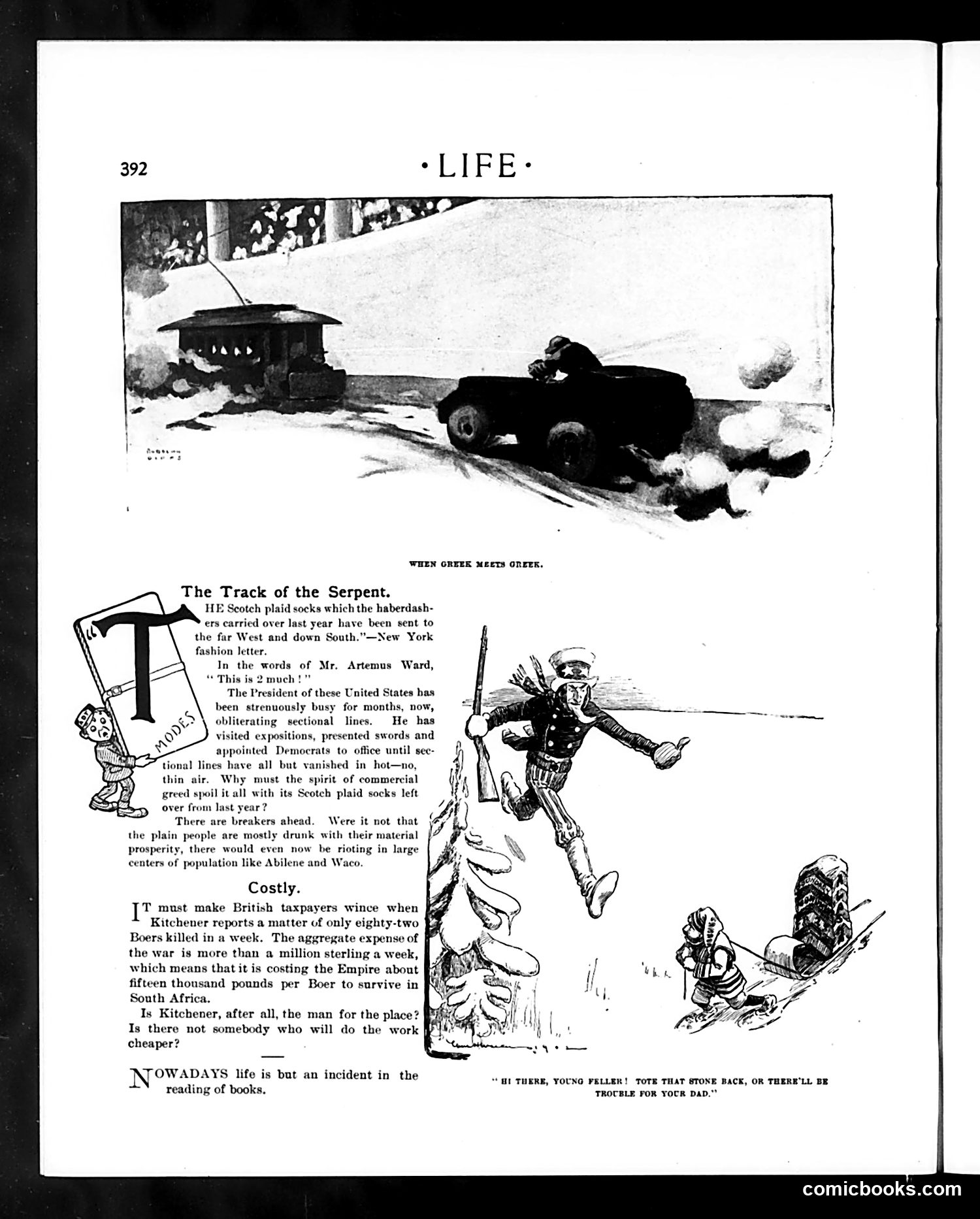
This page contains two satirical pieces from *Life* magazine: **"The Track of the Serpent"** mocks President Theodore Roosevelt's recent diplomatic activities. The text references his "strenuous" touring of expositions and visiting military installations. The satire suggests Roosevelt's energy and activity—symbolized by his characteristic vigor—leave behind only depleted resources, particularly the "Scotch plaid socks" from last year's trade, implying his policies provide little lasting benefit. The illustration shows a racing car, likely representing Roosevelt's notorious recklessness. **"Costly"** critiques British military spending during wartime, specifically attacking Secretary Kitchener's report of only 82 beer deaths in a week. The satire questions whether massive wartime expenditures (over one million sterling weekly) justify such minimal casualties among troops, sarcastically asking if Kitchener truly is the right man to reduce costs. Both pieces use sharp wit to challenge contemporary political decisions.
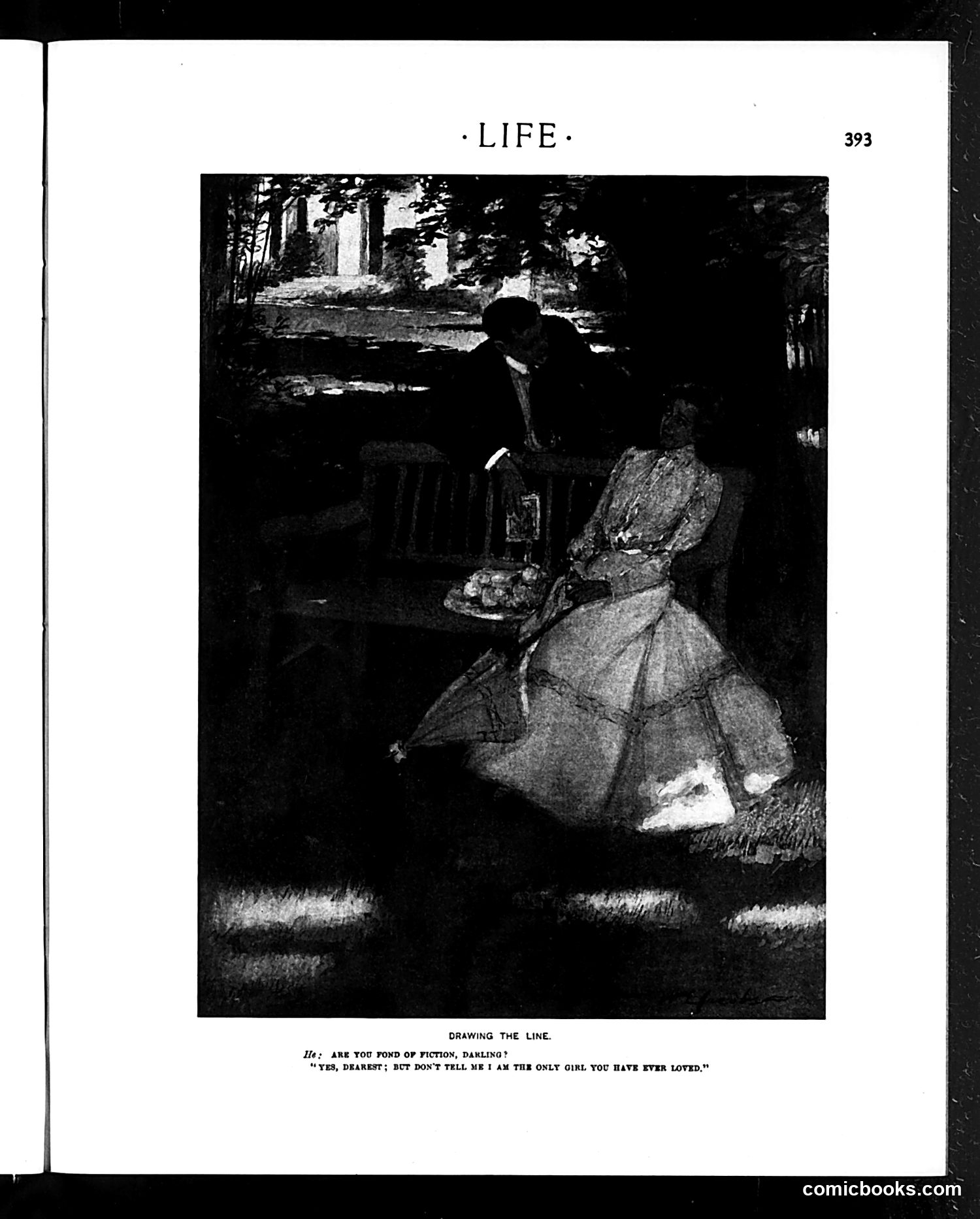
This illustration depicts a romantic scene between two figures in an outdoor garden setting. The caption frames it as a dialogue about romantic fiction: one character asks if the other is "fond of fiction, darling?" The response—"Yes, dearest; but don't tell me I am the only girl you have ever loved"—satirizes the conventions of romantic storytelling. The joke targets the clichéd nature of romantic declarations in popular fiction. The woman's request ironically exposes how even while enjoying fictional romance, people recognize its artificiality and predictability. She's asking him not to use the tired, supposedly-exclusive language that appears in every romantic narrative. The satire comments on how formulaic and insincere popular romantic literature had become by mocking its well-worn tropes.
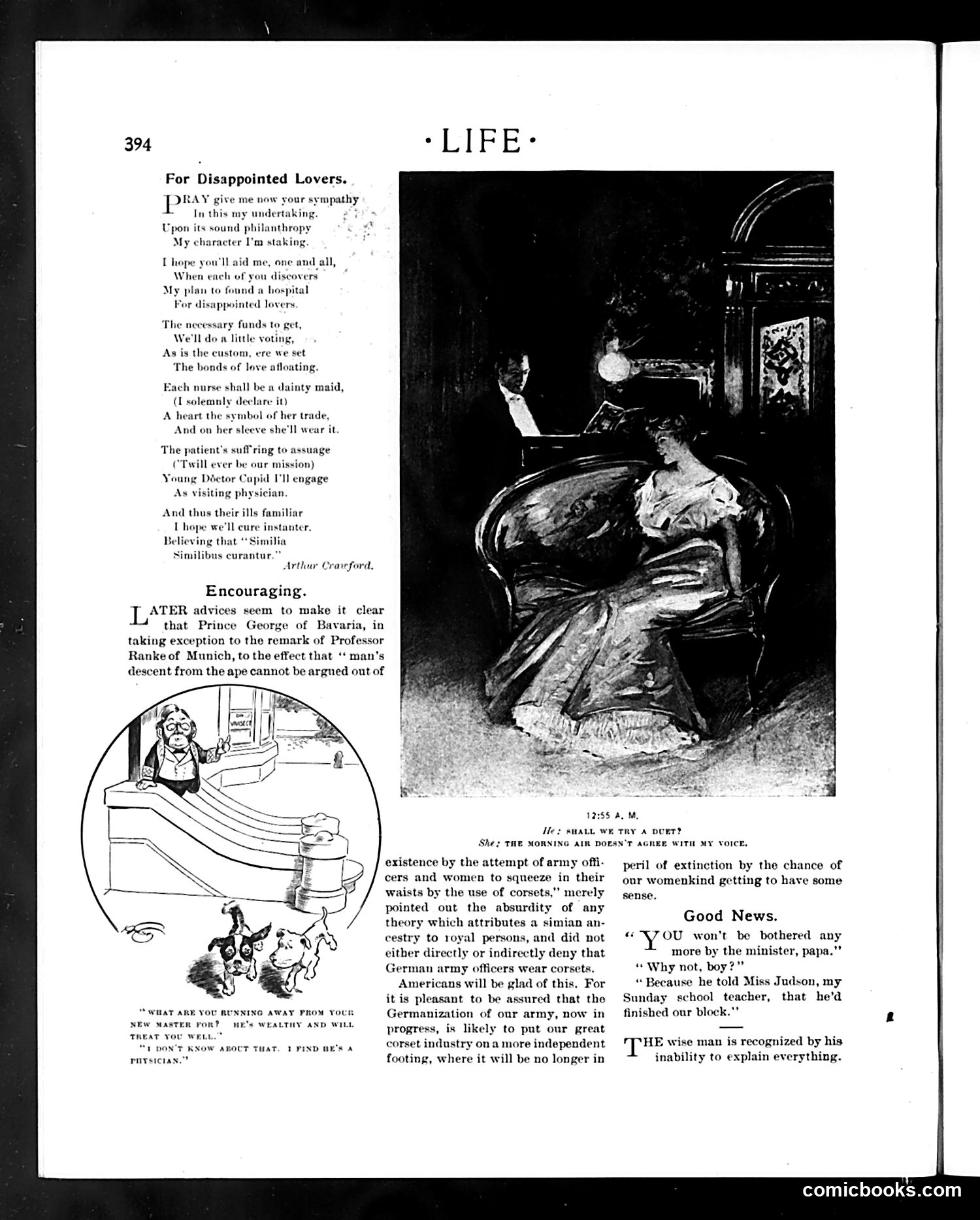
This page contains two distinct satirical pieces: **"For Disappointed Lovers"** (top left): A poem by Arthur Crawford offering mock-serious advice to romantic disappointments, proposing to establish a hospital for jilted lovers and suggesting "Cupid" be hired as physician. **"Encouraging"** (main article): Discusses Prince George of Bavaria's claim that "man's descent from the ape cannot be argued out of" existence. The cartoon below mocks this by depicting German army officers in corsets, visually suggesting they're descended from apes. The satire critiques both evolutionary theory and German militarism, suggesting that if Germanization of the American army proceeds, the corset industry will suffer economically—implying German soldiers are effeminate or ridiculous. The humor relies on anti-German sentiment and gender stereotypes common to the era.
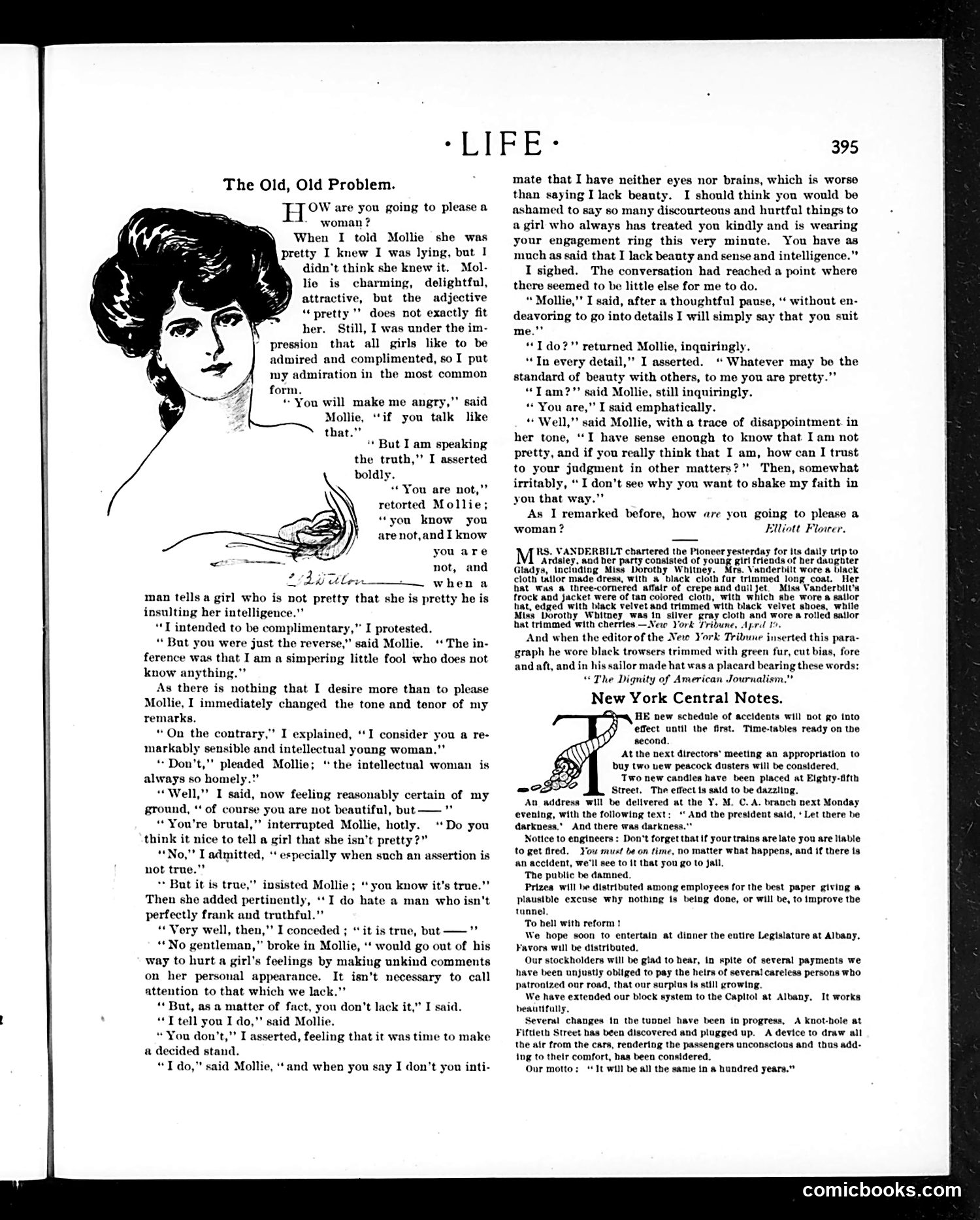
This satirical piece depicts a conversation between a narrator and a woman named Mollie about beauty, intelligence, and compliments. The cartoon illustrates a timeless social debate: whether telling an unattractive woman she lacks beauty is honest but hurtful, or whether politeness requires flattery. The satire targets gender dynamics and courtship conventions of the era. The narrator argues that complimenting a woman solely on being "pretty" is insulting to her intellect. Mollie counters that she values being considered pretty and resents suggestions she should base self-worth on intelligence instead. The piece mocks both parties—the narrator's patronizing "logic" and Mollie's contradictory demands for honest judgment while wanting flattery. It reflects early 20th-century tensions between emerging feminist ideals and traditional romantic expectations.
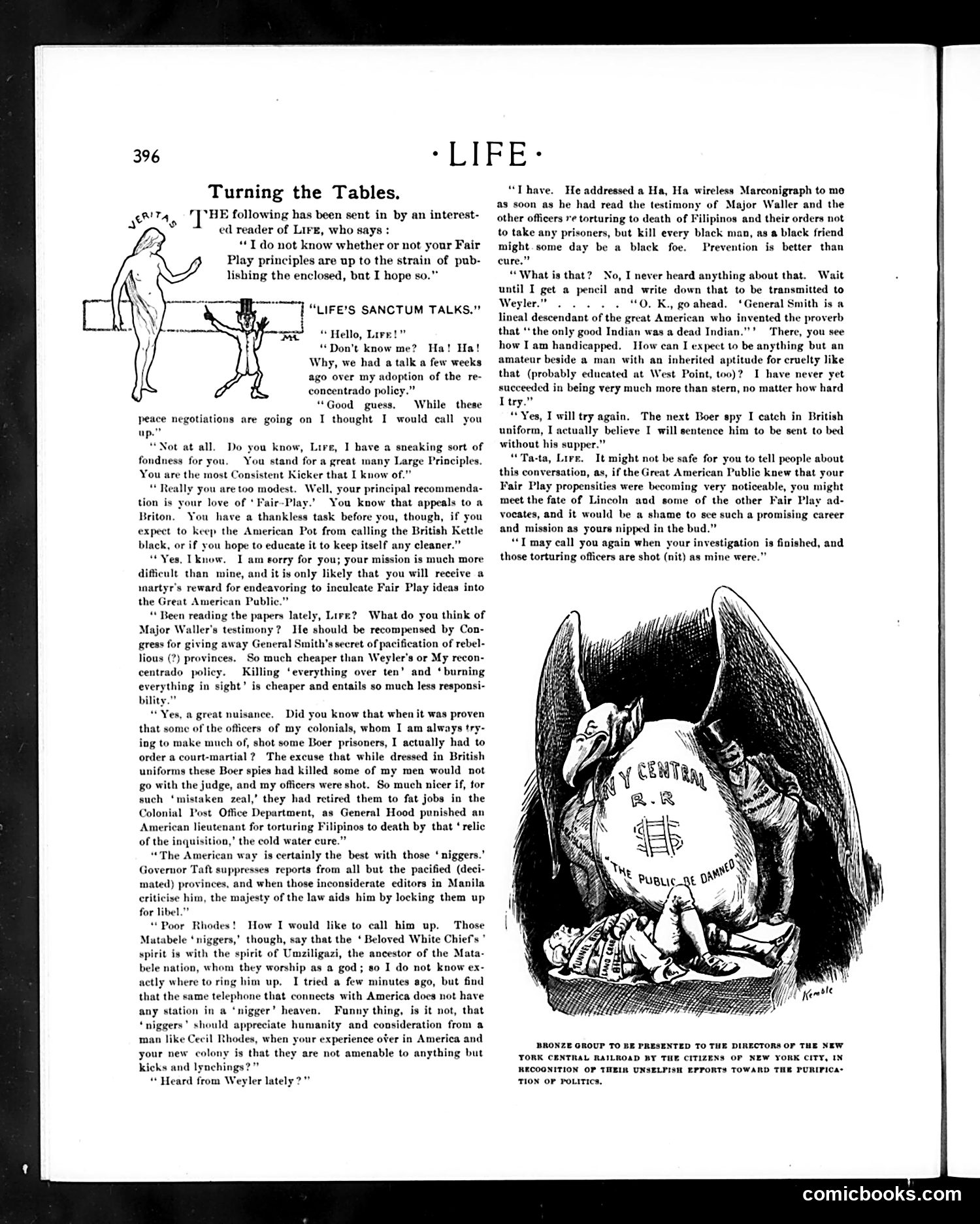
This page satirizes American military conduct in the Philippines during the colonial period. The dialogue between "LIFE" (personified as Lady Liberty) and an unnamed interlocutor discusses alleged war crimes: torture of prisoners, extrajudicial killings, and abuses justified by "Fair Play" principles. The cartoon (right) depicts a bound Filipino prisoner labeled "ENEMY OF THE PUBLIC—DE DAMNATUS," criticizing American treatment of prisoners and soldiers. The text references General "Waller" and "Weyler," comparing American tactics unfavorably to Spanish colonial brutality. It mocks the contradiction between America's stated democratic values and actual battlefield conduct, particularly regarding torture ("water cure") and summary executions of prisoners. The satire targets hypocrisy: America claims moral superiority while committing atrocities identical to those it condemned in Spain's Philippine colonization.
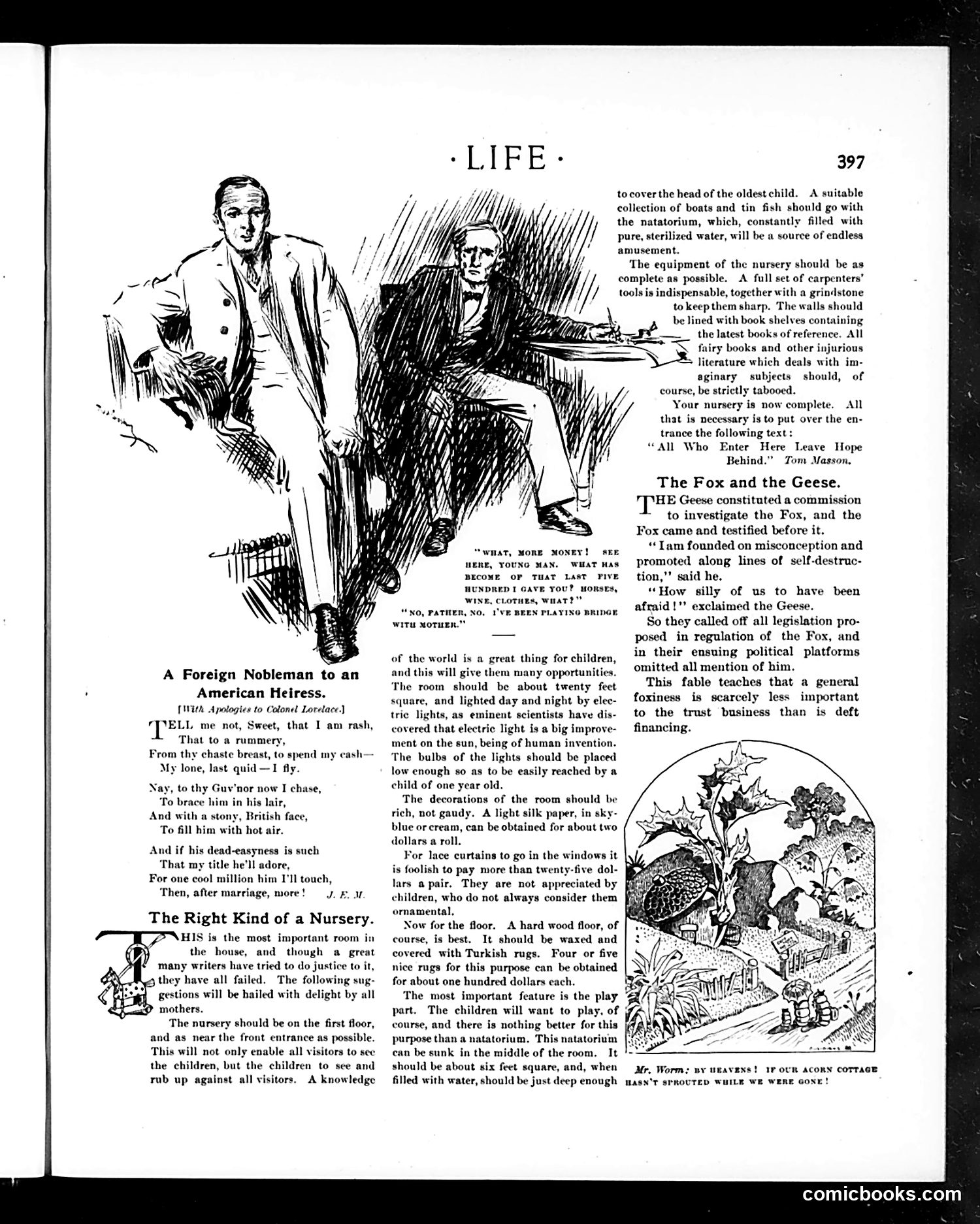
This page contains three distinct satirical pieces: **"A Foreign Nobleman to an American Heiress"** mocks the common practice of impoverished European aristocrats marrying wealthy American heiresses for their money. The poem depicts a British nobleman cynically pursuing an American girl's father ("Guv'nor") to extract a "cool million," planning further financial exploitation after marriage. **"The Right Kind of a Nursery"** is deadpan satire on wealthy American parenting. It mockingly advocates absurdly expensive, impractical nursery design—$25 lace curtains children won't appreciate, electric lights at toddler height (dangerously), a swimming pool indoors—while the accompanying cartoon shows a father complaining about money spent on bridge games and clothes. **"The Fox and the Geese"** is Aesop-style fable satire about political naivety. Geese investigate a fox, who claims he's "self-destructive," convincing them to abandon protective legislation. The moral critiques gullible politicians who accept reassurances from those they should regulate. All three target American wealth, aristocratic fortune-hunting, and political/parental foolishness.
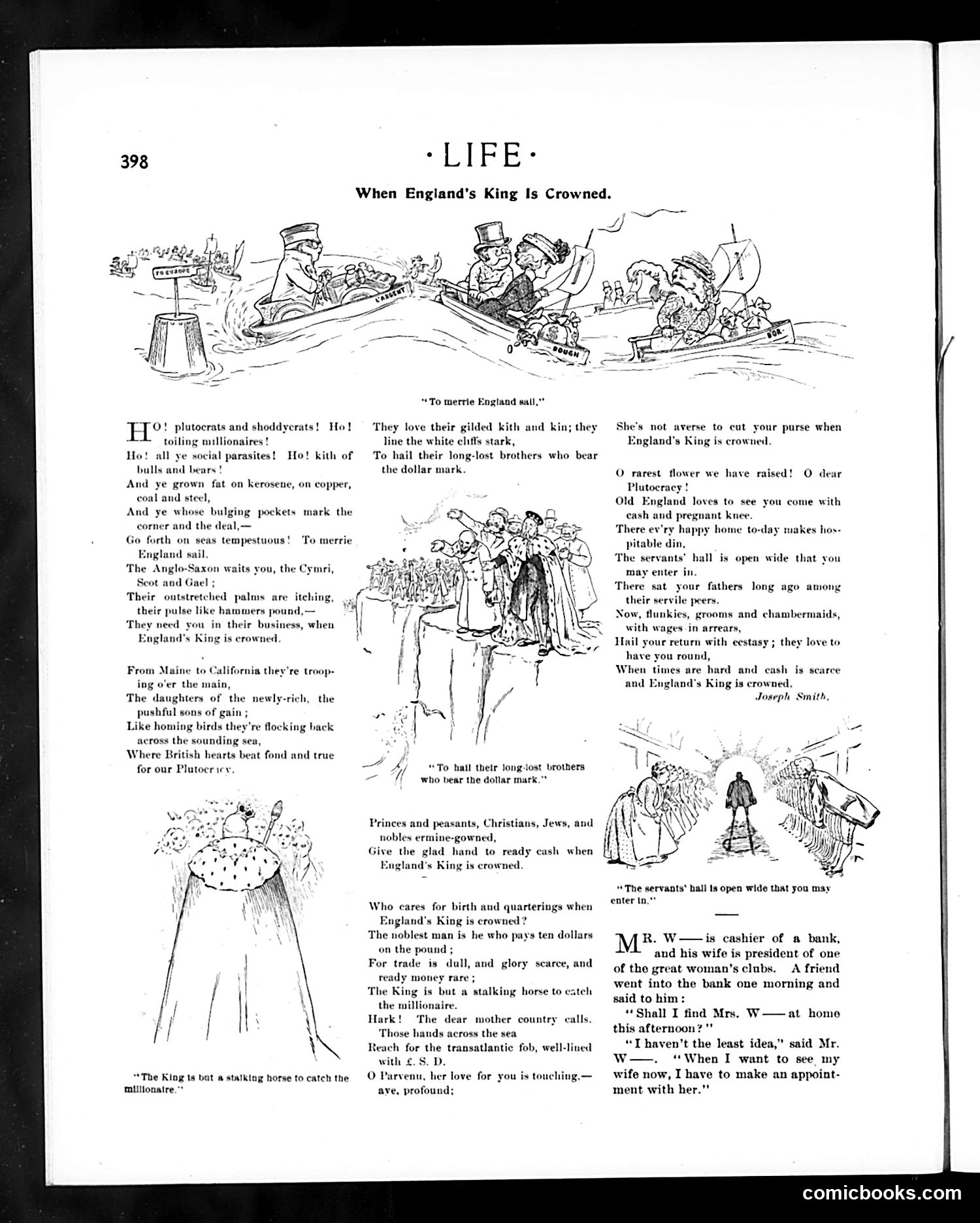
This satirical poem by Joseph Smith mocks wealthy American plutocrats and newly rich "social parasites" who flock to England during a royal coronation. The central joke: these self-made millionaires—dismissed as "shoddyrats" who made fortunes in kerosene, copper, and steel—are welcomed by cash-strapped British nobility despite their lowborn origins. The satire cuts both ways: American nouveaux riches embarrass themselves pursuing social legitimacy abroad, while impoverished English aristocrats cynically court their money ("The King is but a stalking horse to catch the millionaire"). The phrase "hands across the sea" and references to servants' halls emphasize the irony—these Americans' fathers were servants; now they're treated as equals when they bring cash. The page's sidebar anecdote reinforces themes of social pretension and marital discord among the wealthy, fitting the magazine's class-conscious humor typical of Gilded Age satire.
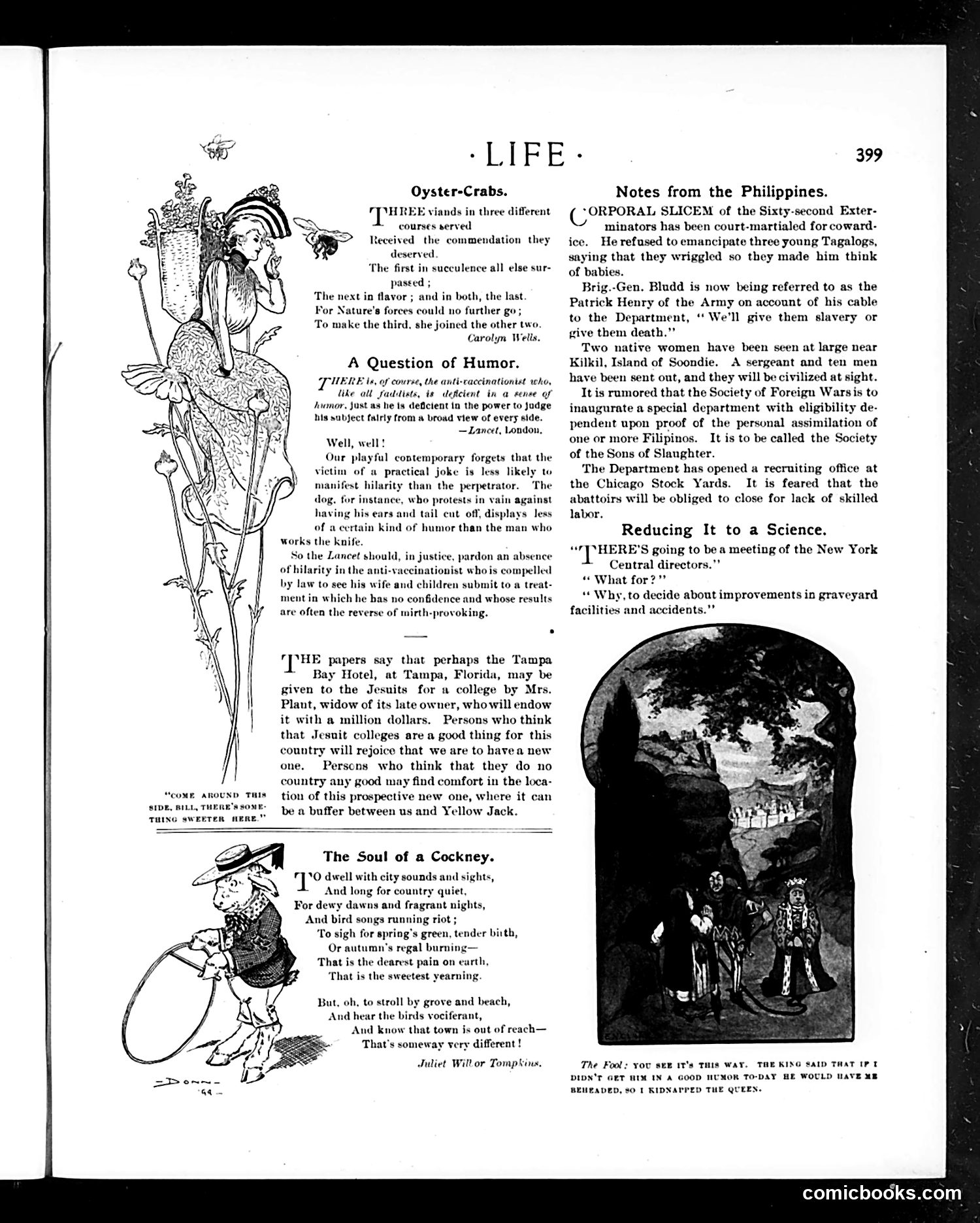
This page contains three distinct satirical pieces: **"Oyster-Crabs"** and **"A Question of Humor"**: The humor piece attacks the *Lancet* magazine's criticism of anti-vaccinationists, arguing they lack humor. Life's counterargument: anti-vaccinationists aren't the joke-tellers but the victims—compelled by law to vaccinate their families against their will. The piece sarcastically suggests they have reason to find vaccination unfunny since results are "often the reverse of mirth-provoking." **"Notes from the Philippines"**: Dark satire on the American military occupation following the Spanish-American War. It mocks brutality toward Filipino civilians and resistance, using absurdist scenarios: a soldier court-martialed for refusing to enslave Tagalogs because they "wriggled...like babies"; a general promising "slavery or death"; recruiting at slaughterhouses. The satire indicts American imperialism and violence disguised as civilization. **"The Soul of a Cockney"**: A poem contrasting urban nostalgia with actual rural disappointment—social commentary on working-class aspirations. The page critiques compulsory vaccination policies and American military conduct in the Philippines.
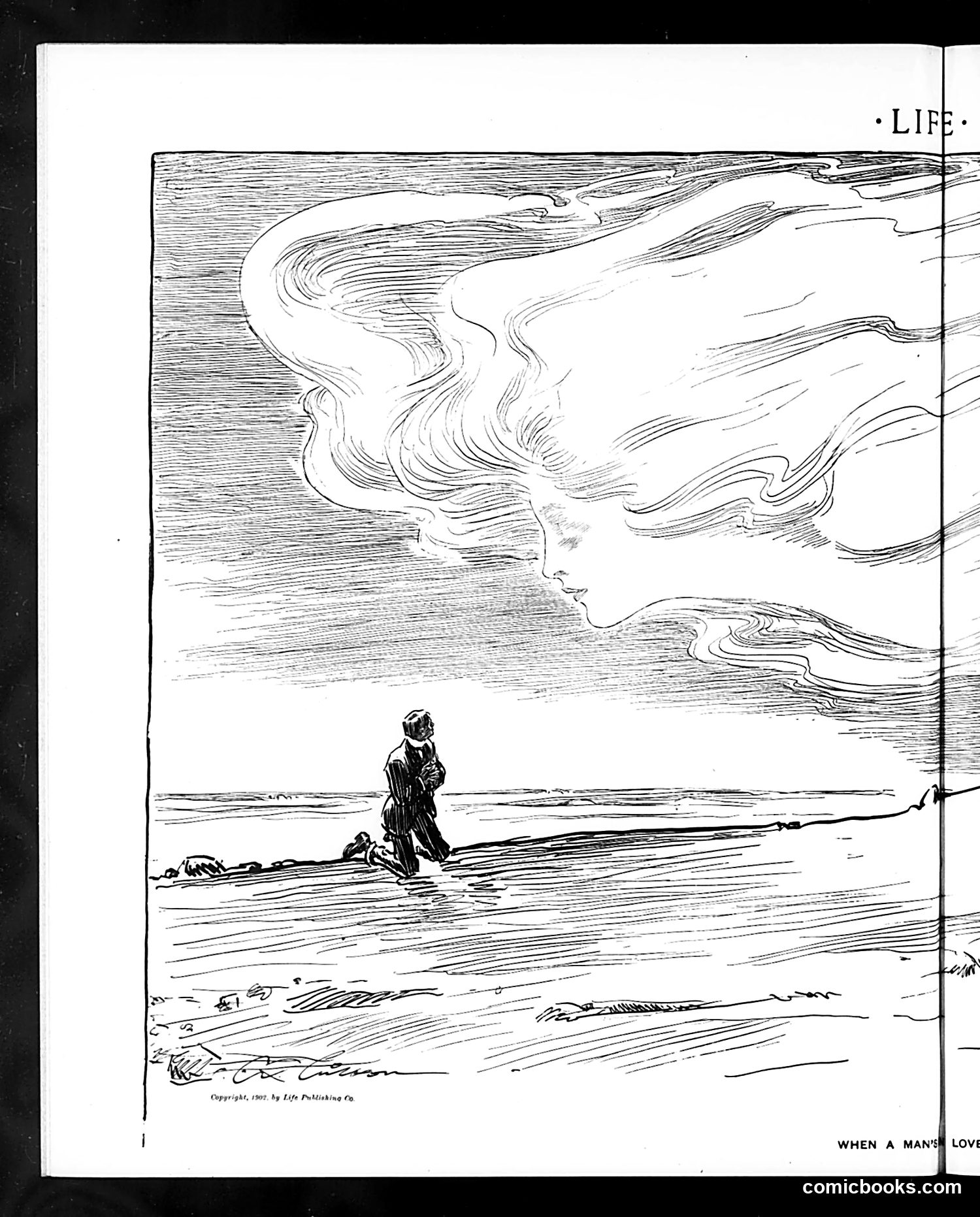
This is a symbolic illustration rather than a political cartoon. The image shows a solitary figure kneeling on a beach, gazing up at a enormous ethereal female face formed by clouds in the sky. The composition is romantic and dreamy, with the woman's face rendered in flowing, wind-swept lines that merge with the cloudy atmosphere. The page title "LIFE" appears at top right, and the partial caption reads "WHEN A MAN'S LOVE" (text appears cut off). This appears to be illustrating idealized, romantic love—depicting a man's emotional longing or devotion as a kind of spiritual or transcendent vision. The artistic style emphasizes the ethereal, almost unattainable nature of the idealized beloved. Without the complete caption, the exact satirical point remains unclear, though it likely comments on romantic idealism or fantasy.

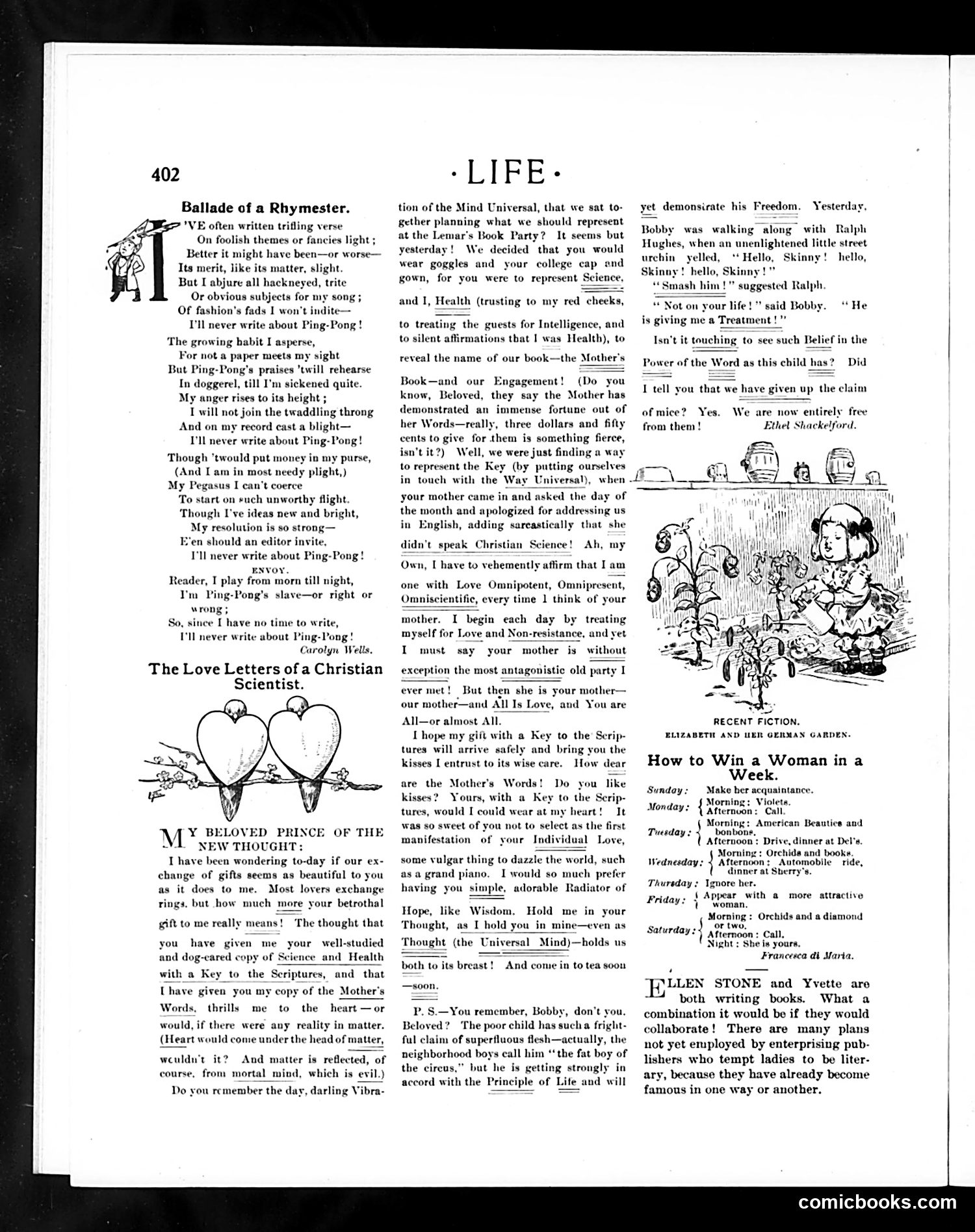
This page contains two satirical pieces mocking contemporary fads and beliefs: **"Ballade of a Rhymester"** ridicules the Ping-Pong craze. The poem is a humorous paradox: the poet swears never to write about Ping-Pong, yet the entire poem obsesses over it. The envoy reveals the joke—he actually plays Ping-Pong constantly ("I'm Ping-Pong's slave") and has no time to write anything else. This satirizes how the game dominated public attention and media coverage around the early 1900s. **"Love Letters of a Christian Scientist"** parodies Christian Science beliefs through exaggerated romantic correspondence. The writer treats abstract concepts (Health, Love, the "Mother's Words," mental "treatments") as gifts equivalent to traditional engagement tokens. The satire peaks when the suitor's mother sarcastically notes they speak "Christian Science" rather than English—mocking the movement's specialized jargon and its adherents' perceived pretentiousness. The joke targets both the religion's philosophical abstraction and its followers' intensity. Both pieces use ironic, overwrought language to expose contemporary obsessions: consumer fads and religious enthusiasm.
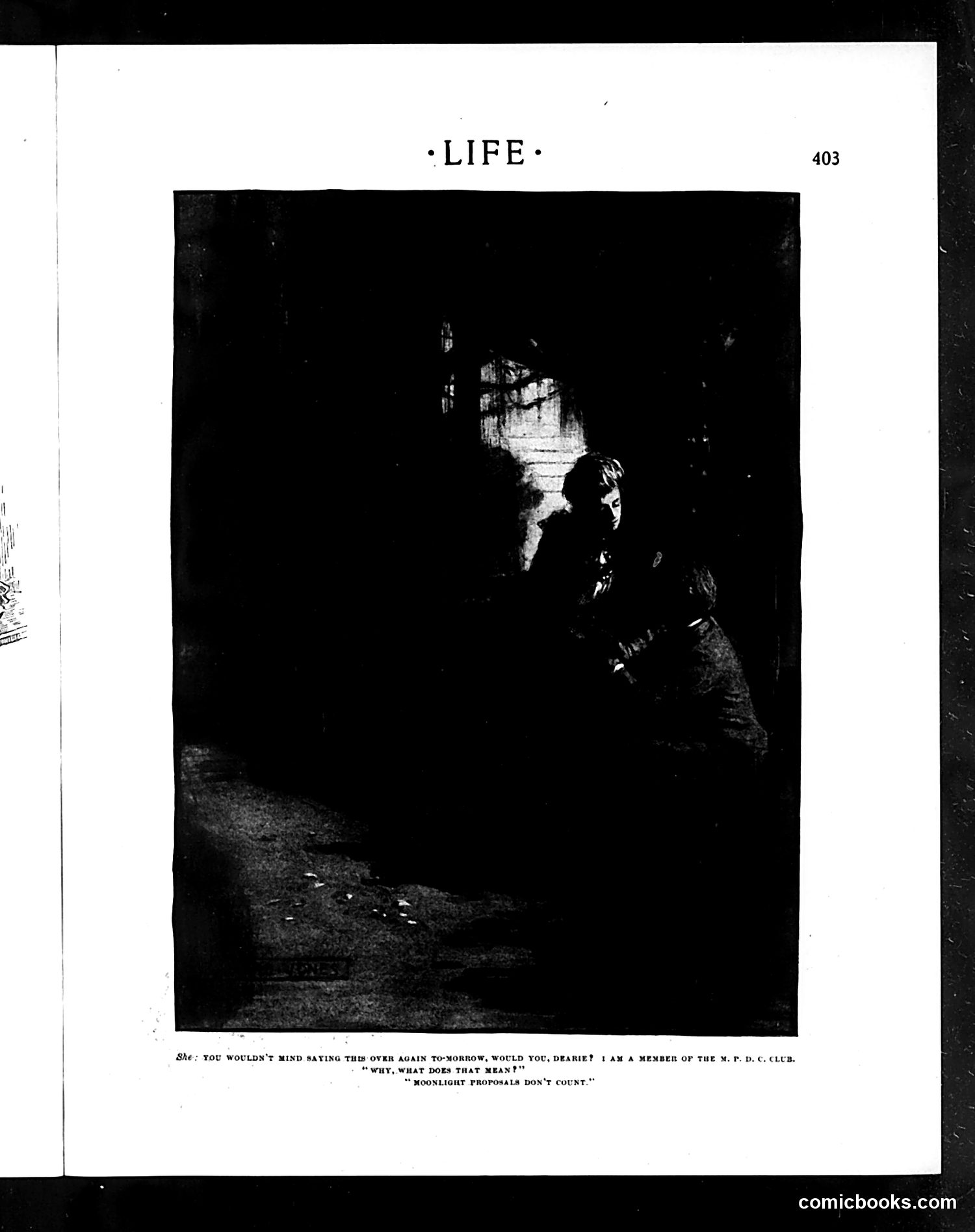
This is a romantic scene satirizing a common social convention of the era. A man proposes to a woman by moonlight, but she responds with a humorous deflection: she's a member of the "M.P.D.C. Club"—"Moonlight Proposals Don't Count." The joke mocks the era's courtship rituals, suggesting that proposals made romantically under moonlight were considered non-binding or insincere by some women. The satire implies that men used romantic atmospherics (moonlight) as shortcuts to genuine commitment, and that savvy women had created an informal "club" to protect themselves from such superficial proposals. The cartoon critiques both male romanticism as performative and female skepticism about male sincerity in courtship.
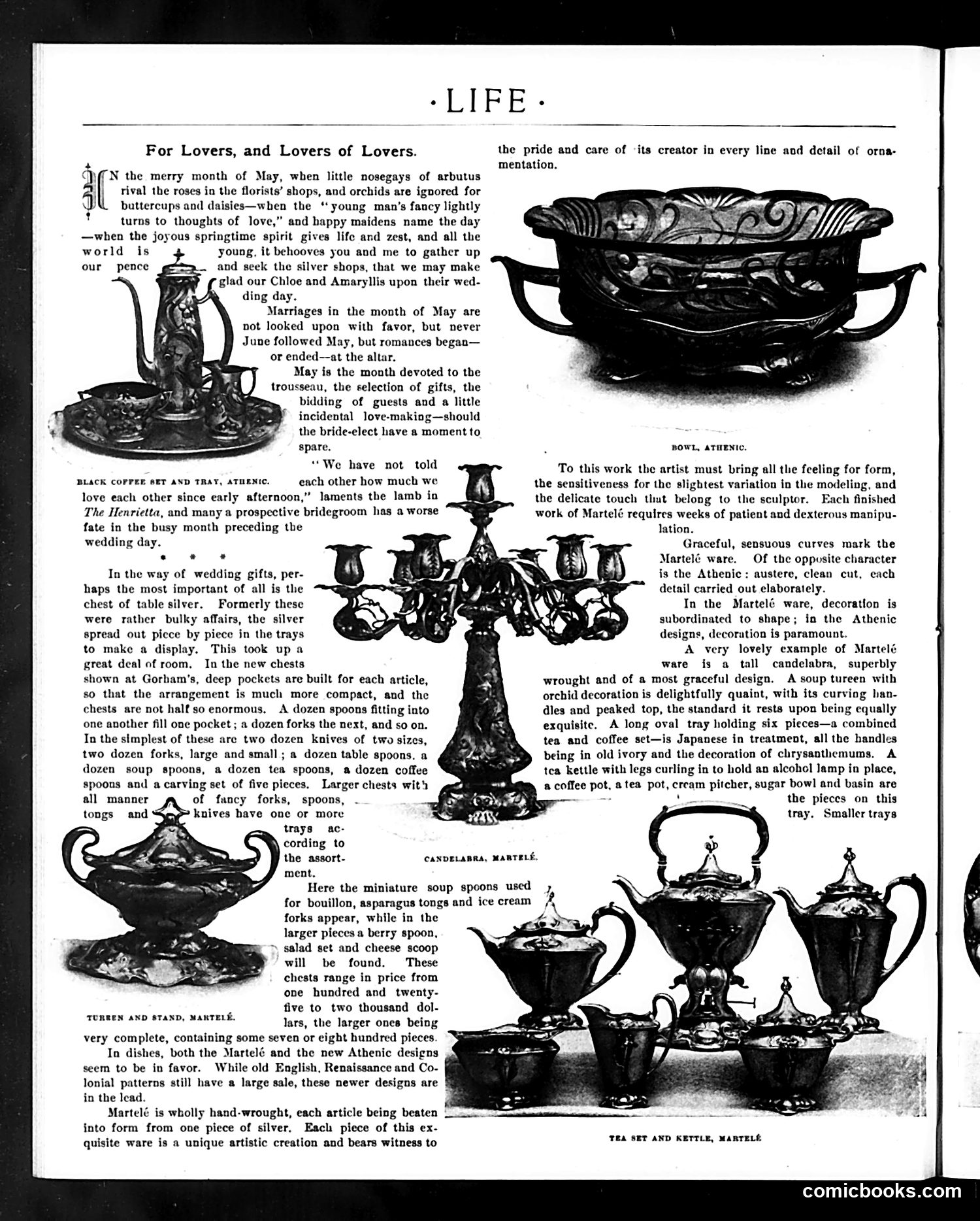
This is **not a political cartoon** but rather a **product feature article** about luxury wedding gifts, specifically silver flatware and serving pieces from Gorham's, a prestigious silverware manufacturer. The page promotes two competing design styles: **Martelé** (flowing, ornate Art Nouveau curves) and **Athenic** (austere, classically detailed). The text explains how Gorham's engineered compact silver chests with nested compartments—an innovation allowing brides to store dozens of pieces efficiently rather than displaying them loosely. The article frames wedding gifts within a broader romantic sentiment about May marriages and young love, using literary references (mentioning "The Henrietta" play) to appeal to educated readers. The numerous photographs showcase elaborately decorated serving pieces—candlesticks, tureens, tea sets—emphasizing craftsmanship and artistic merit to justify premium pricing ($125-$2,000). Essentially, this is **upscale advertising disguised as editorial content**, targeting affluent brides and gift-givers through appeals to romance, taste, and social status.
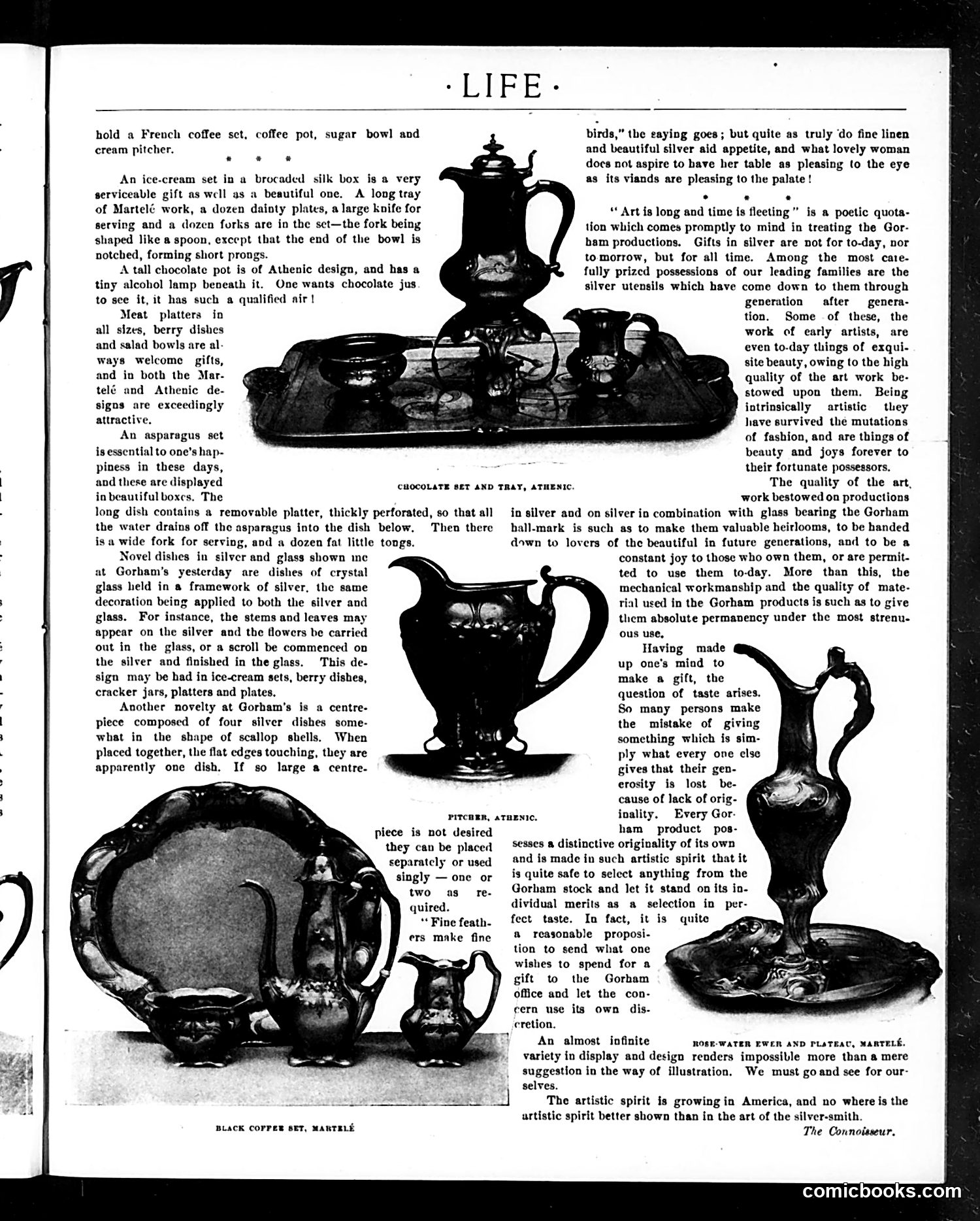
This page is primarily **advertising for Gorham silver and tableware**, not a political cartoon. It features product photography and promotional text describing luxury dining items. The images show: - A **chocolate set with alcohol lamp** (Athenic design) - A **black coffee set** (Martelé) - A **pitcher** (Athenic style) - A **rose water ewer and plateau** (Martelé) The text emphasizes that Gorham silver makes ideal gifts because it combines artistic merit with permanence—pieces passed down through generations retain beauty and value. The rhetoric appeals to wealthy readers by suggesting that giving Gorham silver demonstrates refined taste and originality, unlike generic gifts everyone else gives. This reflects early 20th-century consumer culture targeting affluent Americans who viewed fine tableware as both functional and status symbols marking social sophistication.
This page contains **satirical social commentary and humor columns**, not political cartoons. The main content mocks **American social pretension and manners**. The opening piece satirizes a Western girl who quickly adopts Eastern sophistication, only to encounter a rude Cabinet wife—implying that old-money elites lack the courtesy they claim to represent. The humor undercuts both the girl's social climbing and the supposed superiority of Washington society. **"Dooley on Reading"** (a recurring column by humorist Finley Peter Dunne, written phonetically in Irish-American dialect) jokes that people read newspapers not for intellectual stimulation but as **procrastination**—filling time when avoiding actual work, mindlessly absorbing society gossip, want ads, and crime news before falling asleep. The scattered anecdotes (marriage prospects, obituary, servant confusion) are brief jokes about social absurdity and miscommunication. The page is primarily **advertising** (Northern Pacific Railroad, Raymond & Whitcomb tours, Violettes du Czar perfume) with satirical filler content typical of early 1900s Life magazine.
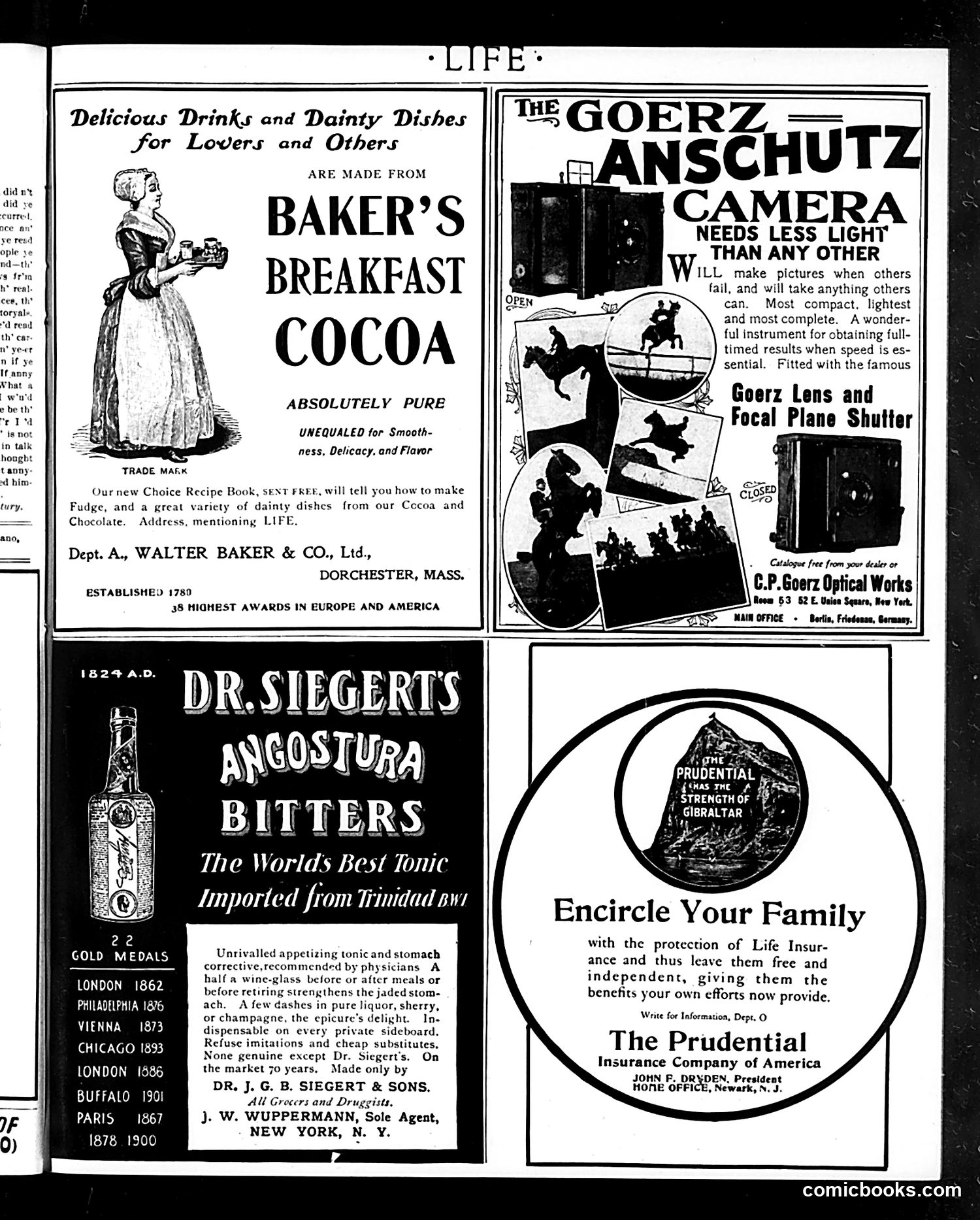
This page contains no political cartoons or satire—it's purely **advertisements** from the early 1900s. Four products are promoted: 1. **Baker's Breakfast Cocoa** (top left): A chocolate product emphasizing purity and offering a free recipe book for making desserts. 2. **Goerz Anschutz Camera** (top right): Promotes a camera requiring less light than competitors, featuring the "Goerz Lens and Focal Plane Shutter." 3. **Dr. Siegert's Angostura Bitters** (bottom left): A digestive tonic imported from Trinidad, claiming 22 gold medals across major cities and recommended by physicians as a stomach corrective or cocktail ingredient. 4. **Prudential Insurance** (bottom right): Uses domestic security imagery (Gibraltar rock) to market life insurance as family protection. These ads reflect early-20th-century consumer culture, emphasizing product quality through awards and medical endorsements—common advertising strategies of the era.
This political cartoon satirizes American military practices during the Philippine-American War (1899-1902). The song parodies "Marching Through Georgia," replacing Civil War liberation rhetoric with grotesque descriptions of the "water cure"—a torture technique allegedly used by U.S. forces against Filipino insurgents. The satire's bitter irony is precise: American soldiers, singing about spreading "liberty" and "freedom," are depicted torturing prisoners with water-forced down their throats until they swell. The repeated phrase "Shouting the battle cry of freedom" underscores the hypocrisy—invoking democratic ideals while committing atrocities. The cartoon targets how U.S. imperial expansion in the Philippines contradicted stated American values. By using familiar patriotic language to describe torture, Life magazine exposes the moral bankruptcy of the occupation to readers who would recognize the tune. The accompanying humorous anecdotes seem deliberately trivial, emphasizing the contrast between Life's satirical critique and lighter content.
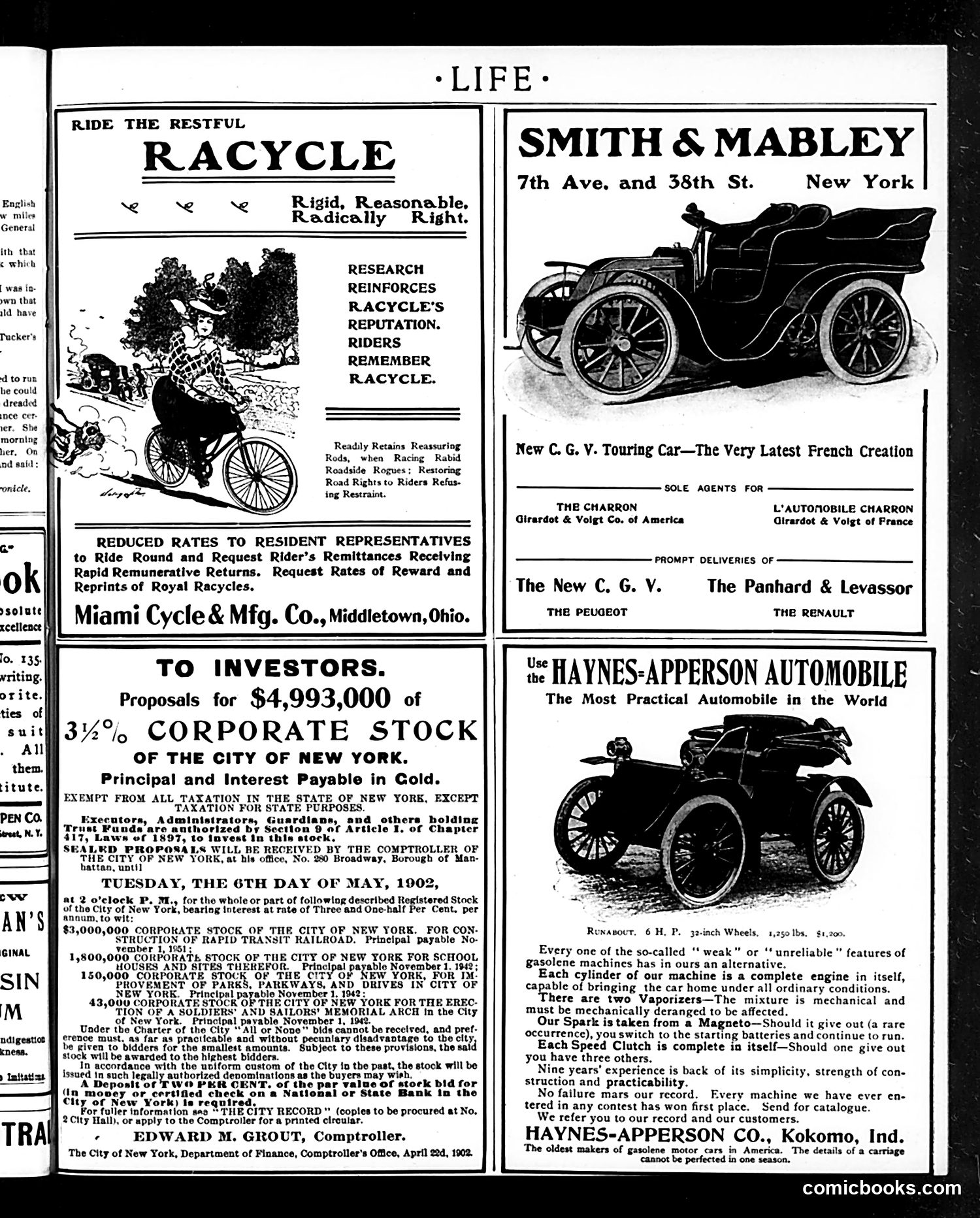
This is primarily an **advertising page** from Life magazine (circa 1902), not satirical content. It features early automobile and bicycle advertisements alongside a New York City municipal bond offering. The visible advertisements include: - **Racycle bicycle** (left): A playful ad using alliterative language ("Rigid, Reasonable, Radically Right") to market a restful riding experience - **Smith & Mabley** (top right): Dealers selling French automobiles (Charron, Peugeot, Renault, Panhard & Levassor) - **Haynes-Apperson Automobile** (bottom right): Marketed as "The Most Practical Automobile in the World," emphasizing mechanical reliability and redundant safety features The **municipal bond notice** (center-left) announces $4,993,000 in New York City corporate stock proposals for infrastructure projects: rapid transit, schools, parks, and a soldiers' memorial arch. This page captures the **transitional moment** between bicycle and automobile eras, reflecting early 1900s consumer interests and municipal finance practices.
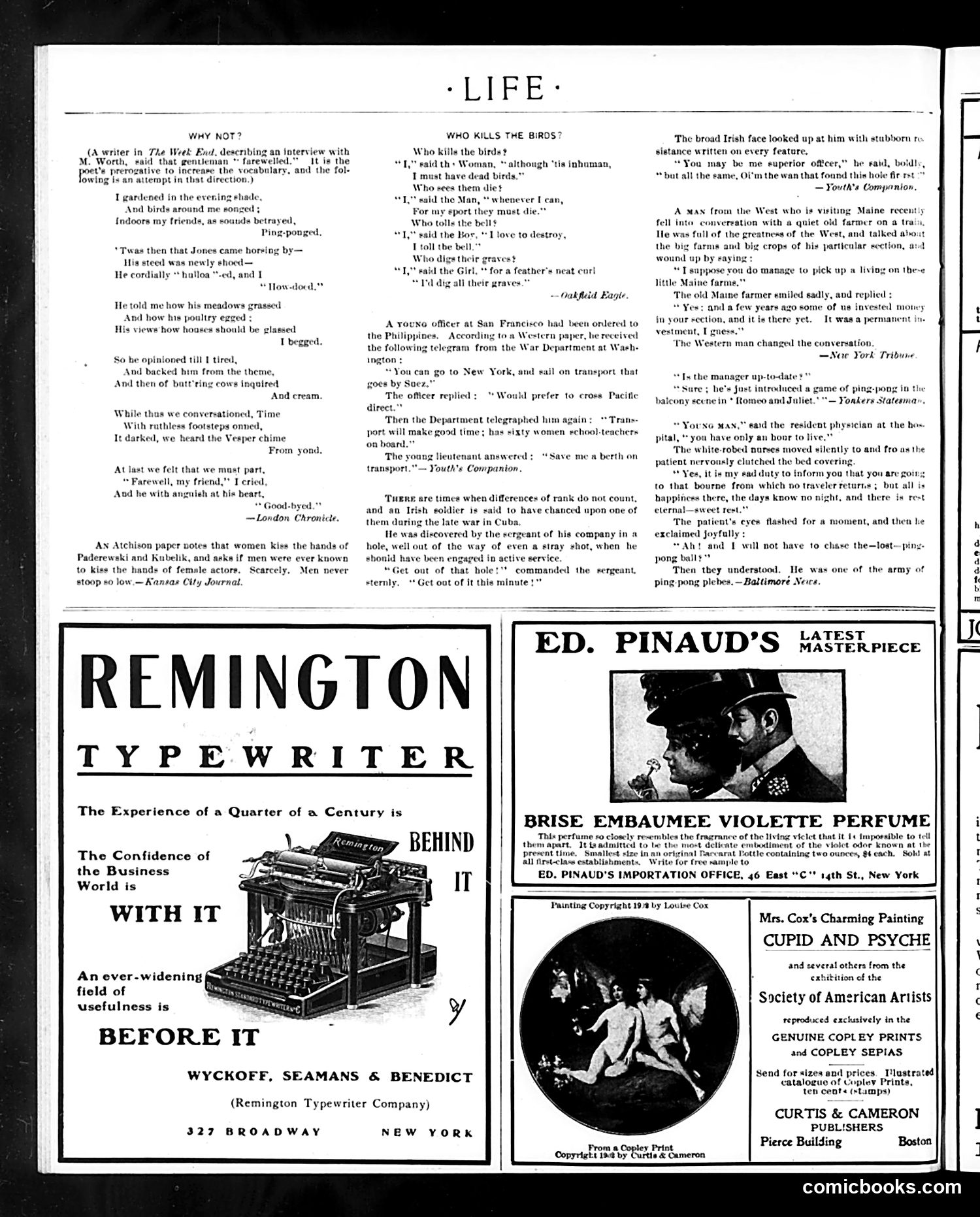
This page contains **light satirical poetry and anecdotes** rather than political cartoons. The humor targets social conventions and language affectations of the early 1900s. **"Why Not?"** mocks the pretension of inventing new verbs from nouns—a writer describes a gentleman who "farewelled" and coins awkward constructions like "how-doed," "opinioned," and "conversationed." The satire targets affected speech and linguistic snobbery. **"Who Kills the Birds?"** is a darker piece criticizing the era's widespread bird killing for fashion (feathers for women's hats) and sport, presented as a children's rhyme with each group (women, men, boys, girls) claiming responsibility. The remaining anecdotes humorously contrast regional pretension: a young officer preferring Pacific passage to avoid female school-teachers; an Irish soldier's insubordination; and a Western man's boasting to a Maine farmer who quietly reveals the Westerner's own failed investments in the region. **The advertisements** (Remington typewriter, perfume, art prints) occupy the lower half—standard period magazine content.
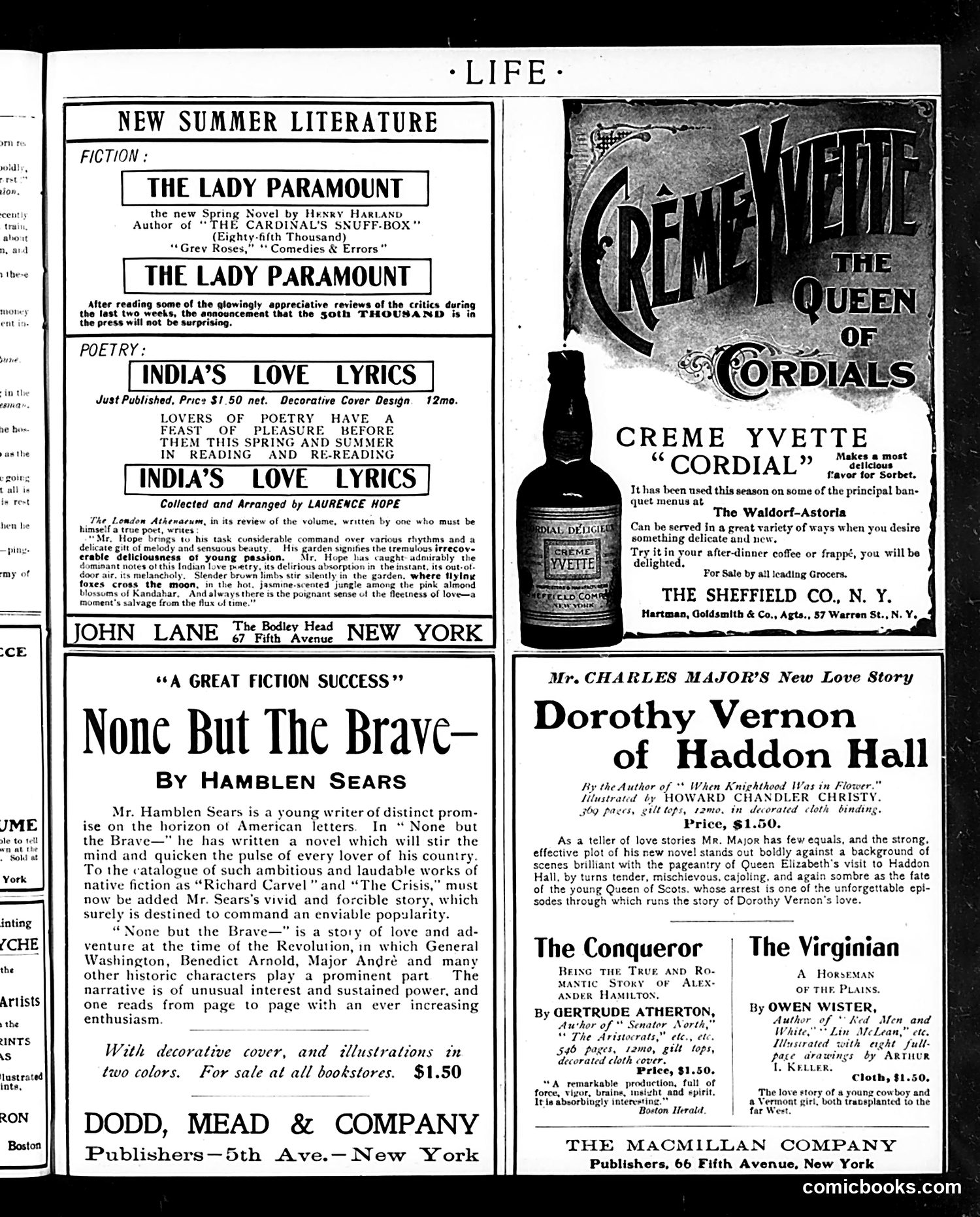
This is primarily a **book and product advertisement page**, not a satirical cartoon page. It showcases summer 1902 literature and luxury goods. The page advertises: **Books:** Henry Harland's novel *The Lady Paramount* (already in its 50th thousand copies), poetry collection *India's Love Lyrics* by Laurence Hope, Hamblen Sears's *None But the Brave* (a Revolutionary War romance), and Charles Major's *Dorothy Vernon of Haddon Hall*. **Beverages:** Crème Yvette cordial, marketed as fashionable for upscale venues like the Waldorf-Astoria hotel. The advertisements reflect **late Victorian/Edwardian taste**: romantic historical fiction, decorative poetry, and refined luxury products. The reviews emphasize emotional intensity and literary merit. Publishers (Dodd, Mead; Macmillan) market these as culturally significant works for educated readers. There is **no political satire** on this page—it's a straightforward commercial advertisement section typical of *Life* magazine's business model.
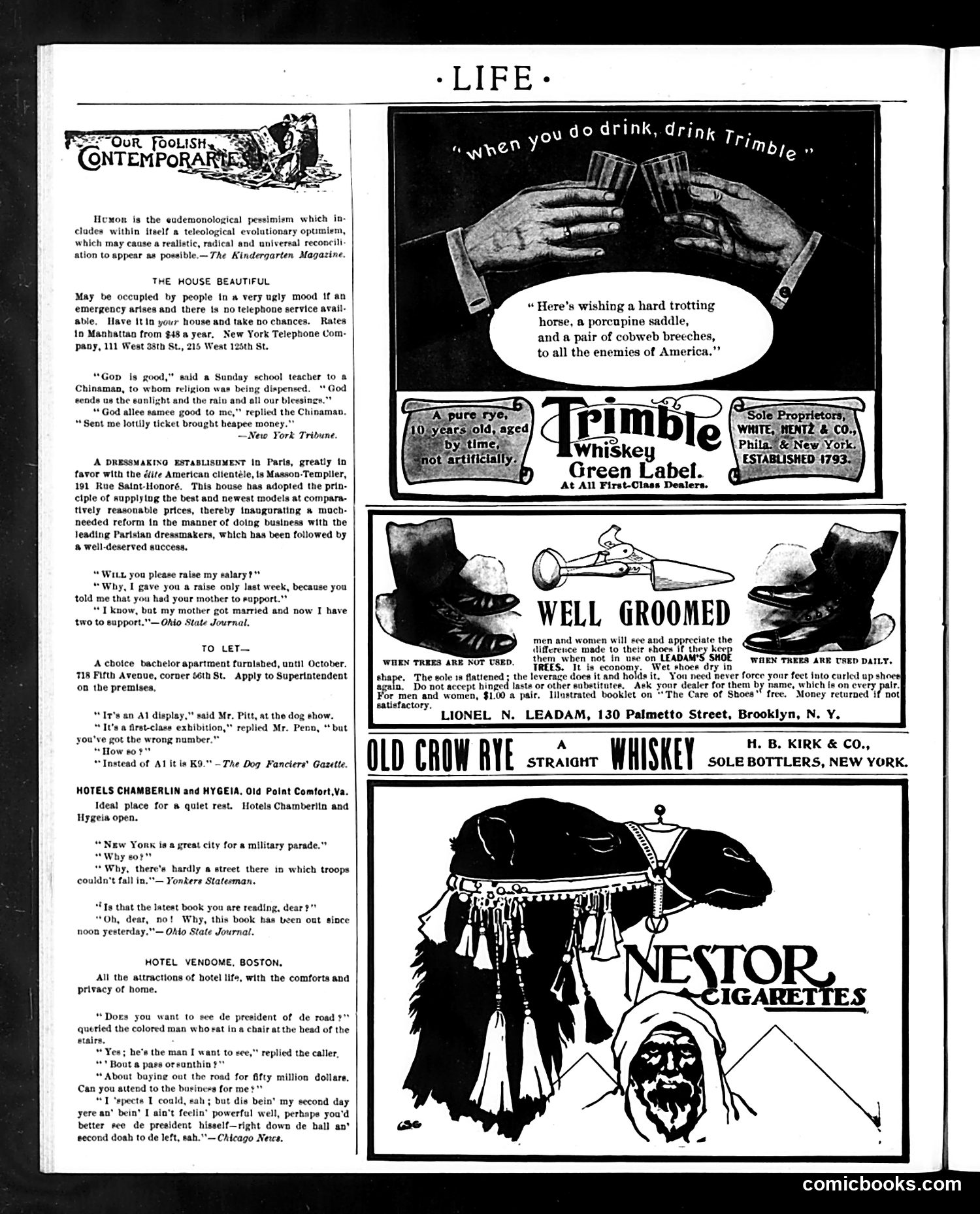
This page is primarily **advertising and satirical humor** rather than political cartoons. The content includes: **Main Advertisements:** - Trimble Whiskey (top): Features hands toasting with a patriotic toast wishing harm to "all the enemies of America"—likely referencing anti-American sentiment during a period of international tension (context unclear without date) - Lionel N. Leadam shoe trees and Old Crow Rye whiskey ads - Nestor Cigarettes (bottom) **Satirical Humor Sections:** Multiple short jokes mocking various subjects: a Chinaman's pragmatic response to religion, pretentious Parisian dressmakers, salary negotiations, dog show terminology, and military parades. **Key Point:** The page reflects early 20th-century American attitudes—including casual ethnic stereotyping (the "Chinaman" joke) and consumer culture advertising targeting educated, urban audiences. The overall tone blends genteel satirical humor with product promotion typical of *Life* magazine's era.
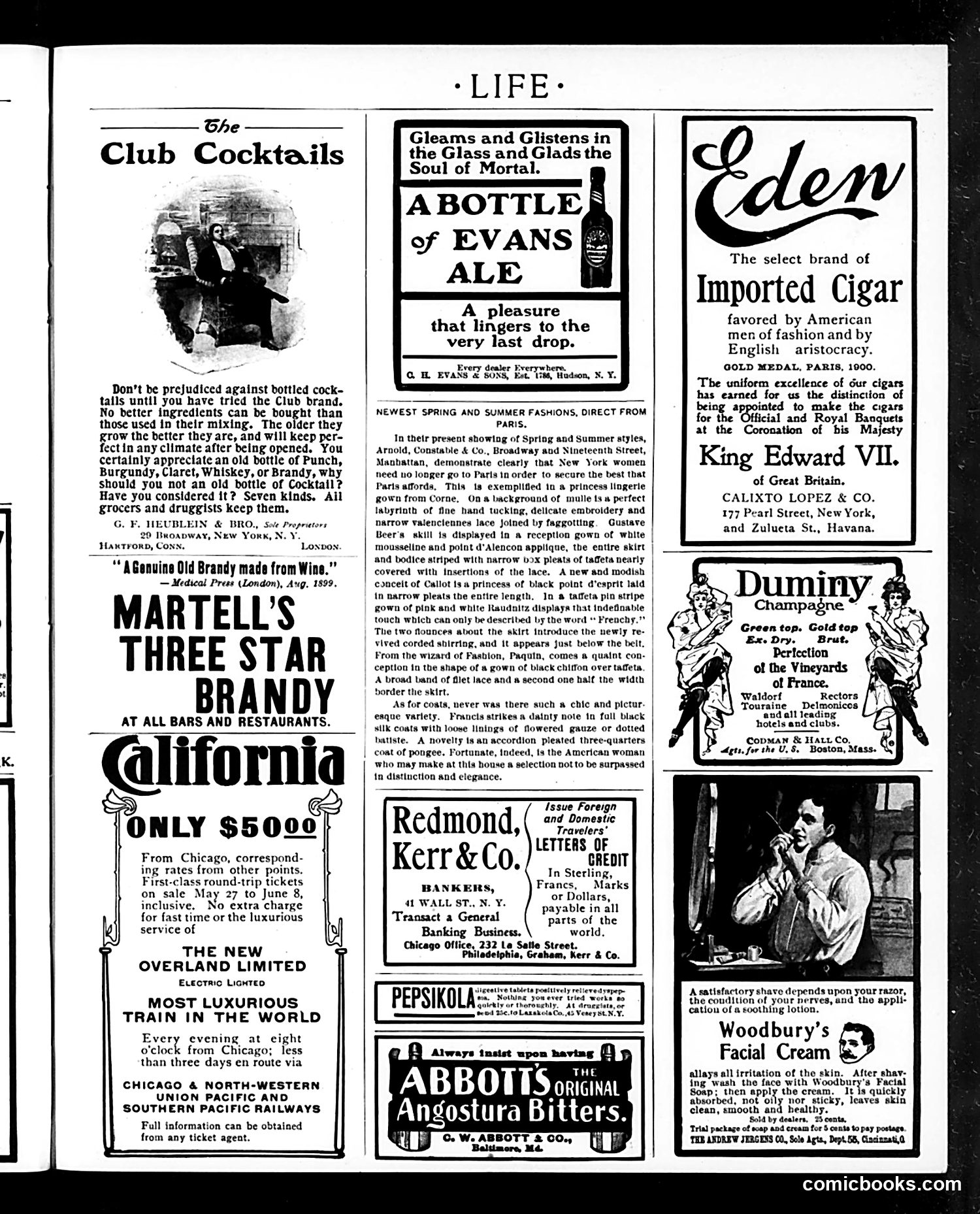
This page is primarily a collection of period advertisements rather than editorial cartoons or satire. The content reflects early 1900s consumer marketing: **Key advertisements include:** - Bottled cocktails and spirits (Evans Ale, Martell's Brandy) - High-end fashion from Paris designers displayed at Arnold, Constable & Co., featuring detailed descriptions of women's gowns with elaborate lacework and pleating - Luxury train travel (the "Overland Limited") from Chicago to California - Banking services and cigars **Notable for modern readers:** The fashion section reveals period attitudes—detailed descriptions emphasize intricate handwork, Paris origins, and luxury materials as status markers. The assumption that wealthy American women should aspire to Paris fashions (while conveniently available locally) reflects Gilded Age aspirations. Advertisements for alcohol appear casually, predating Prohibition. The overall tone treats luxury consumption as natural and desirable for the magazine's affluent readership.
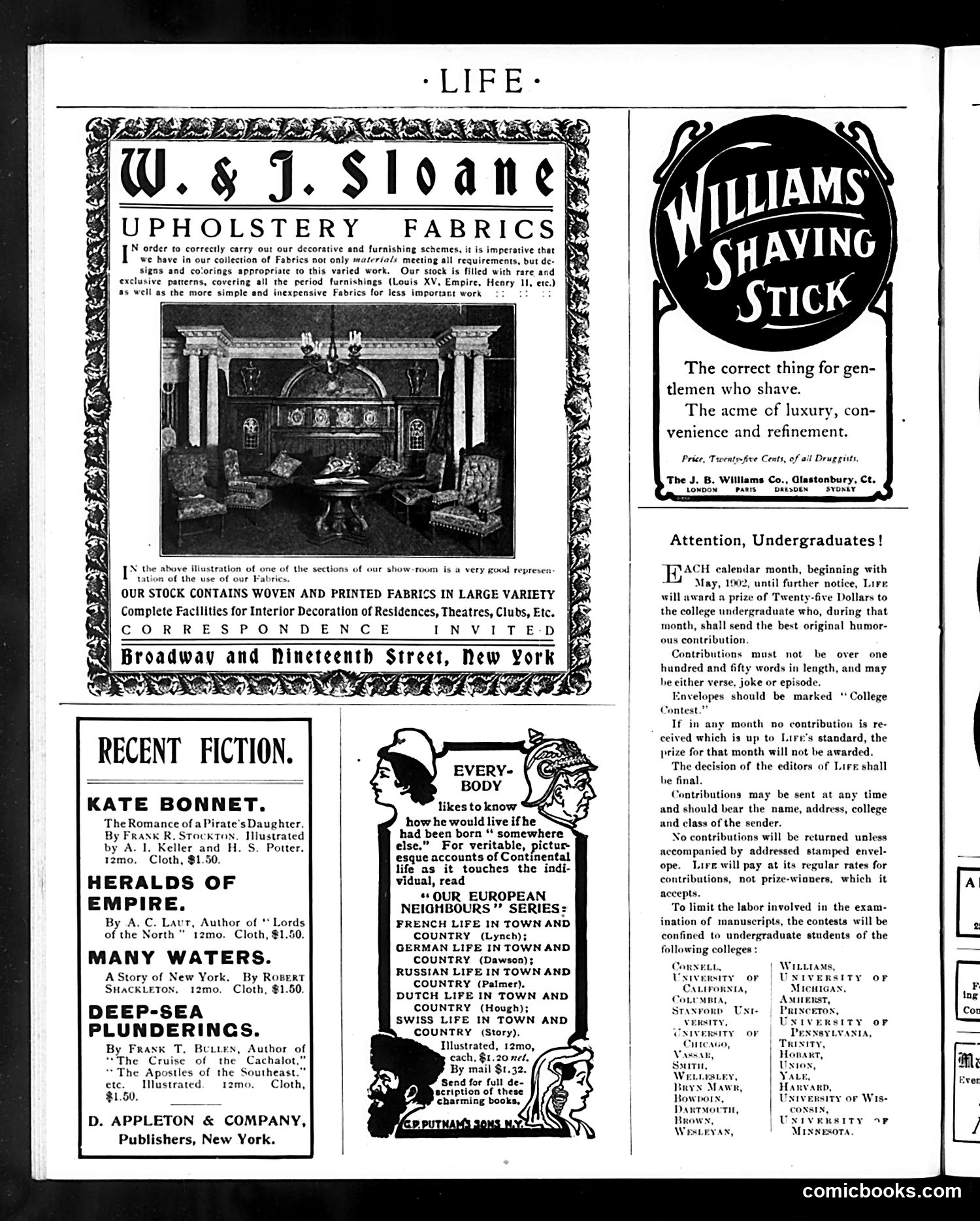
This page is primarily **advertising and editorial content** rather than political satire. The main elements are: **Left side**: A W. & J. Sloane upholstery fabrics advertisement showing an ornate interior room, targeting wealthy clients seeking period furnishings (Louis XV, Empire, etc.). **Right side**: A Williams Shaving Stick ad promising "luxury, convenience and refinement" for gentlemen. **Center**: An "Everybody" series promoting books about European life—allowing readers to imagine living abroad. The cartoon figures are generic illustrations of continental types, not specific political figures. **Bottom**: A book advertisement and a contest announcement offering $25 to college undergraduates for original humor submissions (verse, jokes, or episodes). The page reflects **early 1900s consumer culture** and the aspirational lifestyle marketed to educated, affluent readers—European sophistication, refined grooming, and intellectual pursuits. No specific satire or political commentary is present; it's a straightforward magazine layout mixing ads with editorial announcements.
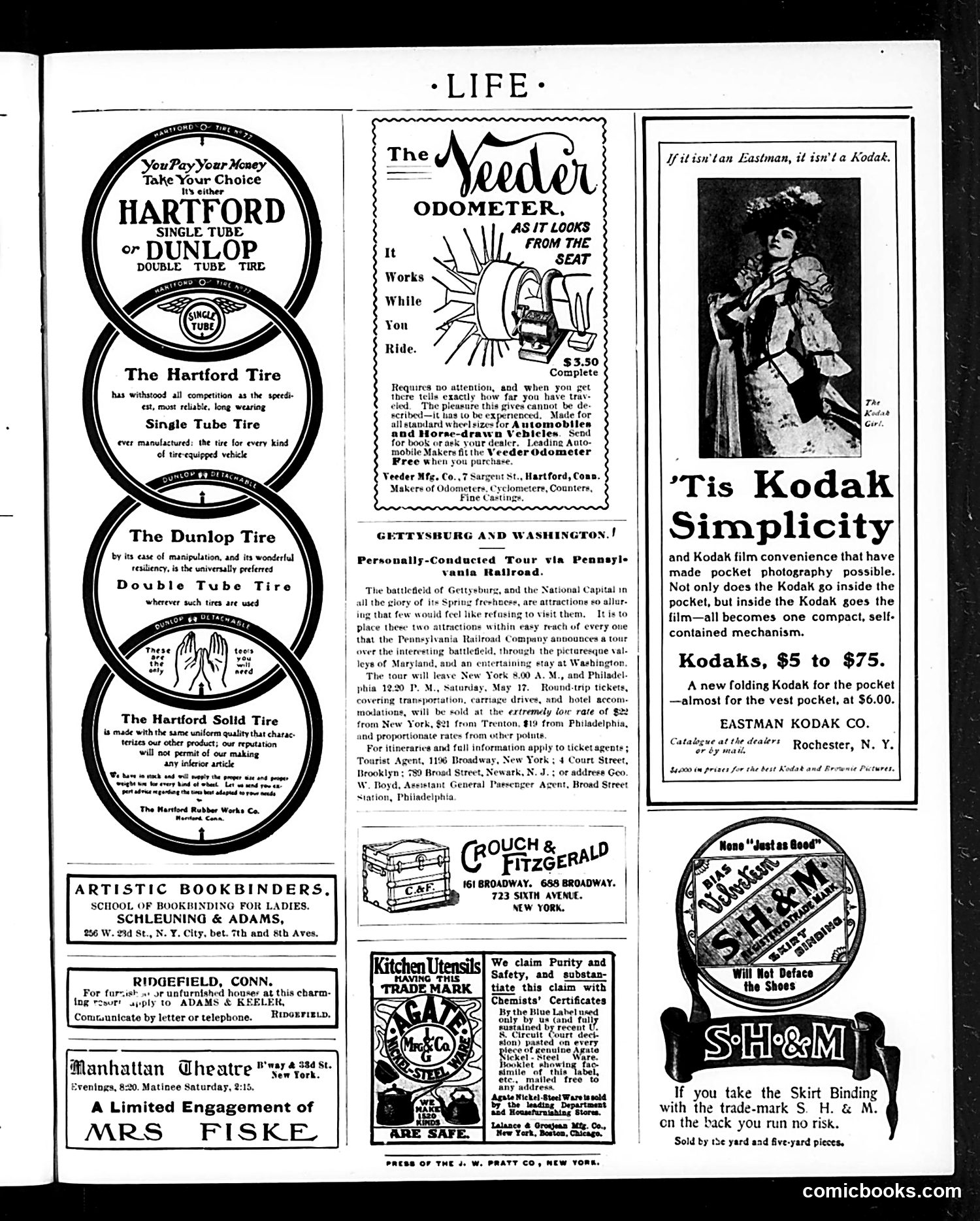
This page is primarily **advertising**, not political satire. It features turn-of-the-century product advertisements for tires (Hartford and Dunlop), an automobile odometer, railroad tours, luggage, cooking utensils, theater tickets, and notably Kodak cameras. The one element with a joke is the **Kodak advertisement** at right, which plays on brand recognition. The tagline "If it isn't an Eastman, it isn't a Kodak" humorously suggests that Kodak cameras are so dominant and desirable that the brand name has become synonymous with pocket photography itself. This is early consumer advertising leveraging market dominance as a selling point. The page otherwise reflects early 1900s commercial culture and the emergence of consumer goods marketed through *Life* magazine to middle-class readers.
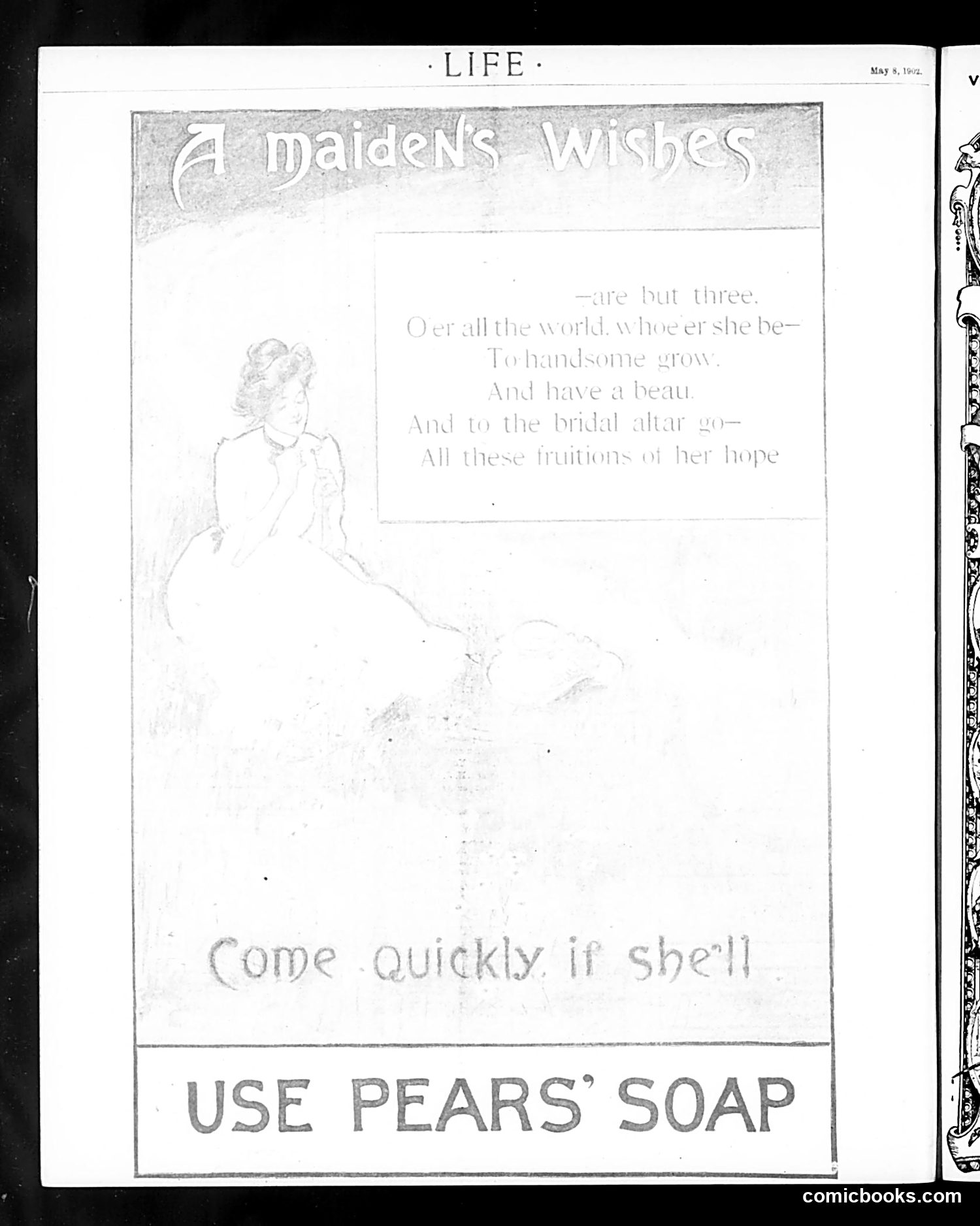
This is a **commercial advertisement**, not political satire. The page features an illustration of a young woman with accompanying verse about a maiden's three wishes: to grow handsome, have a beau, and reach "the bridal altar." The text concludes "Come quickly if she'll" — an incomplete line that advertises **Pears' Soap** at the bottom, implying the soap will help fulfill these romantic aspirations. This reflects early 1900s advertising conventions that marketed beauty products by connecting them to women's traditional life goals: marriage and attractiveness to men. The romantic, illustrated approach was typical for *Life* magazine's advertisements during this era. The text suggests urgency, though the incomplete line creates slight ambiguity about the soap's promised effect.