
Life, 1902-05-08 · page 4 of 32
Life — May 8, 1902 — page 4: what you’re looking at
What you’re looking at
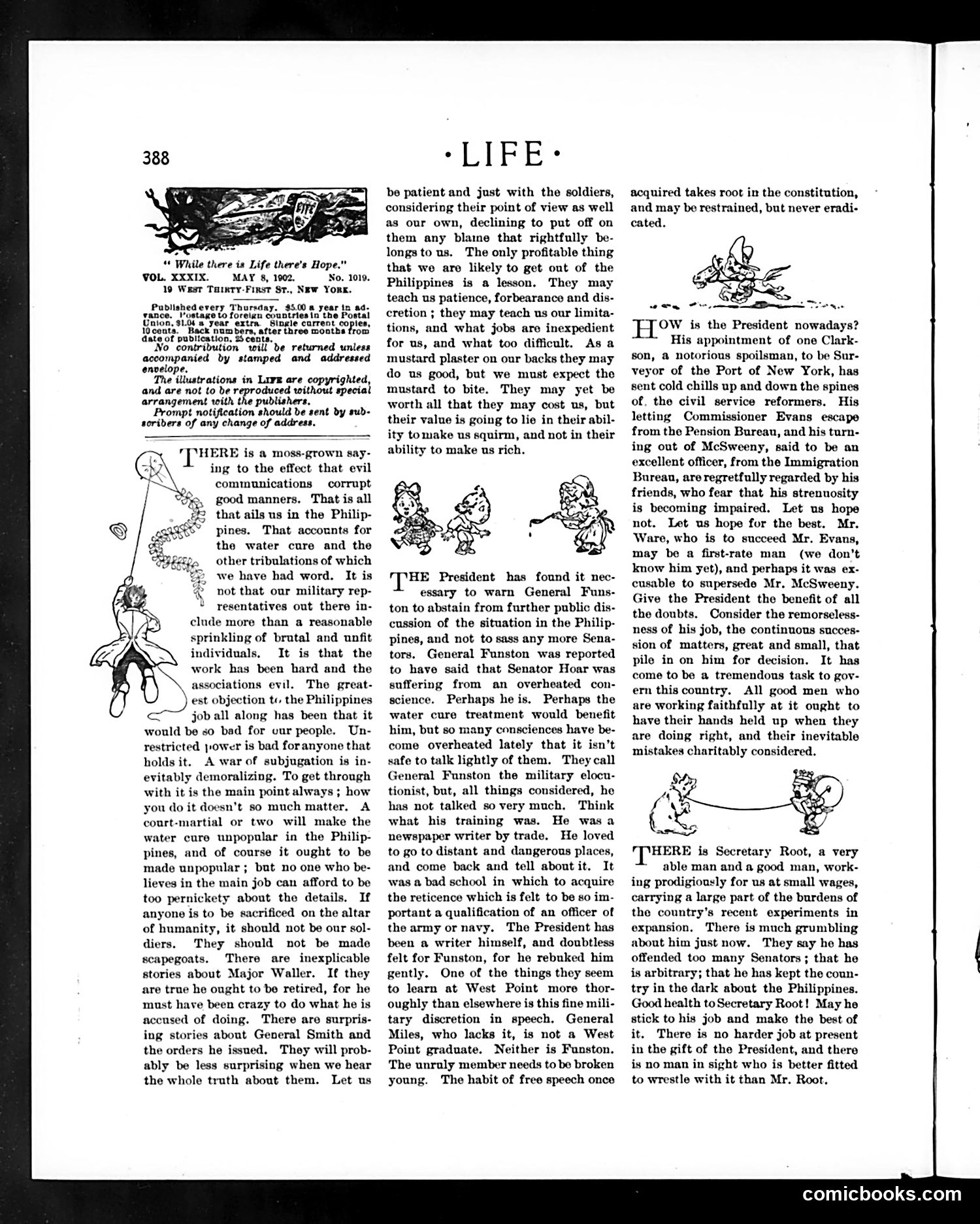
This page contains political commentary on U.S. military involvement in the Philippines. The text discusses General Funston, a military officer criticized for his approach to the conflict, and Secretary Root (the Secretary of War), portrayed as competent but burdened by the administration's Philippine policies. The satirical illustrations show figures in compromising positions—likely representing politicians or military leaders struggling with the Philippine situation's complexities. The cartoons suggest these officials are overwhelmed by the consequences of American imperial expansion. The overall message critiques how U.S. leadership handled the Philippine-American War: military decisions lack strategic coherence, public discourse about the conflict is constrained, and officials blame each other rather than addressing fundamental policy failures. The tone is mocking toward both military decisions and political accountability.
📄 Transcribed text from this page (OCR, searchable)
Machine-transcribed from the original scan — historical spelling and the odd misread are preserved.
* White there is Life there’s Ape VOL. XXXIX. MAY 8, 1902. 19 West Tarnty-Finst St., New Yo cK. devery Thursday. $5.00 8 year tn ad- ostage Lo foreign countries in the Postal cent k numbers, efter: three months from date of publication, 25 cents No contribution. will be returned unless accompanied by stamped and addressed envelope. The illustrations in Lave are copyrighted, and are not to be reproduced without special arrangement with the publishers, Prompt notification should be sent by sub- soribers of any change of address, HERE is a moss-grown say- ing to the effect that evil communications corrupt good manners, That is all that ails us in the Philip- pines. That accounts for the water cure and the other tribulations of which we have had word. It is not that our military rep- resentatives out there in- clude more than a reasonable sprinkling of bratal and unfit individuals, It is that the work has been hard and the associations evil. The great- est objection to the Philippines job all along has been that it would be so bad for vur people. Un- restricted ower is bad foranyone that holds it. A war of subjugation is in- evitably demoralizing. To get through with it is the main point always ; how you do it doesn’t so much matter. A court-martial or two will make the water cure unpopular in the Philip- pines, and of course it ought to be made unpopular; but no one who be- lieves in the main job can afford to be too pernickety about the details. If anyone is to be sacrificed on the altar of humanity, it should not be our sol- diers. They should not be made scapegoats. There are inexplicable stories about Major Waller. If they are true he ought to be retired, for he must have been crazy to do what he is accused of doing. There are surpris- ing stories about General Smith and the orders he issued. They will prob- ably be less surprising when we hear the whole truth about them. Let us LIFE be patient and just with the soldiers, considering their point of view as well as our own, declining to put off on them any blame that rightfully be- longs to us. The only profitable thing that we are likely to get out of the Philippines is a lesson. They may teach us patience, forbearance and dis- cretion ; they may teach us our limita- tions, and what jobs are inexpedient for us, and what too difficult. Asa mustard plaster on our backs they may do us good, but we must expect the mustard to bite. They may yet be worth all that they may cost us, but their value is going to lie in their abil- ity tomake us squirm, and not in their ability to make us rich. HE President has found it nec- essary to warn General Funs- ton to abstain from further public di: cussion of the situation in the Philip- pines, and not to sass any more Sena- tors. General Funston was reported to have said that Senator Hoar was suffering from an overheated con- science. Perhaps he is. Perhaps the water cure treatment would benefit him, but so many consciences have be- come overheated lately that it isn’t safe to talk lightly of them. They call General Funston the military elocu- tionist, but, all things considered, he has not talked so very much, Think what his training was. He was a newspaper writer by trade. He loved to go to distant and dangerous places, and come back and tell about it. It was a bad school in which to acquire the reticence which is felt to be so im- portant a qualification of an officer of the army or navy. The President has been a writer himself, and doubtless felt for Funston, for he rebuked him gently. One of the things they seem to learn at West Point more thor- oughly than elsewhere is this fine mili- tary discretion in speech. General Miles, who lacks it, is not a West Point graduate. Neither is Funston. The unraly member needs to be broken young. The habit of free speech once acquired takes root in the constitution, and may be restrained, but never eradi- cated. ae OW is the President nowadays? His appointment of one Clark- son, @ notorious spoilsman, to be Sur- veyor of the Port of New York, has sent cold chills up and down the spines of, the civil service reformers. His letting Commissioner Evans escape from the Pension Bureau, and his turn- ing out of McSweeny, said to be an excellent officer, from the Immigration Bureau, are regretfully regarded by his friends, who fear that his strenuosity is becoming impaired. Let us hope not. Let us hope for the best. Mr. Ware, who is to succeed Mr. Evans, may be a first-rate man (we don’t know him yet), and perhaps it was ex- cusable to supersede Mr, McSweeny. Give the President the benefit of all the doubts. Consider the remorseless- ness of his job, the continuous succes- sion of matters, great and small, that pile in on him for decision. It has come to be a tremendous task to gov- ern this country. All good men who are working faithfully at it ought to have their hands held up when they are doing right, and their inevitable mistakes charitably considered. HERE is Secretary Root, a very able man and a good man, work- ing prodigiously for us at small wages, carrying a large part of the burdens of the country’s recent experiments in expansion. There is much grumbling about him just now. They say he has offended too many Senators ; that he is arbitrary; that he has kept the coun- try in the dark about the Philippines. Good health to Secretary Root! May he stick to his job and make the best of it. There is no harder job at present in the gift of the President, and there is no man in sight who is better fitted to wrestle with it than Mr. Root, comicbooks.com