
Life, 1902-05-08 · page 11 of 32
Life — May 8, 1902 — page 11: what you’re looking at
What you’re looking at
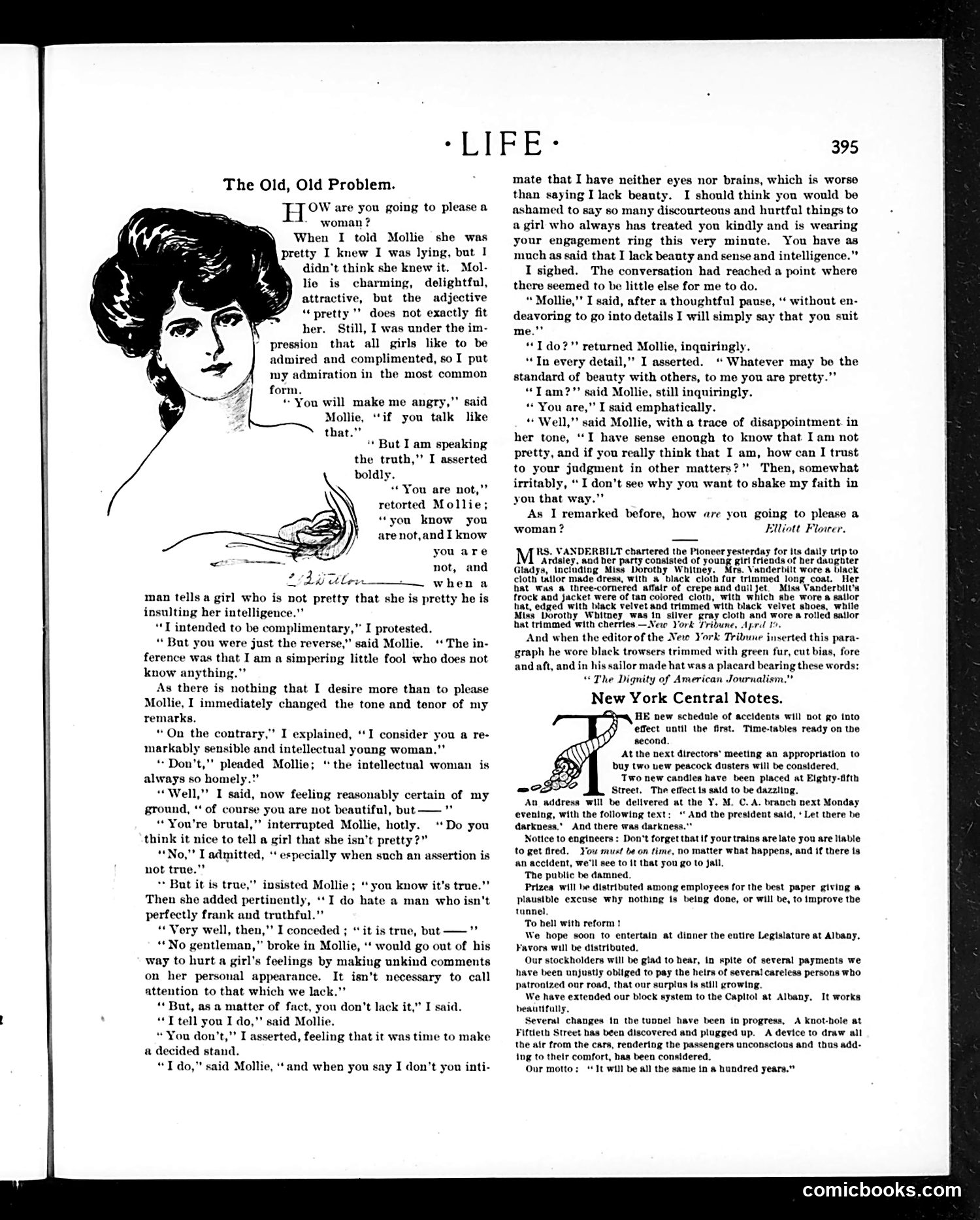
This satirical piece depicts a conversation between a narrator and a woman named Mollie about beauty, intelligence, and compliments. The cartoon illustrates a timeless social debate: whether telling an unattractive woman she lacks beauty is honest but hurtful, or whether politeness requires flattery. The satire targets gender dynamics and courtship conventions of the era. The narrator argues that complimenting a woman solely on being "pretty" is insulting to her intellect. Mollie counters that she values being considered pretty and resents suggestions she should base self-worth on intelligence instead. The piece mocks both parties—the narrator's patronizing "logic" and Mollie's contradictory demands for honest judgment while wanting flattery. It reflects early 20th-century tensions between emerging feminist ideals and traditional romantic expectations.
📄 Transcribed text from this page (OCR, searchable)
Machine-transcribed from the original scan — historical spelling and the odd misread are preserved.
~*LRES The Old, Old Problem. E OW are you going to please a woman ? When I told Mollie she was pretty I knew I was lying, but I didn't think she knew it. Mol- L4 lie is charming, delightful, By) attractive, but the adjective EY “pretty does not exactly fit her. Still, I was under the im- pression that all girls like to be admired and complimented, so I put my admiration in the most common form. “ You will make me angry,” said Mollie, “if you talk like that. ‘* But Iam speaking the truth,” I asserted boldly. “You are not,’” retorted Mollie; “you know you are not,and I know you are not, and 2h ler when a man tells a girl who is not pretty that she is pretty he is insulting her intelligence.” I intended to be complimentary,” I protested. “ But you were just the reverse,” said Mollie.‘ The in- ference was that I am a simpering little fool who does not know anything.”” As there is nothing that I desire more than to please Mollie, I immediately changed the tone and tenor of my remarks. “On the contrary,’ I explained, ‘‘I consider you a re- markably sensible and intellectual young woman.” **Don’t,’”’ pleaded Mollie; “the intellectual woman is always so homely.”’ “Well,” I said, now feeling reasonably certain of my ground, * of course you are not beautiful, but — “You're brutal,” interrupted Mollie, hotly. think it nice to tell a girl that she isn’t pretty?” “No,” admitted, ** especially when such an assertion is not true."” * Bat it is true,” insisted Mollie ; “ you know it’s true.” Then she added pertinently, ‘*I do hate a man who isn't perfectly frank and truthful.” “Vory well, then,” I conceded ; “ it is true, but — “No gentleman,” broke in Mollie, ‘* would go out of his way to hurt a girl's feelings by making unkind comments on her personal appearance. It isn’t necessary to call attention to that which we lack.” “But, as a matter of fact, you don’t lack it,” I said. “T tell you I do,” said Mollie. “You don't,’’ I asserted, feeling that it was time to make a decided stand. “Ido,” said Mollie, “and when you say I don’t yon inti- “Do you 395 mate that I have neither eyes nor brains, which is worse than saying I lack beauty. I should think you would be ashamed to say so many discourteous and hurtfal things to a girl who always has treated you kindly and is wearing your engagement ring this very minute. You have as much as said that I lack beauty and sense and intelligence.” I sighed. The conversation had reached a point where there seemed to be little else for me to do. “ Mollie,” I said, after a thoughtful pause, ‘* without en- deavoring to go into details I will simply say that you suit me."* “Ido?” returned Mollie, inquiringly. “In every detail,” I asserted. “ Whatever may be the standard of beauty with others, to me you are pretty.” “Tam?” said Mollie, still inquiringly. “ You are,” I said emphatically. “ Well,” said Mollie, with a trace of disappointment. in her tone, ‘I have sense enough to know that I am not pretty, and if you really think that I am, how can I trust to your judgment in other matters?” Then, somewhat irritably, “ I don’t see why you want to shake my faith in you that way.” As I remarked before, how are you going to please a woman? Elliott Flower. MUS XANDERBILT chartered the Pioneer yesterday for It daily trip to Ardsley, and her party conalsted of young giri friends of her daugnter Gladys, including Miss Dorothy Whitney. Mra. Vanderbilt wore a black cloth uitlor made dress, with # ‘black cloth fur trimmed long coat. Her hat was # three-comered affair of crepe and duil Jet. Mixa Vanderbilt's frock and jacket were of tan colored cloth, with which abe wore a sailor hat, edged with black velvet and trimmed With black velvet shoes, while Miss Dorothy Whitney was tn sliver gray cloth and wore a rolled sailor hat trimmed with cherries —New York Tribune, Apri 1! And when the editor of the New York Tribuue inserted this para- graph he wore black trowsers trimmed with green fur, cut bias, fore and aft, and in his sailor made hat «as a placard bearing these words: “The Dignity of American Journalism.” New York Central Notes. HE new schedule of accidents will not go into effect until the first. Time-tables ready on the second. At the next directors’ meeting an appropriation to buy two uew peacock dusters will be considered, Two new candles have been placed at Eighty-fifth Street. The effect ts sald to be dazzling. An address will be delivered at the Y. M. C. A. branch next Monday evening, with the following text: “ And the president said, * Let there be darkness. And there was darkness."* Notice to engineers : Don't forget that if your trains are late you are Hable to get fred. Yow must be on time, no matter what happens, and ff there 1s an accident, we'll see to it that you go to Jail. ‘The public be damned. Prizes will be distributed among employees for the best paper giving a Plausible excuse why nothing 1s belng done, or will be, to improve the tuanel. To bell with reform! We hope soon to entertain at dinner the entire Legisiature at Albany, Favors will be distributed. Our stockholders will be glad to hear, in spite of several payments we have been unjustly obliged to pay the heirs of several careless persons who patronized our road, that our surplus ts still growing. We have extended our block system to the Capitol at Albany, It works beautifully. Several changes in the tunnel have been in progress, A knot-hole at Fiftieth Street has been discovered and plugged up. A device to draw all the alr from the cars, rendering the passengers unconscious and thus add- ing to thelr comfort, has been considered. Our motto: “It will be all the same in a hundred years.” comicbooks.com