
A complete issue · 20 pages · 1897
Life — January 14, 1897
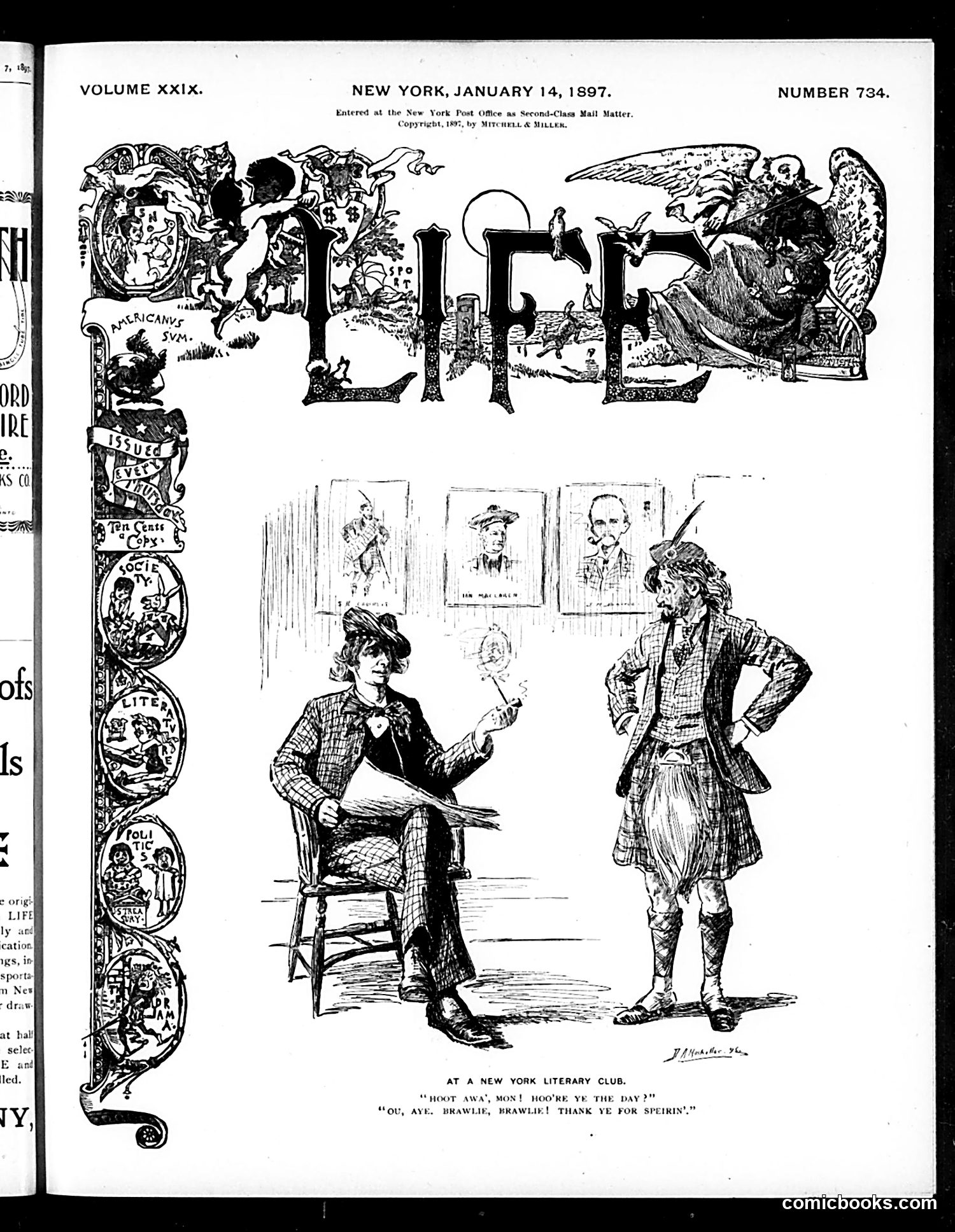
**January 14, 1897** The main cartoon depicts two men at a New York literary club. One sits holding a paintbrush and palette; the other stands in period costume (knickers, checkered jacket). The caption reads: "Hoot awa', mon! Hoo're ye the day?" / "Oi, aye, brawlie, brawlie! Thank ye for sperits!" This appears to satirize Scottish dialect humor popular in 1890s American literature and entertainment. The standing figure's exaggerated costume and the seated figure's artistic tools suggest mockery of how Scottish characters were stereotypically portrayed in contemporary writing and illustration. The joke likely targets affected use of Scottish vernacular in literary circles, presenting it as pretentious or artificial performance rather than authentic expression. The ornamental border contains classical literary medallions, reinforcing the "literary club" setting's self-importance.
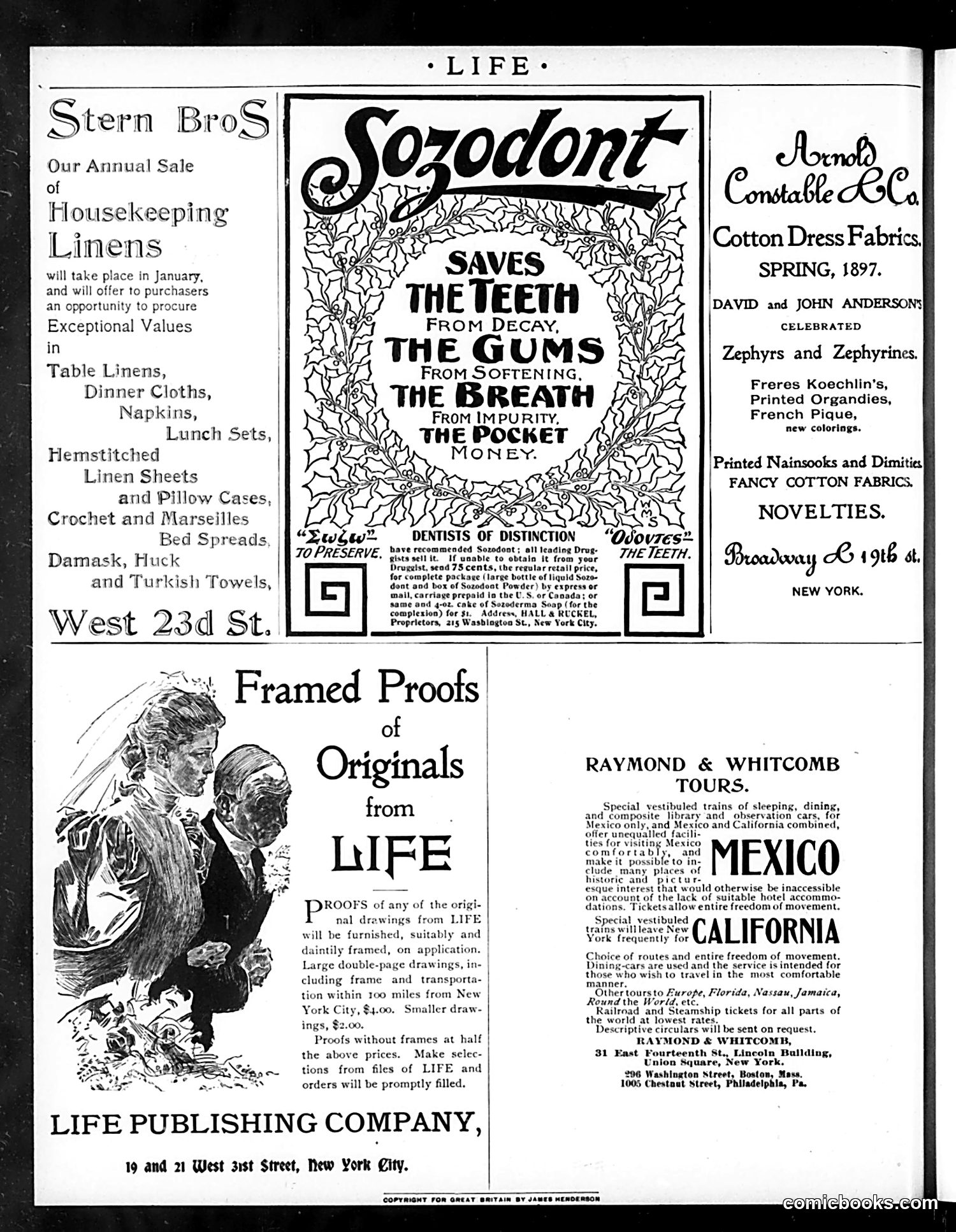
This page is **primarily advertising**, not political satire. It contains four separate ads: 1. **Stern Bros.** (housekeeping linens) 2. **Sozodont** (toothpaste) — the largest ad, claiming to save teeth from decay, gums from softening, and freshen breath 3. **Arnold Constable & Co.** (cotton dress fabrics, Spring 1897) 4. **Life Publishing Company** (offering framed proofs of original artwork) 5. **Raymond & Whitcomb Tours** (travel to Mexico and California) The Sozodont ad is the most visually prominent, featuring ornamental borders and text emphasizing dental health benefits — typical late-19th-century patent medicine marketing. There is no political cartoon or satire evident on this page. It represents Life magazine's revenue model: mixing editorial content with paid advertising.
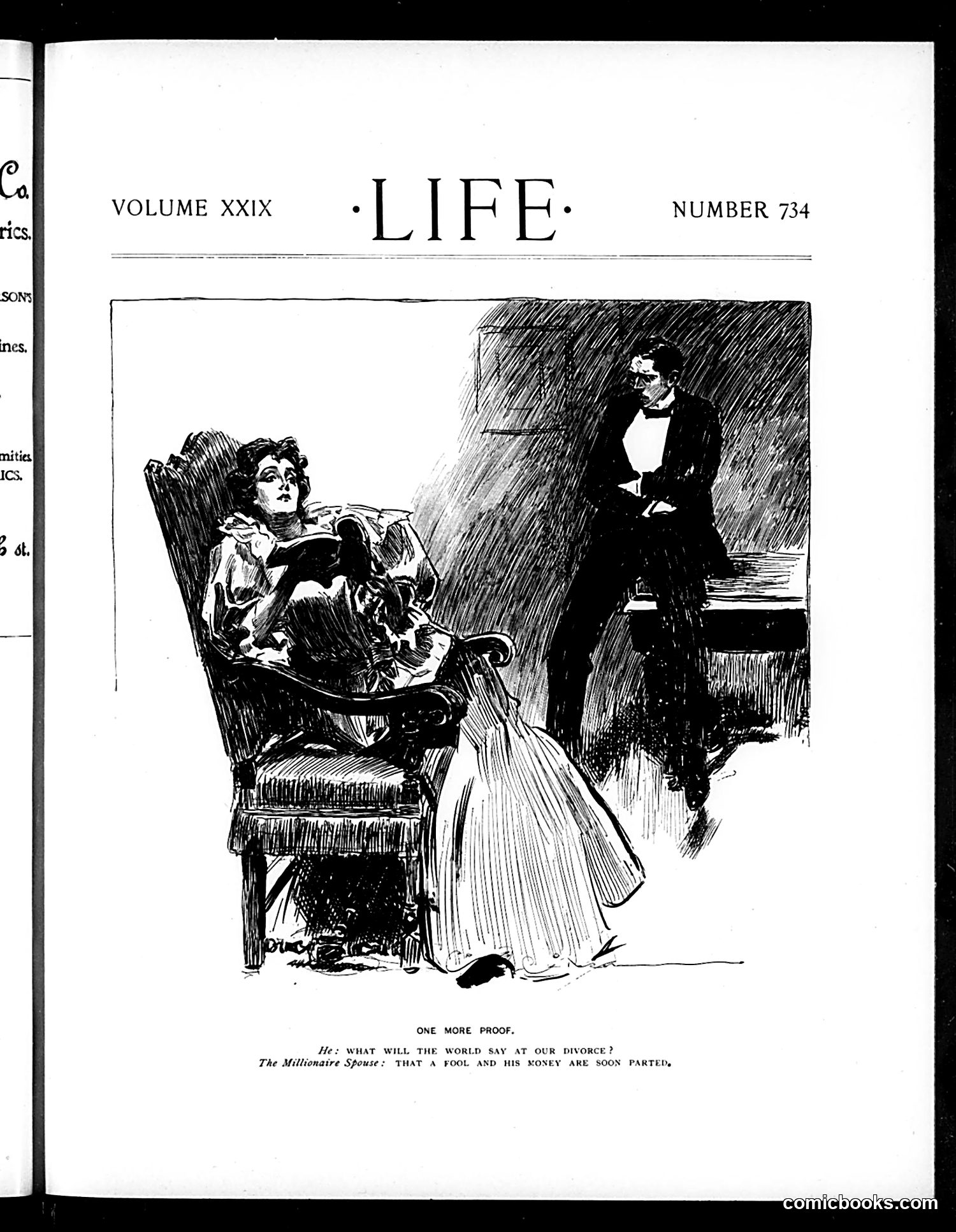
This cartoon satirizes wealthy divorce proceedings. A fashionably dressed woman sits comfortably in an armchair while a man in formal attire stands apart, appearing troubled. The caption presents dialogue: the man asks "What will the world say at our divorce?" The woman, identified as "The Millionaire Spouse," responds callously: "That a fool and his money are soon parted." The satire targets the financial dynamics of wealthy marriages and divorces—specifically how wives of rich men could extract substantial settlements. The cartoon mocks both the man's concern for social reputation and the woman's frank acknowledgment that she's securing his wealth through dissolution of the marriage. It reflects early-20th-century anxieties about divorce, female independence, and money.
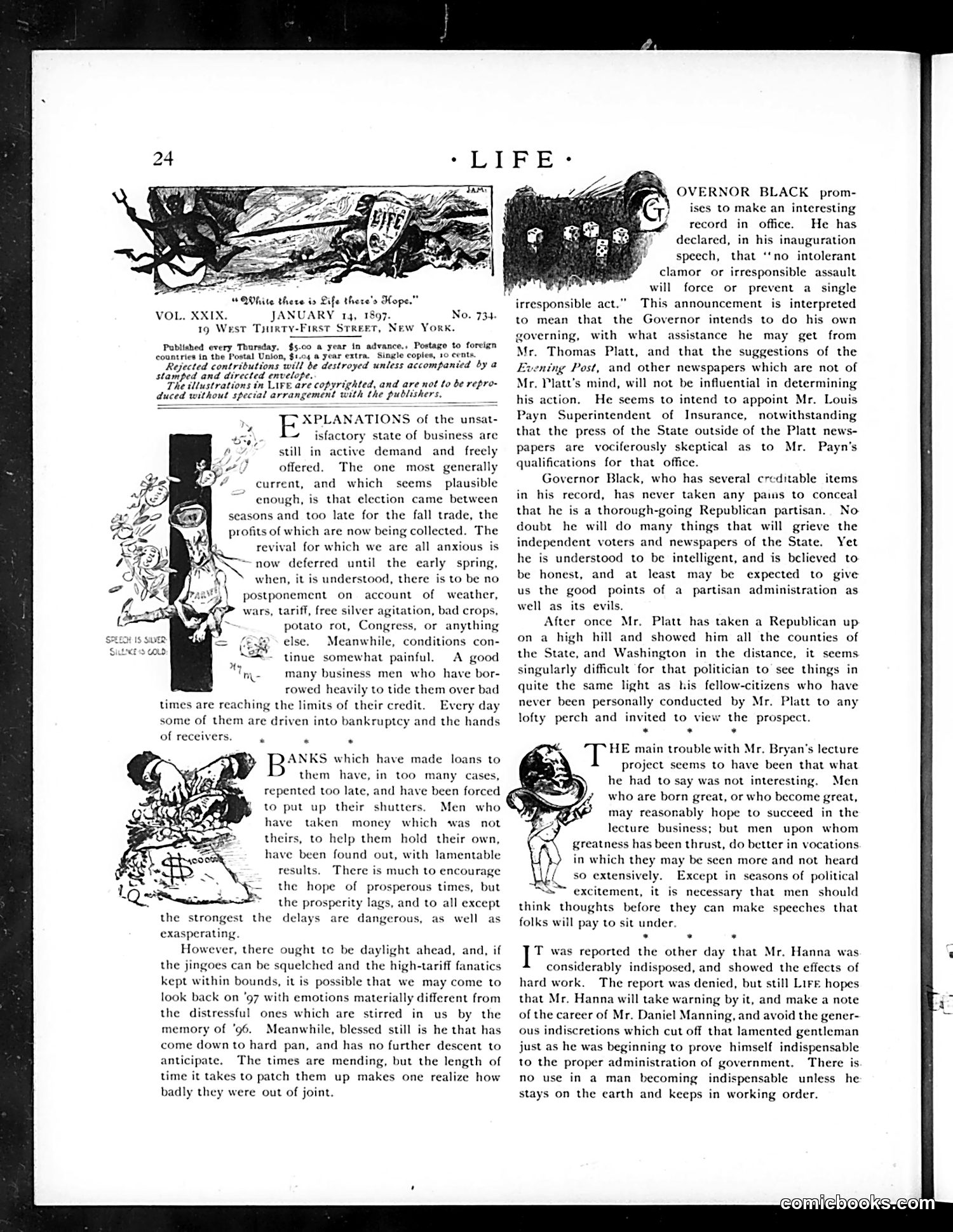
This page contains political commentary rather than cartoons. The main article discusses **Governor Black's** inaugural speech promising strict enforcement of laws without regard for partisan politics. The text expresses skepticism about his independence, noting he's "a thorough-going Republican partisan" despite claims to serve all voters equally. The piece also critiques **Mr. Platt** (a Republican political boss), suggesting Black will follow Platt's guidance despite public assertions of autonomy. Additional sections address economic hardship—bank failures, business stagnation, and agricultural problems—and comment on **Mr. Bryan's** lecture tour, suggesting speakers should avoid overly lengthy performances. The decorative illustrations (a sheep, a barrel, a figure) are generic satirical ornaments rather than specific character caricatures.
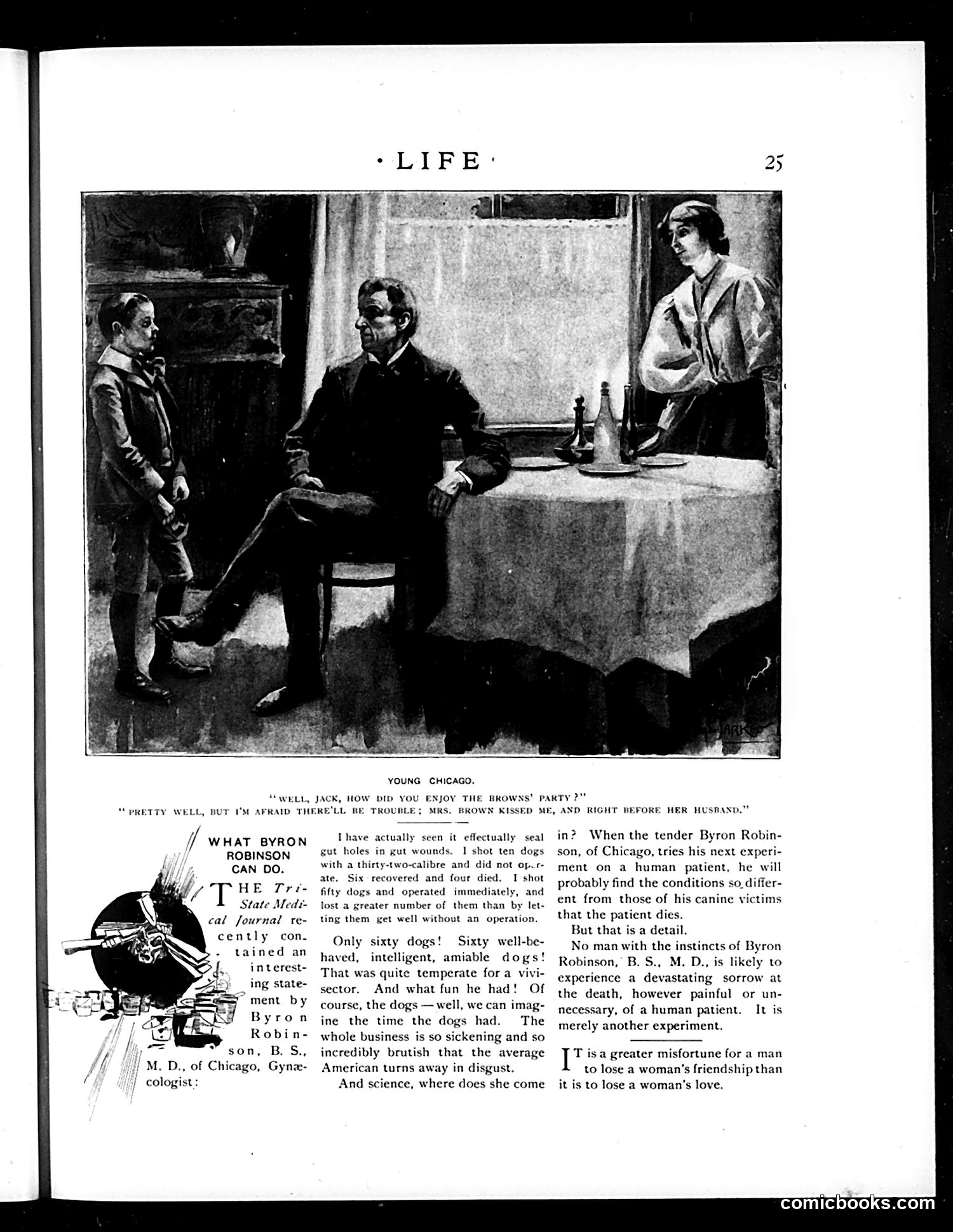
The top illustration depicts a domestic scene where a young boy stands before an adult man at a table, with a woman present. The caption quotes dialogue about a "Browns' party" and a kiss, suggesting marital infidelity or romantic scandal. Below, the page features an article about **Byron Robinson, M.D., a Chicago gynecologist**. Robinson apparently conducted surgical experiments on dogs—reportedly shooting and operating on sixty canines, with mixed survival rates. The article saririzes Robinson's work, noting the brutality and calling it "sickening" and "incredibly brutish." The satire juxtaposes domestic scandal (top) with medical ethics violations (bottom), both representing Chicago society's moral failings. The piece critiques Robinson's casual approach to animal experimentation as scientific justification for cruelty.
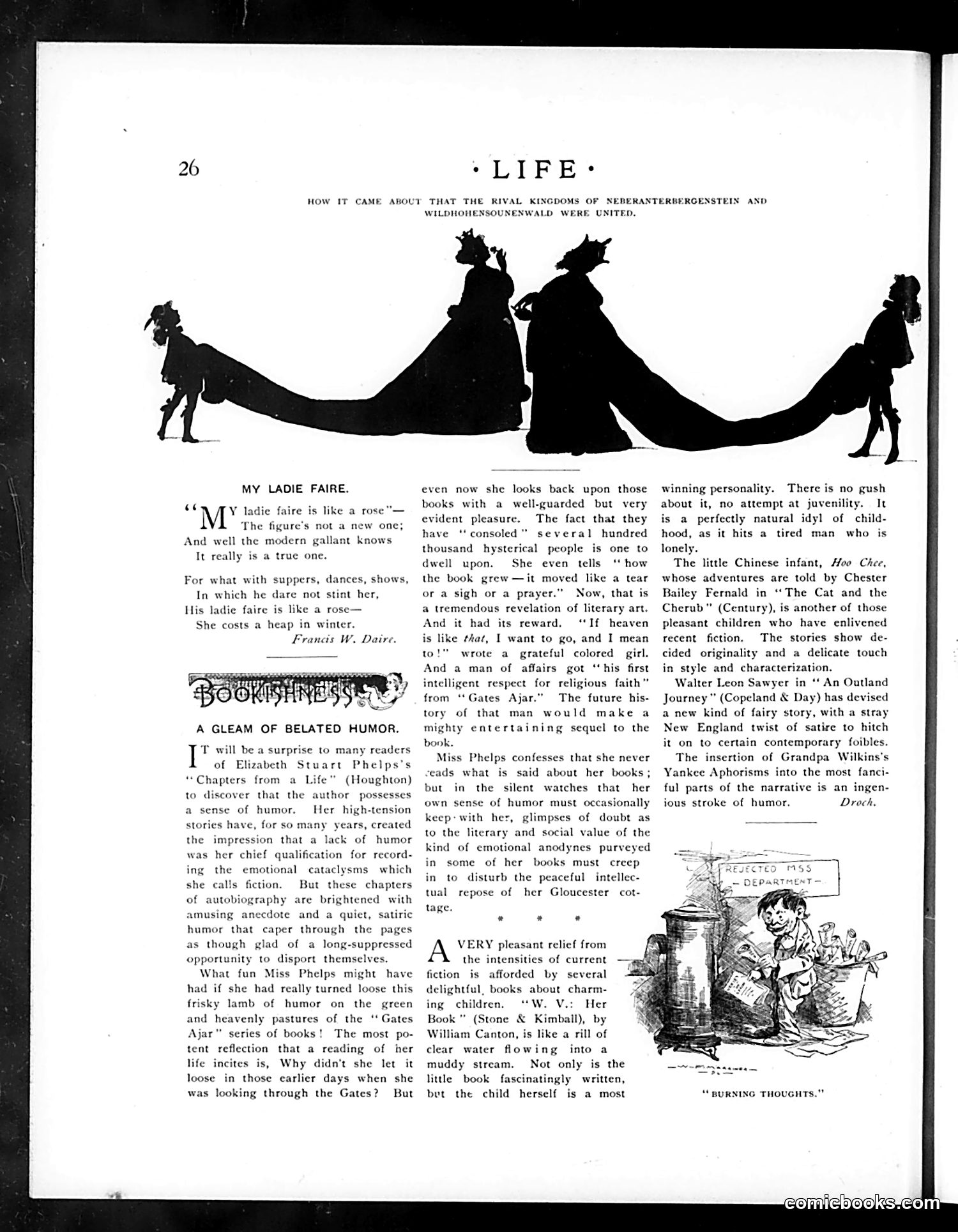
The silhouette cartoon at the top depicts two figures in elaborate cloaks being pulled apart by smaller figures on either end. The caption references "rival kingdoms of Neberaterbergenstein and Wildhoensousenwald" being united—these are clearly fictional, made-up principalities used for satirical purposes. This appears to be mocking European royal or diplomatic disputes of the era, using absurdist humor by inventing ridiculous kingdom names to deflate the seriousness of international power struggles. The rest of the page contains literary reviews, including discussions of Elizabeth Stuart Phelps's work and children's books. The illustration labeled "Bursting Thoughts" shows a figure with books overflowing from their head, humorously depicting intellectual excess or creative inspiration. The overall page blends political satire with literary criticism typical of Life magazine's approach.
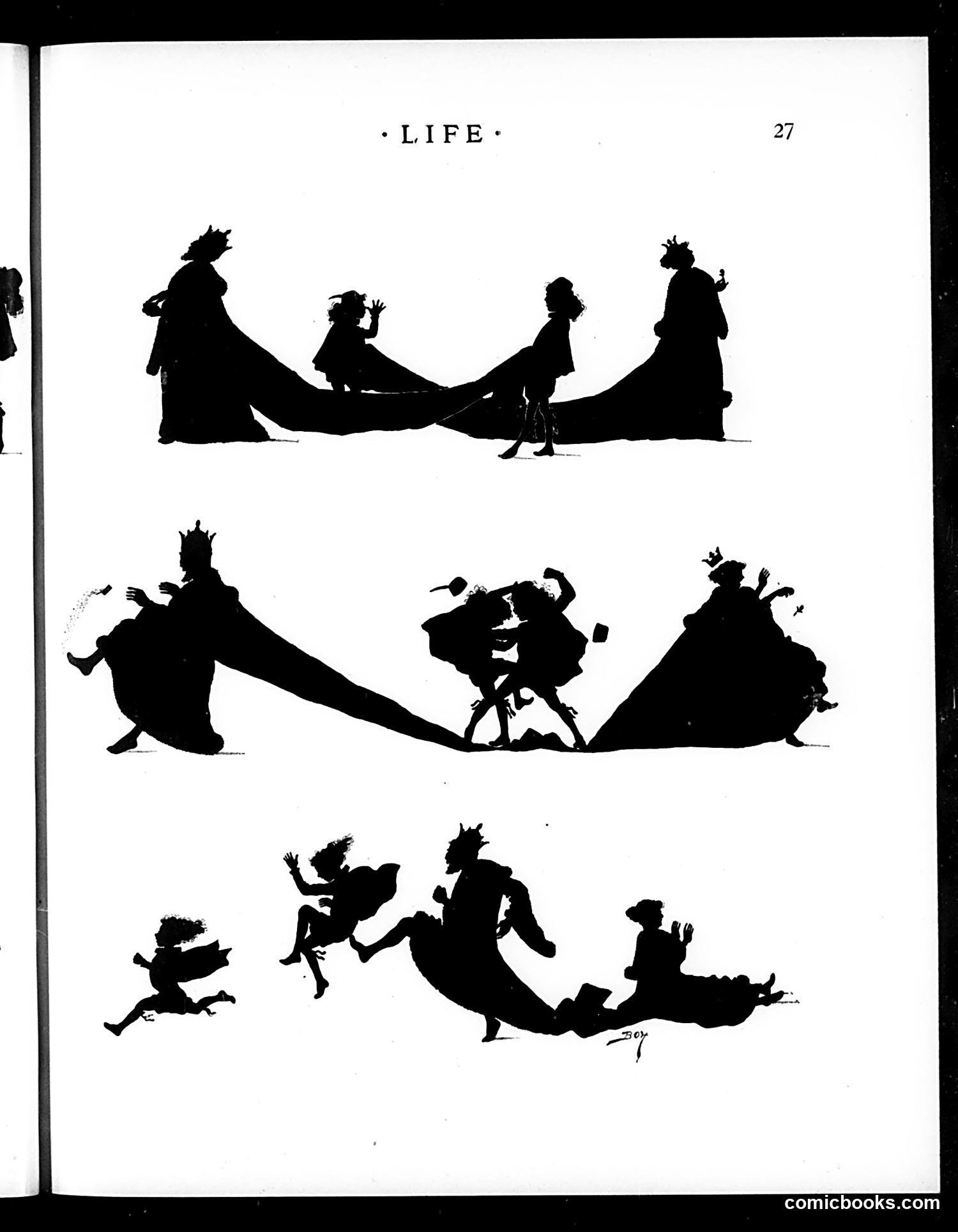
This page contains three silhouette panels depicting what appears to be political or social commentary through exaggerated physical gestures and interactions between crowned figures and other characters. The top panel shows four figures holding a cloth or fabric between them in a stretched position. The middle panel depicts violent or chaotic action with figures in dramatic poses, including what appears to be conflict or struggle. The bottom panel shows figures in motion, with some appearing to flee or chase others. Without visible text labels or captions identifying the specific figures or historical moment referenced, I cannot definitively identify which political figures or events are being satirized. The crowned figures suggest royalty or political leadership, but the exact meaning requires additional context not clearly legible in this image.
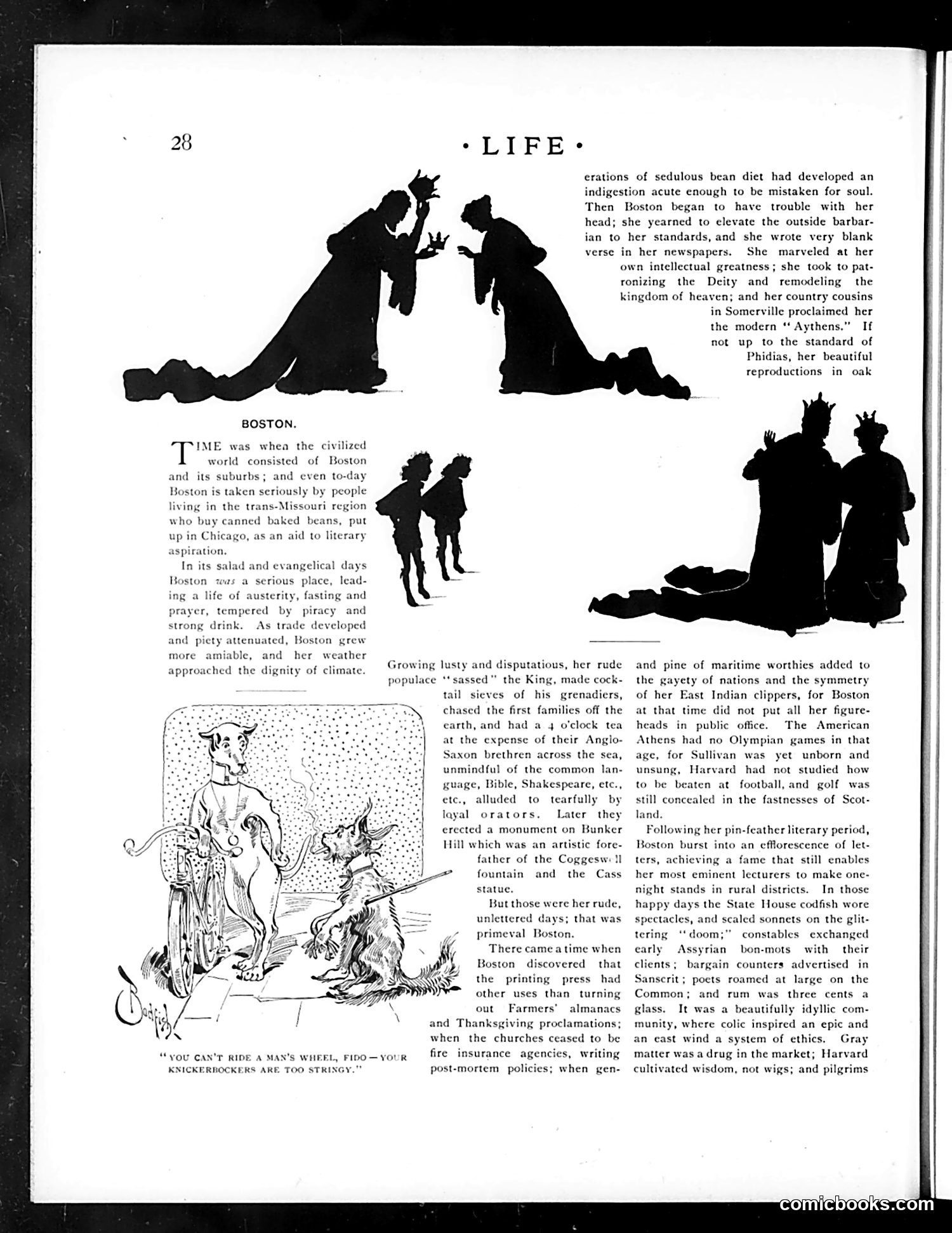
This page satirizes Boston's cultural pretensions and decline. The silhouette illustrations depict Boston's transformation from a serious, austere Puritan settlement into a city obsessed with intellectual and artistic affectation. The text mocks Boston's self-regard as an intellectual center while noting its actual influence has waned—it's now known mainly for canned beans produced elsewhere. The satirical point: Boston clings to outdated cultural authority ("modern Athens") despite being surpassed by other American cities. The bottom cartoon, captioned "YOU CAN'T RIDE A MAN'S WHEEL, FIDO—YOUR KNICKERBOCKER ARE TOO STRINGY," appears unrelated—a separate joke about dogs and clothing. Overall, the page ridicules Boston's provincial snobbery and obsolescence in the modern era.
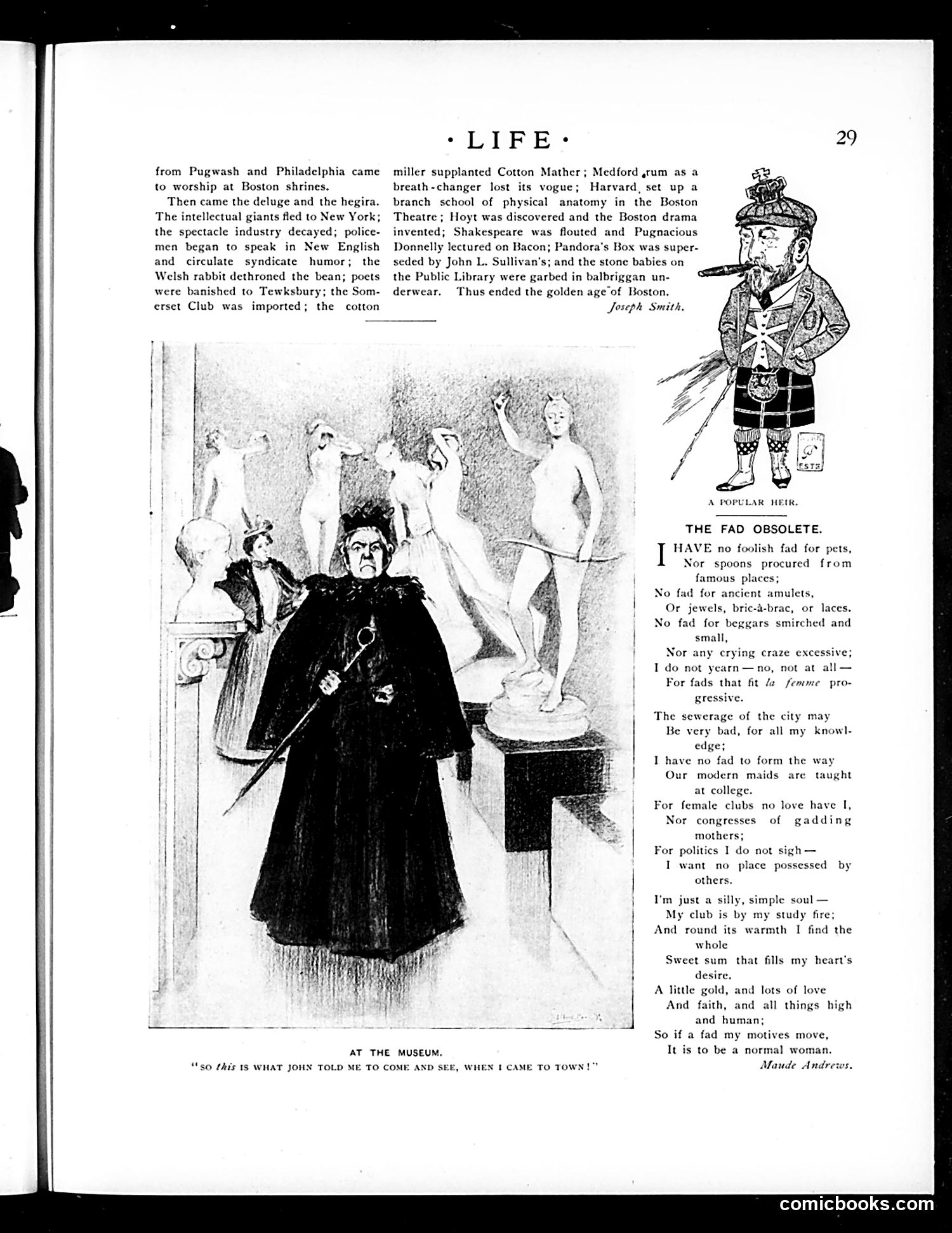
This page contains a satirical poem titled "The Fad Obsolete" by Maude Anderson, accompanied by a cartoon labeled "At the Museum." The cartoon depicts a fashionably dressed woman in an art museum viewing classical nude statues, with the caption: "So this is what John told me to come and see, when I came to town!" The satire targets women who adopt trendy behaviors based on male suggestions. The woman's presence at the museum—ostensibly for cultural education—is reframed as following a man's advice, suggesting she lacks independent judgment. The poem mocks various fashionable pursuits women engaged in, dismissing them as temporary crazes. Together, they satirize female conformity to social fads and reliance on male guidance for cultural sophistication, reflecting early 20th-century attitudes about women's autonomy and taste.
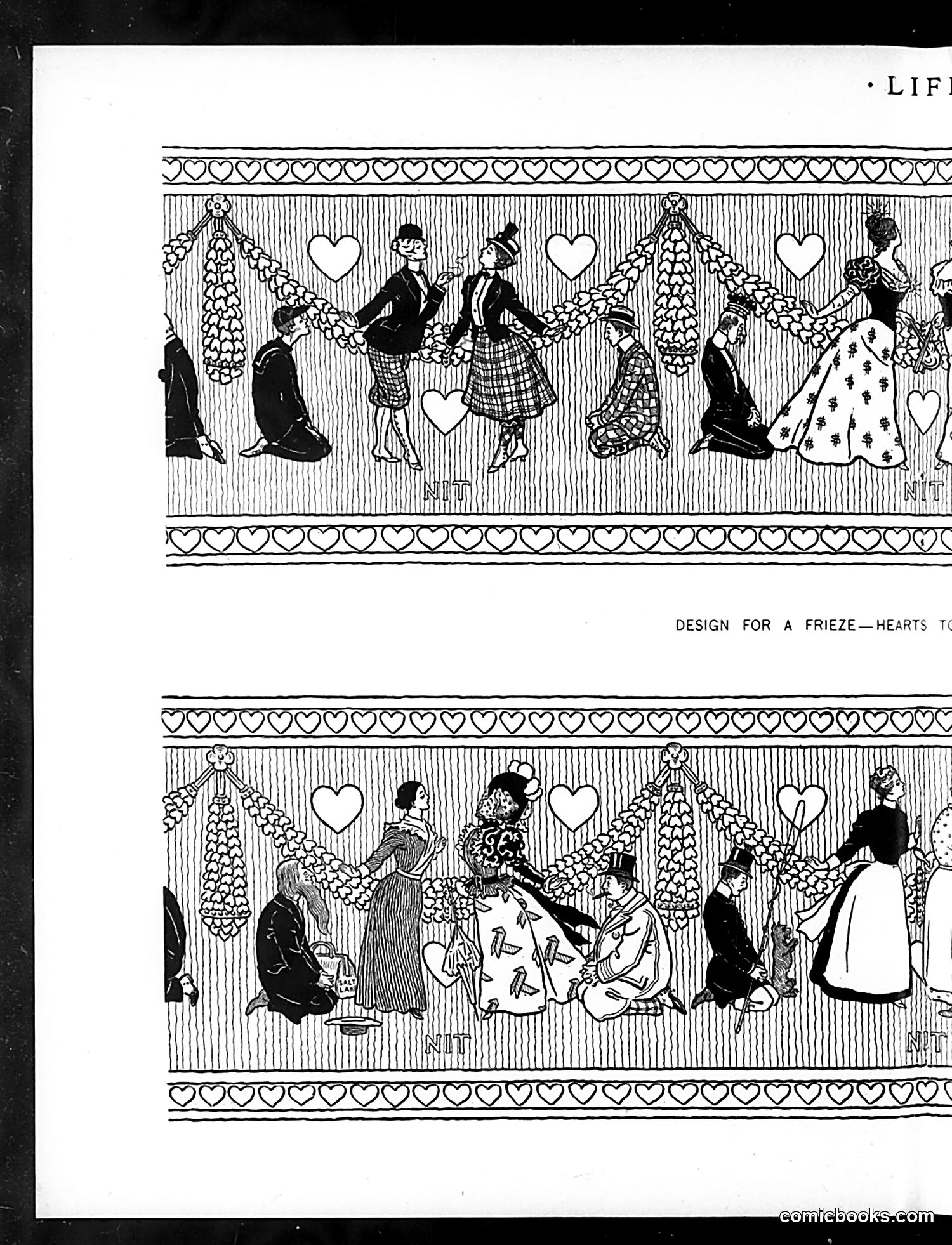
This page shows two decorative frieze designs featuring hearts and floral garland borders. Both designs depict groups of people in early 20th-century clothing arranged in social scenes beneath hanging flower arrangements and heart motifs. The upper design shows figures appearing to dance or socialize, with men in formal attire and women in period dresses. The lower design depicts seated and standing figures in what appears to be a more intimate social gathering. The title references "hearts," suggesting these are romantic or sentimental designs, likely intended as decorative wall borders or textile patterns for Valentine's Day or wedding-related purposes. The designs emphasize courtship, social interaction, and sentiment through their heart imagery and festive arrangement of figures.
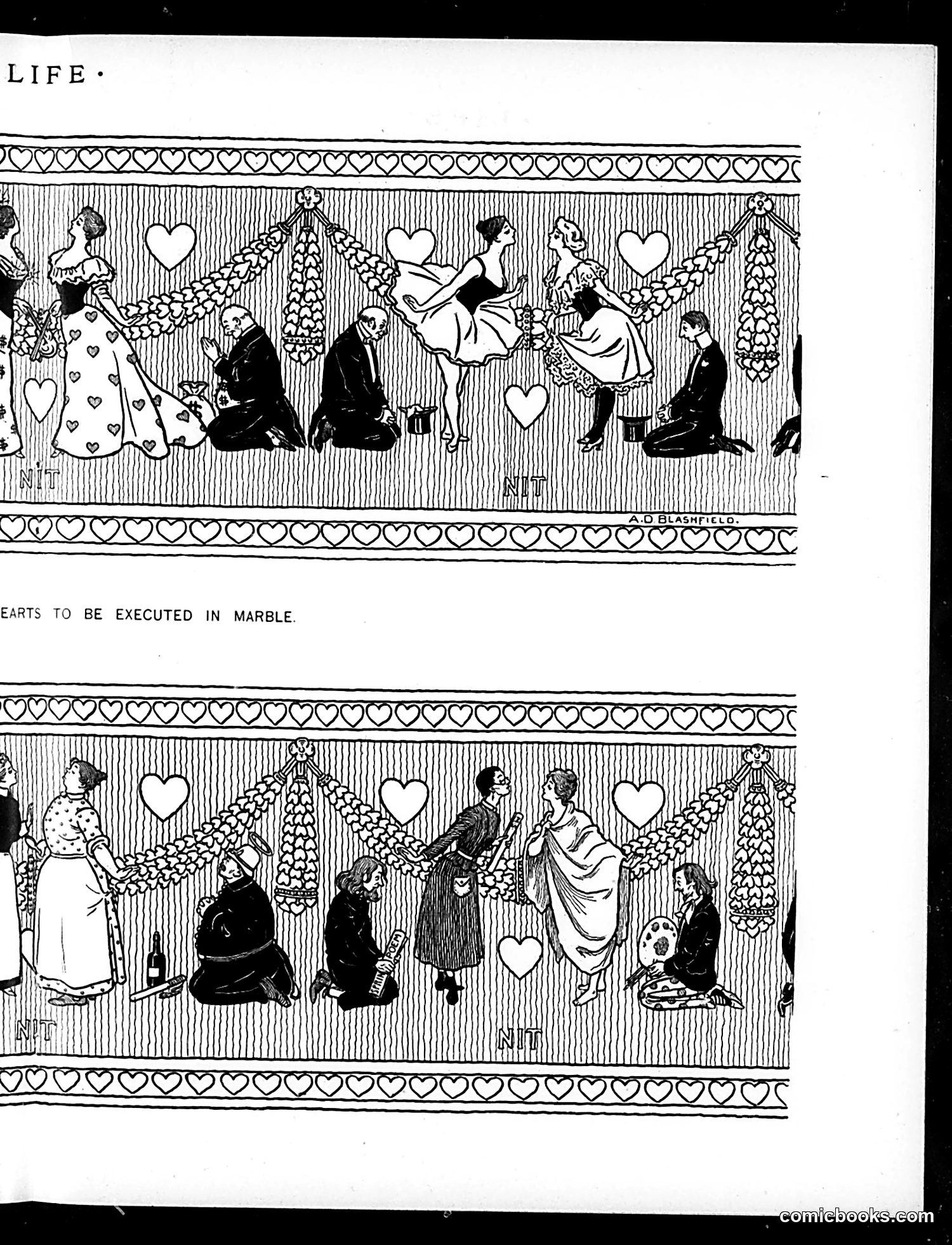
This page from *Life* magazine shows two nearly identical satirical illustrations titled "Hearts to be Executed in Marble." Both depict romantic or sentimental scenes framed by heart decorations and floral garlands—apparently proposals, engagements, or romantic moments. The satire appears to mock the sentimentalization of love and romance in Victorian or early 20th-century society. By suggesting these tender moments should be "executed in marble" (preserved as monuments), the cartoonist ridicules the way romantic gestures were treated as grand, permanent monuments rather than genuine human experiences. The repetition of nearly identical scenes with slight figure variations emphasizes how formulaic and artificial such romantic displays had become—mass-produced sentiment rather than authentic feeling. This represents *Life*'s characteristic satirizing of social conventions and artificial sentimentality.
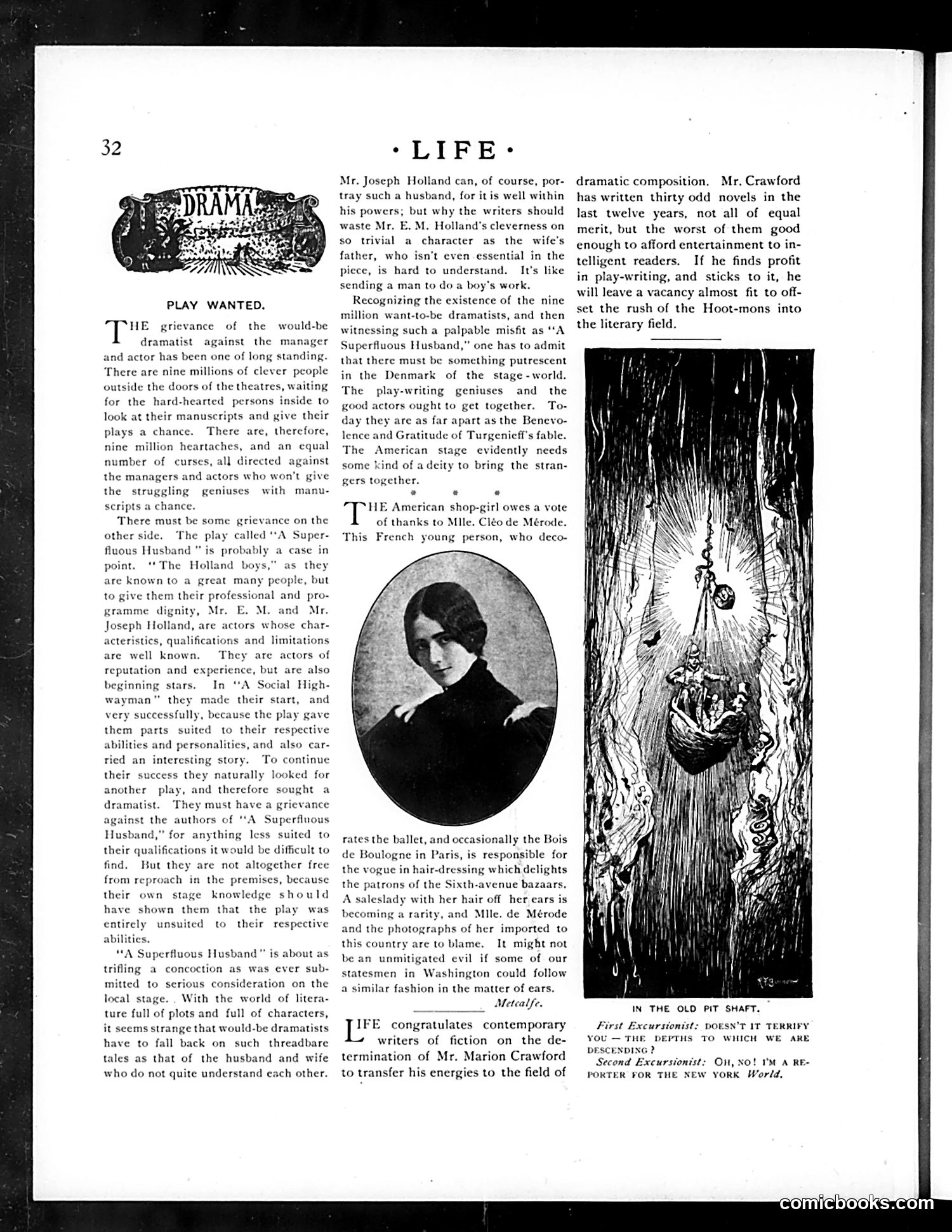
This page critiques theatrical standards and celebrity fashion through two distinct pieces: **"Play Wanted"** attacks the play *"A Superfluous Husband"* starring Joseph Holland and E.M. Holland. The article argues that despite nine million aspiring dramatists waiting for chances, theaters stage trivial works with worn-out plots (husbands and wives who "do not quite understand each other"). The Holland brothers—experienced, capable actors—are wasted on material unsuited to their talents. The piece satirizes the disconnect between desperate writers seeking opportunity and producers mounting mediocre scripts. **The French fashion commentary** mocks American women's adoption of a hairstyle popularized by French dancer Cléo de Mérode, shown in the accompanying photograph. The satire suggests that if American politicians could similarly hide their "ears" (folly/stupidity) by following fashion trends, Washington might improve. The tone throughout is typical Life magazine: witty social criticism targeting theatrical pretension, gender consumption, and political incompetence.
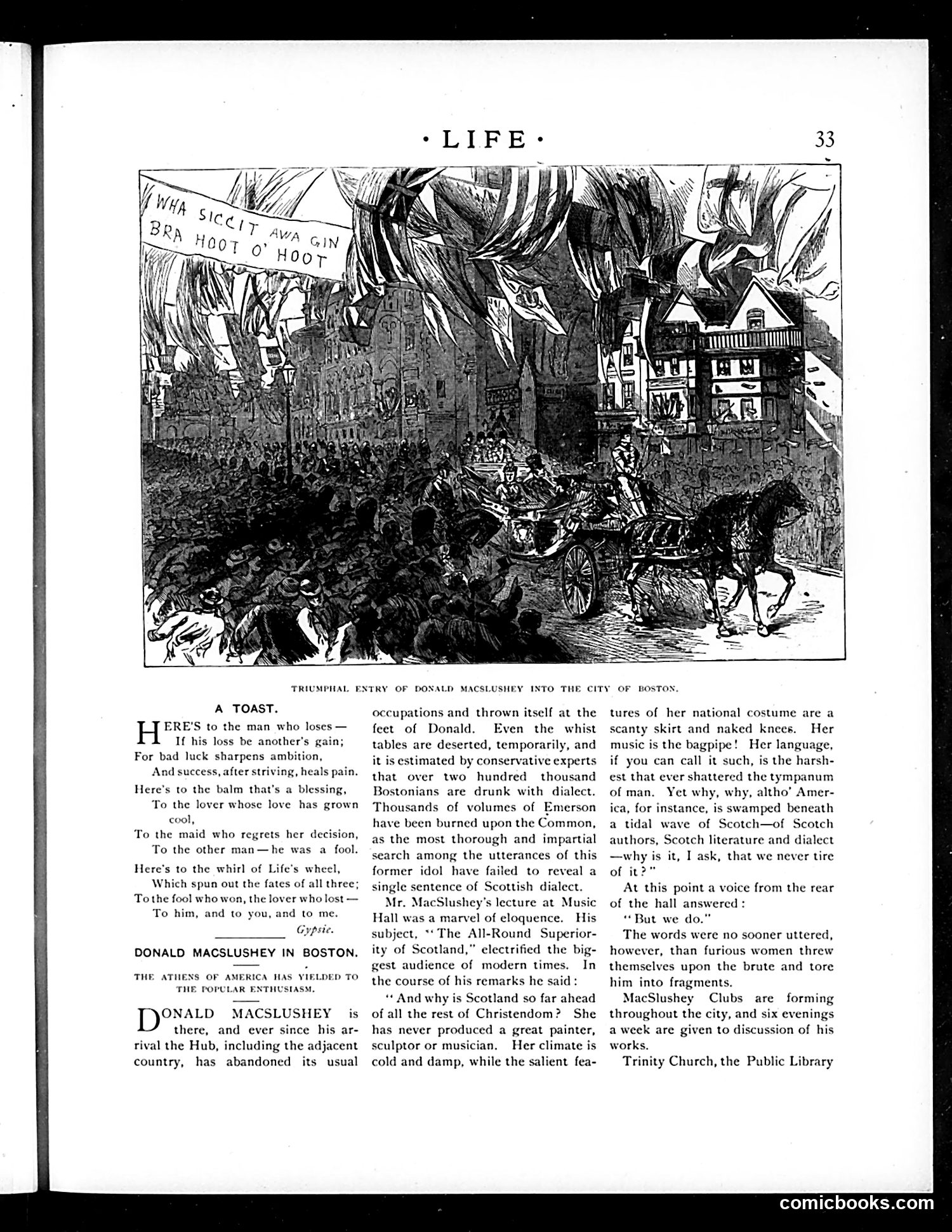
This satirical piece mocks the faddish enthusiasm for Scottish culture that swept Boston around the turn of the 20th century. "Donald MacSlushey" appears to be a fictional stand-in for a Scottish lecturer or entertainer who has captivated the city. The satire works on multiple levels: MacSlushey lectures on Scotland's superiority while listing objectively terrible things (no great art, harsh language, bagpipes, cold weather, ugly clothing). Boston's intellectual establishment—normally devoted to Emerson and high culture—abandons these pursuits for Scottish dialect enthusiasm, burning Emerson volumes. The cartoon depicts his triumphant entry into Boston as a conquering hero. The joke's punchline arrives when an audience member heckles "But we do" tire of it—only to be violently attacked by "furious women," suggesting the cultish, irrational devotion his followers display. The piece satirizes both Scottish cultural nationalism and American susceptibility to fashionable trends that displace serious intellectual pursuits.
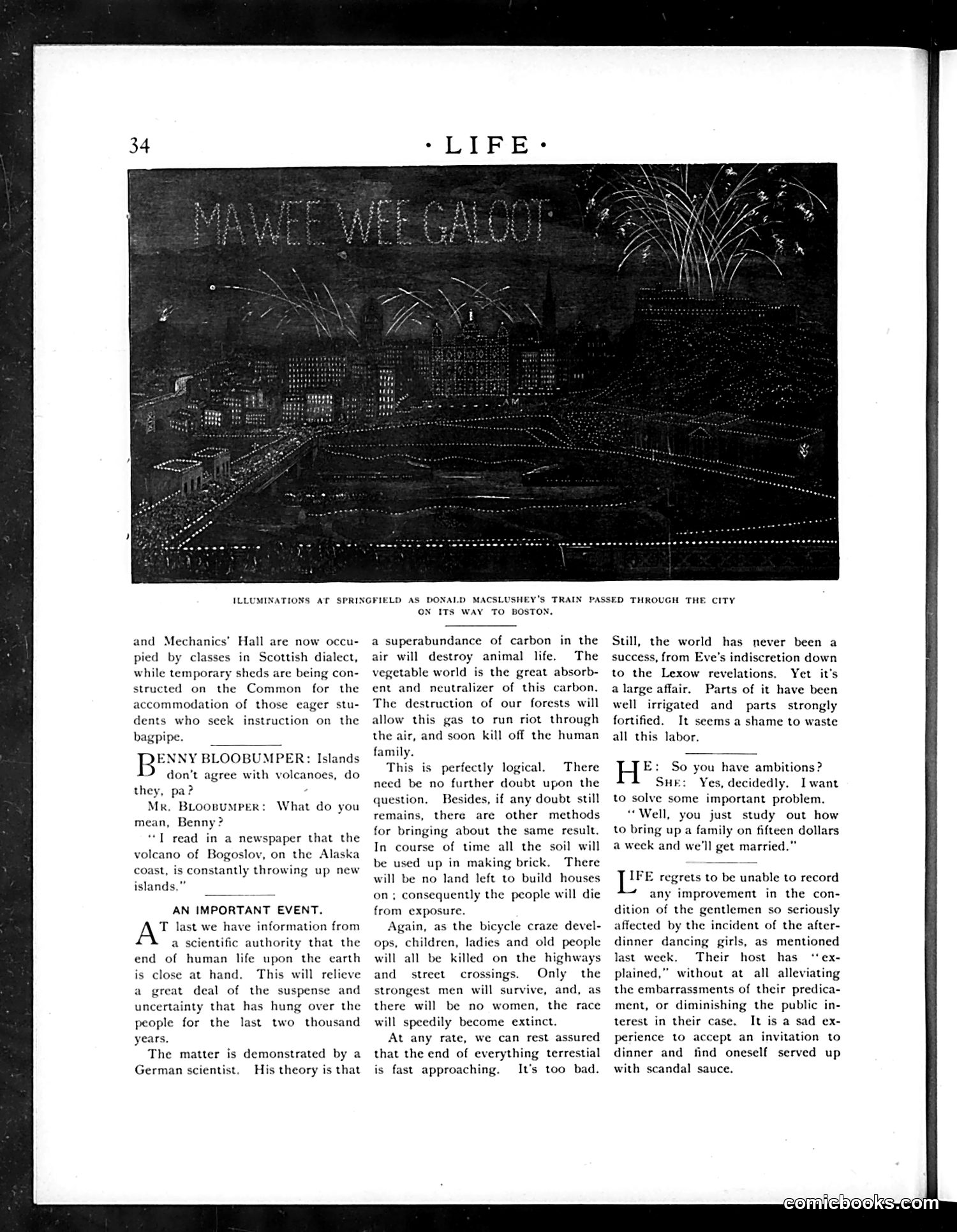
This page contains several distinct satirical pieces mocking contemporary anxieties and social concerns of the early 1900s. The prominent illustration titled "Mawkee Wee Galoot" depicts illuminated Springfield during Donald MacSluskey's train passage to Boston—likely referencing a notable public figure or event now unclear. The text below satirizes doomsday prophecies: a "German scientist" claims carbon buildup will exterminate humanity. The satire systematically mocks this apocalyptic theory while introducing other absurd extinction scenarios—forest destruction, brick-making consuming all soil, bicycles killing pedestrians until only strong men remain. The author ridicules both the scientific panic and human obsession with catastrophe, noting the world "has never been a success" anyway. Additional brief comedic exchanges include Scottish dialect lessons, a father-son dialogue about volcanic islands, and a domestic joke about marriage requiring a husband to support a family on fifteen dollars weekly—highlighting economic anxieties of the era. The final item notes scandal involving "after-dinner dancing girls," suggesting contemporary high-society gossip.
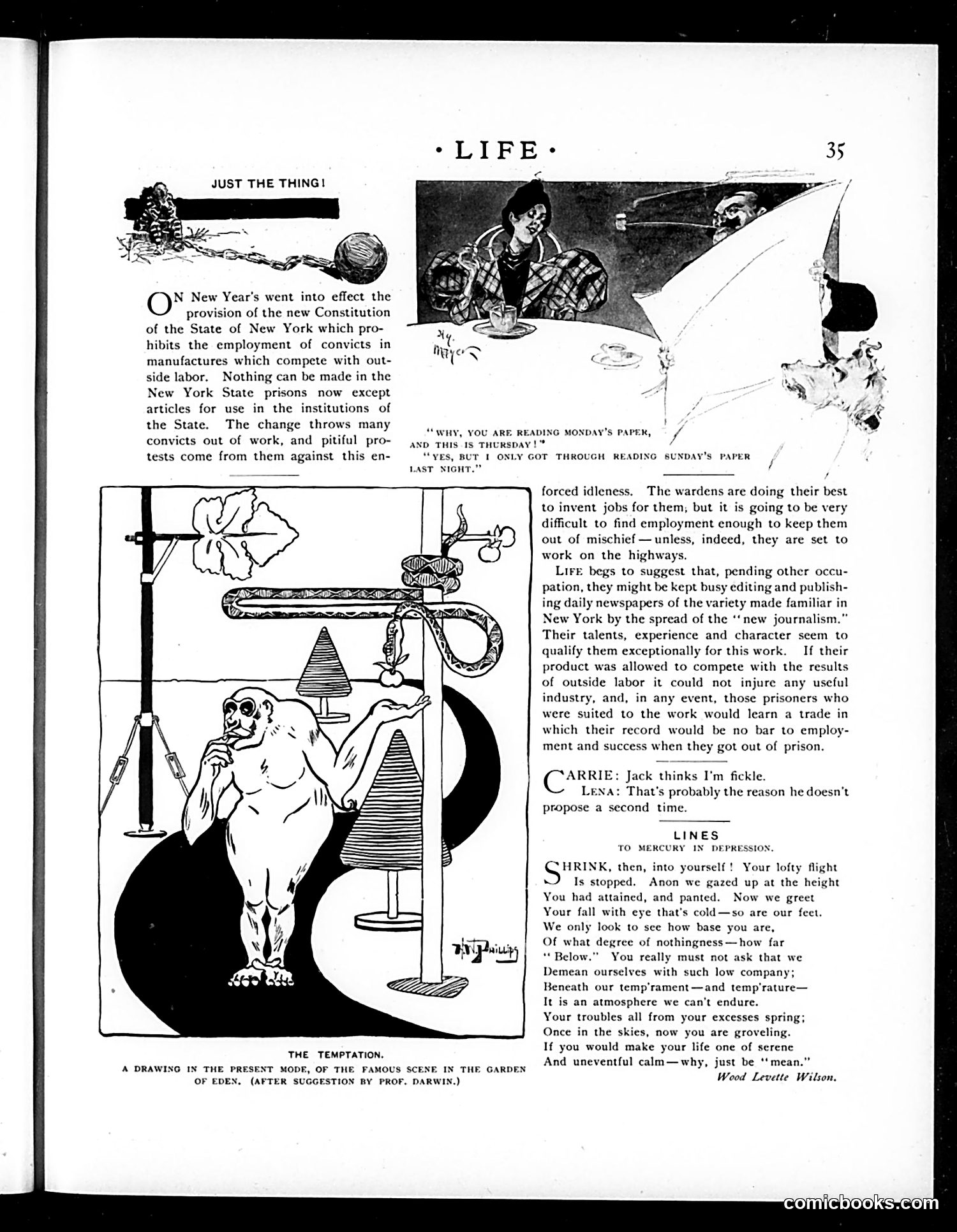
This *Life* magazine page satirizes New York's new prison labor law (enacted January 1st) prohibiting convicts from manufacturing goods that compete with outside industry. The law leaves prisoners idle, creating a practical problem. **The Main Cartoon** ("The Temptation") presents Adam in Eden as an overweight, modern man surrounded by scales, measuring devices, and geometric shapes—a darkly humorous visual pun suggesting temptation through gluttony or excess, updated to contemporary (circa 1900s) scientific/Darwinian imagery. The caption credits "Prof. Darwin," mocking evolutionary theory's contemporary cultural prominence. **The Satire's Point:** *Life* ironically proposes prisoners edit and publish newspapers—specifically the sensationalist "new journalism" then flooding New York. Since convict-made goods can't compete commercially, newspapers wouldn't violate the law, yet prisoners' notorious untrustworthiness would humorously suit them to this morally questionable trade. The page also includes a brief marital joke and a melancholic poem about Mercury's fall from heights, unrelated to the main content.
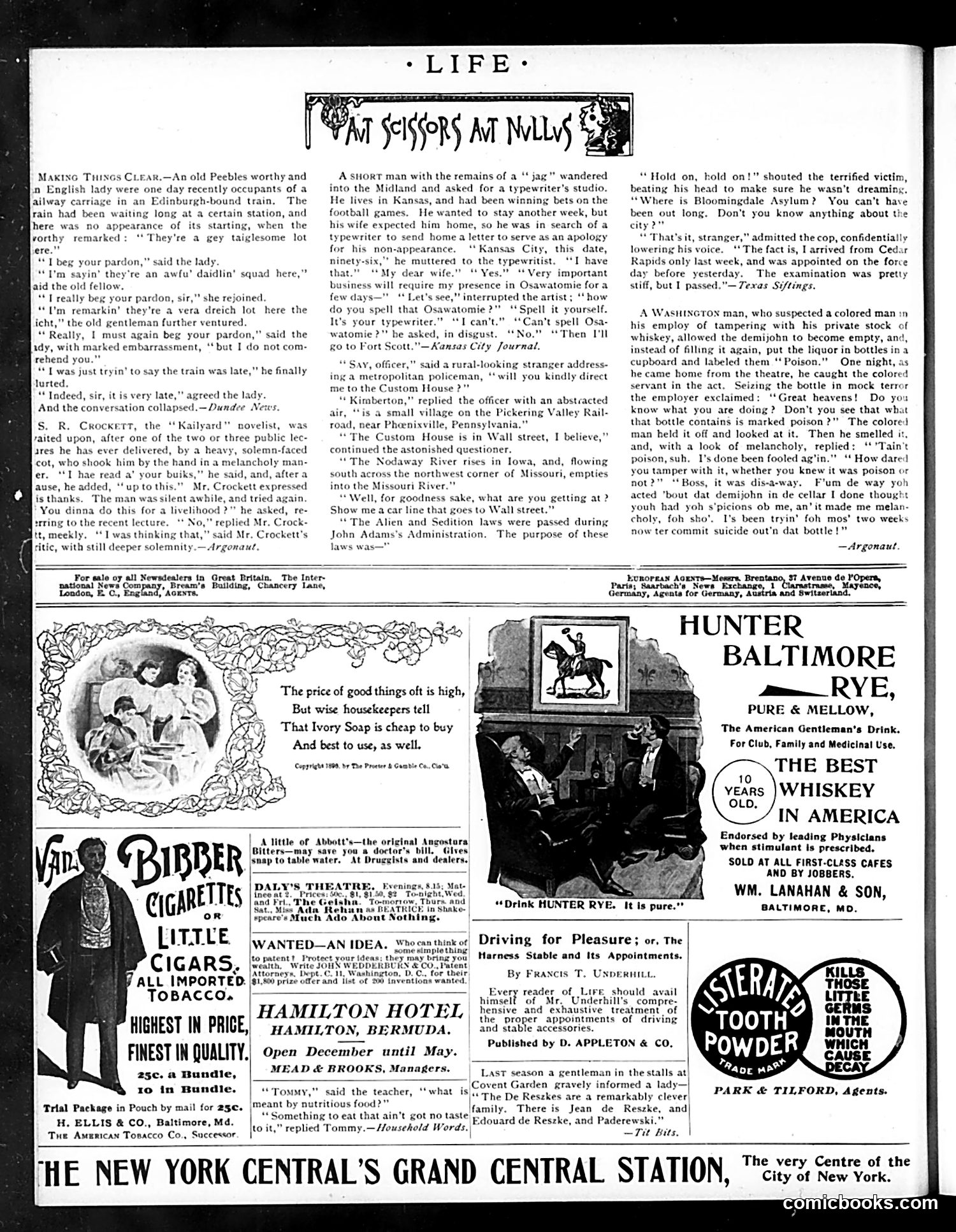
This page contains **humorous anecdotes** rather than political cartoons. The pieces are short comedic stories satirizing American life and regional dialects: 1. **Scottish dialect humor**: Stories about Edinburgh locals whose thick Scottish accent makes them unintelligible to English speakers ("gey taiglesome" = very slow). 2. **Police incompetence satire**: A newly hired New York cop, fresh from Cedar Rapids, responds to a stranger's simple directional question by randomly spouting unrelated facts (about the Nodaway River, Alien and Sedition Laws) instead of helping him find Wall Street or Bloomingdale Asylum. 3. **Whiskey theft**: A Washington employer catches his Black employee stealing liquor by labeling empty bottles "Poison." The humor relies on **period stereotypes**: linguistic confusion, rural-to-urban incompetence, and racial dynamics typical of 1890s American satire. The page also contains contemporary **advertisements** (Ivory Soap, Hunter Rye whiskey, tobacco products).
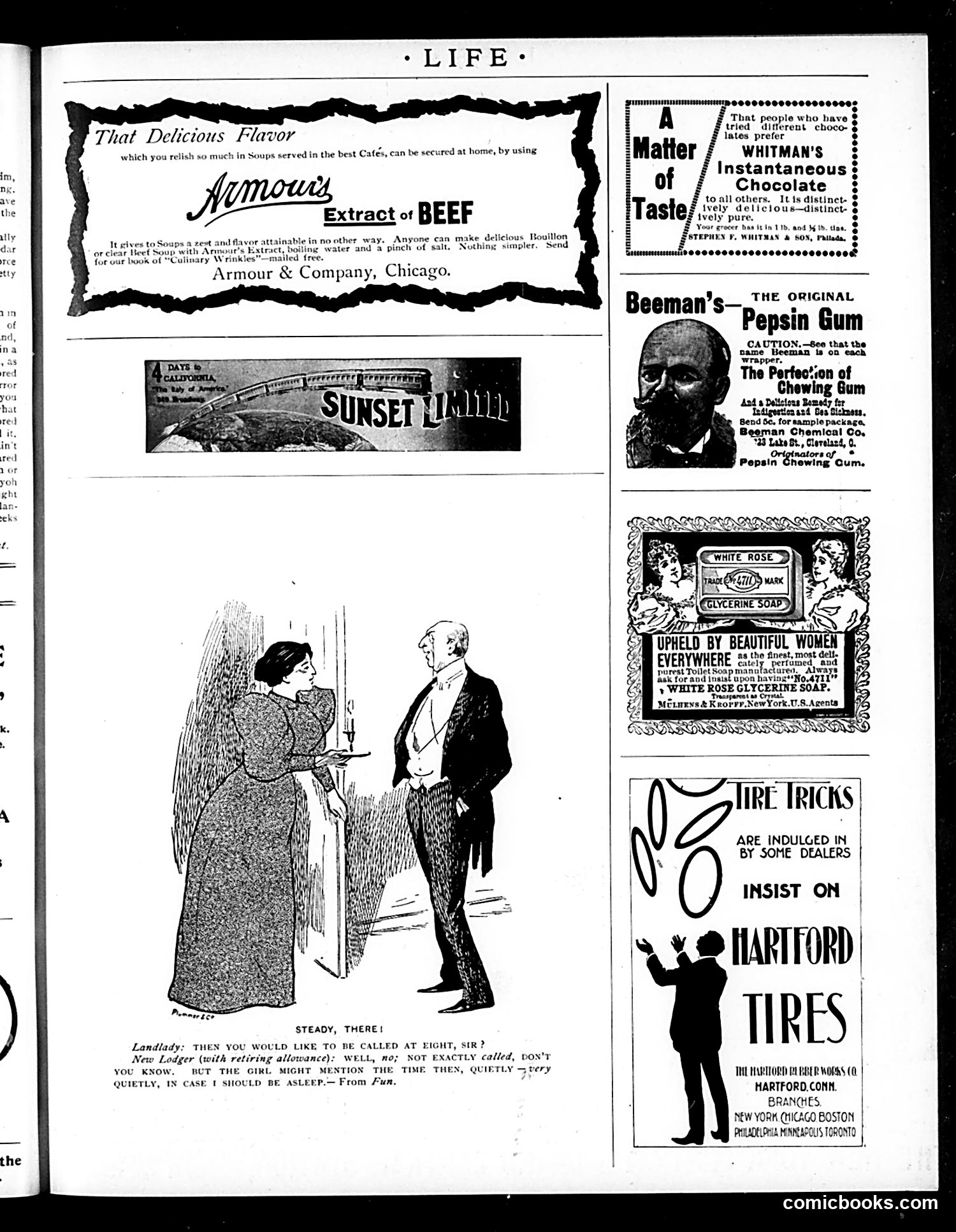
This is primarily an **advertising page** with one cartoon. The ads promote consumer goods typical of the early 20th century: beef extract, chocolate, chewing gum, soap, and tires. The single cartoon, titled "Steady, There!", depicts a **comedic misunderstanding about a boarding house wake-up call**. A new lodger with a "retiring allowance" (likely a pensioner or someone of modest means) requests that the landlady's maid not actually *call* him at eight o'clock, but merely *mention* the time—quietly, in case he's asleep. The humor derives from his absurd, contradictory request: he wants notification without being disturbed, suggesting either excessive sensitivity to noise or gentle mockery of fastidious elderly lodgers. The cartoon satirizes the social pretensions and delicate sensibilities of lower-middle-class boarding house residents.
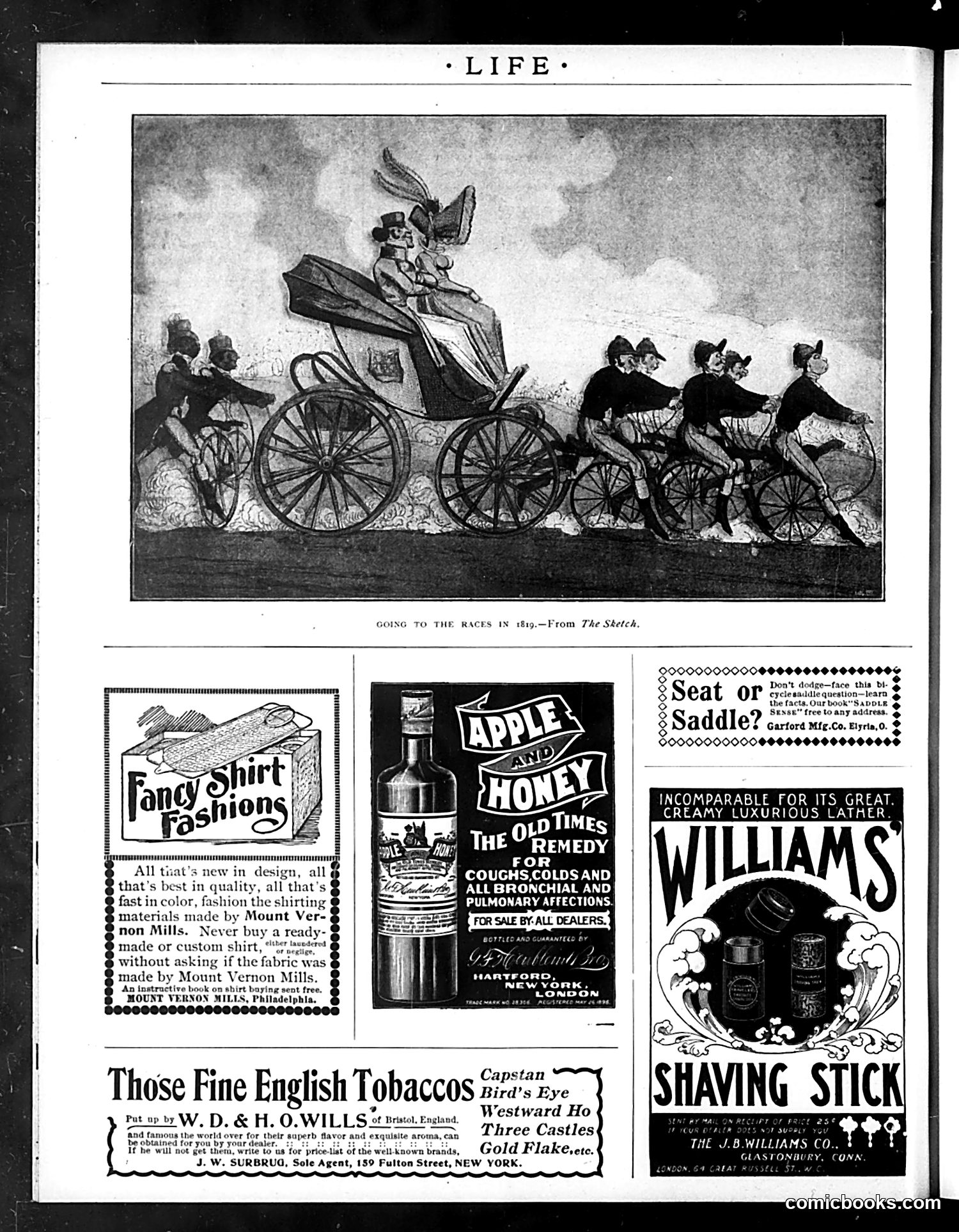
This satirical cartoon from *The Sketch* depicts bicycling as a novel leisure activity. The main figure—a portly gentleman in a top hat riding an elaborate, ornate bicycle-carriage hybrid—leads a procession of cyclists heading to the races. The humor lies in the contrast between the gentleman's elaborate, old-fashioned conveyance and the simpler bicycles ridden by his followers. The caption's specific date (1819) is anachronistic—bicycles didn't exist then—suggesting this is a contemporary joke about how ridiculous early bicycles and cyclists appeared to Victorian observers accustomed to carriages and horses. The satire likely mocks the emerging bicycle craze as an undignified, comical mode of transportation adopted by the leisured classes, particularly for social events like horse racing. The overblown carriage suggests vanity and the absurd lengths people go to maintain status while embracing new technology.
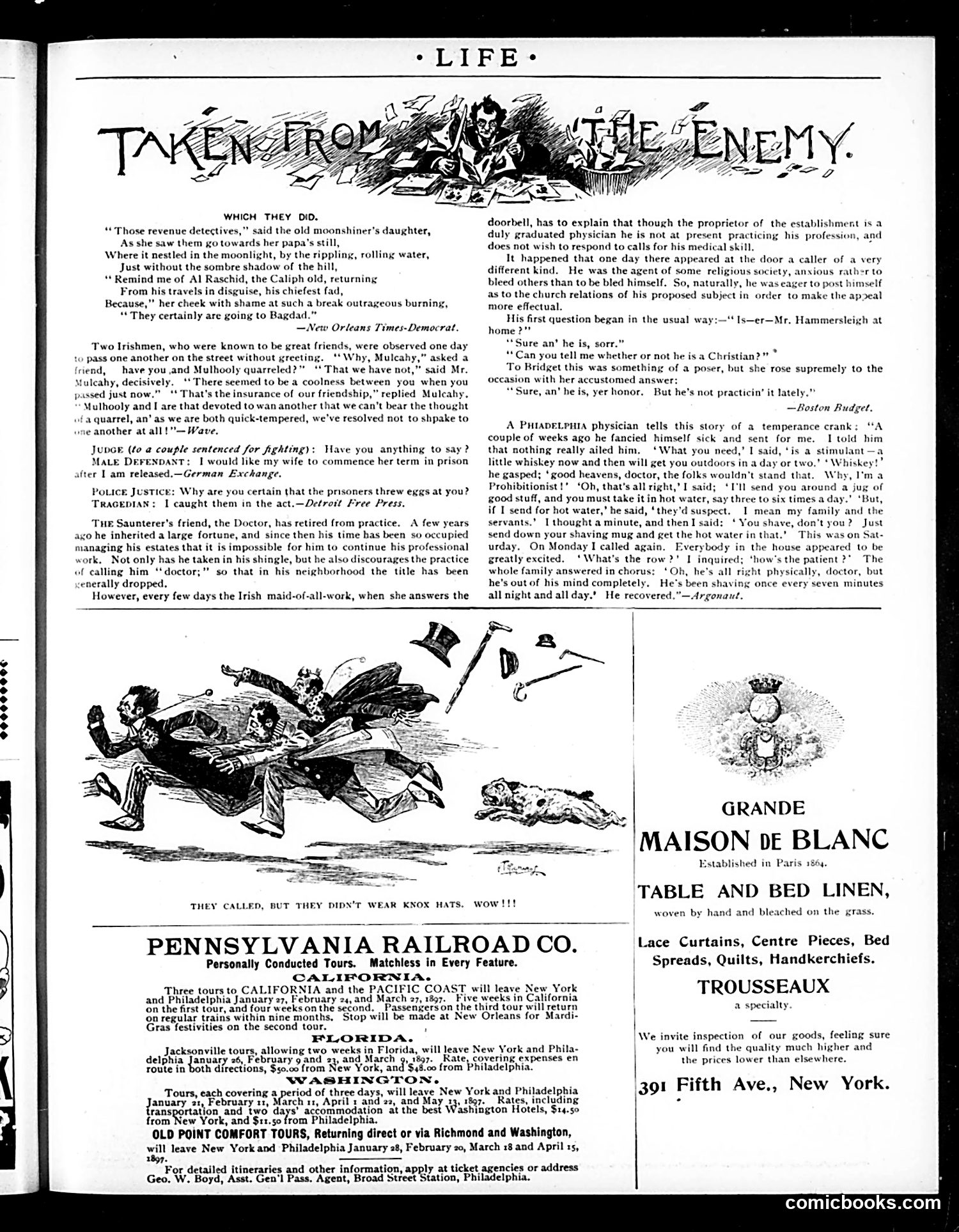
This page contains several humorous short stories and anecdotes typical of early Life magazine satire: **Main cartoon** (bottom left): Shows revenue agents pursuing a moonshiner—a reference to federal alcohol enforcement and rural resistance to it. **Irish friendship joke**: Two Irishmen avoid speaking to maintain their friendship, having agreed not to quarrel since they're "quick-tempered." **Doctor retirement anecdote**: A wealthy physician stops practicing after inheriting money. **Religious caller story**: A church representative visits a doctor's house. The maid (Bridget, an Irish servant stereotype) answers that yes, the doctor is Christian, "but he's not practicin' it lately"—mocking both medical professionals and religious hypocrisy. **Temperance joke**: A prohibitionist patient needs whiskey as medicine but fears his family discovering it. The doctor suggests disguising it in a shaving mug—satirizing both Prohibition-era absurdities and medical authority. The page satirizes class pretension, Irish stereotypes, hypocrisy, and Prohibition-era contradictions through brief comedic vignettes.
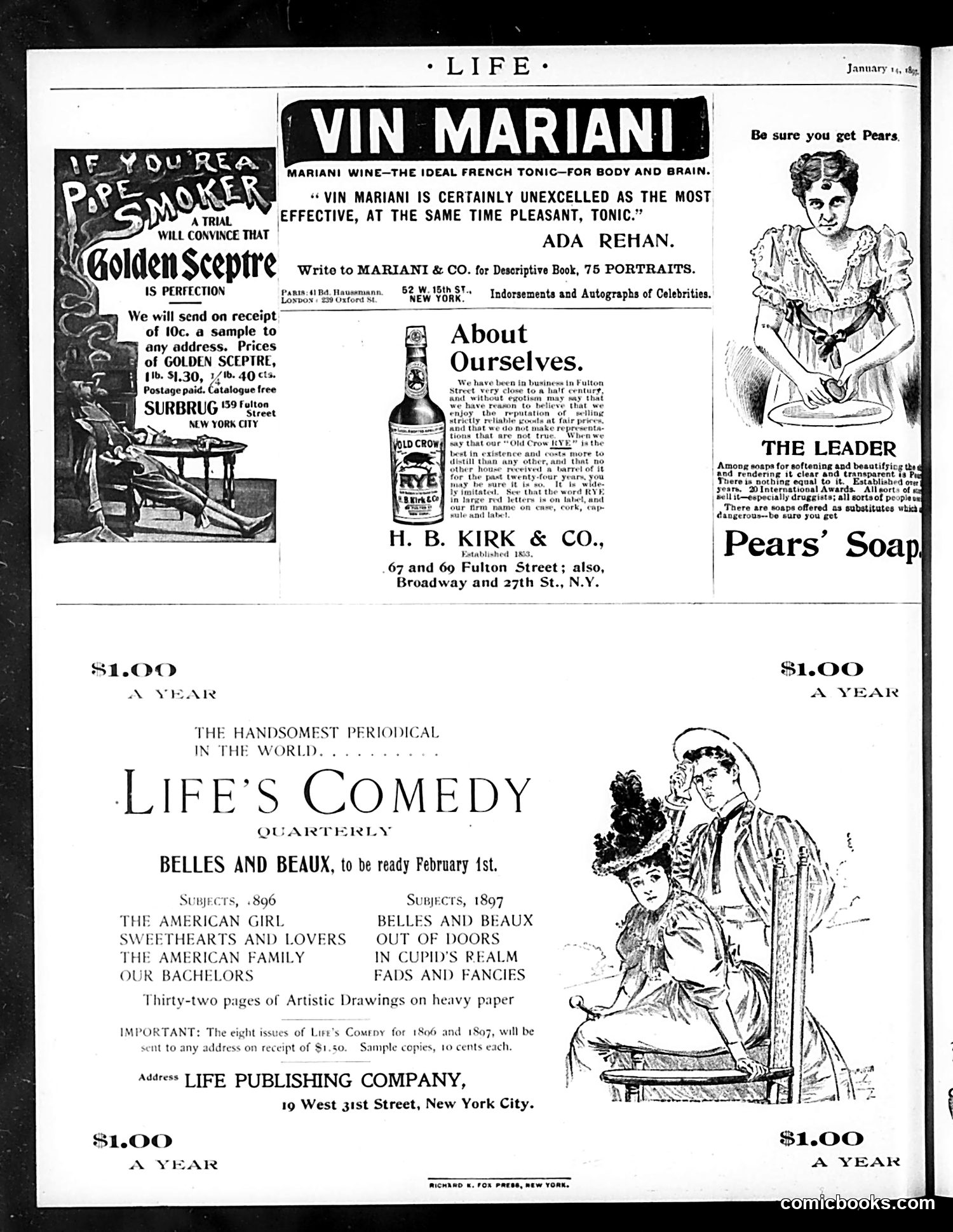
This is primarily an **advertising page** rather than editorial content. The main advertisements are: **Vin Mariani** - A French wine marketed as a health tonic "for body and brain," endorsed by actress Ada Rehan. This reflects late-Victorian patent medicine culture, when wine and alcohol-based tonics were widely promoted as medicinal cure-alls. **Golden Sceptre** - A competing paper smoker product. **Pears' Soap** - Positioned as superior to substitute brands, appealing to aspirational consumers. **H.B. Kirk & Co.** - A liquor company advertising rye whiskey. **Life's Comedy Quarterly** - The magazine's own publication promoting romantic and domestic comedy drawings for 1896-1897. The page reveals period commercial culture: unregulated health claims, celebrity endorsements for dubious products, and genteel advertising aimed at middle-class readers. No political satire is present—this is straightforward commercial promotion typical of 1890s magazine revenue models.