
Life, 1897-01-14 · page 15 of 20
Life — January 14, 1897 — page 15: what you’re looking at
What you’re looking at
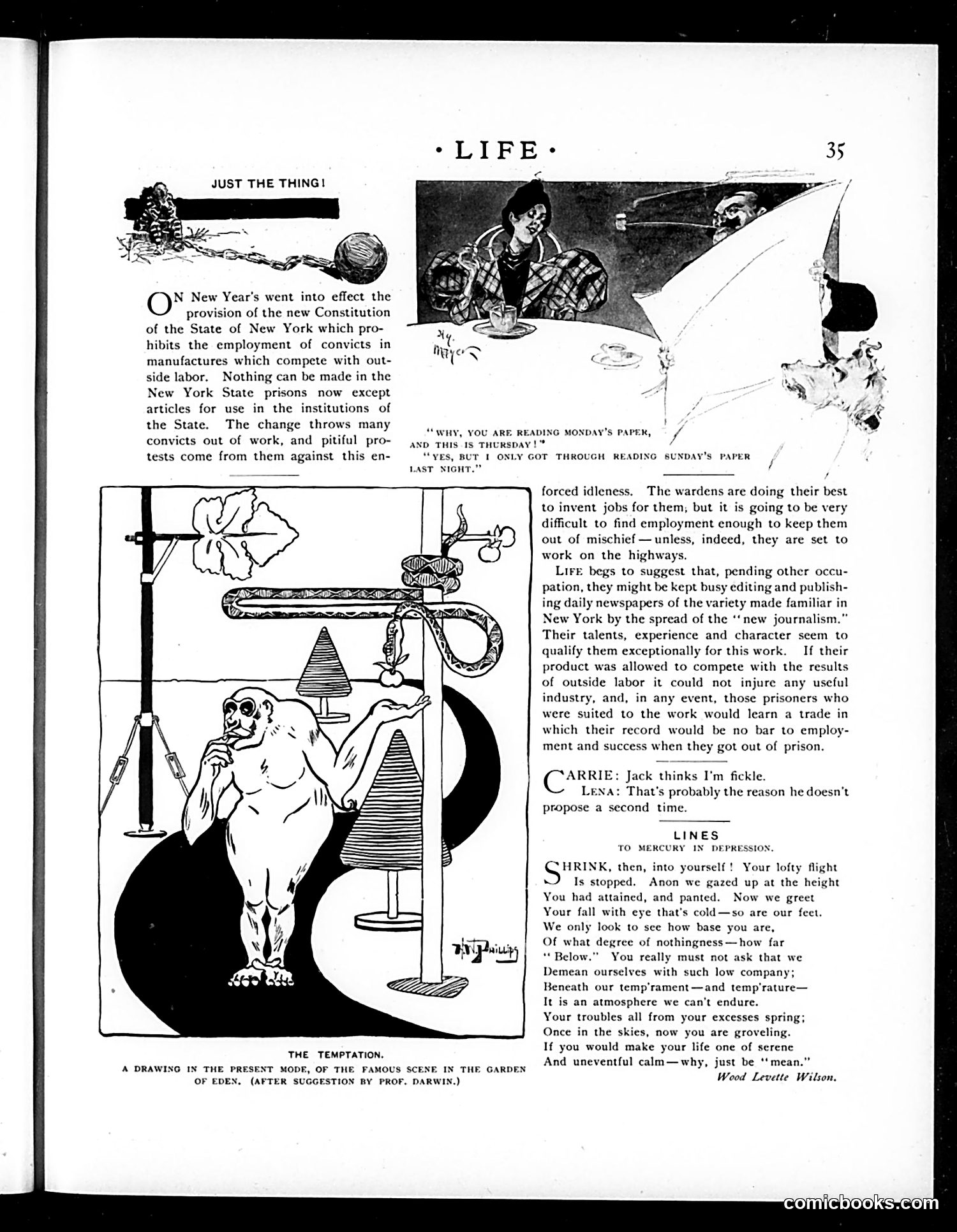
This *Life* magazine page satirizes New York's new prison labor law (enacted January 1st) prohibiting convicts from manufacturing goods that compete with outside industry. The law leaves prisoners idle, creating a practical problem. **The Main Cartoon** ("The Temptation") presents Adam in Eden as an overweight, modern man surrounded by scales, measuring devices, and geometric shapes—a darkly humorous visual pun suggesting temptation through gluttony or excess, updated to contemporary (circa 1900s) scientific/Darwinian imagery. The caption credits "Prof. Darwin," mocking evolutionary theory's contemporary cultural prominence. **The Satire's Point:** *Life* ironically proposes prisoners edit and publish newspapers—specifically the sensationalist "new journalism" then flooding New York. Since convict-made goods can't compete commercially, newspapers wouldn't violate the law, yet prisoners' notorious untrustworthiness would humorously suit them to this morally questionable trade. The page also includes a brief marital joke and a melancholic poem about Mercury's fall from heights, unrelated to the main content.
📄 Transcribed text from this page (OCR, searchable)
Machine-transcribed from the original scan — historical spelling and the odd misread are preserved.
JUST THE THING! O* New Year's went into effect the provision of the new Constitution of the State of New York which pro- hibits the employment of convicts in manufactures which compete with out- side labor. Nothing can be made in the New York State prisons now except articles for use in the institutions of convicts out of work, and pitiful pro- yxy tus 1s THURSDAY!” tests come from them against this en- “YES, BUT I ONLY GOT THROUGH READING SUNDAY'S PAPER LAST NIGHT.” —= forced idleness. The wardens are doing their best to invent jobs for them; but it is going to be very difficult to find employment enough to keep them out of mischief — unless, indeed, they are set to work on the highways. Lire begs to suggest that, pending other occu- pation, they might be kept busy editing and publish- ing daily newspapers of the variety made familiar in New York by the spread of the ‘‘new journalism.” Their talents, experience and character seem to qualify them exceptionally for this work. If their product was allowed to compete with the results of outside labor it could not injure any useful industry, and, in any event, those prisoners who were suited to the work would learn a trade in which their record would be no bar to employ- ment and success when they got out of prison. ARRIE: Jack thinks I'm fickle. LeNA: That's probably the reason he doesn’t propose a second time. LINES TO MERCURY IN DEPRESSION. ~ HRINK, then, into yourself! Your lofty flight x Is stopped. Anon we gazed up at the height You had attained, and panted. Now we greet Your fall with eye that’s cold—so are our feet. We only look to sce how base you are, Of what degree of nothingness—how far ** Below.” You really must not ask that we Demean ourselves with such low company; Beneath our temp’rament—and temp'rature— It is an atmosphere we can't endure. Your troubles all from your excesses spring; Once in the skies, now you are groveling. If you would make your life one of serene And uneventful calm—why, just be **mean.” THE TEMPTATION. A DRAWING IN THE PRESENT MODE, OF THE FAMOUS SCENE IN THE GARDEN i Le ‘ OF EDEN, (AFTER SUGGESTION BY PROF. DARWIN.) Wood Levette Wilson.