
Life, 1897-01-14 · page 5 of 20
Life — January 14, 1897 — page 5: what you’re looking at
What you’re looking at
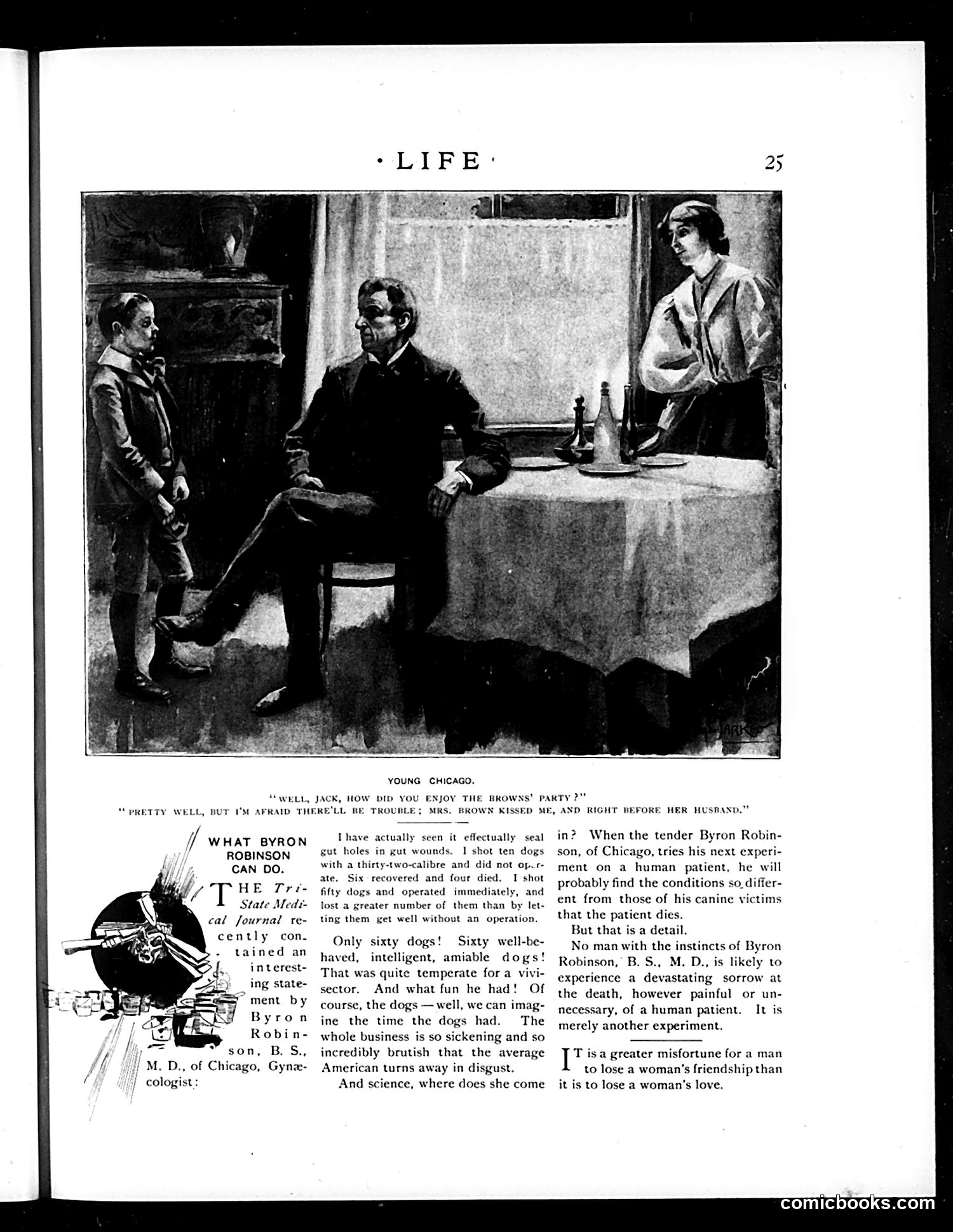
The top illustration depicts a domestic scene where a young boy stands before an adult man at a table, with a woman present. The caption quotes dialogue about a "Browns' party" and a kiss, suggesting marital infidelity or romantic scandal. Below, the page features an article about **Byron Robinson, M.D., a Chicago gynecologist**. Robinson apparently conducted surgical experiments on dogs—reportedly shooting and operating on sixty canines, with mixed survival rates. The article saririzes Robinson's work, noting the brutality and calling it "sickening" and "incredibly brutish." The satire juxtaposes domestic scandal (top) with medical ethics violations (bottom), both representing Chicago society's moral failings. The piece critiques Robinson's casual approach to animal experimentation as scientific justification for cruelty.
📄 Transcribed text from this page (OCR, searchable)
Machine-transcribed from the original scan — historical spelling and the odd misread are preserved.
“WELL, JACK, HOW DID YOU ENJOY THE BROW YOUNG CHICAGO. PARTY “PRETTY WELL, BUT I'M AFRAID THERE'LL BE TROURLE; MRS. BROWN KISSED ME, AND RIGHT BEFORE HER HUSBAND.” // WHAT BYRON ROBINSON CAN DO. HE Trie- State Medi cal Journal re- cently con. ined an interest- ing state- “ment by Byron Robin- ! son, B.S, / M. D., of Chicago, Gyna- | cologist: Ihave actually seen it effectually seal gut holes in gut wounds. 1 shot ten dogs with a thirty-two-calibre and did not op.e- ate, Six recovered and four died, I shot fifty dogs and operated immediately, and lost a greater number of them than by let- ting them get well without an operation. Only sixty dogs! Sixty well-be- haved, intelligent, amiable dogs! That was quite temperate fora vi sector. And what fun he had! Of course, the dogs — well, we can imag- ine the time the dogs had. The whole business is so sickening and so incredibly brutish that the average American turns away in disgust. And science, where does she come in? When the tender Byron Robin- son, of Chicago, tries his next experi- ment on a human patient, he will probably find the conditions so differ- ent from those of his canine victims that the patient dies. But that is a detail. No man with the instincts of Byron Robinson, B. S., M. D., is likely to experience a devastating sorrow at the death, however painful or un- necessary, of a human patient. It is merely another experiment. T isa greater misfortune for a man to lose a woman’s friendship than it is to lose a woman's love. comicbooks.com