
Life, 1897-01-14 · page 12 of 20
Life — January 14, 1897 — page 12: what you’re looking at
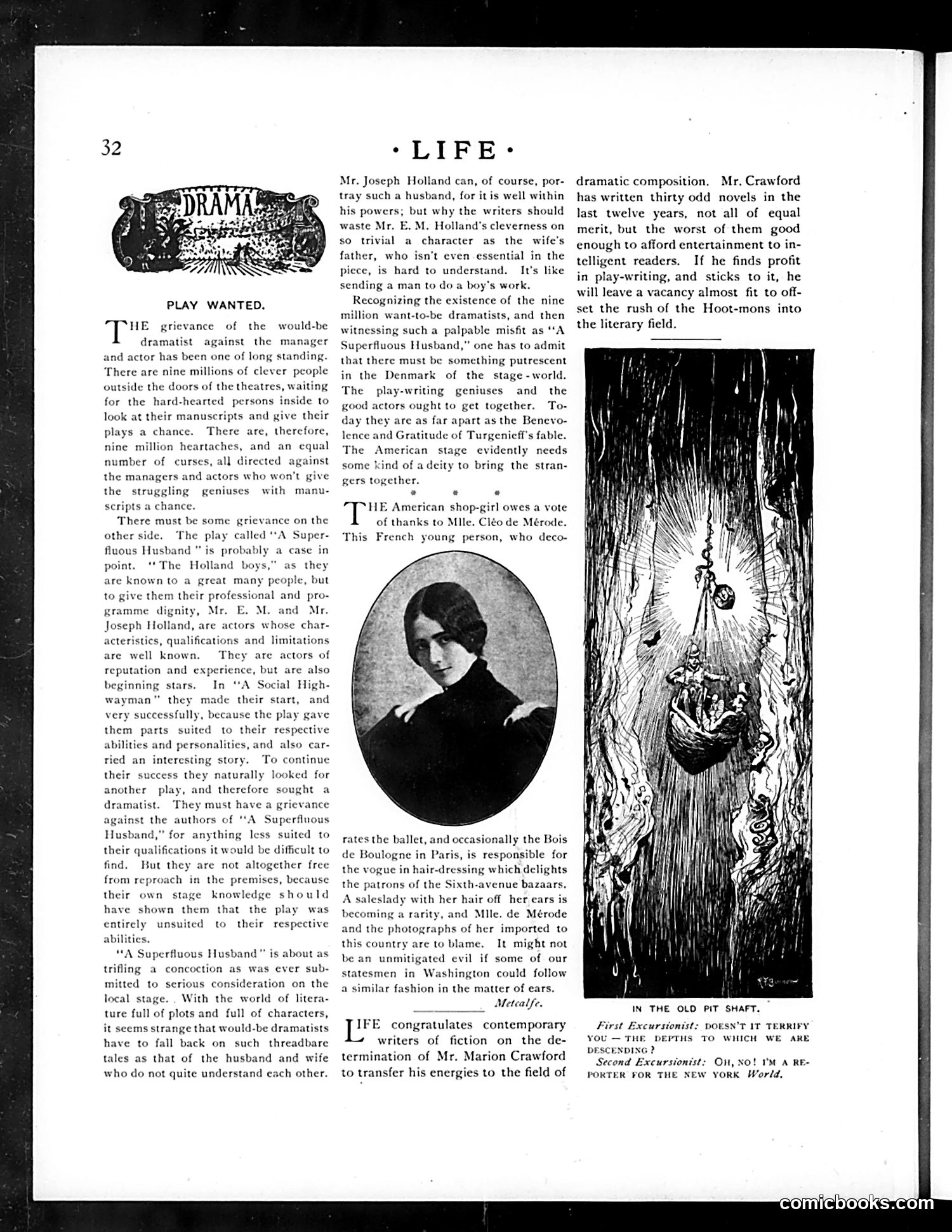
What you’re looking at
This page critiques theatrical standards and celebrity fashion through two distinct pieces: **"Play Wanted"** attacks the play *"A Superfluous Husband"* starring Joseph Holland and E.M. Holland. The article argues that despite nine million aspiring dramatists waiting for chances, theaters stage trivial works with worn-out plots (husbands and wives who "do not quite understand each other"). The Holland brothers—experienced, capable actors—are wasted on material unsuited to their talents. The piece satirizes the disconnect between desperate writers seeking opportunity and producers mounting mediocre scripts. **The French fashion commentary** mocks American women's adoption of a hairstyle popularized by French dancer Cléo de Mérode, shown in the accompanying photograph. The satire suggests that if American politicians could similarly hide their "ears" (folly/stupidity) by following fashion trends, Washington might improve. The tone throughout is typical Life magazine: witty social criticism targeting theatrical pretension, gender consumption, and political incompetence.
📄 Transcribed text from this page (OCR, searchable)
Machine-transcribed from the original scan — historical spelling and the odd misread are preserved.
PLAY WANTED. of the against the manager and actor has been one of long standing. There are nine millions of clever people outside the doors of the theatres, waiting for the look plays a chance. would-be d-hearted persons inside to at their manuscripts and give their There are, therefore, nine million heartaches, and an cqual number of curses, all directed against the managers and actors who won't give the struggling geniuses with manu- scripts a chance. There must be some grievance on the other side. The fluous Husband “The are known to a great many people, but to give them their profe: gramme dignity, Mr. Joseph Holland, are actors whose ch acteristics, qualifications and limita are well known. The play called A Super- s probably a case in point. Holland boys,” as they are actors of reputation and experience, but are also beginning stars. In they Je very successfully, be them “A 1 High. wayman” their start, and ause the play gave parts suited abilities and personalities, ried an interesting stor their success they naturally looked for play, and therefore sought a They must have a grievance A Superfluous Husband,” for anything less suited to their qualifications it would be difficult to find. But they are not altogether free from reproach in the premises, because their have to their respective and also car- To continue another dramatist. inst the authors of own stage knowledge should shown them that entirely abiliti ‘A Superfluous Husband” is about as trifling a mitted to serious consideration on the local stage. . With the world of litera- ture full of plots and full of characters, it seems strange that would-be dramatists ave to fall back on tales as that of the husband and wife who do not quite understand each other. the play their respective was unsuited to concoction as was ever sub- such threadbare *LIFE: Mr. Joseph Holland can, of course, por- tray such a husband, for itis well within his powers; but why the writers should waste Mr. E, M. Holland's cleverness on so the father, who isn’t even essential in the piece, is hard to understand. It’s like sending a man to do a boy's work. Recognizing the existence of the nine million want-to-be dramatists, and then witnessing such a palpable misfit as “A Superfluous Husband,” one has to admit that there must be something putrescent in the Denmark of the stage - world. The play-writing geniuses the good actors ought to get together. To- day they are as far apart as the Benevo- lence and Gratitude of Turgenieff’s fable. The some trivial a character a wife's and American ind of a deity stage evidently needs to bring the stran- gers together. * * « HE American shop-girl owes a vote of thanks to Mlle. Cléo de Mérode. This French young person, who deco- rates the ballet, and occasionally the Bois de Boulogne in Paris, is responsible for the vogue in hair-dressing which delights the patrons of the A sal y with her hair off her ears is becoming a rarity, and Mlle. de Mérode xth-avenue bazaars, lad and the photographs of her imported to It might not be an unmitigated evil if some of our statesmen in Washington could follow a similar fashion in the matter of ears, Metcalfe, this country are to blame. E congratulates contemporary writers of fiction on the de- termination of Mr. Marion Crawford to transfer his energies to the field of dramatic composition. Mr. Crawford has written thirty odd novels in the last twelve years, not all of equal merit, but the worst of them good enough to afford entertainment to in- telligent readers. If he finds profit in play-writing, and sticks to it, he will leave a vacancy almost fit to off- set the rush of the Hoot-mons into the literary field. IN THE OLD PIT SHAFT. First Excursionist; DOESN'T IT TERRIFY YOU — THE DEPTHS TO WHICH WE ARE DESCENDING ? Second Excursionist: On, NO! VM A RE- PORTER FOR THE NEW YORK World,