
Life, 1897-01-14 · page 6 of 20
Life — January 14, 1897 — page 6: what you’re looking at
What you’re looking at
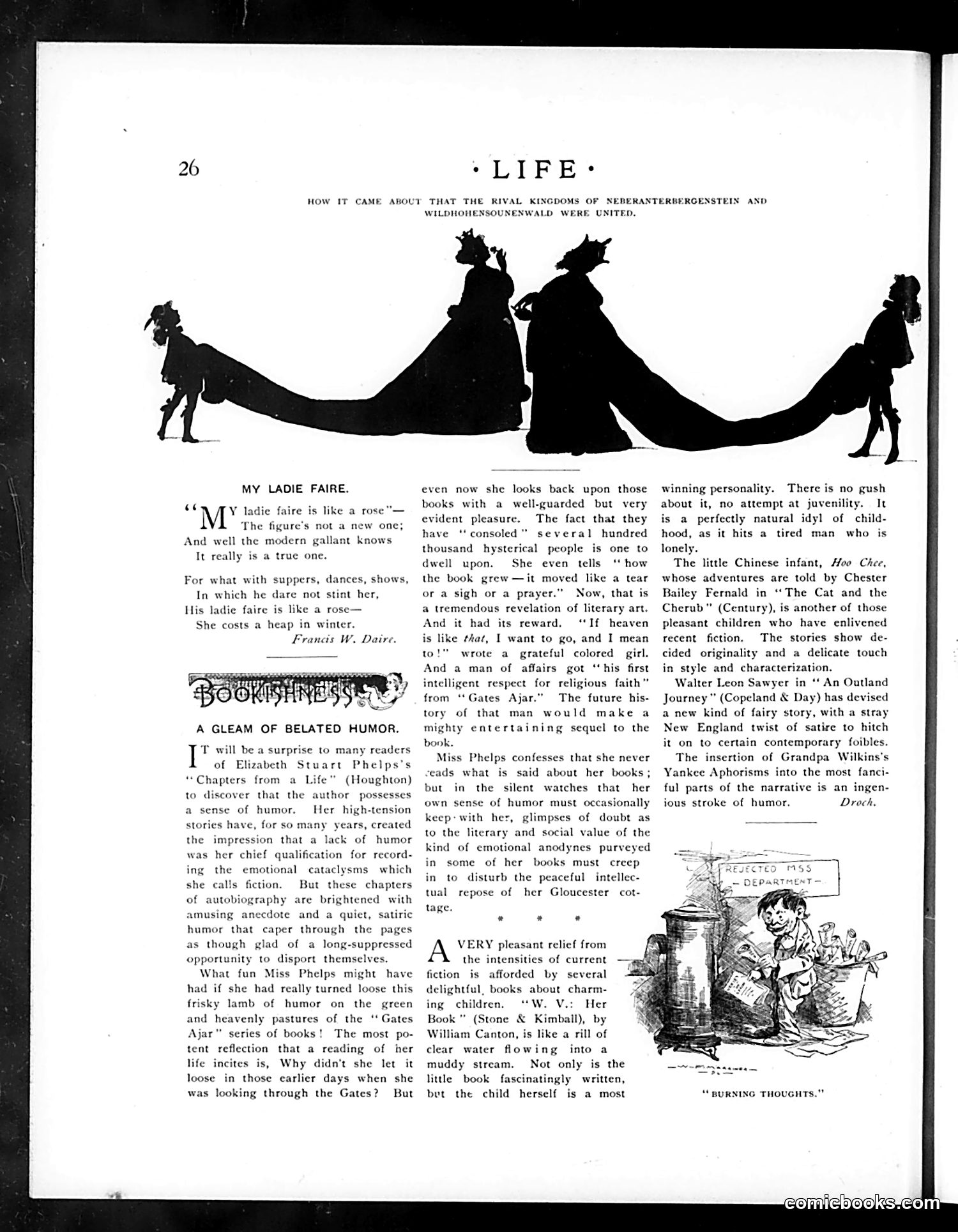
The silhouette cartoon at the top depicts two figures in elaborate cloaks being pulled apart by smaller figures on either end. The caption references "rival kingdoms of Neberaterbergenstein and Wildhoensousenwald" being united—these are clearly fictional, made-up principalities used for satirical purposes. This appears to be mocking European royal or diplomatic disputes of the era, using absurdist humor by inventing ridiculous kingdom names to deflate the seriousness of international power struggles. The rest of the page contains literary reviews, including discussions of Elizabeth Stuart Phelps's work and children's books. The illustration labeled "Bursting Thoughts" shows a figure with books overflowing from their head, humorously depicting intellectual excess or creative inspiration. The overall page blends political satire with literary criticism typical of Life magazine's approach.
📄 Transcribed text from this page (OCR, searchable)
Machine-transcribed from the original scan — historical spelling and the odd misread are preserved.
HOW IT CAME AB MY LADIE FAIRE. “e M’ ladie faire is like a rose"— ah The figure’s not a new one; And well the modern galla It really is a true one. knows For what with suppers, dances, shows, In which he dare not stint her, His ladie faire is like a rose— She costs a heap in winter. Francis W. Daire. A GLEAM OF BELATED HUMOR. I" will be a surprise to many readers of Elizabeth Stuart Phelps’s “Chapters from a Life” (Houghton) to discover that the author possesses a sense of humor. Her high-tension stories have, for so many years, created a lack of humor was her chief qualifica ing the she the impression that ion for record- cataclysms which But these chapters autobiography are brightened with amusing anecdote and a quiet, satiri humor that caper through the pages as though glad of a long-suppressed emotional calls fiction. opportunity to disport themselves. What fun Miss Phelps might have if she had really turned loose this frisky lamb of humor and heavenly pastures of the ‘Gates Ajar" series of books! The most po- tent reflection that a reading of her life incites is, Why didn't she let it loose in those earlier days when she was looking through the Gates? But on the green ‘LIFE: THAT THE RIVAL KINGDOMS OF NEDERANTERBERGENSTEIN AND WILDHOHENSOUNENWALD WERE UNITED. even now she looks back upon those a well-guarded but books with evident pleasure. have ‘consoled ” thousand hysterical people is dwell upon. She even tells the book grew —it moved like or a sigh or a prayer.” Now, a tremendous revelation of literary art. And it had “Tf its reward, is like ¢Aat, I want to go, and I mean to!” wrote a grateful from “Gates Ajar.” tory of that man would mighty entertaining sequel book. Miss Phelps confesses that she never ads but is said about her silent what in the watches keep: with her, glimpses of to the literar: The fact that they several hundred colored And a man of affairs got ‘his first intelligent respect for religious faith” The future his- make a that own sense of humor must occasionally doubt and social value of the winning personality. There is no gush about it, no attempt at juvenility. It is a perfectly natural idyl of child- hood, as it hits a tired man lonely. The litle Chinese infant, Hoo Chee, whose adventures are told by Chester Bailey Fernald in ‘‘The Cat and the Cherub" (Century), is another of those pleasant children who have enlivened recent fiction. The storics show de- cided originality and a delicate touch in style and characterization. Walter Leon Sawyer in ‘‘ An Outland Journey” (Copeland & Day) has devised a new kind of fairy story, with a stray New England twist of satire to hitch it on to certain contemporary foibles. The insertion of Grandpa Wilkins's Yankee Aphorisms into the most fanci- ful parts of the narrative is an ingen- ious stroke of humor. Drock. very who is one to “how a tear that is heaven girl. to the books ; her as kind of emotional anodynes purveyed in some of her books must in to disturb the peaceful tual repose of tage. * * VERY pleasant relief from the intensities of current fiction is afforded by several delightful, books about charm- ing children. “'W. V. Her Book ” (Stone & Kimball), by William Canton, is like a rill of clear water flowing muddy stream. little book bet the into a child herself is a most creep intellec- her Gloucester cot- Jot only is the fascinatingly written, “ BURNING THOUGHTS.”