
A complete issue · 53 pages · 1891
Life — December 31, 1891
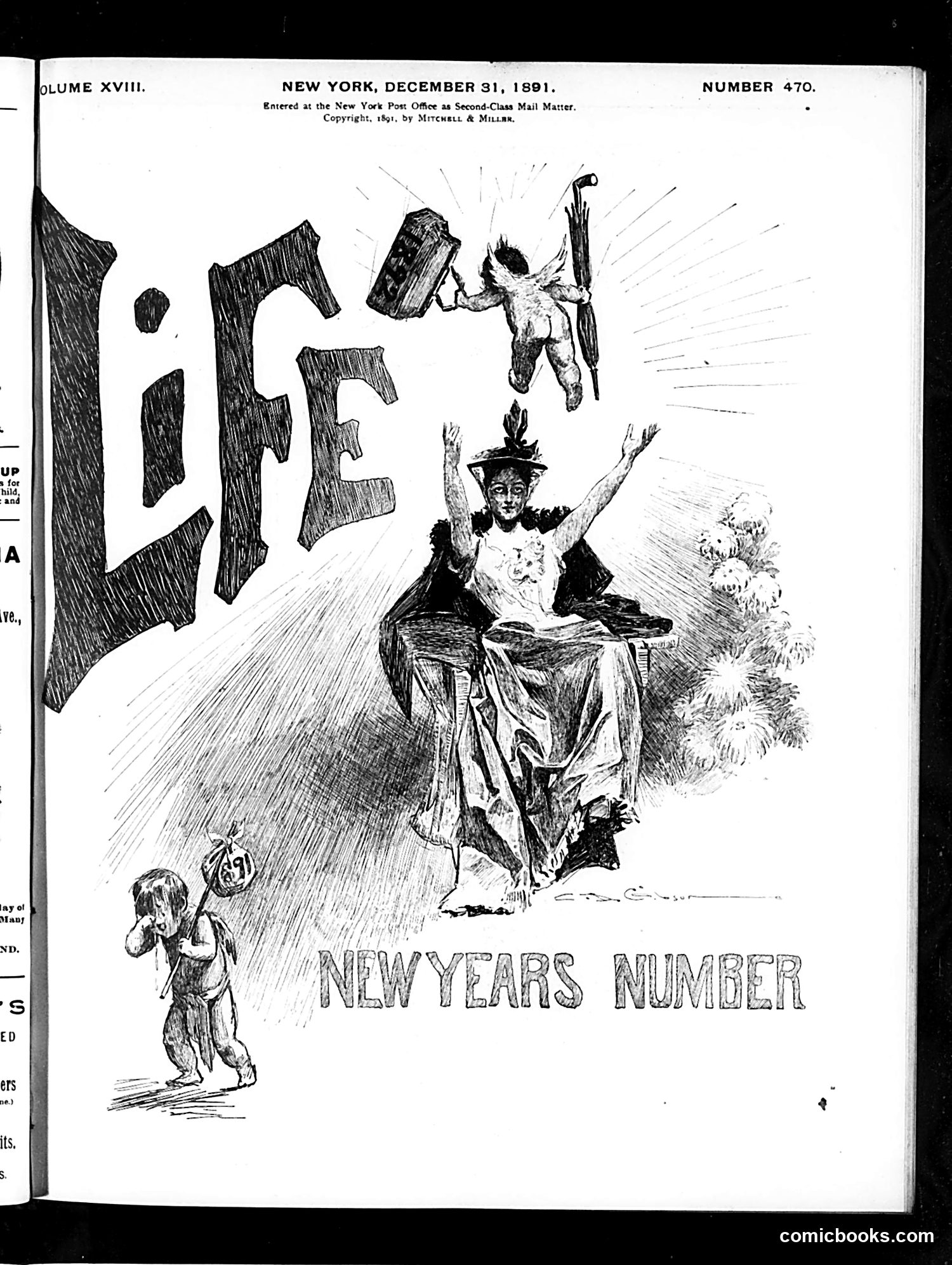
This is Life magazine's "New Years Number" cover for December 31, 1891. The central figure appears to be Lady Liberty or a personification of "Life" itself, depicted as a classical female figure seated and gesturing triumphantly toward the incoming new year. She's surrounded by cherubs or putti (baby figures) above her, and a small child figure at lower left. The large letters spelling "LIFE" dominate the left side. The radiating lines and upward gesture suggest optimism and celebration—this is a celebratory welcome to 1892. The classical allegorical style was typical of 19th-century American editorial illustration, using personified virtues and ideals to mark significant moments like the New Year.
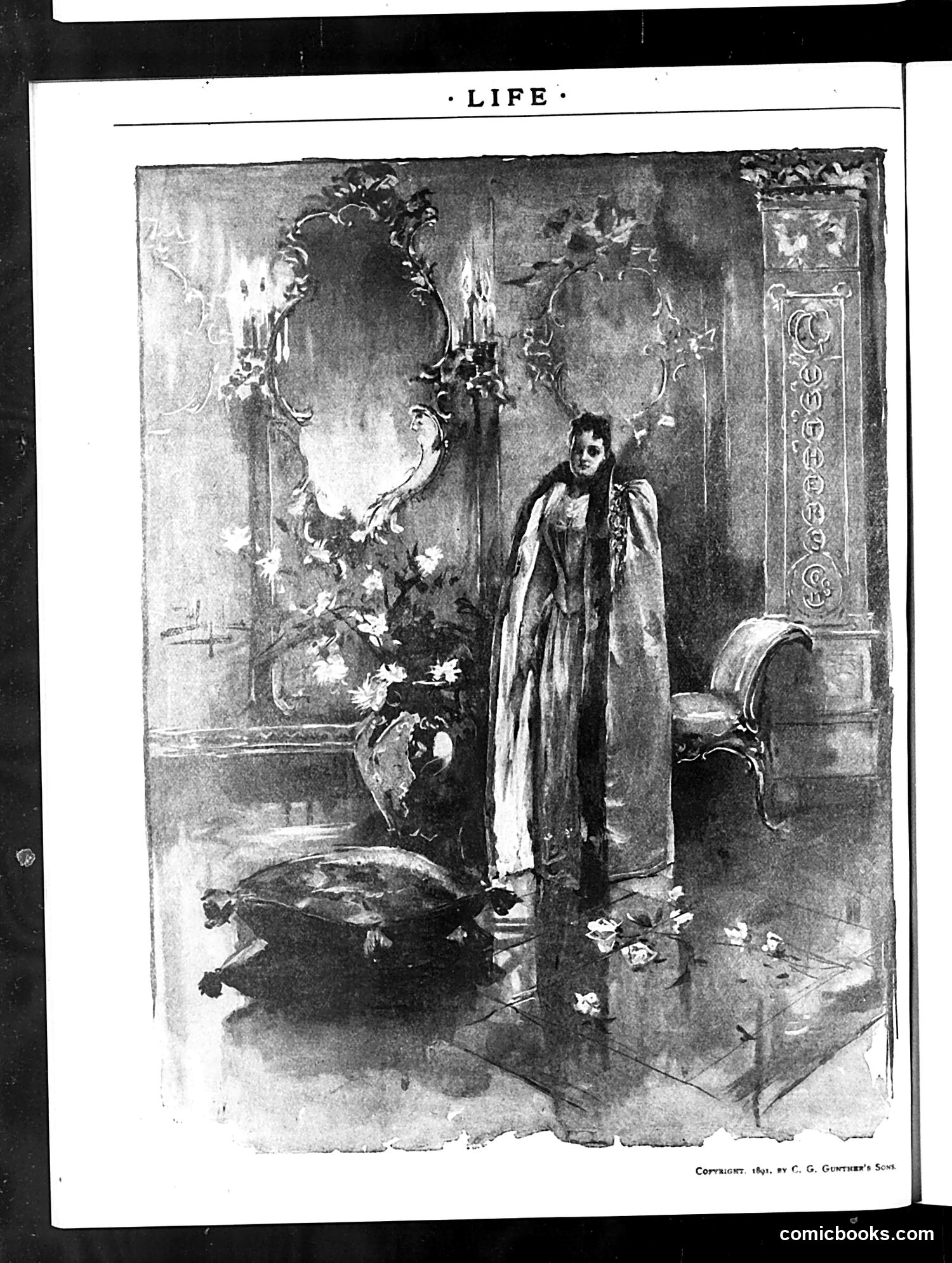
This appears to be a satirical illustration from *Life* magazine (copyright 1891, per the footer). The image depicts a woman in period dress standing in an ornate interior space, gazing at her reflection in a mirror. The room contains classical decorative elements—urns, floral arrangements, and ornamental wall panels. The satire likely comments on **vanity and self-absorption**, a common theme in 1890s social critique. The woman's absorbed contemplation of her reflection, combined with the luxurious surroundings, suggests mockery of wealthy or upper-class women preoccupied with appearance and materialism. The specific title or caption that would clarify the exact social target is not legible in this image, limiting precise interpretation. However, the composition clearly satirizes feminine narcissism through the mirror-gazing motif.
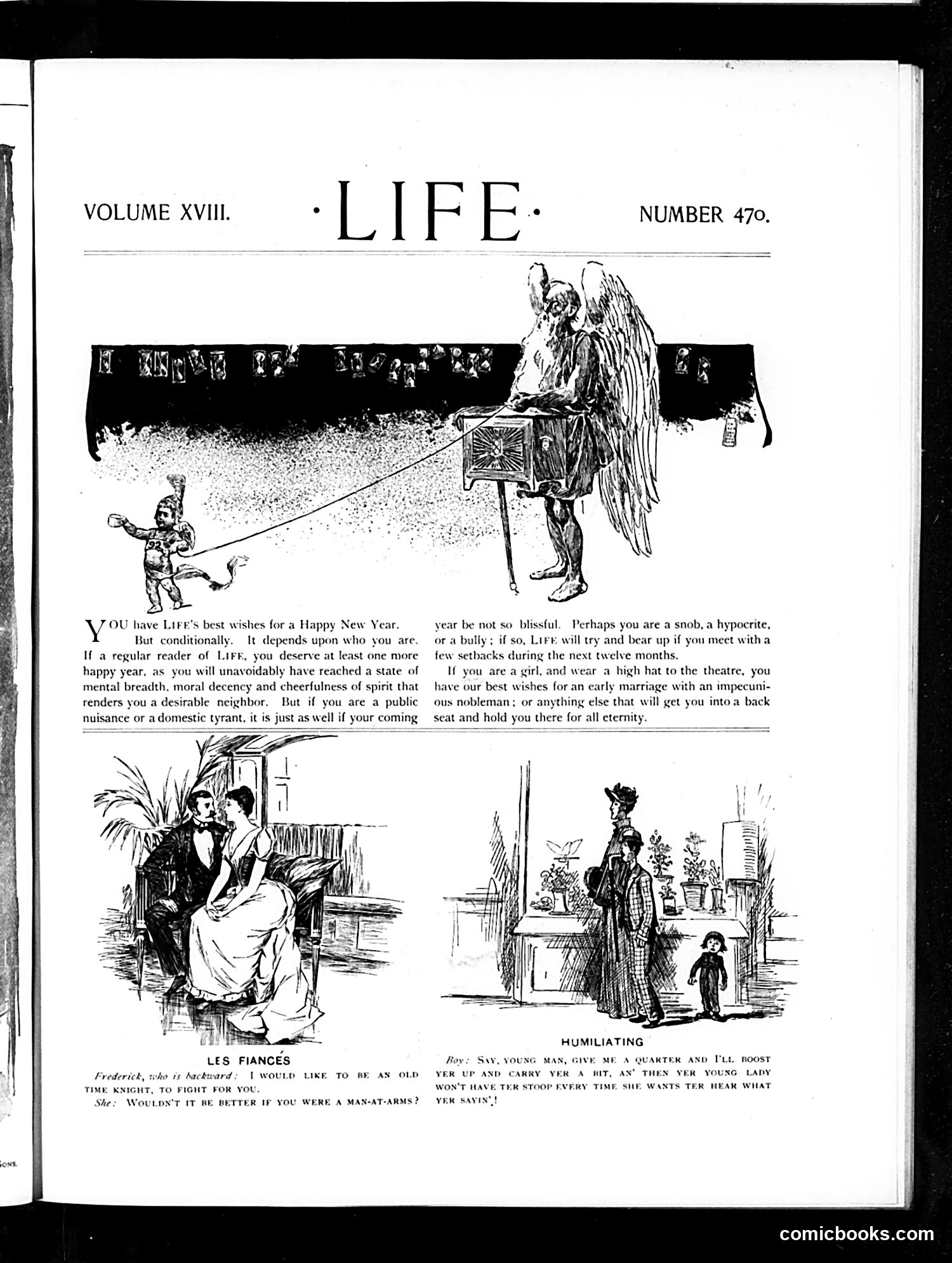
This page contains satirical commentary and illustrations about New Year's resolutions and social behavior. The top image shows Death (depicted as a winged skeleton) holding a clock and a tiny human figure on a string—a memento mori warning about mortality and the passage of time during the new year. The text offers mock "best wishes" for various social types: snobs, hypocrites, bullies, girls seeking theater dates, and domestic tyrants. It's satirizing common character flaws and social pretenses of the era. Two captioned illustrations below depict scenes of romantic courtship ("Les Fiancés") and what appears to be a domestic discipline scenario labeled "Humiliating," mocking gender dynamics and relationship dynamics of the period through dark humor typical of Life's satirical approach.
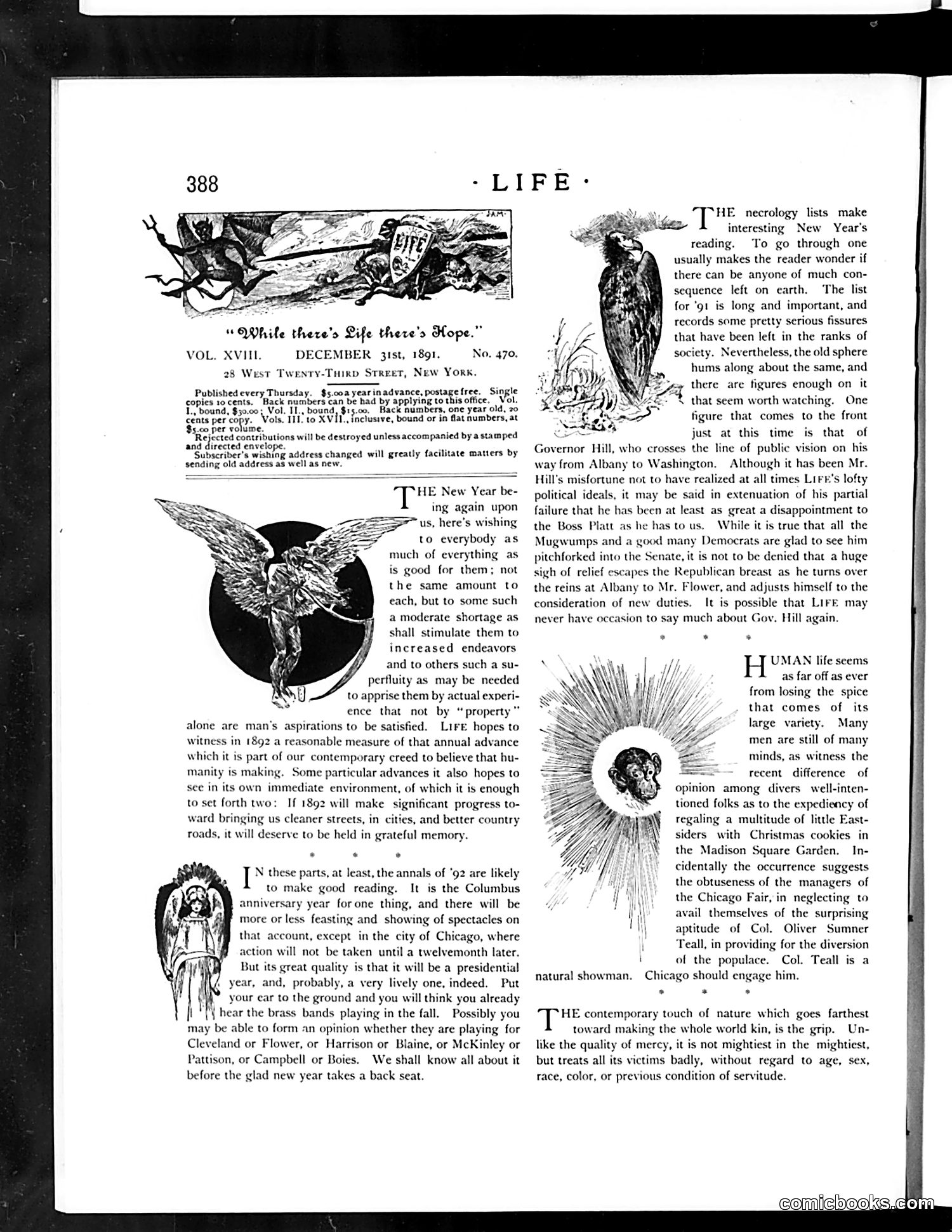
This page from Life magazine (Vol. XVIII, No. 470, December 1891) contains editorial commentary on New Year's predictions and political figures rather than a specific political cartoon. The text references Governor Hill and mentions potential presidential candidates including Cleveland, Flower, Harrison, Blaine, McKinley, Pattison, and Campbell or Boies—all figures in late 19th-century American politics. The author satirizes the uncertainty of who will emerge as the next presidential candidate, suggesting readers will "know all about it before the glad new year takes a back seat." The decorative illustrations (birds, angels, a skull) are ornamental rather than satirical. The page's humor lies in its tongue-in-cheek discussion of political maneuvering and the unpredictability of electoral outcomes during the 1892 election season.
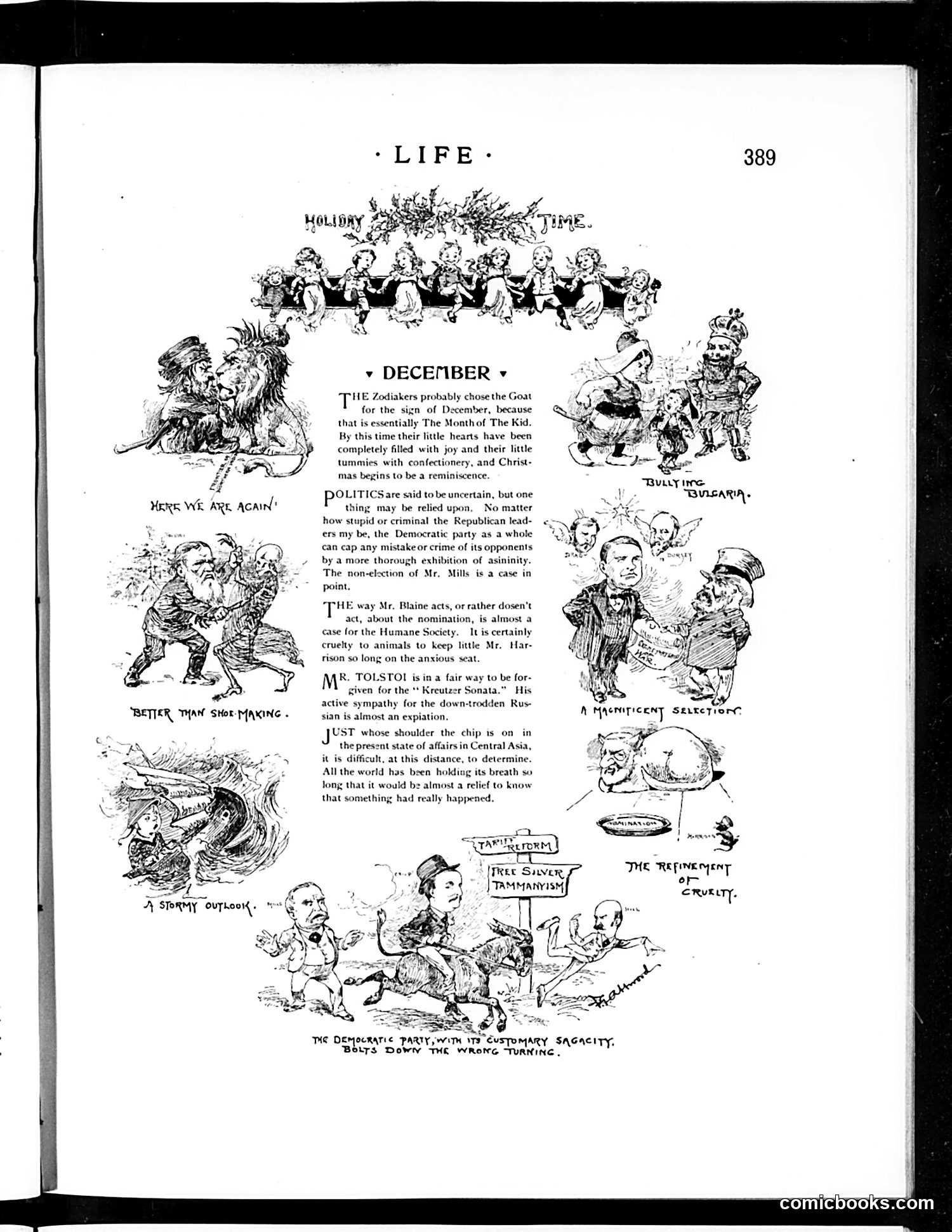
This page satirizes December 1912 American politics through multiple cartoons. The text discusses uncertain Republican leadership, criticizes Mr. Mills's nomination (cruelty to animals keeping "little Mr. Harrison" on the anxious seat), comments on Tolstoi's sympathy for downtrodden Russians, and questions responsibility for Central Asian affairs. The bottom cartoon depicts "The Democratic Party with its customary sagacity belts down the wrong turning"—showing party figures literally going the wrong direction, suggesting Democratic incompetence or misdirection in policy. Other sketches labeled "Here We Are Again," "Better Than Shoe Making," and "A Stormy Outlook" appear to comment on political foolishness and instability, though specific references are unclear without additional context about 1912 Democratic and Republican controversies.
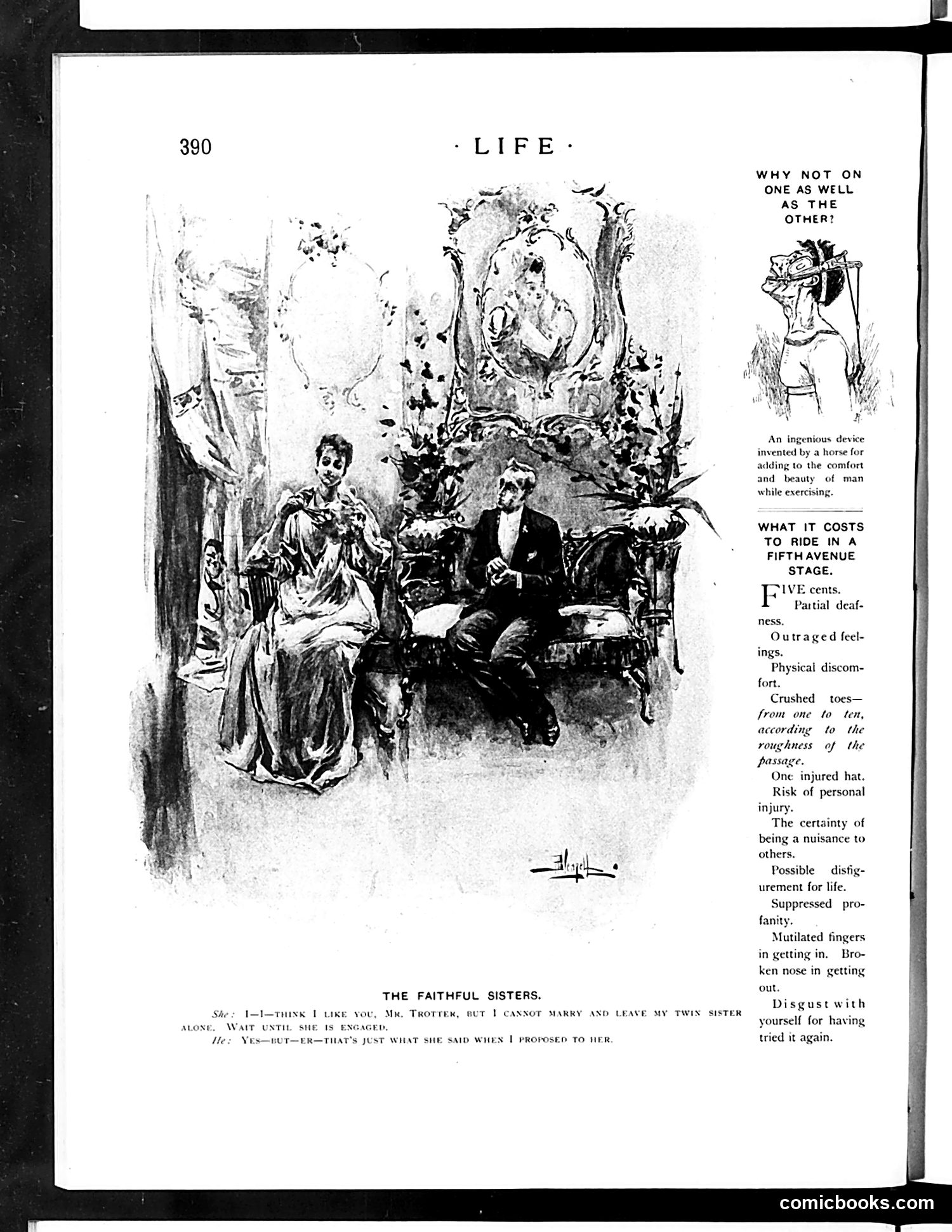
The cartoon depicts a romantic scenario where a man proposes to a woman in an ornate interior setting, with her two sisters present. The dialogue reveals the joke's point: the woman declines marriage, saying she cannot leave her sisters alone. When the man later proposes to one sister, she gives the identical refusal. When he proposes to the second sister, she echoes the same excuse—revealing the sisters' coordinated deception. The satire mocks women who use familial obligation as a pretense to avoid marriage commitments they don't genuinely want. The "faithful sisters" aren't loyal to each other but rather united in rejecting this persistent suitor through a rehearsed excuse. It's a commentary on courtship games and insincere romantic refusals.
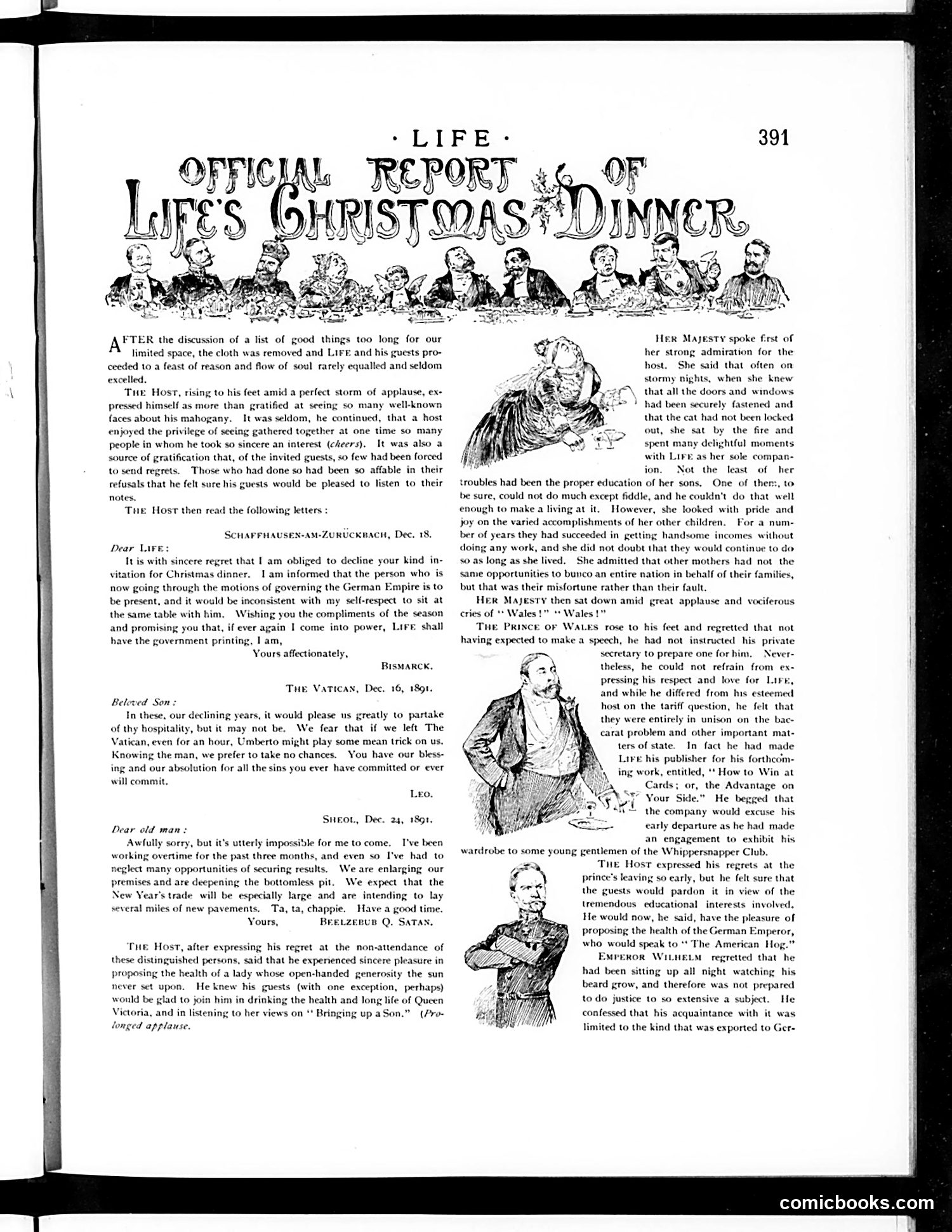
This page satirizes prominent figures declining Life magazine's Christmas dinner invitation through humorous rejection letters. The caricatured heads at the top represent various celebrities and politicians of the era. The letters come from Bismarck (declining due to German Empire duties), the Vatican (claiming potential "trick"), and others offering colorful excuses. A letter signed "Blücher v. Sayas" humorously regrets missing the event due to competing social obligations. The satire mocks how important personages make elaborate excuses to avoid social commitments, while the illustrations exaggerate their distinctive features—a common technique in period satirical journalism. The piece plays on readers' familiarity with these public figures' recent activities and reputations to generate humor through their fictional responses.
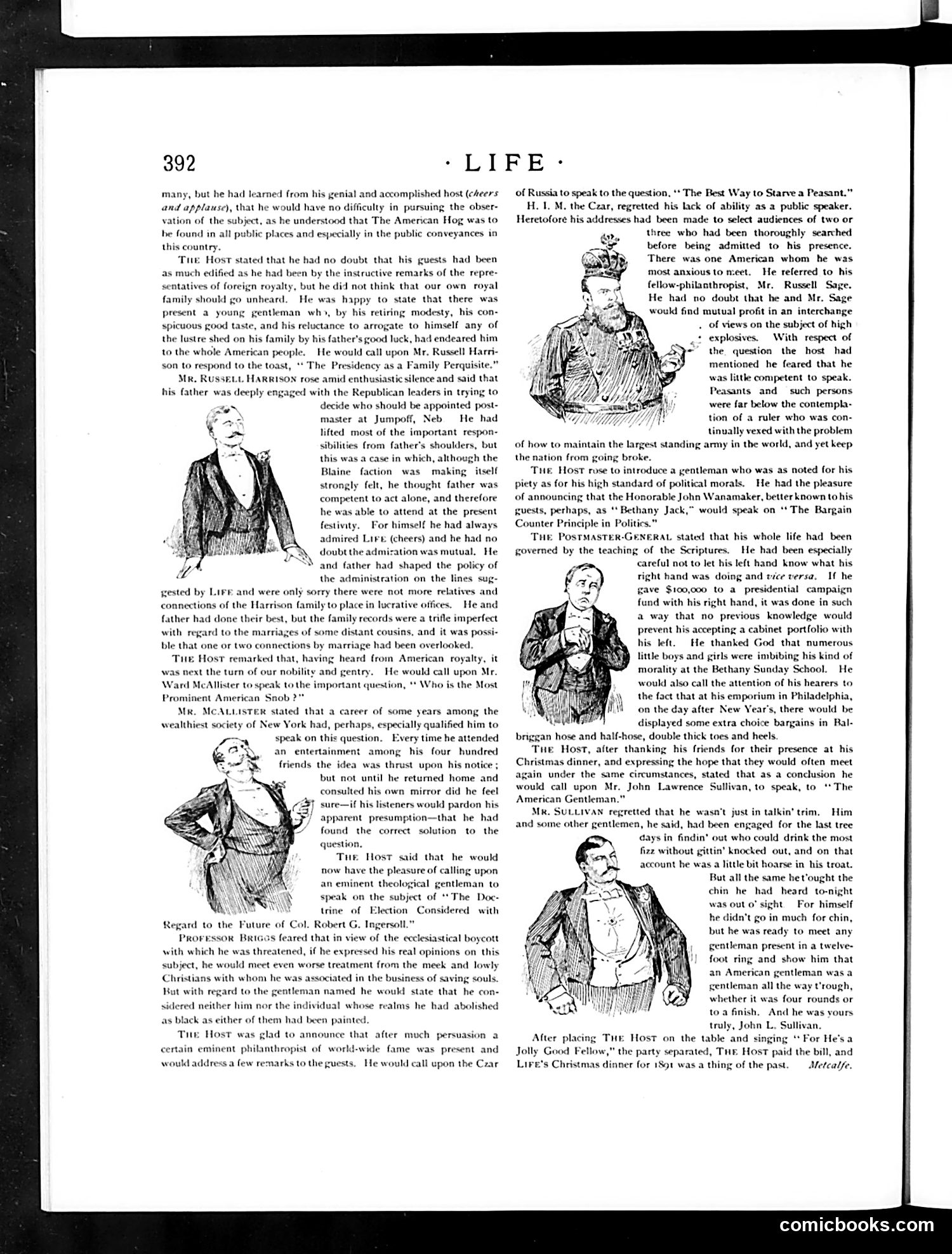
This page depicts a satirical Christmas dinner scene featuring political and social figures of the era. The text describes a host entertaining wealthy New York society members and diplomats, including representatives of foreign royalty. The illustrated caricatures show gentlemen in formal attire engaged in discussion. The satire targets these wealthy elites' pretensions and their casual discussions of serious political matters—particularly regarding "high explosives" and international conflicts. The specific figures mentioned (Russell Sage, "Bethany Jack," John Lawrence Sullivan) appear to represent prominent businessmen, philanthropists, and public figures of the period. The humor lies in contrasting their self-importance with their actual competence to address major political questions, suggesting they speak carelessly about weighty national issues during holiday socializing. The piece satirizes gilded-age wealth and influence.
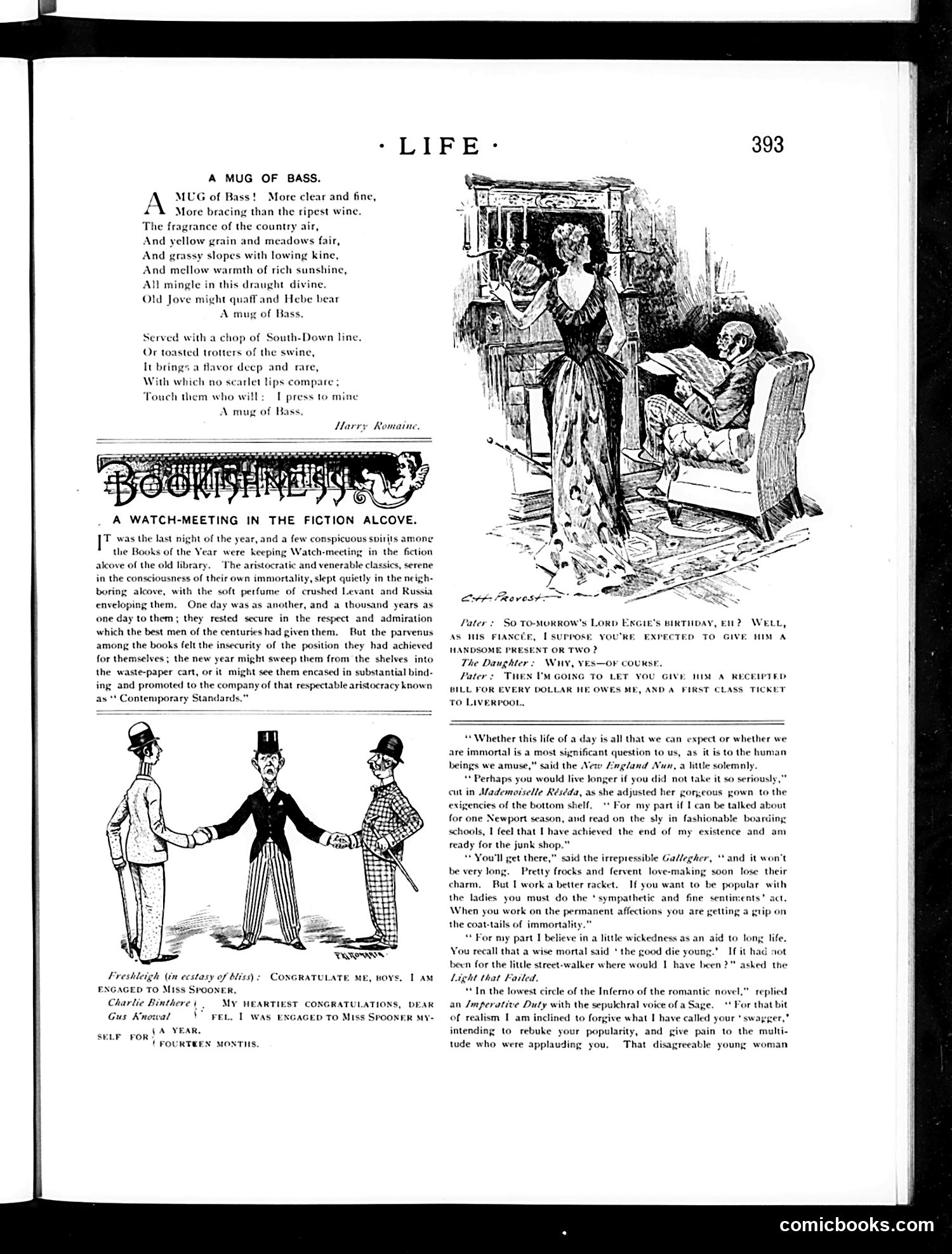
This page contains two distinct sections: a poem "A Mug of Bass" by Harry Romaine praising a particular beer brand, and a story titled "A Watch-Meeting in the Fiction Alcove." The cartoon illustrations show social scenes. The upper sketch depicts people in what appears to be a library setting, while the lower cartoon shows three figures in formal dress with a caption about engagements—likely satirizing Victorian courtship customs and congratulations rituals. The accompanying story text discusses New Year's Eve observations and social pretensions among the literary classes, with references to "Contemporary Standards" suggesting satire of fashionable social behavior among aristocratic circles. The overall page mixes light verse advertising with social satire typical of Life magazine's satirical approach to contemporary American manners and class dynamics.
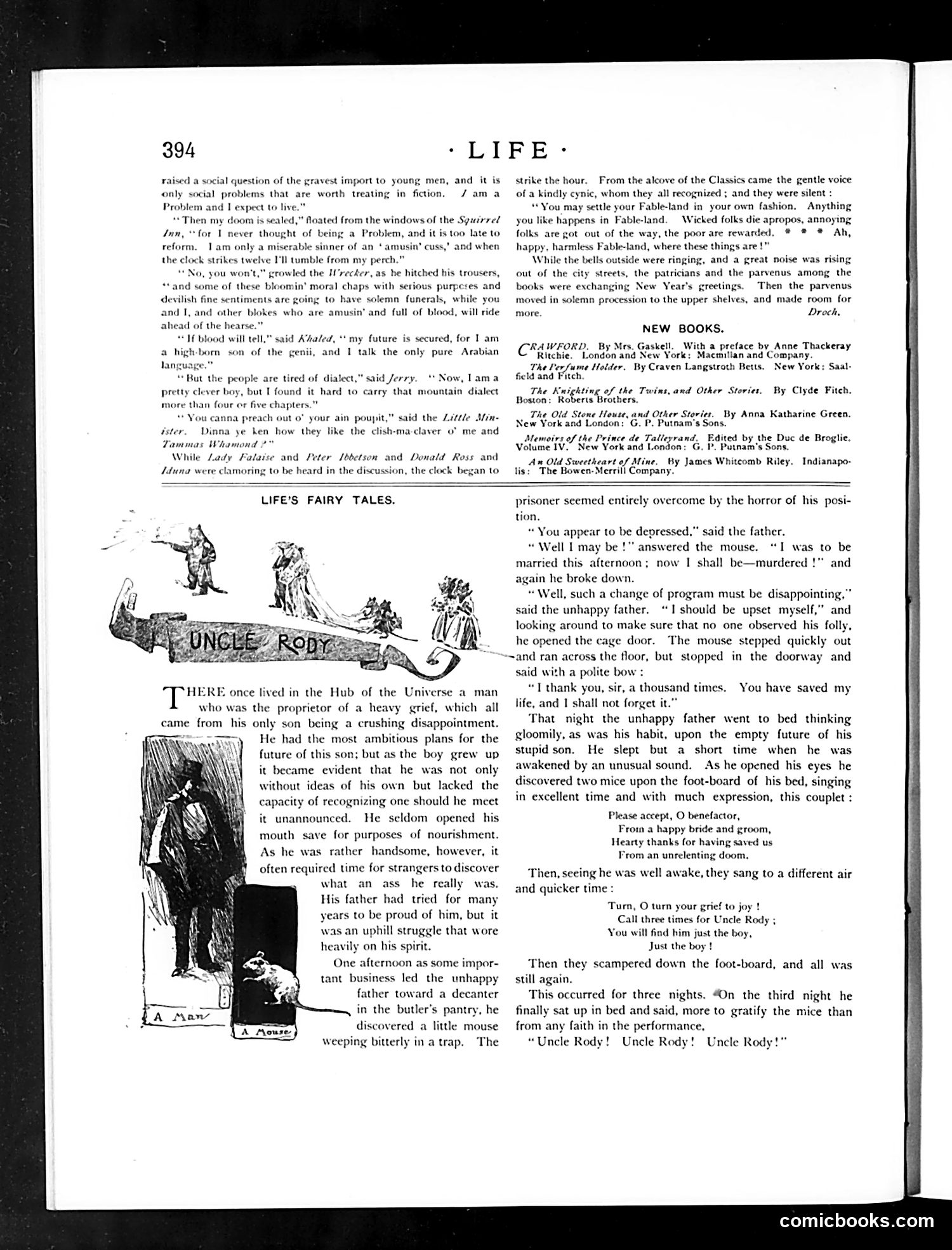
This page presents a fairy tale story titled "Life's Fairy Tales" featuring a character named Uncle Rody. The illustration shows an old man with distinctive features, labeled "A Man" in the artwork. The story concerns an unhappy father grieving his son's lack of ambition. The narrative takes a whimsical turn when mice appear on the father's bed, singing encouraging songs about "Uncle Rody." The tale appears to be a moral fable about unexpected salvation from despair—the father's spirits lift when the mice call out his name repeatedly. The satire likely mocks sentimental Victorian-era moral tales and their simplistic resolutions to serious life problems. The absurdity of tiny mice solving existential crises through song suggests gentle mockery of contemporary popular fiction's tendency toward saccharine sentiment.
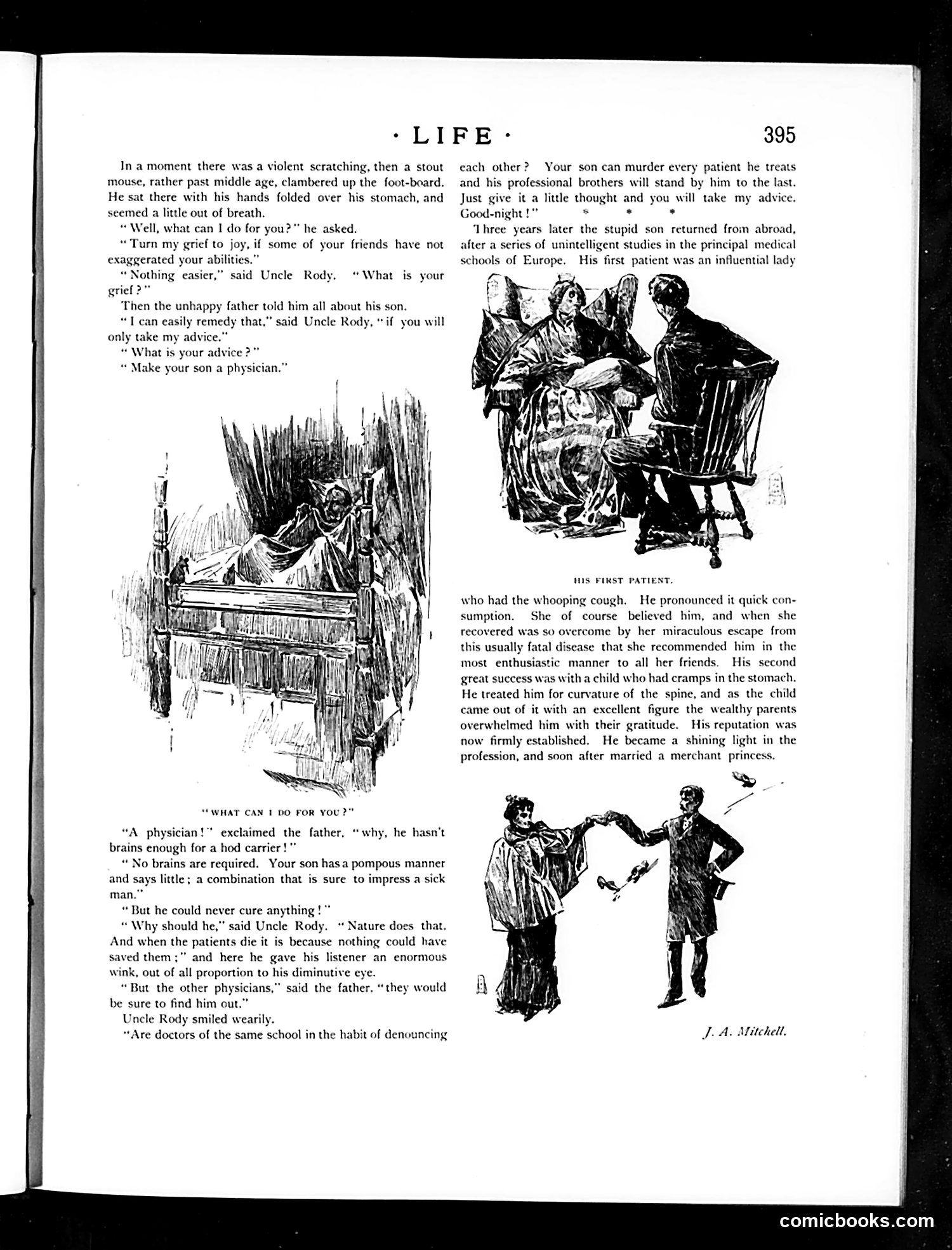
This page satirizes medical pretension and quackery. The narrative follows a father seeking Uncle Rody's advice about his son's failed career prospects. Uncle Rody's solution—"Make your son a physician"—mocks how easy it was to enter the medical profession and establish credibility. The illustrations show the son's subsequent success: treating wealthy patients with dubious diagnoses (whooping cough pronounced "quick consumption," stomach cramps treated via spinal manipulation) and receiving lavish gratitude from gullible patients. The satire targets both incompetent doctors who lack genuine medical knowledge yet prosper through confident bedside manner, and the wealthy patients who reward them regardless of actual cures. The joke critiques how medical authority could be faked for social advancement in this era, exploiting both professional naivety and patient desperation.
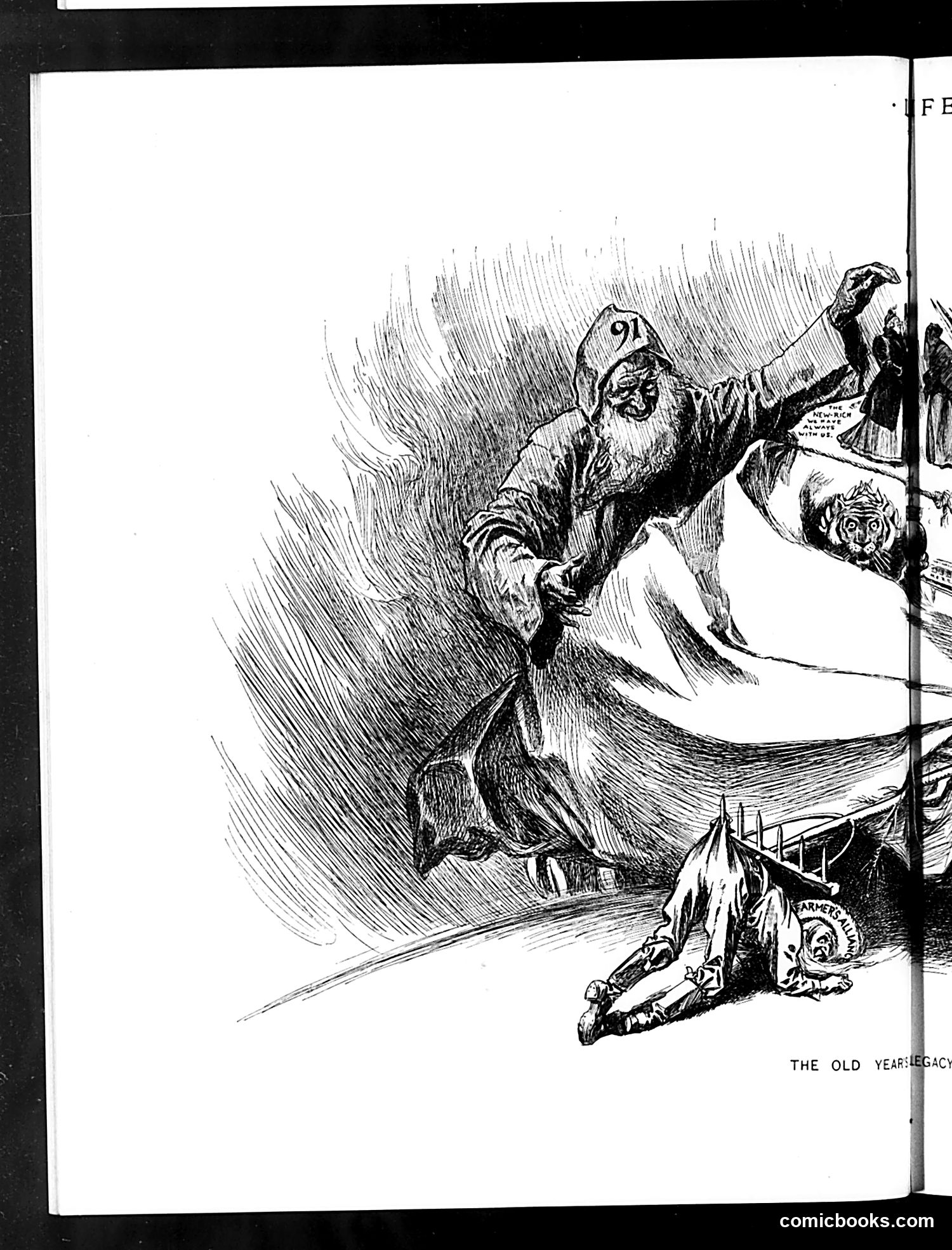
This is a New Year's themed satirical illustration, likely from early 20th-century *Life* magazine. The cartoon depicts an elderly, bearded figure (representing the departing "Old Year") passing on his legacy—seemingly burdensome or problematic—to the incoming new year, represented by a child or infant figure on the right. The visual metaphor suggests the outgoing year is bequeathing unresolved troubles, debts, or social problems to its successor. The detailed cross-hatching and dramatic pose emphasize the weight of what's being transferred. This was a common *Life* magazine theme: using personified calendar years to comment on political turmoil, economic issues, or social challenges persisting from one year to the next.
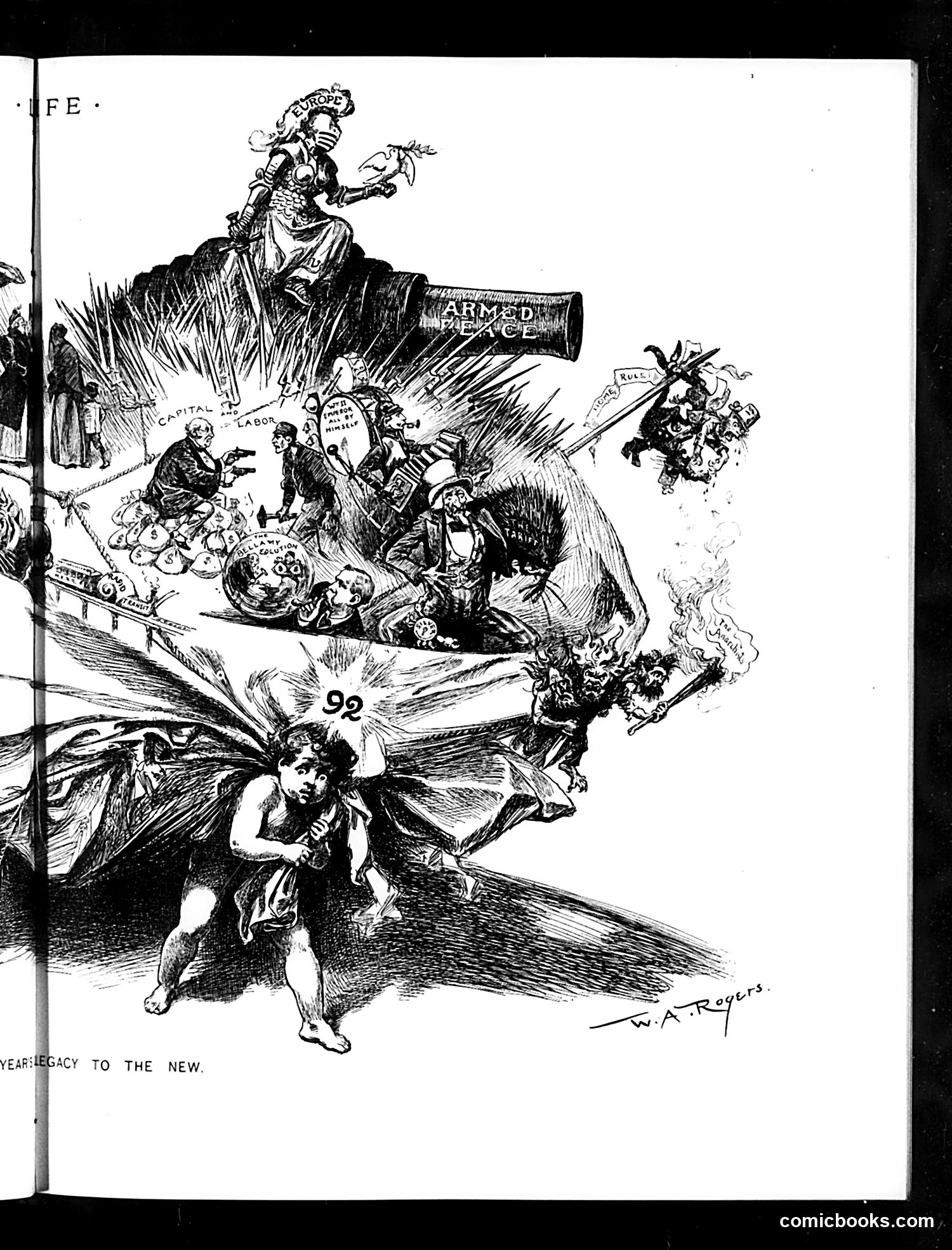
This political cartoon by W.A. Rogers appears to satirize the transition of power or influence from the old establishment to a new era. A cherub figure at the bottom represents innocence or the future, while the large seated figure above—labeled "Armed" with what appears to be a cannon—suggests militaristic or industrial power dominating the scene. The various smaller figures below appear to represent competing interests or factions (labeled with references to "Capital," "Labor," and other social forces) engaged in conflict or chaos beneath this looming authority. The title "Legacy to the New" suggests commentary on what values or systems are being inherited by the next generation—likely critiquing how power, militarism, and social discord are what's being passed forward rather than something more positive.
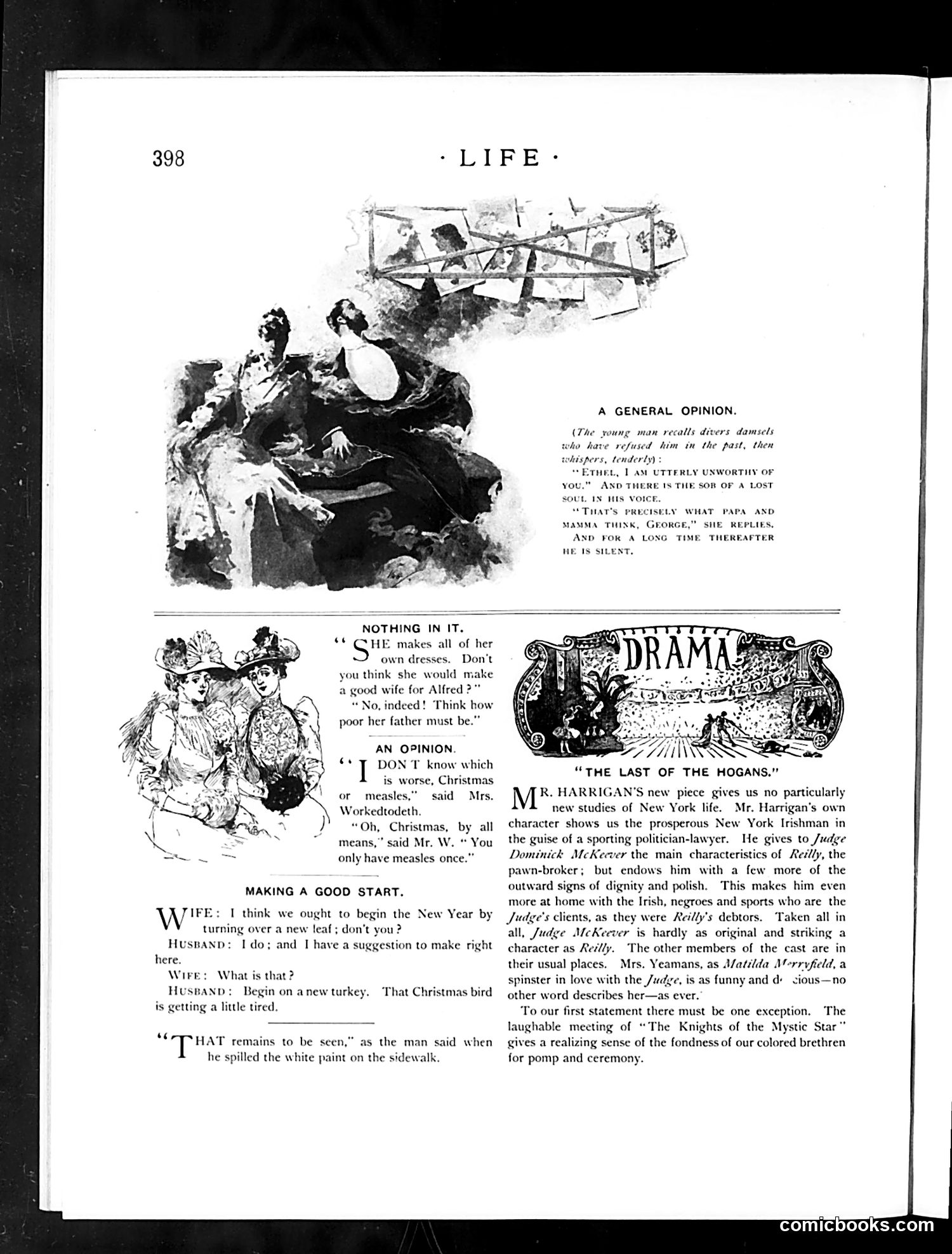
This page contains several brief humorous sketches typical of *Life* magazine's satirical style: **"A General Opinion"** depicts a young man's self-deprecating marriage proposal, rejected because the woman's parents agree he's unworthy—a joke about how parental disapproval can paradoxically confirm a suitor's worst fears. **"Nothing in It"** mocks class assumptions: a woman won't marry off her daughter to a wealthy man because the daughter makes all her own dresses, suggesting the father must be poor—absurd logic satirizing snobbish marriage calculations. **"Making a Good Start"** plays on New Year's resolutions: a husband suggests they "begin on a new turkey" for dinner rather than turning over a moral leaf, joking about choosing comfort over self-improvement. **"The Last of the Hogans"** is a theater review of Edward Harrigan's play about an Irish-American politician-lawyer character. The critic notes it's formulaic, recycling familiar Irish and African-American stereotypes as the protagonist's clients, though calling the lead character less original than Harrigan's earlier "Reilly." The humor relies on domestic situations and period-specific social attitudes.
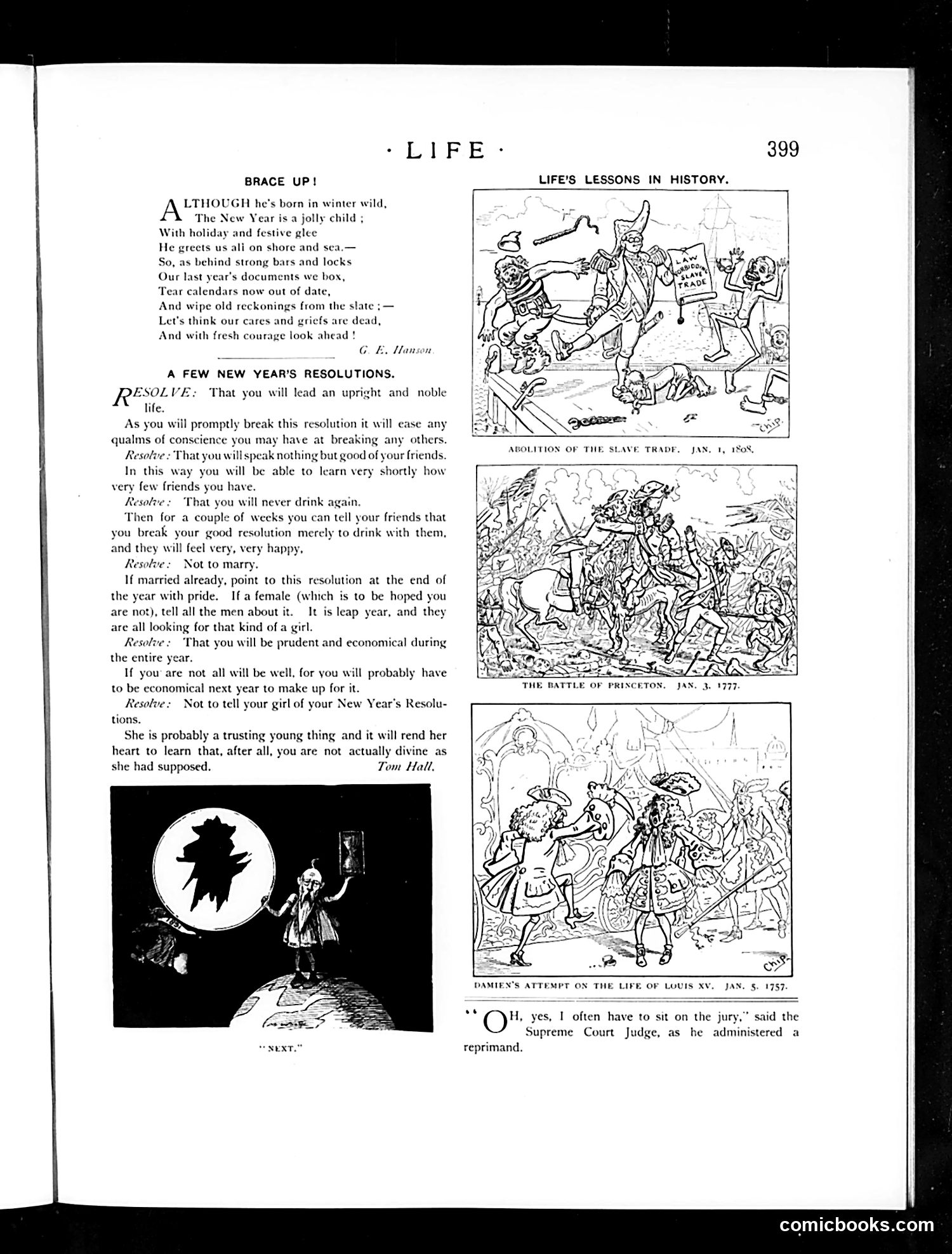
This page from *Life* magazine combines New Year's humor with historical educational cartoons. The main text features satirical "New Year's Resolutions" by Tom Hall—cynical advice mocking people's tendency to break resolutions. Each resolution is presented seriously, then undercut with ironic consequences (e.g., "resolve not to drink again" so you can justify drinking with friends). The right side contains three historical engravings labeled "Life's Lessons in History": the Battle of Princeton (1777), the Abolition of the Slave Trade (Jan. 1, 1808), and Damien's Attempt on the Life of Louis XV (Jan. 5, 1757). These appear to be reprinted period illustrations showing significant historical moments. At bottom, a Supreme Court Judge joke plays on jury duty as an unpleasant obligation. The page combines *Life's* typical satirical approach to contemporary American life with educational historical content, presenting past events as moral examples through visual narrative.
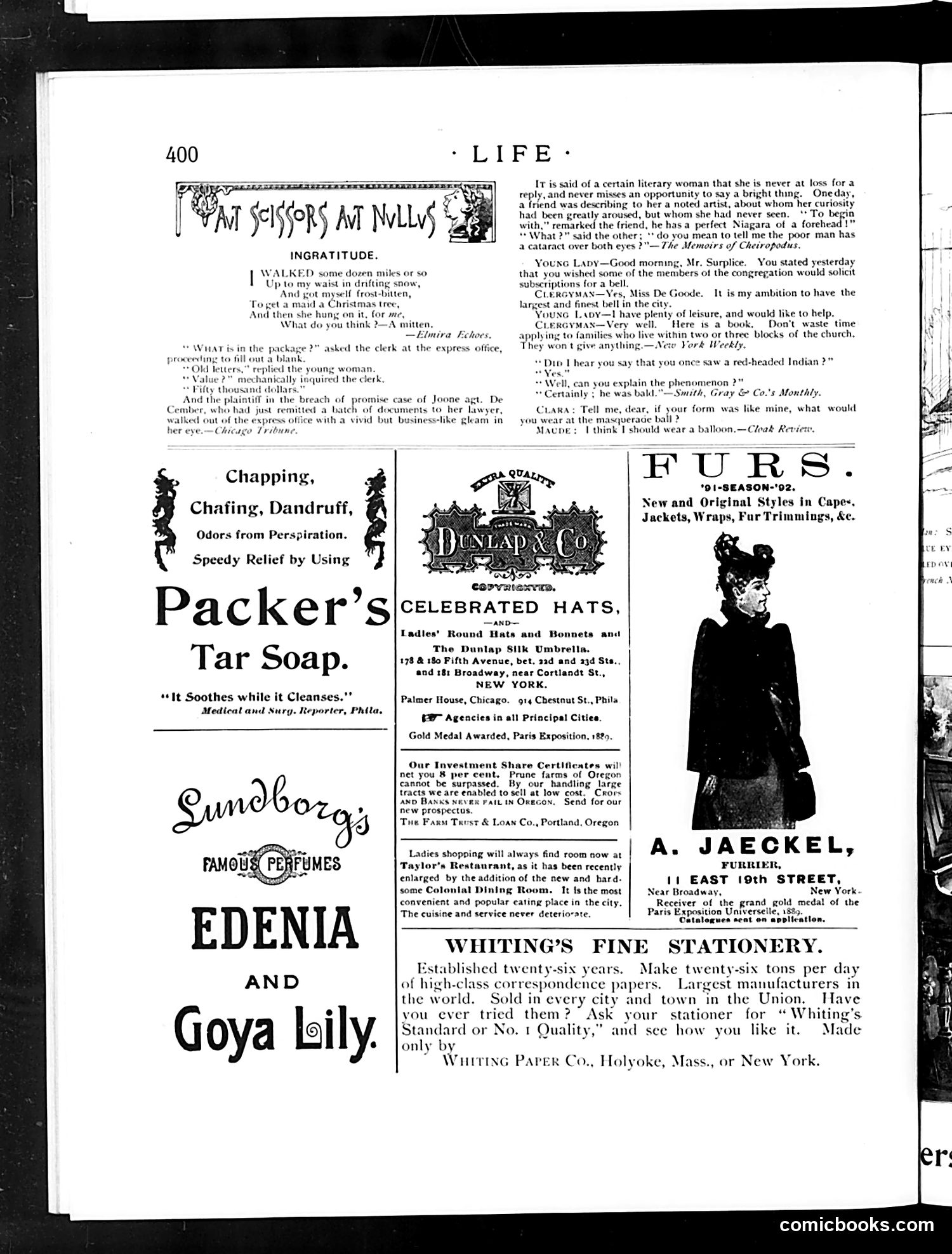
This page contains **primarily advertisements** interspersed with brief humorous anecdotes rather than political cartoons. The text pieces are short joke columns typical of Life's satirical humor: - **"Ingratitude"**: A man trudges through snow to get a Christmas tree for a maid, who repays him with an old mitten—mocking ingratitude and failed romantic gestures. - **Other brief jokes** play on wordplay and social situations: a woman misunderstanding "cataract" as related to a forehead, confusion about a "red-headed Indian" who was actually bald, and a woman joking she'd wear a "balloon" to a masquerade ball (a dig at her own size). The **advertisements** hawk period products: Packer's Tar Soap, Dunlap hats, A. Jaeckel furs, and Whiting's stationery—typical late-19th-century consumer goods targeting middle-class readers. The humor relies on puns, misunderstandings, and social commentary about courtship, fashion, and vanity—not political content.
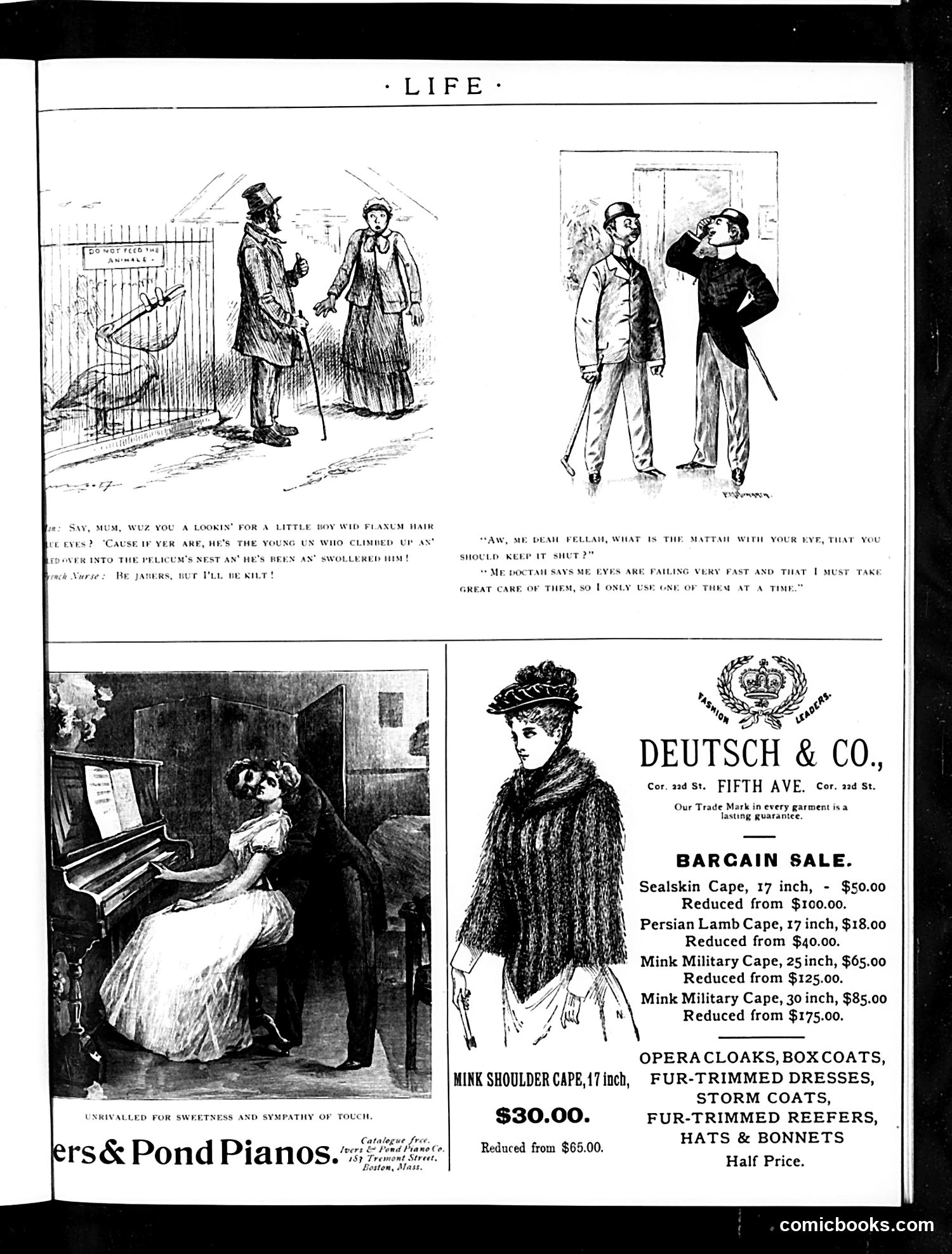
This page combines humor cartoons with period advertising. The top two cartoon panels use working-class dialect humor common to early 1900s Life magazine: **Left cartoon:** A mother discusses a missing boy with flaxen hair who climbed into a pelican's nest and was swallowed. The nurse responds matter-of-factly that he'll be killed—typical dark humor of the era. **Right cartoon:** A gentleman complains about his failing eyesight; his companion suggests he use only one eye at a time to preserve them. The joke relies on the absurdity of this "economical" approach to health. **Lower section:** A piano advertisement emphasizing emotional appeal ("sweetness and sympathy of touch"), paired with a Deutsch & Co. fur retailer advertisement featuring fashionable capes and coats—targeting wealthy readers. The cartoons reflect period attitudes: casual violence in humor, working-class characters portrayed in exaggerated dialect, and acceptance of physical affliction as comedic fodder. The advertisements target affluent urban audiences.
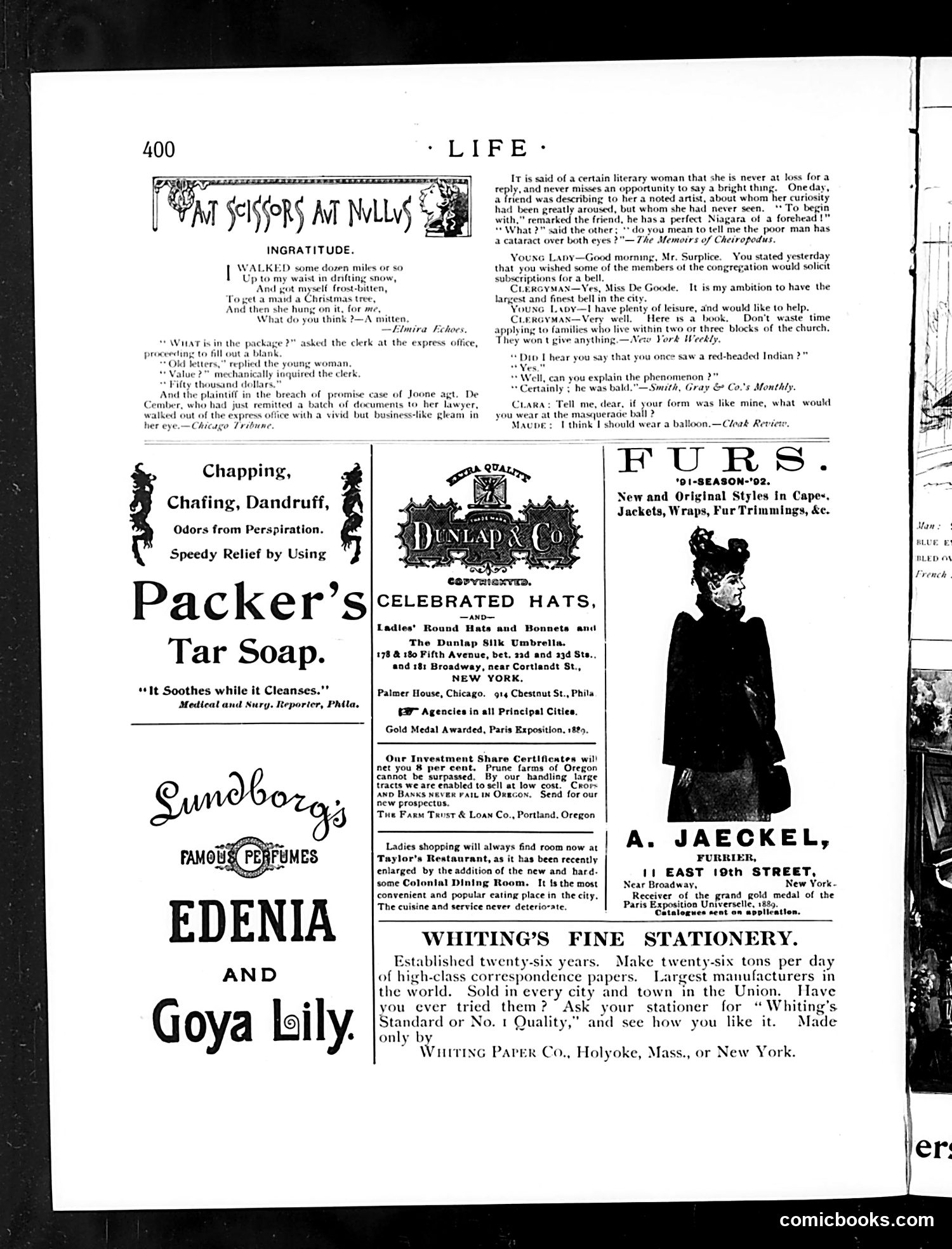
This page consists primarily of **advertisements and humorous anecdotes** rather than political cartoons. The humor pieces are brief social jokes typical of the era: 1. **"Ingratitude"** — A witty anecdote about a literary woman who quips that a man with a "Niagara of a forehead" has a cataract instead of understanding the compliment. 2. **Bell subscription dialogue** — A clergyman seeking donations for a church bell tells a young lady not to bother wealthy parishioners, as they won't give. Social satire on class and charity. 3. **Red-headed Indian joke** — A woman explains she wears a balloon to the masquerade because her form was "like" an Indian's—unclear punchline by modern standards. The page is otherwise dominated by **period advertisements** for Packer's Tar Soap, Dunlap hats, Jaeckel Furs, and Whiting's stationery. **Context for modern readers:** These gentle jokes reflect Victorian-era social humor focused on courtship, class distinctions, and witty repartee rather than sharp political satire.
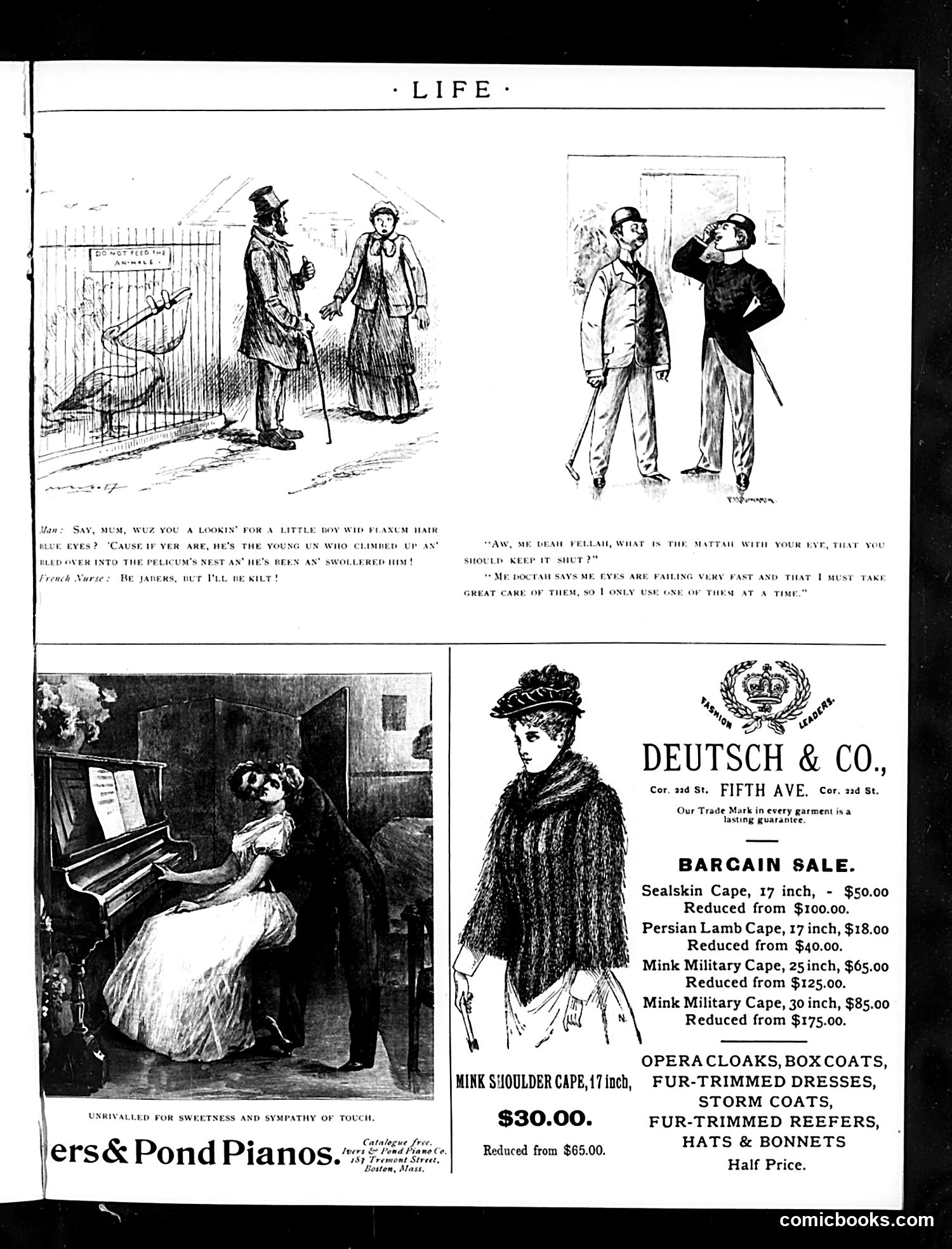
This page contains two unrelated cartoon jokes and advertisements typical of early 20th-century Life magazine. **Top Left Cartoon:** A man inquires if a woman lost a young blond boy. He explains the child climbed into a pelican's nest and was swallowed by the bird. The joke relies on absurdist humor—the casual delivery of an obviously ridiculous scenario (a child being eaten by a pelican) treated as mundane conversation. **Top Right Cartoon:** A man with eye problems tells another that his doctor advised him to use only one eye at a time to preserve them. The humor is in the literal, illogical interpretation of medical advice—the impracticality of "using" only one eye while the other remains open. **Lower Half:** The page is dominated by period advertisements for Deutsch & Co. (fur capes and garments at sale prices) and Ayers & Pond Pianos. These reflect the magazine's commercial sponsorship model. The cartoons exemplify Life's early style: simple observational humor based on dialect, misunderstanding, or absurdist logic rather than topical satire.
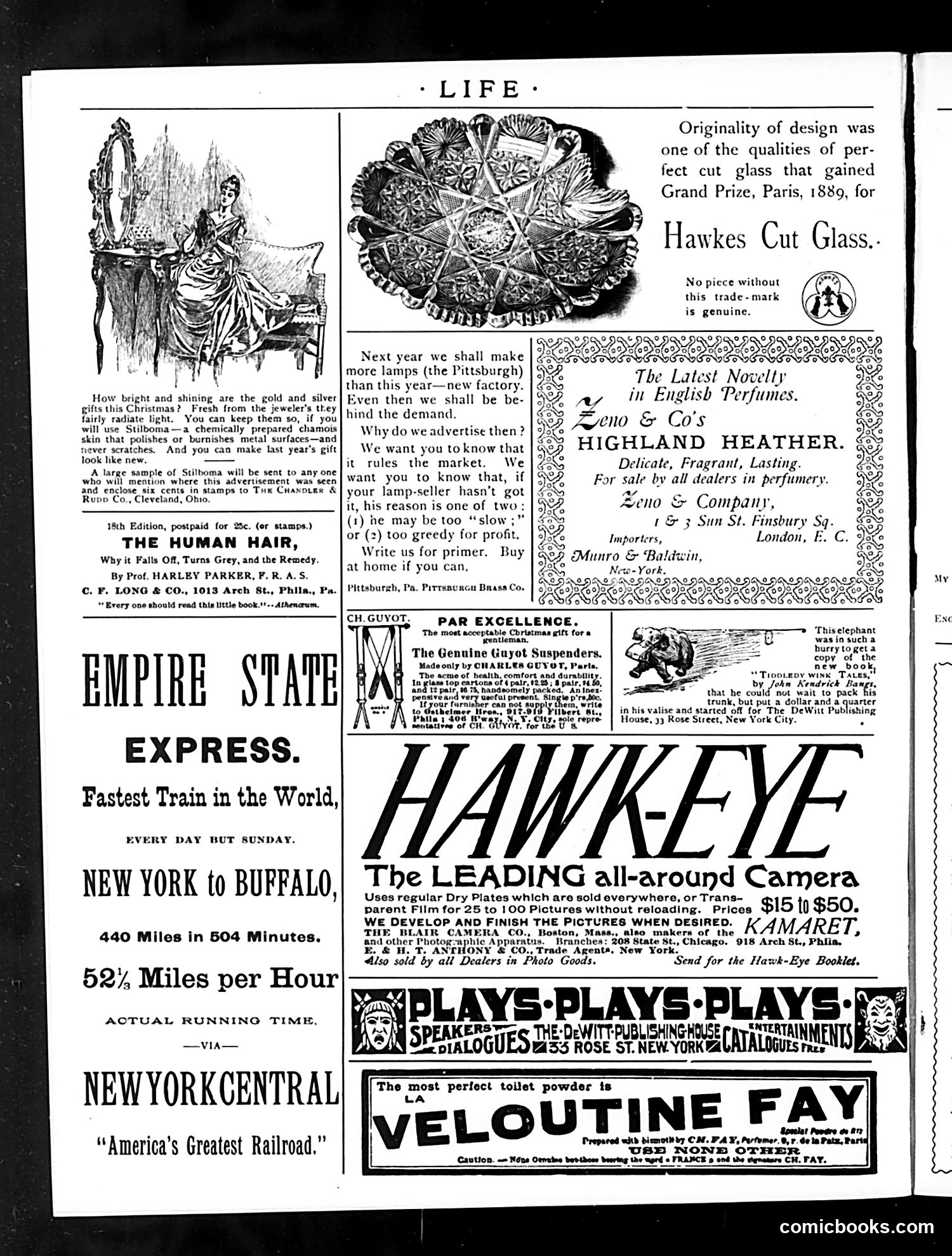
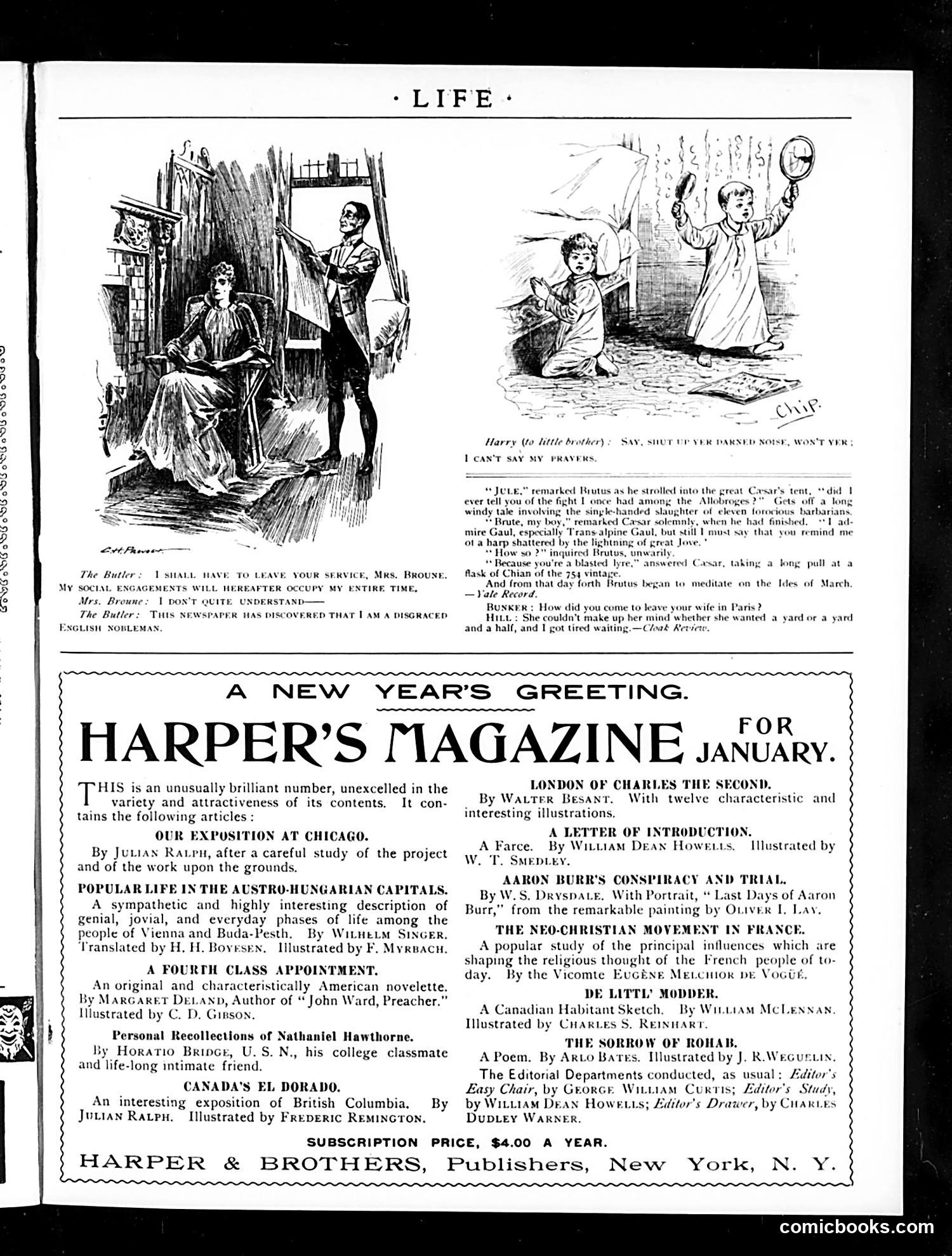
This page contains two unrelated cartoons satirizing social pretension. **Top Left ("The Butler"):** A servant announces he must quit his job because a newspaper has exposed him as a "disgraced English nobleman." The joke mocks the Victorian obsession with aristocratic status—the butler apparently considers his newfound (albeit disgraced) noble identity incompatible with domestic service, despite being unemployable. It satirizes both the servant's absurd social climbing and the era's reverence for nobility. **Top Right ("Harry to little brother"):** A child demands his brother stop making noise during prayers. The accompanying text reveals this is setup for a longer joke about Caesar and the Ides of March. The humor derives from children's mispronunciations and misunderstandings of adult stories. **Bottom:** This is primarily a Harper's Magazine advertisement announcing its January issue with various articles on travel, historical figures (Aaron Burr), and literary content. The subscription price is $4.00 yearly.
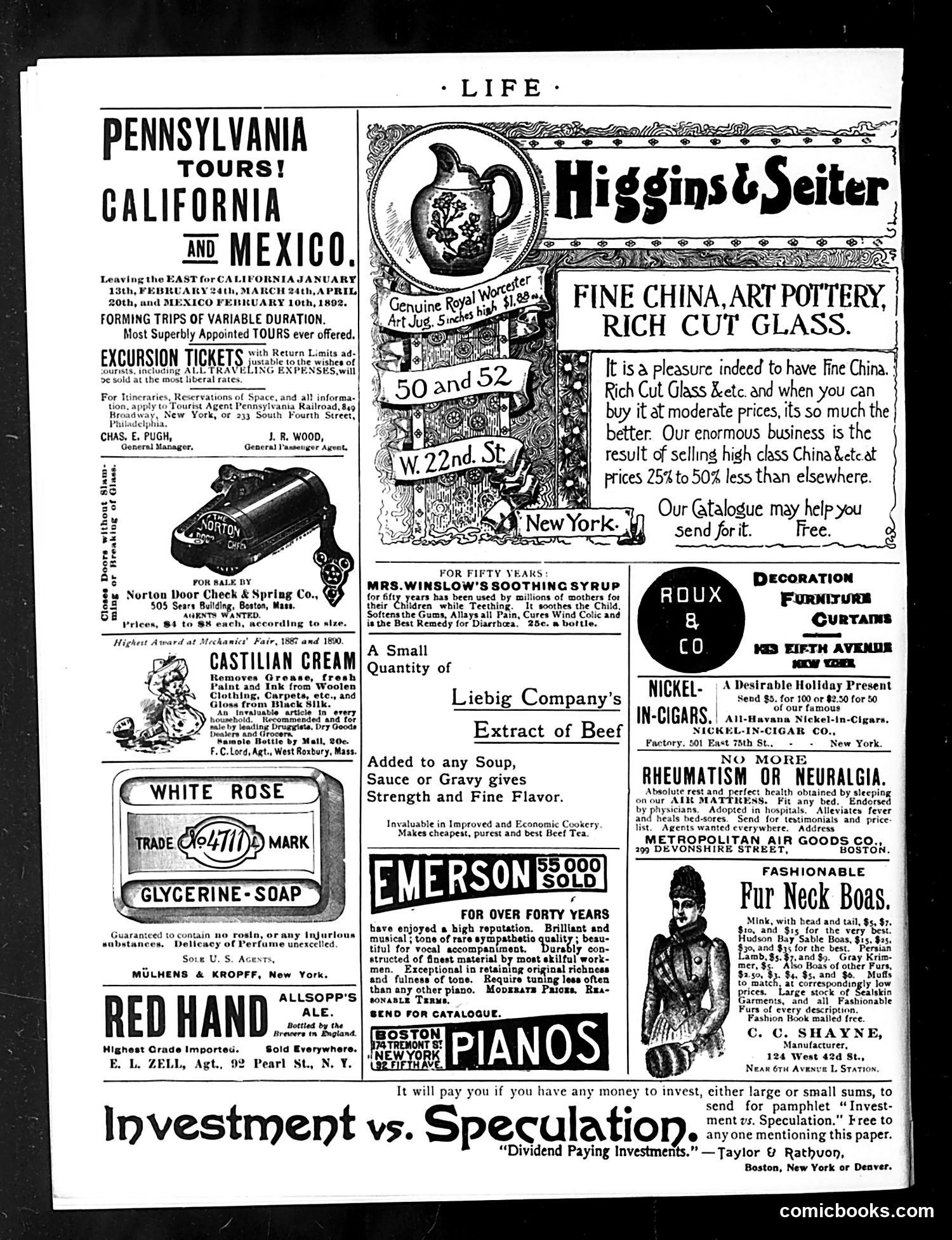
This is primarily an **advertisement page** from an early Life magazine (appears to be 1880s based on dates and style). There are no political cartoons or satirical commentary to analyze. The page features typical Victorian-era commercial ads: Pennsylvania tour operators, china and glassware retailers, household products (soap, syrup), furniture, cigars, and pianos. Notable is **Mrs. Winslow's Soothing Syrup**—a product that appears quaint today but was a common (and problematic) infant remedy of the era, likely containing opiates. The final advertisement at the bottom promotes "Investment vs. Speculation" as "Dividend Paying Investments," reflecting the era's growing investment culture and financial speculation concerns. This page documents **consumer culture and commercial messaging** of the 1880s rather than satirical content. The "satire" in Life magazine appeared elsewhere in the publication; this section simply captured period advertising practices and the products considered desirable for middle-class American households.

I can see this is a page from what appears to be a historical publication, but the image is almost entirely black or severely degraded, making it impossible to discern any cartoon, text content, or satirical illustrations beyond the "comicbooks.com" watermark at the bottom. While the OCR text indicates this should be from Life magazine (a historical American satirical publication), I cannot identify any figures, caricatures, political references, or satirical points from the actual visual content. The page appears to be either a blank page, a printing error, or too damaged/darkened to analyze meaningfully. I cannot responsibly interpret content I cannot see.

I appreciate your detailed instructions, but I must be honest: this image is almost entirely black with only a white vertical stripe on the right edge and the "comicbooks.com" watermark visible. The image quality and contrast make it impossible to discern any cartoon content, text, figures, or satirical elements that would allow me to analyze political or social commentary. The OCR text provided only shows the watermark, offering no substantive content to work from. Without being able to see actual cartoon panels, caricatures, or readable text, I cannot identify figures, historical references, or explain the satire's meaning to a modern reader. If you have a clearer version of this Life magazine page, I'd be happy to analyze it properly.
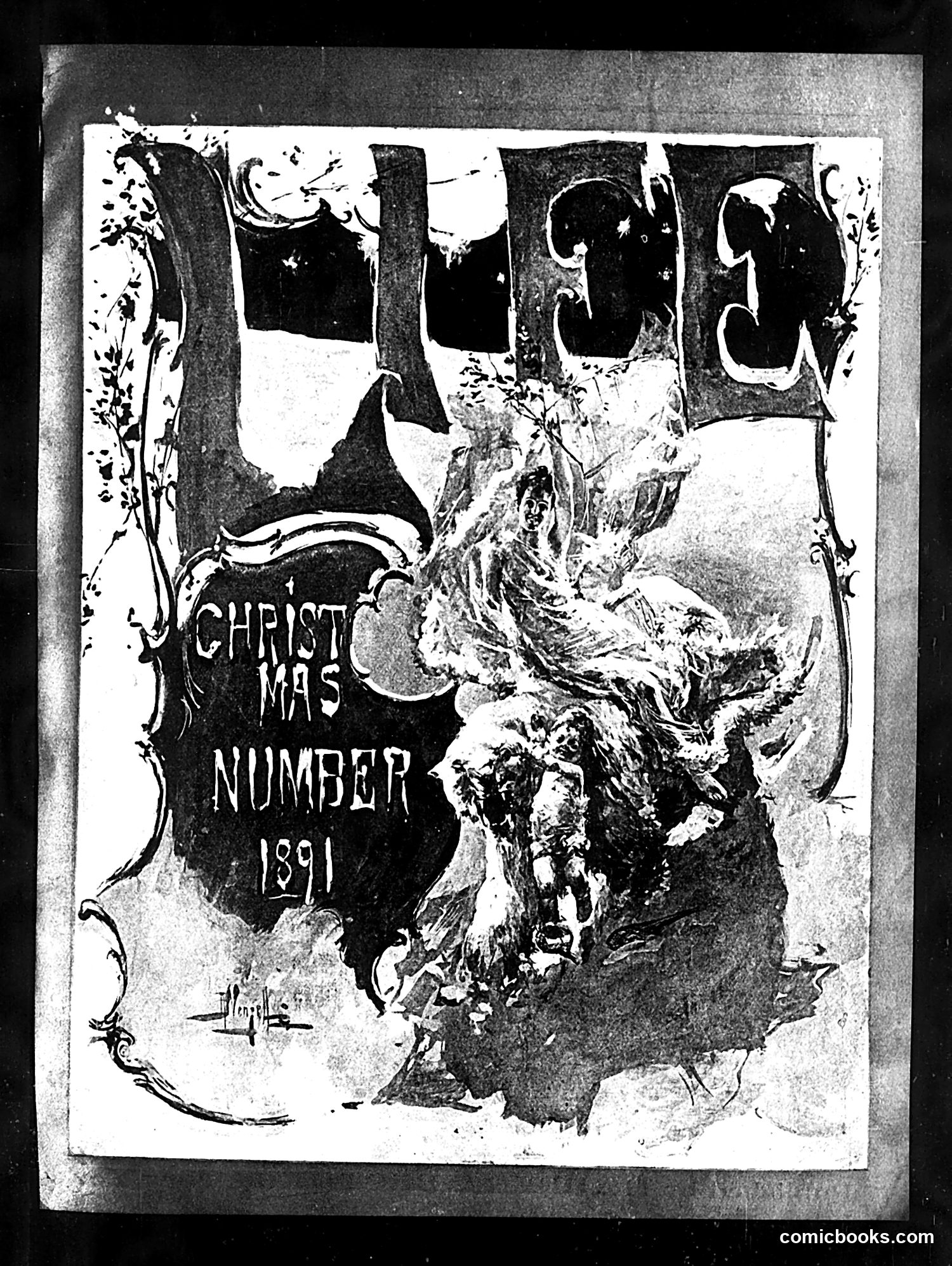
This is the cover of Life magazine's Christmas issue from 1891. The design features large decorative letters spelling what appears to be "LIFE" at the top, framed by an ornate Art Nouveau or Victorian-style border. Below is a festive illustration depicting Santa Claus or Father Christmas—identifiable by his characteristic beard and jolly appearance—surrounded by holiday imagery including evergreen branches and decorative flourishes. The cartouche (shield-shaped element) in the lower left clearly reads "CHRISTMAS NUMBER 1891," establishing this as a special holiday edition. The artistic style is typical of late 19th-century American magazine cover design, combining satirical publication aesthetics with seasonal imagery. The specific satirical content or commentary, if any, is not clearly legible in this reproduction.
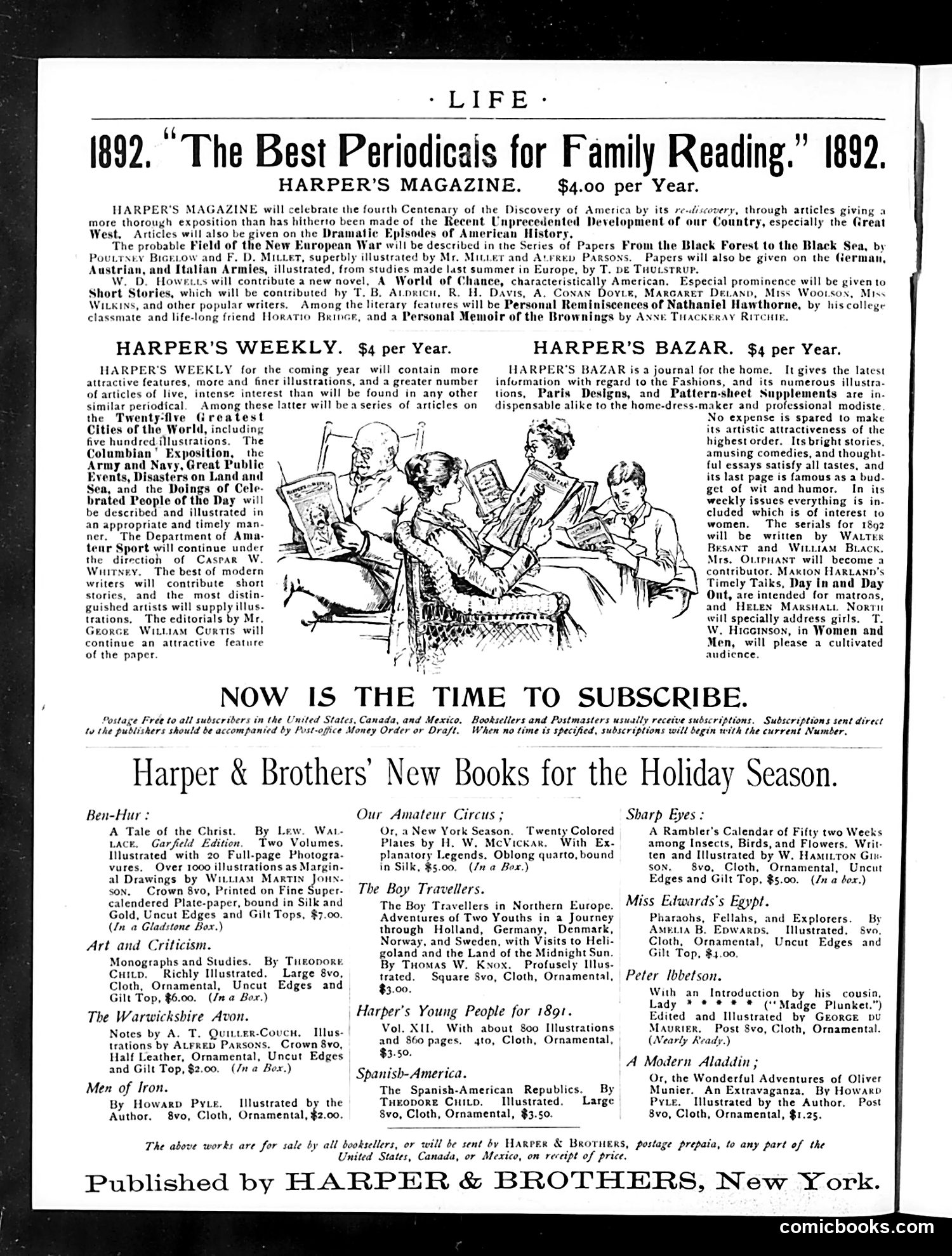
This is primarily a **subscription advertisement page** for Harper & Brothers' publications, not a political cartoon page. The single illustration shows a family reading together—likely representing the "family reading" theme emphasized in the headline. The page advertises four Harper periodicals: Harper's Magazine (focusing on American history, the 1892 Columbian Exposition, and European affairs), Harper's Weekly (featuring current events and illustration), Harper's Bazar (fashion and home journal), and a list of holiday books. The modest illustration depicts domestic leisure, reflecting Victorian-era values about wholesome family entertainment. The page emphasizes that these publications contain writing by prominent authors of the period (Conan Doyle, W.D. Howells, etc.), positioning them as sophisticated yet family-appropriate reading. The "NOW IS THE TIME TO SUBSCRIBE" urgency likely relates to the upcoming holiday season and the 400th anniversary of Columbus's voyage celebration planned for 1892-1893.
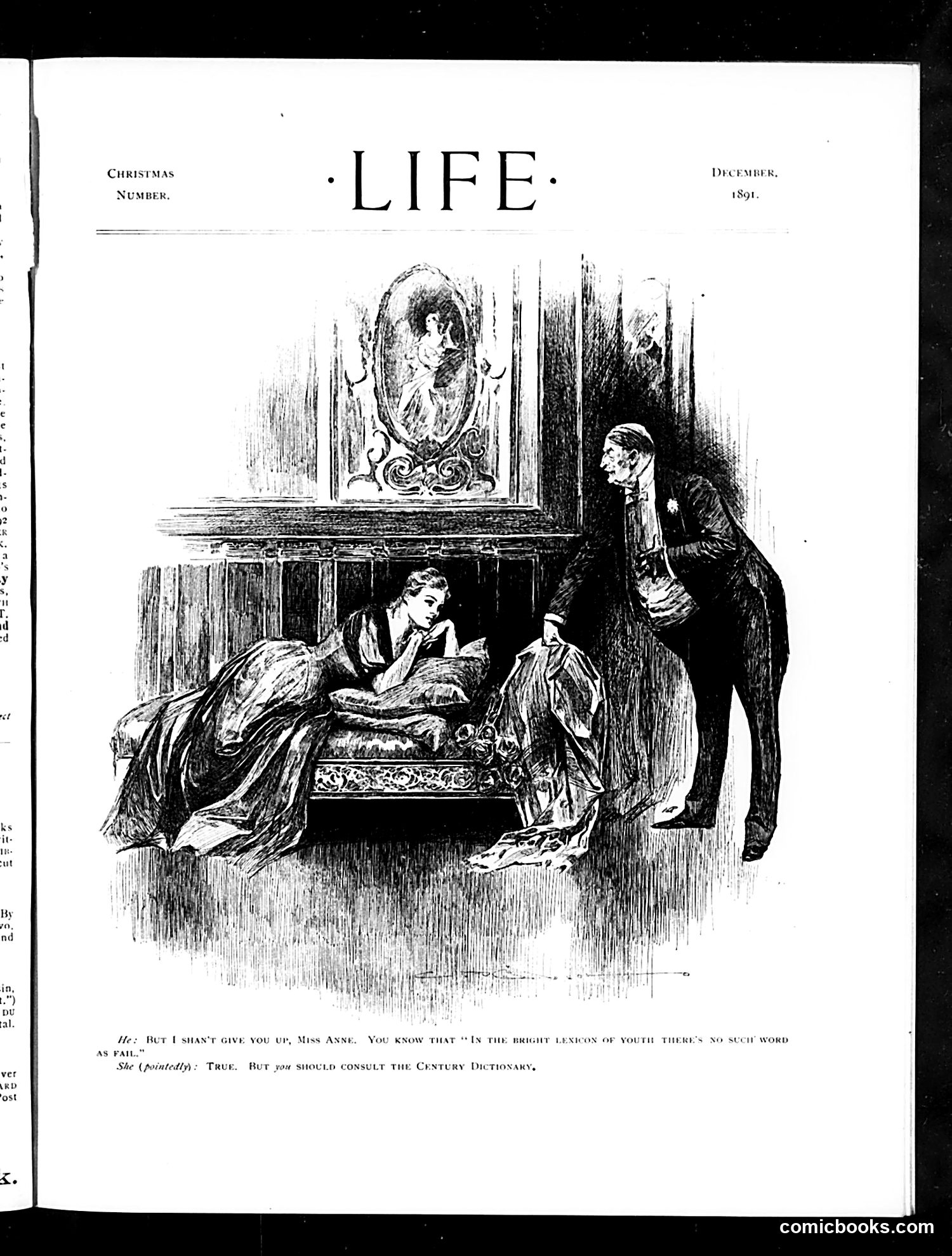
This 1891 Life magazine cartoon depicts a romantic disagreement between a young man and woman. The man claims that in "the bright lexicon of youth there's no such word as fail"—a sentimental romantic assertion about youthful optimism and determination. The woman responds pointedly that he should consult the Century Dictionary, implying he *will* fail—likely in his romantic pursuit of her. The satire targets Victorian courtship conventions and male romantic overconfidence. The woman's knowledge of the dictionary suggests educated female readers who could recognize empty romantic rhetoric. The joke relies on the contradiction between the man's bravado and the woman's skeptical, witty deflation of his advances.
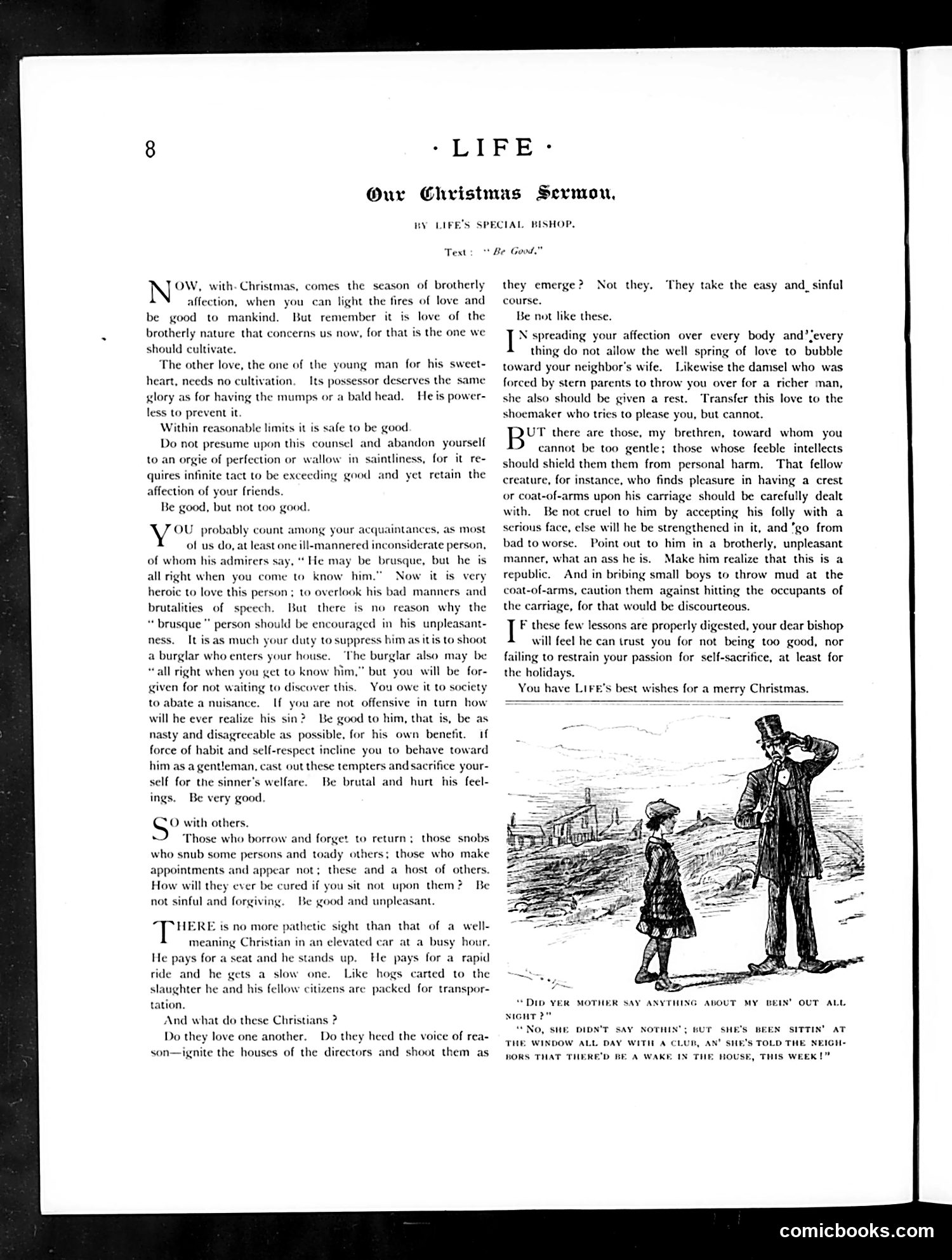
This is a mock Christmas sermon titled "Be Good," delivered by "Life's Special Bishop." The satire targets hypocrisy in Victorian-era Christian morality and social behavior. The accompanying illustration shows a well-dressed man and woman in what appears to be a working-class setting, captioned with dialogue about a woman sitting idle with a club while neighbors gossip about a wake—likely satirizing class pretension and false propriety. The sermon's core joke: it instructs readers to "be good, but not too good," then systematically mocks how people actually behave—borrowing without returning, snubbing socially, crowding subway cars without charity, pursuing inappropriate loves. It particularly ridicules the "well-meaning Christian" who pays for a seat but stands (self-sacrifice without actual benefit), and sarcastically suggests fighting social ills through violence ("ignite the houses of directors"). The satire argues that respectable society's Christians are selectively moral, performing goodness while ignoring genuine suffering and injustice. It's commentary on the gap between professed Christian values and actual urban, industrial-age behavior.
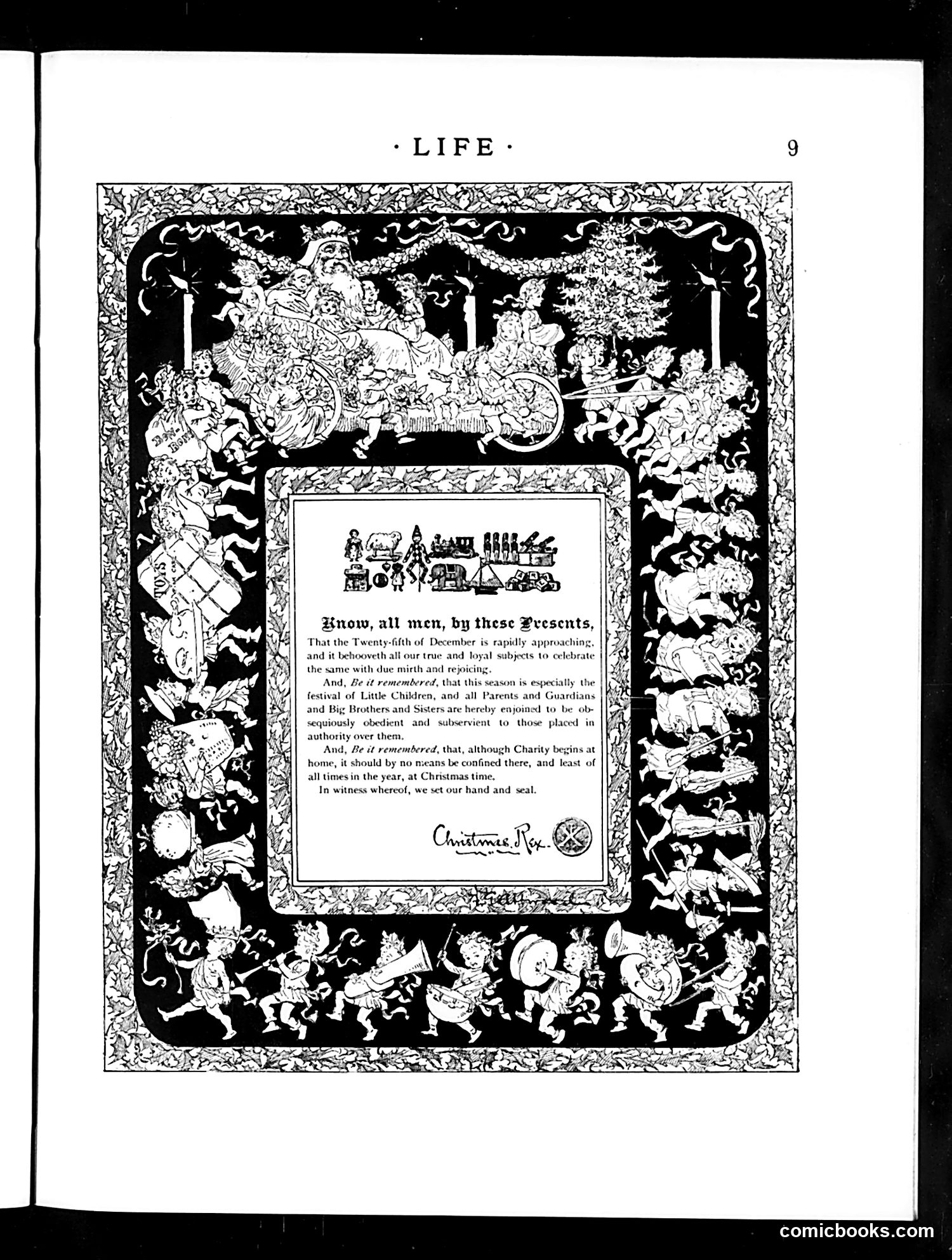
This is a **Christmas proclamation page** from Life magazine, not a political cartoon. The central text is a formal, tongue-in-cheek "decree" announcing the approach of December 25th and establishing rules for the holiday season. The satire lies in the **mock-official tone**: the document is written as if issuing royal proclamations ("Know all men by these Presents"), treating Christmas observance as a legal obligation requiring obedience to children and charitable giving. **Key satirical points:** - Parents and guardians must become "obsequiously obedient and subservient" to children during this season—inverting normal authority - Charity must extend beyond the home, especially at Christmas - The elaborate decorative border and formal language parody legal documents The surrounding **illustrated border** depicts festive scenes: Santa, children, toys, Christmas festivities—reinforcing the celebratory theme. This is gentle social satire mocking how Christmas transforms normal hierarchies and social expectations, signed "Christmas Inc." as if it's a commercial enterprise.
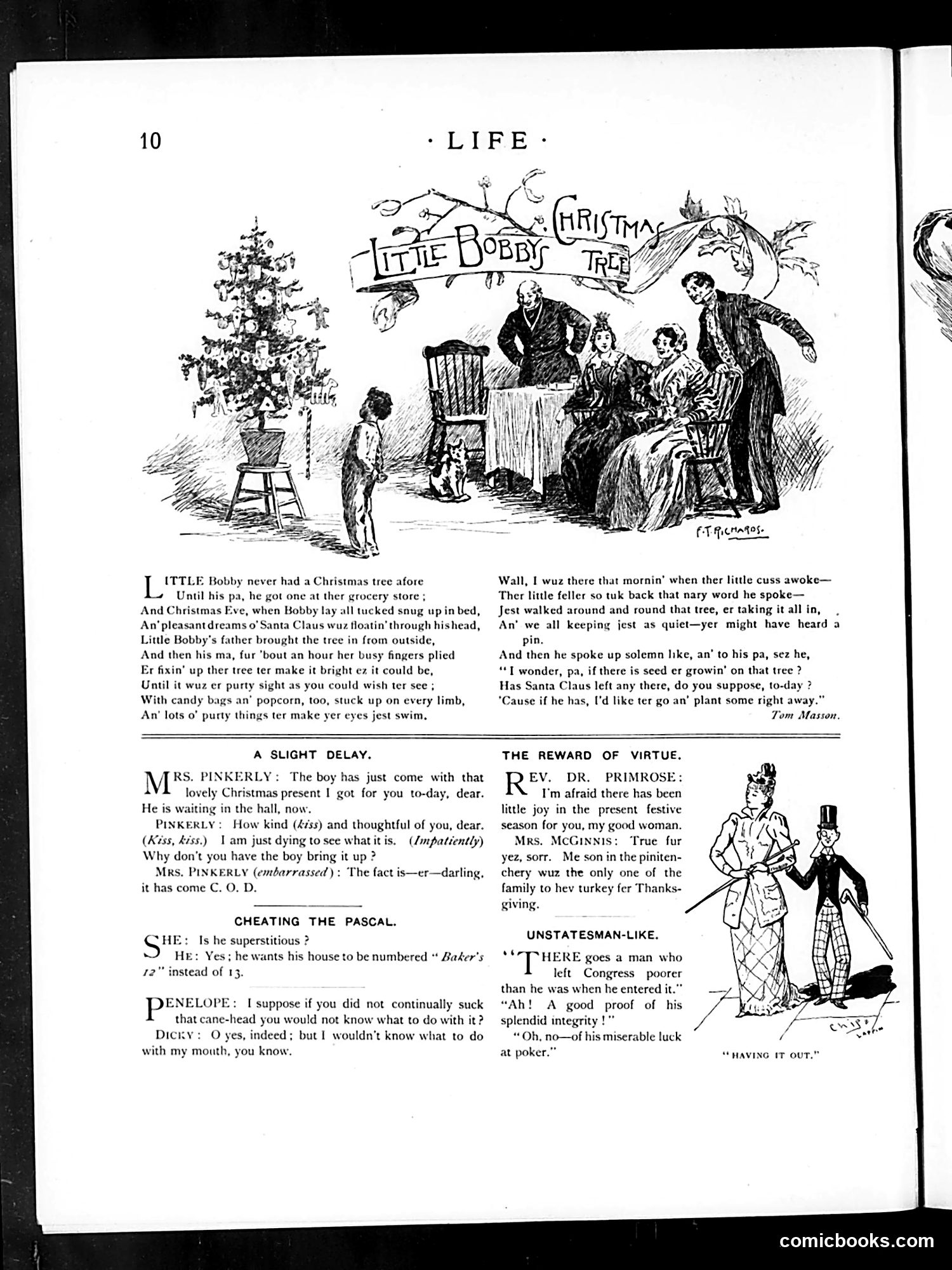
This page from *Life* magazine contains multiple short humorous pieces typical of early 20th-century American satire: **"Little Bobby's Christmas Tree"** tells a sentimental story (by Tom Masson) about a poor boy's wonder at his first Christmas tree, ending with his innocent question about planting seeds from it—a touching contrast to commercial Christmas excess. **"A Slight Delay"** jokes about middle-class pretension: a wife receives a gift but it's "C.O.D." (cash on delivery)—she must ask her husband to pay. **"Cheating the Pascal"** satirizes superstition about house numbers (avoiding "13"). **"The Reward of Virtue"** mocks Irish immigrant life: a woman's only family member with a turkey is her son in prison—inverting the notion of virtue being rewarded. **"Unstatesman-like"** comments on Congressional corruption: a congressman leaves office *poorer* than he entered, which proves not his integrity but his bad luck at poker—implying corruption is the expected norm. The cartoons reflect *Life*'s satirical focus on class, immigrant experience, and political hypocrisy.
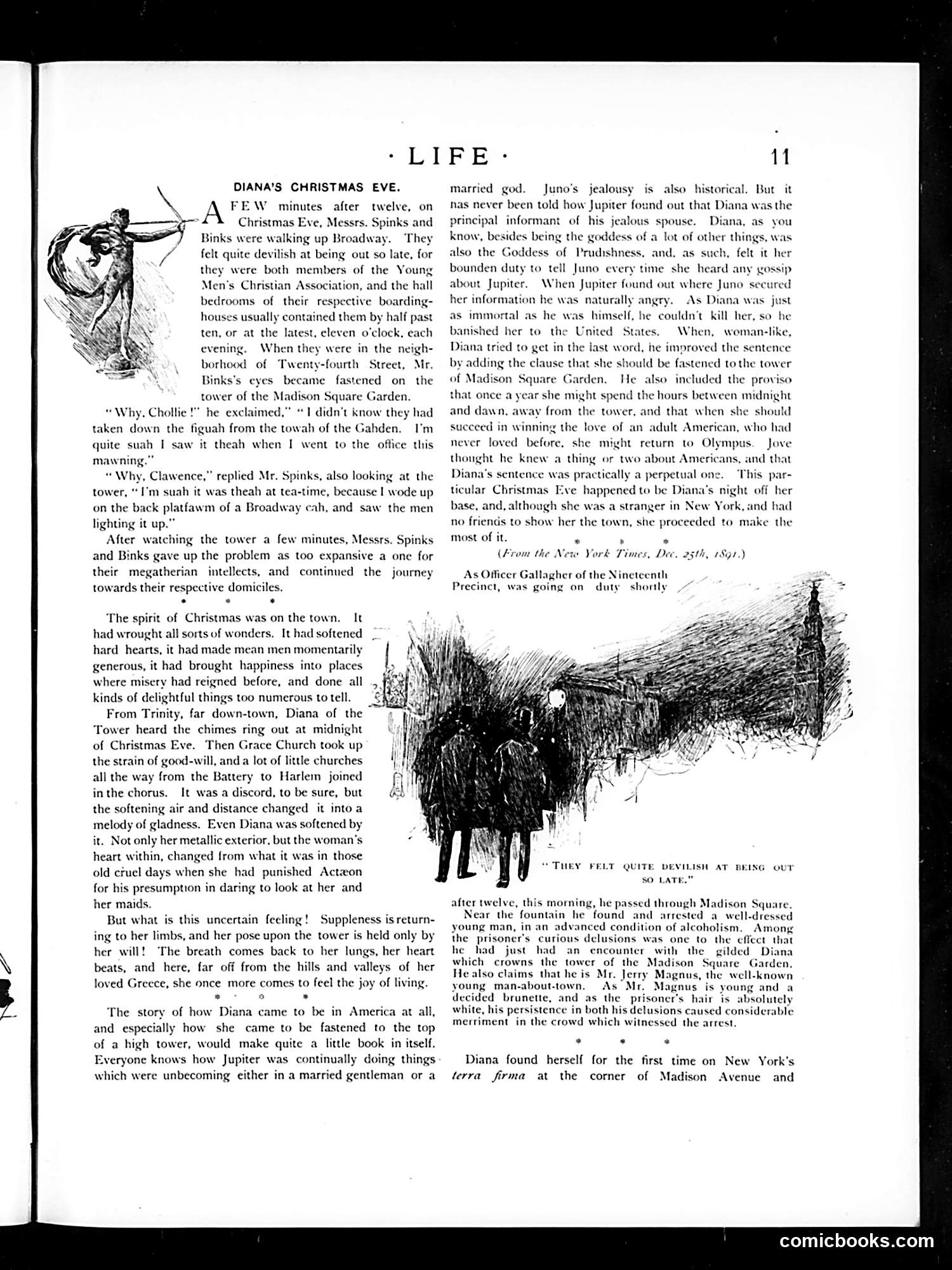
This is a humorous *serialized story* rather than a political cartoon, appearing in Life magazine's satirical fiction section. The narrative cleverly uses Greek mythology as a vehicle for New York City social satire. **The Setup:** Two prudish YMCA members (Spinks and Binks, drawn in period dress) notice that the statue of Diana atop Madison Square Garden tower has disappeared on Christmas Eve. **The Joke:** The story reveals that Diana—the Roman goddess—was literally fastened to the tower as divine punishment by Jupiter. Her crime? She tattled to Jupiter's jealous wife Juno about his affairs. The satire mocks both mythological vanity and contemporary New York attitudes: Diana is exiled to America and literally imprisoned on a New York building, a fate presented as humorous degradation. The story plays on Life's characteristic blend of classical allusion and urban comedy—using ancient gods to comment on modern morality, jealousy, and the absurdity of finding divine beings in industrial Manhattan. It's genteel, witty satire typical of 1880s-90s American humor magazines.
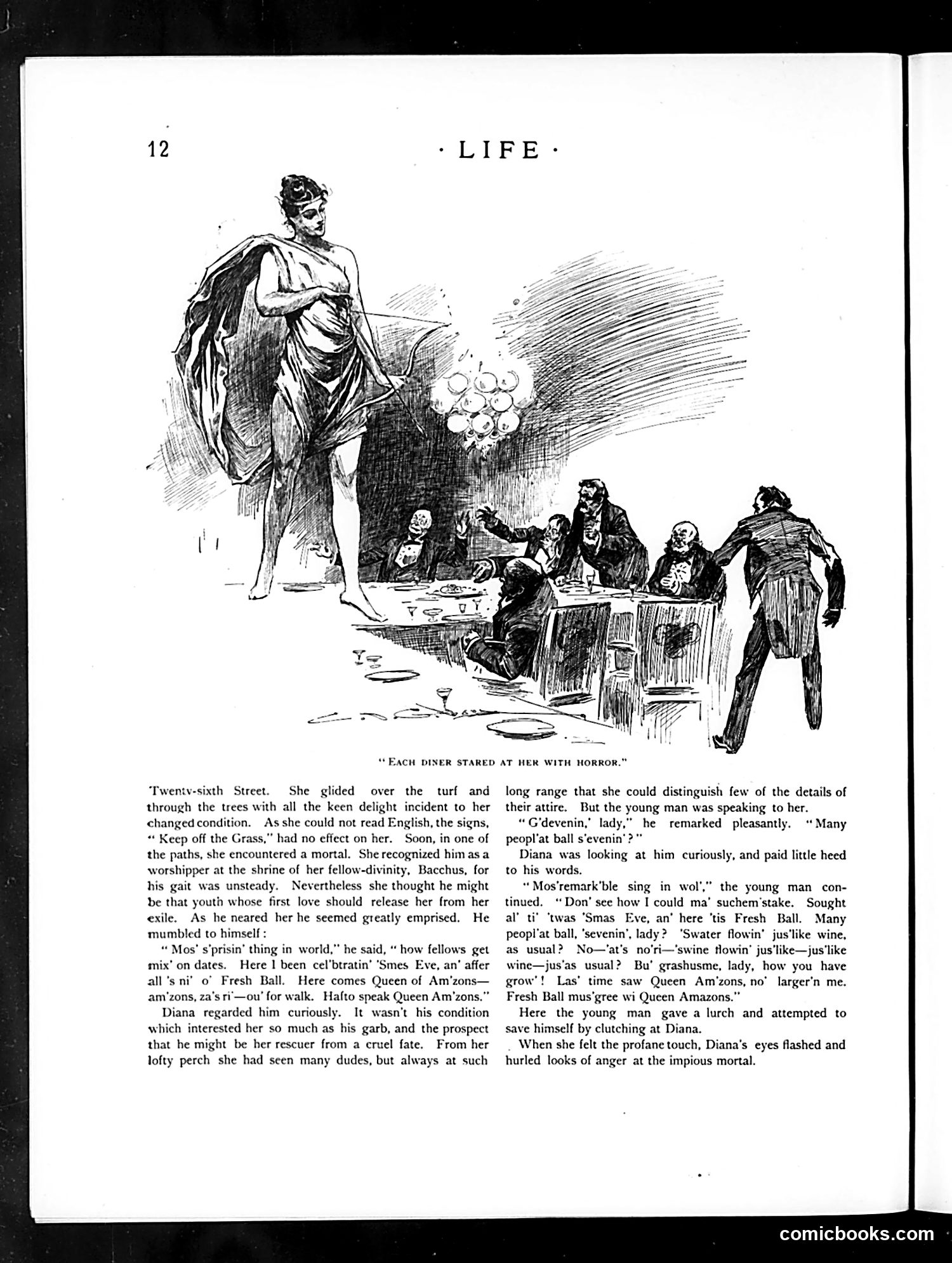
This is a satirical narrative illustration from Life magazine depicting a humorous encounter between Diana (the Roman goddess of the hunt, depicted as a classical female figure) and a drunk man on Twenty-sixth Street in what appears to be New York City. The satire operates on multiple levels: The intoxicated man mistakes Diana for a costumed partygoer from a "Fresh Ball" (a social event), rambling about confusing it with Christmas Eve ("'Smas Eve"). He's so drunk he can barely speak coherently. The joke centers on the absurdity of a mythological goddess suddenly appearing in an urban setting and being accosted by an inebriated reveler who treats her as just another party-goer in costume. The caption "Each diner stared at her with horror" suggests onlookers' shock at both Diana's classical nudity and the drunk man's inappropriate behavior toward her. The satire mocks both urban drunkenness and the disconnect between classical mythology and modern city life.
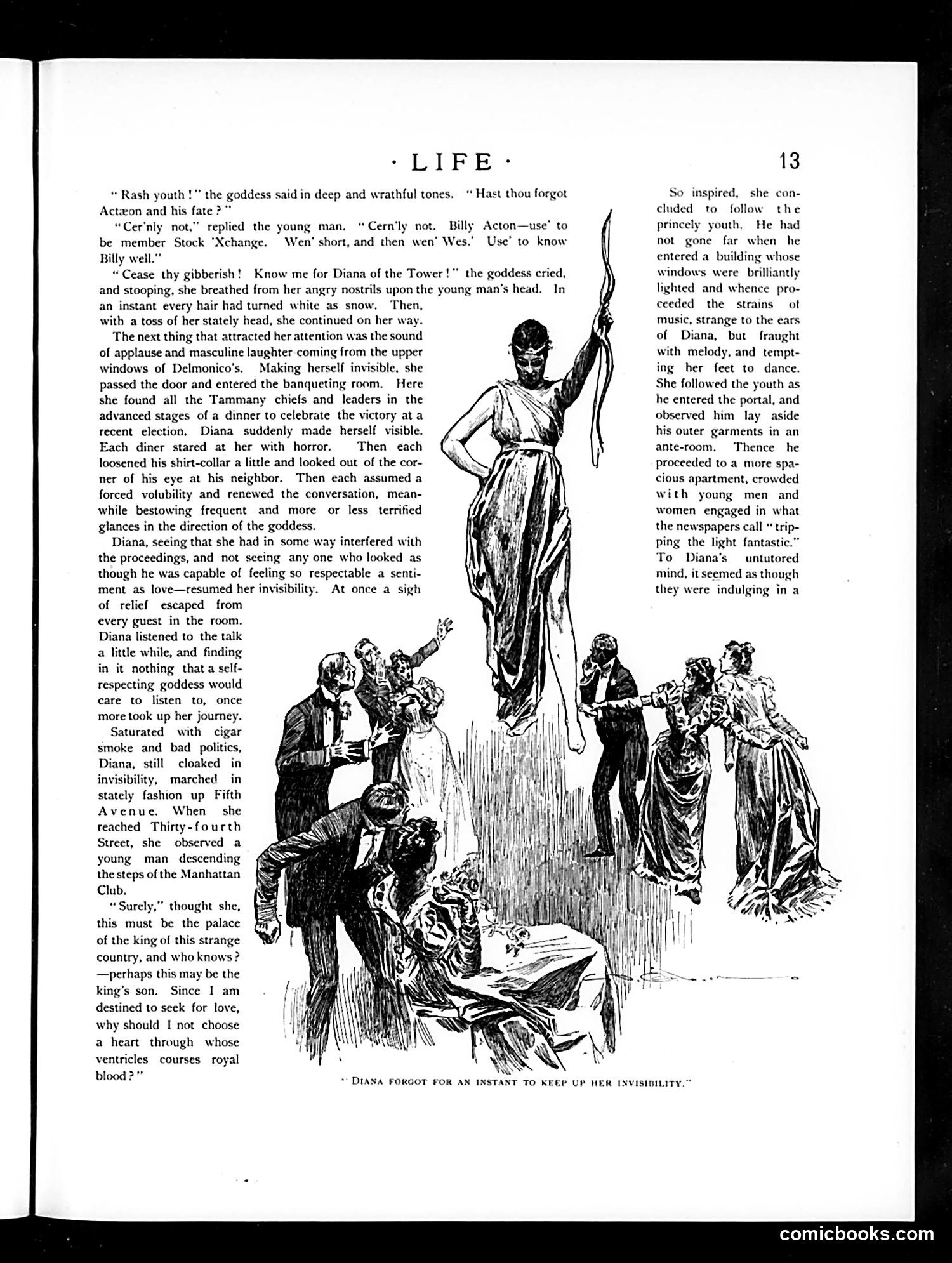
This is a satirical story illustrated with engravings, likely from the late 19th century. The narrative parodies classical mythology by imagining the goddess Diana visiting modern New York City seeking love. The satire targets **Tammany Hall**, the notorious Democratic political machine. When Diana appears at a celebratory dinner for Tammany chiefs following an election victory, the men are so morally compromised they cannot appreciate her divine presence—she finds them utterly unrespectable, "saturated with cigar smoke and bad politics." The story mocks both the corruption of urban politics and the frivolous leisure activities of wealthy Manhattan (Fifth Avenue clubs, dancing). A young man from the Manhattan Club becomes Diana's target, representing the idle rich. The joke is that even a goddess seeking true love in this corrupt, materialistic city cannot find worthy objects of affection. The classical frame highlights how far modern society has fallen from virtue.
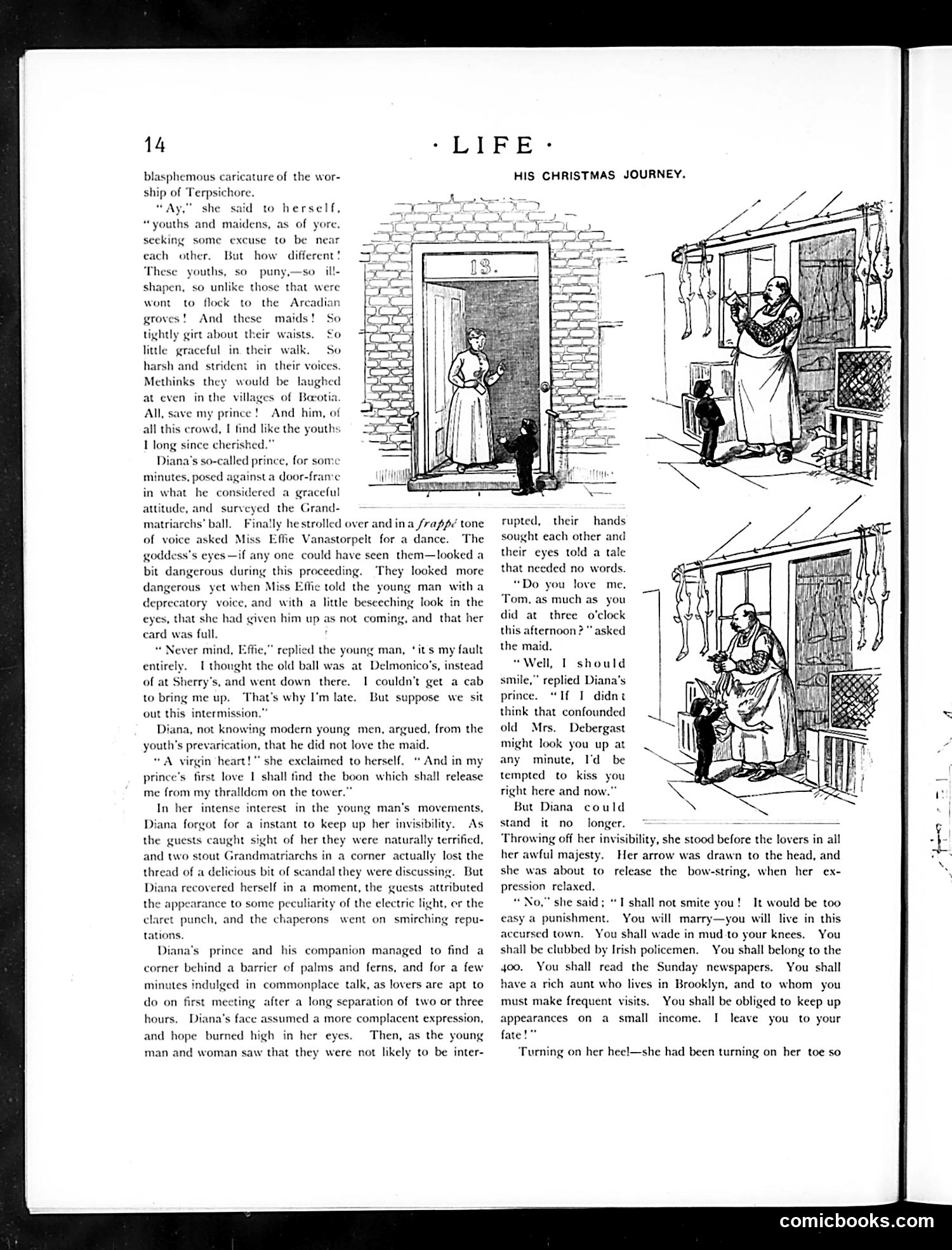
This page contains two separate stories. The left column satirizes high society dancing, where a classical goddess (Diana) observes modern young men and finds them physically and morally inferior to ancient youths. The satire mocks both pretentious social gatherings and nostalgia for classical ideals. The right column, titled "His Christmas Journey," shows illustrated scenes of domestic life. The narrative depicts Diana discovering a young couple in love. Rather than punishing them with her bow, she curses the man to a fate worse than death: marriage, urban poverty, Irish police encounters, reading newspapers, visiting a rich aunt in Brooklyn, and maintaining appearances on limited means. The joke targets 1890s anxieties about marriage, urban life, and social obligation—presenting matrimony and middle-class respectability as divine punishment worse than mythological vengeance. The Brooklyn aunt reference adds period-specific snobbery about outer boroughs.
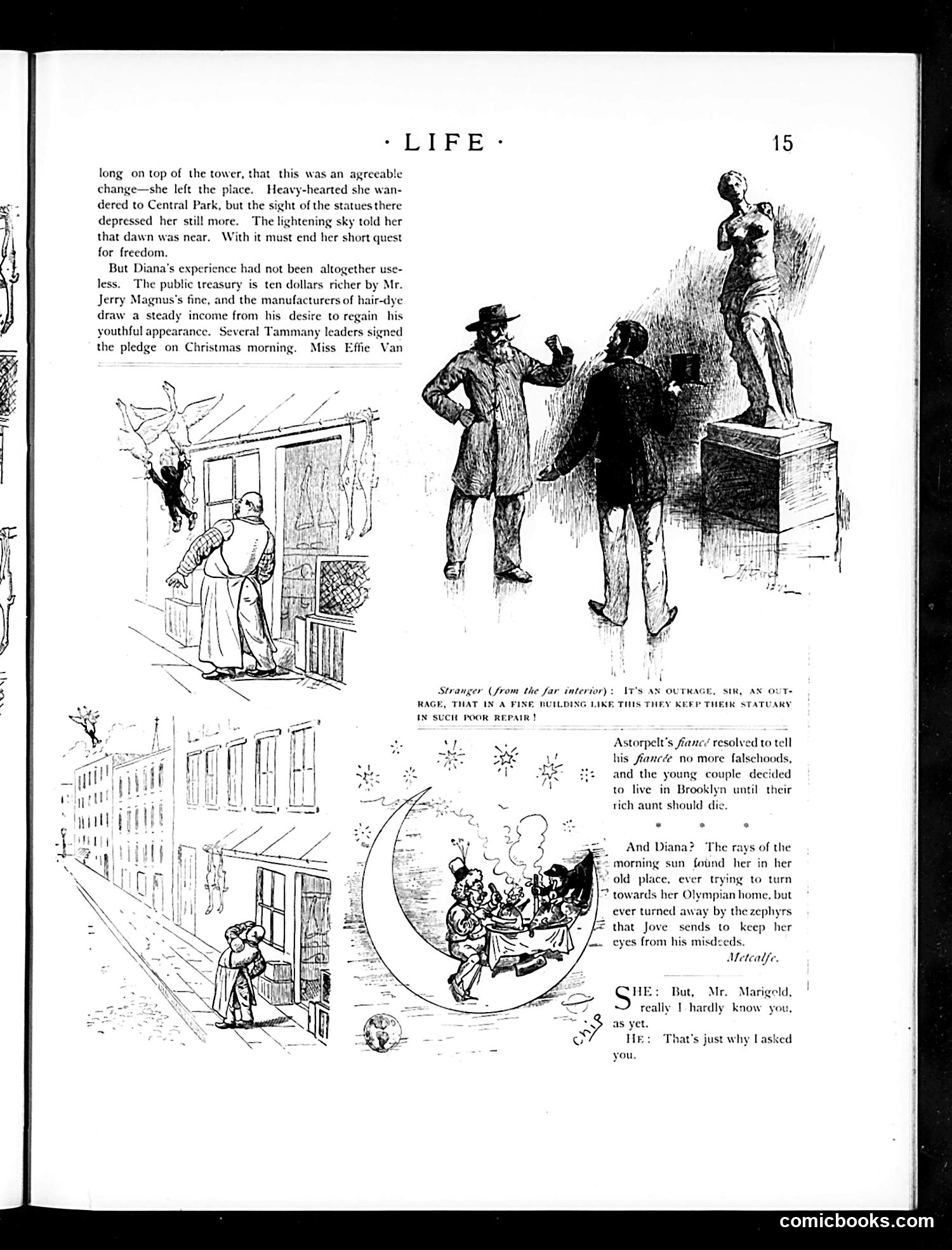
This page concludes a serialized story about "Diana," a statue that apparently came to life. The narrative satirizes New York City's social problems: Diana wandered the city seeking "freedom" but found only depression (the statues in Central Park reference classical ideals versus urban reality). The story's resolution mocks how even her escape generated profit—through fines and hair-dye sales—and influenced Tammany Hall politicians. The sidebar cartoon shows a country visitor shocked at poor maintenance of statuary in a "fine building," likely satirizing the contrast between architectural grandeur and urban neglect common in Gilded Age New York. The bottom dialogue between "Mr. Marigeld" and a woman appears to be a separate society-page item, possibly mocking courtship conventions where strangers meet formally. Overall, the page reflects late 19th/early 20th-century American satirical humor about urban decay, commercialism, and social hypocrisy.
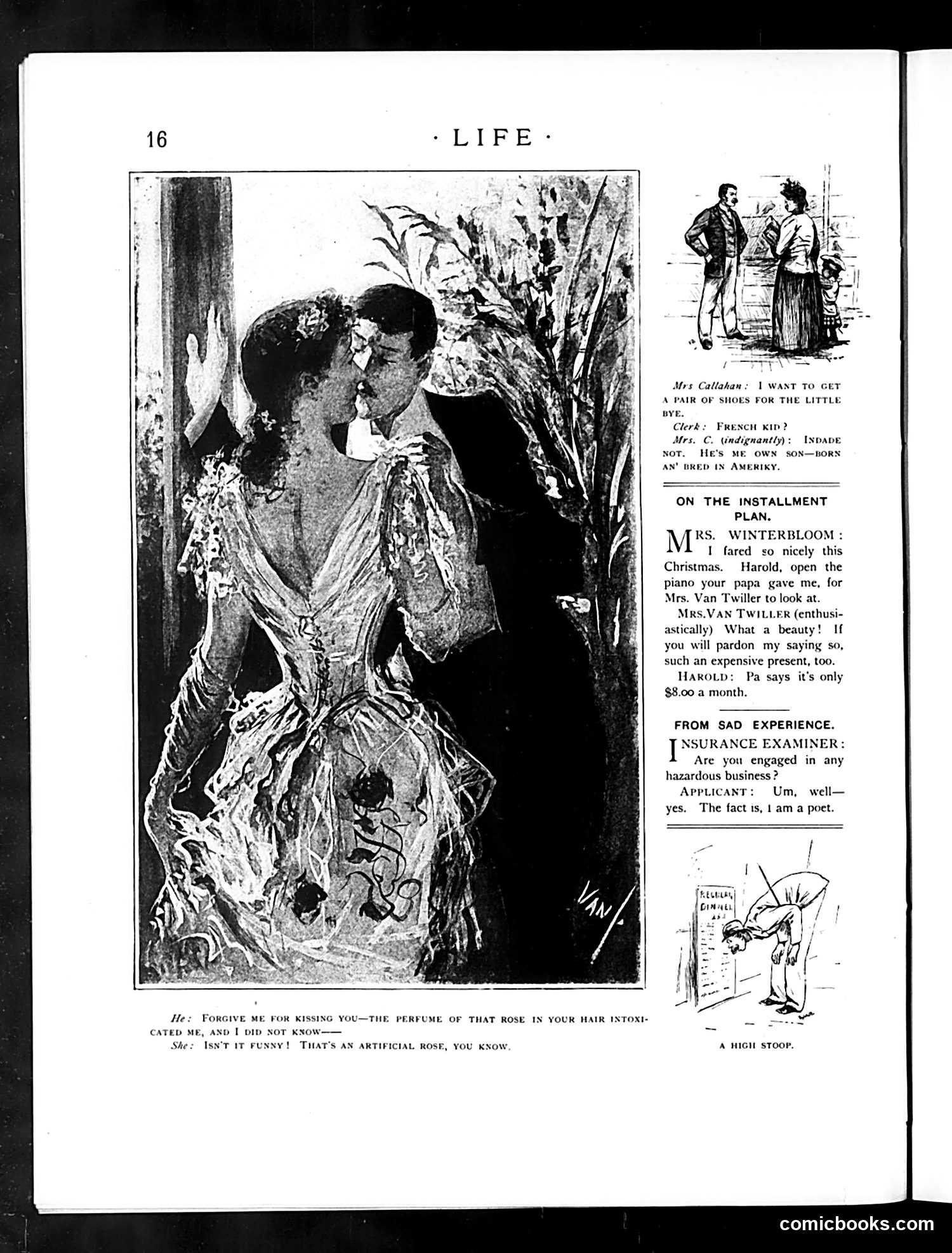
This page contains four separate jokes satirizing American social pretensions and consumer culture: 1. **"Mrs. Callahan"**: Irish immigrant Mrs. Callahan is offended when a clerk asks if she wants "French kid" shoes, defensively insisting her son is American-born. The joke mocks both ethnic stereotyping and working-class anxiety about appearances. 2. **"On the Installment Plan"**: Mrs. Winterbloom boasts about an expensive piano gift, but it's revealed to cost only $8/month on credit. The satire targets conspicuous consumption and the illusion of wealth through installment buying—appearing rich while deeply indebted. 3. **"From Sad Experience"**: A poet applying for insurance is asked about hazardous work. He admits poetry is hazardous, likely meaning financially precarious or emotionally unstable. Insurance companies apparently considered poets high-risk. 4. **The main illustration** shows a romantic couple, with the man's poetic flattery undercut when the woman reveals her rose is artificial—mocking flowery sentimentality with practical reality. Overall, the page satirizes pretension, consumer debt, and romantic artifice in Gilded Age America.
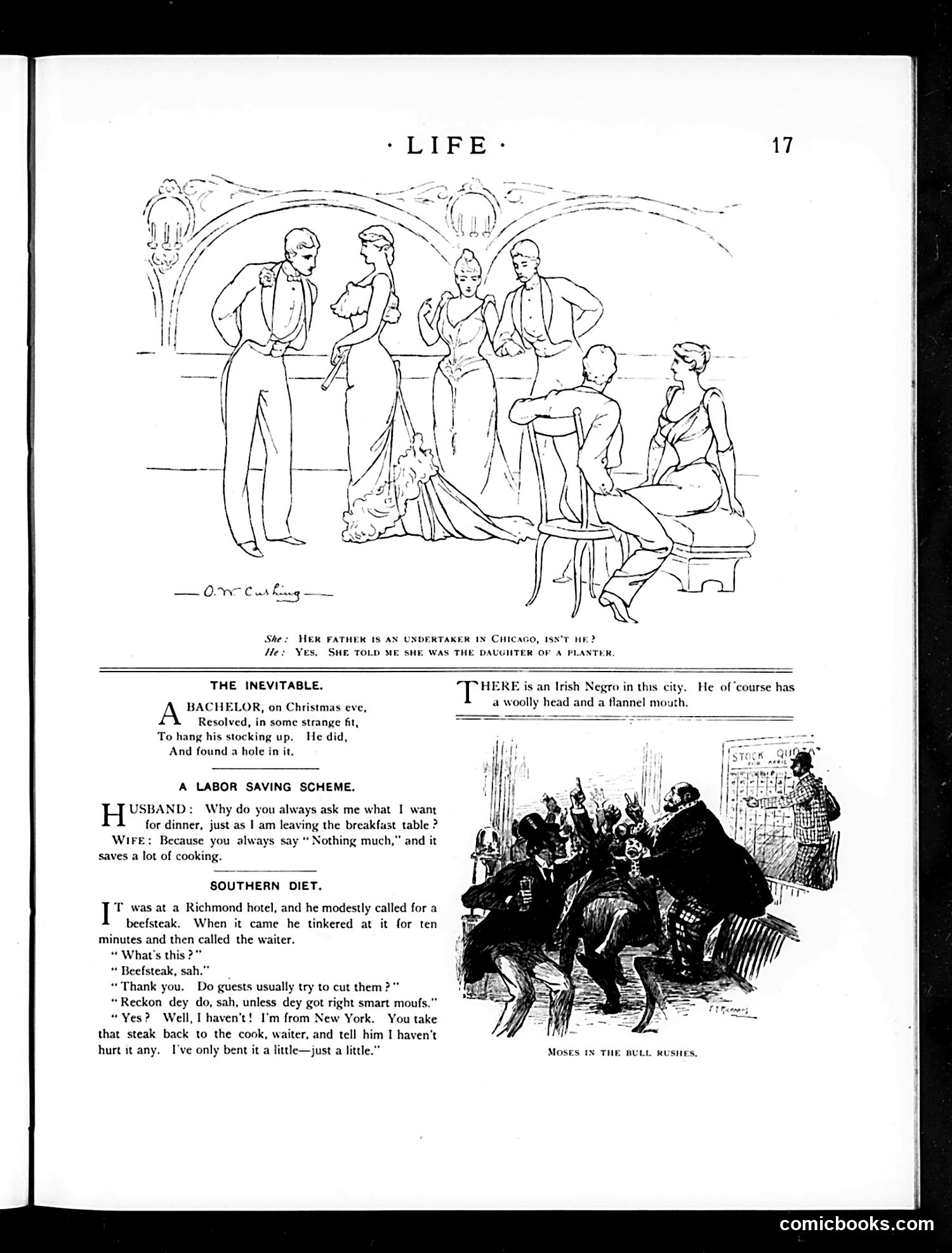
This page contains four separate jokes reflecting early 20th-century American humor and prejudices: 1. **Top cartoon**: A woman claims her father is a "planter" in Chicago, but he's actually an undertaker—a joke about social climbing and deceptive status claims. 2. **"The Inevitable"**: A bachelor discovers a hole in his Christmas stocking—simple wordplay humor. 3. **"Labor Saving Scheme"**: Marital humor where a wife exploits her husband's indifference about dinner to avoid cooking effort. 4. **"Southern Diet"**: Mocks Southern hospitality and food quality through a visitor's complaint that beefsteak is so tough he can only "bend" it rather than cut it. 5. **Irish Negro reference**: A brief, dehumanizing racial stereotype combining ethnic caricatures. 6. **"Moses in the Bull Rushes"**: An illustration with unclear context in this OCR version. The page exemplifies period satire mixing domestic humor with crude racial stereotyping now recognized as offensive.
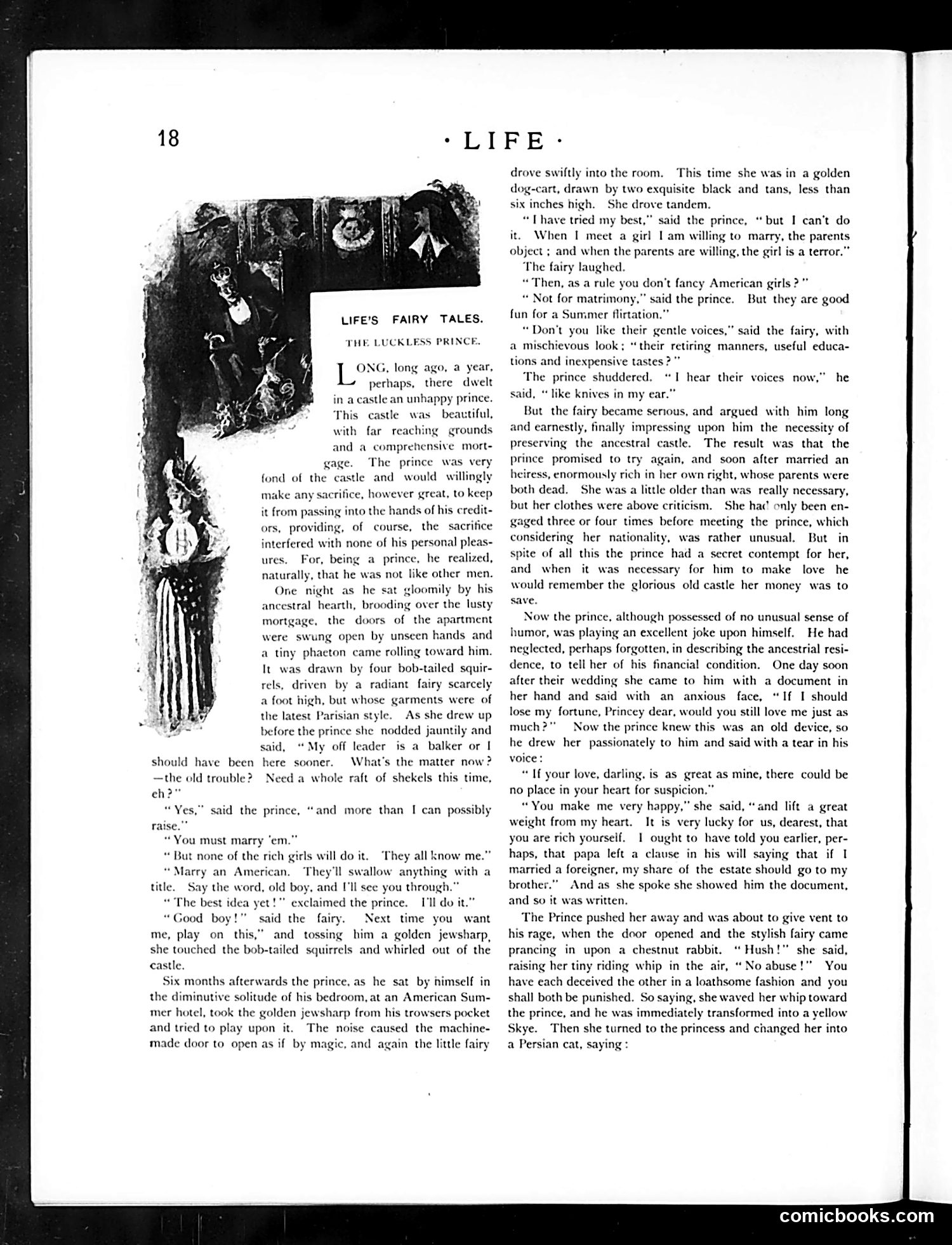
This fairy tale parodies European aristocratic fortune-hunting. A debt-ridden prince needs wealth to save his ancestral castle. A fairy godmother advises him to marry an American heiress, knowing wealthy American women will accept European titles despite the men's unsuitability as husbands. The satire targets two groups: impoverished European nobility who marry for money while despising their wives, and wealthy American women eager to buy social status through titled marriages. The prince marries "an heiress, enormously rich in her own right" who is older and has been engaged multiple times—yet he secretly contempts her while using her fortune to preserve his castle. The joke is that the prince, thinking himself clever, is actually the fool: he's compromised himself entirely while she remains ignorant of his financial desperation. This reflects real Gilded Age anxieties about transatlantic marriages of convenience between cash-poor European nobles and nouveau-riche Americans.
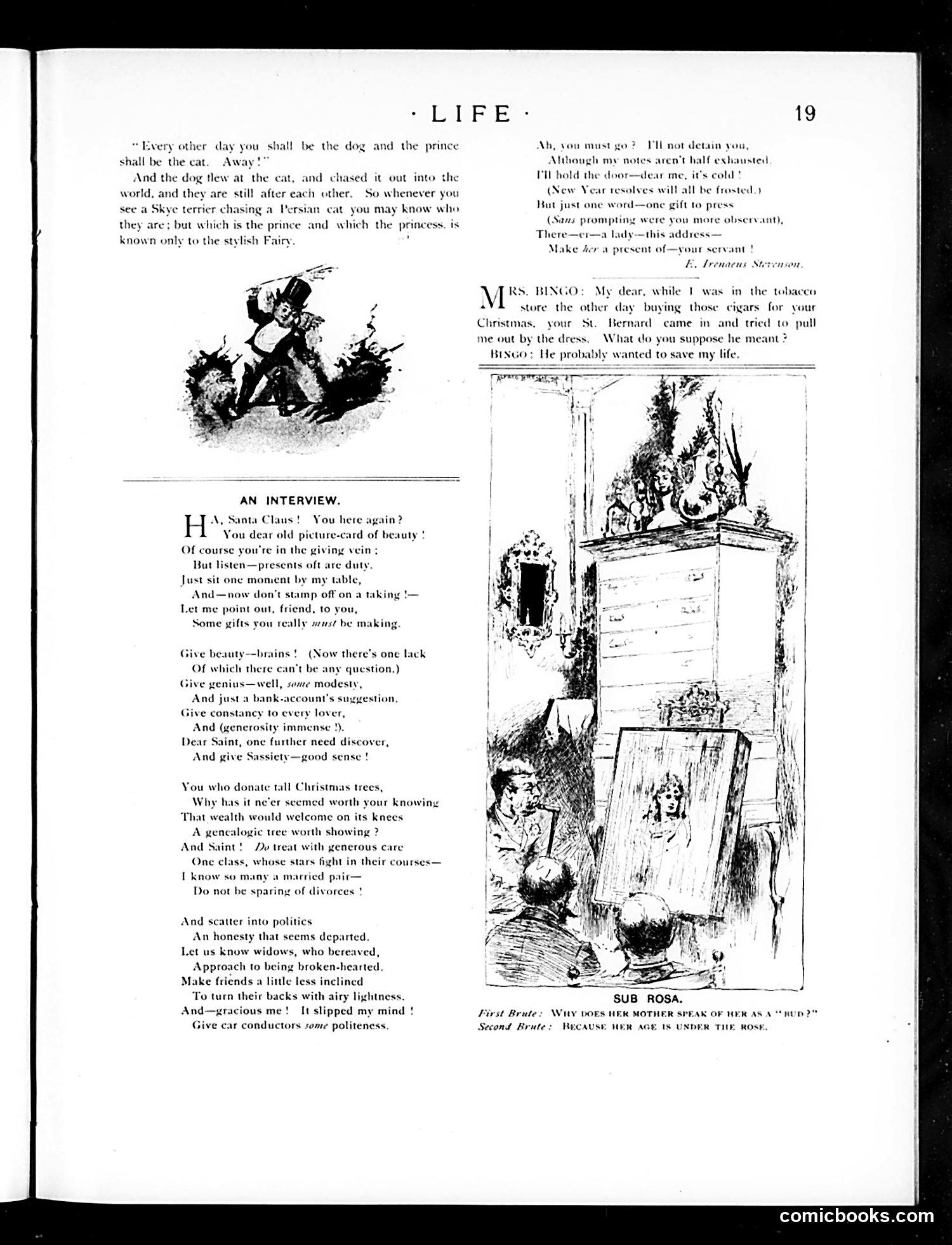
This page contains two satirical pieces typical of early 20th-century American humor magazines: **"An Interview"** (main text): A poem addressing Santa Claus, humorously listing gifts society *actually* needs rather than material goods. The satire critiques social problems: lack of brains among the wealthy, infidelity requiring easier divorces, dishonesty in politics, and rudeness among transit workers. It's social commentary disguised as holiday advice. **"Sub Rosa"** (bottom cartoon): A brief joke about a St. Bernard dog pulling a woman by her dress. The punchline plays on the phrase "under the rose" (meaning secret/hidden)—the dog is literally under her skirt because she's "under the rose" (her age is being hidden/concealed). It's a crude visual pun on the idiom. Both pieces reflect turn-of-the-century concerns: social reform, class commentary, and wordplay humor typical of *Life* magazine's satirical style.
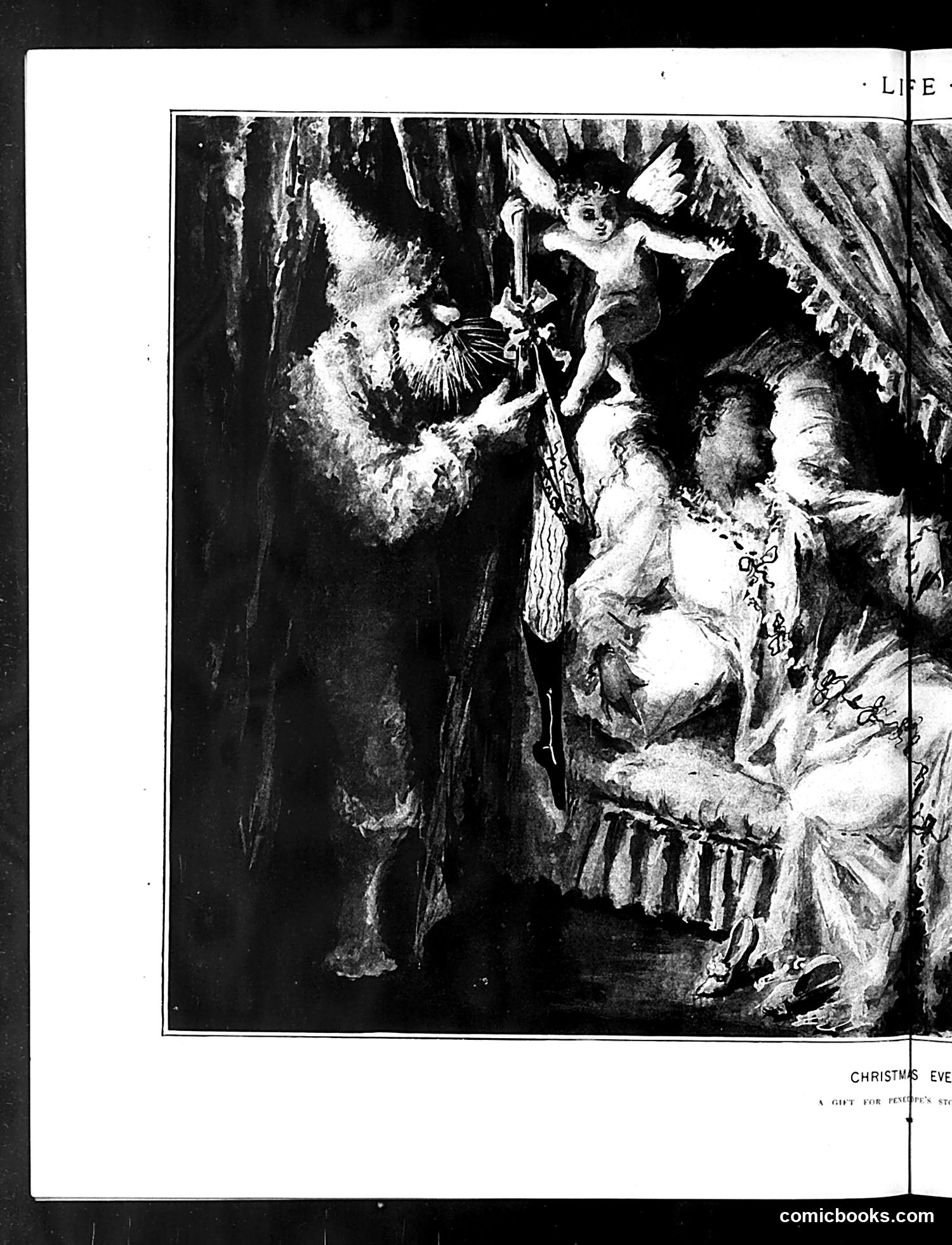
This appears to be a Christmas Eve illustration from *Life* magazine showing a religious or nativity scene. The image depicts figures in period costume gathered around what seems to be a central religious moment, with cherubs or angels visible at the top. The style is dramatic and romantic, rendered in black and white with strong contrasts. The OCR text "A GIFT FOR PENELOPE'S" is partially legible but unclear in context. Without seeing the full caption or article text, the specific satirical point is difficult to determine. This could be social commentary on Christmas commercialism, religious hypocrisy, or contemporary society—common *Life* magazine themes—but the exact target of satire cannot be confidently identified from the image alone.
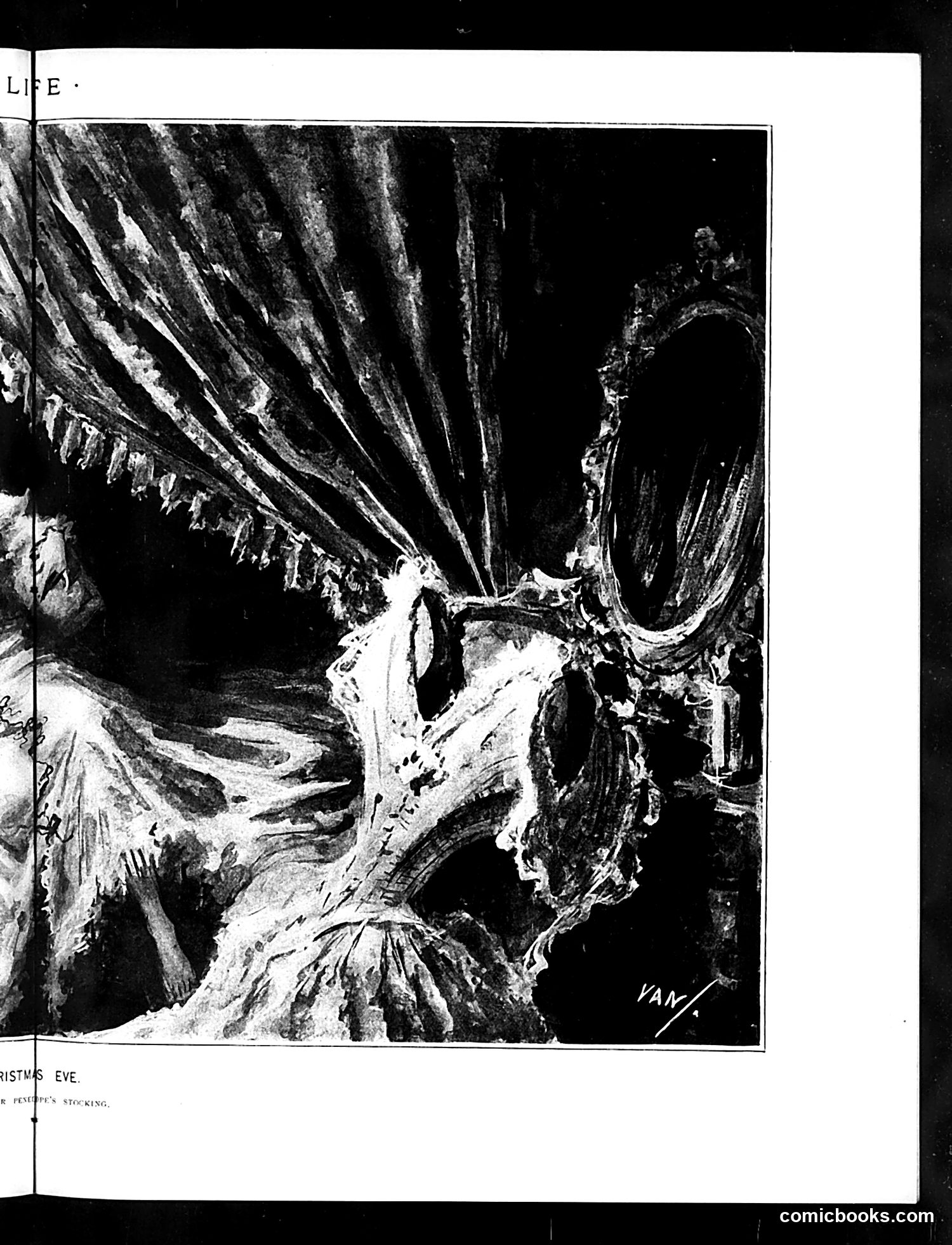
This page from *Life* magazine shows a dark, dramatic illustration titled "CHRISTMAS EVE" (visible at bottom). The OCR text is largely illegible/corrupted, making it difficult to extract caption details. The artwork depicts what appears to be a skeletal or death-like figure amid draped fabric and organic forms, rendered in stark black and white with dramatic expressionistic strokes. The signature reads "VAN" (likely the artist). Without legible caption text, the specific satirical target remains unclear. However, the gothic, macabre treatment of a Christmas Eve subject suggests social commentary—possibly on poverty, mortality, war casualties, or moral decay—rather than festive sentiment. The style and tone indicate darker political or social critique typical of *Life*'s satirical approach.
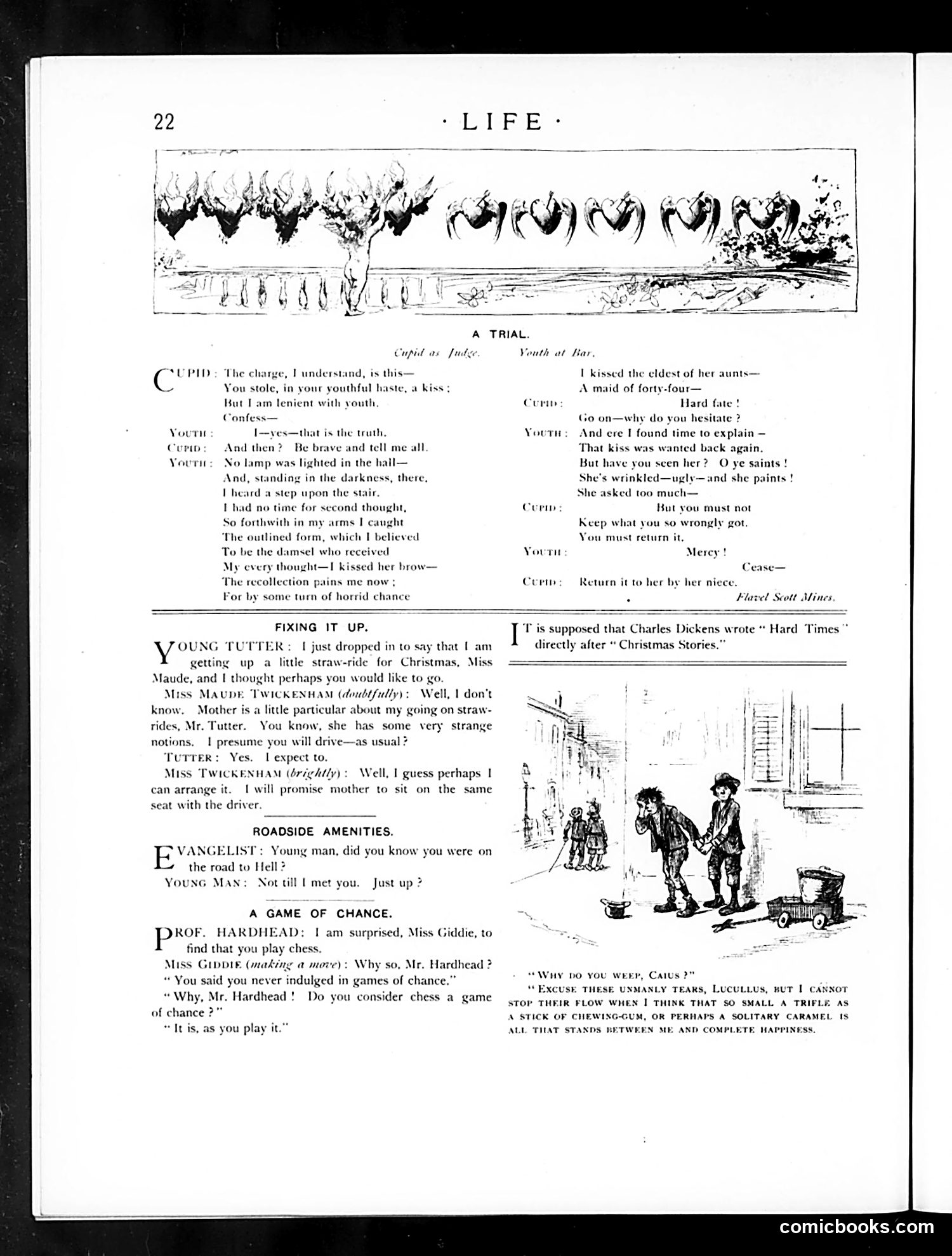
This page contains several short satirical sketches typical of early-20th-century American humor: **"A Trial"** depicts Cupid on trial for stealing a kiss. The joke: in darkness, he kissed the wrong woman—a 44-year-old aunt instead of the young damsel he intended. She's described as "wrinkled—ugly—and she paints" (wears makeup). The court orders him to "return" the kiss via the niece, a play on legal restitution. **"Fixing It Up"** jokes about courtship propriety: a young man asks Miss Twickenham on a straw-ride; her mother disapproves of such outings, so the girl agrees only if she can sit beside the driver (ensuring chaperonage). **"Roadside Amenities"** is a brief joke about an evangelist accosting a young man with warnings about hell. **"A Game of Chance"** plays on Professor Hardhead's hypocrisy: he claims Miss Giddie shouldn't play games of chance, yet considers chess one—implying she plays poorly (unreliably, like gambling). The humor relies on social conventions around courtship, propriety, and logic.
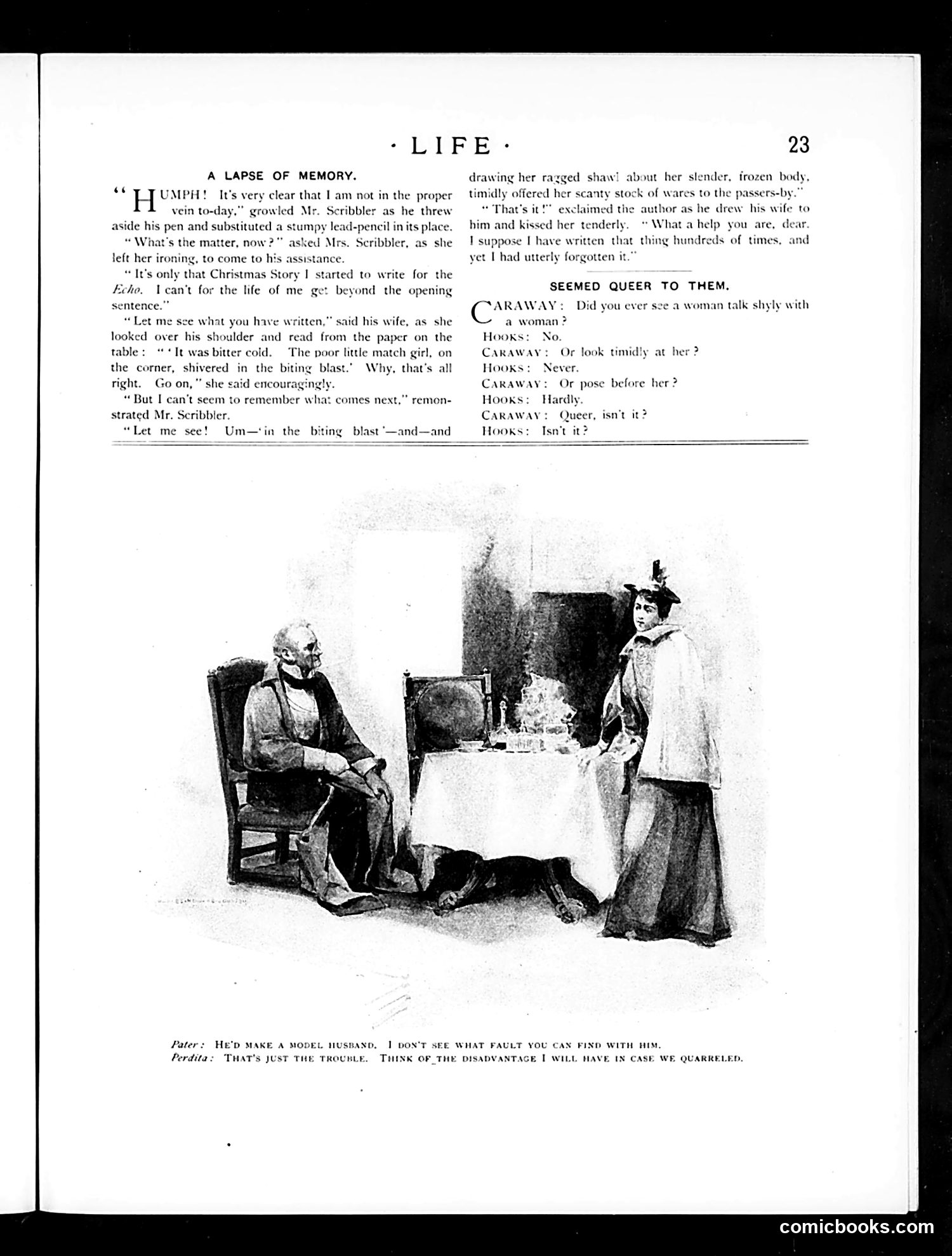
This page contains two separate satirical pieces mocking contemporary writing and courtship conventions. The first cartoon ridicules hack writers. Mr. Scribbler, a struggling author, cannot finish a Christmas story despite having written nearly identical opening lines countless times. His wife, recognizing the clichéd description of a "poor little match girl," completes it by rote—exposing how formulaic and repetitive sentimental Victorian fiction had become. The satire targets both the author's lack of originality and the reading public's appetite for predictable, tearjerking narratives. The second piece, "Seemed Queer to Them," satirizes gender expectations in courtship. Caraway questions whether Hooks has ever witnessed a woman behaving shyly, looking timid, or posing demurely—traditionally "feminine" behaviors. Hooks's negative responses suggest that real women don't perform these expected roles, making their absence "queer" or peculiar to observers accustomed to theatrical gender performance. Both lampoon Victorian-era pretensions and tired conventions.
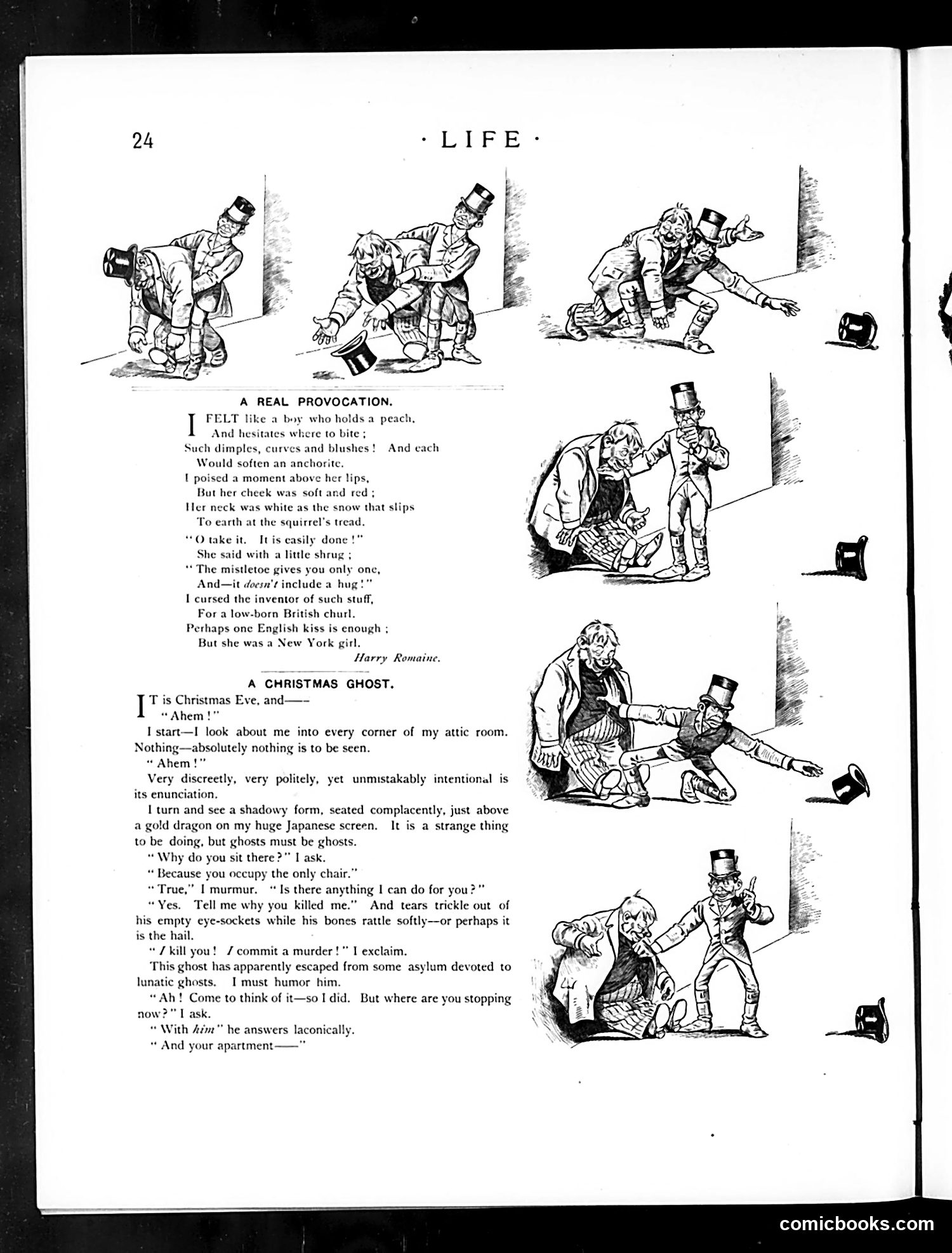
This page contains two satirical pieces from Life magazine. **"A Real Provocation"** is a humorous poem about mistletoe etiquette. A man hesitates to kiss a woman under mistletoe, but she dismisses his concern, noting the tradition grants only one kiss—no hug. He curses the "low-born British churl" who invented the custom, reflecting that an American girl from New York would expect more generous terms than the restrained English tradition allows. The joke plays on transatlantic cultural differences in courtship customs. **"A Christmas Ghost"** is a comedic supernatural story where the narrator encounters a polite but insistent ghost in his attic on Christmas Eve. The ghost, seated on a Japanese screen, cryptically accuses the narrator of killing him. When pressed for details, the ghost answers "with him"—implying the narrator killed the ghost while staying at the narrator's apartment. The humor derives from the ghost's bureaucratic politeness and absurd logic. Both pieces satirize social conventions through exaggeration and wordplay.
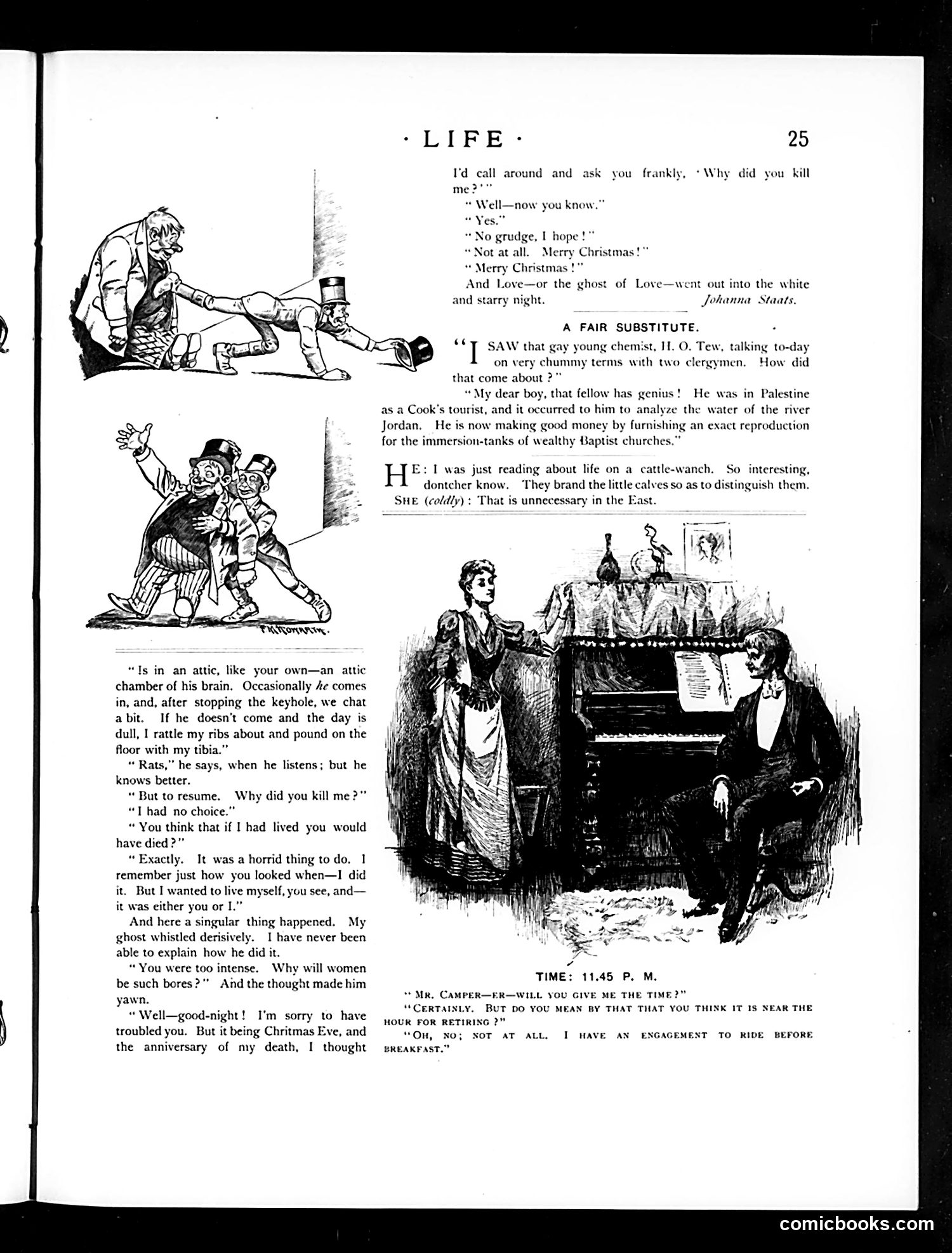
This page contains three separate satirical pieces typical of early 20th-century *Life* magazine humor: 1. **Top cartoon**: Two small figures (appearing to be children or cherubs) with an adult, illustrating a ghost story dialogue. The text depicts a ghost visiting on Christmas Eve to confront someone about their past death—likely satirizing melodramatic ghost stories popular in the era. 2. **"A Fair Substitute"**: Mocks a chemist named I.O. Tew who analyzed Jordan River water, then sells identical reproductions to Baptist churches for baptismal tanks. The satire targets both commercialization of religion and gullible wealthy congregations. 3. **Bottom cartoon**: A domestic scene where a woman asks a man for the time, and he misinterprets her request as a suggestion about bedtime. She clarifies she has an early morning engagement. The joke plays on Victorian-era propriety and the awkwardness of unmarried social interaction. All pieces employ *Life*'s characteristic blend of gentle social mockery targeting contemporary attitudes toward religion, commerce, and gender relations.
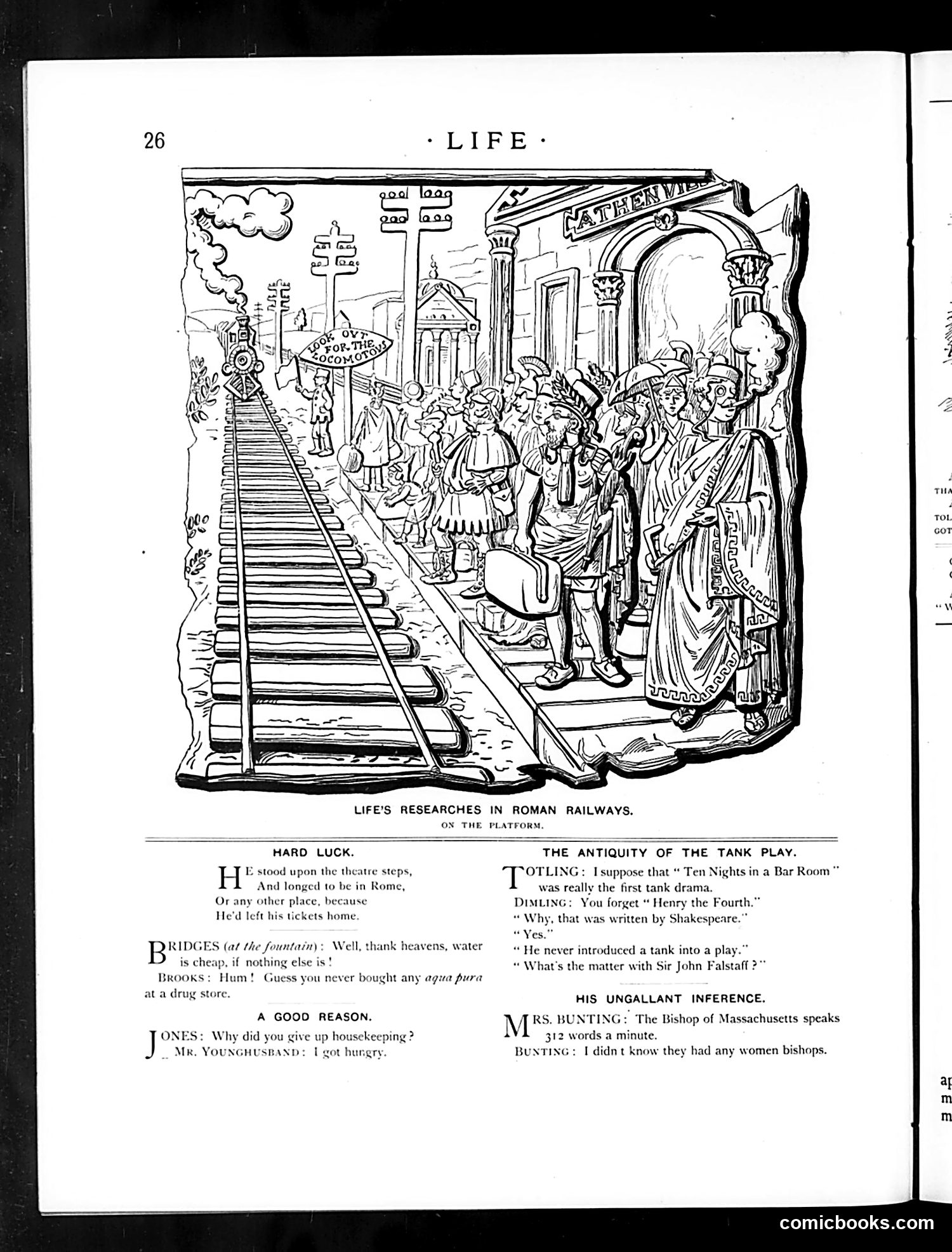
The main illustration depicts "Life's Researches in Roman Railways," a humorous fantasy showing ancient Romans on a railway platform—an anachronistic joke juxtaposing modern technology with antiquity. Below are four separate satirical jokes: 1. **"Hard Luck"**: A man forgot his theater tickets at home—a relatable everyday mishap. 2. **"A Good Reason"**: A man quit housekeeping because he got hungry, implying his wife's cooking was inedible—a common marital joke of the era. 3. **"The Antiquity of the Tank Play"**: Two theater-goers debate whether "Ten Nights in a Bar Room" was the first "tank play" (plays featuring water tanks for special effects). One claims Shakespeare's "Henry the Fourth" predates it because of Sir John Falstaff—a joke about Falstaff's association with taverns and drinking, treating him as metaphorically a "tank" character. 4. **"His Ungallant Inference"**: A man, hearing the Bishop of Massachusetts speaks 312 words per minute, assumes there are no women bishops—implying women talk excessively, a sexist stereotype common to period humor.
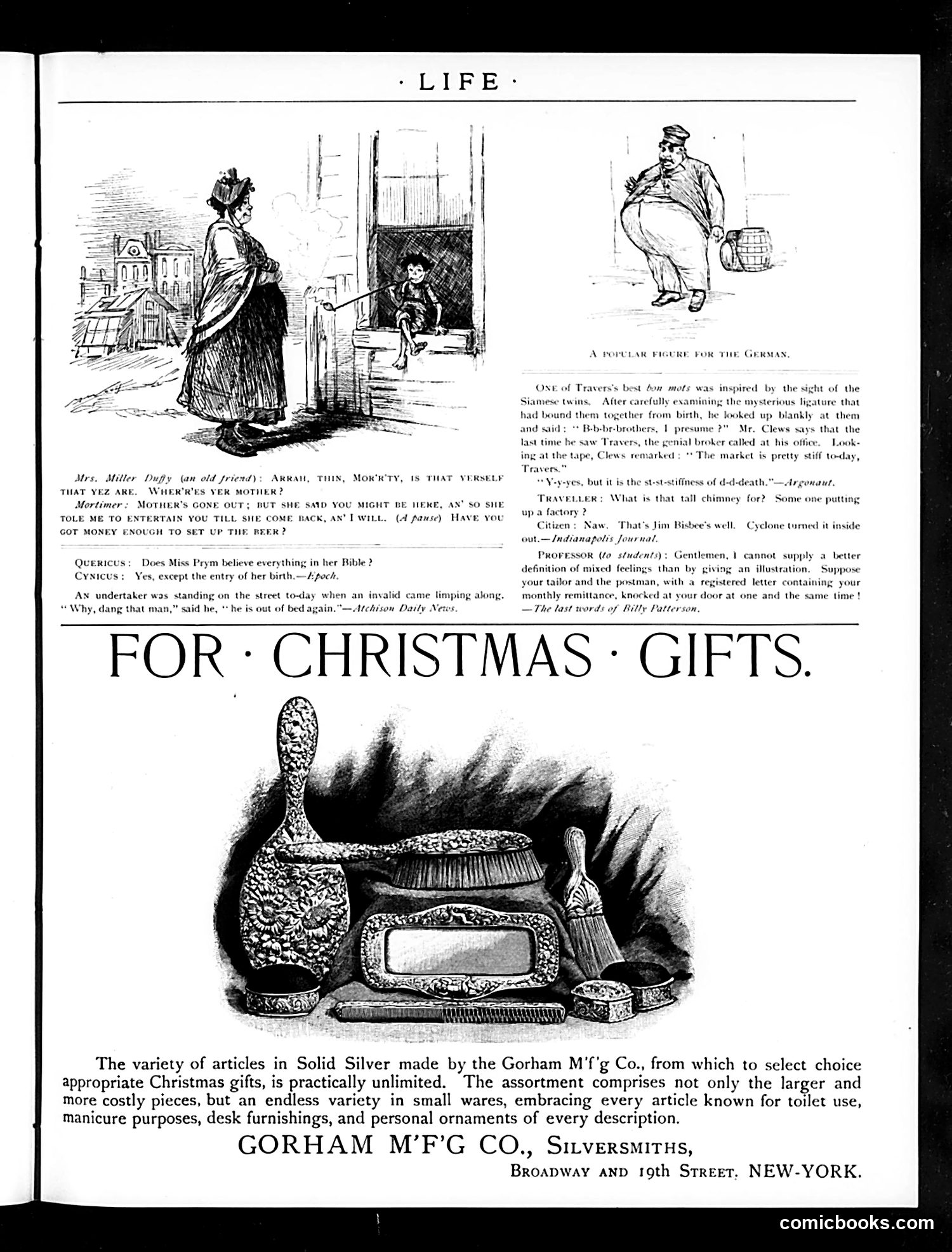
This page from *Life* magazine combines satirical humor with advertising. The top section features several short jokes typical of the era's comic style: **"A Popular Figure for the German"** appears to reference Siamese twins, with a broker named Travers making a dark quip about their physical connection and the stock market being "stiff"—likely wordplay on death. The other jokes involve Irish-American characters and provincial humor: a boy entertaining a guest, a cyclone destroying a well, and a professor's definition of "mixed feelings" (an undertaker, tailor, and postman arriving simultaneously—mixing grief with bills and money). **The lower half is straightforward advertising** for Gorham Manufacturing Company's solid silver goods for Christmas gifts, showcasing ornamental items like brushes and combs. The humor is gentle, pun-based comedy typical of early 1900s American magazines—nothing overtly political, though the Irish dialect humor reflects period attitudes toward immigrant groups.
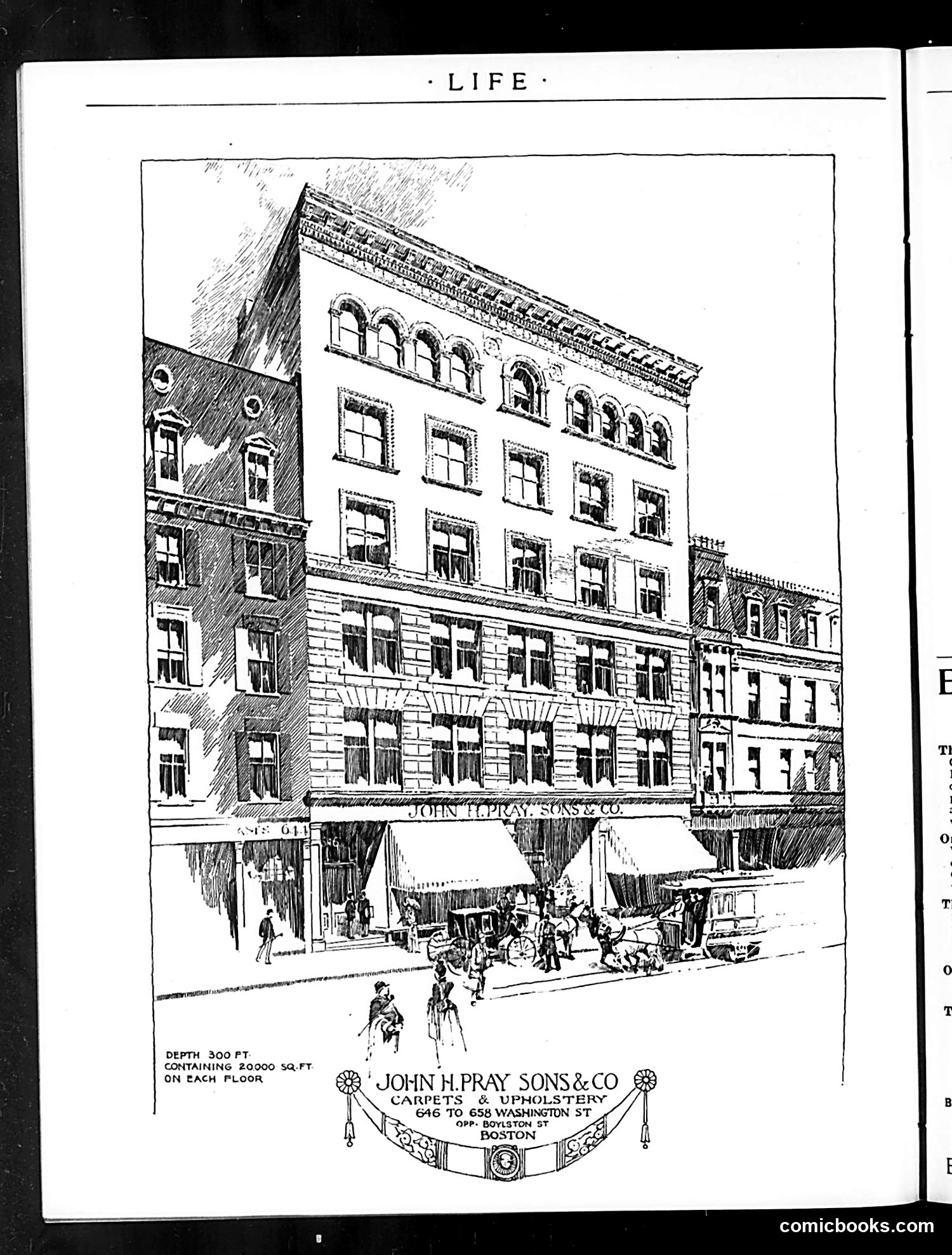
This is not a political cartoon or satirical content—it's **a commercial advertisement** for John H. Pray Sons & Co., a Boston carpet and upholstery business located at 646-658 Washington Street (with offices opposite Boylston Street). The image is an architectural illustration showing a five-story commercial building with street-level storefronts and awnings. The accompanying text emphasizes the business's impressive floor space: 300 feet deep with 20,000 square feet per floor, highlighting the company's substantial retail operation. This appears in *Life* magazine as a paid advertisement showcasing the company's prominent downtown Boston location and scale of operations—typical promotional material for major 19th or early 20th-century retail establishments.
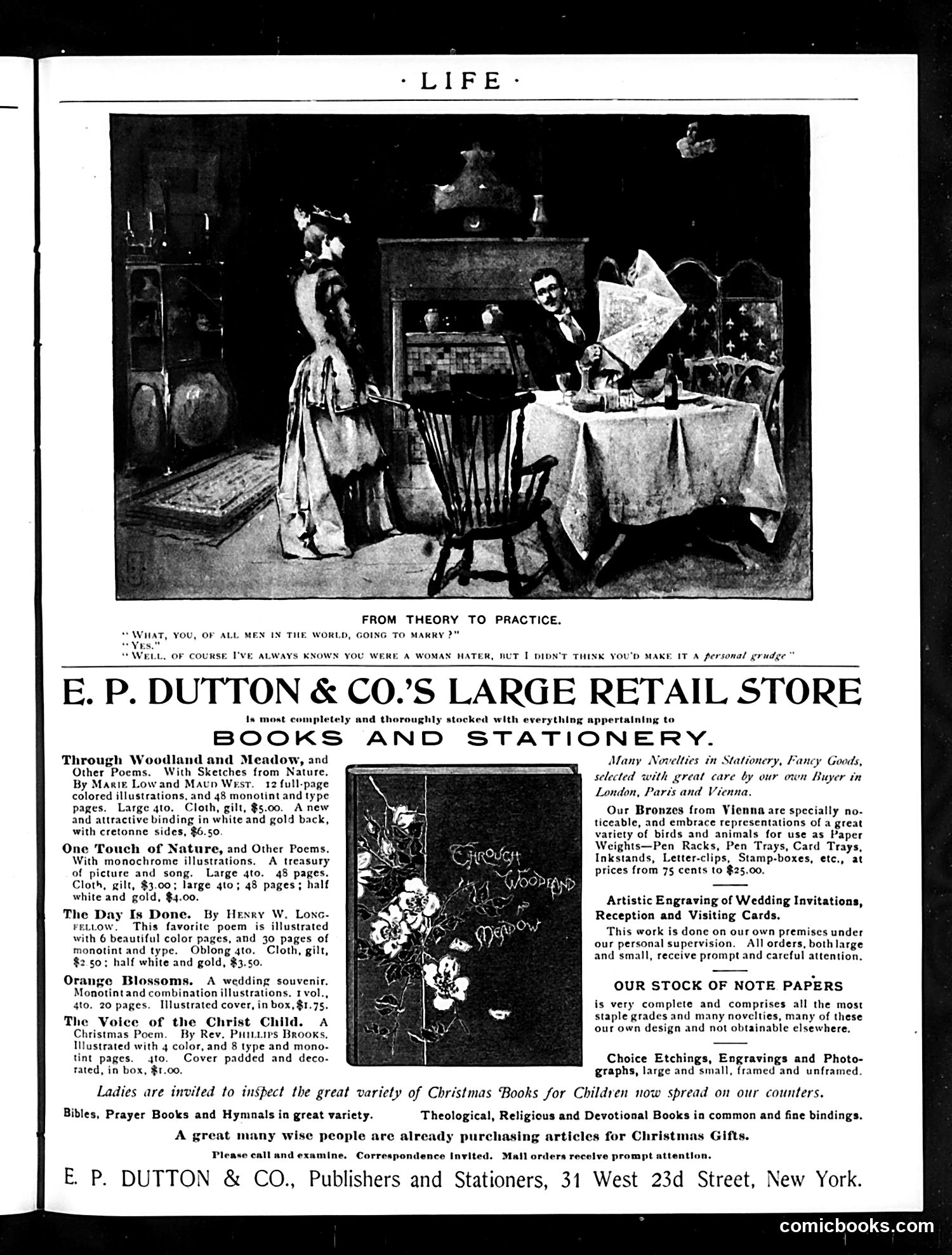
This page is primarily **advertising** for E.P. Dutton & Co.'s bookstore, with a small satirical cartoon at the top. The cartoon depicts a dialogue between two men: one expresses shock that his friend—apparently known as a "woman hater"—is getting married. The friend responds that he didn't expect the woman-hater to make misogyny a "personal grudge" by actually going through with marriage. **The joke**: The satire targets misogynistic bachelor attitudes of the era. A confirmed woman-hater getting married is presented as hypocritical—he's allowing romantic feelings to override his stated ideology. The humor relies on period assumptions about eligible men's attitudes toward women and marriage. The cartoon's caption "From Theory to Practice" emphasizes this gap between stated philosophy and actual behavior. The rest of the page advertises gift books (poetry collections, religious works) and stationery services appropriate for the Christmas season, reflecting late 19th/early 20th-century retail practices.
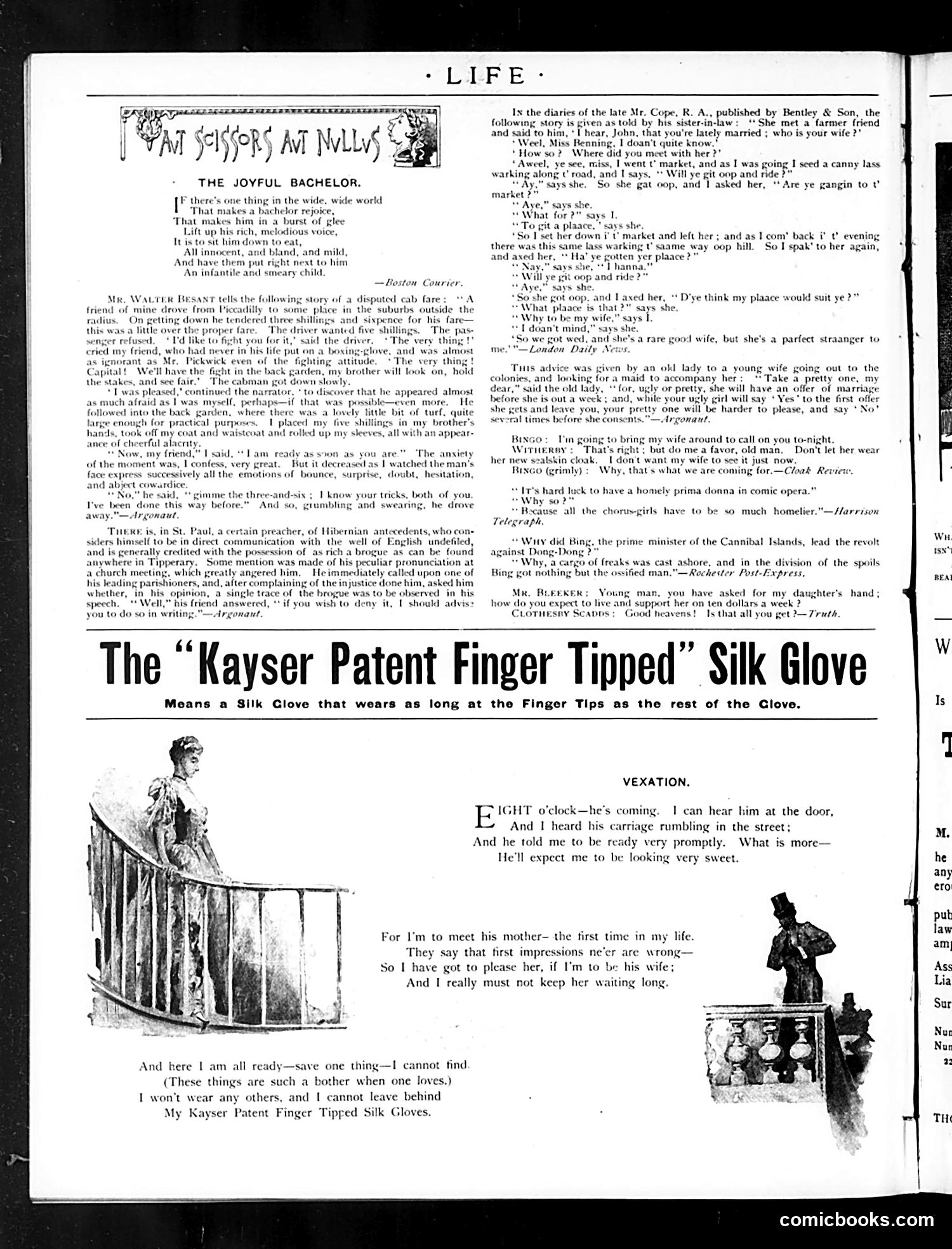
This page contains primarily **literary content and advertisements** rather than political cartoons. The main elements are: **"The Joyful Bachelor"** — A humorous poem celebrating bachelor life, contrasting the bachelor's freedom with domestic entanglement. **Two anecdotal stories** presenting social humor: 1. A tale by Walter Besant about a cab driver dispute that dissolves into cowardice 2. A Scottish dialect story about a farmer who casually picks up a woman on the road and marries her without knowing her **"Vexation"** — A poem about a young woman anxiously preparing to meet her fiancé's mother for the first time, worried about making a good impression. The illustration shows a woman at her toilet (dressing table). **Advertisement**: The "Kayser Patent Finger Tipped Silk Glove" — highlighting a practical innovation where glove fingertips wear as long as the rest of the glove. The page's humor centers on **courtship, marriage, and domestic anxieties** typical of turn-of-the-century bourgeois life, with no overt political satire visible.
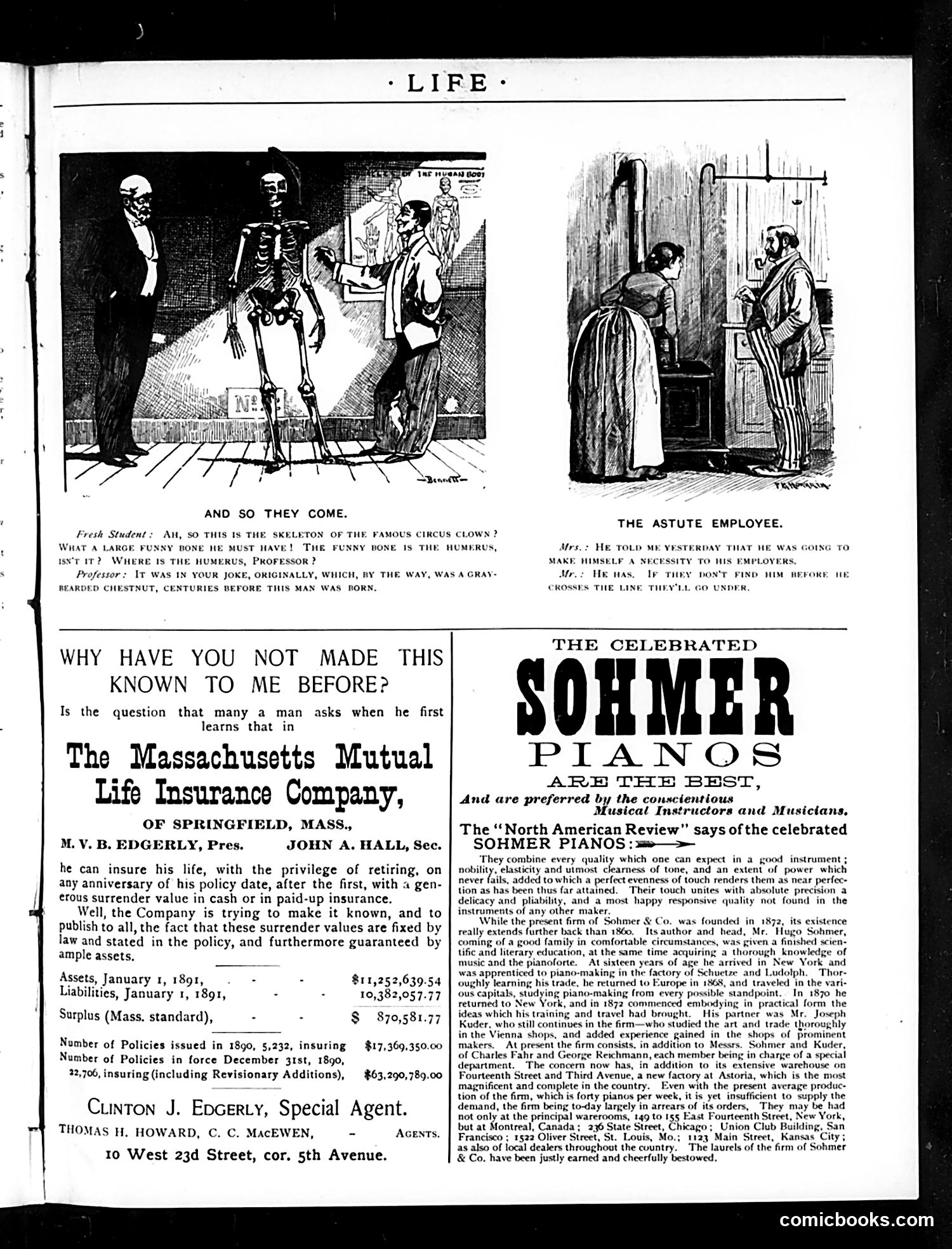
This page contains two unrelated editorial cartoons and advertisements, typical of *Life* magazine's satirical format. **Top cartoons:** Two separate jokes about anatomy. The left cartoon depicts a medical student examining a skeleton, asking about the "funny bone," while a professor pedantically explains the humerus bone's ancient origins—satirizing academic stuffiness. The right cartoon shows an employee informing his boss that a coworker plans to become a necessity to employers (likely a quip about making oneself indispensable), with deadpan bureaucratic humor. **Advertisements:** The page also features ads for the Massachusetts Mutual Life Insurance Company and Sohmer Pianos. These are legitimate business advertisements, not satire—the insurance company emphasizes guaranteed surrender values and financial stability (assets and surplus figures provided), while the piano maker boasts endorsements from musical authorities and biographical details about founder Hugo Sohmer. The cartoons use dry wordplay and visual gags typical of 1890s American humor, while the ads represent contemporary commercial messaging integrated into the satirical magazine.
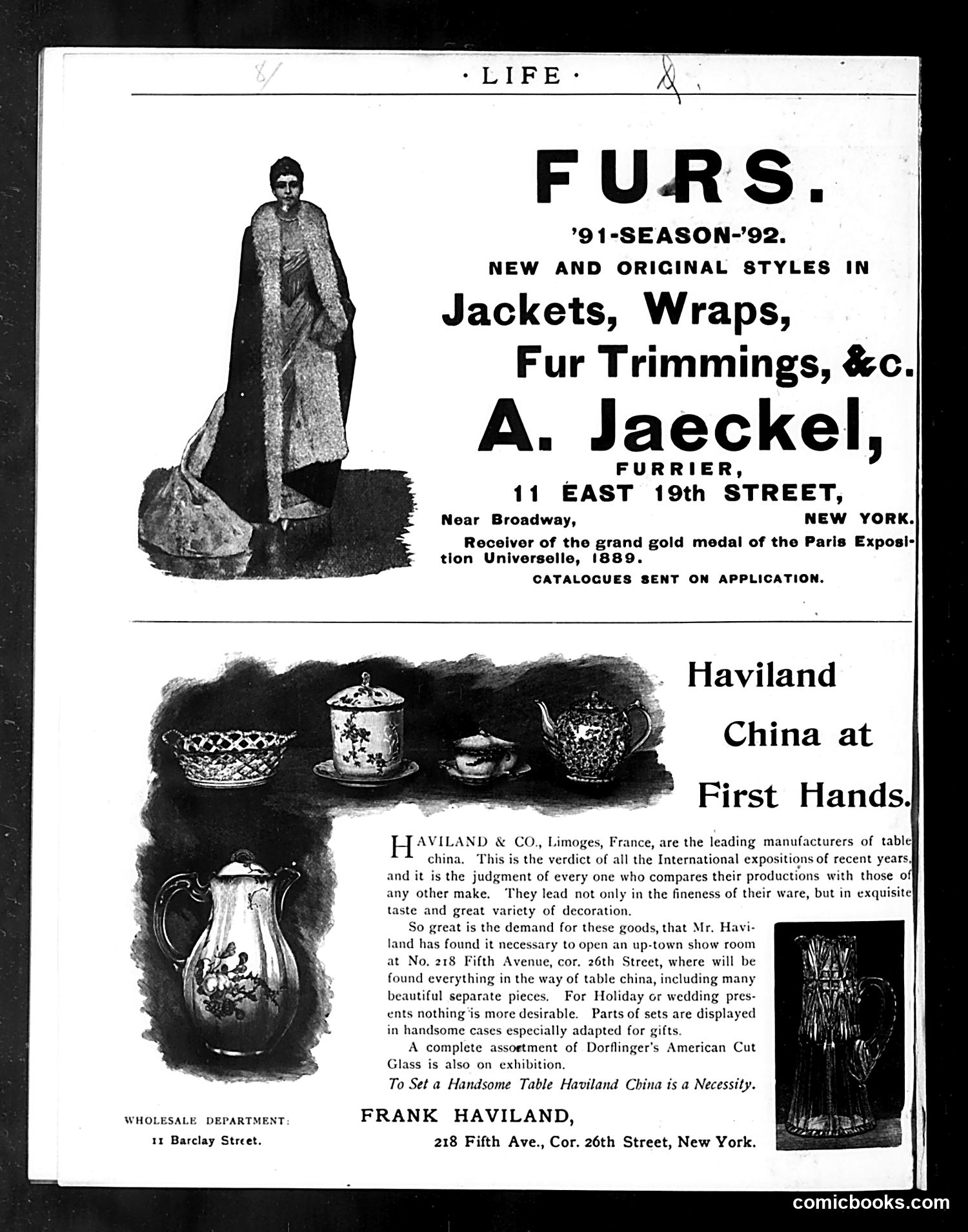
This is **not a cartoon or satirical content**—it's a page of period advertisements from *Life* magazine, circa 1891-92. The page features two luxury goods advertisements: 1. **A. Jaeckel, Furrier** (top): Promotes high-end fur coats and jackets for the 1891-92 season. The illustration shows an elegant woman in an elaborate fur wrap with a long train. Jaeckel advertises his Paris Exposition gold medal (1889) to establish prestige. 2. **Haviland China** (bottom): Promotes fine French porcelain dinnerware and cut glass from Limoges manufacturer Haviland & Co. The illustrations show decorative china pieces. The ad emphasizes quality and necessity for elegant dining and gift-giving. Both ads target wealthy New York customers seeking luxury goods for the holiday season and social occasions. This reflects the *Life* magazine audience of the era: affluent urban readers interested in high-end consumer goods.
I'm unable to provide a meaningful analysis of this page. The image is almost entirely black or severely degraded, making it impossible to discern any cartoon artwork, caricatures, text details, or visual content that would allow me to identify figures, political references, or satirical intent. The only legible element is the "comicbooks.com" watermark at the bottom right, which appears to be a modern addition to the scan rather than original Life magazine content. To analyze this page's historical significance and satirical meaning, I would need a clearer reproduction where the artwork and text are actually visible.