
Life, 1891-12-31 · page 14 of 53
Life — December 31, 1891 — page 14: what you’re looking at
What you’re looking at
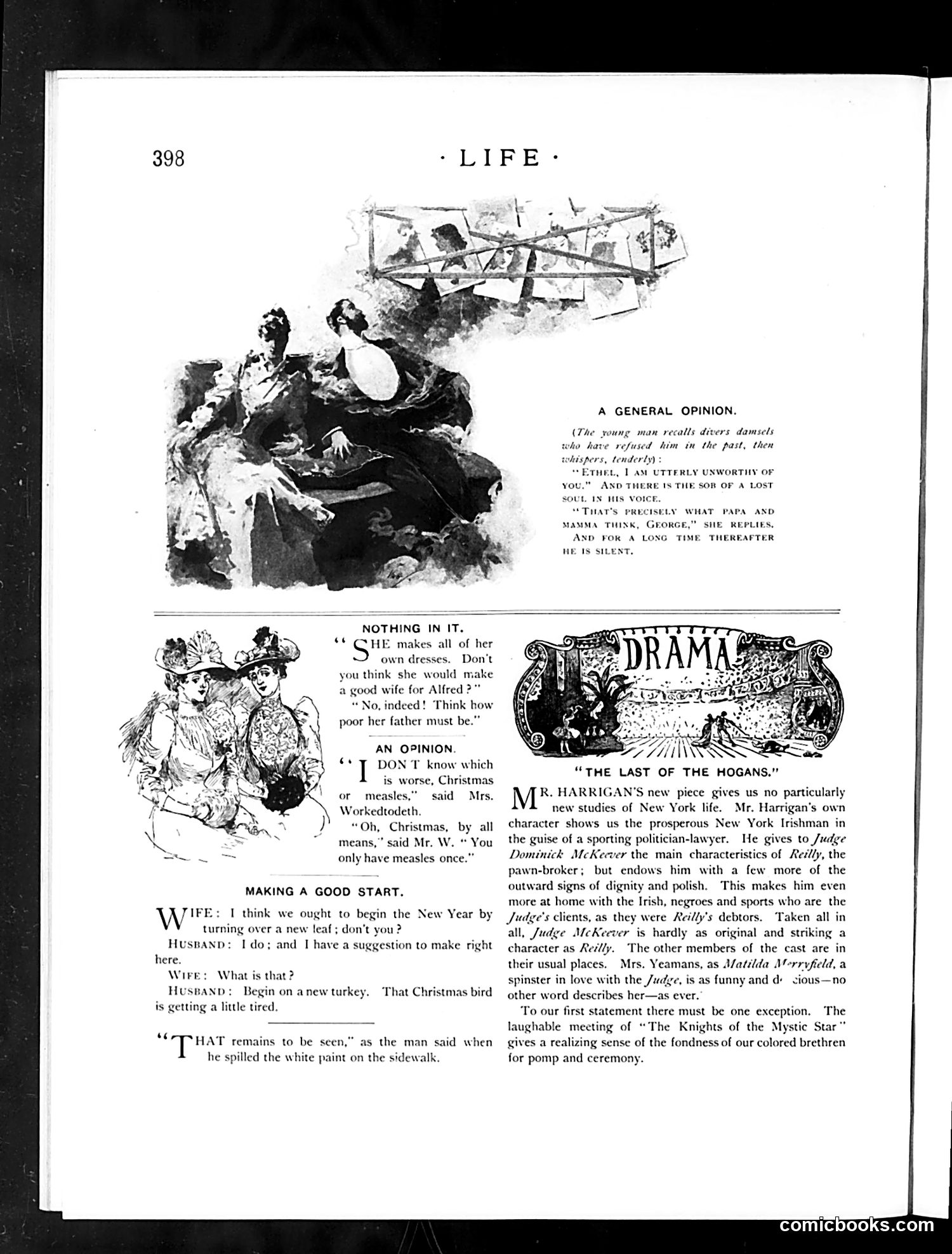
This page contains several brief humorous sketches typical of *Life* magazine's satirical style: **"A General Opinion"** depicts a young man's self-deprecating marriage proposal, rejected because the woman's parents agree he's unworthy—a joke about how parental disapproval can paradoxically confirm a suitor's worst fears. **"Nothing in It"** mocks class assumptions: a woman won't marry off her daughter to a wealthy man because the daughter makes all her own dresses, suggesting the father must be poor—absurd logic satirizing snobbish marriage calculations. **"Making a Good Start"** plays on New Year's resolutions: a husband suggests they "begin on a new turkey" for dinner rather than turning over a moral leaf, joking about choosing comfort over self-improvement. **"The Last of the Hogans"** is a theater review of Edward Harrigan's play about an Irish-American politician-lawyer character. The critic notes it's formulaic, recycling familiar Irish and African-American stereotypes as the protagonist's clients, though calling the lead character less original than Harrigan's earlier "Reilly." The humor relies on domestic situations and period-specific social attitudes.
📄 Transcribed text from this page (OCR, searchable)
Machine-transcribed from the original scan — historical spelling and the odd misread are preserved.
A GENERAL OPINION. (The young man recalls divers damsels refused him in the past, then s, tenderly) : HEL, LAM UTTERLY UNWORTHY OF sho hai shes you," SOUL IN HIS Vorc “THAT'S PRECISELY MAMMA THINK, GEO AND FOK A LONG TIME HE IS SILENT. WHAT PAPA AND ,"” SHE REPLIES, THEREAFTER NOTHING IN IT. = HE makes all of her “a own dresses. Don’t you think she would make a good wife for Alfred ?” “No, indeed! Think how poor her father must be.” AN OPINION. DON T know which is worse, Christmas or measles,” said Mrs. Workedtodeth, “Oh, Christmas, by all means,” said Mr. W. * You only have measles once.’ MAKING A GOOD START. JIFE: I think we ought to begin the New Year by turning over a new leaf; don’t you ? Huspanp: Ido; and I have a suggestion to make right here. Wire: What is that? HUSBAND: Begin on anew turkey. is getting a little tired. That Christmas bird SHAT remains to be seen,” as the man said when he spilled the white paint on the sidewalk. “THE LAST OF THE HOGANS.” R. HARRIGAN’S new piece gives us no particularly new studies of New York life. Mr. Harrigan’s own character shows us the prosperous New York Irishman in the guise of a sporting politician-lawyer. He gives to Judge Dominick McKeever the main characteristics of Retlly, the pawn-broker; but endows him with a few more of the outward signs of dignit d polish. This makes him even more at home with the Irish, negroes and sports who are the Judge's clients, as they were Reilly's debtors. Taken all in all, Judge McKeever is hardly as original and striking a character as Ref//y. The other members of the cast are in their usual places. Mrs. Yeamans, as Matilda Merrvfield, a spinster in love with the Judye, is other word describes her—as evel To our first statement there must be one exception, The laughable meeting of “The Knights of the Mystic Star” gives a realizing sense of the fondness of our colored brethren for pomp and ceremony. as funny and d’ cious—no comicbooks.com