
Life, 1891-12-31 · page 51 of 53
Life — December 31, 1891 — page 51: what you’re looking at
What you’re looking at
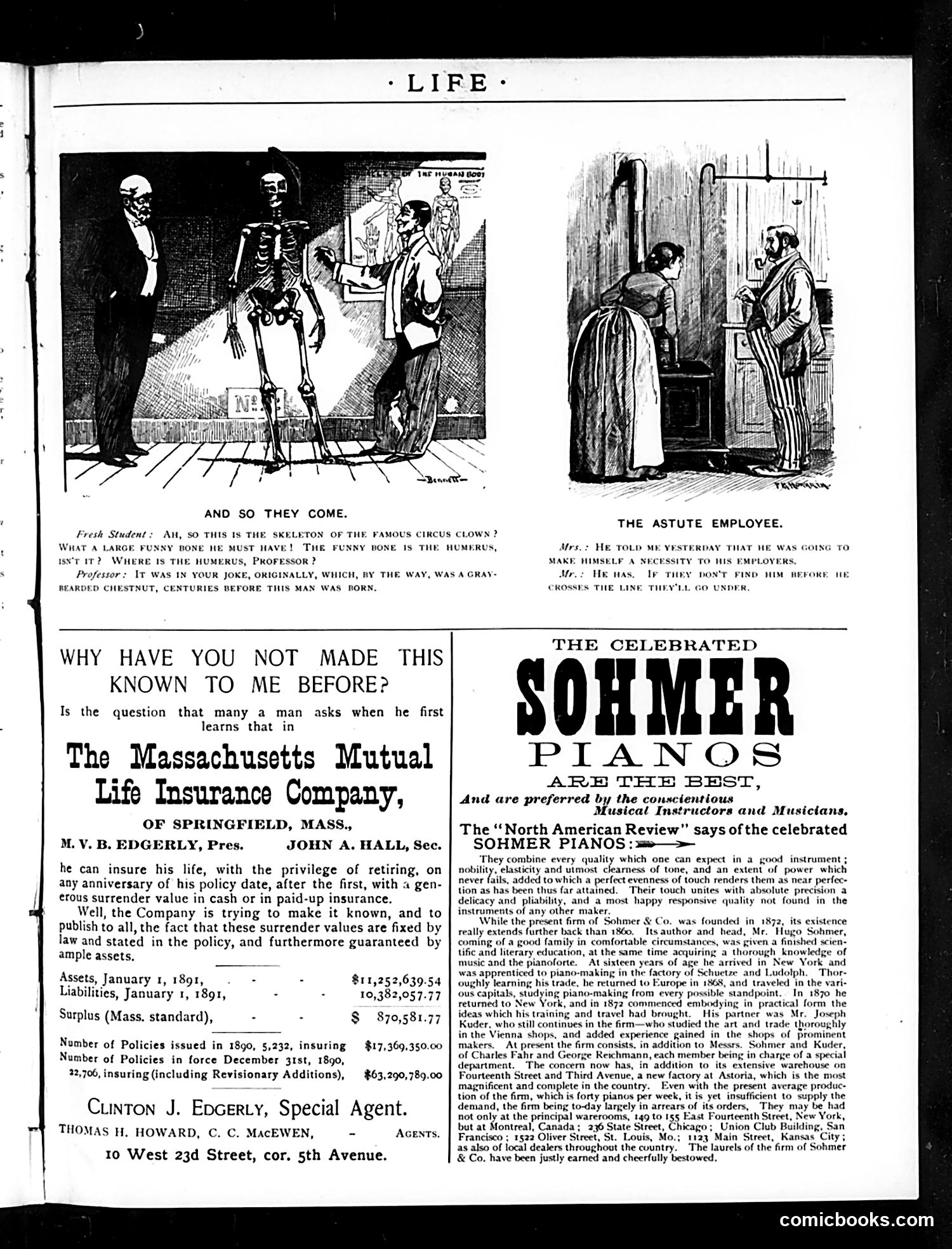
This page contains two unrelated editorial cartoons and advertisements, typical of *Life* magazine's satirical format. **Top cartoons:** Two separate jokes about anatomy. The left cartoon depicts a medical student examining a skeleton, asking about the "funny bone," while a professor pedantically explains the humerus bone's ancient origins—satirizing academic stuffiness. The right cartoon shows an employee informing his boss that a coworker plans to become a necessity to employers (likely a quip about making oneself indispensable), with deadpan bureaucratic humor. **Advertisements:** The page also features ads for the Massachusetts Mutual Life Insurance Company and Sohmer Pianos. These are legitimate business advertisements, not satire—the insurance company emphasizes guaranteed surrender values and financial stability (assets and surplus figures provided), while the piano maker boasts endorsements from musical authorities and biographical details about founder Hugo Sohmer. The cartoons use dry wordplay and visual gags typical of 1890s American humor, while the ads represent contemporary commercial messaging integrated into the satirical magazine.
📄 Transcribed text from this page (OCR, searchable)
Machine-transcribed from the original scan — historical spelling and the odd misread are preserved.
Ree AND SO THEY COME. Fresh Student : WHAT A LARGE isx'r ir?) WHERE Professor : BEARDED CHESTNUT, ¢ y HONE HE MUST HAVE! THE FUNNY BONE IS THE THE HUMERUS, PROFESSOR ? NTURIES BEFORE THIS MAN WAS BORN, If WAS IN YOUR JOKE, ORIGINALLY, WHICH, BY THE WAY, WAS A GRAY: ZEEE ree LE ORES THE ASTUTE EMPLOYEE. AM, SO THIS IS THE SKELETON OF THE FAMOUS CIRCUS CLOWN ? HOMERUS, TOLD ME YESTERDAY THAT HE WAS GOING TO F A NECESSITY TO HUIS He was, Tr THEY DON'T FIND HIM BEFORE 10E CROSSES THE LINE THEY'LL GO UNDER WHY HAVE YOU NOT MADE THIS KNOWN TO ME BEFORE? that many a man asks when he first learns that in The Massachusetts Mutual Life Insurance Company, OF SPRINGFIELD, MASS., M. V. B. EDGERLY, Pres. JOHN A. HALL, Sec. he can insure his life, with the privilege of retiring, on any anniversary of his policy date, after the first, with a gen- erous surrender value in cash or in paid-up insurance. Well, the Company is trying to make it known, and to publish to all, the fact that these surrender values are fixed by law and stated in the policy, and furthermore guaranteed by ample assets, Is the question Assets, January 1, 1891, - Liabilities, January 1, 1891, Surplus (Mass. standard), : “ $ $11,252,639.54 10,382,057-77 870,581.77 Number of Policies issued in 1890, 5,232, insuring Number of Policies in force December gist, 1890, 22,706, insuring (including Revisionary Additions), $17,369,350.00 %63,290,789.00 Cunton J. Epcerty, Special Agent. THOMAS H. HOWARD, C. C. MacEWEN, - 10 West 23d Street, cor. 5th Avenue. AGENTS. THE CELEBRATED PIANOS ARE THE BEST, And are preferred by the conscientious Musical Instructors and Musicians, The “North American Review” says of the celebrated SOHMER PIANOS: »»—> ‘They combine every quality which one can expect in a good instrument; nobility, elasticity and utmost clearness of tone, and an extent of power which never fails, added to which a perfect evenness of touch renders them as near perfec- tion as has been thus far attained. Their touch unites with absolute precision a delicacy and pliability, and a most happy responsive quality not found in the instruments of any other maker, While the present firm of Sohmer & Co. was founded in 1872, its existence really extends further back than 1860, Its author and head, Mr. Hugo Sohmer, coming of a good family in comfortable circumstances, was given a finished scien= tific and literary education, at the same time acquiring a thorough knowledge of music and the pianoforte. ' At sixteen years of age he arrived in New York and was apprenticed to piano-making in the factory of Schuetze and Ludolph. Thor- oughly learning his trade, he returned to Europe in 1868, and traveled in the vari- ous capitals, studying piano-making from every possible standpoint. In 1870 he returned to New York, and in 1872 commenced embodying in practical form the ideas which his training and travel had brought. His partner was Mr. Joseph Kuder, who still continues in the firm—who studied the art and trade thoroughly in the Vienna shops, and added experience gained in the shops of prominent makers. At present the firm consists, in addition to Messrs. Sohmer and Kuder, of Charles Fahr and George Reichmann, each member being in charge of a special department. The concern now has, in’ addition to its extensive warehouse on Fourteenth Street and Third Avenue, a new factory at Astoria, which is the most magnificent and complete in the country. Even with the present average produc- tion of the firm, which is forty pianos per week, it is yet insufficient to supply the demand, the firm being to-day largely in arrears of its orders, They may be had not only at the principal warerooms, 149 to 155 East Fourteenth Street, New York, but at Montreal, Canada; 236 State Street, Chicago; Union Club Building, Francisco ; 1522 Oliver Street, St. Louis, Mo.; 1123’ Main Street, Kansas City; as also of jocal dealers throughout the country. ‘The laurels of the firm of Sohmer & Co, have been justly earned and cheerfully bestowed. comicbooks.com