
A complete issue · 55 pages · 1889
Life — December 26, 1889
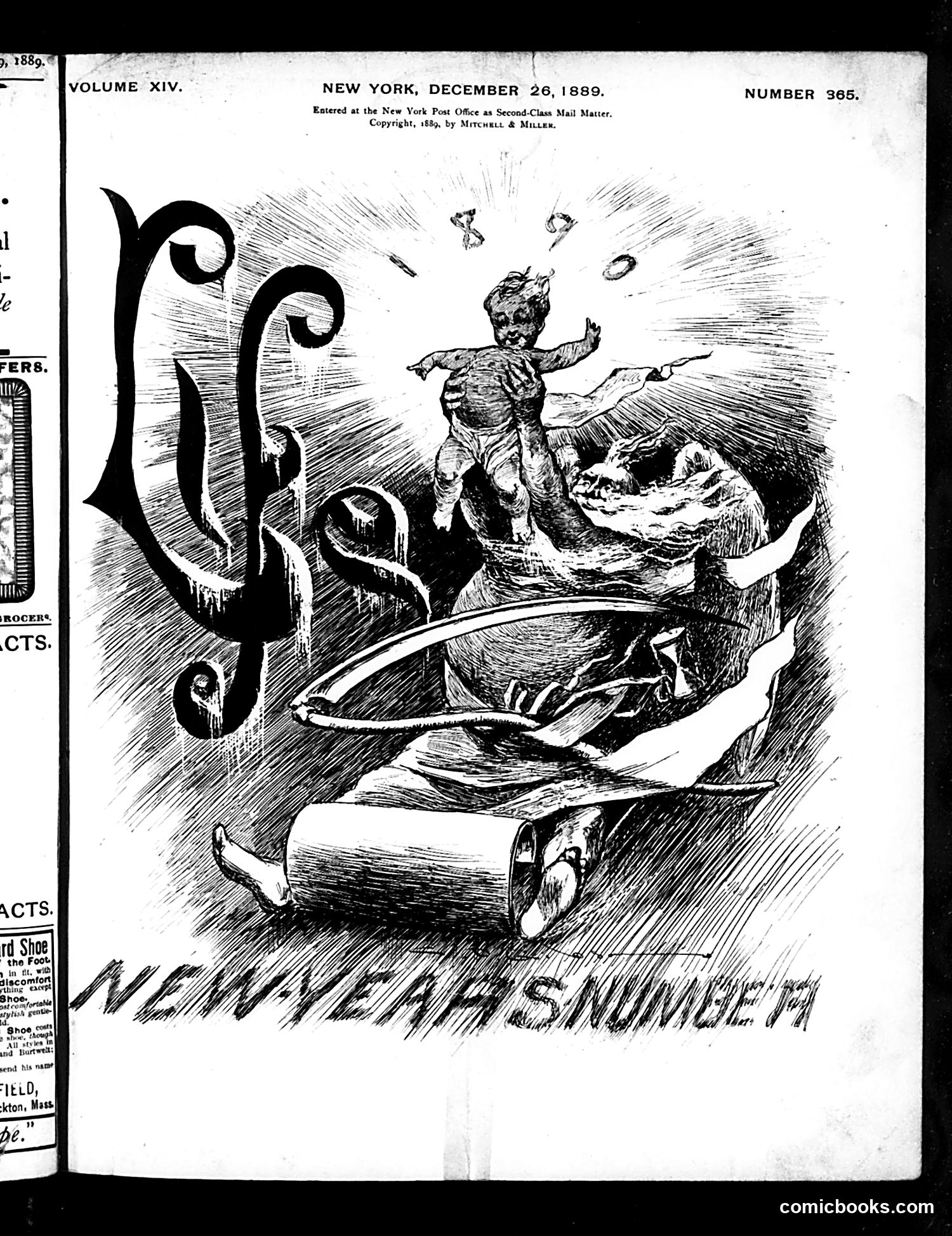
This satirical cartoon depicts a cherub or cupid figure juggling what appears to be romantic entanglements or love interests, with decorative swirls and multiple small figures scattered above. The title reads "WINTER SONG[?]" (text partially unclear). The image likely satirizes romantic complications or infidelity during the holiday season—a common theme in 19th-century satirical magazines. The cherub's juggling act suggests someone managing multiple romantic relationships simultaneously, a subject ripe for social mockery in the Victorian era. Without clearer text identifying specific individuals or events, I cannot definitively identify particular figures or contemporary references. The general theme appears to be romantic entanglement and social scandal, typical satirical fodder for Life magazine's upper-class readership.
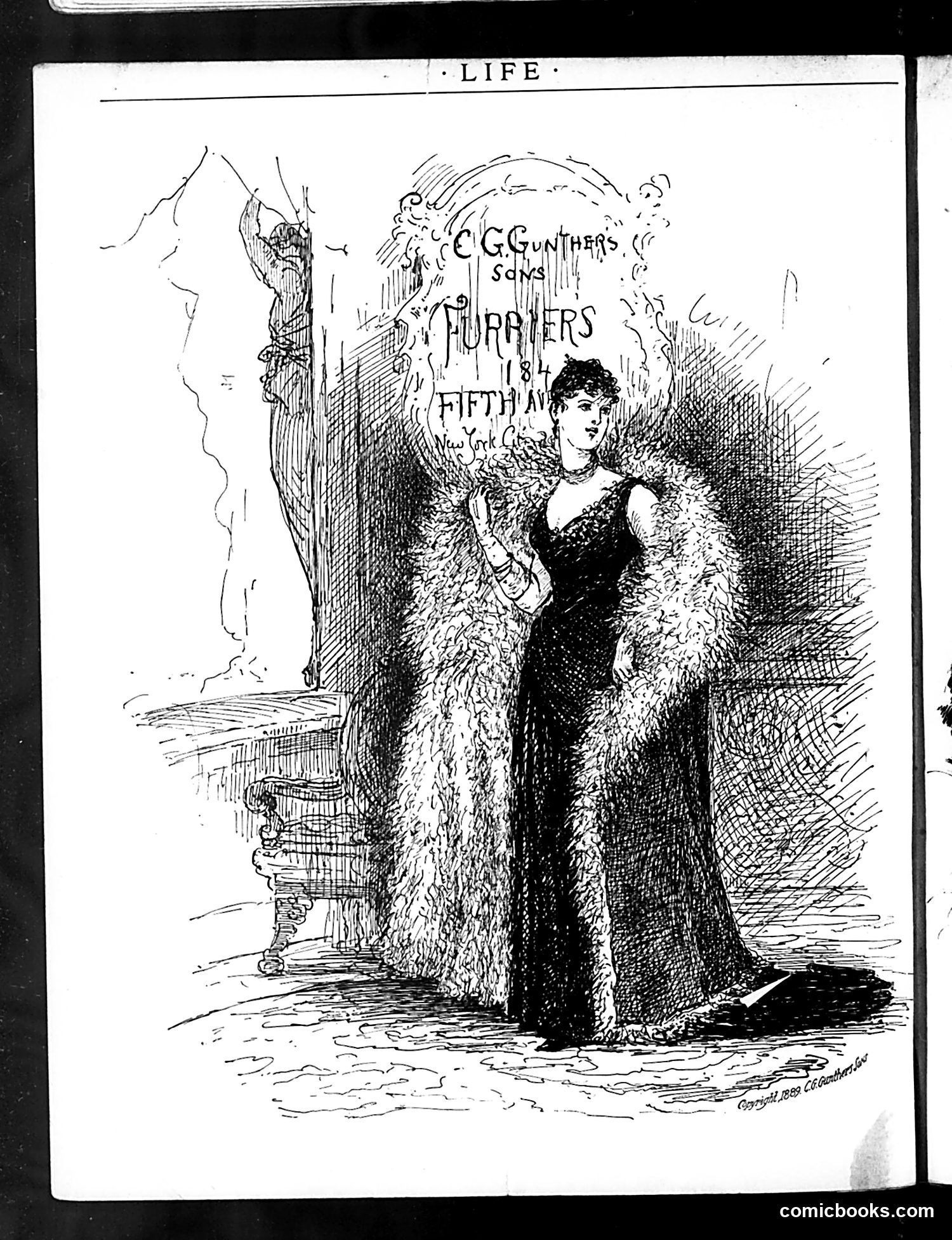
This appears to be a cover or advertisement for **C.G. Gunther's Sons Furriers** located at **Fifth Avenue** in New York. The illustration depicts an elegantly dressed woman wearing an elaborate fur coat or wrap, standing in what appears to be an upscale interior setting with classical architectural elements. The satire likely mocks the **conspicuous consumption and luxury fashion** of wealthy society women during the Gilded Age era. The ornate fur garment and refined pose satirize the pretensions of the wealthy class who flaunted expensive imported furs as status symbols. Life magazine frequently criticized such extravagance and the disconnect between the wealthy elite and ordinary Americans, using satirical illustrations like this to expose social inequality and frivolous spending habits among the rich.
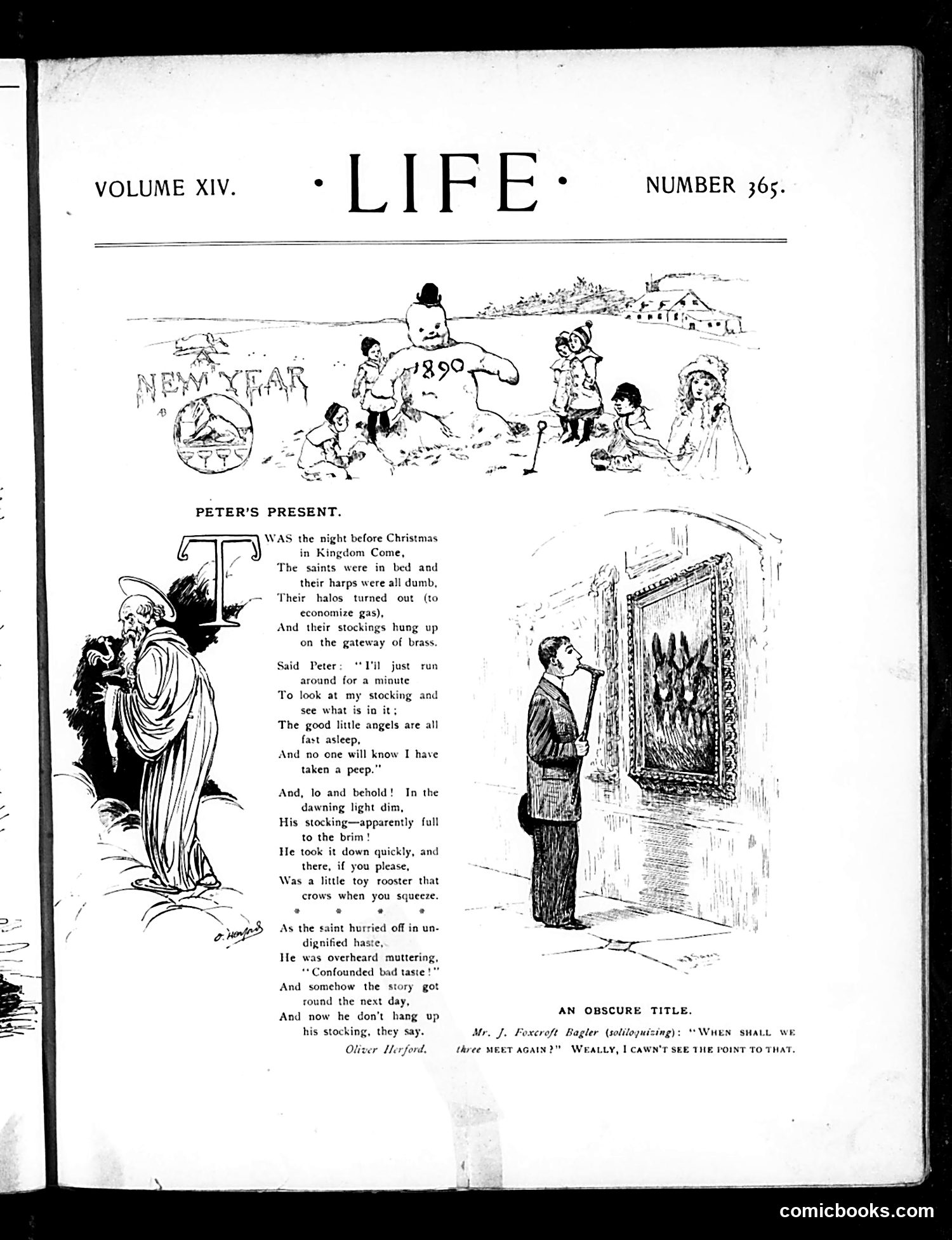
**"Peter's Present"** is a humorous Christmas poem by Oliver Herford about a mischievous child who sneaks downstairs on Christmas Eve to peek at his stocking. The joke centers on Peter discovering a toy rooster in his stocking—which he promptly squeezes, causing it to crow loudly and wake the household, betraying his midnight adventure. The moral: his curiosity and mischief backfired. The top illustration depicts a snowy New Year scene with children and a large snowman marked "1890," celebrating the new decade. **"An Obscure Title"** is a brief joke about a man viewing a painting, with wordplay about unclear meanings and meeting again—the humor appears to rely on double meanings now lost to time. These are light, family-friendly pieces typical of LIFE's satirical but wholesome content.
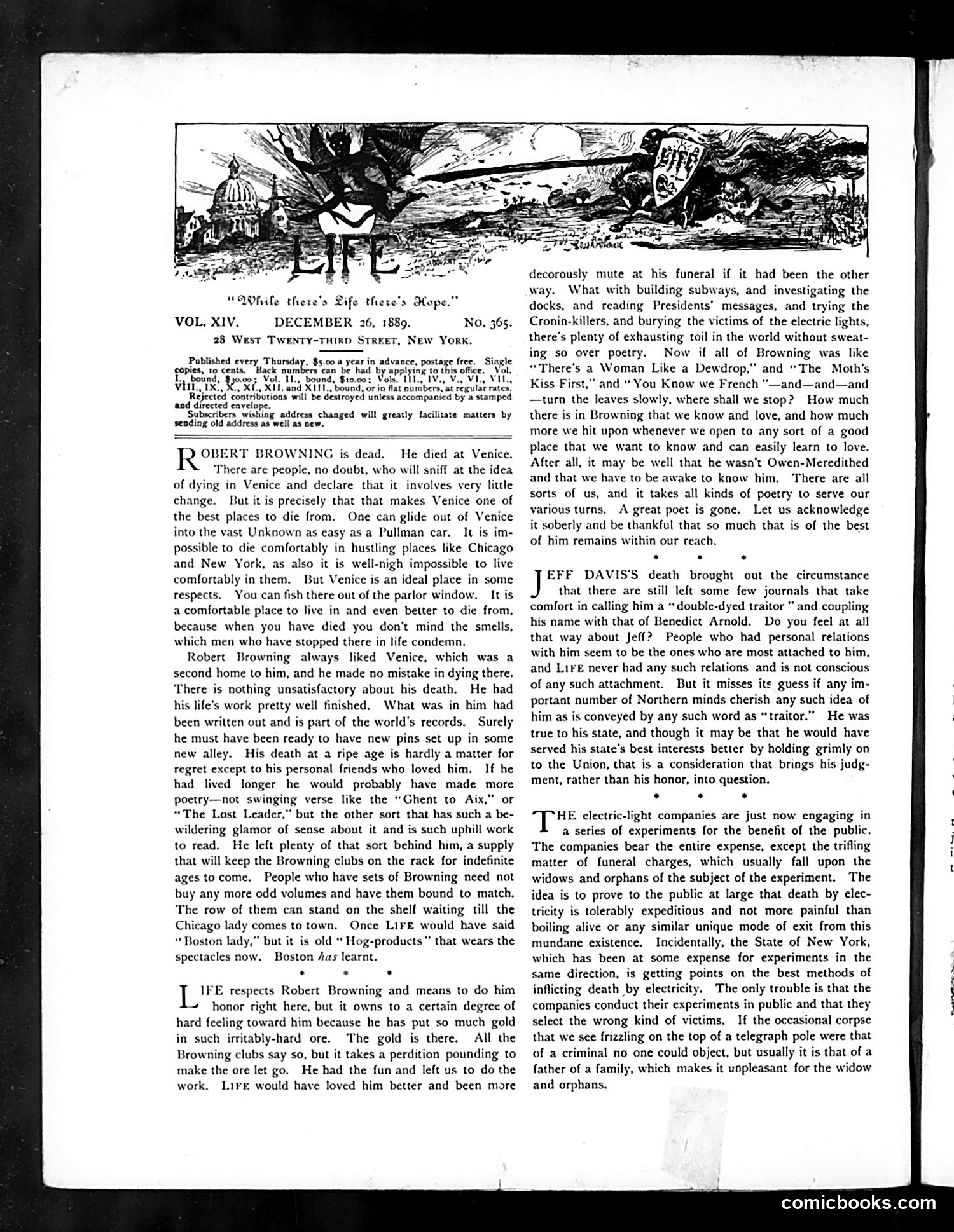
The page contains editorial commentary rather than political cartoons. The masthead cartoon depicts a classical landscape with a tree and buildings—decorative rather than satirical. The main text discusses **Robert Browning's death** in Venice, arguing that while Venice is poetically romantic, it's actually an uncomfortable, smelly place to live. The editors mock the romantic notion of dying there, suggesting Browning would have preferred more practical circumstances. The piece also comments on **Jeff Davis's death**, noting that some journals coupled his name with Benedict Arnold's—a harsh comparison treating Davis as a traitor to the Union. A final section satirizes **electric-light companies' experiments with electrocution as capital punishment**, criticizing the public experiments as unnecessarily cruel spectacles that traumatize families of executed criminals.
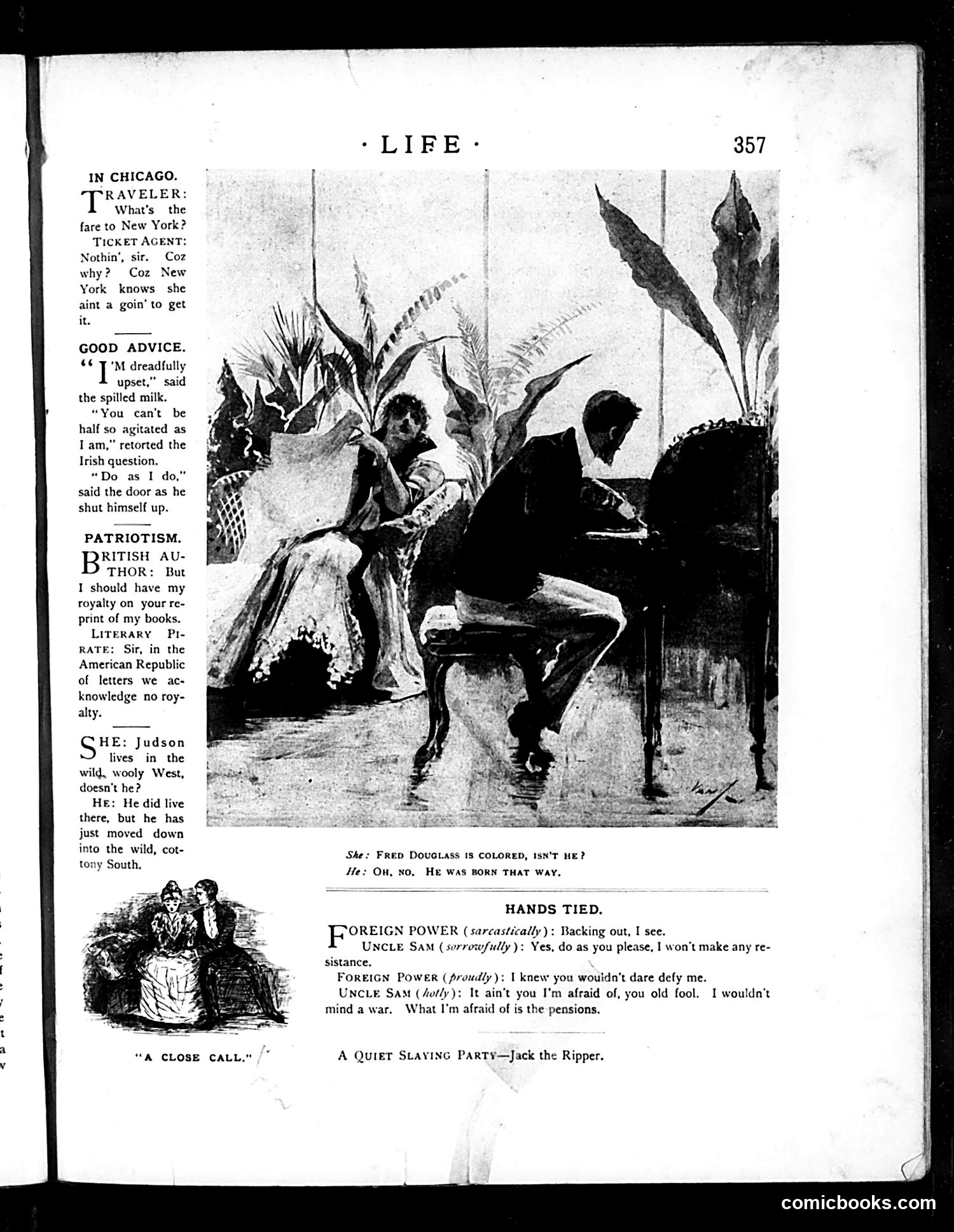
The main cartoon depicts a conversation about racial identity. The caption reads: "She: Fred Douglass is colored, isn't he? / He: Oh, no. He was born that way." This is a racial joke playing on the term "colored" — a common 1800s-era descriptor for African Americans. The humor relies on deliberately misinterpreting "colored" as a choice or acquired characteristic rather than an inherent identity, with the response suggesting Douglass was "born that way" (implying it's natural/immutable). The surrounding text includes unrelated brief jokes about Chicago fares, spillled milk, and British patriotism. The small illustration labeled "A Close Call" appears unrelated to the main content. This page reflects period attitudes toward race through what would be considered offensive racial humor by modern standards.
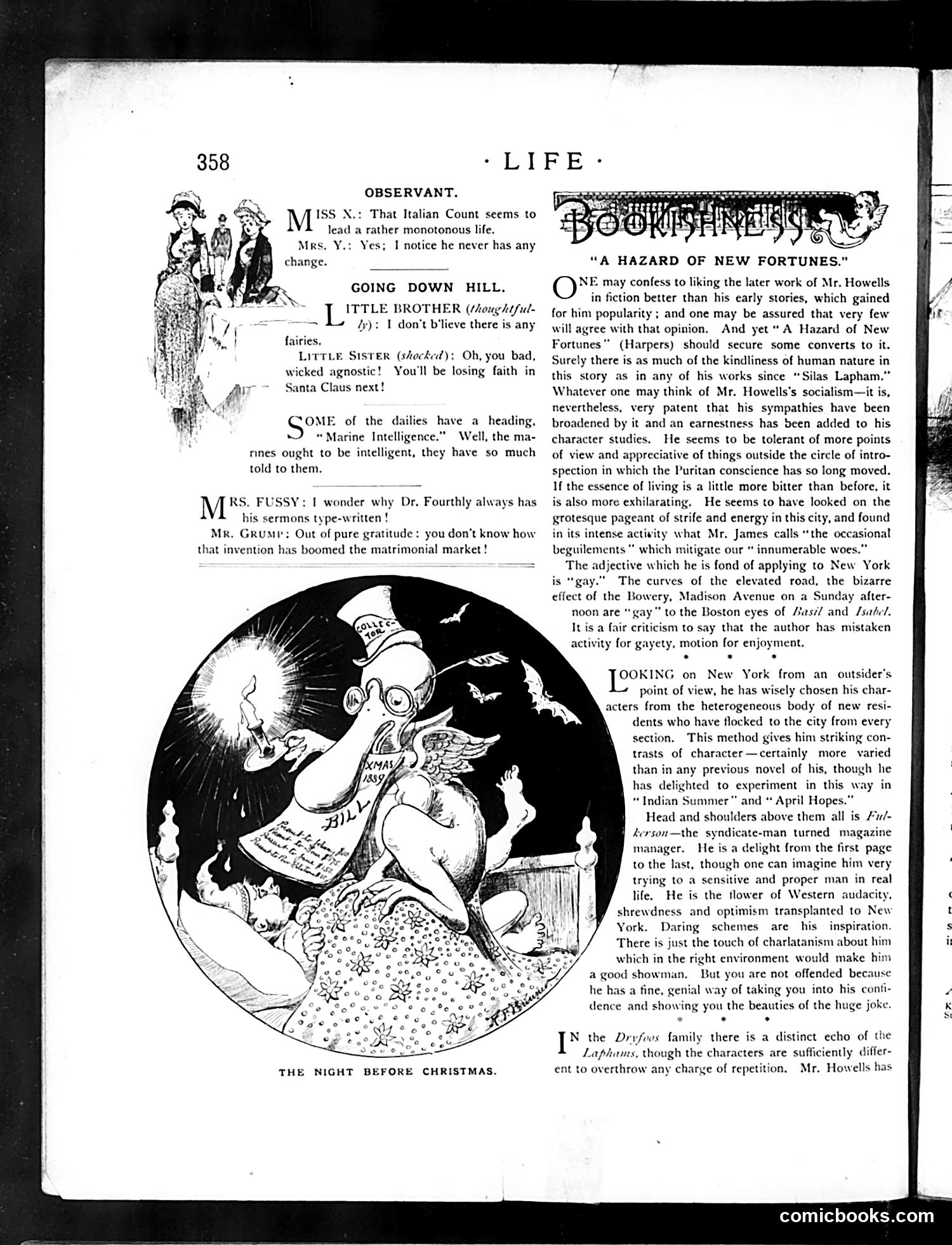
This page contains a book review of H.G. Wells's "A Hazard of New Fortunes" alongside a satirical cartoon titled "The Night Before Christmas." **The Cartoon:** The circular illustration depicts a chaotic Christmas Eve scene with exaggerated figures. It appears to satirize commercialism and excess around the holiday—showing what looks like Santa Claus surrounded by money, gifts, and revelry in a somewhat grotesque manner. The style suggests commentary on how Christmas has become materialistic rather than spiritual. **The Review:** Praises Wells's novel for its varied character studies and sympathetic treatment of New York's diverse population. The critic notes Wells uses "gay" (meaning cheerful) descriptions of the city and praises his character "Fulkerson" as representing Western optimism transplanted to New York. The page reflects early 1900s literary culture and satirical commentary on American commercialism.
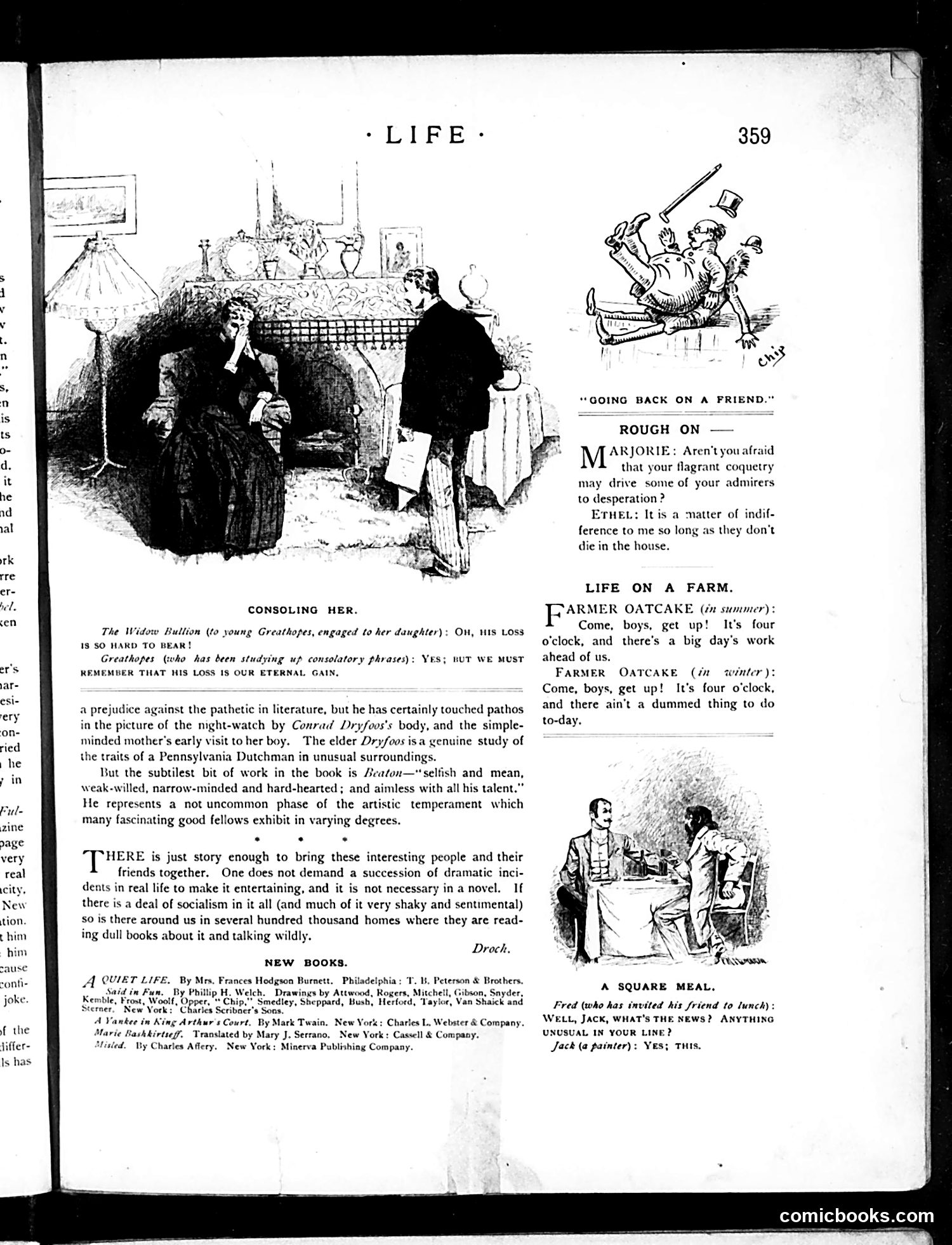
This page contains three separate comic sketches with accompanying dialogue: 1. **"Consoling Her"** depicts a widow being comforted after losing her husband, with text emphasizing that "his loss is our eternal gain"—suggesting the deceased's departure benefits society. 2. **"Rough On—Marjorie"** shows a conversation between two women about a man's "flagrant coquetry" potentially causing admirers despair, with the dismissive response that infidelity matters little "so long as they don't die in the house." 3. **"Life On a Farm"** humorously contrasts a farmer's morning call with a farm hand's sardonic response about the day's lack of work. The sketches reflect early 20th-century domestic humor and social commentary, with satirical takes on marriage, infidelity, and rural labor relations.
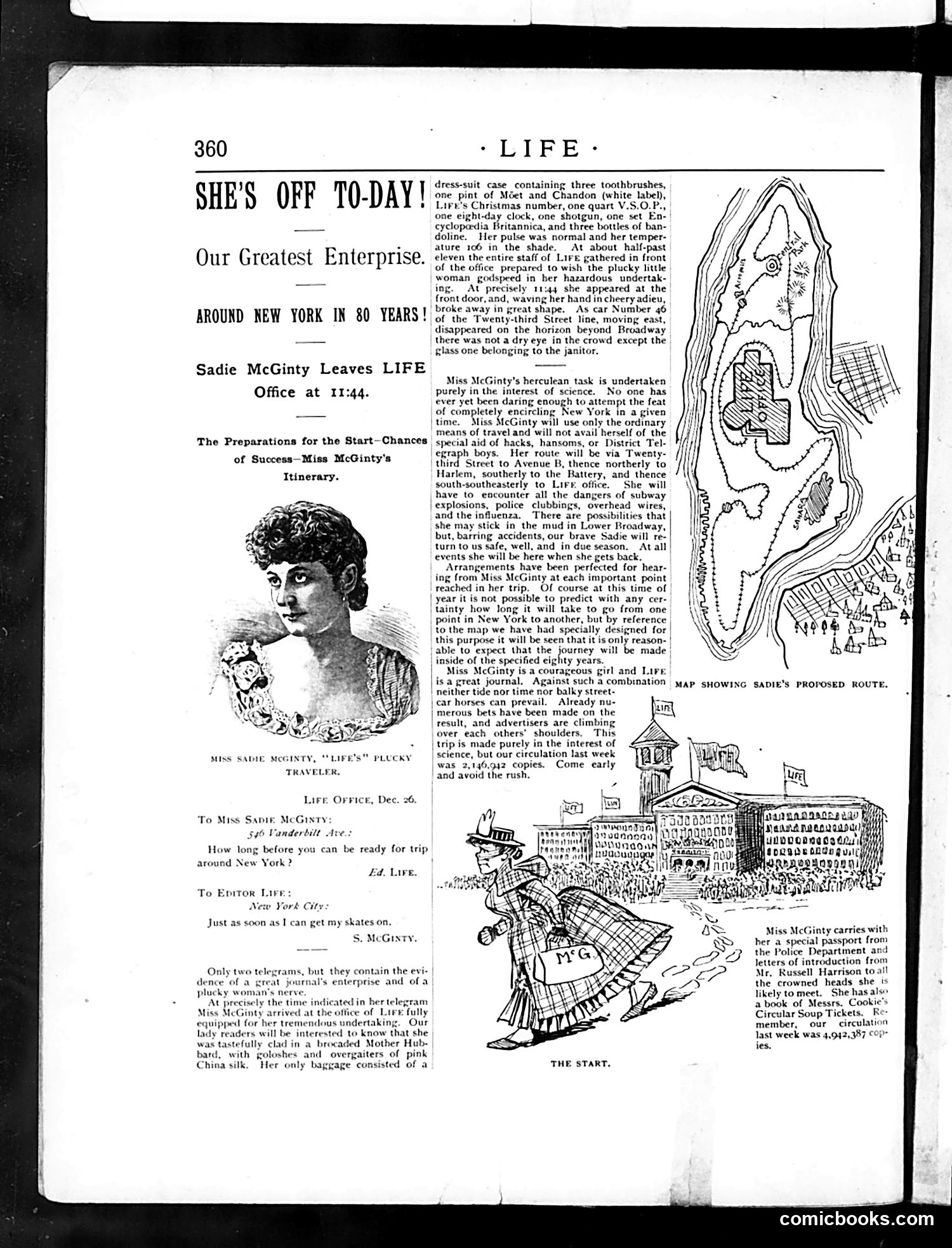
This page chronicles **Sadie McGinty's journey around New York City in 80 years**—a humorous stunt by Life magazine. The cartoon shows a woman ("plucky traveler") attempting to circumnavigate New York using only conventional transportation: streetcars, subway, carriages, and ferries. The satire mocks the challenge's absurdity: traveling the entire perimeter of New York in a single day seems impossible, yet Life frames it as a daring enterprise. McGinty's outfit and determined expression suggest turn-of-the-century feminism—women undertaking audacious public feats. The accompanying map shows her proposed route, while editorial notes and telegrams document preparations. The joke lies in presenting an essentially mundane urban commute as an epic "greatest enterprise," inflating ordinary travel into mock-heroic adventure.
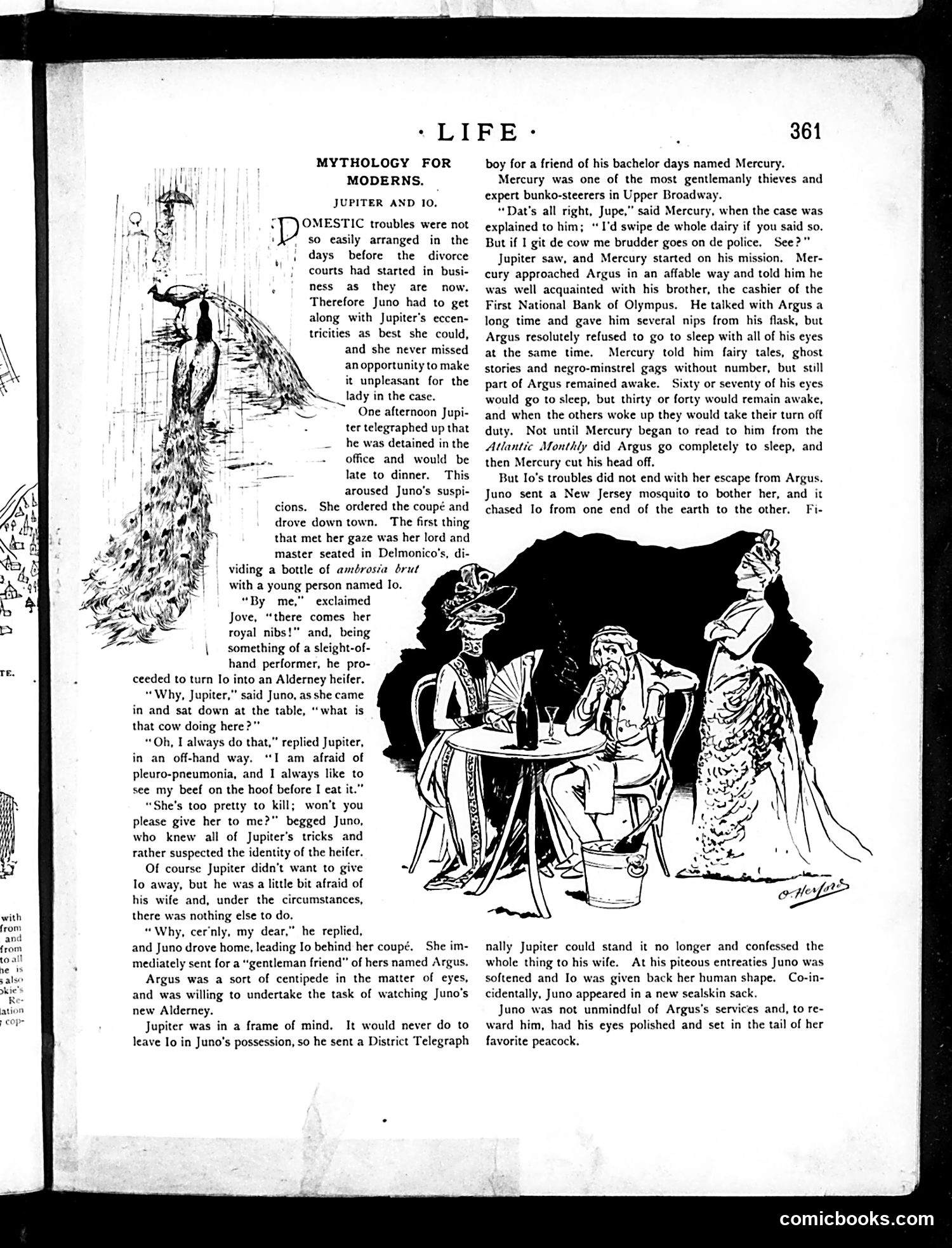
This satirical piece retells the classical myth of Jupiter and Io in contemporary early 20th-century terms. The text humorously transposes ancient gods into modern characters: Jupiter becomes a wealthy businessman dealing with divorce proceedings, Mercury appears as a "gentlemanly thief" and con artist from Upper Broadway, and Argus becomes a hired detective/watchman. The satire mocks high society marital drama, infidelity, and the various schemes used to conceal affairs. The accompanying illustration depicts what appears to be a dinner scene with multiple figures, likely visualizing the mythological scenario translated into modern social settings. The humor derives from contrasting grand classical mythology with petty contemporary scandal and corruption.
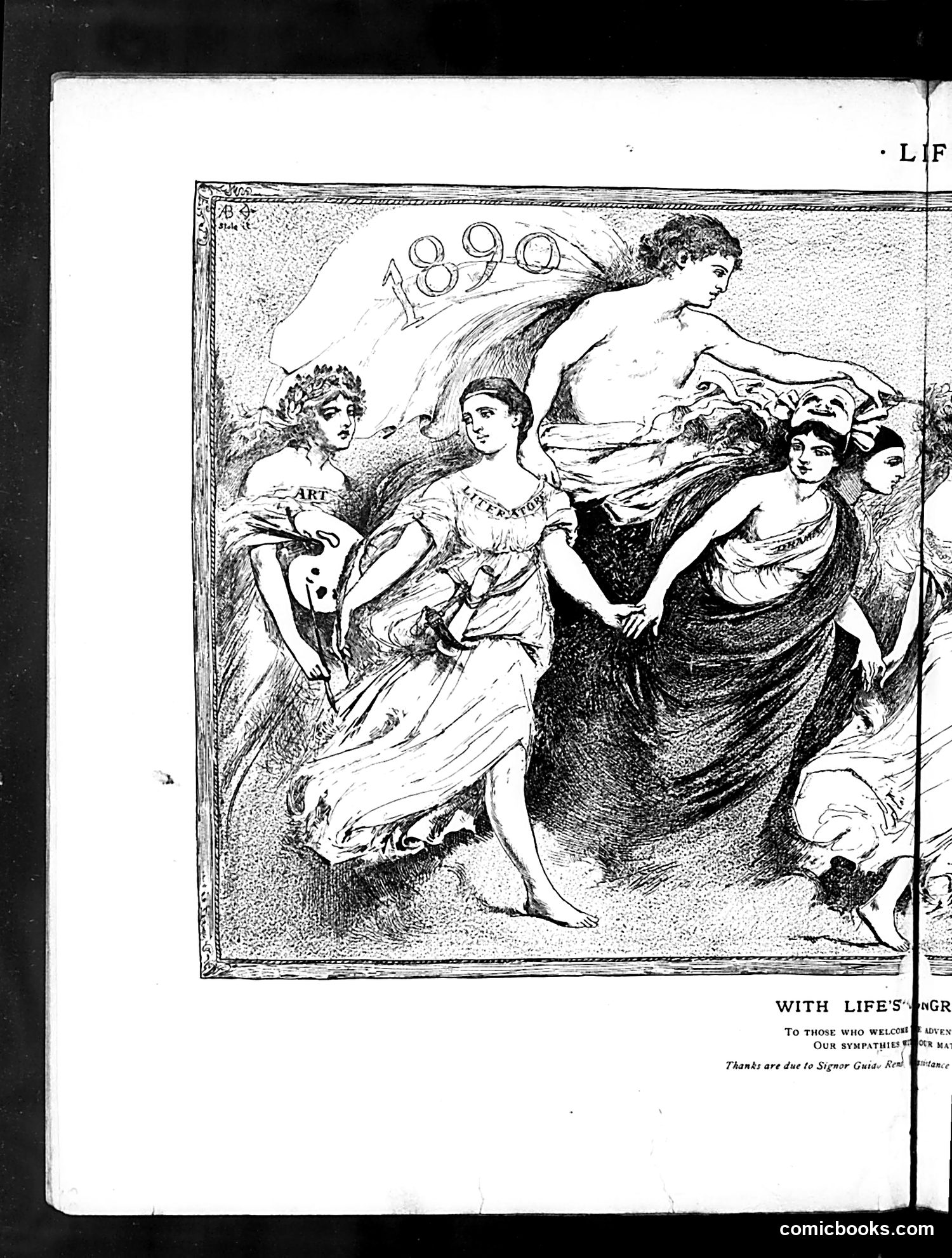
This appears to be an allegorical illustration from *Life* magazine depicting classical or mythological figures—including what looks like personified concepts. The image shows multiple female figures in classical dress, with one labeled "ART" visible on the left side. Another figure appears labeled "LITERATURE" in the center. The composition suggests this is an allegorical celebration of the arts and culture. The date "1890" appears in the upper portion, likely indicating the year of publication. The partial text below references "WITH LIFE'S ANGER" and mentions welcoming something, with a credit to "Signor Guido" visible. Without the complete text or additional context, the specific satirical point remains unclear, though this appears to be honoring cultural and artistic endeavors rather than mocking them.
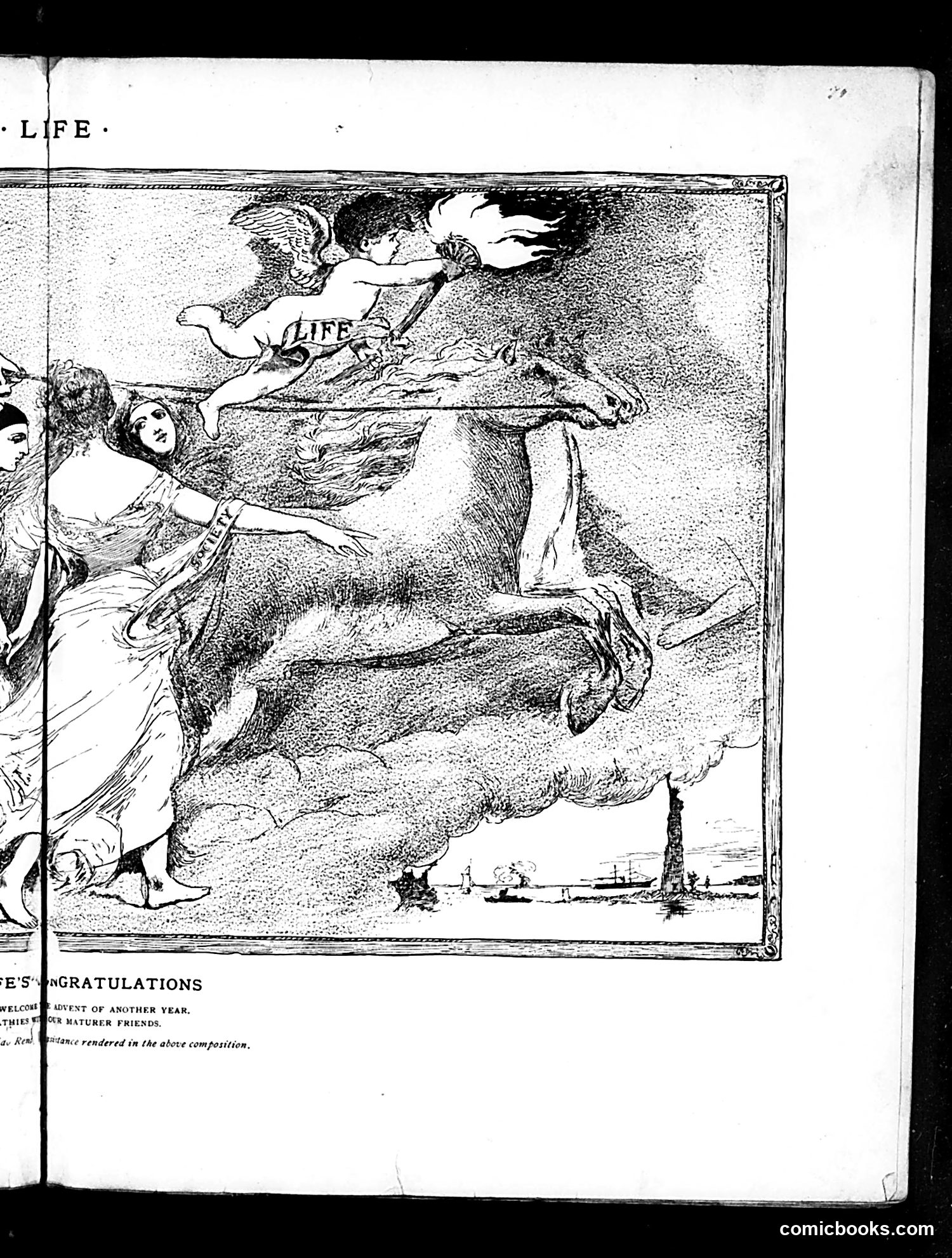
This appears to be a New Year's congratulations illustration from *Life* magazine. The central image depicts allegorical figures: a classical female figure (likely representing the old year or time) riding a winged horse or pegasus across clouds, with a cherub labeled "LIFE" above. Below, the composition includes maritime imagery—ships and a lighthouse visible in the distant landscape. The text references "CONGRATULATIONS / [ON THE] ADVENT OF ANOTHER YEAR" and mentions "OUR MATURER FRIENDS," suggesting this is a New Year greeting celebrating the magazine's continued existence and its readership. The classical artistic style and mythological references were typical of *Life*'s sophisticated satirical approach in this era, using elevated artistic language to mark time's passage and renewal.
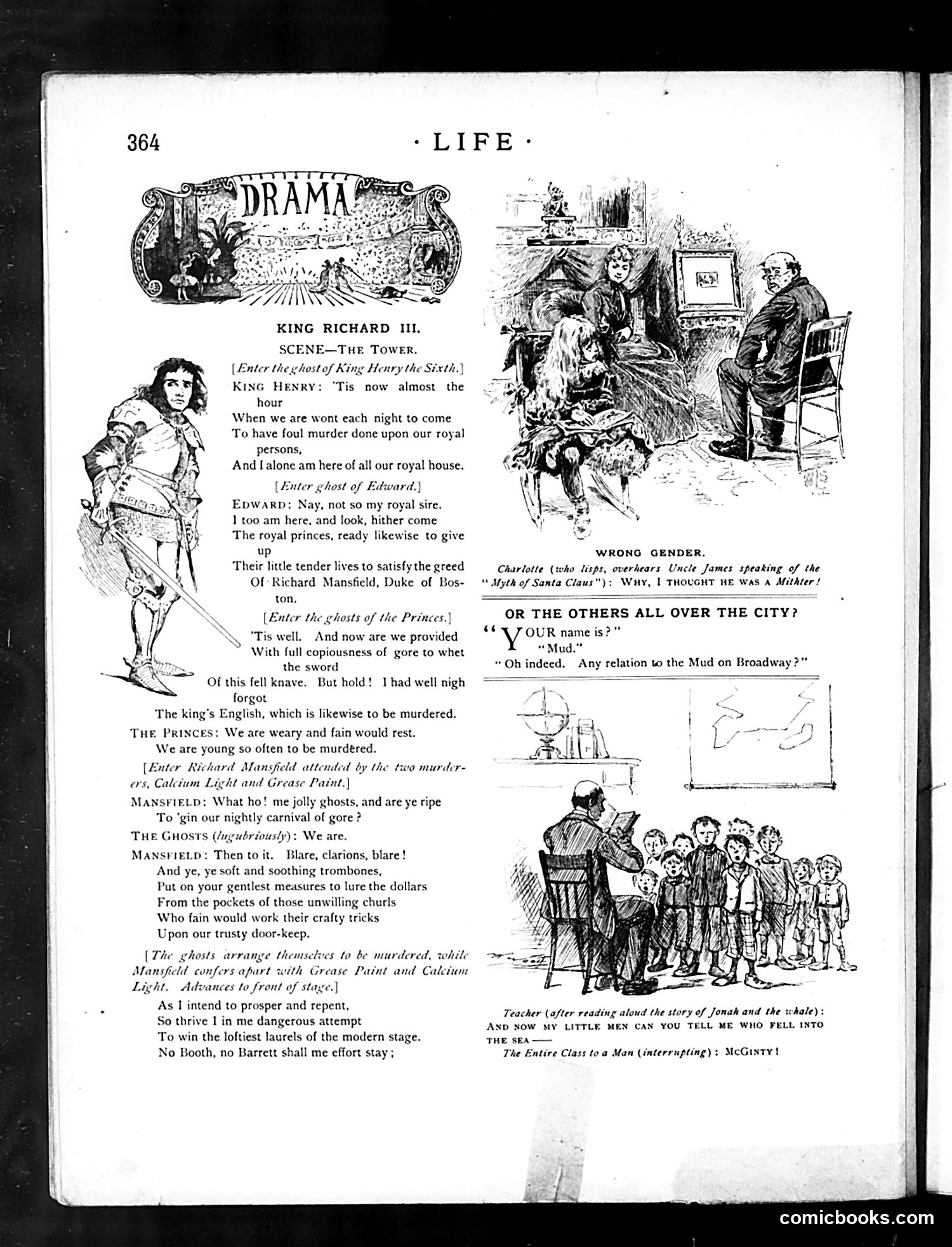
This page satirizes **Richard Mansfield**, a prominent American actor of the era, performing Shakespeare's *King Richard III*. The main sketch mocks his theatrical ambitions by reimagining the famous Tower murder scene where Richard kills the young princes. The satire's targets: 1. **"Caletum Light and Grease Paint"** are puns on theatrical elements—stage lighting and makeup—replacing actual murderers, suggesting Mansfield relies on technical effects rather than genuine acting. 2. **"Duke of Boston"** appears to be a jab at Mansfield's pretensions (he was known for grandiose self-promotion). 3. The joke: Mansfield is so obsessed with commercial success ("lure the dollars / From the pockets of those unwilling churls") that even a serious tragic scene becomes a crass money-making venture. The secondary cartoons mock linguistic/gender confusion in everyday speech—a lighter satirical touch. The overall message critiques theatrical commercialism and overwrought acting of the period.
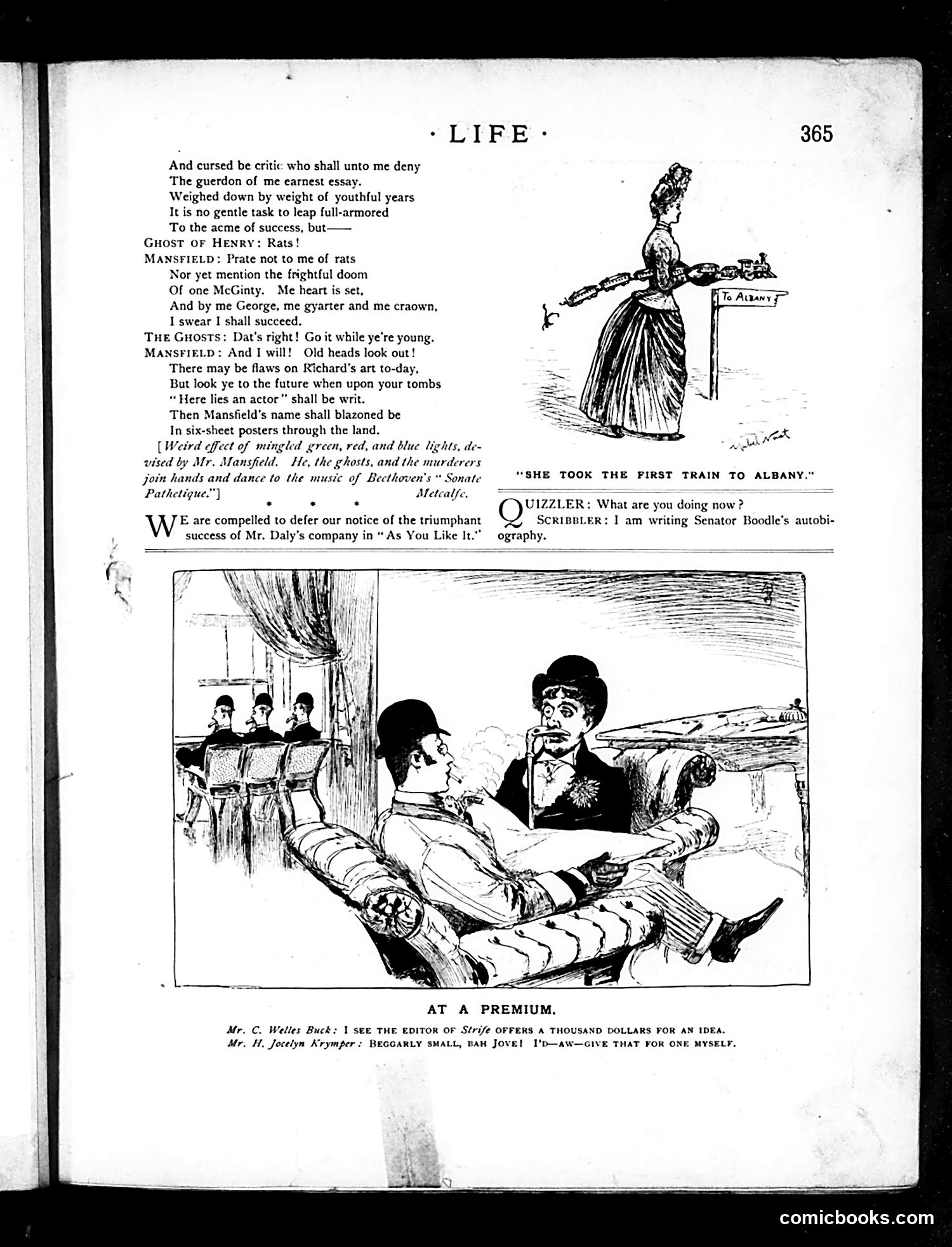
This page satirizes theatrical ambition and the publishing world circa early 1900s. **Top section**: A dramatic monologue parodies actor **Richard Mansfield**, famous for Shakespearean roles. The text mocks his grandiose aspirations—he swears he'll succeed despite current flaws, imagining his name in "six-sheet posters through the land." The theatrical staging (ghosts, Beethoven's music) exaggerates his melodramatic self-importance. **Middle cartoon ("At a Premium")**: Two men lounge while discussing ideas. One notes the *Strife* magazine editor offers $1,000 for an idea; the other dismissively says that's "beggarly small" and he'd demand more himself—satirizing how cheaply writers valued editorial compensation, or conversely, writers' inflated sense of their own ideas' worth. **Bottom vignettes**: Brief jokes about autobiography-writing and a woman taking "the first train to Albany," likely topical references now unclear. The page's overall theme: mocking theatrical ego, writerly pretension, and the gap between ambition and actual talent.
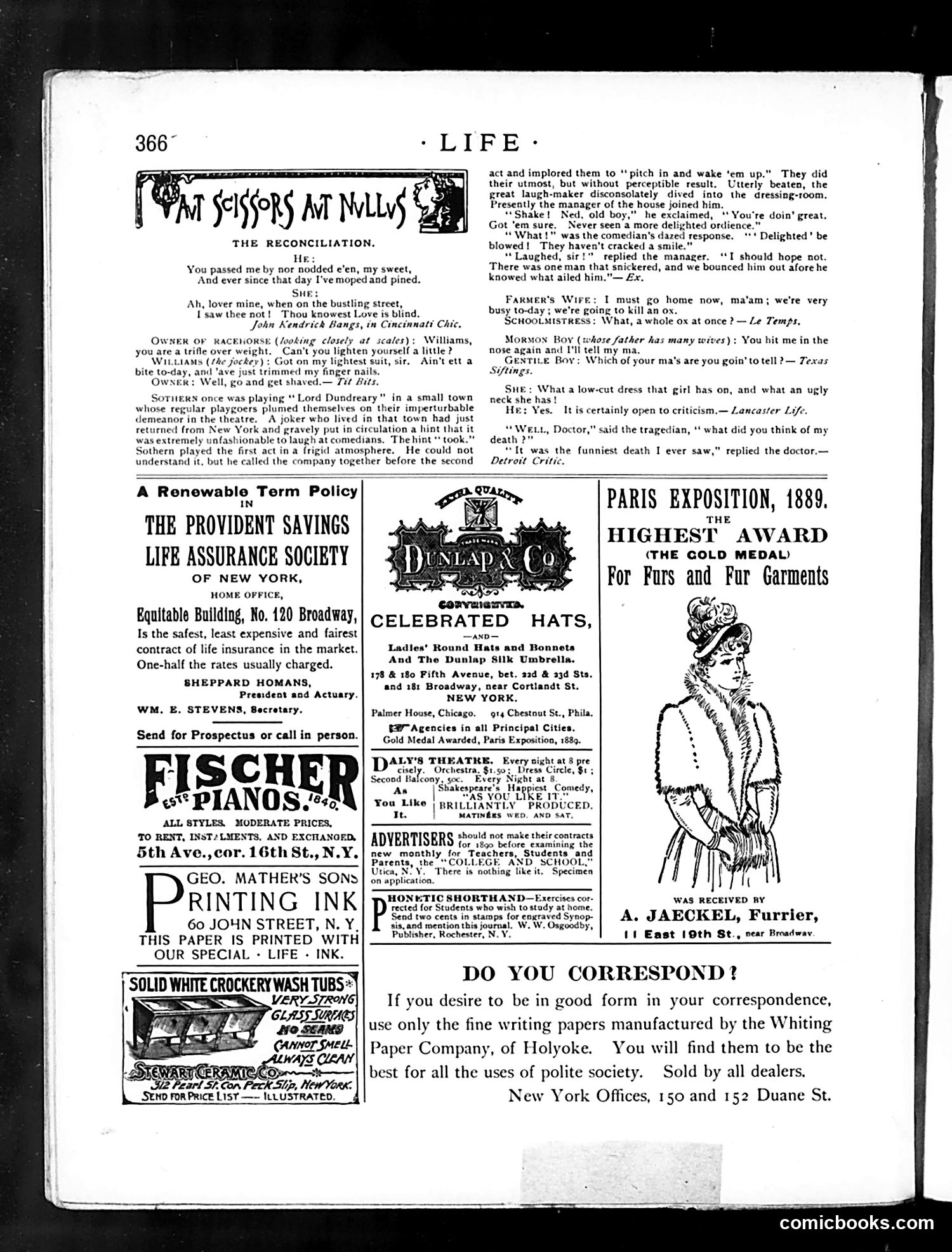
This is a miscellaneous page from *Life* magazine featuring humor columns and advertisements. The cartoon element appears minimal; most content consists of brief comic anecdotes. The jokes reflect period social attitudes: a jockey must lose weight by shaving, a farmer and schoolmistress discuss slaughtering livestock, a Mormon boy has multiple mothers to tell on, and a woman criticizes another woman's low-cut dress and "ugly neck." The most substantial piece recounts actor **E.A. Sothern** (a famous 19th-century performer) struggling during a comedy performance in a small town where audiences had been told laughing was unfashionable. The manager later reveals the audience actually enjoyed it—one person was ejected for snickering. It's a joke about provincial pretentiousness. The rest comprises Victorian-era advertisements for pianos, printing ink, hats, life insurance, and fine writing paper—typical *Life* magazine content from this period.
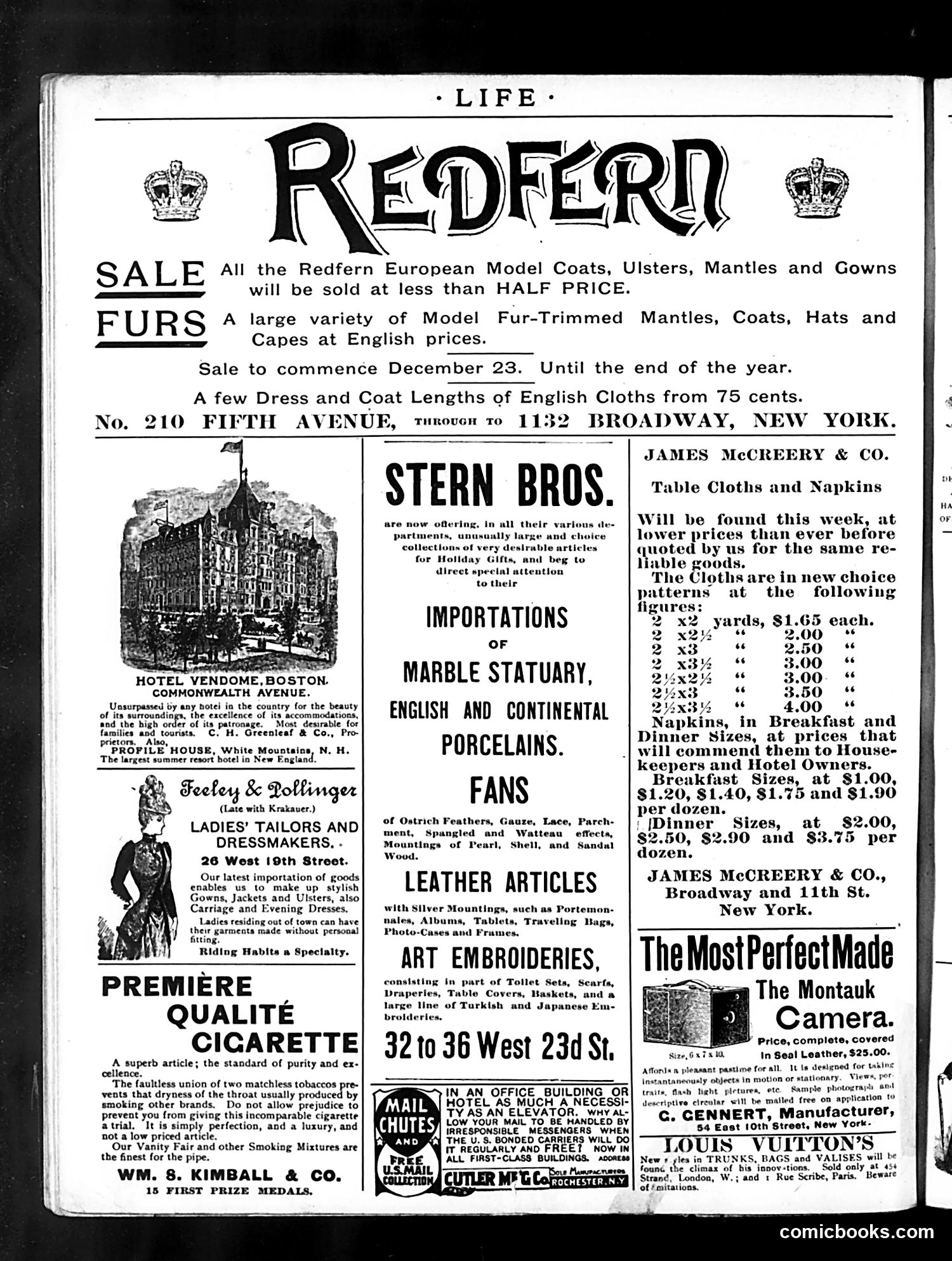
This is primarily a **commercial advertisement page**, not a satirical cartoon. The page showcases luxury retail goods typical of late 19th-century New York, including: - **Redfern clothing sales** (European coats, gowns, furs) - **Fine household goods** (table linens, marble statuary, porcelain, fans) - **Luxury services** (ladies' tailors, dressmakers) - **Specialty items** (leather goods, art embroideries, cigarettes, cameras) The only potential social commentary appears in a small sidebar mentioning that "AN OFFICE BUILDING HOTEL AS MUCH A NECESSITY AS AN ELEVATOR," suggesting rapid urbanization and changing workplace needs. The page reflects **Gilded Age consumer culture**—targeting wealthy New Yorkers with imported European goods and premium domestic products. The advertisements emphasize exclusivity, English/Continental imports, and "less than half price" sales to appeal to affluent holiday shoppers. This snapshot documents what constituted luxury consumption for America's elite during this period.
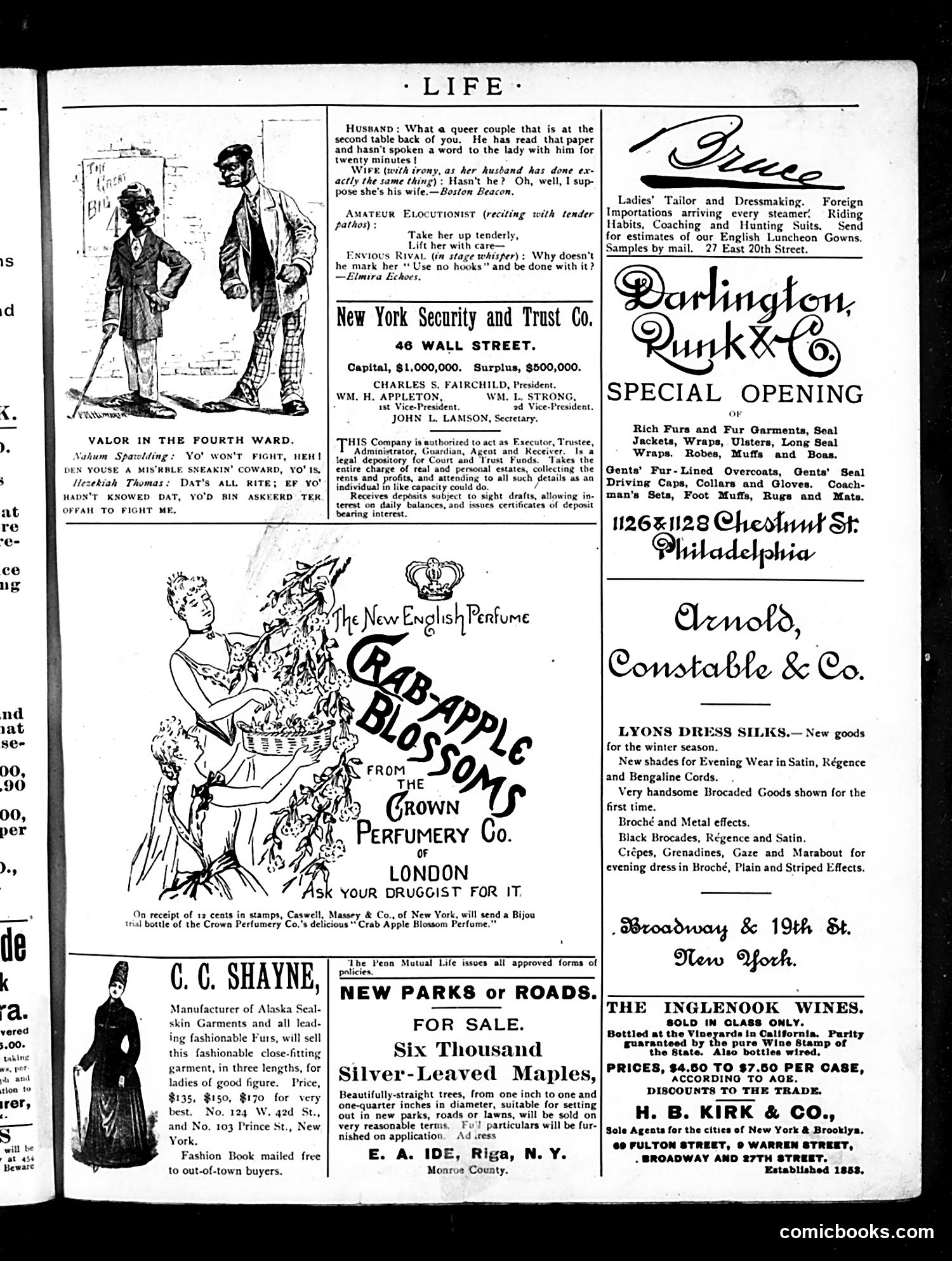
This cartoon satirizes lower-class ethnic immigrant bravado, likely depicting Irish or working-class New York characters named Nahum Spavolding and Hezekiah Thomas. The "Fourth Ward" reference locates this in a densely immigrant Manhattan neighborhood. The joke rests on *ironic toughness*: each man accuses the other of cowardice while simultaneously refusing to fight. Spavolding challenges Thomas, but Thomas responds by saying if Spavolding weren't afraid, he wouldn't have *offered* the challenge—creating circular logic where apparent insults mask mutual reluctance to actually fight. The heavy dialect humor reflects period publications' mocking treatment of immigrant speech patterns. The satire targets performative masculine aggression in working-class communities—men performing toughness through aggressive talk without genuine conflict, a common comedic trope in 19th-century American humor. This page is primarily advertising (furs, dressmaking, wines, etc.) with this cartoon as the only substantive editorial content.
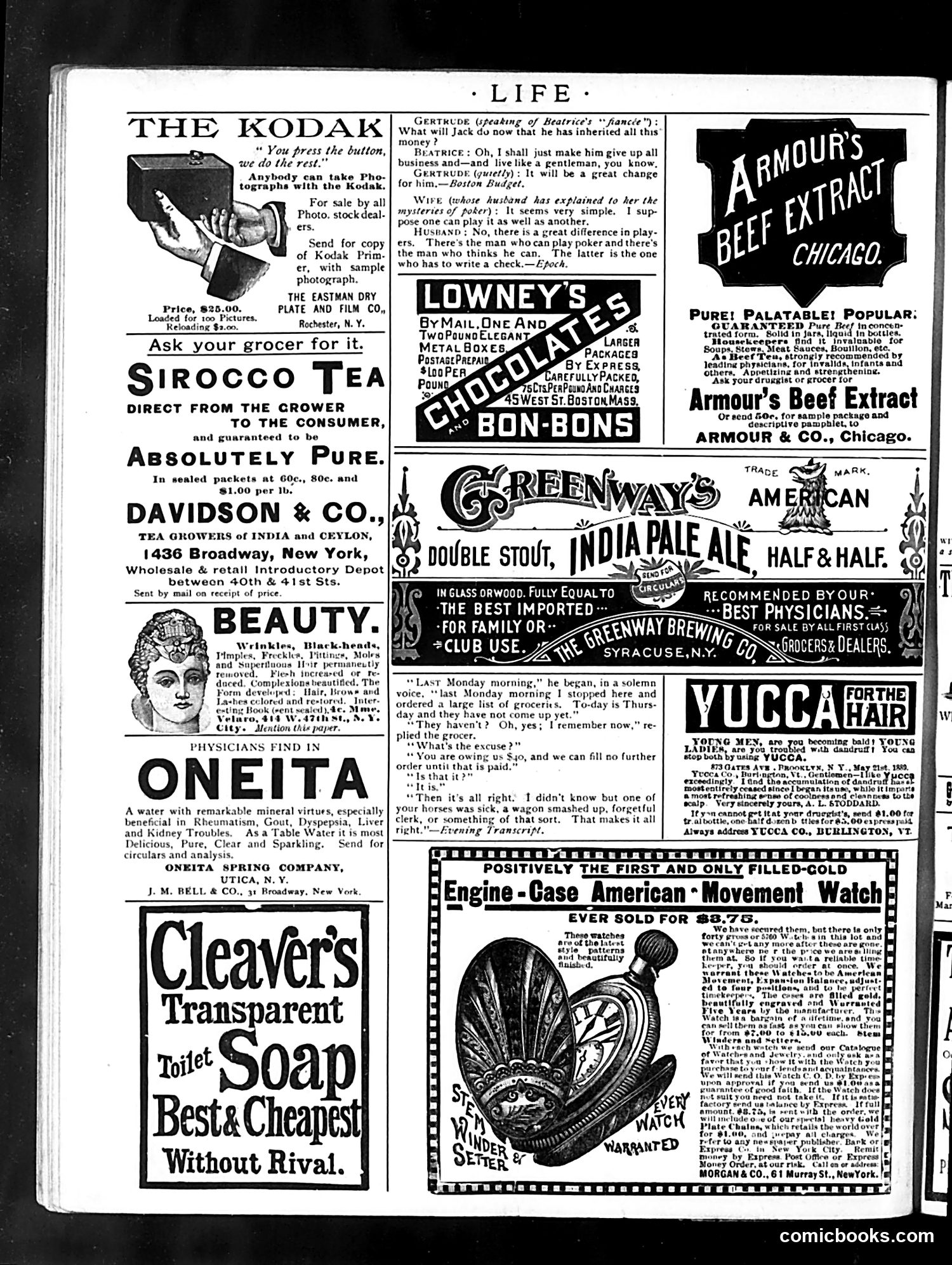
This page is primarily **advertisements** with brief comedic vignettes interspersed. The main satirical content appears in two short jokes: 1. **"Gertrude" dialogue**: A woman whose friend inherits money plans to make him "give up all business and live like a gentleman," prompting the observation this will be "a great change for him"—implying he's currently working-class or commercially engaged, and that idleness is associated with gentlemanly status. 2. **Grocer anecdote**: A customer's delayed grocery order is explained when the grocer reveals the customer owes $40. The customer finds this acceptable reasoning, joking it's not a horse sickness or wagon accident—satirizing poor service and the grocer's willingness to withhold goods over debt. Both jokes reflect late 19th-century social attitudes about class, commerce, and credit. The remaining content is product advertising (Kodak cameras, tea, soap, watches, patent medicines) typical of period magazines, with no significant political cartooning present.
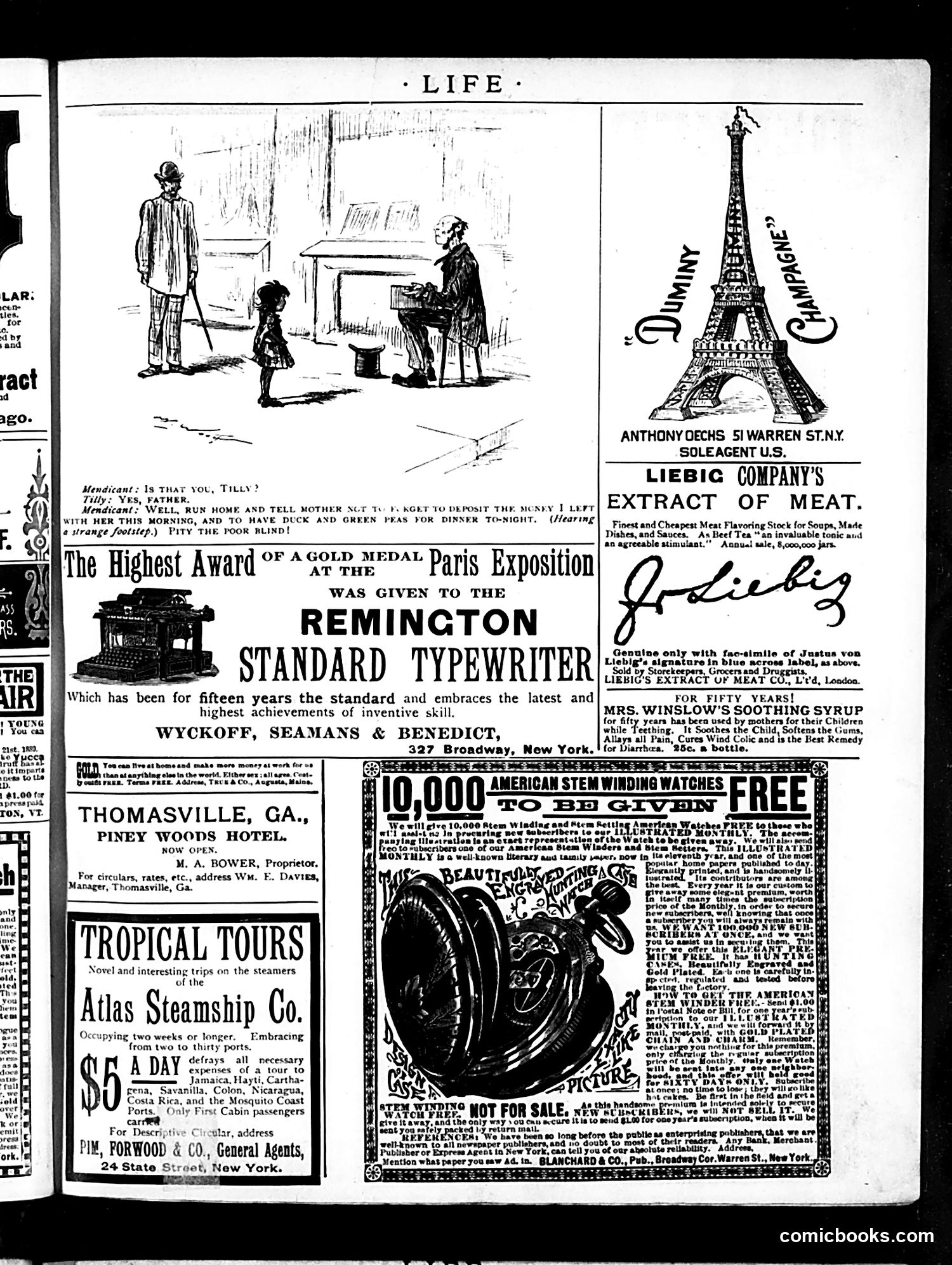
**The Cartoon:** The top sketch depicts a blind beggar stopping a child named "Tilly," asking if it's really him. The father (visible in background) instructs Tilly to run home, tell mother to deposit money he left, and prepare dinner—then adds "Pity the poor blind!" as the beggar approaches. The satire mocks the father's hypocrisy: he exploits sympathy for the blind (literally using the phrase as cover) while conducting mundane financial transactions. It's commentary on how people performatively invoke pity for the disadvantaged while remaining self-absorbed. **The Advertisements:** The page is dominated by period product ads: Remington typewriters (claiming a Paris Exposition award), Liebig's Meat Extract, Mrs. Winslow's Soothing Syrup, and a heavily-promoted giveaway of American stem-winding watches. These ads reveal late 19th-century consumer culture and patent medicines—particularly Winslow's syrup, now recognized as containing opiates, marketed for teething infants.
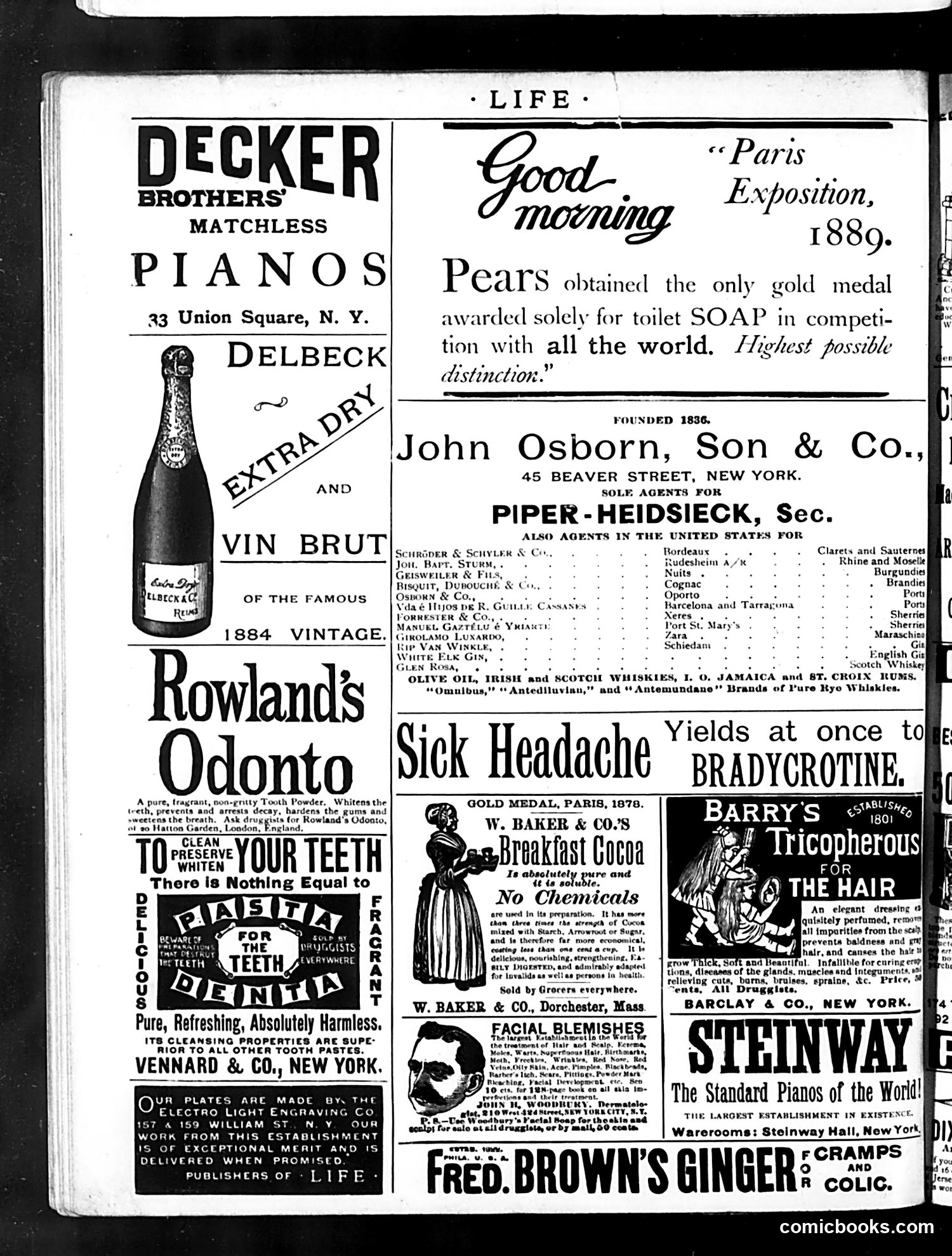
This is primarily a **advertisements page**, not a satirical cartoon. It contains late-19th-century product ads from circa 1889. Notable content includes: - **Pears Soap** claiming the "only gold medal awarded solely for toilet SOAP" at the 1889 Paris Exposition—a common advertising claim of the era, presenting commercial competition as international validation - **Rowland's Odonto** tooth powder and other hygiene products reflecting Victorian obsession with personal cleanliness - **Piano manufacturers** (Decker Brothers, Steinway) advertising luxury goods - **Alcohol distributors** (Delbeck champagne, Piper-Heidsieck) listing European wine and spirits - **Patent medicines** (Bradycrotine for headaches, Tricopherous hair tonic, Baker's Cocoa) typical of an era before FDA regulation, when such products made unverified health claims The page reflects **Gilded Age consumer culture**: aspirational messaging, pseudo-scientific health claims, and emphasis on European prestige goods. Modern readers would notice the lack of ingredient transparency and unsubstantiated medical claims now prohibited by law.
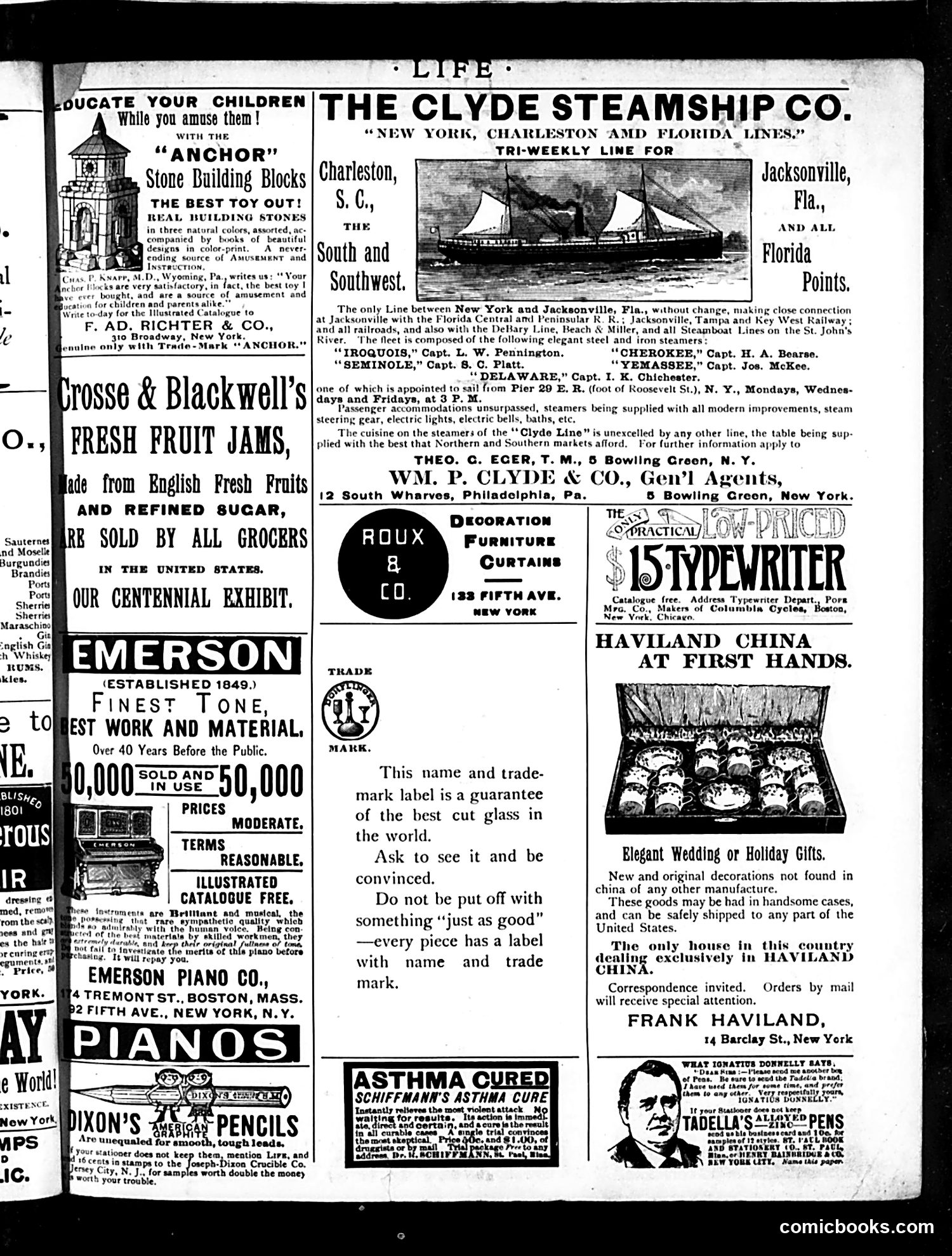
This page is primarily **advertising**, not satire or political commentary. It's a collection of late 19th-century commercial advertisements for various products and services: **Key ads include:** - Anchor Stone Building Blocks (educational toy) - Crosse & Blackwell jam and condiments - Emerson pianos (established 1849) - Dixon pencils - The Clyde Steamship Company (transport between New York, Charleston, and Jacksonville) - Roux furniture and curtains - Typewriters - Haviland china - Schiffmann's Asthma Cure - Tadella's fountain pens The only potential satirical element is a small fragment mentioning "Ignatius Donnelly," but it's largely illegible in this reproduction. The page appears to be a typical product-driven issue of *Life* magazine, emphasizing consumer goods and services rather than editorial commentary.
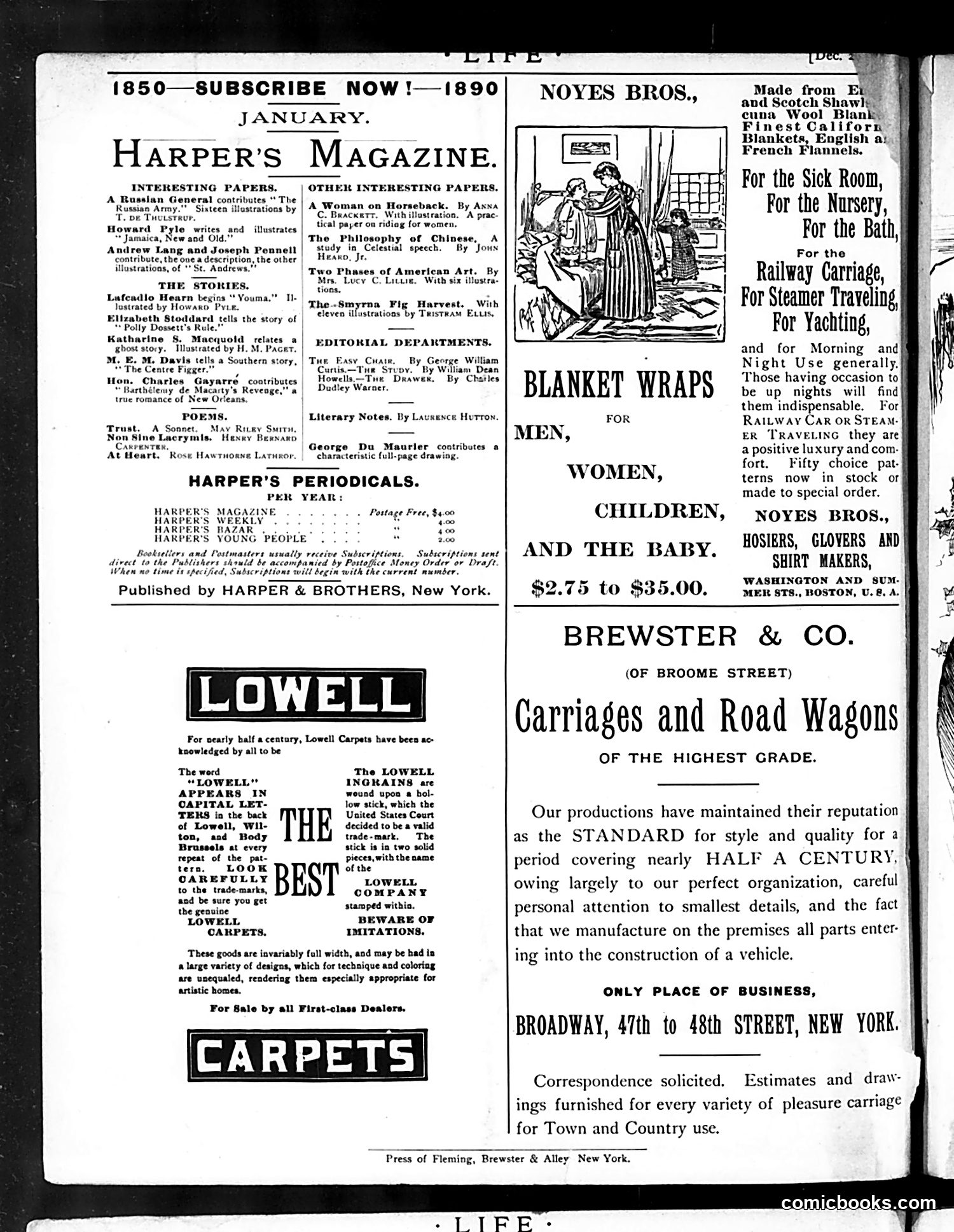
This is primarily a **table of contents and advertising page** for Harper's Magazine's January 1890 issue, not a political cartoon page. The editorial content lists serialized stories by prominent authors (Lafcadio Hearn, Elizabeth Stoddard, Charles Gayarre), poems, and departments covering art, philosophy, and literary criticism—typical of the era's prestigious monthly magazines. The advertisements reflect **1890s luxury consumer goods**: Lowell carpets (emphasizing authenticity against counterfeits via trademark marks), Noyes Bros. blanket wraps for various uses (sickrooms, travel, yachting), and Brewster & Co. high-end carriages manufactured in New York. The page's satire or humor content—if present—appears minimal. The George du Maurier illustration mentioned in the editorial departments would likely contain any satirical commentary, but it's not visible here. This page primarily demonstrates how 19th-century magazines blended serious literary content with advertising to wealthy, educated readers.
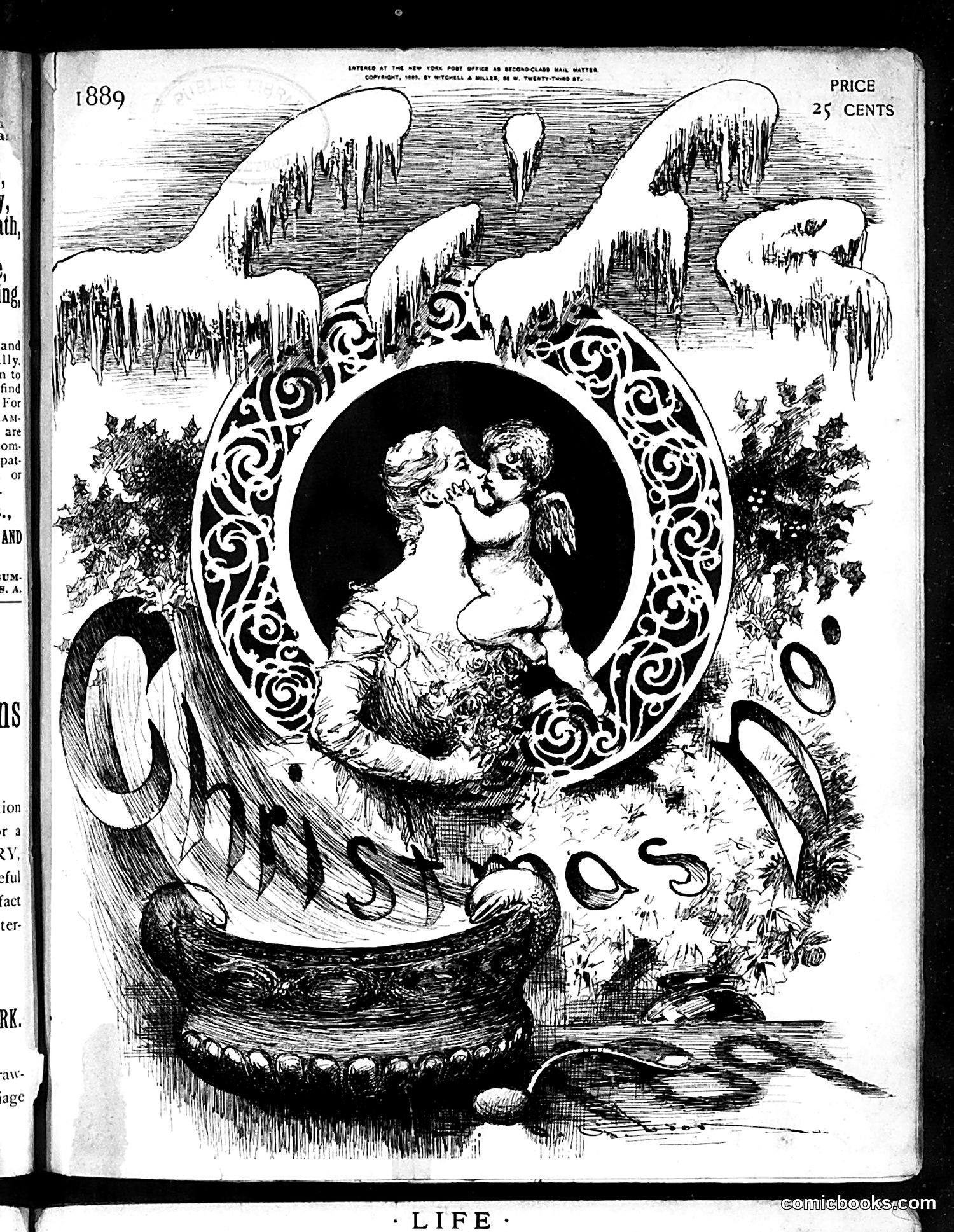
This ornate decorative illustration depicts a cherub or cupid figure kissing a woman's cheek within an elaborate scrollwork frame, surrounded by icicles and winter imagery. The design appears to be a romantic or Valentine's Day-themed cover, emphasizing themes of love and affection. The icicles draping the composition suggest either winter romance or a play on "cold" emotions—possibly satirizing sentimental romanticism. The elaborate Victorian ornamental border frames the intimate scene, which was typical of *Life* magazine's decorative covers during this period. Without additional text context, the specific satirical point remains unclear, though the composition suggests commentary on romantic conventions or seasonal sentimentality popular in 1889.
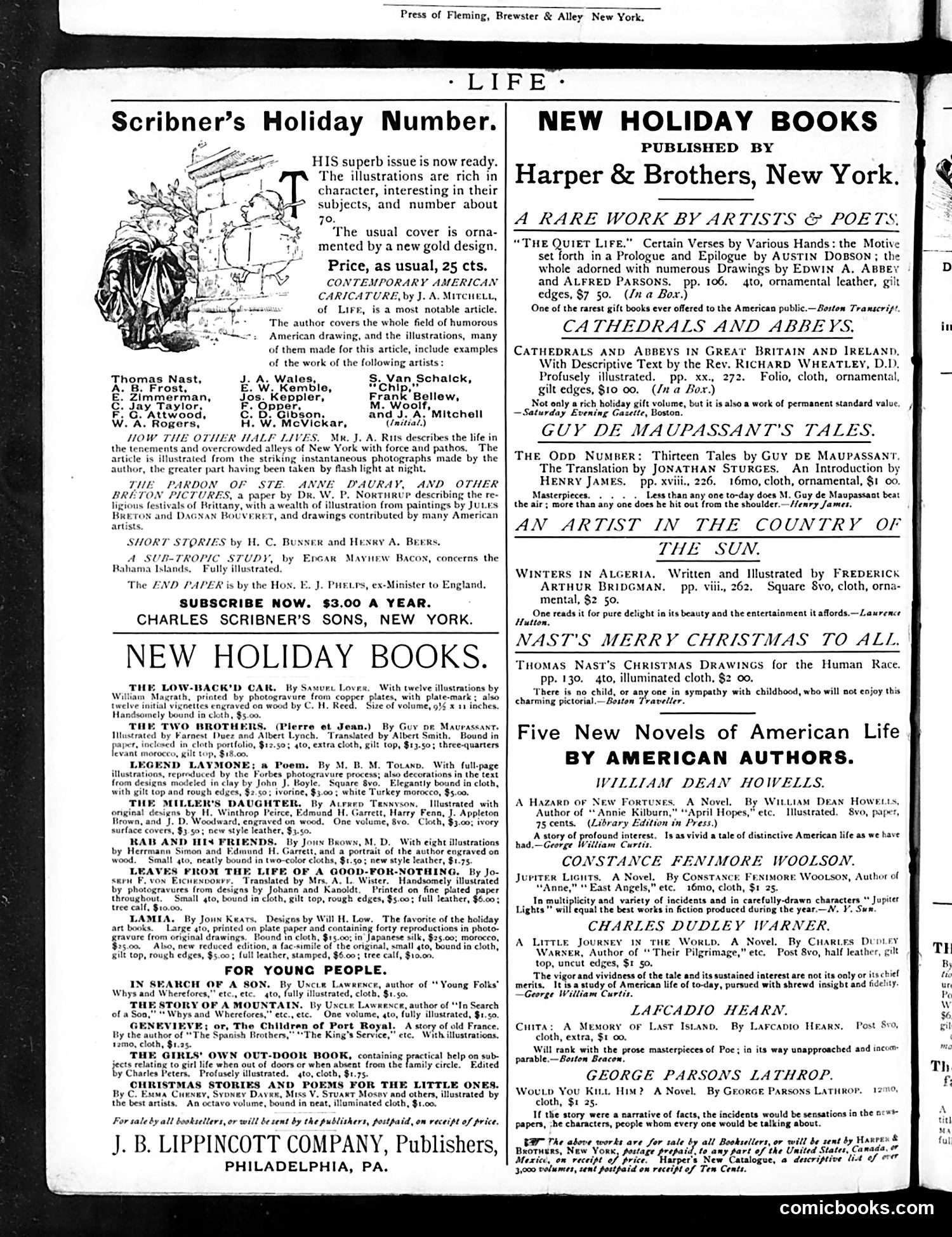
This page is primarily **advertising and book announcements** rather than political satire or cartoons. The main illustration shows a decorative design for Scribner's Holiday Number—an ornamental cover featuring artistic flourishes and flora, not a political cartoon. The page announces holiday books from major publishers (Scribner's, Harper & Brothers, Lippincott). Notable is a mention that *Life* magazine's "Contemporary American Caricature" article covers American satirical artists including Thomas Nast, A.B. Frost, and others—indicating this period valued caricature as an art form. The only substantive content note: an article titled "How the Other Half Lives" by J.A. Riis about tenement conditions, illustrated with photographs, suggests *Life* addressed social issues of the era. This is essentially a **publisher's catalog page** with period advertising design, not satirical content itself.
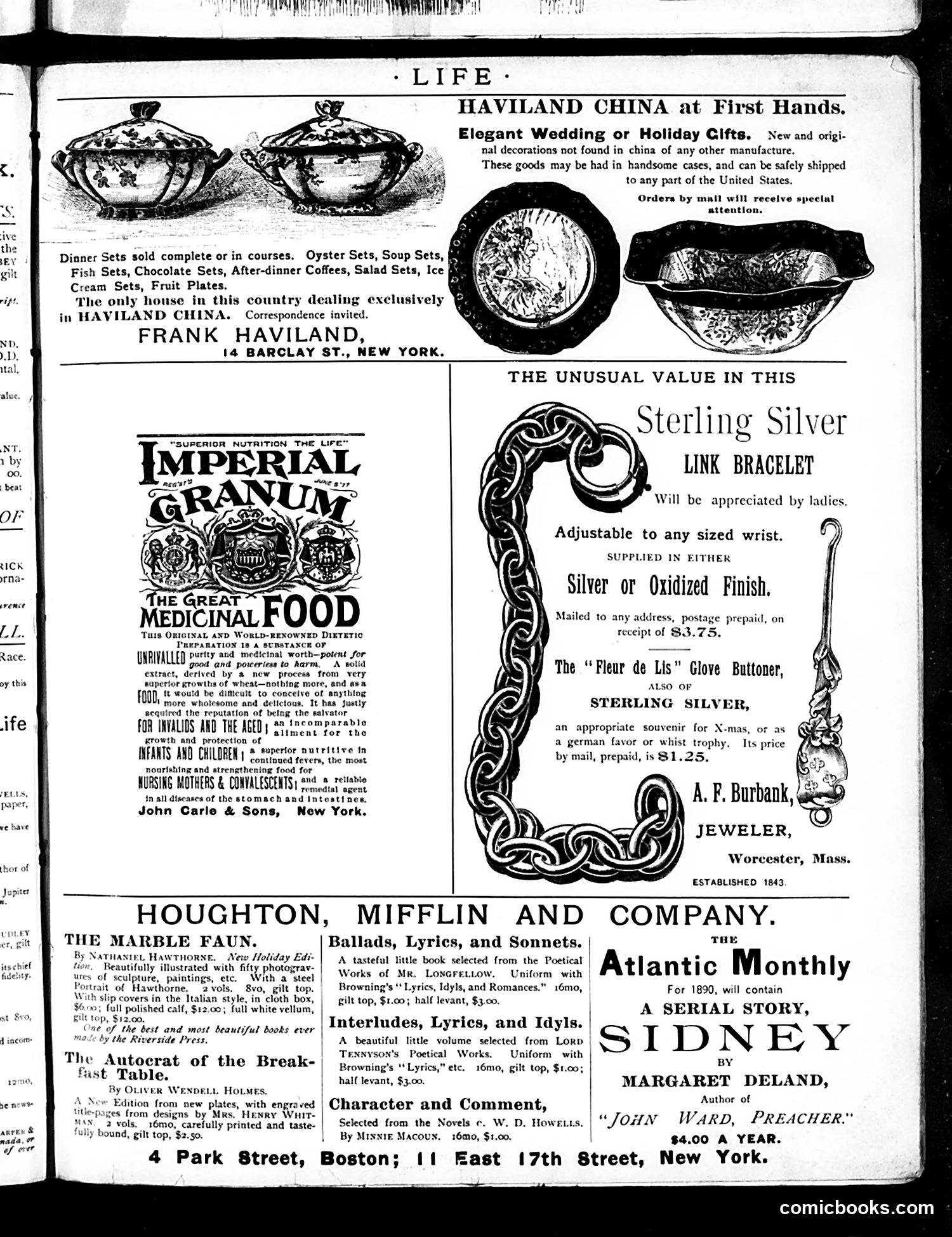
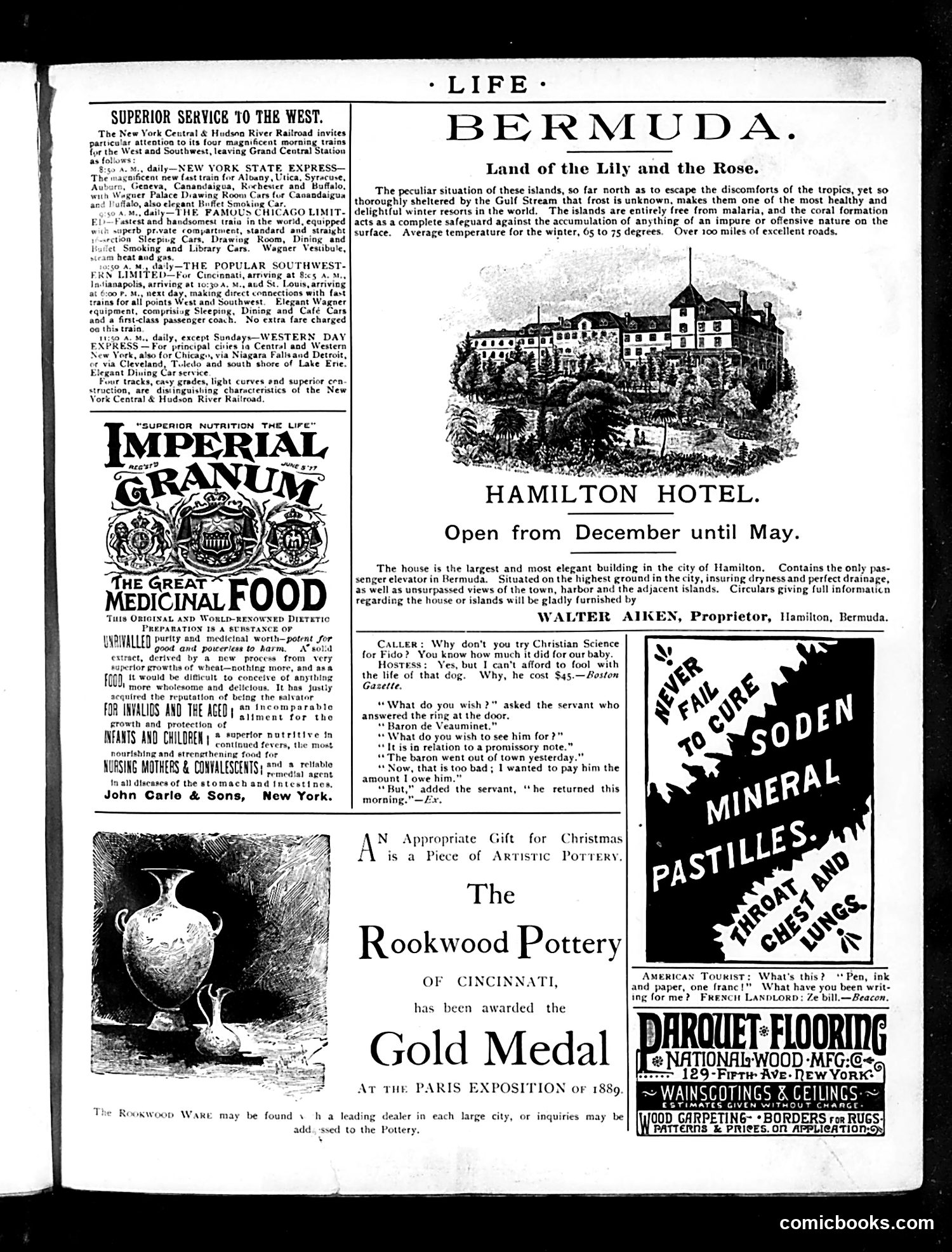
This page is **primarily advertising**, not a satirical cartoon or political commentary. It consists of commercial advertisements for luxury goods popular in the 1890s. The ads feature: - **Haviland China** (fine porcelain dinnerware) for weddings and holidays - **Sterling silver jewelry** (link bracelets, glove buttoners) from jeweler A.F. Burbank - **Imperial Granum** (a medicinal food supplement claiming benefits for invalids, the elderly, nursing mothers, and children) - **Classic literature** from Houghton Mifflin publishers (Hawthorne, Holmes, Longfellow) - **The Atlantic Monthly** magazine subscription announcement The page reflects late-19th-century consumer culture, targeting affluent readers with decorative housewares, jewelry, patent medicines, and books. There is no political satire visible—this appears to be a standard advertising section of *Life* magazine from around 1890.
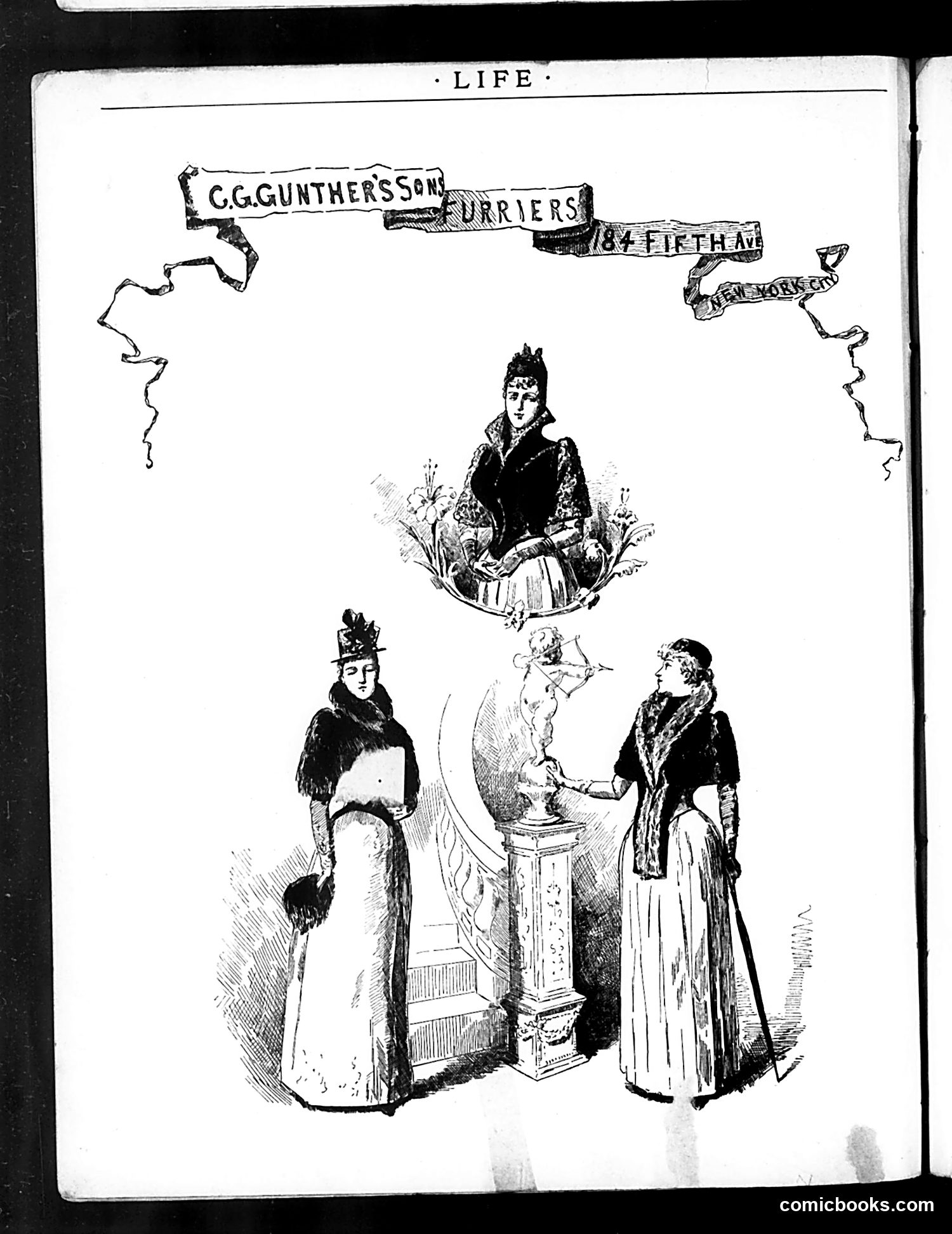
This appears to be a satirical illustration from *Life* magazine featuring "C.G. Gunthers & Son, Furriers" of 184 Fifth Avenue, New York City. The image shows three fashionably dressed women in 1880s attire examining what appears to be a fur piece or garment displayed on a pedestal. The woman at top center is shown in an inset portrait. The satire likely mocks the vanity and expense of high fashion—specifically the fur trade and wealthy women's obsession with luxury garments. The formal presentation and the women's elaborate dress suggest this ridicules the pretension of high-end fashion retail and the social status-seeking behavior of wealthy clientele. The furrier's name prominently displayed at top indicates this is advertising-adjacent satire, poking fun at the merchant class and their wealthy customers.
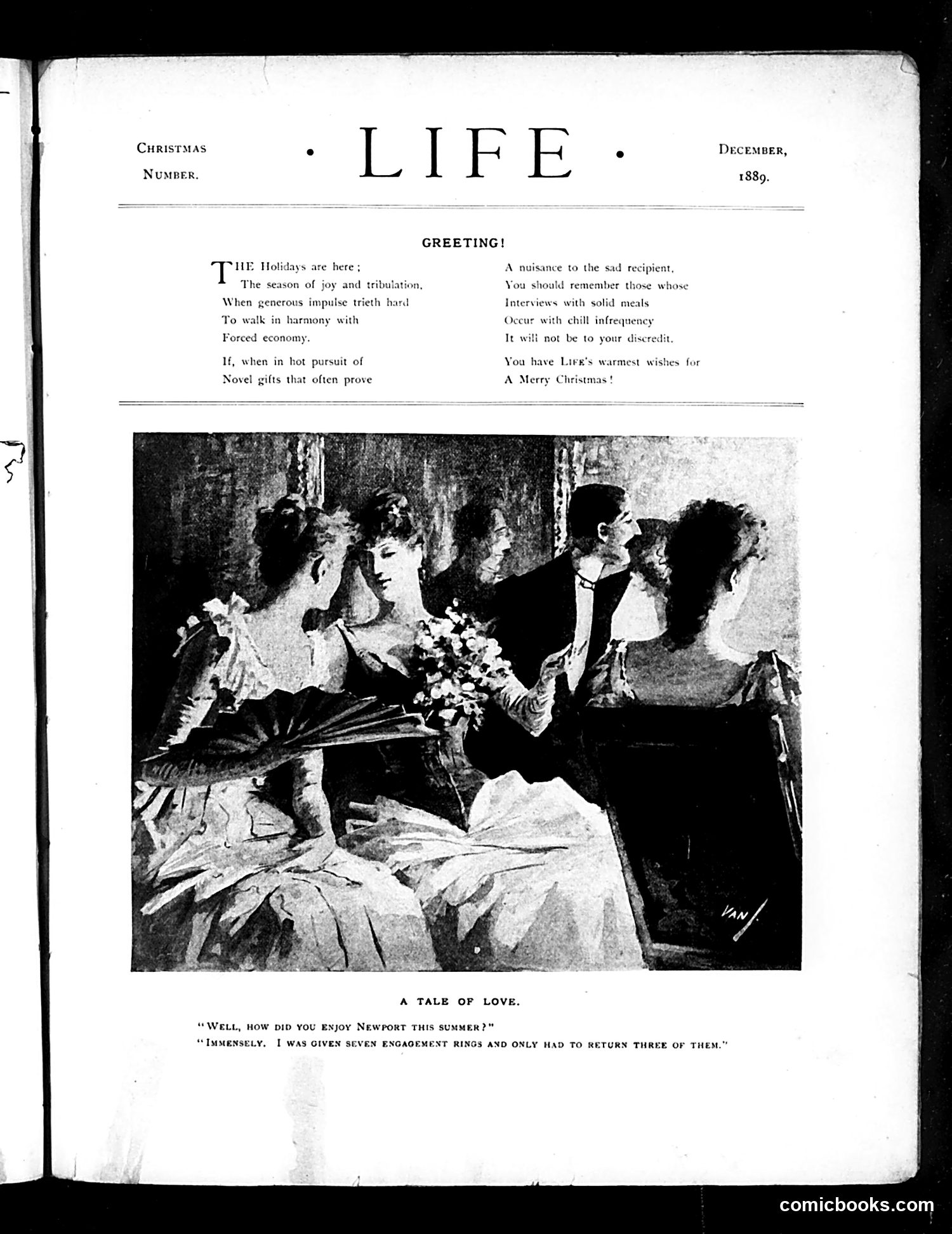
This is a Christmas greeting page from *Life* magazine (December 1889) containing satirical humor about wealth and romance among the upper class. The main cartoon, titled "A Tale of Love," depicts a woman at Newport (an exclusive Rhode Island resort for the wealthy) boasting that she received seven engagement rings during the summer but only had to return three of them. The joke mocks: 1. **Gold-digging behavior**: wealthy men proposing casually to women seeking financial security 2. **Serial engagements**: the assumption that multiple proposals and broken engagements were commonplace among the social elite 3. **The woman's casual attitude**: she treats serious commitments as transactional rather than emotional The top "Greeting" text sardonically addresses Christmas gift-giving expectations while acknowledging financial strain ("forced economy"), adding social commentary about class tensions during this Gilded Age period.
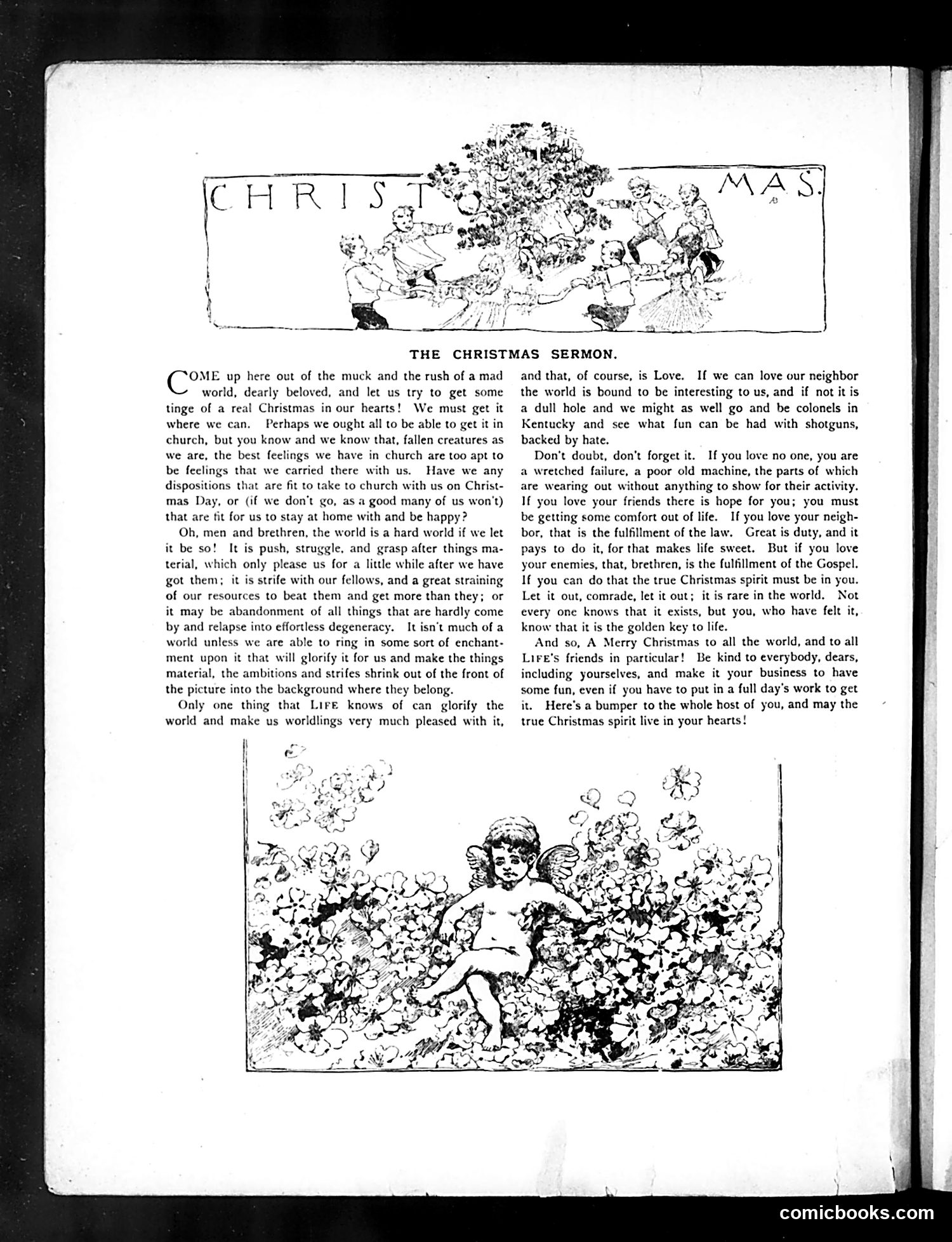
This page presents a holiday editorial sermon from *Life* magazine (a 19th-century American humor and satire publication). The text is a sincere, moralistic Christmas message—not satire—exhorting readers to escape worldly materialism and embrace love as Christianity's true spirit. The sermon contrasts the "muck and rush" of competitive, materialistic life with the transformative power of love. It argues that loving one's neighbor fulfills the law, while loving enemies fulfills the Gospel. The author mocks those who might skip church on Christmas and satirizes the empty pursuit of wealth and status. The illustration shows a cherub surrounded by flowers—a conventional sentimental image reinforcing the message about love and spiritual beauty. The overall piece represents *Life's* genteel, moralistic tone during this era—mixing gentle social criticism with earnest Christian values rather than sharp political satire.
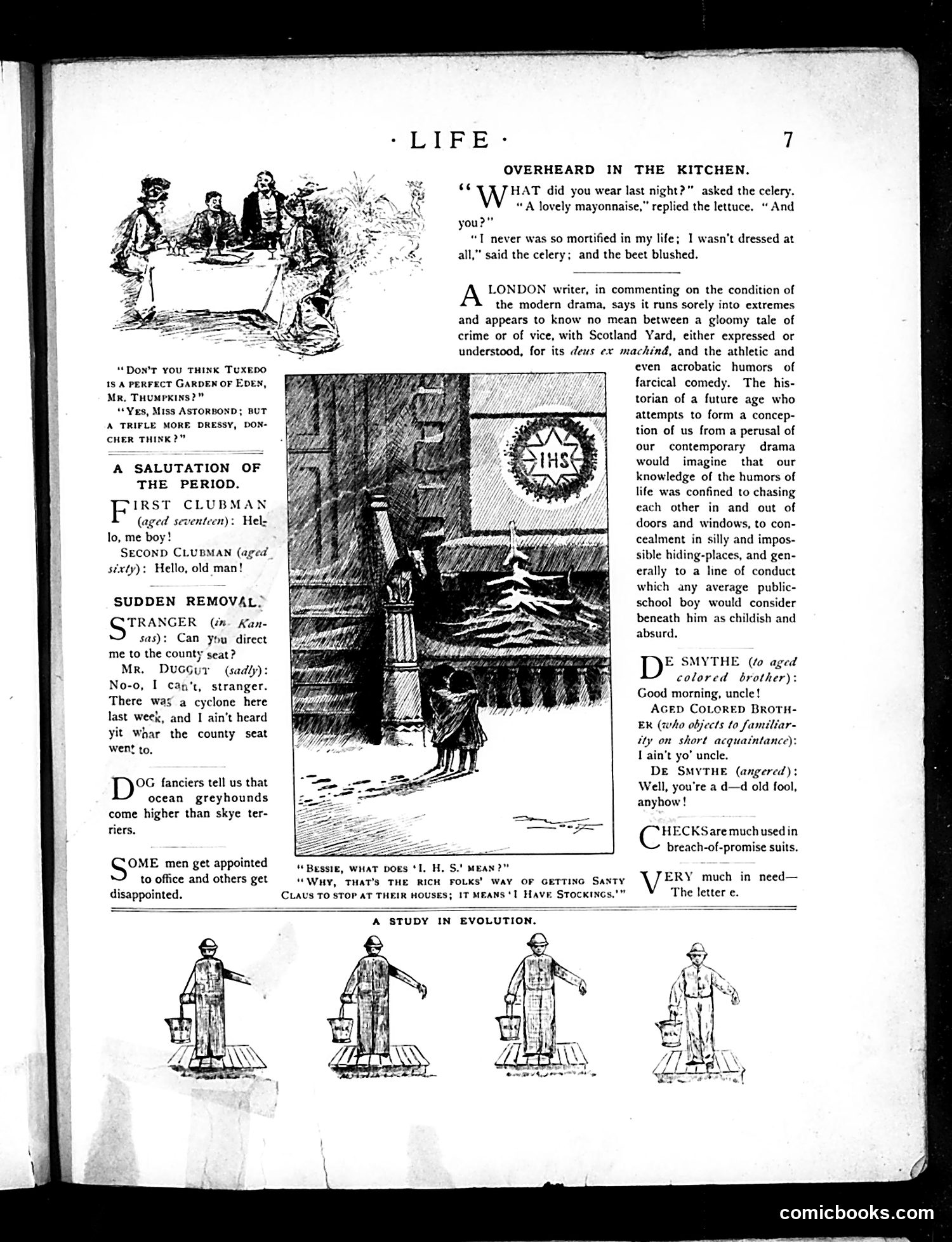
This page contains multiple satirical short pieces typical of early Life magazine's humor format: **"Overheard in the Kitchen"** depicts vegetables as characters discussing their evening attire—a whimsical personification joke playing on fashion consciousness. **"A Salutation of the Period"** mocks the informal greeting conventions of the era, showing a 17-year-old and 60-year-old clubman greeting each other identically ("Hello, me boy!" / "Hello, old man!"), satirizing how age-appropriate social distinctions were blurring. **"Sudden Removal"** jokes about Kansas cyclones—a contemporary reference to severe Midwestern weather that was literally moving towns. **"Overheard in the Kitchen" (servant dialogue)** presents a child's misinterpretation of "I.H.S." (the Christian monogram) as "I Have Stockings," mocking both religious symbols and wealthy gift-giving customs. The remaining items are brief one-liners about social conventions, dating practices, and bureaucratic disappointments—typical period humor reflecting class anxiety and social pretension.
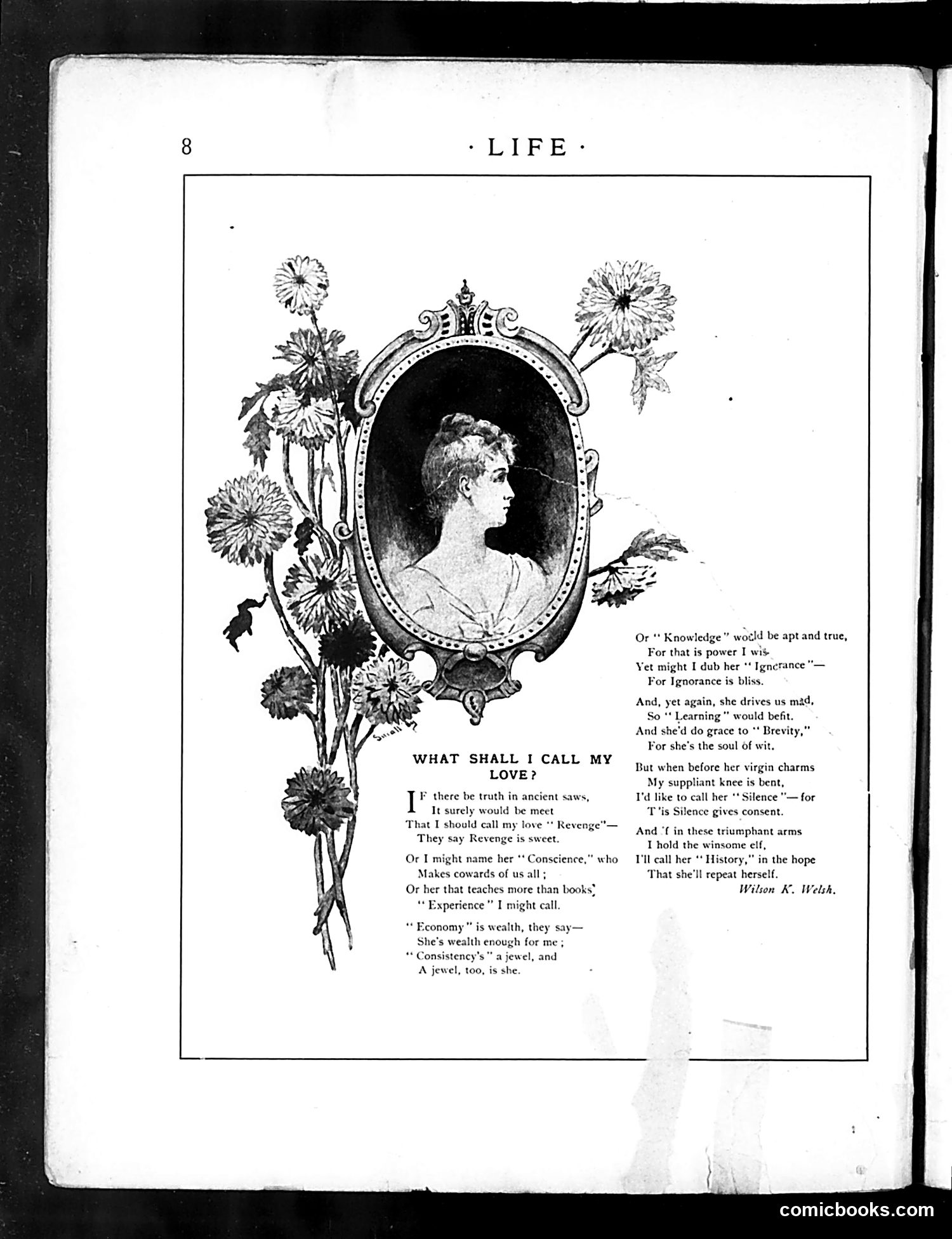
This page from *Life* magazine presents a romantic poem titled "What Shall I Call My Love?" by Wilson K. Welsh, accompanied by an ornamental portrait illustration of a woman's profile in an oval frame, surrounded by decorative flowers (appearing to be daisies or chrysanthemums). The poem is a clever wordplay exercise—a extended conceit where the speaker proposes various abstract qualities as names for his beloved: Revenge, Conscience, Experience, Economy, Consistency, Knowledge, Ignorance, Learning, Brevity, Silence, and History. Each name plays on a familiar saying or proverb (e.g., "Revenge is sweet," "Ignorance is bliss," "Silence gives consent"). The satire targets sentimental Victorian love poetry and masculine romantic posturing. Rather than describing the woman herself, the speaker reduces her to abstract concepts and generic compliments ("winsome elf," "virgin charms"). The final joke—calling her "History" hoping "she'll repeat herself"—mocks both romantic cliché and male presumption about women's roles and predictability. This represents early 20th-century genteel humor for educated readers.
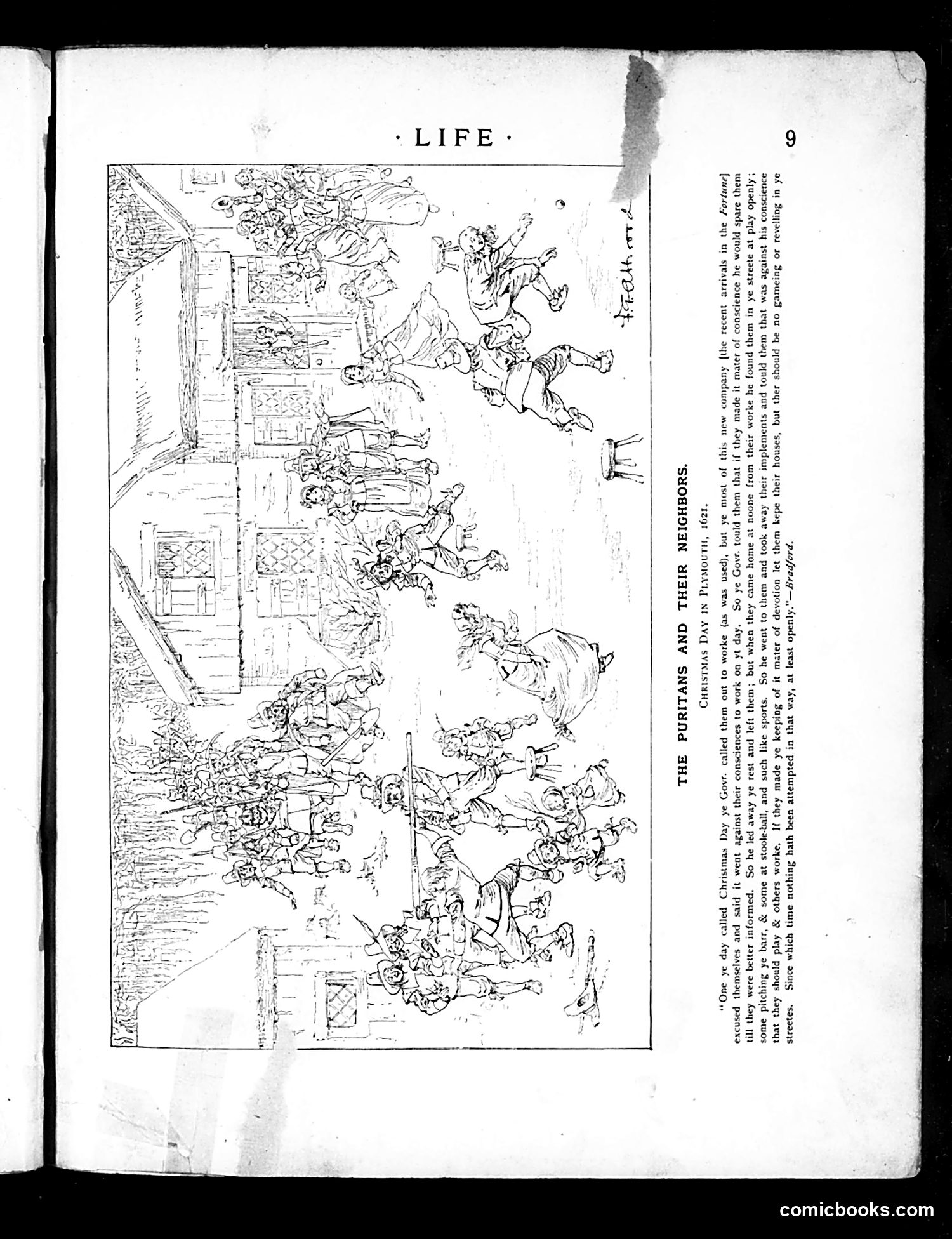
I cannot reliably interpret this page. The OCR text is severely corrupted and largely illegible—it appears to be garbled or improperly scanned, making it impossible to read the actual caption or article text. The image itself shows what appears to be a detailed satirical illustration with many figures in a domestic or social setting, but without legible text, I cannot identify the specific individuals caricatured, the political or social references intended, or the point of the satire. To accurately explain this cartoon to a modern reader, I would need either a clearer image of the text or a reliable transcription. I cannot responsibly guess at the identities or meaning based on the visual alone.
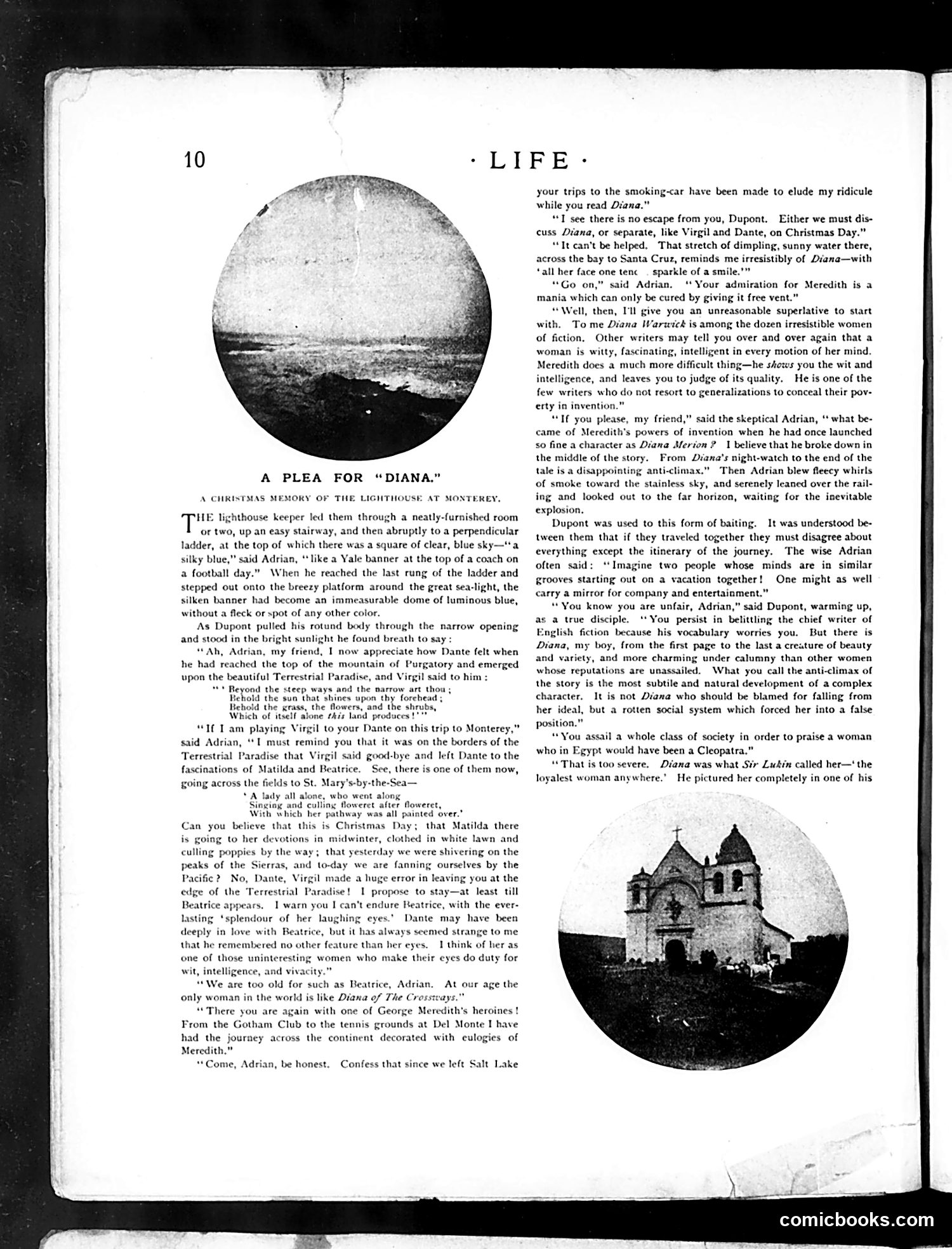
This page satirizes the literary pretensions of American travelers. Two men—Adrian and Dupont—visiting Monterey's lighthouse engage in a learned discussion peppered with references to Dante's *Divine Comedy* and George Meredith's novel *Diana of the Crossways* (1885). The satire targets several things: the affectation of invoking classical literature during casual tourism; Adrian's apparent avoidance of the smoking car to read *Diana* (suggesting escapism); and Dupont's somewhat pedantic enthusiasm for Meredith's heroine as a character who demonstrates wit and intelligence subtly rather than through heavy-handed description. The comparison between the Terrestrial Paradise and California's landscape, along with references to Matilda and Beatrice from Dante, creates ironic juxtaposition between sublime literary ideals and American tourist reality. The photographs of a lighthouse and mission church accompany this literary banter, grounding the abstract discussion in concrete place. The humor lies in these educated men's inability to simply enjoy scenery without literary mediation.
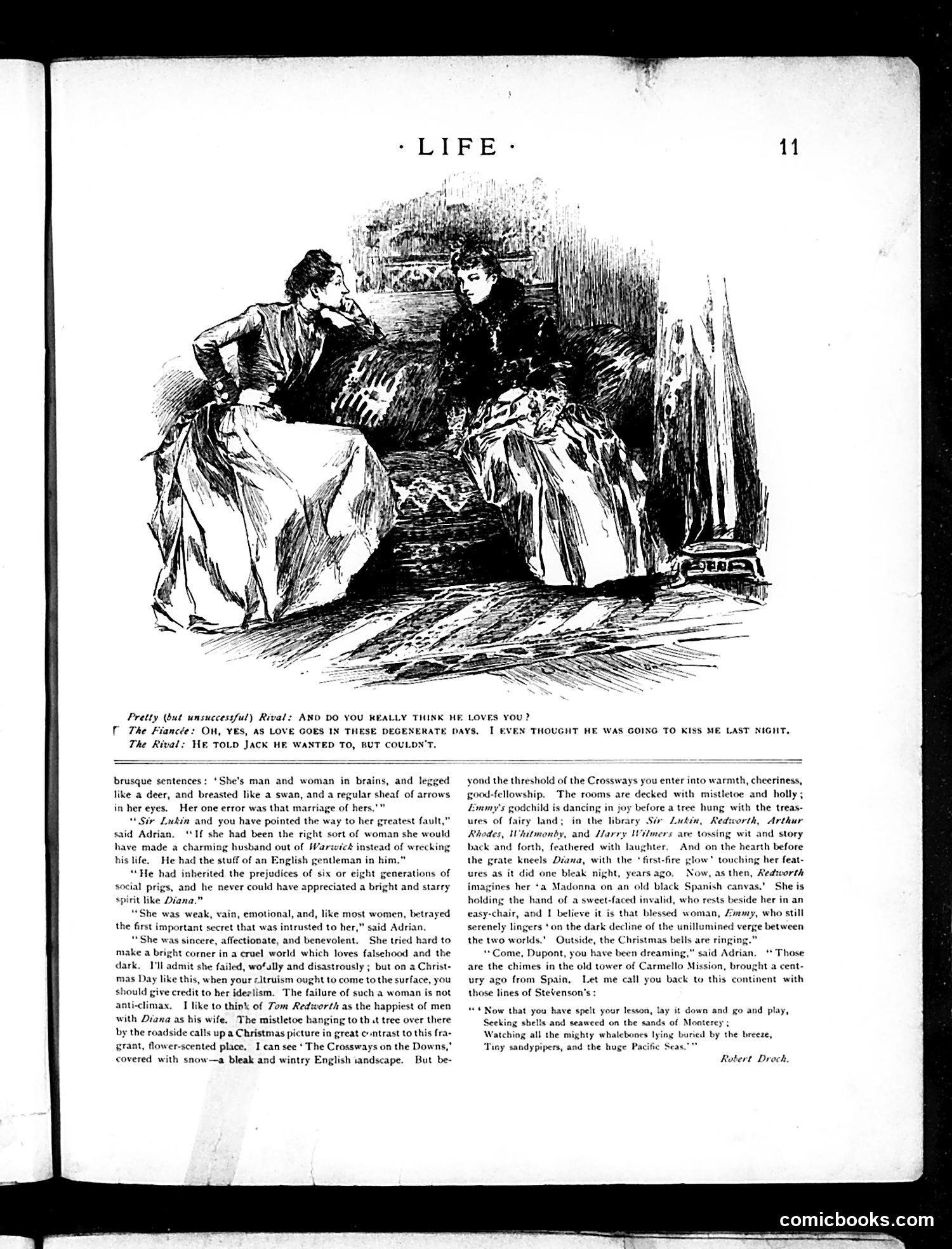
This page from *Life* magazine contains a satirical illustration and literary excerpt rather than a political cartoon. The sketch depicts a romantic scene: a woman confronts her fiancé's rival, questioning whether he truly loves her. The rival admits the fiancé wanted to kiss her but "couldn't." The accompanying text is an excerpt from a novel (appears to be George Meredith's *Diana of the Crossways*, based on character names like Diana, Redworth, and Adrian). It's a literary critique disguised as dialogue, debating a female character's worth—praising her spirit while condemning her for being "weak, vain, emotional" and betraying confidences, yet ultimately championing her capacity for love and goodness. The satire targets Victorian attitudes toward women: celebrating feminine virtue while simultaneously cataloging their perceived weaknesses. The romantic comedy of the illustration contrasts with the serious moral judgment in the text below.
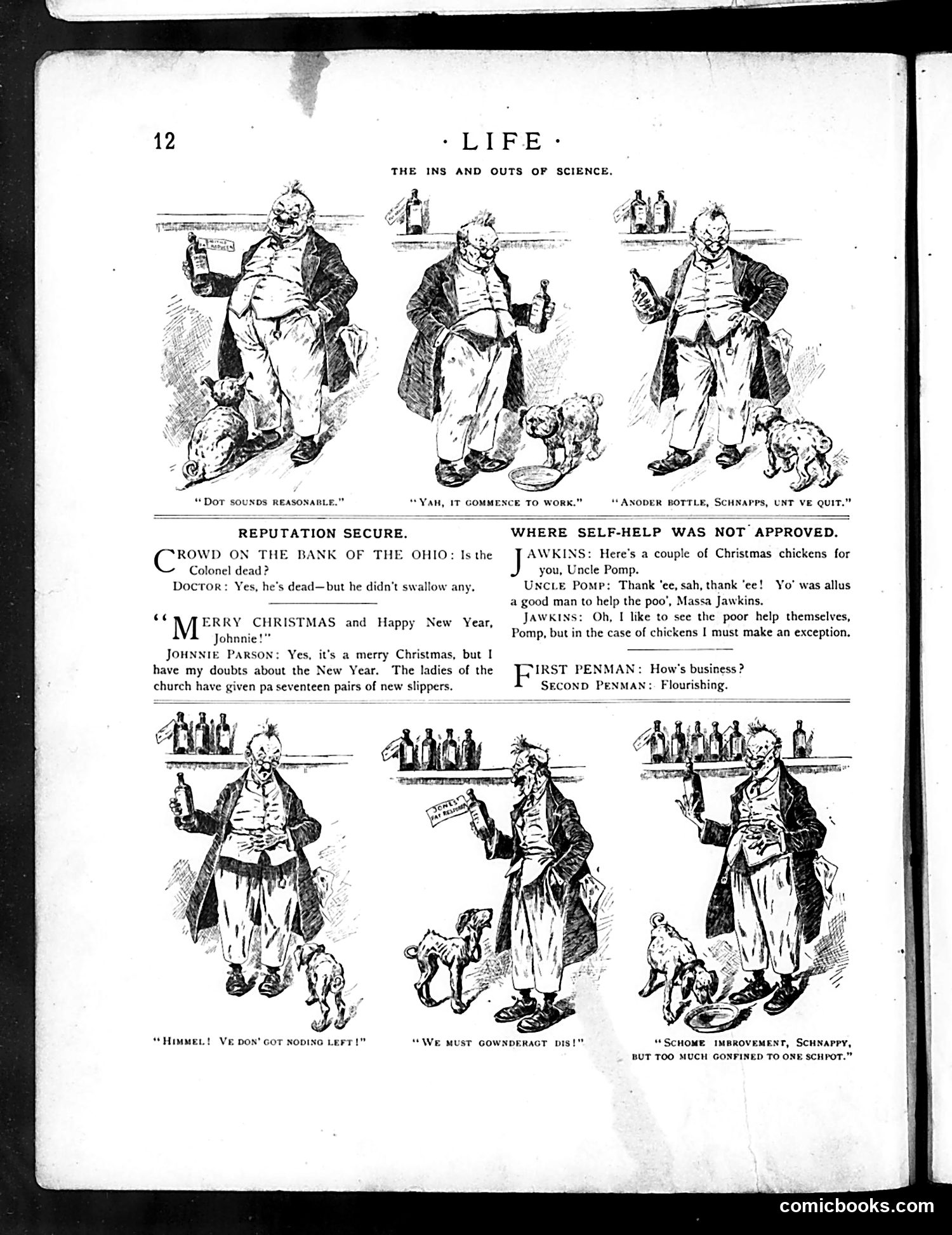
This page satirizes various social types through caricature and dialogue. The top section mocks pseudo-scientific practitioners through exaggerated figures (appearing to represent charlatans or quacks) and their dubious claims about alcohol and health remedies. The lower sections employ ethnic caricature (German and African American dialect humor, typical of late 19th-century American satire) to ridicule: 1. **German immigrants** depicted as heavy drinkers obsessed with schnapps and unable to manage finances ("we don't got nothing left") 2. **Race relations hypocrisy**: A white man (Jawkins) praises "self-help" for the poor generally, but makes an exception for enslaved or formerly enslaved people receiving gifts—exposing the contradiction between stated principles and actual racial attitudes 3. **Business types** boasting superficially about success The satire targets immigrant stereotypes, racial double-standards, and fraudulent scientific claims—reflecting period anxieties about immigration, Reconstruction-era race politics, and medical quackery.
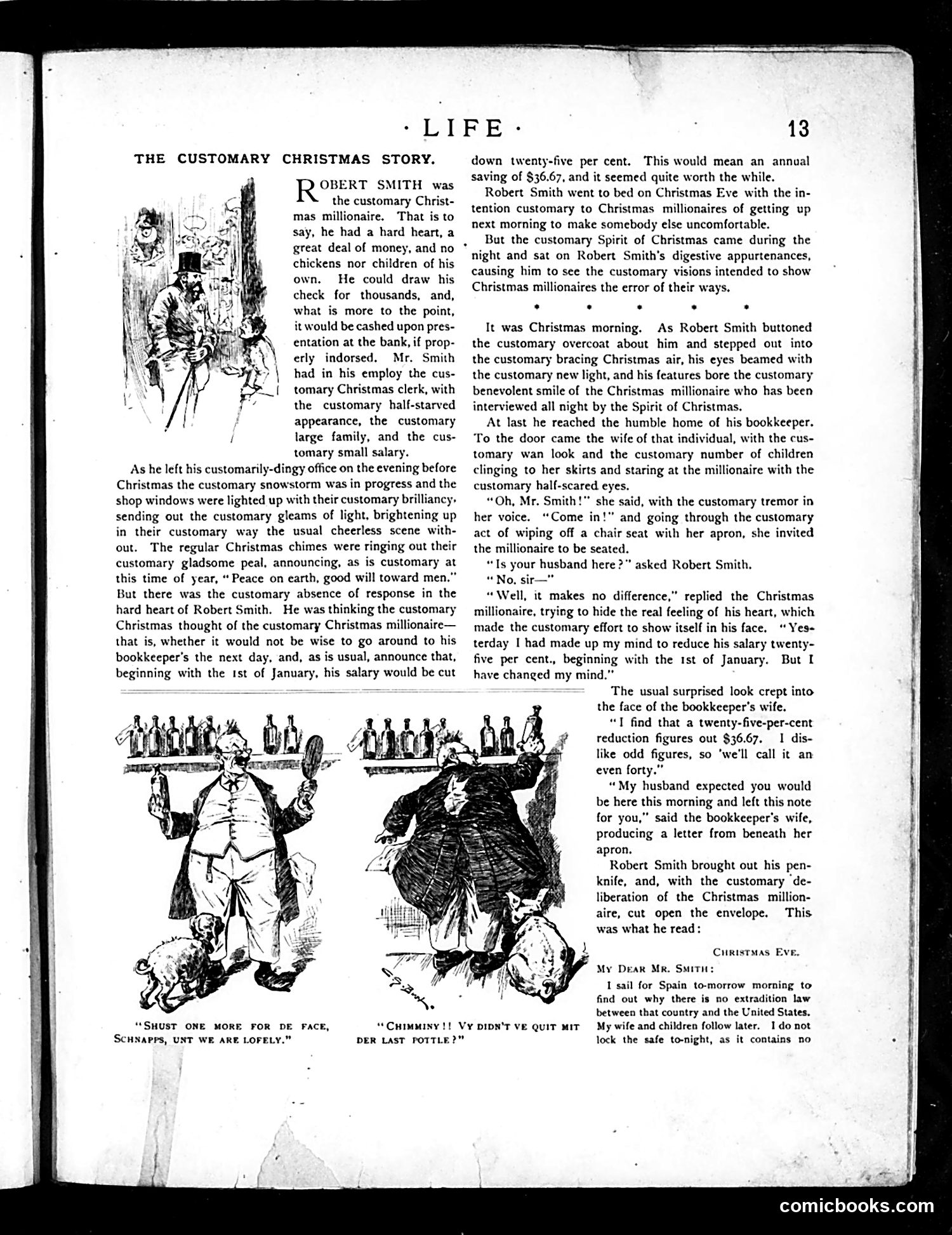
This is a satirical story mocking the predictable "Christmas conversion" narrative popular in Victorian literature. The satire targets Robert Smith, a wealthy miser who embodies every stereotype: hard-hearted, miserly, and exploitative of his underpaid clerk. The humor lies in the *repetition* of "customary"—the author emphasizes that every element (the snowstorm, the Christmas chimes, the poor family) follows a tired, formulaic pattern. Life is satirizing how audiences expected—and demanded—these sentimental redemption stories annually. The cartoons show caricatured German immigrants ("Schnapps," "Chimauny") in what appears to be holiday excess, likely reinforcing stereotypes about working-class Christmas behavior that contrast with Smith's penny-pinching. The story's cruel irony: Smith's "conversion" merely rounds up his salary cut from $36.67 to $40—making his charity a mockery. The satire suggests real social problems (poverty wages, exploitation) can't be solved by sentimentality.
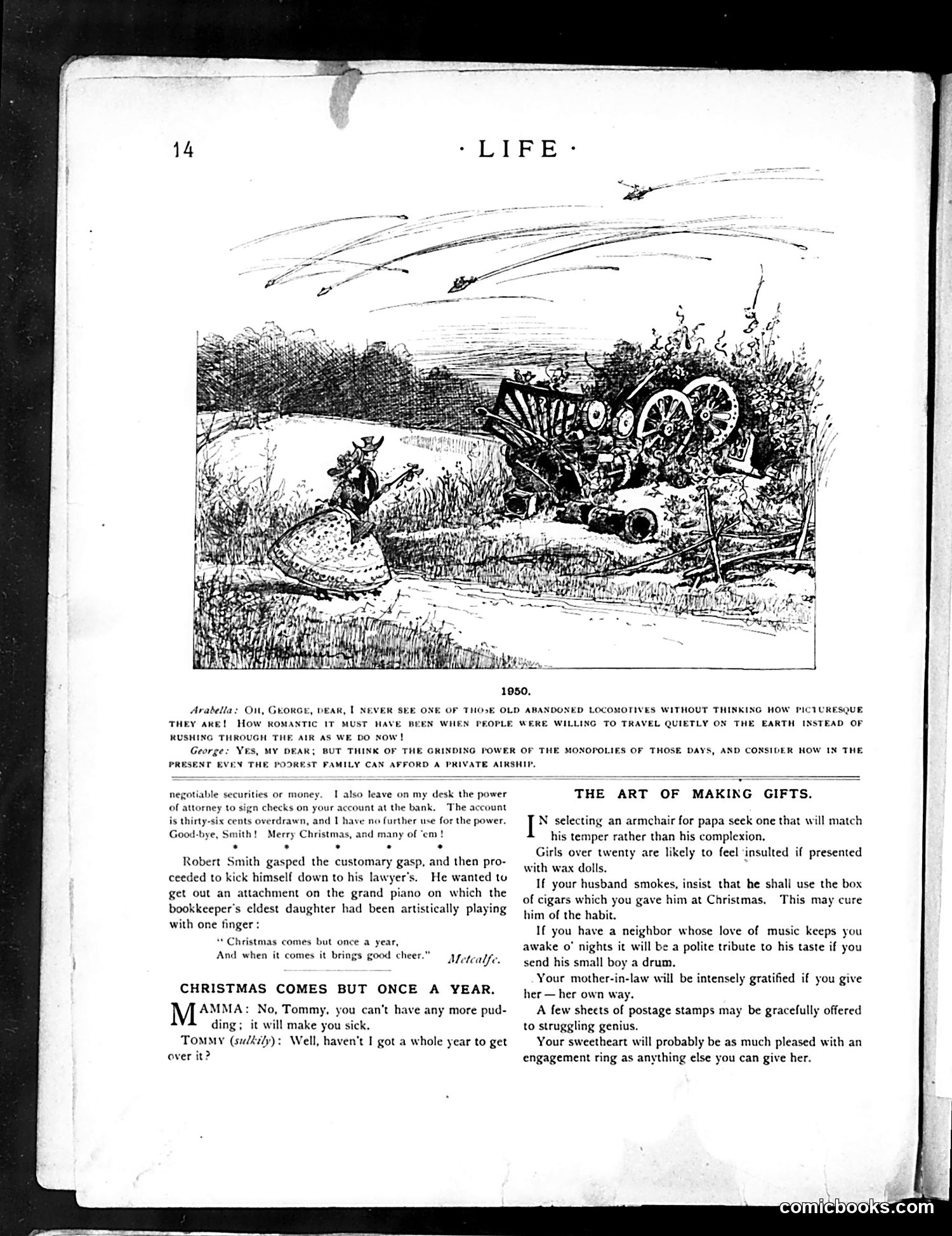
The page contains multiple satirical pieces reflecting post-WWII American prosperity and social attitudes. **Top cartoon:** A couple admires an abandoned locomotive, with the woman romanticizing old train travel. The man responds that while those were "picturesque" times, modern monopolies have democratized luxury—now even poor families own private airships. This satirizes 1950s optimism about technological progress and consumer abundance, mocking the notion that industrial monopolies somehow benefited the masses. **"Christmas Comes But Once a Year":** A dialogue where a mother forbids her son more pudding; he cheekily responds he has a whole year to recover. This gently mocks children's logic and gluttony. **"The Art of Making Gifts":** Humorous advice on gift-giving, including passive-aggressive suggestions (giving a drummer to a noisy neighbor, forcing a smoker to use unwanted cigars). It satirizes marriage dynamics, class pretense, and the awkwardness of gift-giving as social obligation. Overall, the page reflects 1950s middle-class anxieties about consumption, family relations, and technological change with gentle, domestic humor.
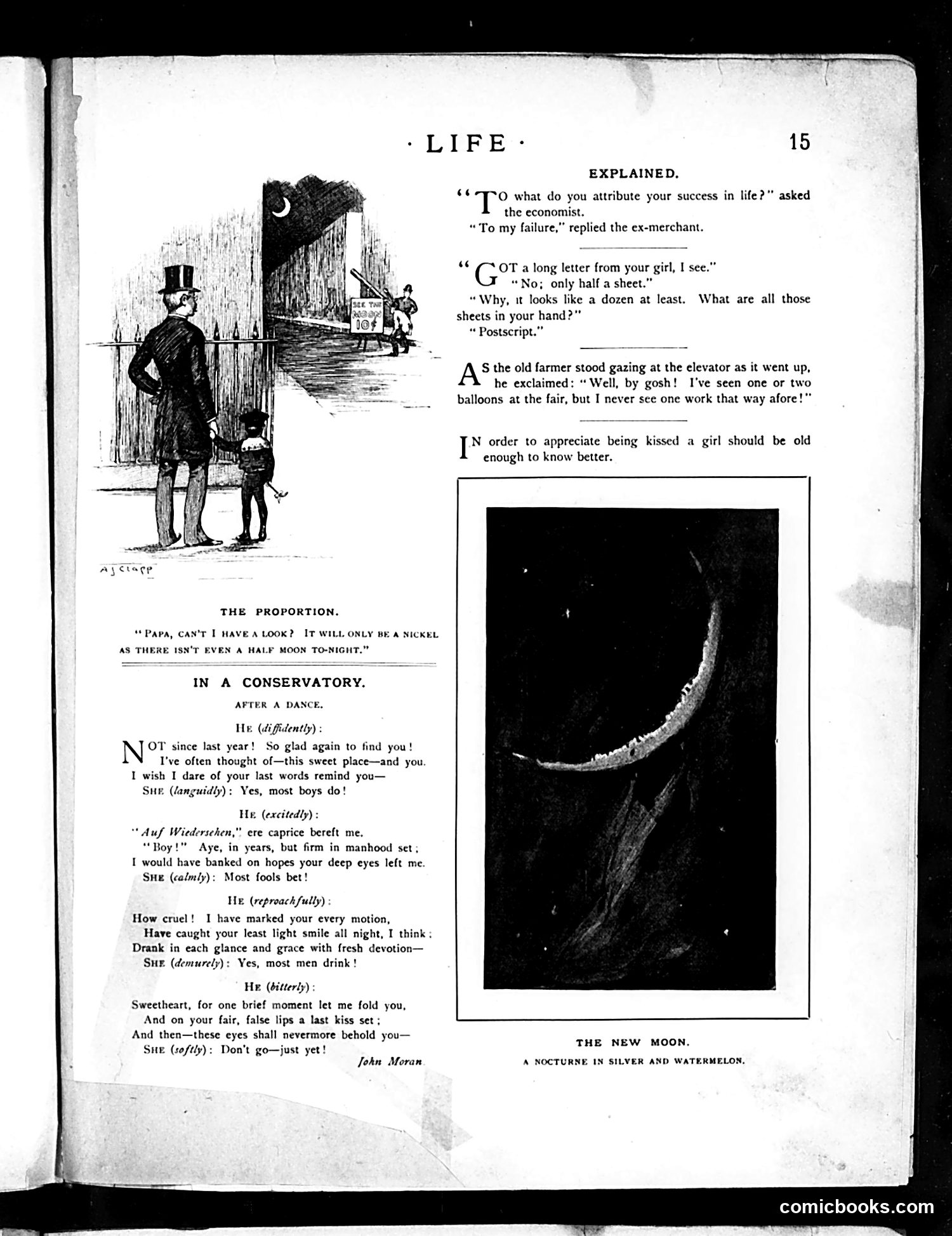
This page contains several brief humorous quips and one longer dramatic poem, typical of *Life* magazine's satirical format. **The jokes** mock social conventions: a failed merchant attributes success to failure (ironic reversal); a girl's postscript-heavy letters suggest excessive correspondence; a farmer mistakes an elevator for a hot-air balloon (rural ignorance of modern technology); and a child wants to see the moon for a nickel (childhood logic). **"In a Conservatory"** is a longer romantic dialogue where a man earnestly expresses devotion after a year's absence, but the woman (labeled "She") repeatedly undercuts his sentiment with dry rejoinders—"most boys do," "most fools bet," "most men drink." The satire targets sentimental male romanticism, suggesting women see through performative passion. The man's final plea ("Don't go—just yet!") ironically validates her cynicism. The accompanying illustration shows an elevator—a modern marvel—reinforcing the rural-vs.-urban divide of the era.
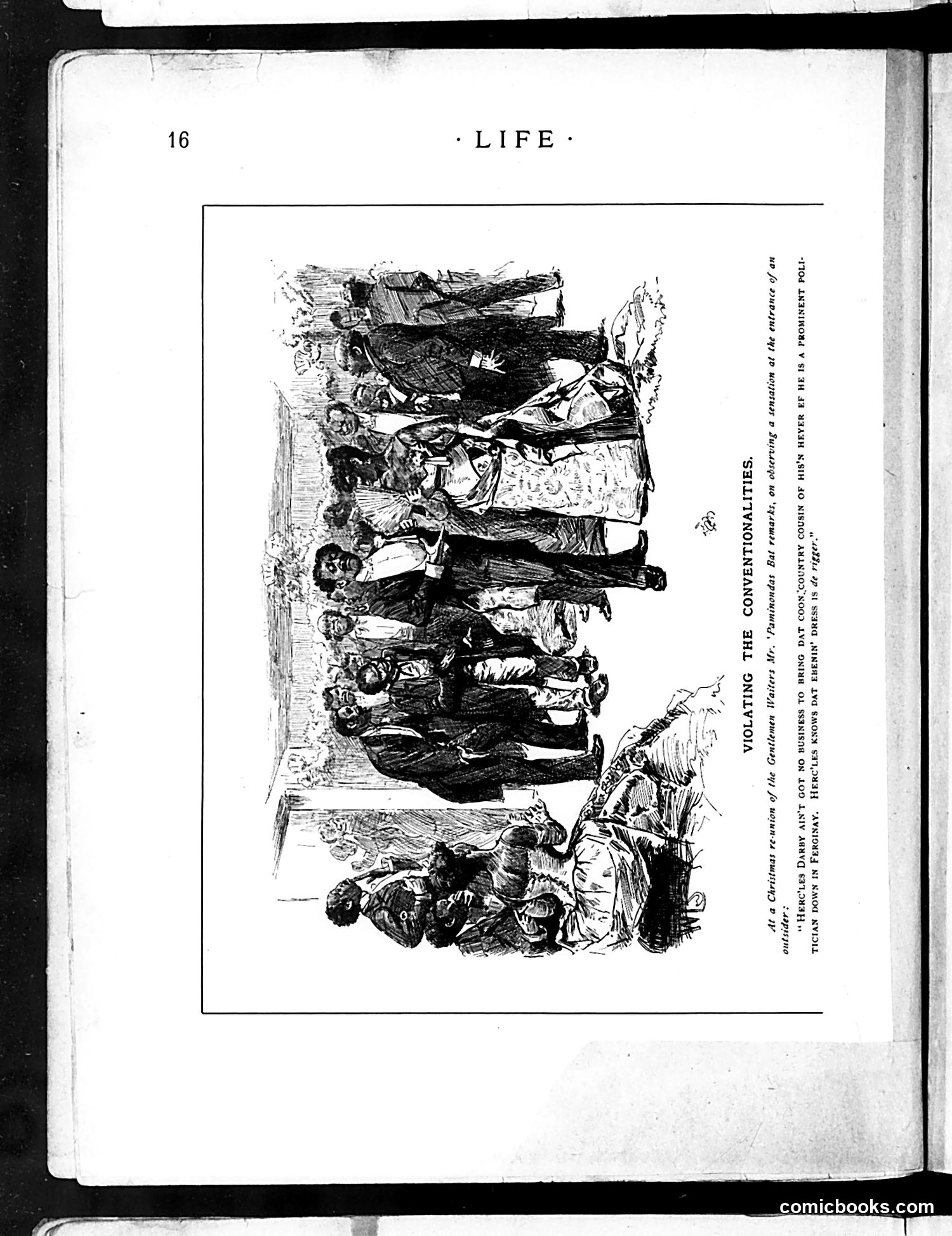
The OCR text is largely corrupted and unreadable. However, the image shows a satirical sketch depicting multiple figures in period dress arranged vertically in what appears to be a social scene. The title "VIOLATING THE CONVENTIONALITIES" suggests the cartoon critiques people breaking social norms or etiquette rules. The sketch uses caricature to mock those flouting Victorian or Edwardian social conventions—likely depicting exaggerated behavior considered improper for the era. Without legible text identifying specific figures or events, the exact targets remain unclear, but the general satire appears to ridicule unconventional social conduct or those challenging established propriety. This was typical Life magazine content: social commentary through humorous caricature.
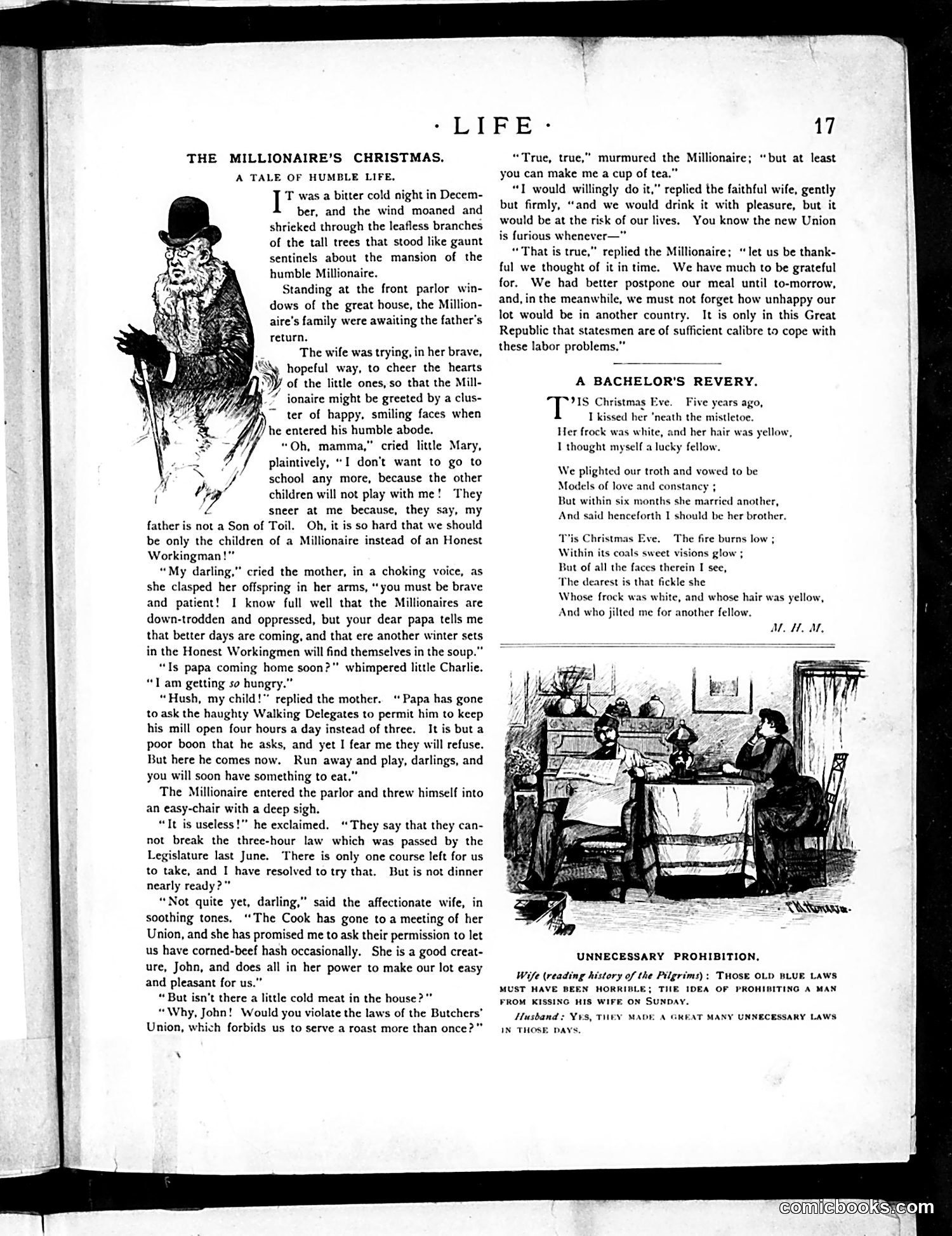
This page contains satirical commentary on labor union power in late 19th-century America. "The Millionaire's Christmas" is an ironic tale inverting class sympathy: a wealthy factory owner and his family are portrayed as *oppressed* by union restrictions. His children suffer social stigma for not being "workingmen," his cook requires union permission to serve meals, the Butchers' Union prevents serving roast twice, and Walking Delegates restrict his mill to three-hour days. The satire mocks both the millionaire's meekness and, implicitly, the unions' growing power to dictate terms. The accompanying poem "A Bachelor's Revery" is unrelated—a sentimental lament about lost love. The illustration shows a bearded, sympathetic-looking figure (the "humble Millionaire"), visually contrasting the text's ironic premise that wealth now brings powerlessness against organized labor.
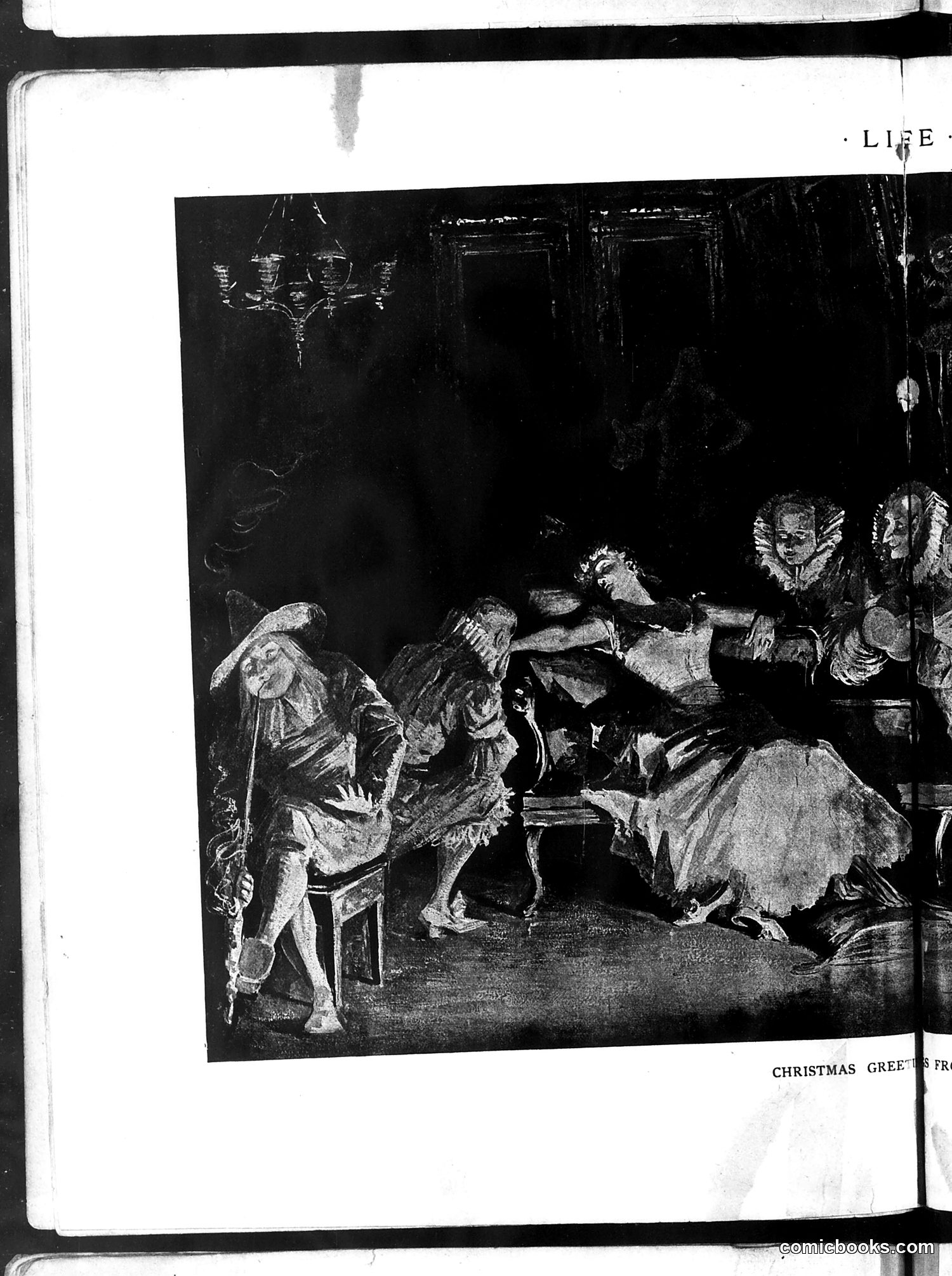
This appears to be a satirical illustration titled "Christmas Greetings From..." (text cut off). The black and white image depicts a theatrical or courtly scene with elaborately dressed figures in period costume, including what appear to be aristocratic or royal characters with ornate clothing, feathered headpieces, and formal military dress. The exact political or social commentary is unclear without the complete caption. However, given Life magazine's satirical nature, this likely mocks either contemporary political figures depicted in historical costume, or comments on aristocratic pretension and excess during the Christmas season. The formal, staged quality suggests theatrical mockery of high society or government officials. Without the full text visible, the specific targets and point of satire remain uncertain.
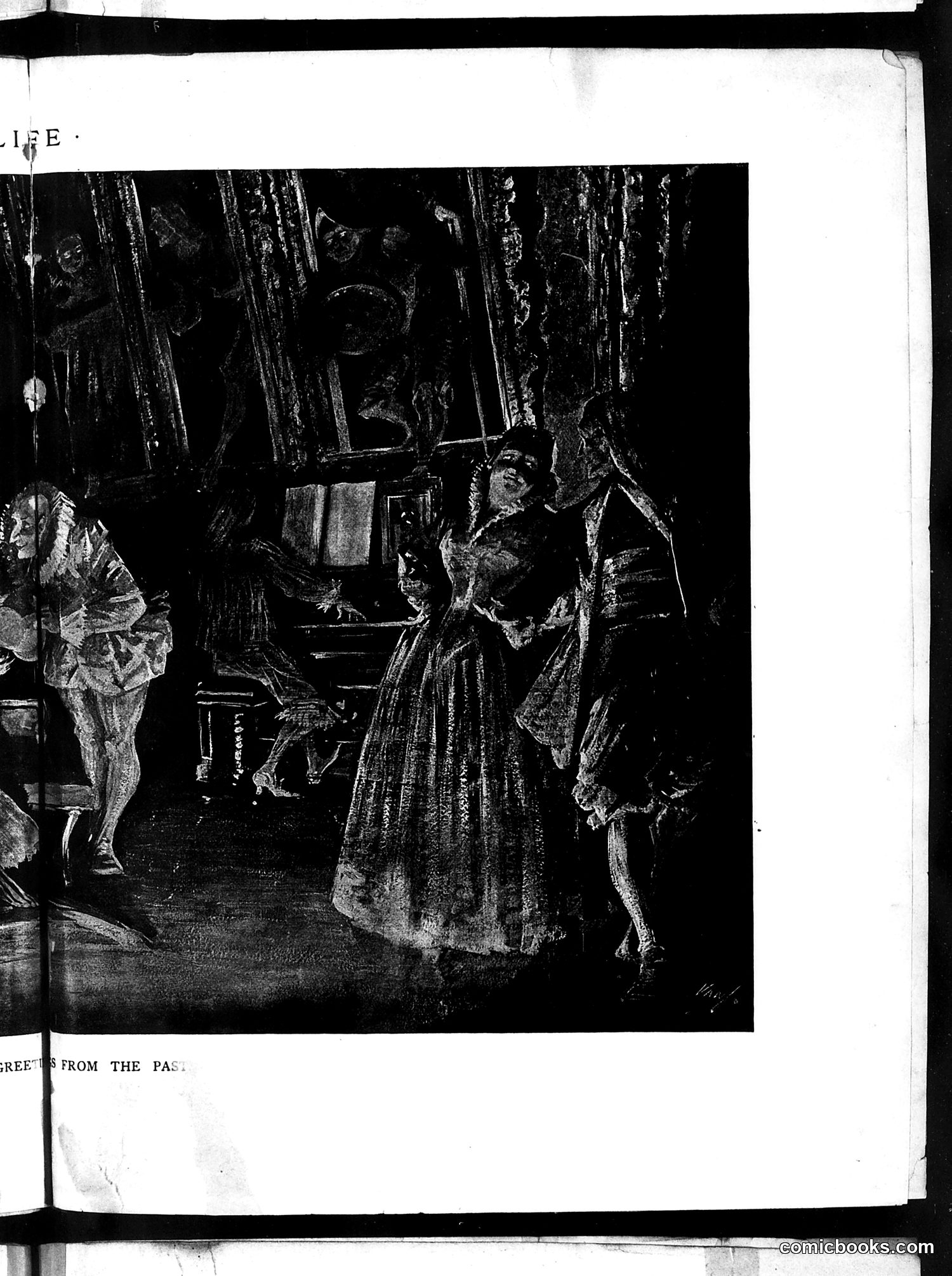
I can see this is a dramatic black and white illustration showing what appears to be a theatrical or operatic scene with multiple figures in period costumes gathered indoors. The partial caption at the bottom reads "...FROM THE PAS..." (likely "PASSION" or similar). However, the OCR text is heavily corrupted and illegible, making it impossible to identify the specific figures, historical references, or satirical point being made. Without clear text identifying the characters or the intended subject matter, I cannot reliably explain what political or social commentary this cartoon contains or who the caricatured figures represent. To provide accurate analysis, I would need either clearer OCR text or additional context about this Life magazine issue's date and theme.
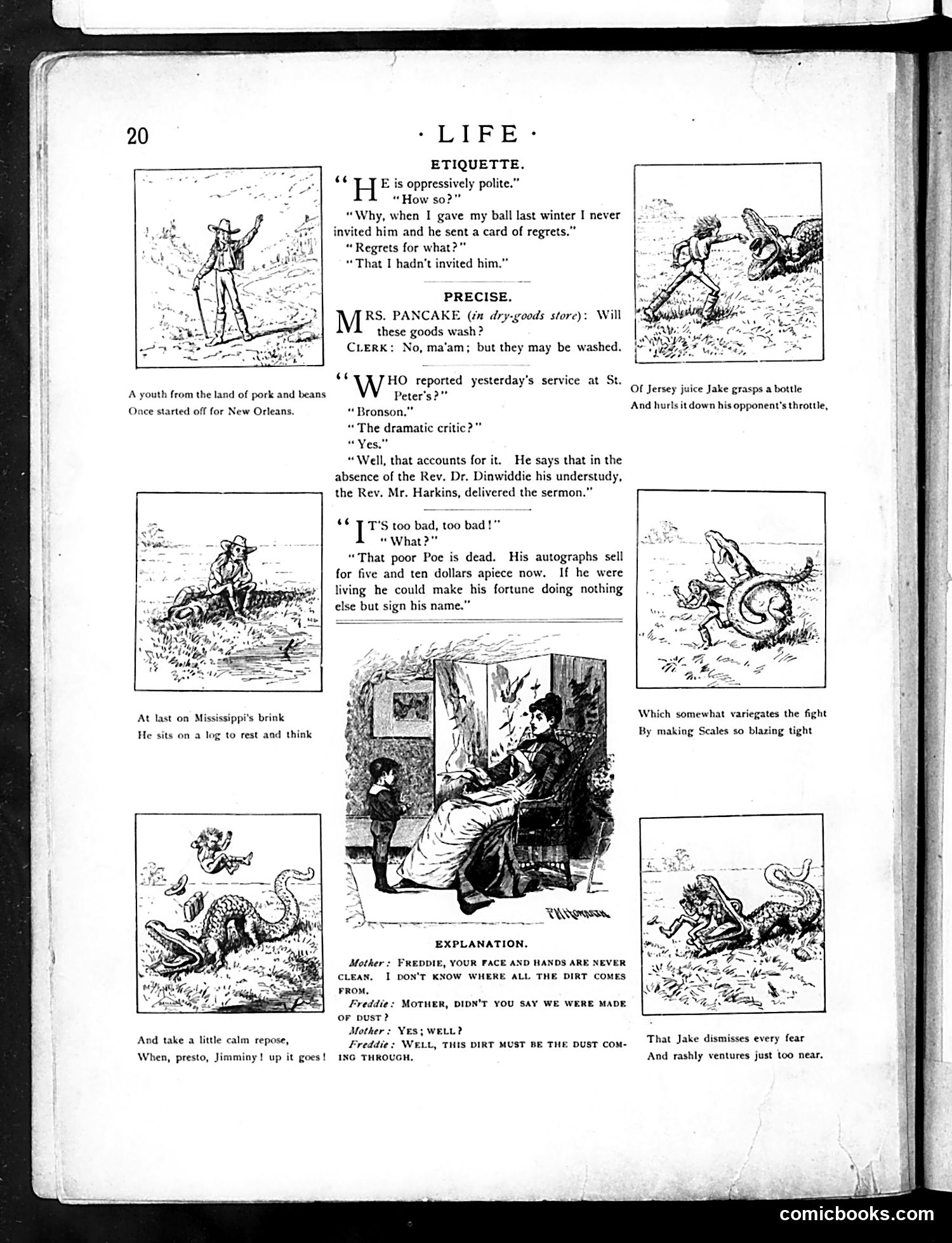
This page contains several short satirical pieces typical of Life magazine's humor: **"Etiquette"** mocks excessive politeness—a man sends regrets for a ball he wasn't invited to, treating the non-invitation as an offense requiring formal apology. **"Precise"** plays on linguistic pedantry: a clerk distinguishes between goods that won't wash versus goods that "may be washed" (technically correct but meaningless). **The Poe reference** jokes darkly about Edgar Allan Poe's death increasing his autographs' value, suggesting he'd be financially better off dead than alive signing his name. **"Explanation"** is a humorous parent-child dialogue where a boy argues that since humans are made of dust, the dirt on him is simply dust "coming through" his body—absurdist logic. The illustrated narratives show a youth encountering alligators on the Mississippi River and a street fight involving "Jake" and "Scales." These pieces exemplify Life's style: brief comic scenarios exploiting social pretension, logical absurdities, and wordplay rather than topical political satire.
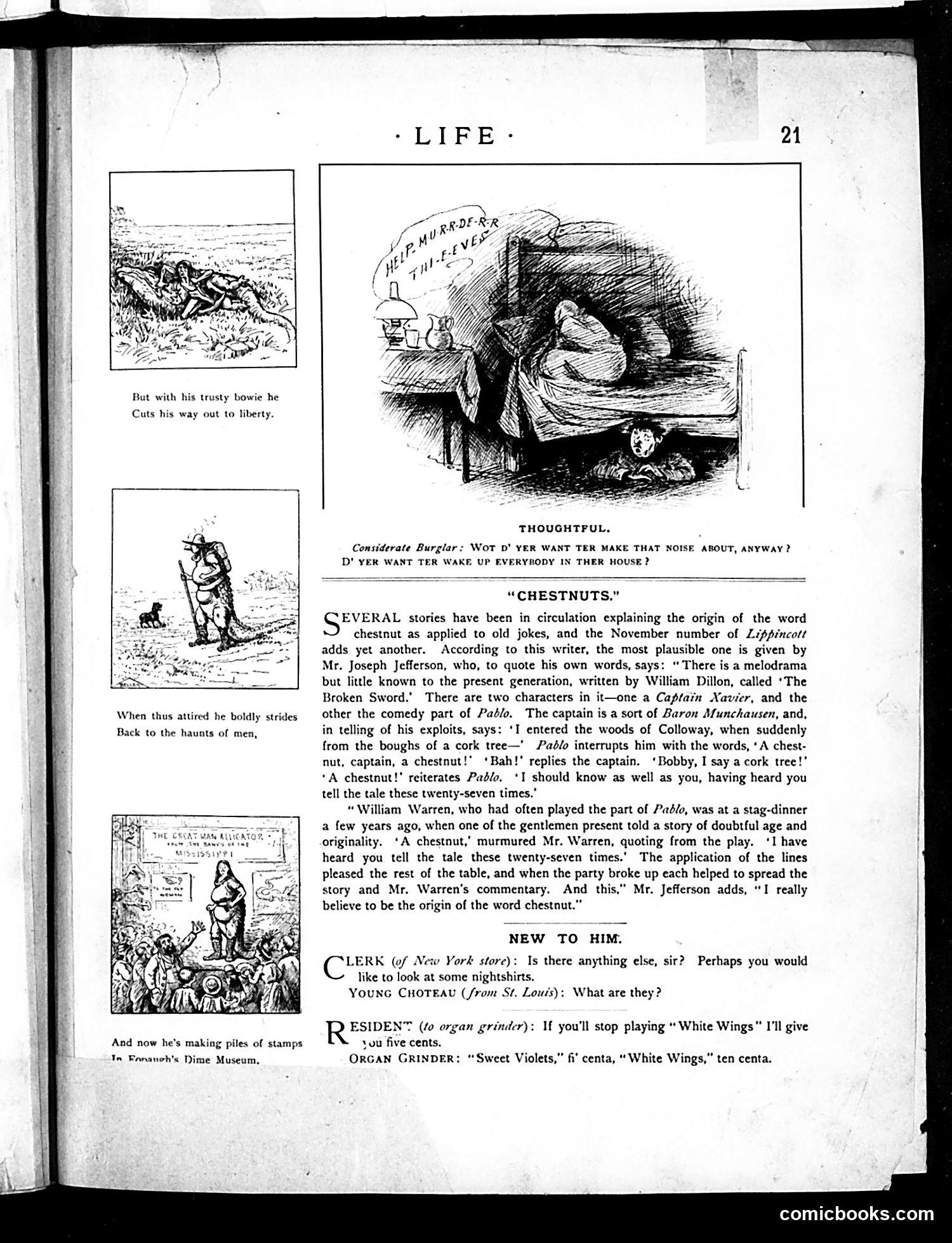
This page contains three distinct satirical pieces: **Top cartoons** depict a burglar escaping ("cuts his way out to liberty") using a bowie knife—likely commentary on crime or lawlessness, though context is unclear. **"Thoughtful" cartoon** shows a considerate burglar worried about making noise during a robbery—absurdist humor satirizing the contradiction of a "polite" criminal. **"Chestnuts" article** explains slang origin: the term "chestnut" (meaning an old, worn-out joke) allegedly comes from William Dillon's melodrama *The Broken Sword*, where character Pablo repeatedly interrupts Captain Xavier's tall tale with "A chestnut!" Actor William Warren popularized this as witty commentary at dinner parties, spreading the phrase. **"New to Him" section** features comic dialogue: a store clerk offers "nightshirts" to a young man from St. Louis who doesn't know what they are—rural/urban culture-clash humor. Below, an organ grinder negotiates song prices, with "White Wings" worth five cents but "Sweet Violets" only five cents.
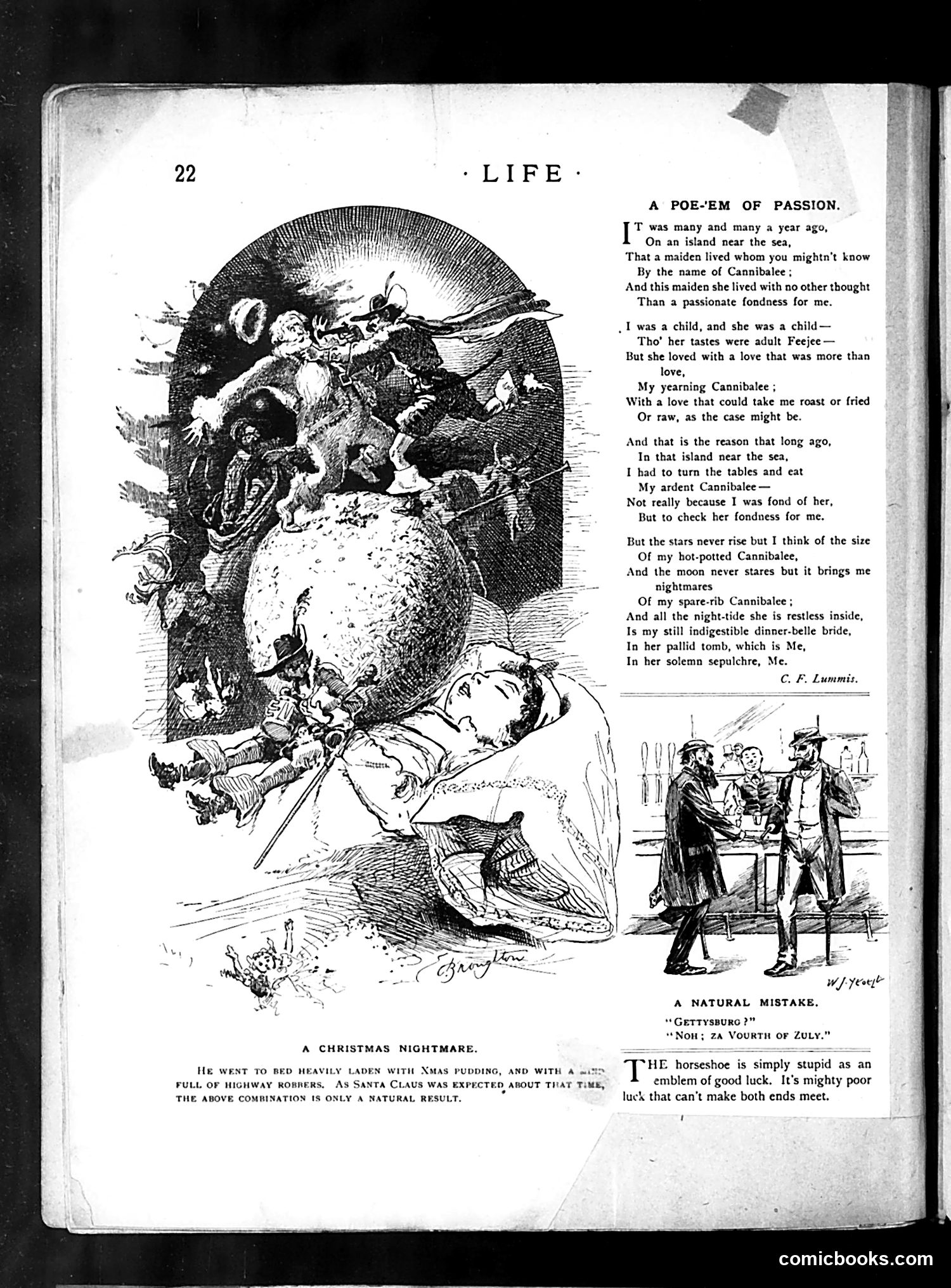
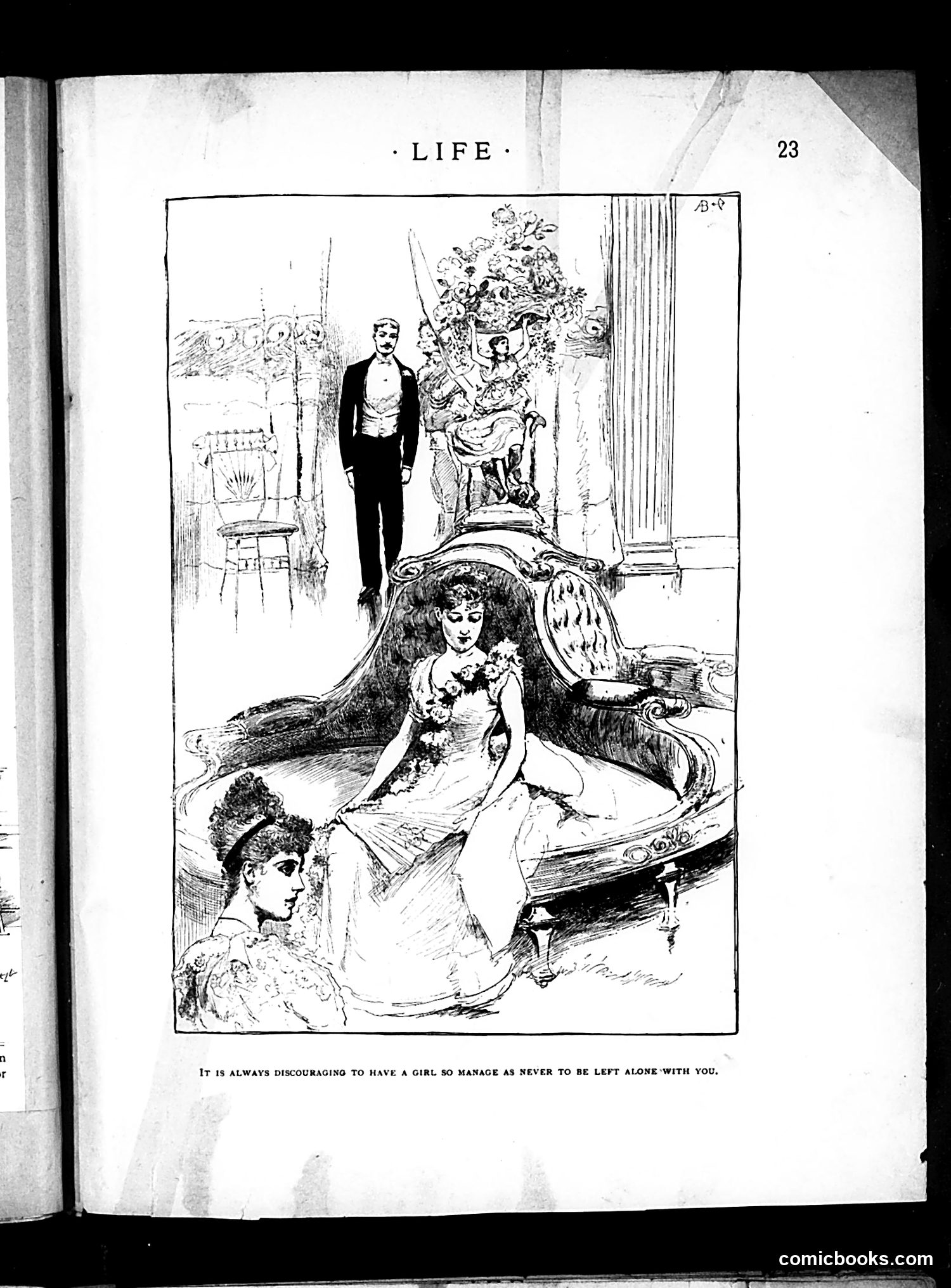
This illustration depicts a romantic/social comedy scene from what appears to be the early 20th century. A well-dressed man in formal attire stands observing a woman in an elaborate white dress seated on a decorative sofa, attended by a chaperone or companion. The caption expresses the gentleman's frustration about being unable to have private time with the young woman. The satire targets Victorian-era courtship conventions, specifically the strict social practice of chaperoning unmarried women. The joke highlights the tension between romantic interest and rigid propriety—the man finds it "discouraging" that the woman is never left unattended, preventing any unsupervised interaction. This reflects period anxieties about changing social norms and young people's desire for greater freedom in romantic pursuits, presented here as lighthearted social commentary rather than serious critique.
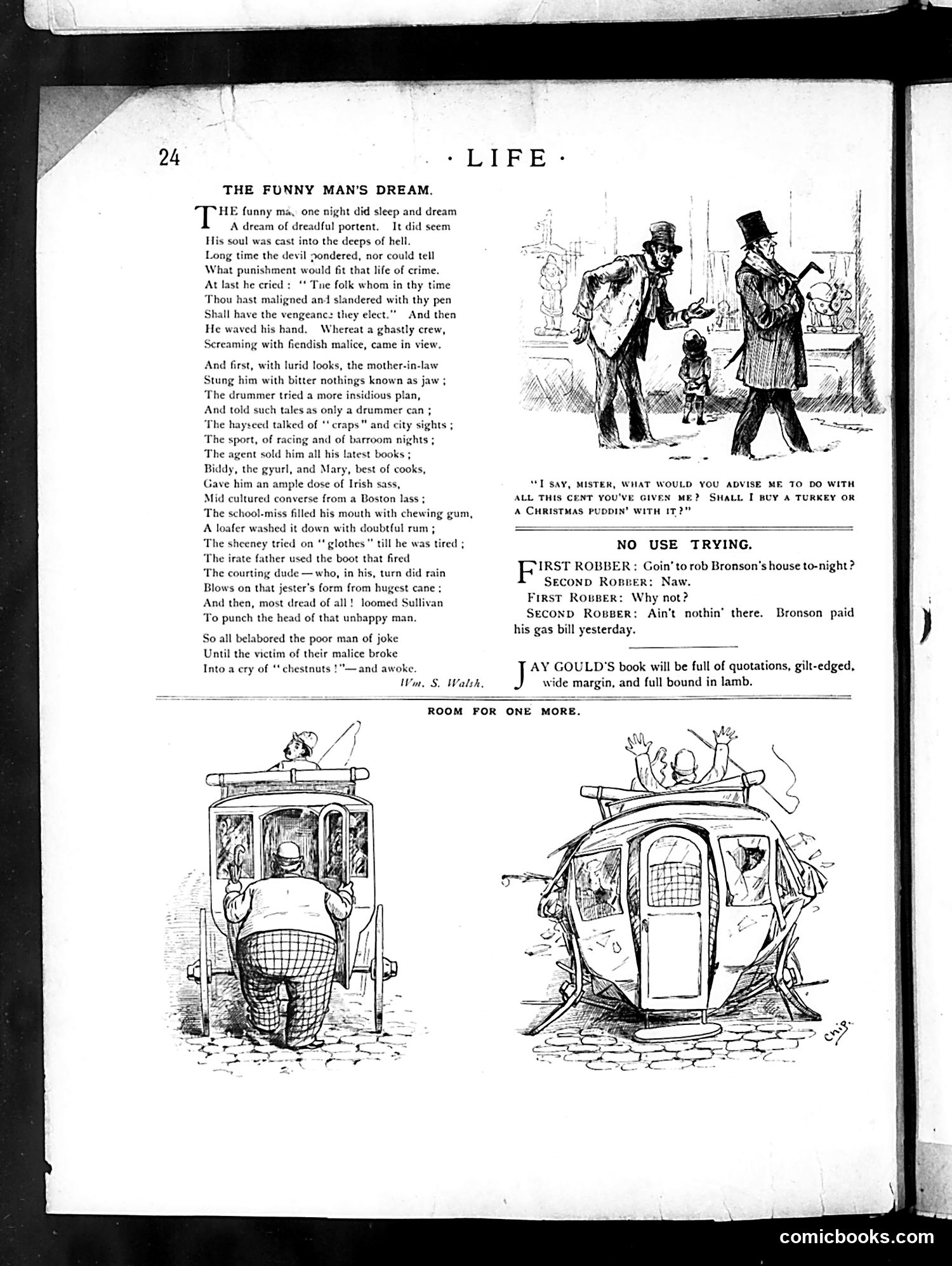
This page from *Life* magazine satirizes humor writers and comedians of the era. "The Funny Man's Dream" is a moral fable where a comic is punished in hell by all the stereotypical characters he has mocked in print—mothers-in-law, drummers, Irish servants, Jewish immigrants ("sheeney"), and others. The "chestnuts" reference means tired, overused jokes, suggesting the humorist deserves torment for recycling stale material. The lower cartoon "No Use Trying" jokes about poverty: robbers won't burgle a man's house because he's already so poor he can't even pay his gas bill—there's nothing worth stealing. Both pieces reflect *Life*'s satirical style: mocking popular comedy tropes, social stereotypes (rendered with period prejudices), and contemporary figures. The cartoons employ ethnic caricature common to 1890s-1900s humor, now considered offensive.
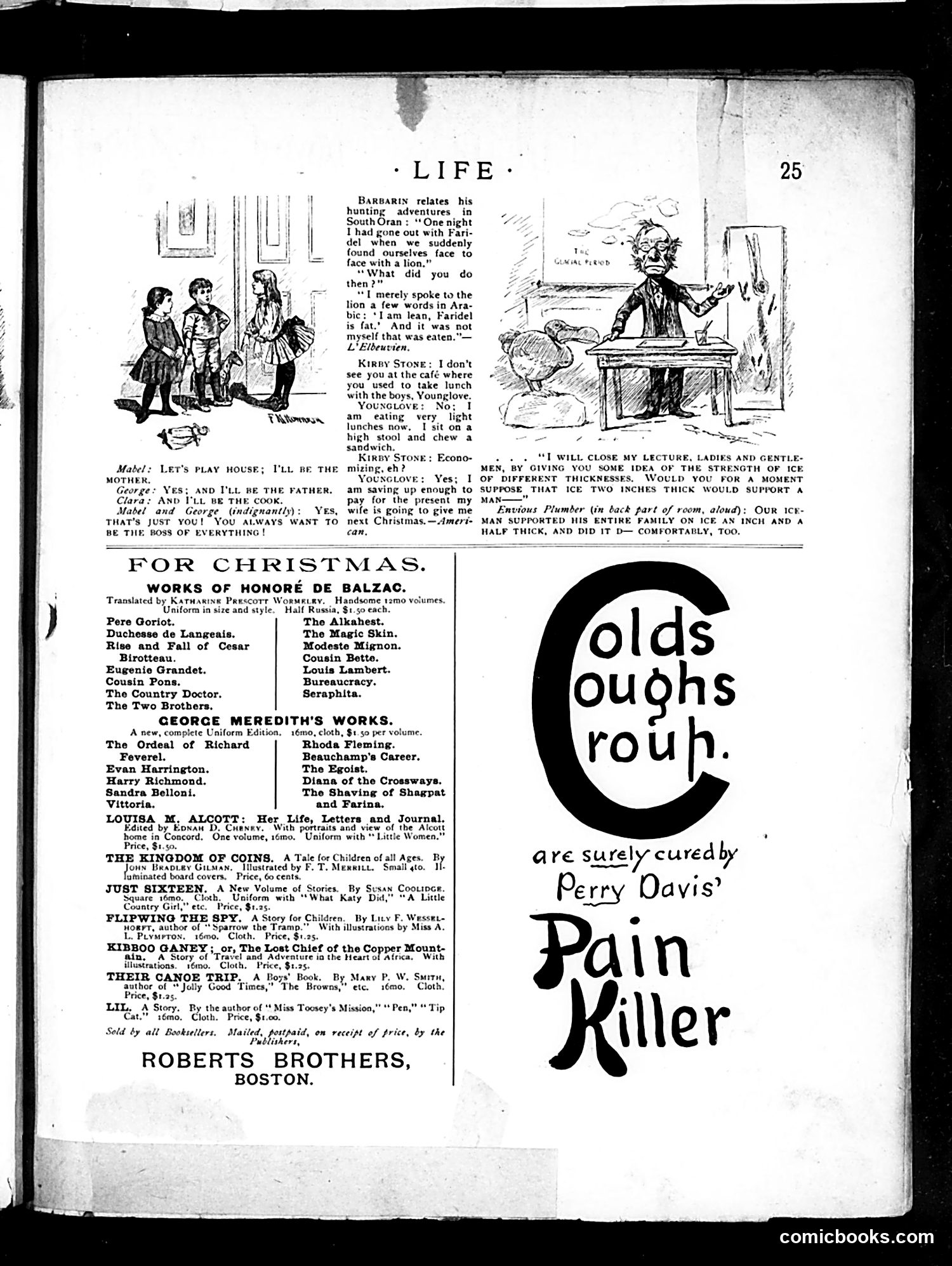
This page contains three separate humor cartoons typical of Life's satirical style: 1. **"Let's Play House"**: Children argue over domestic roles—the girl wants to be mother and cook, the boys resist, claiming they "always want to be boss of everything." This satirizes gender expectations and children's awareness of household hierarchy in the Victorian/Edwardian era. 2. **The Lunch Economy Joke**: A man explains he eats light lunches while sitting on a high stool to save money for his wife's Christmas gift. The humor lies in the absurd economy measure. 3. **The Ice Lecture**: A professor lectures on ice thickness's load-bearing capacity. An "envious plumber" interrupts with a tall tale about supporting his entire family on one-inch-thick ice, mocking both the professor's pedantry and working-class exaggeration. The remaining content is book advertisements from Roberts Brothers publishers, listing works by Balzac, Meredith, Louisa May Alcott, and others—standard Christmas gift suggestions for the period.
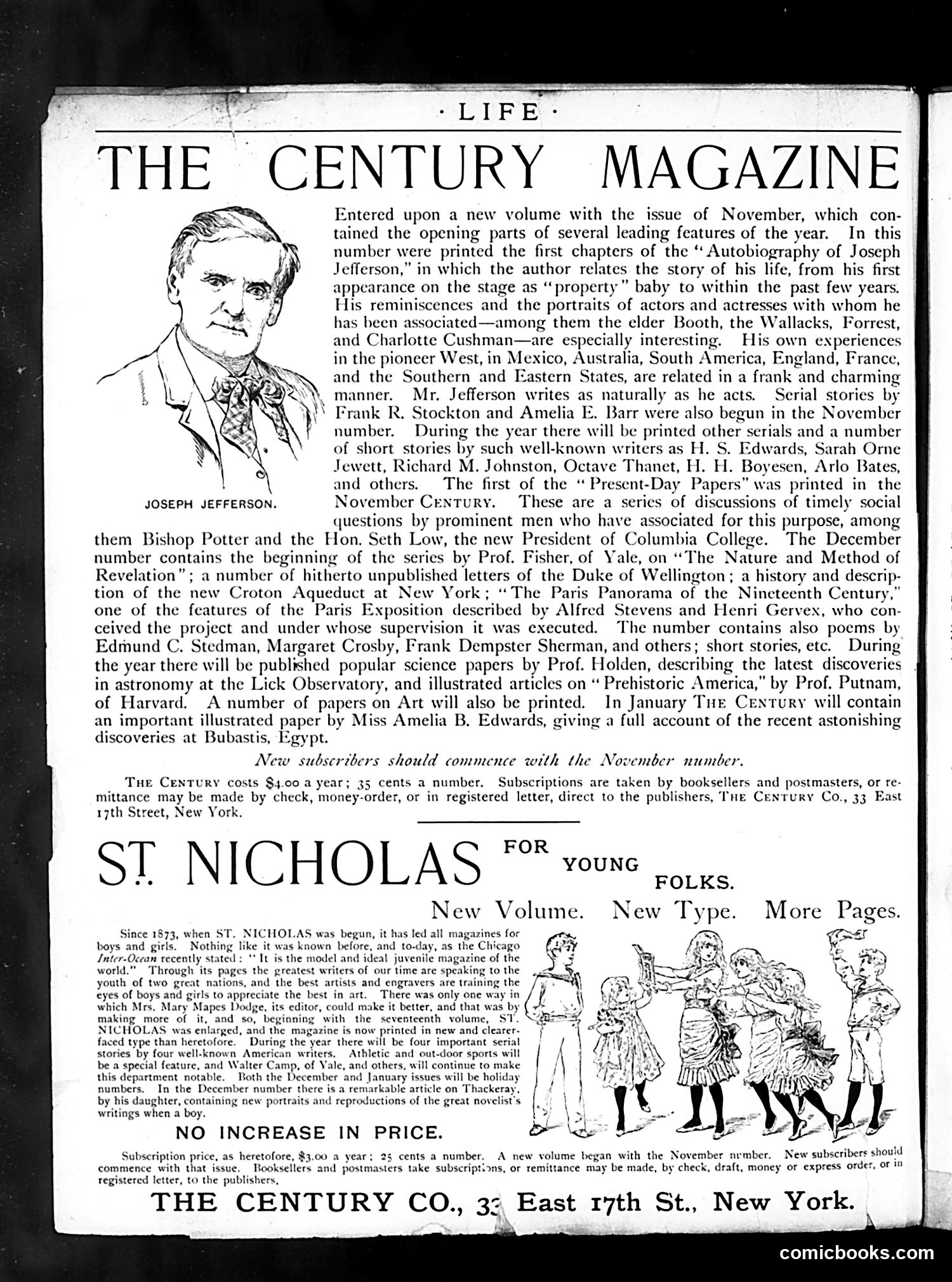
This page is primarily **advertising copy** for two prestigious American magazines rather than satirical content. **The Century Magazine** section features a portrait of **Joseph Jefferson**, a renowned 19th-century actor, promoting his serialized autobiography. The text highlights upcoming literary content by established writers (Stockton, Barr, H.S. Edwards) and scholarly pieces on topics like Egyptian archaeology and astronomy—positioning *Century* as highbrow, culturally sophisticated reading. **St. Nicholas** advertisement promotes the children's magazine, claiming it's "the model and ideal juvenile magazine of the world" (quoting the Chicago Inter-Ocean). It emphasizes the publication's expansion to a new, larger format while maintaining its $1 subscription price. Both sections target educated, affluent readers—*Century* for adults interested in literature and science; *St. Nicholas* for parents seeking quality children's content. There is no political satire visible; this is straightforward magazine promotion highlighting editorial prestige and value.
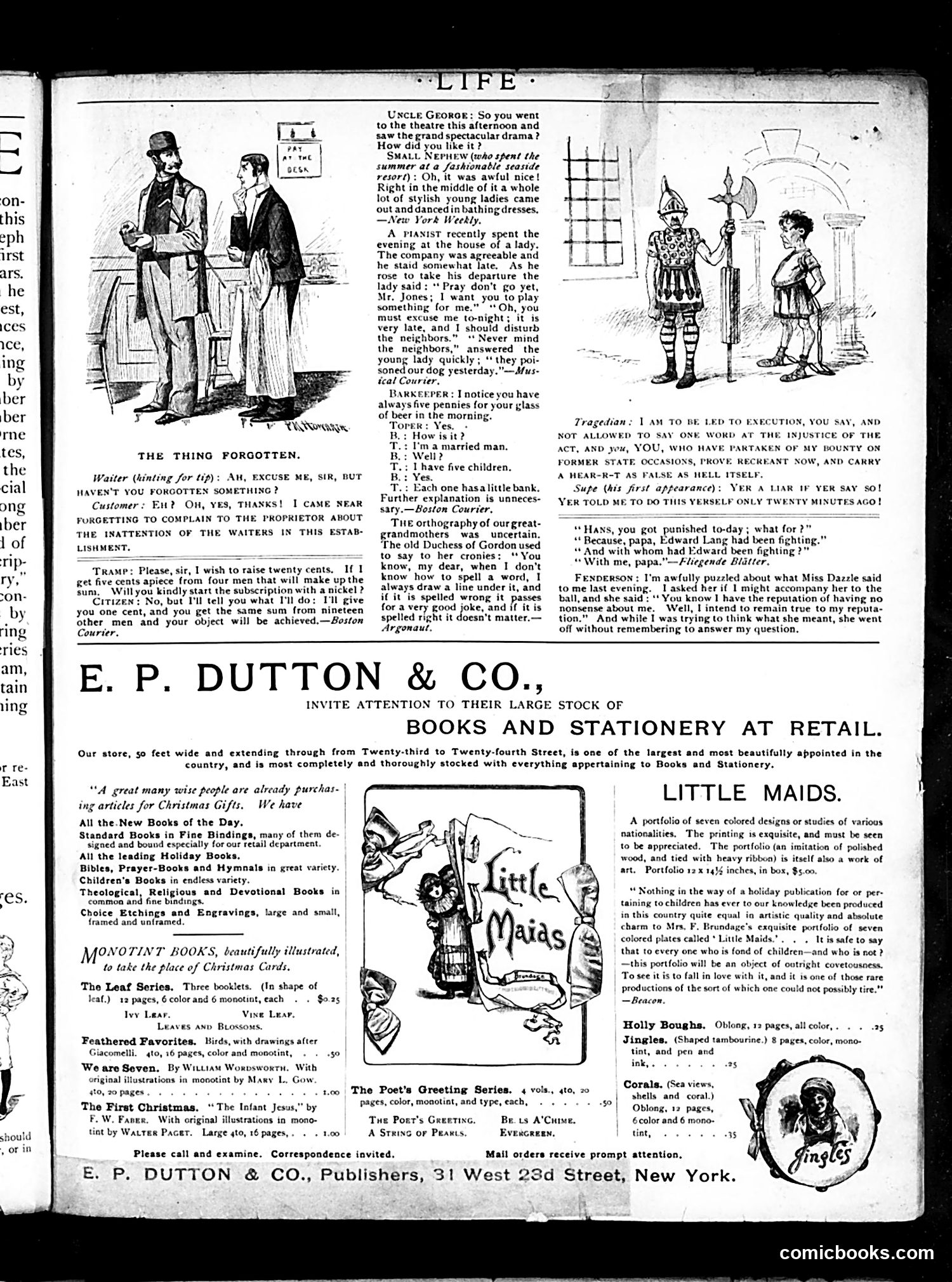
**"The Thing Forgotten"** is the main satirical cartoon, depicting a waiter hinting for a tip while a customer responds that he nearly forgot to complain about the waiters' poor service—the irony being the waiter's inattention made the customer forget the gratuity entirely. The page contains several other brief humorous anecdotes about social awkwardness: - A tramp's math puzzle to extract nickels from citizens - A child's confusion about theatrical "bathing dresses" versus actual seaside bathing - A pianist refusing to play, claiming he'd disturb neighbors (whose dog he'd poisoned) - A bartender's explanation of five pennies correlating to five children with piggy banks The humor relies on logical absurdities, social class commentary, and wordplay typical of 1880s-90s American humor. The page is otherwise dominated by **advertising**: E.P. Dutton & Co. publishers promoting books and stationery, including children's books like "Little Maids" and "Jingles."
This is **not a cartoon page**—it's a advertisements section from *Life* magazine featuring two luxury businesses boasting about their recent accolades. **John H. Pray, Sons & Co.** advertises their Boston interior decoration and upholstery business, emphasizing reasonable prices and experienced craftsmen serving an "intelligent public." **Tiffany & Co.** dominates the right side, prominently displaying their sweeping success at the 1889 Paris Exposition Universelle. They won the Grand Prize for silverware, multiple gold medals for jewelry, gemstones, pearls, leather goods, and engraving—plus the Legion of Honor decoration for their managing director. The satire is implicit: this is *Life* magazine publishing Tiffany's self-congratulatory trophy list almost verbatim, allowing the luxury jeweler to essentially advertise their prestige. For modern readers, it reflects the Gilded Age's worship of international exposition awards as proof of superiority, and how magazines monetized such boasting through advertising.
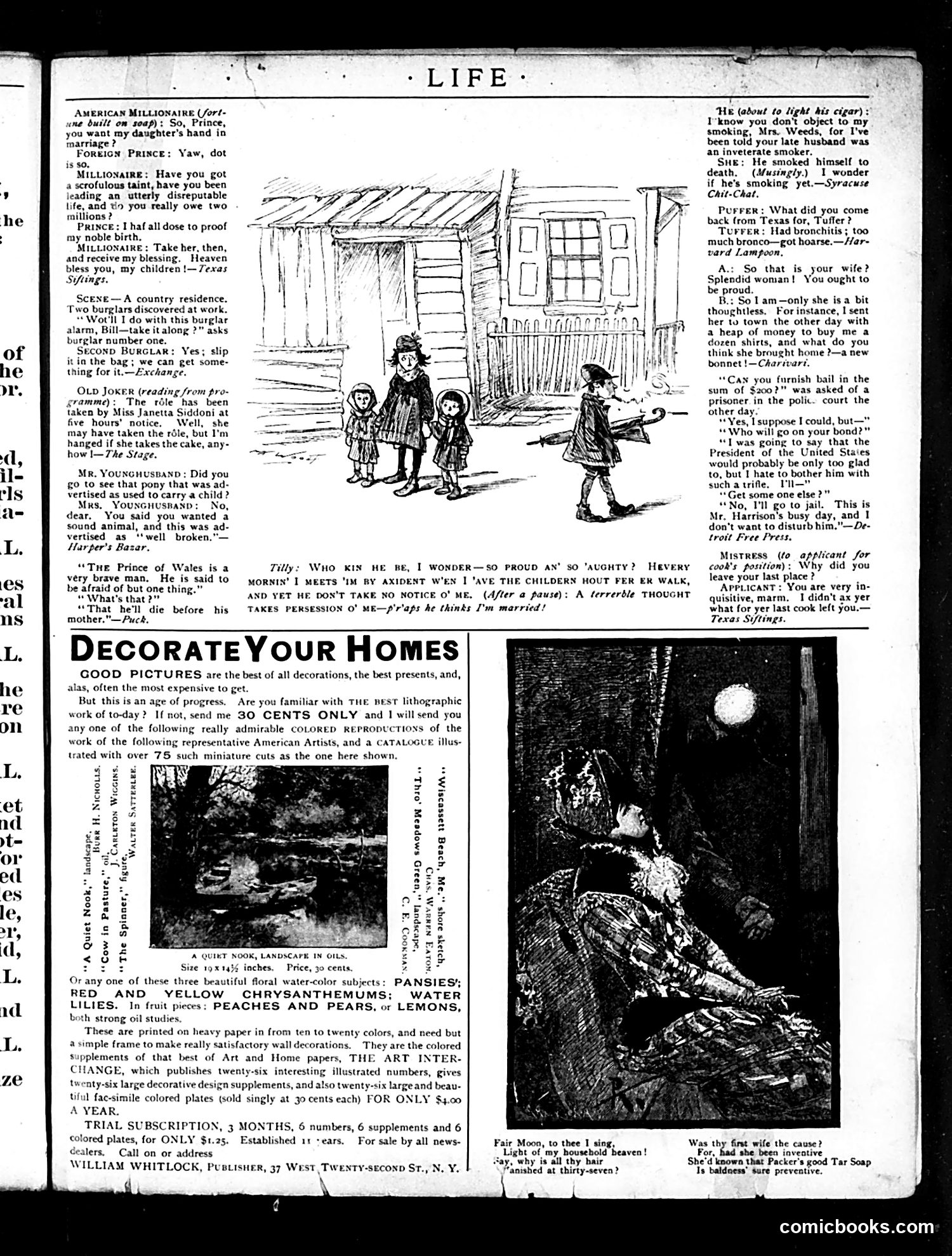
This page contains multiple brief satirical jokes typical of 1890s-era Life magazine humor: **Main cartoon** (top): An American millionaire interviewing a foreign prince seeking his daughter's hand. The satire mocks both figures: the prince proves his "noble birth" by admitting to dissolute living, debts, and disease—exactly what makes him acceptable to the wealth-obsessed millionaire. This skewers American nouveau riche willingness to marry daughters to bankrupt European nobility in exchange for titles. **Other jokes** mock contemporary issues: a burglar stealing a burglar alarm (absurdist humor), theatrical pretension, horse trading deception, and British royalty (the Prince of Wales joke). **Lower section**: Advertisement for decorative art reproductions—landscape and floral paintings—sold affordably to middle-class readers wanting "refined" home decoration. The satire reflects Gilded Age anxieties about class mobility, transatlantic marriages, and conspicuous consumption.
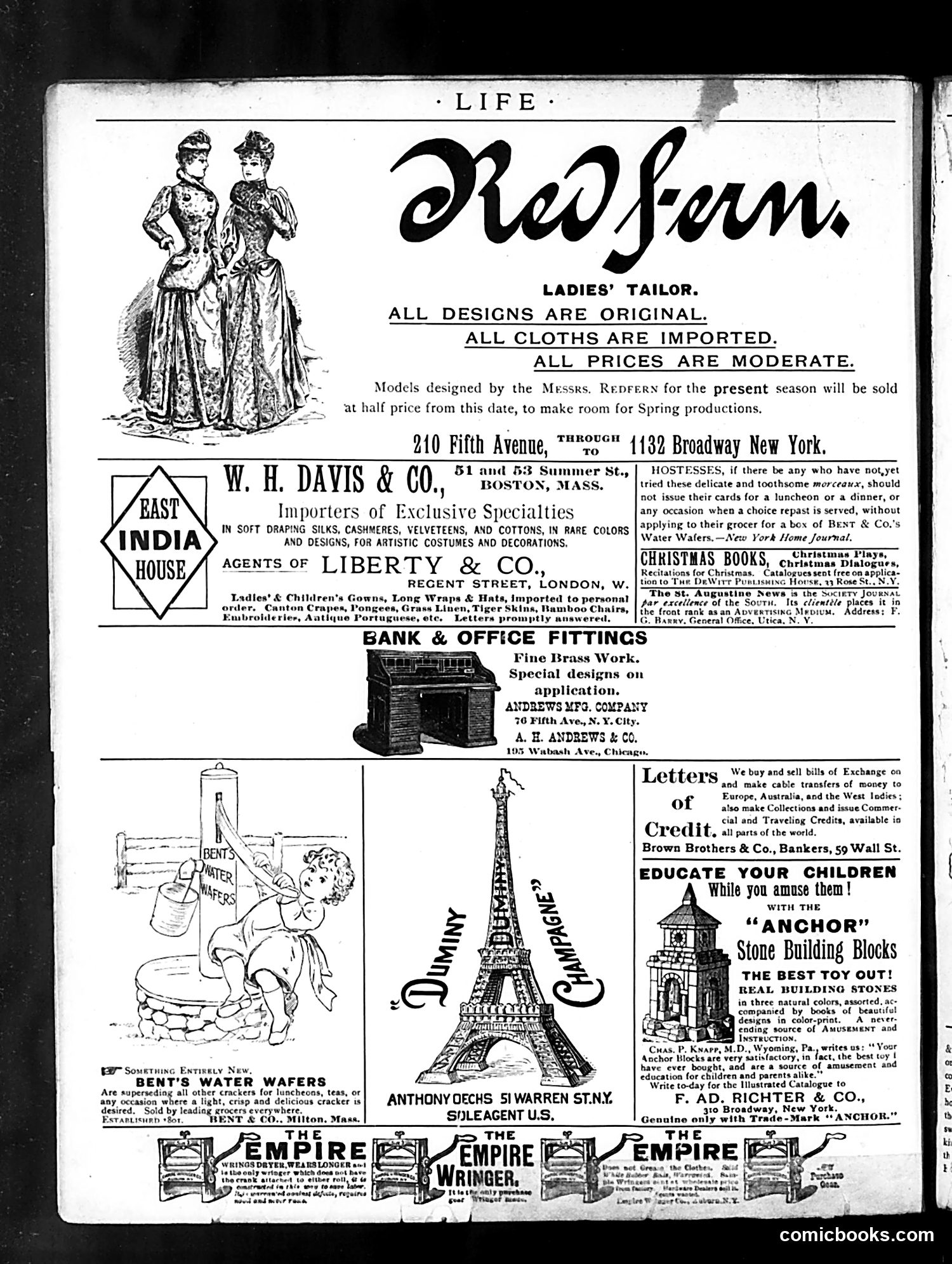
This page is **primarily advertising**, not satire or political commentary. It's a commercial advertisement section from *Life* magazine featuring various products and services aimed at upper-class consumers circa late 19th/early 20th century. **Key advertisers include:** - **Red Fern**: A ladies' tailor on Fifth Avenue and Broadway offering imported fabrics at "moderate" prices - **W.H. Davis & Co.**: Importers of luxury textiles (silks, cashmeres, velveteens) - **East India House**: Importers of specialty goods from London - **Bent & Co. Water Wafers**: Premium crackers for refined dining occasions - **Stone Building Blocks ("Anchor")**: Educational toys for children - **Bank & Office Fittings**: Brass work for commercial spaces - **Brown Brothers & Co.**: Banking services for international transfers The advertisements emphasize exclusivity, imported goods, and genteel consumption—reflecting the affluence of *Life*'s readership. No political satire or caricature is evident here; this is straightforward commercial promotion.
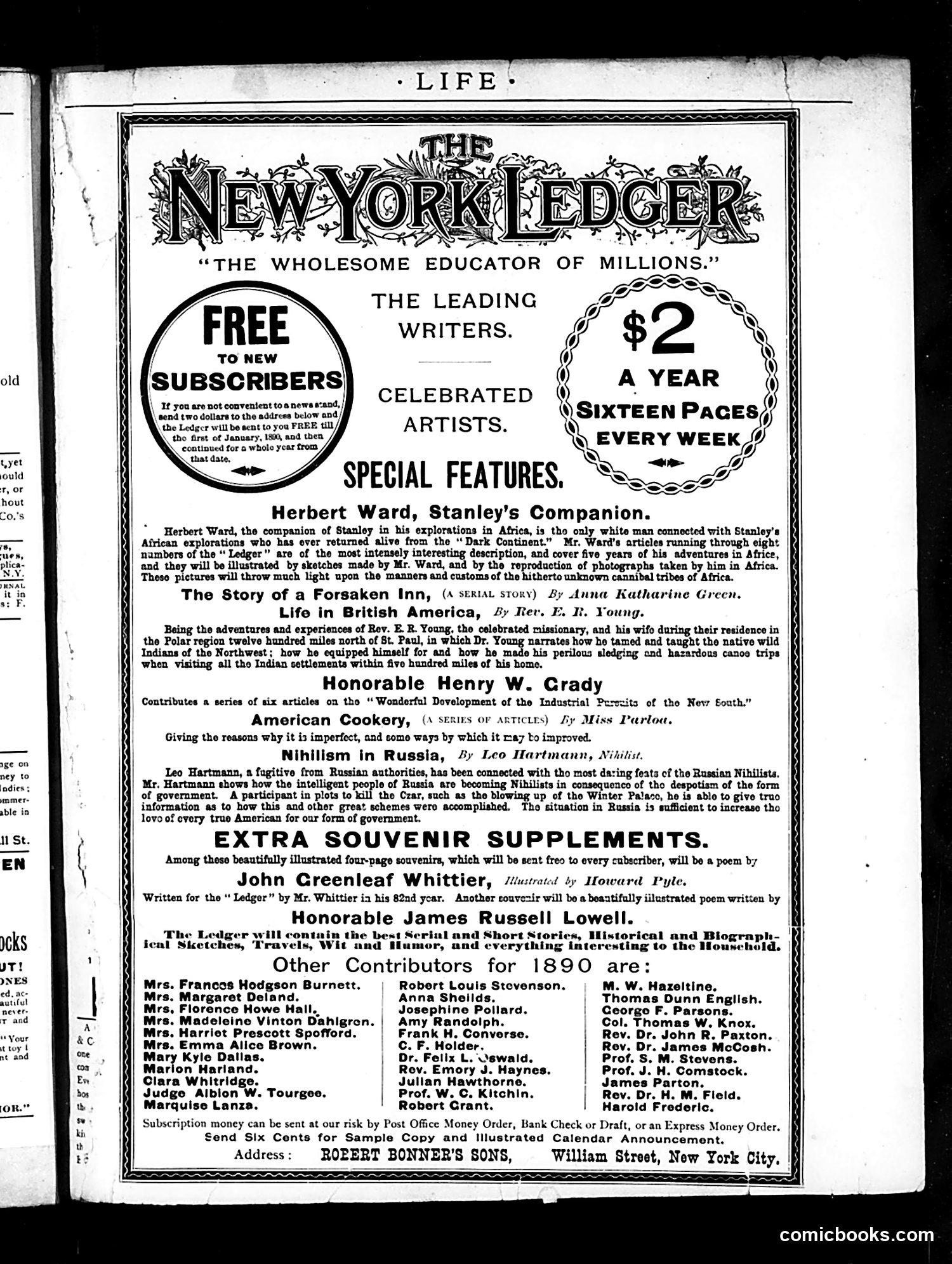
This is primarily a **subscription advertisement** for *The New York Ledger*, a popular American periodical. Rather than political satire, it's a promotional page listing the magazine's content and contributors for 1890. **Key selling points advertised:** - "The Wholesome Educator of Millions" — emphasizing moral/educational value - Price: $2/year for 16 pages weekly - **Notable featured writers** including Herbert Ward (African explorer companion to Stanley), Leo Hartmann (Russian Nihilist fugitive), and established American authors like John Greenleaf Whittier, James Russell Lowell, and Robert Louis Stevenson **The implicit appeal** combines adventure (African explorations, life in polar regions), social reform (industrial development of the "New South," Russian nihilism), and domesticity (American cookery, household sketches). The "Nihilism in Russia" feature is notable—framed to make readers appreciate American democracy by contrasting it with Russian despotism, a common 19th-century rhetorical strategy. This reflects Victorian-era magazine marketing: positioning content as both entertaining *and* morally elevating for middle-class households.
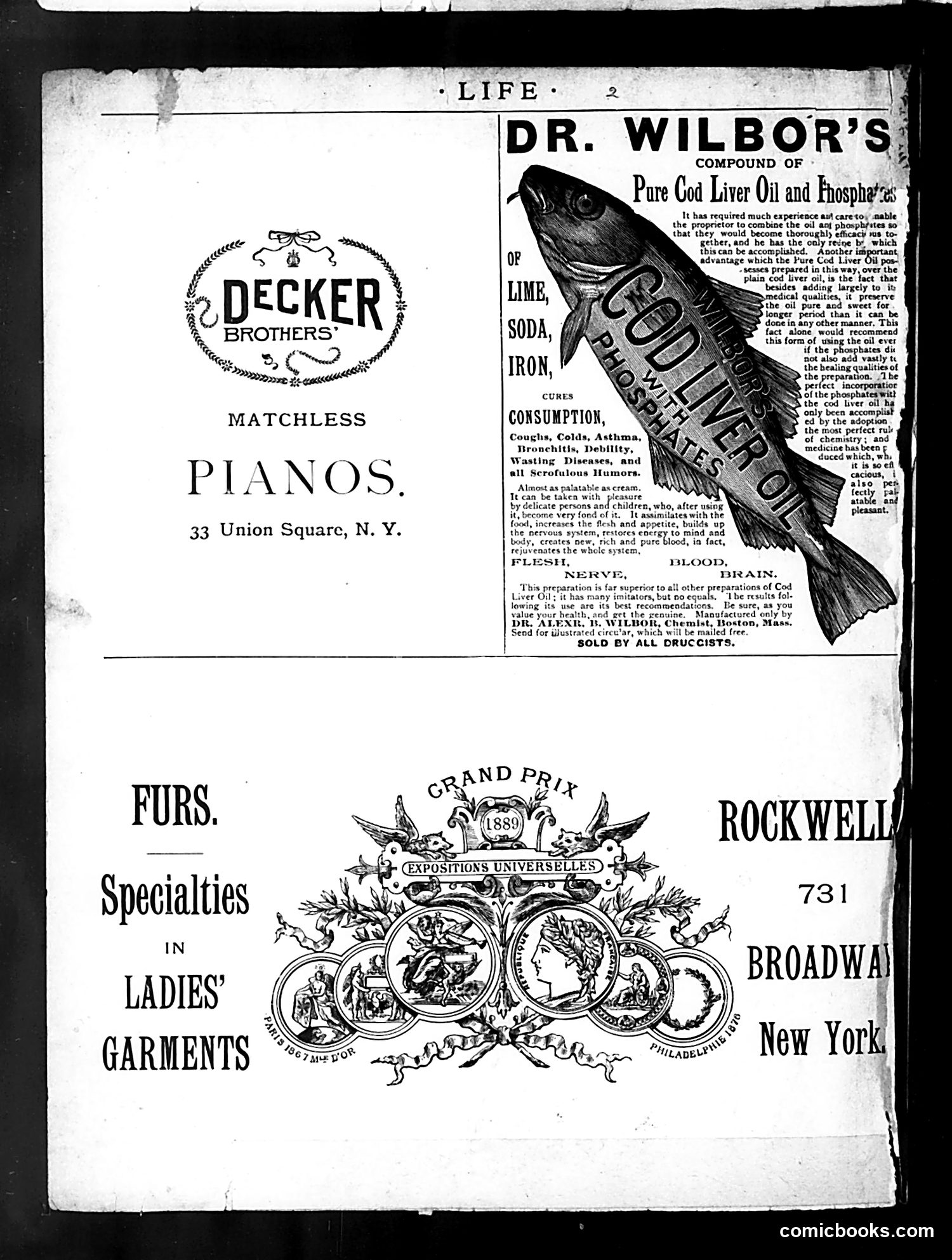
This is primarily an **advertising page** from Life magazine, not a satirical cartoon page. It contains four distinct advertisements: 1. **Decker Brothers Pianos** (top left) — a straightforward piano manufacturer ad at Union Square, NYC 2. **Dr. Wilbor's Cod Liver Oil Compound** (top right) — a patent medicine advertisement claiming to cure consumption, coughs, asthma, and "scrofulous humors." The elaborate text promises the oil builds "flesh, blood, nerve, brain." This represents the era's dubious medical claims before FDA regulation. 3. **Furs/Ladies' Garments** (bottom left) — a specialty clothing merchant 4. **Rockwell** (bottom right) — a Broadway furrier at 731 Broadway, NYC The page reflects 19th-century American consumer culture: piano sales, unregulated patent medicines with exaggerated health claims, and luxury goods. No political satire is present—this is commercial content typical of Life's revenue model.
I can see this is a page from Life magazine (indicated by the "comicbooks.com" watermark), but the image is almost entirely black with only a thin strip of text visible along the left margin. The text is too small and degraded to read clearly in this reproduction. Without being able to discern the actual cartoon content, illustrations, or readable OCR text, I cannot reliably identify specific political figures, social references, or explain the satirical intent. To provide an accurate historical analysis as requested, I would need a clearer, higher-contrast version of this page where both the illustrations and text are legible.