
Life, 1889-12-26 · page 32 of 55
Life — December 26, 1889 — page 32: what you’re looking at
What you’re looking at
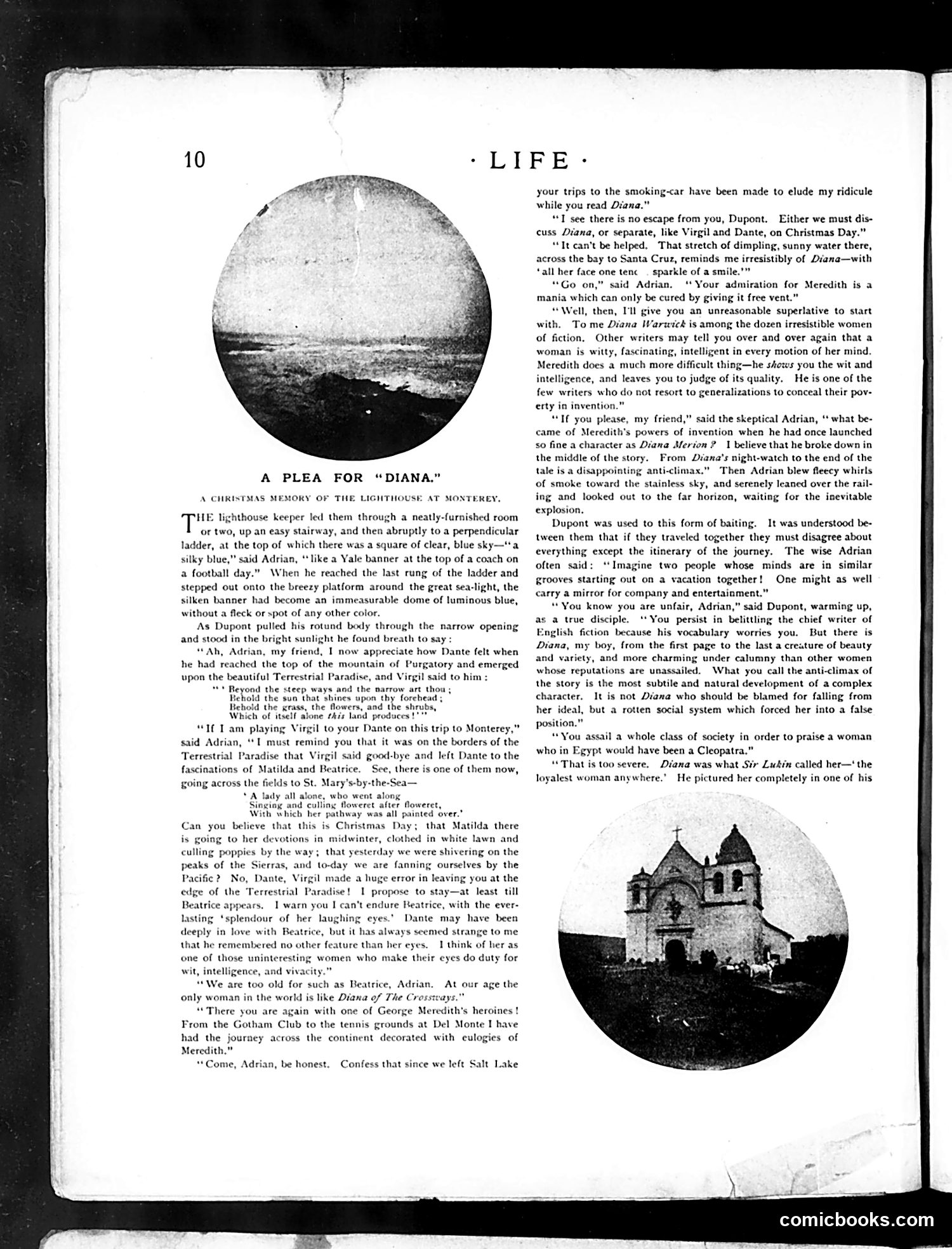
This page satirizes the literary pretensions of American travelers. Two men—Adrian and Dupont—visiting Monterey's lighthouse engage in a learned discussion peppered with references to Dante's *Divine Comedy* and George Meredith's novel *Diana of the Crossways* (1885). The satire targets several things: the affectation of invoking classical literature during casual tourism; Adrian's apparent avoidance of the smoking car to read *Diana* (suggesting escapism); and Dupont's somewhat pedantic enthusiasm for Meredith's heroine as a character who demonstrates wit and intelligence subtly rather than through heavy-handed description. The comparison between the Terrestrial Paradise and California's landscape, along with references to Matilda and Beatrice from Dante, creates ironic juxtaposition between sublime literary ideals and American tourist reality. The photographs of a lighthouse and mission church accompany this literary banter, grounding the abstract discussion in concrete place. The humor lies in these educated men's inability to simply enjoy scenery without literary mediation.
📄 Transcribed text from this page (OCR, searchable)
Machine-transcribed from the original scan — historical spelling and the odd misread are preserved.
‘LIFE: A PLEA FOR “DIANA.” \ CHRISTMAS MEMORY OF THE LIGHTHOUSE AT MONTEREY, HE lighthouse keeper led them through a neatly-furnished room or two, up an easy stairway, and then abruptly to a perpendicular ladder, at the top of which there was a square of clear, blue sky—“a silky blue,” said Adrian, “like a Yale banner at the top of a coach on a football day.” When he reached the last rung of the ladder and stepped out onto the breezy platform around the great sea-light, the silken banner had become an immeasurable dome of luminous blue, without a fleck or spot of any other colo As Dupont pulled his rotund body through the narrow opening and stood in the bright sunlight he found breath to say : “Ah, Adrian, my friend, 1 now appreciate how Dante felt when he had reached the top of the mountain of Purgatory and emerged upon the beautiful Terrestrial Paradise, and Virgil said to h ** Reyond the steep ways and the narrow art thou ; Nehold the sun that shines upon thy forebes Behold the grass, the flowers, and the shru Which of itself alone this land produces !""* “If Tam playing Virgil to your Dante on this trip to Monterey. said Adrian, “1 must remind you that it was on the borders of the Terrestrial Paradise that Virgil said good-bye and left Dante to the fascinations of Matilda and Beatrice. See, there is one of them now, going across the fields to St. Mary’s-by-the ly all alone, who went alo ag and culling floweret after Moweret, which her pathway was all painted over.” Can you believe that this is Christmas Day; that Matilda there is going to her devotions in midwinter, clothed in white lawn and culling poppies by the way; that yesterday we were shivering on the peaks of the Sierras, and to-day we are fanning ourselves by the Pacific? No, Dante, Virgil made a huge error in leaving you at the edge of the Terrestrial Paradise! 1 propose to stay—at least till Beatrice appears, 1 warn you I can't endure Reatrice, with the ever- lasting ‘splendour of her laughing eyes.’ Dante may have been deeply in love with Bea that he remembered no other feature than her eyes. ¢, but it has always seemed strange to me I think of her as one of those uninteresting women who make their eyes do duty for wit, intelligence, and vivacity.” We are too old for such as Beatrice, Adrian. At our only woman in the world is like Diana of The Crossways.” “There you are again with one of George Meredith's heroines ! From the Gotham Club to the tennis grounds at Del Monte I have had the journey across the continent decorated with eculogies of Meredith.” “Come, Adrian, be honest. age the Confess that since we left Salt Lake your trips to the smoking-car have been made to elude my ridicule while you read Diana.” “I see there is no escape from you, Dupont. Either we must dis- cuss Diana, or separate, like Virgil and Dante, on Christmas Day.” “It can't be helped, That stretch of dimpling, sunny water there, across the bay to Santa Cruz, reminds me irresistibly of Diana—with ‘all her face one tenc . sparkle of a sm “Go on,” said Adrian. ‘Your admiration for Meredith is a mania which can only be cured by giving it free vent. “Well, then, I'll give you an unreasonable superlative to start with. To me Diana Warwick is among the dozen irresistible women of fiction, Other writers may tell you over and over again that a woman is witty, fascinating, intelligent in every motion of her mind. Meredith does a much more difficult thing—he shows you the wit and intelligence, and leaves you to judge of its quality. He is one of the few writers who do not resort to generalizations to conceal their pov- erty in invention.” “If you please, my friend,” said the skeptical Adrian, ‘ what be- came of Meredith's powers of invention when he had once launched so fine a character as Diana Merion ? 1 believe that he broke down in the middle of the story. From Diana's night-watch to the end of the tale is a disappointing anti-climax.” Then Adrian blew fleecy whirls of smoke toward the stainless sky, and serenely leaned over the rail- ing and looked out to the far horizon, waiting for the inevitable explosion, Dupont was used to this form of baiting. It was understood be- tween them that if they traveled together they must disagree about everything except the itinerary of the journey. The wise Adrian often said: “Imagine two people whose minds are in similar grooves starting out on a vacation together! One might as well carry a mirror for company and entertainment. You know you are unfair, Adrian,” said Dupont, warming up, as a true disciple. ‘You persist in belittling the chief writer of English fiction because his vocabulary worries you. But there is Diana, my boy, from the first page to the last a creature of beauty and variety, and more charming under calumny than other women whose reputations are unassailed. What you call the anti-climax of the story is the most subtile and natural development of a complex character. It is not Diana who should be blamed for falling from her ideal, but a rotten social system which forced her into a false position.” “You assail a whole class of society in order to praise a woman who in Egypt would have been a Cleopatra.” That is too severe, Diana was what Sir Lukin called her—‘ the loyalest woman anywhere.’ He pictured her completely in one of his comicbooks.com