
Life, 1889-12-26 · page 4 of 55
Life — December 26, 1889 — page 4: what you’re looking at
What you’re looking at
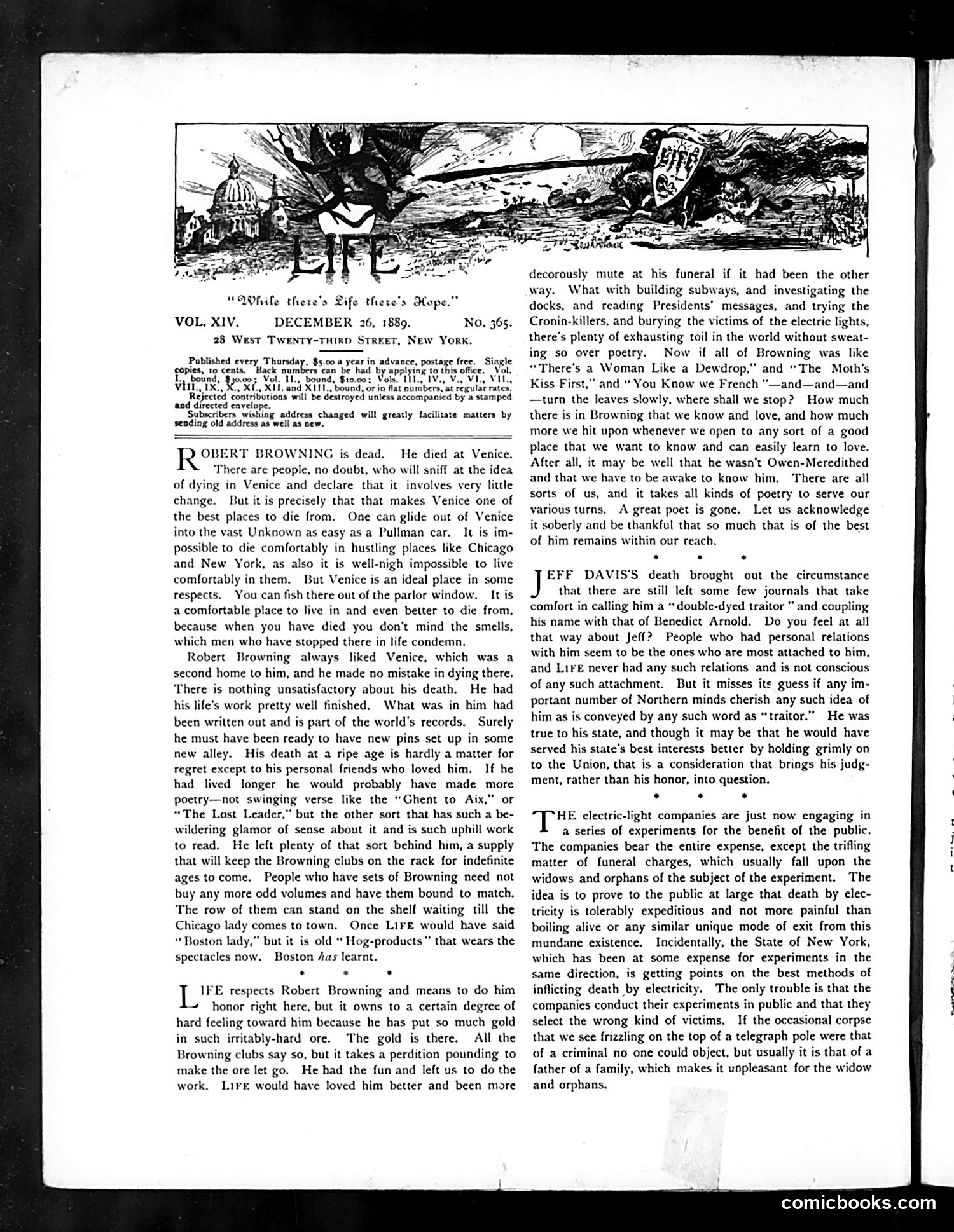
The page contains editorial commentary rather than political cartoons. The masthead cartoon depicts a classical landscape with a tree and buildings—decorative rather than satirical. The main text discusses **Robert Browning's death** in Venice, arguing that while Venice is poetically romantic, it's actually an uncomfortable, smelly place to live. The editors mock the romantic notion of dying there, suggesting Browning would have preferred more practical circumstances. The piece also comments on **Jeff Davis's death**, noting that some journals coupled his name with Benedict Arnold's—a harsh comparison treating Davis as a traitor to the Union. A final section satirizes **electric-light companies' experiments with electrocution as capital punishment**, criticizing the public experiments as unnecessarily cruel spectacles that traumatize families of executed criminals.
📄 Transcribed text from this page (OCR, searchable)
Machine-transcribed from the original scan — historical spelling and the odd misread are preserved.
“While there's Life there's Hope.” VOL. XIV. DECEMBER 26, 1889. No. 365. 28 West Twenty-Tuirp Street, New York, Published every, Thursday. $s.00 a year in advance, ret free. Single copies, tg cents, ‘Back numbers can by applying to this office. Vol. co? Vol. Il bound, Siac; Vols. 111, LV. Vi, VIL, .X1., X1i. and XIIT., bound, or ia fat nussbee an fag nase! He contributions will be destroyed unless accompanied by a stamped and directed envelope. Subscribers wishing address changed will greatly facilitate matters by sending old address as well as new. I OBERT BROWNING is dead. He died at Venice. There are people, no doubt, who will sniff at the idea of dying in Venice and declare that it involves very little change. But it is precisely that that makes Venice one of the best places to die from. One can glide out of Venice into the vast Unknown as easy as a Pullman car, It is im- possible to die comfortably in hustling places like Chicago and New York, as also it is well-nigh impossible to live comfortably in them, But Venice is an ideal place in some respects. You can fish there out of the parlor window. It is a comfortable place to live in and even better to die from, because when you have died you don’t mind the smells, which men who have stopped there in life condemn. Robert Browning always liked Venice, which was a second home to him, and he made no mistake in dying there. There is nothing unsatisfactory about his death. He had his life's work pretty well finished. What was in him had been written out and is part of the world’s records. Surely he must have been ready to have new pins set up in some new alley. His death at a ripe age is hardly a matter for regret except to his personal friends who loved him. If he had lived longer he would probably have made more poetry—not swinging verse like the “Ghent to Aix,” or “The Lost Leader,” but the other sort that has such a be- wildering glamor of sense about it and is such uphill work to read. He left plenty of that sort behind him, a supply that will keep the Browning clubs on the rack for indefinite ages tocome. People who have sets of Browning need not buy any more odd volumes and have them bound to match, The row of them can stand on the shelf waiting till the Chicago lady comes to town. Once LiFe would have said “ Boston lady,” but it is old * Hog-products” that wears the spectacles now. Boston as learnt. . . . IFE respects Robert Browning and means to do him — honor right here, but it owns to a certain degree of hard feeling toward him because he has put so much gold in such irritably-hard ore. The gold is there. All the Browning clubs say so, but it takes a perdition pounding to make the ore let go. He had the fun and left us to do the work, Lire would have loved him better and been more decorously mute at his funeral if it had been the other way. What with building subways, and investigating the docks, and reading Presidents’ messages, and trying the Cronin-killers, and burying the victims of the electric lights, there's plenty of exhausting toil in the world without sw ing so over poetry. Now if all of Browning was like “There's a Woman Like a Dewdrop,” and “The Moth's Kiss First,” and “ You Know we French "—and—and—and —turn the leaves slowly, where shall we stop? How much there is in Browning that we know and love, and how much more we hit upon whenever we open to any sort of a good place that we want to know and can easily learn to love. After all, it may be well that he wasn’t Owen-Meredithed and that we have to be awake to know him. There are all sorts of us, and it takes all kinds of poetry to serve our various turns. A great poet is gone. Let us acknowledge it soberly and be thankful that so much that is of the best of him remains within our reach, EFF DAVIS'S death brought out the circumstance J that there are still left some few journals that take comfort in calling him a “double-dyed traitor” and coupling his name with that of Benedict Arnold. Do you feel at all that way about Jeff? People who had personal relations with him seem to be the ones who are most attached to him, and LiFe never had any such relations and is not conscious of any such attachment. But it misses its guess if any im- portant number of Northern minds cherish any such idea of him as is conveyed by any such word as “traitor.” He was true to his state, and though it may be that he would have served his state's best interests better by holding grimly on to the Union, that is a consideration that brings his judg- ment, rather than his honor, into question. . . . HE electric-light companies are just now engaging in a series of experiments for the benefit of the public. The companies bear the entire expense, except the trifling matter of funeral charges, which usually fall upon the widows and orphans of the subject of the experiment. The idea is to prove to the public at large that death by elec- tricity is tolerably expeditious and not more painful than boiling alive or any similar unique mode of exit from this mundane existence. Incidentally, the State of New York, which has been at some expense for experiments in the same direction, is getting points on the best methods of inflicting death by electricity. The only trouble is that the companies conduct their experiments in public and that they select the wrong kind of victims. If the occasional corpse that we see frizzling on the top of a telegraph pole were that of a criminal no one could object, but usually it is that of a father of a family, which makes it unpleasant for the widow and orphans. comicbooks.com