
Life, 1889-12-26 · page 6 of 55
Life — December 26, 1889 — page 6: what you’re looking at
What you’re looking at
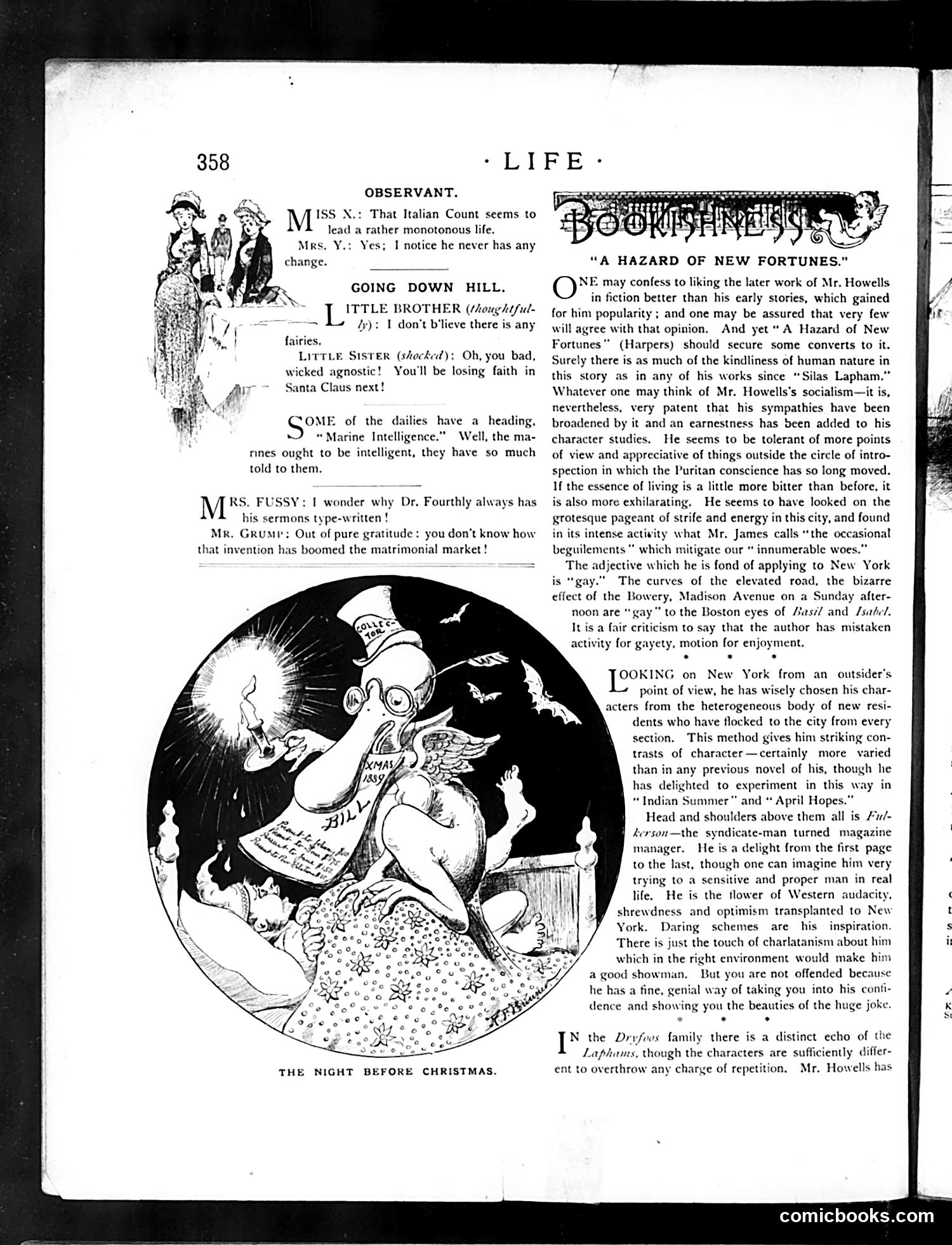
This page contains a book review of H.G. Wells's "A Hazard of New Fortunes" alongside a satirical cartoon titled "The Night Before Christmas." **The Cartoon:** The circular illustration depicts a chaotic Christmas Eve scene with exaggerated figures. It appears to satirize commercialism and excess around the holiday—showing what looks like Santa Claus surrounded by money, gifts, and revelry in a somewhat grotesque manner. The style suggests commentary on how Christmas has become materialistic rather than spiritual. **The Review:** Praises Wells's novel for its varied character studies and sympathetic treatment of New York's diverse population. The critic notes Wells uses "gay" (meaning cheerful) descriptions of the city and praises his character "Fulkerson" as representing Western optimism transplanted to New York. The page reflects early 1900s literary culture and satirical commentary on American commercialism.
📄 Transcribed text from this page (OCR, searchable)
Machine-transcribed from the original scan — historical spelling and the odd misread are preserved.
OBSERVANT. ISS X.: That Italian Count seems to lead a rather monotonous life. Mrs. Y.: Yes; I notice he never has any change. GOING DOWN HILL. Lm BROTHER ((houghiful- — dy): I don’t b'lieve there is any fairie: LitTLe SISTER (shocked): Oh, you bad, wicked agnostic! You'll be losing faith in Santa Claus next! OME of the dailies have a heading, “Marine Intelligence.” Well, the ma- rines ought to be intelligent, they have so much told to them. RS, FUSSY: I wonder why Dr, Fourthly alway his sermons type-written ! Mr. Grup: Out of pure gratitude: you don’t know how that invention has boomed the matrimonial market! THE NIGHT BEFORE CHRISTMAS. “A HAZARD OF NEW FORTUNES.” NE may confess to liking the later work of Mr. Howells in fiction better than his early stories, which gained for him popularity ; and one may be assured that very few will agree with that opinion. And yet “A Hazard of New Fortunes” (Harpers) should secure some converts to it. Surely there is as much of the kindliness of human nature in this story as in any of his works since “Silas Lapham.” Whatever one may think of Mr. Howells’s socialism—it is, nevertheless, very patent that his sympathies have been broadened by it and an earnestness has been added to his character studies. He seems to be tolerant of more points of view and appreciative of things outside the circle of intro- spection in which the Puritan conscience has so long moved. If the essence of living is a little more bitter than before, it is also more exhilarating. He seems to have looked on the grotesque pageant of strife and energy in this city, and found in its intense activity what Mr. James calls “the occasional beguilements ” which mitigate our “ innumerable woes.” The adjective which he is fond of applying to New York is “gay.” The curves of the elevated road, the bizarre effect of the Bowery, Madison Avenue on a Sunday after- noon are “gay” to the Boston eyes of Aase/ and /sabecl. It is a fair criticism to say that the author has mistaken activity for gayety, motion for enjoyment. . . . OOKING on New York from an_ outsider’s point of view, he has wisely chosen his char- acters from the heterogeneous body of new resi- dents who have flocked to the city from every section. This method gives him striking con- trasts of character—certainly more varied than in any previous novel of his, though he has delighted to experiment in this way in “Indian Summer” and “ April Hopes. Head and shoulders above them all is /1/- kerson—the syndicate-man turned magazine manager. He is a delight from the first. page to the last, though one can imagine him very trying to a sensitive and proper man in real life, He is the flower of Western audacity, shrewdness and optimism transplanted to New York. Daring schemes are his inspiration. There is just the touch of charlatanism about him which in the right environment would make hin a good showman. But you are not offended because he has a fine, genial way of taking you into his conti- dence and showing you the beauties of the huge joke. * . . I* the Drrfoos family there is a distinct echo of the Laphams, though the characters are sufficiently differ- Mr. Howells has ent to overthrow any charye of repetition, comicbooks.com