
A complete issue · 43 pages · 1888
Life — December 27, 1888
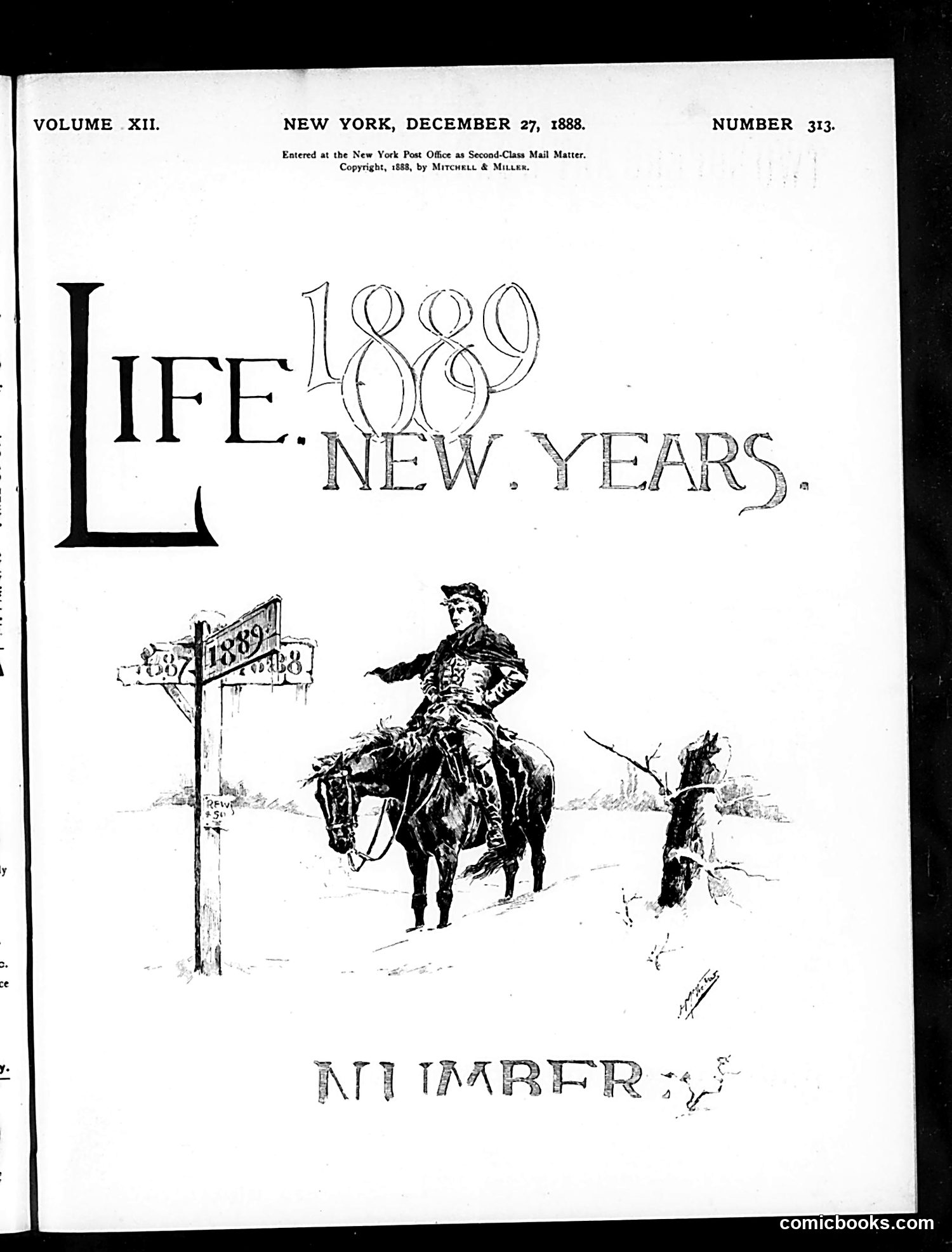
This is the cover of Life's New Year's issue marking the transition from 1888 to 1889. The central image shows a cowboy or frontiersman on horseback pointing at a directional sign marked "1889," with the old year "1888" receding behind him. A dead or barren tree stump appears on the right. The illustration uses the Western frontier metaphor common in late-19th-century American imagery—the idea of moving forward into new territory, leaving the past behind. The cowboy figure represents American progress and optimism about the new year ahead. This was a typical visual trope for New Year's editions of satirical magazines, celebrating forward momentum and fresh starts rather than commenting on specific political events.
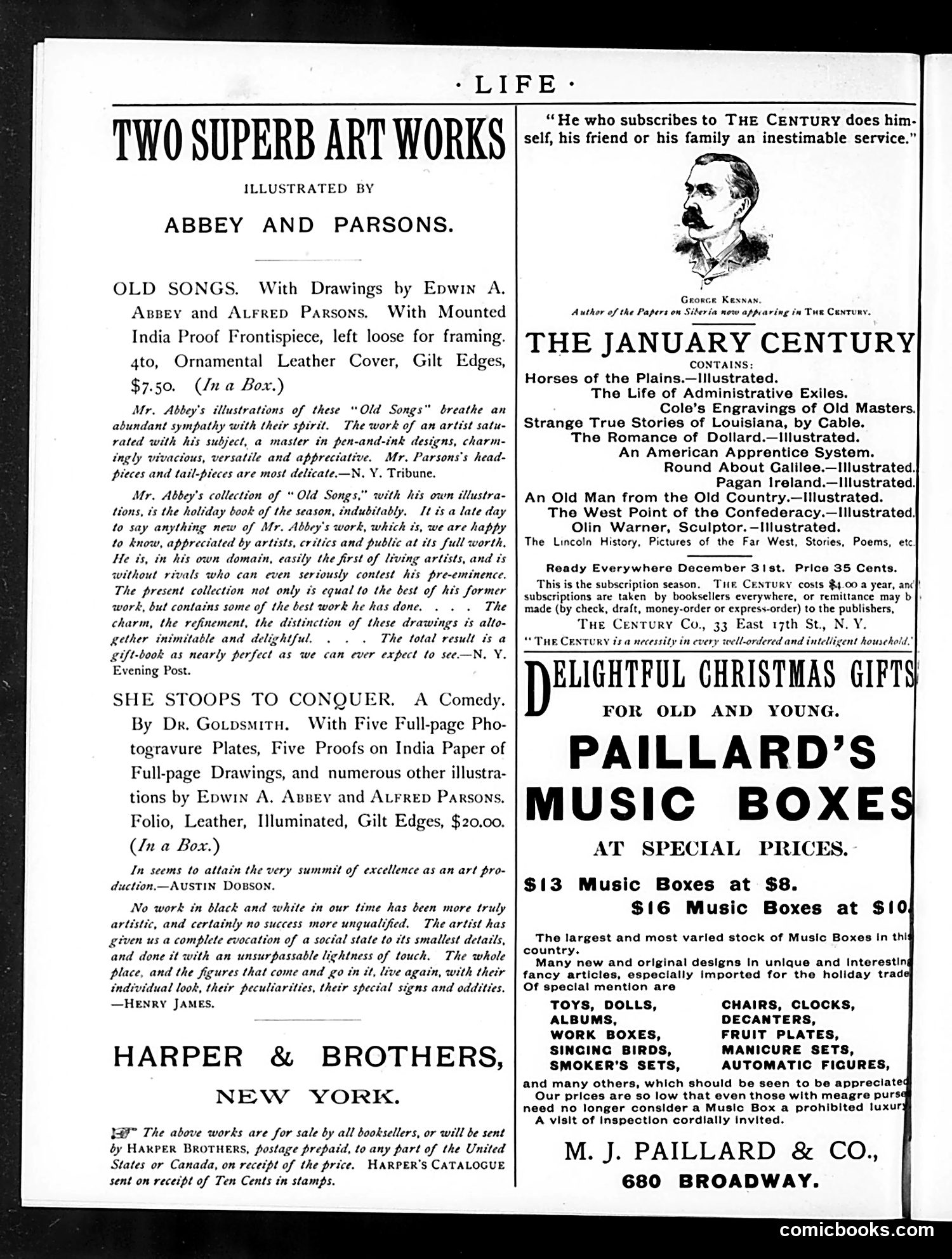
This page is primarily **advertising content** rather than satirical cartoons. It features: 1. **Art book advertisements** from Harper & Brothers promoting illustrated editions of "Old Songs" and "She Stoops to Conquer," with endorsements from the New York Tribune and Evening Post praising the artistic quality. 2. **The Century Magazine advertisement** featuring a portrait of George Kennan (identified as "Author of the Papers on Siberia now appearing in THE CENTURY"), promoting the January issue's contents about Siberian exile experiences and American frontier topics. 3. **Paillard's Music Boxes advertisement** promoting discounted holiday gifts. The page lacks political satire or cartoon commentary. It represents Life magazine's commercial function selling literary and luxury goods to affluent readers during the holiday season.
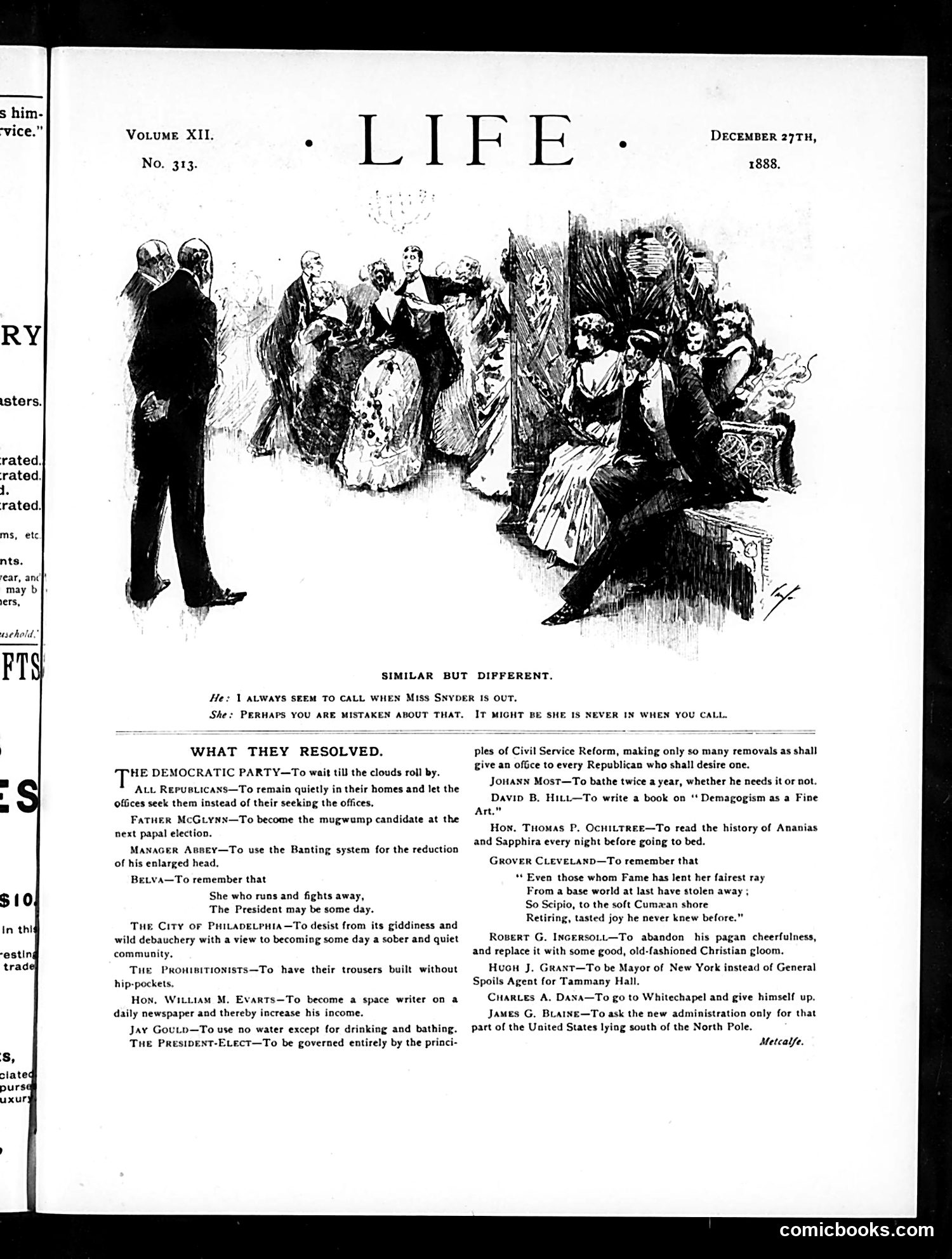
The cartoon titled "Similar But Different" depicts a social scene contrasting two situations involving Miss Snyder. The accompanying caption states: "He: I always seem to call when Miss Snyder is out. She: Perhaps you are mistaken about that. It might be she is never in when you call." This is a drawing-room satire about social etiquette and romantic pursuit. The humor relies on the woman's polite rebuff—she's suggesting the gentleman simply isn't welcome, rather than admitting she's unavailable. The "similar but different" framing highlights how two opposite statements can convey identical meaning. The "What They Resolved" section below contains humorous mock-resolutions about contemporary political figures and issues, including references to the Democratic Party, Republican officials, and administrative matters of the era.
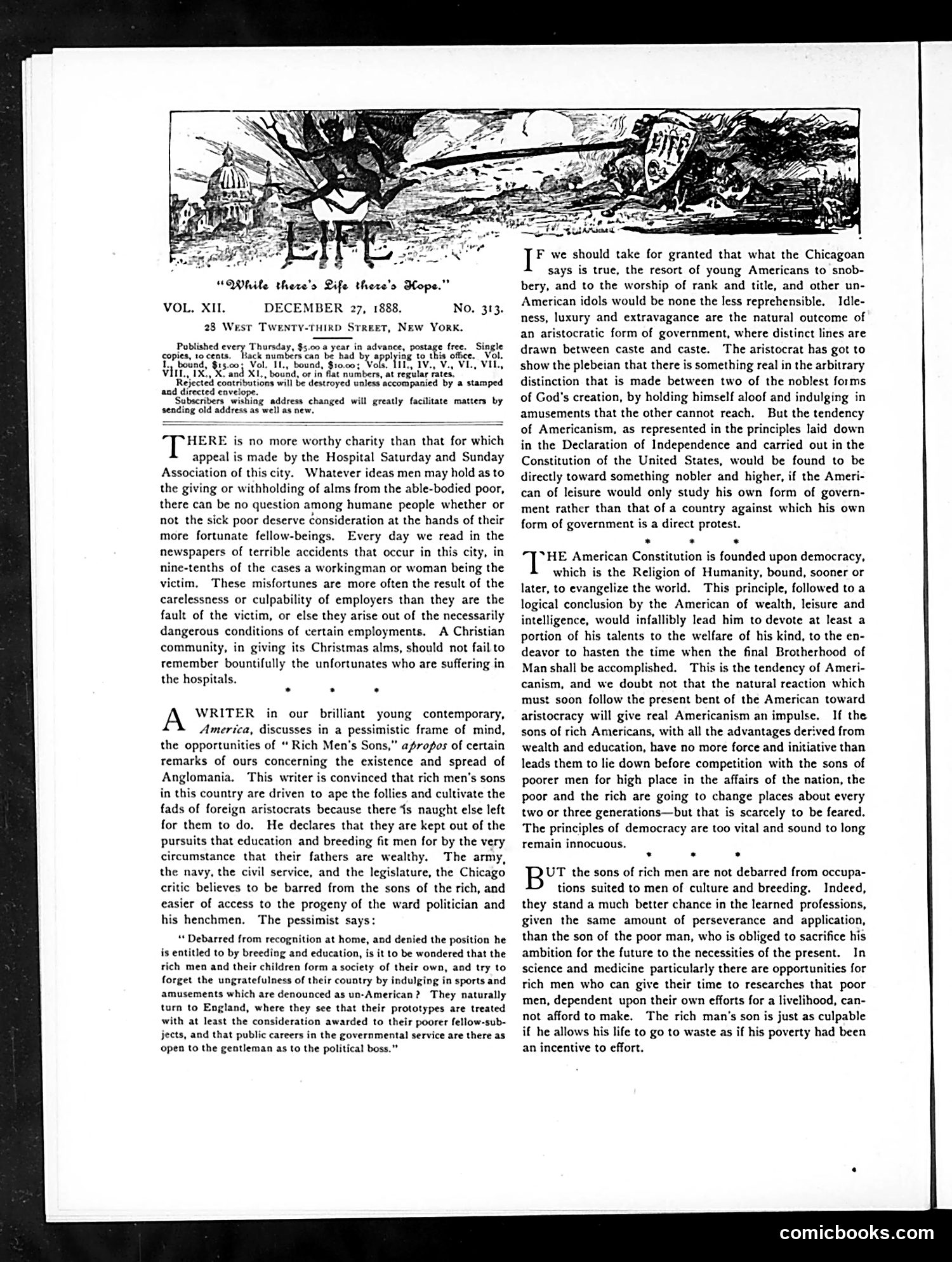
The cartoon at top shows a figure labeled "Life" sitting beneath a tree, with the caption "While there's Life there's Hope." The accompanying editorial discusses American aristocracy and social inequality. The text critiques wealthy Americans who adopt European aristocratic pretensions rather than embracing democratic principles. It argues that the Constitution's foundation in democracy should inspire Americans toward noble pursuits benefiting humanity, not toward leisure and snobbery. The piece specifically attacks rich men's sons who waste opportunities through indolence, contrasting them unfavorably with poor men's sons who must work hard. It warns that unchecked aristocratic tendencies among America's wealthy elite threaten the nation's democratic values. The overall message: American democracy is imperiled when the rich abandon civic responsibility for European-style aristocratic excess.
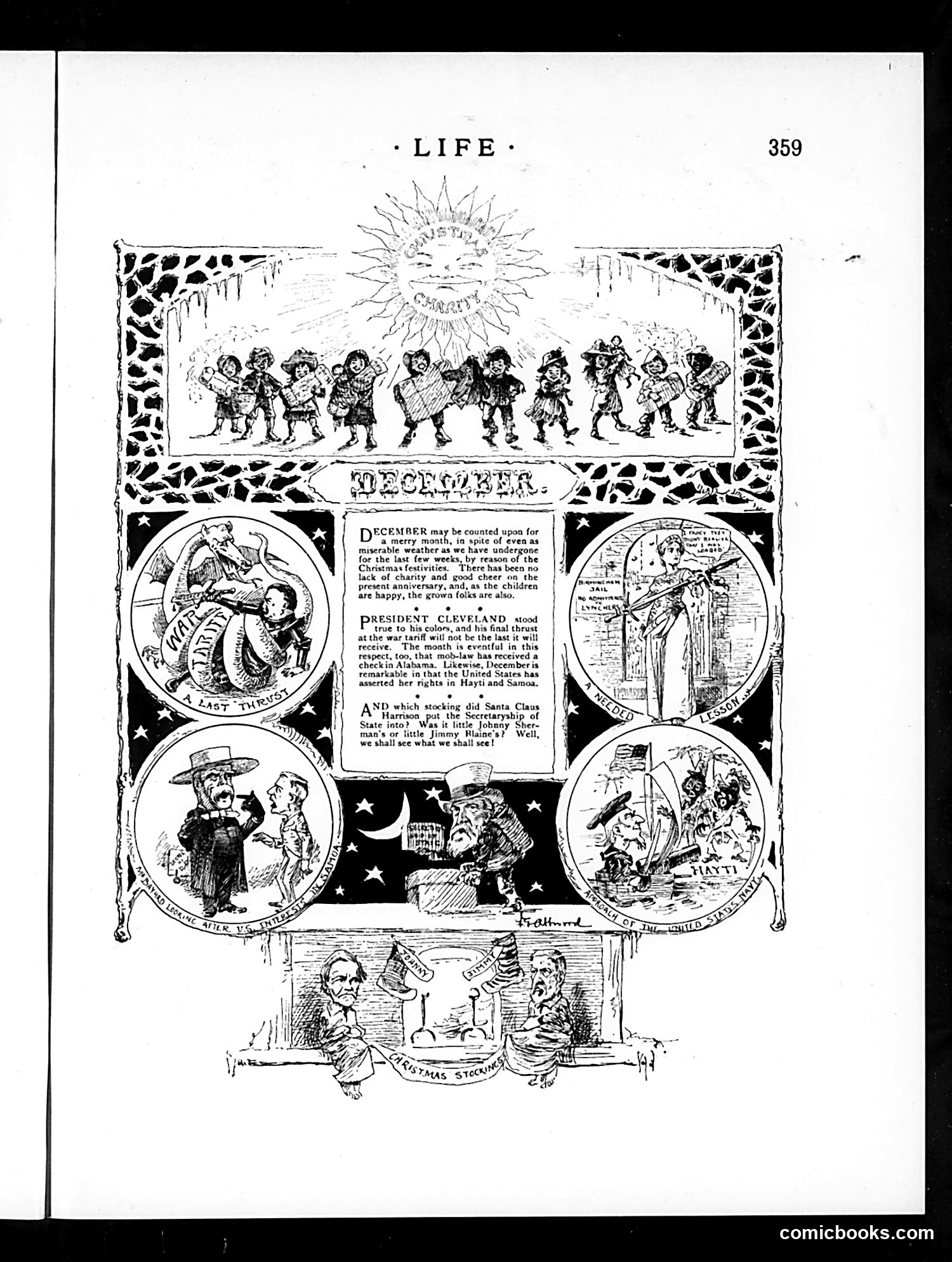
This December issue combines holiday themes with political commentary. The top banner shows children caroling beneath a benevolent sun—traditional Christmas cheer. The four circular vignettes below reference specific 1880s-90s political figures and events: - **"Last Throw"** (upper left): Appears to show a political figure in a precarious position - **President Cleveland reference**: The text explicitly mentions President Cleveland and his foreign policy regarding Haiti and Samoa - The other circles contain satirical scenes, likely depicting political figures or recent scandals The central text discusses Secretary Harrison and "Santa Claus"—likely a pun on Harrison's role in Christmas politics or gift-giving patronage. The bottom panel shows two figures at a table labeled "Christmas Stockings," probably mocking political corruption or backroom deals dressed up as holiday goodwill. Without clearer figure identification, the specific satirical targets remain partially obscure to modern readers.
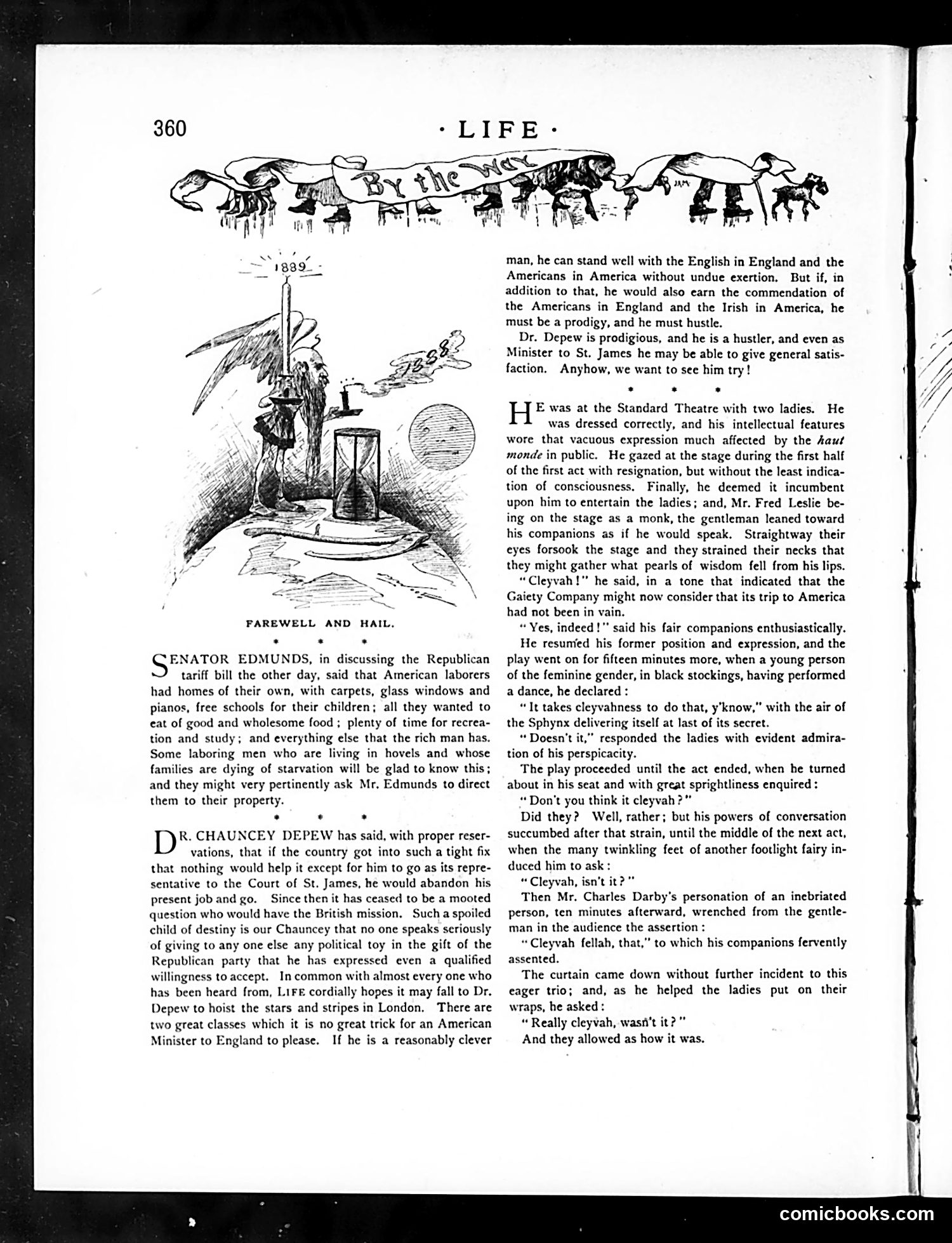
The main cartoon, titled "Farewell and Hail," depicts an 1899 scene at a flagpole. The text discusses Senator Edmunds and Dr. Chauncey Depew regarding American labor conditions and Republican politics. The satire centers on **Dr. Depew's potential diplomatic mission to England**. Life mocks the idea that Depew—described as "prodigious," "a hustler," and capable of giving "general satisfaction"—could represent America abroad. The joke suggests his appointment would be laughable to both the English and Irish. The accompanying theater anecdote about an overly intellectual gentleman performer appears designed to satirize affected behavior and pretension, mirroring the broader mockery of Depew's qualifications for diplomatic service. The cartoon's exact figures remain unclear without additional context.
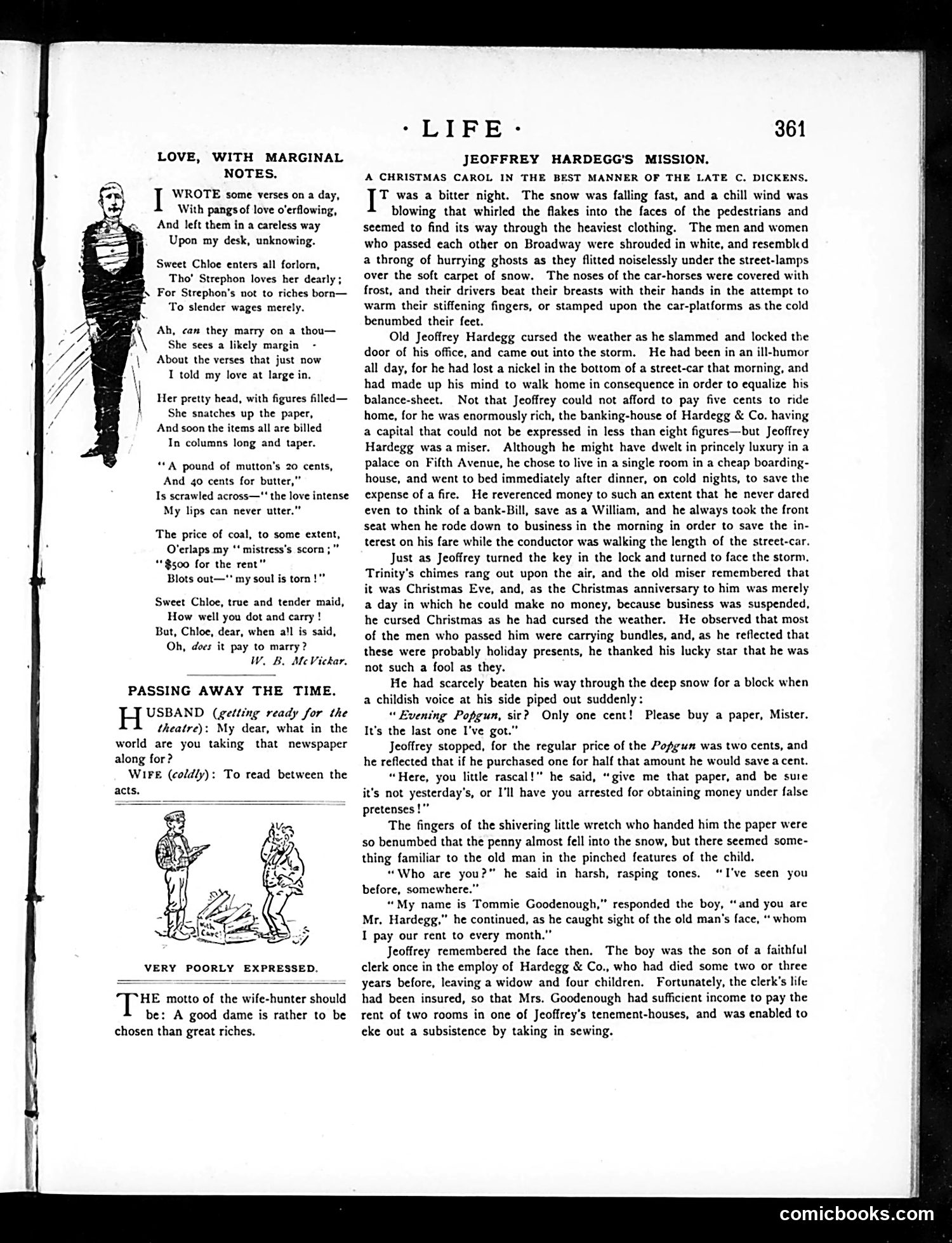
This page contains literary content rather than political cartoons. The main feature is "Jeofrrey Hardegg's Mission," described as "A Christmas Carol in the Best Manner of the Late C. Dickens" — a Dickens parody following a miserly businessman on Christmas Eve. The sidebar sections include three brief satirical pieces: "Love, with Marginal Notes" (verses about romance and money), "Passing Away the Time" (a joke about newspaper reading between theater acts), and "Very Poorly Expressed" (a quip about choosing wives over riches). The small illustrations show figures in period dress. This appears to be primarily literary satire rather than political commentary, using humor to mock social attitudes toward money, marriage, and materialism in the early 1900s.
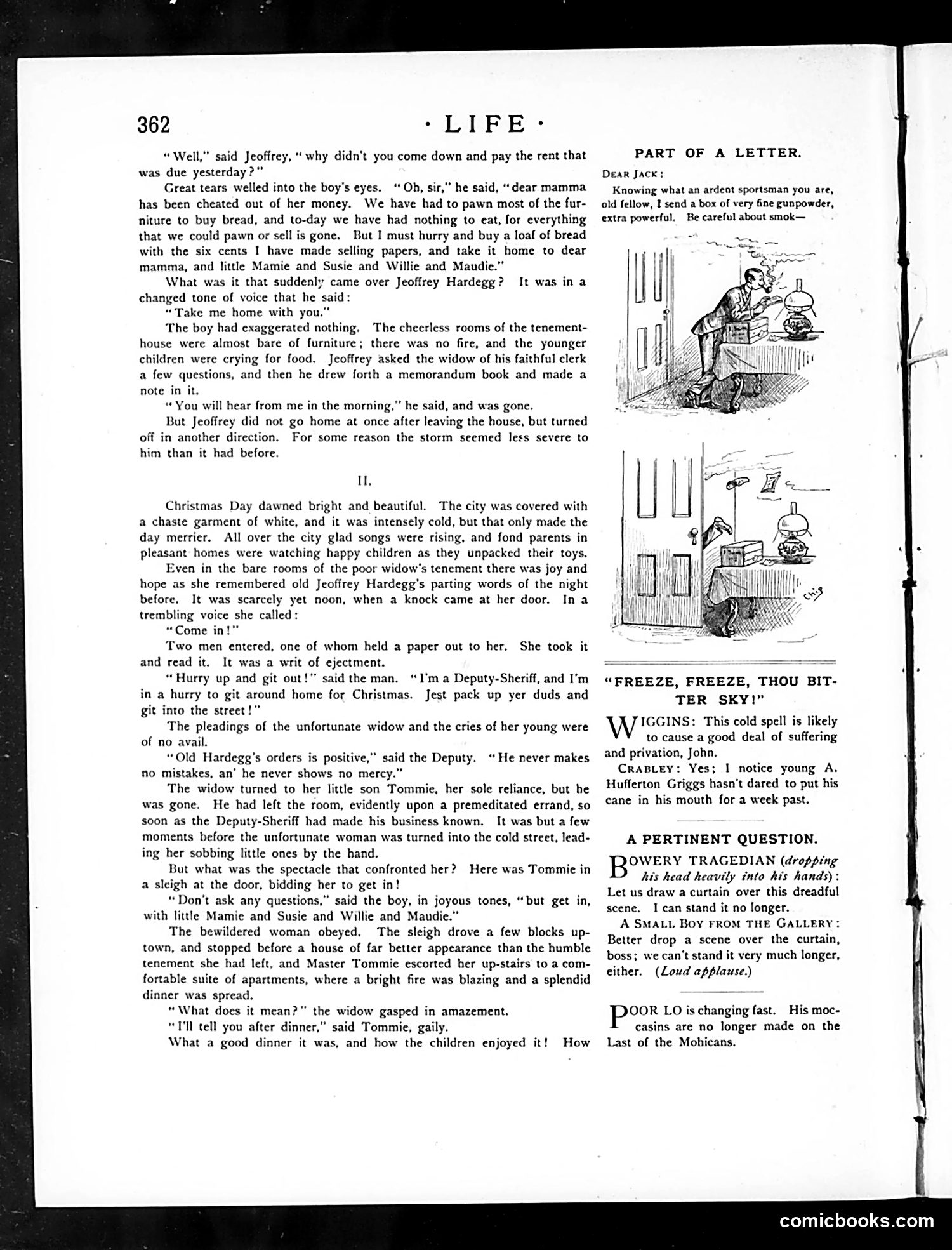
This page contains a serialized story (section II) about Christmas charity, not a political cartoon. The narrative describes a poor widow's tenement receiving an unexpected visit from a Deputy-Sheriff enforcing rent collection on Christmas Day. The plot twist: the sheriff escorts her and her children to a comfortable apartment with a "bright fire" and "splendid dinner." The three small illustrations on the right show domestic scenes—likely depicting the story's key moments. Below the main narrative are three brief comic snippets ("Part of a Letter," "Freeze, Freeze, Thou Bitter Sky," "A Pertinent Question," and "Poor Lo"), which appear to be unrelated humorous observations about winter weather, social discomfort, and Native Americans ("Poor Lo" being period slang for Indigenous peoples).
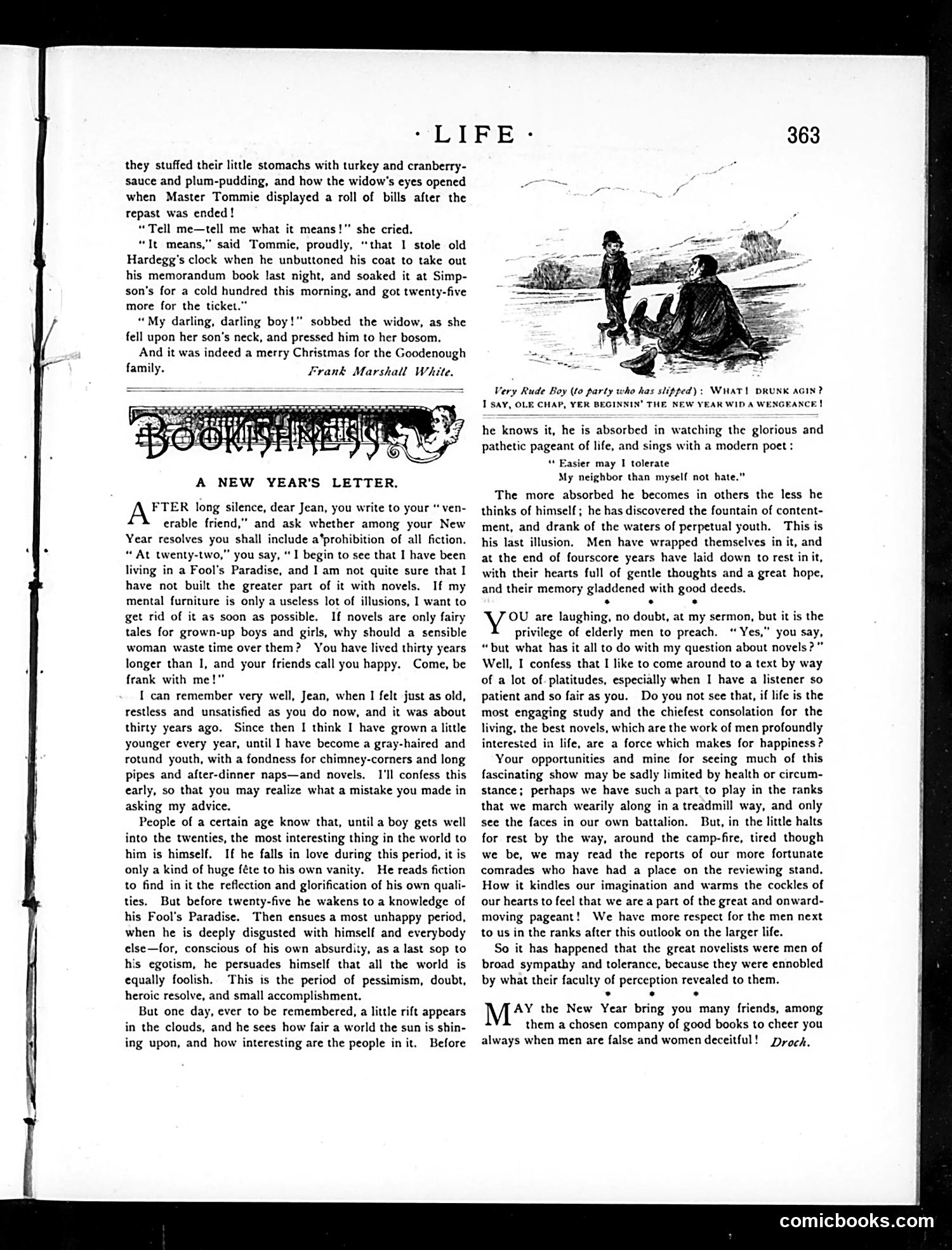
This page contains a Christmas story excerpt by Frank Marshall White (visible at bottom left) and a New Year's letter titled "Bookishness" addressing fiction reading habits. The small illustration shows two figures in a winter landscape, likely from the Christmas narrative. The main content critiques reading habits and intellectualism. The letter argues that novels—dismissed as frivolous—actually offer valuable insight into human nature and moral development. It defends fiction against those who consider it a waste of time, suggesting that serious literature provides "the most engaging study and the chiefest consolation for the living." This reflects early 20th-century debates about literature's cultural value and whether entertainment reading was intellectually legitimate—a class-conscious concern of the era.
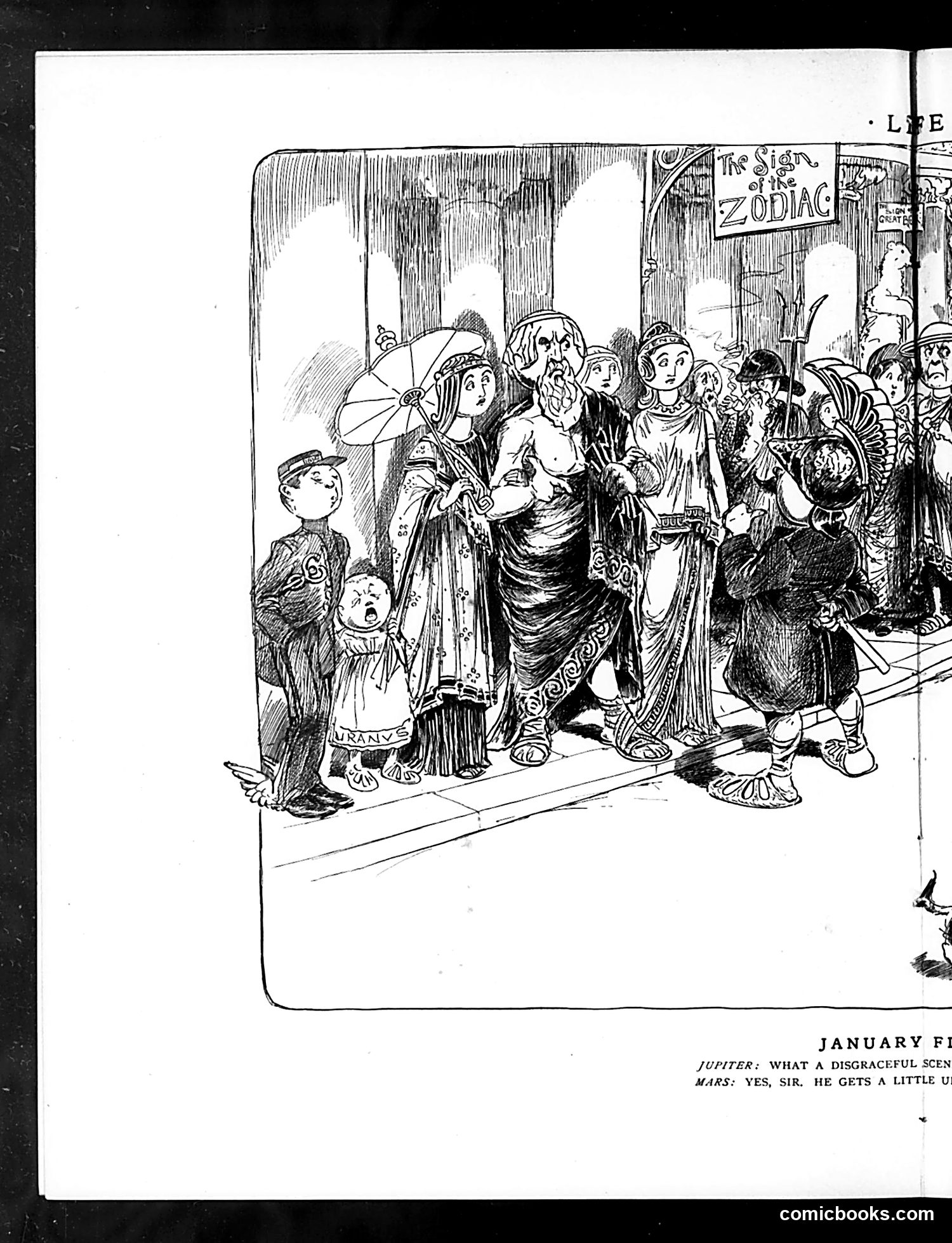
This is a satirical cartoon from *Life* magazine featuring an astrological theme—a sign reading "The Sign of the ZODIAC" is visible in the background. The caption references "JUPITER" and "MARS," continuing the zodiac theme. The cartoon depicts a crowd of people gathered around what appears to be an astrologer or fortune teller (the bearded central figure). The caption reads: "JUPITER: WHAT A DISGRACEFUL SCENE! / MARS: YES, SIR. HE GETS A LITTLE U[nclear]" The satire mocks the public's gullible fascination with astrology and fortune-telling. By having the planetary gods themselves comment disapprovingly on the scene, the cartoon ridicules both the practitioners of astrology and their eager clients. The joke suggests that even the celestial bodies represented in astrology would be embarrassed by how their names are exploited for profit.
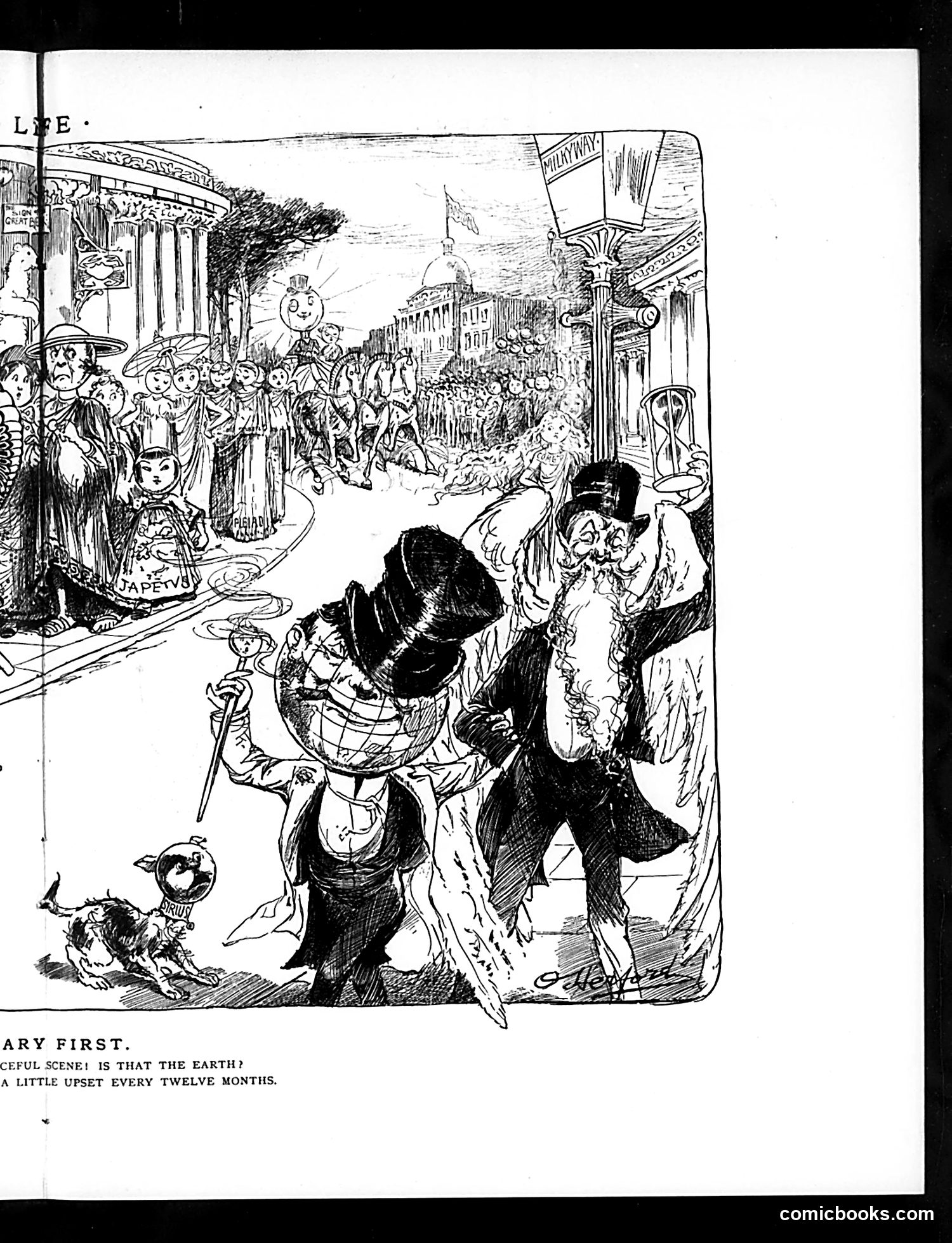
This appears to be a satirical cartoon from *Life* magazine depicting a celestial or astronomical scene. Two figures in the foreground—rendered as caricatured men in formal dress with top hats—observe a globe being juggled or tossed about by angelic or supernatural beings in the background. The caption references "the earth" being "upset every twelve months," suggesting commentary on annual upheaval or instability. The small dog in the lower left adds comedic scale. The precise political targets remain unclear without the magazine's date, but the imagery suggests satirizing either: - Cyclical political or economic crises - Planetary/celestial concerns treated frivolously - Institutional mismanagement causing recurring chaos The artwork style and formal dress suggest early-to-mid 20th century publication, but without dating information, specific identifications of the caricatured figures cannot be confirmed.
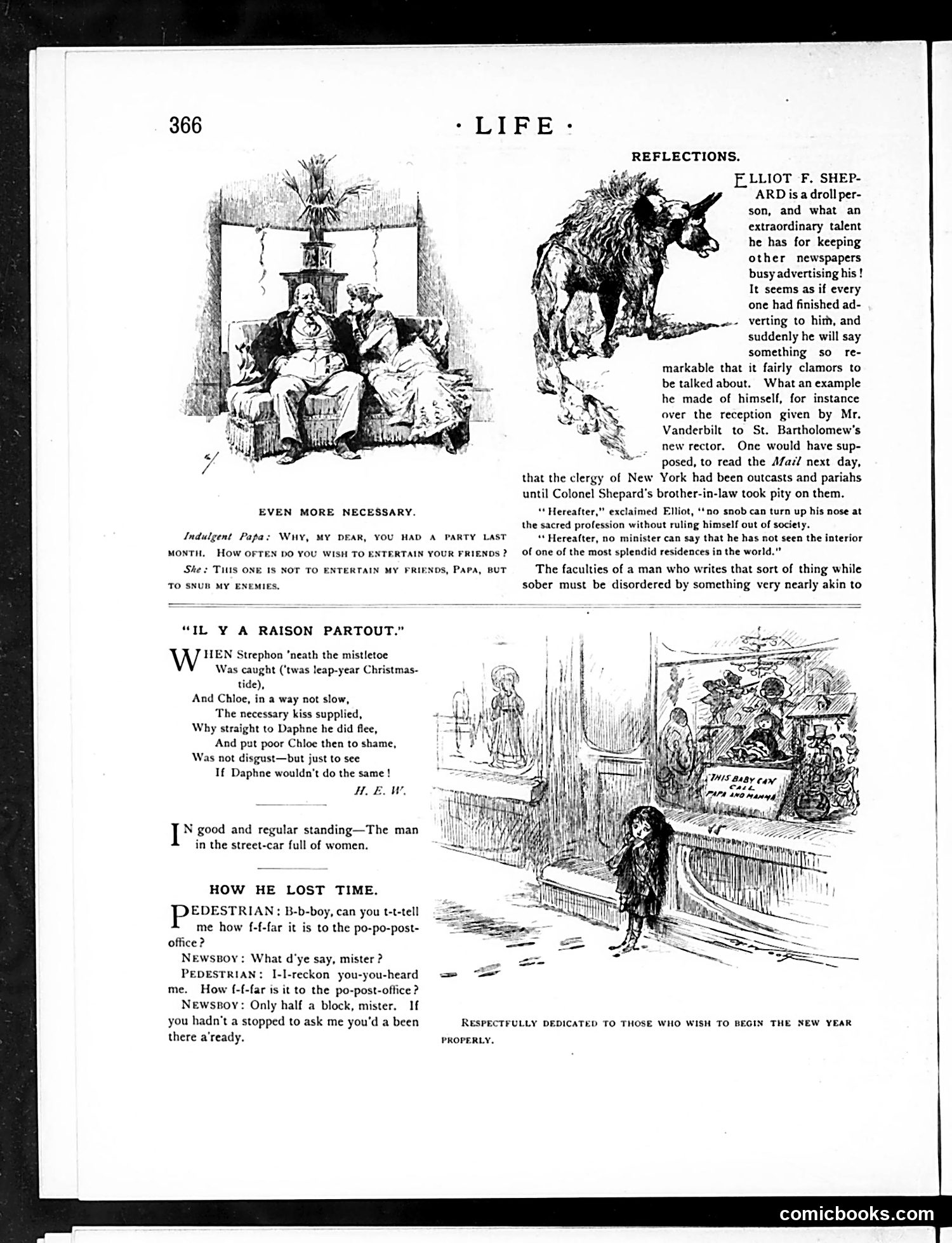
This page contains several unrelated humorous pieces typical of Life's satirical format: **"Reflections"** mocks Elliot F. Shepard, a wealthy society figure, for his talent at generating newspaper coverage through ostentatious gestures. The example cited is his brother-in-law's reception for a new rector at St. Bartholomew's Church—an event the *Mail* covered so extensively that it made New York's clergy seem previously ignored. Life satirizes Shepard's self-aggrandizing pronouncements about snobs and ministers needing to respect the clergy. **"Even More Necessary"** is a joke about a daughter who hosts parties not to entertain friends but to snub enemies—inverting social conventions for petty spite. **"Il Y A Raison Partout"** depicts Strephon using a Christmas mistletoe kiss with one woman as a pretext to pursue another—playing the field under the guise of testing a hypothesis. The remaining brief pieces joke about street-car etiquette, a stammering pedestrian's wasted time, and a newsboy's smart response.
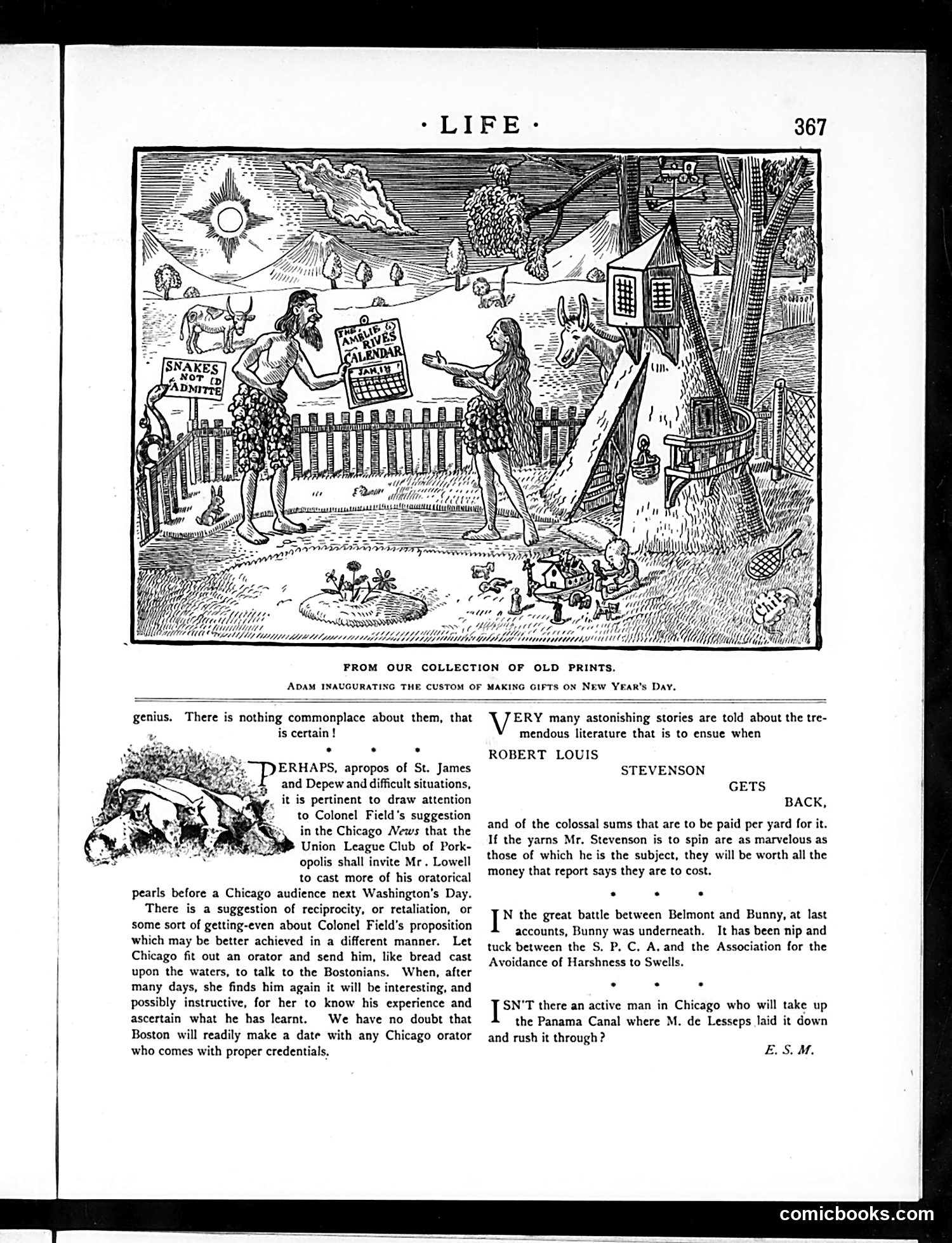
The main illustration is a historical woodcut titled "Adam Inaugurating the Custom of Making Gifts on New Year's Day," showing Adam and Eve exchanging New Year's gifts in the Garden of Eden—a humorous origin story for the gift-giving tradition. The text contains several satirical commentary snippets: **Chicago-Boston rivalry**: References Colonel Field's proposal that Chicago send an orator to Boston (reciprocating an invitation for James Russell Lowell to speak in Chicago), suggesting competitive cultural posturing between the cities. **Robert Louis Stevenson**: Jokes about inflated expectations and payment demands for Stevenson's upcoming literary works—poking fun at hype around his return to publishing. **Belmont vs. Bunny**: References a society feud involving animal welfare organizations (S.P.C.A. vs. Association for Avoidance of Harshness to Swells), likely satirizing wealthy socialites' disputes. **Panama Canal**: A brief question about whether a Chicago businessman will complete de Lesseps' failed canal project—reflecting contemporary interest in this engineering ambition.
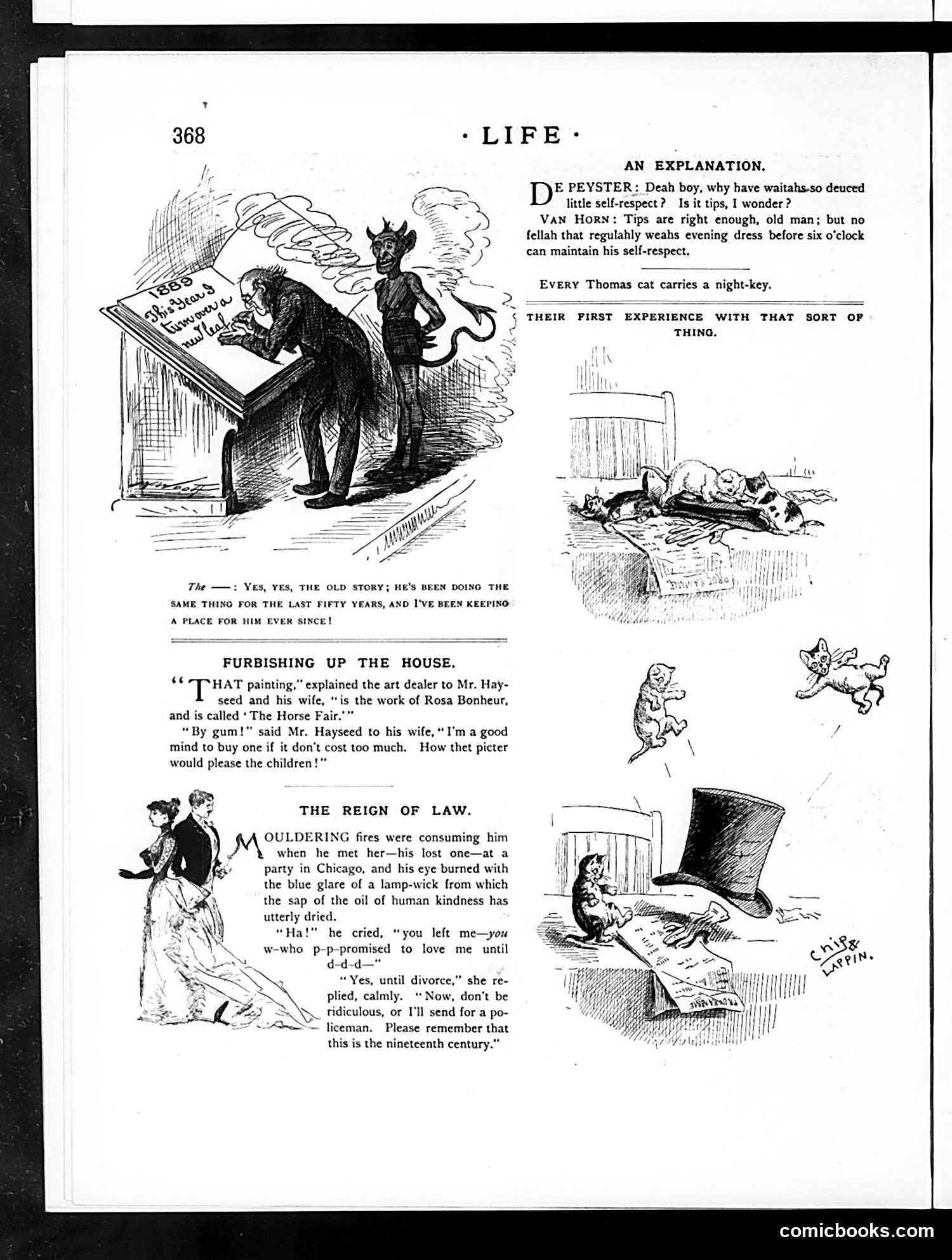
This page contains four separate satirical pieces mocking upper-class pretension and social change: **"An Explanation"**: Two wealthy men discuss why waiters lack self-respect. The joke is that men wearing formal evening dress before 6 p.m. (socially improper) cannot expect respect—the implication being that class-conscious servants judge their employers' social incompetence. **"Their First Experience"**: Brief humor about cats encountering night-keys (skeleton keys), playing on the phrase "every Thomas cat carries a night-key" (a period expression). **"Furbishing Up the House"**: A wealthy but unsophisticated "Hayseed" and his wife consider buying a Rosa Bonheur painting solely because it depicts horses—mocking rural social climbers' ignorance of art. **"The Reign of Law"**: A divorced couple reunites; when he dramatically confronts her about their broken vows, she dismissively threatens to call a policeman, citing "the nineteenth century." The satire targets modern divorce law, suggesting it undermines romantic drama and traditional male authority.
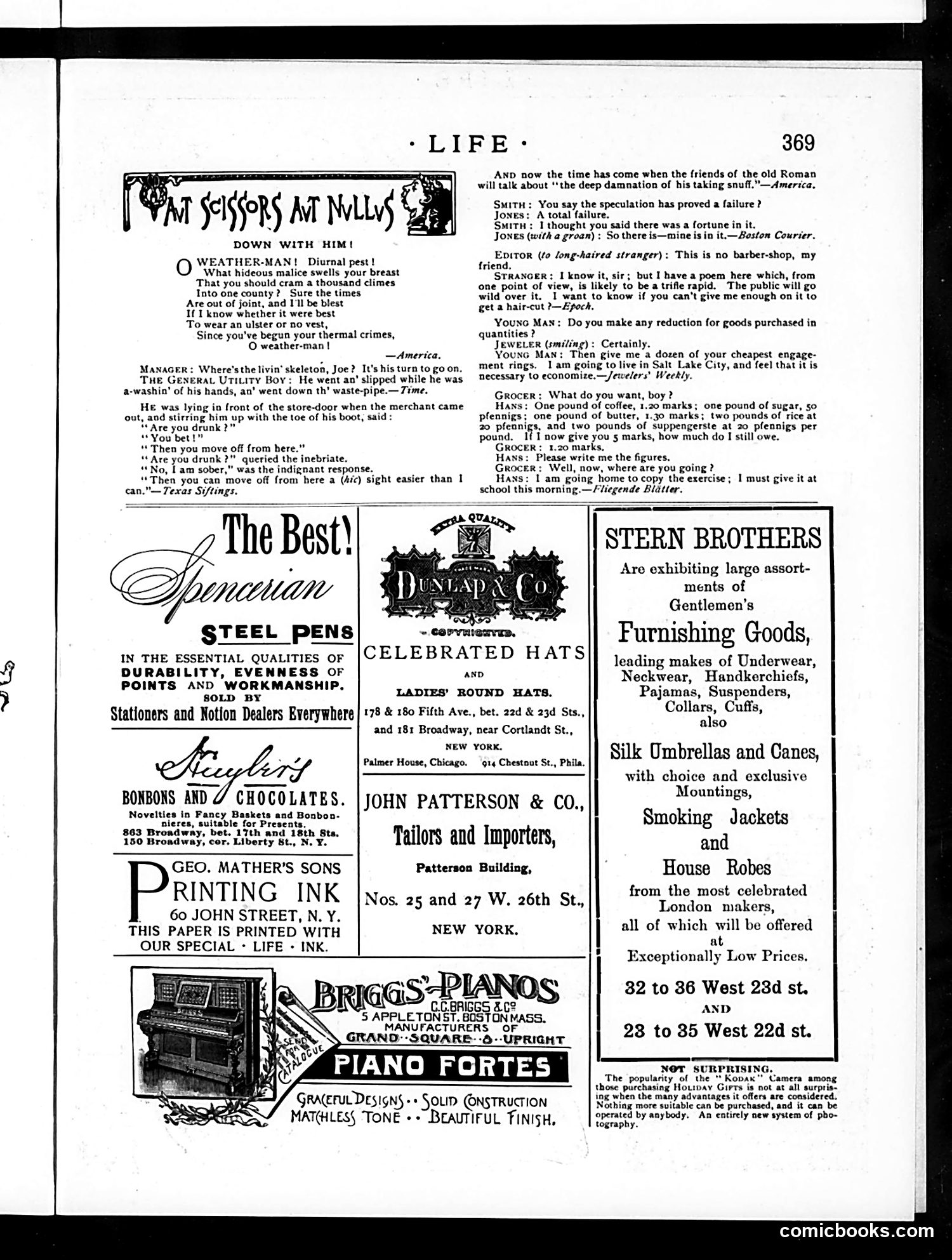
This page contains no unified cartoon but rather several brief, disconnected satirical jokes typical of *Life* magazine's format. **"Weather-Man"** satirizes meteorologists for providing contradictory forecasts that make dressing impossible—the poet can't decide whether to wear an ulster (overcoat) or go vest-only. **"Down With Him"** jokes about a circus "living skeleton" performer who accidentally goes down a waste pipe, creating absurd dialogue between a drunk man and a sober one about who can "move off" more easily. **"Deep Damnation of His Taking Snuff"** appears to mock someone's snuff-taking habit with Shakespearean language. Other brief jokes mock speculation investments, barber-shop poetry submissions, polygamy (Salt Lake City), and a schoolboy copying grocery arithmetic homework. The page is primarily **advertising**—featuring steel pens, pianos, hats, tailoring, chocolate, and furnishing goods from period merchants.
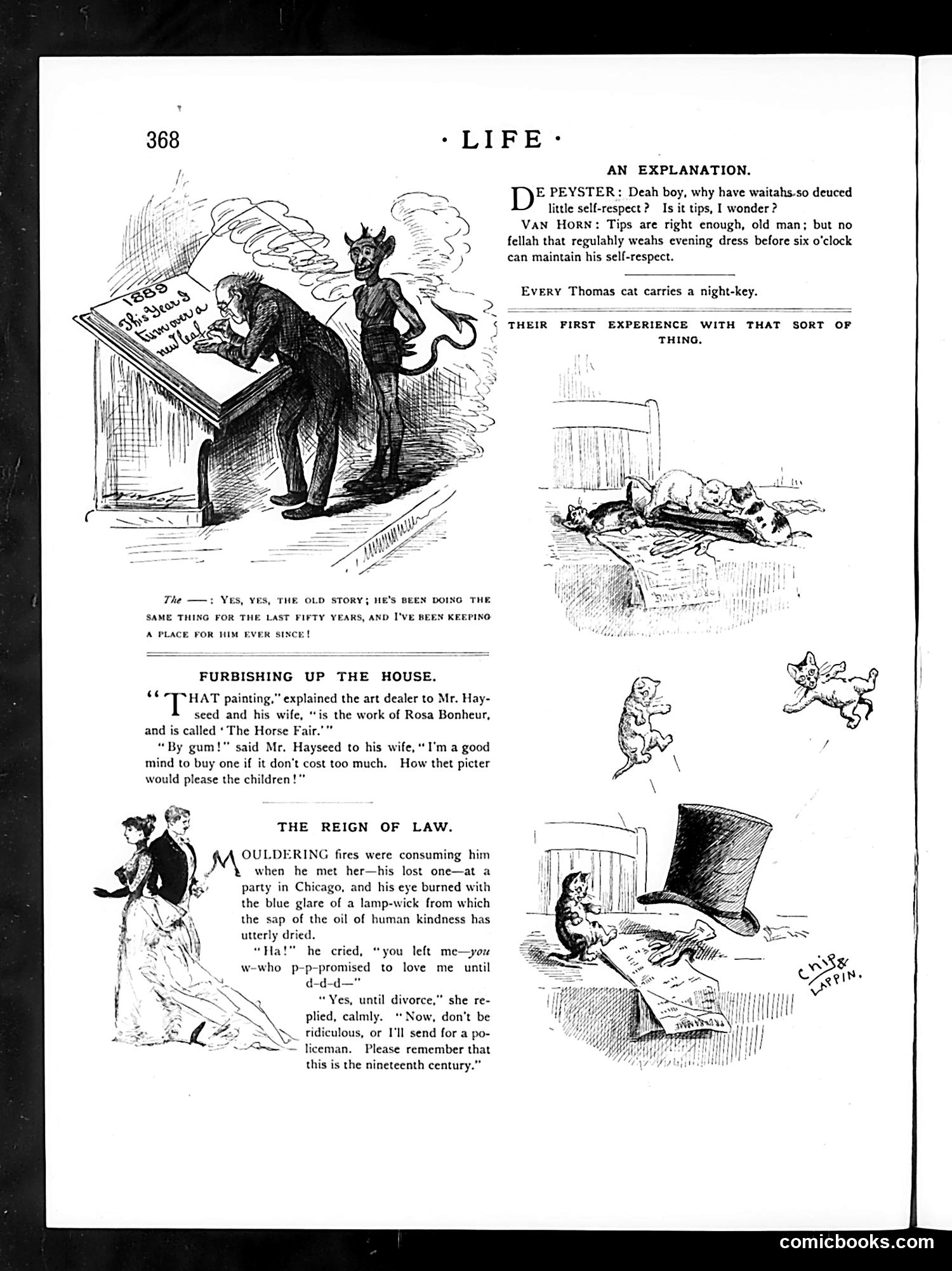
This page contains three satirical sketches mocking 19th-century social pretensions: **"An Explanation"** ridicules wealthy men's obsession with dress codes and propriety. The joke is that waiters who must wear formal evening dress before 6 p.m. cannot maintain self-respect—suggesting the absurdity of rigid social conventions. **"Furbishing Up the House"** satirizes rural Americans' (Mr. Hayseed's) cultural ignorance. He considers buying a painting by Rosa Bonheur (a famous French artist) solely because it depicts horses, assuming it would entertain children rather than valuing its artistic merit. **"The Reign of Law"** mocks melodramatic romance. A man confronts his lost love with theatrical anguish, but she dismissively invokes modern divorce law and threatens police intervention—deflating his emotional outburst with practical 19th-century legality. The satire suggests society's shift toward rational law over romantic sentiment. All three pieces target class pretension, cultural gaps, and changing social values of the period.
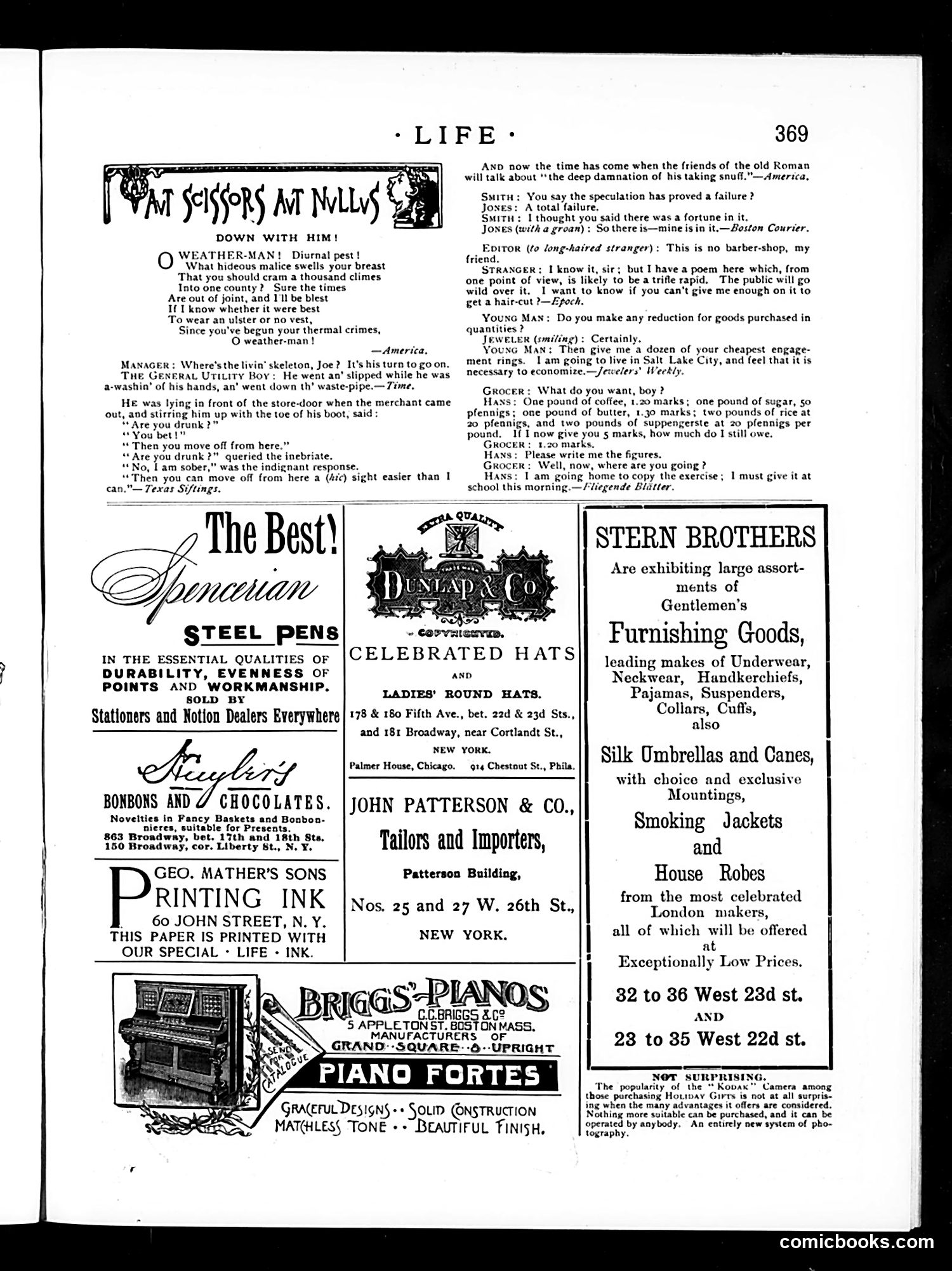
This page is primarily **advertisements with interspersed humor pieces**—typical of Life magazine's format. The cartoons and jokes are short, satirical vignettes rather than single political cartoons: **Main content:** - "Down With Him!" mocks weather forecasters for their unpredictability and the public's confusion about what to wear - A circus joke about a "living skeleton" performer accidentally going down a waste pipe - A drunk-versus-sober exchange playing on ironic logic - A barber-shop poet trying to trade his work for a haircut (satire on struggling artists) - A bigamist buying discount engagement rings for Salt Lake City (referencing Mormon polygamy) - A German immigrant boy's arithmetic problem about grocery costs **The humor** relies on wordplay, social observation, and gentle mockery of everyday situations rather than political commentary. The **advertisements** (hats, pens, pianos, furnishings) dominate the page, reflecting how 19th-century magazines monetized content through dense advertising.
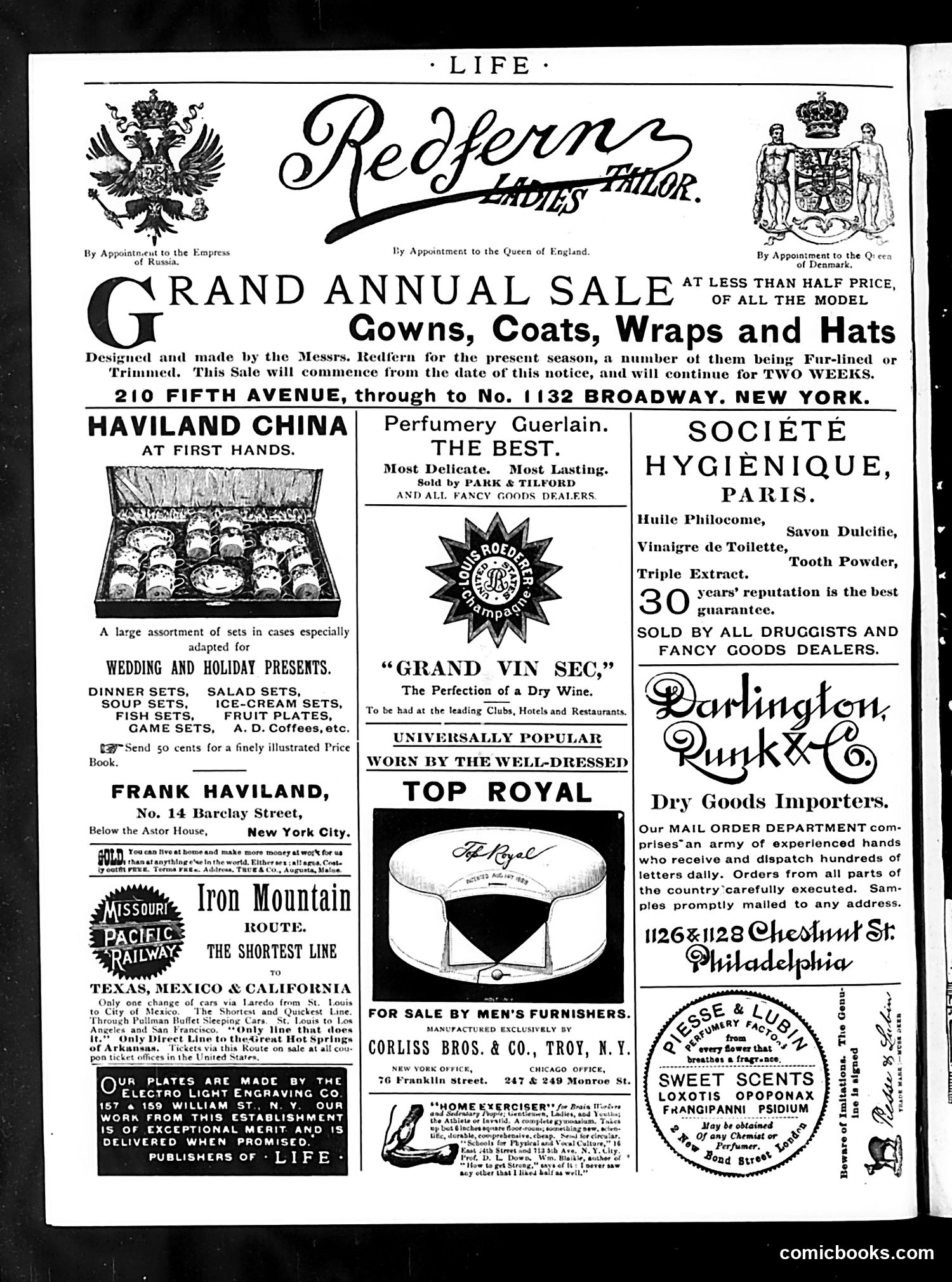
This is **primarily a advertisements page**, not a cartoon or satirical content page. It appears from a late 19th-century issue of *Life* magazine. The page features luxury consumer ads targeting wealthy audiences: Redfern's fashion sale (gowns, coats, wraps), Haviland china, French perfumes (Guerlain), wine, and imported dry goods. Notable is the emphasis on **royal appointments**—vendors advertise patronage by the Empress of Russia, Queen of England, and Queen of Denmark, a common marketing tactic to signal prestige and exclusivity to American consumers of that era. The ads reflect the period's consumer culture and class aspirations. There are no political cartoons or satirical commentary visible on this page—it's a straightforward commercial advertisement section, likely one of many revenue-generating pages in the magazine.
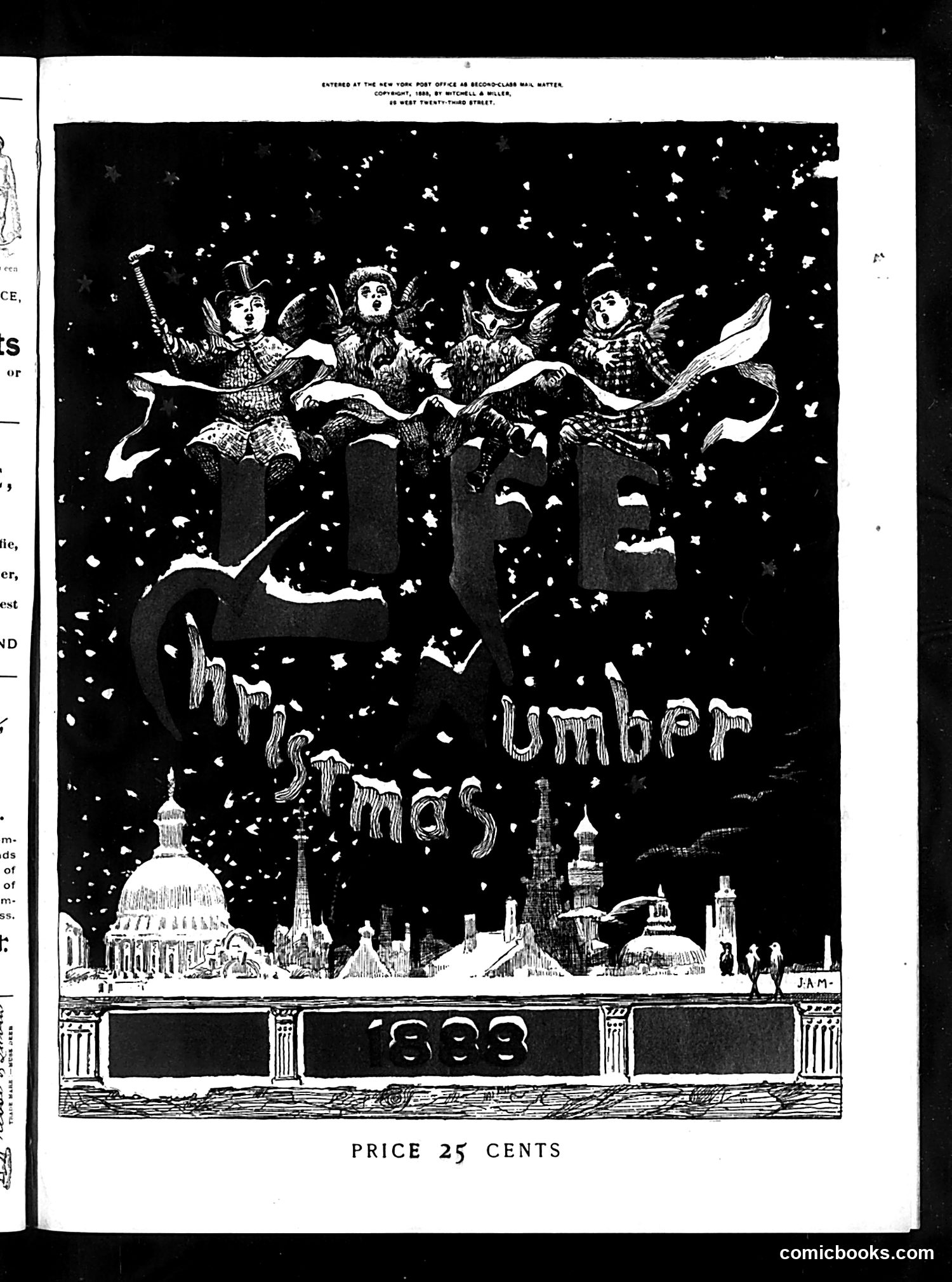
This is a cover illustration for *Life* magazine featuring four cherubic angels flying above a cityscape skyline that includes recognizable American landmarks (the Capitol dome is visible). The angels carry scrolls and trumpets amid falling snow or confetti against a dark starry sky. The title reads "Umber Times." The image appears to be a New Year's themed cover—likely for 1938 or 1939—using classical allegorical imagery. The "umber times" reference and somber tone (note the dark, heavy symbolism) suggest this may be satirizing economic or political conditions of the late 1930s, possibly the lingering Great Depression or growing international tensions before World War II. The angels bearing proclamations in a somewhat ironic style suggests *Life* magazine's characteristic satirical commentary on contemporary American affairs.
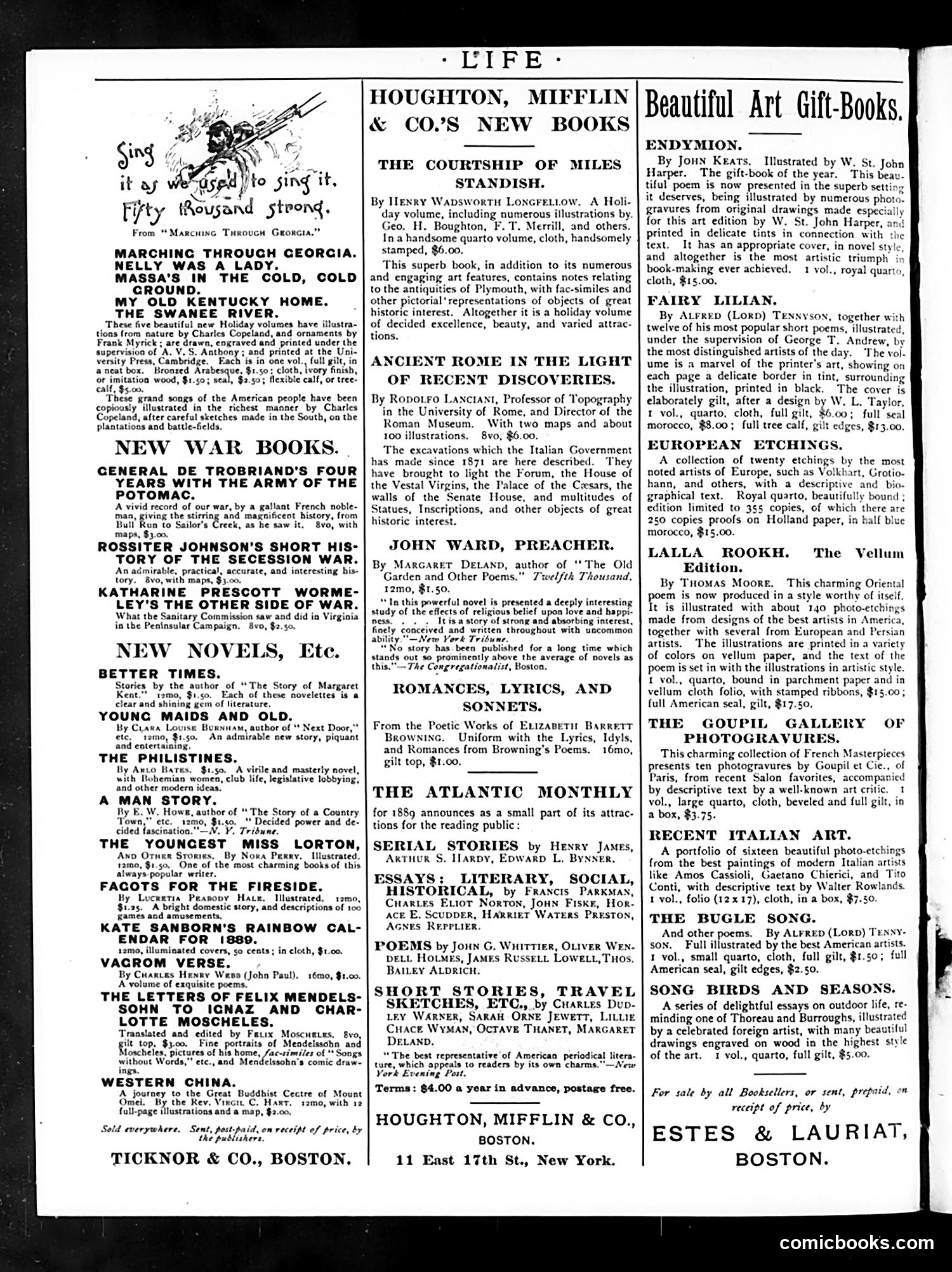
This page is primarily **advertising for books**, not political satire. It showcases new publications from Houghton, Mifflin & Co. and other publishers, circa late 1880s. The top features illustrated editions of American folk songs ("Marching Through Georgia," "Swanee River," etc.)—popular sentimental pieces, notably several with Southern plantation associations. Below are advertisements for Civil War histories, novels, and gift books. The single visual element appears to be a small illustration accompanying the folk songs section, showing figures marching (likely referencing the "Marching Through Georgia" song). The page reflects post-Civil War America's appetite for war memoirs alongside sentimental literature. This is essentially a **book catalog page** rather than satirical content—typical advertising filler common in *Life* magazine during this period.
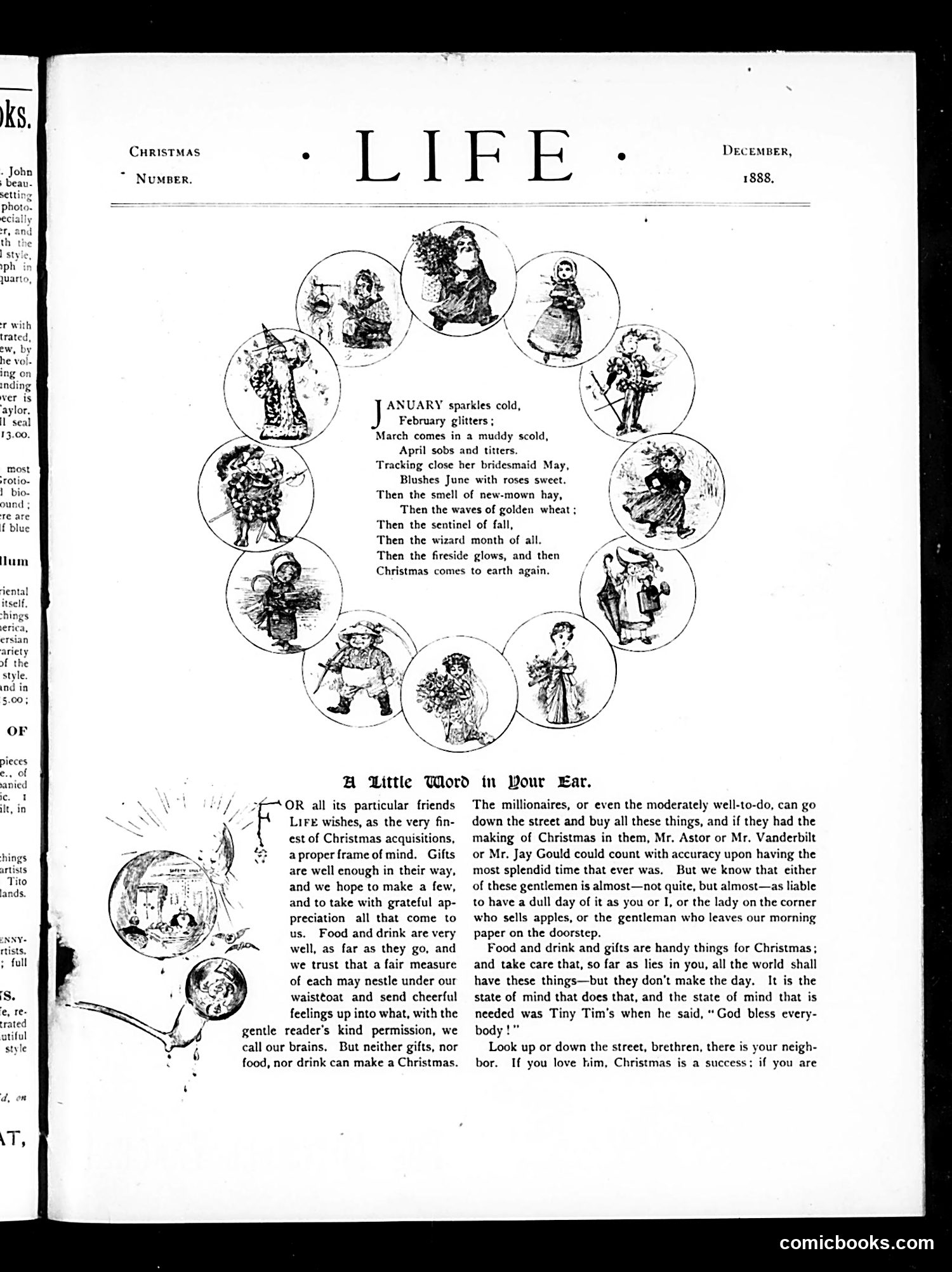
This page presents a sentimental Christmas editorial wrapped in Victorian sentimentality. The central image is a circular calendar wheel depicting the twelve months, each illustrated with figures representing seasonal characteristics—January's cold, February's glitter, spring's growth, summer's harvest, autumn's arrival, and winter's return to Christmas. The accompanying essay argues that true Christmas spirit transcends material wealth. While referencing wealthy industrialists like Astor, Vanderbilt, and Jay Gould—names synonymous with gilded-age excess—the writer insists that rich and poor alike experience dull days without proper mindset. The piece invokes Dickens's *A Christmas Carol* ("God bless every body"), positioning Christmas as fundamentally about love for one's neighbor rather than expensive gifts or lavish food and drink. This reflects late-Victorian middle-class values: Christmas sentimentalism, moral elevation over materialism, and gentle criticism of extreme wealth disparity—without advocating systemic change.
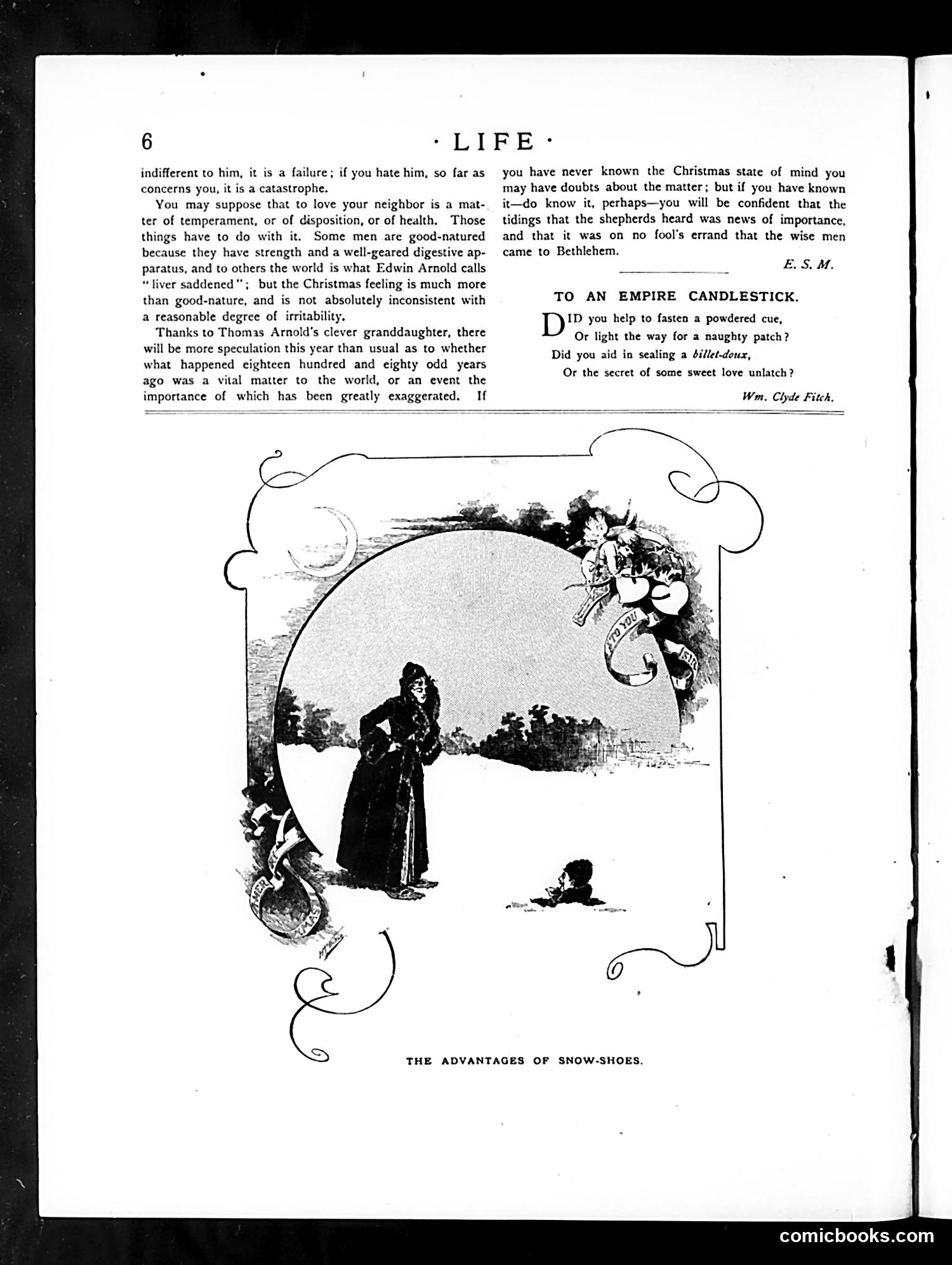
This page contains two distinct items: **Main Article:** A Christmas-themed essay discussing the spiritual meaning of Christmas versus materialism. It references "Thomas Arnold's clever granddaughter" (likely Mary Arnold Ward, a Victorian writer), suggesting contemporary debate about religious faith's importance. **Poem:** "To an Empire Candlestick" by William Clyde Fitch poses whimsical questions to a decorative candle holder, asking if it witnessed romantic moments—powdered wigs (period fashion), beauty marks ("patches"), love letters ("billet-doux"), and secrets. It's playful period nostalgia. **Illustration:** "The Advantages of Snow-Shoes" depicts a woman in winter clothing standing in snow with what appears to be a child or small figure. The title suggests practical winter gear benefits, though the cartoon's specific satirical point remains unclear from the image alone. The overall page emphasizes Christmas sentiment, romance, and winter leisure—typical Life magazine content mixing philosophy, poetry, and illustrated humor for educated Victorian/Edwardian readers.
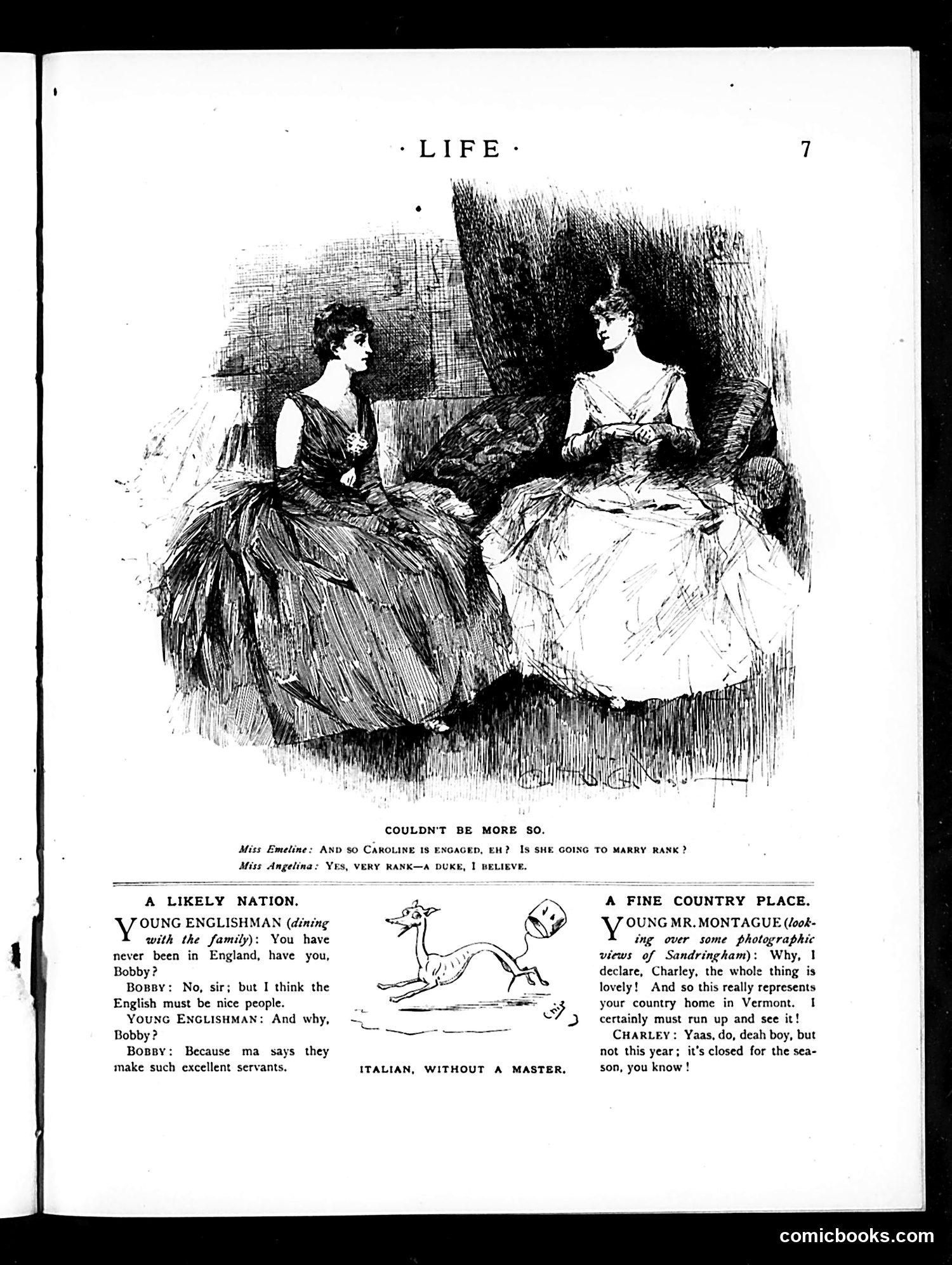
This page contains four separate satirical jokes targeting class pretensions and social snobbery of the era: **"Couldn't Be More So"**: Two women discuss an engagement to "rank—a duke." The pun plays on marrying for aristocratic title rather than genuine affection. **"A Likely Nation"**: A young English visitor claims English people must be "nice" because they make "excellent servants"—satirizing American assumption that the English are primarily suited to servile roles. **"Italian Without a Master"**: A visual gag (image only) about an untethered or uncontrolled Italian. **"A Fine Country Place"**: Mr. Montague admires photographs of what he believes is Charley's Vermont estate, but Charley reveals it's actually *closed for the season*—exposing the pretense of owning a grand country home he doesn't actually use or occupy. The overarching theme mocks American and European social climbing, where status symbols (aristocratic marriages, estates, servants) matter more than substance.
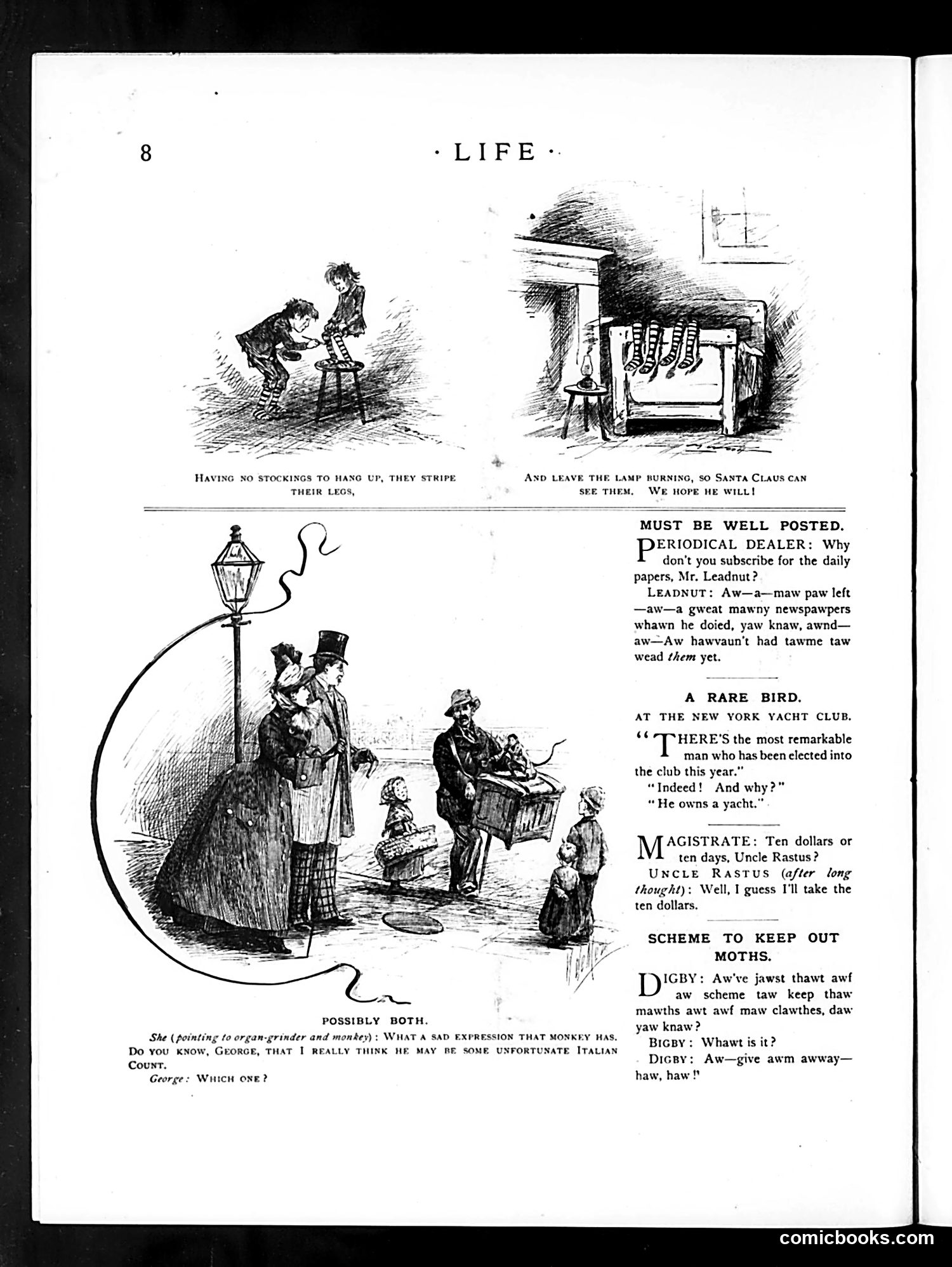
This page contains multiple satirical vignettes typical of early 20th-century American humor: **"Possibly Both"**: A woman points to an organ-grinder's monkey, noting its sad expression and speculating it may be an "unfortunate Italian Count." The joke mocks both sentimental anthropomorphism and anti-Italian prejudice—suggesting either the monkey or an actual Italian nobleman might be equally miserable. **"A Rare Bird"**: At the New York Yacht Club, a man is called "remarkable" for owning a yacht. The satire targets the wealthy elite's pretensions—that merely possessing a yacht makes one noteworthy among the ultra-rich. **"Must Be Well Posted"** and dialect humor pieces use exaggerated phonetic spelling of rural/working-class accents (represented as "aw" and "thaw" speech patterns) for comedic effect—common period humor that relied on mocking non-standard speech. **Christmas and mothproofing sketches** offer gentler domestic humor. Overall, the page reflects period satire targeting class pretension, immigrant stereotypes, and rural/urban dialect mockery.
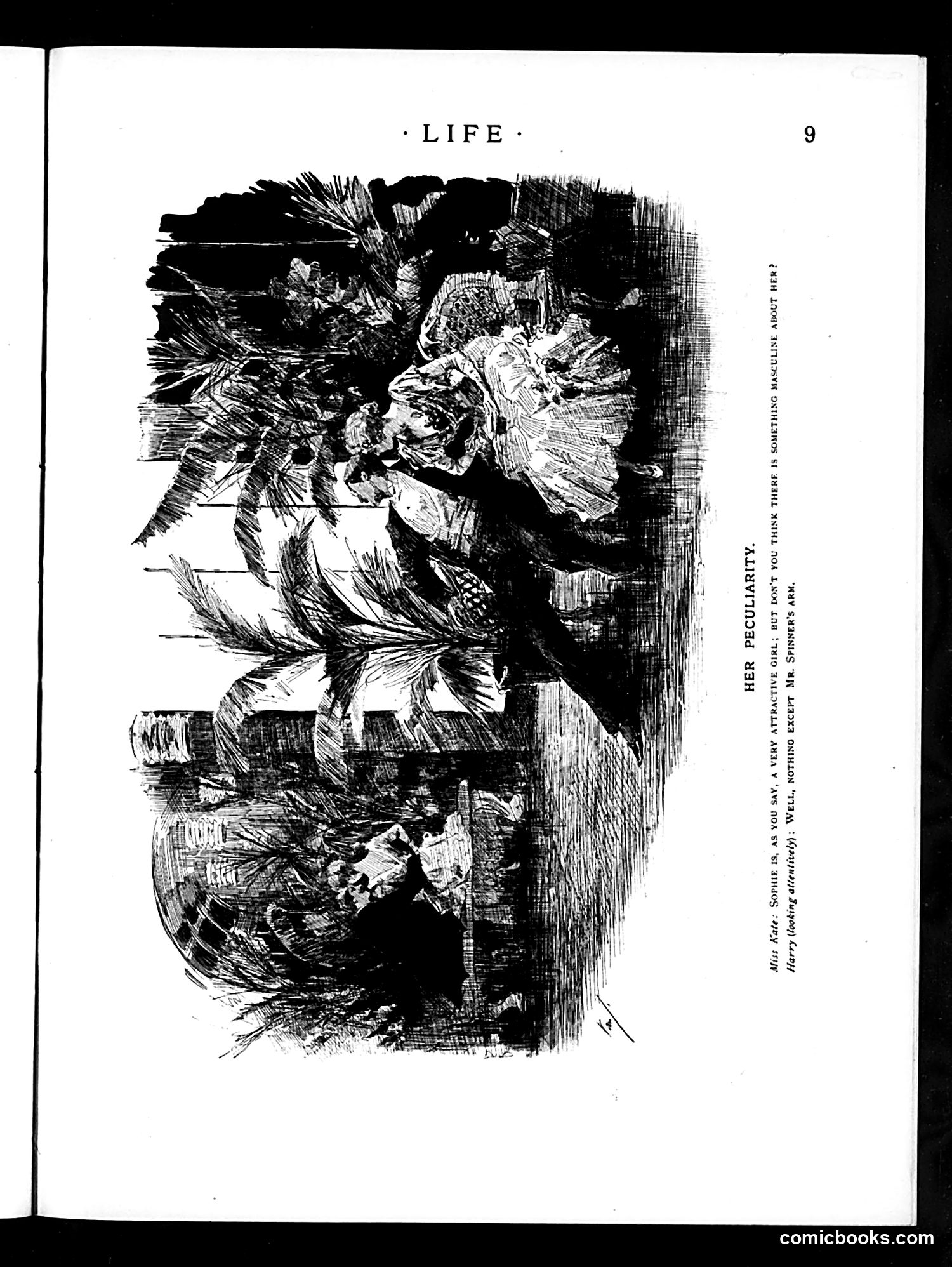
I cannot reliably interpret this page because: 1. **OCR text is corrupted/unreadable** — The text appears garbled and doesn't form coherent English, making it impossible to identify the cartoon's subject, date, or context. 2. **Image orientation unclear** — The illustration appears rotated, making it difficult to definitively identify figures or scenes depicted. 3. **Without legible text**, I cannot determine what political/social event, figure, or satire this addresses. To properly explain this *Life* magazine cartoon for a modern reader, I would need either a clearer image or correctly OCR'd caption text identifying the subject matter, date of publication, and any figures depicted. Without these elements, any interpretation would be speculation rather than evidence-based analysis.
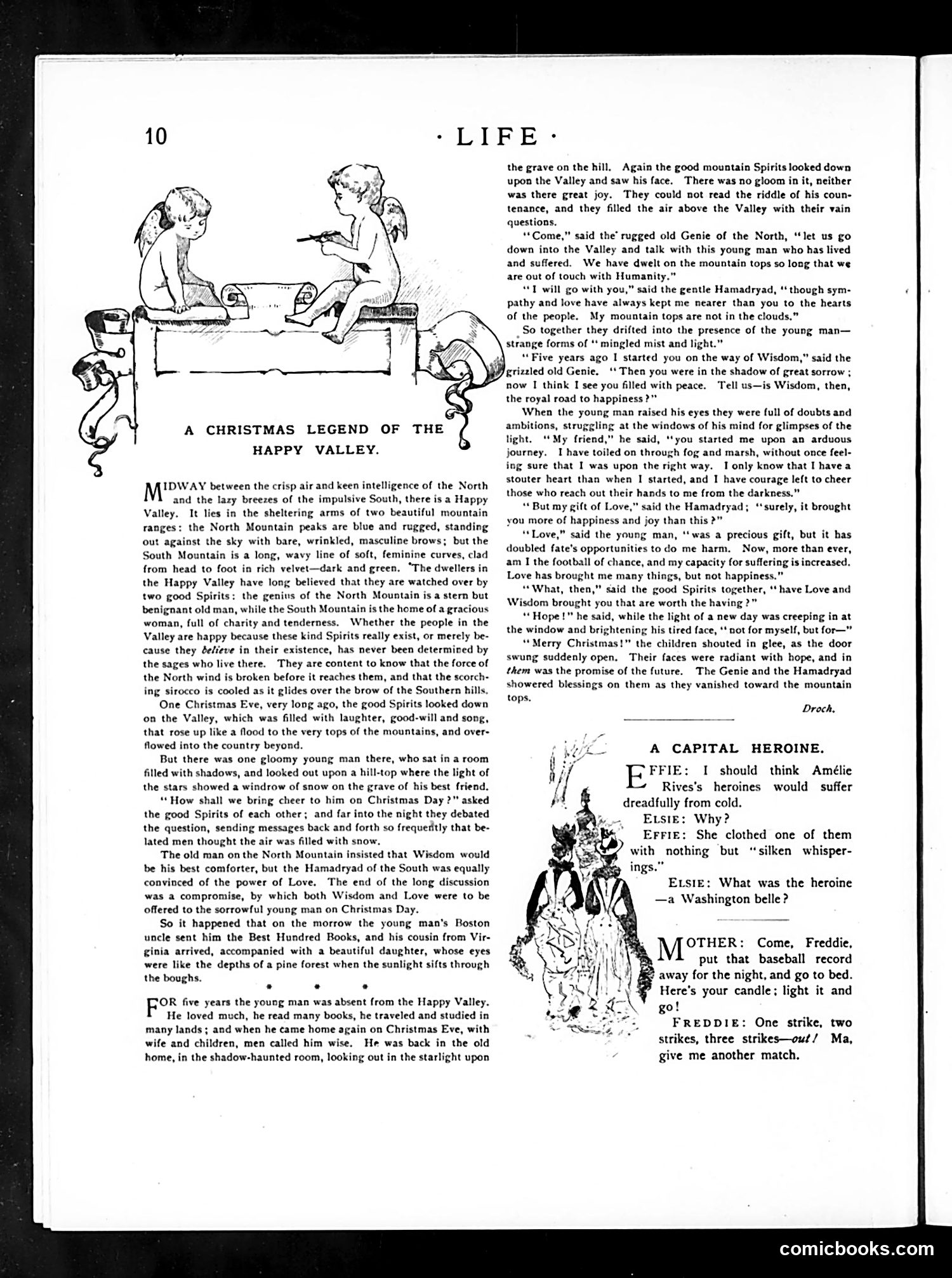
This is a sentimental Christmas story, not political satire. The narrative describes two mountain spirits—a stern masculine North Mountain genius and a gracious feminine South Mountain spirit—who watch over a Happy Valley. When a gloomy young man sits mourning his dead friend on Christmas Eve, the spirits debate whether **Wisdom** (the North's gift) or **Love** (the South's gift) should comfort him. They compromise, sending him books from Boston and a beautiful cousin from Virginia. Five years later, the now-married man returns home transformed—neither gloomily sorrowful nor exuberantly joyful—suggesting life's complex balance of both intellectual and emotional fulfillment. The page also includes an unrelated satirical dialogue titled "A Capital Heroine" mocking women's suffrage advocates and a domestic scene with children.
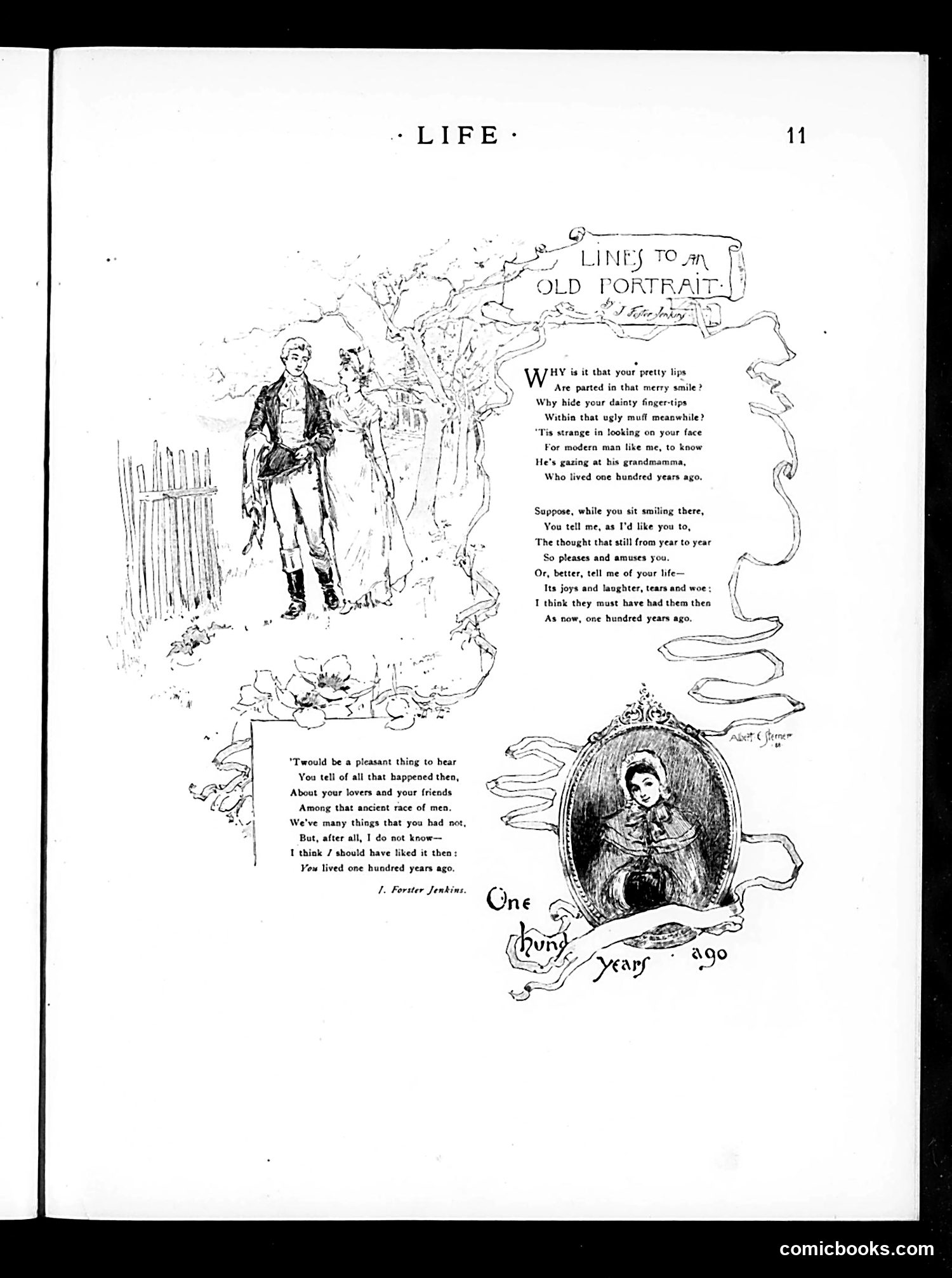
This is a sentimental poem by I. Forster Jenkins accompanying a sketch of a man gazing at a portrait of a woman from a century past. The poem's conceit is that the subject is the speaker's grandmother, and he addresses her image directly, curious about her life, loves, and experiences. The satire is gentle: the speaker notes modern life has "many things" the past lacked, yet paradoxically admits he might have preferred living then. This reflects late-19th/early-20th-century nostalgia—romanticizing the past while acknowledging progress. The illustration shows a fashionably-dressed Victorian-era gentleman contemplating the portrait with a wistful expression, emphasizing the piece's theme of generational reflection and the persistent human tendency to idealize history.
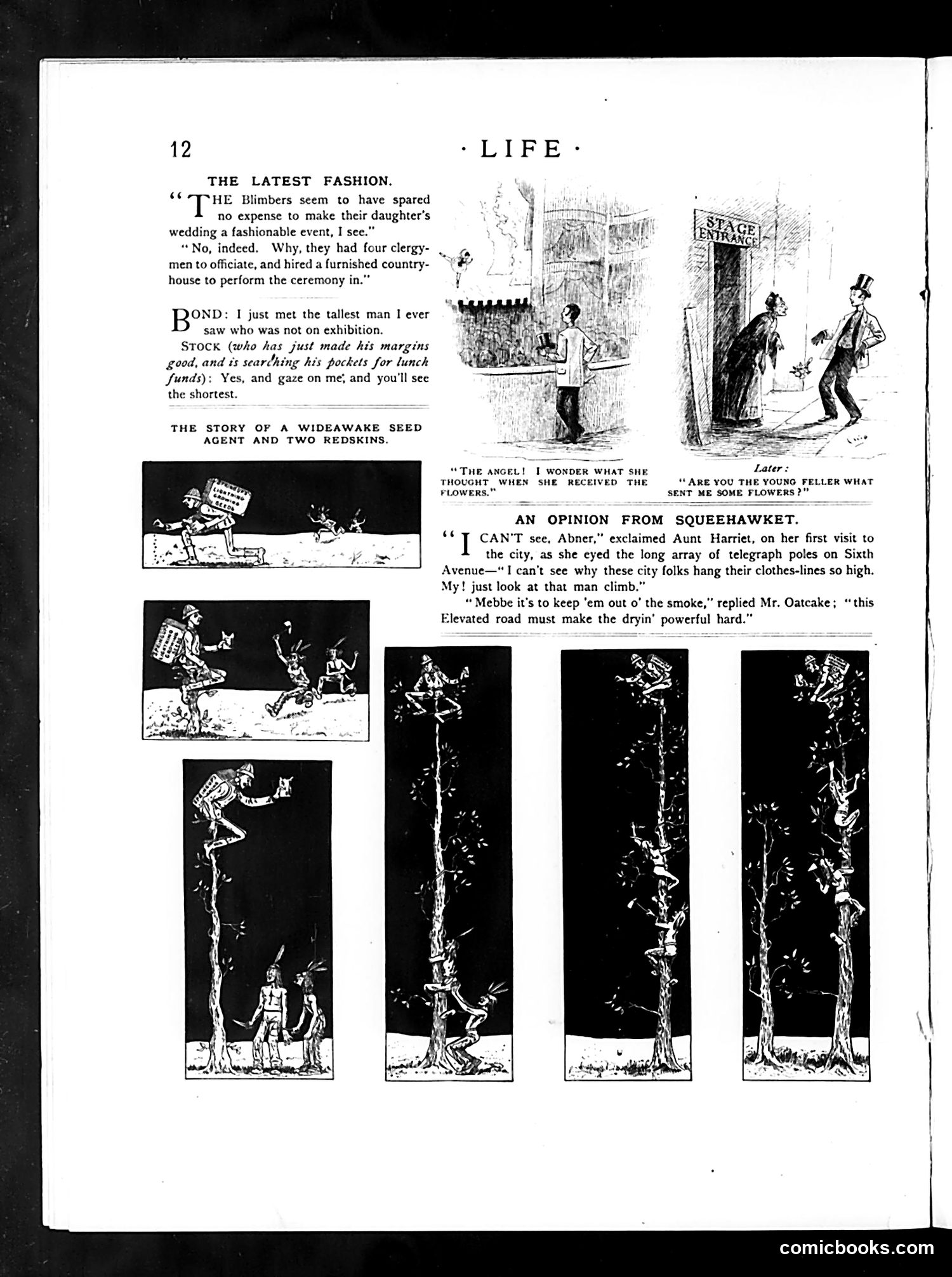
This page contains several satirical pieces typical of early 20th-century American humor: **"The Latest Fashion"** mocks wealthy pretension—the Blimbers hire four clergy and rent a country house for their daughter's wedding, treating it as an ostentatious display rather than a sincere ceremony. **Bond and Stock dialogue** plays on contrasting heights: Bond met an exceptionally tall man not in a circus, while Stock (a financial trader who recently improved his finances) jokes he's the shortest—trading on the contemporary association between poverty and physical stature. **"An Opinion from Squeehawket"** features rural characters visiting the city. Aunt Harriet mistakes telegraph poles for clotheslines hung impossibly high, and Mr. Oatcake blames the "Elevated road" (elevated train) for making clothes-drying difficult. The humor derives from rural ignorance of urban infrastructure—a common satirical theme mocking country folk unfamiliar with modern cities. The page's overall tone ridicules both urban affectation and rural naiveté.
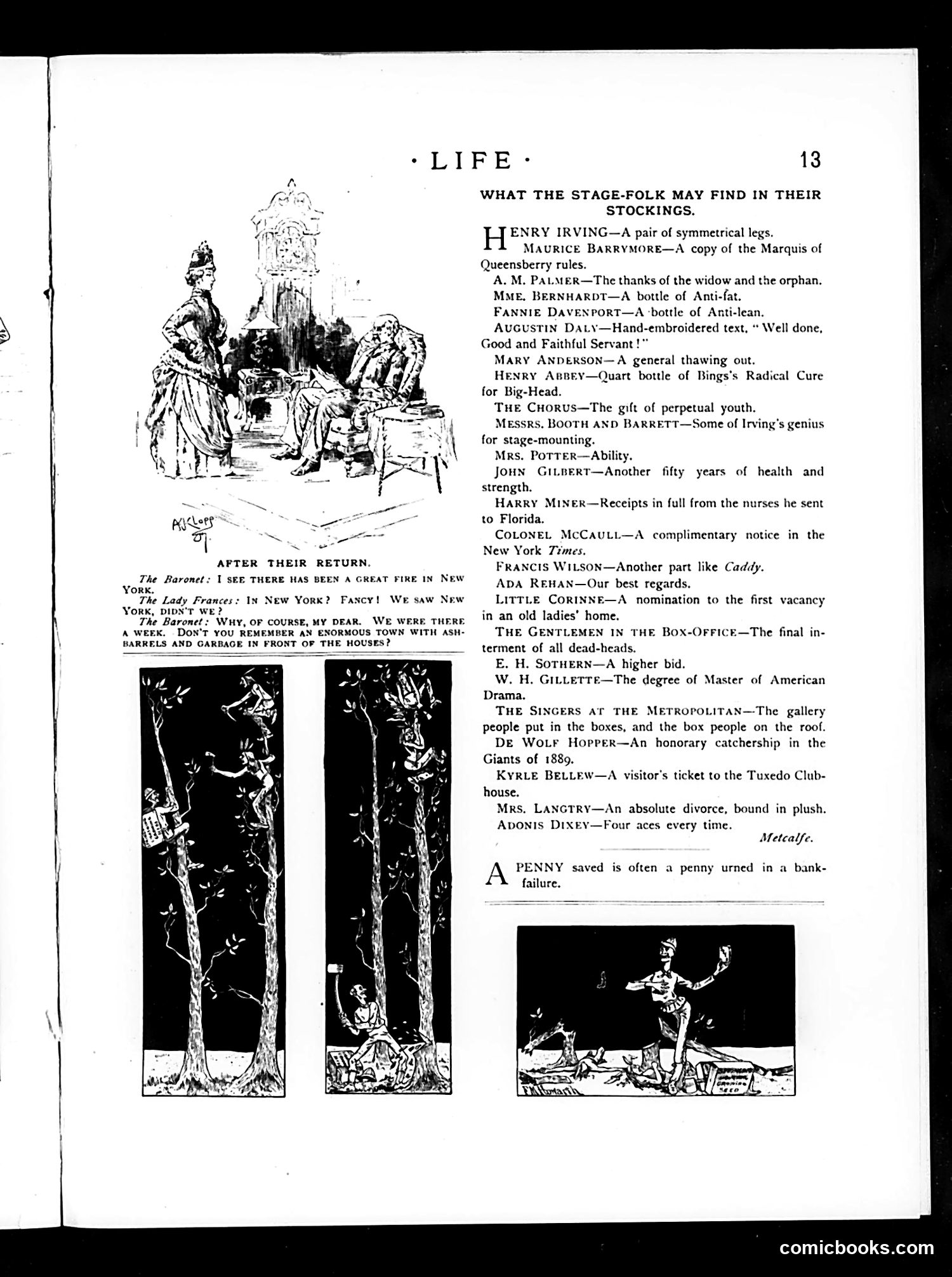
This page contains two satirical pieces from Life magazine targeting theatrical society: **Top cartoon**: British aristocrats return from New York, dismissing the city as merely "an enormous town with ash-barrels and garbage in front of the houses"—mocking upper-class snobbery and their obliviousness to actually seeing America. **Main content**: A mock "Christmas stocking gifts" list for prominent stage performers of the era. The humor lies in personalized insults disguised as presents. Examples: Henry Irving gets "symmetrical legs" (implying awkwardness), Lillie Langtry receives "an absolute divorce" (referencing her scandalous personal life), and De Wolf Hopper gets a Giants baseball catchership (unclear without more context, but likely a contemporary reference). The list satirizes vanity, scandals, and perceived shortcomings of 1880s-90s theater celebrities. The final aphorism about pennies "urned in a bank-failure" references contemporary banking collapses, adding topical economic commentary.
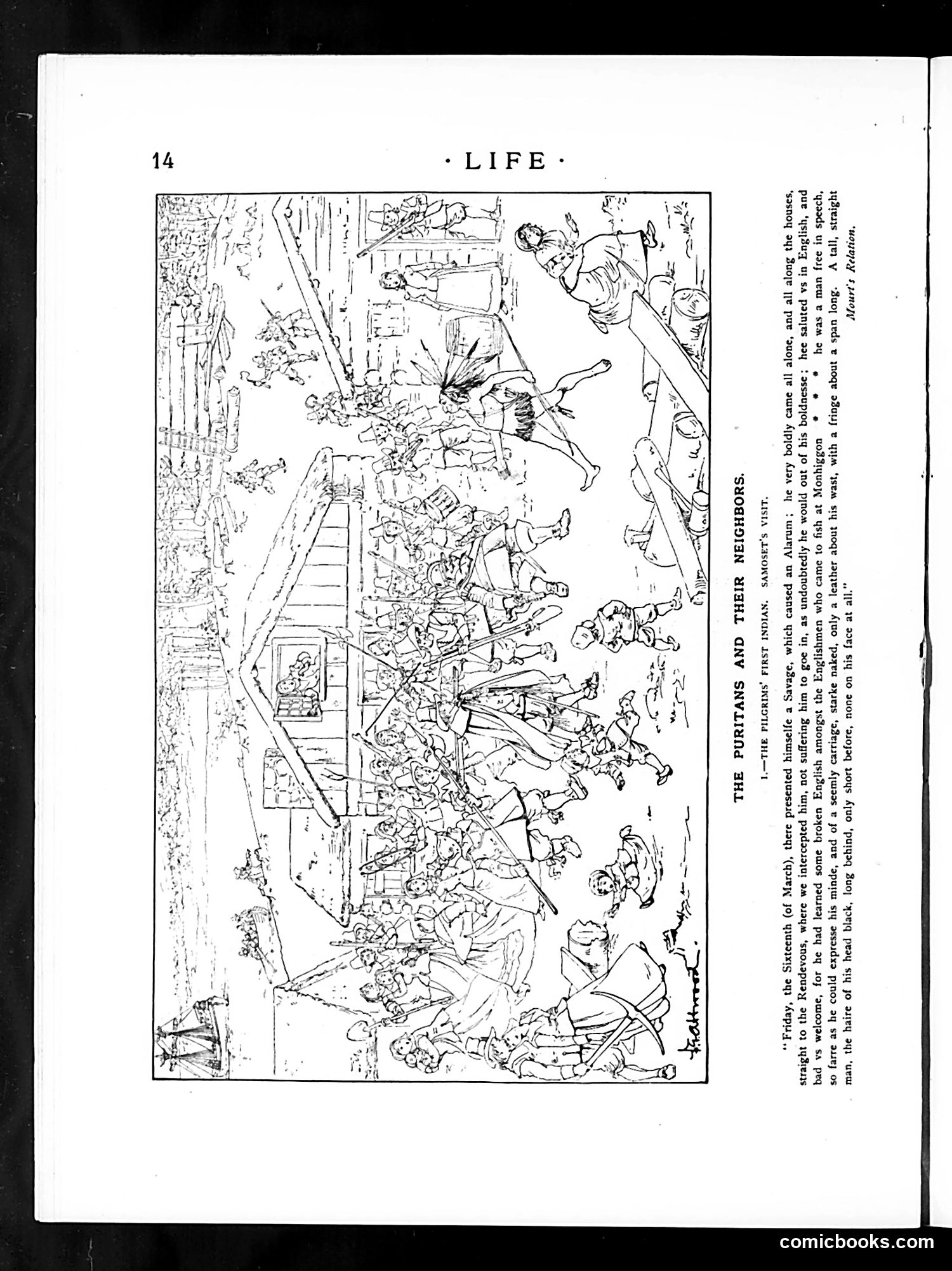
This is a satirical illustration depicting the Pilgrims/Puritans (identifiable by their characteristic colonial dress and bonnets) encountering Native Americans. The cartoon appears to criticize Puritan hypocrisy regarding their neighbors—likely referencing the contradiction between Puritan moral self-righteousness and their actual treatment of Native peoples. The OCR'd text (heavily corrupted) appears to discuss Puritan conduct and morality, though specific details are illegible. The illustration's title and composition suggest this is social commentary on how the Puritans presented themselves versus their actions, a common satirical theme in Life magazine's treatment of American historical mythology. Without clearer text, the precise satirical point remains somewhat unclear, but the juxtaposition of pious Puritans with indigenous people suggests commentary on colonial-era injustice masked by religious piety.
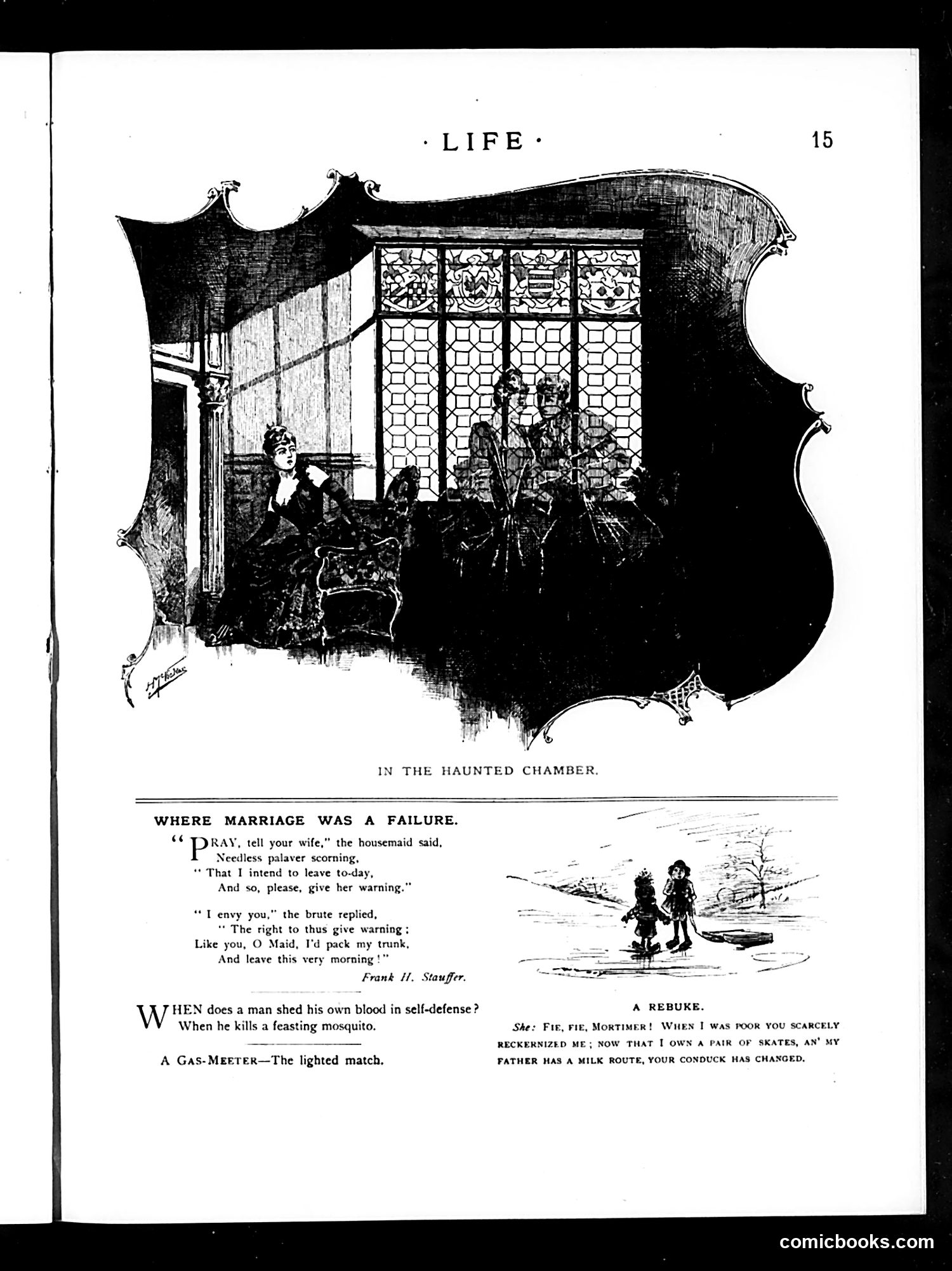
This page contains three separate satirical pieces typical of early Life magazine humor: 1. **"In the Haunted Chamber"** — An illustration accompanying a poem about a failed marriage. A housemaid announces her departure to the master, who replies he envies her ability to leave. The satire targets unhappy marriages where both parties are trapped, treating the domestic situation as mutually miserable rather than romantic. 2. **"Where Marriage Was a Failure"** — A poem by Frank I. Stauffer depicting marital discord, where a husband and housemaid discuss leaving a household. 3. **Brief witticisms** including: - A joke about self-defense and mosquitoes - "A Rebuke": A woman scolds a man (Mortimer) for ignoring her when poor but now showing interest after she acquired skates and her father gained a milk route—satirizing social climbing and mercenary courtship based on improved financial circumstances. The overall theme mocks marriage failures, class consciousness, and romantic hypocrisy among the period's middle class.
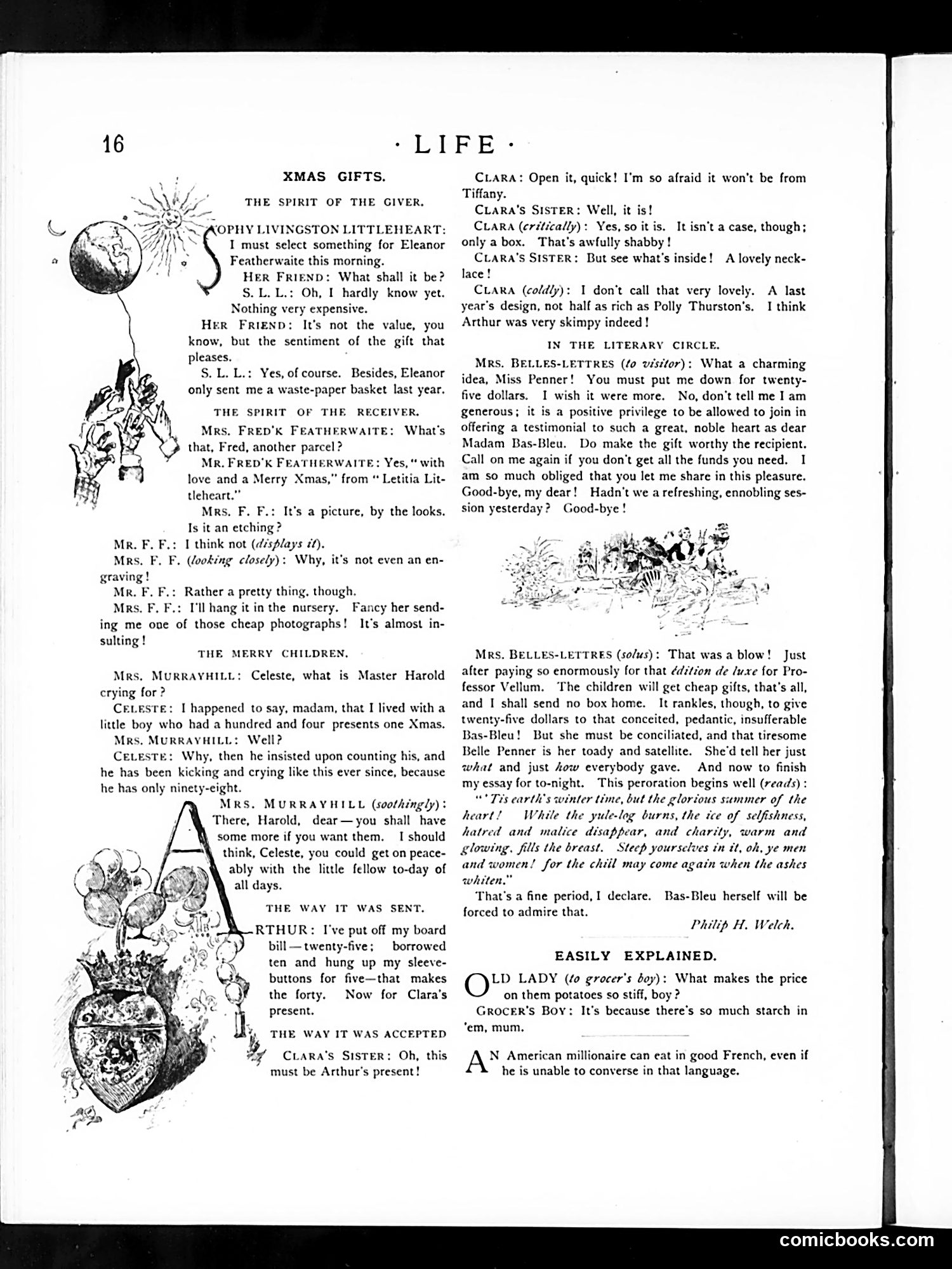
This page satirizes the disconnect between Christmas gift-giving's professed ideals and actual materialistic behavior among the wealthy. The satire operates through contrasted perspectives: "The Spirit of the Giver" shows Dorothy Livingston selecting an inexpensive gift while mentally calculating Eleanor's inferior gift from last year. "The Spirit of the Receiver" depicts the Featherwaites dismissing an etching as a "cheap photograph"—insulting despite the sender's sentiment. Other sketches mock this hypocrisy further: a child counts presents obsessively; Arthur sacrifices financially for Clara's gift, only to have her disdain the jewelry box as "shabby"; and Mrs. Belles-Lettres, a pretentious literary figure, grudgingly donates to a charity testimonial while inwardly resenting the expense, then writes flowery prose about Christmas charity and selflessness. The recurring joke: wealthy Americans espouse noble Christmas virtues while acting with pettiness, calculation, and social climbing—their generosity dependent on status and reciprocal obligation rather than genuine spirit.
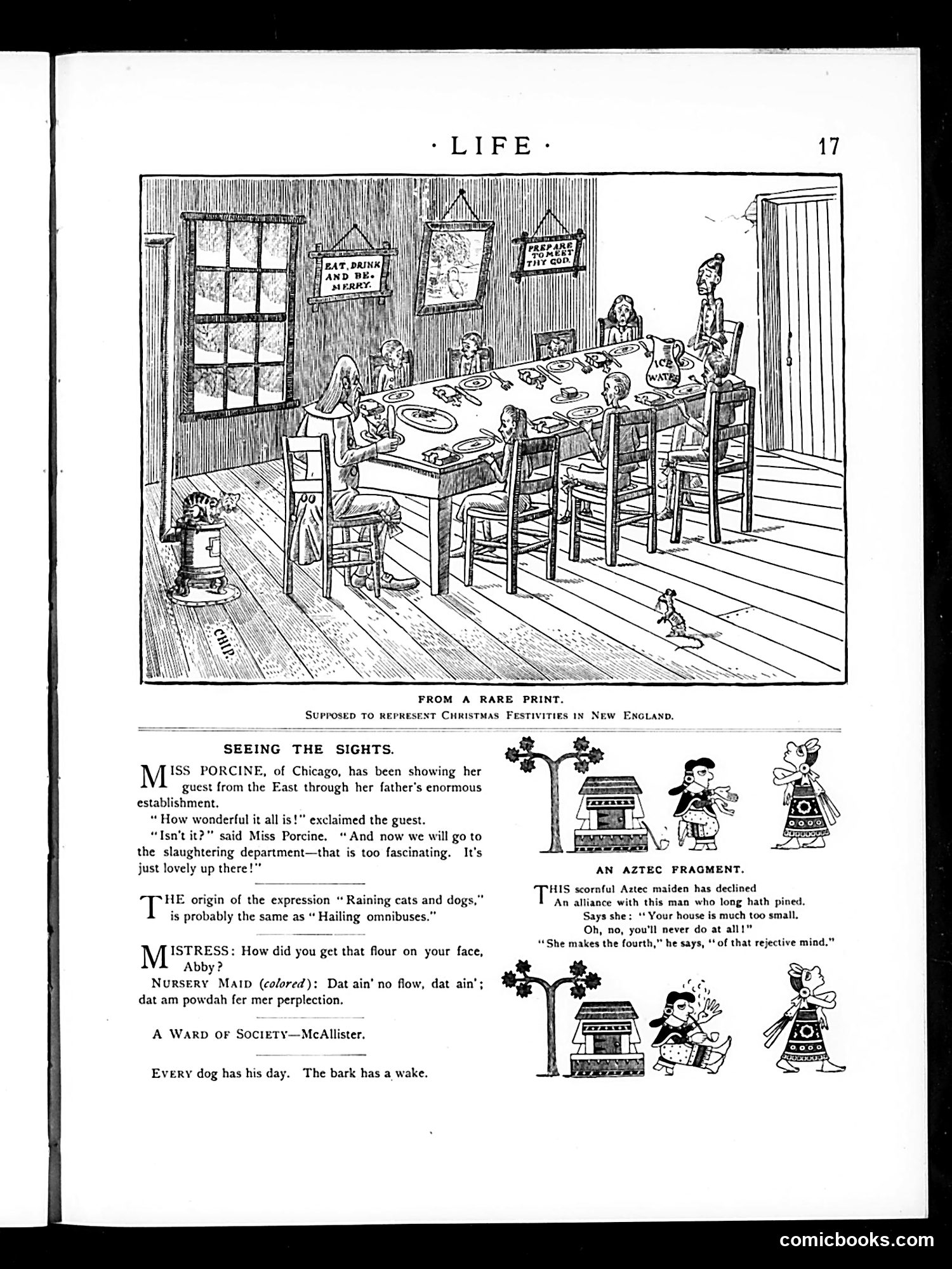
This page from *Life* magazine contains several unrelated satirical pieces: **Top image**: A colonial-era print supposedly depicting New England Christmas celebrations, likely meant ironically—the formal dining scene appears austere compared to modern expectations. **"Seeing the Sights"**: Satirizes the newly wealthy Chicago meatpacking industry. Miss Porcine (surname humorously referencing pigs) proudly shows her Eastern guest her father's slaughterhouse, treating it as a tourist attraction. The joke mocks both nouveau riche materialism and the casual brutality of industrial butchering presented as entertainment. **Etymology note**: A brief aside on the phrase "raining cats and dogs." **Nursery maid exchange**: A racist dialect joke featuring a Black servant claiming face powder is "protection" (likely "complexion" mockingly rendered), playing on period stereotypes. **"Aztec Fragment"**: A short romantic comedy where a woman rejects a suitor for having too small a house—she's the fourth woman to reject him for this reason. The content reflects early 20th-century *Life* magazine's mix of class commentary, casual racism, and light humor.
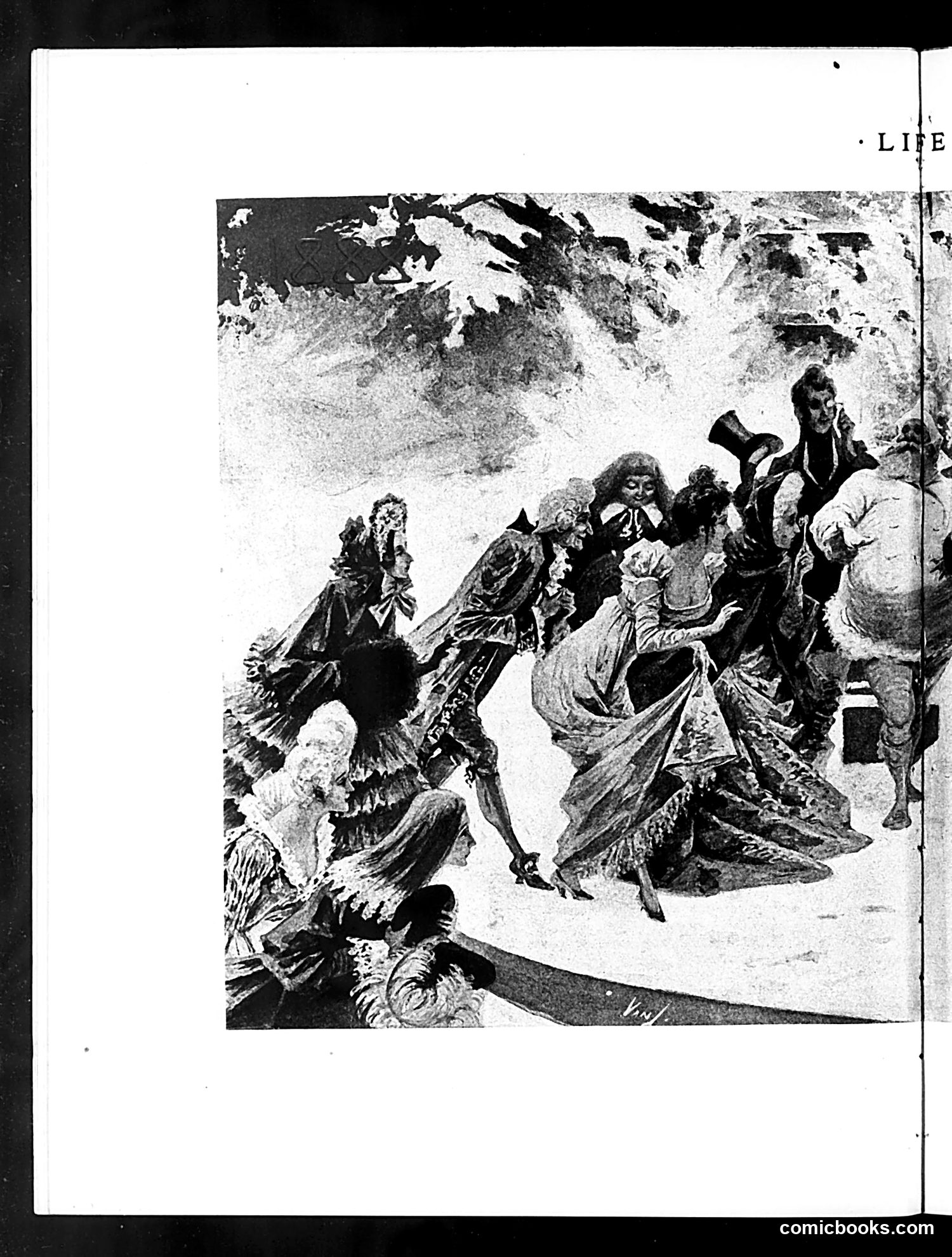
This appears to be a satirical illustration from Life magazine depicting an elaborate formal social scene, likely from the late 19th or early 20th century based on the clothing styles and artistic technique. The image shows well-dressed figures in ornate period costumes gathered in what seems to be a theatrical or social setting. The elaborate gowns, feathered hats, and formal attire suggest satire of high society or aristocratic pretension. The crowded composition and exaggerated details typical of Life's humor indicate mockery of social conventions, vanity, or class pretense. However, without visible OCR text content or clear identifying labels on the figures, I cannot definitively state which specific social event, political figures, or satirical point this cartoon makes. The artistic style suggests social commentary rather than political satire.
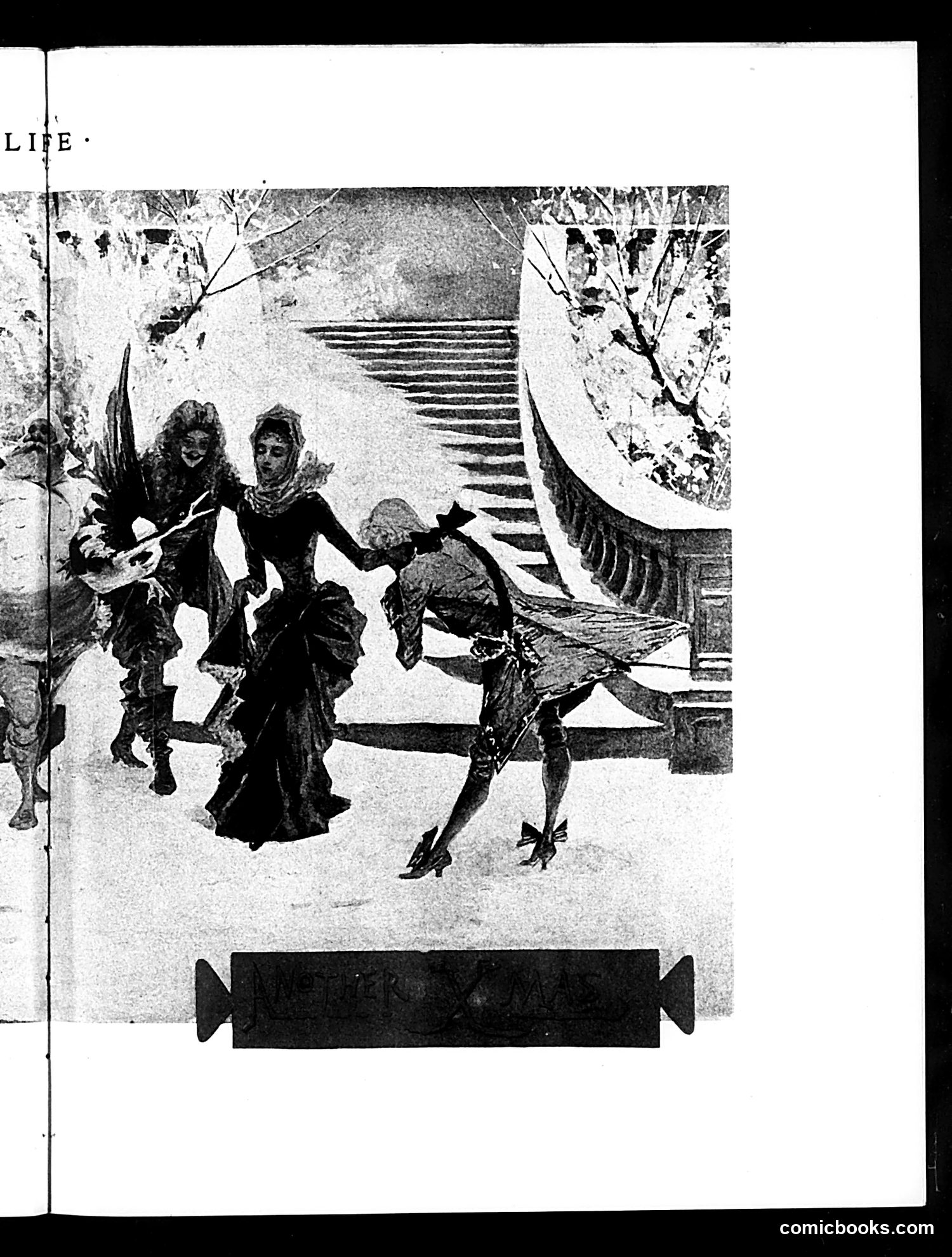
The OCR text is too corrupted to read reliably. Based on the **image alone**, this appears to be a satirical illustration from Life magazine showing figures in what looks like an Asian or Oriental setting (suggested by the architectural elements with curved roofs and the decorative vegetation). The scene depicts several people in dark clothing in what appears to be a courtyard or garden setting. Without legible text, I cannot definitively identify the specific historical or political reference this cartoon intended to mock. The style suggests early-to-mid 20th century, but the exact subject—whether commentary on foreign policy, immigration, cultural stereotypes, or another topic—**remains unclear from the corrupted OCR text**. The image quality and condition make precise interpretation difficult.
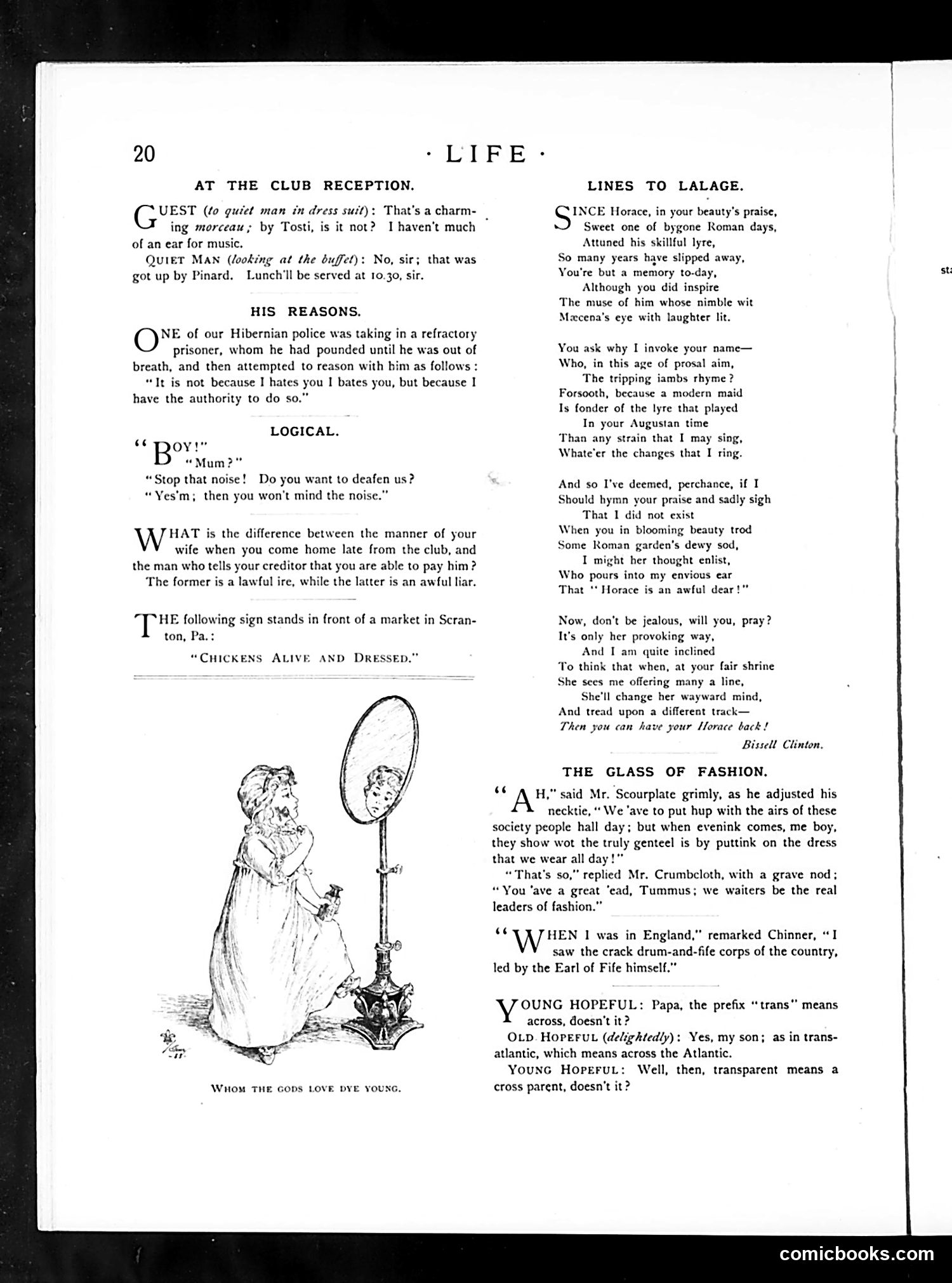
This page contains several brief humorous sketches typical of Life's satirical style: **"At the Club Reception"** mocks superficial dinner conversation—a guest praises a dish as a "charming morceau by Tosti" (a composer), but the quiet man deflates this by revealing it's merely lunch prepared by the caterer Pinard. **"His Reasons"** satirizes Irish police brutality through an absurd quote where an officer justifies beating a prisoner by claiming he has "the authority to do so"—mocking circular logic used to defend abuse. **"Logical"** and **"What is the difference"** present wordplay jokes about domestic life and creditors. **The illustration** shows a woman admiring herself in a hand mirror, captioned "Whom the gods love dye young"—a pun on "die" suggesting vain concern with appearance and hair-dyeing. **"The Glass of Fashion"** has waiters discussing how society people wear formal dress during the day but reveal their true (working-class) nature by evening—inverting typical class assumptions about gentility. **"Young Hopeful"** presents a child's logical wordplay: if "trans" means across, then "transparent" means "cross parent."
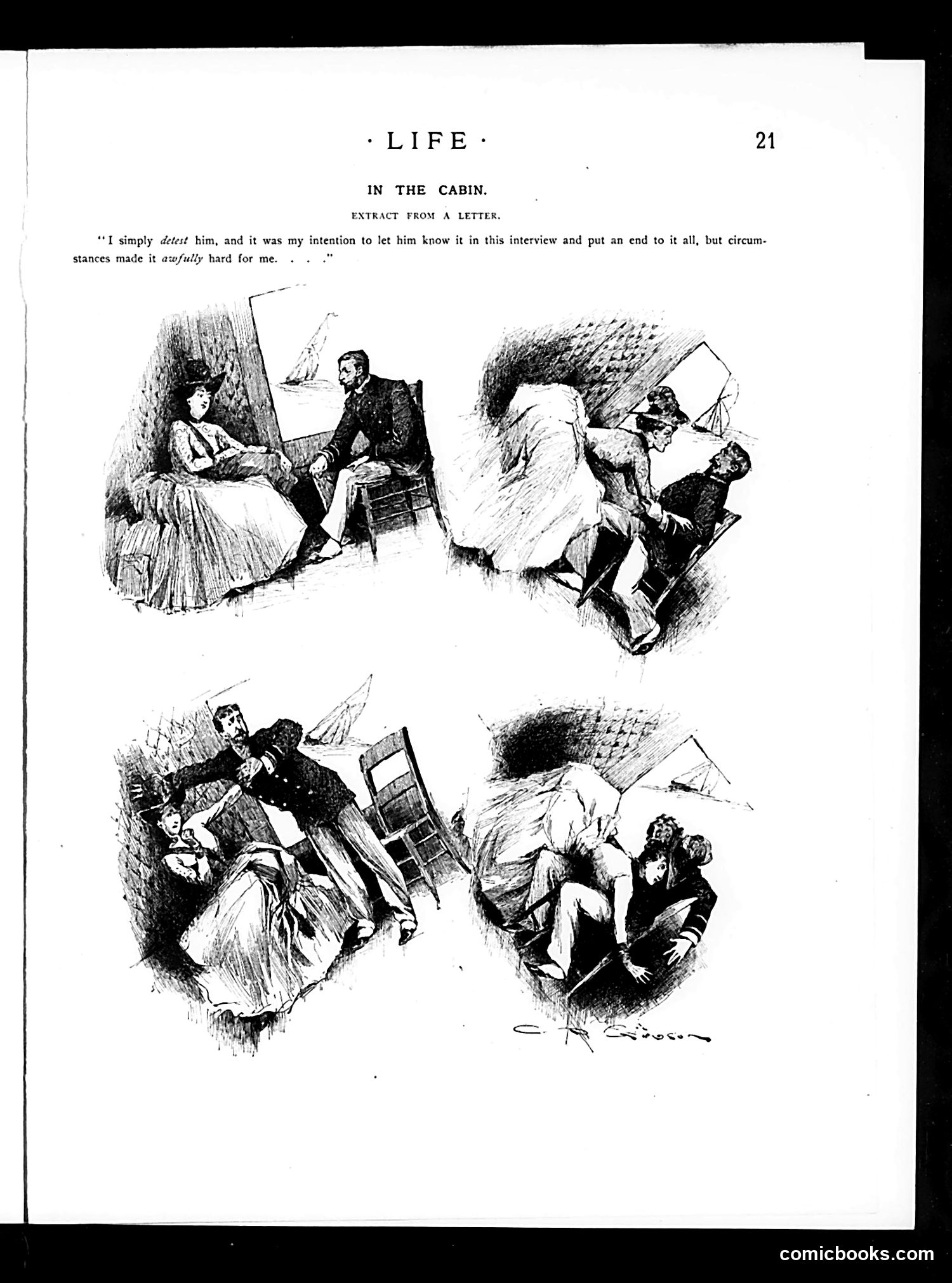
This page shows four sequential sketch panels titled "In the Cabin," illustrating a letter excerpt about a confrontation between two people. The panels appear to depict a domestic or romantic quarrel: a woman and man sit facing each other in conversation (top left), then the interaction escalates with physical comedy—furniture overturning, the woman striking the man, and both parties increasingly disheveled (subsequent panels). The satire mocks the writer's stated intention to end the relationship firmly. Despite planning to "detest him" and terminate things decisively, "circumstances made it awfully hard"—shown humorously through the chaotic physical struggle, suggesting the confrontation devolved into emotional turmoil rather than a clean break. The joke targets romantic entanglements that resist rational resolution.
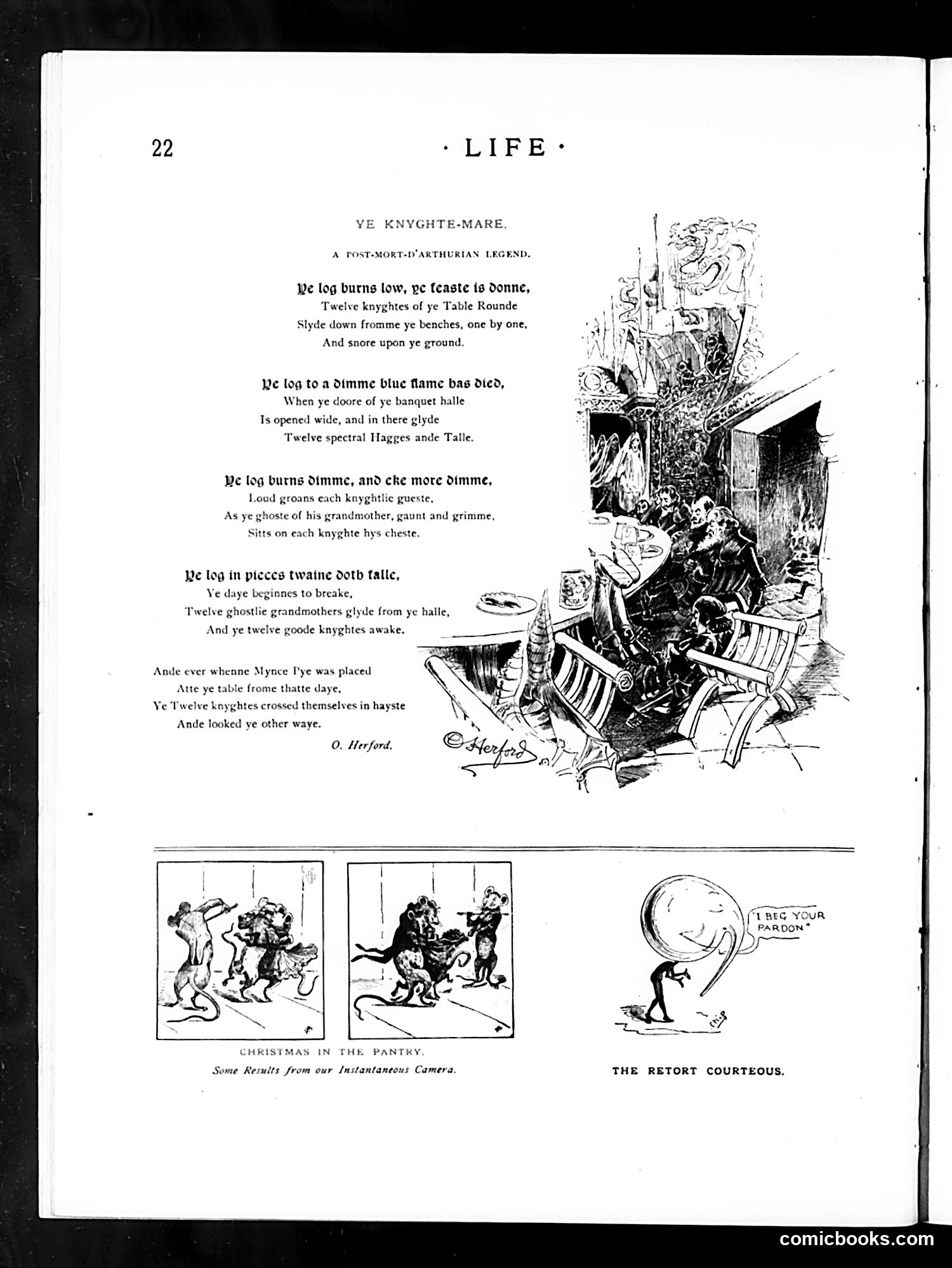
This page contains a mock-medieval poem titled "Ye Knyghte-Mare" (a pun on "nightmare"), written in exaggerated Old English. It's a humorous post-Arthurian legend about twelve knights of the Round Table who, after feasting, fall asleep and are visited by their grandmothers' ghosts—who sit on their chests during the night. Upon waking and experiencing mince pie at dinner, the knights thereafter refuse to eat it, crossing themselves in haste. The satire mocks both medieval romance literature and contemporary squeamishness about food. The page also includes two unrelated cartoon panels labeled "Christmas in the Pantry" (showing Christmas domestic chaos) and "The Retort Courteous" (a small figure apologizing to a large sphere/person). The magazine uses deliberately archaic language and supernatural humor to gently ridicule both historical literature and Victorian sensibilities.
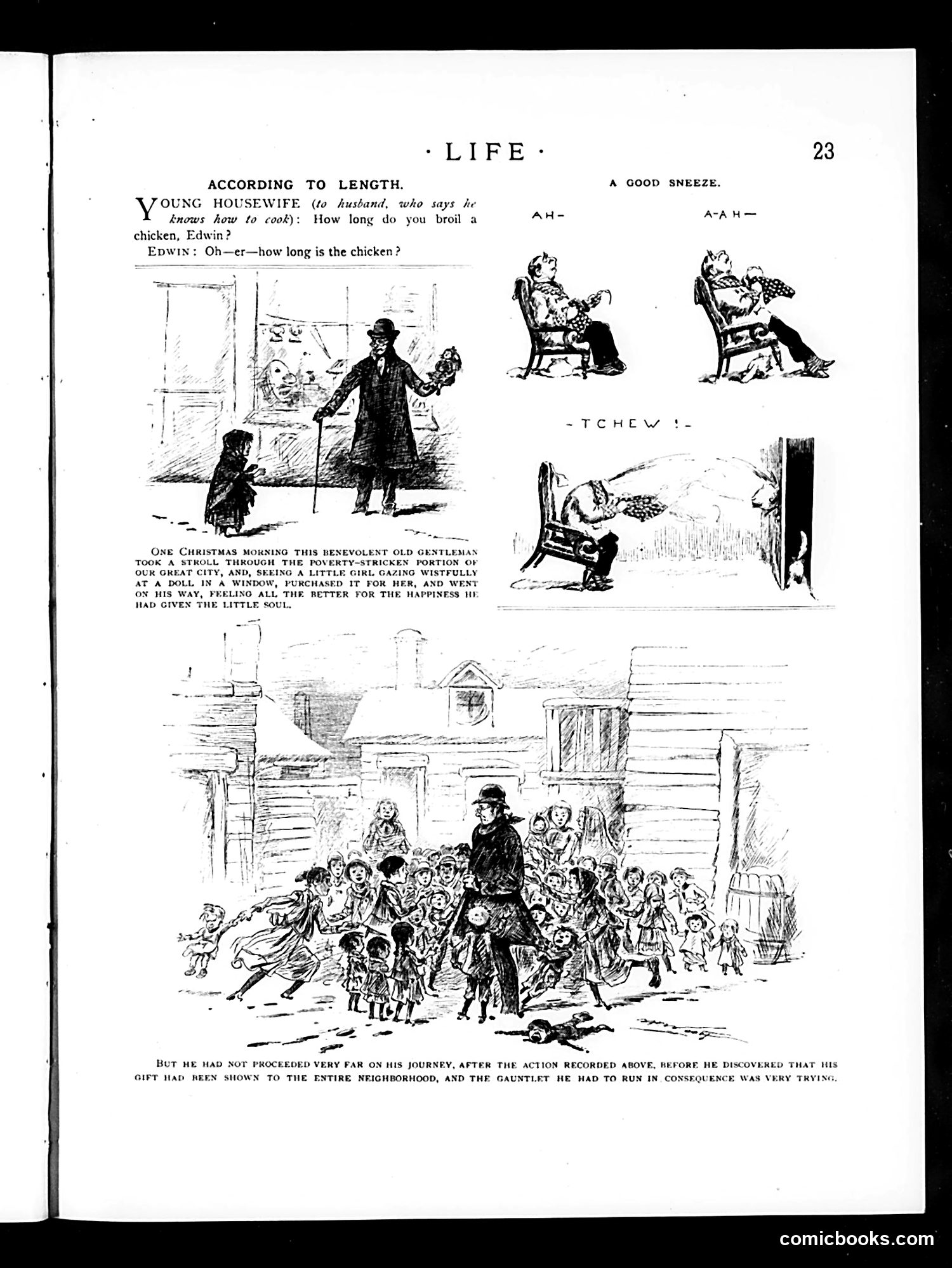
This page contains two satirical pieces typical of early-20th-century American humor: **"According to Length"** (top): A domestic comedy joke mocking husbands' incompetence in the kitchen. Edwin claims to know how to cook but cannot answer a simple question about cooking time, instead asking his wife how long *the chicken* is—absurdly literal and unhelpful. **"A Good Sneeze"** (main illustration): Shows a wealthy gentleman's Christmas act of charity backfiring. He buys a doll for a poor girl he encounters, intending generous goodwill. However, the caption reveals his gift becomes a neighborhood spectacle—other impoverished children swarm him afterward, making him "run the gauntlet" of their expectations and pleas. The satire mocks how charity, even well-intentioned, can create awkward social consequences and attract unwanted attention from the deserving poor. Both pieces reflect period attitudes about class, domesticity, and the complications of benevolence.
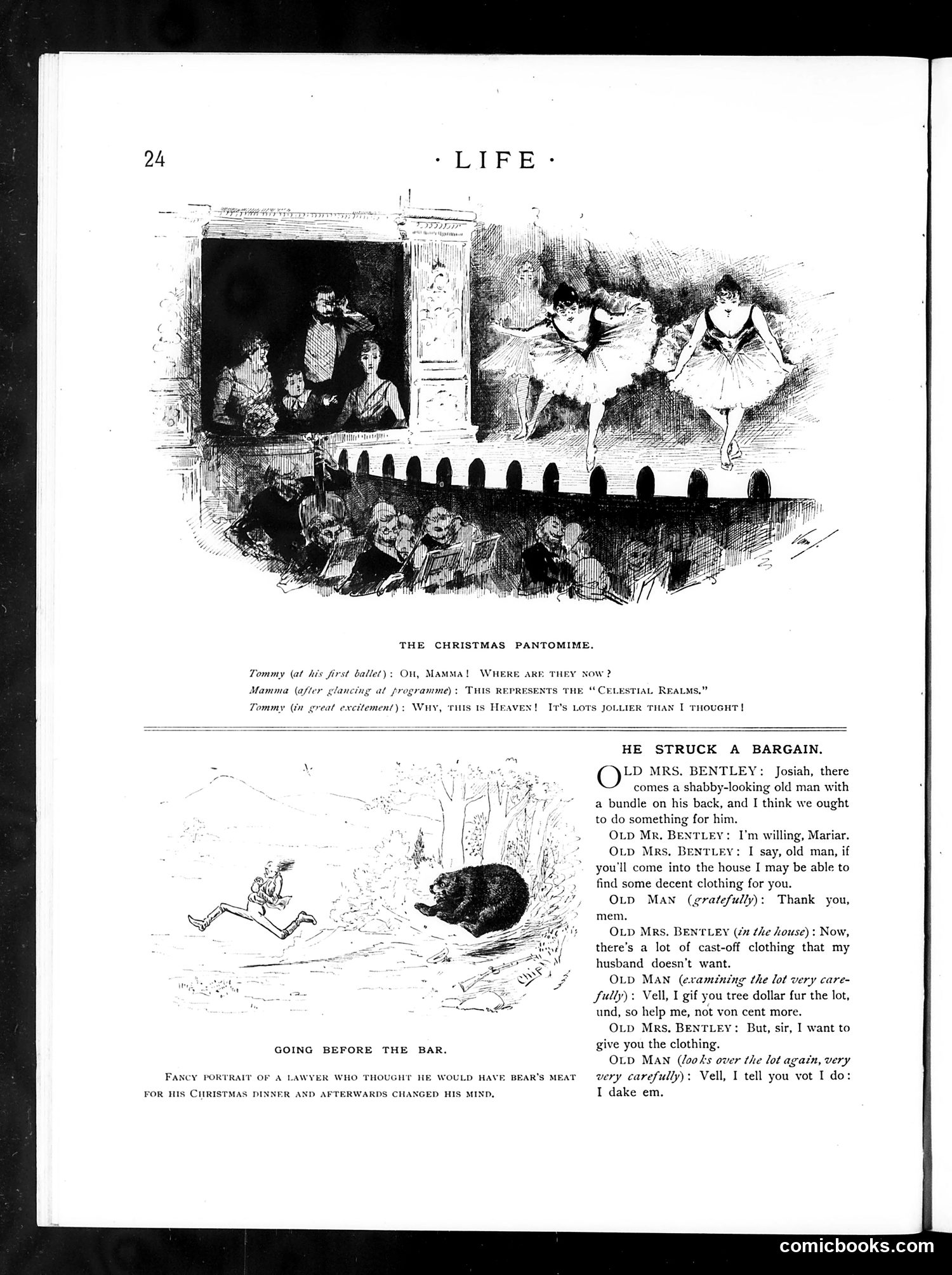
This page contains three separate satirical pieces from the Victorian era: 1. **"The Christmas Pantomime"**: A joke about a child's first ballet performance. Tommy is amazed that the "Celestial Realms" (heaven depicted in the ballet) looks "lots jollier" than he expected—poking fun at both theatrical conventions and perhaps Victorian religious instruction's somber tone. 2. **"He Struck a Bargain"**: A humor piece about class and charity. Mrs. Bentley charitably offers cast-off clothing to a poor man, but he shrewdly negotiates, offering her three dollars for the entire lot instead of accepting charity. The humor lies in his cunning reversal of the power dynamic—he turns her charity into a business transaction where *he* gets the better deal. 3. **"Going Before the Bar"**: A cartoon captioned about a lawyer who reconsidered hunting bear for Christmas dinner. The sketch shows a figure fleeing from a bear, illustrating the punchline about changing one's mind regarding the venture's safety. All three reflect period attitudes toward charity, class, entertainment, and masculine adventure.
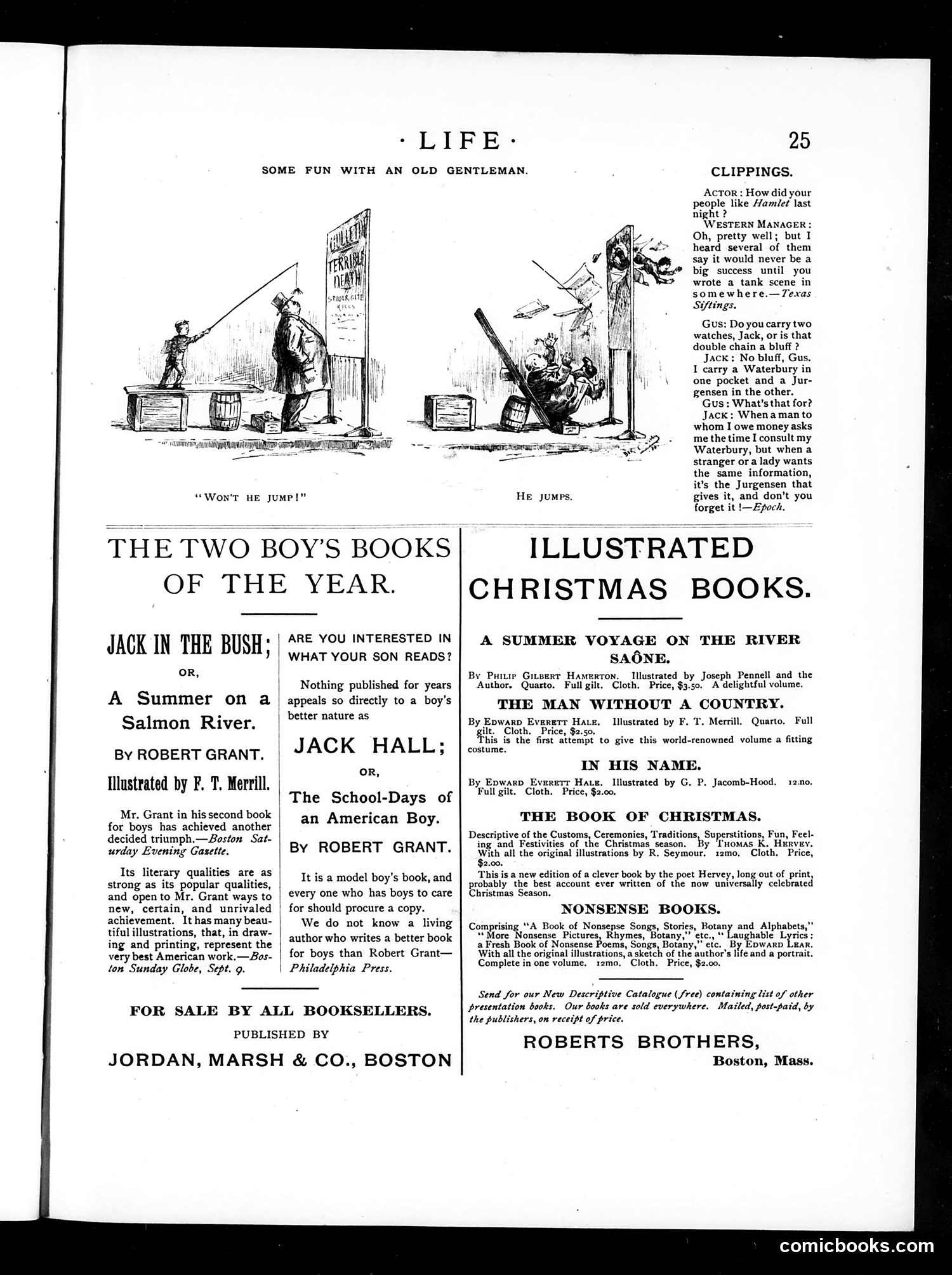
This page combines satirical humor with book advertisements from what appears to be the late 19th century. **The Cartoons**: Two simple sketches show an old gentleman being tricked into jumping—first reluctant ("Won't he jump!"), then successfully startled into action ("He jumps."). This appears to be gentle, physical humor about fooling an elderly person, typical of period comedy. **The Clippings Section**: Three brief jokes mock theatrical pretension and social dishonesty. One actor is told his Hamlet needs a "tank scene" (absurd suggestion). Another joke ridicules a man carrying two watches—an expensive Jurgensen for impressing strangers and ladies, a cheap Waterbury for creditors he's avoiding. These satirize vanity, financial dishonesty, and class consciousness. **The Advertisements**: The bulk of the page promotes boys' books by Robert Grant and illustrated Christmas volumes, targeting middle-class parents concerned about "what your son reads." This reflects Victorian anxiety about proper moral education. The overall tone: lighthearted mockery of pretension and deceit, wrapped in entertainment for genteel readers.
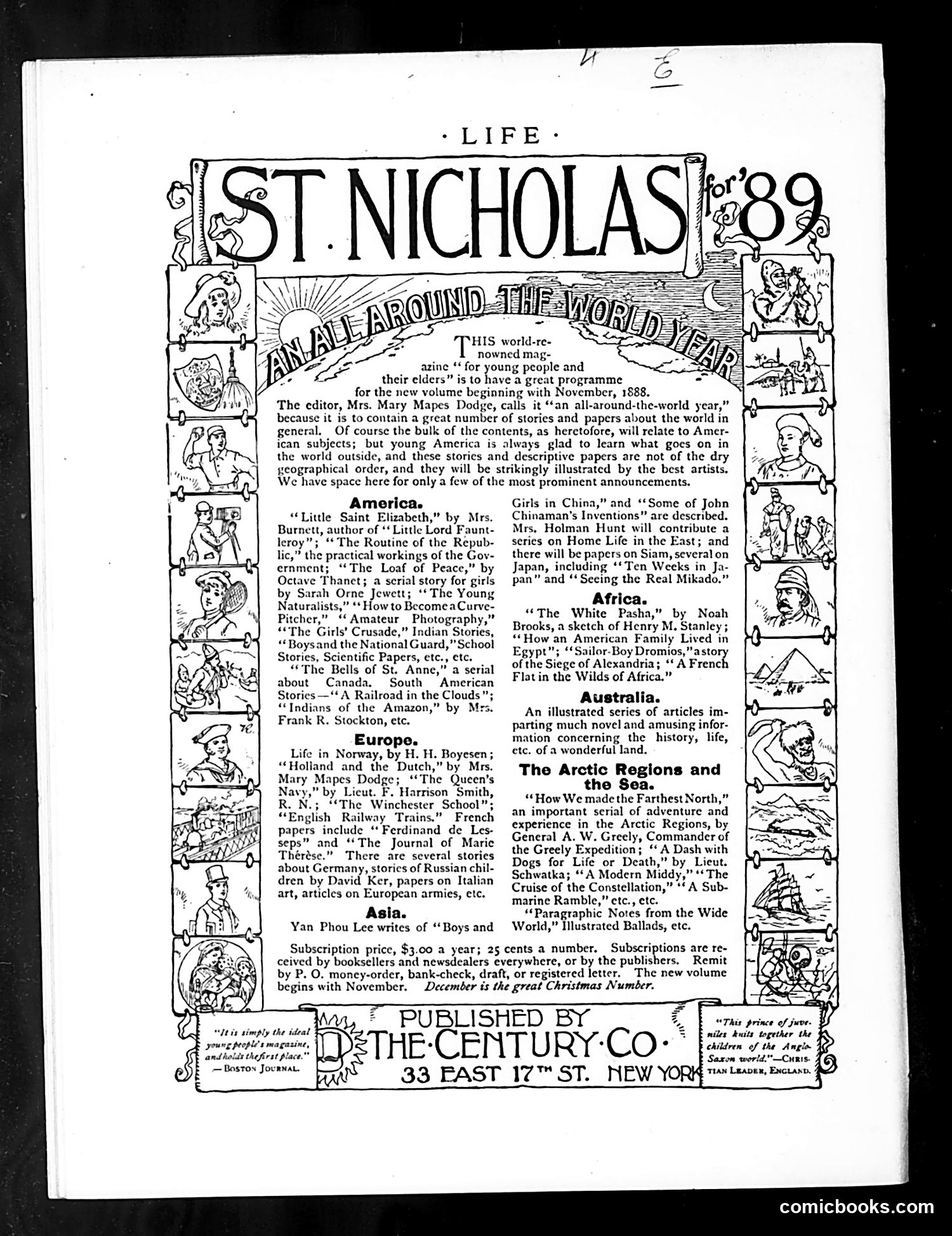
This is a title-page advertisement for *St. Nicholas*, a children's magazine edited by Mary Mapes Dodge, announcing its November 1888 volume. The page is not satirical but promotional, decorated with ornamental illustrations featuring children and global imagery. The announcement highlights an "all-around-the-world year" of content—stories and articles organized by geography (America, Europe, Asia, Africa, Australia, Arctic). Notable contributors include Frances Hodgson Burnett (author of *Little Lord Fauntleroy*), Sarah Orne Jewett, and General A.W. Greely. Content ranges from practical civics lessons to adventure serials to scientific papers. The decorative border and emphasis on world travel reflects late-19th-century American enthusiasm for global exploration and the magazine's positioning as educational entertainment for young people and their parents. The $3.00 annual subscription was substantial for the era.

I can see this is a mostly blank or extremely dark page from Life magazine with only "comicbooks.com" visible in the bottom right corner. The image is too dark to discern any cartoon illustrations, text content, or satirical imagery that would allow me to identify figures, political references, or explain any jokes or social commentary. Without being able to see the actual content, I cannot fulfill the request to analyze the political cartoons or satirical meaning. The page appears to be either a back cover, blank page, or a scanning/reproduction issue that has rendered the content illegible. To provide accurate analysis, a clearer image would be necessary.