
Life, 1888-12-27 · page 7 of 43
Life — December 27, 1888 — page 7: what you’re looking at
What you’re looking at
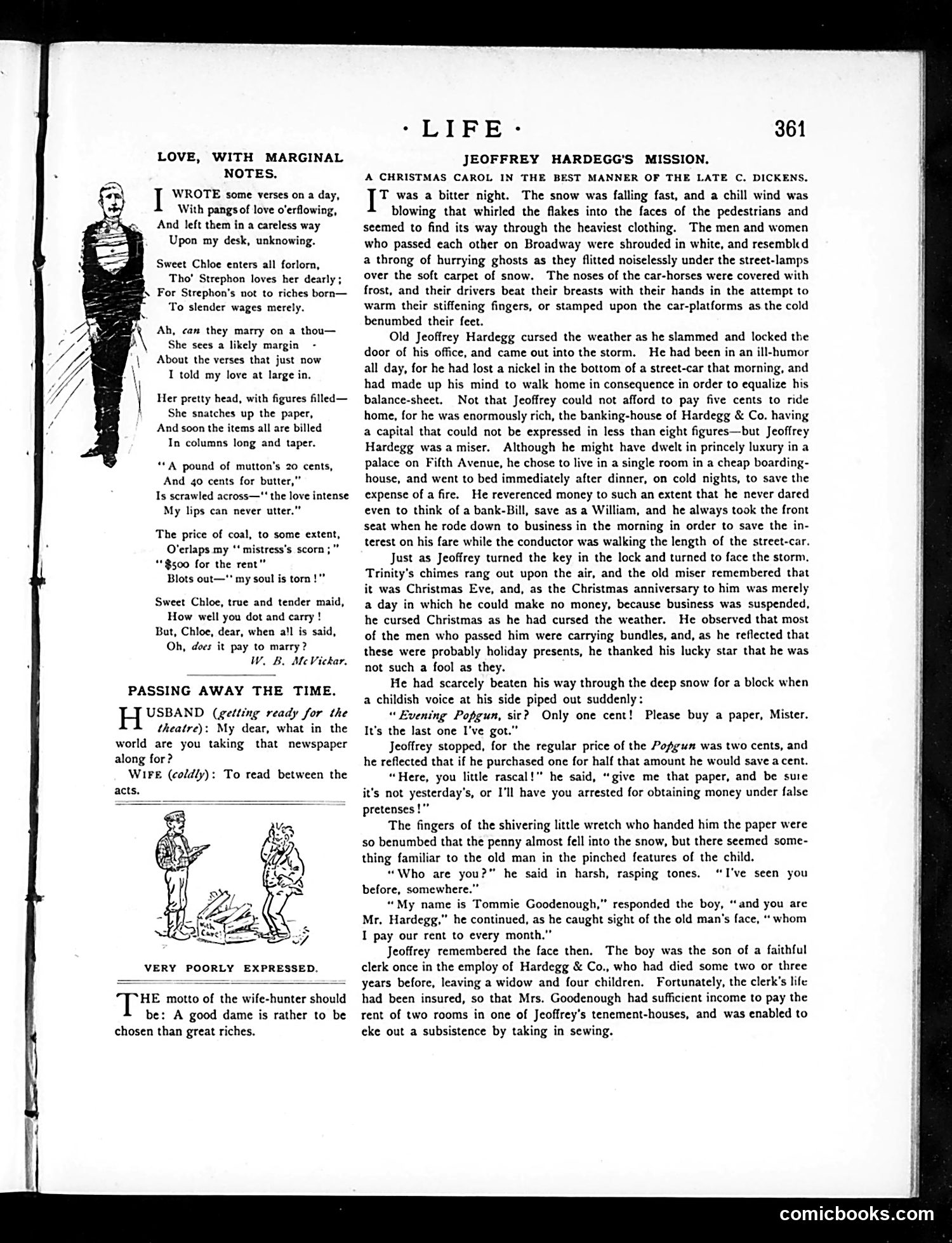
This page contains literary content rather than political cartoons. The main feature is "Jeofrrey Hardegg's Mission," described as "A Christmas Carol in the Best Manner of the Late C. Dickens" — a Dickens parody following a miserly businessman on Christmas Eve. The sidebar sections include three brief satirical pieces: "Love, with Marginal Notes" (verses about romance and money), "Passing Away the Time" (a joke about newspaper reading between theater acts), and "Very Poorly Expressed" (a quip about choosing wives over riches). The small illustrations show figures in period dress. This appears to be primarily literary satire rather than political commentary, using humor to mock social attitudes toward money, marriage, and materialism in the early 1900s.
📄 Transcribed text from this page (OCR, searchable)
Machine-transcribed from the original scan — historical spelling and the odd misread are preserved.
LOVE, WITH MARGINAL NOTES. WROTE some verses on a day, With pangs of love o'erflowing, And left them in a careless way Upon my desk, unknowing. Sweet Chloe enters all forlorn, Tho! Strephon loves her dearly; For Strephon’s not to riches born— To slender wages merely. Ah, can they marry on a thou— She sees a likely margin About the verses that just now I told my love at large in. Her pretty head, with figures filled— She snatches up the paper, And soon the items all are billed In columns long and taper. **A pound of mutton’s 20 cents, And 40 cents for butter,” Is scrawled across—"* the love intense My lips can never utter.” The price of coal, to some extent, O’erlaps my ‘‘ mistress's scorn; " **$500 for the rent” Blots out—"' my soul is torn !"” Sweet Chloe, true and tender maid, How well you dot and carry ! But, Chloe, dear, when all is said, Oh, does it pay to marry? W. B. McVickar. PASSING AWAY THE TIME. USBAND (getting ready for the theatre): My dear, what in the - LIFE: JEOFFREY HARDEGG'S MISSION. A CHRISTMAS CAROL IN THE BEST MANNER OF THE LATE C. DICKENS. T was a bitter night. The snow was falling fast, and a chill wind was blowing that whirled the flakes into the faces of the pedestrians and seemed to find its way through the heaviest clothing. The men and women who passed each other on Broadway were shrouded in white, and resembkd a throng of hurrying ghosts as they flitted noiselessly under the street-lamps over the soft carpet of snow. The noses of the car-horses were covered with frost, and their drivers beat their breasts with their hands in the attempt to warm their stiffening fingers, or stamped upon the car-platforms as the cold benumbed their feet. Old Jeoffrey Hardegg cursed the weather as he slammed and locked the door of his office, and came out into the storm. He had been in an ill-humor all day, for he had lost a nickel in the bottom of a street-car that morning, and had made up his mind to walk home in consequence in order to equalize his balance-sheet. Not that Jeoffrey could not afford to pay five cents to ride home, for he was enormously rich, the banking-house of Hardegg & Co. having a capital that could not be expressed in less than cight figures—but Jeoffrey Hardegg was a miser. Although he might have dwelt in princely luxury in a palace on Fifth Avenue, he chose to live in a single room in a cheap boarding- house, and went to bed immediately after dinner, on cold nights, to save the expense of a fire. He reverenced money to such an extent that he never dared even to think of a bank-Bill, save as a William, and he always took the front seat when he rode down to business in the morning in order to save the in- terest on his fare while the conductor was walking the length of the street-car. Just as Jeoffrey turned the key in the lock and turned to face the storm, Trinity's chimes rang out upon the air, and the old miser remembered that it was Christmas Eve, and, as the Christmas anniversary to him was merely a day in which he could make no money, because business was suspended, he cursed Christmas as he had cursed the weather. He observed that most of the men who passed him were carrying bundles, and, as he reflected that these were probably holiday presents, he thanked his lucky star that he was not such a fool as they. He had scarcely beaten his way through the deep snow for a block when a childish voice at his side piped out suddenly: “Evening Popgun, sir? Only one cent! It’s the last one I’ve got.” 361 Please buy a paper, Mister. world are you taking that newspaper along for? WIFE (coldly): To read between the Jeoffrey stopped, for the regular price of the Popgun was two cents, and he reflected that if he purchased one for half that amount he would save a cent. “Here, you little rascal!" he said, “give me that paper, and be sure it's not yesterday's, or I'll have you arrested for obtaining money under false pretenses!" The fingers of the shivering little wretch who handed him the paper were so benumbed that the penny almost fell into the snow, but there seemed some- thing familiar to the old man in the pinched features of the child. “Who are you?” he said in harsh, rasping tones. “I've seen you before, somewhere.” “My name is Tommie Goodenough,” responded the boy, ‘and you are Mr. Hardegg,” he continued, as he caught sight of the old man's face, “* whom I pay our rent to every month.” Jeoffrey remembered the face then. The boy was the son of a faithful clerk once in the employ of Hardegg & Co., who had died some two or three years before, leaving a widow and four children. Fortunately, the clerk's life had been insured, so that Mrs. Goodenough had sufficient income to pay the rent of two rooms in one of Jeoffrey’s tenement-houses, and was enabled to eke out a subsistence by taking in sewing. VERY POORLY EXPRESSED. HE motto of the wife-hunter should be: A good dame is rather to be chosen than great riches. comicbooks.com