
Life, 1888-12-27 · page 6 of 43
Life — December 27, 1888 — page 6: what you’re looking at
What you’re looking at
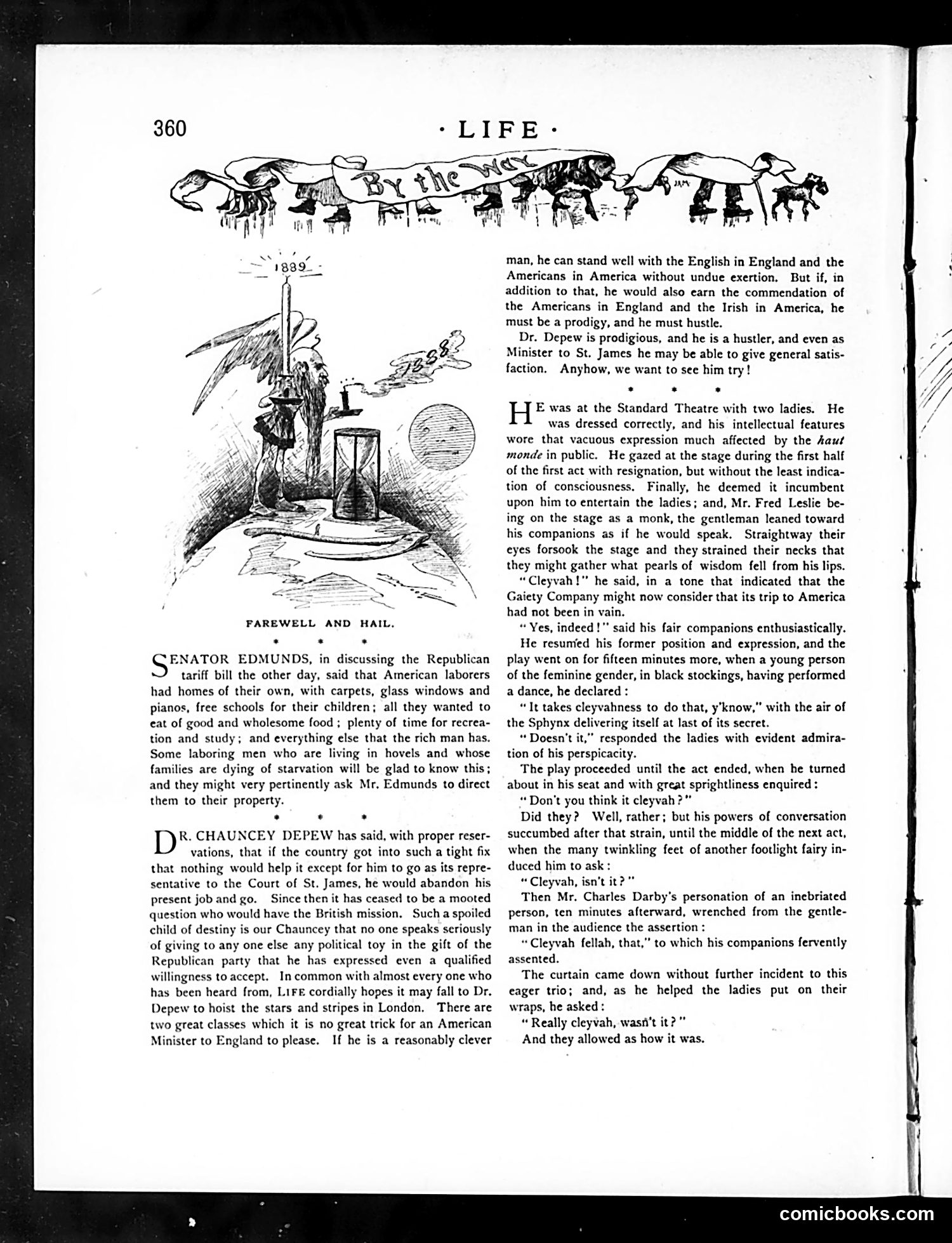
The main cartoon, titled "Farewell and Hail," depicts an 1899 scene at a flagpole. The text discusses Senator Edmunds and Dr. Chauncey Depew regarding American labor conditions and Republican politics. The satire centers on **Dr. Depew's potential diplomatic mission to England**. Life mocks the idea that Depew—described as "prodigious," "a hustler," and capable of giving "general satisfaction"—could represent America abroad. The joke suggests his appointment would be laughable to both the English and Irish. The accompanying theater anecdote about an overly intellectual gentleman performer appears designed to satirize affected behavior and pretension, mirroring the broader mockery of Depew's qualifications for diplomatic service. The cartoon's exact figures remain unclear without additional context.
📄 Transcribed text from this page (OCR, searchable)
Machine-transcribed from the original scan — historical spelling and the odd misread are preserved.
FAREWELL AND HAIL, . . . SENATOR EDMUNDS, in discussing the Republican tariff bill the other day, said that American laborers had homes of their own, with carpets, glass windows and pianos, free schools for their children; all they wanted to eat of good and wholesome food ; plenty of time for recrea- tion and study; and everything else that the rich man has. Some laboring men who are living in hovels and whose families are dying of starvation will be glad to know this; and they might very pertinently ask Mr, Edmunds to direct them to their property. . . * R. CHAUNCEY DEPEW has said, with proper reser- vations, that if the country got into such a tight fix that nothing would help it except for him to go as its repre- sentative to the Court of St. James, he would abandon his present job and go. Since then it has ceased to be a mooted question who would have the British mission. Such a spoiled child of destiny is our Chauncey that no one speaks seriously of giving to any one else any political toy in the gift of the Republican party that he has expressed even a qualified willingness to accept. In common with almost every one who has been heard from, LiFe cordially hopes it may fall to Dr. Depew to hoist the stars and stripes in London. There are two great classes which it is no great trick for an American Minister to England to please. If he is a reasonably clever man, he can stand well with the English in England and the Americans in America without undue exertion, But if, in addition to that, he would also earn the commendation of the Americans in England and the Irish in America, he must be a prodigy, and he must hustle. Dr. Depew is prodigious, and he is a hustler, and even as Minister to St. James he may be able to give general satis- faction. Anyhow, we want to see him try! . * . E was at the Standard Theatre with two ladies. He was dressed correctly, and his intellectual features wore that vacuous expression much affected by the haut monde in public. He gazed at the stage during the first half of the first act with resignation, but without the least indica- tion of consciousness. Finally, he deemed it incumbent upon him to entertain the ladies; and, Mr. Fred Leslie be- ing on the stage as a monk, the gentleman leaned toward his companions as if he would speak. Straightway their eyes forsook the stage and they strained their necks that they might gather what pearls of wisdom fell from his lips. “Cleyvah!" he said, in a tone that indicated that the Gaiety Company might now consider that its trip to America had not been in vain. “Yes, indeed!" said his fair companions enthusiastically. He resumed his former position and expression, and the play went on for fifteen minutes more, when a young person of the feminine gender, in black stockings, having performed a dance, he declared : “It takes cleyvahness to do that, y’know,” with the air of the Sphynx delivering itself at last of its secret. “Doesn't it,” responded the ladies with evident admira- tion of his perspicacity. The play proceeded until the act ended, when he turned about in his seat and with great sprightliness enquired : “Don't you think it cleyvah ?” Did they? Well, rather; but his powers of conversation succumbed after that strain, until the middle of the next act, when the many twinkling feet of another footlight fairy in- duced him to ask : “ Cleyvah, isn’t it?” Then Mr. Charles Darby's personation of an inebriated person, ten minutes afterward, wrenched from the gentle- man in the audience the assertion : “Cleyvah fellah, that,” to which his companions fervently assented. The curtain came down without further incident to this eager trio; and, as he helped the ladies put on their wraps, he asked: “ Really cleyvah, wasn't it?” And they allowed as how it was. comicbooks.com